womanandhersphere

This user hasn't shared any biographical information
Homepage: https://womanandhersphere.wordpress.com
The Garretts And Their Circle: Annie Swynnerton’s ‘Illusions’
Posted in The Garretts and their Circle on July 22, 2013
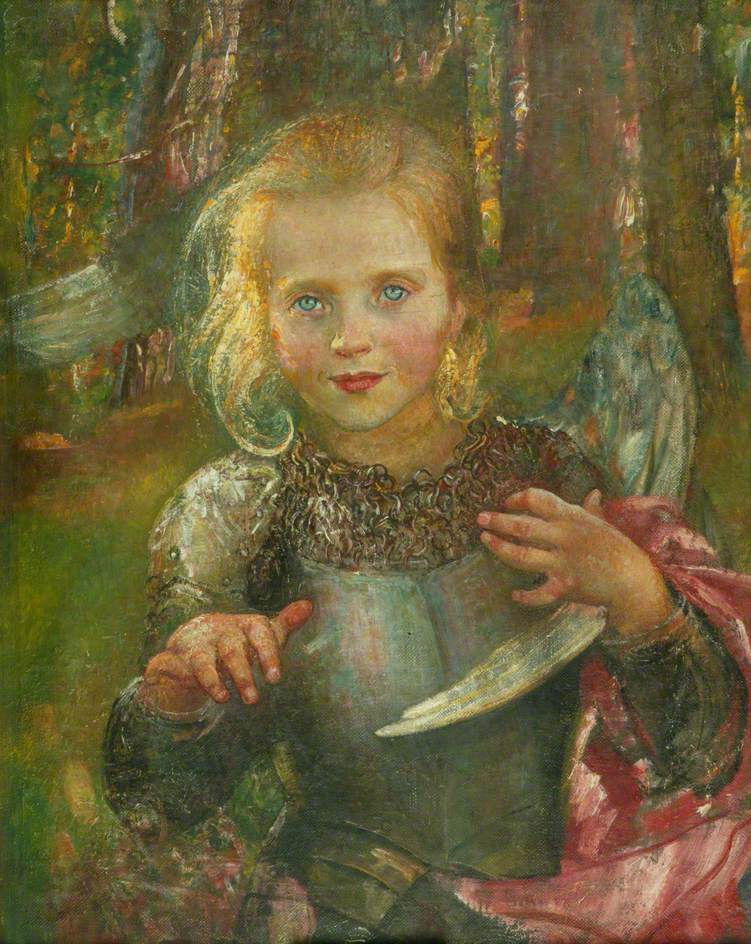
‘Illusions’ by Annie Swynnerton, Collection Manchester City Galleries, courtesy of BBC Your Paintings & ArtUK
This painting was left to the City Art Gallery, Manchester, by Louisa Garrett (nee Wilkinson, sister-in-law to Elizabeth Garrett Anderson, Millicent Fawcett and Agnes Garrett.
‘Illusions’ would once have hung in Louisa’s home at Snape in Suffolk. Her house was named ‘Greenheys’ after the area of Manchester in which she and her sister, Fanny, grew up.
The way in which the Garrett circle did their best to ensure that Annie Swynnerton’s work was included in major public collections is discussed in my book – Enterprising Women: the Garretts and their circle- available online from me, or Francis Boutle Publishers or from all good bookshops..
Kate Frye’s Suffrage Diary: In Bed – Photographed With Radio Headphones At The Ready – 1920s
Posted in Kate Frye's suffrage diary on July 20, 2013
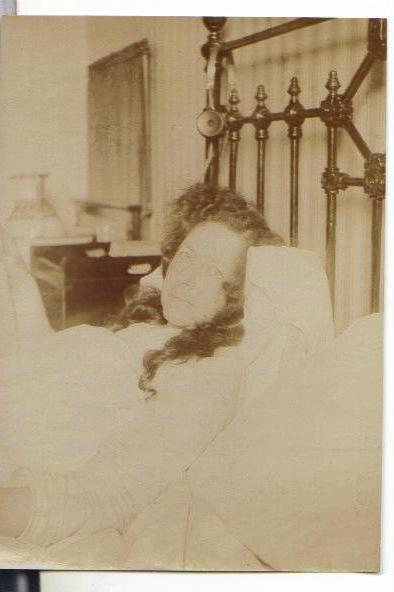
Working my way through Kate Frye’s extensive collection of photographs I have just come across this one. It is so unusual to see a photo of a woman lying in bed that I thought I must share it with you all. You’ll note the radio headphones hooked on the brass bedstead which probably dates the photo to the second half of the 1920s. The photo would have been taken by Kate’s husband, John Collins, who was a keen photographer. Kate, for her part, was a keen and early radio listener, delighting as she did in all forms of music and drama.
The Garretts and Their Circle: Annie Swynnerton’s ‘The Dreamer’
Posted in The Garretts and their Circle on July 19, 2013
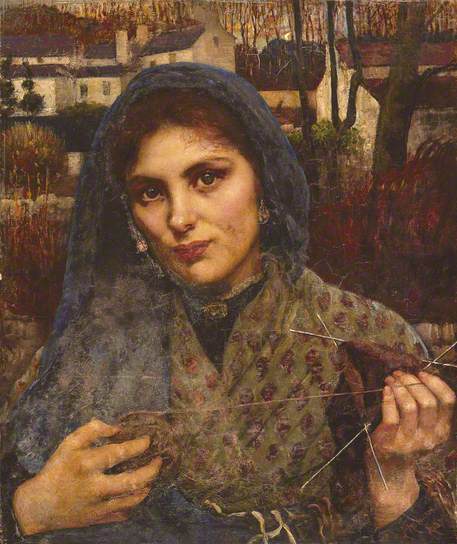
The Dreamer by Annie Swynnerton, 1887. (c) Manchester City Gallery – image courtesy of BBC Paintings and ArtUK
In yesterday’s post I drew attention to Annie Swynnerton’s portrait of Millicent Fawcett. It was hardly chance that brought that artist and that sitter together; both were central figures in what I term ‘the Garrett circle’.
Today’s painting by Annie Swynnerton, The Dreamer, was originally owned by Millicent Fawcett’s sister-in-law, Louisa Garrett (nee Wilkinson) who for a while lived next-door-but-one to Millicent Fawcett and Agnes Garrett in Gower Street (the latter at no 2 and the Wilkinsons at no 6). The Dreamer was owned jointly by Louisa and her sister, Fanny, and may for a time have graced the walls of 6 Gower Street. Louisa only moved out of no 6 on her marriage to Millicent and Agnes’ youngest brother, George Garrett.
Fanny Wilkinson and Louisa Garrett did all in their power to ensure that, after their deaths, Annie Swynnerton was represented in public collections. In her will Louisa specifically left her share in this painting to Fanny and expressed ‘the desire that she will bequeath the said picture to the City Art Gallery, Manchester.’
Discover much more about the way in which the Garrett circle did their best to ensure Annie Swynnerton’s continuing reputation in my Enterprising Women: the Garretts and their circle- available online from me, or Francis Boutle Publishers or from all good bookshops..
Suffrage Stories: The Garretts And Their Circle: Make Millicent Fawcett Visible
Posted in Suffrage Stories on July 18, 2013
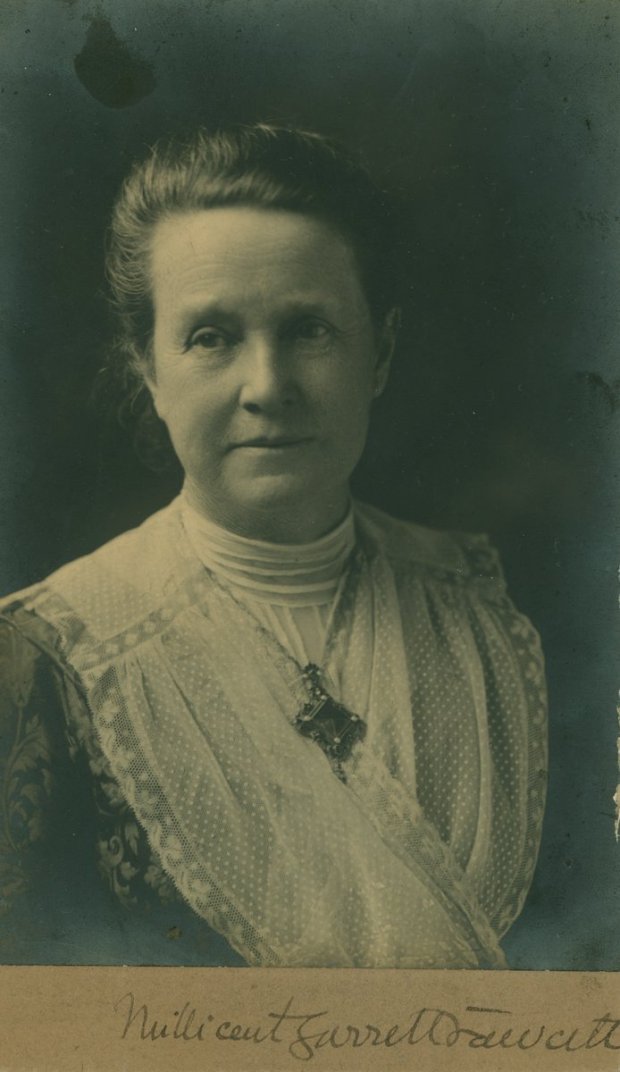
Millicent Fawcett wearing a pendant given to her by the NUWSS in recognition of her service
Because of copyright issues, I don’t feel able to show you the portrait of Mrs Pankhurst that hangs in the National Portrait Gallery. But I wonder how many of you know without looking here which one I mean?
As I thought, a great many. That is doubtless because the portrait is on permanent display.

Mrs Pankhurst’s presence is also kept before us in the shape of her statue in Victoria Tower Gardens, right next to the House of Commons.Both of these images are not where they are by chance. Immediately after her death former suffragettes determined to memorialise their leader in this time-honoured tradition – a portrait painted for the national collection and a statue erected in a prominent and relevant position.
Therefore, it’s unsurprising that Mrs Pankhurst is remembered.
But what of Mrs Millicent Fawcett, whose method of campaigning for the vote for women differed from that of Mrs Pankhurst, but who was in many ways the more effective politician. Indeed, it was she who finally delivered ‘votes for women’.
Mrs Fawcett has no statue. The National Portrait Gallery’s only painted portrait of Mrs Fawcett is this one by Ford Maddox Brown that depicts her as the tender young wife of Henry Fawcett, the blind politician. Incidentally this painting hangs, not in London, but in Bodelwydden Castle. UPDATE: the portrait was moved back to the main London gallery in 2018.
Tate Britain does hold this portrait of Millicent Fawcett, painted at the end of her life by her friend Annie Swynnerton. Mrs Fawcett is shown wearing academic dress, her honorary degree robes from St Andrews.
This painting is permanently in storage. It was shown at the Royal Academy in 1930 and, after being bought for the nation as a Chantrey Bequest purchase, has never been seen in public since. When I was writing Enterprising Women I arranged to see the painting in the Tate’s store. There was no difficulty – beyond making an appointment – in gaining access – but how very different from saying ‘hallo’ to Mrs Pankhurst every day, if one so chose, in the National Portrait Gallery.
Why can’t this portrait be brought out of storage and, if it doesn’t fit into the Tate Britain hanging policy, be transferred to the National Portrait Gallery where it would admirably complement Mrs Pankhurst?
Mrs Fawcett was not, of course, without staunch memorialising supporters. But, rather than a statue, they put their efforts into a building – Women’s Service House in Marsham Street, Westminster – and named the large hall inside for Mrs Fawcett. Financial exigency has long since separated the building from the women’s movement (although we are thankful that it has been given a new lease of life by Westminster School). For many years Millicent Fawcett’s name was synonymous with the wonderful library that originated in Women’s Service House but was at the beginning of the 21st century given the much less resonant name of The Women’s Library.
However Mrs Fawcett’s lifelong work for the women’s cause is still commemorated in the vigorous efforts of The Fawcett Society. I am sure, sensible woman that she was, she would much rather that that was the case than that her portrait should hang in the National Portrait Gallery. And, yet, knowing how responsive the public is to the visual image, I do wish she might be allowed to share Mrs Pankhurst’s limelight.
Because it would be too ironic to devote a post to bemoaning the lack of visual representation of Mrs Fawcett, here she is, wearing an National Union of Women’s Suffrage Societies badge.
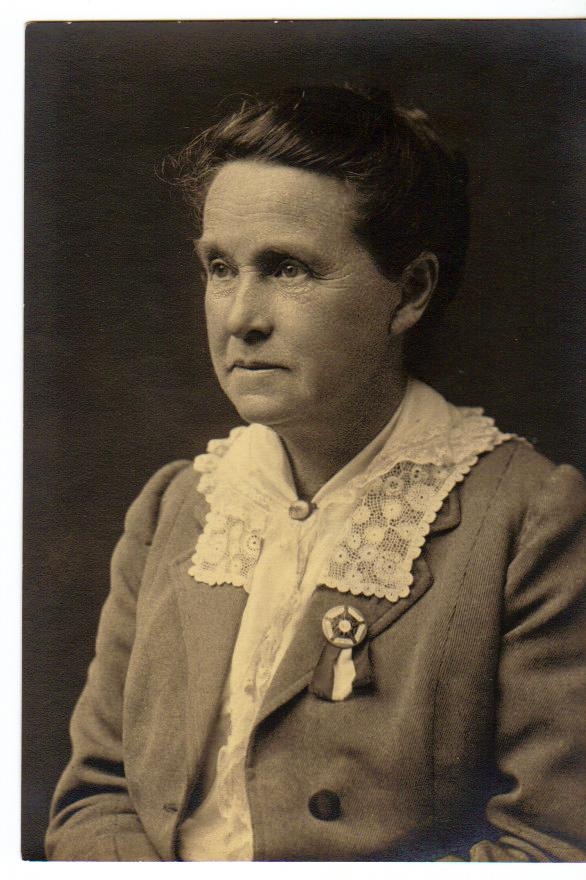
Millicent Fawcett c 1912
Read much more about Millicent Fawcett – and all the Garretts – in Enterprising Women: the Garretts and their circle
and when in London visit the Elizabeth Garrett Anderson Gallery.
UPDATE: And if there were to be a statue of a woman in Parliament Square (see here) to commemorate the women’s suffrage campaign, why should it not be of Millicent Fawcett?
MUCH LATER UPDATE: And there is now, of course, a remarkable statue of Millicent Fawcett now standing in Parliament Square, unveiled in 2018. So she is definitely becoming more visible.
Kate Frye’s Suffrage Diary: Live in Wood Green, 25 July 2013
Posted in Uncategorized on July 9, 2013
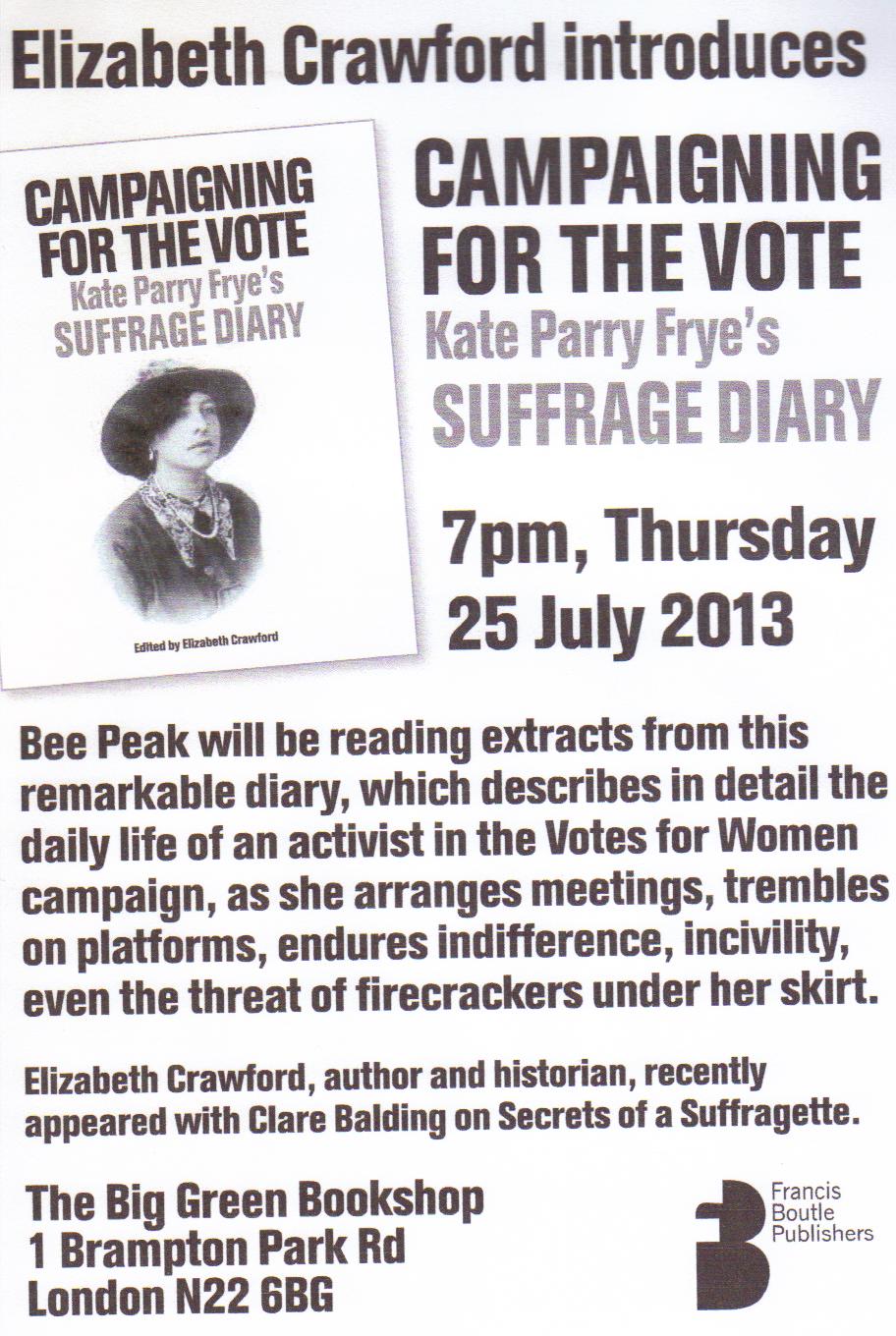
Do come along and experience a taste of suffrage life
Campaigning for the Vote: Kate Parry Frye’s Suffrage Diary is published by Francis Boutle Publishers
Wrap-around paper covers, 226 pp, over 70 illustrations, all drawn from Kate Frye’s personal archive.
ISBN 978 1903427 75 0
For a full description of the book click here
Copies available from Francis Boutle Publishers, London Review Bookshop (shop and online), Foyles (shop and online) – and from all good bookshops – including the Big Green Bookshop!
Suffrage Stories: Women’s Tax Resistance League Sale, Hampstead, May 1914
Posted in Collecting Suffrage, Suffrage Stories on July 8, 2013

The photograph above was taken on Monday 18 May 1914 at the sale in Hampstead of goods belonging to Mrs Louisa Thomson Price and others – all of whom had refused to pay their tax. ‘No Taxation Without Representation’ was the motto of the Tax Resistance League.
The Vote (the paper of the Women’s Freedom League with which Mrs Thomson Price was closely associated) reported (22 May 1914) ‘At Hampstead on May 18 a large group of tax resisters had their goods sold at Fitzjohns Estate Auction Rooms. They were Mrs Thomson Price, Mrs and Miss Hicks, Mrs How Martyn , Mrs Milligan, Mrs Hartley, the Misses Collier, and the Misses Dawes Thompson. A procession with a band marched from Finchley Road station to the auction rooms at Swiss Cottage and after the sale an excellent meeting was held at the corner of the Avenue Road. From a gaily decorated wagonette speeches were made by Mrs Thomson Price, Mrs Nevinson and Mrs Kineton Parkes, explaining the reason of the protest.
Below is the note made by Louisa Thomson Price on the reverse of the photographic postcard.

Mrs Louisa Thomson Price was born Louisa Catherine Sowdon in 1864 and died in 1926. She was the daughter of a Tory military family but from an early age rebelled against their way of thinking and became a secularist and a Radical. She was impressed by Charles Bradlaugh of the National Secular Society. In 1888 she married John Samson, who was a member of the executive of the NSS. She worked as a journalist from c 1886 – as a political writer, then a very unusual area for women, and drew cartoons for a radical journal, ‘Political World’. She was a member of the Council of the Society of Women Journalists. After the death of her first husband, in 1907 she married George Thomson Price. She had no children from either marriage.
Louisa Thomson Price was an early member of the Women’s Freedom League, became a consultant editor of its paper, The Vote, and was a director of Minerva Publishing, publisher of the paper. She contributed a series of cartoons to The Vote, which were then produced as postcards. The ‘Jack Horner’ cartoon was also issued as a poster for, I think, the January 1910 General Election. Louisa Thomson Price took part in the WFL picket of the House of Commons and was very much in favour of this type of militancy. In her will she left £250 to the WFL. and £1000 to endow a Louisa Thomson Price bed at the Elizabeth Garrett Anderson Hospital.
I have a very rare suffrage artefact – a Women’s Freedom League postcard album once owned by Mrs Thomson Price -for sale in my catalogue 185.
Suffrage Stories: Mrs Frood, Topsham’s Suffragette/ist
Posted in Suffrage Stories on July 4, 2013
Some time ago, when researching a talk, ‘No Vote No Census’, that I gave in October 2011 conference on the 1911 census organised by the National Archives, I came across the boycotting census form of Mrs Frood of Topsham. Since then I have passed on this discovery to a researcher associated with Topsham Museum who has been able to link Mrs Frood directly to the 1913 Suffrage Pilgrimage, the 100th anniversary of which is being celebrated in Topsham today, 4 July 2013.
The 3 March 1911 edition of Votes for Women contains a letter from Mrs M.C. I. Frood of Station Road, Topsham, in which she described how, early in the morning of the polling day for the last election (which must have been Dec 1910/Jan 1911), she went out with a pot of ‘good, white oil paint’ [I like the fact that it was ‘good] and ‘printed on the inner edge of the pavement along which voters would pass on the way to the polling station ‘Taxation Without Representation is Tyranny’ and ‘Britons never, never, never shall be slaves. I also printed it along the brick wall of my field, which they also had to pass coming and going to and from the train. ..On the large doors of my field, near the same spot, I printed ‘No Votes No Taxes’. I find my field gate a useful place to stick cartoons and cuttings from Votes for Women.’
A month later Mrs Frood was one of those suffragettes who boycotted the 1911 census. Together with one of her daughters, her servant, Beatrice Hutchings and six unknown females, to whom she had clearly given boycotting shelter, she refused to fill in any details on her census form, writing across it ‘If I am intelligent enough to fill up this paper, I am intelligent enough to put a cross on a voting paper. No Vote No Census.’
The census enumerator, Mr.H. J. Baker, reported this act of civil disobedience to the Census Office and received a reply from its Secretary, Archer Bellingham, instructing him to fill out the form with the best information he could muster. Mr Baker then annotated the letter, quoting Mrs Frood as saying to him that she had had a ‘house full’ of boycotters on census night – and ‘that I am therefore adding to Numbers 6’. With this number revealed as an arbitrary choice of the enumerator, we can only speculate as to how many Topsham women spent the night at Little Broadway House in Station Road.
Although in 1911 it would appear that Mrs Frood, as a correspondent to Votes for Women, was a supporter of the WSPU, by 1913 she is listed in The Suffrage Annual and Women’s Who’s Who as secretary of the Topsham branch of the NUWSS. Perhaps she was one of those who were dismayed by the WSPU’s increasingly militant tactics. It was one thing to paint slogans (with ‘good’ paint’) on pavements and walls, but quite another to break windows and commit arson. So it was as a leading local NUWSS member that Mrs Frood took part in the Suffrage Pilgrimage in early July 1913.
Who was Mrs Frood?
Mrs Mary Catherine Isabella Frood (nee Campbell, c. 1856-1931) had been born of Scottish parentage in Canada and was living in New Zealand when, in 1878, she married James Nicholson Frood (d. 1913), an Irish-born doctor. She had five children, the first four, all daughters, born in New Zealand and the last, a son, born at sea c 1888 – presumably as the family was returning to England. One of her daughters, Hester, was successful as an artist. Although Mrs Frood actually died in London, her address was still in Topsham – 26 The Strand (Old Court House).

26 The Strand, Topsham. Photo courtesy of Derek Harper (geograph.co.uk)
Where was Dr Frood in 1911?
Dr Frood was living with his family (whose name was misrendered as ‘Froud’) when the 1901 census was taken. But where was he in 1911? The name on the cover of the census form had been written as ‘Dr Frood’, but this had been amended to ‘Mrs Frood’ and it is she who is shown as ‘Head of Household’. I can find no trace of James Frood elsewhere in the 1911 census, although he did not die until 1913, his death registered in the local area. Interestingly under the terms of his will probate was granted to the Public Trustee rather than to his wife or any other member of the family.
Where was Little Broadway House?
Thanks to Street View I can see Station Road and the pavement along which Mrs Frood painted her slogans. Thanks to Paul Tucker (see Comment below) who tells me that Little Broadway House is still there – the house with the overhanging upper window that I can see in Street View – although now divided into two. Presumably the ground to its side was Mrs Frood’s field. So let’s take a moment to visualise its gates – decorated with Votes for Women cartoon – a reminder to those walking past on their way to the station that one Topsham woman was prepared to do her bit to win ‘votes for women’.
Suffrage Stories: Bloomsbury Links (Part 2)
Posted in Suffrage Stories on June 25, 2013
In 1907 it was Philippa Strachey, sister of Lytton, who, as secretary of the London Society for Women’s Suffrage, organised the first large-scale London street procession of women prepared to risk ignominy by making of themselves a public spectacle. Thus, in heavy rain, on 9 February 1907 Lady Strachey, Philippa’s mother, walked at the head of ‘The Mud March’, a soubriquet earned from the state of the streets (see here for Kate Frye’s experiences that day).
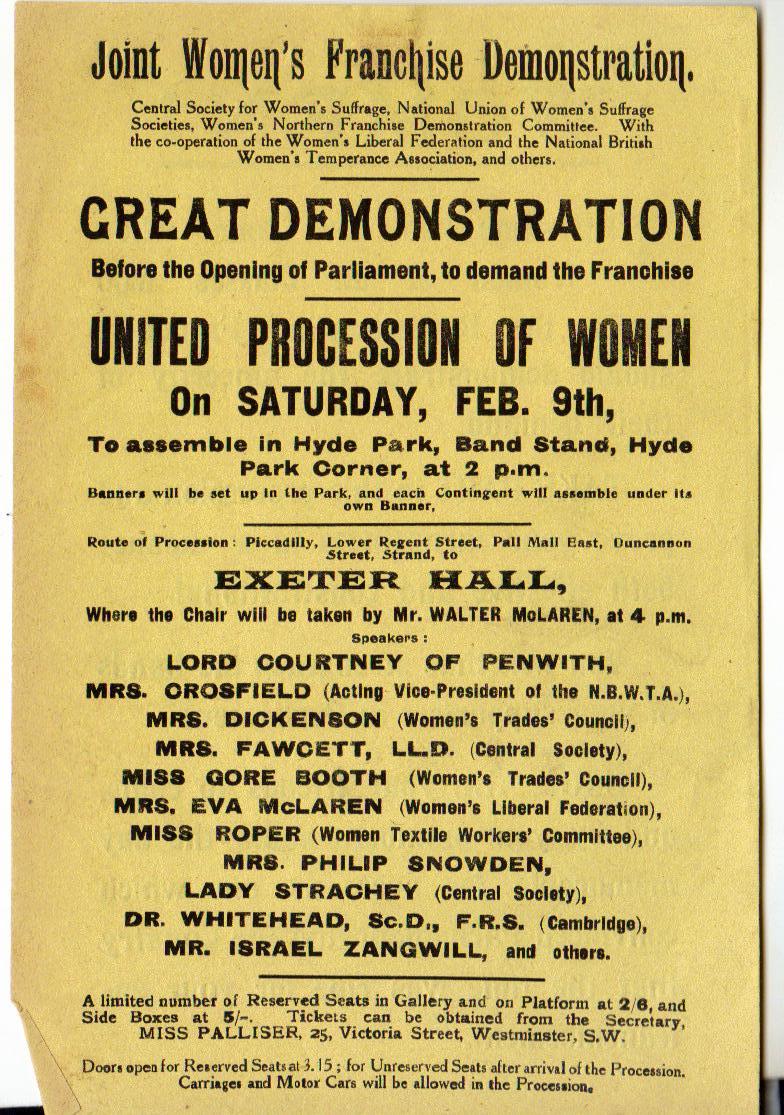
Flyer advertising the NUWSS ‘Mud March’
On 5 February John Maynard Keynes had written to Philippa Strachey, ‘I hear that you may want hired roughs next Saturday. If I can be of any use I am at your service after 1 o’clock’. He kept to his word and acted as chief steward at Exeter Hall in the Strand where, at the end of their march, the suffragists rallied for speeches from, among others, Lady Strachey. Keynes had long been exposed to the workings of the women’s suffrage campaign; his mother was a practical exponent of ‘women’s rights’ and his father, a close friend of Henry Fawcett, had in 1888 been auditor of the Cambridge Women’s Suffrage Association. This influence had permeated sufficiently for Keynes, in 1912, to demur at the inscription of ‘Votes for Women: IDT’ on a bas-relief by Eric Gill depicting a copulating couple, in which the woman was on top. ‘IDT’ was Gill’s way of making light of the issue as the letters stood for ‘I Don’t Think’. Keynes wanted to buy this work but only did so after Gill agreed to remove the inscription.
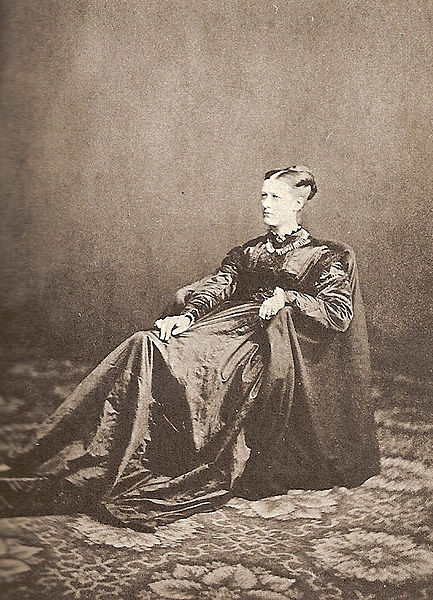
Lady Strachey
Lady Strachey had been an early supporter of the women’s suffrage campaign, having in 1867 signed one of the first petitions in favour of women’s suffrage, probably that presented by John Stuart Mill on behalf of the Edinburgh Society. From 1901 she had been a regular subscriber to the Central Society for Women’s Suffrage, as was her husband. A week after the Mud March Lady Strachey was present at Caxton Hall on the occasion of a WSPU ‘Women’s Parliament’, a meeting that ended in chaos and arrests. Elizabeth Robins, actress and suffragette, afterwards wrote to Lady Strachey, ‘I looked for you during the later evening and was very relieved that you were not to be seen, for the fact was that the police grew very violent as the hours went on…’
Lady Strachey also deployed her pen in aid of the Cause, writing, between 1907 and 1909, a number of pamphlets for the National Union of Women’s Suffrage Societies, including Reduced to the Absurd, a series of humorous syllogisms (such word-play being a Strachey speciality) and, around 1910 supplying the words for several rollicking songs, which were published by the LSWS as Women’s Suffrage Songs. In 1909 Lady Strachey became a member of the editorial committee of a newly-founded feminist journal, The Englishwoman, which was in effect an NUWSS attempt to provide a forum for serious feminist discussion. 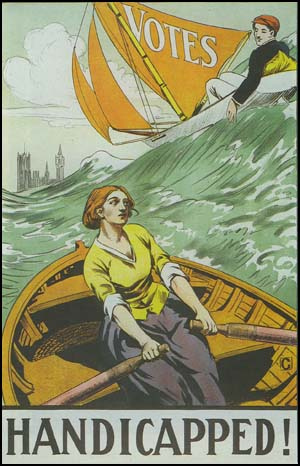 One of Lady Strachey’s co-founders of The Englishwoman was Mary Lowndes, a stained glass artist and chairman of the Artists’ Suffrage League, a society devoted to publishing suffrage propaganda. The ASL each year ran a competition for the design of a poster; Duncan Grant, nephew to Lady Strachey, was the competition’s joint winner, sharing a prize of £4, in the autumn of 1909. He had previously submitted a design, unsuccessfully, for the 1907 competition but was encouraged to try again. It may have been that a weakness in conveying the suffrage message had been responsible for his failure in 1907 because in 1909 Barbara Forbes, Lowndes’ companion and the secretary of the ASL, took the trouble to give him the subject for his design. In its final rendition the poster was described in the NUWSS weekly paper, The Common Cause, 4 November 1909, as depicting ‘a stalwart Grace Darling type struggling in the trough of a heavy sea with only a pair of sculls, while a nonchalant young man in flannels glides gaily by, with a wind inflating his saile – the vote -[treating] with good temper a subject which often causes bitterness’. The Houses of Parliament loom on the horizon as the goal of both vessels. By an interesting coincidence the winner of the ASL’s competition in 1908, with a poster ‘What’s Sauce for the Gander is Sauce for the Goose’ had been Mary Sargent Florence, whose daughter, Alix, was in 1920 to marry James Strachey, Lady Strachey’s youngest son.
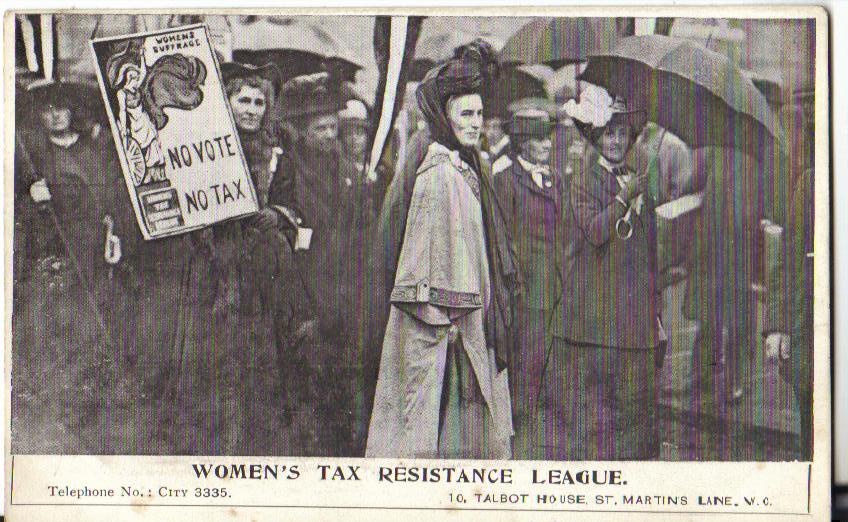
The Tax Resistance League logo – as seen on this banner – was designed by Mary Sargant Forence
Mary Sargent Florence was a leading light of the Tax Resistance League, designing their badge and banner, and in 1912 and 1914, putting principle into practice, refused to pay her taxes, and had goods distrained and sold.
The next ‘ Suffrage Stories: Bloomsbury Links’ post will discuss the life and work of Ray Strachey – a Strachey-by-marriage.
Suffrage Stories: Emily Wilding Davison or Harold Hewitt?
Posted in Suffrage Stories on June 19, 2013
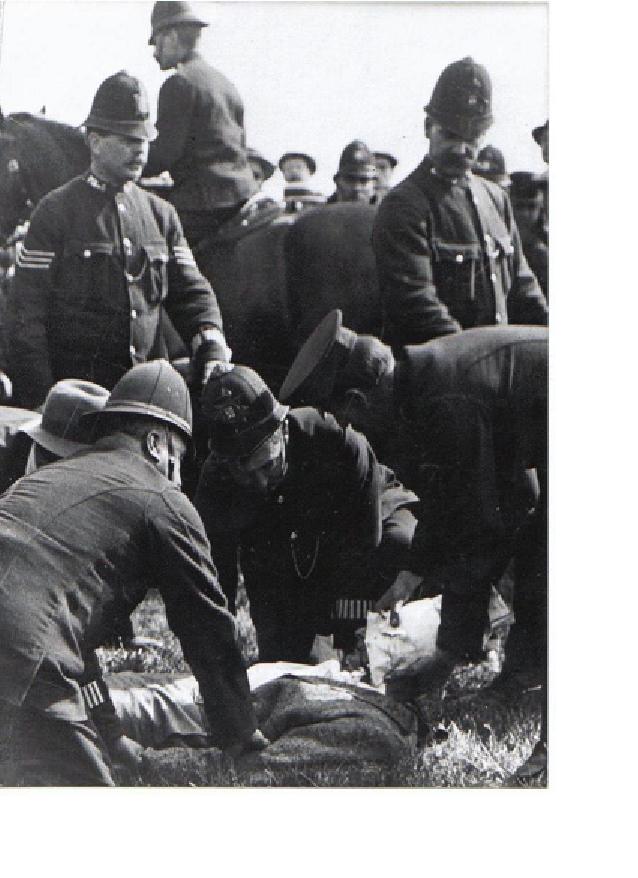 Emily Davison at the Derby 4 June 1913 or Harold Hewitt at Ascot 20 June 1913
For many years, since I acquired this photograph, I had thought it showed Emily Davison lying on the Derby racetrack on 4 June 1913, tended by policemen.
However, it has just been suggested to me that it in fact shows Harold Hewitt who, at Ascot just over two weeks later ran in front of the racing horses, with a ‘suffragist’ flag in one hand and a fully-loaded revolver in the other, in what was deemed a ‘copycat’ action. For details of the event and Hewitt’s action see Lesley Gray’s blog.
Although I have no firm evidence one way or the other, I am minded to believe that the photograph is of Hewitt. There is little to go on but the narrow belt and slanting side pocket do indicate trousers rather than a skirt. Hewitt was, apparently, wearing a loose Norfolk-type jacket which may well be the one in the picture. The filmed images of Emily Davison with which we are now so well acquainted do indicate a rather fuller skirt – with petticoats.
In addition to the information given in Lesley’s blog, I can tell you that Harold Charles Hewitt, who had a Cambridge degree, came from a family with a large estate at Hope End in Herefordshire had lived for lengthy periods of time in Canada and Switzerland and in 1913 was, apparently, planning to go and farm in Africa.
The night before Ascot he had stayed at a hotel in Hart Street, Bloomsbury (perhaps the Kingsley Hotel, right next to St George’s where Emily Davison’s memorial service had been held on 14 June). He had, according to the report in The Times, been present at Emily Davison’s ‘funeral’ -although whether in the church or taking part in the procession is not made clear. The newspaper reports concentrate on his interest in anti-vivisection and apparent hatred of horse races rather than on any particular suffrage sympathies. Tenants at Hope End who knew Hewitt reported that ‘he had always been eccentric on religious matters’.
Harold Hewitt died in 1961 aged c 86, a comparatively wealthy man, the head injury he sustained at Ascot in 1911 having done little to shorten his long life.
Women Writers And Italy: Dorothy Nevile Lees
Posted in Women Writers and Italy on June 17, 2013
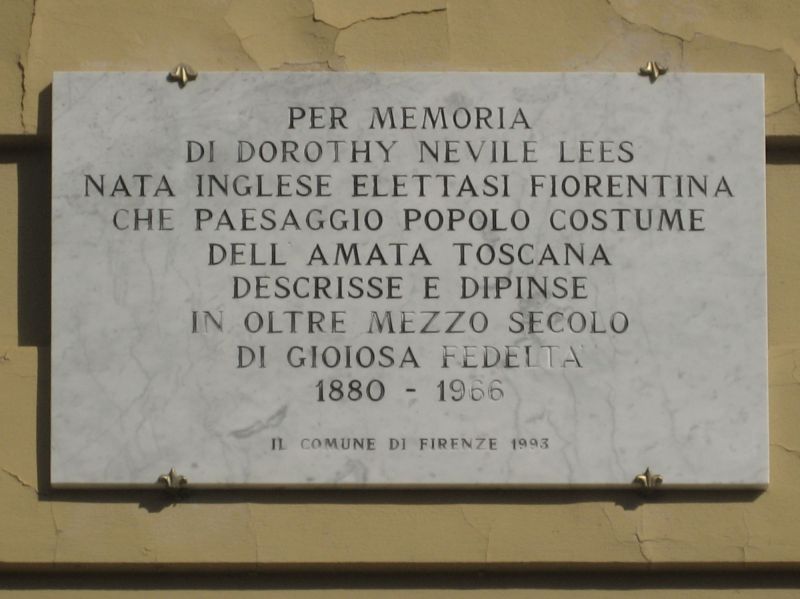
Plaque at Via Foscola, 32, in Florence
Dorothy Nevile Lees was born in Wolverhampton in 1880, the youngest of the seven children of William and Rose Lees. The Lees were a long-established Wolverhampton family and in the 1891 census Dorothy’s father was described as a ‘justice of the peace, Mediterranean merchant and manufacturer of tinned japanned wares’. Ten years later the family were living in Old Ivy House, Lower Street, Tettenhall. For further information about Old Ivy House see here.
In 1903 Dorothy Lees travelled to Italy, arriving on 4 November in Florence, where she was to remain for the rest of her life. On 7 November her brother, Gerald, set sail for Montreal to work there as an agent for Mander Bros, the leading Wolverhampton manufacturer of paint and varnish. In the 1901 Gerald had been working as a clerk his father’s company. I sense that there may have been some kind of business failure, for in 1911 the eldest Lees son, Lawrence, was working as a’ needle manufacturer’, living with his parents, his father being described as ‘a retired export merchant’ (incidentally this is the only 1911 census form that I have seen on which the information has been typed rather than handwritten). When William Lees died in 1917 he left only £300 or so and this may be some kind of explanation as to why Dorothy left home; it was then very much cheaper to live in Italy and, if she hoped to earn money from writing, there was more picturesque ‘copy’ in Florence than in Tettenhall. In 1907 she published two books, Scenes and Shrines in Tuscany and Tuscan Feasts and Friends. She dedicated the latter book to her brother, Gerald, ‘Oceans part not kindred hearts/While they remain akin’. Below is an excerpt from the first chapter, demonstrating the potency of the Tuscan dream that has captivated English women throughout the centuries.

‘From the first moment when, in the afternoon sunshine of a day sweet and unforgettable, a bend in the road revealed it, the Villa took prisoner of my heart.
The Villa, strictly speaking, was not beautiful; its time-stained platstered walls, its lofty height, its heavily-barred windows were a little guant and forbidding; and yet, as I stepped down from the carriage, I felt instinctively that I had found the place of dreams and peace.
It was a house to enchant any lover of antiquity, with its furniture of dark oak and antique gilded leather, its ancient bronze and silver lamps, its tapestries, its painted ‘Cassoni’, in which the brides of a past day brought home their gear; its portraits of old-time Florentines in lucco or parti-coloured hose, in wigs and ruffles and brocaded coats; of ladies in Medicean costume of grave-faced priors and dashing cavaliers, some of whom lived in, and, no doubt, still haunt, the queit rooms on which they down gaze down!
Yes, it was a story-book house. So I decided that night in my quaint little bedroom, with its high wagon-roof and red-paved floor, while the moon, low in the west above the dark huddle of the woods, shone in through the window, drawing the close-crossed bars, with which Italians guard all lower casements, in clear black outline upon the opposite wall. Watching the quiet silver light, which seemed like a benediction, making the little room a holy place, and listening to the dripping of the fountain and the hooting of the owls in the profound stillness of the September night, I could but fall asleep murmuring, ‘the lot is fallen unto me in a fair ground’, since the guiding star of fortune had stood still for me above a place so sweet.’
Dorothy Lees’ Tuscan idyll did not, however, find fulfillment as the consort of an Italian conte or marchese, her lot was not be mistress of a Tuscan estate, but to be a life-long handmaid to Edward Gordon Craig, actor and director.

Edward Gordon Craig
For it was in early 1907 that, in Florence, Dorothy met Craig, the illegitimate son of the actress, Ellen Terry, and the architect, Edward Godwin, and from then on devoted herself to him for the rest of their lives. She was the mother of one of his eight children; her son, David, was born in September 1917. Craig was by no means a constant, or appreciative, companion; Isadora Duncan was another of his lovers.
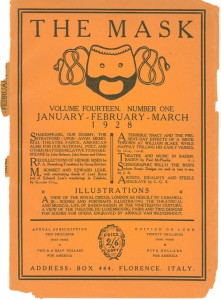
Dorothy Lees collaborated with Craig on the publication of The Mask, the journal through which he aimed to disseminate his philosophy of the theatre and to demonstrate methods of putting his ideas into practice. Dorothy was the journal’s managing editor and provided financial support from money she earned as a journalist. After Craig left Italy, Dorothy Lees lived on in Florence, rescuing his archive from the attention of the Nazis and, after the war, building up a collection of Craig-related publications for the British Institute.
Dorothy Lees’ papers are held in Harvard University – click here for a full and excellent listing of the collection. Below are descriptions of a few of the letters sent by Craig to Dorothy Lees around the time their son was born.
- (915) Craig, Edward Gordon, 1872-1966. Letter to Dorothy Nevile Lees, 1917 Sept. 5. 1 letter.
Publication business; words of encouragement for facing sad things in life; signed “ever yours.”
- (916) Craig, Edward Gordon, 1872-1966. Letter to Dorothy Nevile Lees, 1917 Sept. 13. 1 letter.
On arrangements for DNL in hospital; should not register under EGC’s name; [baby] should have plain name.
- (917) Craig, Edward Gordon, 1872-1966. Letter to Dorothy Nevile Lees, 1917 Sept. 17. 1 letter.
Concerning baptism; EGC does not want name in it (on it?) at all.
- (918) Craig, Edward Gordon, 1872-1966. Letter to Dorothy Nevile Lees, 1917 Sept. 20. 1 letter.
New prospectus for the Marionnette.
- (919) Craig, Edward Gordon, 1872-1966. Letter to Dorothy Nevile Lees, 1917 Sept. 24. 1 letter.
Glad for DNL’s sake news is good; his dissatisfaction with Mr. Furst.
- (920) Craig, Edward Gordon, 1872-1966. Letter to Dorothy Nevile Lees, 1917 Sept. 26. 1 letter.
On Mr. Furst as a worker; his “young apache;” on proper relationship between men and women; “women could make the world a much more pleasant place and life a far more pleasant time for all people if they would do what they [are] told to or asked to do.”
I think this small sample give a flavour of their relationship. Doubtless, for Dorothy life in Florence, which she describes in the opening page of Tuscan Feasts as a ‘dream city’, provided the balm to what must have been a constantly wounding – but self-chosen – way of life. Her son, David Lees, who died in 2004, was renowned as a photographer; several photographs of his father are held by the National Portrait Gallery. Alas, although surely David Lees must have photographed his mother, I cannot locate any photograph of Dorothy. Such is the fate of handmaidens through history.
Collecting Suffrage: 14 June 1913 Emily Wilding Davison’s Funeral Programme: Updated
Posted in Collecting Suffrage, Suffrage Stories on June 14, 2013
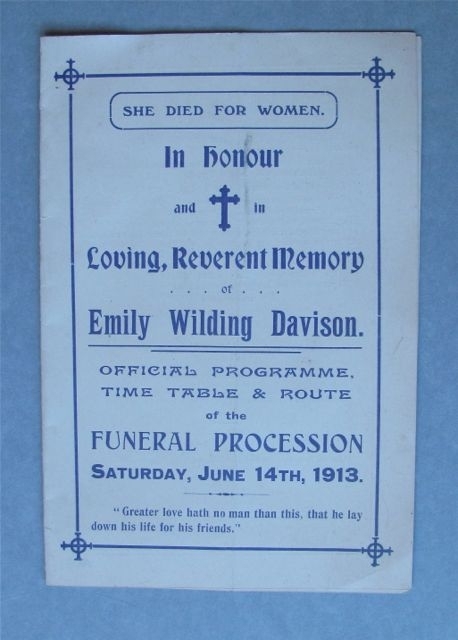
Official Programme for Emily WIlding Davison’s Funeral Procession
I published this post last October, before the extent of interest in the 100th anniversary celebrations of the event commemorated in this 4-pp pamphlet had become clear. I am relieved to report that no suspicious flurry of spurious Emily Davison-related items has appeared on the market. Although the main text of this post is as it first appeared I have updated it with two extra scans of the inside and back cover of the programme. They were made merely for my own research purposes some time before I had a visually-sophisticated blog audience to amuse – so – apologies for their appearance – but I think you will find the details of interest.
For the last 100 years the strange death of Emily Wilding Davison has transfixed the public. It is likely to be the one thing that the ‘man – or woman – in the street’ knows about the suffragette movement. Bizarrely the last seconds of her conscious life are still with us –growing in impact as the internet allows everyone to view footage of film that was in the past relatively difficult to access. In this piece by Andrew Marr the BBC has worked its wonders on the Pathé News original, allowing us to see details that the passing years had blurred. I have always wondered if it was by chance that she chose to position herself alongside a section of the Derby racecourse that was in full view of the film camera. The camera was mounted on a stand and would have been clearly visible. However the camera was, presumably, positioned there in order to capture pictures of the horses entering the final straight and Emily Davison may have chosen to be there for the very same reason. You will now have had the opportunity of viewing the enhanced footage of the film broadcast by Channel 4 in Clare Balding’s Secrets of a Suffragette.
All material related to Emily Wilding Davison’s funeral is scarce – and very collectable – however one of the scarcest is the 4-page ‘Official Programme, Timetable and Route of the Funeral Procession, Saturday June 14th 1913.
I must say that I do find it rather odd that this item should be so very scarce for, as you can see from film and photographs, the streets of London were packed on the day. The hordes must have failed to arm themselves with the Programme or, if they did, to have then discarded it.

Inside pages of the programme for Emily Davison’s funeral procession
In Campaigning for the Vote, Kate Frye, who followed the procession through Piccadilly to Bloomsbury and then on to Kings Cross, in her long diary entry comments on the vastness of the crowd. But even she, who was an inveterate hoarder of suffrage memorabilia, does not seem to have acquired a copy of the Funeral Procession Programme. The result is that, in nearly 30 years of dealing in suffrage artefacts, I have only seen one copy of this item for sale. In fact, if a spate of them were now to hit the market, I shall be very suspicious!

Back cover of the Emily Davison funeral procession
WALKS/Suffrage Stories: The International Suffrage Shop
Posted in Suffrage Stories on June 11, 2013
Another in my series documenting the places that would once have been so familiar to both suffragettes and suffragists in the area surrounding the new home of the Women’s Library @ LSE. The main sites once occupied by the International Suffrage Shop have long since been swept away but, as a devotée of books and bookselling, I would like to ensure that this brave venture is commemorated.
In 1910 the International Suffrage Shop was opened by the actress, Sime Seruya in a room on the third floor of 31 Bedford Street, Covent Garden, lent to her by Edith Craig. In March 1911 the shop moved to spacious new premises – 15 Adam Street – on the south side of the Strand, not far from where Virago ran a bookshop, with which I was associated, in Southampton Street in the late 1980s. (Incidentally, the Virago Bookshop, along with the late-lamented Silver Moon and Sister Write’s in Islington – the latter’s premises now, ironically, a Cook Shop – represented a brief flowering of interest in women-oriented reading material of which the Persephone Bookshop in Lamb’s Conduit Street is now, I think, the only surviving bricks and mortar representative – at least in London.)
The International Suffrage Shop was described as ‘The Only Feminist Bookshop’ and had on sale all kinds of feminist as well as general literature, modern plays on social questions, art and children’s books, pictorial posters, badges and newspapers, photographs and postcards.
The shop also acted as a publisher for Cicely Hamilton’s Pageant of Great Women and Margaret Nevinson’s In the Workhouse and its logo is to be found on the (rare) photographs, published separately, of the leading characters – such as Ellen Terry – who took part in the original pageant.
The ISS had a large room – complete with ‘a picture lamp and sheet’ that could be let out for meetings and, positioned so centrally, was a useful place for assignations. For instance, Kate Parry Frye arranged to meet some friends there on the afternoon of 21 November 1911, before going, first, to have tea at the cafe in the Cecil Hotel and then on to a window-smashing demonstration in Parliament Square.
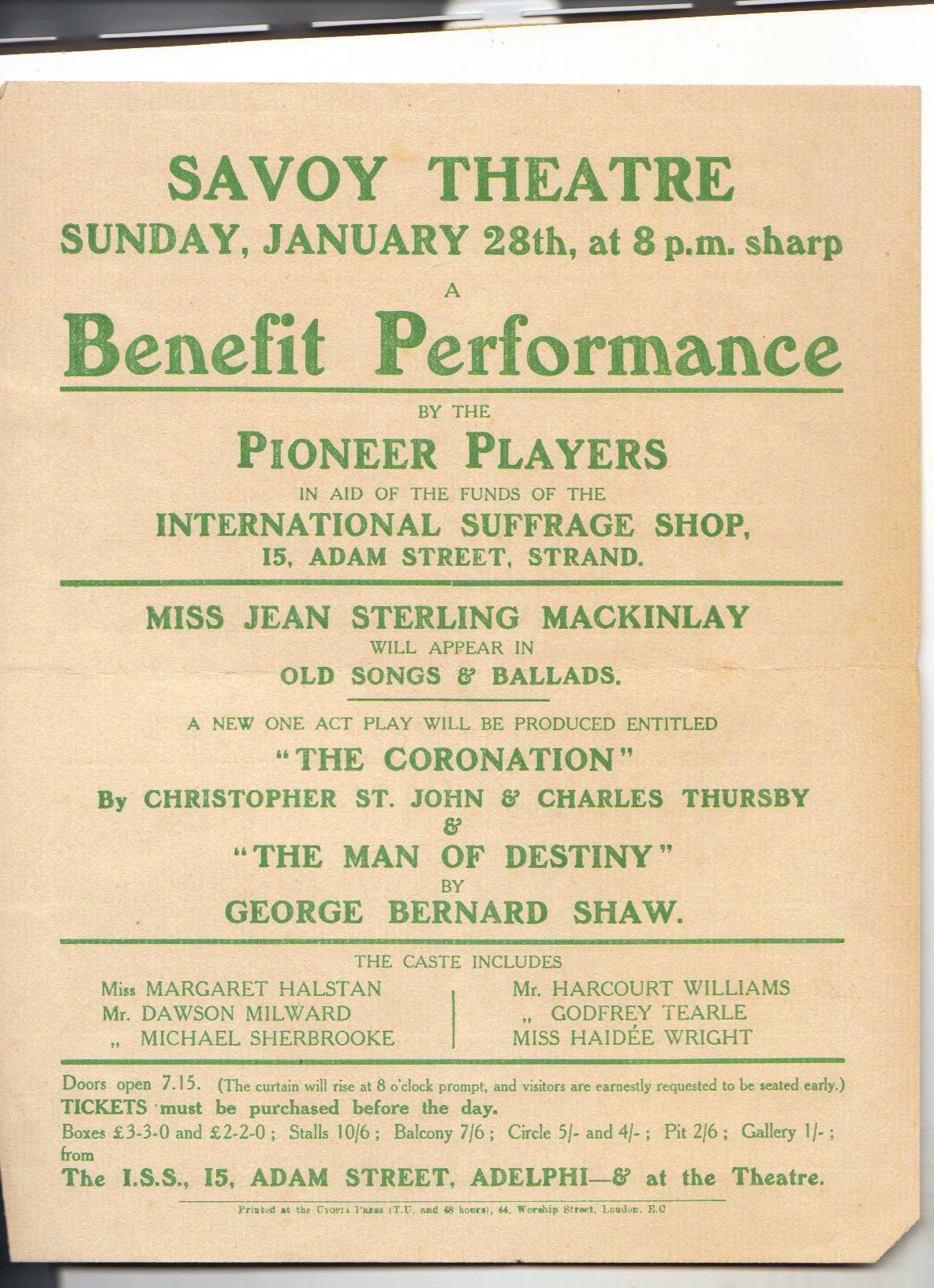
Kate Frye’s copy of the flyer for the ISS Benefit Performance of ‘The Coronation’
Alas it was as difficult then as it is now to make a living through book selling and the International Suffrage Shop was always in financial difficulties. Kate Frye played a leading, if silent, part in Christopher St John’s banned play, The Coronation, published by the ISS and staged by Edith Craig in January 1912 as a Benefit Performance in aid of the shop. A long description of the occasion can be found in Campaigning for the Vote.
As the WSPU campaign became more physically militant the International Suffrage Shop, which boasted two very large plate-glass windows, became a prime target for retaliation. Helena Swanwick described how when, one evening, she was attending a meeting at the shop medical students broke in and threw books about. The police, apparently, would do nothing to help. On at least one occasion one of the shop’s windows was broken.
When the Strand was widened in mid-1913 the shop had to move and certainly by the time it was forced to close in April 1918, threatened with bankruptcy, its address was 5 Duke Street, Adelphi (then off Villiers Street). In 1913 it would appear that the original founders had relinquished their connection and that it had been taken over by Miss Adeline West Trim, who had been in charge of the Book-Selling Department from the beginning and had managed to keep the shop open throughout the First World War and who, alas, died soon after, in 1920 aged barely 50.
For other posts in this series see:
Where and What Was the Aldwych Skating Rink ?
Where And What Was Clement’s Inn ?
Where And What Was the ‘Votes For Women Fellowhip?’
Campaigning for the Vote: Kate Parry Frye’s Suffrage Diary edited by Elizabeth Crawford
For a full description of the book click here
Wrap-around paper covers, 226 pp, over 70 illustrations, all drawn from Kate Frye’s personal archive.
ISBN 978 1903427 75 0
£14.99
Copies available from Francis Boutle Publishers, or from Elizabeth Crawford – e.crawford@sphere20.freeserve.co.uk, from all good bookshops – especially Foyle’s, London Review Bookshop, Persephone Bookshop, British Library Bookshop, Daunt Books, The National Archives Bookshop and Newham Bookshop. Also online – especially recommend very favourable price offered by Foyle’s Online (and they pay all taxes!)
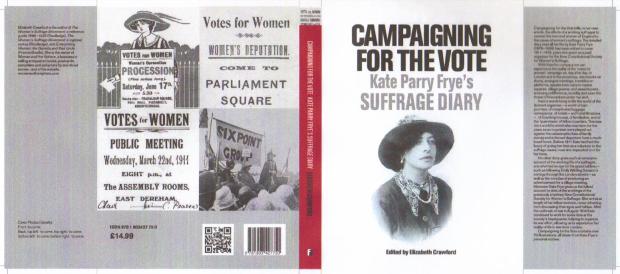 ‘Campaigning for the Vote’ – Front and back cover of wrappers
Suffrage Stories: Parliamentary Radio Interviews Recorded At The Emily Wilding Davison Event In The House Of Commons, Tuesday 4 June 2013
Posted in Suffrage Stories on June 7, 2013
 5 June 2013
100 years since Emily Wilding Davison, the Suffragette died Parliament pays tribute to her
Westminster has paid tribute to the Suffragette Emily Wilding Davison 100 years after she was knocked down by the King’s Horse at Epsom races.
 “Parliament and Votes for Women” The Speaker’s Advisory Committee on Works of Art and Parliament Week, paid tribute to Emily with a special tour of the places in Westminster Emily and others targeted with her Suffrage militant activities.
Boni Sones, our Executive Producer, spoke to the Labour MP Alison McGovern, Elizabeth Crawford, the suffragette historian, and Irene Cockroft, of the Bourne Hall Museum in Ewell, Surrey. All had their own Emily stories, including an eye witness account of Emily’s funeral procession from Kate Frye.
Listen to the interview…
Download this interview (.mp3 format, file size: 14.5MB) Iright click and then click on ‘open link in new tab’ button/
Suffrage Stories: Kitty Marion, Emily Wilding Davison And Hurst Park
Posted in Suffrage Stories on June 7, 2013
Emily Wilding Davison died in Epsom Hospital during the afternoon of Sunday 8 June. However, by the previous evening a plan was already afoot to commemorate, if not yet her death, at least her action at the Derby.

Kitty Marion
In a previous post I explained that Kitty Marion, one-time music-hall artiste – by 1913 a full-time militant suffragette, wrote in her unpublished autobiography that Emily Davison, on the eve of the Derby had given her a purse containing a sovereign, ‘for munitions’. She went on to say that ‘the following Sunday, when unaware of her death, Betty Giveen and I made good use of the ‘munitions’ Emily had paid for.’ It transpired that ‘some one living in the vicinity of Hurst Park race course [had] suggested to Clara [aka ‘Betty’] Giveen and me that the Grand Stand there would make a most appropriate beacon, not only as the usual protest but, in honour of our Comrade’s daring deed for which she paid with her life.’
Whether or not Kitty Marion’s story of Emily’s purse and the sovereign is true (I am horribly suspicious of post-event stories that place an autobiographer in the centre of a dramatic scene – cf Mary Richardson) there is no doubt that, on the evening of 8 June, Kitty Marion and Betty Giveen set out for the Hurst Park stadium at Molesey (near Hampton Court), apparently equipped with their ‘munitions’ – a gallon of oil and fire lighters -together with a piece of candle to ignite the oil-soaked material they was to be used as a wick. In the event the ‘fuse’ ignited far too quickly – an hour was supposed to elapse before the blaze started – and the women had to depart in haste. The stadium was gutted.
The women had difficulty, hampered by their skirts, but with the aid of a piece of old carpet they had brought along, in clambering over the fence that surrounded the grounds and it interests me that in her autobiography (admittedly written many years later) Kitty Marion specifically comments ‘We both regretted that there was no movie camera to immortalise the comedy of it.’ If the power of the ‘movie cameras’ was in their mind on 8 June, it makes Emily Davison’s positioning of herself at Epsom on 4 June all the more convincing. Movies were by 1913 firmly embedded in the contemporary mindset.
The mistake made over the setting of the fuse rather bears out my contention that fires, once started, are not easy to control. Suffragette arsonists – as any other fireraiser, male or female – could never be certain that they would not cause injury to themselves or others. They were lucky.
Leaving the stadium ablaze, Kitty and Betty then walked from Molesey to Kew – to the home of Dr and Mrs Casey (and of their militantly WSPU daughter, Eileen) at 25 West Park Road, Kew. [The house is a typical Edwardian semi; I have often walked past it on my way from Kew Gardens station to the National Archives.] Kitty writes that Mrs Casey, after meeting her and Betty had invited them to stay at her house. Mrs Casey confirmed this meeting in her trial evidence, reporting that she had met Kitty, for the first time, at the WSPU Summer Fair on the evening of 7 June. Presumably in handing to them a latch key to the house so that they could enter during the night without waking the household, Mrs Casey was aware that they were likely to have committed some law-breaking act and had not, as the defence claimed, been attending a party.
During the course of the 7 June meeting Mrs Casey had told Kitty which room in her house would be free for them and in her evidence said that on the morning of Monday 9 June ‘she saw Miss Marion with Miss Giveen asleep in a top room’. The report continues, ‘witness opened the door and said “It’s time to get up for breakfast.”‘
Apparently, however, the house was being watched by police and Kitty and Betty were soon arrested there. They had, in fact, encountered a policeman in the early hours of the morning close to Kew station as they were trying to work out the exact location of West Park Road. The newspaper evidence appears to indicate that the police were watching the Caseys’ house, which, if true, would seem to indicate that far more research needs to be done on the deployment of police surveillance against WSPU sympathisers.
On Tuesday 10 June Kitty and Betty were charged at Richmond court and released on bail of £2000 each on sureties partly offered by two wealthy WSPU supporters, Mrs Williams and Mrs Potts.
Although Betty Giveen, who was from Birmingham, had from 4 June been lodging at 7 Great Ormond Street in Holborn and Kitty had digs at 86 Kennington Road, Lambeth, in court they both named 118 King Henry’s Road, Hampstead, the home of the WSPU Hampstead secretaries, the Misses Collier, as an address that would find them. That evening Kitty Marion returned once again to the Empress Rooms and the WSPU Summer Fair, where a wreath dedicated to the memory of Emily Davison now rested against the statue of St Joan.
The trial of Kitty Marion and Betty Giveen was held at Guilford on 3 July. Both the newspaper reports and Kitty Marion’s autobiography record, as Kitty put it, ‘great astonishment at the Freemasonary among suffragettes, for one to trust a mere acquaintance who had never previously been to her house, with a latch key and to bring another, an utter stranger. Neither court nor counsels could grasp the idea’. ‘She was a Suffragette’, said Mrs Casey, ‘that was quite good enough for us. We trust anyone who is a Suffragette.’
Kitty Marion was sentenced to three years’ penal servitude and immediately went on a hunger-and-thirst strike. For much more about Kitty Marion (and Eileen Casey) read their entries in my The Women’s Suffrage Movement: a reference guide. There is an interesting blog post about Eileen Casey and her mother, Mrs Isabella Casey, on the National Archives website.
Suffrage Stories: Emily Wilding Davison and Kate Frye – Derby Day 1913
Posted in Kate Frye's suffrage diary, Suffrage Stories, Uncategorized on June 4, 2013

The memorial brooch to Emily Davison that Mary Leigh kept all her life, I can’t explain the scribbles!
In yesterday’s post I explained that on the evening of 3 June 1913 Emily Davison went to Kensington, to the WSPU Summer Fair. I think it likely that the idea of doing ‘something’ next day at the Derby only crystallised during the course of that evening or night.
For, the next morning, Emily travelled into town from 133 Clapham Road, where we believe she was staying with her friend, Mrs Alice Green, in order to visit WSPU headquarters in Kingsway and acquire two WSPU flags. The journey she would have followed involved travelling on the City and South London Railway (now the Northern line) to Bank, changing there to the Central line and exiting at British Museum, a station long since incorporated into Holborn station. From there it was a short walk to WSPU headquarters at Lincoln’s Inn House.
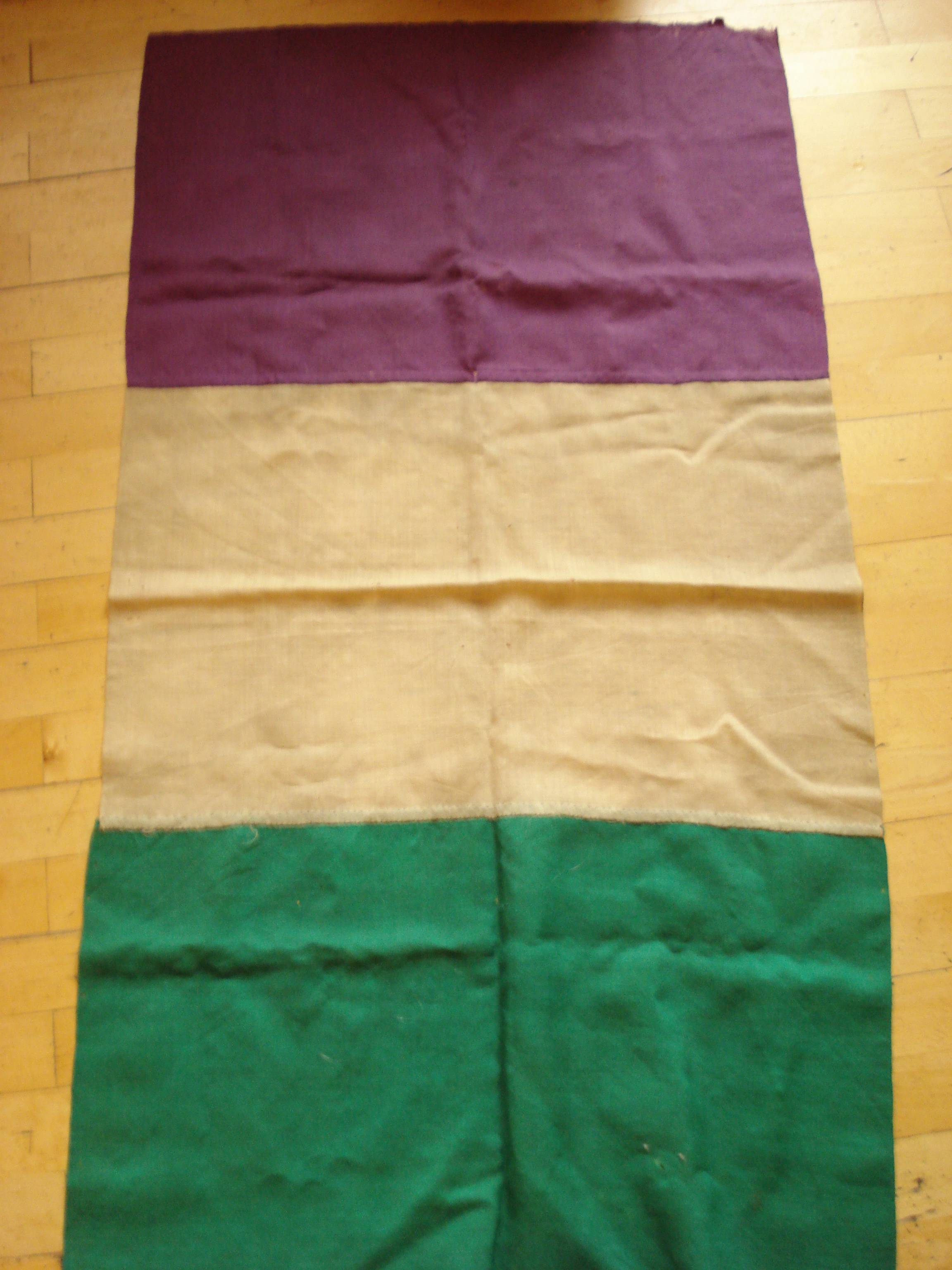
A WSPU flag
If she had planned in advance to travel to Epsom that day, Emily would surely have picked up the flags earlier. It would have been much easier to travel from Clapham to Victoria, without making a detour into Holborn. As it was it would appear that she rolled up the flags, which are made from quite heavy woollen material, pinned them inside the back of her coat (according to the police report) and set off for Victoria.
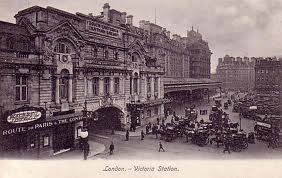
Victoria Station
As I have explained in an earlier post, at Victoria it is more than likely that the only ticket Emily could buy, whether she wanted it or not, was a special Derby Day excursion return – at the not inconsiderable price of 8 shillings. The one she travelled took her to Epsom Downs station, close to the Grandstand, but quite a distance from Tattenham Corner. She may have arrived around the middle of the day, possibly in time for the first race.
The Derby began at 3.01pm. As the horses approached Tattenham Corner a mere 4 seconds elapsed between Emily Davison ducking under the rails and being knocked flying by Anmer. The horse got to his feet and the crowd rushed forward to surround Emily Davison and Herbert Jones, the jockey.
The main witness, a policeman, Frank Bunn, who was standing near to the point where Emily went under the rail, made clear at the inquest that there was no identification of Emily until after she was admitted to Epsom Cottage Hospital. The identification may have come from the marking on a handkerchief in her pocket. Here is the complete inventory of Emily’s possessions, as noted by Frank Bunn.
- ‘On her jacket being removed I found 2 Suffragette flags, 1½ yards long by ¾ yards wide, each consisting of green, white and purple stripes, folded up and pinned to the back of her jacket, on the inside.
- On person, 1 purse containing 3/8¾d.,
- 1 return half railway ticket from Epsom Race Course to Victoria No 0315,
- 8 ½d stamps,
- 1 helper’s pass for Suffragette Summer Festival, Empress Rooms, High Street, Kensington for 4th June 1913,
- 1 race card,
- some envelopes and writing paper,
- 1 handkerchief Emily Davison Mrs. E.W.D 8 88.
- 2 postal order counterfoils No. 790/435593 for 2/6, ‘crossed’ written in ink thereon, one 20H/924704 for 7/6 E.Gore 1/4/13 written in ink thereon,
- one insurance ticket dated May 10th 1913 on G.E. railway to and from New Oxford Street,
- 1 key,
- 1 small memo book’
Some of these items survive in the collection of the Women’s Library @ LSE
As she lay on the racecourse, Emily Davison was tended by Mrs Catherine Warburg, a member of the wealthy banking family, a woman with, the inquest reported, some nursing experience. The Warburgs’ had an estate nearby in Surrey and, quite incidentally, one of Mrs Warburg’s sons, Edmund, was to become an eminent botanist.
While Herbert Jones was carried into the racecourse ambulance, Emily had to rely on the goodwill of a race goer and was taken to Epsom hospital in the car of Johann Faber, who lived at nearby Ewell and, among his other activities, was the Danish consul general in London.

The reverse of Mary Leigh’s Emily WIlding Davison brooch, annotated, characteristically, in Mary’s handwriting
There is no contemporary evidence to suggest that Emily Davison was accompanied to Epsom by anybody else. Mary Richardson, another militant suffragette, claimed, both in her autobiography and in a BBC interview, to have been standing near Emily and to have seen her dash onto the race track. However, I do not believe this. She wrote the book- and recorded the interview – in 1953, forty years after that Derby Day. She was impoverished and to create some hype placed herself at the scene of every major suffragette drama. This is, I feel, a pity as the parts of the book which can be tied to historical fact do have power, but in 1953 (as, perhaps, now) the public only wanted drama from the suffragettes. If she had really been close at Epsom on 4 June 1913 she would surely have written about this – or it would have been reported – in The Suffragette, even if not called as a witness at the inquest. Moreover she rather gilds the lily by claiming to be at the Derby to sell copies of The Suffragette, a paper that, at this very time, the Home Office was not permitting to be sold. I cannot imagine that the masses of police manning the Derby would have allowed Mary Richardson to ply her wares. But such is the power of the media that careful reasoning is always trumped by the easy soundbite.
 If we do not know what Mary Richardson was really doing for the Cause on Derby Day, there is no doubt what Emily Davison was doing and, indeed, what Kate Frye, another stalwart campaigner, working at this time in Fakenham, Norfolk, as organizer for the New Constitutional Society for Women’s Suffrage, was up to.
Kate’s diary entry for 4 June 1913 tells us that she was unsuccessful in her search for a chairwoman for a meeting (the reason often given was that whichever local worthy she approached did not want in any way to be associated with the militant suffragettes, even though the NCS was, as its name suggests, a constitutional society) and spent some hours walking round the town, canvassing for members. A thankless task and, of course, hardly the stuff of drama.
She ends the day’s entry with ‘My good landlady talks more than I need but she seems to like me and as she has never had a lady lodger before I must make a good impression.’ So, in her own way, Kate was breaking boundaries on that day 100 years ago. I am sure we are all grateful that, as women, we are not barred as lodgers. Presumably in previous years that ‘kind landlady’ had turned women away, doubtless worrying that they would give her house a bad reputation. My point being that revolutions require a succession of infinitely small changes – as well as the grand gesture.
Suffrage Stories: Emily Wilding Davison On The Eve Of The Derby 1913
Posted in Suffrage Stories on June 3, 2013
On Tuesday 3 June 1913 Emily Davison was present at the Suffragette Summer Fair, held in the Empress Rooms, on the north side of Kensington High Street, just west of Kensington Palace.
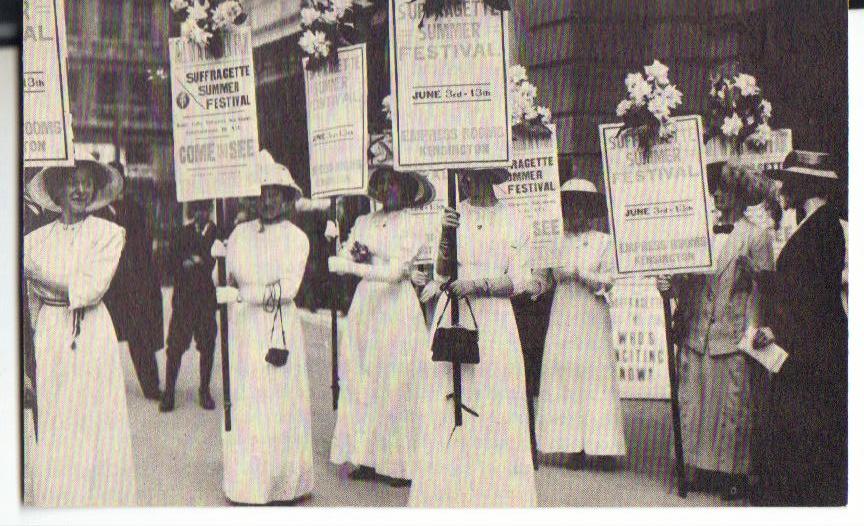
Advertising the ‘All in a Garden Fair’, June 1913
The WSPU’s fund-raising ‘All In a Garden Fair’ saw the hired room transformed into ‘a beautiful rose garden under an Italian sky’, lined with pergolas wreathed in pink rambling roses. In the centre of the hall was an illuminated fountain, which was set in a grass lawn, surrounded by clipped box trees and garden seats. This verdant scene was surrounded by stalls selling WSPU merchandise and all kinds of goods donated by members. The Ladies’ Aeolian Orchestra and the Actresses’ Franchise League contributed live performances. A centrepiece of the Fair was a statue of Joan of Arc, who had come to prominence with her beatification in 1909 and by 1913 was very much a symbolic heroine to suffragettes.
Emily Davison’s biographer, Gertrude Colmore, reported that Emily attended the Fair with her ‘Comrade’, Mary Leigh, and that ‘Saluting, she stood there, reading the words upon the pedestal, “Fight on, and God will give victory”‘ These , reportedly Joan of Arc’s last words, were those that were to appear all too soon on banners draped on Emily Davison’s grave.
Kitty Marion
Another suffragette who places herself with Emily Davison at the Fair was Kitty Marion, music hall artiste and militant suffragette. In her unpublished autobiography she states that, with Emily Davison, she was among a group of friends who discussed the possibility of making a protest the next day at Epsom. As she remembered it nothing was decided but. ‘Before we parted that night, Emily gave me a tiny green chamois purse containing a sovereign for “‘munitions I might need soon”‘. We have only Kitty Marion’s word that Emily Davison made this cryptic comment to which, of course, she then gives her own interpretation; I shall publish a post in a few days time recounting What Kitty Did Next. Did Emily Davison, who we know was by no means well off and with no employment, on the evening before the Derby really give away the large sum of a sovereign (£1 then, worth about £65 today). It doesn’t seem very likely, but, if she did, what could she have meant by it?
For, although Emily Davison is not known to have undertaken any militant acts since the end of 1912 (other than mistakenly taking a horsewhip to a man she mistook for Lloyd George) Kitty Marion most certainly had. While standing talking on 3 June at the ‘All in a Garden Fair’, it was with the knowledge that in the course of the previous few weeks she she had been responsible for setting fire to at least three houses – the latest, from the evidence of her scrapbook, being a house in Folkestone on 17 May. One of these houses, severely damaged on 15 April, was ‘Levetleigh’, the Hastings home of an MP. In addition she had set fire to a succession of stationary railway carriages in places such as Teddington, around London’s outer suburbs.
So, as the women stood together ‘under the Italian sky’, at least one of them had, metaphorically and, probably, literally, traces of paraffin on her hands. It is difficult to believe that Emily Davison was not aware of the arsonists in her circle and that for all the the ‘beautiful rose garden’ that surrounded them and the girls in virginal white standing outside the Empress Rooms inviting passers-by to step in, the atmosphere within the group was not increasingly febrile. For reasons that I will put forward in tomorrow’s post, I think it was in the course of this evening – and not before – that Emily Davison made up her mind to take the train the next day to Epsom – and the Derby.
Suffrage Stories: Emily Wilding Davison And That Return Ticket
Posted in Suffrage Stories, Uncategorized on May 27, 2013
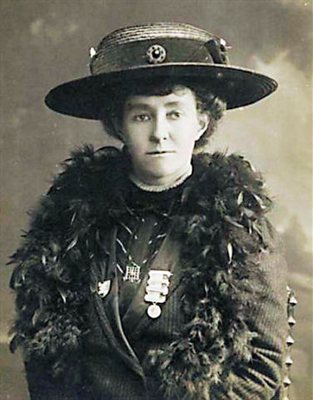
Emily Wilding Davison, wearing a WSPU’ Boadicea’, brooch, her ‘Holloway’ brooch and her hunger-strike medal. The latter was buried with her.
Ever since 1988, when the Women’s Library@LSE (or, as it was then, the Fawcett Library) was given, by descendants of Rose Lamartine Yates, items that had belonged to Emily Wilding Davison, the fact that amongst these was her return ticket, issued on 4 June for travel between Victoria Station and Epsom Race Course, has been considered important in assessing whether or not she intended to act in such a way as to harm herself. Click here to view an image of the ticket, an item in a digital exhibition launched to mark the 100th anniversary of Emily Davison’s death.
The argument was, in essence, that if Emily Davison had a return ticket she intended to return. However, no contemporary report, either at the inquest, in newspapers or in the memoirs of her friends, made such a deduction. The first occasion on which this theory was put forward, as far as I can discover, was in a 1988 Guardian article celebrating the gift to the Fawcett Library.
Some while ago I decided that this lack of contemporary comment required further investigation and that in order to determine what message the ticket carried it was necessary to look more closely at the workings of pre-First World War rail routes between London and Epsom, in particular the arrangements that were in place on 4 June 1913. Experience has taught me that a lack of awareness of just such quotidian details can often lead historians astray. Thus, before attempting to interpret Emily Davison’s motive on Derby Day, it is necessary to understand the detail that shaped her day.
I quickly realised that, as Derby Day has dwindled in importance – no longer the epitome of a wonderful day out for Londoners – so has an appreciation of the logistics that 100 years ago brought hundreds of thousands of Londoners, of all social classes, by carriage, car and, most importantly, by train to Epsom. For Derby Day in 1913 was still the Derby Day of William Powell Frith’s painting and of the wonderfully descriptive scenes depicted by George Moore in Esther Waters, almost a national holiday, racing augmented by funfairs and sideshows. For instance, on 4 June 1913 many London theatres cancelled their matinees, knowing that their audiences would be elsewhere.
First I researched the route that Emily Davison had taken. From newspaper advertisements placed by the train companies in the Manchester Guardian and the Times I saw that on Derby Day virtually all the usual train services were suspended and special trains ran to the three Epsom stations – Epsom Town, Epsom Downs and Tattenham Corner.

Plaque showing map of L B & S C Railway system at Victoria Station
Each of these stations was linked to a different rail company. Emily Davison’s ticket was issued from Victoria Station. I discovered that the only company that ran trains from Victoria was the London, Brighton and South Coast Railway, the rather circuitous route taken by the line ending at Epsom Downs station.
Each of the rail companies advertised the virtues of its Epsom station – so, while the Charing Cross/London Bridge line trumpeted Tattenham Corner as the only station on the race course (and, indeed, at this time trains only travelled to that station on race days), the L B & S C Railway claimed Epsom Downs as the station nearest the Grandstand – and described it as the ‘Racecourse Station’. The return ticket gives the route for return as ‘Epsom Race Course to Victoria’.
On Derby Day 1913 all the companies put on special excursion trains. The L B & S C ran ‘cheap trains’ from Victoria up until 9.38 am and after that – between 10.15 am and 1.38 pm – put on 17 ‘fast trains’. The cost of Emily Davison’s ticket – 8s 6d ‘with no particular class of carriage guaranteed’ – does not seem cheap. In 1913 the WSPU paid its organizers £2 10s a week – and Emily did not even have the luxury of such employment; the 2013 equivalent of the ticket price is over £40.The advertisements do not give much detail about prices. No ‘8/6 ticket’ is mentioned, but the ‘ Pullman Limited’ Non-Stop train that left Victoria at 12.15 cost 12/6 (return) and another Derby Day ‘Special Through Train’ from Willesden cost 6/6 so I would conclude that Emily Davison caught one of the ‘fast trains’ from Victoria to Epsom Downs.
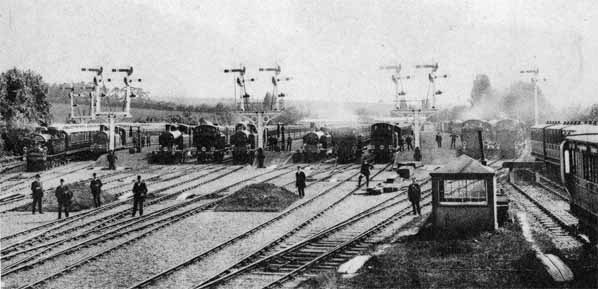
Epsom Downs station, packed with trains, on Derby Day, 1907 (image courtesy of Nick Catford’s ‘Disused Stations’ website)
The advertised arrangements for Derby Day stress, as I have mentioned, that certain ordinary services to Epsom were suspended and others were altered. A reading of the advertisement would strongly suggest that it was not possible, on Derby Day, to buy any ticket from Victoria to Epsom Downs other than one that included a return element. The L B & S C Railway concentrated on running only ‘excursion’ trains on Derby Day, intent on transporting the hordes looking forward to this highlight in the holiday calendar, and that these tickets were, of necessity, ‘return’.
My feeling is that the explanation for no contemporary comment being made of the fact that Emily Davison had bought a return ticket – quite an expensive ticket – was that her contemporaries would have recognised that Derby Day excursion tickets were by their very nature ‘return’. On that day railway companies operating between London and Epsom had a captive market and made the most of it.
Moreover, even if Emily Davison had not expected to be injured at Epsom, she could hardly have been certain of returning to London that day. If, when she bought her ticket, she was then intending to step onto the race course and cause disruption to the Derby she would surely have known that, at the very least, she would to be arrested. I would suggest that the fact that she had notepaper, envelopes and stamps in her pockets (she does not appear to have been carrying any kind of bag) might indicate that she had thought it would be likely that she would need to write a letter or two that day, possibly from a police cell.
I would suggest that it does not seem likely that, impoverished as she was, Emily Davison, with the expectation of, at the least, detention, would have spent so much on a return ticket if she had not been compelled to do so.
COPYRIGHT
All articles on womanandhersphere.com are my copyright.
Clare Balding’s Secrets Of A Suffragette: Channel 4 Sunday 26 May 8pm
Posted in Suffrage Stories on May 24, 2013
Campaigning For The Vote: Kate In Dover 100 Years Ago: A Sunday Visit From John, May 1913
Posted in Kate Frye's suffrage diary on May 23, 2013
Kate Frye is working in Dover, lodging at 26 Randolph Gardens with the Miss Burkitts’, who are WSPU sympathisers and aunts of Hilda Burkitt, a well-known suffragette. A vignette of life in ‘digs’.
‘Poor Gertie’ was, as Kate explains in a previous entry, ‘Miss Odames – a being from Leicester who used to work in a Factory but is now quite well to do. She is very common and very plain.’ ‘Gertie’ was ‘Agnes Gertrude Odames, born in Leicester c 1878 who, in 1901, was a ‘corset maker’ but who, with her sister, was in 1911 able to describe herself as ‘of private means’. Gertie married in 1917 and when she died in 1951 left over £1000, having probably lived a more comfortable life than Kate. I have, as yet, been unable to identify ‘Bertie Bowler’.
Sunday 25 May 1913
A glorious day and quite hot. The others all of to Church. I as usual on Sunday took my time in getting up. While I was in the bathroom the young gentleman who we have been hoping and longing for came to say he would take the rooms. Miss Minn was in. I had to wait until he had departed to get upstairs. We are very excited.
I wore my thin coat and skirt out for the first time without a top coat. Walked along the front to the Town station and met John [her fiance, an actor] at 12.30. He had come down by the Miss Burkitts’ invitation to spend the day. We had not met for 5 months. It was very exciting. I think he was pleased and I enjoyed having him. He looks alright though a trifle thin – came to London last Sunday at the close of the Repertory season at Liverpool.
We walked along the front in the blazing sun and up and got in at 1.15. John behaved very nicely but of course he was a stranger in that homely atmosphere – however the Miss Burkitts seemed to get on with him.
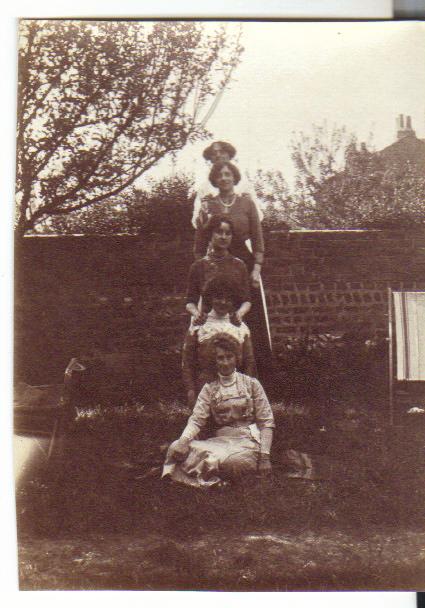
John Collins’ staged photo shoot in the Misses Burkitts’ garden
We went in the garden afterwards and John took snapshots of the group and Janet [Capell] came in to be introduced. Then John and I took a tram as far as it went and strolled about the Admiralty Pier. It was a gorgeous afternoon. We had permission to be late for tea so we walked along the front and took a photograph of Mrs Wilson’s house and then back to tea.

Mrs Wilson’s house at 5 East Cliff, Dover, photographed by John Collins while he and Kate were out for their walk
Then we sat in the garden and Bertie Bowler was there and sang his Ditties. I had told John to be nice to him – and BB said afterwards how nice he was. I don’t think John knew what to make of poor Gertie. Poor soul she looked hopeless in a stiffly starched white embroidery ready made gown. She says such amazing things.
Miss Minn took herself off to Church – a thing she never does in the evening but I think she is madly jealous. She was very nice when she said good-bye to John – said ‘I like you very much – I think you are almost good enough for our darling’ – but afterwards she never referred to him. Once or twice I dragged his name in but she wouldn’t say much. Poor Miss Minn. Miss Burkitt on the other hand chatted of him and said how much she liked him.
We had to walk as the trams were packed to the roof. I was not allowed on to the station – it was like a bank holiday – so i did not wait but came straight back on a Tram – just missing Miss Minn who had gone down after Church to come back with me. When I said she was naughty to go to Church – she said she thought the others would have had the sense to leave us alone together. I was very tired.
Campaigning for the Vote: Kate Parry Frye’s Suffrage Diary edited by Elizabeth Crawford
For a full description of the book click here
Wrap-around paper covers, 226 pp, over 70 illustrations, all drawn from Kate Frye’s personal archive.
ISBN 978 1903427 75 0
£14.99
Copies available from Francis Boutle Publishers, or from Elizabeth Crawford – e.crawford@sphere20.freeserve.co.uk, from all good bookshops – especially Foyle’s, London Review Bookshop, Persephone Bookshop, British Library Bookshop, Daunts Bookshop, The National Archives Bookshop and Newham Bookshop. Also online – especially recommend very favourable price offered by Foyle’s Online (and they pay all taxes!)

Suffrage Stories: Bloomsbury Links in Life And Literature
Posted in Suffrage Stories on May 21, 2013
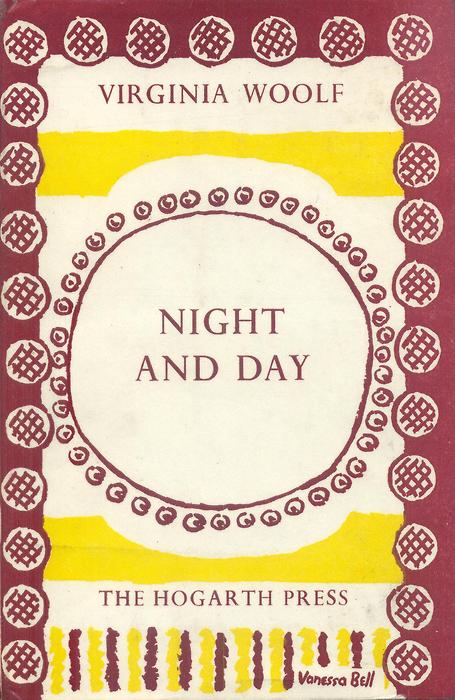 In Night and Day, set in 1910, Virginia Woolf writes explicitly of the suffrage campaign. She places the office of her suffrage society, the ‘S.G.S.’, in the heart of Bloomsbury, in Russell Square. Mary Datchet works there (‘From ten to six every day’) in an office on the top-floor of a large house ‘which had once been lived in by a great city merchant and his family’. When Mary Datchet is found ‘lost, apparently, in admiration of the large hotel across the square’, she could in fact have been looking at not one but two imposing hotels – the Russell and the Imperial.
A house with just such a view, number 23, on the north-western corner of the square, belonged to Sir Alexander Rendel, grandfather of Ellie Rendel, close friend of Ray Strachey. Although by 1910 the offices of the main women’s suffrage societies were in real life based either in Westminster, where Ray Strachey was busy working for the National Union of Women’s Suffrage Societies, or around the Strand, Russell Square had indeed, in the later years of the 19th century, been a centre of the movement. The northern corner of the Hotel Russell (perhaps the very hotel on which Mary Datchet’s gaze rested) had replaced 8 Russell Square, where Dr Richard Pankhurst, his wife Emmeline, and their young family had lived from 1888 to 1893.
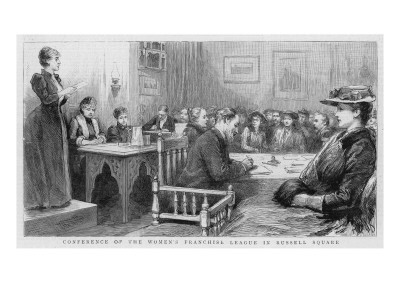 It was here, in the 1890s, that the Pankhursts’ art-furnished double drawing room had provided a useful gathering place for conferences of the Women’s Franchise League, a society aimed at winning the vote for women. The most lavish of these conferences, held over three days in December 1891, was illustrated in the Graphic and reproduced 40 years later in Our Mothers (ed. Alan Bott & Irene Clepahane), a book owned by Virginia Woolf and consulted by her when writing Three Guineas.
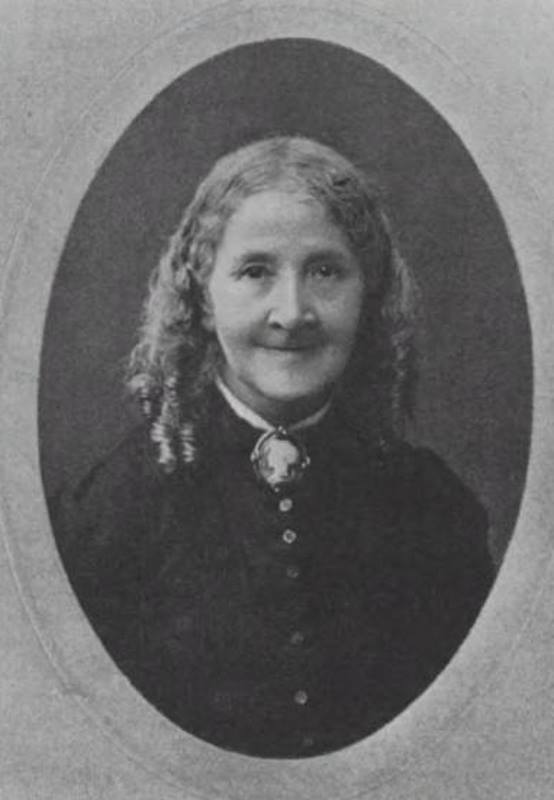
Elizabeth Wolstenholme Elmy photographed c 1906
The chief founder of the Women’s Franchise League was Mrs Elizabeth Wolstenholme Elmy, one of the 19th-century’s most active workers for the women’s Cause. Virginia Woolf’s father, Leslie Stephen, was in touch with Mrs Elmy on at least one occasion, for it is she he thanks for the information he used when compiling the entry for the Dictionary of National Biography on her brother, Joseph Wolstenholme.
The latter was, until his death in 1891, an intimate of the Stephen household; the two men had met at Cambridge where, before an unfortunate marriage, Wolstenholme had been a fellow of Christ’s College. Noel Annan describes a dinner in Wolstnholme’s rooms at Christs’ at which Leslie Stephen took issue with the opinions held by his dining companions. He accused them of ‘drivelling radicalism’ and joked: ‘to give women votes – why, it might save the Church of England for a quarter of a century’.
There were many reasons for objecting to the vote for women but Joseph Wolstenholme was not to be swayed. In 1870 he and two other fro Cambridge subscribed to the Manchester National Society for Women’s Suffrage, the most radical of the women’s suffrage societies, founded by his sister in 1865.
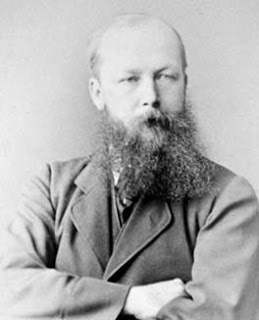
Joseph Wolstenholme
Whatever differences they might have had on such subjects, Leslie Stephen remained an affectionate friend, inviting Joseph Wolstenholme to share the Stephen holiday each summer in Cornwall and reminiscing about these visits in the Mausoleum Book in which he alludes to Wolstenholme’s ‘Bohemian tastes and heterodox opinions’. Quentin Bell has suggested that the character of Augustus Carmichael in To the Lighthouse was based on that of Joseph Wolstenholme. Carmichael and Wolstenholme certainly shared a taste for opium. Carmichael does not, however, reveal his opinion on women’s suffrage.

Virginia Woolf with her parents at Talland House, Cornwall, in 1892. Alas, the ‘Woolly One’ would be holidaying with them no more
Virginia Woolf included memories of ‘The Woolly One’ (as Wolstenholme was fondly known to the young Stephens) in A Sketch of the Past and mentions in 22 Hyde Park Gate, that George Duckworth thought ‘old Mr Wolstenholme not one of the “nice people”‘.
So we can recognise that, as Mary Datchet’s eyes gazed across Russell Square from the S.G.S. office, threads of association spooled forth linking her and her creator to two of the most influential activists for women’s suffrage. It would be a mistake, however, to identify the ‘S.G.S.’, the acronym never elucidated, with a women’s suffrage society.
In 1910 Virginia Stephen offered her services to the People’s Suffrage Federation (P.S.F.), a society formed in October 1909 to promote adult (not merely female) suffrage and to remove the property basis as the qualification for citizenship.
To her friend and teacher, Janet Case, Virginia wrote in a letter dated 1 January 1910: ‘I don’t know anything about the question. Perhaps you could send me a pamphlet, or give me the address of the office …You impressed me so much the other night with the wrongness of the present state of affairs that I feel that action is necessary.’
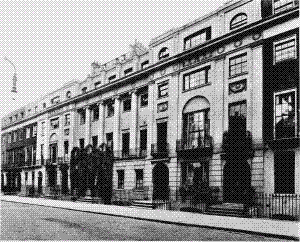
Mecklenburgh Square, Bloomsbury
So it was that Virginia Stephen spent a short time working in an office in Mecklenburgh Square, addressing envelopes for the P.S.F., while absorbing details that were to be transported across Bloomsbury to the office of the S.G.S. As the adult suffrage for which the P.S.F. was committed was also known as ‘universal suffrage’, perhaps we could unravel the initials of Mary Datchet’s society and reconstruct them as ‘The Society for General Suffrage’.

Hotel Russell
All things pass away and, as Mrs Pankhurst’s double drawing room made way for the terracotta splendour of the Hotel Russell, so the ‘Virginia Woolf Burger and Pasta Bar’ that at the beginning of the 21st century nestled in the hotel’s northern corner where once the members of the Women’s Franchise League held earnest debate, is, alas, no more. How suitable, then, that the hotel’s new dining room is named ‘Tempus’, with Night following Day in the diurnal rhythm that sweeps us onward while Mary Datchet still stands, ‘lost in admiration’, gazing out across Russell Square.
Campaigning For The Vote: Kate Frye and ‘Black Friday’, November 1910
Posted in Kate Frye's suffrage diary on May 20, 2013
Kate Frye was present on so many important suffrage occasions – including ‘Black Friday’ – 18 November 1910. On this day the suffrage societies learned that the Conciliation Bill, on which they had pinned their hopes, would be abandoned as, with the two houses of Parliament locked in confrontation over Lloyd George’s budget, Parliament was to be dissolved. The police were out in force and employed brutal tactics to break up the women’s demonstration.
Only a short excerpt of Kate’s ‘Black Friday’ diary entry appears in Campaigning for the Vote because it occurred in the period before Kate began work as a paid organizer for the New Constitutional Society for Women’s Suffrage. There was, alas, just too much material in her diary to make a book out of her whole suffrage experience. So, for those who would like more, here are full details of Kate’s experience that momentous day.
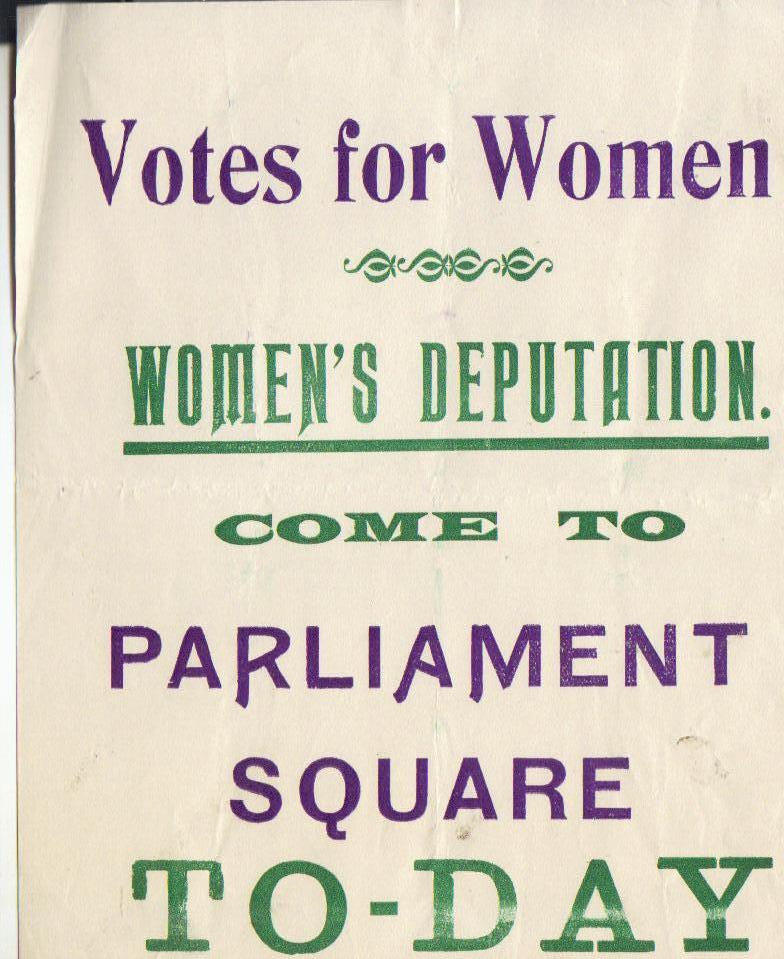
Kate’s invitation from the WSPU to attend the protest, Friday 18 November 1910. Just imagine how many of these fragile flyers lay torn and trampled on the ground at the end of ‘Black Friday’. Kate carefully preserved hers, took it home and laid it in her diary
Friday November 18th 1910
Up in good time. Brushed Mickie [her dog] then took him for a walk – then started at 10.30 for the Caxton Hall. Train from Notting Hill Gate to St James’ Park. I got there about 12 – and the hall was already full and the crowd hanging about were soon after turned out of the vestibule – so I stood some time on the steps. Then from there we were turned into the street and I waited there, chatting with different women, till about 12.40 when the 1st deputation left the Caxton Hall for Parliament Square.
They were soon swallowed up in a seething mob and I simply flew with many other women by short cuts to Parliament Square where I landed more or less by chance in the thick of it. One could hardly see the plan of it all amid the hurly burly excitement, shouts, laughter applause & rushes of the enormous crowd which grew every minute. I was almost struck dumb and I felt sick for hours. It was a most horrible experience. I have rarely been in anything more unpleasant – it was ghastly and the loud laughter & hideous remarks of the men – so called gentlemen – even of the correctly attired top-hatted kind – was truly awful. It made all the men and women seem mad together. And the poor women – the look of dogged suffering & strain on their faces.
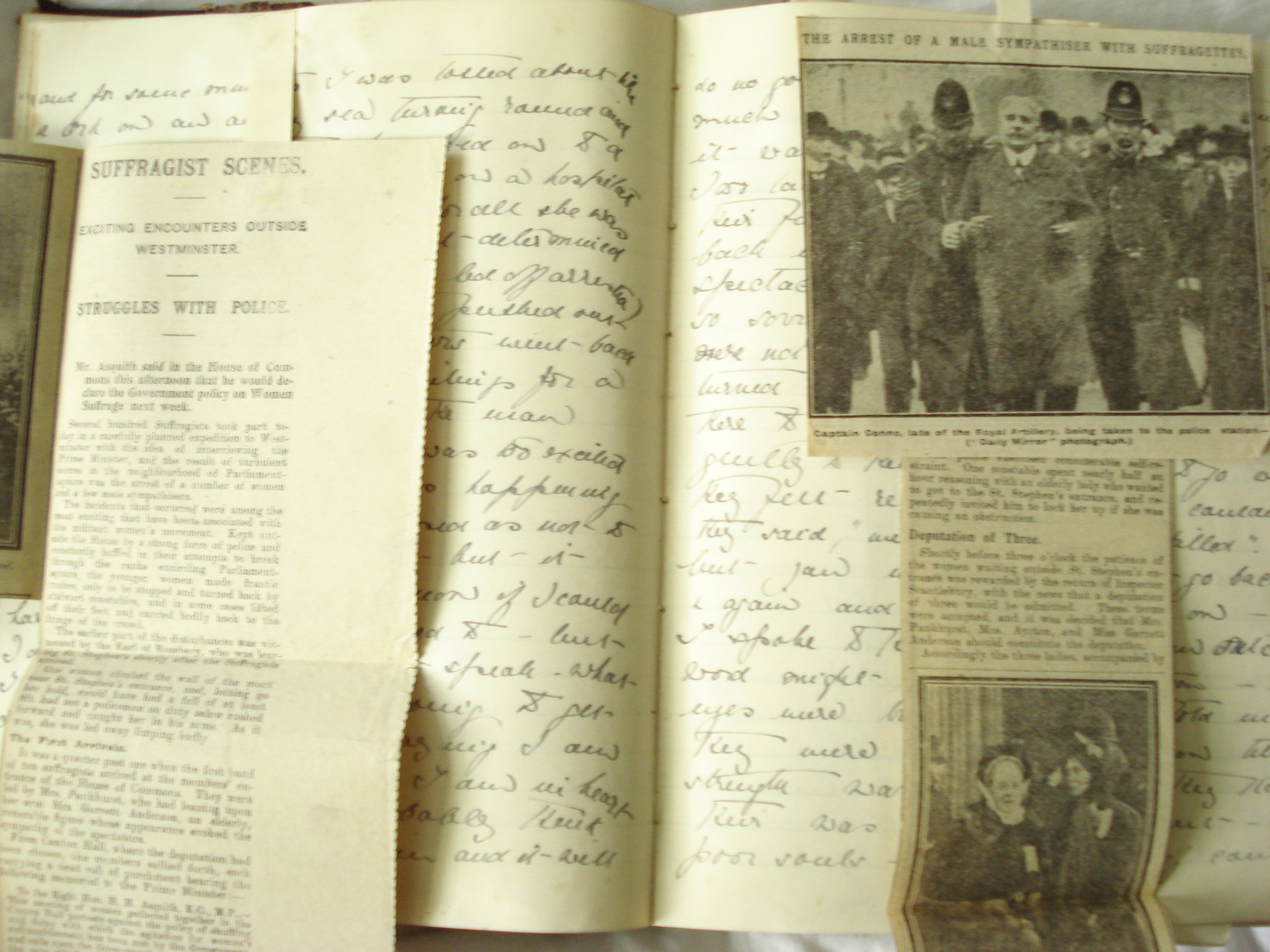
Spread – with newspaper cuttings laid in – from Kate’s Black Friday’ diary entry
I first reached the wall of the moat [round the Houses of Parliament] at the angle so I could see the door plainly and Mrs Pankhurst and the elderly lady [Elizabeth Garrett Anderson] – over 70 years of age – with her. Then I saw policemen breaking up the little standards held by a group of women. I saw deputations pass along and ugly rushes and ever the crowd grew.
I stood some time but I had to give up my place by the wall people pushed so and I was awfully afraid of getting crushed. So I got out to the road and there watched the deputations come along and saw the horrible hustling by the crowds of roughs and overheard the hideous laughter and remarks of the men looking on. Half of them made the remark that it was the funniest thing they had ever seen in their lives – all had their mouths open in an insane grin. One or two were so horrible that I just gazed upon them till they noticed me and moved away, not liking I suppose to be overheard. Several spoke to me – many indignant: ‘What good do you suppose this will do?’ ‘What else would you suggest?’ said I. Then he began the usual – that the militant methods had disgusted all nicely feeling people etc. I turned his attention to my two badges – constitutional societies, as I told him – and asked ‘What help have you ever given us?’ He walked away. Not one man did I hear speak on the women’s side. There may have been some, but not near me.
I saw Captain Gonne led off & heard afterwards of his doings. Many women there were of the WSPU – and a few London Society [ie members of the constitutional NUWSS society] – all standing about perfectly wretched & green – cheering them on to battle and off to Cannon Row when arrested. One poor lady in her wheel chair [probably Rosa Billinghurst]– propelled by hand – followed in the wake of a deputation – generally 6 to a dozen people – she rang her bell violently and the crowd gave way before her – it was a funny but dreadfully tragic sight.
As the crowd grew and the crowd kept being pressed back – I moved away and once, seeing some fighting women & policemen on the pavement coming my way, I stood back to the railing expecting them to go by. But, oh no – a burly policemen, taking me for one of a deputation, caught hold of me with an ‘Out you come’ and for some minutes I was tossed about like a cork on an angry sea, turning round and round – sometimes bumped on to a policeman – sometimes on a hospital nurse, who was fighting for all she was worth – pale to the lips but determined (and I afterwards saw her led off arrested ) – until I was with the others pushed out of the danger zone.
The others went back but I sat down by the railing for a few minutes. I can’t say the man actually hurt me and I was too excited to realise quite what was happening and I was so thickly dressed as not to feel the bumps much – but it wasn’t nice. I don’t know I could have spoken if I had wished to – but I didn’t wish and I didn’t speak. What I felt was – I am not going to get out of the trouble by saying I am not one of them for I am in heart and anyway he will probably think I am trying to trick him and it will do no good and if these women can stand so much I can stand this little. And of course it was nothing really – only a new experience.
Two ladies – one quite elderly came out of their first battle determined not to go back into it. They were a pitiable spectacle – their nerve had gone. One felt so sorry – they were beside themselves and were not aware they had in fact turned ‘coward’. A little lady – evidently there to plead with the faint hearted – spoke quietly to them, urging them to go when they felt rested. ‘But we couldn’t’, they said, ‘we have been half killed’. ‘Oh, but you must – you must go back again and again and again’ and so on. And I spoke to them – thinking an outsider’s word might turn their attention. Their eyes were brimming. They told me that they were supposed to go on till their strength was exhausted – they thought theirs was – but it wasn’t. But poor souls – their fight – of course they had never realised the awfulness of the business and what they would have to endure until they should fall fainting or injured. I wonder if they went back. Perhaps courage did come back to them but who could blame them – they were very saddening.

On the next page of the diary entry Kate laid in the WSPU’s pamphlet prepared as a result of ‘Black Friday’
I couldn’t seem to leave even when I had crossed to the station side. I stood and watched the arrested being led off – & gave them a send off – but soon after 2 I gave it up and, leaving the horrid spectacle, went in to Westminster Bridge station. They were beginning to clear the Square of people. Hundreds of policemen were arriving and one could less than ever see the plan of it all. A lot of Yankee sailors had been mystified but delighted and a lot of people were frankly puzzled by it all – and it was a sad business explaining to them. I got back cold to the bone – fetched my lunch on a tray – and was glad of hot soup.
After a visit to friend for tea on way home] grabbed up some evening papers then home. Couldn’t keep my mind off the morning’s experience and we talked of little else. 105 have been arrested. It was about the most bitterly cold night I have ever been out in.’
As a result of what she had witnessed on ‘Black Friday’ Kate Frye joined the WSPU
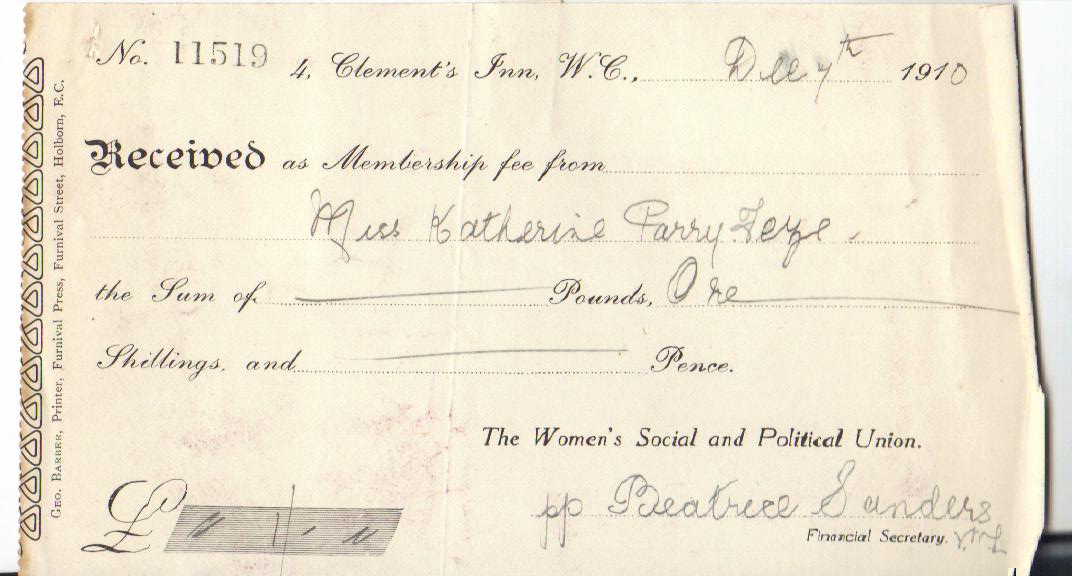
Campaigning for the Vote: Kate Parry Frye’s Suffrage Diary edited by Elizabeth Crawford. Now, alas, out of print
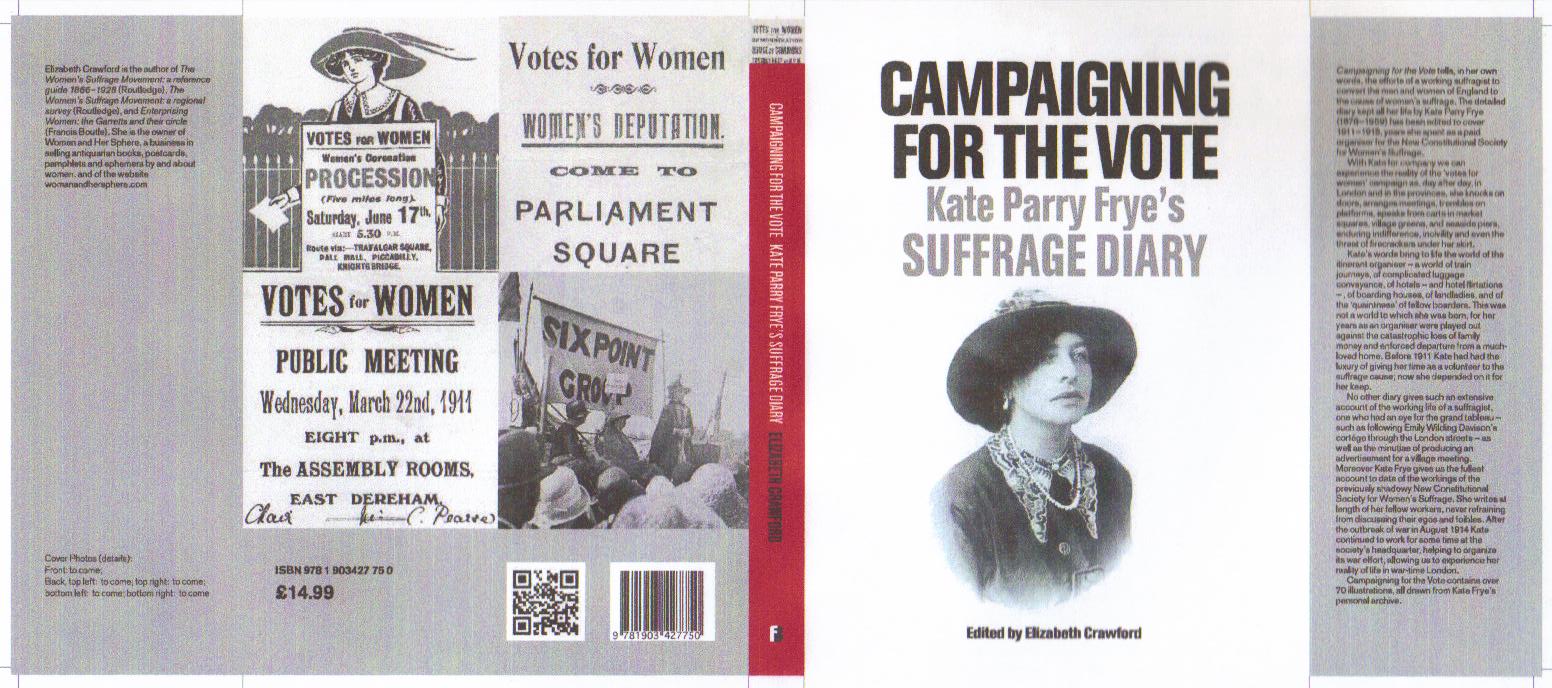
- ‘Campaigning for the Vote’ – Front and back cover of wrappers
Collecting Suffrage: Suffragette Jewellery And ‘The Antiques Trade Gazette’
Posted in Collecting Suffrage on May 17, 2013
This week’s issue of the Antiques Trade Gazette contains a letter from me protesting against the mis-describing of random pieces of Victorian/Edwardian jewellery that have a combination of metals and/or stones approximating to the purple, white and green of the WSPU, as ‘suffragette’.

Here is the text of the letter:
‘As a long-established dealer in suffragette memorabilia I must try once again to take a stand against the mis-labelling as ‘suffragette’ of any pieces of jewellery that contain stones approximating to some shade of purple (or pink or red), white and green.
I see on page 32 of this week’s ATG that two auction houses so described 3 brooches/pendants. I have no idea if the intrinsic value of the items was commensurate with the sale price achieved, but of one thing I am certain – there was nothing in the lot descriptions that convinced me that these pieces had any association with the suffragette movement. I only hope that those bidding were not doing so with any thought that they were acquiring a piece of suffragette history. It should be obvious to anyone with any historical sense that it is necessary to have a much more detailed provenance – a documented history – other than some woolly description about ‘purple, white and green’.
The ‘colours’ were the invention of one of the leaders of the WSPU, Mrs Emmeline Pethick-Lawrence, as a way of creating a ‘brand’ for the WSPU and were first used in June 1908 at a grand rally held by the WSPU in Hyde Park.‘The Public Meeting Act’ of December 1908, mentioned in the ATG piece, was intended, although notably unsuccessful, to prevent suffragettes from heckling ministers – not to prevent suffragettes themselves from holding meetings. It was not until years later – in April 1913 – that there was any prohibition on the WSPU holding meetings in public parks. Moreover, Britain was never such a repressive country that suffragettes found it necessary to wear jewellery ‘in the colours’ as a secret token of allegiance. Quite the reverse; women wore their badges (also now very collectable) proudly –advertising the WSPU and many other suffrage societies.
Since each of these societies followed the WSPU lead and adopted an individual combination of colours of their own I am surprised that auction houses and dealers have not yet leaped onto that bandwagon. For instance, the colours of the main suffrage society – the National Union of Women’s Suffrage Societies – were red, white and green. Just think how many pieces of jewellery with stones in those colours could be described as ‘suffragette’ if we were seriously to follow the ‘purple, white and green’ rule.
I have studied the suffragette movement in depth – in all its manifestations – and can report that there is no evidence that ‘suffragette’ jewellery was made in anything like the quantity flooding the auction houses and, of course, Ebay. Moreover the only commercial company known to have made and retailed ‘suffragette jewellery’ as such was Mappin and Webb (Stanley Mappin was a convinced supporter of the WSPU – joining in the suffrage boycott of the 1911 census). I would be interested to learn of any documentation citing any other commercial company as maker of ‘suffragette jewellery’.
Other jewellery was made by individual artist craftswomen- such as the well-known enameller Ernestine Mills – to sell at fund-raising suffragette bazaars and may well have included references to suffragette colours and motifs. On occasion one can find pieces that demonstrate clearly their suffragette provenance. One such is a pendant made – in purple, white and green enamel – from a design by Sylvia Pankhurst. The pendant is long since sold but I use the image of it as the identifier on my website – womanandhersphere.com – on which those who really want to know about ‘suffragette’ jewellery can find more information – as they can in the entry under ‘Jewellery and Badges’ in my The Women’s Suffrage Movement; a reference guide, published by Routledge. Ignorance should not be a reason for allowing auction houses and dealers to perpetuate the ‘suffragette jewellery’ myth. As I say, I specialize in suffragette memorabilia but could not possibly bring myself to sell something as ‘suffragette’ if I was not certain that it had an authentic provenance.’
I don’t suppose this will make a jot of difference – but I try. A suffrage collector told me recently that, after buying an item on Ebay and then doing a little research, he realised that the item was not of original suffragette provenance. When he protested to the Ebay seller, he was told, ‘Prove it’. That was not a valuable item, so it was not worth the trouble of engaging in a prolonged battle with a seller who lacked both historical knowledge and a conscience. However, I am sure there are cases, particularly of jewellery, where sales are made that would not have been without the spurious ‘suffragette’ description.
Caveat Emptor
Buy only from a reputable dealer.
Suffrage Stories/Campaigning for the Vote: Selfridge’s and Suffragettes
Posted in Kate Frye's suffrage diary, Suffrage Stories on May 16, 2013
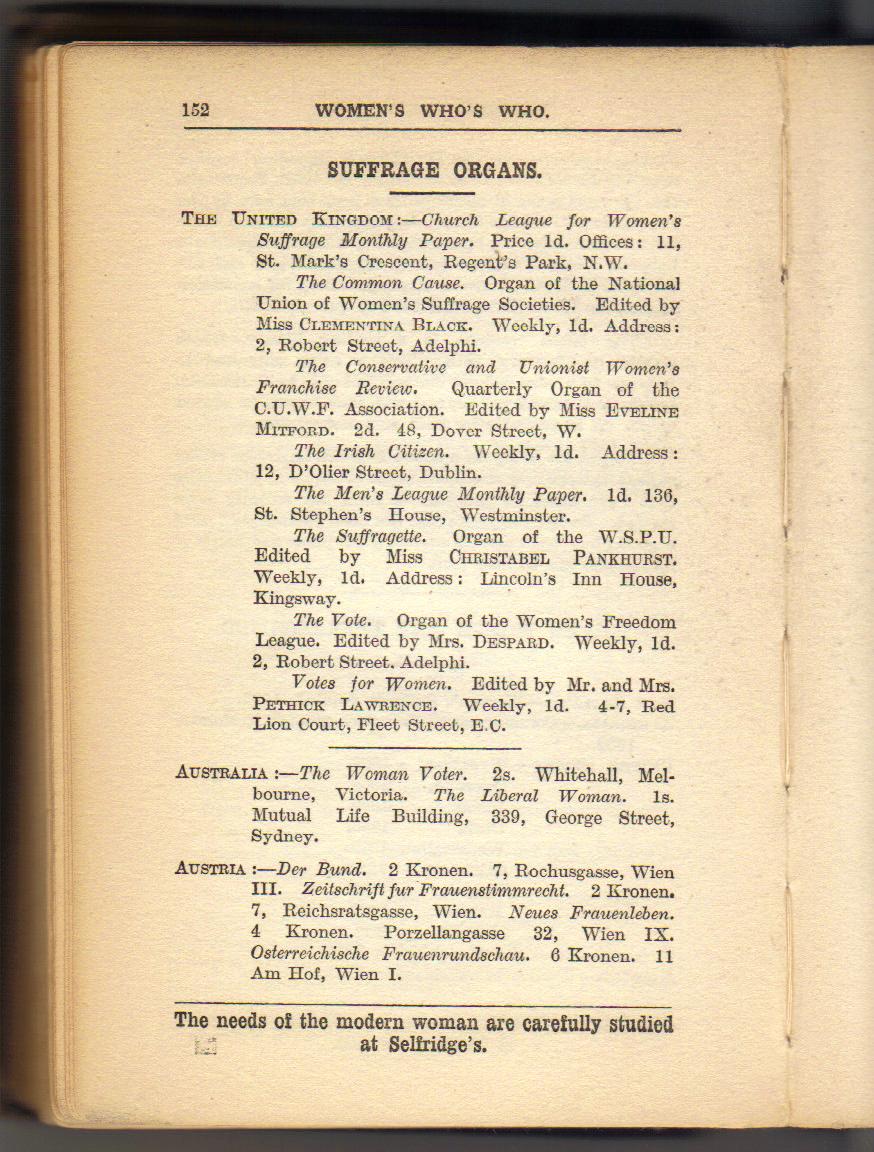
The Suffrage Annual and Women’s Who’s Who
Selfridge’s opened its glamorous, purpose-built store in Oxford Street on 15 March 1909 and Kate Frye, an ever curious shopper, paid her first visit there on 29 March. (For Kate’s published suffrage activities see here.)
In the morning Kate attended a meeting of the Dance Committee of which she, along with the actress Eva Moore, was a member – they were organising a fund-raising dance for the New Constitutional Society for Women’s Suffrage. Then she met her fiance, John Collins, and, together, they went along to inspect Selfridge’s.
‘We had some lunch there and did the roof and tried to make ourselves giddy – it was lovely up there. Then we systematically did the shop beginning with the top. We had 2d of gramophone each and generally played about and it was 4.30 by the time we had finished. It is a wonderful building but there is nothing in the goods to especially attract. The place was packed and a good many people were buying.’
Kate was, of course, a keen suffrage sympathiser and, although she may not, on that first visit, have appreciated it, Selfridge’s was to be generally supportive of the suffrage cause. For four years later, advertising itself as ‘Selfridge and Co: The Modern Woman’s Club-Store’ on the book’s purple cover, Selfridge’s put its stamp on what is now one of the most useful research tools available to suffrage historians.
The Suffrage Annual and Women’s Who’s Who, published in 1913, contains irreplaceable details about women involved in the suffrage campaign – both militants and constitutionalists. It is likely that Selfridge’s underwrote much of the expense of producing it for, as you see, besides its cover advertisement, the store took running advertisements along the foot of every page.
It is reported, but I have yet to verify, that on occasion Selfridge’s dressed their windows in the purple, white and green colours of the WSPU and even flew the WSPU purple, white and green flag from the store’s flagpole.
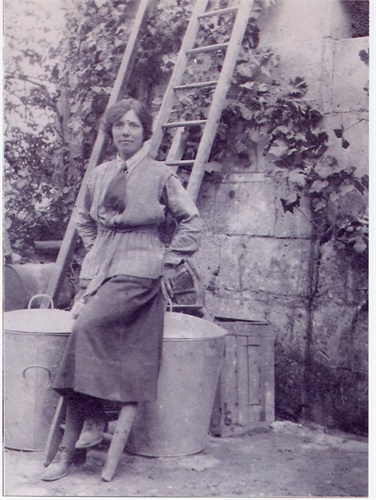
Gladys Evans (photo courtesy of Ward Skinner)
However, one clear link between Selfridge’s and the suffragettes is this woman, Gladys Evans, the daughter of a man, now dead, who had owned the British weekly magazine Vanity Fair –a very influential ‘society’ paper ( not to be confused with the Conde Naste magazine which in 1914 adopted the name). Gladys joined Selfridge’s in 1908 in preparation for the opening of the new store and worked there for over a year before leaving to take over a WSPU shop. In 1911 she emigrated to Canada, where a sister had settled, but returned in March 1912 after learning of the arrests of Mrs Pankhurst and Mr and Mrs Pethick Lawrence.
Firmly back on the WSPU warpath, in July 1912 Gladys went over to Dublin where Asquith was on a formal visit and, with other suffragettes, Mary Leigh and Jennie Baines, set fire to a theatre – empty at the time – but the one in which Asquith was due to speak that evening. Gladys Evans was given a long prison sentence, went on hunger strike and was forcibly fed for 58 days.
There was a good deal of lobbying to get her and her companions given the status of political prisoners – which would have allowed them better conditions. One of those who wrote on Gladys’ behalf was Selfridge’s staff manager, Mr Best. and 253 of the store’s employees signed a Memorial sent to the Lord Lieutenant of Ireland pleading for a remission of Gladys Evans’ sentence – see Votes for Women, 6 September 1912. Apparently, even Mr Selfridge himself was sympathetic, though reluctant to put pen to paper in Gladys’ support because, as an American, he thought it might look as though he were trying to interfere in matters that didn’t concern him. Gladys and Mary Leigh were eventually returned to England, where they promptly gave the police the slip and went on the run.
For most of her later life Gladys Evans lived in the US, dying at the age of 90 in Los Angeles. Evans’ family history relates that Gladys gave all her suffragette papers to the New York Public Library. I have not, however, been able to find a listing for them. That might be a research project for an interested New Yorker.
Selfridge’s suffrage sympathies may have stood the store in good stead when the WSPU went on its window-smashing campaigns in November 1911 and March 1912. Many department stores- even those which, like Swan and Edgar, were regular advertisers in Votes for Women – were targeted. But Selfridge’s windows – 21 in all, of which 12 contained the largest sheets of plate glass in the world – escaped unscathed.
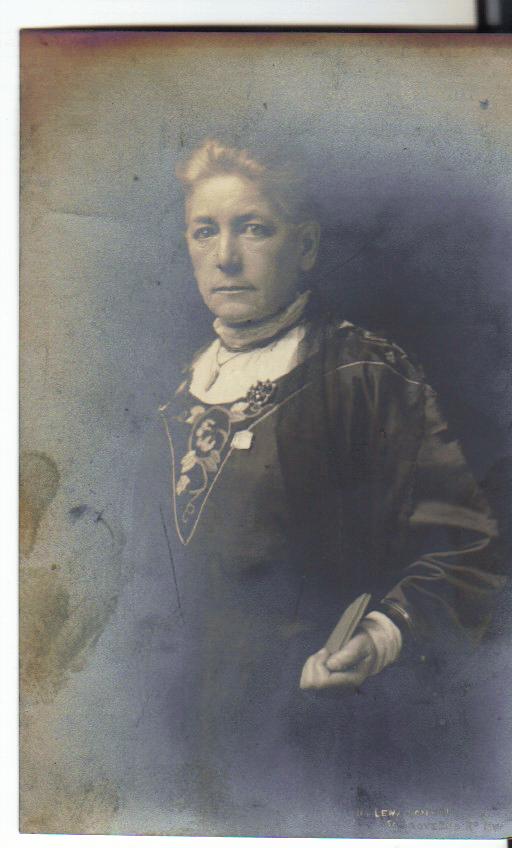
Sarah Bennet, photographed by Lena Connell
However in February 1913, in protest against the fact that the government had been withdrawn the proposed Franchise Bill, Sarah Benett, one-time treasurer of the Women’s Freedom League, was sentenced to six month’s imprisonment after breaking one of these windows. Incidentally, Sarah Benett in 1916 sent a donation to Maud Arncliffe Sennett towards the expense of employing Gladys Evans as an organizer for the Northern Men’s Federation for Women’s Suffrage.
Copyright
Suffrage Stories: The 1911 Census: A Bristol Boycotter
Posted in 1911 Census, Suffrage Stories on May 14, 2013
There is no end to the interesting family histories one unearths while digging into the suffrage boycott of the 1911 census.
I recorded in the Women’s Suffrage Movement: a reference guide that in 1913 a certain ‘H.M. T Lehmann’ was the honorary secretary (pro tem) of the Bristol branch of the Men’s Political Union for Women’s Enfranchisement and that his address was ‘Rock Mount, Shirehampton’. As a child I lived in Bristol very close to Shirehampton, so this address stayed with me and I thought that when I had an idle moment I would investigate this 3-initialled man about whom I knew nothing.
When I came to look at the census return for ‘Rock Mount’ I was very interested to discover that, although there was no mention on the form of ‘H.M.T’ Lehmann – the householder, Caroline Edith Lehmann, was a census boycotter. She wrote firmly across the form: ‘Being an unrepresented ratepayer I refuse to give any information respecting myself or my household for the benefit of an Un-Liberal government. C.E. Lehmann. ‘ But who were Caroline Edith and H.M. T. Lehmann? Their names, as far as I know, appear nowhere else in suffrage history.
Well, it took some untangling – but here goes.
Caroline Edith Mayne was born in 1859 in Kidderminster, daughter of a former captain in the 10th Dragoons In 1883 she married John Harold Watson, a minor Kidderminster industrialist, with whom she had 2 daughters, Hilda and Joyce. Ten years later, in 1893, Watson filed a petition for divorce against her, citing a Weston-super-Mare pharmacist, Henry Ruck. The petition goes into considerable detail, describing adultery committed in 1888 and 1893 – and presumably at times in between – at various addresses -in Weston Super-Mare, particularly at 5 Royal Crescent where Caroline Watson was staying. The decree nisi was given in 1895. Ruck’s wife divorced him for desertion in 1895. While the Watson divorce case was being heard Caroline was only allowed access to her children once a week – at her mother’s Kidderminster house. It is clear that her husband was trying to prevent her having any access at all and after the divorce the two daughters remained in Kidderminster with their father. I wonder how often they saw their mother in later life? Neither married.
In November 1897 in London – at 41 Burlington Road, Paddington – Caroline gave birth to a son – Heinz Maurice Talbot Lehmann. On his birth certificate his father is given as Ernst Lehmann, journalist, and his mother as Caroline Edith Lehmann, late Watson, formerly Mayne. The couple had been married in April 1896 in London – with Caroline’s name given as ‘Edith Lillie Watson’.
Four years later, when the 1901 census was taken, mother and son, who was now known as ‘Henry’ rather than ‘Heinz’, were living at Ramsbury Road, St Albans. Caroline Lehmann is described as married, but there is no trace on the census of Ernst Lehmann either here or elsewhere in England. The fact that his son’s name has been anglicized may indicate that by now Ernst was removed from the household. I think that, as Ernest Lewis, he died in Kensington in 1927.
At some point between 1901 and 1911 mother and son moved to Shirehampton, on the outskirts of Bristol, to a house in Station Road that went under the name, variously, of ‘Rockmount’ or ‘Rock Mount’. In 1911 the census enumerator was informed that Henry Lehmann was a pupil at Clifton College. Caroline was to remain living in Shirehampton for the rest of her long life. Her later address was Talbot Cottage, 27 Grove Leaze.
Caroline Lehmann’s interesting marital history and the separation from her two daughters may well have coloured her views on ‘votes for women’. How could they not? Certainly by 1910 she was an active member of the Women’s Social and Political Union. In that November she was part of a Bristol delegation arrested when Mrs Pankhurst led a deputation to Downing Street in the aftermath of the ‘Black Friday’ violence in Parliament Square. In 1911, as we have seen, she followed the WSPU call to boycott the census.
Then, on 2 March 1912, Caroline travelled to London to take part in the WSPU’s window-smashing campaign on 4 March. Her diary for this period survives – describing a few suffrage meetings in Bristol (including one organised by the Labour party), followed by the journey to London with about 16 other Bath and Bristol WSPU members, including Victoria Simmonds (later Lidiard). She described how she felt a little fearful. On 3 March she went to the house of Mrs Beatrice Sanders in Battersea to hear details of the next day’s demo.
Caroline Lehmann threw her stones at a basement window in the Home Office – she was then dragged to Cannon Row police station – where she met up with Victoria Simmonds who was also being charged. Caroline described how she had managed to get rid of one of the number of stones she was carrying on her way to the police station – and then tried to drop the rest under the table. She described how she felt the greatest happiness in having done her bit – saying that while she was waiting to do her deed in Whitehall she kept in mind the horrors of the White Slave Traffic. The arrested suffragettes in that police station were all bailed out at 11pm by Frederick Pethick-Lawrence, a prominent supporter of the WSPU. Caroline was not tried under her own name – but is doubtless ‘Caroline Maurice’ who appeared at Bow Street on Sat 9 March. (Maurice was her son’s second name).
Caroline’s diary then describes prison life in great detail- a day by day description. She had managed to smuggle her knitting, a book, and notepaper and pencils hidden in her bloomers – to keep her occupied in her cell. She describes the games of football played by the younger suffragettes – the ball was a vest stuffed with fibre taken from mattresses. She joined in the hunger strike but was not forcibly fed before the Home Office gave in and allowed them Rule 243A privileges.
Had Caroline encouraged her son to take up the position as ‘hon sec pro tem’ of Bristol’s Men Political Union? He was barely 16 in 1913 but, from what I have learned of his subsequent career, would certainly have been ‘up’ for anything that might set him in opposition to the establishment.
Henry Lehmann joined the army in October 1914. His military record states that he was 19 but he was, of course, actually only 17. I wonder if he consulted his mother before taking this step? I rather doubt it. On 17 December 1915, at the grand old age of 18 and 1 month, Henry Lehmann, now a 2nd lieutenant in the 3rd Essex Regiment, gained his Aero Club Aviator’s certificate. He qualified while flying a Maurice Farman biplane. His address at this time was 192 Redland Road, Bristol. The Royal Aero Club album containing his 1915 photograph can be accessed by subscribers to Ancestry.com. While serving with the Royal Flying Corps, he was awarded the Military Cross.
In 1917 Henry married and with his wife, Joyce, had two daughters – Yvonne and [Bridget] Margaret. The couple divorced in 1925, with Joyce being given custody of children. Matters had obviously become rather desperate as Joyce forewent maintenance on condition that Henry had no communication with her.
In January 1928 Joyce Lehmann was living in Malvern with her younger daughter, working as secretary to Malvern Ladies’ College, having left the elder daughter, Yvonne, in Shirehampton in the care of her mother-in-law, with whom she clearly had a rapport despite the divorce. Henry Lehmann arrived one day at the school and, posing as a ‘Major Brown’ asked to see Mrs Lehmann. Despite this trick, Joyce Lehmann felt compelled to agree to her ex-husband’s request to take their daughter for a walk. She was clearly fearful that he would cause a scene and jeopardise her position at the school.
Henry did not return young Margaret at the due time and Joyce Lehmann was forced to institute court proceedings. After an Interpol search Margaret was discovered two weeks later, enrolled in a boarding school at Lille, and returned to her mother.
Henry Lehmann had an exotic post-First World War flying career, on occasion wing-walking with a flying circus and working as an advisor the the Chinese Nationalist air force. The latter position resulted in questions being asked in the House of Commons.
Clearly a man of parts, in 1940, while based in Sydney, Australia, Henry designed and built a sailing yacht, the Escapee, which, classed as a ‘tall ship’, is still sailing in the 21st century.
Lehmann later emigrated to Canada, flying with the Canadian Royal Air Force and as a commercial pilot – and died in 1956, the same year as his mother.
Anyway, all this is what comes of wondering who was the ‘hon sec pro tem’ of the Bristol branch of the Men’s Political Union for Women’s Enfranchisement. Alas, I am unable to use images of Caroline Lehmann and her diary in order to enliven the story – but perhaps readers may consider it quite lively enough without
Copyright
All the articles on Woman and Her Sphere and are my copyright. An article may not be reproduced in any medium without my permission and full acknowledgement. You are welcome to cite or quote from an article provided you give full acknowledgement.
Campaigning for the Vote: Kate Frye in ‘History Workshop Online’
Posted in Uncategorized on May 13, 2013

Do click History Workshop Online
to discover how, in a dark and dank north-London cellar, I first encountered Kate Parry Frye and how I slowly recognized the importance of her diaries are to those interested in the suffrage movement.
To buy Campaigning for the Vote, published by Francis Boutle Publishers, £14.99 click here
Campaigning For The Vote: Book Launch Invitation
Posted in Kate Frye's suffrage diary on May 9, 2013
Campaigning for the Vote: Kate Frye And The Problem Of The Diarist’s Multiple Roles
Posted in Kate Frye's suffrage diary on May 7, 2013
In the following article I discuss the ethics of ‘mining’ the diary that Kate Parry Frye kept for her entire lifetime in order to re-present her in one role only– as a suffragist. The piece is based on a paper I gave at the 2011 Women’s History Network Conference. Campaigning for the Vote: Kate Parry Frye’s Suffrage Diary is published by Francis Boutle Publishers at £14.99
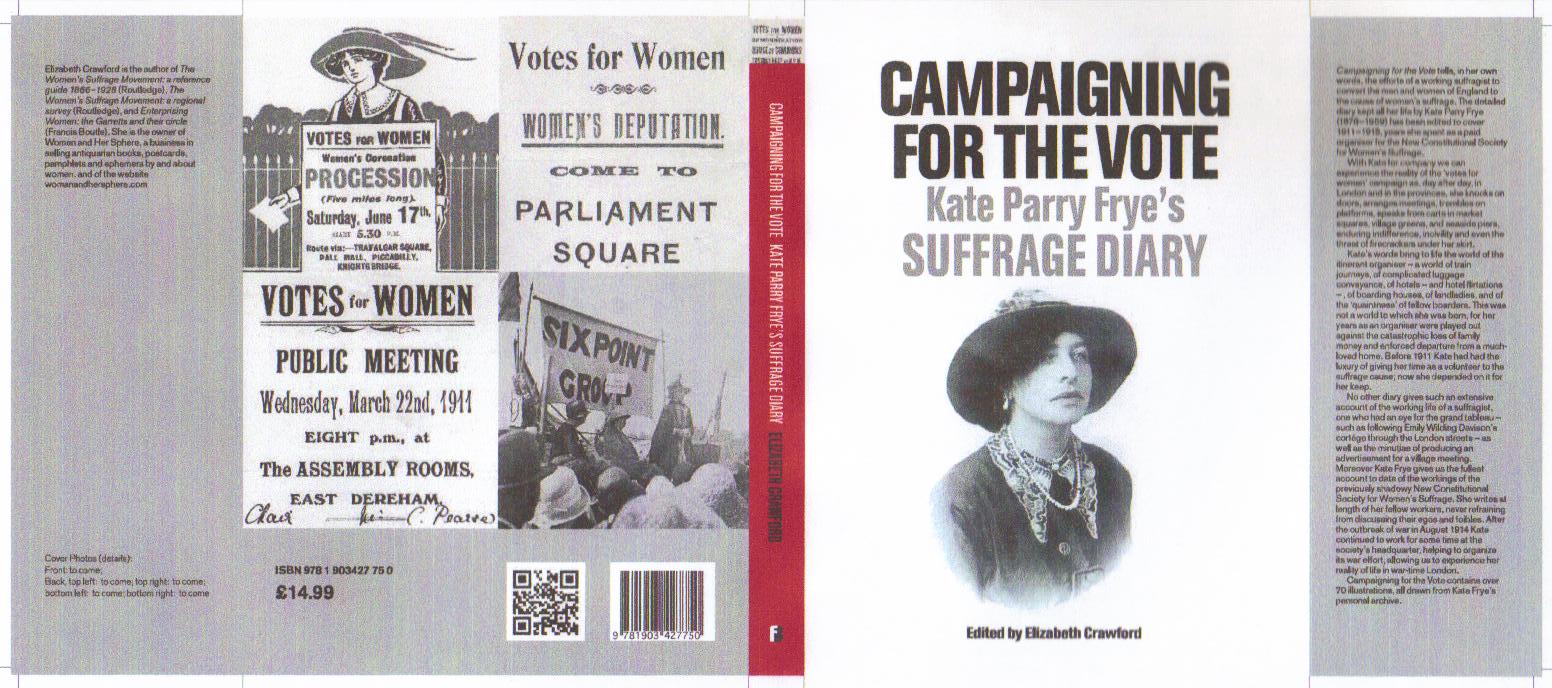
‘Campaigning for the Vote’ – Front and back cover of wrappers
Kate Parry Frye[1] was a diarist. She was also a girl, a young woman, a middle-aged woman, an old woman, a daughter, a sister, a cousin, a niece, a fiancée, a wife, an actress, a suffragist, a playwright, an annuitant, a letter writer, a Liberal, a valetudinarian, a playgoer, and a shopper. She was a rail traveller, a bus traveller, a tube traveller, a reader, a flaneur, a friend, and a political canvasser. She was a diner – in her parents’ homes, in digs, in hotels, in restaurants, in cafés and later, of necessity, a diner of her self-cooked meals. She was an enthusiast for clothes, a keeper of accounts, a reader of palms, a dancer, a holidaymaker, a visitor to the dentist, to the doctor, an observer of the weather, a worker of toy theatres, a needleworker, an animal lover – indeed dog worshipper – a close observer of the First World War and then of the Second.
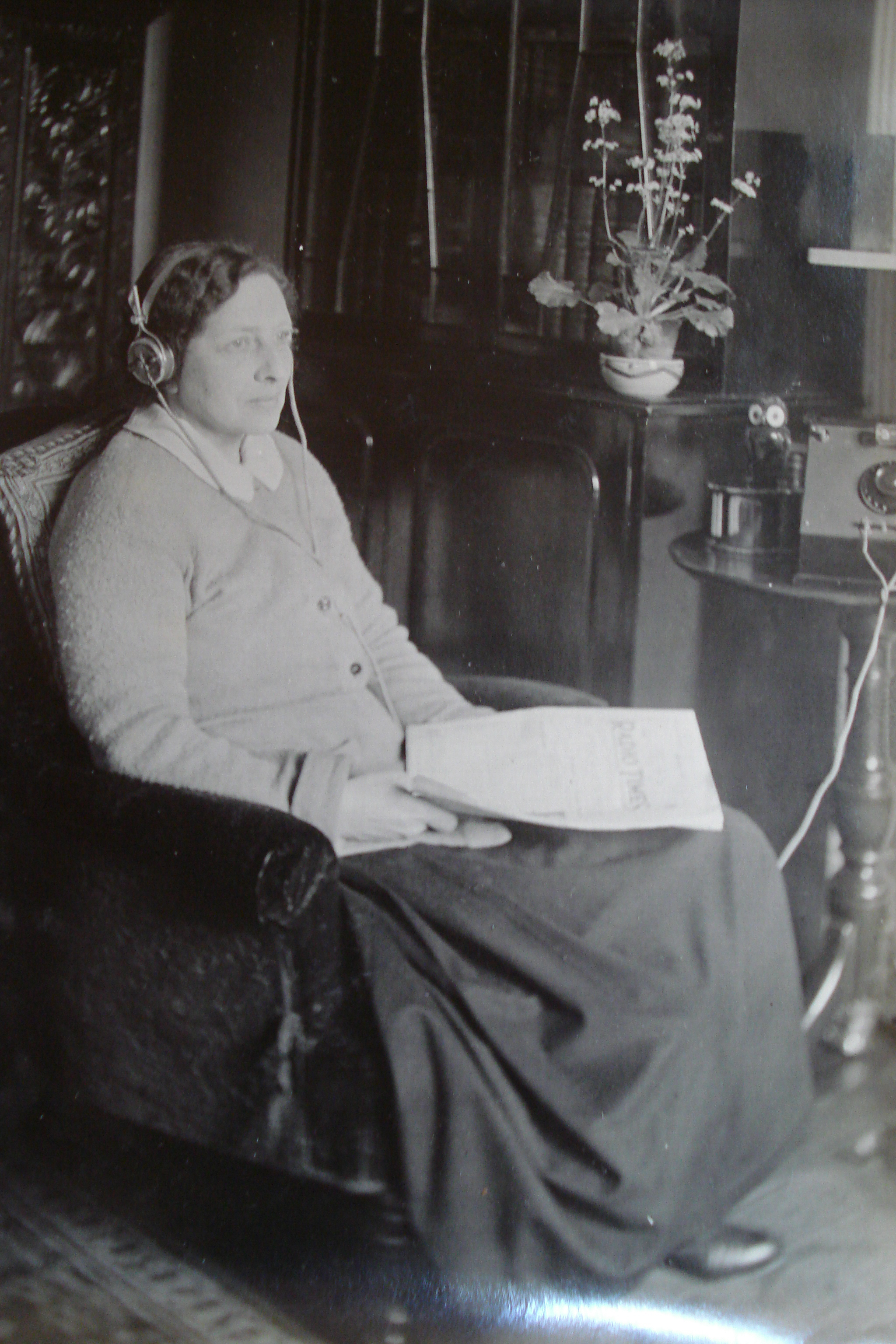
Kate as a radio listener – 1920s?
She was radio listener, a television viewer, a neighbour and, finally, a carer, recording in detail the effect on her husband of the remorseless onset of dementia and the disintegration of his body and mind. Every one of these roles is played out in minute detail in the diaries Kate Frye kept for 71 years, from 1887, when she was 8 years old, until October 1958, barely three months before her death in February 1959.[2]
Moreover, each role has its variations, depending on time and place. Thus, for example, as a middle-class daughter, Kate Frye played the pampered child, the indulged adolescent and, later, the resentful adult.
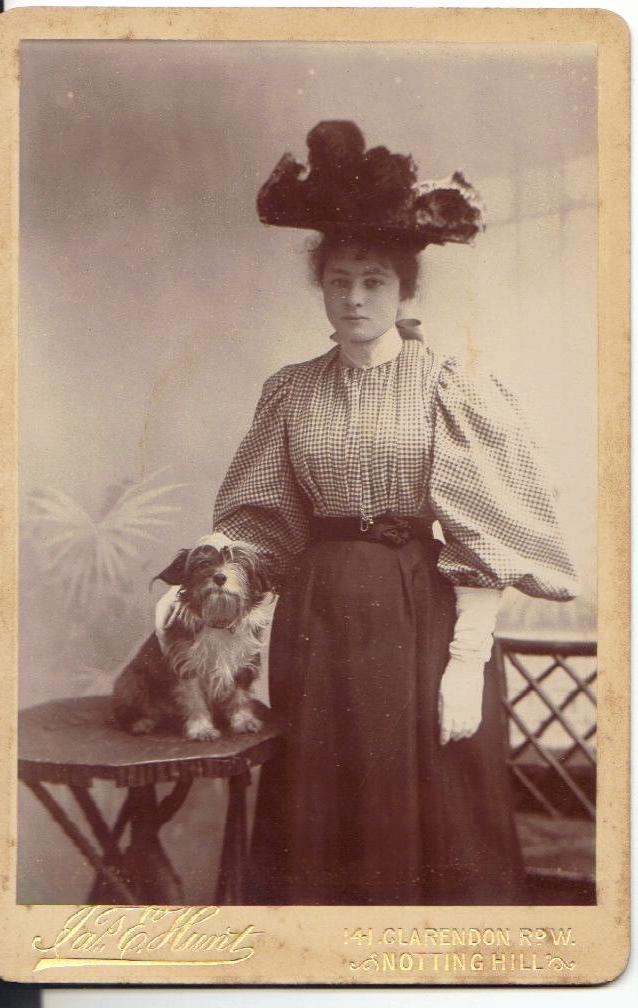
Kate photographed c 1897
She was for many years supported financially and lived comfortably. In early womanhood she was afforded considerable freedom, her parents allowing her, indeed encouraging her, to train as an actress and to travel around Britain and Ireland with a repertory company. When that venture proved unprofitable she was able to return to life as a daughter-at-home, a role that appears to have combined the minimum of domestic chores with the maximum of freedom. Until December 1910 the family divided their time between two homes – a house, later a flat, in North Kensington and ‘The Plat’, a large detached, much-loved house on the river at Bourne End in Buckinghamshire.

Details of the auction of The Plat and its contents – the Fryes’ possessions
But Kate Frye was also the daughter of a man whose business failed, whose lack of financial acumen she judged harshly, forcing as it did her mother, her sister and herself to leave their homes and sell all their possessions. Before 1910 there had been periodic indications of financial instability, when, for instance, ‘The Plat’ was let out for the summer, but Kate’s father failed to take his wife and daughters into his confidence, making the ultimate catastrophe all the more shocking. To Kate’s shame the family subsequently relied on the charity of her mother’s wealthy wine-merchant relations, the Gilbeys.[3] Her role in this performance might be studied, shedding as its does a clear light on the precarious reality of the long Edwardian summer. One year Kate could take for granted a life of boating and regattas, dressmakers, cooks and maids, the next she was living in dingy digs, attempting to raise money by hawking the family jewellery and old clothes around shops, while wondering if her relations had remembered to send the remittance and what she would do if they forgot..
Or perhaps one could look through Kate Frye’s eyes at the reality of working the towns of Edwardian England, Scotland and Ireland as an actress.

Kate Frye photographed in costume for her part in J. M. Barrie’s ‘Quality Street’ – on tour in 1903
For instance, between September and December 1903 she was a member of a Gatti and Frohman touring production of J.M. Barrie’s Quality Street and writes in considerable detail of company train travel, theatrical lodgings and the other members of the cast, among who was a young May Whitty. Kate was paid £2 a week and includes in the diary some weekly accounts, which could be studied in conjunction with the management’s financial accounts of the tour.[4] Or her diary could be used to give an insight into the issue of class and gender in the Edwardian theatre; Kate’s experience does not indicate that family and friends felt that her new role was in any way either imprudent or declassé.[5] Or her diary might be used to research the behind-the scenes world of post-1918 theatre, as Kate reports on her husband’s attempt to earn a precarious living as actor and stage manager.[6] Kate’s involvement with theatre saw her performing on both sides of the stage – in her role as an actress and, in the auditorium, as a spectator – and her diary might also be used to study of the habits of playgoers over the decades, recording as it does her comments on the vast number of performances she attended. On occasion she thought nothing of seeing two plays in one day.
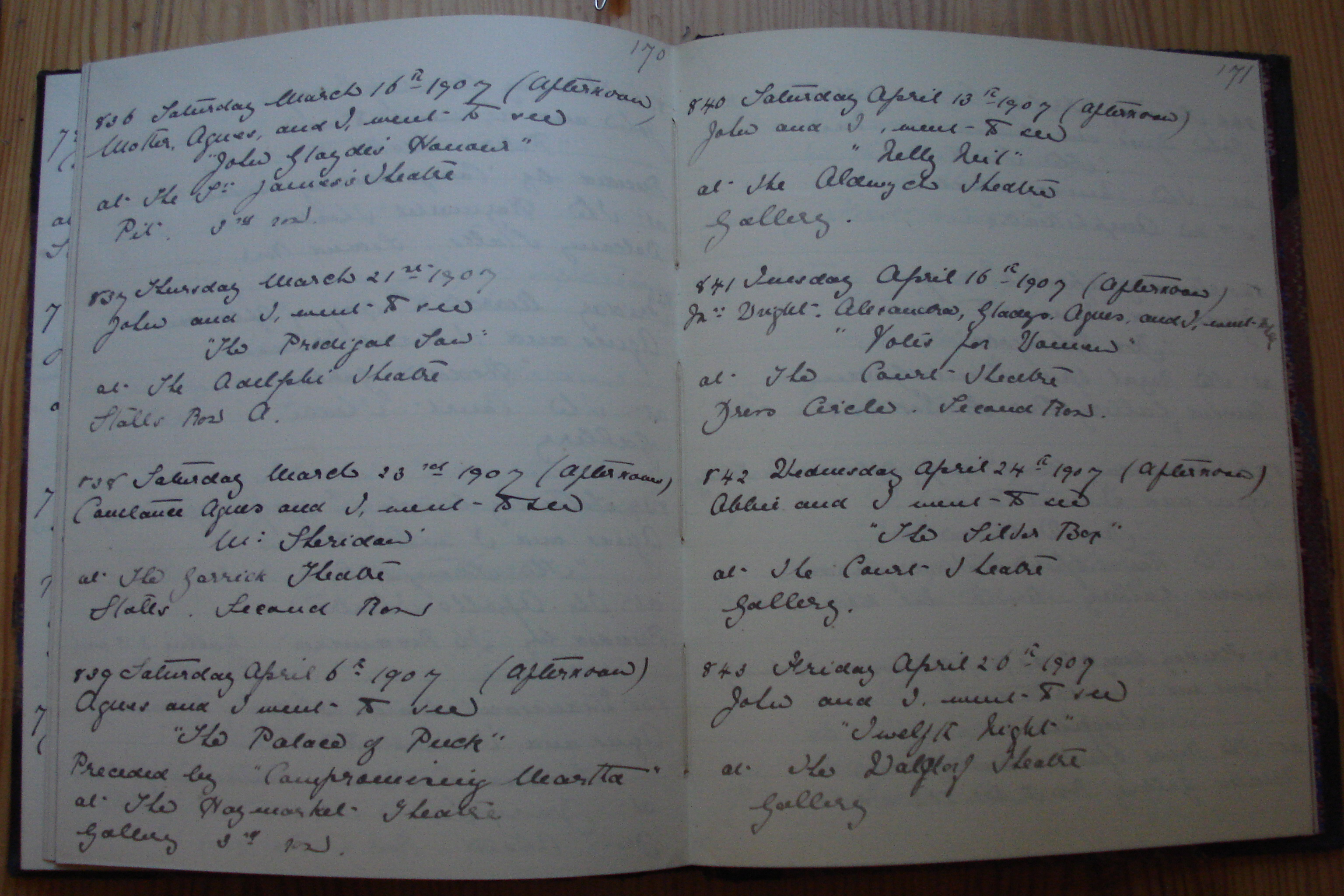
Kate kept a separate record of all the plays she saw – including Elizabeth Robins’ ‘Votes for Women!’
Or perhaps one could use her diary to study the nature of ill-health, real or perceived. Menstrual pain – ‘the rat pain’ – lurks behind some of Kate’s continuous complaints of ‘seediness’ and included in some of the diaries are small yearly calendars with the date of each menstrual period marked in pencil.

Kate’s menstrual calendar
But the feeling of ill-health suffered by Kate, by her elder sister, Agnes,[7] and their mother was due to more than menstruation. For weeks at a time, year after year, one or the other, or all three, are confined to their beds. The doctor calls – and is paid – medications are prescribed and taken. For some of the time ‘seediness’ is endured and Kate, at least, gets on with things. It is noticeable that when she has an active life to lead, whether on tour as an actress or as a suffrage organiser, she makes many fewer complaints of ill-health. It is difficult to avoid the thought that some, at least, of the malaise was due to depression occasioned by lack of occupation. Kate did, after all, continue fit and healthy until she was 80. The diary could be read and edited to bring this aspect of her life to the fore, studying the links, in the first 50 years of the 20th century, between status, expectation and occupation – or lack of it – and mental and physical wellbeing Certainly Kate’s sister, who never worked and appears to have had few interests, seems to have given up on life, spending much of her later years in bed and drifting into death. However, although these aspects of Kate Frye’s life are intriguing, it is for her involvement with the Edwardian suffrage movement that she is now likely to be remembered. For Kate Frye’s diaries have been directed, by chance, towards an editor whose research interests centre on suffrage.
Kate was what one student of diary writing terms a ‘chronicler’, that is her diary was a ‘carrier of the private, the everyday, the intriguing, the sordid, the sublime, the boring – in short a chronicle of everything’ and in its extent is not a little daunting.[8] But, reading the volumes covering the years prior to the First World War, one quickly realises that involvement in one of the major campaigns of the day provided Kate’s life – and her diary – with a focus. For the Frye family’s descent into near, if genteel, destitution coincided with the growth of the suffrage movement, which subsequently provided Kate with employment. Although she was untrained for any career other than acting, which she had found, in fact, did not pay, work of a political nature was not outside her sphere of knowledge, for one of her earlier roles had been that of the daughter of an MP. Kate’s father, Frederick Frye, had been the Liberal member for North Kensington from 1892 to 1895 and an interest in politics was taken for granted within the family. Over the years Kate had helped her mother with the regular ‘At Homes’ held for the Liberal ladies of North Kensington and had accompanied her father to many a political meeting.
Flyer advertising the NUWSS ‘Mud March’
The diary entries trace her growing involvement in the suffrage campaign, from participation in the first NUWSS ‘Mud March’ in early 1907, through her performance as a palm reader at numerous fund-raising suffrage bazaars and dances, attendance at meetings of the Actresses’ Franchise League, marching in all the main spectacular processions, stewarding at meetings, bearing witness to the ‘Black Friday’ police brutality in Parliament Square on 18 November 1910, to her employment, from early 1911 until mid-1915, as a paid organiser for the New Constitutional Society for Women’s Suffrage. The diary, as edited as Campaigning for the Vote, highlighting the detail Kate provides of daily life as a suffragist and illustrated with the wealth of suffrage ephemera with which she embellished the original, is an interesting addition to published source material.
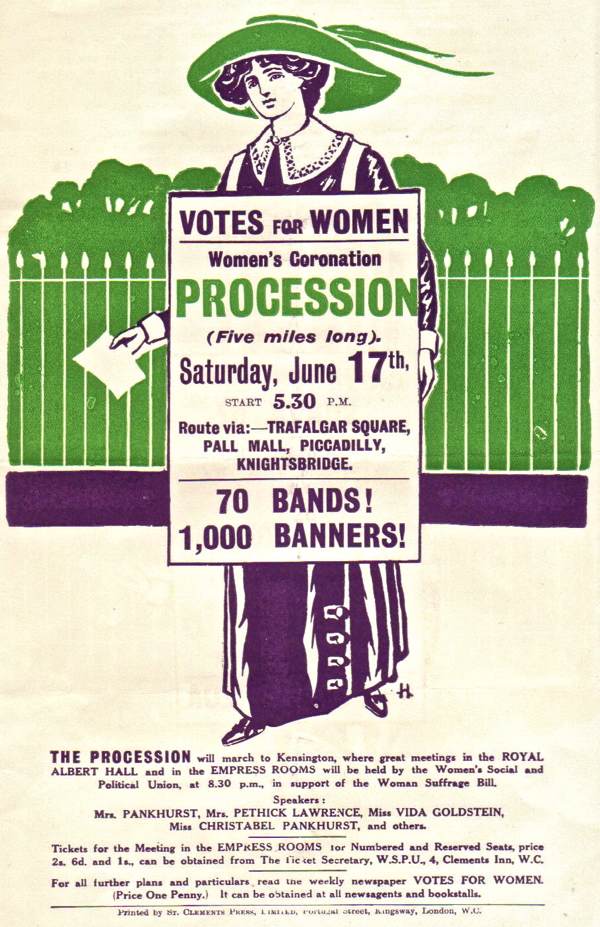
But what are the ethics of spotlighting this one role – or any role – from a lifetime performance? Kate’s diary seems to lend itself quite naturally to a style of editing that sets her entries, replete with delightfully quotidian suffrage detail, within a linking narrative, explaining the greater campaign and providing information on people she meets in the course of her days. But, increasingly uneasy, the editor of Kate Frye’s diary felt it necessary to take soundings from commentators on diary writing in order to discover whether the perceived problem, that of highlighting only one of the diarist’s multiple roles – one of her many selves, is one that others have resolved.
Robert Fothergill’s Private Chronicles, published 35 years ago, is generally considered the earliest academic work to have made a serious study of diary-writing.[9] In his study Fothergill considered the diaries both of men and of women but since then much of the attention the genre has received has concentrated on diary writing by women. For in the 1980s and 1990s, with the growing interest in women’s history, academics such as Margo Culley, Cheryl Cline, Harriet Blodgett, Suzanne Bunkers and Cynthia Huff saw women’s diaries as an exciting new source through which to re-examine and re-envisage women’s lives.[10] As Bunkers and Huff wrote, ‘Within the academy the diary has historically been considered primarily as a document to be mined for information about the writer’s life and times – now the diary is recognized as a far richer lode. Its status as a research tool for historians, a therapeutic instrument for psychologists, a repository of information about social structures and relationships for sociologists, and a form of literature and composition for rhetoricians and literary scholars makes the diary a logical choice for interdisciplinary study.’[11] These writers use metaphors such as ‘weaving’, ‘quilting’, ‘braiding’ and ‘invisible mending’ to describe the way in which a woman fashions her diary, a diary of dailiness rather than of great moments. But that ‘weaving’ or ‘quilting’ or ‘braiding’ lies at the heart of the problem. Is it legitimate to unravel this self-construction and fashion it into something else?
That question might be answered quite simply by a judgment made in 1923 by Sir Arthur Ponsonby and much quoted, even by the American women historians of the 1980s. For in English Diaries, Ponsonby was adamant: ‘No editor can be trusted not to spoil a diary.’[12] For his part, Robert Fothergill stated that the only respectable motive behind the amputation of a diary was the desire to make it readable – ‘commonly the abridgement or distillation of an unwieldy original, through the elimination of whatever was considered stodgy, pedestrian or repetitious’.[13] But such an ‘amputation’ is not unproblematic, for what might be considered stodgy and pedestrian to one reader, or in one decade, might be lively and interesting to the next. To anyone interested in the daily life of a suffragist, even the repetitions in Kate Frye’s daily life are revealing. Cheryl Cline elaborated Fothergill’s point, writing, ‘The most sensitive and careful editors, in cutting what they may feel unimportant, irrelevant, repetitious or even “too personal”, walk a very fine line. They may end up, for all their good intentions, ruining the work. Many editors have been neither sensitive nor careful. Editors have cut manuscripts they felt were too long, padded those they thought too short; re-arranged material to suit themselves; bowdlerized writings which revealed the less-than-perfect character of their authors. Too often, they have destroyed the originals once the edited version was published’.[14] So reservations about editing Kate Frye’s lifetime performance to refashion it as a ‘suffrage diary’ are, perhaps, not unjustified, although Kate Frye’s published diary will be neither ‘padded out’, or ‘bowdlerized’, nor will the original be ‘destroyed’. However, the charge of ‘re-arrang[ing] material’ is, perhaps, not inappropriate. It is not that the published entries will have been re-arranged, rather they will have been accorded a prominence they did not have in the original.
It is worth remarking that much of the academic literature on diary writing concentrates on the published diary.[15] There appears to be little recent consideration of the ethics of, as Bunkers and Huff put it, ‘mining’ a manuscript diary for the light it throws on particular aspects of the past, other than the difficulty this creates for those critiquing diary writing per se. Indeed, these authors appear to suggest that it was only in the past that a diary would be treated in this way. Fothergill touched on this point, condemning most severely ‘the ravages of editors, committed in, amongst other things, the name of thematic unity, writing that, from the point of view of his study of diaries, ‘A fatally damaging editorial approach is the subordination of a diary’s general interest to a specialist one, retaining only what is of use to the political or religious historian, for example.’[16] However Cheryl Cline has taken a more tolerant attitude to this aspect of diary editing, commenting ‘The urge to make a “good story” out of a diary that seems rambling and disjointed…is the motive which guides many an editor’s blue-pencil. While many diaries..are written around a theme .. or an event .., most private writings are disjointed and far-ranging. In this case material may be extracted from them and shaped into a more cohesive narrative.’[17] She then cites, as a well-known example of editing for story, A Writer’s Diary, compiled from Virginia Woolf’s diary by Leonard Woolf.[18] Kate Frye’s diary, edited to tell her suffrage story, might, therefore, be said to be keeping exalted company.[19] However it is certainly true that since the middle of the 20th century, the move in diary editing has been towards the unabridged text, complete with full scholarly apparatus. But Kate Frye would never be given that kind of treatment. So is it better to give a wider audience a ‘ravaged’ text – or to leave it, unpublished, in its wholeness on the archive shelf? An argument for leaving it untouched might well be made by the academics who have stressed the importance of the diary as a complete self-construct, a form of autobiography or life writing.[20] The author has considerable sympathy with this viewpoint, while recognising the specific interest to students of women’s suffrage in retelling the story of Kate’s suffrage years.
But perhaps, if theory cannot provide a clear answer, we should look for guidance to the diarist herself. What would Kate Frye have liked done with her text? Although she has been dead for 50 years that text is still alive with her personality and it is not inconceivable that someone who put so much of herself onto the page, developing her writing skill as she shaped her life, would have been happy to have known that she would one day reach out to a wider audience.
In this context it is worth considering for whom Kate Parry Frye had been performing. Most certainly in her diary she acted out her days for herself. From her very early years the diaries had become an essential part of her life. On occasion she discusses whether to bring her diary writing to an end, but always decides to carry on. Until mid-1916, utilising the format that Cynthia Huff describes as ‘self-determined,’ Kate wrote her entries in a large ledger-type book, embellishing them with the addition of relevant ephemera.[21] When, on 16 November 1913, on reaching the end of yet another of these books, she wrote ‘And so I have come to the end of this volume with no book to go on with though I have written to Whiteleys.[22] It would be more sensible to leave off writing a diary – at any rate such an extensive one – but more lonely’. But she did acquire another volume from Whiteleys, although that was to be the last of this kind and she afterwards continued her record in purpose-made diaries, adhering, more or less, to the space allocated for each day and no longer inserting additional material..
So that is one explanation as to why Kate kept her diary; it was her daily companion. In it she depicts herself as slightly aloof from her parents, sister and husband, her abilities unappreciated. As Fothergill has observed, ‘the function of the diary is to provide for the valuation of [self] which circumstances conspire to thwart.’[23] Financial circumstances certainly thwarted Kate’s ability to maintain the class position that for some years she had enjoyed, but in her diary she could continue to present herself as an aspiring member of the upper-middle middle class, although, after 1910, always conscious of the financial chasm that existed between this idea of herself and the reality. On March 17th 1913, when meeting her Kensington contemporaries, she notes: ‘They all seemed so smart and so well dressed and so of a different life – the life really that we have left behind. Oh what a difference money makes.’ Lack of money is a recurrent theme, although in her entry for 22 December 1913 she does try to overcome her regrets, writing, ‘I always feel given nice clothes … I could look nice and attractive. I hate being shabby. It is bad enough to grow old, but to grow dowdy with it, but what can one do without money and lots of it. I do seem to grumble. I seem to forget I am aiming for “goodness” in an advanced and suffrage meaning, and that really any other state is very petty.’ It was not that she struck extravagant poses in her diary, rather that there she felt that there her days were being re-enacted in front of an appreciative audience – herself.
Kate seldom dwells on the act of diary writing, but on Sunday 8 February 1914 was prompted to record:
‘I am reading ‘The Journal of Marie Bashkirtseff’. It is too absolutely interesting for words – and yet all so natural….it isn’t far off me in the inmost soul. Only in performance she was a genius – she could do – I can only dream that I could and do – accomplish. It made me want to read my old Journals but how tame after Marie’s. I was always for putting time and place and leaving out the really interesting bits in consequence – though I sometimes think I catch atmosphere. That is the disadvantages of writing a diary instead of a Journal – one only ought to write when one is inspired and at the moment the feeling or idea strikes one – but with a diary the date and correctness is the thing.’[24]
Perhaps it is fortunate for us the Kate did not write what she terms a ‘Journal’; it is the ‘putting time and place’ that makes Kate’s diary so interesting.[25] We can sit with her on the tube or bus, travelling around London; we can reconstruct the route taking her from Notting Hill Gate to the Criterion Restaurant in Piccadilly for a meeting of the Actresses’ Franchise League – and then eavesdrop on the proceedings; we can go with her to Covent Garden to see the Russian Ballet – ‘as for M Nijinsky, well, words fail me’;[26] we can travel with her around the country roads of Norfolk, searching out suffrage sympathisers; and accompany her as she organises the transport of her boxes, a complicated business, to and from stations and ‘digs’ in the small towns of east and southern England.
For Kate Frye’s diary keeping makes no distinction between the daily chores – brushing her dog, having lunch, changing her books at Smith’s – and life-changing events. Even so, like all diarists, it is clear that she edited her day and, unsurprisingly, for her diaries had no locks, did not make explicit the details of everything that happened to her. For instance, it was only the reading of an entry in a post-Second World War diary that gave a clue to what lay behind her long association with – and eventual marriage to – John Collins, a fellow actor in the 1903 touring production of Quality Street, a relationship that, as presented in Kate’s words, seems rather puzzling. That post-war entry referred to the one for 20 September 1904, the day that Kate finally agreed to marry John. The entry itself is, naturally, of interest because she is writing of the day of her engagement but, when read in context, is constructed – or self-edited – so as not to include anything particularly revealing, merely that, after some, perhaps rather melodramatic, hesitation, Kate had finally acquiesced to John’s repeated offer of marriage. However, on re-reading the entry in the light of the later comment, a rather different story emerges. Kate’s words – ‘..I had to promise, it is the only right thing left to do …I couldn’t marry anyone else now, as he says. I have burnt my boats and no one must ever know that my real self is hesitating’ – appeared to be those of a woman who had realised that she had to make a decision, that she could no longer keep the man hanging on. But, alerted by the entry written nearly 50 years later, a re-reading reveals a rather different story. For, it transpires Kate had acted in such a way that ensured that, this time, she had to agree to marry John. It is hardly worth speculating on what actually had occurred, although in this entry Kate does write of passion and desire. In fact his lack of money, coupled with her lack of inclination, meant that it was a further 11 years before Kate and John married. Although she often debates with herself as to whether she can continue with the engagement, Kate feels unable to escape what she sees as her obligation. The story of that day in Croydon digs – with the landlady out shopping – is only one, albeit major, episode where the diarist, while ostensibly being frank, has not made all explicit.

The ‘Wedding Day’ page – 9 January 1915 -of Kate Frye’s diary
There are doubtless very many other such occasions on which the doings of the self as portrayed in Kate’s diary do not reflect exactly the experience of the self that enacted them, the self of the diary having been refashioned by the diarist’s pen. For Kate Frye recognised her diary’s usefulness in providing her with the daily discipline of putting words on paper. Her diary is written in direct, colloquial prose. Her writing is fluent and she makes virtually no corrections. As we have seen, she was interested in ‘catching atmosphere’ and, although she never intended her diary for publication, she did aspire to literary success. Over many years she mentions time spent on ‘writing’ and a quantity of her manuscripts and typescripts, together with the rejection letters from agents and publishers, survive. Unsurprisingly, for one so enamoured of the theatre, these works are all plays, but only a one, co-written with John Collins, was ever published.[27]

Kate as writer
Regretting as she did her lack of literary success, it is difficult to believe that she would be averse to seeing her words in print now.
Recognising the affection Kate felt for her diary and the time and care she had spent on shaping it, it is worth considering what she had thought might happen to it after her death. In fact her will reveals that the diaries were in effect her main bequest. She left the many volumes, together with the lead-lined bookcase in which they were kept, itself an indication of the concern she felt for their well-being, to the son of one of her cousins. That cousin, long dead, had been the only one of her relations to have had similar literary aspirations, albeit rather greater success. For, Abbie Frye was a prolific Edwardian novelist who wrote under the name ‘L. Parry Truscott’.[28] Kate had clearly wanted the diaries preserved and had not been worried at the thought of their being read by a member of the younger generation – and, by inference, a later general public. But would she have objected to being presented to the general public only in her role as a suffragist – for that is in effect how she is now re-created?
So let us now view the problem from the other side and consider the contribution that Kate Frye’s diary may make to our understanding of the suffrage movement and of the lives lived by its members. How does Kate’s diary stand among other diaries dealing with the suffrage movement? What makes it worth the trouble of editing and publishing? The main difference between the diary of Kate Frye and most others recording suffrage involvement that survive in the public domain is that the latter were written primarily because that involvement represented a singular experience, a highpoint in the diarist’s life. Thus, for instance, the militant campaign is well represented by diaries kept by imprisoned suffragettes, recording the horrors of forcible feeding.[29] For the constitutionalists, two diaries kept by Margery Lees have survived. Leader of the Oldham NUWSS society, she has recorded in one the work of the society and, in the other, gives an account of her participation in a great NUWSS event, the 1913 suffrage pilgrimage.[30]
Apart from that of Kate Frye, only a handful of other diaries with suffrage-related daily entries are known. Those of the delightfully Pooterish Blathwayts of Batheaston, father, mother and daughter, have proved an excellent source for researchers of WSPU personalities and of the militant campaign in Bath[31] and that of Dr Alice Ker provides short factual notes on the suffrage scene in Birkenhead and Liverpool.[32] The diary of Eunice Murray, a prominent Scottish member of the Women’s Freedom League, is in some ways comparable to that of Kate Frye, although the former’s comments on the suffrage campaign are more measured, while her actual accounts are less detailed.[33] Like Kate, Eunice Murray spoke at suffrage meetings but was not required to organise them and was certainly less concerned with ‘catching the atmosphere’ when writing up her diary entries. The diaries of the actress and novelist Elizabeth Robins (held in the Fales Library, New York) record her involvement with the English suffragette movement but, again, although she contributed as a speaker, she was not working at the suffrage ‘coal face’, as it were. None of these diaries, suffragist or suffragette, has yet been published. Excerpts from the diaries of Ruth Slate and Eva Slawson make clear their interest in the Cause and, interwoven with material from their letters, have been published, but within the overall narrative of their lives and concerns suffrage plays only a relatively minor part.[34]
Kate’s diary is valuable because it records her continuous involvement as a foot soldier in the suffrage campaign. She is writing without the benefit of hindsight, recording the inconsequential details of, say, finding a chairman for a suffrage meeting in Maldon or dealing with an imperious speaker in Dover, as well as the rather more momentous suffrage occasions, such as waiting on the platform at King’s Cross station as the train carrying Emily Wilding Davison’s coffin is about to leave for Morpeth. We can trace day by day, week by week, Kate’s growing participation in the movement, reflecting as it does both the increasing publicity given to and acceptance of the suffrage campaign and the decline in her family’s fortunes.

In 1913 Kate was campaigning for the New Constitutional Society in Whitechapel, distributing NCS leaflets translated into Yiddish
Although we cannot say that she became an increasingly militant (although never actively militant)[35] supporter because she regretted her lack of education, in the very first entry in which she refers to suffrage, on 3 December 1906, she writes: ‘I really do feel a great belief in the need of the Vote for Women – if only as a means of Education. I feel my prayer for Women in the words of George Meredith: “More brains, Oh Lord, more brains” ‘[36] – or, again, in 1914, ‘Neither do I understand why I was born if I wasn’t to be educated.’ Kate’s education had been that considered suitable for her gender and class. She did not attend school, but until she was 16 was visited by a ‘daily governess’, although visits were not invariably daily. After that she received somewhat erratic tuition from teachers of French and music. Nor can we say she became a suffragist because she lacked economic power. But she was certainly aware that those two factors – a lack of education and a lack of funds – made life as a woman without the shelter of family money, or the ability to earn her own, very difficult.
Like so many other women at that time, Kate Frye saw the acquisition of the vote as one step towards autonomy. It is our luck that for a few years she attempted to solve her economic problem by propounding the political solution, that is, she earned a living, of sorts, by becoming a suffrage organiser. It is extra fortunate that she did so for a society, the New Constitutional Society for Women’s Suffrage, about which very little has hitherto been known. In fact Kate Frye’s diary contains more information about the NCSWS and more of the society’s ephemera than exists anywhere else.
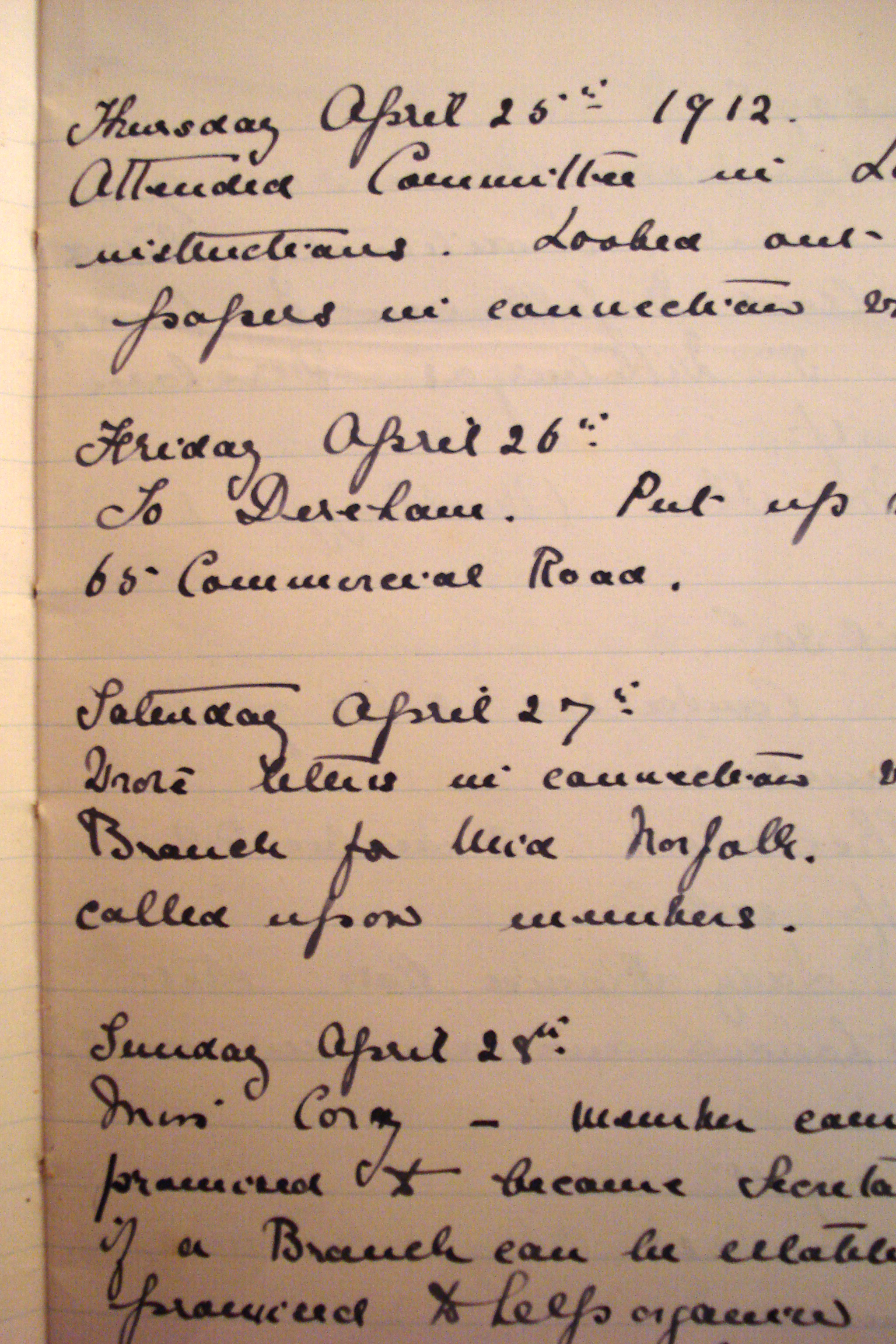
A page from the ‘Organiser’s Book’ kept by Kate for perusal by the Committee of the NCS
Her elaboration of diary entries by the addition of leaflets advertising the suffrage meetings she attended, even on occasion leaflets she herself had arranged to have printed, and for the processions in which she took part, demonstrates how prominently the campaign figured in her life. Virtually no other ephemeral material is included during this period.
We need only look to the diary for the answer to the question as to whether Kate Frye would object to being remembered as a suffragist. For on ‘Sunday 10 February 1918’ she wrote, ‘One of my afternoon letters was to Gladys Simmons[37] in commemoration of the passing of the Franchise Bill. Haven’t had a single letter from anyone concerning it – I said I wouldn’t but it seems very strange – that someone hasn’t thought of me in connection with the work.’ Now that her suffrage diary is published, at last Kate Frye will ‘be thought of in connection with the work’ and be recognised as a suffragist.[38] However, the very act of publication highlights just this one of her many roles. Out of the multiplicity of Kate Frye’s self-constructions, it is the ‘self’ of her suffrage years that emerges. The reader will have to accept that ‘mining’ a diary in order to view an historical episode from a fresh angle may come at the expense of maintaining the integrity of the diarist’s conception of ‘self’.
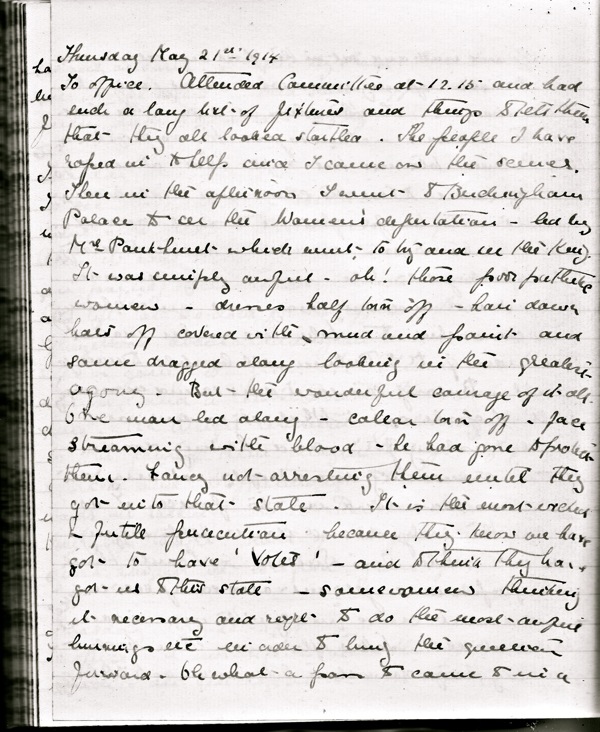
Kate’s diary entry for 21 May 1914 in which she records witnessing the WSPU demonstration in front of Buckingham Palace
[1] Katharine Parry Frye (1878-1959), daughter of Frederick and Jane Kezia Frye. Frederick Frye was a director of a chain of licensed grocery shops, Leverett and Frye, a firm financed by the wine merchants W.& A.Gilbey, as a useful outlet for their wines. When Frederick Frye became an M.P., Gilbey’s took over the running of the business. The Irish branch still operates. Frederick’s father had been a ‘professor of music’ and for 64 years organist at Saffron Walden parish church. Jane Frye’s father was a Winchester grocer. In 1915 Kate married John R. Collins.
[2] In August 2010 correspondence on Guardian Online, which included contributions from members of the Women’s History Network, demonstrated that it is by no means unusual for contemporary women to keep daily diaries over decades of their lives..
[3] Kate’s Aunt Agnes (1834-1920, née Crosbie), her mother’s sister, was the widow of Alfred Gilbey (d. 1879). For details of the Gilbeys of Wooburn House, Wooburn, Buckinghamshire see B. B. Wheals (1983) Theirs were but human hearts: a local history of three Thameside parishes (Bourne End: H.S. Publishing). From their relatively humble origins the brothers Walter and Alfred Gilbey grew wealthy as they developed England’s largest wine merchant business, W. & A. Gilbey.
[4] ‘Accounts and Legal’, Quality Street tour accounts (Theatre Museum), cited in Tracy C. Davis (2000) The Economics of the British Stage 1800-1914 (Cambridge: Cambridge University Press) p.217.
[5] For a discussion of the entrance of middle-class women into the acting profession see Tracy C. Davis (1991) Actresses as Working Women (London: Routledge) pp. 13-16.
[6] In the 1920s and 1930s Kate often joined her husband on tour. For instance, over many years she spent some time each year at Stratford-on-Avon, where her husband was stage manager for productions at the old Memorial Theatre.
[7] Agnes Frye (1874-1937)
[8] See T. Mallon (1995) A Book of One’s Own: people and their diaries (St Paul, Minn: Hungry Mind Press) p. 1.
[9] Robert A. Fothergill (1974) Private Chronicles: a study of English diaries (London: OUP).
[10] See Jane DuPree Begos (1977) Annotated Bibliography of Published Women’s Diaries (issued by the author); Margo Culley (Ed) (1985) A Day at a Time: the diary literature of American women from 1764 to the present day (Old Westbury NY: Feminist Press); Harriet Blodgett (1989) Centuries of Female Day: Englishwomen’s Private Diaries (New Brunswick, London: Rutgers University Press); Cheryl Cline (1989) Women’s Diaries, Journals and Letters: an annotated bibliography (New York and London: Garland Publishing); Harriet Blodgett (Ed.) (1992) The Englishwoman’s Diary (London: Fourth Estate); Suzanne L. Bunkers and Cynthia A. Huff (1996) Inscribing the Daily: critical essays on women’s diaries (Amherst: University of Massachusetts Press) Suzanne L. Bunkers (2001) Diaries of Girls and Women: a midwestern American sampler (London, University of Wisconsin Press).
[11] Suzanne L. Bunkers and Cynthia Huff ‘Issues in Studying Women’s Diaries: a theoretical and critical introduction’, in Bunkers and Huff (Eds) Inscribing the Daily, p.1
[12] Sir Arthur Ponsonby (1923) English Diaries (London:Methuen & Co), p. 5.
[13] Fothergill, Private Chronicles, p. 5
[14] Cline, Women’s Diaries, p xxvii-xxviii.
[15] Exceptions include Bunkers, Diaries of Girls and Women. See also Cynthia Huff (1985) British Women’s Diaries: a descriptive bibliography of selected 19th-century women’s manuscript diaries (New York: AMS Press).
[16] Fothergill, Private Chronicles, p. 5.
[17] Cline, Women’s Diaries, p. xxviii.
[18] L. Woolf (Ed) (1953) A Writer’s Diary. Being extracts from the diary of Virginia Woolf (London, Hogarth Press).
[19] Although, after Leonard Woolf’s ‘dismembering’, the diaries were reconstructed, in five volumes, edited by Anne Olivier Bell.
[20] For instance, Martin Hewitt (2006) Diary, Autobiography and the Practice of Life History in David Amigoni (Ed) Life Writing and Victorian Culture (Aldershot: Ashgate).
[21] Huff, British Women’s Diaries, p xiv.
[22] Whiteleys was a large department store, which, when Kate wrote this 1913 entry, was in Queensway. The store’s owner, William Whiteley, ‘the Universal Provider’, had been a close friend of the Frye family and his murder and subsequent trial are recorded in detail in Kate’s 1907 diary.
[23] Fothergill, Private Chronicles, p.82.
[24] .Marie Bashkirtseff, a young Frenchwoman, filled 85 notebooks with her journal, which was edited for publication after her death in 1884. An English edition, Mathilde Blind (Ed. and Trans) 1890, The Journal of Marie Bashkirtseff (London: Cassell) 2 volumes. Philippe Lejeune has described the Journal as foreshadowing ‘a line of diaries where introspection, active contestation of the condition of women, and interest in writing stand out as defining features’, see Philippe Lejeune The “Journal de jeune fille” in Nineteenth Century France in Bunkers and Huff, Inscribing the Daily, p119.
[25] Some attention has been paid to this distinction by scholars of diary writing. Suzanne Bunkers, after initially believing that what distinguishes a journal from a diary is that the diary is ‘a form of recording events, and the journal is a form of introspection, reflection, and the expression of feeling’, comes to the conclusion that the distinction is untenable, see S. Bunkers, Diaries of Girls and Women, p 12.
[26] Diary entry for 9 July 1912.
[27] Katharine Parry and John R. Collins (1921) Cease Fire!: a play in one act (London: French’s Acting Editions).
[28] Gertrude Abbie Frye (always known as Abbie), later Mrs Basil Hargrave (1871-1936). The works of ‘L. Parry Truscott’ were mistakenly attributed to Katharine Edith Spicer-Jay in Halkett (1926) Dictionary of Anonymous and Pseudonymous English Literature, (Edinburgh: Oliver and Boyd), Vol 1. By 1926 ‘L. Parry Truscott’’s star had waned and Abbie, by now a widow, was vitually penniless. A considerable amount of information about the interesting life of Abbie Frye can be gleaned from Kate Frye’s diary.
[29] See the manuscript prison diaries of Mary Anne Rawle, Elsie Duval and Katie Gliddon (Women’s Library); the manuscript prison diaries of Olive Walton and Florence Haig (Museum of London); and the manuscript prison diary of Olive Wharry (British Library); The manuscript prison diary of Anne Cobden Sanderson (London School of Economics) has been edited by Anthony Howe but is, as yet, unpublished.
[30] Both Margery Lees’s diaries are held by the Women’s Library.
[31] The Blathwayt diaries are held in the Gloucestershire Record Office. See June Hannam ‘Suffragettes are Splendid for Any Work’: the Blathwayt Diaries as a Source of Suffrage History in Clare Eustance, Joan Ryan and Laura Ugolini (Eds.) (2000) A Suffrage Reader: charting directions in British Suffrage History (London: Leicester University Press).
[32] Dr Alice Ker’s diaries are held in a private collection.
[33] The manuscript of Eunice Murray’s diary are held at the Women’s Library, together with a bound copy of the Diary of Eunice Guthrie Murray, transcribed by Frances Sylvia Martin.
[34] T. Thompson (Ed.) (1987) Dear Girl: the diaries and letters of two working women (1897-1917) (London: Women’s Press).
[35] Kate Frye joined the WSPU in November 1910, after witnessing the ‘Black Friday’ demonstration, but was soon appointed as a paid organiser for the newly-formed New Constitutional Society for Women’s Suffrage.
[36] The quotation is taken from Modern Love by George Meredith, first published in 1862.
[37] As Gladys Wright, she had been a very old Kensington friend of Kate Frye and hon. Sec. of the NCSWS.
[38] Campaigning for the Vote: The Suffrage Diary of Kate Parry Frye, is published by Francis Boutle
Suffrage Stories: Mrs Alice Singer, Miss Edith New And The Suffragette Doll
Posted in Collecting Suffrage, Suffrage Stories on May 2, 2013
The arrival of the first issue of the admirable Swindon Heritage magazine has reminded me of a slight connection I had some years ago with an interesting object created by Edith New – the subject of one of its articles.
It was in 2006 that I was approached by a BBC TV producer planning a spin-off of the Antiques Roadshow -to be called the Antiques Roadshow Greatest Finds. The idea was that they would take a few of the more intriguing items that had been brought to Roadshows in the previous year and research and discuss them in greater depth. The item that was brought to my attention was a Suffragette Doll. My research into its history and that of the woman who had owned it proved utterly fascinating. In addition I had a most enjoyable couple of days making the film that developed from the research.
I am only sorry that I do not have a photograph of the doll, which was dressed as a suffragette in prison uniform. Items such as this may occasionally appear on ebay or at auction but it is not that difficult to ‘forge’ a Suffragette Doll and what one needs is provenance, linking it to its original owner. This ‘Roadshow’ doll was just such a treasure – handed down through a family. What is more to my great pleasure I was able to discover more of the original owner, Mrs Alice Singer, than, when given the commission, I thought would be possible. For, like Kate Frye (the subject of my latest book, Campaigning for the Vote). Mrs Singer had kept a diary which, although a very much more sketchy affair than Kate’s, did reveal a good deal of her involvement with the Women’s Social and Political Union. The diary is now held in Israel by a branch of the family, but they were kind enough to let me have a look at it for the purpose of researching the programme.
Mrs Alice Singer (1873-1955) was born Alice Emma Isabel Isaac, the eldest of three daughters of Stephen Hart Isaac (1850-1877) and his wife Sime Seruya Isaac. Sime Seruya was of Portuguese extraction, although she was living in London when they married in 1872 at Bayswater Synagogue. At this time, and presumably later, when Alice was born, Stephen Isaac was working as the assistant manager of a coal mine at Colwick in Nottinghamshire. When he married he was living at Colwick Hall with his uncle, Saul Isaac, who was the lessee of the mine. Saul Isaac, was at this time MP for Nottingham (1874-80).
When Stephen Isaac died, aged 26, (at 31 Warrington Crescent, Paddington) on 2 January 1877, he was a widower. His death certificate shows that he had been ill for c. 9 months, probably with TB. His wife had died in Lisbon on 4 September 1876, a week after the birth of her third child. It is possible that they were in Lisbon for the sake of Stephen’s health. Lisbon was a place favoured by those suffering from TB. The fact that Sime had family there would have been an obvious attraction.
The three young girls, Alice, Daisy and Sime Seruya Isaac (who was now more than 6 months old) were left under the guardianship of their grandfather, Samuel Isaac, although Sime was brought up by her Portuguese grandparents. Alice, therefore, was orphaned by the time she was 4 years old. She lived at Warrington Crescent until her marriage, I think. [NB across the road, at no 2 Warrington Crescent, there is a plaque to Alan Turing. Interestingly – and the ghosts pile up in London – that was also the address in 1866 of Louisa Garrett Smith (eldest sister of Millicent Garrett Fawcett and Elizabeth Garrett Anderson) the very first secretary of the first London women’s suffrage society.]
Samuel Isaac was an army contractor – his firm was the largest European supporter of the southern (Confederate) states during the American Civil War – and failed on the fall of the Confederacy. After a while he became the main promoter of the Mersey Tunnel, which he was responsible for building.
Samuel (1812-86) and his wife, Emma (nee Hart), with the 2 elder girls, continued living at 31 Warrington Crescent until at least 1881. By 1886, when Samuel died, they were living at 29 Warrington Crescent. [Warrington Crescent, north of Paddington, was a smart address – houses were then new, large and italianate]. In 1891 Sime Seruya Isaac was boarding at a school at Kew. She went on to become an actress – a leading member of the Actresses’ Franchise League and one of the founders of the International Suffrage Shop.
Alice was educated at home by a governess and in 1895 married Julius Singer (1870-1926), son of Simeon and Charlotte Singer. In 1899 her sister, Daisy, married Julius’ brother, David.
Simeon Singer (1846-1906) was a leading light in the Jewish establishment in England, minister of the New West End Synagogue, St Petersburgh Place, Bayswater, from 1878 until his death. He was the translator and editor of the Authorized Daily Prayer Book, still the standard prayer book of Orthodox Jews in Britain. He is clearly still, a hundred years after his death, a strongly felt presence in the synagogue. Julius had four brothers and a sister and the family was clearly at the heart of Anglo-Jewry. Julius died in 1926 (18 Reynolds Close, Golders Green). During the course of the diary Alice is definitely anti-religion – of any kind.
When the census was taken in 1901 Alice and Julius Singer were living at Darby Green Farm, Darby Green, Yateley, Hampshire, which Alice had bought in 1900. Julius was described as a ‘wine and spirit merchant’. However, around 1908 his work seems to have involved the tea industry in some way –probably Lyons – and by then the family had moved to London. In 1911 they were living at 18 Reynolds Close, Golders Green where, on the day of the census, only two servants were at home. There is no trace elsewhere of the Singers – were they evading the enumerator to join in the suffragette boycott of the census?
In 1906 Alice and Julius appear to have been Conservative supporters. In later life Alice lamented that she wished she had been brought up in Fabian circles and, like her sister, Sime, moved dramatically to the Left. She visited Russia in the 1930s. She was keen to use women doctors (Dr Honor Bone) and opticians (Amy Sheppard – who worked at the Elizabeth Garrett Anderson Hospital for Women). She was keen on passing fads – such as vegetarianism, psychology etc – which clearly infuriated her children!
Alice Singer joined the WSPU after attending one of their meetings on 18 February 1907 and by November was prepared to give some time to the cause, addressing envelopes in the office at Clement’s Inn. A week later, when she and her husband attended a WSPU rally in the Queen’s Hall, Julius bought a copy of the new card game – ‘Suffragette’. for my post about this game click here. At the end of the month the Singers took the momentous decision to adopt a child – being themselves still childless. In the casual fashion typical of the time a girl, Mary, was found for them by Mrs Ernestine Mills, a fellow suffragist. (For an example of Ernestine’s work as a jeweller, see here). The Singers were on very friendly terms with the Ernestine and her husband, on occasion staying with them at their Dorset home at Studland.
The Singers continued to be involved members of the WSPU, Alice’s activities only briefly curtailed in 1909 by a long-awaited pregnancy. Emmeline Christabel Kenney Singer (known as ‘Christabel) was born on 10 December. A studio photograph, taken by Lena Connell, is still held by the family, showing Alice with Mary and Christabel. Baby Christabel has a WSPU badge pinned to the hem of her frock.
It was in 1908/9 that Alice Singer bought the Suffragette Doll – presumably at a WSPU fund-raising event. Remarkably in a diary entry of 1931 she reveals that she had met again, at a Suffragette party, the maker of the doll – Miss Edith New. It was such luck that she chose to put this connection on paper – such an ephemeral link but one that gives the doll such an excellent provenance.
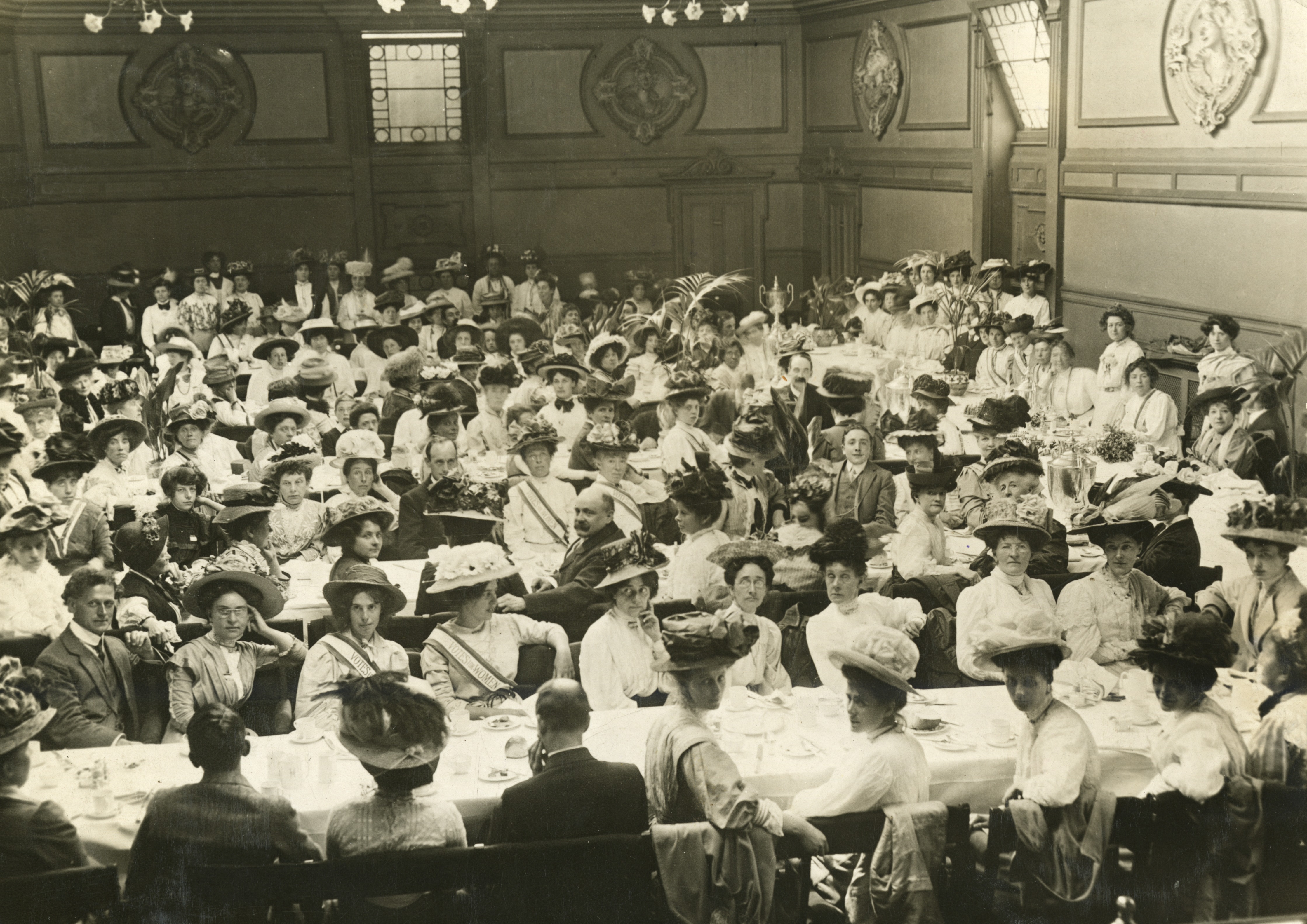
WSPU Breakfast celebrating the release of Edith New and Mary Leigh from Holloway Prison, held at the Queen’s Hall on 22 August 1908 (courtesy of LSE Library)
On 22 August 1908 Alice Singer had attended the WSPU breakfast honouring Edith New and Mary Leigh on their release from Holloway. For much more about Edith New do read the Spring 2013 edition of ‘Swindon Heritage’ – and in her entry in my The Women’s Suffrage Movement: a reference guide
There is a strong Antiques Roadshow connection linking Edith New and Alice Singer’s Suffragette Doll – for in 2011 a quantity of Edith’s suffragette memorabilia, now held in the Swindon Heritage Centre (see http://www.swindonheritage.com), was brought to the Roadshow when it visited Swindon. Coincidentally it was the Roadshow expert Hilary Kay who discussed this collection, as she had the Suffragette Doll a few years earlier.
In March 1912 Alice Singer was arrested after taking part in the WSPU window-smashing campaign. When arrested she had a hammer in her hand and when charged said of the windows, ‘I thought it was only one, they seemed like marble, not going to break.’ Alice had chosen to break three windows in the West Strand Telegraph Office, close to Trafalgar Square. Her family thought it appropriate that she, essentially law abiding and a respecter of property, should have chosen quasi-official premises, rather than privately-owned property.
Alice was remanded in Holloway until she appeared in court on 13 March. By now the Singers were living in Golders Green and a solicitor was organised by Mrs Lilian Hicks to represent the Hampstead women. Alice was charged under the Malicious Damage to Property Act and in court declared, ‘I only did it as a political protest. I admit I did it, but not for malice. I plead not guilty to malice.’ She agreed to be bound over – that is, not to commit any other such acts – for 12 months. Only one other woman also agreed to be bound over – all the other women (over 100 had been arrested) were sentenced to prison – their sentences varying but some repeat offenders getting as long as six months. Most of the other women were either single or with older families. Christabel was only 2 years old and I imagine Alice could not contemplate being away from home – in prison – for any length of time. The diary does not reveal any guilt at not opting for imprisonment.
Julius was very supportive while Alice was in prison – he visited her – but was kept waiting for 2 hours before seeing her for a short time ‘We forgot all we really wished to say in the fluster of the time limit and presence of wardresses..’
Alice Singer continued to work actively for the WSPU, in 1913 becoming treasurer of the Hendon and Golders Green branch. In November 1918 she was at last able to cast her first parliamentary vote – ‘I recorded for Mrs Edith How-Martyn for the new constituency of Hendon’. Edith How-Martyn, who had been a leader of the Women’s Freedom League, was standing as a Labour candidate but was unsuccessful.
The Suffragette Doll, treasured by Alice’s descendants, is silent testimony to her involvement in the ‘votes for women’ campaign and her indirect connection to Edith New, Swindon’s own suffragette.
Copyright
WALKS/Suffrage Stories: The Raid On WSPU Headquarters, 30 April 1913
Posted in Suffrage Stories on April 30, 2013
On 30 April 1913 WSPU headquarters at Lincoln’s Inn House in Kingsway were subjected to their first police raid. See here for a photograph (Museum of London) showing a subsequent raid in progress.

Lincoln’s Inn House 2013, former headquarters of the WSPU
The WSPU had moved into the imposing new office building during the summer of 1912 – vacating their previous quarters in Clements Inn which had been very much Pethick-Lawrence territory. The geographical separation heralded the political separation that occurred in October 1912 when the Pethick-Lawrences were dismissed from the WSPU.
The elegant and imposing entrance hall of Lincoln’s Inn House -through which both suffragettes and police once purposefully made their way – and its mezzanine floor – is now a ‘Bill’s Restaurant‘. I doubt that the bones of the space – the pillars, the stair case and the ironwork – have changed much in the last century and it is not difficult to imagine – as one sits eating one’s ice cream on a warm summer’s morning – the shades of our foremothers going about their business here.

 The police raid was one element in the increasing Home Office crackdown on the WSPU which had begun in February 1913 when, on the day after a house being built for Lloyd George had been damaged by a suffragette bomb, Mrs Pankhurst declared,’For all that has been done in the past I accept full responsibility. I have advised, I have incited, I have conspired.’ The speech was seized on by the Home Office as the opportunity for which they had been waiting to arrest Mrs Pankhurst. She was charged with procuring or inciting women to commit offences contrary to the Malicious Injuries to Property Act and on 2 April was found guilty and sentenced to three years’ imprisonment. She immediately went on hunger strike. See here for the article on this episode commissioned from me for the No 10 website.
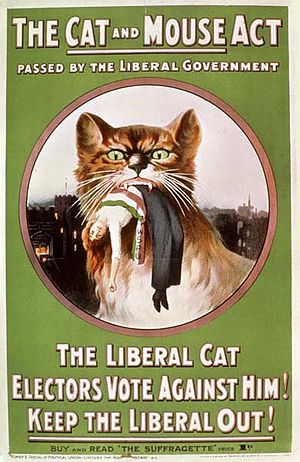
WSPU poster protesting against the ‘Cat and Mouse’ Act
It was no coincidence that a day later the bill that was to become known as the ‘Catand Mouse Act’ received its Second Reading in Parliament. The passage of this Bill demonstrates how quickly Parliament could move when the Government was determined to act, for the Bill rapidly became an Act, receiving its Royal Assent on 25 April.
At the beginning of April both Annie Kenney and Flora Drummond were also arrested, the Home Office invoking obscure statutes to ensure that they would appear before the courts. A few days later managers of halls were encouraged by the Home Office no longer to let to the WSPU, who were also proscribed from holding meetings in public parks.
This is the context in which the raid on Lincoln’s Inn House should be seen. The chief office organizers, Harriet Kerr, Beatrice Sanders, Rachel Barrett, Agnes Lake and Flora Drummond were arrested and were to spend most of May in front of the Bow Street magistrate, Mr Curtis Bennett. The police, under the command of Inspector Quinn of Scotland Yard, loaded a pantechnicon with WSPU papers seized from Lincoln’s Inn House, papers, incidentally, which were never returned. I must say I lament their loss as they would most certainly have shed more factual light on the workings of the WSPU – Emmeline Pethick Lawrence had been a very business-like manager. In their absence the WSPU story has had to rely to a great extent on hindsight memories and the information culled from Votes for Women and The Suffragette, sources biased in a way that business letter, receipts and account books are not.
As part of their campaign to cut off WSPU funding, the Home Office intended to trawl through the records seized in order to discover the names of WSPU subscribers and then prosecute them for supporting an organization that encouraged its members to damage property. This plan was never put into practice. The Home Office did, however, prosecute the printer of the WSPU paper, The Suffragette, driving the paper underground but never preventing its publication. On 2 May the Home Office asked the General Post Office to cut off all telephone communication with Lincoln’s Inn House; but the GPO replied that it was not entitled to do so.
These attempts at suppressing the WSPU had, as might have been predicted, the effect of creating a void that was filled by even more extreme words and deeds. Between February and April there were over 30 arson attacks ascribed to the ‘work’ of suffragettes, as well as many lesser attacks – on golf courses, letter boxes etc. Moreover, when combined with the publicity given to Mrs Pankhurst’s successive hunger strikes, it is unsurprising that matters reached a crisis point – at the Derby on 4 June 1913.
A year later the police again raided Lincoln’s Inn House, arresting Grace Roe. Christabel Pankhurst’s chief deputy, seen here being marched out of the building. Nearly a century later the rusticated stonework is still the same – a’ Bill’s’ menu now substituted for The Suffragette poster.

Campaigning For The Vote: Kate Frye and Knightsbridge
Posted in Kate Frye's suffrage diary on April 29, 2013
In early 1911 Kate Frye took up her position as a paid organizer for the New Constitutional Society for Women’s Suffrage. The Society had been founded in January 1910 to take a position between that held by the militant Women’s Social and Political Union and the ‘constitutional’ National Union of Women’s Suffrage Societies. Although its members did not want to break the law themselves, the NCS did not condemn WSPU tactics and supported its policy of campaigning against government (Liberal) candidates at elections, thinking the NUWSS had become too ineffectual.
Unlike the other main suffrage societies that had their offices either around the

Burberry shop, Knightsbridge. The offices of the NCS were inside this building
Holborn/Strand area or in Victoria/Westminster, the NCS took up residence in Knightsbridge. They rented an office in Park Mansions Arcade which ran through a relatively newly-built block of mansion flats between Knightsbridge and Brompton Road. The shop area at street level is now occupied by a major Burberry store, into which the Arcade has, at some time in the past, been incorporated. The Arcade part now houses a recently created Burberry Menswear department. To see today’s glamorous reality and to imagine Kate and her co-workers at the NCS walking through this space – full of thoughts of converting the women – and men – of Britain to the Cause – click here.
Knightsbridge was an area that would have appealed to members of the NCS, many of whom lived in Kensington and Paddington. Many of these women had belonged to the London Society for Women’s Suffrage (NUWSS), but had become disenchanted with what appeared to be lack of progress, although were not quite prepared to go so far as to join the militants. However, you can see from the entertainments offered at the opening of the Park Mansions Arcade Office, that members of the WSPU and the Actresses’ Franchise League lent their support.
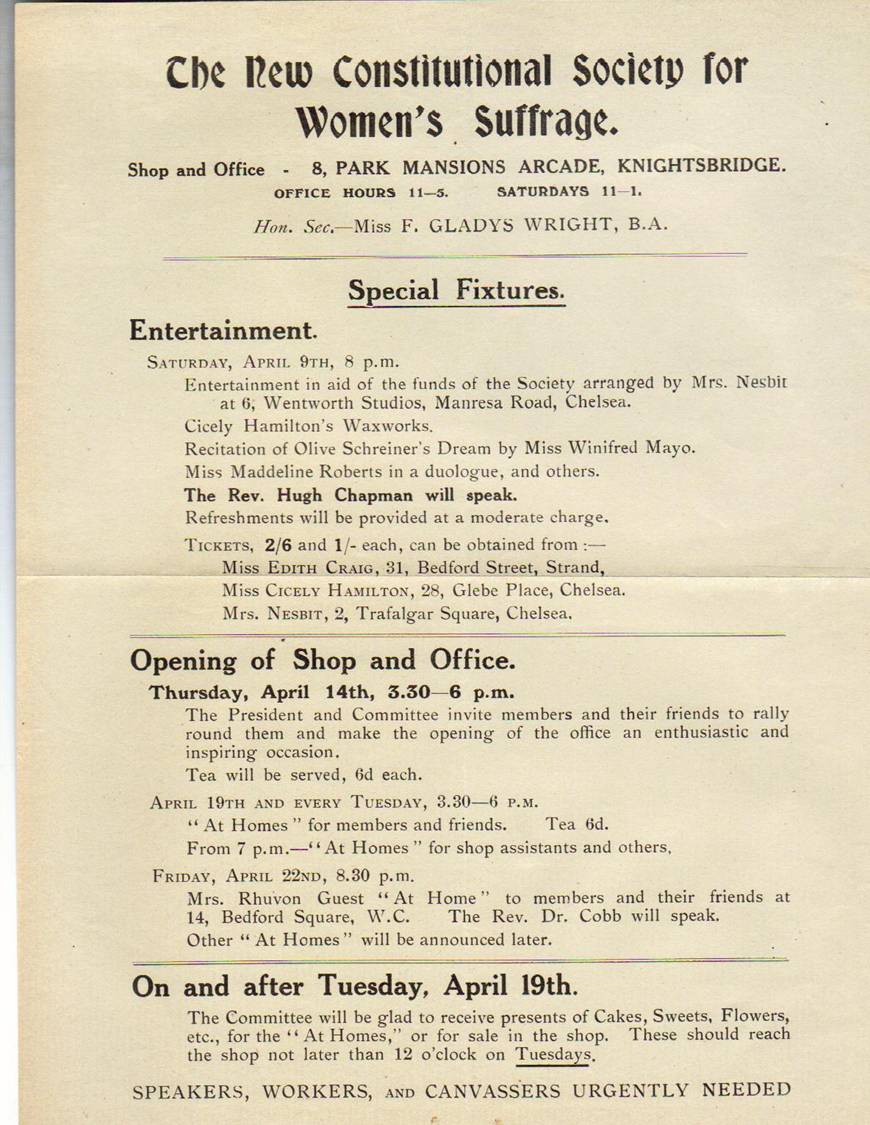
Notice of the opening of the NCS office, April 1910
Campaigning For The Vote: Kate Wrestles With North Norfolk, 1912
Posted in Kate Frye's suffrage diary, Suffrage Stories on April 25, 2013
In early summer 1912 Kate Frye was in Norfolk, based in East Dereham, organizing the ‘votes for women’ campaign for the New Constitutional Society for Women’s Suffrage in Norfolk. In May the sitting MP for the Northwestern Division of Norfolk died and a by-election was called. Kate hurried to Hunstanton to organise the NCS campaign – rather at a disadvantage vis a vis the other suffrage societies, the WSPU and the NUWSS, both of which had many more organisers, money, and, above all, cars at their disposal to cover the constituency. But Kate did her best. For example:
On 28 May she hired a motor for 22/- from Johnson’s Garage in Hunstanton to take the Society’s speakers, Miss McGowan, Mrs Chapman (the Society’s president) and Mr Lloyd (supposedly an Australian although she began to have her doubts) to Burnham Market. Tuesday May 28th 1912 [lodging in Hunstanton at Palace House, Westgate] Had a lot of writing to do in the morning and had to go out to make arrangements and then a great rush to get something to eat and off to Burnham Market at mid-day. I took the Literature to the Hotel, left it here and ordered tea – then I canvassed hard and walked all the way to Burnham Overy.
Hoste Arms, 2013
Came [back to Burnham Market] to Hoste Arms Hotel – found one of my Irish friends [these were Irish political organisers also in the area campaigning for the by-election] still there- the younger married one- at least the other was married too – but I gathered he was separated from his wife. My friend greeted me quite tenderly – we met as old friends – there were two other Irishmen – Anti Home Rulers and two Liberals – a young coming-on Politician – quite nice looking – and an older man who, I was told afterwards, was Mr Ouithwaite – a candidate somewhere. We all had tea and eggs and Suffrage discussions – Mr Ouithwaite was quite violent – but I really had him every time – quite a roar went up at some some my answers – I enjoyed that tea party immensely. I think we all did – Mr Ouithwaite least of all, perhaps, but I felt I was scoring – and as only the two odd Irishmen were inclined for Votes for Women I had no help. No 1 Irish was not so rabid though.
Burnham Market, 1912
I only got to the Schools just in time to have the doors open and let the crowd in – no policeman there so the boys had to go – it looked like a rowdy meeting from the first. The place was pretty full when the car arrived – Miss McGowan with Mrs Chapman and Mr Lloyd. Miss McGowan took the Chair – and they were fairly quiet while she spoke – but directly Mrs Chapman got up the trouble began. No one could hear her – she was feeling so dreadfully ill with a feverish cold – she must have had a miserable evening and I felt so sorry for her – and the people were so insolent. I went and stood right at the back amongst the rowdies and it was a lively evening – and so stuffy. Mr Lloyd (from Australia) stood on a Chair and bellowed – ‘Oh men of England’ over and over again – he tried his best and was cheery but not much of what he shouted could be heard. I took a collection – which was brave I think – but I felt I had to do something. I was so disappointed and we drove off amidst groans. A very Liberal place – but the boys were the mischief – once in they wouldn’t quiet. We motored back to Hunstanton – left Mrs Chapman at the ‘Golden Lion’ – then Mr Lloyd at the Temperance Hotel in our road – then home. The WSPU had been holding a meeting in the Town Hall and Miss Mansell had been down to help Steward – but only about 100 people turned up – some said 50 – so they had an open air afterwards as Mrs Massy and Mrs Haverfield were there. That was just over so we three tramped off to Roberts Room where Mr Hemmerde [the Liberal candidate] was speaking – a small room but well filled. He was just answering questions put to him by our lively friend Mr Lloyd – so when the people came out we gave away our handbills. ‘ Campaigning for the Vote: Kate Parry Frye’s Suffrage Diary edited by Elizabeth Crawford For a full description of the book click here Wrap-around paper covers, 226 pp, over 70 illustrations, all drawn from Kate Frye’s personal archive. ISBN 978 1903427 75 0 £14.99 Copies available from Francis Boutle Publishers, or from Elizabeth Crawford – e.crawford@sphere20.freeserve.co.uk or from all good bookshops.

- ‘Campaigning for the Vote’ – Front and back cover of wrappers
Campaigning For The Vote: Kate Converts Bourne End, Buckinghamshire
Posted in Kate Frye's suffrage diary, Suffrage Stories on April 24, 2013
‘The Plat’ at Bourne End in Buckinghamshire had been the Frye family’s country house since the late 1880s.
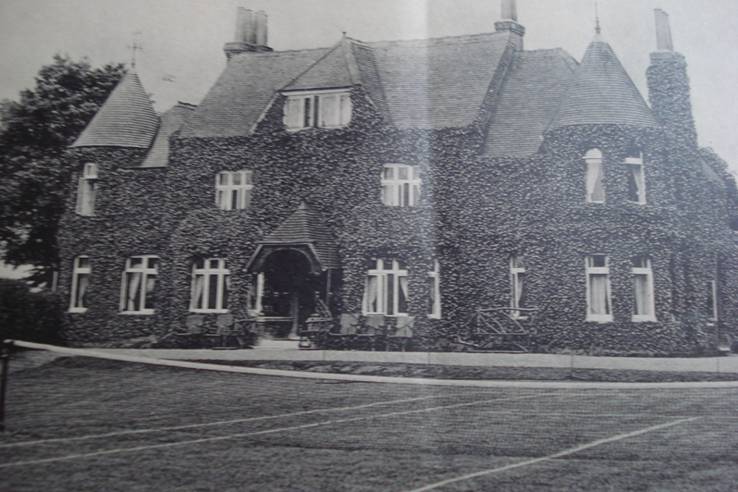
The Plat, Bourne End
The house was right on the River and teas were served on its lawns during the annual Bourne End Regatta.
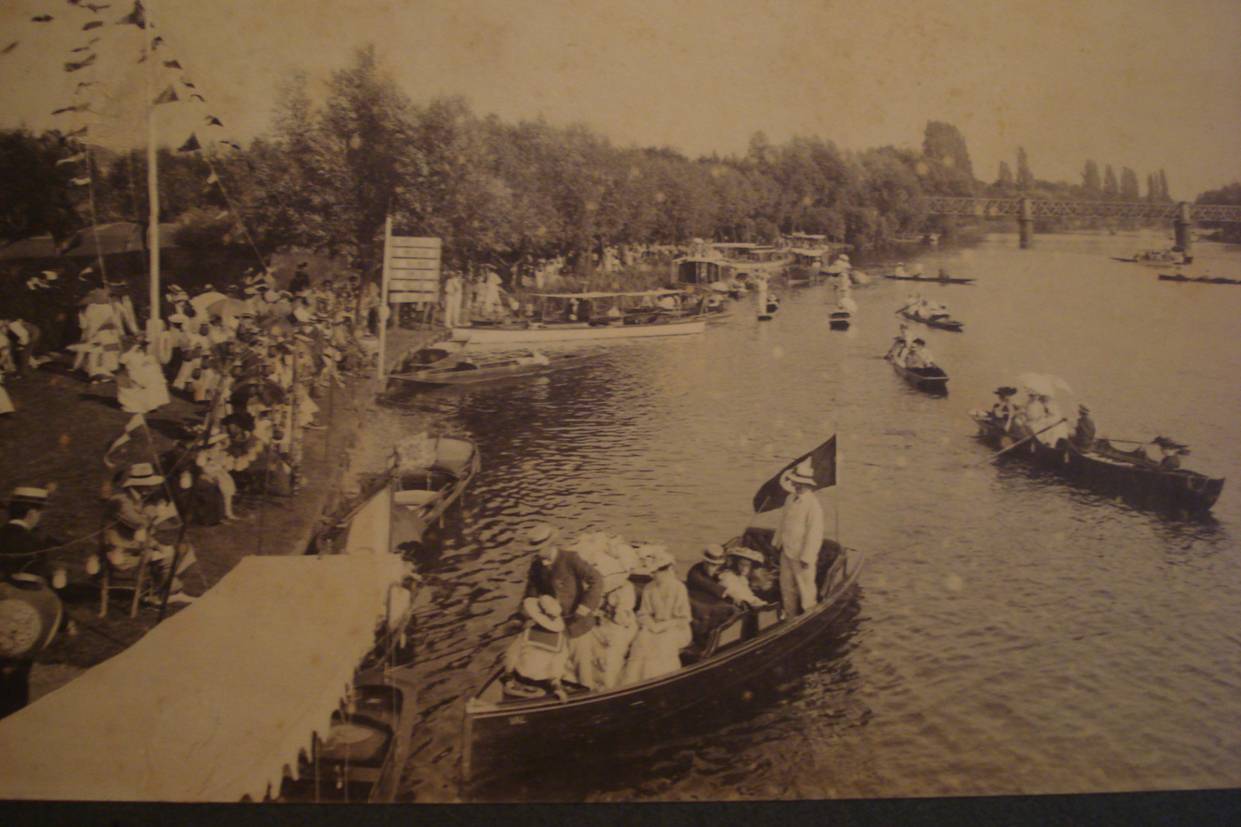
Bourne End Regatta
Kate’s father, Frederick Frye, had been an influential figure in the neighbourhood but by 1911 had lost control of his business and the family finances were in dire straits. In order to earn her keep Kate now took employment as a paid organiser for the New Constitutional Society for Women’s Suffrage. She spent much of the time working away from home but in the autumn of 1911 did succeed in launching the Bourne End and District Women’s Suffrage Society.
Thursday October 19th 1911 [Bourne End: The Plat]
So hot – very foggy and dull, some rain but fortunately it didn’t keep on. Agnes and I walked up to Mrs Bleek-Leech’s at Lindenhurst as she was most kindly having the first meeting of the Bourne End and District Women’s Suffrage Society. It was such a success – about 50 people present. Miss Dove [headmistress of Wycombe Abbey School] was going to take the Chair but in her absence Daddie did so. Mrs Cecil Chapman [president of the New Constitutional Society] came to speak. She spoke for an hour and was most stirring. Mrs Graham from Henley also somehow got there and spoke for a few minutes on the sweated workers at Reading. Mrs Smart proposed a Vote of Thanks all round. Then tea. Mrs Leech had arranged it all most beautifully and was quite charming about it. I was as busy as a bee, of course. A good bit rested on me but I was delighted at the success. Mrs Chapman must have touched her hearers’ hearts and although we only made 10 or so members. People said that they had never heard suffrage before but were so interested they promised to come on Dec 15th. Every one was pleased. We stayed last finishing up things. Then after supper accounts for the 3 Suffrage Papers and the Standard.
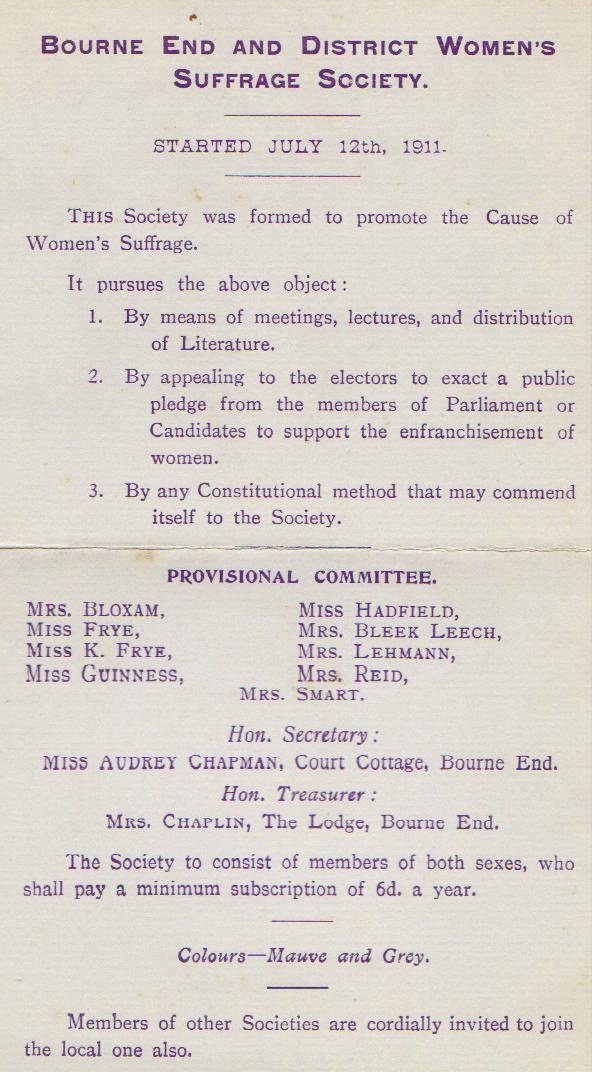
Campaigning for the Vote: Kate Parry Frye’s Suffrage Diary edited by Elizabeth Crawford
For a full description of the book click here
Wrap-around paper covers, 226 pp, over 70 illustrations, all drawn from Kate Frye’s personal archive.
ISBN 978 1903427 75 0
£14.99
Copies available from Francis Boutle Publishers, or from Elizabeth Crawford – e.crawford@sphere20.freeserve.co.uk
or from all good bookshops.
- ‘Campaigning for the Vote’ – Front and back cover of wrappers
Campaigning For The Vote: Kate Frye In ‘Spitalfields Life’
Posted in Kate Frye's suffrage diary on April 19, 2013
Kate and her Suffrage Diary have been given most generous coverage in that most admirable of blogs
Campaigning for the Vote: Kate Parry Frye’s Suffrage Diary edited by Elizabeth Crawford
For a full description of the book click here
Wrap-around paper covers, 226 pp, over 70 illustrations, all drawn from Kate Frye’s personal archive.
ISBN 978 1903427 75 0
Copies available from Francis Boutle Publishers, or from Elizabeth Crawford – e.crawford@sphere20.freeserve.co.uk (£14.99 +UK postage £3. Please ask for international postage cost), or from all good bookshops. In stock at London Review of Books Bookshop, Foyles, National Archives Bookshop.
- ‘Campaigning for the Vote’ – Front and back cover of wrappers
Campaigning For The Vote: Kate In Norfolk: East Dereham
Posted in Kate Frye's suffrage diary on April 18, 2013
Between 1911 and 1914 Kate Frye spent over 20 weeks organising the New Constitutional Society for Women Suffrage’s campaign in Norfolk. For the greater part of that time she was based in East Dereham.
In Campaigning for the Vote entries – such as these samples below relating – at random – two days in Kate’s Norfolk experience – are fully annotated, giving biographical details of most of the people she mentions. Thus Kate’s diary is of interest to local historians over and above the light it sheds on the suffrage campaign in the area. For instance, ‘Miss Cory’ was Violet, daughter of the London and Provincial bank manager. The Corys lived above the bank, now Lloyds TSB and still there at 38 Market Place. For a most interesting tour around Dereham’s Market Place – an area with which Kate became intimate – see here.
Tuesday March 25th 1913 [lodging at 63 Norwich Street, East Dereham]
Most of the day spent in hunting about for rooms for Mrs Mayer with no success – even the Kings Head refused to have her. Canvassing and bill distributing – beginning, as usual, to feel anxious about the success of next Monday’s meeting. Changed and out at 4 to Miss Cory’s to tea. I went to call on Mrs Pearse when I left there and saw Mr Pearse and asked him to take the Chair but he would none of it. We had all been so ‘naughty’ etc and of course the destruction of the golf links had been the last straw. He is a pasty-faced Villain. But I wish he would take the Chair for us because if he does not I don’t know who will and I shall have to do it – the very idea curdles my blood.
On 10 March 1914 a WSPU member, Mary Richardson, attacked the Velasquez painting, ‘Venus with a Mirror’, hanging in the National Gallery, in order to draw attention to what she saw as the slow destruction of Mrs Pankhurst, who had, on 9 March, yet again been arrested.
Wednesday March 11th 1914 [lodging at 3 Elvin Road, East Dereham]
Miss Cory here at 10.30 and we went through the people I am to call upon. Out 12 to 1. To see Miss Shellabear. Very off, of course, the latest – the Rokeby Velasquez – is upsetting everyone now. Out 2.45 to 6.15. Calls.

Quebec Hall is now a Christian Eventide Hall. Photo courtesy of Quebec Hall website
Happened on the new people at Quebec Hall who are keen WSPU. Had tea with Miss Louisa Gay who has done 8 months [in prison]– a very jolly girl – she means to do some waking up if she can. Then to see Mr and Mrs Hewitt – I do like them so. Miss Cory and Mrs Goddard here 8 to 10. Talking. Talking. Talking.
Campaigning for the Vote: Kate Parry Frye’s Suffrage Diary edited by Elizabeth Crawford
For a full description of the book click here
Wrap-around paper covers, 226 pp, over 70 illustrations, all drawn from Kate Frye’s personal archive.
ISBN 978 1903427 75 0
Copies available from Francis Boutle Publishers, or from Elizabeth Crawford – e.crawford@sphere20.freeserve.co.uk (£14.99 +UK postage £3. Please ask for international postage cost), or from all good bookshops. In stock at London Review of Books Bookshop, Foyles, National Archives Bookshop.
- ‘Campaigning for the Vote’ – Front and back cover of wrappers
Campaigning For The Vote: Kate In Kent: Folkestone
Posted in Kate Frye's suffrage diary on April 17, 2013
In the course of the years 1911-1914 Kate Frye spent over 20 weeks organising the New Constitutional Society for Women’s Suffrage’s campaign in Kent. She recorded every detail of her daily life in the entries she made in her diary and a selection, relating to the conduct of the campaign, are included in Campaigning for the Vote.
Kate spent time in Ashford, Folkestone, Hythe and Dover, canvassing house-by-house and organising meetings in drawing-rooms and public halls.
Below are three samples of Kate’s Folkestone experiences.
Saturday October 21st 1911 [Folkestone: 4 Salisbury Villas]
Quite a mild day and needed no fire till evening but inclined to shower. I wrote letters – then at 11 to Mrs Kenny’s – 63 Bouverie Road, Folkestone.
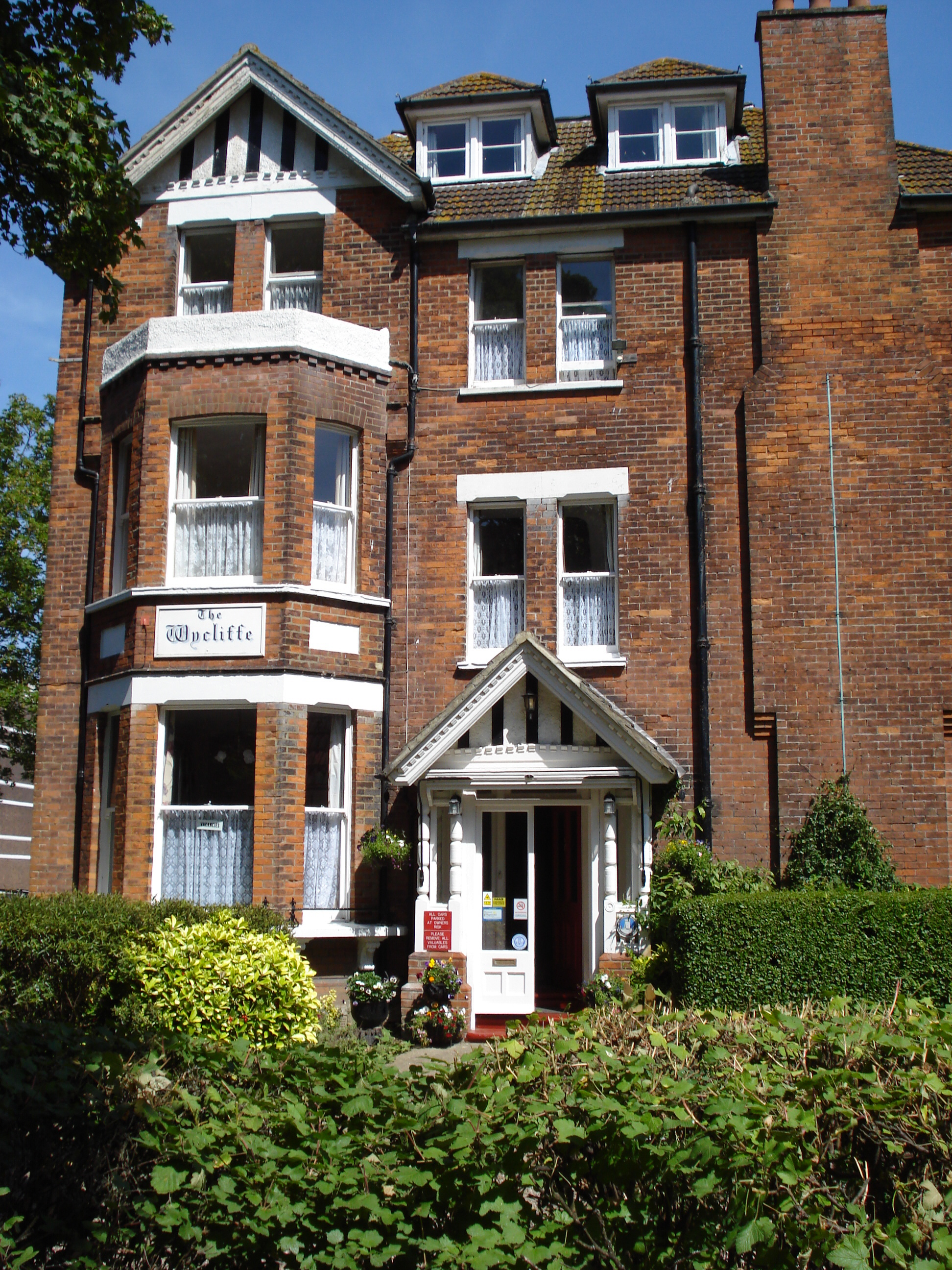
The Kennys’ house in Bouverie Road
She had asked me to lunch but Mrs Hill wanted me back again so, as there wasn’t much I could do, I just had a chat with her and Mrs Chapman, who is staying there, and came back again. Changed and got back to Mrs Kenny’s at 2.30 for her party at 4. Miss Lewis of Hythe took the Chair and Mrs Chapman spoke. There were between 70 and 80 people – mostly very smart – a military set. Mrs Kenny is very nice and Colonel Kenny is quite sweet. Some of the men were very amusing. I got a golf ball from one and sold it for 2/6. And got one young officer to buy The Subjection of Women. There was a most gorgeous tea, which no-one hardly touched. Mrs Hill and I walked home together – got in about 6.30. Another evening of gabbling chat and to bed about 10 o’clock. She is very nice but so intellectual. I feel sorry for the child. A most terrific gale raged all night. I thought the house must be blown in.
Kate spent two weeks in Folkestone on that occasion, returned for another two in February 1912 and that autumn spent a further three weeks attempting to galvanise the Kent campaign into a semblance of life.
Saturday October 5th 1912 [Folkestone: 33 Coolinge Road]
In my morning of calls, I only found two people at home. At 12.30 I gave it up. I did feel depressed. More so when, having met Mrs Kenny at the Grand Hotel at 3.30, where she was attending a wedding reception of a Miss Cooper, and whose good-byes I just came in for, Mrs Kenny and I called together upon the manager’s wife, Madame Gelardi, and to my horror I found that her husband would not contemplate for a moment letting us have a Suffrage At Home in the reception room. Well that does put the lid on things.The time is slipping away here – the days fly, I love the place and am very comfortable in my rooms but I cannot seem to work here and I feel utterly miserable about it.
Kate’s mention – in the entry below – of ‘this split’ refers to the announcement Mrs Pankhurst had made on 17 October at an Albert Hall meeting that the Pethick-Lawrences were no longer involved with the WSPU. The Pethick-Lawrences’ departure had been unilateral. Lady Irving was the – long-estranged – widow of the actor, Sir Henry Irving
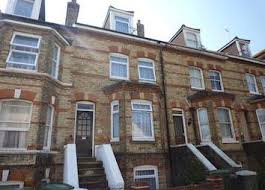
Coolinge Road, Folkestone
Tuesday October 22nd 1912 [Folkestone: 33 Coolinge Road]
As for the work I am doing here I am clean off it – I am doing nothing towards ‘Votes for Women’ – what do the people of Folkestone care and what is the good of trying to make them care? Propaganda may have had its uses in the past, it may still please some people, but I don’t want to go on talking about the Vote – I want to get it! And I am wondering more than ever what is the way to get it. This split, if split it is between the Pankhursts and Pethick-Lawrences is depressing, but I am not at all sure there it not more in it than meets the eye. Anyway here one feels so out of things – the Vote seems a very tiny speck in an ocean of talk and twaddle.
Back to tea and to write letters, then at 8 o’clock I tidied myself and went off to call on Lady Irving by appointment at 8.30. I was interested and so much enjoyed the interview, and she joined us as a member. I had been told of her powdered face, how, like the cat, she always walked alone, that all Folkestone hates her. I liked her immensely, she seems the only real person I have met, the only understanding person. I am told her temper is abnormal, that may be, she was sweet to me, and, after all, these sweet-tempered creatures can be temper trying enough for anything. That she and Henry Irving could not get on together I can quite understand. ‘No surrender’ is writ large in her composition – and after all why should the woman always give way. I imagine she had very strong views as to what was fitting for a wife and probably he did not live up to these. I did not stay long but we got a lot in the time and I think she liked me. How wonderfully young she is. Suffrage to her finger tips, and Suffrage before it was passably comfortable to be Suffrage.
Campaigning for the Vote: Kate Parry Frye’s Suffrage Diary edited by Elizabeth Crawford
For a full description of the book click here
Wrap-around paper covers, 226 pp, over 70 illustrations, all drawn from Kate Frye’s personal archive.
ISBN 978 1903427 75 0
Copies available from Francis Boutle Publishers, or from Elizabeth Crawford – e.crawford@sphere20.freeserve.co.uk (£14.99 +UK postage £3. Please ask for international postage cost), or from all good bookshops. In stock at London Review of Books Bookshop, Foyles, National Archives Bookshop.
- ‘Campaigning for the Vote’ – Front and back cover of wrappers
Now Published: Campaigning For The Vote: Kate Parry Frye’s Suffrage Diary, Edited By Elizabeth Crawford
Posted in Kate Frye's suffrage diary on April 15, 2013
An extract:
‘Saturday June 14th 1913. [Kate is lodging in Baker Street, London] I had had a black coat and skirt sent there for Miss Davison’s funeral procession and the landlady had given me permission to change in her room. I tore into my black things then we tore off by tube to Piccadilly and had some lunch in Lyons. But the time was getting on – and the cortege was timed to start at 2 o’clock from Victoria.
We saw it splendidly at the start until we were driven away from our position and then could not see for the crowds and then we walked right down Buckingham Palace Rd and joined in the procession at the end. It was really most wonderful – the really organised part – groups of women in black with white lilies – in white and in purple – and lots of clergymen and special sort of pall bearers each side of the coffin.
She gave her life publicly to make known to the public the demand of Votes for Women – it was only fitting she should be honoured publicly by the comrades. It must have been most imposing.
The crowds were thinner in Piccadilly but the windows were filled but the people had all tramped north and later on the crowds were tremendous. The people who stood watching were mostly reverent and well behaved. We were with the rag tag and bobtail element but they were very earnest people. It was tiring. Sometimes we had long waits – sometimes the pace was tremendous. Most of the time we could hear a band playing the funeral march.
Just before Kings Cross we came across Miss Forsyth (a fellow worker for the New Constitutional Society) – some of the New Constitutional Society had been marching with the Tax Resisters. I had not seen them or should have joined in. I had a chat with her.
Near Kings Cross the procession lost all semblance of a procession – one crowded process – everyone was moving. We lost our banner – we all got separated and our idea was to get away from the huge crowd of unwashed unhealthy creatures pressing us on all sides. We went down the Tube way. But I did not feel like a Tube and went through to the other side finding ourselves in Kings Cross station.
Saying we wanted tea we went on the platform and there was the train – the special carriage for the coffin – and, finding a seat, sank down and we did not move until the train left. Lots of the processionists were in the train, which was taking the body to Northumberland for interrment – and another huge procession tomorrow. To think she had had to give her life because men will not listen to the claims of reason and of justice. I was so tired I felt completely done. We found our way to the refreshment room and there were several of the pall bearers having tea. ‘
Campaigning for the Vote tells, in her own words, the efforts of a working suffragist to instil in the men and women of England the necessity of ‘votes for women’ in the years before the First World War.
The detailed diary kept all her life by Kate Parry Frye (1878-1959) has been edited to cover 1911-1915, years she spent as a paid organiser for the New Constitutional Society for Women’s Suffrage. A biographical introduction positions Kate’s ‘suffrage years’ in the context of her long life., a knowledge of her background giving the reader a deeper appreciation of the way in which she undertook her work. Editorial comment adds further information about the people Kate meets and the situations in which she finds herself.
Campaigning for the Vote constitutes that near impossibility – completely new primary material on the ‘votes for women’ campaign, published for the first time 100 years after the events it records.
With Kate for company we experience the reality of the ‘votes for women’ campaign as, day after day, in London and in the provinces, she knocks on doors, arranges meetings, trembles on platforms, speaks from carts in market squares, village greens, and seaside piers, enduring indifference, incivility and even the threat of firecrackers under her skirt. Kate’s words bring to life the world of the itinerant organiser – a world of train journeys, of complicated luggage conveyance, of hotels – and hotel flirtations – , of boarding houses, of landladies, and of the ‘quaintness’ of fellow boarders.
This was not a way of life to which she was born, for her years as an organiser were played out against the catastrophic loss of family money and enforced departure from a much-loved home. Before 1911 Kate had had the luxury of giving her time as a volunteer to the suffrage cause; now she depended on it for her keep. No other diary gives such an extensive account of the working life of a suffragist, one who had an eye for the grand tableau – such as following Emily Wilding Davison’s cortége through the London streets – as well as the minutiae of producing an advertisement for a village meeting.
Moreover Kate Frye gives us the fullest account to date of the workings of the previously shadowy New Constitutional Society for Women’s Suffrage. She writes at length of her fellow workers, never refraining from discussing their egos and foibles. After the outbreak of war in August 1914 Kate continued to work for some time at the society’s headquarters, helping to organize its war effort, her diary entries allowing us to experience her reality of life in war-time London.
ITV has selected Kate Frye – to be portrayed by a leading young actress – as one of the main characters in a 2014 documentary series to mark the centenary of the outbreak of the First World War.
See also ‘Kate Frye in “Spitalfields Life”‘ and ‘Kate Frye in “History Workshop Online”‘
Wrap-around paper covers, 226 pp, over 70 illustrations, all drawn from Kate Frye’s personal archive. ISBN 978 1903427 75 0 Copies available from Francis Boutle Publishers, or from Elizabeth Crawford – e.crawford@sphere20.freeserve.co.uk (£14.99 +UK postage £2.60. Please ask for international postage cost), or from all good bookshops. In stock at London Review Bookshop, Foyles, Daunt Books, Persephone Bookshop, Newham Bookshop and National Archives Bookshop.
‘Campaigning for the Vote’ – Front and back cover of wrappers
Suffrage Stories: Arson at Tunbridge Wells, April 1913
Posted in Collecting Suffrage, Suffrage Stories on April 15, 2013

The Nevill Pavilion, Tunbridge Wells, on the morning of 11 April 1913
On Friday 11 April 1913 Percy Lankester, one of Tunbridge Wells’ leading photographers, forsook his studio at 38 High Street and, on a day as cold as that 100 years later, set off with his camera for the Nevill Cricket Ground, a brisk 15 minute walk away.
He was on his way to photograph a scene very different from his usual views of the elegant and harmonious streets of Tunbridge Wells. For what he recorded, from several different angles, was the all-but destruction of the cricket pavilion – and the complete destruction of the club’s archives. Percy Lankester published his photographs of the ruined Nevill Pavilion as postcards, souvenirs of one incident in Tunbridge Well’s history.
The arson attack was ascribed to the action of militant suffragettes – although no-one was ever held responsible. With Mrs Pankhurst on hunger strike in prison, April 1913 saw an intensifying in the WSPU campaign of protest – with arson becoming an increasingly popular weapon. The Nevill Pavilion was one of the first casualties in this new stage in the long fight for ‘votes for women’.
The above photograph is one of the postcards published by Percy Lankester- and I have it in stock at the moment. It has never been posted and – 100 years old – is in fine condition and, a crisp and clear image, is a tribute to Mr Lankester’s photographic skills. NOW SOLD
Other arson attacks -on churches, houses, railway stations etc – were recorded in other localities by other photographers – who then issued the result, as did Mr Lankester, on a photographic postcard. Such scenes make an interesting sub-genre for the collector of suffragette postcards.
Suffrage Stories: Where Did Christabel Pankhurst Live In Paris?
Posted in Suffrage Stories on April 12, 2013
In early March 1912, after members of the WSPU had launched a window-smashing campaign in the West End of London, the Home Office determined to hold their leaders accountable and immediately arrested Emmeline Pankhurst and Frederick and Emmeline Pethick-Lawrence. Christabel Pankhurst, however, nimbly escaped over the English Channel to the safety of Paris.

9 rue Roy
9 Rue Roy, now the Hotel Saint Augustin, is where she took refuge and where she lived for well over a year. It would appear that she rented an apartment in the building – perhaps not then functioning as an hotel.
Here we see Christabel photographed in her room, looking out of the window – perhaps one of those in my photograph. Not that there was much to see – Rue Roy is a narrow, somewhat nondescript little street, a turning off the Boulevard Haussmann. But this district, still relatively recently developed, was a usefully central and anonymous location in which a fugitive might take up residence. Did Christabel avail herself of the nearby Metro station in Place Saint Augustin?
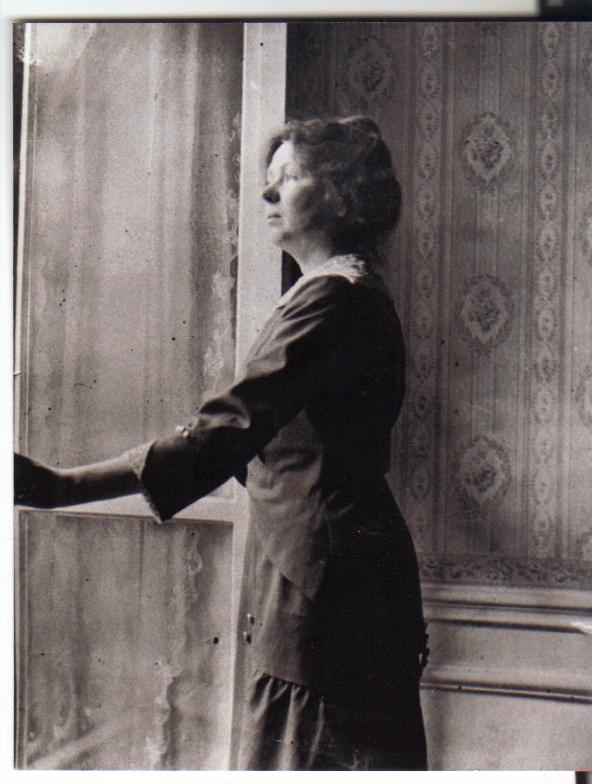
Christabel looking out of the window at 9 Rue Roy

Place Saint Augustin
Christabel could not have taken with her much in the way of personal possessions (though one imagines she perhaps did not regret being forced to acquire a suitably Parisian wardrobe) – but she did arrive well-armed with useful introductions. A mere four or five days after her arrival she was visiting the salon of Winaretta Singer, Princesse de Polignac – an entrée arranged through the good offices of Ethel Smyth, the Princesse’s sometime lover.

Princesse de Polignac’s music room (courtesy of The Blue Lantern blogspot)
It was in these glamorous surroundings that Annie Kenney, on her first visit to Paris, was asked to meet Christabel. One would love to know more – but in her posthumous memoir, Unshackled, Christabel is distinctly discreet as to how her time in Paris was spent. Or, indeed, how her prolonged sojourn there was financed; she did no work – in the conventional sense – during the two and a half years that she lived in Paris until the outbreak of war in August 1914 made it safe for her to return to England.
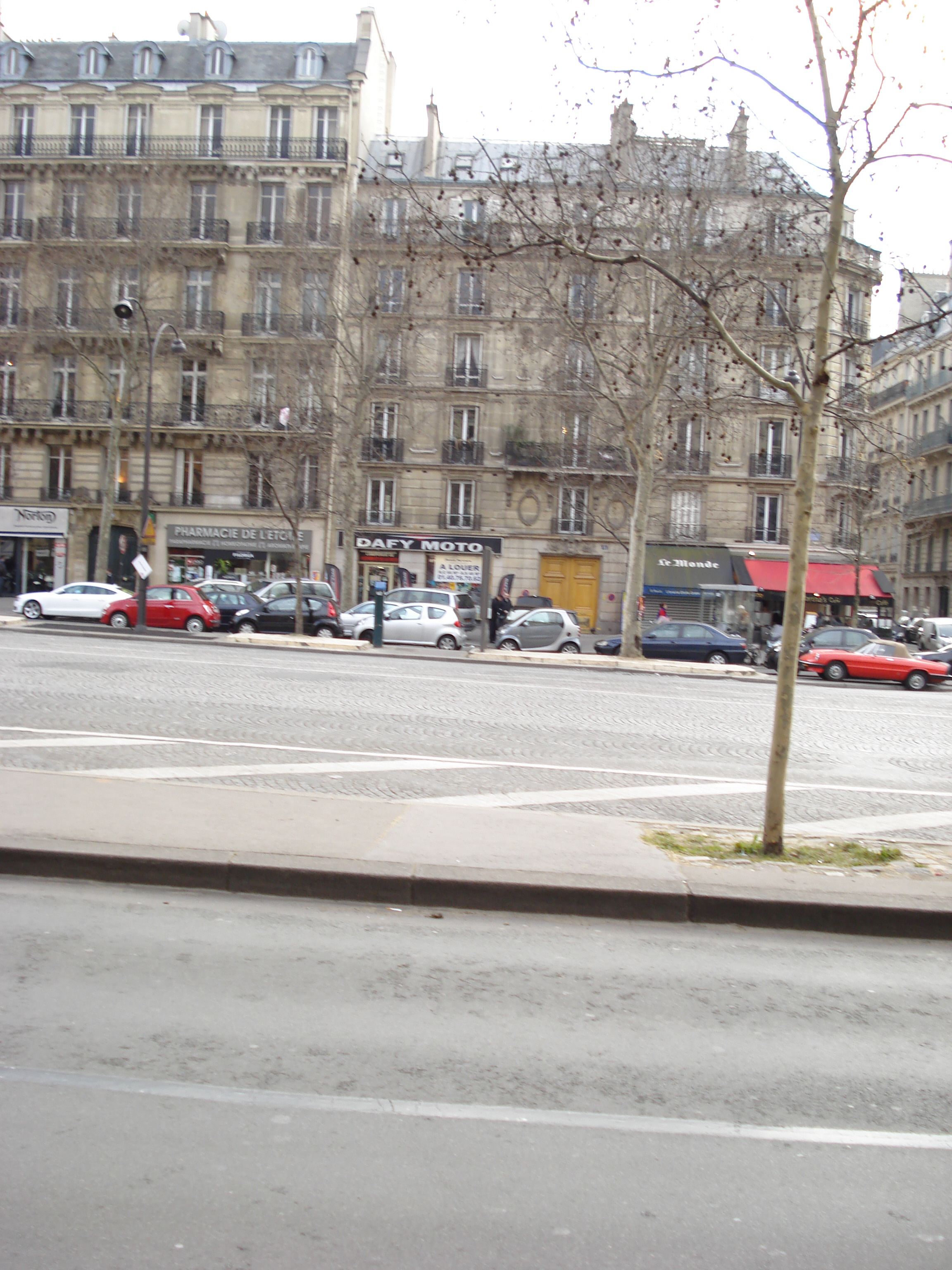
11 Avenue de la Grande Armee – on right
Indeed, after the French had refused to extradite her, by the autumn of 1913 Christabel had moved to a rather more central – and presumably more expensive – Parisian address -11 Avenue de la Grande Armeé, later -crossing the Avenue to live at a flat at no. 8. It was from here, in the very heart of Paris, that she conducted the last frenetic months of the WSPU campaign.
Number 8 Avenue de la Grande Armee – across the road from number 11
and a stone’s throw from the Arc de Triomphe
All the articles on Woman and Her Sphere and are my copyright. An article may not be reproduced in any medium without my permission and full acknowledgement. You are welcome to cite or quote from an article provided you give full acknowledgement.
Women Writers And Italy: Mrs Piozzi Vouchsafes Her Opinion of Rome And The Romans
Posted in Women Writers and Italy on April 6, 2013
In April 1786 Mrs Piozzi (the former Mrs Hester Thrale) was about to depart from Rome, the leisurely continental tour she had been enjoying with her second husband, Gabriel Piozzi, former music teacher to her children, was drawing to a close. Her final observation on the Eternal City and its inhabitants – both natives and visitors – is characteristically sharp.
‘The laburnum which at this gay season (16 April) adorns the environs of London, I look for in vain about the Porta Del Popola’. ‘Piazza del Popolo’ from Glimpses of Italian Society in the 18th century
The air of the city is unwholesome to foreigners, but if they pass the first year, the remainder goes well enough. Many English seem very healthy who are established here without even the smallest intention of returning home to Great Britain, for which place we are setting out to-morrow, 19th April, 1786, and quit a town that still retains so many just pretences to be styled the first among the cities of the earth, to which almost as any strangers are now attracted by curiosity as were dragged thither by violence in the first stage of its dominion, impelled by superstitious zeal in the second.
The rage for antiquities now seems to have spread its contagion of connoisseurship over all those people whose predecessors tore down, levelled, and destroyed, or buried underground, their statues, pictures, every work of art; Poles, Germans, Swedes, and Germans innumerable flock daily hither in this age to admire with rapture the remains of those very fabrics which their own barbarous ancestors pulled down ten centuries ado, and give for the head of a Livia, a Probus, or Gallienus, what emperors and queens could not then use with any efficacy for the preservation of their own persons, now grown sacred by rust and valuable from their difficulty to be deciphered.
The English were wont to be the only travellers of Europe, the only dupes, too, in this way; but desire of distinction is diffused among all the northern nations, and our Romans here have it more in their power, with that prudence to assist them which it is said they do not want, if not to conquer their neighbours once again, at least to ruin them, by dint of digging up their dead heroes, and calling in the assistance of their own pagan deities, now useful to them in a new manner, and ever propitious to the city.
From Glimpses of Italian Society in the Eighteenth Century, From the ‘Journal of Mrs Piozzi’, Seeley & Co, 1892
Suffrage Stories: An Entire Birmingham College Boycotts The 1911 Census
Posted in 1911 Census, Suffrage Stories on April 2, 2013
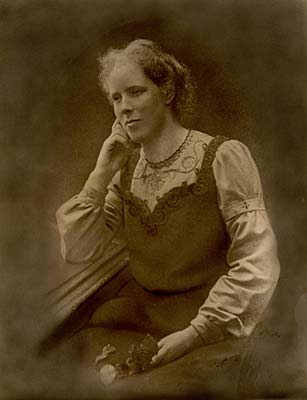
Rhoda Anstey (1865-1936) [courtesy of ConnectingHistories)
When researching the suffragette boycott of the 1911 census it is no surprise to find individuals in households – or, in the case of all-female households, all the members – refusing to give information to the enumerator.
Moreover one can discover instances of mass- evasion, such as those in Manchester and Portsmouth, which were instigated by the local WSPU organiser. It is, however, more unusual to find that an entire institution has absented itself from the census – but that is what happened in the case of the Anstey College of Physical Education. The College occupied a large house on the long Chester Road in Edrington, on the outskirts of Birmingham. All the Chester Road houses were then unnumberd, each having its own name – such as ‘Davos, ‘Glen Mor’ or ‘Westbourne’ – and it has taken some determined hunting but I have now managed to locate the census form issued to the College’s Principal, Rhoda Anstey. She gave no answers to the government’s questions but wrote across the form:
No Vote No Census! I protest against the injustice done to women rate-payers by the continued refusal of the government to give them the vote, and hereby refuse to fill in the census forms for my household.’ Rhoda Anstey, Principal of Anstey College. Note ‘If the Conciliation Bill passes the 3rd Reading on 5 May I undertake to give the information desired.’
On the form the Registrar noted in red ink that: ‘From the information obtained from several sources it is estimated that on the night of April 2nd 40 females slept on the premises and this number has been enumerated. ‘
Rhoda Anstey, theosophist, vegetarian and tax resister, had taken a contingent of her students to London on 19 June 1910 to take part in the grand procession organised by the WSPU in London and for the next few years actively supported the WSPU, advertising regularly in Votes for Women. Some of the College’s former students are likely to have been members of the Gymnastic Teachers’ Suffrage Society which had been founded in 1908. I presume that the 40 females enumerated on the night of 2 April included students at the College; I wonder if Miss Anstey enquired as to whether or not they wished to be enumerated?
For further information about Rhoda Anstey and her College click here
To listen to a talk I gave on the suffragette boycott at a National Archives conference on the 1911 census click here
Women Writers and Italy: Two Englishwomen In Rome and Sarah Parker Remond
Posted in Women Writers and Italy on March 30, 2013
Anne ( 1841-1928) and Matilda Lucas (1849-1943) were the daughters of Samuel Lucas, a brewer with land and influence in Hitchin, Hertfordshire. The Lucas family were Quakers. Their mother had died when they were young and after their father’s death in 1870 the sisters continued to live for a short time with their step-mother. But then, in mid-1871, they left England for Rome, where, for the next 29 years, they were to spend much of the year. Ten years after her sister’s death, Matilda Lucas published excerpts from the letters sent over the years by the sisters to friends and relations back in England. Two Englishwomen in Rome, 1871-1900 (Methuen, 1938) makes very interesting reading.
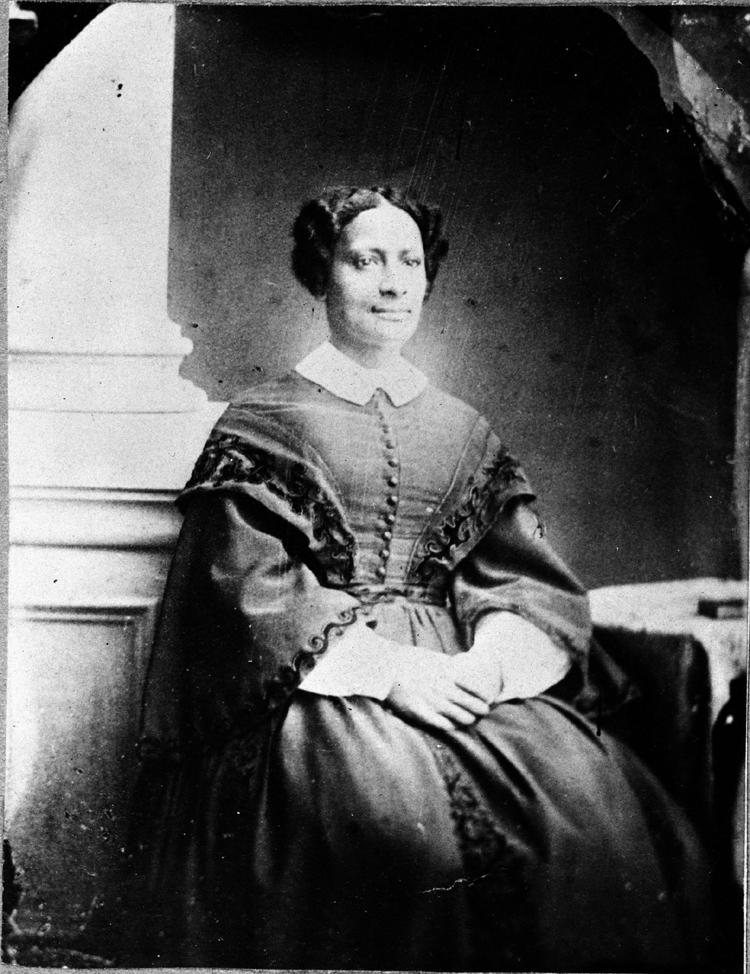
Sarah Parker Remond c. 1865 (Courtesy Peabody Essex Museum Collection)
The few disingenuous sentences I transcribe below would appear to delineate the discomfort that must have been endured by Sarah Parker Remond (1824-94) , or Sarah Remond Pintor as she was by then, as she mixed in society – even expatriate Roman society, which was by no means ruled by convention. An American free-born black woman, Sarah Remond had lived for a time in London, signing the first women’s suffrage petition in 1866, perhaps the only black woman to do so, had then travelled to Italy, where she qualified as a doctor. She had married an Italian, Lazzaro Pintor in Florence in 1877. There is some debate as to how long the marriage lasted. From the Lucas’ evidence, Pintor did not accompany his wife to this social occasion in Rome in March 1878, but Sarah was sufficiently still married to feel able to don her bridal dress.
However am I correct, I wonder, to read the passage as reflecting the curiosity and, perhaps, also slight discomfort felt by the gathering at the presence of a black woman in their midst? If Sarah was their aunt the P___s must surely have been the ‘Putnams’ – the family of Sarah’s sister, Caroline Remond Putnam, who lived with her in Italy on various occasions. If so the fact that Caroline also was ‘black’ makes the passage a little difficult to interpret. Why was Sarah specifically their ‘black aunt’? Did they have any other kind? So perhaps it was only the bridal dress that was the cause for comment. A simple scene, but something of a puzzle.
March 17, 1878. Tell Madgie that the P___s were there with their black aunt. She was a bride, having just married an Italian, and wore her bridal dress of grey silk. It must have been very trying for Mrs P____. People came up to question her. One Italian said, ‘Chi e quell’Africana?’ It appears that she is very clever, and a female doctor. She was taken up a good deal in London by different people who were interested in negroes. I think she lived with the Peter Taylors. She has given lectures. I went to sit on the sofa with her, to the amusement of Franz, who cannot rise above her appearance. Dr Baedtke was much impressed to think that anyone has had the courage to marry her, and said, ‘In that I should have been a coward.’
Click here for Sarah Parker Remond: A Daughter of Salem, Massachusetts – a very interesting website
Elizabeth Garrett Anderson Gallery At The UNISON Centre
Posted in The Garretts and their Circle on March 28, 2013
ALAS, IT WOULD APPEAR THAT THE GALLERY HAS FAILED TO REOPEN AFTER COVID CLOSURE. PLEASE PHONE UNISON TO ENQUIRE.
The Elizabeth Garrett Anderson Gallery at the UNISON Centre tells the story of Elizabeth Garrett Anderson, of the hospital she built, and of women’s struggle to achieve equality in the field of medicine.

HAElizabeth Garrett Anderson
Elizabeth Garrett Anderson (1836-1917) was determined to do something worthwhile with her life. In 1865 she qualified as a doctor. This was a landmark achievement. She was the first woman to overcome the obstacles created by the medical establishment to ensure it remained the preserve of men.
Elizabeth Garrett Anderson then helped other women into the medical profession, founding the New Hospital for Women where women patients were treated only by women doctors.
Elizabeth Garrett Anderson, by her example, demonstrated that a woman could be a wife and mother as well as having a professional career.
Elizabeth Garrett Anderson worked to achieve equality for women, being especially active in the campaigns for higher education and ‘votes for women’.
In the early 1890s the New Hospital for Women (later renamed the Elizabeth Garrett Anderson Hospital) was built on the Euston Road and continued to treat women until 2000. For some years this building then lay derelict until a campaign by ‘EGA for Women’ won it listed status. UNISON has now carefully restored the building, bringing it back to life as part of the UNISON Centre.
Two important rooms in the original 1890 hospital building have been dedicated to the Elizabeth Garrett Anderson Gallery. One is the
ORIGINAL ENTRANCE HALL
of the hospital which has been carefully restored to its original form. Here you can study an album, compiled specially for the Gallery, telling the history of the Elizabeth Garrett Anderson Hospital in words and pictures, while, in the background you can listen to a soundscape evocative of hospital life. This is interwoven with the reminiscences of hospital patients, snippets from the letters of Elizabeth Garrett Anderson and sundry other sounds to stimulate your imagination.
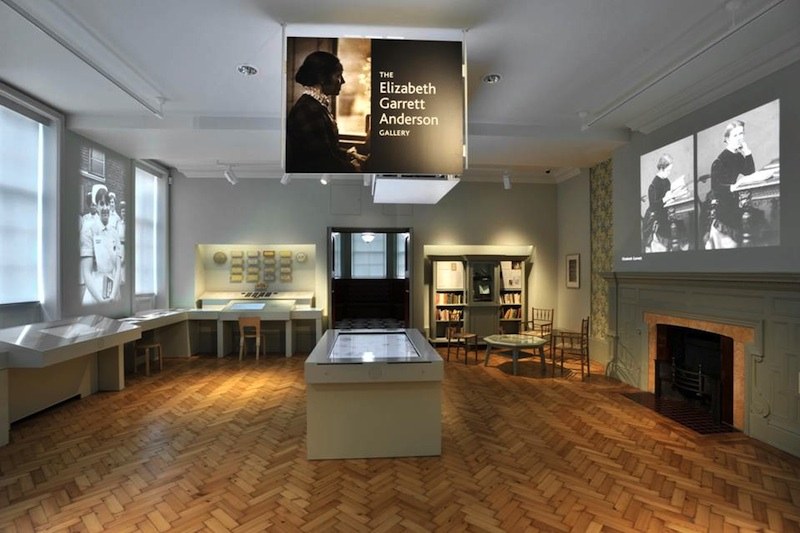
The main gallery
The other Gallery room is what was known when the hospital opened as
THE MEDICAL INSTITUTE
This was a room, running along the front of the hospital, parallel to Euston Road, set aside for all women doctors, from all over the country, at a time when they were still barred from the British Medical Association. It was intended as a space in which they could meet, talk and keep up with the medical journals.
Here you can use a variety of media to follow the story of women, work and co-operation in the 19th and 20th centuries.
A BACK-LIT GRAPHIC LECTERN RUNS AROUND THE MAIN GALLERY:
allowing you to see in words and pictures a quick overview of the life of Elizabeth Garrett Anderson and of her hospital.
AT INTERVALS ARE SET SIX INTERACTIVE TOUCH-SCREEN MONITORS
-named – Ambition, Perseverance, Leadership, Equality, Power in Numbers and Making Our Voices Heard – allowing you to access more information about Elizabeth Garrett Anderson, about the social and political conditions that have shaped her world and ours, and about the building’s new occupant – UNISON..
Each monitor contains:
TWO SHORT VIDEO SEGMENTS.
‘Elizabeth’s Story’. Follow the video from screen to screen. Often speaking her own words, the video uses images and voices to tell the story of Elizabeth Garrett Anderson’s life.
‘UNISON Now’ UNISON members tell you what the union means to them.
and four
INTERACTIVES
‘Campaigns for Justice’ and ‘Changing Lives’.
Touch the screen icons to discover how life in Britain has changed since the birth of Elizabeth Garrett Anderson.
AMBITION
Campaigns for justice
Victorian Britain: a society in flux
Victorian democracy: who could vote, and who couldn’t
Did a woman have rights?
Workers organised
Changing lives
The people’s lives in Victorian Britain
The medical profession before Elizabeth Garrett
Restricted lives, big ambitions: middle-class women in the Victorian era
Women workers in the first half of the 19th century
PERSEVERANCE
Campaigns for justice
The changing political landscape
Widening the franchise: can we trust the workers?
Women want to vote: the beginnings of a movement
Trade unions become trade unions
Changing lives
A new concept of active government: Victorian social reform
Women as nurses and carers
Living a life that’s never been lived before: women attempt to enter medicine
International pioneers: women study medicine abroad
LEADERSHIP
Campaigns for justice
Contagious Diseases Acts
Trade unions broaden their vision
Women and education
Women trade unionists
Changing lives
The middle-class century
Working women in the second half of the 19th century
Social reform, philanthropy and paternalism
Women doctors for India
EQUALITY
Campaigns for justice
The women’s suffrage movement
The Taff Vale decision hampers the unions
The founding of the Labour party
The People’s Budget
Changing lives
Work and play
Marylebone and Somers Town
Did the working classes want a welfare state?
1901 – Who were the workers in the NewHospital for Women?
POWER IN NUMBERS
Campaigns for justice
The General Strike – 1926
The first Labour governments
Feminist campaigns between the wars
1901: The lives of working women in London
Changing lives
Work of women doctors in the First World War
Can we afford the doctor? Health services before the NHS
Wartime demand for social justice
The creation of the National Health Service 1945-1948
MAKING OUR VOICES HEARD
Campaigns for justice
Equality campaigns
Public sector unions before UNISON
UNISON brings public service workers together
Are trade unions still relevant?
Changing lives
The National Health Service becomes sacrosanct
Did the welfare state change the family?
Women’s equality today
Women in medicine now
IN THE CENTRE OF THE GALLERY YOU WILL FIND:
ENTERPRISING WOMEN
an interactive table containing short biographies of over 100 women renowned for their achievements in Britain in the 19th-21st centuries. Up to four visitors can use the table at any one time. Drag a photograph towards the edge of the table to discover details of that individual’s life. Or search by name or vocation, using the alphabetical or subject lists.
ON THE WALLS OF THE GALLERY
PROJECTIONS
show a changing display of pictures of the hospital as it was and of Elizabeth Garrett Anderson and some of the other women whose stories the Gallery tells.
 THE GARRETT CORNER
is designed in the style associated with the work of Elizabeth Garrett Anderson’s sister, the architectural decorator Agnes Garrett, who was in charge of the original interior decoration of the hospital in 1890. The Gallery’s fireplace is the only surviving example of Agnes Garrett’s work. Next to this hangs a length of wallpaper, ‘Garrett Laburnum’, re-created from one of her designs.
In the Garrett Corner a display case and a low table contain a small collection of objects relevant to Elizabeth Garrett Anderson, the hospital and early women doctors.
While here do sit down and browse the library of books. These relate to the history of women – in society, in medicine, in the workplace, and in trade unions – and to the Somers Town area.
Plaque commemorating a substantial donation to the hospital by Henry Tate, industrialist and philanthropist
ACROSS FROM THE GARRETT CORNER IS A DISPLAY OF CERAMIC PLAQUES
Decorative plaques that used to hang beside patients’ beds, each commemorating a donor’s generosity.
You can read in detail about the work of the Garrett family in the fields of medicine, education, interior design, landscape design, citizenship and material culture in Elizabeth Crawford, Enterprising Women: the Garretts and their circle, published by Francis Boutle Publishers, £25. The book can be bought direct from womanandhersphere.com or click here to buy from the publisher
DO VISIT:
Elizabeth Garrett Anderson Gallery at the UNISON Centre
130 Euston Road
London NW1 2AY
Telephone: 0800 0 857 857
Open Wednesday to Friday 9.00am to 6.00pm
and the third Saturday of every month 9.00am to 4.00pm
Admission Free
Suffrage Stories: Devon Suffragists
Posted in Suffrage Stories on March 26, 2013
NUWSS South-West branch of the Pilgrimage photographed in 1913
In the summer of 1913, in the aftermath of Emily Wilding Davison’s spectacular funeral procession, while WSPU members were reading in the pages of The Suffragette details of Mrs Pankhurst’s successive hunger strikes, numerous reports of increasingly dangerous suffragette militancy, and Christabel Pankhurst’s denunciation of prostitution and venereal disease (eventually published as The Great Scourge), the constitutional suffragists, the National Union of Women’s Suffrage Societies, were planning a ‘Woman’s Suffrage Pilgrimage’.
The Pilgrimage was intended to act as a counter to suffragette militancy, to create a spectacle demonstrating that women, while disciplined, were also law-abiding. The air of spirituality that had surrounded Emily Davison’s coffin was paralleled by the consciousness-raising intent of the Pilgrimage. It is interesting to note that the model, which had been enacted the previous autumn when a small group of women had journeyed from Edinburgh to London, was known as the ‘Women’s March’. By mid-1913 the mood had changed – the women were no longer marchers, they were pilgrims.
In my Women’s Suffrage Movement: a reference guide I give an account of the various strands of the Pilgrimage, which, beginning at various distant points in England, approached London along eight main routes.
Now, to mark the centenary of the Pilgrimage, the Dreadnought South West Association is planning to tour a new play, ‘Oxygen’, playing at many of the stopping places of the south-west route of the Pilgrimage, which began at Land’s End on 19 June. One of those involved in planning the Pilgrimage commemoration is Dr Julia Neville, details of whose latest book are given below.
 Viva Juanita:
Juanita Phillips: Champion for Change in East Devon between the wars
by Julia Neville
‘”Juanita Maxwell Phillips, OBE (1880 – 1966) was eleven times Mayor of Honiton, Alderman and Freeman of the Borough, Devon County Councillor and County Alderman, JP and OBE. Her extraordinary story – from Chile to Honiton, from suffragette to pillar of the establishment, from amateur dramatics to theatre impresario – was uncovered in 2009 by the Senior Council for Honiton. It was brought to life in Honiton in newspaper articles, presentations, commemorative events, and a Honiton Players production, Viva Juanita! Now this fascinating illustrated book tells her story in words and pictures.”
For details of how to buy Viva Juanita see here
While being generally interested in NUWSS activities, I have an interest slightly more personal in the Devon branch because for some years before 1913, its secretary was Miss Jessie Montgomery, who was also a mover in establishing the college that eventually became Exeter University. When I arrived as a student I was among the first intake at a hall of residence that went by what seemed the rather cumbersome name of ‘Jessie Montgomery House’. We were never told who this Jessie Montgomery was – or had been – and I must say I never inquired – although I do remember being rather pleased when I could give her some reality, after coming across a commemorative plaque to her in Exeter Cathedral. Anyway, Miss Montgomery is now once more history – I see that ‘her’ hall of residence, along with others on that campus, have now been demolished. Sic transit…
Suffrage Stories: ‘From Frederick Street to Winson Green’: The Birmingham Women’s Suffrage Campaign
Posted in Suffrage Stories on March 22, 2013
On 13 October 2008 I gave the following talk in King’s Norton, Birmingham. It was part of a series of lectures to commemorate the restoration of the Old Grammar School and the Saracen’s Head, which in 2004 had won the BBC’ ‘Restoration’ television series.
I chose the title ‘From Frederick Street to Winson Green’ because it is interesting to trace the growth of the women’s suffrage movement in Birmingham through the streets and buildings in which the men and women of the city conducted their campaign. We will see that this campaign moved slowly from a domestic environment, from the villas (particularly the drawing rooms) of its main protagonists – into the public buildings and then the streets of Birmingham. And it was in Winson Green, the city’s castellated jail, that in 1909 the campaign which had begun 43 years earlier, took on a completely different and very much more dangerous aspect, that for which it has become notorious, when it was in there that suffragettes were forcibly fed for the first time in Britain.
But to begin at the beginning – it is worth bearing in mind that the campaign for women’s enfranchisement was just one among many in which liberal-minded men and women of the mid-19th century were interested. The campaigns for, example, land reform, anti-vaccination, compulsory education, early closing, and the Sunday opening of museums and art galleries were ones to which equal attention was devoted by their adherents. In 1866 the country was aware that parliamentary reform was in the air. It was over 30 years since the last attempt at reform and those who had industrialised Britain were determined that their exclusion from the franchise should be remedied. John Bright, who from 1858 had been Birmingham’s Radical MP, was at the forefront of this agitation. It was not, however, around Bright, who, unlike the rest of his remarkable family, was never in favour of giving any women the vote, but around another Radical MP, John Stuart Mill, that the campaign to include women in this potentially enlarged electorate was to centre. When Mill was elected to the Westminster seat in 1865 it was on a manifesto that included women as a category in a proposed enlarged franchise
A year later, in June 1866, he presented to Parliament a petition, signed by 1499 women, asking that the vote should be given to women on the same terms as it was given to men. This did not, of course, mean that all women should have a vote – any more than it meant all men – the capacity to vote was still to be determined by a property qualification. This petition includes only three names definitely from the Birmingham area – one woman lived at King’s Heath and two in Hockley. None of these women played any significant part in the ensuing campaign and it is likely that they were each asked to give their signature by a friend or relation from outside the area. There was clearly not yet an existing ‘feminist network’ in Birmingham, although this situation was soon to be remedied by the arrival at 10 Chad Road,
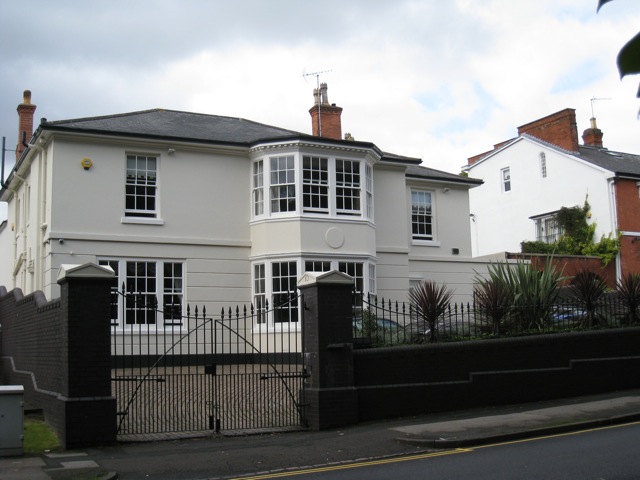
10 Chad Road (with thanks to Carole McKeown)
Edgbaston in c. 1867 of William Taylor and his young family. He was a member of a family that was closely involved both by business and marriage with the Courtaulds, manufacturers in Essex of that most eminently Victorian material – crape. Courtauld and Taylor fortunes were built on the backs, literally, of mourning Britons. William’s brother, Peter Alfred Taylor, was the very wealthy and very radical MP for Leicester. P.A. Taylor’s wife, Clementia, had been very active in the campaign to abolish slavery – as well as in numerous other radical causes – and was a member of the committee that organised that first women’s suffrage petition. William Taylor’s wife, Caroline, had signed the petition while they were living in Bridgwater. The family was Unitarian (as were so many others of their fellow campaigners of this period) and William is described in the 1871 census as an iron merchant and manufacturer.
The 1867 Reform Bill, when passed, did not, of course, include women in the enlarged franchise and groups of men and women in London and Manchester slowly formed themselves into the nuclei of a continuing campaign to put further petitions before parliament. At the time this was seen as the correct way in which to exert pressure on parliament; methods were to change over the years.
A committee of this National Society for Women’s Suffrage was formed in Birmingham on 21 April 1868 ‘in accordance with the request of Mrs P. Taylor, the Secretary of the London Suffrage Society, who had urged Mrs William Taylor, of Birmingham, and Miss Johnson to take up the matter’. A month later the committee held its first public meeting at the Exchange Rooms in New Street. William and Caroline Taylor were from the first members of the Birmingham executive committee and in 1868 Caroline was its treasurer. The first secretary was Mary Johnson, who had already been subscribing to the main London suffrage society in 1867. She lived with her parents, George and Fanny Johnson, at 90 Wheeley’s Road in Edgbaston. George Johnson is described in the 1871 census as an Independent minister. Lydia Becker, who was secretary of the very influential women’s suffrage society in Manchester, acted as Mary Johnson’s mentor, giving her guidance in setting up and running the society.
However in 1870 after her marriage, Mary Johnsonmoved to West Bromwich and was succeeded as secretary by Eliza Mary Sturge who lived at 17 Frederick Street (long ago renamed ‘Frederick Road’). She was the 28-year-old daughter of Charles Sturge, alderman of the city, brother of Joseph Sturge. The latter was by then dead, but very much alive in the Birmingham municipal memory. In the 1820s he had been one of the most vociferous campaigners against slavery and had been secretary of the Birmingham Anti-Slavery Society – even going out to the West Indies to inspect conditions there for himself. In the 1840s Joseph Sturge had been a leading campaigner in favour of the repeal of the Corn Laws, had throughout his life been an ardent supporter of free trade, peace and temperance, an advocate of manhood suffrage, founder of the Complete Suffrage Union, but, like John Bright, was not prepared to include women in any proposed enlarged franchise.

Sturge statue
After his death, in 1862 a fountain and statue had been dedicated to his memory at Five Ways, in Edgbaston and it is still there, despite all the road alterations. His brother, Charles, who worked in business with him as a corn merchant, was also involved in Joseph’s philanthropic endeavours but, unlike him gave practical, financial, support to the women’s suffrage movement. In 1871 he lived with his two daughters, Eliza and Maria, at 17 Frederick Street and it was from her home that Eliza conducted the business of the Birmingham Women’s Suffrage Society. The Sturges were Quakers and were related to the Clark family – the Quaker shoe makers – of Street in Somerset, who with other Sturge cousins were influential in the Bristol women’s suffrage society.
Having taken over the role of secretary in Birmingham, Eliza quickly became an active speaker in the suffrage cause. It was the policy of the suffrage societies around the country to attempt to influence both the existing, male, electorate and the women of the country by holding public meetings, using both local and imported speakers to lay out the arguments for women’s right to a vote in pithy speeches. In December 1871 there had been such a meeting in Birmingham, held in the Masonic Hall and described as crowded and highly successful.
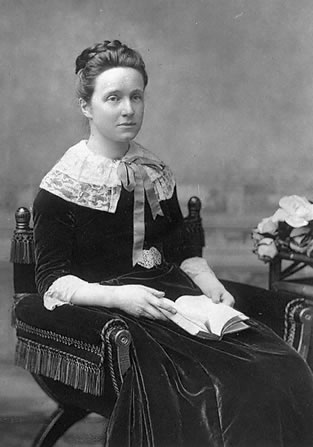
Millicent Fawcett
Millicent Garrett Fawcett came from London to speak at it. Eliza Sturge herself also took to the road as a suffrage speaker. In 1872, for instance, she was a speaker at suffrage meetings in both Bristol and Rochdale. A speech she gave on 6 December that year at BirminghamTown Hall was reprinted as a pamphlet. In the course of this speech she mentions that ‘I know that I can go and return from public meetings alone at night without experiencing the slightest difficulty or annoyance’, which says something about the streets of Birmingham at the time and gives us an idea of how Eliza Sturge occupied her evenings! Millicent Garrett Fawcett was again a speaker and her speech was also reprinted. In it she made the point that ‘I can scarcely imagine that the Birmingham politicians, who took so prominent part in the reform agitation for the extension of the suffrage to working men, can be blind to the patent fact that all the most convincing arguments used during that agitation in favour of admitting the working classes to representation apply with equal cogency to the case of women.’ In 1873, very soon after women became eligible to stand, Eliza Sturge was elected as a member of the Birmingham School Board, of which Joseph Chamberlain was then the chairman. She was a Liberal supporter but in the 1870s despaired at the Liberal Party’s lack of interest in the woman’s cause.
As well as holding public meetings, members of the Birmingham society also undertook personal canvassing and the distribution of pamphlets in some of the wards of the city. However they were always at this time hampered by a lack of funds. At the beginning of the 1870s the society had a subscribing membership of about 30 and had only slightly increased its numbers by the end of the decade. The society’s annual reports are notably brief in comparison with those of, for instance, the Manchester or Edinburgh societies, But in March 1873 the society did manage to move its affairs out of Frederick St and into an office in central Birmingham, at 4 Broad Street Corner and spent £3 13s on its furnishing.
In 1872, the executive committee of the society also included the Rev Henry Crosskey and his wife, who, like the Taylors, were also recent arrivals in Birmingham. He was a Unitarian minister and had previously been living in Glasgow.
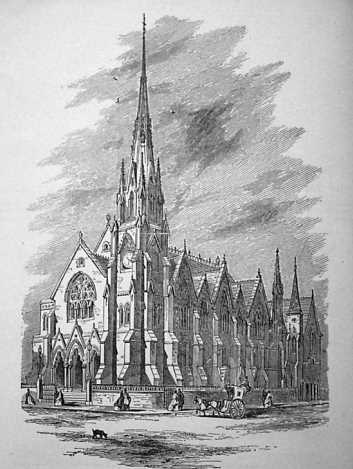
Church of the Messiah
In Birmingham he became minister of the congregation of the Church of the Messiah in Broad Street, a large Gothic building which reflected, as Pevsner put it, ‘the importance of Unitarians in Birmingham in the second half of the 19th century’. Under Crosskey the Church of the Messiah became an intellectual centre, a place where ideas about society were openly and critically discussed. Crosskey had long been associated with such radical causes as the Young Italy movement (Garibaldi and Mazzini were heroes to all the early supporters of women’s suffrage) and in Birmingham found a comrade in George Dawson, another independent nonconformist minister. Dawson had been a Baptist but in 1847 had opened his own church, the Church of the Saviour, in the middle of the city. His congregation included many people – Kenricks, Martineaus and Chamberlains -who were to become influential in the civic life of Birmingham. Dawson’s message was that the church should eschew fixed creeds and work towards the greater good, urging citizens to give all their talents for the service of the city. Dawson, thus, was a promoter of the ‘civic gospel’ that led Birmingham, in the 1870s and 1880s, to acquire the reputation for being the best-governed city in the world. Dawson had as early as the 1840s made clear that he was concerned about the position of women in society. It is unsurprising, therefore, to discover that his wife was also a member of the executive committee of the suffrage society at this time.
By 1878 Eliza Sturge had moved with her father and sister to Bewdley, from where, for a time she continued to act as secretary to the suffrage society. But by 1885 the honorary secretaryship had been taken over by Catherine Osler, who was finally to retire, as president of the society, 35 years later in 1920. As Catherine Courtauld Taylor, daughter of William and Caroline Taylor of 10 Chad Road, she had subscribed 1/- to the Birmingham Women’s Suffrage Society when it was founded in 1868; she was then 14. In 1873 she had married, in Crosskey’s Church of the Messiah, Alfred Clarkson Osler, a member of the wealthy Birmingham family of glass manufacturers. From both their families Catherine and Alfred Osler inherited a radical liberal tradition and from about 1884 Catherine was president of the Birmingham Women’s Liberal Association. All 4 of their children were to become active in the women’s suffrage movement. With increasing prosperity the Oslers moved to a large house in Edgbaston, ‘Fallowfields’, in Norfolk Road, the scene of a plethora of drawing-room meetings at which the question of women’s suffrage was discussed.

Mrs Osler (c) Birmingham Museums and Art Gallery, Supplied by the Public Catalogue Foundation
When Catherine Osler became secretary of the suffrage society her unmarried sister, Edith, became treasurer. It will have become clear that the 19th-century suffrage campaign in Birmingham, as in the rest of the country, was very much a middle-class affair – indeed very much an Edgbaston affair. With the vote firmly allied to a property qualification, it would only be householders and ratepayers who would benefit from any extension of the vote. There were, however, even within the middle-class pro-suffragists, degrees of liberalism. The 19th-century campaign split in 1888 along the lines of the split in the Liberal Party over Home Rule for Ireland. In Birmingham, as in the country at large, Joseph Chamberlain was one of the most prominent of the Liberal Unionists (those against Home Rule); the Oslers, unlike most of the Birmingham industrial families, who followed Chamberlain, were members of the more radical wing – followers of Gladstone in supporting Home Rule. This schism was reflected in a split in the national suffrage society so that for most of the 1890s the suffrage movement rather lost its focus, although individual members and societies were extremely active.
In 1892 Birmingham was chosen as the venue for a national conference organized by one of the splinter societies, the Women’s Emancipation Union, perhaps the most radical of these societies, with an agenda that demanded equality with men in every aspect of life. Although it is doubtful that Catherine Osler was actually a member of this society she did chair one session of this conference and proposed a resolution supporting the inclusion of women in any reformed scheme of local government. One of the leading members of the Women’s Emancipation Union was an interesting Birmingham woman. She was Caroline Smith, the sister of George Jacob Holyoake, Chartist and secularist, the last man in England to be sentenced on a charge of atheism. They were the eldest children in a large family, living in the 1820s in comparative poverty at 1 Inge Street in central Birmingham. As a child George Holyoake worked as a whitesmith alongside his father in the Eagle Foundry. Their mother had a small home workshop making horn buttons, before being put out of work by the growth of larger manufacturers. The Holyoakes were obviously an able family. However nothing is known about Caroline’s early life except that at some point she married a William Benjamin Smith, who had been born in Kings Norton around 1822. When the 1871 census was taken they were living at 19 Carpenter Road, Edgbaston. Although the Smiths’ house has now disappeared, it was presumably not unlike those that do remain – that is to say a large stucco Regency villa – a far cry from the house cum workshop in Inge Street where Caroline grew up. She was a member of the executive committee of the Birmingham Women’s Suffrage Society in 1885 but had clearly been attracted to the more radical movement and by 1892 was the national treasurer of the Women’s Emancipation Union.
It was doubtless its central position in the country that made Birmingham a popular venue for national conferences because again it was here, in 1896, that the main suffrage societies made a concerted effort to regroup. It was proposed that past differences be put aside and that they should unite as the National Union of Women’s Suffrage Societies, it being recognised that, after 30 years of campaigning – and the goal little nearer achievement – there was a need to present a common front from the centre. Although no parliamentary bill in favour of women’s suffrage was presented between 1897 and 1904 the suffrage movement did benefit from a more effective central organisation and this enthusiasm permeated down to the local societies. In October 1900 the minutes of the Birmingham society record that one of its best ever drawing-room meetings had been held in a private house at which 100 ladies were present and 26 new members enrolled. In 1902 the annual meeting of the Birmingham society – held in the Grand Hotel – was addressed by Sir Oliver Lodge, principal of Birmingham University. His speech was published as a pamphlet‘ so that today we can read that he thought, ‘The vote itself is a trivial affair, but its artificial withholding is a gratuitous insult: I am not surprised that the arbitrary withholding on that small function is one that galls out of all proportion to its importance. I recognize the desirability of doing away with artificial obstacles, and giving to everyone a clear field and an equal chance – a fair share in education, an open entrance to the professions, and a fair and reasonable opportunity of service in every direction.’
By this time Catherine Osler had become president of the Birmingham society and in 1903-4, with help from paid organizers (the movement was definitely moving away from involvement on a purely voluntary basis), she had supervised the opening of new branches in Coventry, Warwick, Redditch, and Leamington. At this time the Birmingham Women’s Suffrage Society thought it advisable to undertake work among working women, as was being done in Lancashire among the women textile workers. The Birmingham society began with the women chain makers of Cradley, paying for an organizer to go around from yard to yard, talking to the women about the suffrage issue.
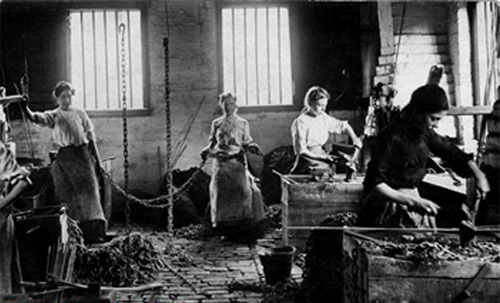
Women chainmakers at Cradley Heath
In early 1904 they conducted another campaign amongst the Cradley nail makers. During 1907 the society held 30 meetings in Birmingham and the surrounding district and in 1908 drew in £8 6s 3d in subscriptions – making it the second largest society (after London) in England.
The increasing activity of the Birmingham Women’s Suffrage Society was not only due to better central organization but doubtless owed something to the impetus provided by the arrival on the suffrage scene of a new ginger group. This was the Women’s Social and Political Union, which had been founded in October 1903 in Manchester by Mrs Emmeline Pankhurst, but which had only really begun to make an impact with the arrest and imprisonment in October 1905 (in Manchester) of Mrs Pankhurst’s eldest daughter, Christabel, and of Annie Kenney on charges of obstructing the police.
The WSPU determined to win the vote by what they termed ‘militant methods’, that is, in order to bring pressure to bear on the Cabinet they were prepared to do more than hold orderly public meetings and present petitions to parliament through MPs. The political process itself had evolved since the 1860s; it was clear that individual members of parliament had little real power (that now resided in the Cabinet) and that no bill in favour of women’s suffrage would have a chance of passing into law unless it was presented as a government measure. What actually were ‘militant methods’ was never clearly defined by the WSPU – members more or less set their own limits, and that militancy escalated as the years passed. Initially WSPU strategy was to hold large meetings at the beginning of each session of parliament in a hall, such as Caxton Hall, close to the House of Commons, and for a deputation, often led by Mrs Pankhurst herself, to attempt to present a petition to the Prime Minister, who would invariably refuse to see them. The police would attempt to prevent them reaching Parliament and brawling would ensue.
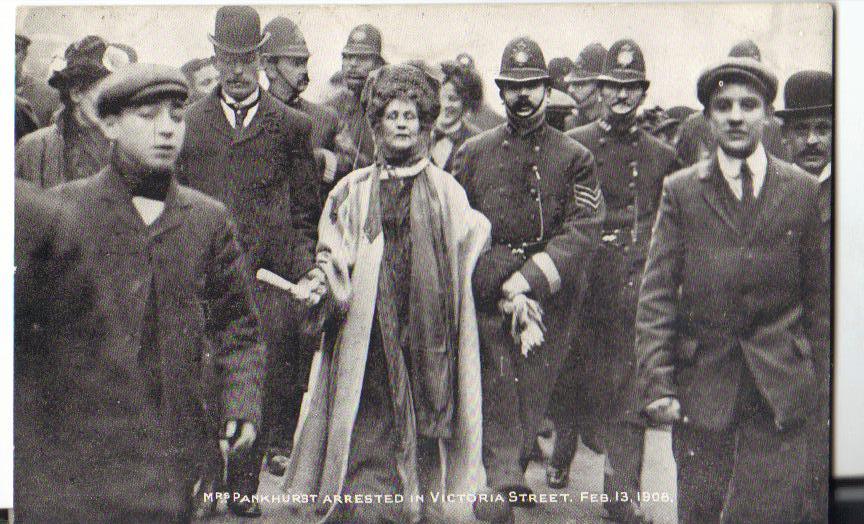
Mrs Pankhurst arrested while leading a deputation to Parliament
This all attracted marvellous publicity, in a way in which drawing-room meetings in Edgbaston never had. The WSPU provided newspapers with ‘news’, that is, spectacle that was recorded in the photographs that had only lately superseded the engravings with which newspapers had been illustrated, and with the kind of behaviour that, because it was considered ‘extreme’, was, therefore, ‘news’.
Although the WSPU opened branches around the country it was increasingly autocratically controlled from Clement’s Inn, its London centre, by the Pankhursts and their fellow leaders, Emmeline and Frederick Pethick-Lawrence. The WSPU did not, like the NUWSS societies, foster local centres run by local women, Instead organizers were appointed by Clement’s Inn to the main cities and were expected to work to orders. These organizers were moved frequently around in order that they might not develop too close local attachments.
The Pankhursts’ autocratic system was not put in place without difficulty. In the autumn 1907 one group, which perhaps might be roughly characterized as a more left-wing element, broke away from the WSPU. When first founded in Manchester the WSPU had drawn support from the local Labour party and women had been drawn into it through their interest in furthering the cause of Labour as well as of women. When it became clear that, as well as forbidding any democracy within their own society, the Pankhursts were not interested in supporting the Labour party at parliamentary elections, a group, under the leadership of Charlotte Despard, withdrew and formed the Women’s Freedom League.
Thus in Edwardian Britain there were three main suffrage groupings, the National Union of Women’s Suffrage Societies, which sought the vote using constitutional methods, the Women’s Social and Political Union that employed militant methods, and the Women’s Freedom League that was prepared to use militant methods against the political process (such as attacking the ballot box and picketing parliament) but would not countenance harm to people or property. Interestingly, although by 1913 the WFL had 59 branches, it only had two in the West Midlands, in Wolverhampton and the Potteries, and never supported a branch in Birmingham, although on occasion, during general election campaigns, for instance, WFL speakers, such as its leader, Charlotte Despard, did come to speak in Birmingham.
Emma Sproson
The most active member of the WFL in the West Midlands was Emma Sproson, who had been a member of the WSPU in 1906, but joined the WFL after the 1907 split. She was a keen supporter of the Labour Party. Mrs Pankhurst had stayed with Emma Sproson when she visited Wolverhampton in 1906 to speak to local members of the Labour Party.
In keeping with their practice, by November 1907 the WSPU had appointed as their organizer in Birmingham Annie Kenney’s younger sister, Nell, who was based at 22 Belgrave Road, Edgbaston. She had worked from the age of 10 in an Oldham mill, until forced by ill health to leave and become a shop assistant. Now in her mid- twenties she set about organizing Birmingham. She calmly notes in her report for the WSPU newspaper, Votes for Women, in November 1907, ‘I am visiting most of the influential people in Birmingham and surrounding districts’. She was also holding a series of drawing-room, open-air and factory-gate meetings, besides addressing different religious societies and women’s co-operative guilds. She notes that ‘Our meetings are being run on strictly economical lines. The outdoor meetings are being advertised by chalking the pavements or ringing the bell, and the audiences so far have been orderly and sympathetic’. On 20 November 1907 a well-publicized WSPU meeting was held at Birmingham Town Hall, with both Mrs Pankhurst and Mrs Pethick-Lawrence as speakers, and Christabel Pankhurst taking the chair. Regular, women-only meetings were held at this time on Thursdays at the Bristol Street Schools. In February 1908 a contingent of women travelled from Birmingham to London to take part in what was called ‘The Women’s Parliament’, a meeting held in Caxton Hall on the occasion of the opening of a new session of the ‘the men’s parliament’. In the ensuing fracas four women from Birmingham were among the 50 or so arrested and subsequently sent to Holloway.
Mrs Pankhurst arrested while leading a deputation to Parliament
Another Birmingham woman was arrested the next day while taking part in the deputation led by Mrs Pankhurst that attempted to approach the House of Commons.
In June 1908 the WSPU organized an extravagant demonstration in Hyde Park to which women from all over the country came. Birmingham was on the line from Wolverhampton along which travelled on the day a Special Train bringing Birmingham supporters to take part in the rally. Tickets for the train cost seven shillings return and could be bought from Stanford and Mann, booksellers in New Street, from James Pass’s music warehouse at 48 Cherry Street, or from Combridge at 4 and 5 New Street. The train left Birmingham at quarter to eight in the morning. When they got off the train at Euston the women lined up with thousands of others to process to Hyde Park.
One of the main speakers in Hyde Park, with her own platform from which to address the vast crowds, was Gladice Keevil,
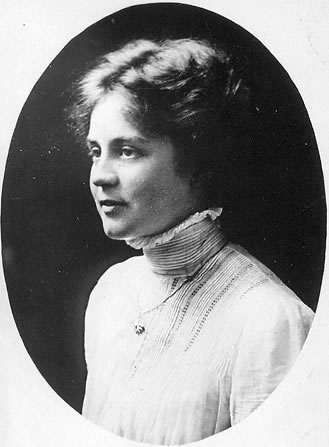
Gladice Keevil
considered one of the prettiest and most effective of WSPU speakers. She was a Londoner and was then 24 years old – she had already spent six weeks that year in Holloway. The Daily News report of the Hyde Park rally singled her out : ‘Miss Keevil was a particularly striking figure. Robed in flowing white muslin, her lithe figure swaying to every changing expression, and the animated face that smiled and scolded beneath the black straw hat and waving white ostrich feather, was the centre of one of the densest crowds’, showing that then, as now, it is the messenger rather than the message that captures the attention of the reporter. It was around this time that Gladice Keevil came to Birmingham, appointed WSPU National Organizer in the Midlands. She had already played her part in the conducting of the WSPU campaign at a by-election in Wolverhampton in May. WSPU election policy was to oppose the government (that is the Liberal) candidate in order, as they hoped, to bring pressure to bear on the government. At this Wolverhampton election the Liberal retained his seat with a majority of only eight (reduced from over 2800); the WSPU of course claimed that it was their campaign that had produced this close call. By the end of October 1908 Gladice Keevil had opened a WSPU office in Birmingham at 14 Ethel Street, which was to act as the headquarters for the Midlands. Evening At Homes were held there at 7.30 on Tuesdays, presumably attracting women who were working during the day, while afternoon
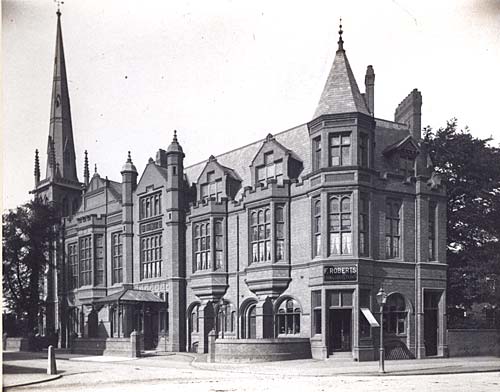
Edgbaston Assembly Rooms
meetings were held for the leisured at the Edgbaston Assembly Rooms. Working closely with Gladice Keevil at this time was Bertha Ryland, the daughter of Mrs Alice Ryland, of 19 Hermitage Road,
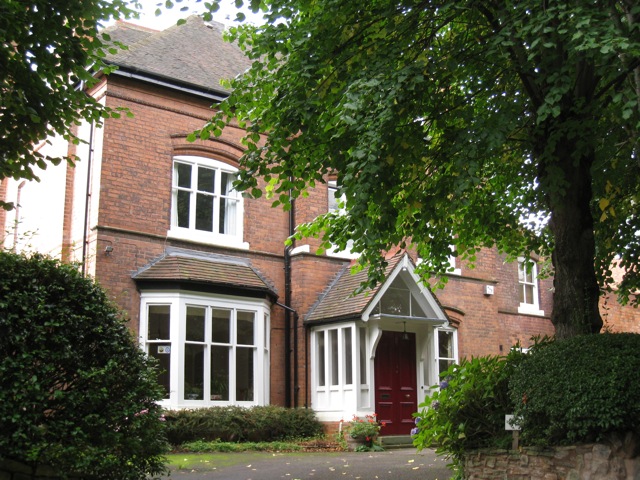
19 Hermitage Road (thanks to Carole McKeown)
Edgbaston, who in the mid 1870s had been a member of the executive committee of the Birmingham Women’s Suffrage Society and who had, with her daughter, transferred allegiance The Birmingham WSPU took its campaign into the Bourneville works and reported that many of the girls there wore the WSPU ‘Votes for Women’ badges. In February 1909 Christabel Pankhurst was the speaker at a meeting at the Town Hall and, as Votes for Women reported, ‘received an ovation the like of which no woman has ever experienced in Birmingham’.
A month later Mrs Pankhurst addressed a reception at the Midland Hotel, and a month after that Mrs Pethick-Lawrence led another Town Hall meeting. Birmingham was certainly not allowed to forget the women’s Familiar names appear in the list of WSPU activists; Miss Mathews and Miss Saxelby, for instance, have the same surnames as married women members of the 19th-century suffrage society, presumably attracted by the opportunity of more direct action offered by the WSPU. Catherine Osler’s daughters, Nellie and Dorothy, remained active members of the constitutional society and their brother, Julian was by this time a member of the Men’s League for Women’s Suffrage, the male counterpart of the NUWSS. Their other brother, John, was running the London side of the glass business and his wife was secretary of the Hampstead NUWSS society.
Gladice Keevil had introduced plenty of amusement for the young women of Birmingham; they could join the Votes for Women Corps and take to the street, standing in the gutter and attempt to persuade passers by to buy the WSPU newspaper. Again this activity seems to have been aimed at the leisured because quarter to 12 on a Friday morning was the rendevous time for the Corps to meet. Those sufficiently active could join the Cycling Scouts who, covering a 10-mile radius around Birmingham, took the suffrage message to out of the way places. There was also a Midlands WSPU horse-drawn caravan which in the summer toured the surrounding countryside.
Throughout the spring of 1909 there was also rather more sedentary activity that could be dedicated to the cause; the WSPU held in London a vast fund-raising bazaar, to which each district was encouraged to contribute goods for sale. The Midland group supported two stalls, one presided over by Mrs Kerwood, who had been one of the WSPU prisoners in March 1908, and the other by Mrs Gertrude Howey of Malvern, who had donated the campaigning caravan and whose daughter, Elsie, was one of the most active of the younger WSPU members. Women were encouraged to come from all over the country to visit the Exhibition, which was beautifully decorated by Sylvia Pankhurst, another of that remarkable family. Parties came down from Birmingham for the occasion on special excursion tickets. Birmingham women jewellers, including a Miss Myers and Annie Steen (of Woodfield Cottage, Woodfield Road, King’s Heath) contributed jewellery for sale on the Midland stall. Annie Steen was a regular advertizer in the pages of Votes for Women. In the 1901 census she had been described as an Art Teacher living at Mayfield Road, Kings Norton. Some of this jewellery would have been rendered with enamelling or stones in the WSPU ‘colours’; Annie Steen advertised in October 1909 ‘Handwrought jewellery in gold and silver set with stones in the colours’. Emmeline Pethick-Lawrence had introduced the colours, purple, white, and green, as ‘favours’ to be worn at the Hyde Park rally the previous year and WSPU branding had taken off in Birmingham. In a May 1909 report Gladice Keevil reminded members that hats, ties etc in the colours could be obtained from Romney, a milliner at 150 Broad Street and noted that one member was having the colours introduced into her wedding in every possible way, including the bouquets and the cake. Besides supplying jewellery to the cause Annie Steen also volunteered her drawing room for WSPU At Homes. Such meetings were also held at this time in the Women’s Hospital and in Queen’s College.
Mary Leigh in her uniform as leader of the WSPU Fife and Drum Band
Birmingham hit the headlines in September 1909 when suffragettes (as WSPU members had been nicknamed in order to be differentiated from members of the non-militant societies, the suffragists) dramatically interrupted a meeting that Asquith was attempting to hold in the Bingley Hall. Birmingham had tried to protect itself against any likely outrage; nine-foot high barricades had lined the station platform and the main streets along which the prime minister had travelled. However one intrepid suffragette had penetrated the defence and had reached the roof of the hall, from where she proceeded to hurl down slates to the ground. The five suffragettes, only one of whom (Evelyn Hilda Burkitt, a secretary who lived at 214 Wellington Road, Perry Barr) was native to Birmingham, were arrested. Four were sentenced to three months’ imprisonment and the fifth, Mary Leigh, who was regarded as a repeat offender, was sentenced to four months’ imprisonment with hard labour in Winson Green. There they went on hunger strike. Mary Leigh had used the tactic, both in Holloway and in Walton jail, Liverpool, and on both occasions had starved herself out of prison before the end of her sentence. However by late September the Home Office, whose officials had been giving advice to the prison medical officers, decided that enough was enough and Winson Green staff were instructed to institute a regime of forcible or, as the Home Office preferred to call it, ‘artificial’ feeding.
The minutes of the Prison Visiting Committee for this period make interesting reading. Unlike the issues of Votes for Women in which the suffragettes told their story, the Committee minutes give a dispassionate account of the procedure, recording that attempts were first made to feed Mary Leigh with a spoon, and when she resisted, resort was made to feeding by a nasal tube, but that by the end of the month she was taking food from a feeding cup. The WSPU brought a case on her behalf against the Home Office and the Governor of Winson Green, to the effect that a prisoner had a right to refuse such ‘treatment’ as feeding, However, the Lord Chief Justice eventually ruled that it was a medical officer’s duty to prevent prisoners committing suicide. A statement made by Mary Leigh, ‘Forcible Feeding in Prison’, based on her experiences in Winson Green, was published by the WSPU. The Birmingham WSPU did what they could to capitalise on the prison’s notoriety; parades were organised to march around outside, the women singing to offer encouragement to the inmates, I have seen a postcard sent at the time by a certain Arthur Lewis, who wrote to his correspondent ‘No doubt you have heard of the Birmingham suffragettes being forcibly fed in the prison.. It is occurring only about 3 minutes walk from our house and nearly every night the suffragettes who are at liberty ride to the prison in sometimes wagonettes and sometimes a fruitier’s cart and blow bugles. There are always some policemen there and do not let the conveyance stop. One suffragette Mrs Leigh was released yesterday, Saturday.’ Indeed Much had been made of the release of Mrs Leigh who was taken to the Ethel Street office in a cab and then straight to a nursing home.
The sight, as it were, of the Liberal government forcibly feeding suffrage prisoners was too much for Catherine Osler and at the end of the year she resigned as president of the Birmingham Women’s Liberal Association, a position she had held for most of her adult life. She did not, however, condone militancy, as she made clear in a pamphlet, ‘Why Women Need the Vote’.
By January 1910, when the general election that resulted from the House of Lord’s rejection of Lloyd George’s budget was held, Gladice Keevil had been moved on from Birmingham to Exeter, a very marginal Liberal seat, which went, with an equally small majority to the Conservatives; obviously Gladice’s winning ways were thought an essential tool in this aspect of the campaign. Liberalism was presumably too entrenched in Birmingham for it to be thought worth more than the usual measure of campaigning. The new organiser was Dorothy Evans and a new office, which stayed open until 8 in the evening, was opened at 33 Paradise Street. Throughout 1910, with the Liberal government dependent on a greatly reduced majority, the WSPU put militancy on hold, taking at face value Asquith’s assurance that if a reform bill were to be introduced the government would make the question of a women’s suffrage amendment open to a free vote. Activity therefore in the country concentrated on keeping the issue in front of the electorate. Bertha Ryland and Hilda Burkitt were still active WSPU workers, attracting a range of high- profile WSPU speakers to Birmingham. Through the pages of Votes for Women the minutiae of the campaign can be traced; it certainly involved an incredible amount of organisation. By the end of the year the WSPU activists were even able to employ electricity to advertize a meeting at which Mrs Pankhurst was speaking in the Town Hall; lanterns were ‘fitted with electric light which shone through’ throwing up the words ‘Mrs Pankhurst, Town Hall, November 15’ and were carried around the streets. The lanterns had been made by members of the local Men’s Political Union – the WSPU’s male counterpart. Women might agitate for the vote but they obviously didn’t mess with electricity.
The Birmingham NUWSS society had reopened an office c 1908 at 10 Easy Row – it was apparent that they had been without a central office for several years. Catherine Osler had by now an extremely competent secretary to run the society – Mrs Florence Carol Ring. I have been unable to find out anything about Mrs Ring – perhaps some local researcher can – but believe she was a most efficient organizer. A notebook in the Archives is labelled ‘Town Hall Meetings: Method of organizing and procedure’ and is full of the most detailed notes of how to organize and advertize the suffrage society’s meetings. All the items are costed and this notebook highlights the orderliness and forward planning that went into NUWSS meetings in this period.
In the summer of 1910 the country’s NUWSS and WSPU societies jointly staged in London a grand rally, wonderfully decorated with banners. There would have been trainloads of participants from Birmingham.
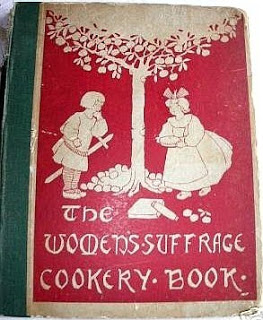
MRs Aubrey Dowson (ed), The Women’s Suffrage Cookery Boook
The Birmingham Women’s Suffrage Society was behind the production of one of the NUWSS’s most appealing fund-raising projects, the Women’s Suffrage Cookery Book, edited by Mrs Aubrey Dowson, whose husband was a nephew of Catherine Osler. The recipes were gathered from suffragists all over the country – the first in the book, for Egg Croquettes is from Mrs Julian Osler, Catherine’s daughter-in-law.
The suffrage peace came to an end in November 1910 when it was announced that parliament was to be dissolved without women being any closer to getting the vote. This was not the outcome for which the suffrage societies, both constitutional and militant, had been working; the WSPU put in place prepared plans for a deputation to the House of Commons. This met with firm police resistance in Parliament Square.
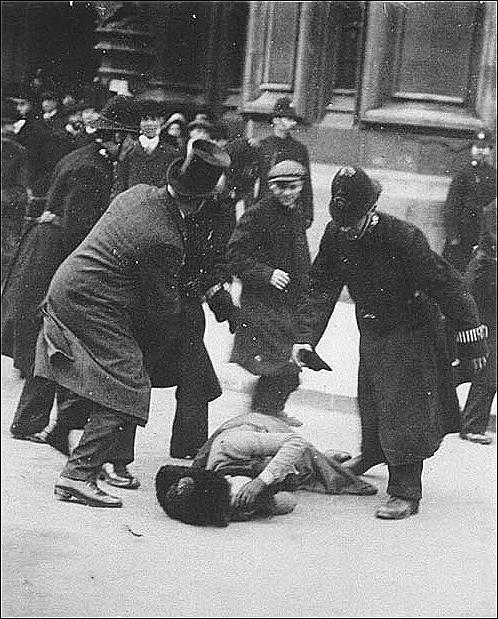
‘Black Friday’, Parliament Square, November 1910
Women were assaulted and the occasion went down in suffrage history as ‘Black Friday’. Dorothy Evans was among the women arrested but, because the Home Office realised that the occasion would be used as a wonderful source of propaganda by the WSPU, no charges were brought against her or any of the many others. However women who, a couple of days later, protested about the Parliament Square debacle by throwing stones at government offices, were arrested and charged. One of these, who was sentenced to two weeks’ imprisonment, was a Mrs Pattie Hall, who although originally from Manchester, where she and her husband had been very close associates of the Pankhursts in their Labour Party days, now lived in Edgbaston, at 56 Hagley Road. Her young daughter, Nellie, had taken part the previous year in the parades outside Winson Green and was to remain a supporter of Mrs Pankhurst until the latter’s death. A wonderful collection of Nellie Hall’s suffrage papers and ephemera (including a suffragette tea service and her hunger strike medal) is on loan to the Birmingham Museum. By mid 1911 the WSPU office had moved again – to 97 John Bright Street.
In April 1911 some members of the Birmingham WSPU joined in the boycott called on the census. One of these was Mrs Ethel Adair Impey, a Quaker, of Cropthorne, Middletonhall Road, King’s Norton. She was described on the census form, filled in by the registrar, as a ‘Suffragette, Information Refused’. In fact information was refused not only by her, but also by her husband, her son, her servant and about 6 nameless females.
In November 1911 after yet another long period of truce, Asquith announced that the government planned to introduce a manhood suffrage bill, which might, if the House of Commons desired, be amended to include women. An unlikelihood. This was the signal for women to take to the streets in London with stones, breaking more windows of government offices. Amongst the many arrested was Bertha Brewster, a young Birmingham woman whose mother had also long been a suffrage supporter. She was sentenced to 21 days’ imprisonment and on her release, with other Birmingham prisoners, she was given a hero’s welcome, in a room in Queen’s College, by the local WSPU. Dorothy Evans was among the many women arrested in London in March 1912 after smashing windows in the West End; Mrs Pankhurst had told the WSPU that ‘the argument of the broken pane of glass is the most valuable argument in modern politics’. Dorothy Evans was sentenced to two month’s imprisonment and a Miss Grew took over as organizer in Birmingham. Because there were too many suffragette prisoners to be accommodated in Holloway many were farmed out to prisons around the country. Twenty-five ordinary prisoners were moved from Winson Green in order to make way for suffragettes, who then went on hunger strike and were forcibly fed. Miss Grew organized members to go each night to stand outside the prison and cheer them on.
The prisoners appear to have made the most of their incarceration. They produced a hand-written, illustrated magazine, entitled The Hammerer’s Magazine – ‘for private circulation only’, its cover showing a hammer striking a pane of glass. One of the sketches, drawn on toilet paper, shows the 25 suffragettes in two rows seated on chairs, backs to the artist, with the prison gallery above, one warder at the front and another on the first-floor gallery. This is quite an important sketch, giving a rare view of life inside Winson Green..
The best poem in the magazine is probably one entitled ‘Winson Green in April & May 1912’ which appears to be written on the back of a Robertson’s Golden Shred marmalade wrapper! It begins:
Cling, clang of prison keys,
Slam bang of doors,
Wash slosh – Monday morn,
Water on the floors –
Tramp, tramp of prison feet,
Ring, rang of bells,
Clash smash of prison bars,
Suffragettes in cells.
Among the women imprisoned at this time was Maude Kate Smith from Birmingham, with whom Professor Brian Harrison recorded an excellent interview now held in the Women’s Library. Besides giving very graphic detail of her experience of forcible feeding, during the course of the interview Miss Smith reveals that there were plans afoot to blow up a Birmingham canal – for during 1912 and 1913 WSPU militancy escalated as the government’s intractability became more apparent.
 Pillar boxes were fired – here is one comical comments on this method of militancy. More seriously, property (always at least intended to be empty) was also targeted. The actions of the government contributed towards what might now be seen as ‘terrorism’. In April 1913 parliament passed ‘The Cat and Mouse Act’, by which women prisoners who were being forcibly fed were to be released for a few days to recover their health and were required to return to prison to resume their sentence. Most of those released – the mice – did not bother to return to prison and in many instances the police did not bother to look for them. This ‘underground’ life did, however, have a momentum of its own. Mice, already branded as criminals, thought nothing of repeating their acts of arson (or, as they called it, ‘work’) and much of the damage, which was really quite extensive, was carried out by a dedicated few, travelling around the country, given shelter by well wishers.
For instance, on Christmas Day 1913 one young suffragette, Lilian Lenton, who had been arrested on a charge of setting fire to a house in Cheltenham, was released from prison after going on a hunger-and-thirst-strike – into the care of Mrs Edith Impey of King’s Norton. In April 1913 suffragettes were suspected of setting fire to a boathouse in Handsworth Park. In the same month the Morning Post reported that the suffragettes had planned to set fire to the Old Grammar School at Kings Norton, but had changed their minds when they saw its beauty. In June 1913 a house in Solihull was destroyed and in July one in Perry Bar and another in Selly Park was set on fire. Nellie Hall was charged on suspicion of having been involved with this last arson attack; she had been caught on 13 July after throwing a brick at Asquith’s car when he visited Birmingham and was sentenced to three weeks’ imprisonment. In October 1913 two local railway stations -Northfield (not far from here) and
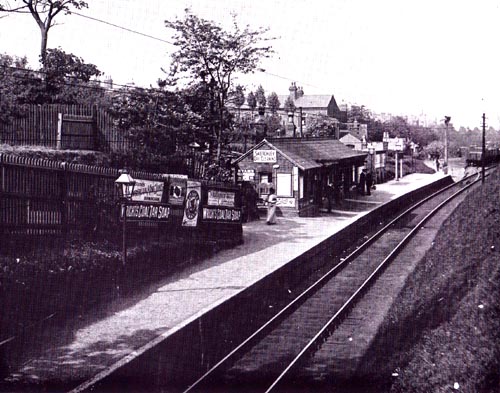
Hagley Road Station c 1913
Hagley Road were fired and in February 1914 Northfield Library was destroyed – the damage was estimated at £1000 – and on the same day a bomb exploded at Moor Hall Green. Soon after there were several other serious arson attempts in Birmingham; two houses and two cricket pavilions were set alight – at Smethick and Harborne. The slogan left at Harborne was ‘Down with sport, up with fair play for women’ – and there was a fire on the Midland railway at Kings Norton. .In March 1914 the Cathedral was defaced by suffrage slogans – including ‘Stop Forcible Feeding’ –which were daubed on much of its interior in white enamel paint. ‘Votes for Women’ was painted across the middle of the Burne- Jones window. On the vestry door was painted ‘The clergy must rise on our behalf’ Edgbaston Parish Church and St Stephen’s Selly Hill were also attacked.
On 17 May a grandstand at Bromford Bridge racecourse was destroyed and on 8 June Bertha Ryland, cleaver in hand, slashed a picture, ‘Master Thornhill’ by Romney, in Birmingham Art Gallery . She carried a letter giving an explanation of her conduct, saying ‘I attack this work of art deliberately as a protest against the government’s criminal injustice in denying women the vote, and also against the government’s brutal injustice in imprisoning, forcibly feeding, and drugging suffragist militants, while allowing Ulster militants to go free..’ The gallery was immediately closed for six weeks. After that it was not open after 5 in the afternoon and was closed all day Sunday; presumably the level of security had to be increased and the gallery could not afford to open for so many hours. A rule of ‘No muffs, wrist-bags or sticks’ was subsequently enforced.. Bertha Ryland, the presumably gently-nurtured daughter of Edgbaston (whose mother had 30 years earlier been intent on bringing art to the working-classes), had already spent a week in Holloway in November 1911 and, after taking part in the March 1912 window-smashing campaign in London, had been sentenced to six months’ imprisonment. She had spent four months in Winson Green prison, had gone on hunger strike and been forcibly fed.

Bertha Ryland’s WSPU hunger-strike medal (together with her Coronation medal) courtesy of Christie’s
After her arrest in the Art Gallery she went on hunger strike while held on remand. She then accepted bail, was too ill to stand trial at the July assizes, and still had not been sentenced when war broke out. She suffered permanent kidney damage as a result of her treatment in prison.
With Mrs Pankhurst in and out of prison under the Cat and Mouse Act and Christabel based in Paris, to where she had fled to escape the police, the WSPU leadership was

Christabel Pankhurst relaxing in France
increasingly out of touch with day-to-day reality and the campaign was ricocheting out of control. It is my contention that the WSPU was only saved from real disaster by the outbreak of war. The Pankhursts then dropped all suffrage activity and rallied to the flag leaving many, but by no means all, of their supporters dumbfounded. Some of the latter group founded the United Suffragists, to carry on campaigning. In 1915 Bertha Brewster founded a Birmingham branch of the United Suffragists, with an office at 15 New Street.
The NUWSS had, of course, eschewed all the pre-war violence and concentrated on spectacle and politicking. The constitutional or ‘law-abiding’, as they termed themselves, societies had organised themselves into Federations to concentrate their efforts. Birmingham played a leading part in the Midlands (West) Federation and in June 1913 joined with the other societies in The Pilgrimage, a grand attempt to bring a dignified campaign to the country and the prime minister. The Birmingham society travelled along the route that brought pilgrims, with cockleshell badges pinned to their hats, from Carlisle to London. On 14 July 1913 the Birmingham Daily Mail carried a report of the arrival of the pilgrims in Birmingham. ‘At 5 o’clock a strong contingent of the Birmingham Women’s Suffrage Society marched from Easy Row to meet the pilgrims who had started early in the afternoon from Wolverhampton. At Great King St, Hockley, the visitors were joined by the local suffragists, and a procession was formed, headed by the Baskerville Band. Banners bearing the legends ‘Law Abiding’ and ‘By Reason, Not Force’ were prominently displayed’. The pilgrims that passed through Birmingham would have been among those who continued on to Oxford.
As far as politics was concerned, the NUWSS entered into an electoral alliance with the Labour party in order to support Labour candidates at by-elections and thereby subject Liberal candidates to rather more opposition that the usual lone Conservative – that is, they were prepared to turn by-elections into three-cornered fights. Catherine Osler supported the national executive in this, although by no means all local societies did. Birmingham was still radical. By 1913 the society had enrolled 1600 ‘Friends of Women’s Suffrage’, mainly working-class women who could not afford to pay the annual membership fee but were prepared to sign pledges of support. The society at this time suggested founding ‘Women’s Study Circles’ at which working women could meet in each others homes to discuss the suffrage issue; Mrs Osler’s pamphlet ‘Why Women need the Vote’ was one of the suggested texts, as was John Stuart Mill’s Subjection of Women. At this time the Society had over 700 full members.
Unlike the WSPU, the NUWSS societies carried on campaigning during the First World War, as well as supporting the war effort. There was a split in the NUWSS; a majority of its committee wished to withdraw this support and to join in a Women’s Peace Conference to be held at The Hague and it was in Birmingham in June 1915 that at a national conference this move was defeated.
Whether it was because of women’s contribution to the war effort, matters were at last reaching a resolution. In March 1917 Catherine Osler presided over a meeting held in the Midland Institute in support of the move to include women in the proposed Electoral Bill. When the first installment of enfranchisement (that is, to women over the age of 30) was granted in 1918 the NUWSS’s work was ostensibly finished. Catherine Osler was in the chair at the meeting in which the proposed amalgamation of the Birmingham Women’s Suffrage Society and the local branch of the National Union of Women Workers (‘workers’ in this usage were not working-class women but women workers in a cause – in a 19th-century sense – philanthropists). The amalgamated society became the Birmingham Society for Equal Citizenship. Catherine Osler, radical to the end, was keen that the lack of representatives of women’s labour organizations on the new body should be rectified, suggesting that the Women’s Co-operative Guild should be given three representatives. She finally resigned as president in 1920; a portrait of her was commissioned and was presented to the ArtGallery (see above). The surplus of the money raised to pay for the portrait was used to fund a scholarship in her name at Birmingham University, to allow women graduates to read for a postgraduate degree in the Faculty of Arts. It is still awarded from time until very recently.
As well as all this activity from the two main suffrage societies, Birmingham also had other smaller but active suffrage groups. In 1913 the Birmingham branch of the Church League for Women’s Suffrage operated from the home of Miss Griffiths at 34 Harborne Road, Edgbaston; that of the Conservative and Unionist Women’s Franchise Association from the home of Miss Adams at 56 Carlyle Road, Edgbaston, the Birmingham branch of the Men’s League for Women’s Suffrage was run by Mr Evans from 382 Moseley Road, and that of the Friends League for Women’s Suffrage from the home of Miss Joyce at 12 Frederick Road, Edgbaston (a few doors from where Eliza Sturge, also a Quaker, had campaigned nearly 45 years previously).

Mrs Margery Corbett Ashby
At the 1918 general election, the first at which women (albeit only those over 30 years of age) could both vote and stand as candidates, the main attention was focused on Smethwick where Christabel Pankhurst stood as a coalition candidate; she was defeated. At that election Birmingham’s first woman candidate (at Ladywood) was Mrs Margery Corbett Ashby, who stood as a Liberal, again unsuccessfully. The Women’s Library archive includes a 1975 interview with Dame Margery, as she had then become, in which she says that the idea of her standing against a Chamberlain in Birmingham was greeted by her family with hoots of laughter. She goes on to say that she didn’t have ‘the faintest idea of getting in – which would have been very inconvenient – but did so in order to get people used to the idea of a woman standing. That she did as well as other Liberal candidates around. And her candidature was greeted with surprise but with no ridicule.
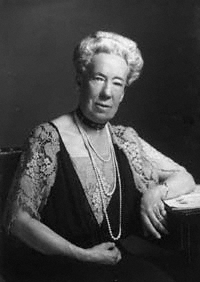
Dame Elizabeth Cadbury
The first woman to stand as a candidate for King’s Norton’s at a general election – in 1923 – was Elizabeth Cadbury, widow, by then, of George Cadbury, the chocolate manufacturer. She was a Liberal and was also unsuccessful. She lived at Manor House, Northfield, and was a city councillor for Kings Norton from 1919 to 1924. In 1928, 60 years after Birmingham’s campaign had been launched at the meeting in the Exchange Rooms, New Street, all women were given the vote on the same terms as men. However Birmingham did not have a woman MP until after the Second World War – with Mrs Edith Wills elected as Labour member for Duddeston in 1945 and Mrs Edith Pitt (Conservative) elected for Edgbaston in 1953 – the culmination of the campaign that had begun in 1866 with a mere three Birmingham names on that very first ‘women’s suffrage’ petition.
See also:
Birmingham Stories: Votes for Women
Fight for the Right: the Birmingham Suffragettes
Suffragette Acts in Birmingham: Parliament UK
Suffrage Stories: Radio 4 ‘Document’: Votes For Victorian Women
Posted in Suffrage Stories on March 19, 2013
On Monday, 18 March 2013 Radio 4 broadcast, in the series ‘Document, an interesting programme to which I made a small contribution. Below is the description of the programme that appears on the BBC website. The programme is available on iPlayer for a year – that is until March 2014 – click here to listen.
‘Votes for Victorian Women
- Duration:
- 28 minutes
- First broadcast:
Monday 18 March 2013
Popular history tells us that women did not get the vote until 1918.
Though they could technically vote in local elections before that, many historians have argued that in practice they had no vote until the 1860s at the earliest. And evidence that they ever did vote has proved almost impossible to find.
But now a poll book, discovered in a box of papers in a local record office, clearly shows 25 women voting in elections for important local posts in Lichfield in 1843.
In this week’s Document, the historian Sarah Richardson follows the trail of these women, to reveal a picture of Victorian women’s involvement in politics which challenges many of our assumptions.
She discovers that they represented a surprising cross-section of society – old and young, poor and prosperous – and attempts to trace their descendants today.
She finds out how, when even universal manhood suffrage was seen as a radical, dangerous idea, these women may have been just a few of many more who could vote at a local level.
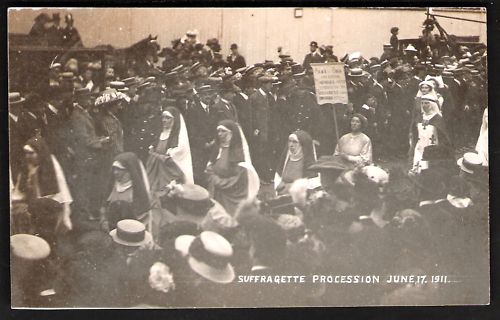
Coronation Procession 1911: The Historical Pageant
And she explores how, decades later, campaigners for Votes for Women at the Westminster level had to contend with this complex legacy.’
[Left – the photograph that Sarah and I are looking at when discussing the way in which 20th-century suffrage campaigners were keen to legitimise their claim to the franchise by looking to the power, occasionally electoral, exercised by women in the past.]
Women Writers And Italy: Mrs Piozzi And St Peter’s, 1786
Posted in Women Writers and Italy on March 18, 2013

Mrs Piozzi
Before images of St Peter’s and the Sistine Chapel disappear from our television screens, I thought you might like to read how this set piece of the Roman scene was viewed at the end of the 18th century by a plain-spoken English woman.
At Easter 1786 Mrs Piozzi (the former Mrs Hester Thrale) was in Rome. The continental tour she had been enjoying with her second husband, Gabriel Piozzi, former music teacher to her children, was drawing to a close.
Like Charlotte Eaton, who arrived in Rome some years later, Mrs Piozzi viewed St Peter’s – and its Easter celebration – with an eye not a little clouded by Protestant prejudice.
‘Nothing can look very grand in St Peter’s church; and though I saw the general benediction given (I hope partook it) upon Easter Day, my constant impression was, that the people were below the place; no pomp, no glare, no dove and glory on the chair of state, but what looked too little for the area that contained them. Sublimity disdains to catch the vulgar eye, she elevates the soul; nor can long-drawn processions, or splendid ceremonies, suffice to content those travellers who seek for images that never tarnish, and for truths that never can decay. Pius Sextus, in his morning dress, paying his private devotions at the altar, without any pageantry, and with very few attendants, struck me more a thousand and a thousand times, than when arrayed in gold, in colours, and diamonds, he was carried to the front of a balcony big enough to have contained the conclave; and there, shaded by two white fans, which, though really enormous, looked no larger than that a girl carries in her pocket, pronounced words which, on account of the height they came from, were difficult to hear.

Pilgrims in St Peter’s From ‘Glimpses of Italian Society’
All this is known and felt by the managers of these theatrical exhibitions so certainly, that they judiciously confine great part of them to the Capella Sistina, which, being large enough to impress the mind with its solemnity, and not spacious enough for the priests, congregation, and all, to be lost in it, is well adapted for those various functions that really make Rome a scene of perpetual gala during the Holy Week – which an English friend here protested to me he had never spent with so little devotion in his life before.’
From Glimspses of Italian Society in the Eighteenth Century, From the ‘Journal of Mrs Piozzi’, Seeley & Co, 1892
Kate Frye’s Suffrage Diary: ‘Campaigning for the Vote’ Is Here
Posted in Kate Frye's suffrage diary, Suffrage Stories on March 13, 2013
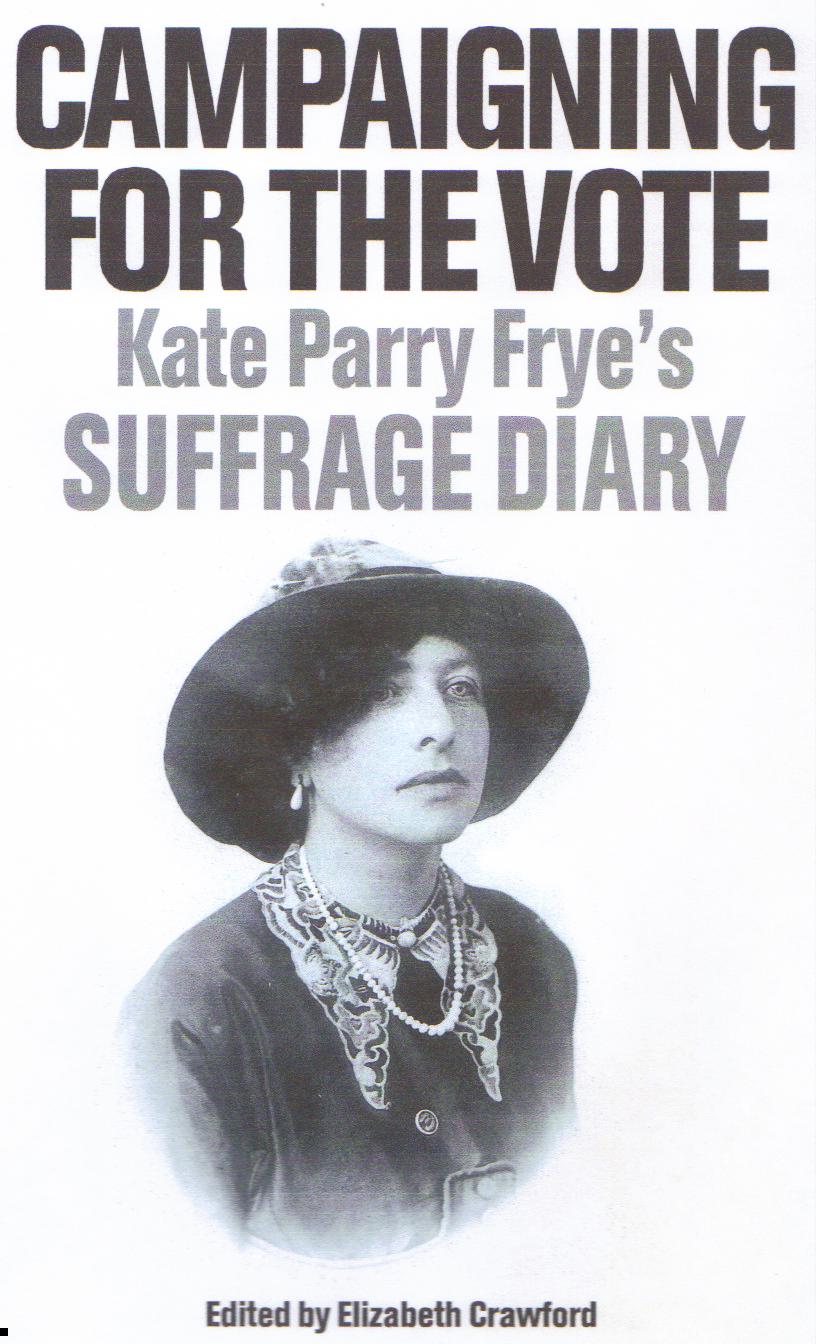 Here is the front cover of Campaigning for the Vote: Kate Parry Frye’s Suffrage Diary – published by Francis Boutle Publishers.
The key points about the book are:
- Drawn from a new primary source, Campaigning for the Vote tells, in her own words, the efforts of Kate Frye, a working suffragist, to convert the men and women of England to the cause of women’s suffrage. The detailed diary Kate kept all her life (1878-1959) has been edited to cover 1911-1915, years she spent as a paid organiser for the New Constitutional Society for Women’s Suffrage.
- No other diary gives such an extensive account of the working life of a suffragist, one who had an eye for the grand tableau – such as following Emily Wilding Davison’s cortége through the London streets – as well as the minutiae of producing an advertisement for a village meeting.
- With Kate for company we can experience the reality of the ‘votes for women’ campaign as, day after day, in London and in the provinces, she knocks on doors, arranges meetings, trembles on platforms, speaks from carts in market squares, village greens, and seaside piers, enduring indifference, incivility and even the threat of firecrackers under her skirt.
- Kate’s words bring to life the world of the itinerant organiser – a world of train journeys, of complicated luggage conveyance, of hotels – and hotel flirtations – , of boarding houses, of landladies, and of the ‘quaintness’ of fellow boarders. This was not a world to which she was born, for her years as an organiser were played out against the catastrophic loss of family money and enforced departure from a much-loved home. Before 1911 Kate had had the luxury of giving her time as a volunteer to the suffrage cause; now she depended on it for her keep.
- Kate Frye gives us the fullest account to date of the workings of the previously shadowy New Constitutional Society for Women’s Suffrage. She writes at length of her fellow workers, never refraining from discussing their egos and foibles.
- After the outbreak of war in August 1914 Kate continued to work for some time at the society’s headquarter, helping to organize its war effort, while allowing us to experience her reality of life in war-time London.
- Campaigning for the Vote is over 200pp long and contains over 70 illustrations, all drawn from Kate Frye’s personal archive. ISBN 978 1903427 75 0 £14.99
- Advance orders may be placed either with me or with the publisher – or with any good bookshop.
‘Campaigning for the Vote’ – Front and back cover of wrappers
Women Writers and Italy: Charlotte Eaton: St Peter’s Through Protestant Eyes
Posted in Women Writers and Italy on March 12, 2013
Scottish- born Charlotte Waldie (1788-1859), with her sister, Jane, and brother, John, travelled to Europe – as did so many others – in 1816/17, after the final defeat of Napoleon. For at least some of the time the two sisters travelled alone, when John was otherwise occupied. They each kept detailed notes of their journeys and sojourns: Charlotte turned her experience into Rome in the Nineteenth Century, first published privately and then, in 1820, by Archibald Constable.
Charlotte’s view of St Peter’s, recorded in these extracts, was reflected through a prism of Protestantism.
Colonnade of St PEter’s from ‘Rome in the Nineteenth Century’
It is impossible to express my disappointment I felt on seeing what seemed to me to be – not a church, but a large house or palace, three stories high, with little attic windows at the top. The dome is placed so far back, in consequence of the length of the Latin cross, that in the front view its grandeur is lost. Its design is irredeemably faulty, in giving to the front of the greatest temple in the world the frittering littleness of the exterior of a dwelling-house, and the effect, in producing apparent mediocrity of size, is as striking to the eye, that I could scarcely recognise in it any character of a church, much less of St Peter’s, that boast of modern architecture, and latest wonder of the world.
The crowded courts and irregular angles of that huge, unwieldy pile of building, the Vatican Palace, which adhere to it on one side like a monstrous excresence, are a great deformity. They overlook the top of the colonnade, depress the elevation, destroy its uniformity, and injure its general effect.
Having ventured inside, Charlotte found ‘The interior, on the whole, as far surpassed my highly-raised expectations, as the exterior fell short of them. Yet notwithstanding its beauty, I was conscious of a species of disappointment too commonly felt, when what we have long dwelt on in fancy is seen in reality. I had pictured it to myself less beautiful, and far less magnificent but more sublime. With an imagination deeply impressed with the imposing effects of the Gothic cathedrals of our own country, I expected, from the immensity of St Peter’s, even more of that religious awe and deep solemn melancholy, which they never fail to inspire: and I was unprepared for its lightness, decoration, and brilliance; – and, above all, for that impression of gaiety, which the first sight of its interior produces.
Charlotte condemns the use of Corinthian pilaster and, particularly, the Grecian arch which ‘has the unfortunate effect of diminishing the apparent length, which the the perspective of a Grecian colonnade, or a Gothic aisle, uniformly appears to increase….The windows, too, are mean and poor-looking, and offensive to the eye. It is easier, however, to point out the fault than the remedy; for windows do not enter gracefully into the beautiful combinations of Grecian architecture. In Gothic churches, on the contrary, how grand and majestic an object is the arched and shafted window! Indeed, if I may venture to own to you the truth, it is my humble opinion, that though Grecian architecture is admirably adapted to palaces and theatres, and places of public assembly, and public buildings of almost every other kind, it is not suited to churches….it does not accord with the solemn purposes of Christian worship, to which the simplicity and grandeur of the Gothic, and its impressive effect upon the mind, are so peculiarly fitted.
Certainly some apology may be found for its defects in the frequent changes of plans, and architects, and Popes during the building of [St Peter’s]; and in the real and imaginary necessity of having an upper balcony for the purpose of giving the benediction; a circumstance which has been so ruinous to its beauty, that we might say with truth, that the blessings of the Popes have been the perdition of the Church. But whatever the cause, the faults of the front of St Peter’s are unredeemable and unpardonable.
Kate Frye’s Suffrage Diary: ‘Votes for Women!’ At The Royal Court, April 1907
Posted in Kate Frye's suffrage diary, Suffrage Stories on March 8, 2013
Kate Frye photographed in costume for her part in J. M. Barrie’s ‘Quality Street’ – on tour in 1903
Kate Frye, besides being a life-long diarist, had a life-long devotion to the theatre, for a few years at the beginning of the 20th century even putting herself on the stage. However, on this afternoon in April 1907, it is her experience as a theatre-goer that she records. Her growing interest in women’s suffrage, which had been instigated by her new friends, Alexandra and Gladys Wright, was stimulated by a visit to the Royal Court Theatre to see Votes for Women! – a play by the American actress and author, Elizabeth Robins.
‘Tuesday April 16th 1907 [London: 25 Arundel Gardens, North Kensington]
..Changed my dress before lunch. Agnes and I had to leave at a quarter to two and went up to Notting Hill Gate. There met Mrs Wright, Alexandra and Gladys. They had asked us to join them in a theatre party to see ‘Votes for Women’ at The Court – but Mrs Wright told us it was her party and wouldn’t let us pay for a thing. They took us first-class to Sloane Square and in the Dress Circle – second row right – in the centre – to see the piece. It was a most enjoyable and interesting afternoon. I loved the piece – it is quite fine – most cleverly written and the characters are so well drawn. Needless to say the acting was perfection as it generally is at the Court Theatre and the second act – the meeting in Trafalgar Square – ought to draw the whole of London. I was besides myself with excitement over it – so were the Wrights – we all loved it. It was a jolly afternoon – and most awfully kind of them to take us like that. Gladys was very keen to know if it would have any effect on people. I can’t tell – people are not so easily influenced, I fear, except in isolated cases. I wanted to know what the men were thinking of it.
Miss Wynne Matthison was fine – really great, I thought – as Vida. Dorothy Minto was good and I liked Jean Sterling Mackinlay. Aubrey Smith was just the man for the part and played it well. Lewis Casson, Holman Clark were good too and Edmund Gwenn was fine and so amusing as a ‘Labour Member’. Miss Maud Milton, Miss Frances Ivor, Miss Gertrude Burnett and Agnes Thomas all played well and added to the complete success of the piece. The papers have not done it credit, I think – they have only seen the novelty of the idea and situations – not the cleverness in writing and construction. It was pouring when we came out. Mrs Wright took us to a tea shop and gave us tea and then we all came home by train together.’
Votes for Women! (n.b. the exclamation mark that Kate omitted) was first performed on 9 April 1907, directed by Granville Barker. The title had been changed from more the rather more anodyne ‘The Friend of Woman’. The Pankhursts were in the audience on the first night.
Nearly 100 years later, on 19 March 2003, Samantha Ellis wrote a most interesting piece on the play and its production for guardian.co.uk. See here for the whole article.
She notes that, like Kate, the critics loved the second act,
‘which had 40 actors, a plastercast base of Nelson’s Column and two huge ‘Votes for Women’ banners. For the Sketch it was “the finest stage crowd scene that has been seen for years”; to the Observer, it was “a marvel of verisimilitude akin to that which might be achieved by a joint use of megaphone and cinematograph”. Beerbohm, writing in the Saturday Review, felt that Dorothy Minto, playing one of the speakers, “caught exactly the spirit of her part – the blithe spirit of the budding platformist”. The Illustrated London News praised Agnes Thomas, playing a speaker identified in the script only as “A Working Woman”, for having “just the rasping Cockney tones, the termagant attitude, that are required” but carped: “There never were such speeches in Trafalgar Square.”
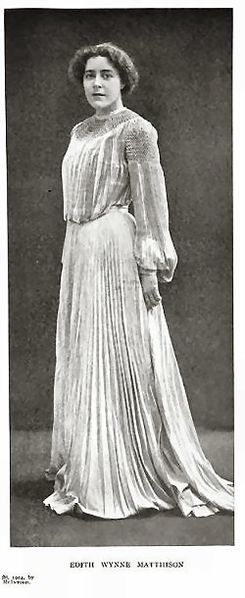
Edith Wynne Matthison
The play’s heroine, Vida Levering, a militant with a mysterious past, who may have been based on Christabel Pankhurst, was played by doe-eyed Edith Wynne-Matthison. Her casting affronted some reviewers; the Times’s critic sniffed, “The cause would make much more headway than it does if all its advocates were as fair to look upon and as beautifully dressed as Miss Wynne-Matthison,” and wondered: “Why, by the way, does Miss Levering take such care to make the best of her good looks and pretty figure and wear such charming frocks? Is it to please other women?”
He also cast doubt on the play’s polemical power: “Whether … the cause Miss Robins has at heart is likely to be advanced by hanging it on to other questions of seduction, abortion, and infanticide is perhaps doubtful.” He was not the only one to dislike the plot, in which Vida is revealed as the quintessential fallen woman, who hates men because an ex-lover forced her to have an abortion. Beerbohm claimed that he “yawned outright” when the ex-lover’s perfidy was revealed by the creaky device of a dropped handkerchief.
At the final plot twist, “when the ex-lover became a born-again suffragette”, even the Stage’s critic became distressed: “Except to those who have the Cause at heart … this might have seemed a rather lame and impotent conclusion.” For the Illustrated London News’s critic, the “play proper [was] not so interesting; its melodramatic story … [was] far too long and … far too thin”. But the suffragettes did not care. Robins gave them a quarter of her royalties, and in 1909 the play was staged in New York and Rome, selling the feminist message far beyond London. It also converted its leading lady, Edith Wynne-Matthison, to the cause; she and Robins founded the Actresses’ Franchise League in 1908 “ensuring that men like the Times’s critic could never again imply that suffragettes could not be glamorous”. ‘
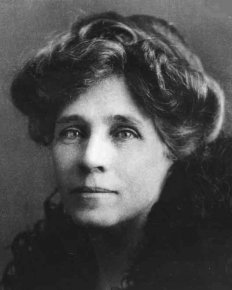
Elizabeth Robins
As far as I remember Kate Frye, although she became a member of the Actresses’ Franchise League very soon after it was founded and was very proud to walk with the AFL in the 1911 Coronation Procession, makes no mention of seeing any of the short plays written to be performed by members of the suffrage societies. Some of these plays – such as How The Vote Was Won by Cicely Hamilton and Christopher St John – have been collected in The Methuen Drama Book of Suffrage Plays, edited by actress and researcher Naomi Paxton, recently published by Bloomsbury. See here for details.
Kate Frye did, however, have a starring – if silent – role in the first production, directed by Edith Craig, of Christopher St John’s controversial play, The Coronation. You can read her full diary entries relating that experience in
Campaigning for the Vote: Kate Parry Frye’s Suffrage Diary edited by Elizabeth Crawford
For a full description of the book click here
Wrap-around paper covers, 226 pp, over 70 illustrations, all drawn from Kate Frye’s personal archive.
ISBN 978 1903427 75 0
Copies available from Francis Boutle Publishers, or from Elizabeth Crawford – elizabeth.crawford2017@outlook.com (£14.99 +UK postage £3. Please ask for international postage cost), or from all good bookshops.
- ‘Campaigning for the Vote’ – Front and back cover of wrappers
For much more about Kate Frye’s life as an actress see Kate Parry Frye: the long life of an Edwardian actress and suffragette by Elizabeth Crawford for details see here

Suffrage Stories: Kate Frye’s Suffrage Diary, The Royal Albert Hall, And The Importance of Gas
Posted in Suffrage Stories on March 5, 2013
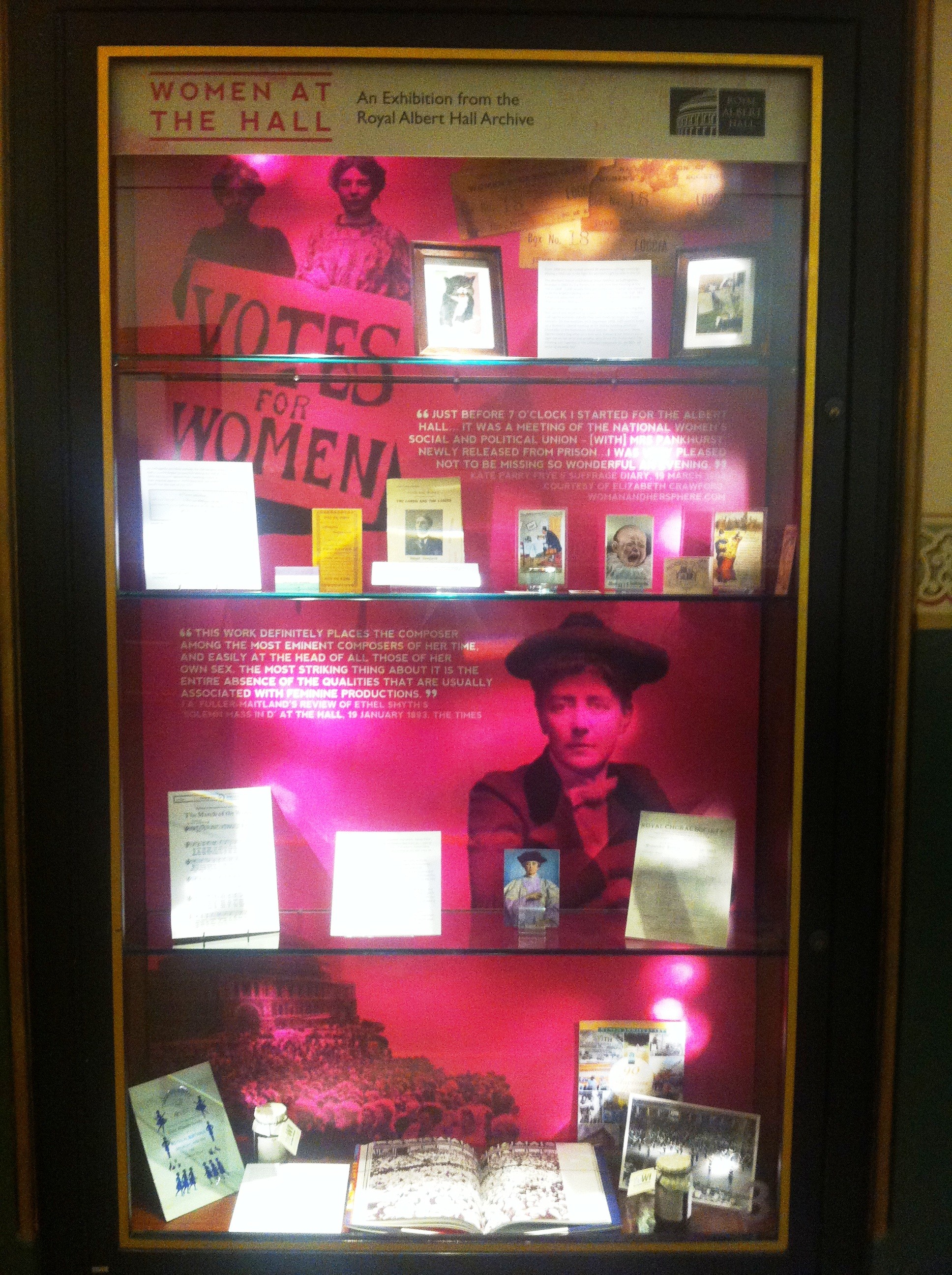 The Royal Albert Hall was the scene of many grand suffrage occasions – organised by both the constitutional and the militant suffrage societies. The management of the Hall has recognised this by supporting its archivists in mounting a small display relating to its suffrage past. The display may be viewed by anyone with a ticket to an event in the hall.
Researchers use the primary sources available and Suzanne Keyte, Project Archivist at the Royal Albert Hall, has mined what is known as the Hall’s ‘Gas Book’ to recreate a list of occasions on which the Hall was rented for suffrage-related meetings. The ‘Gas Book’ records the amount of cubic feet used each time the Hall was let for a concert or a political or a religious meeting and, with certain provisos, can be used as an indication of the size of the audience.
Kate Frye witnessed several grand suffrage occasions in the Hall. Here she describes an evening stewarding for the London Society for Women’s Suffrage at a Mass Meeting of suffrage societies in support of the Conciliation Bill
 Saturday November 12th 1910
I sat and sewed a red, green and white scarf for the evening. We had tea at 4.15 and I had a rush to dress and take Mickie [her dog] out and get off by soon after 5 o’clock. I was due at the Albert Hall at 5.30. Was given a job to do till 6.30 – or rather before – when we all went to our posts. Mine was Balcony – selling of programmes and ‘Common Causes’ [the NUWSS newspaper] & helping with the collections. The hall looked lovely – the banners were so beautifully arranged – but it wasn’t so full as I should have liked. The W.S.P.U. had a crowded meeting on Thursday and collected £8,000. Wonderful people one simply cannot hear from the Balcony. Mrs Swanwick was the only one I could really hear – her elocution is marvellous. It was so interesting seeing all the Societies – but [ie except for] the W.S.P.U. there – such lots of colours & badges – and I got very chatsome to some of my companions upstairs from the different societies.
When the meeting was nearly over I went down to the hall & tried to sell ‘Common Cause’. Old Major General Sir Alfred Turner, who was sporting around with Adeline Bourne, bought one of me with a beam and a handful of coin – he is a joke. It had come on to pour with rain and the Wrights insisted on bringing me as far as their place in their Taxi which was kind. ‘
The Hall’s ‘Gas Book’ shows that for this meeting the NUWSS consumed – and were charged for – 47,800 cubic feet of gas. On this November night one imagines that it would have been necessary to have lit all the Hall’s lamps. In fact, on 19 March 1908, when Kate Frye attended the first WSPU meeting to be held in the Albert Hall, that night’s gas consumption had been very similar- 46,800 cubic feet (click here to see Kate’s description of that meeting). From this idiosyncratic source we can deduce that the NUWSS did not lag behind the WSPU in ensuring that their evening meetings were brilliantly lit, even though, from Kate’s account, they were not necessarily able to muster as large an audience.
There was something to be said for staging meetings in the Albert Hall on summer evenings. For at the meeting held there that marked the finale to the NUWSS’s procession through London on 13 June 1908, gas consumption was only 16,000 cubic feet. We know when the meeting started because Kate Frye carefully noted in her diary that, after marching from the Embankment in the rearguard position which the Kensington branch had been allotted, she reached the Albert Hall at 5.10, just as the meeting was about to begin. Clearly less artificial illumination was required for a meeting held on an early evening in summer than for one in the winter, thereby reducing at least one element of the cost. (See here for the entry from Kate’s diary describing the procession).
Suzanne Keyte has identified c 30 suffrage meetings that were held at the Royal Albert Hall. By June 1913, however, after pressure had been exerted on hall owners throughout the country, the management of the Hall decided that they would refuse the WSPU any further lettings. What was in effect their last meeting had taken place a couple of months earlier, on 10 April.
Campaigning for the Vote: Kate Parry Frye’s Suffrage Diary edited by Elizabeth Crawford
For a full description of the book click here
Wrap-around paper covers, 226 pp, over 70 illustrations, all drawn from Kate Frye’s personal archive.
ISBN 978 1903427 75 0
Copies available from Francis Boutle Publishers, or from Elizabeth Crawford – e.crawford@sphere20.freeserve.co.uk (£14.99 +UK postage £3. Please ask for international postage cost), or from all good bookshops. In stock at London Review of Books Bookshop, Foyles, National Archives Bookshop.
- ‘Campaigning for the Vote’ – Front and back cover of wrappers
Suffrage Stories/Suffragette Jewellery: Mary Leigh’s Emily Wilding Davison Brooch
Posted in Collecting Suffrage, Suffrage Stories on February 18, 2013
This circular brooch, containing a photograph of Emily Wilding Davison in academic dress, formerly belonged to her friend and champion, Mary Leigh. The photograph of Emily Wilding Davison (for the photographer/publisher of the postcard see here) is rather worn and has a little ink scribble on it – though what the intention – if any – of this is, I cannot say.
The photo is held in the brooch frame by a card showing Sylvia Pankhurst’s WSPU design, in purple, white and green, of ‘the sower’. This may originally been a component in a WSPU badge. Written on it in capital letters, in Mary Leigh’s idiosyncratic style, is ‘LIBERTY. NO SURRENDER. E.W.D.’.
This is a piece that, unlike so much else on the market, clearly merits the description ‘suffragette jewellery’. I do not think that this commemoration photo of Emily Wilding Davison was issued by the WSPU in this particular style of circular brooch, but suspect that Mary Leigh herself put the photo in it. The brooch is edged with alternating little pink and white stones. It is worth noting that Mary Leigh, even with her close acquaintance with WSPU imagery and branding, did not bother to select or commission a brooch with stones reflecting more closely the WSPU colours.
Kate Frye’s Suffrage Diary: Myra Luxmoore, Suffrage Artist
Posted in Kate Frye's suffrage diary, Uncategorized on February 4, 2013

57 Bedford Gardens (now renumbered as 77, courtesy of wikipage on William Magrath)
I first came across mention of ‘Miss Luxmoore’ in the pages of Kate Frye’s diary. Obviously a suffragist, with a Studio at 57 Bedford Gardens, Campden Hill, I presumed she was an artist. But who was she? Her name is not recorded in, for instance, Lisa Tickner’s Spectacle of Women, the vademecum on suffrage artists. Intrigued, I thought it worth finding out more about Miss Luxmoore and her world.
So, to begin at the beginning, here are three entries from Kate Frye’s diary in which she records meetings held at Miss Luxmoore’s Studio.
Tuesday February 9th 1909
Dinner at 7.30. Off at 8 o’clock to Bedford Gardens – Miss Luxmoore’s Studio to a Suffrage meeting. Got there in good time and started to work at once stewarding and trying to make converts. Got a young man student to join the Men’s League. Mr Mitchell and Miss Clementina Black were the speakers and did very well. Alexandra [Wright] was in the Chair. I waited at the end helped count the money etc and walked up to Notting Hill Gate with the Wrights and Miss Black and walked all the way home. Was not in till after 11 o’clock. Very much enjoyed the meeting and the Suffrage atmosphere and meeting all those students was like a page out of a book.
Tuesday March 30th 1909
I changed my dress had a bit of something to eat then off at 7.30. Walked to Richmond Road took a bus to Bedford Gardens and went to Miss Luxmoore’s Studio Suffrage meeting. Gladys was there. Mrs Graves took the chair. Miss Meyer helped and Mrs Stanbury spoke – but, besides ourselves, there were only 15 audience. Mrs Henry of the Camden Institute was there. I had sent her a card and she quite disgraced herself and made Mrs Stanbury very uncomfortable by hissing loudly, then walking out with her poor unfortunate daughter. Something Mrs Stanbury said upset her – she was only talking history but Mrs Henry took it to mean the Queen of Spain – but I could not understand it till I got home and found from Daddie that Mrs Henry has become a ‘pervert’ to the Roman Catholic Church. It made a nasty impression on us somehow. We had a chat afterwards and all got very low spirited. There has been another raid on the House – several arrests and the women much knocked about – it is all so awful.
Tuesday May 4th 1909
Went off at 7.30 [pm] Walked to Richmond Road – a bus from there to Bedford Gardens – and to Miss Luxmoore’s Studio for a Woman’s Suffrage meeting. Such a crush of people and no end of helpers. Mrs Carl Hentschel, Miss Abadam and Mr Walter McLaren were the speakers. Miss Hentschel [her father, Carl Hentschel, was a lithographic printer, responsible for some suffrage posters], Miss Porter, Miss Meyer and, of course, Gladys and Alexandra. I had sent Miss Lockyer [who had been the late William Whiteley’s housekeeper] a ticket and she was there with Miss Clara Whiteley – and who should be there but one of the Miss Hollingsworths (Jessie) taken by some friend. I made three members – which wasn’t bad – and I waited with the others to help clear up and walked to Notting Hill Gate with them. Then came home in a bus. Was so tired. Mother was waiting up. Supper & bed. Mrs Carl Hentschel’s maiden speech and she did it very well and I don’t think I ever heard a more rousing speech than Miss Abadam. Mr McLaren [Walter McLaren, Liberal MP] was stupid.’
My research has shown me that ‘Miss Luxmoore’ was Myra Elizabeth Luxmoore (1860-1918), born in Paddington, the only child of John and Jane Luxmoore. By her first marriage, however, Jane had at least three daughters, Myra’s elder half-sisters. John Luxmoore worked for the Great Western Railway as a superintendent locomotive engineer. After a period based in Paddington, the family followed John’s work to Newport in south Wales and finally to Newton Abbot in his native Devon.
By 1888, giving her address as Somerford, Newton Abbot, Myra Luxmoore was exhibiting as an Associate with the Society of Women Artists. By 1891 she had moved to London and was living at 32 Charlotte Street, Fitzroy Square. She then spent a brief time living at 87 Cadogan Gardens before moving, c 1905, to her studio at 57 Bedford Gardens. After that she began exhibiting regularly at the Royal Academy. Around 1912 Myra Luxmoore moved to 80 Redcliffe Square, Kensington, remaining there until her death in 1918.
You can see from the photograph (above) that 57 Bedford Gardens had been purpose-built with artists in mind, with large windows to provide ample light. A google search shows photographs of the inside of the apartments as they are today – lofty spaces, providing ample room for a suffrage meeting.
When researching suffrage boycotters of the 1911 census I was interested to note that, while the enumerator wrote in his book that Myra Luxmoore was the occupier of a studio at 57 Bedford Gardens, he marked the apartment as unoccupied on census night. Presumably she, along with several other of the artists who shared the address, had opted to spend the night elsewhere. Her distinctive name is to be found nowhere else in the census returns.
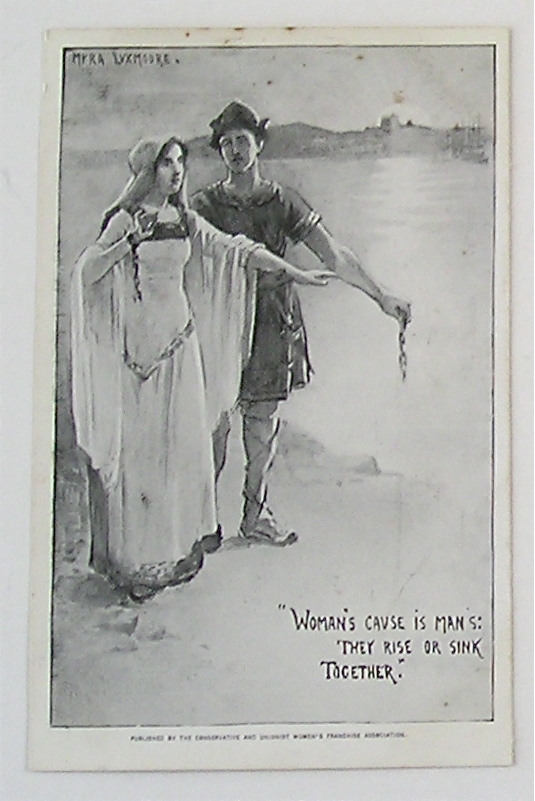
Myra Luxmoore’s card published by the Conservative and Unionist Women’s Franchise Association (photo courtesy of Ken Florey)
I had wondered where Myra Luxmoore’s suffrage allegiances lay and have recently discovered this card (left) illustrated by her and published by the Conservative and Unionist Women’s Franchise Association. I think, therefore, it would not be too far-fetched to think that she was a supporter of the CUWFA. Incidentally, as far as I remember, this is the only postcard issued by the CUWFA that I have ever seen.
The majority of Myra Luxmoore’s exhibited works bear rather wispy titles – such as ‘Roses and Sweet Lavender’, or ‘What’s O’Clock?’ – although a few portraits are noted. One such was the portrait of Norah, the 18-year-old daughter of Sir John Craggs MVO, exhibited at the Royal Academy in 1913. By 1910 another of Sir John’s daughters, Helen, was a full-time paid organiser for the WSPU. This was most definitely not a career move of which her father approved and I wonder if he would have commissioned the portrait if he had known that the artist had strong suffrage – although not militant – sympathies? [Incidentally Helen Craggs in 1957 married, as her second husband, the widowed Lord Pethick-Lawrence.]
One portrait by Myra Luxmoore is known to hang in a public collection, that of the Very Rev Edward McClure (1833-1906), Dean of Manchester.
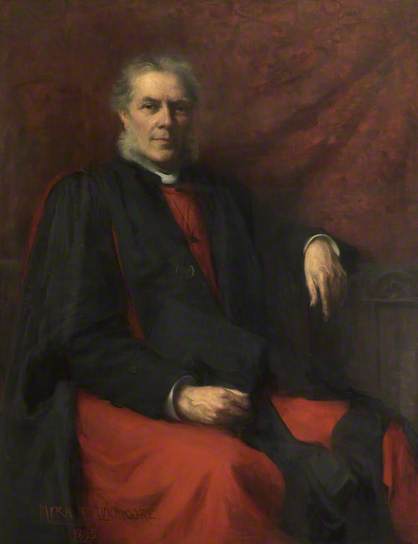
Very Reverend Edward C. MClure, Manchester City Art Gallery, courtesy of BBC – Your Paintings
Other of her works were collected by Mother Agnes Mason, Foundress of the Community of the Holy Family. Click here to read about her connection with Myra Luxmoore and her works. The article also gives some, unverified, information about the Luxmoore family’s friendship with the family of Gerard Manley Hopkins.
Campaigning for the Vote: Kate Parry Frye’s Suffrage Diary edited by Elizabeth Crawford
For a full description of the book click here
Wrap-around paper covers, 226 pp, over 70 illustrations, all drawn from Kate Frye’s personal archive.
ISBN 978 1903427 75 0
Copies available from Francis Boutle Publishers, or from Elizabeth Crawford – e.crawford@sphere20.freeserve.co.uk (£14.99 +UK postage £3. Please ask for international postage cost), or from all good bookshops. In stock at London Review of Books Bookshop, Foyles, National Archives Bookshop.
- ‘Campaigning for the Vote’ – Front and back cover of wrappers
Women Writers And Italy: The Albergo Di Parigi In Via Della Croce
Posted in Women Writers and Italy on January 28, 2013

Charlotte and Jane Waldie arrived in Rome in the winter of 1816. We have read Charlotte’s report of her first sight of Rome, but Jane, too, was busy with her notebook. Her Sketches Descriptive of Italy in the years 1816 and 1817 were published by John Murray in 1820, the same year as Charlotte’s Rome in the Nineteenth Century.
Jane corroborated her sister’s description of that magical first sight of Rome. ‘ When the dome of St Peter’s first burst on our view in the midst of the Campagna. Unable any longer to restrain ourselves, we leaped out of the carriage and ran up a bank by the road-side. Never, oh, never shall I forget the motions with which I gazed on this prospect! That Rome itself should be before me seemed incredible, that my mind could scarcely take in the fact.’
We can then take up their story again with Charlotte who describes how, having arrived in the Piazza del Popolo, ‘Rome was overflowing. We drove about for more than two hours, and found every hotel full of Inglesi. The lucky departure of one family of them, however, at length enabled us to take possession of their newly-vacated apartments, which are indeed most comfortable. You cannot conceive, without having travelled Vetturino from Florence to Rome, and lodged in the holes we have done, how delightful is the sensation of being in a habitable hotel, how acceptable the idea of a good dinner, and how transporting the prospect of sleeping in a clean bed.’
Charlotte was, however, immediately ill with a pleuritic fever ‘Cicero himself was dangerously ill of it; so that, if I had died, I should have died a very classical death, which would undoubtedly have been a great consolation.’
‘By way of an agreeable adventure, about midnight, on the second night of my illness, loud cries through the hotel and in the street spread the alarm of fire. The master of the house (a Frenchman) burst into my room in his shirt, followed by a whole train of distracted damsels wringing their hands, while he continued to vociferate ‘Au feu! Grand Dieu!’ in a key which drowned even the shrill lamentations of the women. Volleys of smoke rolled down our chimney, where the fire had originated, and, rapidly spreading to the rafters of the room above, gained ground so fast, that in spite of the promptitude with which all the firemen of the city and their engines set to work, two hours elapsed before it was extinguished. In the interim, the inmates of the hotel fled in consternation from their apartments, all but ourselves; for, conceiving that there was much more danger, in my situation, of getting my death by cold than by fire, and expecting the flames to be got under every moment, I laid quietly in bed and S-, who would not leave me, sate beside me until we were both nearly stifled; thus acting as if it was no concern of ours the house being on fire, since we were only lodgers.’

It is from Jane that we learn that this hotel, its management conducted by, as Charlotte relates, a Frenchman, was in fact the Albergo di Parigi in the Via della Croce, just off the Piazza di Spagna. This hotel – sometimes variously termed the Hotel de Paris or Villa di Parigi – was to provide shelter to many English women writers over the next 20 years. It is slightly surreal to see their shades slipping into bed, one after the other, under this one Roman roof. Amusingly all commented on the indifference of its facilities; as soon as Charlotte had recovered the Waldies moved to lodgings in the Corso.
It was at the Villa di Parigi in March 1819, two years or so after Charlotte and Jane’s sojourn, that Mary Shelley, with husband, step-sister – Claire Clairmont – and her sole surviving child, William – stayed very briefly before also making the move to lodgings in the Corso. As summer approached they then moved again to take advantage to what they hoped was less feverish air at the top of the Spanish Steps. They may as well not have bothered, as far as the fate of poor little William was concerned.
A few years later Anna Jameson – then still Anna Murphy – related in Diary of an Ennuyee that her party was ‘rather indifferently lodged at the Albergo di Parigi’. ‘So here we are in Rome where we have been for the last five hours, and have not seen an inch of the city beyond the dirty pavement of the Via Santa Croce; where an excellent dinner cooked a la Anglaise, a blazing fire, a drawing-room snugly carpeted and curtained, and the rain beating against our windows, would almost persuade us that we are in London; and every now and then, it is with a kind of surprise that I remind myself that I am really in Rome .’ But to be fair to the Parigi it was December and the scene as she describes it appears rather cosy. At least the fire blazed without setting the chimney alight.
All the articles on Woman and Her Sphere and are my copyright. An article may not be reproduced in any medium without my permission and full acknowledgement. You are welcome to cite or quote from an article provided you give full acknowledgement.
Women Writers and Italy: Charlotte Eaton’s First Sight of Rome
Posted in Women Writers and Italy on January 25, 2013
Scottish- born Charlotte Waldie (1788-1859), with her sister, Jane, and brother, John, travelled to Europe – as did so many others – in 1816/17, after the final defeat of Napoleon. For at least some of the time the two sisters travelled alone, when John was otherwise occupied. They each kept detailed notes of their journeys and sojourns: Charlotte turned her experience into Rome in the Nineteenth Century, first published privately and then, in 1820, by Archibald Constable.
Here follows her report of arriving – at last – in sight of Rome. The night before their arrival was spent at Monterosi. I particularly relish descriptions of gothic-horror inns.

Jervis McEntee, Journey’s Pause in the Roman Campagna
‘After considerable delay we did get into a bed-room, more wretched than language can describe: open in many a cranny to the weather, unswept, unplastered, and unfurnished except by two such beds as it is impossible for you to form any idea of; but as the surly people of the house could or would shew us no other, we had no remedy. A fire, that grand consoler of discomforts, was not to be had. The wood was so wet, the wind so high, and the chimney so wide, that while we were blinded and suffocated with wreaths of pungent smoke, and while the wind whistled at its pleasure through the hundred chinks of the unglazed windows, our most persevering efforts failed to make a blaze. Though something swimming in oil, and smelling of garlic, was set before us its appearance was so disgusting, that, after a fast of more than twelve hours, not even hunger could persuade us to touch it. If we did not eat, however, we were eaten; whole hosts made us their prey during the night, while we lay shivering and defenceless.

First view of Rome from Eaton, Rome in the 19th century
We got up – I believe in the middle of the night..and we were dragged along at a foot-pace.. for about three hours in darkness, til we approached Baccano, when the sun rose in splendour and we found ourselves on the deserted Campagna of Rome. In answer to our eager inquiries of when we should see Rome, our phlegmatic Vetturino only replied, ‘Adesso! adesso!!’ unable to conceive any other cause for our anxiety than the very natural impatience to get to the end of our tedious journey. Our longing eyes were intently fixed on the spot where we were told that it would first appear; when, at length, the carriage having toiled up to the top of a long hill, the Vetturino exclaimed, ‘Eccola!’ The dome of St Peter’s appeared in view; and, springing out of the carriage, and up a bank by the road side, we beheld from its summit, Rome!’
Women Writers and Italy: Two Englishwomen in Rome, Garibaldi And Rheumatism
Posted in Women Writers and Italy on January 22, 2013
Anne ( 1841-1928) and Matilda Lucas (1849-1943) were the daughters of Samuel Lucas, a brewer with land and influence in Hitchin, Hertfordshire. The Lucas family were Quakers. Their mother had died when they were young and after their father’s death in 1870 the sisters continued to live for a short time with their step-mother. But then, in mid-1871, they left England for Rome, where, for the next 29 years, they were to spend much of the year. Ten years after her sister’s death, Matilda Lucas published excerpts from the letters sent over the years by the sisters to friends and relations back in England. Two Englishwomen in Rome, 1871-1900 (Methuen, 1938) makes very entertaining reading.

Garibaldi and family c 1875
Rome. Hotel Milano. February 27, 1875.
We have not seen Garibaldi yet. He is quite a cripple and goes about on crutches. He seems quite taken up with his scheme of draining the Campagna and turning the Tiber. I think it very well that he should be harmlessly busy; it keeps him quiet. I have not heard of his baptizing any one here. It seems to be one of his ideas to think he can do those sort of things instead of a priest.
Rome. March 14, 1875.
This morning I paid a call of sympathy on Miss Pagan. She spent yesterday in bed with rheumatism and was rather feverish. Tomorrow she is going with some others to call on Garibaldi. The poor General’s hands are quite drawn with rheumatism and he often cannot sleep at night; so I tell her she had better take some of her pills with her. I am thinking of calling on him with a small bottle of colchicum and a little laudanum for outward application.
Rome. March 21, 1875.
As it was Garibaldi’s Saint’s day, Villa Casalini was crowded with people. Just as the Irvings came by the General threw up a window and appeared in his red shirt, waving his rheumatic hand.
Suffrage Stories: Mrs Evelina Haverfield And The Campaigning Raincoat
Posted in Suffrage Stories on January 21, 2013
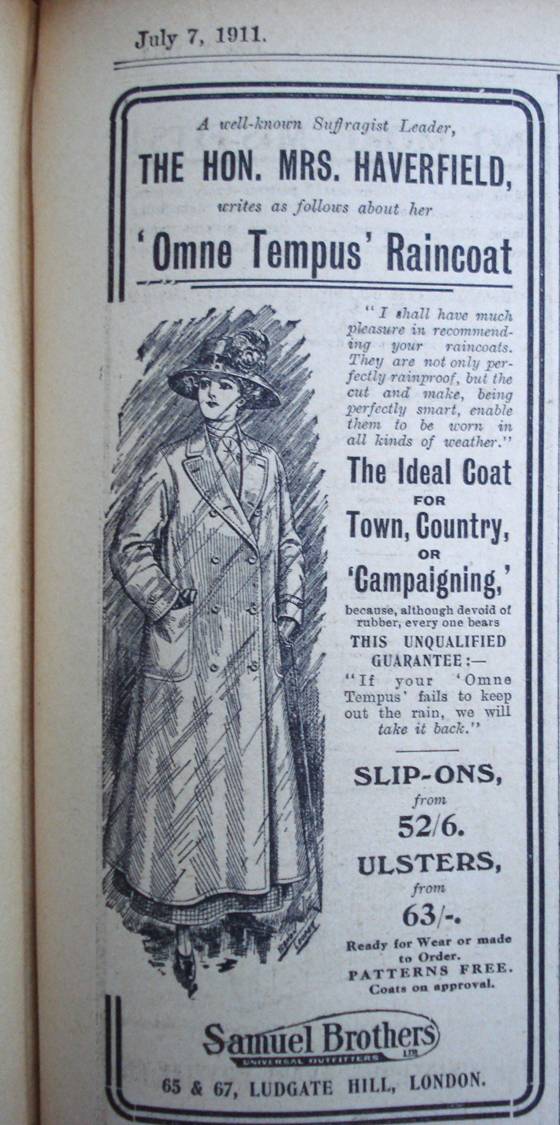
Advertisement from ‘Votes for Women’, 1912
In 1912 Mrs Evelina Haverfield gave her imprimatur to the ‘Omne Tempus’ Raincoat – ‘The Ideal Coat for Town, Country or Campaigning’. As Kate Frye records in Campaigning for the Vote (my forthcoming edition of her diary), the suffrage organiser was forced to contend with all weathers as she tramped from door to door, canvassing for support for her society. On a typical wind-lashed and rain-soaked day she then had the prospect of returning to dank digs, to a room that offered few facilities for drying a sodden, mud-splashed skirt. A coat – suitable for ‘all times’ – guaranteed by the manufacturers to keep out the rain – was a very necessary requirement for the suffrage campaigner. Kate, in fact, favoured Aquascutum; Mrs Haverfield put her faith in Samuel Brothers.
Evelina Haverfield (1867-1920) was the younger daughter of 3rd Baron Abinger. An adept sportswoman, she married young and had two sons. After his early death she remarried and for two years during the Boer War was with her second husband in South Africa, where she set up a retirement camp for horses left to die on the veldt. By 1908, with the second husband no longer on the scene, she was a suffragette, a member of – and generous benefactor to – the Women’s Social and Political Union. She was particularly keen on appearing on horseback – riding astride in suffragette processions – often with Vera Holme, with whom she formed a life-time partnership.
Mrs Haverfield’s collaboration with Samuel Brothers of Ludgate Hill was clearly very suitable. The manufacturers of the ‘Omne Tempus’ were – and are still – military tailors. During the First World War Mrs Haverfield, was one of the founders of, first, the Women’s Emergency Corps and then the Women’s Volunteer Reserve, a militaristic organisation, the members of which sported khaki uniforms and felt hats. She was commandant of the WVR and the writer Christopher St John described her as looking ‘every inch a soldier in her khaki uniform, in spite of the short skirt which she had to wear over her well-cut riding breeches’. See here for Mrs Haverfield’s defence of the WVS uniform as ‘useful and sensible’ and her dismissal of much current fashion as ‘ridiculous and preposterous’.
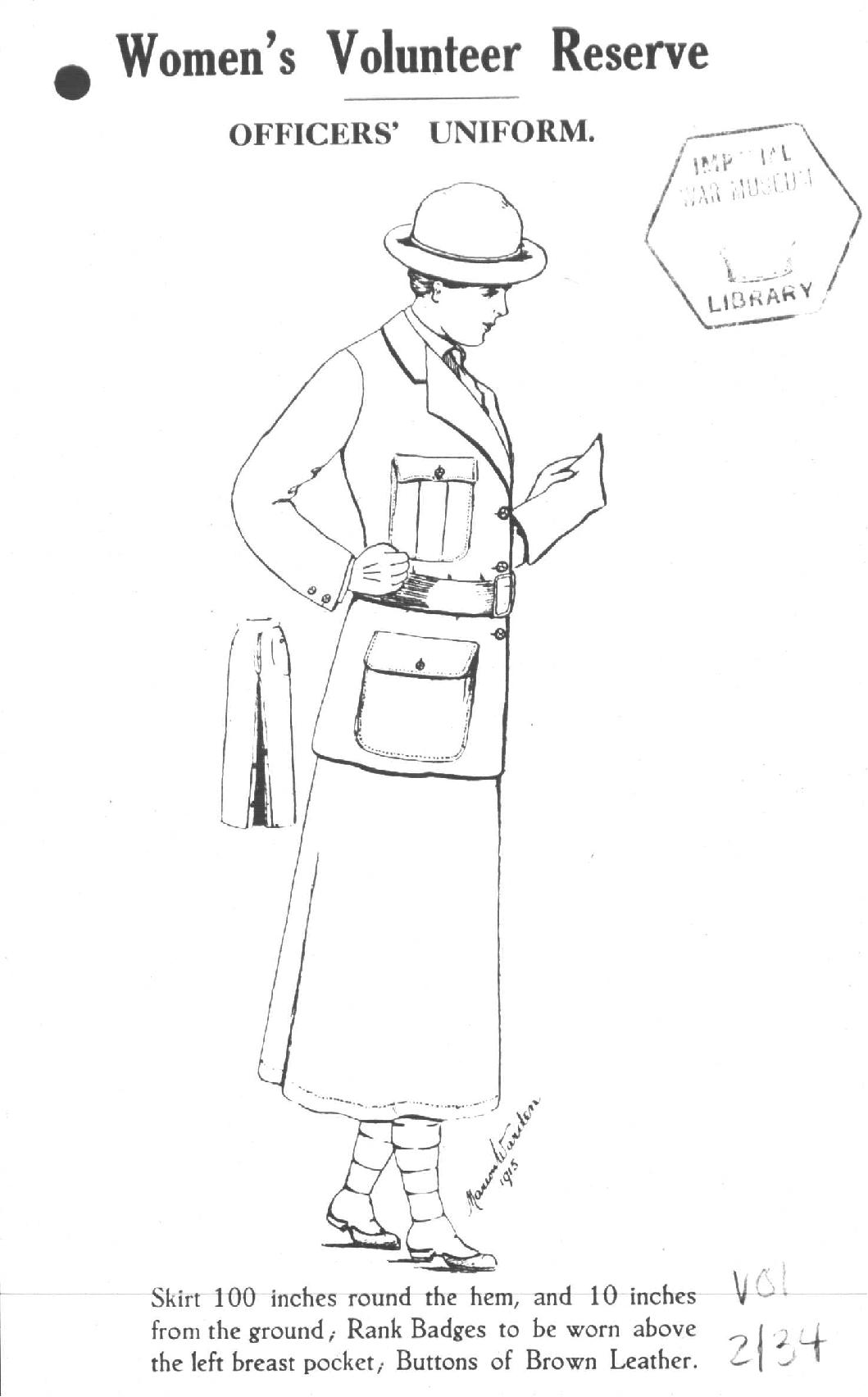
WVS uniform – from Imperial War Museum ‘Women’s War Work Collection’, courtesy of Gale Learning
I wonder if the WVS uniform (for details see here) – modelled on male military attire and certainly made in London – was manufactured by Samuels Brothers? It did initially excite a great deal of controversy- see here, for instance – but as the war wore on lost the power to shock. Indeed, ‘civilian’ fashion was soon influenced with, as the Daily Graphic (7 June 1915) put it, ‘military touches charmingly introduced’.
From 1915 Mrs Haverfield, with Vera Holme, promoted the Serbian cause, both in that country and in England. She was working in Serbia in 1920 when she contracted pneumonia and died.
For more information see the entries on Evelina Haverfield and Vera Holme in Crawford, The Women’s Suffrage Movement: a reference guide.
Suffrage Stories: The WSPU Photographer, DORA And The Nazis
Posted in Suffrage Stories on January 17, 2013
If you care to look at the entry ‘Photographs and Photography’ in my Women’s Suffrage Movement: a reference guide’ – you will discover that F. Kehrnhahn & Co of Bexleyheath were the publishers of a variety of real photographic postcards depicting key WSPU occasions. For instance, see here the firm’s picture of WSPU members tricked out in 18th-century attire, designed by Sylvia Pankhurst, as they (wo)manned their stall at the 1911 Christmas Fair.
But who was ‘F. Kehrnhahn’, whose name sat a little incongruously alongside ‘Bexleyheath’? The answer is another intriguing ‘Suffrage Story’.
Ferdinand Louis Kehrhahn was born in Birkenhead in 1883, christened at Tranmere, Cheshire, in 1884 and by 1911 was living with his parents and younger brother, Frederick, at 303 Broadway, Bexleyheath. His father, a watchmaker, had been born in Germany and his mother in Sheffield. On the census form Ferdinand described himself as a ‘Traveller & Photographer’ and Frederick as a ‘Photo Postcard Producer’.
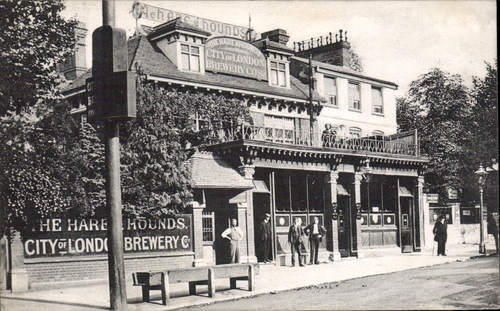 Hampstead by F. Kehrhahn
The brothers, as one might expect, produced a great number of topographical postcards showing scenes in Kent and in London and, at some point, had made contact with the WSPU. I note in my book a number of WSPU occasions – and a number of individual WSPU members – photographed by F. Kehrhahn. I now realise that this was probably something more than a purely commercial arrangement and that there may have been a real coincidence of sympathy between the Bexleyheath photographer and the militant wing of the suffrage movement.
For I have now discovered that during the First World War Ferdinand Kerhahn was an internee. From 1916 he spent some time in the Islington internment camp, which was housed in a former workhouse. The vast majority of the inmates – c 700 – were, according to Hansard (20 Dec 1916), alien enemies, but, in addition, the camp held 39 British subjects and 7 alien friends, held there under the Defence of the Realm Act. Presumably Kehrhahn, who had been born in Birkenhead, was one of those 39 British subjects.
But how had he fallen foul of DORA? The answer lay in his membership of the radical ‘anti-war’ wing of the British Socialist party. In November 1916 he managed to escape from internment and reached New York before being arrested and returned, c April 1917, to Brixton prison [see Hansard 29 Nov 1917].
In the inter-war period Kerhahn, who had now changed his name to ‘Kerran’, was a leading member of the Communist Party, working alongside such former suffragettes as Sylvia Pankhurst, Dora Montefiore and Helen Crawfurd. Apparently, although I have not verified this, before the outbreak of the Second World War Ferdinand Kerran was working in Germany, helping Jews to escape and listed by the Gestapo as an enemy of the Nazis.
And so, when, on the suffrage trail, you view pictures of maidens in mob caps standing by their stalls ready to sell gewgaws for the Cause, your eye should travel back through the camera into the mind of the photographer where, biding its time, was the desire that capitalism should be overthrown.
Ferdinand Kerran, who had married Lily Chris in 1919, died in Hampstead in 1949.
The Garretts And Their Circle: Ladies’ Residential Chambers And The Importance of Tiles
Posted in The Garretts and their Circle on January 15, 2013
York Street Chambers
York Street Chambers – in York Street, Marylebone – was the second venture undertaken by the Ladies’ Residential Chambers Company, of which Agnes Garrett was a driving force. Its purpose was to provide purpose-built accommodation for ‘educated working women’.
The company had successfully launched the Ladies’ Residential Chambers in Chenies Street in 1889 – to a design by J.M. Brydon – and lost no time in commissioning Thackeray Turner, brother-in-law of Christiana Herringham, one of the company’s directors, to plan for another set of chambers, to be erected in York Street, just south of the Marylebone Road. Turner worked in partnership with Eustace Balfour, whose sister, Eleanor Sidgwick, was involved with Millicent Fawcett (Agnes Garrett’s sister) in the founding of Newnham College, Cambridge.
The York Street Chambers were twice as expensive to build as those in Chenies Street – and have not suffered the indignity of the Second World War bombing that destroyed much of the latter’s original detail. Today York Street Chambers still looks handsome – both outside and inside.
Although it is unlikely that Agnes Garrett was responsible for the internal decoration (while, of course, assiduously attending committee meetings and doubtless supervising such matters) the green tiles that still line the corridors of York Street Chambers appear identical to the blue tiles commissioned from Powells of Whitefriars by Agnes for the corridors of the New Hospital for Women, her sister Elizabeth’s contemporary venture. Alas, we cannot compare them with those selected for Chenies St for it appears that, c 1990, Camden Council removed the corridor tiles before spraying the walls with a purple-fleck paint (they have since been given a rather less aggressive treatment).
Basement c. 2000- originally the communal dining room – of York Street Chambers
As in Chenies Street, so in York Street, the basement of the chambers housed a communal dining room. While this was supposed to make life easier for the residents by relieving them of the burden of cooking, committee minutes show that in both sets of chambers the dining room was the focus of a variety of bitter resentments. It makes quite entertaining reading when minuted (if you are that way inclined), but must have been very wearing on the patience of the Company’s directors. When I visited York Street Chambers – probably c 2000 – the basement was in the process of being renovated in order to house a School of Massage and I do not know whether the tiles with which the room was lined were retained. I was, however, very taken by the vigour and panache of the decoration and cannot believe that they would have been ripped out.
Tiles in the erstwhile dining room of the York Street Residential Chambers
When, in Enterprising Women, I described the similar space – by then divided into two flats – that had originally constituted the Chenies Street communal dining room I had no idea that underneath the bland decoration lay a similar riot of ‘Persian’ tiles. It was only a year or so after the book was published that the elderly owner (who had been so helpful in giving me access – and allowing me to photograph Ellen Rope’s ‘Hope’ hovering over his mantle piece) sold the flat to a young couple who undertook a full-scale renovation. Knowing that I had written about the Chambers – indeed ‘Hope’ was on its cover (see pic below) -they were kind enough to invite me round to see what they had uncovered. And, behold, the room was transformed – the light reflecting off the colourful tiles with which the original dining room had been lined. This was closer to the effect experienced by the chambers’ earlier tenants as they dined – with Ellen Rope’s ‘Hope, Faith, Charity and Heavenly Wisdom’ for inspiration along the wall above them – than the rather claustrophobic gloom of the room as I had first encountered it.
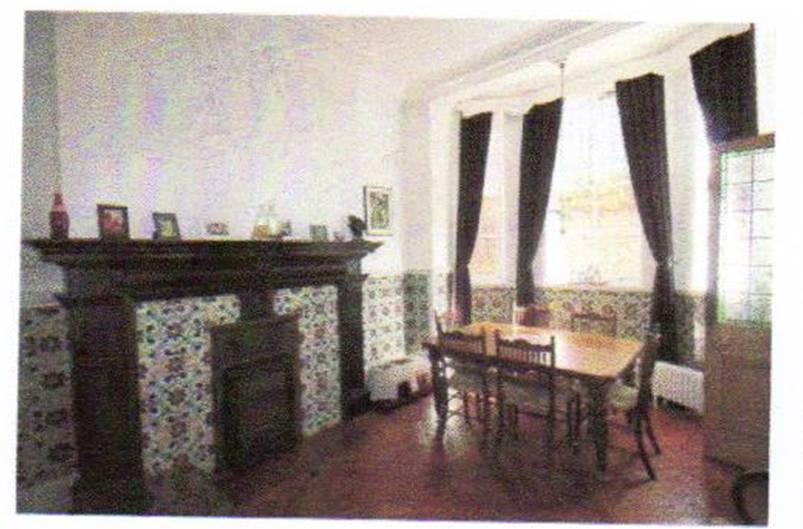
A section of the (former) Chenies Street communal dining room. ‘Hope’ remains on the wall over the mantle piece (though not clear in this pic), while part of ‘Charity’ has survived in the alcove to the left of the fireplace. ‘Faith’ and ‘Heavenly Wisdom’ have disappeared, absorbed into a corridor and another flat. The four spandrels had originally been created to decorate the vestibule of the Woman’s Building at the 1893 World’s Columbian Exposition and afterwards travelled back across the Atlantic to be incorporated in 1897 into the extended dining room of the Chenies Street Chambers. What an adventure.

Copyright
The Garretts and their Circle: Fanny Wilkinson And The Bloomsbury Triangle
Posted in The Garretts and their Circle on January 14, 2013
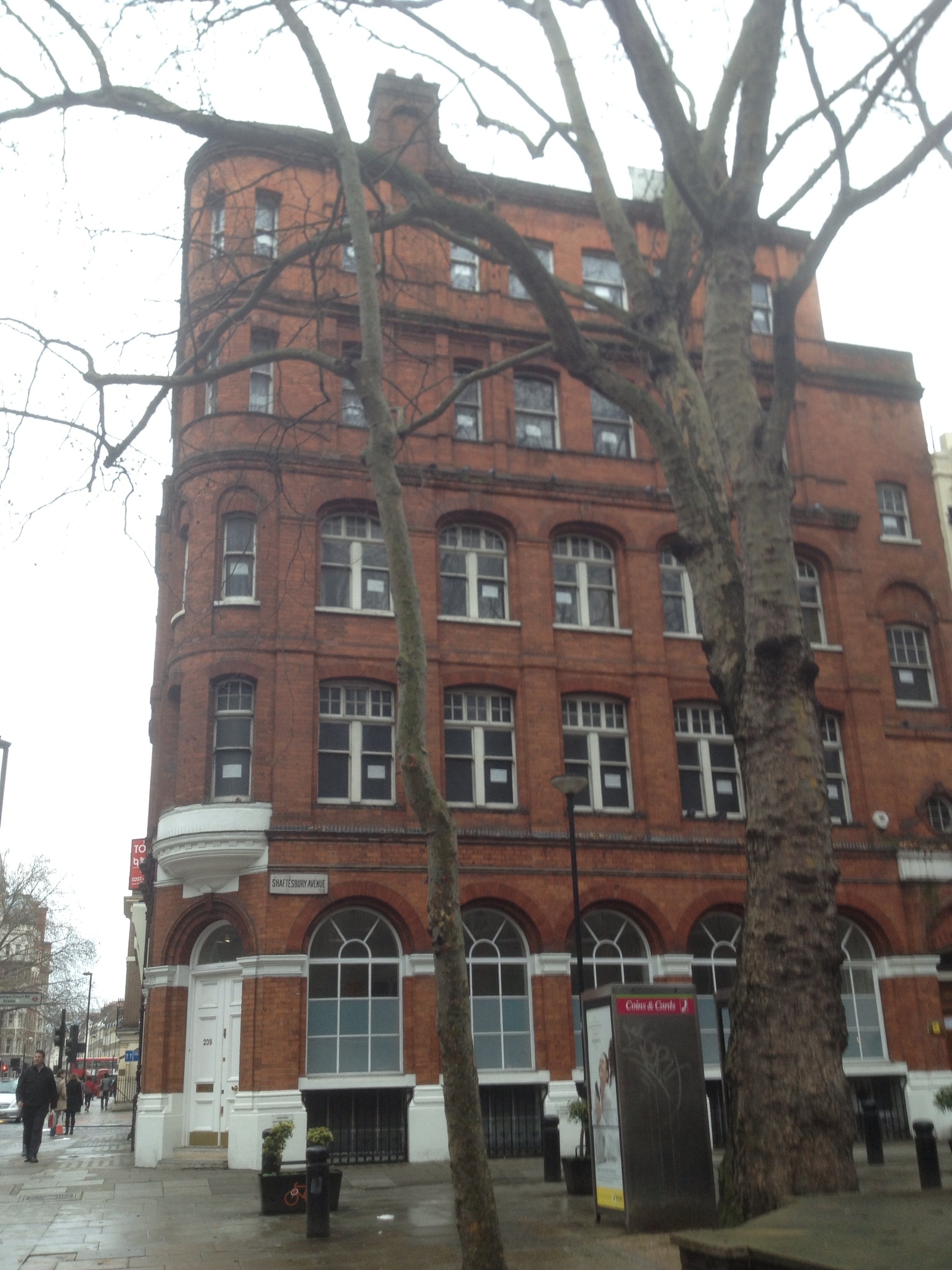
Fanny Wilkinson’s flat was on the first floor. Photo courtesy of understanding rome.com
In early 1885 Fanny Wilkinson, a recently qualified landscape architect – indeed the first woman in Britain to undertake a professional training course – moved into a flat at 15 Bloomsbury Street, just south of what is now New Oxford Street. Ten years or so ago, when I first wrote about Fanny Wilkinson – in Enterprising Women: the Garretts and their circle – I assumed that, as there was no trace now of that address, the building had been swept away in the various redevelopments that have taken place in the area over the last 100 years or so. Anyway, the exact site of Fanny’s first London home was not particularly important in the context of that book.
However, three or four years ago I undertook a little more concentrated research on the subject and, realising that 15 Bloomsbury Street had, soon after Fanny’s arrival, been renamed 241 Shaftesbury Avenue, discovered that the building in which she had lived is still there. Moreover, because the bus routes I use most frequently – the 38 and 19 – have been diverted (courtesy of CrossRail development at Tottenham Court Road) I now pass almost daily alongside Fanny Wilkinson’s former home.
The building – red-brick, with Queen Ann-ish windows and corner turret – faces onto an odd little triangle of land that had I long thought rather intriguing. The space is reminiscent of one of those Parisian squares (or triangles) that one may have seen – or imagined. It is rather dark – even in the summer – with lofty trees rising, close together, out of the pavement. In Paris one would add a cafe, waiters with long white aprons, an accordion etc. The London reality includes quantities of strutting pigeons and a peculiar raised concrete circle – ugly and serving no obviously useful purpose – probably something to do with underground systems of one kind or another – a useful shelf for discarded KFC packets, coca cola cans etc.
A little investigation revealed that the triangle had been formed when the final section of Shaftesbury Avenue was cut through St Giles Rookeries and that it was Fanny Wilkinson, in her capacity as landscape gardener to the Metropolitan Public Gardens Association, who ensured that it was not built over. She recommended that trees – London plane trees, as it happened – should be planted and seats made available for the public. The trees – although probably not the originals – are still there but the seats had only a short existence. They were removed c 1893 having attracted ‘dirty tramps, who make them a sleeping place in the day time and by loose women at night.’
Had the journalist who interviewed Fanny Wilkinson for the Women’s Penny Paper in 1890 ‘at her charming flat in Bloomsbury’, had to pick her way past sleeping tramps? Anyway, if she did, she put a brave face on it and assured her readers that ‘[Miss Wilkinson’s] rooms have a pleasant country air about them, and it would be difficult to imagine that one was in the heart of the big city in her pretty drawing room. It is the home of a lady, and instinctively one feels its owner must be a woman of refined taste.’ I do not know for certain, but would like to think that the drawing room ran across the first-floor, including the turret corner window, and that one would have looked down onto the leafy tops of the recently-planted trees.
Next door to the building is a pub – The Crown – which was there, under the same name, in Fanny’s day. It now does something to bring an approximation to the Parisian look by setting out tables on its frontage on the triangle. As the smokers huddle there we can be certain that not one – if they gave any thought at all to their surrounding – would imagine that the tiny section of urbanscape before them owed anything to decisions taken 125 years ago by a young Yorkshire woman. Nor, indeed, will the estate agents now attempting to lease the building in which she lived have any idea that what to them is merely so many square feet of office space was once the ‘pretty drawing room’ of a ‘woman of refined taste’. But now, as you walk up this section of Shaftesbury Avenue or inch past on the 38 or 19 (because the traffic is always jammed) – you, at least, will be aware of the layers of the past that hover around this odd little triangle.
Suffrage Stories: Alison Neilans Cleans The Stove
Posted in Suffrage Stories on January 12, 2013
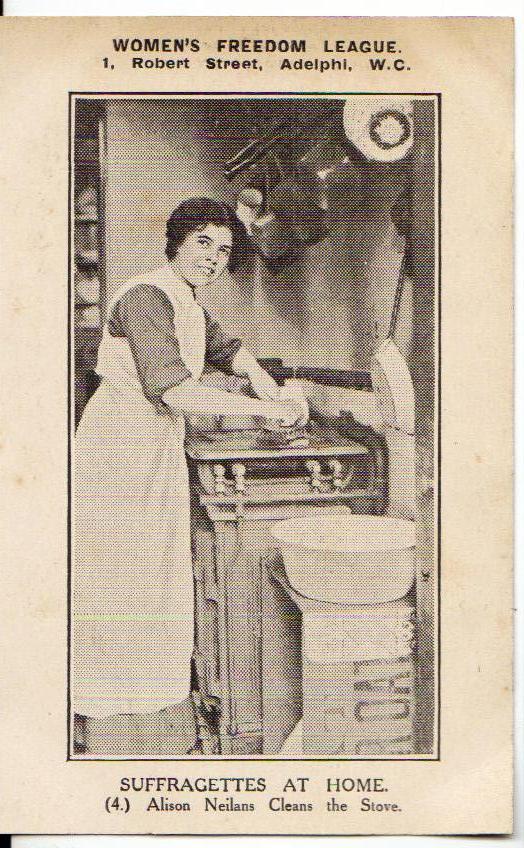 Another in the Women’s Freedom League ironic series – c 1910 – of ‘Suffragettes At Home’. Here Alison Neilans, then about 26 years old, is seen cleaning her gas cooker.
The gas stove may have been in the kitchen/scullery attached to the 4 rooms she shared with her mother and brother at 37 Caversham Road, Kentish Town. (Not that she was there on the night of the 1911 census – she was, rather, enumerated by the police walking with a couple of companions down Hampstead Road in a boycotting attempt.) Or perhaps it photographed in somebody else’s kitchen – borrowed for this propaganda purpose. Who knows.
Moreover, as ‘Mrs Joseph McCabe Bathing Her Baby’ (the previous card in the series about which I posted), was rather more subverting than the ostensibly homely depiction of a suffragette mother and her son when one realised that the child was the product of her marriage to an ex-Catholic priest, that the erstwhile ‘Brother Anthony’ was now a rampant aetheist, and that she herself was a secularist – so I would like to think that more can be read into this photograph of Alison Neilans.
The fact that she is photographed engaged in an act of cleaning might be taken as an allusion to the act of sabotage she performed at the 1909 Bermondsey by-election when she poured liquid into the ballot boxes. Is this photograph not saying ‘I may have dirtied and destroyed voting papers in the man’s sphere of the polling station but in the woman’s sphere I am relentless in my cleansing’? For, from 1917, Alison Neilans devoted her life to ‘Moral and Social Hygiene’ – as Secretary of the Association of Moral and Social Hygiene and editor of its journal.
By the way, I do have a number of leaflets/pamphlets etc associated with Alison Neilans in stock at the moment
Suffrage Stories: Mrs Joseph McCabe Bathing her Baby
Posted in Suffrage Stories on January 10, 2013
 This card was one of several published by the Women’s Freedom League in 1910 in an ironical series ‘Suffragettes At Home’ – a tongue-in-the cheek riposte to those who castigated suffragettes as being unwomanly.
Mrs Joseph McCabe was born Beatrice Alice Lee in Leicester in 1880, one of several children of William Lee, a framework knitter and, most importantly, a member of the Leicester Secular Society. For it was doubtless through the Lee family’s association with that Society that in 1899 Beatrice Lee, at barely 19 years old, came to marry Joseph McCabe. The latter was then 32 years old and had already experienced an adventurous religious life – having, at about the time Beatrice was born, entered the Franciscan order and in 1890 having been ordained as a Roman Catholic priest. By 1896, however, he had lost his faith, left the priesthood and begun a career as a writer and thinker on freethought. From 1898-99 he was secretary of the Leicester Secular Society.
In 1911 the family was living in north London, at 16 Elm Grove, Cricklewood. On 2 April, when the census was taken, Joseph was away in Wales, presumably on a lecture tour, leaving Beatrice at home with her four children. Although we must assume – in that she allowed herself to be promoted in the WFL card – that she was a member of the Women’s Freedom League she did not evade the census enumerator when he left the form with her at 16 Elm Grove. She completed it, describing herself as ‘mother, nurse and housekeeper also cook’. Besides the 4 children and the 17-year-old domestic help she lists the other members of the household – the cat ‘Diddie’ (neutered), 5 rabbits: ‘Brownie’, ‘Toodles’, ‘Baby’, ‘Biskie’ and ‘Bunkie’, and 3 goldfishes ‘no name’.
Across the form she added the following protest:
‘I wish to register in the strongest possible terms, my utter detestation of, and indignation at, having thrust upon me in the absence of my husband, the duties and responsibilities of citizenship, when neither I nor any single member of my sex is allowed to exercise the most elementary right of a citizen. I would also protest against the insult especially to mothers in describing their valuable services as ‘”only” domestic’.
Joseph McCabe was a keen supporter of women’s suffrage – particularly speaking for the Women’s Freedom League. In 1917 Beatrice McCabe was the hon secretary of the Hendon Women’s Franchise Society, which was affiliated to the United Suffragists. The McCabes were then living at 49 Bridge Lane, Hendon, but separated in 1925; Joseph was notoriously difficult. Beatrice died in 1960.
So that is the story that underpins ‘Mrs Joseph McCabe Bathing her Baby’ – that chubby-cheeked chap being Ernest (1909-1988).
Kate Frye: A War-Time Birthday: 9 January 1917
Posted in Kate Frye's suffrage diary on January 9, 2013
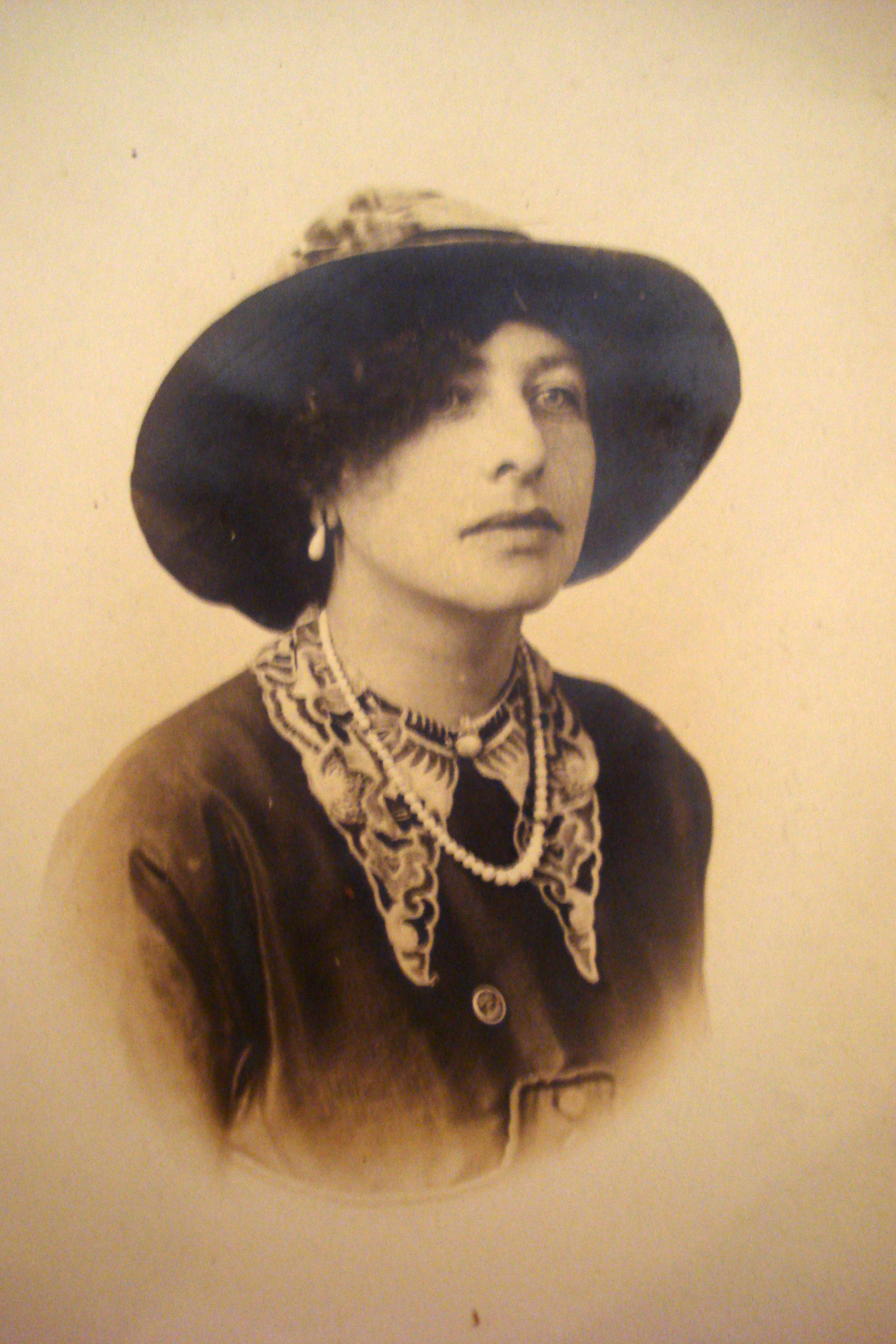
Kate
On her birthday – 9 January 1915 – Kate Frye had at last married her long-term fiance, John Collins. Two years later he was fighting in France and she was living with her mother and sister in a house at Berghers Hill, Buckinghamshire, courtesy of her mother’s sister, the wealthy Mrs Agnes Gilbey. A small cluster of cottages on a ridge at the top of a steep hill above Wooburn Green, Berghers Hill lay exposed to the elements. The wind whipped through Kate’s cottage, bedrooms were icy, the pipes froze – and burst. The walk down the hill to Wooburn Green and Cores End, whether by the road or the path through Wooburn Manor Park (the Gilbey property), was treacherous in winter.
Tuesday 9 January 1917
Woke to a terrible morning – dark & cold & sleet. It continued to sleet & snow & hail at intervals all day and the wind out was cruel. The anniversary of our wedding day. Two years ago at Hove. All day long & into the night I kept thinking at this time we were doing so & so and Oh it was sad to think of the present and to wonder whether John was alive or dead. It comes so suddenly – the death to them and it would be hours & days before I should hear.
Agnes [Kate’s sister] still seedy & in bed and so cross with both Mother & I. I went off soon after 10.30 to Cores End to seek a Cod’s Head for the cats & fish for her dinner. Couldn’t get the former, the latter she refused to eat when cooked and sent up.
Writing letters most of the evening and after supper sat over the fire trying to get warm & thinking, thinking. Fortunately Mother went to bed. A letter from John – the first since Friday.
For more on Kate – look out for Elizabeth Crawford (ed): Campaigning for the Vote: the suffrage diary of Kate Parry Frye to be published by Francis Boutle Publishers in February 2013
Mariana Starke: First Productions
Posted in Mariana Starke on January 7, 2013
In 1787 J. Walter, a London publisher/bookseller operating from premises close to Charing Cross, issued – as Theatre of Education – a new English translation of Le Théâtre á l’usage des jeunes personnes, a collection of comedies by Mme de Genlis, the first woman to be appointed tutor to princes of France.
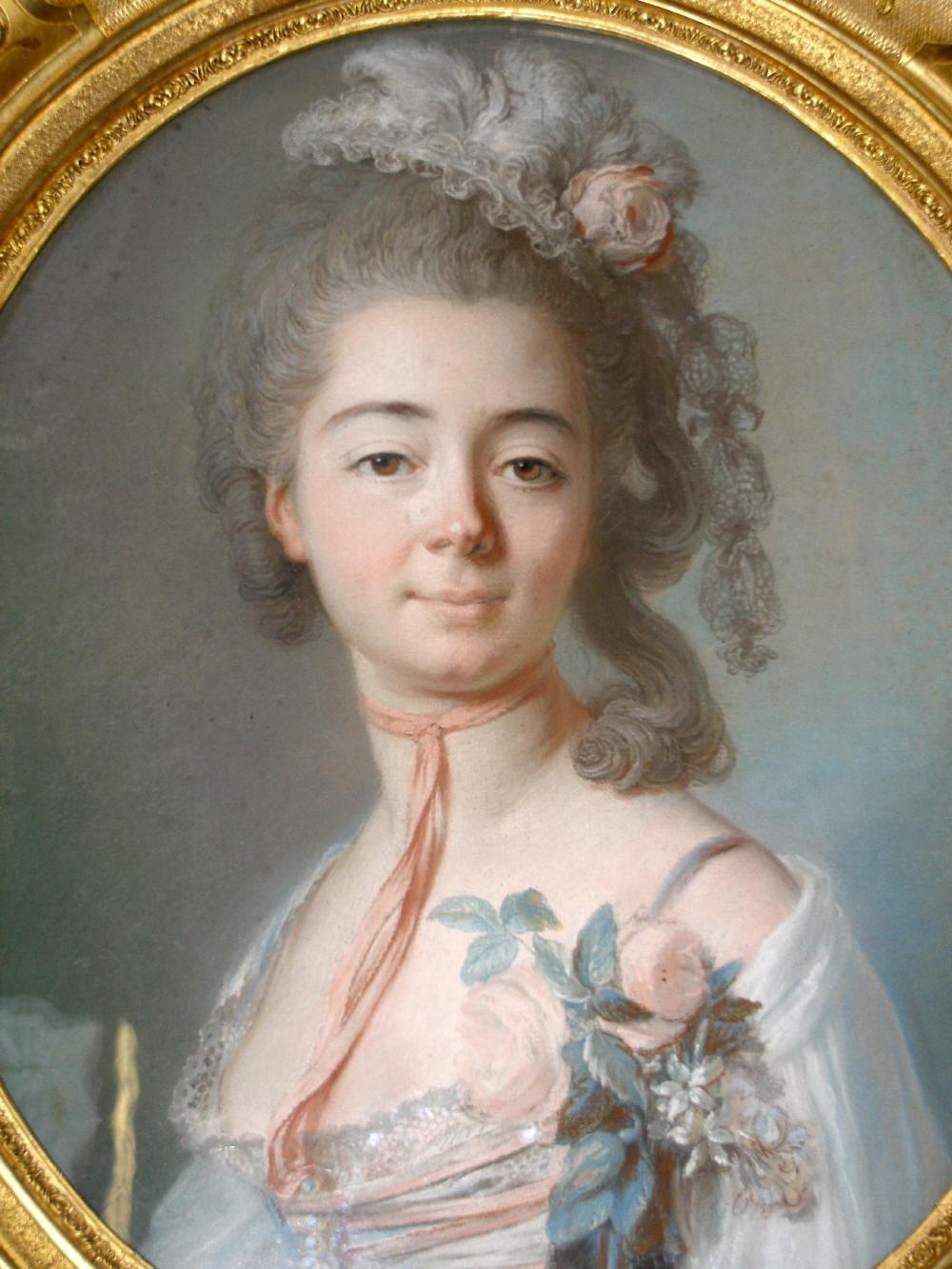 Madame de Genlis
This innovative method of providing a moral education for children through the use of short plays had proved immensely popular on both sides of the Channel. First published in France in July 1779, an English translation, under the imprint of T. Cadell and P. Elmsly ; T. Durham, appeared in 4 octavo volumes in 1781, with a new edition, in 3 volumes, under the same imprint, following in 1783. [See http://archive.org/details/theatreeducatio07genlgoog for the online edition of the 1781 4-volume edition]. Nowhere is the name of the translator of this edition stated, although it is thought that he was male. As far as I know he has never been identified – although this really is not my field and I would welcome correction.
Nor, indeed, is there any indication on the title page of the J. Walter edition of the names of the translator(s) of his edition. It was not until 1831, when an obituary of Mrs Millecent Thomas (the former Millecent Parkhurst -see Mariana Starke: An Epsom Education) appeared, that the truth was revealed.
As the Annual Register and The Gentleman’s Magazine reported, Mrs Thomas ‘assisted her friend Miss Starke in translating Mme de Genlis’ Theatre of Education’. Over 150 years later, in Notes and Queries (45:1; March 1998), Edward W. Pitcher identified the edition translated by Mariana and Millecent as that published by J. Walter. The Annual Register had cited the translation as being issued between 1783 and 1788 in three duodecimo volumes, although a consultation of COPAC reveals no J. Walter edition pre-dating 1787. It does, however, seem to have been issued in a variety of formats. The 3-volume British Library set appears to be inscribed, if I have deciphered the handwriting correctly, ‘Miss M.B. Woollery, the gift of her friend Mrs Thomas’. Millicent Parkhurst married the Rev Joseph Thomas in 1791, the gift, if it really was from her, presumably post-dating her marriage. The only advertisement for the J. Walter edition that I have found appears in The Times, 28 July 1790, and refers to a set of four-volumes, at the not inconsiderable price of 10 shillings. J. Walter was the publisher of, among a wide variety of productions, Mrs Chapone’s works – including Letters on the Improvement of the Mind, a seminal conduct book for young women of the period. He had presumably thought it worth backing a translation of Theatre of Education to rival that issued by Cadell et al, although doubtless he had paid little to the youthful translators. It does not appear to have merited either a reissue or a second edition.
So we find that the two young women, still in their mid-20s, living close to each other in Epsom, had embarked on a new translation of a much-fêted work which they had then succeeded in getting published. Not that this, when we know their circumstances, is particularly surprising. For, by the 1780s, Millecent Parkhurst and Mariana Starke were well-educated young women, with influential literary contacts. We have noted that John Parkhurst, Millecent’s father, and William Hayley, to whom Mariana was a ‘poetic daughter’, both gave encouragement.
Mariana Starke was also on intimate authorly terms with George Monck Berkeley (1763-93), a precocious literary talent. In a letter written to him at Magdalen Hall, Oxford, on 22 August 1787, Mariana reveals ‘that I am now much better qualified to write a Tragedy than when I composed the first three Acts of Ethelinda, as I have lately studied dramatic composition with great diligence.’ She is referring to a play, Ethelinda, which she and Monck were writing together. It is tempting to conclude that her reference to recent dramatic composition might not be unrelated to the work involved in producing the translation of Mme de Genlis’ plays. A few sentences later she tells Monck that ‘After I had finished Ethelinda to the best of my abilities, I carried it to my excellent Friend, Mr Parkhurst, whose almost paternal regard for me prompted him to consider it with great attention: he has corrected all the errors which happened to strike him; and advises me to let every material thing stand as it is now, saying, he thinks the Play very dramatic, and very likely to be well received: As he has condescended to take infinite pains with the Piece, I am sure you must agree with me in thinking it would be extremely indelicate to put any Critic over him, especially as Mr Parkhurst (from the soundness of his judgment and the depth and universality of his knowledge), is perhaps of all men in this Kingdom, best qualified for the office of a Critic. I have, in conformity to your advice, shortened my own acts and lengthened yours; and I have studied to insert the many excellent speeches, with which your acts abound; but sorry am I to say, that there is one sweet speech on fame, which I know not how to introduce according to the present plan of the Play. Your speech on murder, which is, by the by, the finest thing I ever read, I have put into the beginning of the Play, where it shows to great advantage; and many more of your lines I have occasionally introduced among my own, by way of giving a strength to my composition, which it seemed to want. I find, from Joinville, that the Crusaders always crowned their Heroes with palm, therefore I have substituted that for laurel. I am told by a Gentleman who is deeply read in the records, that even Kings, in the time of Richard the 1st, did not espouse what we now call the regal style; therefore I should think Ethel had better not do it – and I have taken the liberty to alter the two last lines of Bertram’s [?] dying speech, because (if Homer may be credited) no man, who dies of a wound in the breast, can see objects immediately before his death. I have applied to a Friend for Mrs Siddons’s interest but am not certain how I shall succeed – if I was more intimate with Mrs Soane [?] I would certainly write to her; but slight as our acquaintance is, it would be too presumptuous – from you, perhaps, she might receive an application graciously. Another Friend of mine, who is acquainted with Linley and King, has undertaken to introduce Ethelinda and me to both of them, and I almost daily expect a summons to appear before those mighty Rulers of the Theatre. So, if you have any interest, work it now, let me entreat you. Linley, at present, is at Bath, but he will speedily return to London.’
Thus, it is clear that by 1787 Mariana Starke was working her apprenticeship as a playwright and knew how to network the theatrical scene. (Mrs Siddons was the most famous tragic actress of her day; Thomas Linley and Thomas King were both involved with the management of the Theatre Royal, Drury Lane.) It is virtually certain (although I have not yet found any pre-1788 evidence) that Mariana was already well acquainted with Mrs Mary Crespigny (see Mariana Starke: The Mystery of the Bodleian Diary), who organized dramatic performances at a private theatre erected in the grounds of her Camberwell home. The success of The Theatre of Education was predicated on the willingness of families, such as the Crespignys, to stage short plays for amusement – and instruction. For an interesting article on the relationship at this time between private theatricals and public theatre see here.
Although the translators of the J. Walter edition are not named, the ‘Advertisement’ that prefaces the text at least makes clear that they were women. ‘The fame acquired by Madame de Genlis is so deservedly great, and the Theatre d’Education so universally considered as her chef-d’oeuvre, that it naturally becomes the study and admiration of her sex; some of whom, in order to amuse their minds, and at the same time amend their hearts, by imprinting on the memory such exalted precepts as those contained in the Theatre d’Education, undertook to translate it into English, and have now, to the best of their abilities, finished this Work, which they presume to place before the eyes of an indulgent Publick….[so that].people of all ages and all ranks may derive from the Original of Madame de Genlis, the most useful and persuasive lessons, couched in the most eloquent and characteristic language.
I have only compared the two editions in the most superficial way, but, even so, could immediately detect distinct differences in the language used. It was presumably because they felt something wanting in the 1781 translation of Mme de Genlis’ work that the two young women felt encouraged to embark on their own. However, The Critical Review, while conceding that there were faults in the 1781 edition, could not bring itself to praise the J. Walter edition.
The translators make clear in the Preface to the J. Walter edition that they had sought Mme de Genlis’ permission to publish their translation of her work: ‘Permit us, Madam, thus publickly to return our most thankful acknowledgements for the honour you confer upon us, by allowing the following translation to be inscribed to your name; an honour which demands our gratitude in an especial manner, as we do not enjoy the happiness of your personal acquaintance’. There had, presumably, been an exchange of letters between Epsom and France. Unfortunately there is no correspondence (or, at least, none that I have found) that throws any more light on either the production of the translation of the Theatre of Education or its afterlife as it related to the life of Mariana Starke. I have come across no reference at all to the work in any subsequent correspondence. This is perhaps just a little surprising.
We do know, however, the fate of the other work mentioned with which Mariana was involved – for, on 30 October 1788 [at least, I think it was 1788, but it may have been 1787 – the dating of the letters is uncertain], her mother, Mary Starke, wrote from Epsom to George Monck Berkeley a letter in which she she mentions that Mariana is awaiting ‘something decisive respecting the fate of the rash, yet beauteous Ethelinda.. You long ago were informed that this heroic Damsel was presented to, and rejected, by the respective Managers of Drury Lane and Covent Garden. Her next application was to Mr Colman [of the Theatre Royal, Haymarket] who paused a long while upon the question, her merit making a deeper impression upon his mind, than upon either of the other Gentlemen. Yesterday, and not before, his determination reached Epsom – ‘That he thinks the piece distinguished by many touches of Poetry, tho’ on the whole too romantick ..for the Theatre. ‘…The dear Authoress has laid aside her pen, and taken up her distaff, in other words, her time now is chiefly occupied in inquiring as to the practicability and possibility [?] of establishing Sunday Schools & Schools of Industry in this neighbourhood. How much more becoming in a Female [?] is this than dabbling in ink. However I have derived so large a portion of amusement, not to say instruction, from some female Writers of the present age that I cannot subscribe implicitly to this opinion, worthless perhaps it does not seem proper and may so claim an exception from this lordly privilege on behalf of my own daughter. Therefore she, as I told you before, is resuming the primitive employment of the distaff. Let her rejoice at the success attendant upon the fair Heloise….’
 The latter remark may refer to Monck Berkeley’s Heloise: or the Siege of Rhodes, published in 1788. Ethelinda, clearly a play set at the time of the Crusades, does not alas, appear ever to have been staged. However we know that Mariana Starke certainly did not take up the distaff and devote herself to ‘Sunday Schools & Schools of Industry’ but, if the dating of her mother’s letter is correct, had already, on 8 August 1788, seen another of her plays – The Sword of Peace – given its first public performance at the Theatre Royal, Haymarket. George Colman had, as we shall discover in the next Mariana Starke post, proved most supportive.
Sources: Berkeley mss, British Library
Copyright
Last-Minute Christmas Present With A Suffragette Theme? Look To Persephone and ‘No Surrender’
Posted in Uncategorized on December 16, 2012
 Looking for a last-minute present?
We are but a few weeks away from 2013, the year in which the 100th anniversary of the death of Emily Wilding Davison will be extensively commemorated. A present with a suffragette theme will seem percipient.
So – for a good ‘suffragette’ read – No Surrender by Constance Maud is the answer.
The novel was first published in 1911 and gives the modern reader an insight into the arguments that fuelled the fight for ‘votes for women’. The author was herself involved in the campaign and is faithful to reality, including among her characters some based on leading suffragette personalities.
No Surrender has been republished, in their usual stylish format, by Persephone Books. The fabric pattern shown – so suffragette – so 1911 – decorates the endpapers.
Click here for full details of the book and how to order it. There is still time for Christmas delivery – and Persephone will even gift wrap the book for you.
Problem solved.
Women Writers and Italy: Two Englishwomen in Rome: The Tiber Flooded, 1875
Posted in Women Writers and Italy on December 12, 2012
 Anne ( 1841-1928) and Matilda Lucas (1849-1943) were the daughters of Samuel Lucas, a brewer with land and influence in Hitchin, Hertfordshire. The Lucas family were Quakers. Their mother had died when they were young and after their father’s death in 1870 the sisters continued to live for a short time with their step-mother. But then, in mid-1871, they left England for Rome, where, for the next 29 years, they were to spend much of the year. Ten years after her sister’s death, Matilda Lucas published excerpts from the letters sent over the years by the sisters to friends and relations back in England. Two Englishwomen in Rome, 1871-1900 (Methuen, 1938) makes very entertaining reading.
Rome. November 23, 1878.
There is no reason now to complain that events do not happen, for with thunderstorms, floods, popular demonstrations, and Orsini bombs, we are living in a perpetual whirl of excitement; so that a woman going mad last Sunday on the Spanish Steps, and a man killed yesterday in sight of our windows, seem quite in the natural order of things.
First the thunder-storm last Wednesday week. It was terrific and raged all night. The rain came down like a water-spout, as it only can rain in Rome. It came through our roof, and basins and pans were put all about to catch it; the staircase was a cascade. Our ruffian Augusto was had in to help and was quite in his element.
In spite of the rain, as soon as lunch was over we put on our ulsters and rushed out to see the river. It was coming down tremendously. The people were crowding the bridges. The water had got into some of the streets, but the flood had not reached its height. On Friday the floods were much higher and on Saturday still higher. The Bowen’s palazzo was invaded by the water. Shops were shut on the Corso, and people saved their goods. All night the latest telegrams from Orte were being shouted in the streets. The Tiber works were so much money thrown away. The people were hard at work down by the Farnesina strengthening part of the works, but the water burst in on them and they had to run for their lives. One if not more bodies were carried into Rome from the Campagna. I suppose peasants who had been surprised by the water. It was not so bad as in 1870, when bodies of men and animals came down the Corso, and people could not get out of their houses to buy provisions.

Roesler: Tiber Flooded, c 1880
We called together our walking academy on Saturday and made the round of the different bridges, the Ghetto, and the ruins. Carts were acting as ferry-boats and taking people through the flood for a soldo a crossing. The Pantheon looked very grand reflected in the water. Victor Emmanuel’s grave was under water, but Pio Nono was quite safe over his doorway. We had no difficulty in getting about, having to make only a few detours to avoid the inundations. The Temple of Vesta and the Arch of Janus had water round them, and there was a good deal in the Forum.
See here for more about the flooding Tiber
Kate Frye’s Suffrage Diary: Palmist At The Women’s Freedom League Bazaar
Posted in Kate Frye's suffrage diary on December 10, 2012
 By 1909 Kate Frye was keenly involved – as a volunteer – in the women’s suffrage campaign. Although she belonged to the constitutional London Society for Women’s Suffrage she was happy to give her services to other, more militant, suffrage societies – such as the Women’s Freedom League.
Dramatis Personae for these entries
Marie Lawson (1881-1975) was a leading member of the WFL. An effective businesswoman, in 1909 she formed the Minerva Publishing Co. to produce the WFL’s weekly paper, The Vote.
May Whitty (1865-1948) and Ben Webster (1864-1947) were a well-established theatrical couple. Kate had toured with May Whitty in a production of J.M. Barrie’s Quality Street in 1903.
Ellen Terry (1847-1928) the leading Shakesperean actress of her age.
Edith Craig (1869-1947) theatre director, producer, costume designer, and a very active member of the Actresses’ Franchise League. She staged a number of spectacles for suffrage societies, working particularly closely with the Suffrage Atelier and the Women’s Freedom League. In January 1912 Kate appeared in Edith Craig’s production of The Coronation.
Lena Ashwell (1862-1957) actress, manager of the Kingsway Theatre, a vice-president of the Actresses’ Franchise League and a tax resister.
Thursday April 15th 1909 [The Plat, Bourne End]
I went up to London at 9.50 all in my best. Went to Smiths to leave the books – then straight from Praed St to St James Park by train and to the Caxton Hall for the 1st day of the Women’s Freedom League Bazaar. Got there about 11.30 – everything in an uproar, of course. I had to find out who was in authority over me and where I was to go to do my Palmistry. I had to find a Miss Marie Lawson first and then was taken to a lady who had charge of my department and she arranged where I was to go. A most miserable place it seemed – in a gallery overlooking the refreshment room. I meant to have gone out to have a meal first – but it all took me so long running about getting an extra chair etc that I should have missed the opening. Then another Palmist hurried up – the real thing who donned a red robe. I was jealous. Madame Yenda.

Kate kept Madame Yenda’s card within the pages of her diary
We got on very well, however, and exchanged cards (I have had some printed) it was all about as funny as anything I have ever done and I have had some experiences.
Then I went back to the main room which was beginning to get thronged and stifling from the smell of flash- light photographs. I discovered Miss May Whitty and Mr Ben Webster and chatted to them while we waited for Miss Ellen Terry who was half an hour late. Miss Whitty was awfully nice and I quite enjoyed meeting her again. Ellen Terry looked glorious in 15th century costume and was very gay and larkish. Her daughter Edith Craig was there to look after and prompt her – and ‘mother’ her – what a mother to have had. I expect she had to pay for it. She is a sweet-looking woman with a most clever face – only a tiny shade of her Mother in it but Ellen Terry took the shine out of everyone – what a face to be sure. When she went round the stalls I went to the Balcony and for a little time Madame Yenda and I tried to work up there together but it was impossible. All my clients had to disturb her as they walked to and fro so at last I came out to find 3 more Palmists waiting and nowhere for them to work. One, a real professional, was very cross especially at the small fee being charged and I don’t think she could have been there long. Two other girls, looking real amateurs, were also there. So I sat a while at a table outside and told a few but it wasn’t very satisfactory and at 2 o’clock I went out for some lunch leaving the four others there. I went into a Lyons place in Victoria Street and then went back a little before 3 o’clock meaning to have a look round the Bazaar but I was pounced on to begin again and I was alone at it all the afternoon from 3 till 5.45 up in the gallery. I was left at it with sometimes just a few minutes in between but must have told 40 hands I should say. I did about 7 or 8 before 2 o’clock. We were only supposed to give 10 minutes at the outside but I could not quite limit myself and sometimes, when there wasn’t a rush, I had long talks with the people. It was very interesting and on the whole I think I was successful. Train to Praed St and to Smiths for the books and home by the 6.45.
Friday April 16th 1909 [The Plat, Bourne End]

Ribbon from the WFL Bazaar carefully preserved by Kate
I went straight to Caxton Hall by train from Praed St to St James’s Park – left some flowers at the flower stall. Mother had packed up some lovely bunches for me. Then I went up to the l[ondon] S[ociety] for W[omen’s] S[uffrage] office on business connected with the Demonstration – then back to the Caxton Hall for the opening of the Green White and Gold Fair on the second day. Miss Lena Ashwell was punctual 12 o’clock and she looked delicious and did it all so nicely. Madame Yenda was there but no other Palmists. My chatty friend, who greeted me rapturously, helped fix up the gallery a much nicer place – but clients did not come very early -they were all following Lena Ashwell – so I had 1/- from Madame Yenda myself. I think she was clever but, of course, I am rather a hard critic at it. She told me a great many things I know to be absolutely true and she gave me some good advice especially about morbid introspective thoughts and I think she is quite right. I do over worry. I am to beware of scandal which is all round me just now. She predicts a broken engagement, a rich alliance and always heaps of money. I should have immense artistic success in my profession if only I had more confidence in myself and if only I had some favourable influence (a sort of back patter, I take it) to help me but such an influence is far away. I shall never live a calm uneventful existence. I shall always spend so much of myself with and for others. I am rather glad of that. I was just beginning to tell her her hand but I wouldn’t let her pay as she told me she was very poor and I could see it when some clients came for us both and we both had to start our work.
I didn’t feel a bit inclined for work at first but got into it and had wonderful success. Kept on till 2 o’clock – went to the Army and Navy Stores then and had some fish for lunch – then back – saw the ‘Prison Cell’ for 5 and was very interested – then started work at 2.45 and never moved off my chair till 6.15. I did have an afternoon of it. Madame Yenda had gone and I was alone in my glory. I must have had quite another 40 people if not more and they were waiting in line to come in to me. I seem to delight some of the people and one or two said I quite made them believe in Palmistry. One old lady came back for another shill’oth [shilling’s worth] as I had been so good with her past and present she wanted her future. I must have been very clairvoyant as I told the people extraordinary things sometimes and they said I was ‘true’. Of course one or two I could not make much headway with but that must always be so.
Where I found I had missed my train I wanted to go on but my chatty friend was really awfully decent and would not hear of it. She said if I would tell one man who had been waiting ever so long that was all I must do and she would send the others away. There were about 18 waiting and she did – rather to my relief. I felt ‘done’
Campaigning for the Vote: Kate Parry Frye’s Suffrage Diary edited by Elizabeth Crawford
For a full description of the book click here
Wrap-around paper covers, 226 pp, over 70 illustrations, all drawn from Kate Frye’s personal archive.
ISBN 978 1903427 75 0
NOW, ALAS, OUT OF PRINT.
KATE FRYE’S DIARIES AND ASSOCIATED PAPERS ARE NOW HELD BY ROYAL HOLLOWA COLLEGE ARCHIVE
- ‘Campaigning for the Vote’ – Front and back cover of wrappers
You can listen here to a talk I gave in the House of Commons – ‘Campaigning for the Vote: From MP’s Daughter to Suffrage Organiser: the diary of Kate Parry Frye’.
Copyright
Suffragette Autograph Album To Be Auctioned: Save It For The Nation – And Future Researchers
Posted in Collecting Suffrage on December 8, 2012
A very interesting autograph album is to be auctioned by Dominic Winter Auctions on Wednesday, 12 December 2012. How I wish it would be bought by a British library or museum so that all researchers would have access to it. It would be an ideal fit in the collections of either the Museum of London or the Women’s Library. Neither, alas, are likely to be bidding. Is there any other institution that could come to the rescue?
Below is the entry from the Dominic Winter catalogue.
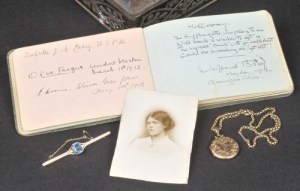 Lot 380* Suffragettes. A rare and historically important autograph album containing approx. fifty autographs of suffragettes and sympathisers, 1909 and later, but many dated from the time of the WSPU’s second window-breaking campaign, March/May 1912, the majority signed below quotations and epithets relating to the cause, written mostly in pen and occasionally pencil and inscribed to thirty-four leaves (mostly rectos) with some leaves blank, prisoner (?) pencil number 94472186/3 to front free endpaper, contemp. cloth, rubbed and soiled, oblong small 8vo, 11 x 14.5 cm, together with an Edwardian 9ct gold circular locket, engraved with initials M.E.P. within a shield cartouche amongst foliate scrolls, enclosing two colour portrait photographs of a lady (possibly wearing this locket) and a gentlemen of similar age and social status, Birmingham, 1905, suspended on a 9ct gold belcher link chain, plus an Edwardian 9ct rose gold bar brooch, set with a facet cut blue stone within pierced wavy gold mount, stamped ‘9ct’, 8cm wide with gold safety chain, plus a vignette b&w photo postcard portrait (cut down), showing an unidentified woman and on the verso the same identification number (94472186) as the autograph album, all included in an early 20th-century Mackintosh’s rectangular toffee tin, lid embossed with heraldic knights, sides with geometric scrolls, base printed with retailer’s logo and ‘John Mackintosh & Sons Limited, Toffee Town, Halifax, Eng’, 15 x 23 x 6 cm
In order, the autographs are as follows, (names in bold are given separate biographical entries in Elizabeth Crawford, ‘The Women’s Suffrage Movement: A Reference Guide 1866-1928’: Emily Redfern, 8th December 1909; Adeline Redfern Wilde, 18th March 1911; J. L. Guthrie (Laura Grey), quotation by Robert Louis Stevenson in pencil, and possibly not in Guthrie’s hand as her name was Joan Baillie Guthrie; Charlotte Despard, 22 October 1911; Emily Diederichs Duval; Sarah Benett, in pencil, 2 March 1912; Janet A. Boyd, in blue pencil; E. Sylvia Pankhurst, ‘Bravely and willingly we bear our share of the world’s burdens. Why then deny us the right to vote which would dignify our labour and increase our power of service?’, below which Pankhurst family friend George Bernard Shaw has inscribed: ‘Ungrateful Sylvia! Did I ever deny it?, Hanley, 15/2/11; Helen A. Archdale, 2nd March 1912; Jennie (?)Itenmy; M. Violet Aitken, Holloway Prison, 6th March 1912; Dorothea Benson, Holloway Prison, 1st March 1912; Anna F. Hutchinson, Bow Street, 6th March 1912 (and details of three previous imprisonments at Holloway); Kitty Marion, Bow Street Station, 6th March 1912; Vera Wentworth, 6th March 1912; Ethel Haslam, 6th March 1912; Janie Tererro, in pencil; Isabella J. A. Casey; Olive Fargus, window breaker, 1st March 1912; L. Caron (?), Winson Green Prison, 1st May 1912; Winifrid Bray, May Day, 1912, Birmingham Prison; Hilda Burkitt, Winson Green, 1909 (one month), Holloway, March 1912 (4 months); Elizabeth Redfern; Clara Giveen, Birmingham Prison, 1st May 1912; V[iolet] H. Friedlaender, Winson Green Prison, 1st May 1912; a further autograph of V. H. Friedlaender to verso of the same leaf with a previously published poem titled ‘The Road’ written in her holograph noting it was published in ‘Votes for Women’ on 19th August 1910 and set to music in the Fabian Songbook, 1912; L. Archibald, Winson Green, May 1912; John Watts; W. Leonard Page; Josiah C. Wedgwood, 9th December 1923; G. M. Cook, Winson Green Prison, 28th April 1912; Cynthia Mosley; Florence Ward, Winson Green, 1st May 1912; Kathleen O’Kell, Birmingham, 1st May 1912; Cicely Neale; Olive Wharry, Winson Green, Birmingham, 1912; Edith M. (?) Begbie, Winson Green, 1st May 1912; Janet Green, in pencil, Winson Green Prison, April 1912; Evelyn Hudleston, Winson Green, March 1912, Charlotte Blacklock, Birmingham Prison, 1st May 1912, with V. H. Friedlaender initialled pencil riposte below; Alice Farmer, 1st May 1912, Emma Bowen; Caroline L. Downing; Aida Knott; Fred J. Kepple, 28 February 1924; Norah Kathleen Lackey, Birmingham Prison, 1st May 1912; Constance Bryer, 2nd May 1912, Birmingham Prison (4 months); Madeleine Caron Rock (in pencil), DX.1.30, March 1912; Hugh Graeme Topping.
Following a WSPU window-breaking campaign on 21 November 1911, some 220 women and three men were arrested, about 150 of whom were given short sentences of imprisonment. Subsequently, Lloyd George joined Herbert Asquith in opposition to women’s suffrage furthering outrage among the suffragettes. Mrs Pankhurst told members of the WSPU that ‘the argument of the broken pane of glass is the most valuable argument in modern politics’. A protest planned to take place in Parliament Square on 4 March 1912 was pre-empted when, without warning on 1 March 150 women armed with hammers and instructions as to their timing and use, broke shop and office windows in London’s West End causing an estimated £6,600 worth of damage. This time around 220 arrests were made and sentences of up to six months handed out. The sheer number of imprisoned suffragettes caused disruption to the prison service with an overflow from Holloway being dispersed to Aylesbury and Winson Green in Birmingham. On 5 April the members held in Aylesbury went on hunger strike and were quickly followed by members in London and Birmingham, including members noted here. This led to the contentious force feeding of hunger strikers, and a year later the ‘Cat and Mouse Act’, where weakened prisoners were released to recover and immediately arrested again upon any further wrong-doing.
Provenance: The tin with contents originally come from a house in Stoke-on-Trent, but the identity (or identities) of the owner of the locket, the woman in the photograph and the owner of the album have not been established. The most likely suggestion is that the autograph album was compiled by one or other of the Redfern sisters. Adeline, Elizabeth and Emily (whose rallying call begins the album) were the daughters of Frederick and Elizabeth Redfern of Hanley, Stoke. (George Bernard Shaw signed the album in Hanley while there lecturing on the ‘Ideals of Socialism’ in February 1911). The sisters were all active in the Birmingham area and Adeline Redfern-Wilde founded the Stoke-on-Trent WSPU in 1908. The last autograph page in the album has a pencil note: ‘Left Stoke for Birmingham October 16th 1919’. The journal ‘Votes for Women’ (15 March 1912, pp. 380-81) gives details of some of court cases at Bow Street on 7 March, noting several of the names above including Adelaide (sic) Redfern Wilde: ‘charged with breaking windows value £20 at 129, New Bond Street, said: “It was one more blow for freedom”. She was committed for trial.’
(5)
£3000-5000
Rooms Of Their Own: Victorian and Edwardian Women’s Clubs: Tea and Shopping
Posted in Rooms of their Own: Women's Clubs on December 3, 2012
‘Is it not possible for ladies to possess a Club which will not afford too striking a contrast with the splendours of St James?’ So wrote Frances Power Cobbe in the early 1870s. She continued, ‘Are not the female members of the families of those who frequent those palaces never to have a place of resort, where the rooms and appointments shall be at least as airy and handsome as those of their own homes, and where it may be a healthful and pleasant change for them to pass now and then a few hours of leisure?’ She then commented that whenever the idea was mooted ‘the poverty of women, as regards ability to incur any unusual expense, become curiously revealed..’ – that is, women who appeared wealthy, ‘lapped in excessive luxury, provided for them by the affection of husbands and fathers’ actually had no money of their own to expend on such a project and the affectionate husbands and fathers would not, she assumes, be prepared to give their money towards providing a club for their wives and daughters.
We have seen in previous posts how, after 1870, clubs for women had, indeed, been opened. Although many of these, like the Somerville, University or Writers’, were particularly aimed at working middle-class women. What Frances Power Cobbe was envisaging was the opening of clubs on a par of grandeur with the gentleman’s clubs, such as the Athenaeum or Carlton. Within 20 years her plea had, to some extent, been answered. Such clubs did open: their existence may owe something to the passing of the Married Women’s Property Act, which gave women greater control over their own funds.
However opulent the late-19th-century ladies’ clubs they never competed for territory with the gentlemen. Ladies’ clubs tended to group to the north of Piccadilly, close to the shopping areas of Oxford, Bond and Regent streets, leaving the southern side to the men.
The first of these ‘ladies’ clubs’ was the Alexandra, which opened in Grosvenor Street in 1884, its membership restricted to those eligible to attend Court, a not so subtle indication that divorcées were unwelcome. Adopting for its name that of the Princess of Wales ensured its eminent respectability; there was no hint of the blue-stocking here. Men were not allowed to enter, even as visitors. a rule that Amy Levy regretted in her article, ‘Women and Club Life’, published in Woman’s World, 1888. The club was large and extremely comfortable, residential for short visits only, but with accommodation for accompanying ladies’ maids.
 Dinner at the Empress Club
The Empress Club, founded in Dover Street in 1897, named for the Queen-Empress herself, was even grander than the Alexandra, boasting two drawing room -offering a choice between the Louis Quinze or the Venetian style -, a dining room, a lounge, a smoking gallery and a smoking room, a library, a writing room, a tape machine for news, a telephone, and a staircase decorated with stained glass windows depicting Shakespeare’s heroines.
On the night of the 1901 census Otho Oliver, the owner and club secretary, was living on the premises, together with a female manager and a large domestic staff, comprising around 40 female and 12 male servants (including an engineer). There were around 30 women guests staying at the club, as well as several family groups, including husbands.
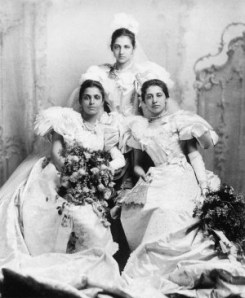 Princess Bamba Duleep Singh and her daughters, Sophia and Catherine, were leading members of the Empress Club
At one time the Empress had 70 bedrooms available to its 2700 members. However, on the night of the 1911 census the number of live-in staff had shrunk to 25 and only 14 guests – all women – were registered as staying the night.
Otho Oliver (1868-?), the owner of the Empress, was the younger brother of Gilbert Oliver (1867-?) In 1891 Gilbert had been a ‘perfume manufacturer’, but in 1894 founded the ‘Ladies’ Tea and Shopping Club’,’to provide for ladies of social position the comforts and convenience that men have found in their clubs for years past.’ I am not sure that the Oliver brothers would themselves have been eligible to join a gentleman’s club, but they clearly knew what the ladies wanted. In 1899 the Tea and Shopping Club had transformed itself into the rather more imposingly named ‘New County Club’, with premises at both 21 Hanover Square – with 30 rooms – and 84 Grosvenor Street.
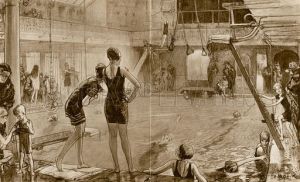 Ladies’ day at the Bath Club, 1920
Next door to the Empress, at 34 Dover Street, women were able to make use of the facilities of the Bath Club, which had been founded in 1894. However, they were not allowed to use the Dover Street entrance but had to access the club through a ‘ladies’ entrance’ in Berkeley Street. The club’s main emphasis was on sport particularly, as it name suggests, swimming.
Dover Street was favoured for clubs. At no 31 Mrs Jennie Cornwallis-West (aka the mother of Winston Churchill) founded the Ladies’ Athenaeum for ladies interested in politics, arts, literature and music and a little earlier the Ladies’ Imperial – for women members of the Conservative and Unionist parties – had opened at nos 17 and 18.
A little to the north the Alexandra Club (no 12) was later joined on Grosvenor Street by the Ladies’ Empire Club at no 69. The Ladies’ Automobile Club, which had been founded in 1903 when the Automobile Club (later the RAC) refused to admit women, eventually moved to Brook Street. It drew its members from the class that could not only afford to motor but were sufficiently daring to do so.
And it is clubs for the more socially and politically daring that the next ‘Rooms of their Own’ post will discuss.
Women Writers and Italy: Two Englishwomen in Rome
Posted in Women Writers and Italy on November 30, 2012
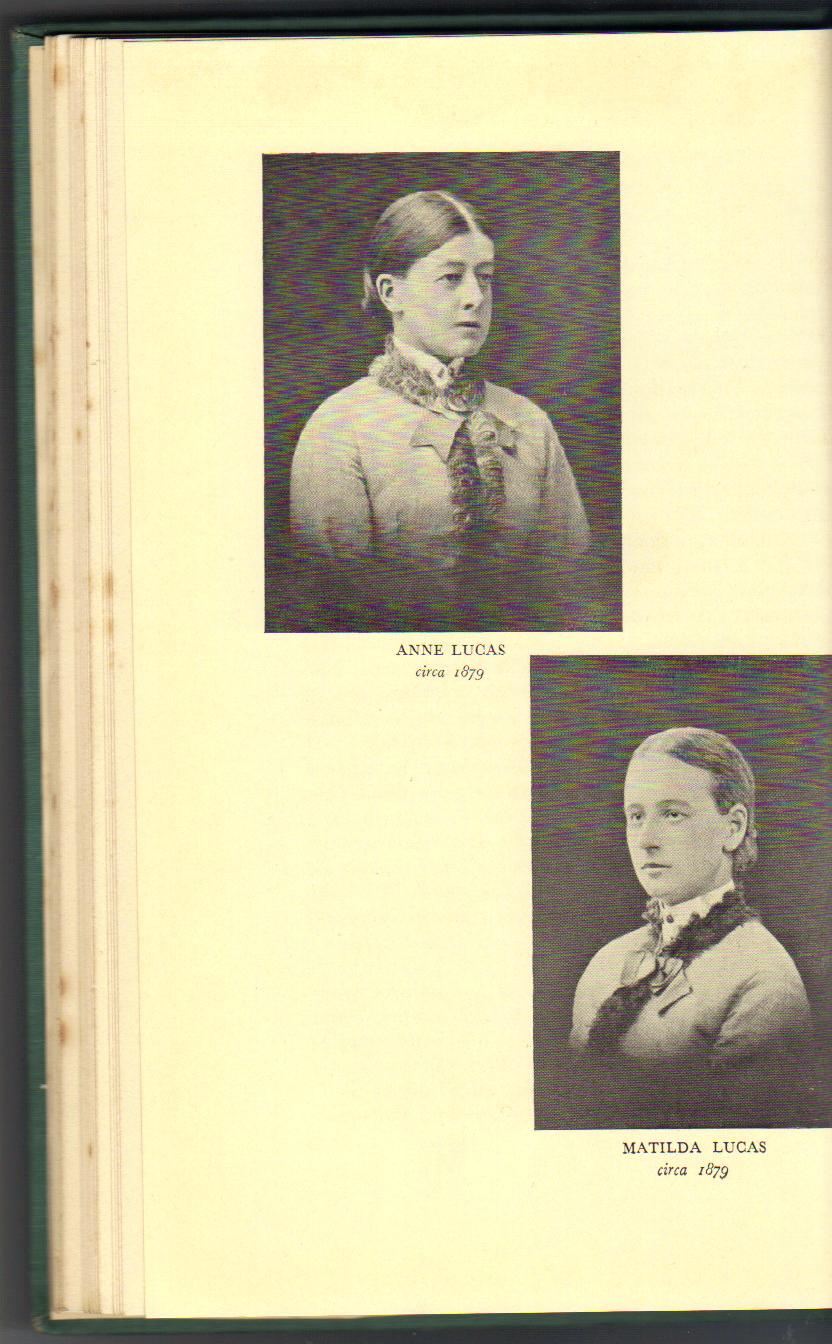 Anne ( 1841-1928) and Matilda Lucas (1849-1943) were the daughters of Samuel Lucas, a brewer with land and influence in Hitchin, Hertfordshire. The Lucas family were Quakers. Their mother had died when they were young and after their father’s death in 1870 the sisters continued to live for a short time with their step-mother. But then, in mid-1871, they left England for Rome, where, for the next 29 years, they were to spend much of the year. Ten years after her sister’s death, Matilda Lucas published excerpts from the letters sent over the years by the sisters to friends and relations back in England. Two Englishwomen in Rome, 1871-1900 (Methuen, 1938) makes very entertaining reading.
Artistic talent clearly ran in the family. Here is a study of Matilda Lucas by her niece, Rose Lucas. Samuel Lucas had been a renowned amateur artist and his daughters, too, had evidently inherited a measure of his talent. They spent much of their time in Rome engaged with their sketchbooks and easels, working both in the studio and plein air.
”Rome. February 14, 1875. On Saturday morning I went off my myself round by the Capitol, Forum, and Arch of Janus and out to the place where the Campagna oxen stand not far from the Temple of Vesta. I had taken my sketch-book, and, as I was walking down the road looking out for some cattle to draw, a splendid pair drew up with a very picturesque cart loaded with fodder and logs. So I set to work on that and stood there, surrounded by some villainous-looking roughs and a beggar. I gave out that I had no money and had left my watch at home, so I did not think they could do me much harm. They were much interested in my performance, and I talked to them. But when I shut up my book to go, the owner of the cattle demanded brandy and began to get excited, at which the others said, ‘Quella non ha denaro’. He seemed much disgusted, but I got away all right, and walked on to the Temple of Vesta and Santa Maria in Cosmedin.’
‘Rome. 1879. Augusto sat very well. The first day he arrived long before time, so that Anne and I might have a private view and see whether he had shaved properly and arranged his curls. When we arranged the red doublet and short mantle on him it was most amusing to see the satisfaction with which he looked at himself in the glass.’

Corrodi: Tasso’s Oak and view of Rome from the Janiculum (mid-19th century)
‘Rome. May 20, 1878. By Tasso’s Oak are the remains of an amphitheatre with cypresses at the top and a small grass plot at the bottom. The singers were on the steps above us. By day the view of the distant city is grand; by night we could see where the city was by the lights, and could make out the line of Monte Cavo. Carlandi [the art master] was very indignant with the moon for being so late, but I told him I thought the stars and fireflies did very well. It was most beautiful to see the moon rise behind the Alban hills; it came up quite golden and made the mists look red. The singers were Carlandi’s sisters, the Professor, and Monsieur Thouron. They have good voices and sang with good taste; the mandolines were very sweet in the open air.
It was charming. Carlandi could not have given us a more artistic entertainment. The frogs, which Anne said had been awoken out of their beauty sleep, encored loudly from the Corsini gardens. The last son was Mendelssohn’s Adieu, which we generally call ‘Mourn Not’, after which we made the best of our way home, delighted with our entertainment and the Carlandis.’
Suffrage Stories: Beware! A Warning to Suffragists by Cicely Hamilton (The End)
Posted in Suffrage Stories on November 29, 2012

Cicely Hamilton wrote the words – the sketches were supplied leading suffrage artists: Mary Lowndes, Dora Meeson Coates, C. Hedley Charlton – and the ‘Rhyme Book’ was published by the Artists’ Suffrage League, 1909.
I will reproduce this delicious work in a series of posts – a few pages at a time – for your amusement and edification.
Final instalment: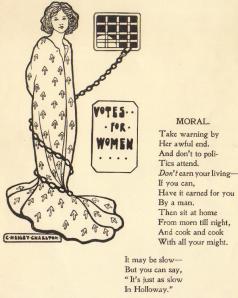
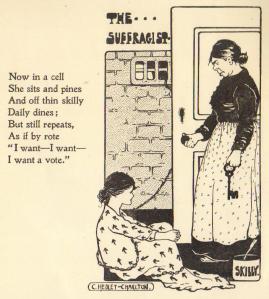
Suffrage Stories: Beware! A Warning to Suffragists by Cicely Hamilton (6)
Posted in Suffrage Stories on November 28, 2012
Cicely Hamilton wrote the words – the sketches were supplied leading suffrage artists: Mary Lowndes, Dora Meeson Coates, C. Hedley Charlton – and the ‘Rhyme Book’ was published by the Artists’ Suffrage League, 1909.
I will reproduce this delicious work in a series of posts – a few pages at a time – for your amusement and edification.
Instalment 6: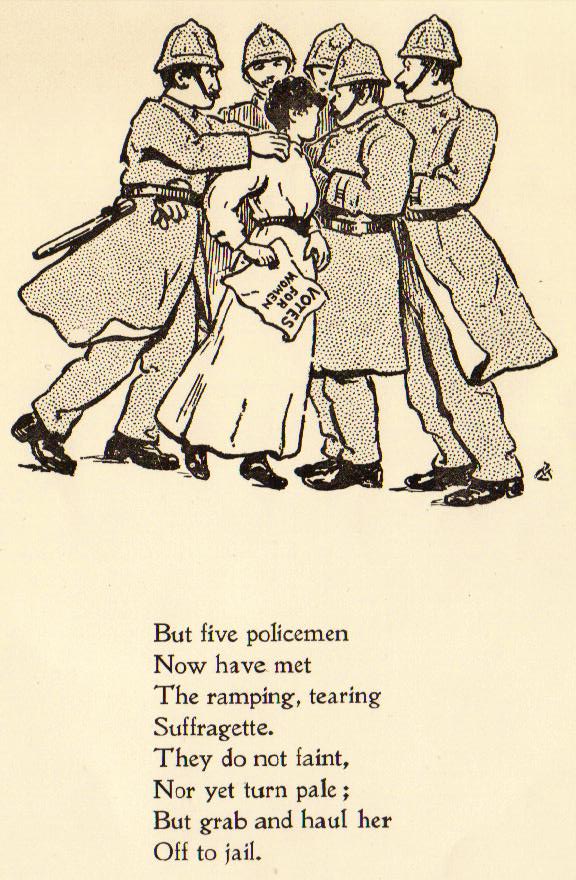
Suffrage Stories: Beware! A Warning to Suffragists by Cicely Hamilton (5)
Posted in Suffrage Stories, Uncategorized on November 27, 2012
Cicely Hamilton wrote the words – the sketches were supplied leading suffrage artists: Mary Lowndes, Dora Meeson Coates, C. Hedley Charlton – and the ‘Rhyme Book’ was published by the Artists’ Suffrage League, 1909.
I will reproduce this delicious work in a series of posts – a few pages at a time – for your amusement and edification.
Instalment 5:
Suffrage Stories: Beware! A Warning to Suffragists by Cicely Hamilton (4)
Posted in Suffrage Stories on November 26, 2012
Cicely Hamilton wrote the words – the sketches were supplied leading suffrage artists: Mary Lowndes, Dora Meeson Coates, C. Hedley Charlton – and the ‘Rhyme Book’ was published by the Artists’ Suffrage League, 1908.
I will reproduce this delicious work in a series of posts – a few pages at a time – for your amusement and edification.
Instalment 4:
Suffrage Stories: Beware! A Warning to Suffragists by Cicely Hamilton (3)
Posted in Suffrage Stories on November 24, 2012
Cicely Hamilton wrote the words – the sketches were supplied leading suffrage artists: Mary Lowndes, Dora Meeson Coates, C. Hedley Charlton – and the ‘Rhyme Book’ was published by the Artists’ Suffrage League, 1908.
I will reproduce this delicious work in a series of posts – a few pages at a time – for your amusement and edification.
Instalment 3:
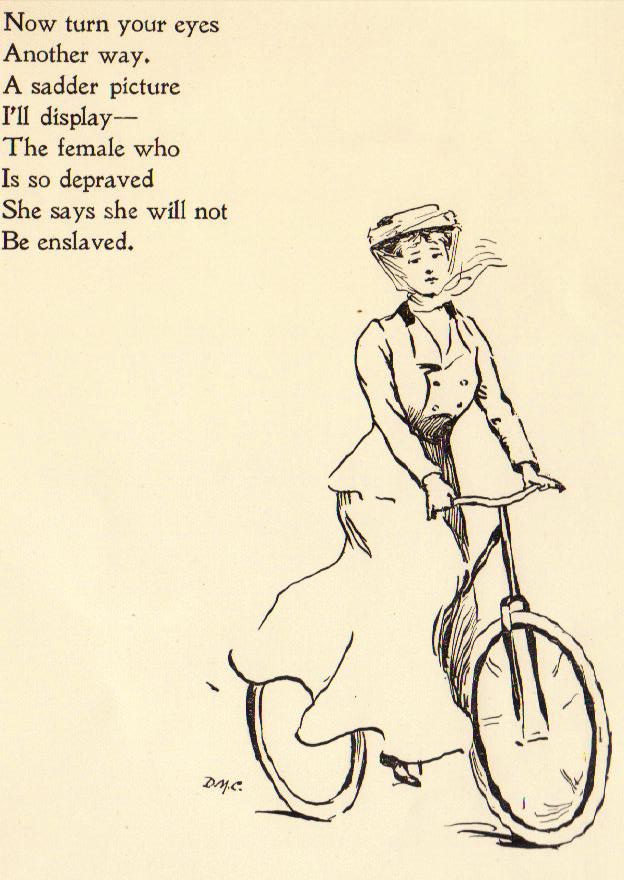
Suffrage Stories: Beware! A Warning to Suffragists by Cicely Hamilton (2)
Posted in Suffrage Stories on November 23, 2012
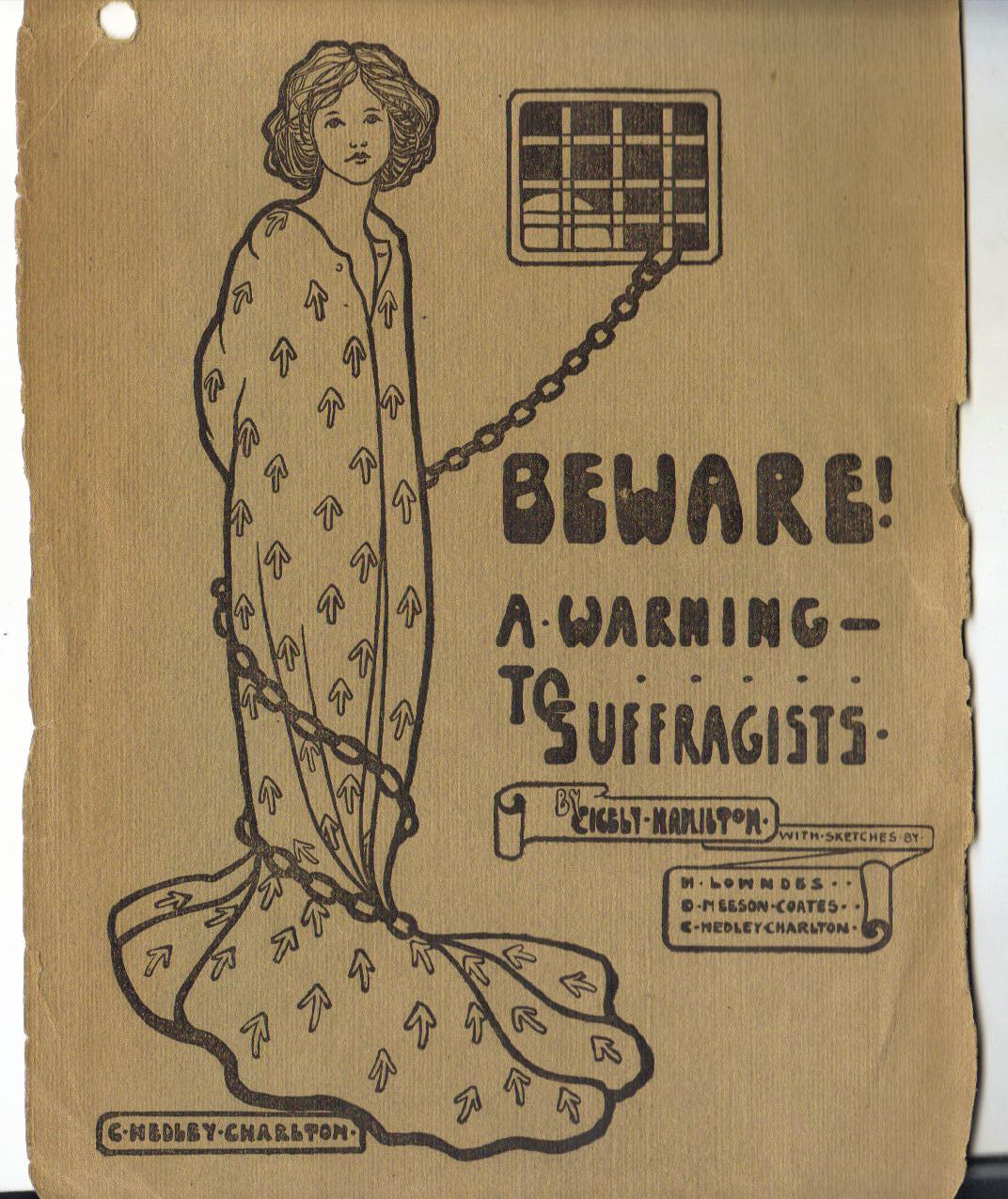 Cicely Hamilton wrote the words – the sketches were supplied by leading suffrage artists: Mary Lowndes, Dora Meeson Coates and C. Hedley Charlton – and the ‘Rhyme Book’ was published by the Artists’ Suffrage League, 1908.
I will reproduce this delicious work in a series of posts – a few pages at a time – for your amusement and edification.
Instalment 2:
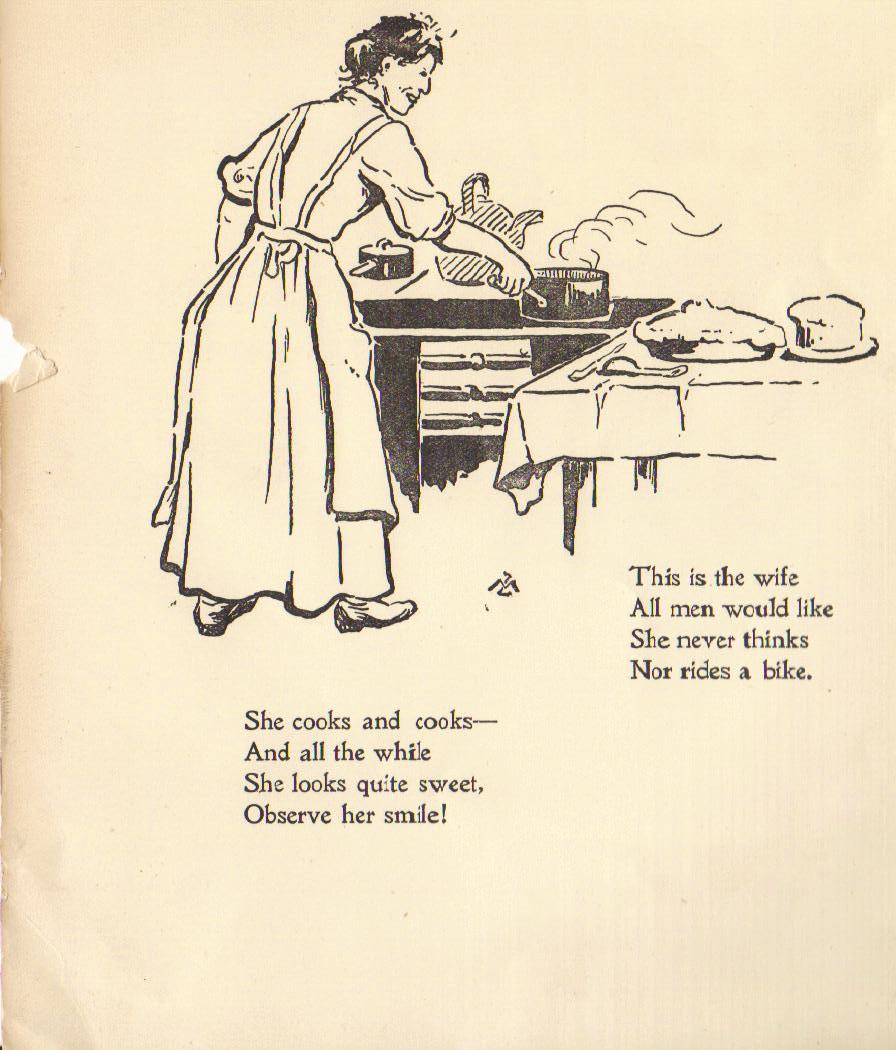
Suffrage Stories: Beware! A Warning to Suffragists by Cicely Hamilton
Posted in Suffrage Stories on November 22, 2012
Cicely Hamilton wrote the words – the sketches were supplied by
leading suffrage artists: Mary Lowndes, Dora Meeson Coates and
C. Hedley Charlton – and the ‘Rhyme Book’ was published by the
Artists’ Suffrage League, 1908.
I will reproduce this delicious work in a series of posts – a few pages at a time – for your amusement and edification.
Instalment 1:
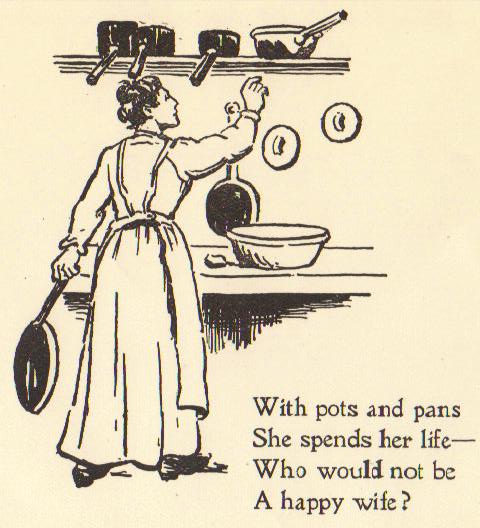
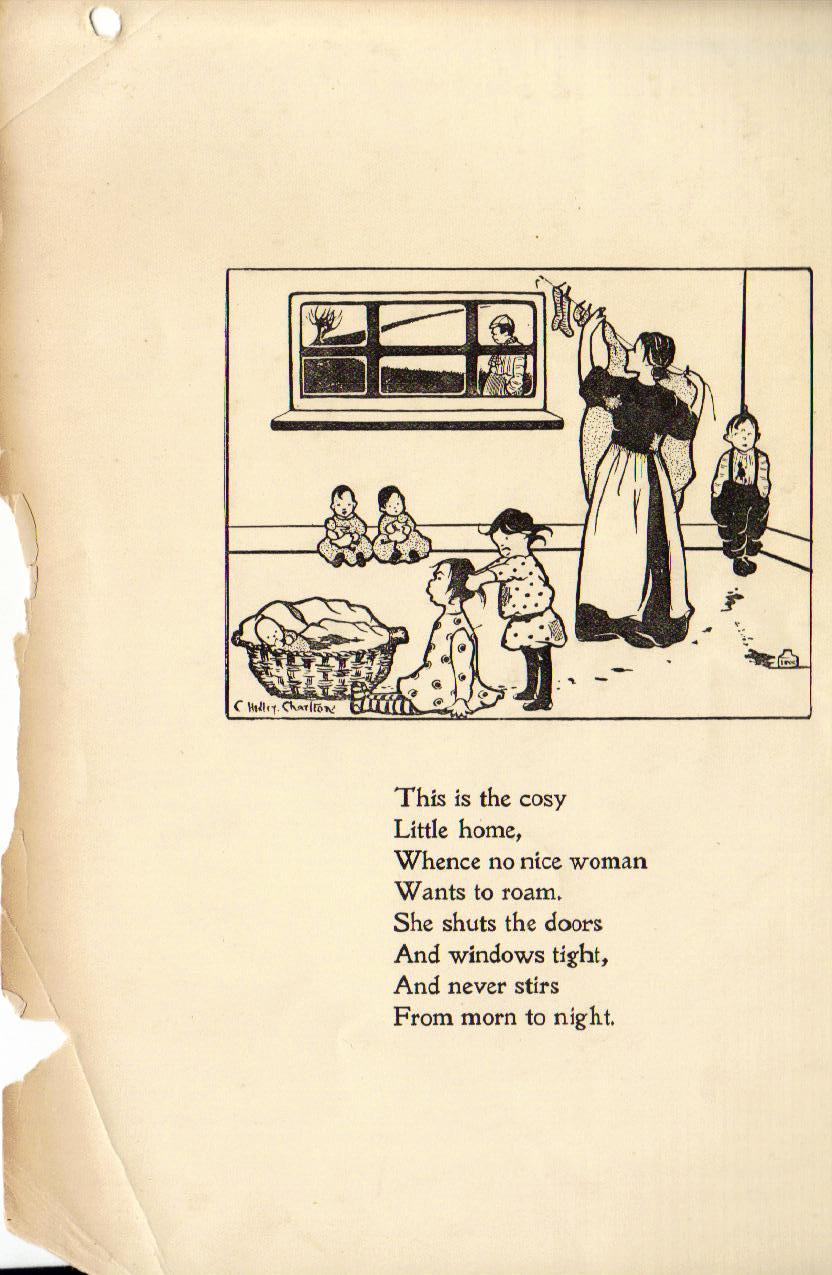
Kate Frye’s Suffrage Diary: The Mud March, 9 February 1907
Posted in Kate Frye's suffrage diary on November 21, 2012
Kate Frye had first joined a suffrage society in the spring of 1906. Her choice was the Central Society for Women’s Suffrage (later renamed the London Society for Women’s Suffrage) – a constituent society of the National Union of Women’s Suffrage Societies Interest in the long-running women’s suffrage campaign leapt ahead in the following few months and in February 1907 the NUWSS staged the first open-air suffrage spectacular – a march through the wintry, muddy London streets. For obvious reasons this became known as the ‘Mud March’. Kate’s estimate of 3000 participants accords with later reports.
Saturday 9 February 1907 [25 Arundel Gardens, North Kensington]
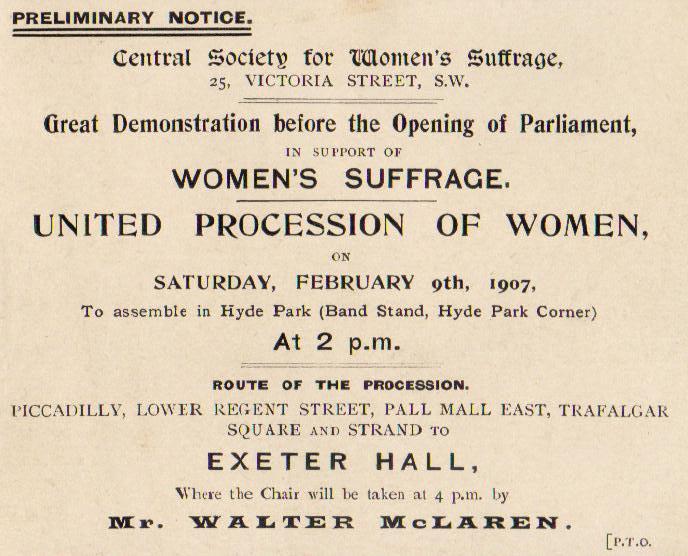 In bed for breakfast – and what was my utter disgust – and disappointment – to hear the torrents of rain – and there was not a shadow of its coming last night – it was bitterly cold. As it was so heavy I hoped it would stop – but it went on and on into a fine heavy drizzle. They said I should be mad to go in the procession and though I knew I must – I went out at 12.30 taking Mickie a walk and sent a telegram to Alexandra Wright telling her the rain prevented my joining them. I had arranged to be at their house at 1 o’clock and go with them to Hyde Park. We all had lunch. I knew I was going all the time – but couldn’t go. Off to wash my hands. 2 o’clock. ‘They will be just starting’, said I. Then as I washed I made up my mind I would go rain or no rain and – lo – the rain had ceased. I prepared a plan to Agnes. She too knew she was to be of it – both flew upstairs and were out of the house before 2.15.
We tore to Notting Hill Gate – meaning to go the quickest way. No motor bus – so we tore for the train – it came in as I started to race down. In we scrambled – had to change at South Kensington much to our disgust – but we were not kept long. We flew out at Charing Cross and up Villiers Street. No sign of the Procession of Women Suffragists in the Strand. They were timed to leave Hyde Park at 2 o’clock so I had to pluck up my courage and ask a policeman. No, they had not passed. So, knowing the route, we flew up as far as Piccadilly Circus and there in about 2 minutes we heard strains of a band and waited, anxious and expectant. The crowd began to gather and we were nearly swept away by the first part – a swarm of roughs with the band – but the procession itself came – passed along dignified and really impressive. It was a sight I wouldn’t have missed for anything – and I was glad to have the opportunity of seeing it as well as taking part in it.
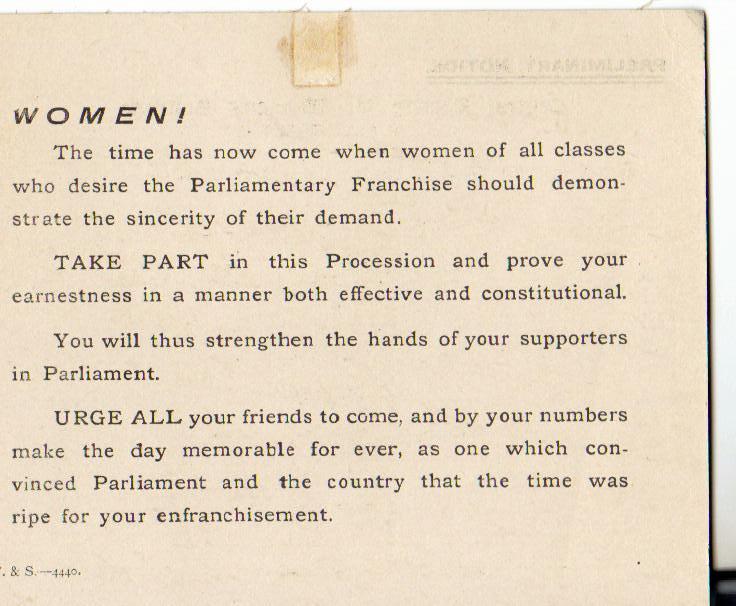 We stood right in front so as not to miss our contingent – and I asked if they knew where it was. Miss Gore Booth said it was coming and we were fearfully excited and I was so anxious not to miss our lot. I shrieked out when I saw Miss Doake’s red head in the distance and we dashed up to them and asked if we could join in. Alexandra carried our banner. Mrs Wright said come along here – it felt like boarding an express train but I suppose it was a quite simple rally though I cannot look back on it as that – but we were so excited and so anxious not to miss them. We walked three abreast – Miss Doake, Agnes and I – I was on the kerb side – behind us Gladys [Wright], Miss Ellis and Mrs Doake. North Kensington was not very well represented but I really do not know who else of us was there.
Then the real excitement started. The crowds to see us – the man in the street – the men in the Clubs, the people standing outside the Carlton – interested – surprised for the most part – not much joking at our expense and no roughness. The policemen were splendid and all the traffic was stopped our way. We were an imposing spectacle all with badges – each section under its own banners. Ours got broken, poor thing, unfortunately, and caused remarks. I felt like a martyr of old and walked proudly along. I would not jest with the crowd – though we had some jokes with ourselves. It did seem an extraordinary walk and it took some time as we went very slowly occasionally when we got congested – but we went in one long unbroken procession. There were 3000 about I believe. At the end came ever so many carriages and motor cars – but of course we did not see them. Lots of people we knew drove.
Flyer advertising the NUWSS ‘Mud March’Up the Strand it was a great crowd watching – some of the remarks were most amusing. ‘Here comes the class’ and two quite smart men standing by the kerb ‘I say look at those nice girls – positively disgraceful I call it.’ Then ‘Ginger hair – dark hair – and fair hair’ ‘Oh! What nice girls’ to Miss Doake, Agnes and I. Several asked if we had brought our sweethearts and made remarks to express their surprise at our special little band. ‘All the prizes in this lot’ etc. The mud was awful. Agnes and I wore galoshes so our feet were alright but we got dreadfully splashed. It was quite a business turning into the Exeter Hall. A band was playing merrily all the time – the one which had led the procession – and there was one not far off us. Three altogether, I was told.
 Exeter Hall in 1905
We got good seats and of course had to wait some time before the meeting started – it was just after 4 pm when it did – but there was a ladies’ orchestra performing and playing very well and a lady at the organ in between whiles. The meeting was splendid. Mr Walter McLaren in the Chair and Israel Zangwill as chief speaker – he was so splendid and most witty. Miss Gore Booth – Mrs Fawcett – Mrs Eva McLaren – Lady Strachey and several other ladies spoke and Keir Hardie made an excellent speech. It was altogether a wonderful and memorable afternoon – and felt we were making history – but after all I don’t know, I am sure, what will come of it. The MPs seem to have cheated and thoroughly ‘had’ us all over it. They wanted the Liberal Women’s help to get into the House and now they don’t care two straws or they are frightened of us. We walked up to Tottenham Court Road and came home by bus. It was nearly 7 o’clock when we got in. .. I felt bitterly tired all the evening after the excitement.
Dramatis Personae for this entry
Agnes, Kate’s elder sister
Mickie, Kate’s beloved dog
Alexandra and her sister, Gladys, lived at 10 Linden Gardens. It was under their influence that Kate had joined the London Society for Women’s Suffrage.
Violette Mary Doake (b 1888) her parents were Irish, which may account for the red hair. Her mother, Mary Elizabeth Doake, was also a suffragist. Her father, Richard Baxter Doake, described in the 1911 census as a ‘tea planter’, was elected as a Progressive party member in 1892 to the LCC seat relinquished by Frederick Frye. In 1901 the Doakes lived at 24 Stanley Gardens, close to the Fryes. By 1911 they had moved to 25 Ladbroke Gardens.
Walter McLaren and his wife, Eva were members of a family of long-standing supporters of women’s suffrage. He had been Liberal MP for Crewe in the 1890s and regained the seat in 1910.
Israel Zangwill, Jewish novelist and very effective writer and speaker in support of women’s suffrage
Lady Strachey had worked for women’s suffrage since the 1860s. She remarked that after this march she had to boil her skirt.
Keir Hardie, first Independent Labour Party MP. He had strongly supported a motion in favour of women’s suffrage at the Labour party conference on 26 January
Campaigning for the Vote: Kate Parry Frye’s Suffrage Diary edited by Elizabeth Crawford
For a full description of the book click here
Wrap-around paper covers, 226 pp, over 70 illustrations, all from Kate Frye’s personal archive.
ISBN 978 1903427 75 0
Copies available from Francis Boutle Publishers, or from Elizabeth Crawford – elizabeth.crawford2017@outlook.com (£14.99), or from all good bookshops.
-
‘Campaigning for the Vote’ – Front and back cover of wrappers
- Campaigning for the Vote– Front and back cover of wrappers
You can also listen here to a Radio 4 programme as Anne McElvoy and I follow the route of the ‘Mud March’.
Copyright
Rooms Of Their Own: Victorian and Edwardian Women’s Clubs: A Practical Demand
Posted in Rooms of their Own: Women's Clubs on November 16, 2012

In ‘The Ladies’ Clubs of London’, an 1899 article, the journalist Dora Jones identified ‘the evolution of the independent professional woman’ as the catalyst in the explosion of women’s clubs, writing:’ The modern professional woman, be she artist, journalist, clerk, doctor, teacher, or nurse, living as she often does in rooms in the suburbs, needs some fairly central haven of refuge where she can drop in, when she has a spare hour, for a rest, a cup of tea, and a glance at the newspapers. She is probably an intelligent woman, with a keen interest in everything that affects the interests of her sex, and she likes to have a place open to her where she may have a chance of meeting those like-minded and of discussing questions of common interest. And, unfortunately, she is very likely to be a lonely woman, and there is no loneliness which presses one more cruelly than the isolation of a great city.’ Dora Jones concentrated her researches on clubs, such as the Somerville, the University Women’s, the Pioneer, and the Writers’, where women such as she described might be found. In the early days the clubs were open during the day and in the evenings but did not offer members residential facilities.
The Somerville Club (named for Mary Somerville) had been founded in 1878 and by 1888 was based in utilitarian premises above an ABC cafeteria in Oxford Street, later moving to Hanover Square. It always hovered on the edge of financial disaster, its membership subscription kept low in order to appeal to the poorer, working, middle-class woman. The Somerville allowed her a respite from cramped lodgings, the prospect of mildly radical lectures and discussions on subjects such as ‘Rousseau ‘and ‘Poets and Poetry as Moral and Spiritual Teachers’.
The University Women’s Club, or the University Club for Ladies as it was originally termed, aimed to ‘afford facilities of intercourse for Women educated at the Universities’, its members initially drawn mainly from Girton and Newnham, with some from Oxford and a few from London, particularly from the London School of Medicine for Women. By late 1886 premises had been opened in New Bond Street, in a setting of Morris wallpapers and Chippendale chairs, and subscriptions taken to various weekly and monthly papers and to a circulating library. By 1896 the club had 270 members.
The minute books of the University Women’s Club (and it is the only club whose committee books are extant) reveal the prosaic details of running such an enterprise. For instance in 1890, when the club had no cooking facilities of its own, relying on meals supplied by an outside restaurant, there were complaints that the tariff was limited and that ‘a chop was not always wanted’. Writing of the club in 1888 Amy Levy (a graduate of Newnham) commented that ‘the mingled sense of independence and esprit de corps which made college life at once so pleasant and so wholesome are not wanting here in the colder, more crowded regions of London club-land’. However, in 1890 when a fortnightly house dinner was instituted, presumably to encourage greater camaraderie, the minutes record that these dinners were not largely attended.
From 1902 gentlemen were welcomed as guests. The resolution allowing this pointed out that ‘it was very inconvenient to members who lived in lodgings, and perhaps had only one room, not to be able to ask a gentleman to their Club’. On the night of the census, at a time when the club was at 4 George Street, Hanover Square, three members were recorded as staying there that night – one was a teacher, one a hospital nurse and the third of ‘private means’.
The minutes emphasise that the club’s purpose was social only. This is the only one of the 19th-century women’s clubs to survive, although, alongside a programme of social activities, it is nowadays quite happy to host the occasional lecture.

The apotheosis of the clubs associated with the new breed of ‘strong-minded’ women was the Pioneer. This had opened in 1892, by 1894 was ensconced at 22 Bruton Street, the home of Mrs Emily Massingberd, its founder, and had around 400 members, who, in order to eliminate class differences, were, while in the club, identified by their membership number.
Dora Jones commented that ‘Country ladies who have heard it whispered that there is a smoking room at the Pioneers’ still, I believe, mention the place sometimes with bated breath, as the resort of alarming beings with short hair, strident voices, and unbecoming garments of a masculine cut. A visit to the club some afternoon would make short work of these preconceptions. For a woman to succeed in the battle of life at the present time, she must be neither a “frump”, nor a “crank”’. However, writing in the feminist journal, Shafts, in January 1894 its editor, Mrs Margaret Shurmer Sibthorpe, declared it was her intention to adopt Rational dress and that she meant ‘to go freely to and fro in it wherever my business may call me, to appear in it at my club (the Pioneer), and at many places of public resort.’ Moreover, Viscountess Harberton, a co-founder of the Rational Dress movement was a member of the Pioneer.
That the Pioneers, whether or not ‘alarming beings’, welcomed independence of mind may be seen in the club’s programme of debates, each of which was preceded by a club dinner.
In 1893 the summer session included ‘Why should not women vote?’, ‘Will socialism benefit women’, and ‘Should women marry?’.
Although the Pioneer continued well into the 1920s there seems to have been some doubt in 1897, after the death of Mrs Massingberd, as to whether it would continue, many members leaving to join the Grosvenor Crescent Club (15 Crosvenor Crescent). This also catered for the professional working women, by 1900 boasting not only a telephone, but also an exchange telegraph to provide stock market reports. However, on the night of the 1911 census there were five woman members staying at the club, none of whom claimed to have any paid occupation, looked after by an ample staff.
In London most of the Victorian and Edwardian ladies’ clubs tended to be located in the shopping, feminine area south of Oxford Street, north of Piccadilly and west of Regent Street. Not only were they conveniently situated for shopping and socialising, but the fact that they were in an acceptably feminine area appears successfully to have negated the masculinity inherent in the idea of the club.
However in 1892 the Writers’ Club, founded to provide a social and working centre for women authors and journalists, did open its doors in an essentially masculine area, Norfolk Street, just off the Strand. Based in Hastings House, a building sheltering many small businesses associated with publishing and journalism, the club comprised a reception room (originally decorated with what Dora Jones affectionately terms ‘a greenery-yallery tinge’), a dining room, an occasional room, and a writing room, where silence was enforced in order that members might work and which was well supplied with works of reference. The Writers’ Club held a Friday house tea, which Dora Jones described as having come ‘to rank among the most interesting gatherings of literary London. Some leading light in the women’s world fills the place of hostess, and many of the most distinguished personalities of the day are to be met. A well-known ornament of these gatherings, the author of Joanna Traill [Annie E. Holdsworth], and some other powerful and intensely modern books, has introuduced a description of them into her latest work.’ Philip Gibbs in his novel Intellectual Mansions, 1910, also gives a vibrant description of the Literary Ladies’ Club (which he based in ‘Arundel Street’, clearly a nod to Norfolk Street), clearly based on his experience of the Writers’ Club house teas.

However the food provided by the Writers’ Club was indifferent, the surroundings rather shabby and in 1904 a group with higher aspirations broke away to form the Lyceum Club. This was the first woman’s club to brave the male club land of Piccadilly, initially taking over premises that had formerly housed the Imperial Services Club. Its founder, Constance Smedley, recorded that the Lyceum was intended for ladies engaged with literature, journalism, art, science and medicine, who required ‘a substantial and dignified milieu where [they] could meet editors and other employers and discuss matters as men did in professional clubs: above all in surroundings that did not suggest poverty’. The Lyceum had a library, an art gallery in which the work of members was displayed, 35 bedrooms and employed hairdressers and sewing maids. The club had international aspirations and branches were soon formed in Berlin, Paris, Rome and Florence – and is still in existence – the International Association of Lyceum Clubs.
These were all clubs that aspired to cater for the professional working woman or the woman interested in social and political affairs. However, once the tacit barrier against women forming clubs was broken, another style of club, more akin to that of the men, made its appearance. I shall discuss these in a future post.
Copyright All the articles on Woman and Her Sphere and are my copyright. An article may not be reproduced in any medium without my permission and full acknowledgement. You are welcome to cite or quote from an article provided you give full acknowledgement.
WALKS/Suffrage Stories: Where And What Was ‘The Votes For Women Fellowship’?
Posted in Suffrage Stories on November 12, 2012

Red Lion Court. The site (on the left) of the offices of the Votes for Women Fellowship
To mark the very welcome co-operation planned for the future between the Women’s Library and the London School of Economics the next few ‘Suffrage Stories’ will demonstrate the past importance to the women’s movement of streets and buildings in the vicinity of Houghton Street.
In previous posts I described how the Women’s Social and Political Union came to have its offices in Clement’s Inn and to have its campaign publicised in the weekly paper owned and edited by Frederick and Emmeline Pethick-Lawrence – Votes for Women – which was printed close by at the St Clement’s Press In October 1912 the Pethick-Lawrences, who had been recuperating abroad after enduring a term of hunger-striking imprisonment, returned to England to be told by Emmeline and Christabel Pankhurst that they, as Emmeline Pethick-Lawrence herself put it, had ‘no further use for them’. In her autobiography Emmeline Pethick-Lawrence records that she never saw or heard from Emmeline Pankhurst again.
During the Pethick-Lawrences’ absence Mrs Pankhurst had moved the WSPU from Clement’s Inn to Lincoln’s Inn House on Kingsway (about which I will write in a later post). In fact I rather think, from studying the relevant rate book, that the WSPU may actually have been evicted from Clement’s Inn. After their expulsion from the WSPU the Pethick-Lawrences took back their paper, Votes for Women, and continued to publish it, on their own account, from a new office. Again, it may have been that after their imprisonment they were no longer welcome to the Clement’s Inn management company.
For whatever reason, the Pethick-Lawrences moved a little to the east of Clement’s Inn and set up office in 4-7 Red Lion Court, one of the quaint passages off the north side of Fleet Street. Despite the redevelopment that has swept away their office, the narrow court is still atmospheric. The office was close to Votes for Women‘s new printer in Whitefriars Street, off the south side of Fleet Street. The first issue of Votes for Women published from this address was that of 25 October 1912.
In addition, in Red Lion Court, on 1 November 1912, the Pethick-Lawrences made their paper the centre of another suffrage society, the Votes for Women Fellowship. This group, made up of former members of the WSPU who were no longer in sympathy with the Pankhursts’ tactics, aimed to promote the paper and its policies rather than stand as a new militant organisation. In Emmeline Pethick-Lawrence’s words the Fellowship was ‘giving full expression to the awakened militant spirit of womanhood, that they should associated themselves in various plans for carrying the message far and wide, until in every town and village of this land women realise that they are a living part of a spiritually militant sisterhood that is at war under the triple banner of liberty, compassion, and purity against every form of evil dominance. (Votes for Women, 8 November 1912). The Fellowship’s emblem was of a lady with a lamp and its motto was ‘To spread the Light’.
Without the backing of the WSPU, Votes for Women had a greatly diminished circulation and in 1914 the Pethick-Lawrences gave the paper to the newly-founded United Suffragists. Although there was an overlap of membership, it would be a mistake to construe the United Suffragists as a direct descendant of the Votes for Women Fellowship. Despite being for most of the time in dire financial straits, Votes for Women continued to be published throughout the First World War only ceasing publication in February 1918 when the vote was (partially) won.
Mariana Starke: The Mystery Of The Bodleian Diary
Posted in Mariana Starke, Uncategorized on November 2, 2012
 Duke Humfrey’s Library
It was over a year ago that I became aware that the Bodleian Library in Oxford had recently acquired a manuscript pocket diary that was catalogued as:
‘Diary of Mrs Starke, relative of the playwright and travel writer, Mariana Starke, 1791. This Ladies Pocket Journal; or Toilet Assistant: For the Year 1791 had been published in London by S. Bladon and comprised 84 leaves in a binding of gilt-stamped roan, with flap, clasp missing, marbled endpapers. The catalogue description went on to explain that ‘From internal evidence it appears that the author was the wife of ‘Starke’, an officer in the army, and a relative of the playwright Mariana Starke. They were married 16 Feb. 1764 (see fol. 18v). There are brief entries each day describing her social engagements and her husband’s movements. They often visited Mariana Starke’s family at Epsom and were frequently in the audience at her new play, ‘The Widow of Malabar’. The entries include weekly accounts. Many are supplemented by notes in shorthand.’
I was intrigued. Having, as I thought, researched Mariana Starke’s family fairly comprehensively from her great-grandfather’s merchant life in the late 17th century, through the overseas adventures of her grandfather and father I was interested in discovering who this ‘new’ Starke relation was. For I could not place any ‘army’ Starke – married in 1764 – in the family tree. Nor, using all the wonderful internet genealogical sites that we now have at our disposal, could I discover a suitable 1764 Starke marriage. I was, however, quite prepared to believe that the marriage had taken place abroad – perhaps in India – or that there were collateral branches of the family of which I knew nothing. And it was certainly interesting to know of anyone who had had such close contact with Mariana – as this diarist apparently had
So, I eventually got round to planning a visit to Oxford and amassing the various forms that would allow me access to the Bodleian Special Collections. It was some years since I had been there – and then it had been to research the 19th-century suffrage movement. That had not necessitated sitting amidst the splendour of the Duke Humfrey Library; what a pleasure it was to do so now.
I devoted about four hours to reading this little diary. The shorthand was impenetrable, the conventional handwriting crisp and legible, but at the end of my visit I was no clearer as to the identity of the diarist than I was at the beginning. One thing was incontrovertible – she did refer to her husband as ‘Starke’ or ‘S’ throughout – and there was no mention of any other family name. There were, however, various clues as to identity – of which I took careful note. There was the date of her wedding – on 16 February 1791 she had been married 27 years and there was mention in March of the birth – abroad – of a third son to her own son. Further reading showed that her son’s name was William; there was no mention of any other children, so perhaps, I thought, William was her only son. It also appeared that William’s wife was ‘Lady Sarah’, a daughter of Lord Plymouth. Moreover after her son’s family returned from abroad they were all staying with the diarist when the new grandson was christened ‘Augustus James’, in July, from her house.
On my return home I used this information to search the online websites for a likely Augustus Starke, a William Starke, a Lady Sarah Starke – all to no avail. I then made a wider search – using just the names ‘Augustus James’ and a date of birth ‘1791’. And immediately came up with the answer to the conundrum.
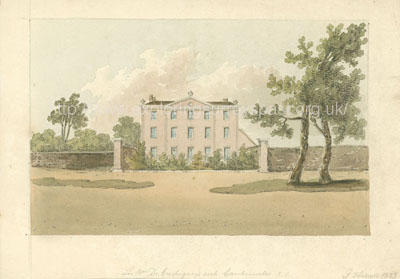 Champion Lodge, Camberwell, a watercolour painted in 1823 by which time Mrs Crespigny’s son, WIlliam, had inherited the estate. Courtesy of Surrey History Centre.
The diarist’s family name is not ‘Starke’ but ‘Crespigny’. She is Mrs Mary Crespigny of Champion Lodge, Camberwell, patron and friend of Mariana Starke. Mary Clark (1748-1812) (see her portrait here) was married at St Giles, Camberwell, to Claude Champion Crespigny (1734-1818) on 16 February 1764 (see here for his portrait, painted 10 years before the marriage). Their only child – a son – William (1765-1829) was baptized at St Giles Camberwell (Jan 1765). William Crespigny married Lady Sarah Windsor, daughter of the Earl of Plymouth, in 1786. William Crespigny’s third son, Augustus James Crespigny, was born on 9 March 1791 in Nice and baptized at St Giles, Camberwell, in July 1791. The military group to which the diary often refers – her husband is on duty etc – is likely to have been the Camberwell Volunteers (which may have had a slightly different name in 1791), to whom Lady de Crespigny (Claude Crespigny was created a baronet in 1805) later presented colours.
I – and the Bodleian – would be most interested in hearing from anybody who might be able to shed light on why Mrs Crespigny referred to her husband – Claude Champion de Crespigny were all the names he seems to have possessed – as ‘Starke’. There is not, as far as I know, any connection between the families by either blood or marriage. There was, however, certainly a connection between Mary Crespigny and Mariana Starke – sympathy – and the theatre. Their preoccupation with drama – as writer, actor and patron – will become clear in a subsequent post. But for the time being let me mention that Mrs Crespingy noted on 12 January in this 1791 diary that:
‘Miss Starke’s play The Widow of Malabar came on and it went off extremely well – but Lady Salisbury took my Box which caused great confusion’. A week later, on Wednesday 19 January, Mrs Crespigny attended ‘Third night of the Widow. Miss Starke had a very full house. I sent [?] vast numbers – filled 10 rows of pit & nearly all the Boxes – & numbers [?] into the Gallery.
As I say, Mrs Crespigny’s handwriting is really very clear and these lacunae could have been filled in – or puzzled out – had more time been available.
With the identity of the diarist known, the names she mentions can begin to shape themselves into a circle of acquaintances – families that lived within riding distance of Camberwell or whom she saw on her frequent visits to Town. Epsom was a favourite haunt – not only to visit – or even stay with – the Starkes at Hylands House, but to go hunting (Mr Crespigny) or for archery (Mrs Crespigny). For Mary Crespigny, I now discover, was an early female toxophilite, the diary describing competitions held at Epsom and Box Hill. In fact, with the diary identified as recording a year in the life of Mrs Crespigny, it now has a considerably greater significance than if it had indeed belonged to a shadowy ‘Mrs Starke’. It only now requires a cryptographer to set to work to decode the sections that she wished to keep safe from prying eyes.
I shall certainly have to return to Duke Humfrey’s Library and re-engage with Mrs Crespigny’s diary. One piece of information that it contained pleased me greatly: she notes the exact day on which the Starkes embarked on their travels on the continent and, before the year’s end, records letters from Calais and Lyons. These letters were undoubtedly penned by Mariana who, despite the difference in their ages, was, the diary makes clear, Mrs Crespigny’s especial Starke friend.
Copyright
Kate Frye’s Suffrage Diary: Banner Bearer For The 13 June 1908 Procession
Posted in Kate Frye's suffrage diary on October 30, 2012
Asquith became prime minister in April 1908. In response to his claim that he needed proof that large numbers of women really wanted the vote, the National Union of Women’s Suffrage Societies – and the WSPU – decided to mount a spectacular summer procession through London. The magnificent banners, such as that for North Kensington, carried some of the way by Kate, were the work of the Artists’ Suffrage League, in particular of Mary Lowndes.

Mary Lowndes’ design for the North Kensington banner – with swatches of suggested material (courtesy of the Women’s Library@LSE)
The design of the North Kensington banner, held in the Women’s Library, can be seen
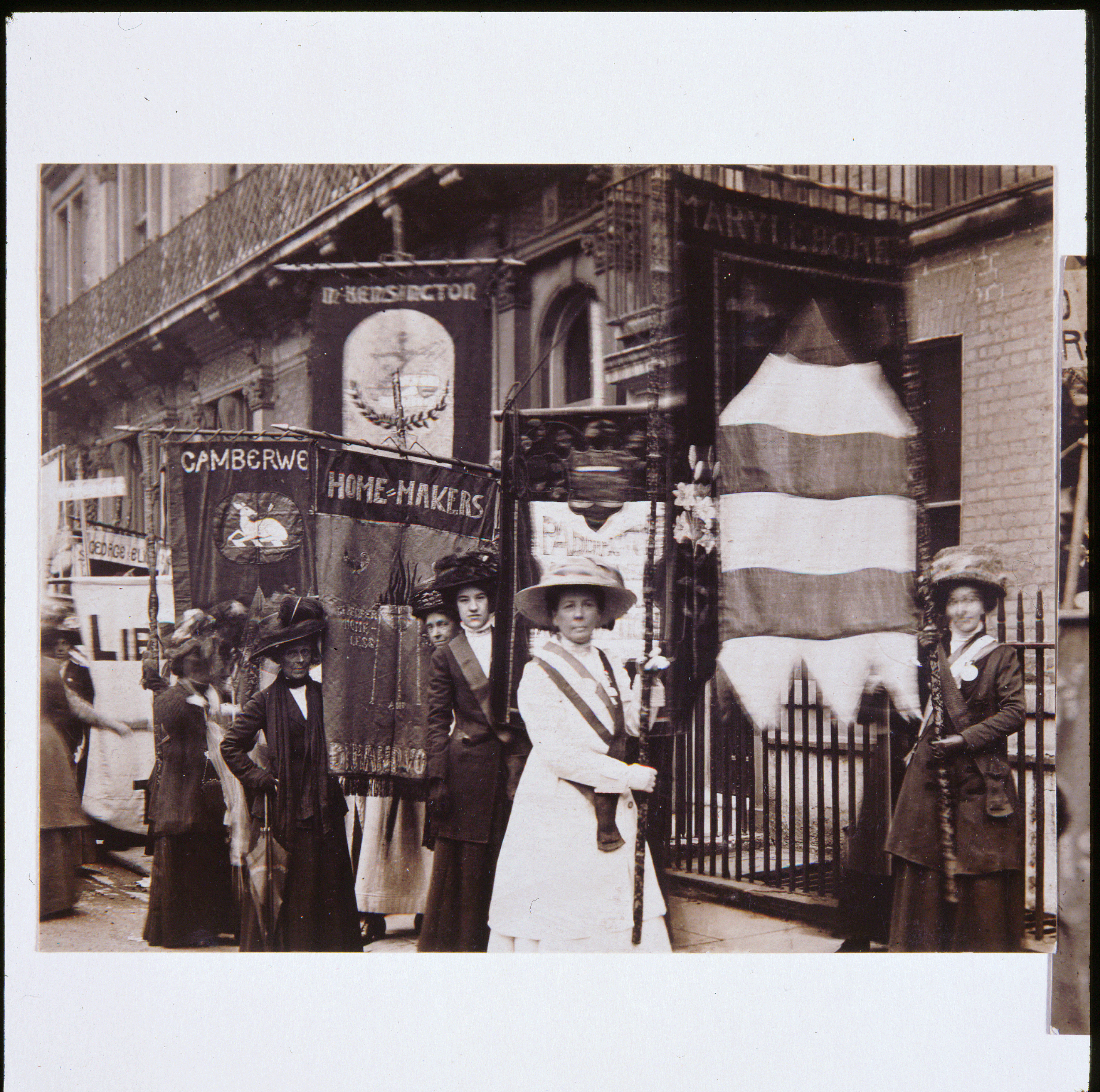
Banners – 13 June 1908 (courtesy of Women’s Library@LSE)
The banner itself was photographed during the course of the 13 June 1908 procession. ‘North Kensington’ is being held high; unfortunately the ‘Home Makers’ obscure the North Kensington banner bearers. Was one of them Kate?
Saturday June 13th 1908 [Bourne End]
Kate’s ticket for the June 1908 Suffrage Procession
The great day dawned at last looking rather threatening – dull and very windy. I did not know quite what to wear but chanced the day wisely as it fell out and wore my best cream linen skirt and embroidery blouse and made myself look nice. I took a coat with me. Down to breakfast, had a chat to Agnes, who was very disappointed not to be going but really she was not up to it and it would have been no use attempting such an exacting and arduous day. It took it out of me. I was ‘going’ inside all day. Went up to London by the 9.53 train wearing my decorations – my ‘Votes for Women’ disk – my National Union Suffrage brooch and my red and white ribbon – the one that went through that exciting evening at the Paddington Baths. I wore them all day and it was most amusing to see the looks given to them. I went shopping in Whiteleys. Then a bus to Bond Street, walked through Burlington and along to the Strand – there I began to see some of my fellow marchers and the Lyons where I lunched was crowded with them – every one agog, of course, to see us.
Then I went to the A.A. [the Actors’ Association] tidied myself up and went upstairs. Quite an excitement there to see me and I found Eve Erskine wavering as to whether or not she should join the march. She rather aggravated me by some of the things she said about it. Then she is so tactless and really doesn’t know. It was from her I learned that there would be a contingent of Actresses headed by Gertrude Kingston, Lillah McCarthy and Mrs Pat [Campbell] and I must own I did feel deadly disappointed not to be going with them. I am sure Miss Gladys [Wright] kept it from me on purpose as she knew how eager I was to get the theatrical people to go and I said how I should like to march with them. So for that reason she did not send me a plan of the order of procession, I feel sure. Not quite straight because, any way, if she had said they really needed my help in Kensington I should have gone. But she and Alexandra went with the graduates and they wanted me responsible for N[orth] Kensington. There was really no-one else. Mrs Wright could not have carried the Banner or any of the small women if they could have it would not have looked right and comfortable. So I was offered up as a sacrifice. I think it was only right a Frye should be the Banner Bearer for North Kensington and I loved to do it and felt very proud but at first I must own to feeling a bit sick over it. I had a few words with Mr Halliwell Hobbs, who was crimson in the face with annoyance about it all. I said ‘will you shake hands though I am going to carry a banner.’ He simply could not bear himself – it so upset him to see my decorations. Eve walked or rather ran – we got so excited seeing the crowds – to the Embankment and there I lost her. I suppose she found her Block and marched with them for I saw her no more.

Kate preserved her programme
The crowds and the excitement was terrific and I really didn’t know how I should find my banner in it all. First I saw Miss Corbett who gave me a plan. Eve had one so I am sure Gladys ought to have sent her Banner Bearer one. And then I found I should be Block 8 – and a nice scamper I had right up Whitehall before I came to my place. Whitehall was quieter, but the crowds on the Embankment were terrific. At last I came to the Block for the London Society and found a messenger boy with the little White and Red Banners we had before. He gave it up to me on hearing my name and I was left alone. As I got there soon after 2 o’clock it was alright but I longed for some friendly face. I had had a glance at some of the Banners as I sped along – they were lovely. At last one or two women whose faces I knew turned up and then three girls with a huge and beautiful banner – one of the Artist League ones – the one Gladys meant me to carry and take the responsibility of. They were in too much of a hurry, the girls, to be off to tell me how to manage it and I had my flapping coat and the wind was terrific. I got one of the others to hold the little one till Mrs Wright and a lot of other people came. Then a tall girl carried the little one at the back of the Kensington Block. Some one very kindly carried my coat and I got the frog fixed round the banner more comfortably. Miss Madge Porter carried one cord, Miss Meyer the other.
We were immediately behind the Holborn section and Lady Grove’s pretty daughters carried that Banner – a huge one – but, lucky beggars, they had two poles to support it. Mine was fearfully heavy, especially in the wind – but I was given a gift with it I think. It was a beauty nauge cloth – brown and yellow silk and cloth of gold. Mrs Percy Harris was just behind. She had to fall out early as she went very strange and there were lots of people I know by sight. We were quite a smart collection – all in our best summer attire. The stewards marshalled us six abreast behind the Banner which had to stand out. The whole thing was most wonderfully organised.
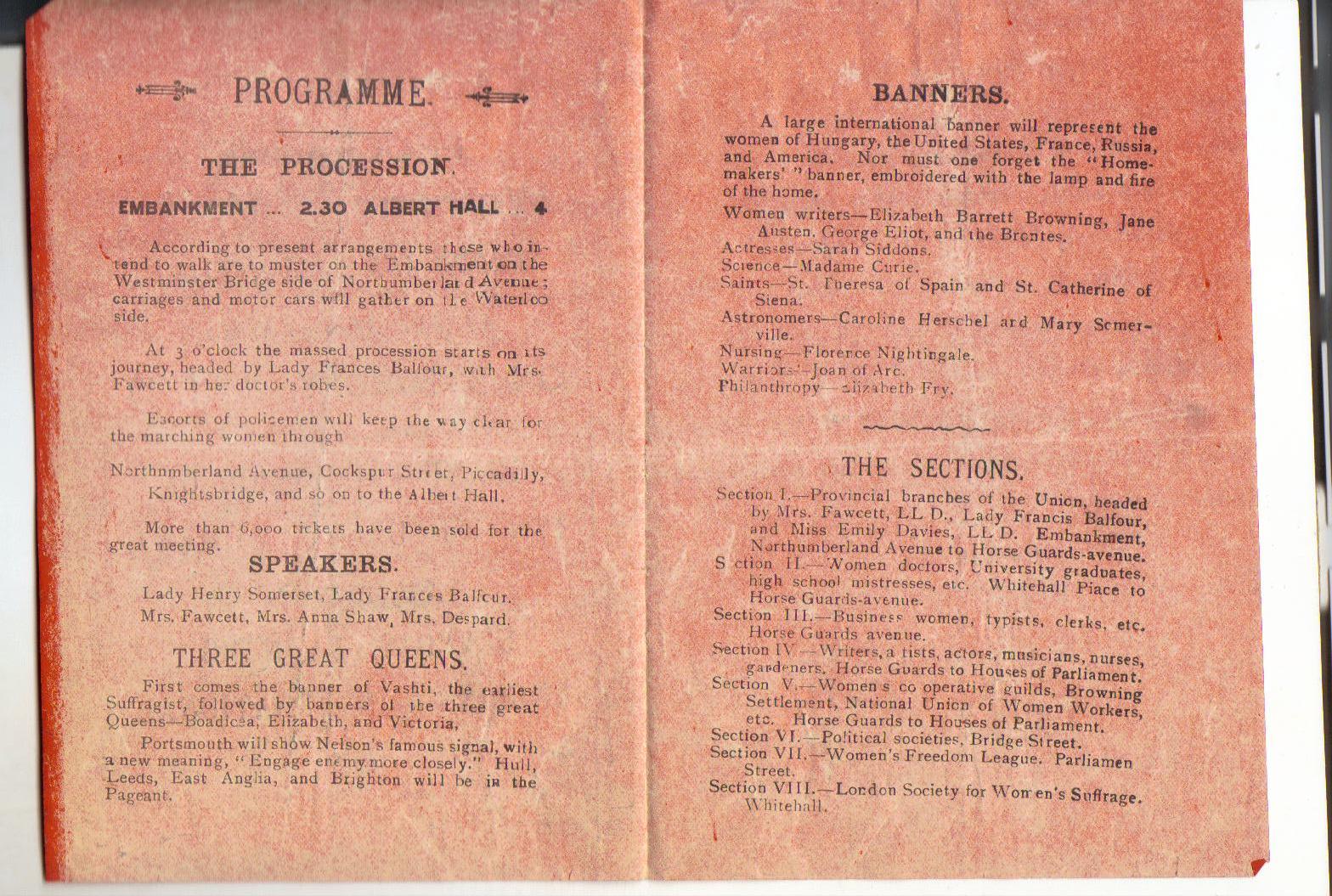
Programme details for the procession
Before we moved off John [her fiance] arrived on the scene with Mr Andrews [a friend] and was most proud to shake hands with me and I think the whole thing quite converted him. They went off to see the Banners, then took up their stand in Trafalgar Square and watched us go. John watched it over an hour. He saw me but I didn’t see him. He says I was laughing away and looked to be enjoying myself. Some of the remarks were enough to make one laugh. I saw Mr Dickenson [the M.P.] go past and G.B. Shaw while I was waiting and there were all sorts of weird and curious men – one dressed up like a Jack in the Box to represent Adam, I think – but I couldn’t make him out.
Before 2.30 we were off to the strains of a Band and marshalled in order and we reached one side of the Embankment. We were given 2.30 to assemble – so those who turned up then must have had a difficulty in finding us. It took some time – then there was half an hour’s wait in line – then we began to manoeuvre about – the police directed us. I don’t really know what we did but we turned back round the road while a stream passed us the other way then round me went again over to the side of the trams which made some of them nervous. The trams were packed with people to see us. Then a long wait again – 3.30 I should say before we moved off – and then a very slow procession up Northumberland Avenue – halts of five minutes at a time, it seemed. We were in the middle of two Bands so we were never dull and sometimes with the clamour of the two together it was terrific but the marches helped me along and we three kept step. Oh the crowds – packed like sardines the other side of Piccadilly – some of the roughest of the rough on the Embankment but for the most part quite friendly and polite. There seemed so few policemen in comparison that if the crowd had liked to be disagreeable it would have been awful. The clubs and hotel windows and steps were thronged. Most of the people seemed interested – some were laughing. We only had passage enough just to pass along till we got to the Square then our pace mended till it grew terrific and had almost to run to keep up and going up Waterloo Place was a great strain. From the bottom we could see the Banners winding up and up.
We were about 10,000 with 70 Artist League banners – lots of others and hundreds of Bannerettes shimmering in the wind. For the most part after Piccadilly the crowd was quite a different class and quiet and respectful – many men raised their hats to us and ladies clapped their hands – lots of children? were in the crowd and ‘Mother’ made one clap his hands at me. One nice old clergyman bared his silver locks to each Banner Bearer. Of course it was a very different thing from last year [ie the February ‘Mud March’] – gigantic in comparison and, as for the crowds, I had never seen anything like them except at Royal Weddings etc and a good long route we had. Up Northumberland Avenue, Lower Regent Street, Piccadilly, Knightsbridge, Exhibition Road to the Albert Hall. The first part of them must have been in the hall soon after we left the Embankment. I was in the last section – No 8, the London Society – but I could not see our end and after us came all the motor cars and carriages. The Social and Political Union people had a four in hand and were up and down distributing notices of their great demonstration on Sunday week in Hyde Park. The Graduates and Doctors looked simply lovely – I am sure they must have got some cheering ‘Well’ I heard one man say, ‘what I like about them is there isn’t one with a bit of powder on’.
‘Lucky you have dropped your garter’ ‘Have you mended the socks’ Have you washed the baby’ and such remarks as those were rife and, of course, lots of comments on one’s personal appearance – rather painful some of them –‘Oh look at this nice girl’ ‘isn’t she a beauty’ etc but really most of the people were quite kind and sympathetic. I think it must have been rather a stirring sight – it seemed to me ‘magnificent’. I felt it was moving the people. I heard people say in awestruck tones ‘I don’t believe it will ever end’ Miss Meyer took the Banner from me in Piccadilly and carried it to the end – she hadn’t had all that tiring first part and the long waits and she was strong and capable. I must say I was getting a bit done with it but I would have liked it again later only she seemed quite happy and I did not like to take it from her. Gladys had written to say she would help me with it. She took it in the hall and sat with it also.
The approach to the [Albert] hall was very slow again – but the pace all along Piccadilly had been tremendous. I think we must have been catching the first lot up where it had been broken at Trafalgar Square for the traffic. I got in the hall about 5.10 and they started the meeting just as I sank down. I must own to feeling completely done when I left the Banner. I got cramp in both feet at once and felt 1,000 but I dashed into the hall found the seat in my box with the Wrights and Alexandra, like an angel, got me a cup of tea. She, Gladys and another girl looking most awfully charming in cap and gown. Mrs Stanbury was there and Mrs Lambert and several people I knew. I had to keep my eye on the clock but I heard Lady Henry Somerset, Dr Anna Shaw, Mrs Fawcett and [then] Miss Sterling present the Bouquet to Mrs Fawcett – then the procession of Bouquets till the platform looked like a garden. They were just singing ‘For she’s a jolly good fellow’ when I came out. I got a cab, still very lame, and drove to Paddington. There I met John and Mrs Harris and the train was looking out for me – so we travelled down together, talking all the way…
The Actors Association, a club to which both Kate and John belonged, was at 10 King Street, Covent. Garden.
Halliwell Hobbs, 30-year-old actor, was clearly a young fogey.
Margery Corbett (1882-1981- later Dame Margery Corbett-Ashby) was the daughter of a Liberal MP. At this time she was secretary of the NUWSS
Lady Henry Somerset (1851-1921) was a wealthy philanthropist and leader of the temperance movement.
Mrs Percy Harris, née Marguerite Frieda Bloxam, wife of Percy Harris (later Sir Percy Harris), who became a Liberal MP in 1916, lived in Bourne End.
Anna Howard Shaw (1847-1919) US physician, temperance reformer and, at this time, leader of the National American Woman Suffrage Association.
Frances Sterling (1869-1943) joint honorary secretary of the NUWSS.
Campaigning for the Vote: Kate Parry Frye’s Suffrage Diary edited by Elizabeth Crawford
For a full description of the book click here
Wrap-around paper covers, 226 pp, over 70 illustrations, all drawn from Kate Frye’s personal archive.
ISBN 978 1903427 75 0
Copies available from Francis Boutle Publishers, or from Elizabeth Crawford – e.crawford@sphere20.freeserve.co.uk (£14.99 +UK postage £3. Please ask for international postage cost), or from all good bookshops. In stock at London Review of Books Bookshop, Foyles, National Archives Bookshop.
- ‘Campaigning for the Vote’ – Front and back cover of wrappers
Rooms Of Their Own: Victorian And Edwardian Women’s Clubs: Hesitant Beginnings
Posted in Rooms of their Own: Women's Clubs on October 24, 2012
Rooms of Their Own:Victorian and Edwardian Women’s Clubs
 ‘The Ladies’ Reading Room’ – the genesis of the woman’s club, c. 1858, as it appeared in an advertisement in Barbara Bodichon’s guide book, ‘Algeria Considered as a Winter Residence for the English.’
‘The multiplying of women’s clubs, and the accompanying facilities for social intercourse, is distinctly a latter-day feature of London society. Twenty years ago they were practically unknown: today they are to be met with on all sides. They are a sign of the times; women have awakened to the fact that they want something outside their domestic and home duties’. Thus observed a Lady’s Realm journalist in 1898. One might, indeed, go further and state that, 20 years earlier, not only were clubs for women practically unknown, but that the concept was all but inconceivable.
During the first three-quarters of the 19th century economic and social regulation had kept the majority of middle-class women in a family home, either that of their birth, that of a relative or that of their marriage. For those who had neither such support nor the wealth to maintain their own house-hold, the alternative was a life spent in rented rooms. Such lodgings controlled a woman’s social life just as strictly as any family. Under this regime there was little opportunity for women whose interests did not coincide with those of their family to make contact with one another. What were required were places in which women could relax in company, but yet be beyond society’s reproach.
In the mid-19th century the idea of ‘the club’ was synonymous with ‘a man’s club’, a development of the 18th-century coffee house where men gathered to discuss the news of the day. By the mid-19th century the number of clubs, their popularity and comforts had increased apace. Club culture was firmly established among the middle and upper classes, but was absolutely a male culture. The story of how women managed to create a parallel tradition is yet another strand in the history of women’s emancipation.
The idea had first been mooted in 1857 when Bessie Parkes and Barbara Bodichon thought of opening a club room on the same premises as that of the feminist journal they planned to publish. Initially their aim was very modest, merely to provide a room in which to make available the magazines and papers they knew women of cultivation but limited means would like to read but could not otherwise afford.
The club room did materialise, by 1860 known as the Ladies’ Institute. It was housed in premises in Langham Place, just north of Oxford Street, comprising a Reading Room, open from 11 in the morning to 10 at night, a Luncheon Room and a room for the reception of parcels. The latter was a boon for women travelling into central London to shop at the new department stores. Thus the club provided rest and recreation not only for London’s many middle-class working women, such as daily governesses, who were likely to be living alone in lodgings, but also for her like-minded, but more leisured, sister.
Needless to say the club room’s opening did not pass without criticism. The Saturday Review commented, ‘If all that is meant is a lounge for the unprotected female, in which she can daily meet her like-minded and strong-minded sisterhood to discuss the Divorce court till half-past one, and then console the inner woman with sandwiches and sherry, we can only hint to the ladies that this may be a mistake.’ However, despite this reprimand, the Ladies’ Institute proved popular for the seven years of its existence. The general subscription was one guinea a year, but for the category described as ‘professional ladies’ – such as daily governesses – it was reduced by half.
The Ladies’ Institute closed in 1867 but its spirit continued in the Berners Club, which opened in Berners Street, again just north of Oxford Street, and continued in existence until almost the end of the century. In the 1870s it shared premises and personnel with the leading London suffrage society. It followed the pattern set by the Ladies’ Institute, was principally aimed at working, middle-class women, had a reading room, a drawing room and a dining room and was open until 10.30 each evening.
From the 1880s, once the idea had been shattered that clubs were only for men, women’s clubs multiplied, two distinct types emerging. There were those that followed the tradition set by the Ladies’ Institute and the Berners, appealing to independent-minded working women, and those that provided ‘tea and shopping facilities’, social in their aims and fashionable in their membership.
I will consider both types of clubs in future posts.
WALKS/Suffrage Stories: St Clement’s Press
Posted in Suffrage Stories, Walks on October 22, 2012
St Clement’s Press, c. 1959, courtesy of LSE Library
To mark the very welcome co-operation planned for the future between the Women’s Library and the London School of Economics the next few ‘Suffrage Stories’ will demonstrate the past importance to the women’s movement of streets and buildings in the vicinity of Houghton Street.
In the last ‘Suffrage Story’ I described why and how, from the autumn of 1906, the Women’s Social and Political Union came to have its offices at Clement’s Inn, a few hundred yards from the London School of Economics which, since 1902, had taken up residence in premises in Clare Market and Houghton Street.
In the previous post I also mentioned that Frederick Pethick Lawrence had had some experience as a newspaper proprietor and editor. It was, therefore, natural that he and his wife, Emmeline, should consider it useful for the suffrage society with which they were now so closely associated to have its own proselytizing organ. This would both broadcast the aims and actions of the WSPU and serve as a point of focus for its swiftly expanding membership.
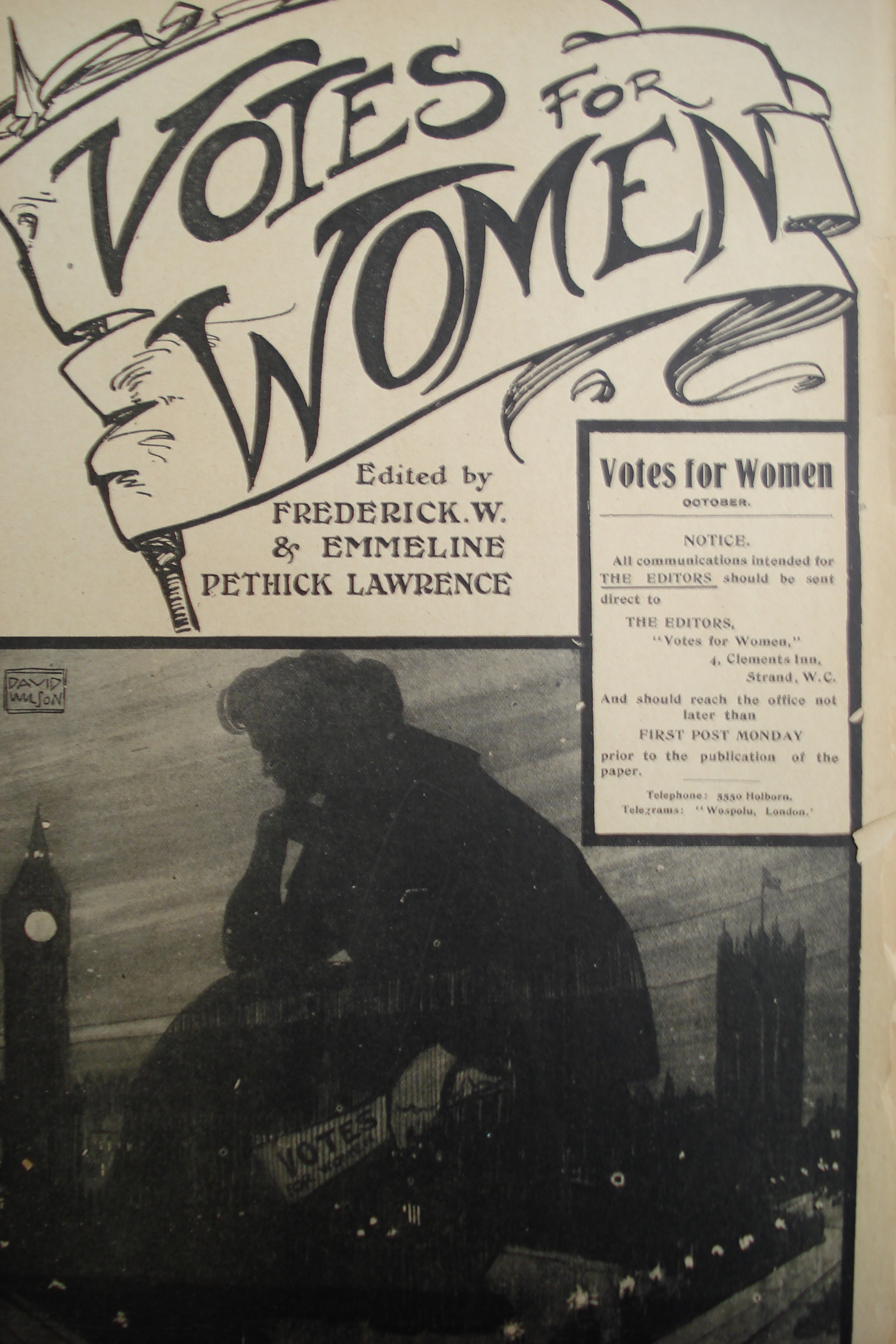
The first issue of ‘Votes for Women’
The first issue of Votes for Women, as the new paper was unequivocally named, appeared on 16 October 1907. It was financed and edited by Emmeline and Frederick Pethick Lawrence and published from the WSPU office at 4 Clement’s Inn.
The Pethick Lawrences had not had to look far for a printer for their new paper. Housed in ‘Newspaper Buildings’, at the junction of Clare Market and Portugal Street, opposite the end of Clement’s Inn Passage (now St Clement’s Lane), the late-19th-century bulk of St Clement’s Press towered over the maze of narrow streets bounded by the Strand and the swathe of Kingsway, still a raw building site. The Press had begun business in 1889 and was to be printer to a variety of other organisations sympathetic to the suffrage cause – from 1909, for instance, responsible for the Anti-Vivisectionist Review.
Votes for Women was published monthly until April 1908, after which it took on a larger format and became a weekly. This increase in frequency and size was a direct reflection of the WSPU’s great success in attracting members and creating interest in its campaign. By early 1910 Votes for Women had a weekly print run of c. 30,000 copies.

Grace Chappelow, a WSPU member from Essex, selling ‘Votes for Women’. Courtesy of Chelmsford Museum
The paper was sold in newsagents but also by members of the WSPU who were prepared to stand in the gutter (to stand on the pavement counted as obstruction) and sell it to passers by. St Clement’s not only printed Votes for Women but also a variety of posters to advertise the paper – such as this one, held in the Women’s Library collection.
This arrangement continued for three and a half years until March 1912. At the beginning of that month WSPU members embarked on a dramatic window-smashing campaign, attacking shops and offices in London’s West End. As a result Emmeline Pankhurst and Frederick and Emmeline Pethick Lawrence were all arrested on the charge of conspiracy to commit criminal damage. Christabel Pankhurst escaped from Clement’s Inn and fled to Paris. The first issue of Votes for Women to be issued after the arrests – the number for 8 March – appeared with blanks in the text. There was a note on the front page:”The Editors who are responsible for “Votes for Women” in the absence of Mr and Mrs Pethick Lawrence beg to inform their readers that the blank spaces in this week’s issue do not represent lack of interesting matter for publication, but mark the suppression by the printers of articles, comments, and historical facts considered by them to be of an inflammatory nature.’
Whether it was because the temporary editors considered it impossible to continue working with a printer who felt unable to print all the material supplied, or whether it was that St Clement’s Press declined to be associated with a publication that might bring them into direct conflict with the law – for whatever reason the 15 March 1912 and subsequent issues of Votes for Women were no longer printed by the St Clement’s Press but by Walbrook & Co of 14 & 15 Whitefriars Street, off Fleet Street.
After the Pethick Lawrences were ousted from the WSPU in the autumn of 1912 they retained ownership of Votes for Women, still printed by Walbrook, making the paper the focus of their new organisation, the Votes for Women Fellowship. I will discuss this organisation in a subsequent post.
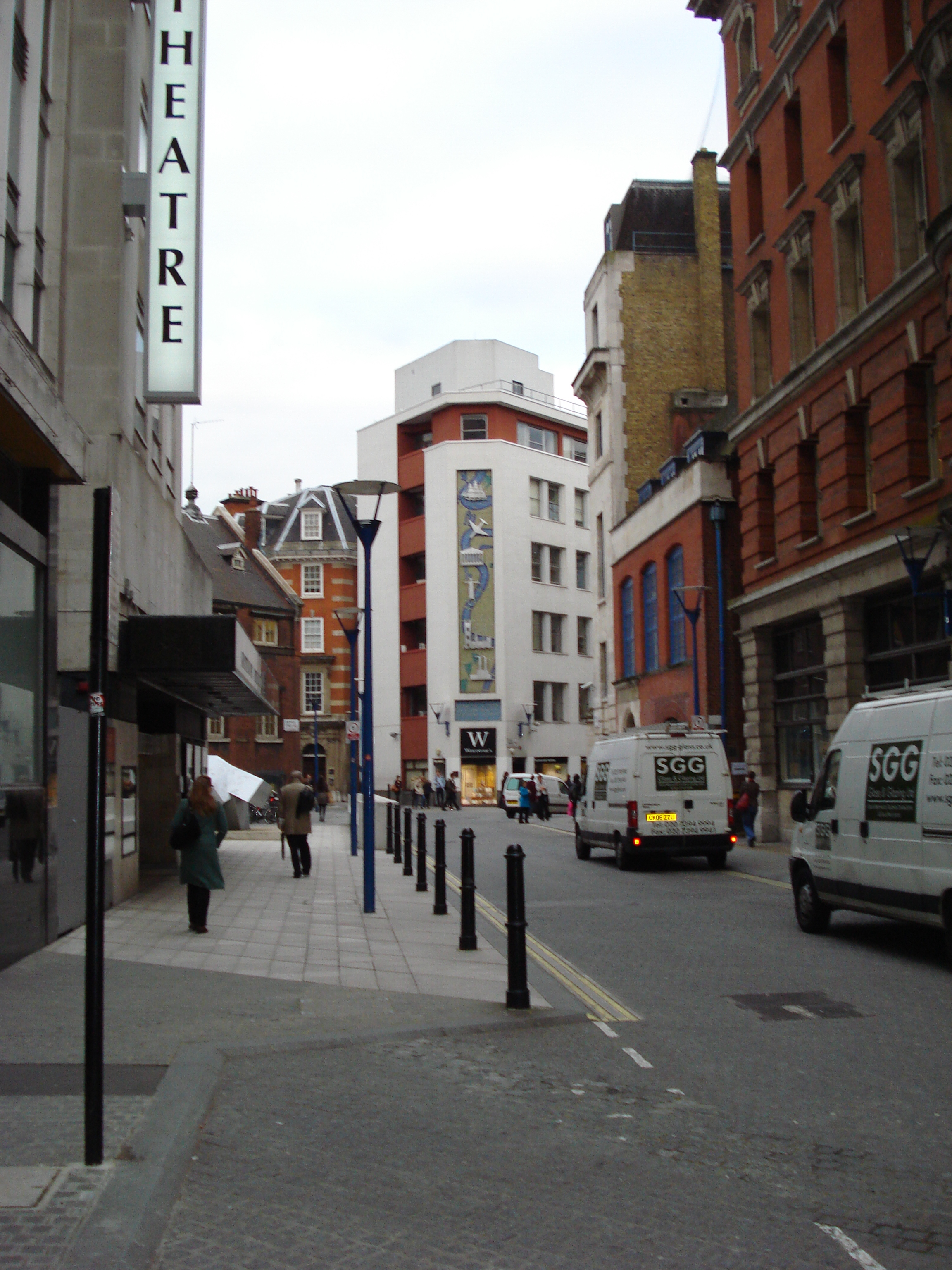
The Economists’ Bookshop, viewed from Kingsway
The site of the St Clement’s Press was occupied by Waterstone’s Economists’ Bookshop, very much an LSE institution – now itself history.
Collecting Suffrage: The WSPU Holloway Brooch
Posted in Collecting Suffrage on October 19, 2012
This is the ‘Holloway Brooch’ presented to members of the Women’s Social and Political Union who had undergone imprisonment. As such it is now a very desirable addition to any suffrage collection. If you are hoping to own one of your own, I have one for sale – see https://wp.me/p2AEiO-1CV
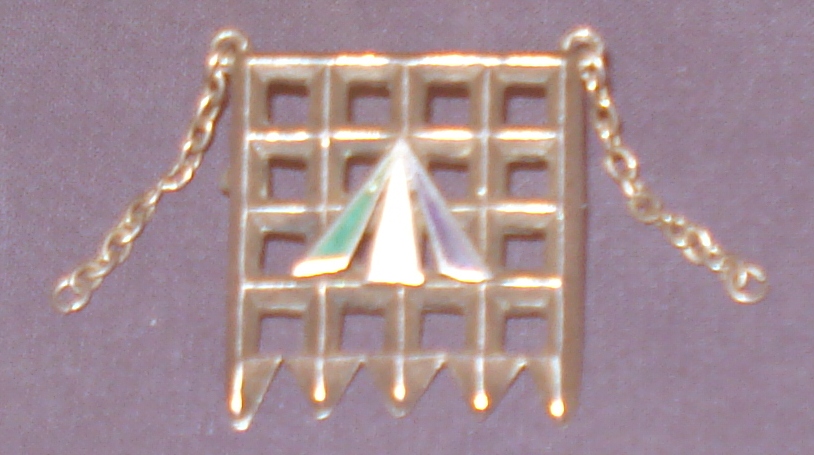
The first presentation of the brooches took place at a mass demonstration organised by the WSPU in the Albert Hall on 29 April 1909. It was held to coincide with the meeting in London of the International Woman Suffrage Alliance. The presence on the platform of a large number of ex-WSPU prisoners and,to honour their sacrifice, the ceremonial presentation to them of the first ‘Holloway’ brooches was designed to make an international impression.
The brooch was designed by Sylvia Pankhurst. The portcullis symbol of the House of Commons, the gate and hanging chains are in silver, and the superimposed broad arrow (the convict symbol) is in purple, white and green enamel. Some of the brooches, but by no means all, are marked with dates of imprisonment.
The brooch was first mentioned in Votes for Women, the WSPU newspaper, in the issue of 16 April 1909, described as ‘the Victoria Cross of the Union’. However, in April 1909 WSPU prisoners had not yet begun using the hunger strike as a tool in their battle with the authorities. In recognition of that, which was considered the greater sacrifice, the WSPU instituted the hunger strike medal, the first of which was presented four months later.
 Mrs Pankhurst chose to be photographed wearing her ‘Holloway’ brooch in this photograph- as, 65 years later, did the elderly suffragettes, Leonora Cohen and Grace Roe . The latter two, like many other women, had received both of the WSPU accolades.
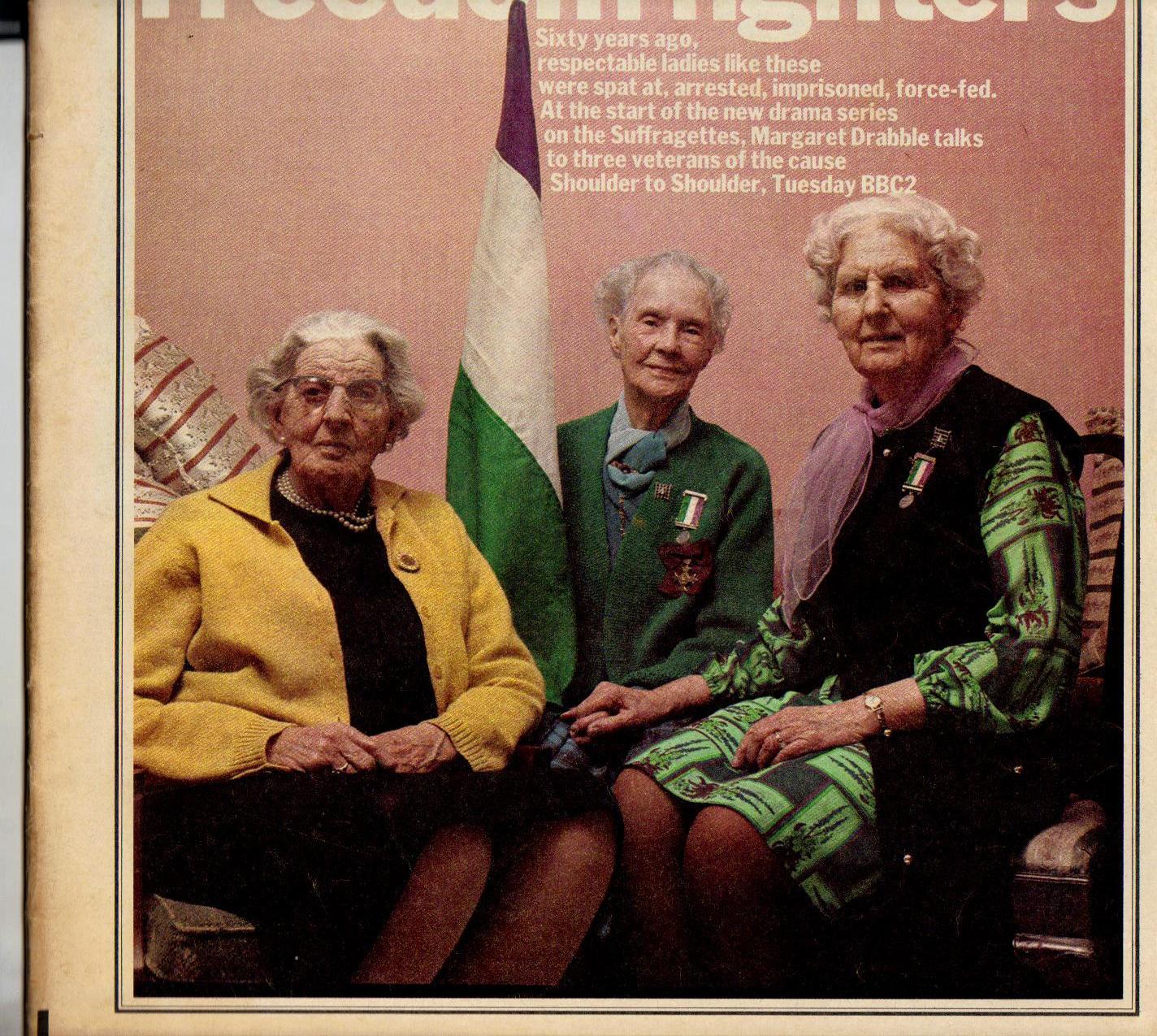
Kate Frye’s Suffrage Diary: Two Days in April 1908
Posted in Kate Frye's suffrage diary, Uncategorized on October 16, 2012
Kate Frye was a devoted theatre goer. She had trained as an actress and had toured for two or three years from 1904 and joined the Actresses’ Franchise League as soon as it was founded.
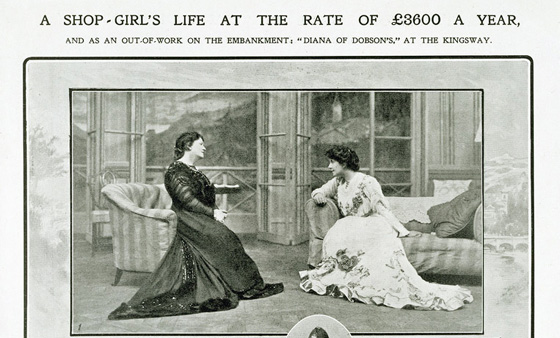
A scene from ‘Diana of Dobson’s’ – an article in ‘The Sketch’, 10 February 1908. Courtesy of the V & A
‘Diana of Dobson’s, a romantic comedy that also criticized the ‘live-in’ conditions that Edwardian drapery stores imposed on their staff, was written by Cicely Hamilton (1872-1952) actress, author, and active suffragist. Lena Ashwell (1862-1957) was both the leading actress in the production and the manager of the Kingsway Theatre. ‘Diana of Dobson’s was the second play in Ashwell’s first season at the Kingsway. She was later a vice-president of the Actresses’ Franchise League and a tax resister. Dennis Eadie, in the ‘elderly character part’ was then only 33 years old.
The walk from Tottenham Court Road to the Kingsway Theatre in Great Queen Street, to the west of Kingsway, would have taken the Fryes through the still relatively unsavoury St Giles and Seven Dials area.
Wednesday April 8th 1908
Mother, Agnes and I left just before 2 o’clock and went by bus to Tottenham Court Road and walked to the Kingsway Theatre just before 3 o’clock and we went in to the reserved seats to see ‘Diana of Dobsons’. It is nearly a month since I got the seats. We very much enjoyed our afternoon. The play is most interesting and amusing and sad too – underneath it all. Lena Ashwell, though her voice sounded tired, was very good – so was Hollard – and Dennis Eadie excellent in an elderly character part. It is quite a novel sort of play and I don’t wonder it is popular. It ought to make people think. The scene of the first act must be a revelation to lots of people.
The next day’s ‘Suffrage Discussion’ was organised under the aegis of the London Society for Women’s Suffrage – a constitutional society. Although it was to be several years before the founding of the Jewish League for Women’s Suffrage, there was obviously already an interest in the subject among the Jewish community.
Mrs Gertrude Spielman (1864-1949) born in Germany, was the wife of Meyer Spielman, who was later knighted. She was actively engaged in educational and other forms of social work, particularly with the Norwood Jewish Orphanage and was, in 1912, to be a founder of the Jewish League for Women’s Suffrage.
Aylmer Maude (1858-1938) translator of Tolstoy, Fabian, was renowned as a persuasive lecturer.
Mrs Campbell Lethbridge (1873 -1945), a woman of mystery, was born Sybil MacGregor Allen, in 1894 married William Lonergan, but by 1901 had become Sybil Campbell Lethbridge, a popular and prolific author. Find out more about her here.
Israel Zangwill, Jewish novelist, was always a great favourite of Kate’s.
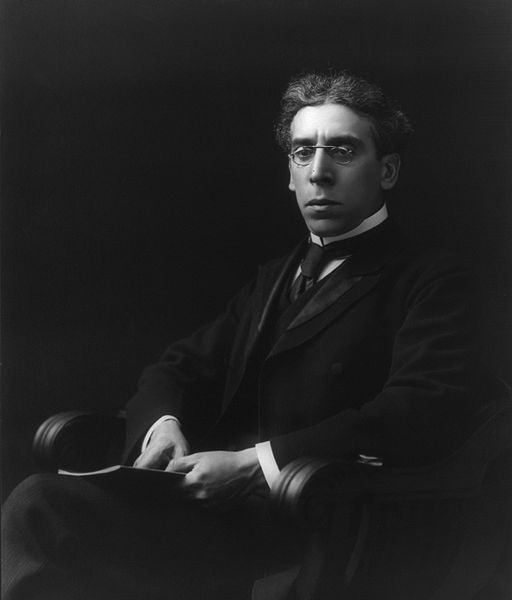
Israel Zangwill, photographed in 1905
Thursday April 9th 1908
Agnes and I left in a cab at 8 o’clock to Mrs Spielman, 38 Gloucester Square. Got there with Alexandra and Gladys [Wright] and some of the other stewards and we all went up together. There was nothing for us to do at first except make the people sit tight – such a pack it was – hundreds – nearly all Jews except our own friends. It was a Suffrage Discussion – Mr Aylmer Maude in the chair – Mrs Campbell Lethbridge spoke, Miss Spielman (oh! that was painful) and Mr Zangwill. He, of course, was beautiful – but I am much afraid too frivolous to do any converting. He was so funny he made me laugh until the tears ran down my face. The discussion was most amusing – such weird people got up and said things. Afterwards we went up and talked to people. I got five members and did better than anyone – but it was hard work. I didn’t give myself any rest and kept straight on – while Agnes looked after our guests and saw they got something to eat. We came back in a hansom. Got in at 11.45 and then had supper. It was past one before John [her fiancé] departed and 2.30 before we got off to bed. I was tired.
Campaigning for the Vote: Kate Parry Frye’s Suffrage Diary edited by Elizabeth Crawford
For a full description of the book click here
Wrap-around paper covers, 226 pp, over 70 illustrations, all drawn from Kate Frye’s personal archive.
ISBN 978 1903427 75 0
Copies available from Francis Boutle Publishers, or from Elizabeth Crawford – e.crawford@sphere20.freeserve.co.uk (£14.99 +UK postage £3. Please ask for international postage cost), or from all good bookshops. In stock at London Review of Books Bookshop, Foyles, National Archives Bookshop.
- ‘Campaigning for the Vote’ – Front and back cover of wrappers
WALKS/Suffrage Stories: Where And What Was Clements Inn?
Posted in Suffrage Stories on October 15, 2012
To mark the very welcome co-operation that now exists between the Women’s Library and the London School of Economics the next few ‘Suffrage Stories’ will demonstrate the past importance to the women’s movement of streets and buildings in the vicinity of Houghton Street.
In previous posts I have described the Tea Cup Inn, which was in Portugal Street in the building which, for the time being at least, houses the LSE Chaplaincy, and the Aldwych Skating Rink, in which the WSPU organized its grand 1911 census boycott meeting. In the latter post I remarked that, all but abutting onto the back of the Skating Rink, were the offices of the WSPU at 3 & 4 Clement’s Inn.
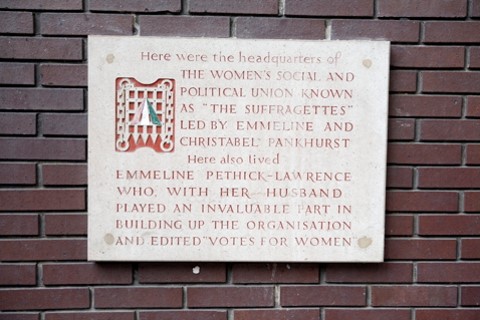
A commemorative plaque, placed on a building now occupied by LSE. marks the site, citing the words of Christabel Pankhurst: ”Clement’s Inn, our headquarters, was a hive seething with activity… As department was added to department, Clement’s Inn seemed always to have one more room to offer.’ [9 February 1907]
But what was ‘Clements Inn’?
The history of the late-19th-century Clement’s Inn buildings are surprisingly sketchy – although I daresay that archival research would uncover more detail. In its original incarnation Clement’s Inn had been one of the original Inns of Chancery, but its purpose and its buildings were swept away sometime during the second half of the 19th century. The exact date of its removal is vague; Pevsner merely puts it between 1868 and 1891, presumably meaning that it was demolished in stages. Suffice it to say that towards the end of the 19th century – probably in the 1880s – large blocks designed for both office and residential use were built on the site of the old Inn. They stretched in a line, just west of the Royal Courts of Justice – and on the west side of Clements Inn Passage – north from the Strand up to Clare Market. These blocks were given the name ‘Clement’s Inn’ and housed a medley of solicitors, architects, chartered accountants, surveyors, publishers and even, at 5 & 6 the Uruguayan Legation and Consulate. The southern-most blocks were numbered ‘1 & 2 Clement’s Inn’ and were still standing in 1977. By then the more northerly blocks – 3 & 4 – had already been demolished.
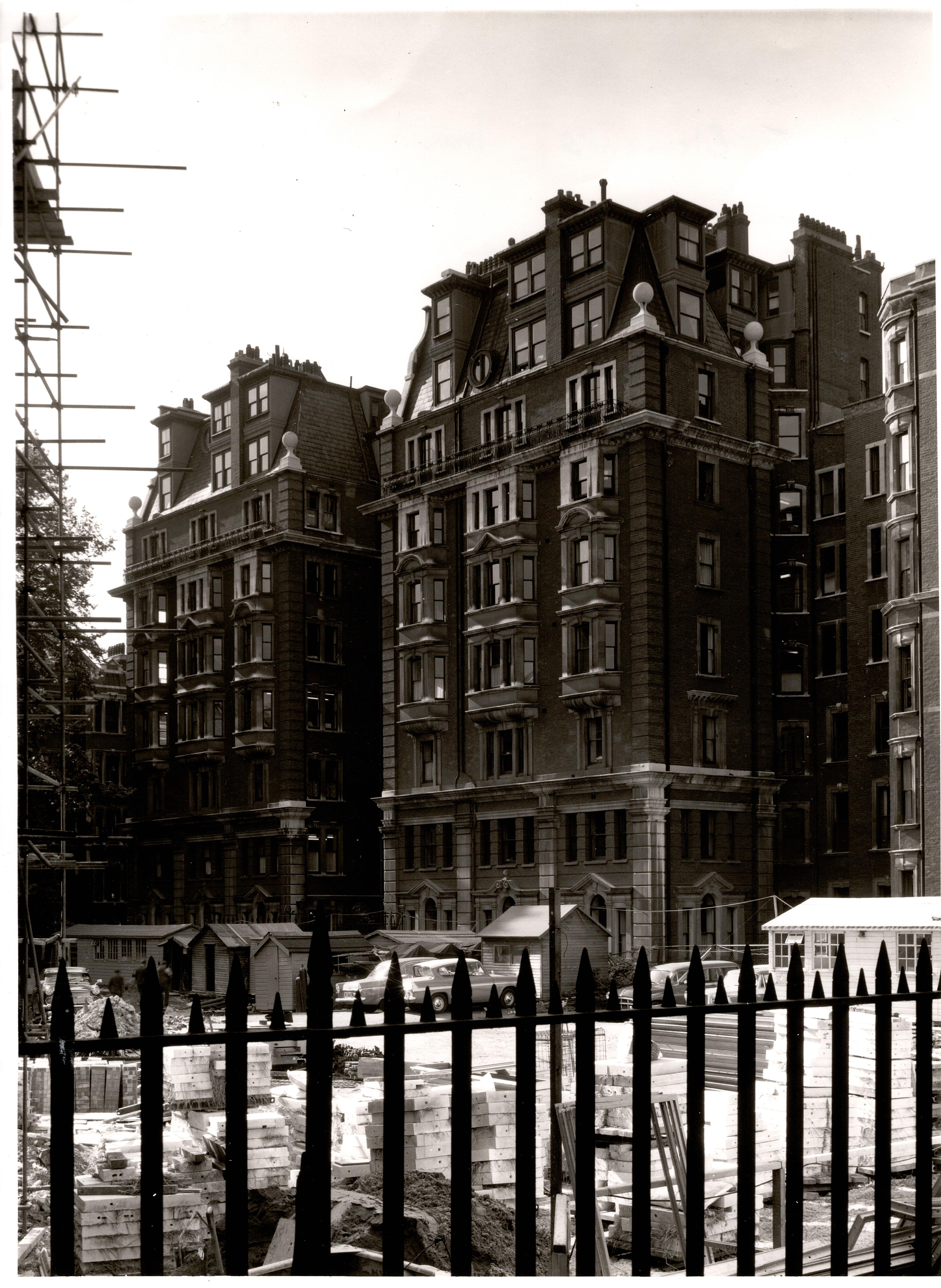
Extraordinary as it seems, photographs of the exterior of 3 & 4 Clement’s Inn seem all but non-existent, the one above one of very few I’ve been able to track down.
The photograph shows the Clement’s Inn buildings to have been rather imposing – five storeys high, rising in places to seven. They were built of brick – presumably once red, doubtless very quickly blackened in the London atmosphere, with facings of stone around the windows and doors. Detailing was gothic, doubtless a nod to the adjacent Royal College of Justice buildings. The ‘look’ was not unlike that of nearby Old Square, Lincolns Inn, where in later years Frederick and Emmeline Pethick-Lawrence, who are specifically noted on the WSPU plaque, had a flat.
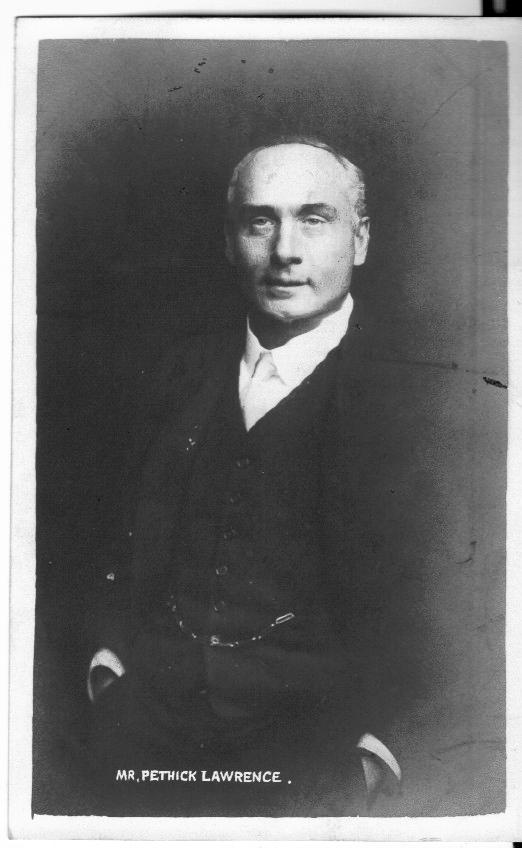
For it was entirely due to the Pethick Lawrences that the WSPU office came to be sited at 3 & 4 Clement’s Inn. Frederick Pethick Lawrence first appears on the London electoral register at 3 & 4 Clement’s Inn in 1904. He and Emmeline – they had married in 1901 -were living in what is termed in the rate book as ‘a residential suite’ – to differentiate this type of apartment from the offices that were also available for rent. The apartments were serviced; the Clement’s Inn building included a servants’ hall, servants’ dormitories and a kitchen in which meals were cooked for delivery to the tenants. This, I would imagine, was a style of living that entirely suited the Pethick Lawrences whose many interests surely precluded any time for domesticity.
The Pethick Lawrences had presumably chosen Clement’s Inn as their London address – they did also have a house in Surrey – because it was close to the office, at 19 St Bride Street, of The Echo, a newspaper bought by Frederick Pethick Lawrence c 1902. It had been a Liberal paper – with a bias towards the Liberal Unionist section of the party- but, under Pethick Lawrence was re-directed towards the Labour movement, with Ramsay MacDonald among its contributors. However The Echo ran at a loss and in 1905 Pethick Lawrence closed it and in May launched a new monthly publication, the Labour Record and Review. Pethick Lawrence was also the publisher of the Reformers’ Yearbook (called, before 1905, the Labour Annual and Reformers’ Yearbook). In the 1905 edition of the Yearbook, printed from information supplied in 1904, the ‘Directory of Useful Addresses’ lists the ‘Women’s Union’ , the secretary of which is Mrs Rachel Scott of Woodbine, Flixton, Manchester. This was the recently formed Women’s Social and Political Union. Its founders, Mrs E. Pankhurst and Miss C Pankhurst, of 62 Nelson St, Manchester, are also listed as ‘Useful’.

In her autobiography Emmeline Pethick Lawrence records that it was from her roof garden in Clement’s Inn that in January 1906 she saw the general election results ‘as they were thrown by a lantern-slide on the elevated-whitened board in the Strand’. This new technology was displaying a Liberal landslide. But it was, however, the success of Keir Hardie and the Labour Party that particularly pleased the Pethick Lawrences. A month later Hardie introduced Emmeline Pethic -Lawrence to Emmeline Pankhurst as ‘a practical and useful colleague who could develop in London the new society she had founded in Manchester’ – the WSPU.
Later that year the embryonic London campaign, which had been spearheaded by Annie Kenney and which for several months had held its business meetings around kitchen tables in various hospitable London homes, was given office premises by Frederick Pethick Lawrence in 3 & 4 Clement’s Inn. In the relevant rate book the WSPU is shown as taking up its tenancy at Michaelmas (29 September) 1906 in rooms 68,69 and 70.
This apartment was separate from number 119 shared jointly by the Pethick Lawrences; Frederick had given Emmeline the luxury of ‘a room of her own’.
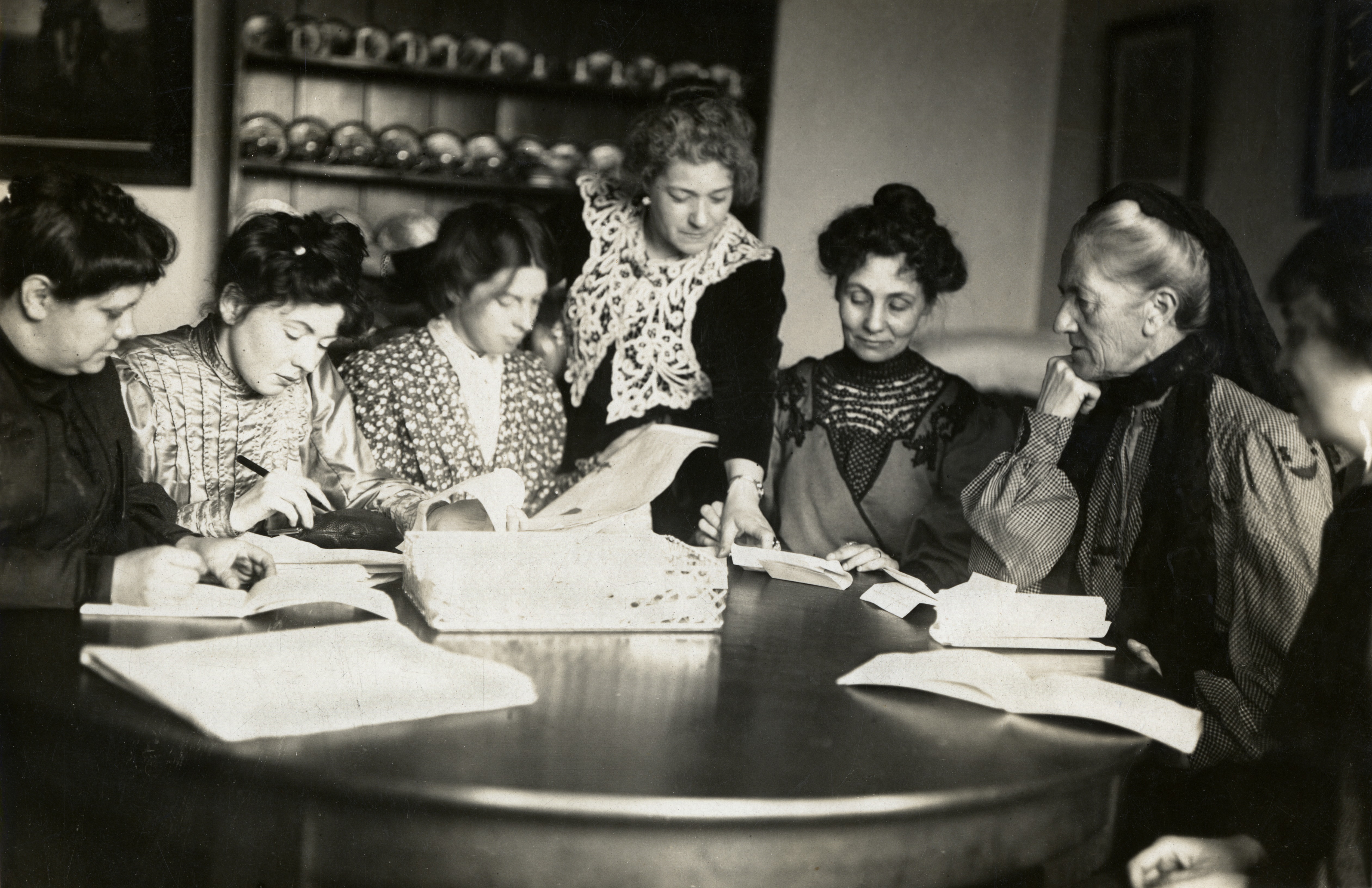
When, in July 1906, Christabel Pankhurst came to London, after gaining her first-class law degree in Manchester, she lived with the Pethick Lawrences – perhaps in Emmeline’s separate apartment. The rate books show that over the years the Pethick Lawrences occupied several different sets of rooms, the quantities and configuration varying from year to year.
When, in October 1908, warrants were issued for the arrest of Christabel and Emmeline Pankhurst after the WSPU had urged Londoners to ‘Rush the House of Commons’, the pair were photographed hiding from the police on Emmeline Pethick Lawrence’s roof terrace.
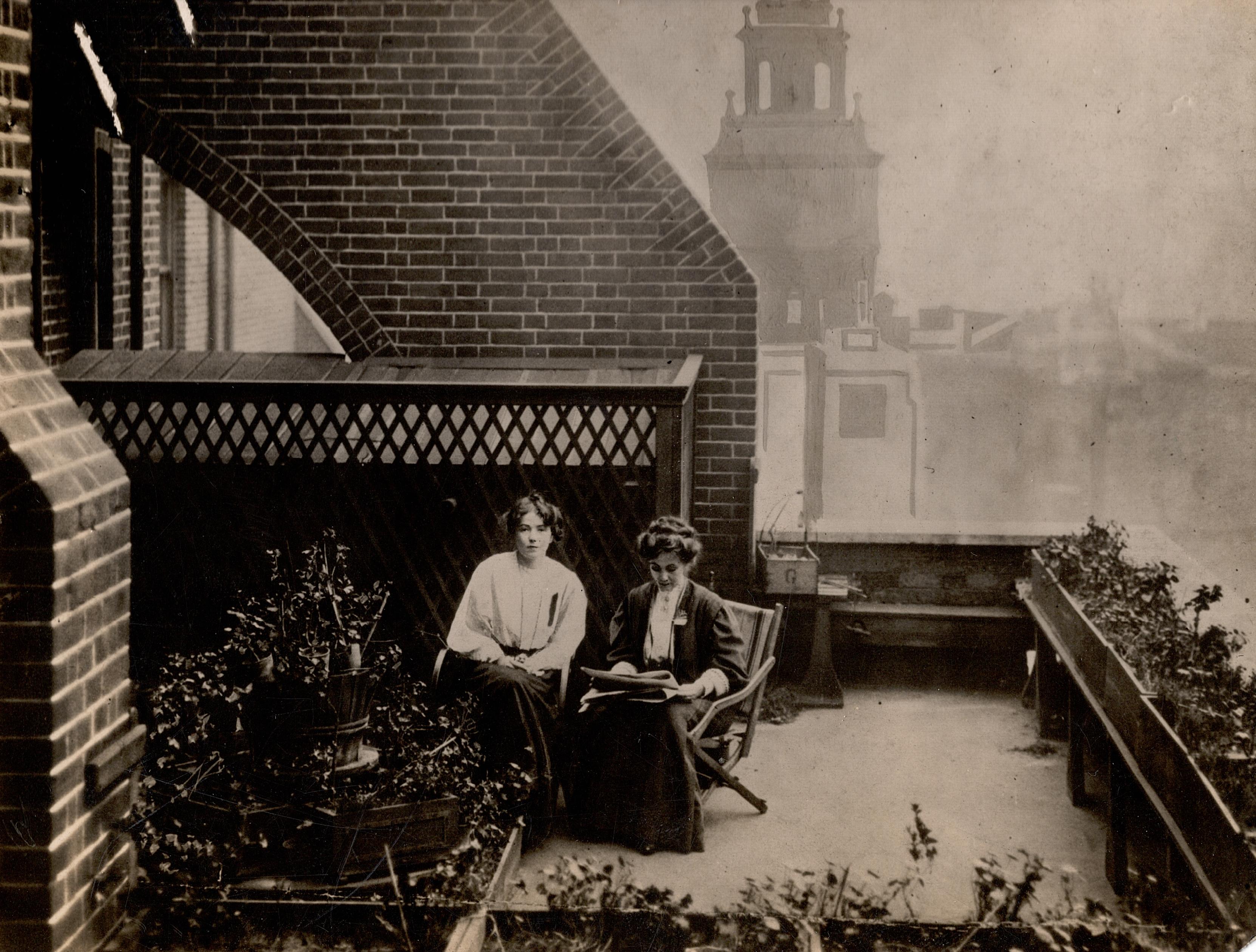
Emmeline and Christabel Pankhurst photographed on Clement’s Inn roof terrace, 1908 (courtesy of LSE Library)
After ensuring that their evasion had been captured on camera, they then went downstairs and were photographed in the course of being arrested by Inspector Jarvis.
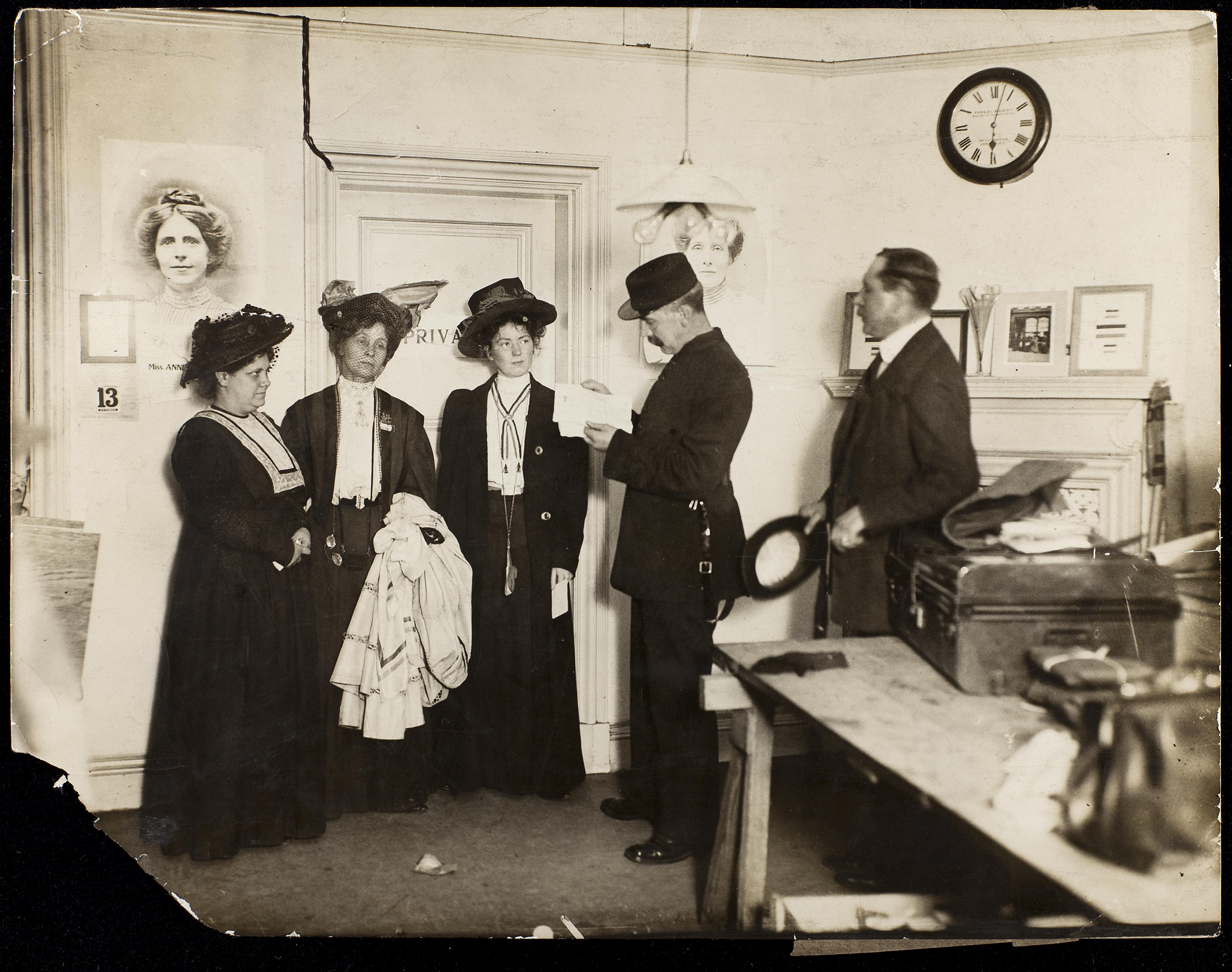
Other WSPU offices were photographed on other occasions. Here is Mrs Pankhurst’s. Note the pictures, posters, flowers, and mantlepiece items.

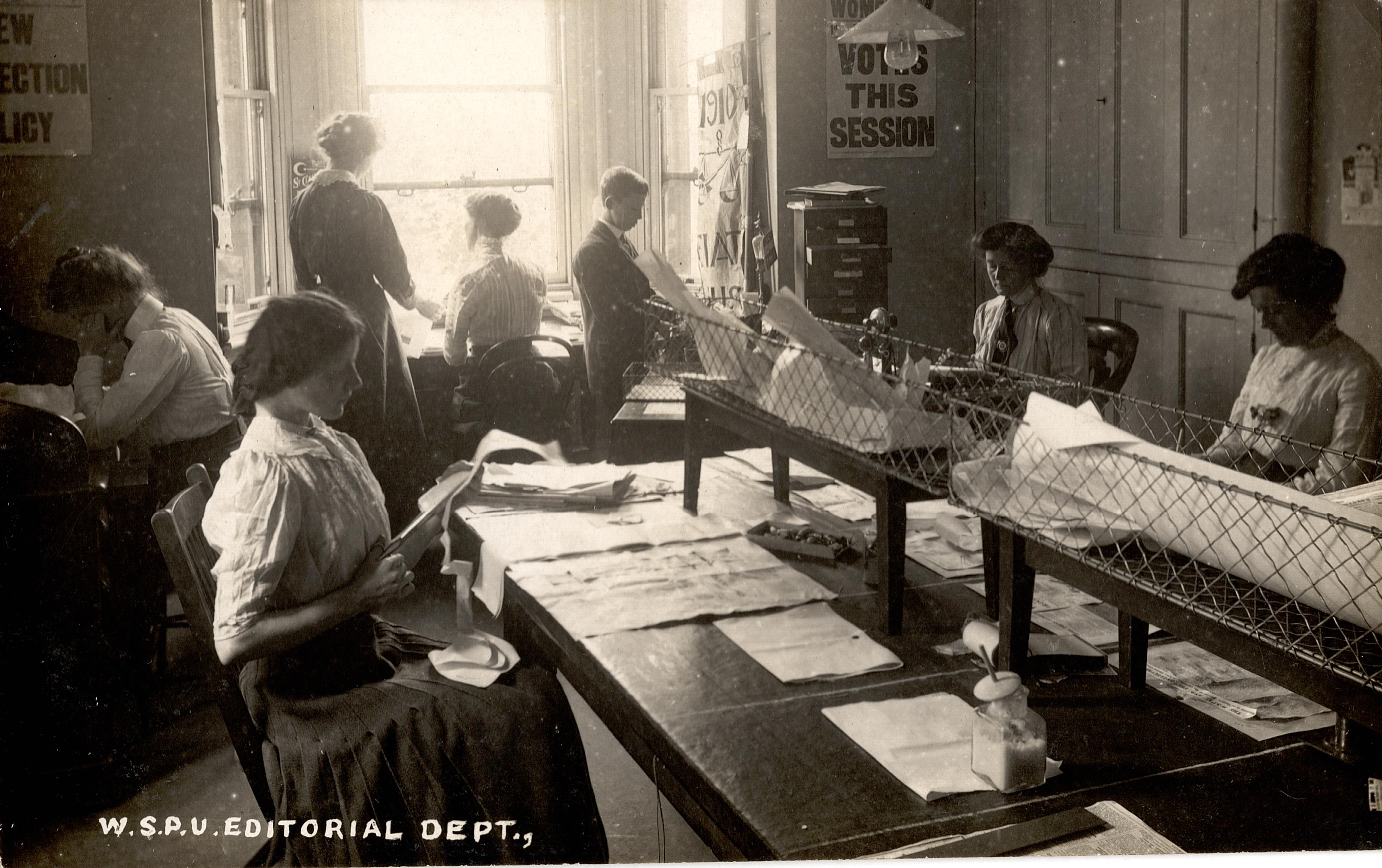
This ‘seething hive of activity’ is pictured in at least one contemporary novel. For in Ann Veronica, published in 1909, H.G. Wells furnishes the offices of the Woman’s Bond of Freedom – the suffrage society that sweeps his heroine off her feet and into prison – with ‘notice boards bearing clusters of newspaper slips, three or four posters of monster meetings..and a series of announcements in purple copying ink, and in one corner …a pile of banners’. Wells had no need to rely on photographs for his information; during the years when the WSPU was working from Clement’s Inn, it was doing so in close physical proximity to the Fabian Society, of which Wells was a leading member and which had been responsible for the founding of the LSE. Knowing from the rate book that the WSPU’s basement office was next door to that of the Fabian Society, it requires little stretch of the imagination to envisage Wells finding a reason to combine a visit to one with a brief sortie into the other, the result being good ‘copy’ for his novel.
It would be surprising if there had not been some tension between the two offices – the one campaigning for votes for some, not all, women while the other backed the cause of adult suffrage. For although, when they agreed to support the WSPU, the Pethick Lawrences were still committed to the Labour cause, as the women’s suffrage campaign developed its tactics changed and the association with Labour was considered by the Pankhursts no longer to be advantageous. Despite this, there were many connections between the WSPU, the Labour Party and the Fabian Society. For instance, Beatrice Sanders, working from an office in Clement’s Inn as financial secretary to the WSPU, was the wife of William Sanders, a Fabian Society lecturer, LCC alderman and Labour parliamentary candidate. Mrs Sanders was herself a member of the Fabian Women’s Group. However, William Sanders was one of what Wells termed the ‘Old Gang’ that ranged itself against him when he attempted to reform the Fabian Society and, in retaliation, probably took Sanders as his prototype for ‘Alderman Dunstable’ in Ann Veronica. Wells certainly found plenty to mock in the WSPU and its activities and, unsurprisingly, although Ann Veronica was listed among ‘Books Received’ in the WSPU newspaper, Votes for Women, it never received the accolade of a review.
A very powerful propaganda tool for the WSPU, Votes for Women was brought to life each week in a building even closer to Houghton Street than Clement’s Inn and will be the subject of the next of my ‘Suffrage Stories’.
Copyright All the articles on Woman and Her Sphere and are my copyright. An article may not be reproduced in any medium without my permission and full acknowledgement. You are welcome to cite or quote from an article provided you give full acknowledgement.Book Of The Week: Gilbert Stone (editor), Women War Workers, published 1917
Posted in Book of the Week on October 12, 2012
‘Woman and Her Sphere’ has had a long-standing interest in searching out – and cataloguing for sale – books and ephemera by and about women’s involvement in the First World War. With the 100th anniversary drawing nearer, radio and television producers already searching for new angles from which to approach the subject , and the Government heralding what is likely to be a long period of commemoration, it is, perhaps, appropriate to draw readers’ attention to some of the contemporary works that recorded ways in which women reacted to the disruption of their world. The first book I have chosen is:
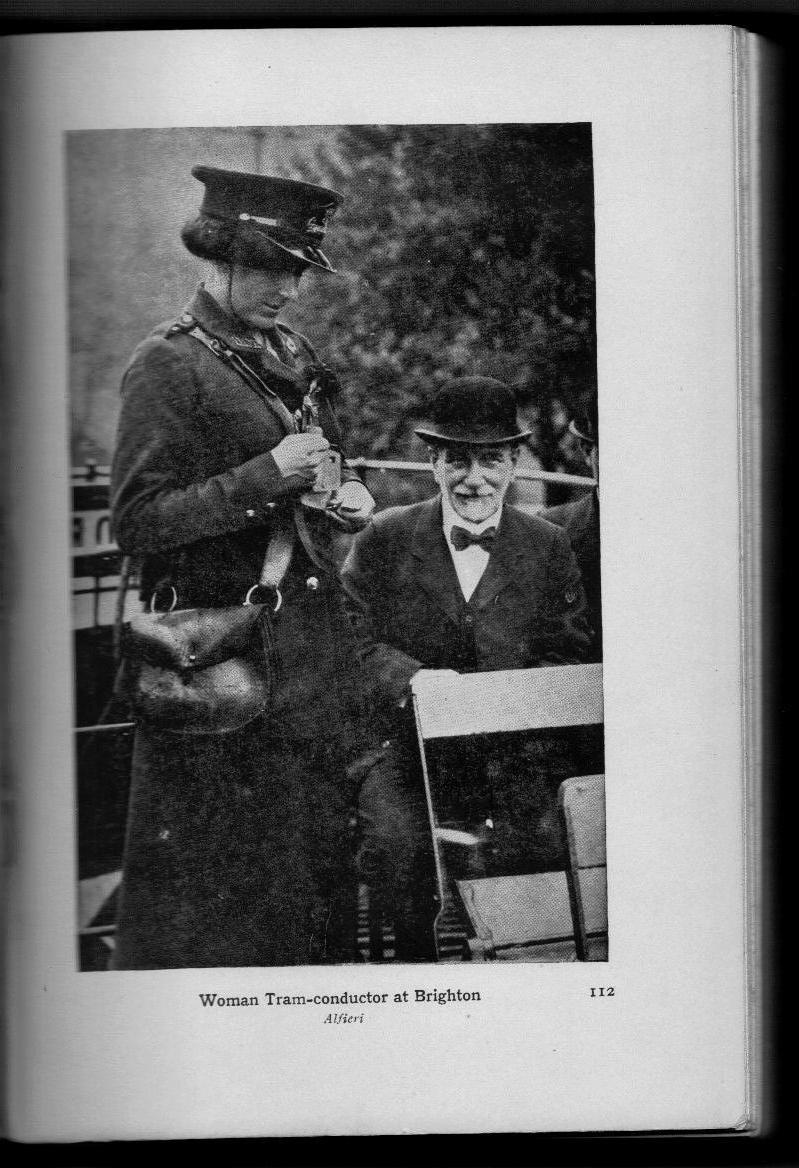
Woman tram-conductor in Brighton
Gilbert Stone (editor), Women War Workers: accounts contributed by representative workers of the work done by women in the more important branches of war employment, George G. Harrap & Co, 1917. With a foreword by Lady Jellicoe.
The book comprises articles written by women working in new areas of employment. The chapters are titled:
Munition Work; The Land; A Postwoman’s Perambulations; Banking; ‘Fares Please!’ [work as a bus conductor]; Deliverng the Goods [driver of butcher’s delivery cart]; Nursing at the French Front; The V.A.D. Nurse ; The Comforteers [working with ‘Concerts at the Front’] ; Welfare Work; The Women of Paris During the German Advance, and ‘War Organisations for Women’ – giving statistical information, together with the chief purposes and aims of the more prominent organizations connected with Women’s War Work.
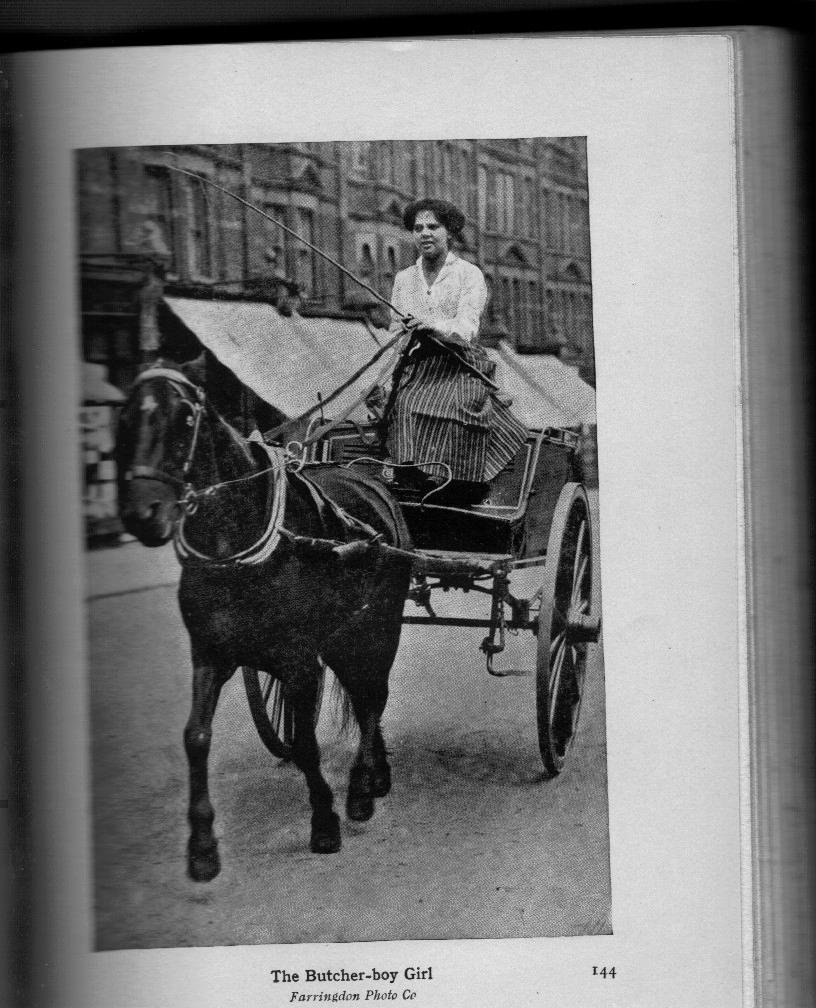
The butcher-boy girl
The book concludes with a very interesting chapter by Gilbert Stone in which he discusses the difficulties that women will face after the end of the war. ‘To coop them up at home without future, without outlook, without freedom, dependent on their father’s purse, yet with a memory of the wide world ever present, or, if possible it is a poor way of showing man’s sense of the meaning of the words Liberty, Equality, Fraternity.
The book – with 12 photographs – is surprisingly scarce. This copy is in good condition and is £60.
To buy: contact e.crawford@sphere20.freeserve.co.uk
Mariana Starke: An Epsom Education
Posted in Mariana Starke, Uncategorized on October 8, 2012
Mariana Starke was christened at Epsom Parish Church on 23 October 1762. On 19 June, barely four months earlier, and three years into their marriage, her parents had buried their first-born child – a son, John – in the church’s graveyard. Mariana was to be an only child for six years – until the birth of her brother, Richard Isaac Starke, in 1768 – and to be an only daughter until the birth of her sister, Louisa, in 1772. Although there is no record of other children having been born in the years between the births of these living children, the gaps are significantly long, suggesting the possibility that Mary Starke may have suffered miscarriages. Certainly Richard’s father, John Starke, while leaving his eldest son only Hylands House in his rather punitive 1763 will, seems to have expected him to sire at least five children – to all of whom the grandfather was prepared to leave handsome legacies.
We know no firm details of Mariana’s early life as she grew up in Epsom. She may have had a governess, but more likely was taught by her mother, who from her letters appears a competent, amusing woman, interested in literature and the world. The only extant reference I have found to the hiring of a teacher occurs in one of Mrs Starke’s letters, in which she mentions that she is thinking of engaging a music master for her daughters.
This letter written, probably, in 1781, is to Mrs Hayley, wife of William Hayley, an influential man of letters and, in his life-time at least, a highly-regarded poet, patron of William Blake, friend of Cowper, of Romney and of Mariana Starke, who was to him his ‘dear poetical daughter’. The earliest letter in the extant correspondence between the Starkes and the Hayleys dates from 1779 and it is clear from the tone and language employed by the writers that the two families were on close and affectionate terms – and would appear to have been so for some time. There is no indication, however, of how or when the introduction between the families took place. Mariana’s earliest letter in the sequence, dated 22 December 1780, is to Mrs Hayley inviting the Hayleys to ‘a little Hop’to be held by her family early in the new year – on Monday 8 January – and to dinner the day before. At this time the Hayleys lived at Eartham in Sussex, about 45 miles south of Epsom. Hylands House was on their route into Town; in another letter Mrs Starke mentions that she could look out for their chaise as it passes along the Dorking Road. When she wrote this letter of invitation Mariana was 18 years old and entirely at ease in corresponding with the older woman.
From her mother’s letters we can catch glimpses of this youthful Mariana. In November 1780 (?) when Mrs Starke suffered a a bout of illness, during which exertion ‘produced a spitting of blood’, she was ‘an affectionate un-wearied attendant under Providence’ ‘her tenderness contributes materially to my recovery….I can read a little, and so my daughter ransacks the circulating library for my amusement and has brought me the life of Garrick, written by Davies, the materials supplied by Johnson and the whole regulated by him. Tis very entertaining; it contains a history of the Theatre for 36 years. I remember many of the persons mentioned. It likewise comprehends an account of the contemporary dramatic Writers. What an assemblage of opposite qualities met in ‘Dr Goldsmith’ without one particle of common sense to rectify the composition.’ Davies’ life of Garrick was first published in 1780, suggesting that the Epsom circulating library was quick to offer the latest published works and that Mariana had been prompt in her ‘ransacking’. From the list of books catalogued when the stock of the Epsom circulating library [as far as I can establish this was the only circulating library in Epsom during this period] was put up for auction in 1823 it is clear that there was no shortage of reading matter likely to appeal to both mother and daughter. For instance, quantities of novels and book of travels dating from the 1780s were still held in the stock of the library at the time of its sale – novels such as Aspasia, the wanderer (1786), Alfred and Cassandra (1788), Letters of an Italian Nun (1789) and Adeline the Orphan (1790).
By the 1780s Epsom’s heyday as a spa town had passed but, in a healthy position close to the Downs and close to London, it attracted well-to-do merchants quite prepared then – as now – to commute into town on business. Although he had no necessity to make this journey regularly, ‘Governor Starke’ – by which slightly inflated version of his former title Richard Starke is often named in contemporary accounts – still some had business with the East India Company. By virtue of his stock holding in the Company he was able to vote for candidates to the Directorate of the Company and probably made periodic visits to their headquarters in Mincing Lane – a stone’s throw from the house in which his grandfather, Thomas Starke, the slave trader, had lived 100 years before. It is interesting – if useless – to speculate as to whether a knowledge of the lives of his forebears was incorporated into his perception of the world. Did he know – as we shall never – that his father had turned to India because he did not wish to be involved in the trade in Africans of which Thomas was a pioneer? Or, what is more likely, did he know that John Starke had seen that the Virginia tobacco trade was taking a downward turn – and was tediously prone to litigation – and that India was the new Virginia? Whatever his thoughts as he walked along Mincing Lane Richard Starke would have been well aware of the importance in Starke family history of the church of St Dunstans in the East, just three minutes walk away, down towards the river. Besides his grandfather – and all the late-17th- c infant Starkes buried there, it was here that his own mother had been interred in 1730 and here, five years later, that his wife, the daughter of a merchant, had been christened. That, at least, should have inculcated a proprietorial feeling for this small area of the City in a man who had spent his working life in India and now lived a rather secluded life in Surrey. Again, idle to speculate, but surely, on occasion, Mariana would have been taken to the City. Would she not have been curious to see the streets where her forebears lived?
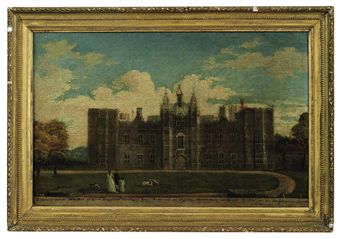 Cowdray Park, late 18th century, courtesy of Christies
For Mariana, we know, was in her youth passionate about ‘antiquity’. In 1781 her mother, writing to Mrs Hayley, mentions that they had visited ‘Cowdry’ [Cowdray, a Tudor house in Sussex that in 1793 was reduced to ruins by a fire but whose magnificence was still intact when the Starkes visited], remarking that ‘The outside is striking, fine, venerable and claims respect, but within tis unequal and disappoints the expectation. Perhaps altogether no ill emblem its owner. Marian was pleased; I am not so rapturously fond of antiquity as she is. At her age I was, but my passion for gothic structures, and tragedy, expired at the same moment. When the gaiety of youth is fled, lively scenes become necessary.’ So, here is a glimpse of a Mariana swept up in the zeitgeist for the gothic – her ‘sensibility’ a counterpoint to her mother’s ‘sense’.
‘Sense’ was, I am sure, a virtue with which Mariana’s closest contemporary companion of her youth was liberally endowed. Millecent Parkhurst, who was a few months younger than Mariana, lived with her parents in Church Street, Epsom.
[For details of the history of the Parkhursts’ house see here. After her marriage, now ‘Mrs Thomas’, Millecent lived in a house, Abele Grove, just on the other side of Dorking Road from Hylands. Then an elegant house, with coach house, stables and grounds of about 1 acre, Abele Grove was until recently associated with the Epsom Central branch of the Premier Inn chain. But it is there still – as is Hylands House – and you can still walk along the Dorking Road between the two- either on your own two feet or, thanks to Google Street View, on your computer.]
 Millecent’s elderly father, John Parkhurst, had inherited valuable estates around Epsom and, although a clergyman, of the high Anglican variety, felt neither the necessity nor inclination to seek preferment. His life was devoted to scholarship; amongst other writings he had published both Hebrew/English and Greek/English Lexicons (the latter to the New Testament). When, in 1798, after his death, a new edition of this work was called for, it was published with Millecent as editor. In the preface to the 5th edition, a later editor recorded that she was ,’reared under the immediate inspection of her learned and pious father, by an education of the very first order, [and] has acquired a degree of classical knowledge which is rarely met with in the female world’. In a 1787 letter (to be considered at greater length in a subsequent post) Mariana mentions ‘the almost paternal regard that [Mr Parkhurst] has for me.’ It would, I think, be safe to assume that Mariana spent a considerable time in that household, that she was at home in John Parkhurst’s library and, with Millecent, benefited from his teaching. See here to view portraits of John Parkhurst and his wife – held at Clare College, Cambridge. If the date (1804) attributed to the paintings is correct they were commissioned some time after the pair had died – John in 1797 and Millecent in 1800.
The Rev Parkhurst was not only Mariana’s advisor and critic but, with William Hayley, was responsible for inducting Mariana into the literary world. In 1781 she was among the subscribers to Ann Francis’ Poetical Translation of the Song of Solomon, from the original Hebrew, published by J. Dodsley. John Parkhurst subscribed six copies and it is to him that the book was dedicated, with a credit for supplying Notes. Among the female Epsom subscribers were Mrs Foreman, Mrs E. Foreman, Miss Foreman and Mrs Phipps. The latter ladies, who were presumably of a literary incline, were unlikely to have been those of whom Mariana wrote to William Hayley on 1 October 1781, ‘I spent an afternoon a short time since in company with Mrs Francis. She appears perfectly good-natured and unaffected – our Epsom Ladies were quite astonished that she should be in the least degree like other people – one observed that she really dressed her hair according to the present fashion, another, that she had a very tolerable cap, and a third that she certainly conversed in a common way, in short they spoke of her, as tho’ they had expected to have seen a wild beast instead of a rational creature, & I felt myself very happy that they were perfectly ignorant of my ever having made a Poem in my life.’ In her preface Ann Francis had felt it necessary to defend her translation of this particular text on two counts – in case it might ‘be thought an improper undertaking for a woman [since] the learned may imagine it a subject above the reach of my abilities; while the unlearned may incline to deem it a theme unfit for the exercise of a female pen.’
 Besides John Parkhurst, the other male Epsom subscriber to The Song of Solomon was the Rev Martin Madan, who the previous year had raised considerable controversy with his publication of Thelyphthora; or a treatise on female ruin. In this Madan argued the social benefit of polygamy as a means of countering the evils of prostitution. He had been chaplain at the Hyde Park Corner Lock Hospital – a hospital for those afflicted with venereal disease – and may be considered to know of what he spoke. His treatise immediately attracted a series of ripostes. It was clearly a book – and, therefore, a subject much debated at this time and in the same 1 October 1781 letter to Hayley Mariana writes. Have you met with a book entitled ‘Whisper in the ear of the Author of Thelypthora’? The author Mr Greene did me the honor of sending it to me, and was it small enough to be enclosed in a frank, I would sent it to Earthham; tho I do not imagine it is a Book that would amuse either you, or Mrs Hayley much.’ Why, one wonders, did 40-year-old Edward Burnaby Greene send his work on this subject to 19-year-old Mariana Starke?
Greene was a translator and poet – though even in his lifetime not held in much regard – and at some time point his social or literary life must have intersected with that of Mariana to occasion this ‘honor’ . For, while the Ladies of Epsom may have been ignorant of the fact that they harboured a young Poet in their midst, her literary mentors were not – Mariana was in the custom of enclosing poems in her letters to Hayley. And to Hayley she made clear her feelings about Epsom society, writing at the end of a 7 January 1782 letter, ‘Pardon this hasty and stupid scrawl, as I am going to dress for an Epsom Party, the very thought of which, has benumbed my faculties.’ Both Mariana and her mother doubtless felt more stimulated at gatherings at which literature and ideas took precedence over discussions of hairdressing and caps. Not only did they utilise the circulating libraries but when in Town they made a point of visiting booksellers. In a letter to Mrs Hayley, dated 2 August 1781, Mrs Starke wrote, ‘Marian and I were at Dodsley’s the other day. The counter was covered by Mr Hayley’s poems, nothing sells so well. Dodsley did himself great credit with us, by his manner of speaking of Mr Hayley, second to none, now living, or that ever did live!’
 Dodsley – whose shop was in Pall Mall – had recently published Hayley’s Triumphs of Temper, a didactic work illustrating the usefulness of a good temper to a young woman in search of a husband. See here for a Dulwich Picture Gallery page setting Romney’s portrait of Hayley alongside one of his illustrations from Triumph of Temper
The literary Epsom ladies maintained their interest in furthering the publication of interesting new works by women, subscribing to two important works of the period. In 1785 Millecent Parkhurst (‘Miss Parkhurst, Epsom’) and ‘Mrs Starke, Epsom’ were subscribers to Poems by Ann Yearsley, the Bristol milkwoman and protegee of Hannah More and in 1786 Mariana, her mother and Mrs Parkhurst were all subscribers to Helen Maria Williams’ Poems. The women may well have supported other publications, their connection not yet brought to light by the digital scanner. We can, however, be certain that these were two works that, along with The Song of Solomon, Hayley’s poems and that oddity, Whisper in the ear of the author of Thelypthora’?, were definitely on the shelves in Hyland House in the late 1780s. It was not to be long before Mariana, together with Millecent Parkhurst,- put her own pen into public action.
Sources: William Hayley Papers, Fitzwilliam Museum, Cambridge
epsomandewellhistoryexplorer.org.uk
Copyright
Collecting Suffrage: Emily Wilding Davison’s Funeral Programme
Posted in Collecting Suffrage on October 4, 2012
Official Programme for Emily WIlding Davison’s Funeral Procession
For the last 100 years the strange death of Emily Wilding Davison has transfixed the public. It is likely to be the one thing that the ‘man – or woman – in the street’ knows about the suffragette movement. Bizarrely the last seconds of her conscious life are still with us –growing in impact as the internet allows everyone to view footage of film that was in the past relatively difficult to access. In this piece by Andrew Marr the BBC has worked its wonders on the Pathé News original, allowing us to see details that the passing years had blurred. I have always wondered if it was by chance that she chose to position herself alongside a section of the Derby racecourse that was in full view of the film camera. The camera was mounted on a stand and would have been clearly visible. However the camera was, presumably, positioned there in order to capture pictures of the horses entering the final straight and Emily Davison may have chosen to be there for the very same reason.
With the 100th anniversary less than a year away media attention is mounting. All material related to Emily Wilding Davison’s funeral is scarce – and very collectable – however one of the scarcest is the 4-page ‘Official Programme, Timetable and Route of the Funeral Procession, Saturday June 14th 1913.
I must say that I do find it rather odd that this item should be so very scarce for, as you can see from film and photographs, the streets of London were packed on the day. The hordes must have failed to arm themselves with the Programme or, if they did, to have then discarded it.
Inside pages of the programme for Emily Davison’s funeral procession
In Campaigning for the Vote, Kate Frye, who followed the procession through Piccadilly to Bloomsbury and then on to Kings Cross, in her long diary entry comments on the vastness of the crowd. But even she, who was an inveterate hoarder of suffrage memorabilia, does not seem to have acquired a copy of the Funeral Procession Programme. The result is that, in nearly 30 years of dealing in suffrage artefacts, I have only seen one copy of this item for sale. In fact, if a spate of them were now to hit the market, I shall be very suspicious!
Back cover of the Emily Davison funeral procession
Book of the Week: Margaret Sanger, Woman And The New Race – Kitty Marion’s copy – rich with suffrage and Sanger associations
Posted in Book of the Week on October 2, 2012
Margaret Sanger, Woman And The New Race, published by Brentano’s (NY), 1921 (3rd printing) – Kitty Marion’s copy
Inscription on free front endpaper of this copy of Woman and the New Race
Margaret Sanger spearheaded the birth-control campaign in the US. In this book, first published in 1920, she writes: ‘The most far-reaching social development of modern times is the revolt of woman against sex servitude. The most important force in the remaking of the world is a free motherhood’. The Introduction to the book is by Havelock Ellis, one of several leading thinkers with whom she had an affair.
In October 1914 Margaret Sanger fled from the US to England while on bail for violating US postal obscenity laws – the charge was that of sending through the post copies of her radical feminist journal, The Woman Rebel, which advocated the use of contraception. She remained in England until October 1915. Coincidentally it was in October 1915 that Kitty Marion, a former, German-born, militant suffragette, set sail for the US. Once in New York she worked for many years for Margaret Sanger, her role being that of street seller of Sanger’s Birth Control Review.
In England in 1913 Kitty Marion had been sentenced to three years’ imprisonment for her part in the burning of the grandstand at the Hurst Park racecourse (as retaliation for the death of Emily Wilding Davison)- although, after going on hunger and thirst strike, she was released under the Cat and Mouse Act. It would appear that, on the run, she was one of the WSPU’s most active arsonists, although she evaded detection for much of the destruction she committed. In New York, on 14 October 1918, she was again given a prison sentence – this time for distributing Birth Control Review.
This particular copy of this book brings together these various histories. The free front endpaper bears the ink inscription, in Margaret Sanger’s handwriting – ‘Margaret Sanger, New York, Oct 14-1921.
Underneath this is written ‘zum Andenken! Kitty Marion’ [translated from German: In Memory!]. This inscription obviously commemorates the 3rd anniversary of Kitty Marion’s imprisonment – of which Margaret Sanger had at the time written ‘We glory in her deed’. I think the second part of the endpaper inscription may be Kitty Marion’s hand. For although the ink looks much the same as the Sanger message, I think the writing is different.
Yet another layer of suffrage association is revealed by the ownership signature, written faintly in pencil in the top right corner of the same page. It is that of Maud Fussell, another former member of the WSPU – and, again, one who suffered imprisonment.
My reconstruction of the history of the book is that it was signed by Margaret Sanger for Kitty Marion and was subsequently given by Kitty Marion to Maud Fussell. It was sold to me along with other books that had been in Maud Fussell’s possession.
The book is in good condition and is a particularly interesting association copy. Price £165 plus postage.
To buy: please contact me at e.crawford@sphere20.freeserve.co.uk
Am I Not A Woman And A Sister: Women and the Anti-Slavery Campaign
Posted in Uncategorized on October 1, 2012
Am I Not a Woman and a Sister: women and the anti-slavery campaign
 ‘Am I not a woman and a sister’ reads the legend arching over the female figure of Justice as she reaches towards a kneeling black slave woman, who holds her chained hands up in supplication. In the 1830s this powerful emblem was used on printed matter and on artifacts associated with women-only, or ‘ladies’, anti- slavery associations. It very consciously echoed the motto, ‘Am I Not a Man and a Brother’, adopted in 1787 by the founders of the Society for the Abolition of the Slave Trade. Throughout the long years of abolitionist campaigning women were always participants, their role becoming, over the years, increasing prominent. Experience gained in a movement of such social, economic and political importance was to prove valuable when, in the 1860s, they launched the campaign to gain their own political freedom.
In 1787, however, women could take no direct part in politics, their role confined to that of exercising influence on those who did have political power. One such woman was Lady Middleton, a member of the evangelical Clapham Sect, who conducted a country-house salon at Barham Court in Kent. It was she who, according to Thomas Clarkson, in 1786 persuaded both William Wilberforce and himself to take up the anti-slavery cause. Lady Middleton’s own interest in the subject was not new. In 1782 she had been among the subscribers to Letters of Late Ignatius Sancho, the first prose work by an African to be published in England. Ignatius Sancho, born on a slave ship, had, as a child, been a house slave in London, at Greenwich.
Women’s influence extended to rather more than cajolery over the dinner table. Another member of the Clapham Sect, Lady Middleton’s close friend the writer Hannah More, was asked, in late 1787, to write a poem to draw attention to the discussion soon to take place in Parliament. She quickly composed Slavery, a Poem, published as a large, handsomely printed, 20-page book. She was just one of many women writers who wielded their pens in the abolitionist cause. Although they did not have direct power women could exercise their influence through the medium considered most suitable to their sex, poetry.
Women were also a valuable source of the finance necessary for the funding of the campaign. Although the Society for the Abolition of the Slave Trade was formed and officered by men, there was no attempt to prevent women from becoming subscribers. Subscriptions ranged from one to five guineas, sizeable sums, indicating that those donating were drawn from the middling to wealthy section of society. Fortunately for us, the Society printed a report listing by name all its subscribers. Women clearly had no more qualms at having their names listed in such a quasi-political publication than they did in appearing as subscribers to a novel or volume of poetry. It is possible, therefore, to study the names of 206 women, comprising about ten per cent of the total, who in the late-18th century made public their condemnation of the slave trade.
The main, London-based, committee attracted members from all around the country. It is noticeable that there are few obviously upper-class or aristocratic women on the list. Only three titled ladies subscribed: Lady Hatton of Longstanton, the Dowager Countess Stanhope (who gave £50), and the Dowager Viscountess Galway. A superficial investigation would indicate that all three were women associated with families with radical sympathies. Indeed the Dowager Countess Stanhope’s son, who had succeeded her husband as earl, was soon to style himself ‘Citizen Stanhope’ to demonstrate his support for revolution in France. Two others of those listed, ‘Miss Pelham and Miss Mary Pelham of Esher’ were members of an influential Whig family, counting a former prime minister amongst their forebears.
The names of some subscribers have entered the literary canon. Prominent are Elizabeth Carter (writer and ‘blue stocking’), Sarah Trimmer (evangelical educationalist and writer) and Mary Scott of Milborne Port, Dorset, who in 1774 had written a lengthy poem, The Female Advocate, in which she drew attention to Phillis Wheatley, the first slave and black woman to have a book of poetry published in Britain.
Phillis Wheatley, as depicted on the frontispiece to her ‘Poems on Various Subjects’
Information can, with some application, be teased out about many of the other names on the list. A quick Google search reveals that, at random,’ Mrs Elizabeth Prowse of Wicken Park, Northampton’ was the sister of Granville Sharp, a leading member of the Abolition Committee. That ‘Mrs Peckard, Cambridge’ was, probably Martha, the wife of Peter Peckard, vice chancellor of Cambridge University and a preacher of sermons against the slave trade. It was he who, he in 1785 had set the question, ‘Is it lawful to make slaves of others against their will?’, for the University’s Latin essay won by Thomas Clarkson, the first step in his abolitionist career.
Through the Will Search facility at DocumentsOnline on the National Archives website it is possible to read the wills of some of the subscribers and discover a little more about their lives. For example, ‘Mary Belch, Ratcliffe’ was a corn chandler of Broad Street, Ratcliffe, in east London and ‘Deborah Townsend, Smithfield Bars’ was either the wife or the daughter of a Smithfield grocer. The wills may not reveal much about their abolitionist sympathies but they do demonstrate that women from this sector of society were committed to the cause.
The will of another subscriber, ‘Elizabeth Freeman, Woodbridge’, reveals that she was a Quaker and that she left ‘to my poor relations in America twenty pounds to be disposed of by friends of the Monthly Meeting in North Carolina’. It might be presumed that with these connections she knew something of conditions in an American slave state. Further research might indicate that other women subscribers from Woodbridge were also Quakers. Some names, of course, do indicate clear Quaker connections. Five female member of the well-known Fox family of Falmouth were subscribers and, with their fellow Quakers, are likely to be traceable through the records kept by the Society of Friends.
Women were also subscribers to the separate local committees formed in provincial towns. In Manchester 68 out of total of 302 subscribers were women. However few of the names include any indication of address and are, therefore, more difficult to identify. Some were wives of men involved with the Manchester committee. One such was ‘Mrs Bayley of Hope’, wife of Thomas Bayley, Unitarian, JP and penal reformer. Here too many the female subscribers were likely to have been nonconformists, particularly Unitarians and Quakers, a large number having connections with Manchester’s manufacturing interests.
In Bristol, notorious as a slave port, subscribers to the local committee included Miss Anna Goldney and ‘Mrs Goldney’. It has to be remembered that ‘Mrs’ at that time was a title given to unmarried as well as married women and, therefore, that the latter was probably Ann Goldney, who was unmarried and had recently inherited the family’s Clifton estate from her brother. The Goldneys were Quakers although an ancestor, Thomas Goldney, had, in the early 18th century, been the principal investor in a venture leading to the capture of slaves, the family fortune enhanced by investment in the manufacturing of guns for trade with Africa. Between them, Ann and Anna Goldney, a cousin living in the Clifton household, gave a generous six guineas.
Other Bristol women subscribers were Mrs Esther Ash, Mrs Frampton, Mrs Olive and Mrs Merlott, all of whom had at least one other thing in common, being subscribers in 1787 to a translation of Persian poems by Charles Fox. It is likely some were Quakers, but ‘Mrs Merlott’ was probably the unmarried sister of John Merlott, a Presbyterian sugar refiner.
Named women also subscribed to local committees in Birmingham, Exeter, Leeds and Leicester, some of which were probably set up with the encouragement of Thomas Clarkson as he acted as roving ambassador for the Abolition Society. He also organized mass petitions that were such a novelty of this campaign, an early manifestation of the method to be used by popular protest groups throughout the 19th century. Women, however, were not signatories. It was presumably thought that if they were the value of the petition would be diminished.
Women did, though, on occasion take part in public debates about the slave trade. One such was held in 1788 in La Belle Assemblée, a concert hall in Brewer Street, Soho, London, where ‘ladies were permitted to speak in veils’. In 1792 women were also present at a debate at the Coach-makers’ Hall, Foster Lane, Cheapside calling for the boycott of West Indian sugar and rum. The motion was carried by a unanimous vote of 600.
The subject of this latter meeting was one that women were making their own. For, although denied political power, they were able, at least in theory, to influence the economy. As early as 1788 Hannah More had urged a friend ‘to taboo the use of West Indian sugar in your tea’. Women, as chief purchasers of household goods, were encouraged to boycott slave-produced sugar from the West Indies, shopping instead for that grown in the East Indies by free labour. It is thought that by 1791-92 the sugar boycott affected as many as 300,000 people.
As well as redirecting their spending power to ‘free’ produce, women were also encouraged to purchase items that would proclaim their support for the abolitionist cause.
Wedgwood jasper-ware cameo. By courtesy of the Wedgwood Museum Trust, Barlaston, Staffordshire
Thousands of Josiah Wedgwood’s ‘Am I Not a Man and a Brother’ jasperware cameos were incorporated into brooches, bracelets, earrings and hair ornaments, allowing the wearer to indicate sympathy with the abolitionist cause. The ‘kneeling slave’ image was also rendered on a variety of other artefacts and was considered a very suitable subject for young girls to embroider on their samplers.
Women could also buy china bearing anti-slavery messages. The tea table was the sphere of influence particular to the woman of the house and, while entertaining her friends, she could pass round a sugar bowl bearing the motto, ‘East India Sugar not made/By Slaves/By Six families using/East India, instead of/West India Sugar, one/Slave less is required’. By boycotting West Indian sugar and displaying articles such as this she turned herself from a passive consumer into a political activist.
Women were able to demonstrate their sensibility by buying and subscribing to the slim volumes of abolitionist poetry that were finding a popular readership. These were written by women of all sorts and conditions, by, as already noted, the evangelical Hannah More, by her working-class protogée, Ann Yearsley, by Mary Robinson, ex-mistress of the Prince of Wales, and by a succession of young women, such as Mary Birkett of Dublin. Women were also able to educate the younger generation by purchasing works such as The Negro Boy’s Tale: a poem addressed to children, published by Amelia Opie in 1802.
By then, however, the mass popular campaign had collapsed. In 1792 the British public had watched in horror as the French monarchy was overthrown by the mob and, in the same year, slaves in Saint-Domingue (Haiti) rose up against their masters. Whatever its theoretical sympathy with the anti-slavery campaign, the British public had no wish to unleash similar forces. When the act abolishing Britain’s direct involvement in the slave trade was passed in 1807 it was as a result, not of popular protest, but of parliamentary manoeuvrings, in which, of course, women played no part.
There was no further popular agitation against slavery until 1823 when Wilberforce and Clarkson once again took the lead in the formation of the Society for the Mitigation and Gradual Abolition of Slavery Throughout the British Dominions. Over the intervening years there had been a decided change in the position of women who now had no inhibition about founding their own anti-slavery societies. The first such was formed in Birmingham in 1825. Here Lucy Townsend, the wife of an Anglican clergyman, worked with a Quaker, Mary Lloyd. Contact was made through their various denominational networks and soon towns such as Manchester, Sheffield, Liverpool, Bristol, Newcastle, York, Southampton and Plymouth, as well as London, supported ladies’ associations. There were also groups in Scotland, Wales and Ireland.
The formation of these societies and the activities they undertook did not escape criticism. Wilberforce expressed what one imagines was a very common view: ‘All private exertions for such an object become their character, but for ladies to meet, to go from house to house stirring up petitions – these appear to me proceedings unsuited to the female character as delineated in Scripture’.
For women were now, indeed, a petitioning force. In the early 1830s hundreds of thousands of women signed petitions. Those presented in 1833 alone bore the signatures of 298,785 women, nearly a quarter of the total. A large number – 187,157 – were on a single petition circulated by the London Female Anti-slavery Society and presented to the House of Commons on 14 May 1833, the day the emancipation bill was produced.
 Women were not only, by petitioning, participating in the political process, but were now even questioning the aims of the movement. In 1824 Elizabeth Heyrick, a Leicester Quaker, published a pamphlet, Immediate not Gradual Abolition, calling for immediate emancipation of slaves, in contradistinction to the Anti-Slavery Society’s aim of gradual emancipation. In 1830, at Elizabeth Heyrick’s suggestion, the influential Birmingham women’s society threatened to withdraw its funding from the Anti -Slavery Society if it did not agree to change its aim to immediate abolition. The change was agreed.
Elizabeth Heyrick was also the leader of a new campaign to boycott West Indian produce, especially sugar. Like that of the late-18th century, the 19th-century campaign appealed to the woman of the family to exercise her economic power. In 1828 the Peckham Ladies’ African and Anti-Slavery Association published Reasons for Using east India Sugar, demonstrating to its readers ‘that by substituting east India for west India sugar, they are undermining the system of slavery, in the safest, most easy, and effectual manner, in which it can be done’. ‘If we purchase the commodity, we participate in the crime. The laws of our country may hold the sugar-cane to our lips, steeped in the blood of our fellow-creatures; but they cannot compel us to accept the loathsome potion.’
Women also exercised their talents in order to raise funds for the cause. The bazaar became a particularly womanly form of demonstrating support. As ever, this activity was regarded in some quarters as a waste of effort. In a letter of 22 September 1828 the salon hostess, Mary Clarke Mohl, wrote: ‘My niece spends all her time making little embroidered bags to be sold for the Anti-Slavery Society …which would be all very well if, instead of turning seamstress to gain £10 a year, she put some poor woman in the way of work’.
Only three years after the Anti-Slavery Society had agreed to change its agenda, the 1833 Anti-Slavery Act abolished slavery within the British colonies. Although a period of apprenticeship was imposed on former slaves before they could obtain freedom, a determined effort by the abolitionists led, in 1838, to the early termination of this system. A national women’s petition on behalf of the apprentices addressed to the newly crowned Queen Victoria had carried the signatures of 7000,000 women, a number described as ‘unprecedented in the annals of petitioning’.
Although Britain no longer allowed slavery within its own territories the anti-slavery campaign continued, with the aim of abolishing slavery world wide. In 1840 the British and Foreign Anti-Slavery Society organized the first World Anti-Slavery Convention. Women delegates, among them a grand-daughter of Lady Middleton, arrived in London from all parts of Britain. From across the Atlantic came women belonging to a section of the US abolitionist movement that wished to combine anti-slavery activity with campaigns for women’s rights. All women were, however, denied participation in the proceedings. As might be expected that decision led not only to a split in the British anti-slavery movement but, indirectly, to the beginning of the US campaign for women’s suffrage. Several of the British women who were barred, women such Elizabeth Nicholls (later Pease), Hannah Webb, Maria Waring, and Matilda Ashurst Biggs, were among those who 26 years later signed the first women’s suffrage petition.
Both factions of the American anti-slavery movement were keen to gain support from British activists and throughout the 1840s and 1850s strong transatlantic links were developed. As in Britain, bazaars became a particular field of endeavour for American abolitionist women, with the British societies keen to supply boxes of goods for sale. In 1846 the Glasgow Society reported that at the Boston Anti-Slavery fair ‘every one of the great plaid shawls sold instantly. The beautiful cloaks sold, and also the bonnets. Aprons do well. The shawls sent by the Duchess of Sutherland sold immediately.’
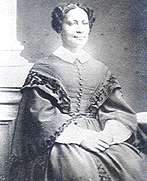
Sarah Parker Remond
The societies organized lecture tours for members of the American movement. In 1853 the Glasgow Society sponsored Harriet Beecher Stowe, whose novel Uncle Tom’s Cabin had already sold 1.5 million copies in Britain and in 1861 the Edinburgh Society organized a series of lectures by Sarah Remond, whom they described as ‘a lady of colour from America.’ She wrote: ‘I have been received here as the sister of the white woman’.
Even after the ending of the American Civil War and the freeing of slaves in the US, British women’s societies continued their work, concentrating now on providing aid for the ‘Freedmen’. The Birmingham women’s anti-slavery society continued to meet until 1919.
Over the years many of the women’s anti-slavery societies printed reports, listing the members of their committees. It is now possible to study these, together with publications such as the Anti-Slavery Reporter, to discover not only who the women were who worked for this cause, but also to examine the clear links between the members of the abolitionist and of the women’s suffrage movements.
Further Reading
C. Midgley, Women Against Slavery: the British campaigns 1780-1870, Routledge, 1992.
Anti-Slavery International: http://www.antislavery.org .
Wilberforce House Museum, Hull: details of materials relating to the anti-slavery campaign can be found by searching for ‘Wilberforce House’ at http://www.cornucopia.org.uk .
http://www.quaker.org.uk contains an article on the Quaker involvement in the anti-slavery campaign. The library at Friends’ House, London, contains useful biographical records.
BBC History: Elizabeth Crawford, Women: From Abolition to the Vote
Kate Frye’s Suffrage Diary: Spring 1908 – Suffrage Hope – WSPU in Albert Hall ‘a little too theatrical but very wonderful’
Posted in Kate Frye's suffrage diary on September 26, 2012
Another extract from Kate Frye’s manuscript diary. An edited edition of later entries (from 1911), recording her work as a suffrage organiser, is published as Campaigning for the Vote: Kate Parry Frye’s suffrage diary.
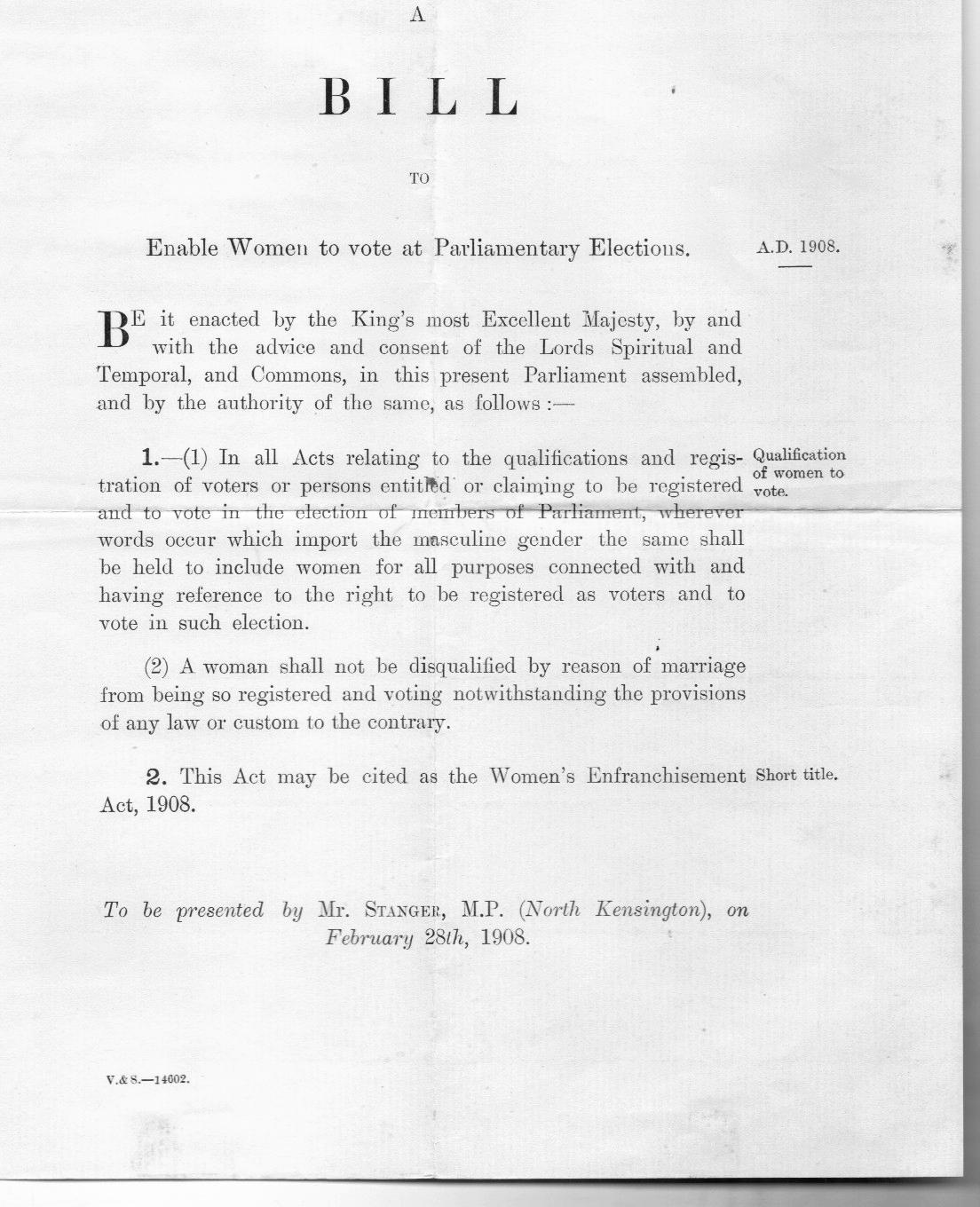
H.Y. Stanger’s Bill, 1908
Kate’s MP, Henry Yorke Stanger, was the promoter of the current Enfranchisement Bill – the latest in the long line that stretched back through the latter half of the 19th century. Despite, as Kate describes, the bill passing its second reading, the government eventually refused to grant facilities to further the debate. However, that blow was yet to come as Kate records in these entries details of the suffrage meetings she attended in February and March 1908. She had the knack of always being present on the great occasions – and on 19 March was in the Albert Hall to witness the rousing – and profitable – reception given to Mrs Pankhurst on her release from prison.
Dramatis personae:
Miss Harriet Cockle, was 37 years old, an Australian woman of independent means, lving at 34 de Vere gardens, Kensington.
Mrs Philip Snowden – Ethel Snowden (1880-1951) wife of the ILP politician, Philip Snowden.
Mrs Clara Rackham (1875-1966) was regarded as on the the NUWSS’s best speakers. In 1910 she became president of the NUWSS’s Eastern Federation, was founder of the Cambridge branch of the Women’s Co-operative Guild, and was sister-in-law to Arthur Rackham, the book illustrator.
Margery Corbett (1882-1981- later Dame Margery Corbett-Ashby) was the daughter of a Liberal MP. At this time she was secretary of the NUWSS.
Mrs Fanny Haddelsey,wife of a solicitor, lived at 30 St James’s Square, Holland Park.
Mrs Stanbury had been an organiser for NUWSS as far back as 1890s.
Tuesday February 25th 1908 [London-25 Arundel Gardens]
We got home at 5.15 and had tea. Then I did my hair and tidied myself and Agnes and I ate hot fish at 6.30 and left soon after in a downpour of rain for the Kensington Town Hall – we did get wet walking to the bus and afterwards. We got there at 7 o’clock to steward – the doors were opening at 7.30 and the meeting started at 8.15. I was stewarding in the hall downstairs and missed my bag – purse with 6/- and latch Key etc – very early in the evening which rather spoilt the evening for me as I felt sure it had been stolen. It was a South Kensington Committee of the London Society for Woman’s Suffrage and we were stewarding for Miss Cockle. It was a good meeting but not crowded but, then, what a night. Miss Bertha Mason in the Chair. The speech of the evening was Mrs Philip Snowdon, who was great, and Mrs Rackham, who spoke well. The men did not do after them and poor Mr Stanger seemed quite worn out and quoted so much poetry he made me laugh. Daddie had honoured us with his presence for a little time and had sat on the platform – so I feel he has quite committed himself now and will have no right to go back on us. We were not in till 12.20 and then sat some time over our supper.
Wednesday February 26th 1908
Before I was up in the morning Mother came up in my room with my bag and purse and all quite safe. It had been found and the Hall Door Keeper had brought it. I was glad because of the Latch Key. Daddie generously had paid me the 6/- which I was able to return.
Friday February 28th 1908
Mr Stanger’s Woman’s Suffrage Bill has passed the second reading. I had to wait to see the Standard before going to my [cooking] class. That is very exciting and wonderful – but of course we have got this far already in past history. Oh! I would have liked to have been there.
MargWednesday March 11th 1908
To 25 Victoria Street and went to the 1st Speakers Class of the N.[ational] S.[ociety] of W.[omen’s] S.[uffrage]. I was very late getting there and there was no one I knew so I did not take any part in the proceedings and felt very frightened. But Alexandra Wright came in at the end and I spoke to Miss Margery Corbett and our instructoress, Mrs Brownlow. And then I came home with Alexandra from St James’s Park station to Notting Hilll Gate.
Thursday March 12th 1908
Mother went to a Lecture for the NKWLA [North Kensington Women’s Liberal Association] at the Club and Agnes and I started at 8 o’clock and walked to Mrs Haddesley [sic] for a drawing-room Suffrage Meeting at 8.30. Agnes and I stewarded and made ourselves generally useful. The Miss Porters were there and a girl who I saw at the Speakers’ Class on Wednesday. Alexandra was in the Chair and spoke beautifully – really she did. And Mrs Stanbury spoke. Mrs Corbett and Mrs George – all very good speakers. Mrs Stanbury was really great and there were a lot of questions and a lot of argument after, which made it exciting. It was a packed meeting but some of the people were stodgy. Miss Meade was there with a friend – her first appearance at anything of the kind she told us and she said it was all too much for her to take in all at once. The “class” girl walked with us to her home in HollandPark and we walked on home were not in till 11.45. I was awfully tired and glad of some supper and to get to bed.
Mrs Pankhurst had been arrested on 13 February as she led a deputation from the ‘Women’s Parliament’ in Caxton Hall to the House of Commons. She was released from her subsequent imprisonment on 19 March, going straight to the Albert Hall where the audience waiting to greet her donated £7000 to WSPU funds. Kate was there.
Thursday March 19th 1908
I had a letter in the morning from Miss Madge Porter offering me a seat at the Albert Hall for the evening and of course I was delighted….just before 7 o’clock I started for the Albert Hall. Walked to Notting Hill gate then took a bus. The meeting was not till 8 o’clock but Miss Porter had told me to be there by 7 o’clock. We had seats in the Balcony and it was a great strain to hear the speakers. It was a meeting of the National Women’s Social and Political Union – and Mrs Pankhurst, newly released from Prison with the other six was there, and she filled the chair that we had thought to see empty. It was an exciting meeting. The speakers were Miss Christabel Pankhurst, Mrs Pethick Lawrence, Miss Annie Kenney, Mrs Martel and the huge sums of money they collected. It was like magic the way it flowed in. It was all just a little too theatrical but very wonderful. Miss Annie Kenney interested me the most – she seems so “inspired” quite a second Joan of Arc. I was very pleased not to be missing so wonderful an evening and I think it very nice of Miss Porter to have thought of me. She is quite a nice girl of the modern but “girlie” sort – a Cheltenham girl and quite clever – but very like a lot of other girls. Coming out we met, strangely enough, Mrs Wright and Alexandra (Gladys was speaking at Peckham) and after saying good-bye to Miss Porter I walked home with them as far as Linden Gardens. Got in at 11.30 very tired indeed and glad of my supper. Mother was waiting up.
Campaigning for the Vote: Kate Parry Frye’s Suffrage Diary edited by Elizabeth Crawford
For a full description of the book click here
Wrap-around paper covers, 226 pp, over 70 illustrations, all drawn from Kate Frye’s personal archive.
ISBN 978 1903427 75 0
Copies available from Francis Boutle Publishers, or from Elizabeth Crawford – e.crawford@sphere20.freeserve.co.uk (£14.99 +UK postage £3. Please ask for international postage cost), or from all good bookshops. In stock at London Review of Books Bookshop, Foyles, National Archives Bookshop.
- ‘Campaigning for the Vote’ – Front and back cover of wrappers
Mariana Starke: Father is Worsted by Robert Clive
Posted in Uncategorized on September 20, 2012
Fort St George in the 18th century
Although Mariana Starke’s grandfather, John Starke, was never an employee of the East India Company, both his sons, Richard and John, were. Richard Starke (1719 – 93) – yet to be the father of Mariana – sailed from London in 1734 as a passenger in the Onslow to Fort St George, taking with him wine, a chest of apparel and an escritoire. In Fort St George he could have resumed contact with his mother’s family, the Empsons.
On 29 December 1735 Richard Starke entered ‘the service of the Honourable Co on the coast of Coromandel as ‘Writer Entertained’. A 1736 note made clear that it was ‘out of regard for his father’ that he was ‘taken into our service’, a 10 May 1737 dispatch confirming that ‘Mr Richard Starke is so usefull a hand in the Secretary’s Office’. During the following years his father sent out to him several boxes ‘of apparel’ and in 1746 ‘two boxes of books’, in 1747 one box of books and a hat, in 1750 one box of pamphlets and pens, in 1752 a box of books and in 1753 a pair of scales, a lanthorn and books. In April 1747 Richard was joined as a writer in the EIC by his younger brother, John Starke (aged 22), who sailed out on the Houghton with one chest, one escritoire, and a bundle of bedding
A dispatch from Fort St George to England, dated 22 February 1749, stated that Richard Starke, who had been ‘upper searcher at Madras – now appointed to that position at Cuddalore [i.e. Fort St David]. By 2 November 1749 he had been appointed ‘second’ at Fort St George – that is ‘under deputy governor’ and in February 1752 he succeeded Mr Prince as deputy governor of Fort St David, formally taking office on 31 July 1752.
Fort St David, about a mile from Cuddalore, was a small fortified town, near to the sea and, by all accounts, a very comfortable billet. In The Life of Lord Clive Sir George Forrest quotes the following description of the area: ‘The country within the boundaries is very pleasant, and the air fine, having seldom any fogs. In the district are many neat houses with gardens; the latter were laid out with much good taste by the gentlemen, who either had been, or were in the company’s service. These gardens produce fruits of different sorts, such as pine-apples, oranges, limes, pomegranates, plantaines, bananoes, mangoes, guavas, (red and white,) bedams (a sort of almond), pimple-nose, called in the West Indies, chadocks, a very fine large fruit of the citron-kind, but of four or five times it’s size, and many others. At the end of each gentleman’s garden there is generally a shady grove of cocoanut trees.’
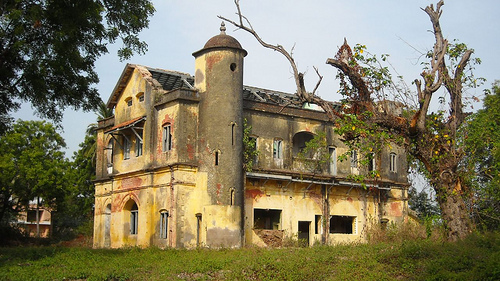
Ruined remainder of Fort St David. Courtesy of indiatravelfaq.com
Clearly it was all too comfortable to last. First we hear that John Starke, who was also working at Fort St David, under the Paymaster, received a peremptory dismissal for which no reason was given; a dispatch from London to Madras, 31 Jan 1755 merely noted: ‘The services of John Starke are dispensed with.’.’ Having no further occasion for the service of Mr John Starke he is upon receipt of this to be accordingly discharged from the Company’s service’.
A year later Richard Starke was compelled to write the following letter, dated 19 August 1756:
‘Honourable Sir and Sirs [to the President and Governors of Fort St George] I am to acquaint you that agreeable to your orders of the [lacuna] June I have delivered over the charge of the settlement of Fort St David to Col Robert Clive and as I imagine by the Company’s having been pleased to supersede me, by the appointment of that Gentleman so much my junior in their service, my conduct cannot have been so agreeable to them as I can assure Your Honour etc I have endeavoured to make it, I am to desire permission to resign their employ and return to Europe. Richard Starke.’
To the letter was subsequently appended a brief note: ‘In which the Board acquiesce’.
A dispatch of 21 November 1756 gave further information. ‘Starke handed over charge to Clive, returned to Madras in August, and requested leave to resign the service as he had been superseded by Clive.’ A further dispatch, 20 October 1757, gave a list of the passengers sailing to England on the Norfolk, among whom were Richard and John Starke.
Thus ended, rather ignominiously, Richard Starke’s Indian career, ousted by the very much more wily and ambitious Robert Clive. I am sure that a reading might be made of The Sword of Peace in the light of Mariana’s close knowledge of these events.
In 1759 Richard Starke married Mary Hughes, the 23-year-old daughter of Isaac Hughes, a merchant of Crutched Friars in the City of London, and Yewlands House, Banstead. Mariana, born in the last week of September 1762, was their first surviving child; I think a first son had died soon after birth. UPDATE (6 April 2014) I’ve just found a news report in ‘The Public Advertiser’ of 21 June 1762, to the effect that this young boy, aged 20 months, had died the previous week after falling out of the coach in which he was ‘taking an airing’ with some women servants and was then run over by the vehicle’s wheels.
Richard’s father, John Starke, died in a year later, in October, 1763. His will reveals some family dissension. Richard and his sister, Martha, appear to have been involved in a lawsuit, presumably involving John, the result being that, although John Starke left Hylands House at Epsom to Richard, the main part of his wealth was to bypass Richard, to be settled on Richard’s children. Thus, by the time she was a year old, Mariana Starke was living in a large, pleasant house in Epsom, where her father, who never again took up employment, could maintain a position in society on account of his Indian EIC service and, while probably not overburdened with great wealth, could live with a certain nabob style.
Copyright
Kate Frye’s Diary: Learning the ‘Two Step’ for Suffrage
Posted in Kate Frye's suffrage diary on September 19, 2012
Another extract from Kate Frye’s manuscript diary. An edited edition of later entries (from 1911), recording her work as a suffrage organiser, is published as Campaigning for the Vote: Kate Parry Frye’s suffrage diary.
Working for women’s suffrage involved taking part in many different kinds of social activities. In the first month of 1908 Kate danced, stewarded and was lectured by Ford Madox Hueffer – all in the suffrage cause.
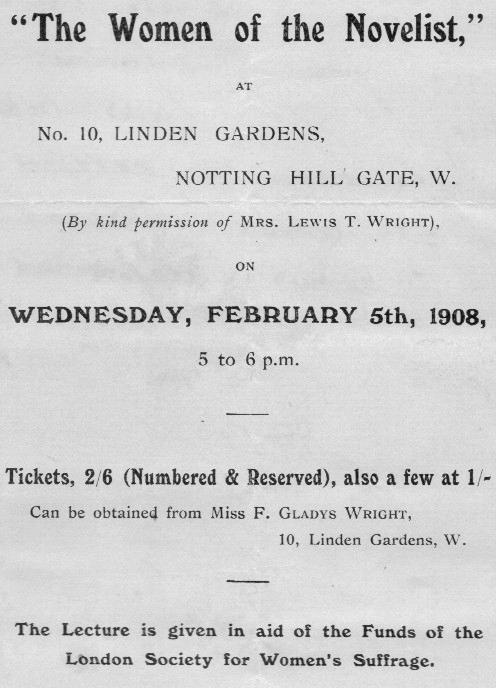
The flyer produced – presumably by the Wrights – for the lecture that Ford Madox Hueffer gave in their house. I wonder if the error in the spelling of his middle name was pointed out to them?
Dramatis personae for these entries:
‘Mrs Wright and the girls’: Mrs Lewis Wright and her daughters, Alexandra and Gladys, who then lived at 10 Linden Gardens. It was under their influence that Kate had joined the London Society for Women’s Suffrage, a constitutional suffrage society.
Geoffrey Stanger: the son of H.Y. Stanger, Liberal MP for North Kensington, who had introduced a women’s suffrage bill into the House of Commons.
Miss Mason: Bertha Mason, honorary treasurer of the National Union of Women’s Suffrage Socities – a suffragist of long-standing.
Miss Frances Sterling: joint honorary secretary of the NUWSS.
Ford Madox Hueffer (later Ford Madox Ford): author, then living in Kensington with Violet Hunt.
Friday January 10th 1908 [London: 25 Arundel Gardens, North Kensington]
I sat over the fire and had another little rest and got dressed early in my white satin dress. It is pretty – a charming frock – the nicest I have ever had, it seems to me. I did my hair Greek fashion with a silver and turquoise band round it which I have made myself – and though it’s me what says it and shouldn’t ‘I did look nice’. Even Mother said I did, I heard after from Agnes. Agnes’s dress was pretty too. And Mother has made hers beautifully but it hadn’t on a trace of style and she really did not look very nice……We had a private omnibus to the Grafton Galleries and got there about 9.15. Met Mrs Wright and her party just inside but by the time our four men had helped themselves we hadn’t many dances left. The girls introduced me to a few but I thought theirs rather a scratch lot – one boy wasn’t bad and Geoffrey Stanger, but one or two others I had I lost as soon as possible. It was a great pack – too many people for dancing in comfort somewhere about 300 and they have made for the London Society of Women’s Suffrage about £70…We stayed to the bitter end and I danced every dance except a few extra at supper time .. I learnt to do the Two Step with Mr Stanger and loved it. We reached home at 3.20 and were able to stir the fire into a blaze. John went off before 4 o’clock but we four sat over the fire talking till 4.30 and it was 5 o’clock before I was in bed as I always like to put some of my things away and tidy the room.
Thursday January 16th 1908
Changed at 6.30 and Agnes and I went off at 7.30 to Miss Mason’s (9 Hyde Park Place) for a Drawing-room Suffrage Meeting at which we had promised to Steward and get there at 8 o’clock for 8.30. We started to walk but we were all in our best and it started to drizzle and we took a cab from the top of the hill. The speakers were the Hon Bertrand Russell, Mr Mitchell Morton and Miss Frances Sterling. She made a most excellent speech and it was a most successful meeting. We did much good work in the way of getting members for the Society and it was all most encouraging and enthusiastic. They had a meeting here last night too – 70 people – but Alexandra said they were a most cold unenthusiastic audience – they could not do anything with them. She has paid Agnes and me a great compliment in saying ‘ I always like to see Agnes and you come into a room – then I know the thing will “go”’. I suppose we have a lot of personality and a lot of electrical excitement and it does help. John is quite in the movement now – though still apt to go back on us in the society of his own sex. .. These meetings are so exciting. I never feel like settling off after them.
Friday January 24th 1908
Changed after tea and at 5.30 Agnes and I went by motor bus from Notting Hill Gate to Oxford Circus and to the Queen’s Hall for the Liberal Federation Woman’s Suffrage Meeting. As we had been asked to act as Stewards and had to be there at 6 o’clock. We stewarded up in the Balcony but there was very little to be done. A good meeting, but not very full. But the audience was a very enthusiastic one and the speeches went well. Mrs Eva McLaren in the chair. Miss Balgarnie, Mrs Conybeare, Mrs Booth and the usual Liberal Women’s Federation people. It was a meeting for women only but there were a number of men stewards. The doors were opened at 7 o’clock and it commenced at 8 o’clock. Mother was there and we met at Oxford Circus and the three of us came home together by bus.
Wednesday February 5th 1908
They had quite a dozen awful Hampstead females there [at home] so we slipped quietly away and hurried to Notting Hill Gate so as to be at the Wrights (10 Linden Gardens) punctually at 4.45. Gladys had asked us to help them I stood in the hall and looked at tickets and sold others etc and later went up to hear the lecture from 5 to 6 by Mr Ford Maddox [sic] Heuffer on the Women of the Classical Novelist of England. It was most interesting and a breezy discussion followed. We got in at 6.30 .. I was very tired but I worked till 11 o’clock directing envelopes for the South Kensington Committee of the L.S.W.S. for a meeting to be held at the Town Hall on the 25th inst.
Campaigning for the Vote: Kate Parry Frye’s Suffrage Diary edited by Elizabeth Crawford
For a full description of the book click here
Wrap-around paper covers, 226 pp, over 70 illustrations, all drawn from Kate Frye’s personal archive.
ISBN 978 1903427 75 0
Copies available from Francis Boutle Publishers, or from Elizabeth Crawford – e.crawford@sphere20.freeserve.co.uk (£14.99 +UK postage £3. Please ask for international postage cost), or from all good bookshops. In stock at London Review of Books Bookshop, Foyles, National Archives Bookshop.
- ‘Campaigning for the Vote’ – Front and back cover of wrappers
Book of the Week: The Love-Letters of Mary Hays, ed A.F. Wedd
Posted in Book of the Week on September 18, 2012
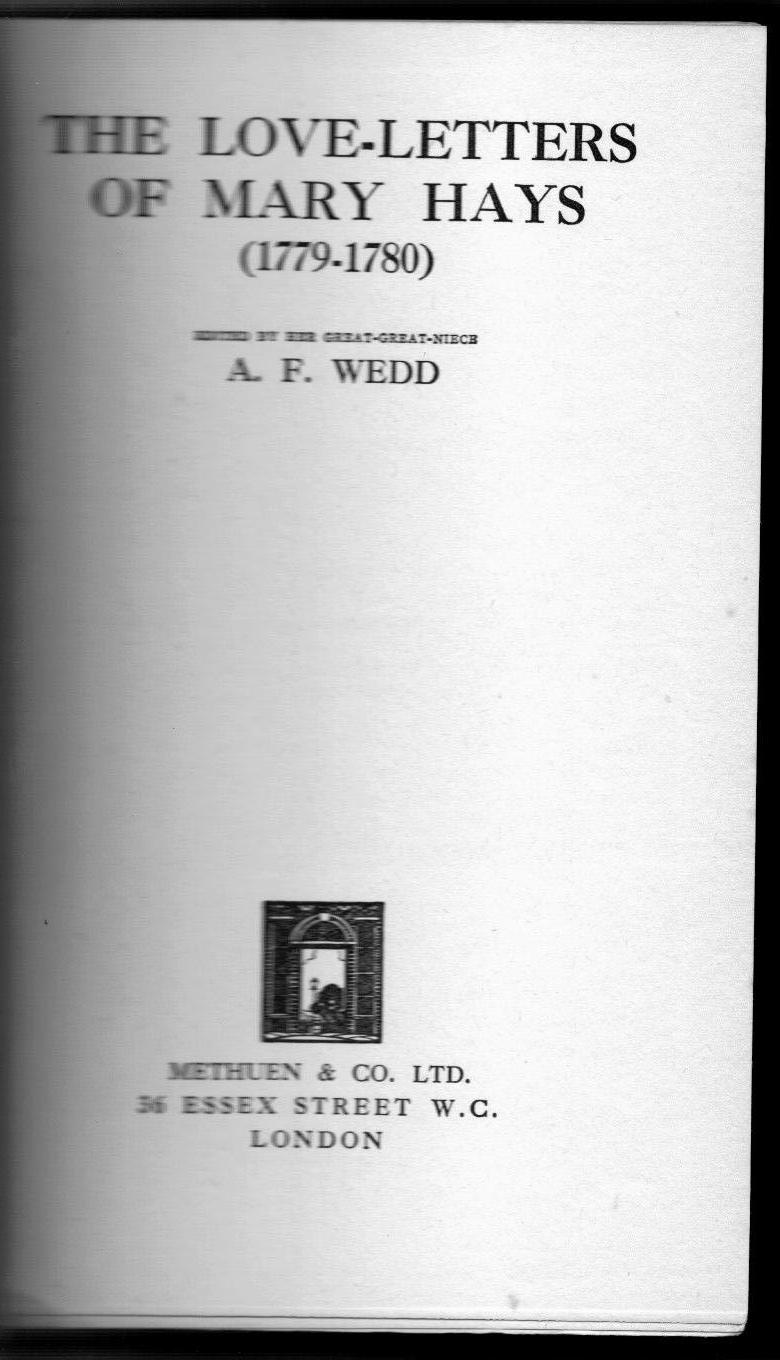 The Love-Letters of Mary Hays (1779-1780), edited by her great-great-niece A.F. Wedd, Methuen 1925.
Tortured by her sensibility, for one blissful year 17-year old Mary Hays enjoyed – or suffered – a romance with John Eccles, a fellow non-conformist who lodged close by her family home in Southwark. Initially opposed by their families, the romance appeared to be approaching a happy conclusion when, shortly before the marriage, John died. However that year had produced an abundance of correspondence, letters treasured by Mary Hays for the rest of her life. In her Introduction to the edited version, her great-great-niece explains how:
‘After many years of oblivion, the papers from which this book has been compiled were discovered stored away in a cupboard of the little old house inhabited by the descendants of Mary Hays’s sister “Sister Dunkin”. The Love-Letters, with Mary’s own introduction and notes, had been copied, in the exquisite writing of her friend Mrs Collier, into two volumes, from which the handsome morocco covers, stamped with the initials M.H. and J.E., had fallen.. The other letters, dusty, stained, and nibbled by mice, but still tied in packets and labelled with the names of their famous authors, were contained in a small wooden chest.’
Is that not a researcher’s dream? For, 230 years later, Mary Hays attracts attention. Having struggling to surface from her great grief – it took about 10 years – she turned from letter to book writing, producing novels, polemics – including Appeal to the Men of Great Britain on Behalf of the Women, 1798 – in which she refutes the contemporary rationale for the subjection of women – and, most importantly, her six volumes of Female Biography, 1802. In these years she moved in the London literary and philosophical circles that included Mary Wollstonecraft and William Godwin, letters from whom are printed at the end of Love-Letters.
By editing these letters Annie Frances Wedd played her part in the renaissance of Mary Hays. In her Introduction she noted that ‘Mary Hays is now unknown; her books are unread; even her connection with the literary celebrities of her day has been forgotten’. However, when the late 20th-century ‘female turn’ in literary studies ensured that novels such as Hays’s Emma Courtney were reprinted, The Love-Letters was there to provide quotable material to place Mary Hays firmly in Mary Wollstonecraft’s circle. Miss Wedd’s Introduction is delightfully tart. She makes clear that, while feeling a sympathy with her forebear, she did not herself suffer from the ‘exquisite sensibility’ that rendered Mary Hays’s days so melancholy – noting, for instance, that when, after Eccles’ death, Mary upbraids ‘the nightingale for not joining in her plaint, as the month was August this was hardly to be expected’.
The book is in very good condition, is quite scarce – £45 (plus postage). To buy contact: e.crawford@sphere20.freeserve.co.uk
Collecting Suffrage: The Game of ‘Suffragette’
Posted in Collecting Suffrage on September 17, 2012
I will shortly be issuing a new book and ephemera catalogue – number 175. It will comprise books and ephemera by and about women – with special sections on Women’s Suffrage and Women in the First World War. If you would like a copy of the printed or email version please let me know. A short time after these have been sent out, I shall post the catalogue on this website.

The Rules of the Game. ‘The Haunted House’ appears on the reverse of every card
Amongst several rare items that I shall be including in the ‘Women’s Suffrage’ section is ‘The Game of “Suffragette”‘.
This card game was invented by the Kensington branch of the WSPU, probably in the late summer of 1907, and, as such, is, I think, the earliest of the games that were marketed as a tool of suffragette propaganda. It was described in the second issue of ‘Votes for Women’, November 1907.
The first issue of ‘Votes for Women’, October 1907, had on its cover the picture of the ‘Haunted House’ by David Wilson, which had first appeared in the ‘Daily Chronicle’ in April 1907. Depicting a seated woman brooding over the Houses of Parliament, a demand for ‘Votes for Women’ in her hand, this image appears on the reverse of every card in this game – and on the base of the box. David Wilson (1873-1935) was an Irish-born illustrator, soon to become chief cartoonist for ‘The Graphic’.
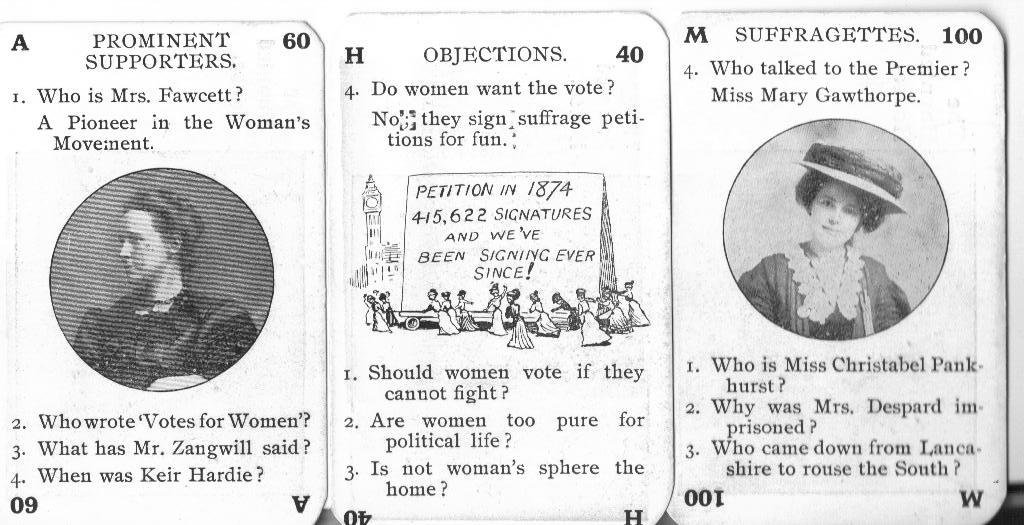 The game comprises 54 cards (all present) divided into 13 sets of 4 cards each – one of the odd ones being known as ‘The Bill’ – and the other a spare which has been used to record the score of a game played long ago by 6 people, designated by their initials. All the sets have names: eg. Prominent Supporters, Arguments, Freewomen, Voteless Women etc – and each card poses a series of questions. Some of the cards also carry photographs – of Christabel Pankhurst, Annie Kenney, Mrs Fawcett, Elizabeth Robins, Israel Zangwill, and Mary Gawthorpe.
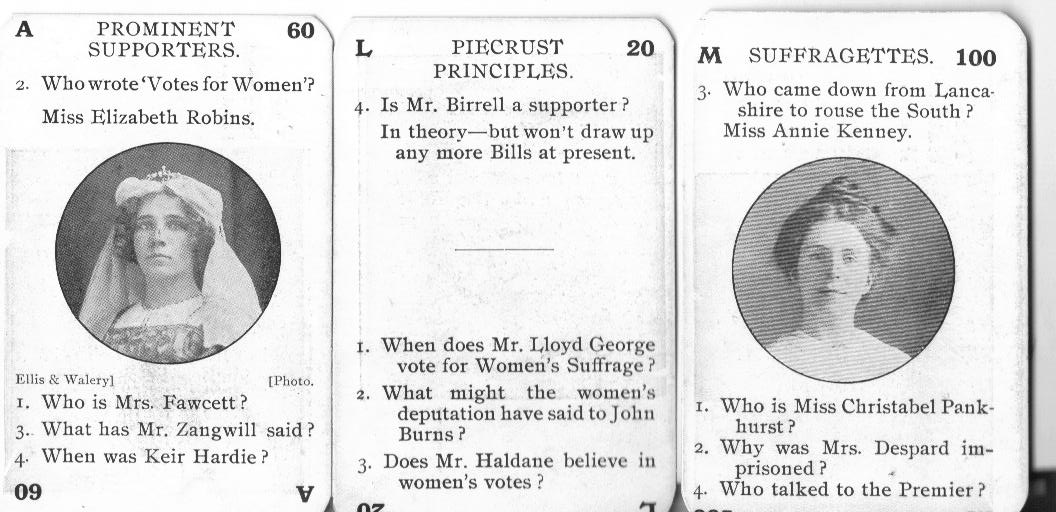 Along with the cards – and the original box – is the original, all-important, set of rules. These describe in detail the various ways in which the game can be played – it seems very inventive.
This is an incredibly scarce item. Although I wrote of it in The Women’s Suffrage Movement: a reference guide, this is the first set I have ever seen. An amazing survival.
Mariana Starke: Grandfather Spurns Virginia for India
Posted in Mariana Starke on September 14, 2012
In ‘What Mariana Starke was Not’ I explain that she was not – as has so often been cited – born in India. ‘India’ was, however, a formative presence in her worldview, a continent with which generations of her forebears had been associated. For, c 1710/11, it was to India that the young man who was to be her grandfather, John Starke (1685-1765), set sail. Having dealt with the many law suits he had inherited from his father, Thomas Starke, merchant and slave trader, John turned his back on the Virginia plantations and joined the East India ship, Averilla, heading for Madras.
Why did he forsake America for India? Doubtless the reasons were of the economic variety – he saw better prospects in the East. The fact that 25 years later the grandson of Micajah Perry, one of Thomas Starke’s most successful associates, was forced to sell his home, Hylands House in Epsom, and that the buyer was John Starke, would appear to vindicate the decision.
John Starke settled down to life in India, marrying, in 1713 at Fort St George, Martha Empson, whose father, now dead, had been an English merchant there. John Starke, described as a ‘seafaring man in the Madras service’, was not an employee of the East India Company but certainly travelled on their ships as supra cargo (or supercargo) – that is with responsibility for the management of the cargo and its trading.
It is possible still to catch glimpses of John Starke’s life as a free merchant at Fort St George. For instance in February 1724 an East India Company ship, the Lynn, travelling out to ‘the coast of Coromandel’, carried on it for his use 6 rheams of paper £12; 2 fowling pieces [guns] £5; 2 hatts and 2 wiggs £12. John and Martha Starke had a son, Richard, born in Madras in 1719 and a daughter, Martha. The family returned to England in early 1727, sailing on the ship Lyell. This may have been for the sake of the health of John’s wife, for she died in England, buried on 24 November 1730 at St Dunstan in the East, the churchyard that had in the previous half century received so many Starke bodies.
John travelling back east in 1731 and in 1732 was appointed supra cargo for a ship sailing to China.He was now, for a short time, associated with the developing China trade but by the end of 1734 had returned to England, buying and settling into Hylands House, Epsom, which comprised ‘a messuage, forecourt, coachouse, stables and other outhouses and garden, ¾ acre’.
His son, Richard, was not, however, able to enjoy the pleasures of Epsom for in 1735 he began his career with the East India Company. He still had family – the Empsons – in Fort St George. In 1736 John Starke had sent there to Matthew Empson (either his brother in law or his nephew) ‘a box of books and apparel’ Empsons continued through several generations to live in Madras and Mariana may have been aware of these Indian relations – although they are never mentioned in any extant correspondence.
Comfortably settled in Epsom, John Starke maintained his interest in travel, in 1745 subscribing to A New General Collection of Voyages and Travels in Europe, Asia, Africa etc by John Green. At some point (I have, as yet, been unable to trace the date) he remarried – taking as his second wife Honor, daughter of Sir Thomas Rawlinson and sister of Mary Rawlinson, devoted friend of his sister, Martha. Starke clearly was the uxorious type, losing no time, after Honor’s death in February 1751, in marrying in October, at Temple Church, Ann Clotterbooke. He died 14 years later and was buried at St Mary, Ewell, on 11 April 1765.
In John Starke’s will, among the usual bequests, was one leaving £2000 [2012 = £229,000] to the Incorporated Society for the Propagation of the Gospel, specifying that part of the money was to be applied ‘by the Society towards such charitable purposes as they shall judge most efficacious towards converting the savage Indians in our American colonies and late Acquisition’ [ie territory gained up to the Mississippi following victory over the French in 1763].He stresses the need to extend the Gospel ‘in all the remote and uncivilised parts of our settlement where providence has been graciously pleased to open a fair field to us (and probably for that purpose). It seems as though John Starke felt the necessity of making amends – one takes it that conversion to Christianity was intended as a gift – to at least one group affected by his family’s business dealings in North America – while blustering, even in his will, that English men were also the gift of providence.
On her death, also in 1765, his former sister-in-law, Mary Rawlinson left to John’s daughter, Martha, ‘my dressing table and the dressing stand in my own bedchamber, the bureau in the maid’s room and the black and gold Japan corner cabinet in my bed chamber, the Japan tea table in the parlour, the little mahogany table in ditto and likewise my tea board and writer and all my china ware except 6 blue and white cups and saucer… I give likewise to Miss Starke a pair of glass salts and the turkey carpet in my bed chamber.’ Martha Starke never married and I have wondered if any of these delightful pieces were eventually subsumed into the Hylands House furnishings, to be appreciated by Mariana Starke.
Source: The East India Company papers in the British Library provide a wealth of easily accessible details of life about individual ‘British in India’.
Copyright
 Woman and her Sphere