Posts Tagged women’s suffrage
The British Women’s Suffrage Movement in 100 Objects: a material history – FORTHCOMING IN JULY
Posted by womanandhersphere in British Women's Suffrage Campaign in 100 Objects on February 9, 2026
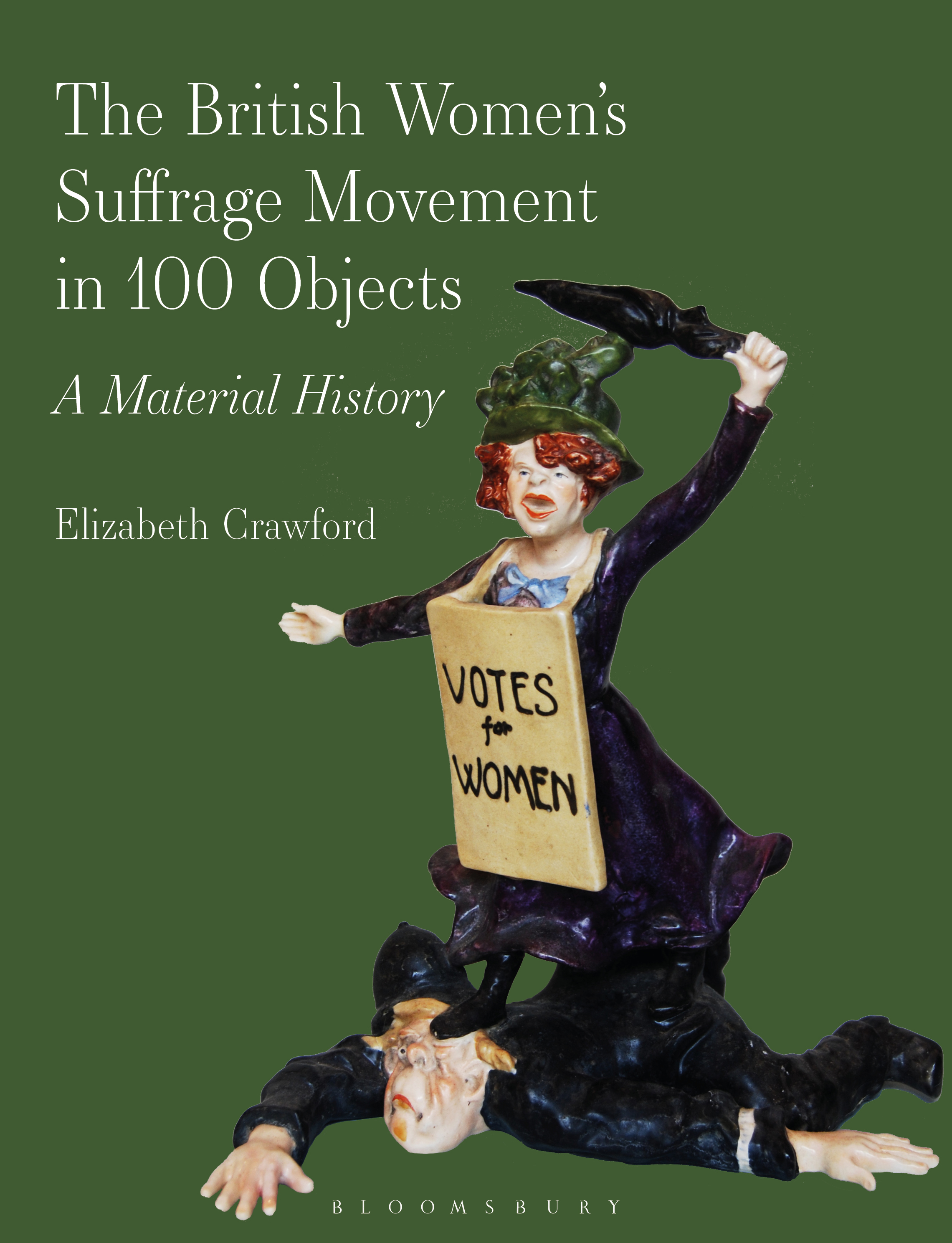
TO BE PUBLISHED ON 23 JULY – IN PAPERBACK (£24.99), HARDBACK AND AS AN EBOOK
You can pre-order from Bloomsbury at a reduced price here – or from Amazon here – or from your local bookshop.
I had no thought of producing another book when, one day in October 2023, I opened up my laptop, ready to watch an online auction mounted by Bonhams. This Votes for Women sale was devoted to suffrage memorabilia from the collection put together by a couple I’ve known ever since I began dealing in books and ephemera in the mid-1980s. I had no intention of bidding for anything in the auction as by 2023 the prices reached for suffrage material at such auctions had soared into the stratosphere. But, naturally, I took a professional interest in seeing what was up for sale – and the prices they would achieve. And I had a personal interest in that some of the items were ones I had myself sold to the vendors many years ago.
Watching the bidding was absorbing, but as the sale progressed I realised I was experiencing a niggling conflict between what might be termed my instinct as a trader and my instinct as an historian. Bonhams had organised the lots in the sale in a way as to appeal to bidders, grouping together items of a similar type, such as textile rosettes or china or badges or books – but this arrangement by no means coincided with what I knew to be the dates of their production. In my mind I was itching to reorder the lots into an historically coherent order. Well, there lay the germ of an idea …and it slowly gained traction..and, in due course, a publishing contract with Bloomsbury Academic. The result of my labours will be published in July.
For the book tells the story of the British ‘votes for women’ campaign in a sequence of 100 objects. From the beginning of the campaign in 1866 until all women were granted the vote on the same terms as men in 1928, women used every means in their power to persuade the government to allow them the right to elect members of parliament. Through the analysis of an astonishing array of objects – including books, bags, petitions, posters, plays, photographs, china, leaflets, newspapers, games, jewellery, sashes, films, and figurines – all of which are illustrated – The British Women’s Suffrage Movement in 100 Objects explores the role that material culture played in this vital struggle. Each of the 100 objects is illustrated, the accompanying text setting it in its context to explain the campaign’s politics and the part played by key personalities.
I must say that when I began work on the book it had not occurred to me that the suggestion could be voiced in any western democracy that women should be relieved of the right to the vote. But, that day having come (see here), although not yet here, there is all the more reason for understanding why and how British women won that right.
The book will be published in July in paperback at £24.99. To discover more details – as set out on the Bloomsbury website – including a special pre-order price and some most heart-warming reviews from readers who have viewed the text of the book in advance – see here.
My cup overflows – in that Bloomsbury will only accommodate six endorsements on their webpage – and nine readers were kind enough to give feedback on the book. I, as blushingly as self-promotion permits, set out below the final three to arrive. As you may imagine, I am immensely heartened – and hopeful that the 100 Objects will give a new clarity to the chronology, politics and personalities of the women’s suffrage campaign.
‘Drawing on a lifetime of groundbreaking scholarship on the British Suffrage movement and its materiality, Crawford’s new book is an essential read for anyone interested in the history of women’s campaigns for the vote. The British Women’s Suffrage Movement in 100 Objects brings to life in unprecedented detail the material world in which campaigners strove for social and political change, conveying this to new audiences with a lightness of erudition and a treasure trove of vivid detail. The extraordinary creativity and complexity of women’s activism during this era is made tangible through Crawford’s expert guidance.’ Dr Zoë Thomas, Associate Professor of Modern History, University of Birmingham
‘Beautifully illustrated and exceptionally curated, Crawford’s The British Women’s Suffrage Movement in 100 Objects is an essential and defining resource for the ways technological advances, community building, and popular culture played in the British campaign for “Votes for Women.” In clearly written and focused essays on everything from the intersection of the automobile and women’s rights to the ubiquity of comic suffragette ceramics, Crawford’s book will be of interest to scholars and general public alike.’ Heidi Herr Librarian for English, Philosophy, The Writing Seminars, & Student Engagement for Special Collections The Johns Hopkins University
‘The British Women’s Suffrage Movement in 100 Objects powerfully demonstrates the richness that material culture brings to the study of women’s histories. By centring objects, it reveals the political struggle as something lived, worn, exchanged, and displayed, rather than simply written or spoken. Together, the 100 objects offer an engaging, vivid and very human perspective on the suffrage movement, recovering voices and experiences that often remain muted in conventional narratives.’ Dr Miranda Garrett
100 Years Of The Women’s Library: one-day conference, 14 January 2026
Posted by womanandhersphere in Suffrage Stories on January 6, 2026
To mark the centenary of the coming into being of the treasure that is now the Women’s Library, the Friends of the Women’s Library are holding a free one-day conference on 14 January. The venue is LSE’s Shaw Library. If you would like to attend please email anniversarywomenslibrary@protonmail.com
The speakers will include Kelly Bosomworth on the Six Point Group, Clara Jones on Virginia Woolf and the Adult Suffragists, Carmen Mangion on the religious women and feminist activism to be found in the Women’s Library collections, Caroline Derry on Fighting the sexual double standard and raising the age of consent, 1885-1922 and a discussion between Sally Alexander and Mary Evans on ‘What questions will the future ask of our past?’.
For my part, I’ve been invited to talk about my forthcoming book – The British Women’s Suffrage Movement in 100 Objects: a material history – to be published in paperback by Bloomsbury Academic in July. When making my selection of objects I was able to draw deeply from the marvellous Women’s Library collection as well as from other institutions and from private collections.
To those attending the conference, Bloomsbury is offering a 20% pre-order discount on the published price of £24.99.
‘Votes for Women: Everywhere – 1866-1928’ – an Online talk for the British Association of Local Historians – This Evening – 8 October
Posted by womanandhersphere in Suffrage Stories on October 8, 2025
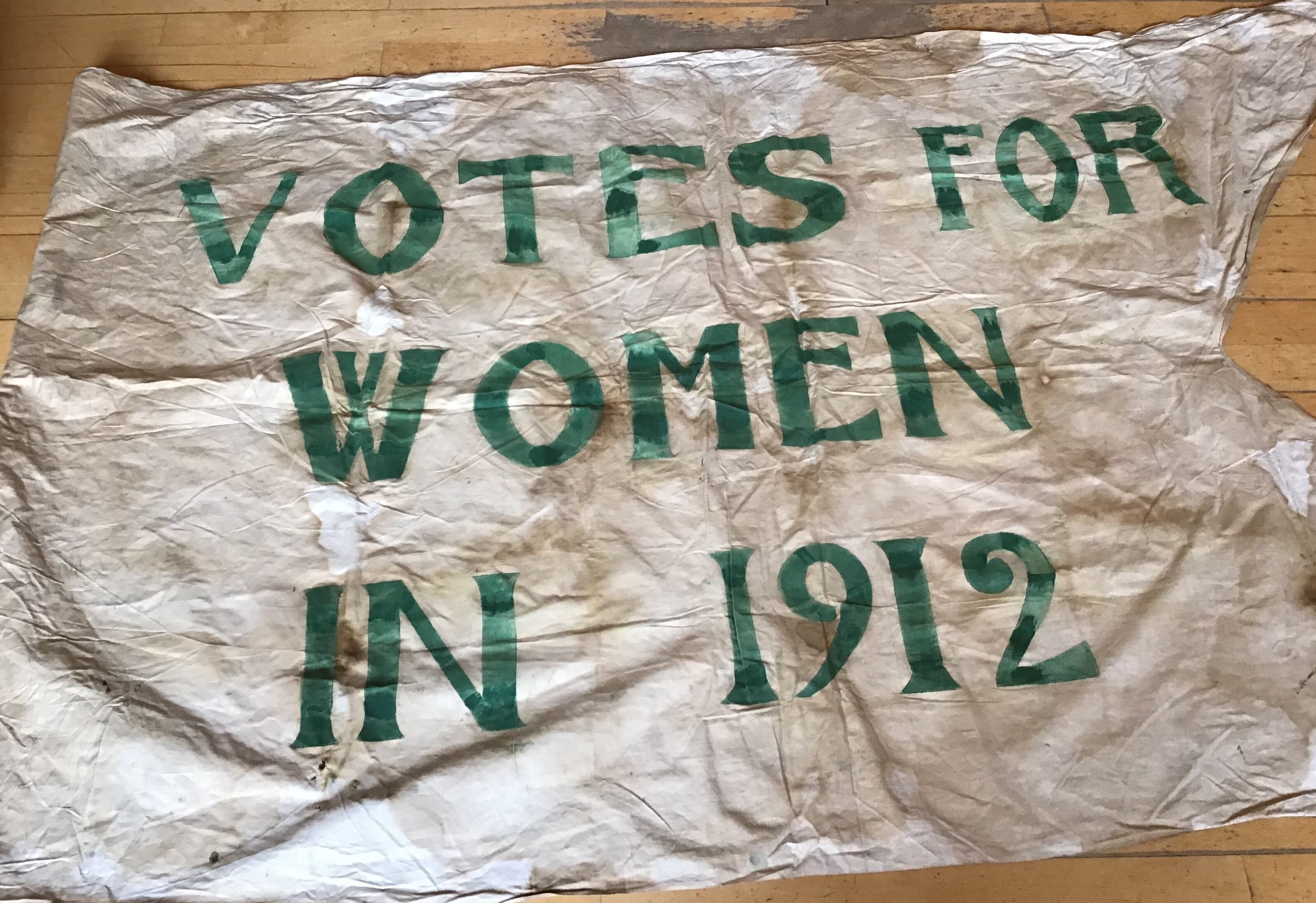
I will be giving an online talk this evening (Wednesday 8 October) at 7pm for the British Association of Local Historians – offering ideas about how to discover the history of the women’s suffrage movement – and its activists – in your locality.
See here for details https://www.balh.org.uk/event-balh-votes-for-women-everywhere-1866-1928-2025-10-08
Another Blue Plaque for Enterprising Women: Rhoda and Agnes Garrett Commemorated
Posted by womanandhersphere in The Garretts and their Circle on March 11, 2025

I am delighted to report that two more of my ‘Enterprising Women’ have just been recognised with an English Heritage Blue Plaque. For the work of Rhoda and Agnes Garrett is now highlighted, this new plaque joining that of their sister/cousin, Millicent Fawcett, on the outside of their home and business premises, 2 Gower Street, Bloomsbury.

The first published study of their work is detailed in a section headed ‘The Home’ in my Enterprising Women: the Garretts and their circle (2002). Having continued the research in the intervening years, most recent discoveries were revealed in an online talk I gave last month for the Victorian Society. If you are interested it is, I believe, possible to buy a recording.
Thus, Rhoda and Agnes Garrett are now memorialized by two blue plaques, the other being by the gate to their Rustington, Sussex, house, then known as ‘The Firs’. I had the pleasure of unveiling that one in 2018.

And while Blue Plaques are on my mind, I’ll mention that Fanny Wilkinson, entirely forgotten before I made her the subject of the section ‘The Land’ in Enterprising Women, is also now memorialised by two. One is the English Heritage version, on her one-time flat in Bloomsbury
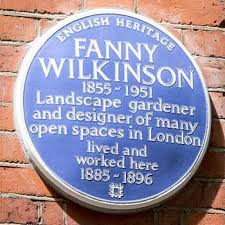
The other is in the garden of her former family home, Middlethorpe Hall, now a delightful hotel. I had the pleasure of giving a talk about Fanny and her work to accompany that unveiling in 2022.

I may say that I initiated none of these commemorations – I just didn’t think to do so – but how delighted I am that the work of these interesting women has touched the imagination of those who launched the four proposals.
And here’s the book that started it all:

330 pages, 75 illustrations £25 +pp (can be ordered directly from me – elizabeth.crawford2017@outlook.com).
Suffrage Stories: The Mystery of Nurse Pine’s Medal – Solved
Posted by womanandhersphere in Suffrage Stories on April 27, 2024
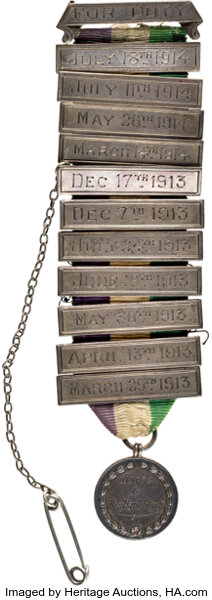
Nurse Pine’s Medal ‘For Duty’ sold at auction on 26 April 2024
Very nearly 8 years ago – on 26 May 2016 – I published a post titled The Mystery of Nurse Pine’s Medal. I knew that Nurse Catherine Pine, who had for many years attended Emmeline Pankhurst, had been given a medal by the Women’s Social and Political Union and I knew that she had bequeathed it to a now defunct nursing organisation but, as my post makes clear, I didn’t know what the medal looked like or what had happened to it.
Most satisfactorily, the mystery is now solved. The medal, resplendent with its bars, was given to Nurse Pine ‘For Duty’ (rather than ‘For Valour’, as denoted on the Hunger-Strike Medals). She did indeed leave it in her will to the ‘History Section’ of the British College of Nursing, who had it in their possession until the BCN, a charity, dissolved in chaos in 1956. It would seem that the contents of the ‘History Section’, along with the furniture and fittings of the BCN building, were sold off to any member interested – perhaps at a valuation set by Harrods, who had been appointed as valuers.
The medal resurfaced in 1990 when put up for sale at Sothebys, where it failed to sell, reappearing at a specialist medal sale in 2008 when it was bought by an American dealer. He sold it to an American collector of suffrage memorabilia, who has since died and whose collection was auctioned yesterday in Dallas, Texas, by Heritage Auctions.
I have known since the beginning of this year that the medal was coming up for sale and tried to interest various institutions in this country, but none had sufficient funds to consider acquiring it. However, for the last couple or so years I have been in touch with a US academic, Hope Elizabeth May, who has taken a legal, philosophical, and personal interest in the fate of Nurse Pine’s medal. She and I recorded a podcast about Nurse Pine and her medal a few days ago – on 21 April. You can listen to it here:
I am pleased to say that Hope Elizabeth May is now the ‘steward’, as she rather delightfully terms it, of Nurse Pine’s medal. She has interesting plans to use it for educational purposes, not only to promote interest in suffrage history but also to discuss philosophical questions about autonomy and its implications for estate law. I think we can be assured that the intention behind Nurse Pine’s bequest to the BCN will now be honoured.
Since being able to view the medal so clearly (thanks to the auctioneer’s image) I researched the dates on all the bars and established (thanks to the information contained in the entry on Emmeline Pankhurst in my The Women’s Suffrage Movement: A Reference Guide, in which I had carefully noted from the Home Office papers the precise dates on which she was released from prison) that all except the first represented a date in which Nurse Pine had taken over the care of Mrs Pankhurst. Hope Elizabeth May suggested, and I am sure she is correct, that the first bar – engraved ’25 March 1913′ – refers to care taken of Sylvia Pankhurst, who was released from Holloway on 21 March after being forcibly fed for several weeks while on hunger-and thirst-strike.
For an article about Nurse Pine, written in the centenary year of 2018, see the City University’s City Magazine Although the nature of the medal was still then unknown to the writer – and to me – it does tell something of the life of Nurse Catherine Pine.
Copyright
All the articles on Woman and Her Sphere and are my copyright. An article may not be reproduced in any medium without my permission and full acknowledgement. You are welcome to cite or quote from an article provided you give full acknowledgement.
The Garretts And Their Circle: A Talk For International Women’s Day
Posted by womanandhersphere in Art and Suffrage, Suffrage Stories, The Garretts and their Circle on February 23, 2024
For the Pascal Theatre Company I am giving a talk on 8 March:
Gower Street’s ‘Enterprising Women’:transforming the home, the land, and politics, 1875-1928
The event is free and already fully booked – but, of course, people who have signed up for it may drop out – so, if you are interested, do add your name to the waiting list. To accompany my talk Senate House Library is amounting a small Garrett/Fawcett-related exhibition, to include sections from the ceiling from 2 Gower Street that was decorated by Rhoda and Agnes Garrett.


Women for Women March Events
WOMEN FOR WOMEN
CELEBRATES WOMEN’S HISTORY MONTH: MARCH 2024
Elizabeth Crawford at Senate House Library Friday 8 March 4.00pm. THIS EVENT IS NOW FULL – WE HAVE A WAITING LIST WE ARE HAPPY TO ADD YOUR NAME TO.

Millicent Fawcett standing on the doorstep of 2 Gower Street, Bloomsbury, on her way to receive her DBE, 12 February 1925
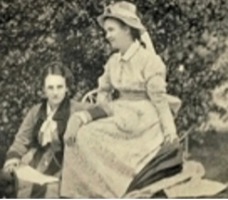
Rhoda and Agnes Garrett
Gower Street’s’ Enterprising Women’: transforming the home, the land, and politics, 1875-1928
RHODA GARRETT (1841-1882)
AGNES GARRETT (1845-1935)
FANNY WILKINSON (1855-1951)
MILLICENT FAWCETT (1847-1929)
A FULLY ILLUSTRATED TALK by Elizabeth Crawford
In the late-19th and early-20th centuries four pioneering women lived at 2 and 6 Gower Street, Bloomsbury. These houses were their homes as well as the sites of their commercial and campaigning enterprises.
The firm of ‘R & A Garrett House Decorators’ operated from number 2, which was first the home of the cousins Rhoda and Agnes Garrett. After Rhoda’s death, it housed Agnes and her sister Millicent Fawcett, leader of the constitutional women’s suffrage movement.
Fanny Wilkinson lived and worked next door but one, at number 6. She was the first professional woman landscape gardener, responsible for laying out over 75 of London’s public parks and gardens.
All four women were also involved, together with an intriguing assortment of friends and relations, in any number of other campaigns. All worked to improve the position of women.
This fully-illustrated talk will describe the life and work of Rhoda Garrett, (1841-1882), Agnes Garrett (1845-1935), Fanny Wilkinson (1855-1951), and Millicent Fawcett (1847-1929).
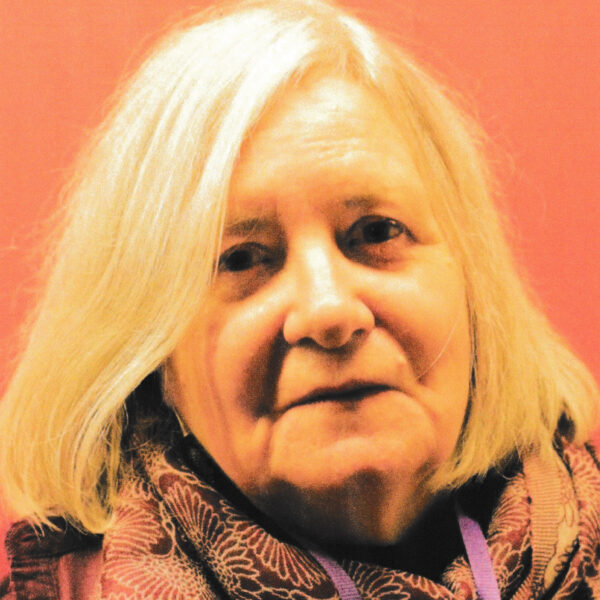
Elizabeth Crawford is the author of a number of books on aspects of women’s history. Of particular relevance to this talk is Enterprising Women: the Garretts and their circle.
Venue: Seng Tee Lee Seminar Room, Senate House Library, 4th floor, Senate House, Malet Street, WC1E 7HU
Timing: The talk 4pm-5.00pm will include a Q & A session.
You are also invited to join an introduction to the library at 5.15pm.
Registration (free) (access will be given at reception to those who have registered)
We have a waiting list and will notify you if a space becomes available.Continue reading“Elizabeth Crawford at Senate House Library Friday 8 March 4.00pm. THIS EVENT IS NOW FULL – WE HAVE A WAITING LIST WE ARE HAPPY TO ADD YOUR NAME TO.”
Other talks organised by the Pascal Theatre for Women’s History Month
Tuesday 12 March
An online talk by Lynsey Cullen about the first Lady Almoner: Mary Stewart
Thursday 14 March
An in- person talk by Emily Midorikawa about the most unlikely Victorian celebrity: Georgina Weldon.
Thursday 21 March
Jane Martin in conversation with Melissa Benn remembering the educational life and networks of educator and activist Jane Chessar.
Further information here: Women for Women March Events – Pascal Theatre Company (pascal-theatre.com)
Suffrage Stories: An English Heritage ‘Blue Plaque’ For The Women’s Freedom League
Posted by womanandhersphere in Suffrage Stories on September 20, 2023
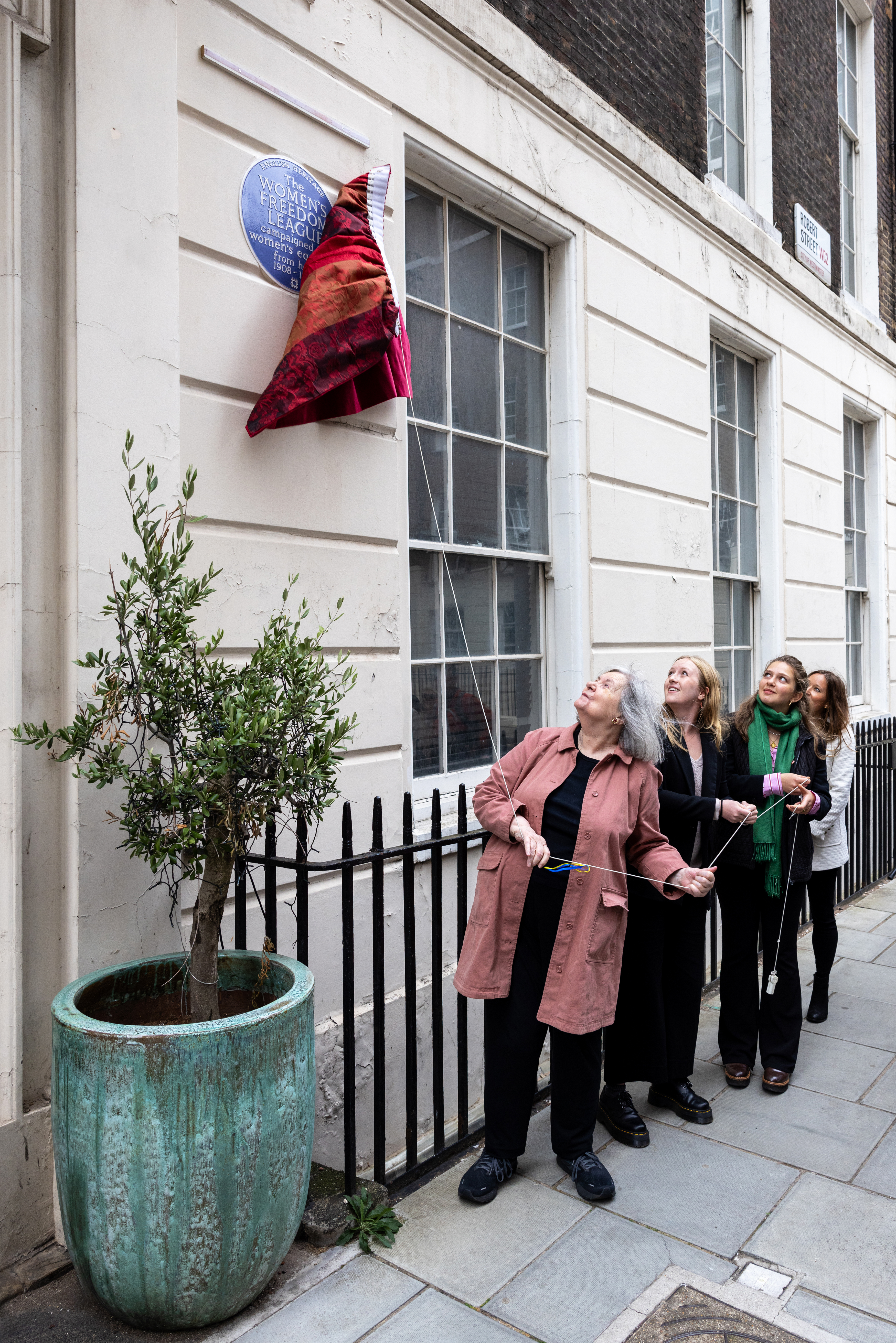
Photo courtesy of English Heritage
On 19 September 2023, together with members of the Feminist Society of Ibstock Place School, I unveiled the 1000th English Heritage Blue Plaque. It commemorates the Women’s Freedom League and is mounted on the wall of their sometime headquarters, 1 Robert Street, Strand.
This was 116 years and 5 days after the Women’s Freedom League (WFL) was formed at a meeting held close by – in the very popular Eustace Miles vegetarian restaurant. Vegetarianism was very much a WFL ‘thing’.
The meeting had been called by some women, erstwhile members of the Women’s Social and Political Union, who had protested Mrs Pankhurst’s unilateral action in abolishing the WSPU constitution and cancelling their annual conference. They did not care for the fact that the Pankhursts intended, in effect, to rule the WSPU by dictat.
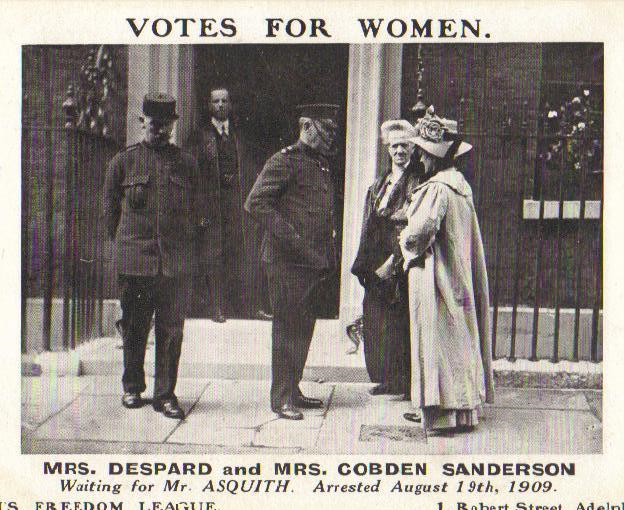
Mrs Charlotte Despard was voted into the chair and among others present at that first meeting were Teresa Billington (later Billington-Greig) and Edith How-Martyn – all strong individuals –with strong views – believing particularly in democracy and socialism.
Charlotte Despard, born into an Anglo-Irish family and long a widow, had since the 1890s devoted herself to social work with women and children in an impoverished area of Battersea, hemmed in by the Thames and railways. Most unusually, she chose to live there – at least during the week – only returning to her country home at Esher at the weekend. Teresa Billington-Greig – the WFL’s political theorist – had been a teacher before devoting herself to the WSPU suffrage campaign – while Mrs Edith How-Martyn, a young science graduate – was an effective and practical campaign organiser.
The three leaders were all supporters of the Independent Labour party and had been particularly troubled by the Pankhursts’ decision, announced earlier in 1907, not to support Labour candidates at elections. They were not women who took kindly to autocracy and were all to give a lifetime commitment to the WFL – and to its campaigns for social justice for women.
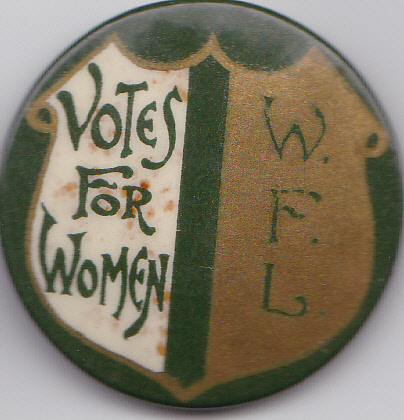
It took a little time for matters to resolve themselves, but in November 1907 the new society was given a new name –the Women’s Freedom League – chosen democratically by a referendum to members. The other suggested names were all associated with emancipation and rights – but Women’s Freedom League was good choice. It was not a name tied only to suffrage, but encompassed all kinds of freedom – appropriate to an agenda that changed over time to meet changing conditions. The thread running through the WFL’s long active life was – Equal citizenship, equal pay, equal opportunity, and equality under the law.
After a year in a temporary office, the WFL moved to 1 Robert Street in September 1908 – into 4 rooms on the first floor – staying until 1915, when they moved to High Holborn. Their presence there is marked by a plaque, although not the esteemed ‘Blue’ one.
Although considered a militant society, unlike the WSPU the WFL didn’t carry out acts of physical protest. Its members were not arsonists or bombers but, influenced by the teachings of Gandhi, they conducted campaigns of passive resistance, such as protesting in Police Courts that women were tried by laws made only by men, and in 1909 conducting a 5-month continuous picket of the House of Commons, ‘The Great Watch’.

One WFL tactic was to attempt to present petitions to the King.

It was WFL members, Helen Fox and Australian Muriel Matters, who attracted publicity in 1908 by chaining themselves to the grille in the Ladies’ Gallery in the House of Commons – and Muriel Matters, again, who hired an airship from which to drop leaflets over London. It was the WFL who first had the idea of boycotting the 1911 census, and whose members set up the Tax Resistance League, refusing to pay taxes and then creating publicity when their goods were seized and auctioned.

Local branches were set up throughout the country – the WFL was notably strong in Wales and in Scotland – but at both a local and a national level the WFL always struggled financially. To support their work the WFL relied on generous donors and on their own, time-consuming, fund-raising activities. Seen as of particular importance was raising enough money to ensure the publication of their weekly paper, The Vote, in which they were very successful as it ran from 1909 until 1933 and is an invaluable source of information on the changing nature of feminism in the first three decades of the 20th century. As well as its newspaper, the WFL’s main archive is held just across the Strand from Robert Street in the Women’s Library @LSE.
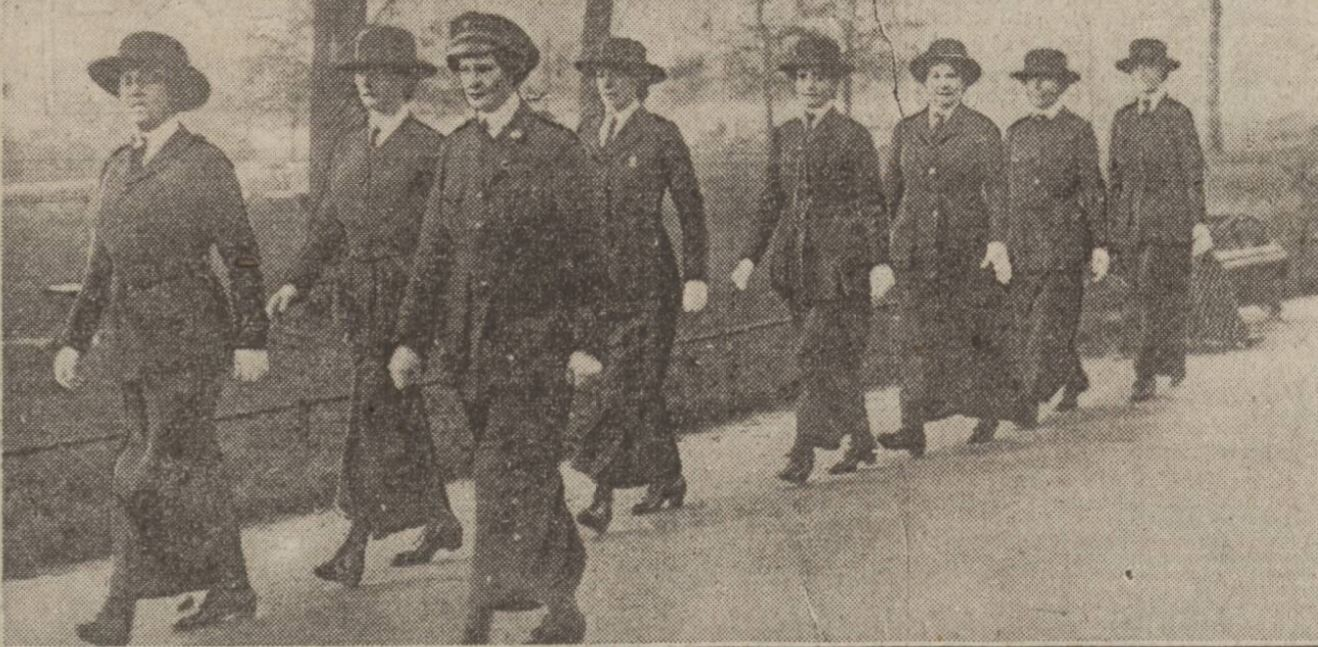
Women Police Volunteers, December 1914
Although they called a halt to militant protests during the First World War, the WFL continued to campaign for women’s rights – for instance, its members were associated with the founding of the first women’s police force.
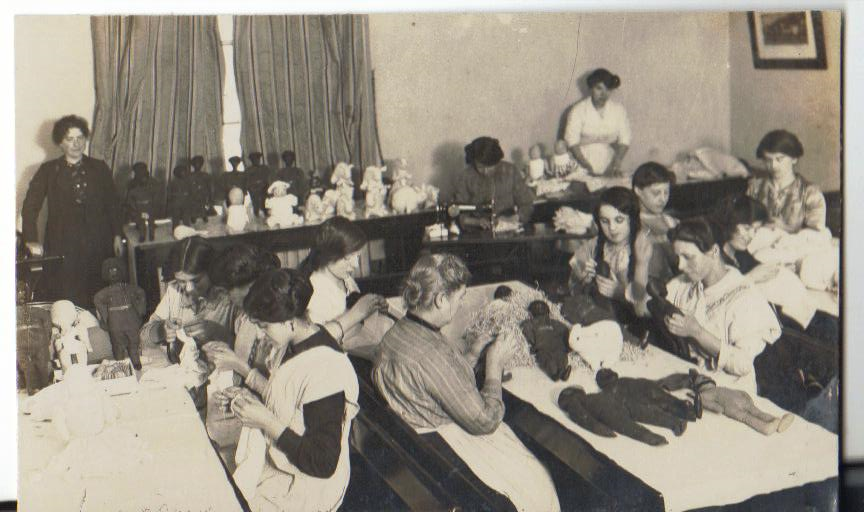
In the early years of the war the WFL ran a toy factory in Hackney, providing work for women, particularly those who had hitherto been employed in the garment trade.
Although most members of the WFL were pacifists the organisation managed to avoid a schism on the subject, such as beset the National Union of Women’s Suffrage Societies. Indeed, WFL members were generally adept at putting aside differences –including party differences – and instead concentrating on working for their shared causes.
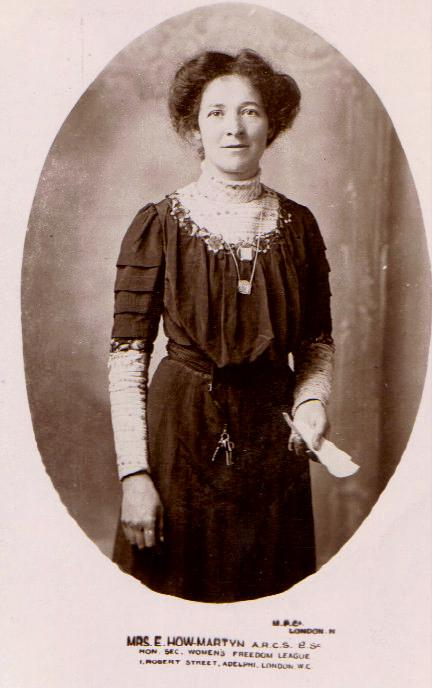
Mrs Edith How-Martyn
Several members of the WFL were candidates in the November 1918 general election, the first in which women over 30 could vote and at which women could stand for Parliament Charlotte Despard, who stood for Labour in Battersea, was one and Edith How-Martyn, who stood as an Independent in Hendon, was another – but all were unsuccessful. In one way the fact that not all women were granted the vote in 1918 had a positive effect in that it gave a society such as the WFL the impetus to continue the campaign – for an equal franchise was an obvious goal– while also working for gender equality across all aspects of political, educational, work, and social life.
During the interwar years new WFL branches were formed, while old ones maintained a loyal following – many members who had held posts in the pre-war years continuing to do so right through the 1920s. One such was Mrs Sarah Whetton , honorary secretary of the Portsmouth branch, where the WFL was particularly active as a pressure group, influencing local government on housing, education and health – all areas of special concern to women.
The WFL spanned the lifetime of its early members, only dissolving itself in 1961 after the death of its president, Marian Reeves, who had joined the organisation as a young woman in 1909. The WFL had run its course. Back in 1907 the founders had announced ‘we hope to fight to the finish as members of the Women’s Freedom League’ – and we were there in 2023 to vindicate their hope.
With many thanks to English Heritage for arranging such an engaging event – and commiserations to Dr Claire Eustace, who would have been my fellow speaker but who was prevented by illness from attending.
If you have a BBC account already, or sign up to one, you can listen to me speaking, very briefly, about the WFL on the Radio 4 Today programme (at 50 mins in). There was also a well-researched piece on the BBC 1 Local News.
Copyright
All the articles on Woman and Her Sphere and are my copyright. An article may not be reproduced in any medium without my permission and full acknowledgement. You are welcome to cite or quote from an article provided you give full acknowledgement.
Suffrage Stories/Collecting Suffrage: The Evolution Of The Hunger-Strike Medal
Posted by womanandhersphere in Collecting Suffrage, Suffrage Stories on June 30, 2023
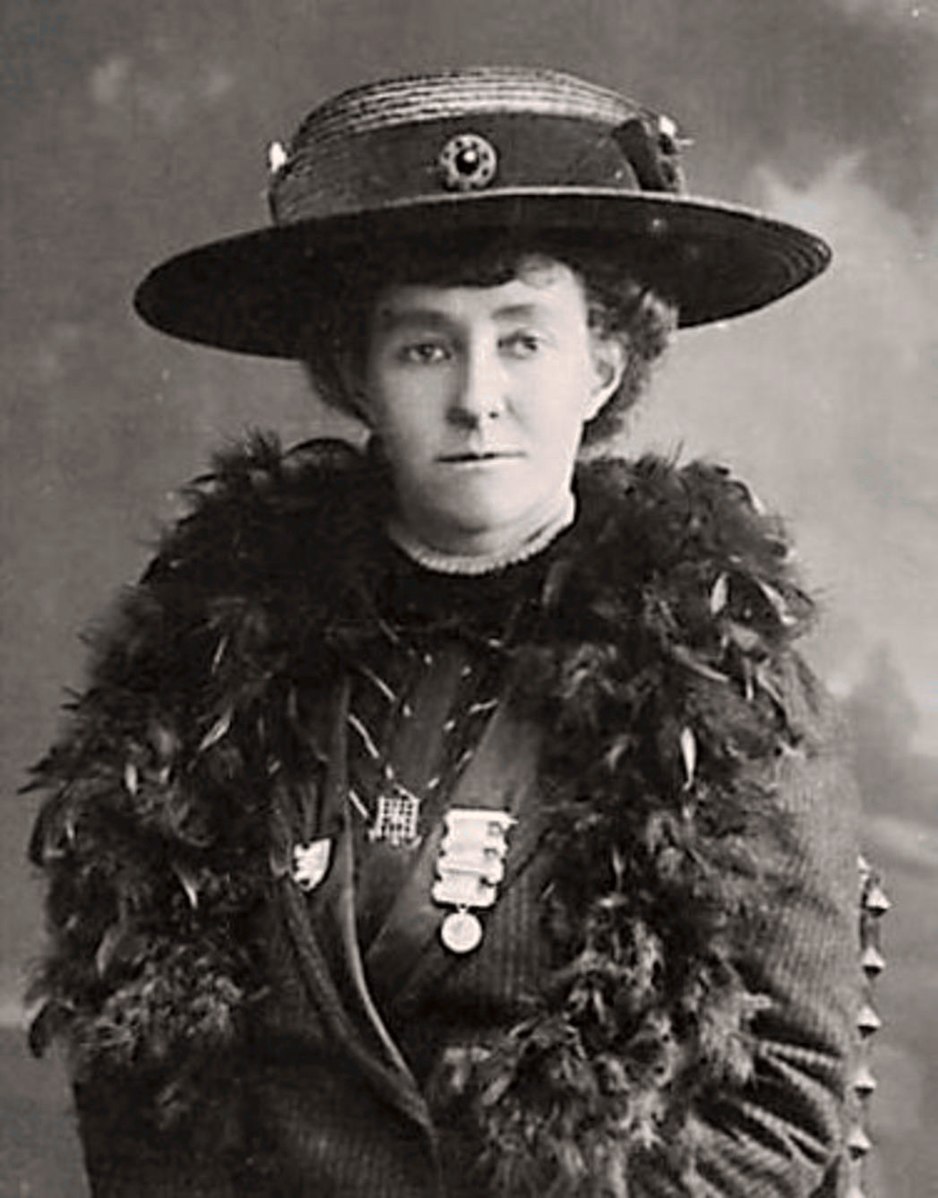
Here we see Emily Wilding Davison, one of the most famous suffragettes, wearing her Hunger Strike Medal c. 1912. Now, well over a century later, these medals are a familiar sight, appearing surprisingly often at auction, as the price they attract tempts descendants to sell. But the history of the WSPU Hunger-Strike Medal is not uncomplicated.
My research would indicate that the first WSPU members to be awarded medals as a reward for hunger striking stood in the dock at Bow Street Police Court on 30 June 1909, 114 years ago today. The previous evening they had been arrested when taking part in a deputation to the Houses of Parliament, led by Mrs Pankhurst, who was carrying a petition from a large WSPU meeting in Caxton Hall.

WSPU flyer advertising the 29 June deputation (from my collection)
The case was adjourned and on 12 July thirteen women were found guilty of stone-throwing – breaking windows in Whitehall. They duly served their sentence in Holloway and, following the example of Marion Wallace-Dunlop, who had recently been imprisoned for a a different offence, went on hunger strike. Like Wallace-Dunlop, the 13 hunger strikers were released without being forcibly fed. The authorities had not yet arrived at the solution to that particular problem.
I will now take you back to an event that took place a few weeks earlier, on 16 June 1909, when WSPU member Patricia Woodlock, who had been imprisoned for three months in Holloway – but had not been on hunger strike – was presented with a ‘For Valour’ medal at a ceremony described in Votes for Women (18 June 1909, p. 810). I think that this was the very first medal presented to a WSPU ‘foot soldier’ and, although there is now no trace of it, I assume that it took its name from ‘For Valour’ engraved on the medal’s top bar.
Although I can find no contemporary reference to the sequence of events, my thinking is that when the women who had taken part in the 29 June 1909 deputation were eventually released, after their hunger strike, the WSPU chose to honour them with medals identical to that designed for Patricia Woodlock.
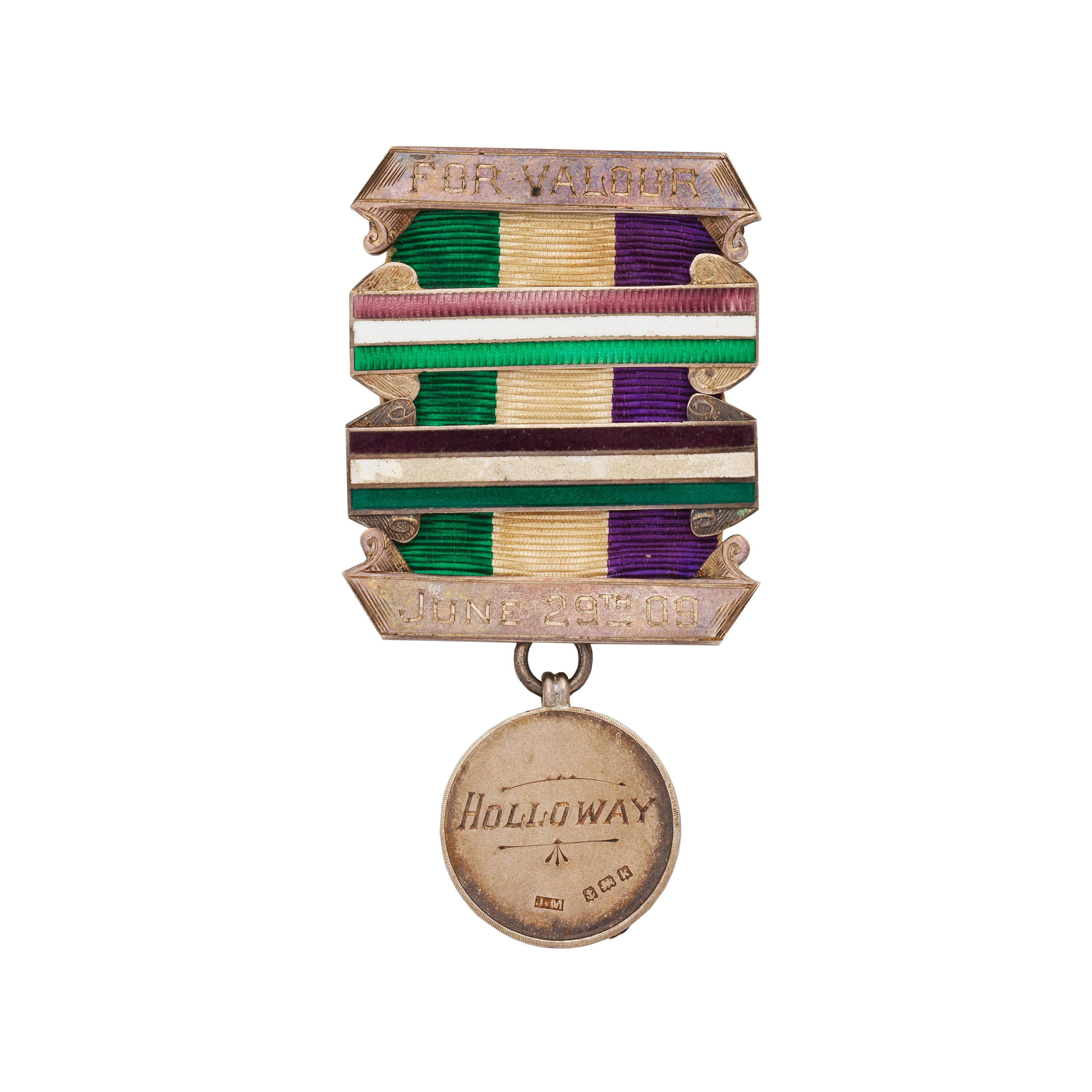
Ada Wright’s ‘Holloway’ medal (Image courtesy of Bonhams)
These medals were presented by Mrs Pankhurst at a ceremony at St James’ Hall, Great Portland Street, as reported in Votes for Women, 6 August 1909. Two of the medals have resurfaced. That awarded to Theresa Garnett is held by the Museum of London and that to Ada Wright was recently sold at auction. This batch of medals makes no mention of the hunger-strike (unlike the later, more common, more famous version); instead, the roundel depending from the bottom bar is engraved with the word ‘Holloway’. The fact that the recipients had been on hunger strike was not yet commemorated in the medal wording.
However, in early November 1909 another medal presentation ceremony took place, held in Birmingham Town Hall (see Votes for Women 5 Nov 1909, p 84) . As far as I can discover this was only the second such medal presentation. The recipients were WSPU members who had protested at the meeting held by Asquith in Bingley Hall in September, had been arrested, sentenced and had gone on hunger strike and been forcibly fed in Winson Green Prison.
Mabel Capper’s medal, commemorating her hunger strike, presented to her in Birmingham in November 1909
Although the medal is described in Votes for Women as the ‘For Valour’ medal, I am sure this was the first occasion on which the medal with the ‘Hunger Strike’ roundel was presented – for research reveals a photo of the medal presented on this occasion to Mabel Capper, with the ‘Hunger Strike’ inscription on the roundel.
By the way, if you wonder what happened to Emily Wilding Davison’s hunger-strike medal, you might like to read a piece I wrote about it a while ago
And be very careful to research for authenticity any hunger-strike medal offered for sale.
Copyright
All the articles on Woman and Her Sphere are my copyright. An article may not be reproduced in any medium without my permission and full acknowledgement. You are welcome to cite or quote from an article provided you give full acknowledgement
Collecting Suffrage: Fake Flags – Or Why Researching Material Culture Matters
Posted by womanandhersphere in Collecting Suffrage on June 19, 2023

Led by Miss Kerr, who is carrying a WSPU flag, suffragettes parade outside the WSPU offices in Clement’s Inn (image courtesy of Women’s Library@LSE)
When I started in business nearly 40 years ago as a dealer in books and ephemera, specialising in the lives of women, there was little need to think twice about the authenticity of any appealing object. I do remember being very careful to check that a signature on, say, a photograph of Mrs Pankhurst was penned rather than printed but, in those days, ‘women’ as a class had not attracted the attention of scammers. How times have changed. And that change is particularly manifest in objects associated with the suffragette movement.
Nowadays I take extreme care, perhaps bordering on paranoia, to check the authenticity and provenance of any object before I add it to stock. For unscrupulous dealers are now ridiculing the suffragette movement by creating and selling objects that claim to be associated with the WSPU. Perhaps, unsurprisingly, the NUWSS has not attracted this attention, scammers knowing where lies the popular appeal.
This trade disturbs me on several levels. I am upset to see those with no knowledge or interest in the suffrage movement traducing the historical record, I am upset to see buyers disappointed when, thinking they have acquired an original object, they discover they have not, and I am particularly worried when, as has happened, a public collection acquires a spurious suffrage artefact.
It may be useful to present the history of one element of suffragette material culture that currently concerns me: the phenomenon of the WSPU flag currently flooding the market.
It was probably three or four years ago that a purple, white, and green flag first appeared on an eBay site. Along the white side selvedge strip was printed the legend ‘WPSU 3 & 4 Clement’s Inn, Strand W.C.’. I have not kept a record of the price this object fetched, but it was, if memory serves, several hundred pounds. Another book dealer contacted the seller to point out that this flag was unlikely to be original, as the initials were incorrect – ie ‘WPSU’ rather than ‘WSPU’. He did not receive a reply, but answer was made in kind as another flag then appeared – with the middle two letters cut out – leaving only the ‘W’ and the ‘U’ – and the (correct) address. Laughable, really. In fact, at the moment (June 2023) one of these flags is available for sale on eBay – for £260 – although now the whole of ‘WPSU’ has been raggedly removed, leaving only the address.
Most of the flags now boast a ‘Votes for Women’ slogan across the central white stripe and have a variety of marks on the white webbing at the side. Currently (June 2023) there are 7 WSPU flags for sale on eBay: one is marked with ‘1912’, two with ‘London 1908’, one with ‘London 1910’, and two with ‘1910 WSPU’ (both of these listed by the same dealer). The flags are priced at between £149 and £895.
Between March and June 2023 27 ‘original’ WSPU flags were sold on eBay– their prices ranging from £58 to £310. Again, they are printed on the selvedge with dates and places – such as ‘Bath 1912’, ‘London 1914’ etc. They variously claim to have been found in ‘a box at an antiques fair’ or from ‘a deceased estate’.
A number of these flags have moved from eBay to terrestrial auctions and, on the whole, auctioneers do remove them from a sale once doubts are expressed as to their originality. I note that one auctioneer who initially refused to withdraw one of the flags from sale – and has since sold several more – does at least now note that their authenticity cannot be guaranteed. The flags have, of course, moved out of salerooms and are now to be found at antiques markets and fairs and I accept that, as they move further from their source, vendors may well not realise that they are selling fakes.
I have not inspected any of these flags in person – my reasons for knowing that they are not ‘right’ is based on my many years of archival research and on my hard-acquired knowledge of the trade in suffrage ephemera. At the most basic level, if you study the Flickr account of the Women’s Library@LSE, perhaps the most extensive photographic record of the suffrage movement available to view on the internet, you will note that there is no evidence of the WSPU flag as is currently being traded. At the head of this post is one of the few photographs to show a WSPU flag (we presume it is purple, white, and green but, of course, the photograph is in black and white). However, you will note that the orientation of the stripes is such that one of the colours (purple or green?) lies against the carrying pole, whereas on that of the fake flag all the colours meet the pole. That is to say, the stripes on the flags currently being sold are lying horizontally, whereas they should be positioned vertically. In addition, I do not remember seeing a ‘Votes for Women’ slogan imposed on a purple, white and green flag; they are invariably plain. I suspect that any analysis of the material and method of manufacture would indicate a 21st rather than early-20th century provenance.
The Women’s Library photographs do, of course, contain innumerable images of all manner of other banners and it was exactly because I am always so worried about fakery that when, in 2017, I spotted an amazing Manchester banner coming up for sale at a little-known auction house, I alerted first the Working Class Library and, through their archivist, the People’s History Museum because I thought it essential for a textile expert to inspect it in person in case somebody had taken it upon themselves to fake it. Fortunately, it was ‘right’ and now hangs in pride of place in the PHM.
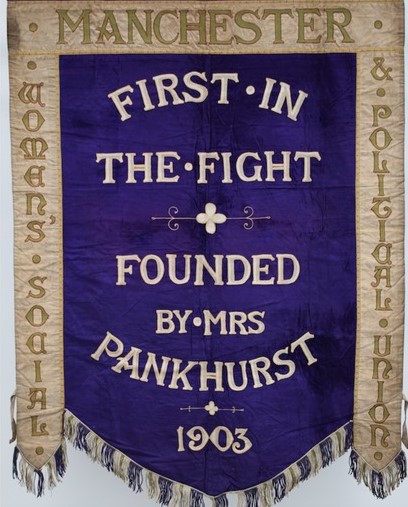
The Manchester WSPU banner (image courtesy of the People’s History Museum)
And that is why I hope that no well-meaning donor will think of presenting their local museum with one of the spurious ‘Votes for Women’ flags for, by allowing the scammers to muscle in on our history, we are demeaning everything that is ‘right’.
Cynic that I am in such matters, I only hope this post does not encourage scammers to create more accurate reproductions.
Copyright
All the articles on Woman and Her Sphere are my copyright. An article may not be reproduced in any medium without my permission and full acknowledgement. You are welcome to cite or quote from an article provided you give full acknowledgement
Suffrage Stories and The Garretts and their Circle: Millicent Garrett Fawcett: Selected Writings – Zoom Talk
Posted by womanandhersphere in Suffrage Stories, The Garretts and their Circle on October 5, 2022

Here is a link to the recording of the Zoom Book Launch of Millicent Garrett Fawcett: Selected Writings.
My co-editor, Prof Melissa Terras, and I discuss, in some detail, Millicent Fawcett’s life, work, and writings – and the importance of the digital to the archival as a means of undertaking this act of feminist interpretation and exposition. There are pictures!
We are in conversation with Prof Fiona Mackay (University of Edinburgh School of Political Science), the event hosted by the University of Edinburgh Centre for Data, Culture and Society.
Millicent Garrett Fawcett: Selected Writings is published by UCL Press and is available to download, with free open access, or to buy in hard copy – for details see here.
Suffrage Stories: Suffrage in South Devon – Watch My Zoom Talk
Posted by womanandhersphere in Suffrage Stories on September 29, 2021
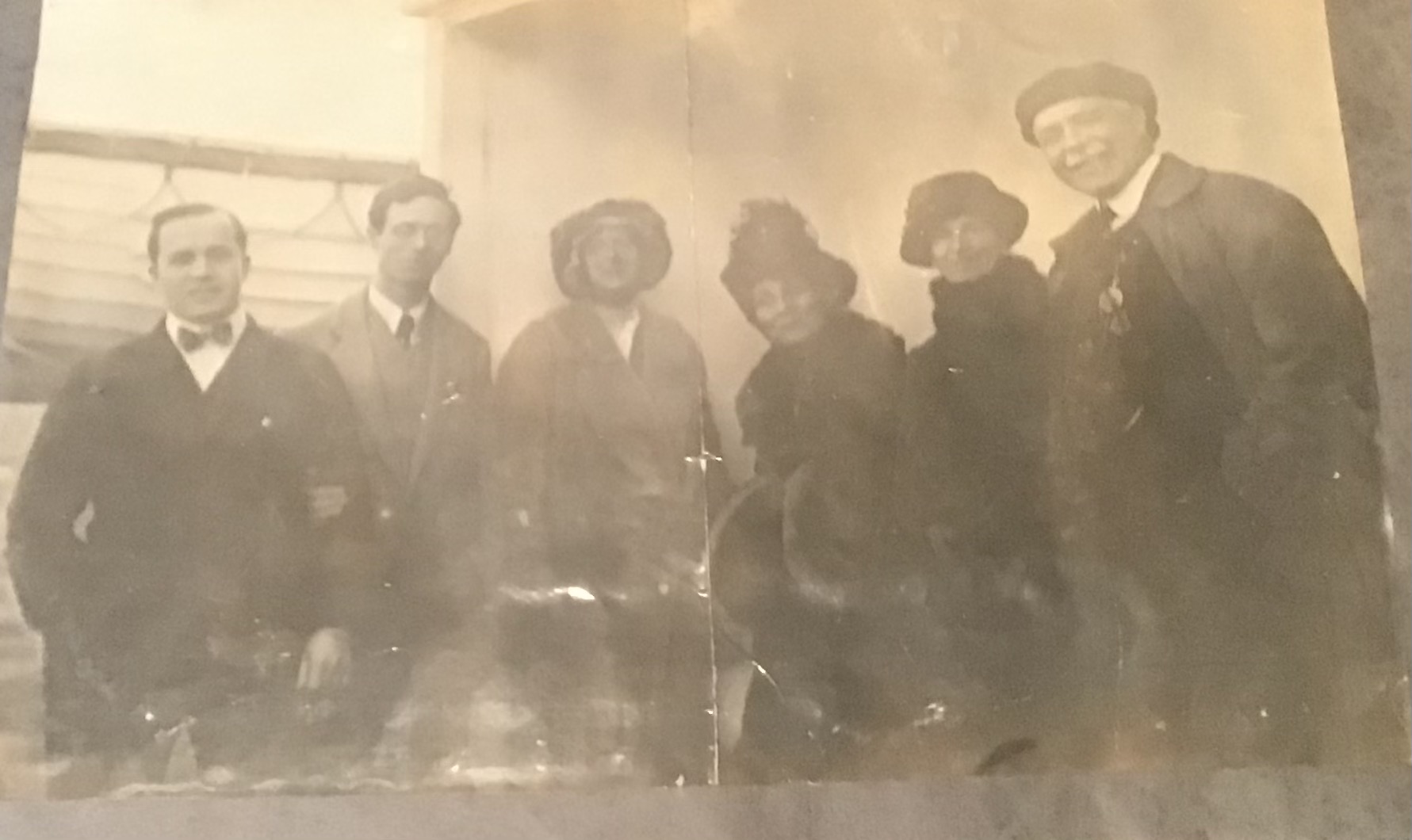
Here is a link to the Zoom talk on the women’s suffrage campaign in South Devon that I gave on 25 September as part of Torbay’s Heritage Lecture Day. The fully-illustrated talk traces suffrage activity in the area from its beginnings in 1866 – through the 19th and 20th centuries.
Collecting Suffrage: Photograph of Mrs Fawcett, 1890
Posted by womanandhersphere in Collecting Suffrage on September 3, 2020

Today I offer you a studio photograph of Millicent Garrett Fawcett by W & D Downey. Published by Cassell & Co, 1890. She was 43 years old and had already been a leading light of the women’s suffrage movement for over 20 years.
A very good image – mounted. Suitable for framing. £40 + VAT in UK & EU.
In the past I have been concerned about the low profile afforded popularly to Mrs Fawcett. Indeed, in 2013 I wrote a post on the subject: Make Millicent Fawcett Visible.
And in 2016 when there was a suggestion that there should be a statue of a ‘suffragette’ in Parliament Square I did point out that there was already one nearby to Mrs Pankhurst (which I was also determined would not be moved) and one, so often forgotten, to the suffragette movement in general, just down Victoria Street in Christchurch Gardens. That resulted in another post – on Suffragette Statues.
As we all know, the idea of a ‘suffragette’ statue in Parliament Square morphed, thanks to input from Sam Smethers and the Fawcett Society, into the already well-loved statue of Mrs Fawcett. So that she is now indeed publicly visible.
Yesterday’s photograph of Mrs Pankhurst proved very popular, but if you would like demonstrate your loyalty to Mrs Fawcett, here is an excellent opportunity to acquire a photograph of her with which to adorn your desk or wall.
Do email me if you’re interested in buying. elizabeth.crawford2017@outlook.com
Collecting Suffrage: Photograph Of Mrs Emmeline Pankhurst c 1907
Posted by womanandhersphere in Collecting Suffrage on September 2, 2020
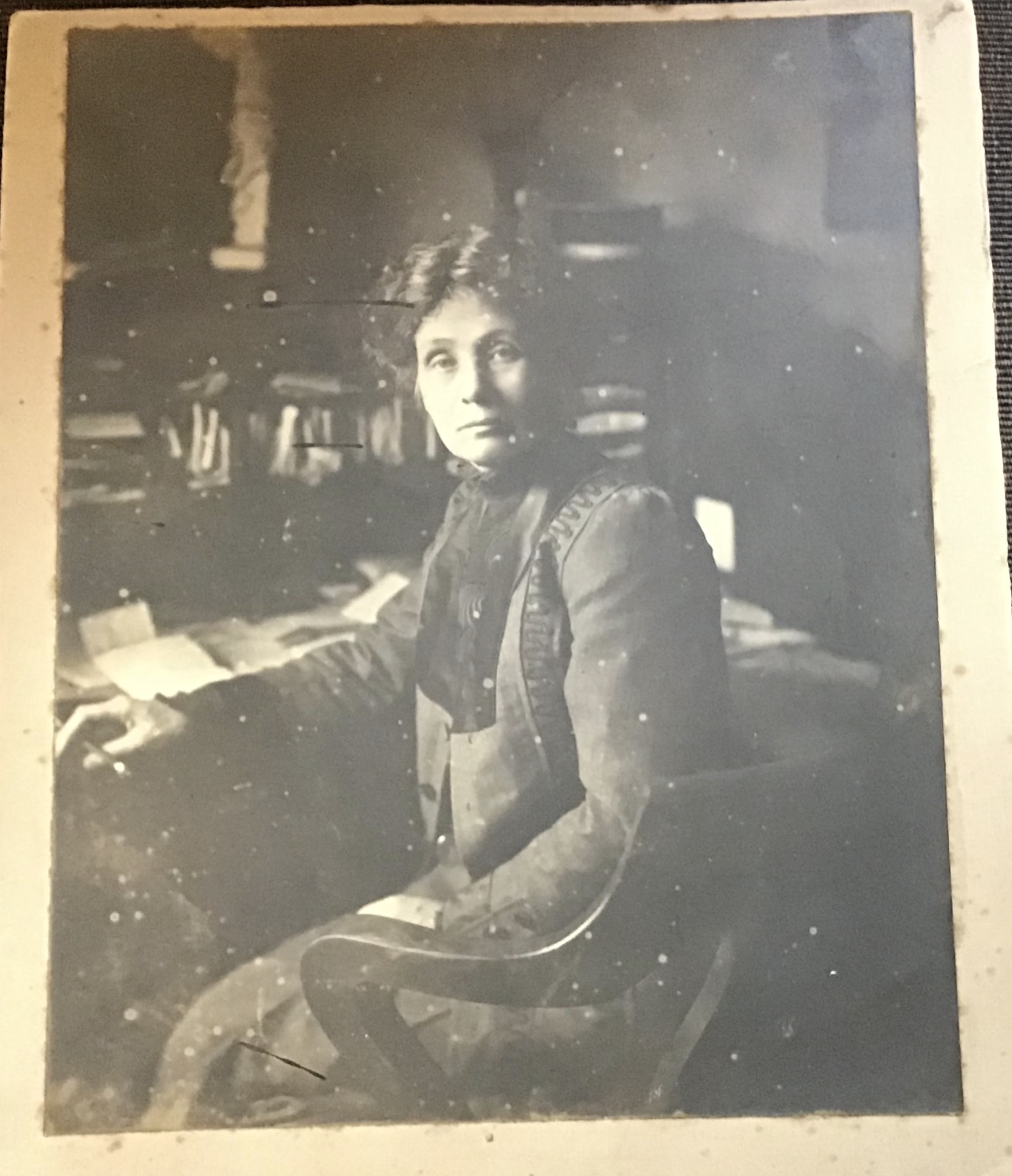
This photograph of Mrs Emmeline Pankhurst probably dates from c 1907, taken at her desk in Clement’s Inn, headquarters of the Women’s Social and Political Union.
The photograph comes from the collection of Isabel Seymour, who was an early WSPU supporter working in the WSPU office.
The photograph is mounted and is 15 x 20 cm (6″ x 8″) and is in good condition for its age. SOLD
Do email me if interested in buying. elizabeth.crawford2017@outlook.com
Collecting Suffrage: The Church League For Women’s Suffrage Paper
Posted by womanandhersphere in Books And Ephemera For Sale, Collecting Suffrage on August 5, 2020
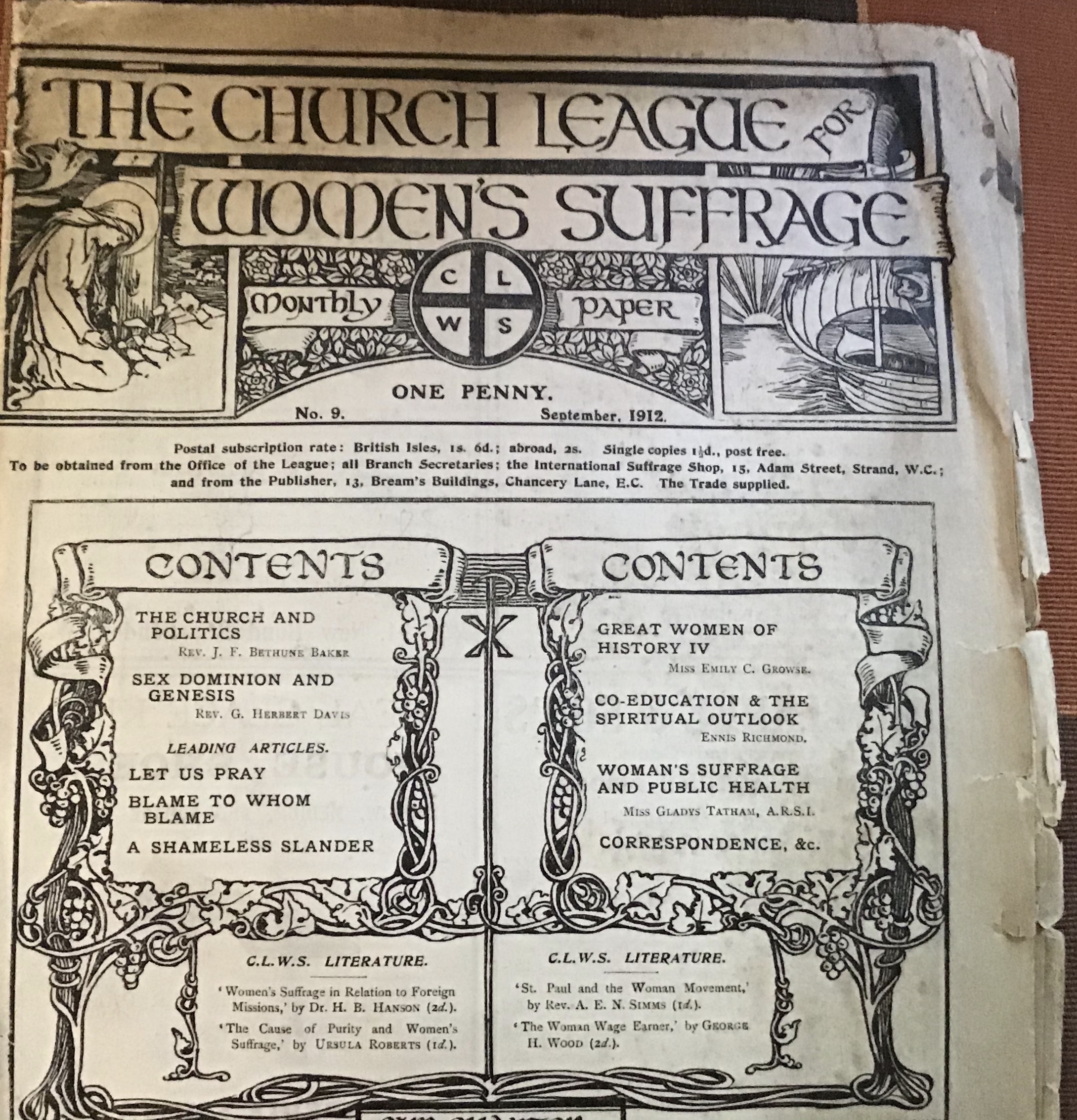
The paper of the Church League for Women’s Suffrage was published monthly from January 1912. This is the issue for 9 September 1912. Issues of the paper are scarce and this one is in good condition for its age – packed with information. For sale – SOLD
If interested email me: elizabeth.crawford2017@outlook.com
Kate Frye’s Diary: What Was Kate Doing One Hundred Years Ago Today – The Day She Appears On Our TV Screens?
Posted by womanandhersphere in First World War, Kate Frye's Diary on August 17, 2014
Tonight Kate Parry Frye – in the guise of Romola Garai – appears on our television screens (Sunday 17 August, ITV at 9pm). What was she doing on this day 100 years ago?
Kate was still on holiday from her work with the New Constitutional Society for Women’s Suffrage, spending the time with her sister and mother in their rented rooms at 10 Milton Street, Worthing. However, this was no summer idyll such as the Fryes had enjoyed in days gone by. Then they had rented a large house and travelled down from London with their four servants, to spend a season by the sea. Now that they were virtually penniless, these rented rooms were all they could call home. In the life of Kate and, more tragically in that of her sister, we see the jarring disconnect when young women, brought up to a life where marriage was to be their only trade, are left with insufficient money to support their social position and expectations. As such Kate’s life story is very much a tale of its time.
Monday August 17th 1914
Gorgeous day. Up and at house work. Out 12.30- just to the shops. Wrote all the afternoon and after tea to 6. Papers full of interest. Preparing for the biggest battle in the World’s History. There is no doubt the English have landed over there. I hear from John most days – that he is very busy but not a word of what his work is. Mickie [her Pomeranian] and I went out after tea. Agnes still a bit limp.
John Collins, Kate’s fiancé, who had long been an officer in the Territorial Army, had already been recalled to his barracks at Shoeburyness – leaving his engagement with a touring repertory theatre company. Kate’s sister, Agnes, at the first hint of the European trouble had taken to her bed, prostrate. Kate, a would-be playwright, was busy writing – although exactly what she was writing at this time she doesn’t divulge. On her death forty-five years later she left behind a box of unpublished scripts – and one that was published. She hoped one day to achieve fame and fortune. As it was she would soon be back at work at her suffrage society’s headquarters – with a new role as organizer of their War Work Work Room.
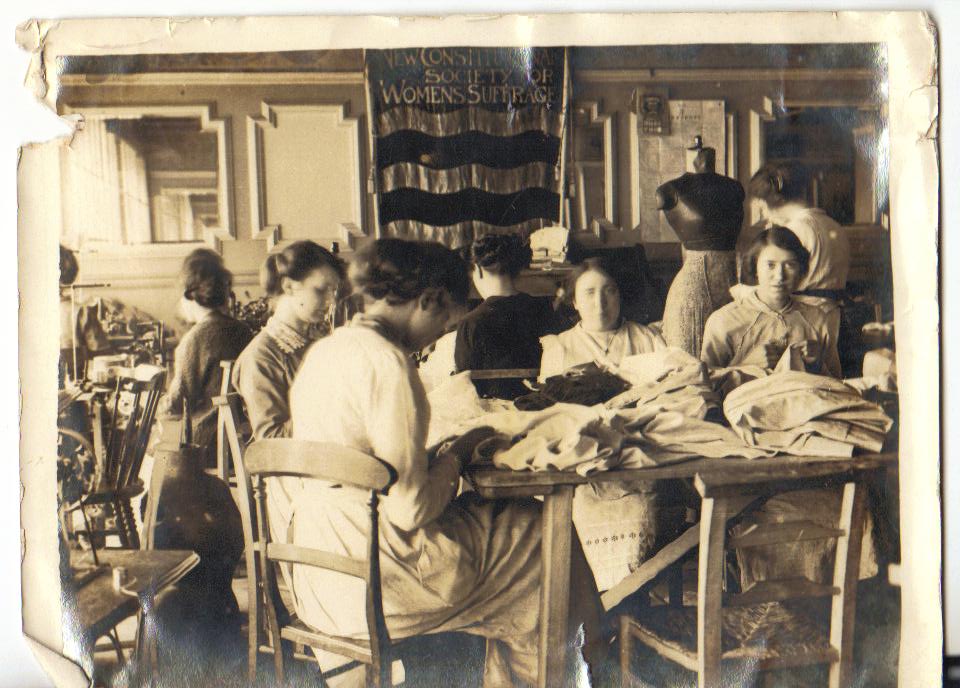
Work Room set up by the New Constitutional Society for Women’s Suffrage – of which Kate was in charge. Note the NCS flag in the background.

To discover more about the entirety of Kate’s life – her upbringing, her involvement with the suffrage movement, her marriage, her London flats, her life in a Buckinghamshire hamlet, her love of the theatre, her times as an actress, her efforts as a writer, her life on the Home Front during two world wars, her involvement with politics – and her view of the world from the 1890s until October 1958 – download the e-book – £4.99 – from iTunes – : http://bit.ly/PSeBKPFITVal. or £4.99 from Amazon.
I’d love to hear what you think of Kate and the life she lived.
To read in detail about Kate’s involvement in the women’s suffrage campaign – in a beautifully-produced, highly illustrated, conventional paper book – see Campaigning for the Vote: Kate Parry Frye’s Suffrage Diary.
Copyright
Suffrage Stories: Mrs Frood, Topsham’s Suffragette/ist
Posted by womanandhersphere in Suffrage Stories on July 4, 2013
Some time ago, when researching a talk, ‘No Vote No Census’, that I gave in October 2011 conference on the 1911 census organised by the National Archives, I came across the boycotting census form of Mrs Frood of Topsham. Since then I have passed on this discovery to a researcher associated with Topsham Museum who has been able to link Mrs Frood directly to the 1913 Suffrage Pilgrimage, the 100th anniversary of which is being celebrated in Topsham today, 4 July 2013.
The 3 March 1911 edition of Votes for Women contains a letter from Mrs M.C. I. Frood of Station Road, Topsham, in which she described how, early in the morning of the polling day for the last election (which must have been Dec 1910/Jan 1911), she went out with a pot of ‘good, white oil paint’ [I like the fact that it was ‘good] and ‘printed on the inner edge of the pavement along which voters would pass on the way to the polling station ‘Taxation Without Representation is Tyranny’ and ‘Britons never, never, never shall be slaves. I also printed it along the brick wall of my field, which they also had to pass coming and going to and from the train. ..On the large doors of my field, near the same spot, I printed ‘No Votes No Taxes’. I find my field gate a useful place to stick cartoons and cuttings from Votes for Women.’
A month later Mrs Frood was one of those suffragettes who boycotted the 1911 census. Together with one of her daughters, her servant, Beatrice Hutchings and six unknown females, to whom she had clearly given boycotting shelter, she refused to fill in any details on her census form, writing across it ‘If I am intelligent enough to fill up this paper, I am intelligent enough to put a cross on a voting paper. No Vote No Census.’
The census enumerator, Mr.H. J. Baker, reported this act of civil disobedience to the Census Office and received a reply from its Secretary, Archer Bellingham, instructing him to fill out the form with the best information he could muster. Mr Baker then annotated the letter, quoting Mrs Frood as saying to him that she had had a ‘house full’ of boycotters on census night – and ‘that I am therefore adding to Numbers 6’. With this number revealed as an arbitrary choice of the enumerator, we can only speculate as to how many Topsham women spent the night at Little Broadway House in Station Road.
Although in 1911 it would appear that Mrs Frood, as a correspondent to Votes for Women, was a supporter of the WSPU, by 1913 she is listed in The Suffrage Annual and Women’s Who’s Who as secretary of the Topsham branch of the NUWSS. Perhaps she was one of those who were dismayed by the WSPU’s increasingly militant tactics. It was one thing to paint slogans (with ‘good’ paint’) on pavements and walls, but quite another to break windows and commit arson. So it was as a leading local NUWSS member that Mrs Frood took part in the Suffrage Pilgrimage in early July 1913.
Who was Mrs Frood?
Mrs Mary Catherine Isabella Frood (nee Campbell, c. 1856-1931) had been born of Scottish parentage in Canada and was living in New Zealand when, in 1878, she married James Nicholson Frood (d. 1913), an Irish-born doctor. She had five children, the first four, all daughters, born in New Zealand and the last, a son, born at sea c 1888 – presumably as the family was returning to England. One of her daughters, Hester, was successful as an artist. Although Mrs Frood actually died in London, her address was still in Topsham – 26 The Strand (Old Court House).

26 The Strand, Topsham. Photo courtesy of Derek Harper (geograph.co.uk)
Where was Dr Frood in 1911?
Dr Frood was living with his family (whose name was misrendered as ‘Froud’) when the 1901 census was taken. But where was he in 1911? The name on the cover of the census form had been written as ‘Dr Frood’, but this had been amended to ‘Mrs Frood’ and it is she who is shown as ‘Head of Household’. I can find no trace of James Frood elsewhere in the 1911 census, although he did not die until 1913, his death registered in the local area. Interestingly under the terms of his will probate was granted to the Public Trustee rather than to his wife or any other member of the family.
Where was Little Broadway House?
Thanks to Street View I can see Station Road and the pavement along which Mrs Frood painted her slogans. Thanks to Paul Tucker (see Comment below) who tells me that Little Broadway House is still there – the house with the overhanging upper window that I can see in Street View – although now divided into two. Presumably the ground to its side was Mrs Frood’s field. So let’s take a moment to visualise its gates – decorated with Votes for Women cartoon – a reminder to those walking past on their way to the station that one Topsham woman was prepared to do her bit to win ‘votes for women’.
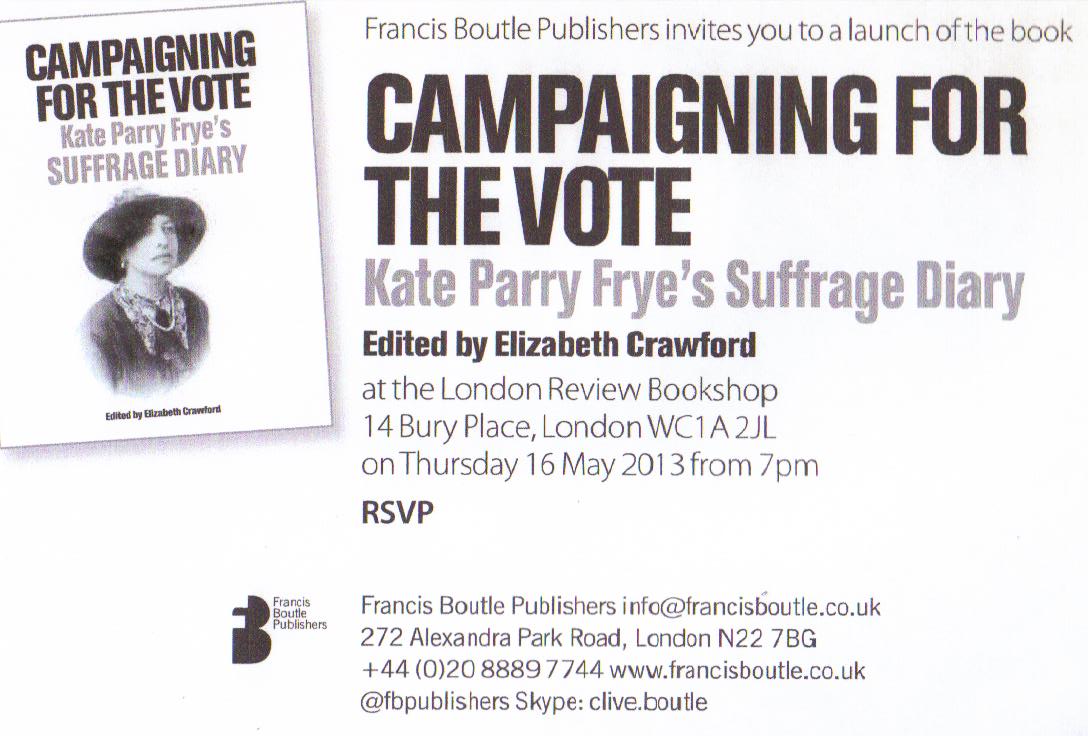
Campaigning For The Vote: Book Launch Invitation
Posted by womanandhersphere in Kate Frye's suffrage diary on May 9, 2013
Women Writers and Italy: Two Englishwomen In Rome and Sarah Parker Remond
Posted by womanandhersphere in Women Writers and Italy on March 30, 2013
Anne ( 1841-1928) and Matilda Lucas (1849-1943) were the daughters of Samuel Lucas, a brewer with land and influence in Hitchin, Hertfordshire. The Lucas family were Quakers. Their mother had died when they were young and after their father’s death in 1870 the sisters continued to live for a short time with their step-mother. But then, in mid-1871, they left England for Rome, where, for the next 29 years, they were to spend much of the year. Ten years after her sister’s death, Matilda Lucas published excerpts from the letters sent over the years by the sisters to friends and relations back in England. Two Englishwomen in Rome, 1871-1900 (Methuen, 1938) makes very interesting reading.
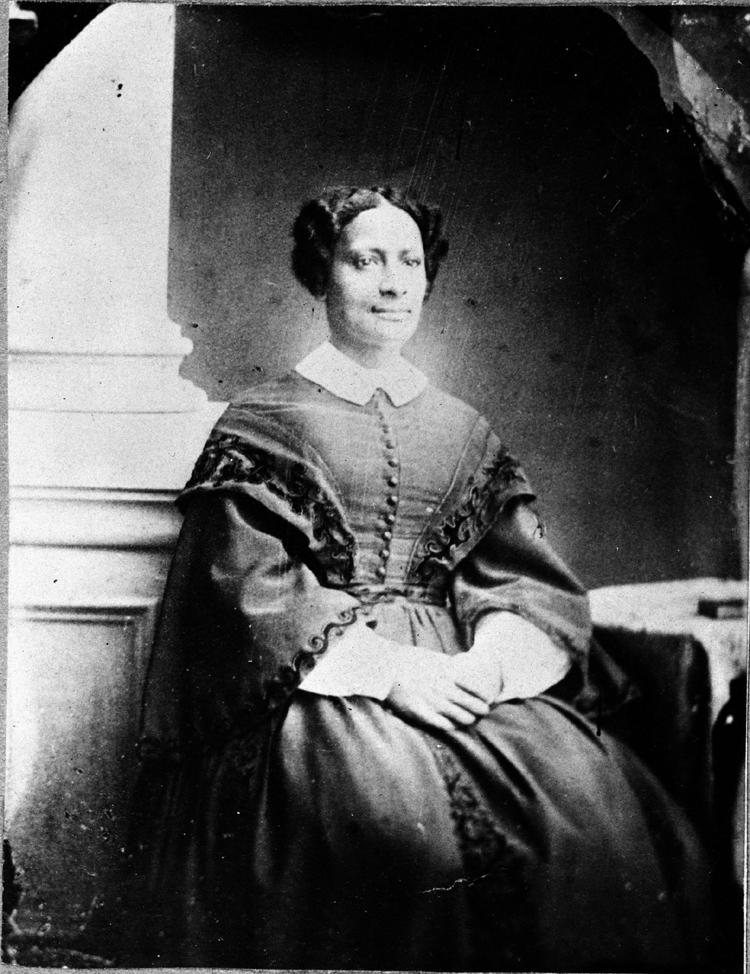
Sarah Parker Remond c. 1865 (Courtesy Peabody Essex Museum Collection)
The few disingenuous sentences I transcribe below would appear to delineate the discomfort that must have been endured by Sarah Parker Remond (1824-94) , or Sarah Remond Pintor as she was by then, as she mixed in society – even expatriate Roman society, which was by no means ruled by convention. An American free-born black woman, Sarah Remond had lived for a time in London, signing the first women’s suffrage petition in 1866, perhaps the only black woman to do so, had then travelled to Italy, where she qualified as a doctor. She had married an Italian, Lazzaro Pintor in Florence in 1877. There is some debate as to how long the marriage lasted. From the Lucas’ evidence, Pintor did not accompany his wife to this social occasion in Rome in March 1878, but Sarah was sufficiently still married to feel able to don her bridal dress.
However am I correct, I wonder, to read the passage as reflecting the curiosity and, perhaps, also slight discomfort felt by the gathering at the presence of a black woman in their midst? If Sarah was their aunt the P___s must surely have been the ‘Putnams’ – the family of Sarah’s sister, Caroline Remond Putnam, who lived with her in Italy on various occasions. If so the fact that Caroline also was ‘black’ makes the passage a little difficult to interpret. Why was Sarah specifically their ‘black aunt’? Did they have any other kind? So perhaps it was only the bridal dress that was the cause for comment. A simple scene, but something of a puzzle.
March 17, 1878. Tell Madgie that the P___s were there with their black aunt. She was a bride, having just married an Italian, and wore her bridal dress of grey silk. It must have been very trying for Mrs P____. People came up to question her. One Italian said, ‘Chi e quell’Africana?’ It appears that she is very clever, and a female doctor. She was taken up a good deal in London by different people who were interested in negroes. I think she lived with the Peter Taylors. She has given lectures. I went to sit on the sofa with her, to the amusement of Franz, who cannot rise above her appearance. Dr Baedtke was much impressed to think that anyone has had the courage to marry her, and said, ‘In that I should have been a coward.’
Click here for Sarah Parker Remond: A Daughter of Salem, Massachusetts – a very interesting website
Elizabeth Garrett Anderson Gallery At The UNISON Centre
Posted by womanandhersphere in The Garretts and their Circle on March 28, 2013
ALAS, IT WOULD APPEAR THAT THE GALLERY HAS FAILED TO REOPEN AFTER COVID CLOSURE. PLEASE PHONE UNISON TO ENQUIRE.
The Elizabeth Garrett Anderson Gallery at the UNISON Centre tells the story of Elizabeth Garrett Anderson, of the hospital she built, and of women’s struggle to achieve equality in the field of medicine.

HAElizabeth Garrett Anderson
Elizabeth Garrett Anderson (1836-1917) was determined to do something worthwhile with her life. In 1865 she qualified as a doctor. This was a landmark achievement. She was the first woman to overcome the obstacles created by the medical establishment to ensure it remained the preserve of men.
Elizabeth Garrett Anderson then helped other women into the medical profession, founding the New Hospital for Women where women patients were treated only by women doctors.
Elizabeth Garrett Anderson, by her example, demonstrated that a woman could be a wife and mother as well as having a professional career.
Elizabeth Garrett Anderson worked to achieve equality for women, being especially active in the campaigns for higher education and ‘votes for women’.
In the early 1890s the New Hospital for Women (later renamed the Elizabeth Garrett Anderson Hospital) was built on the Euston Road and continued to treat women until 2000. For some years this building then lay derelict until a campaign by ‘EGA for Women’ won it listed status. UNISON has now carefully restored the building, bringing it back to life as part of the UNISON Centre.
Two important rooms in the original 1890 hospital building have been dedicated to the Elizabeth Garrett Anderson Gallery. One is the
ORIGINAL ENTRANCE HALL
of the hospital which has been carefully restored to its original form. Here you can study an album, compiled specially for the Gallery, telling the history of the Elizabeth Garrett Anderson Hospital in words and pictures, while, in the background you can listen to a soundscape evocative of hospital life. This is interwoven with the reminiscences of hospital patients, snippets from the letters of Elizabeth Garrett Anderson and sundry other sounds to stimulate your imagination.
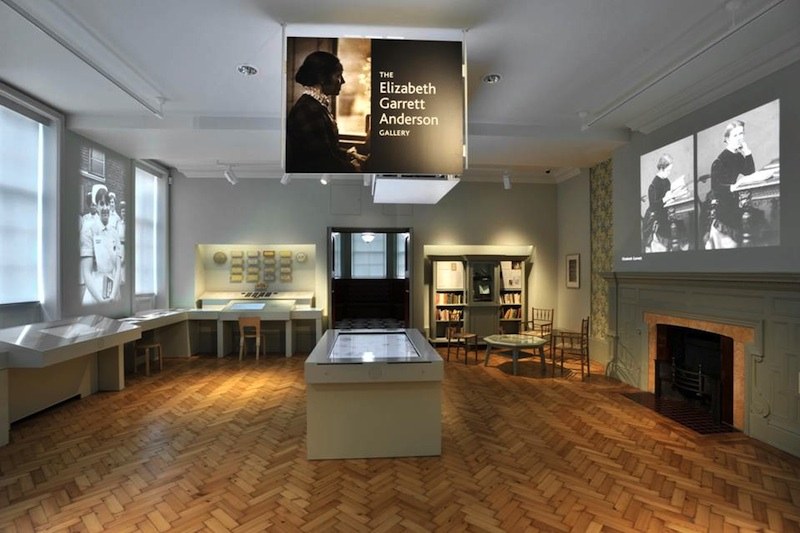
The main gallery
The other Gallery room is what was known when the hospital opened as
THE MEDICAL INSTITUTE
This was a room, running along the front of the hospital, parallel to Euston Road, set aside for all women doctors, from all over the country, at a time when they were still barred from the British Medical Association. It was intended as a space in which they could meet, talk and keep up with the medical journals.
Here you can use a variety of media to follow the story of women, work and co-operation in the 19th and 20th centuries.
A BACK-LIT GRAPHIC LECTERN RUNS AROUND THE MAIN GALLERY:
allowing you to see in words and pictures a quick overview of the life of Elizabeth Garrett Anderson and of her hospital.
AT INTERVALS ARE SET SIX INTERACTIVE TOUCH-SCREEN MONITORS
-named – Ambition, Perseverance, Leadership, Equality, Power in Numbers and Making Our Voices Heard – allowing you to access more information about Elizabeth Garrett Anderson, about the social and political conditions that have shaped her world and ours, and about the building’s new occupant – UNISON..
Each monitor contains:
TWO SHORT VIDEO SEGMENTS.
‘Elizabeth’s Story’. Follow the video from screen to screen. Often speaking her own words, the video uses images and voices to tell the story of Elizabeth Garrett Anderson’s life.
‘UNISON Now’ UNISON members tell you what the union means to them.
and four
INTERACTIVES
‘Campaigns for Justice’ and ‘Changing Lives’.
Touch the screen icons to discover how life in Britain has changed since the birth of Elizabeth Garrett Anderson.
AMBITION
Campaigns for justice
Victorian Britain: a society in flux
Victorian democracy: who could vote, and who couldn’t
Did a woman have rights?
Workers organised
Changing lives
The people’s lives in Victorian Britain
The medical profession before Elizabeth Garrett
Restricted lives, big ambitions: middle-class women in the Victorian era
Women workers in the first half of the 19th century
PERSEVERANCE
Campaigns for justice
The changing political landscape
Widening the franchise: can we trust the workers?
Women want to vote: the beginnings of a movement
Trade unions become trade unions
Changing lives
A new concept of active government: Victorian social reform
Women as nurses and carers
Living a life that’s never been lived before: women attempt to enter medicine
International pioneers: women study medicine abroad
LEADERSHIP
Campaigns for justice
Contagious Diseases Acts
Trade unions broaden their vision
Women and education
Women trade unionists
Changing lives
The middle-class century
Working women in the second half of the 19th century
Social reform, philanthropy and paternalism
Women doctors for India
EQUALITY
Campaigns for justice
The women’s suffrage movement
The Taff Vale decision hampers the unions
The founding of the Labour party
The People’s Budget
Changing lives
Work and play
Marylebone and Somers Town
Did the working classes want a welfare state?
1901 – Who were the workers in the NewHospital for Women?
POWER IN NUMBERS
Campaigns for justice
The General Strike – 1926
The first Labour governments
Feminist campaigns between the wars
1901: The lives of working women in London
Changing lives
Work of women doctors in the First World War
Can we afford the doctor? Health services before the NHS
Wartime demand for social justice
The creation of the National Health Service 1945-1948
MAKING OUR VOICES HEARD
Campaigns for justice
Equality campaigns
Public sector unions before UNISON
UNISON brings public service workers together
Are trade unions still relevant?
Changing lives
The National Health Service becomes sacrosanct
Did the welfare state change the family?
Women’s equality today
Women in medicine now
IN THE CENTRE OF THE GALLERY YOU WILL FIND:
ENTERPRISING WOMEN
an interactive table containing short biographies of over 100 women renowned for their achievements in Britain in the 19th-21st centuries. Up to four visitors can use the table at any one time. Drag a photograph towards the edge of the table to discover details of that individual’s life. Or search by name or vocation, using the alphabetical or subject lists.
ON THE WALLS OF THE GALLERY
PROJECTIONS
show a changing display of pictures of the hospital as it was and of Elizabeth Garrett Anderson and some of the other women whose stories the Gallery tells.
 THE GARRETT CORNER
is designed in the style associated with the work of Elizabeth Garrett Anderson’s sister, the architectural decorator Agnes Garrett, who was in charge of the original interior decoration of the hospital in 1890. The Gallery’s fireplace is the only surviving example of Agnes Garrett’s work. Next to this hangs a length of wallpaper, ‘Garrett Laburnum’, re-created from one of her designs.
In the Garrett Corner a display case and a low table contain a small collection of objects relevant to Elizabeth Garrett Anderson, the hospital and early women doctors.
While here do sit down and browse the library of books. These relate to the history of women – in society, in medicine, in the workplace, and in trade unions – and to the Somers Town area.
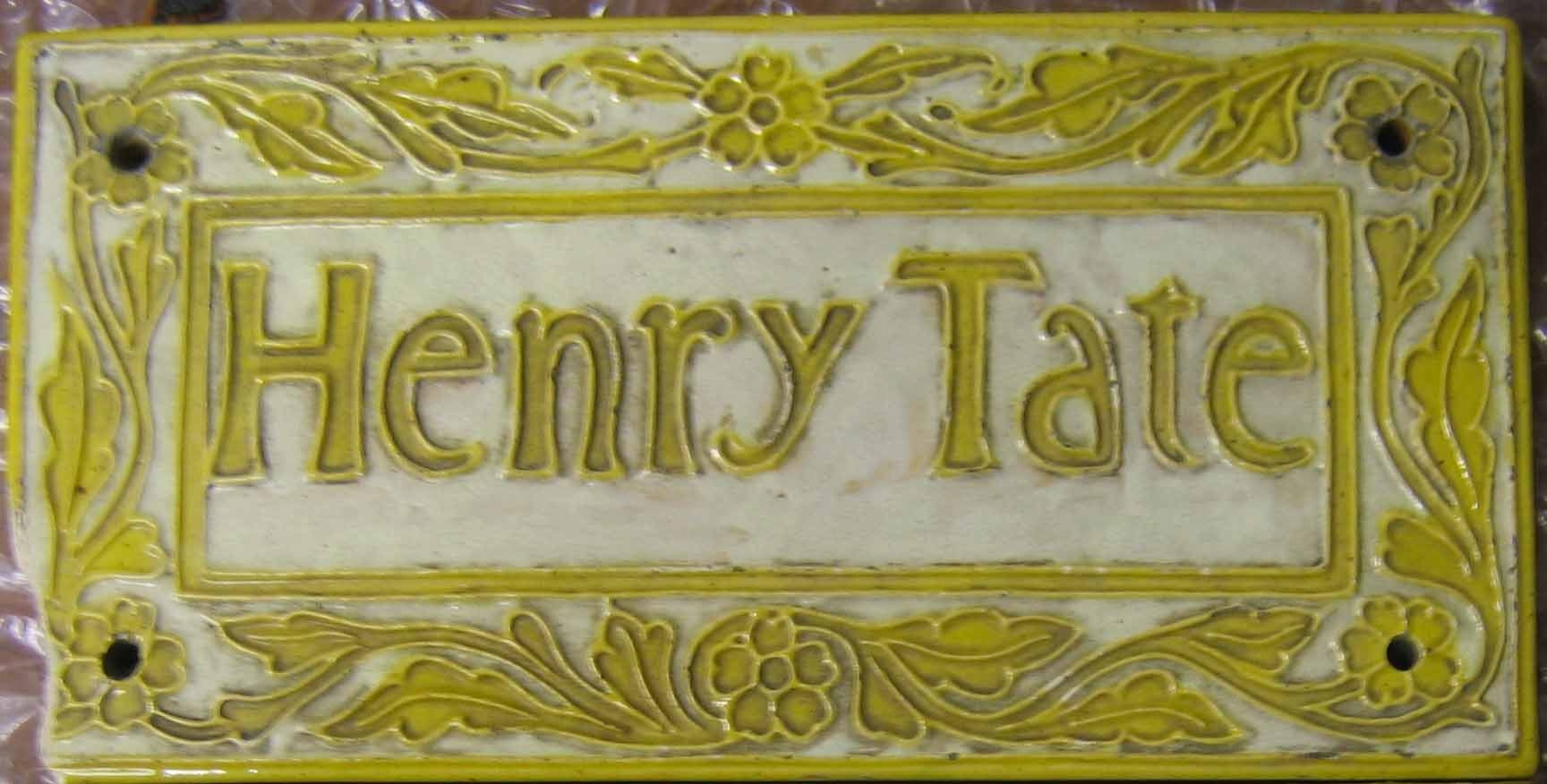
Plaque commemorating a substantial donation to the hospital by Henry Tate, industrialist and philanthropist
ACROSS FROM THE GARRETT CORNER IS A DISPLAY OF CERAMIC PLAQUES
Decorative plaques that used to hang beside patients’ beds, each commemorating a donor’s generosity.
You can read in detail about the work of the Garrett family in the fields of medicine, education, interior design, landscape design, citizenship and material culture in Elizabeth Crawford, Enterprising Women: the Garretts and their circle, published by Francis Boutle Publishers, £25. The book can be bought direct from womanandhersphere.com or click here to buy from the publisher
DO VISIT:
Elizabeth Garrett Anderson Gallery at the UNISON Centre
130 Euston Road
London NW1 2AY
Telephone: 0800 0 857 857
Open Wednesday to Friday 9.00am to 6.00pm
and the third Saturday of every month 9.00am to 4.00pm
Admission Free
Kate Frye’s Suffrage Diary: ‘Campaigning for the Vote’ Is Here
Posted by womanandhersphere in Kate Frye's suffrage diary, Suffrage Stories on March 13, 2013
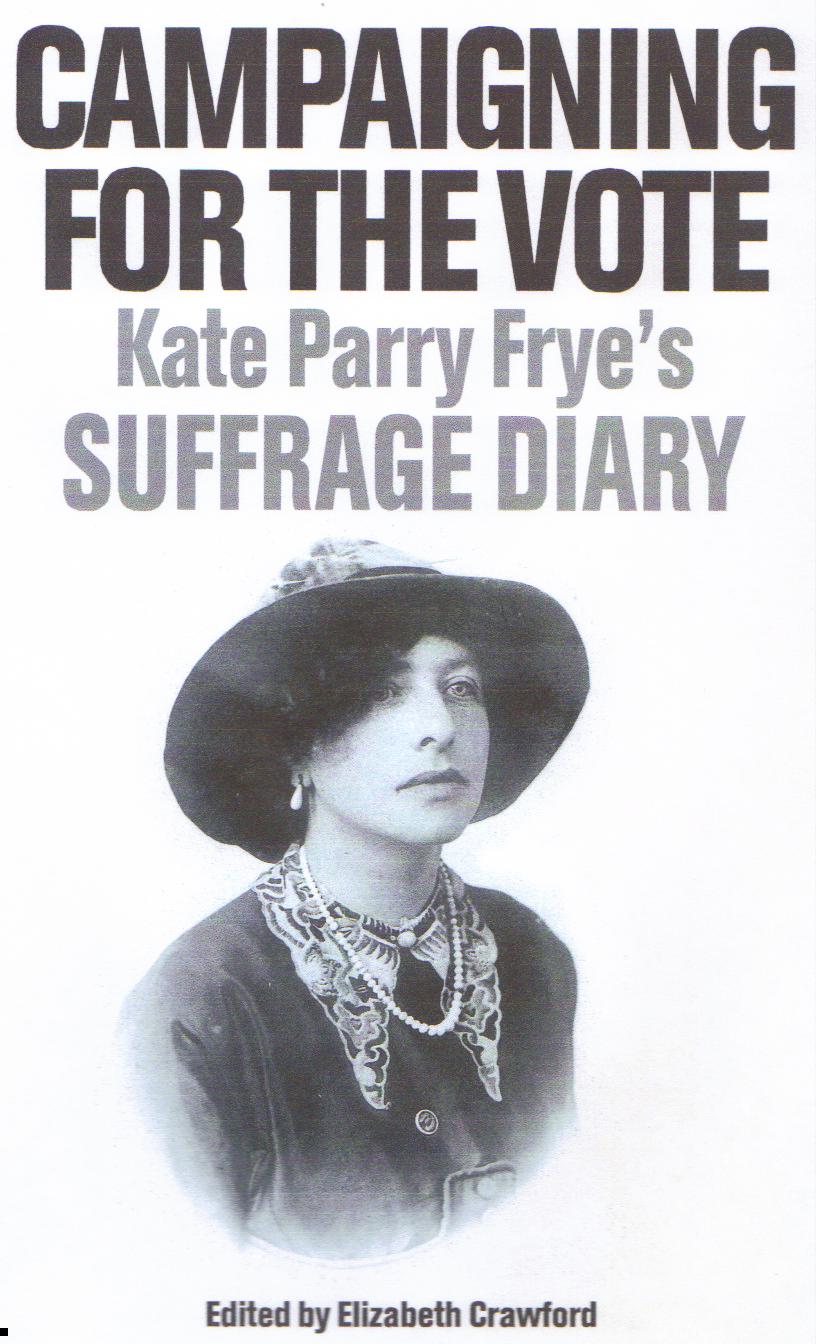 Here is the front cover of Campaigning for the Vote: Kate Parry Frye’s Suffrage Diary – published by Francis Boutle Publishers.
The key points about the book are:
- Drawn from a new primary source, Campaigning for the Vote tells, in her own words, the efforts of Kate Frye, a working suffragist, to convert the men and women of England to the cause of women’s suffrage. The detailed diary Kate kept all her life (1878-1959) has been edited to cover 1911-1915, years she spent as a paid organiser for the New Constitutional Society for Women’s Suffrage.
- No other diary gives such an extensive account of the working life of a suffragist, one who had an eye for the grand tableau – such as following Emily Wilding Davison’s cortége through the London streets – as well as the minutiae of producing an advertisement for a village meeting.
- With Kate for company we can experience the reality of the ‘votes for women’ campaign as, day after day, in London and in the provinces, she knocks on doors, arranges meetings, trembles on platforms, speaks from carts in market squares, village greens, and seaside piers, enduring indifference, incivility and even the threat of firecrackers under her skirt.
- Kate’s words bring to life the world of the itinerant organiser – a world of train journeys, of complicated luggage conveyance, of hotels – and hotel flirtations – , of boarding houses, of landladies, and of the ‘quaintness’ of fellow boarders. This was not a world to which she was born, for her years as an organiser were played out against the catastrophic loss of family money and enforced departure from a much-loved home. Before 1911 Kate had had the luxury of giving her time as a volunteer to the suffrage cause; now she depended on it for her keep.
- Kate Frye gives us the fullest account to date of the workings of the previously shadowy New Constitutional Society for Women’s Suffrage. She writes at length of her fellow workers, never refraining from discussing their egos and foibles.
- After the outbreak of war in August 1914 Kate continued to work for some time at the society’s headquarter, helping to organize its war effort, while allowing us to experience her reality of life in war-time London.
- Campaigning for the Vote is over 200pp long and contains over 70 illustrations, all drawn from Kate Frye’s personal archive. ISBN 978 1903427 75 0 £14.99
- Advance orders may be placed either with me or with the publisher – or with any good bookshop.
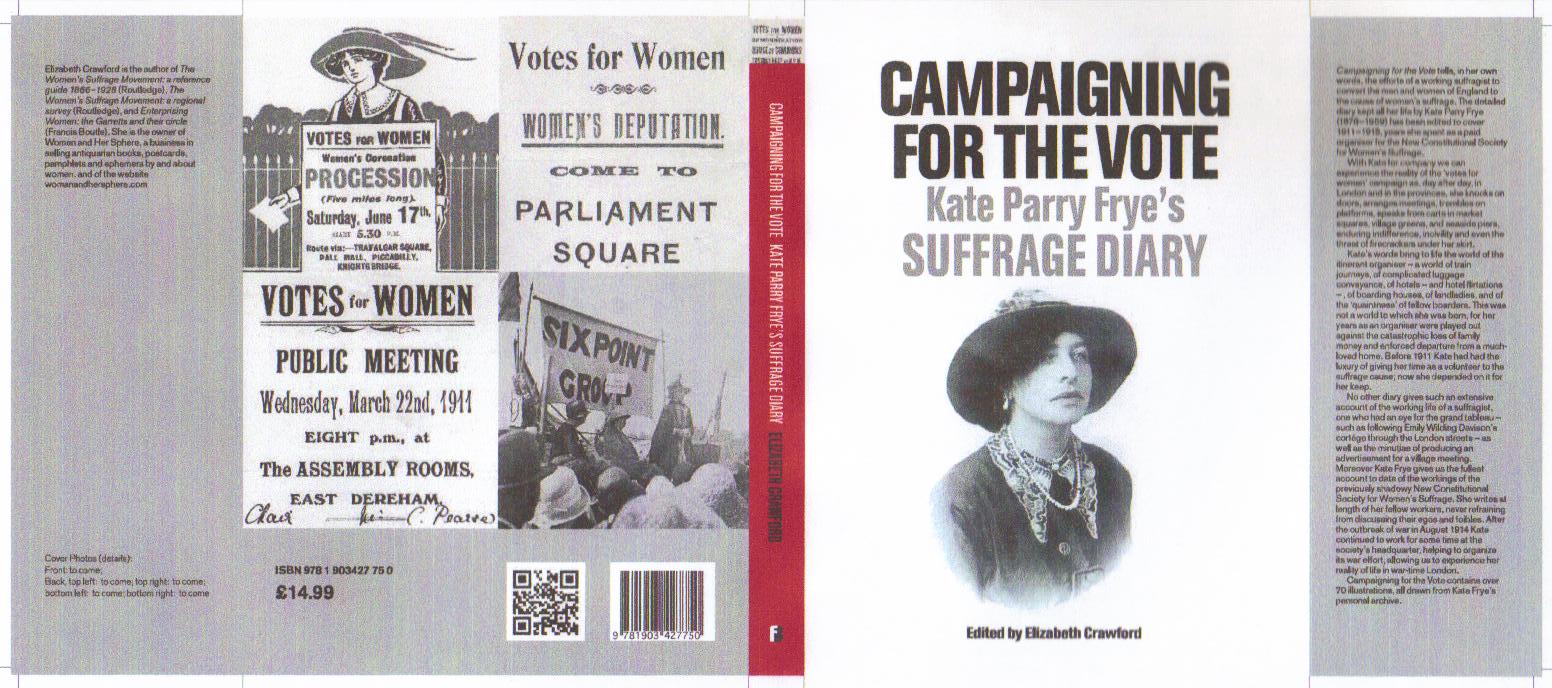
‘Campaigning for the Vote’ – Front and back cover of wrappers
Suffrage Stories: Kate Frye’s Suffrage Diary, The Royal Albert Hall, And The Importance of Gas
Posted by womanandhersphere in Suffrage Stories on March 5, 2013
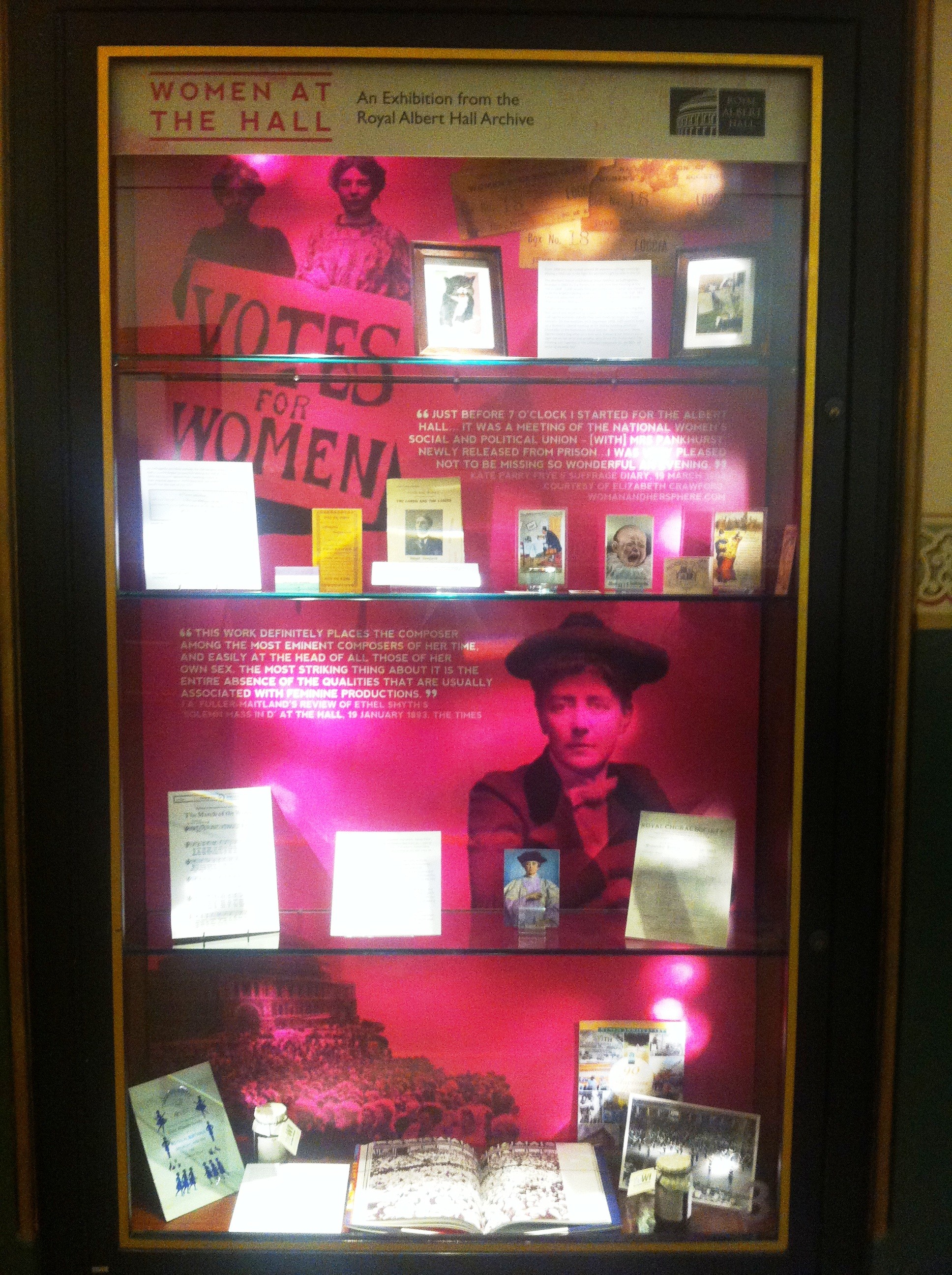 The Royal Albert Hall was the scene of many grand suffrage occasions – organised by both the constitutional and the militant suffrage societies. The management of the Hall has recognised this by supporting its archivists in mounting a small display relating to its suffrage past. The display may be viewed by anyone with a ticket to an event in the hall.
Researchers use the primary sources available and Suzanne Keyte, Project Archivist at the Royal Albert Hall, has mined what is known as the Hall’s ‘Gas Book’ to recreate a list of occasions on which the Hall was rented for suffrage-related meetings. The ‘Gas Book’ records the amount of cubic feet used each time the Hall was let for a concert or a political or a religious meeting and, with certain provisos, can be used as an indication of the size of the audience.
Kate Frye witnessed several grand suffrage occasions in the Hall. Here she describes an evening stewarding for the London Society for Women’s Suffrage at a Mass Meeting of suffrage societies in support of the Conciliation Bill
 Saturday November 12th 1910
I sat and sewed a red, green and white scarf for the evening. We had tea at 4.15 and I had a rush to dress and take Mickie [her dog] out and get off by soon after 5 o’clock. I was due at the Albert Hall at 5.30. Was given a job to do till 6.30 – or rather before – when we all went to our posts. Mine was Balcony – selling of programmes and ‘Common Causes’ [the NUWSS newspaper] & helping with the collections. The hall looked lovely – the banners were so beautifully arranged – but it wasn’t so full as I should have liked. The W.S.P.U. had a crowded meeting on Thursday and collected £8,000. Wonderful people one simply cannot hear from the Balcony. Mrs Swanwick was the only one I could really hear – her elocution is marvellous. It was so interesting seeing all the Societies – but [ie except for] the W.S.P.U. there – such lots of colours & badges – and I got very chatsome to some of my companions upstairs from the different societies.
When the meeting was nearly over I went down to the hall & tried to sell ‘Common Cause’. Old Major General Sir Alfred Turner, who was sporting around with Adeline Bourne, bought one of me with a beam and a handful of coin – he is a joke. It had come on to pour with rain and the Wrights insisted on bringing me as far as their place in their Taxi which was kind. ‘
The Hall’s ‘Gas Book’ shows that for this meeting the NUWSS consumed – and were charged for – 47,800 cubic feet of gas. On this November night one imagines that it would have been necessary to have lit all the Hall’s lamps. In fact, on 19 March 1908, when Kate Frye attended the first WSPU meeting to be held in the Albert Hall, that night’s gas consumption had been very similar- 46,800 cubic feet (click here to see Kate’s description of that meeting). From this idiosyncratic source we can deduce that the NUWSS did not lag behind the WSPU in ensuring that their evening meetings were brilliantly lit, even though, from Kate’s account, they were not necessarily able to muster as large an audience.
There was something to be said for staging meetings in the Albert Hall on summer evenings. For at the meeting held there that marked the finale to the NUWSS’s procession through London on 13 June 1908, gas consumption was only 16,000 cubic feet. We know when the meeting started because Kate Frye carefully noted in her diary that, after marching from the Embankment in the rearguard position which the Kensington branch had been allotted, she reached the Albert Hall at 5.10, just as the meeting was about to begin. Clearly less artificial illumination was required for a meeting held on an early evening in summer than for one in the winter, thereby reducing at least one element of the cost. (See here for the entry from Kate’s diary describing the procession).
Suzanne Keyte has identified c 30 suffrage meetings that were held at the Royal Albert Hall. By June 1913, however, after pressure had been exerted on hall owners throughout the country, the management of the Hall decided that they would refuse the WSPU any further lettings. What was in effect their last meeting had taken place a couple of months earlier, on 10 April.
Campaigning for the Vote: Kate Parry Frye’s Suffrage Diary edited by Elizabeth Crawford
For a full description of the book click here
Wrap-around paper covers, 226 pp, over 70 illustrations, all drawn from Kate Frye’s personal archive.
ISBN 978 1903427 75 0
Copies available from Francis Boutle Publishers, or from Elizabeth Crawford – e.crawford@sphere20.freeserve.co.uk (£14.99 +UK postage £3. Please ask for international postage cost), or from all good bookshops. In stock at London Review of Books Bookshop, Foyles, National Archives Bookshop.

- ‘Campaigning for the Vote’ – Front and back cover of wrappers
Kate Frye’s Suffrage Diary: Palmist At The Women’s Freedom League Bazaar
Posted by womanandhersphere in Kate Frye's suffrage diary on December 10, 2012
 By 1909 Kate Frye was keenly involved – as a volunteer – in the women’s suffrage campaign. Although she belonged to the constitutional London Society for Women’s Suffrage she was happy to give her services to other, more militant, suffrage societies – such as the Women’s Freedom League.
Dramatis Personae for these entries
Marie Lawson (1881-1975) was a leading member of the WFL. An effective businesswoman, in 1909 she formed the Minerva Publishing Co. to produce the WFL’s weekly paper, The Vote.
May Whitty (1865-1948) and Ben Webster (1864-1947) were a well-established theatrical couple. Kate had toured with May Whitty in a production of J.M. Barrie’s Quality Street in 1903.
Ellen Terry (1847-1928) the leading Shakesperean actress of her age.
Edith Craig (1869-1947) theatre director, producer, costume designer, and a very active member of the Actresses’ Franchise League. She staged a number of spectacles for suffrage societies, working particularly closely with the Suffrage Atelier and the Women’s Freedom League. In January 1912 Kate appeared in Edith Craig’s production of The Coronation.
Lena Ashwell (1862-1957) actress, manager of the Kingsway Theatre, a vice-president of the Actresses’ Franchise League and a tax resister.
Thursday April 15th 1909 [The Plat, Bourne End]
I went up to London at 9.50 all in my best. Went to Smiths to leave the books – then straight from Praed St to St James Park by train and to the Caxton Hall for the 1st day of the Women’s Freedom League Bazaar. Got there about 11.30 – everything in an uproar, of course. I had to find out who was in authority over me and where I was to go to do my Palmistry. I had to find a Miss Marie Lawson first and then was taken to a lady who had charge of my department and she arranged where I was to go. A most miserable place it seemed – in a gallery overlooking the refreshment room. I meant to have gone out to have a meal first – but it all took me so long running about getting an extra chair etc that I should have missed the opening. Then another Palmist hurried up – the real thing who donned a red robe. I was jealous. Madame Yenda.

Kate kept Madame Yenda’s card within the pages of her diary
We got on very well, however, and exchanged cards (I have had some printed) it was all about as funny as anything I have ever done and I have had some experiences.
Then I went back to the main room which was beginning to get thronged and stifling from the smell of flash- light photographs. I discovered Miss May Whitty and Mr Ben Webster and chatted to them while we waited for Miss Ellen Terry who was half an hour late. Miss Whitty was awfully nice and I quite enjoyed meeting her again. Ellen Terry looked glorious in 15th century costume and was very gay and larkish. Her daughter Edith Craig was there to look after and prompt her – and ‘mother’ her – what a mother to have had. I expect she had to pay for it. She is a sweet-looking woman with a most clever face – only a tiny shade of her Mother in it but Ellen Terry took the shine out of everyone – what a face to be sure. When she went round the stalls I went to the Balcony and for a little time Madame Yenda and I tried to work up there together but it was impossible. All my clients had to disturb her as they walked to and fro so at last I came out to find 3 more Palmists waiting and nowhere for them to work. One, a real professional, was very cross especially at the small fee being charged and I don’t think she could have been there long. Two other girls, looking real amateurs, were also there. So I sat a while at a table outside and told a few but it wasn’t very satisfactory and at 2 o’clock I went out for some lunch leaving the four others there. I went into a Lyons place in Victoria Street and then went back a little before 3 o’clock meaning to have a look round the Bazaar but I was pounced on to begin again and I was alone at it all the afternoon from 3 till 5.45 up in the gallery. I was left at it with sometimes just a few minutes in between but must have told 40 hands I should say. I did about 7 or 8 before 2 o’clock. We were only supposed to give 10 minutes at the outside but I could not quite limit myself and sometimes, when there wasn’t a rush, I had long talks with the people. It was very interesting and on the whole I think I was successful. Train to Praed St and to Smiths for the books and home by the 6.45.
Friday April 16th 1909 [The Plat, Bourne End]
Ribbon from the WFL Bazaar carefully preserved by Kate
I went straight to Caxton Hall by train from Praed St to St James’s Park – left some flowers at the flower stall. Mother had packed up some lovely bunches for me. Then I went up to the l[ondon] S[ociety] for W[omen’s] S[uffrage] office on business connected with the Demonstration – then back to the Caxton Hall for the opening of the Green White and Gold Fair on the second day. Miss Lena Ashwell was punctual 12 o’clock and she looked delicious and did it all so nicely. Madame Yenda was there but no other Palmists. My chatty friend, who greeted me rapturously, helped fix up the gallery a much nicer place – but clients did not come very early -they were all following Lena Ashwell – so I had 1/- from Madame Yenda myself. I think she was clever but, of course, I am rather a hard critic at it. She told me a great many things I know to be absolutely true and she gave me some good advice especially about morbid introspective thoughts and I think she is quite right. I do over worry. I am to beware of scandal which is all round me just now. She predicts a broken engagement, a rich alliance and always heaps of money. I should have immense artistic success in my profession if only I had more confidence in myself and if only I had some favourable influence (a sort of back patter, I take it) to help me but such an influence is far away. I shall never live a calm uneventful existence. I shall always spend so much of myself with and for others. I am rather glad of that. I was just beginning to tell her her hand but I wouldn’t let her pay as she told me she was very poor and I could see it when some clients came for us both and we both had to start our work.
I didn’t feel a bit inclined for work at first but got into it and had wonderful success. Kept on till 2 o’clock – went to the Army and Navy Stores then and had some fish for lunch – then back – saw the ‘Prison Cell’ for 5 and was very interested – then started work at 2.45 and never moved off my chair till 6.15. I did have an afternoon of it. Madame Yenda had gone and I was alone in my glory. I must have had quite another 40 people if not more and they were waiting in line to come in to me. I seem to delight some of the people and one or two said I quite made them believe in Palmistry. One old lady came back for another shill’oth [shilling’s worth] as I had been so good with her past and present she wanted her future. I must have been very clairvoyant as I told the people extraordinary things sometimes and they said I was ‘true’. Of course one or two I could not make much headway with but that must always be so.
Where I found I had missed my train I wanted to go on but my chatty friend was really awfully decent and would not hear of it. She said if I would tell one man who had been waiting ever so long that was all I must do and she would send the others away. There were about 18 waiting and she did – rather to my relief. I felt ‘done’
Campaigning for the Vote: Kate Parry Frye’s Suffrage Diary edited by Elizabeth Crawford
For a full description of the book click here
Wrap-around paper covers, 226 pp, over 70 illustrations, all drawn from Kate Frye’s personal archive.
ISBN 978 1903427 75 0
NOW, ALAS, OUT OF PRINT.
KATE FRYE’S DIARIES AND ASSOCIATED PAPERS ARE NOW HELD BY ROYAL HOLLOWA COLLEGE ARCHIVE
- ‘Campaigning for the Vote’ – Front and back cover of wrappers
You can listen here to a talk I gave in the House of Commons – ‘Campaigning for the Vote: From MP’s Daughter to Suffrage Organiser: the diary of Kate Parry Frye’.
Copyright
Kate Frye’s Suffrage Diary: The Mud March, 9 February 1907
Posted by womanandhersphere in Kate Frye's suffrage diary on November 21, 2012
Kate Frye had first joined a suffrage society in the spring of 1906. Her choice was the Central Society for Women’s Suffrage (later renamed the London Society for Women’s Suffrage) – a constituent society of the National Union of Women’s Suffrage Societies Interest in the long-running women’s suffrage campaign leapt ahead in the following few months and in February 1907 the NUWSS staged the first open-air suffrage spectacular – a march through the wintry, muddy London streets. For obvious reasons this became known as the ‘Mud March’. Kate’s estimate of 3000 participants accords with later reports.
Saturday 9 February 1907 [25 Arundel Gardens, North Kensington]
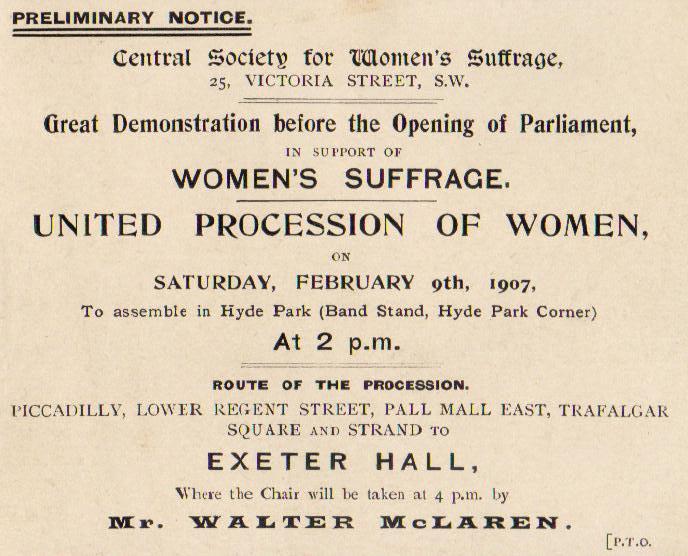 In bed for breakfast – and what was my utter disgust – and disappointment – to hear the torrents of rain – and there was not a shadow of its coming last night – it was bitterly cold. As it was so heavy I hoped it would stop – but it went on and on into a fine heavy drizzle. They said I should be mad to go in the procession and though I knew I must – I went out at 12.30 taking Mickie a walk and sent a telegram to Alexandra Wright telling her the rain prevented my joining them. I had arranged to be at their house at 1 o’clock and go with them to Hyde Park. We all had lunch. I knew I was going all the time – but couldn’t go. Off to wash my hands. 2 o’clock. ‘They will be just starting’, said I. Then as I washed I made up my mind I would go rain or no rain and – lo – the rain had ceased. I prepared a plan to Agnes. She too knew she was to be of it – both flew upstairs and were out of the house before 2.15.
We tore to Notting Hill Gate – meaning to go the quickest way. No motor bus – so we tore for the train – it came in as I started to race down. In we scrambled – had to change at South Kensington much to our disgust – but we were not kept long. We flew out at Charing Cross and up Villiers Street. No sign of the Procession of Women Suffragists in the Strand. They were timed to leave Hyde Park at 2 o’clock so I had to pluck up my courage and ask a policeman. No, they had not passed. So, knowing the route, we flew up as far as Piccadilly Circus and there in about 2 minutes we heard strains of a band and waited, anxious and expectant. The crowd began to gather and we were nearly swept away by the first part – a swarm of roughs with the band – but the procession itself came – passed along dignified and really impressive. It was a sight I wouldn’t have missed for anything – and I was glad to have the opportunity of seeing it as well as taking part in it.
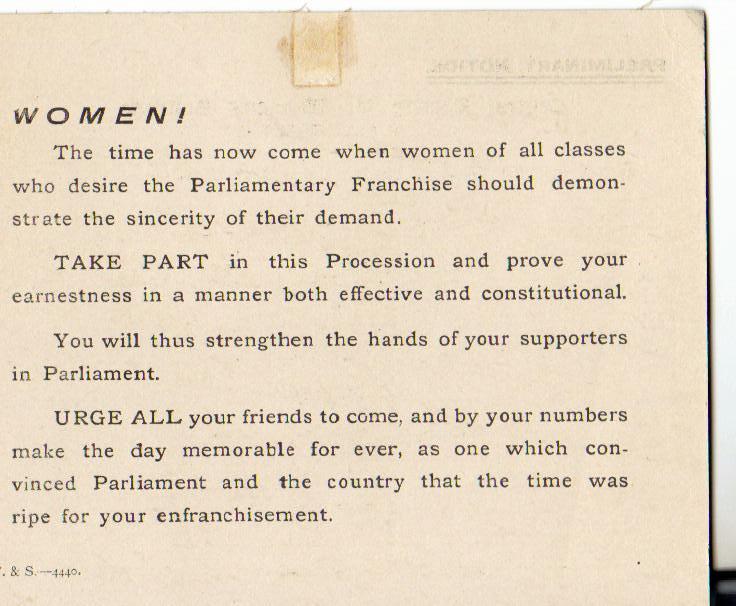 We stood right in front so as not to miss our contingent – and I asked if they knew where it was. Miss Gore Booth said it was coming and we were fearfully excited and I was so anxious not to miss our lot. I shrieked out when I saw Miss Doake’s red head in the distance and we dashed up to them and asked if we could join in. Alexandra carried our banner. Mrs Wright said come along here – it felt like boarding an express train but I suppose it was a quite simple rally though I cannot look back on it as that – but we were so excited and so anxious not to miss them. We walked three abreast – Miss Doake, Agnes and I – I was on the kerb side – behind us Gladys [Wright], Miss Ellis and Mrs Doake. North Kensington was not very well represented but I really do not know who else of us was there.
Then the real excitement started. The crowds to see us – the man in the street – the men in the Clubs, the people standing outside the Carlton – interested – surprised for the most part – not much joking at our expense and no roughness. The policemen were splendid and all the traffic was stopped our way. We were an imposing spectacle all with badges – each section under its own banners. Ours got broken, poor thing, unfortunately, and caused remarks. I felt like a martyr of old and walked proudly along. I would not jest with the crowd – though we had some jokes with ourselves. It did seem an extraordinary walk and it took some time as we went very slowly occasionally when we got congested – but we went in one long unbroken procession. There were 3000 about I believe. At the end came ever so many carriages and motor cars – but of course we did not see them. Lots of people we knew drove.
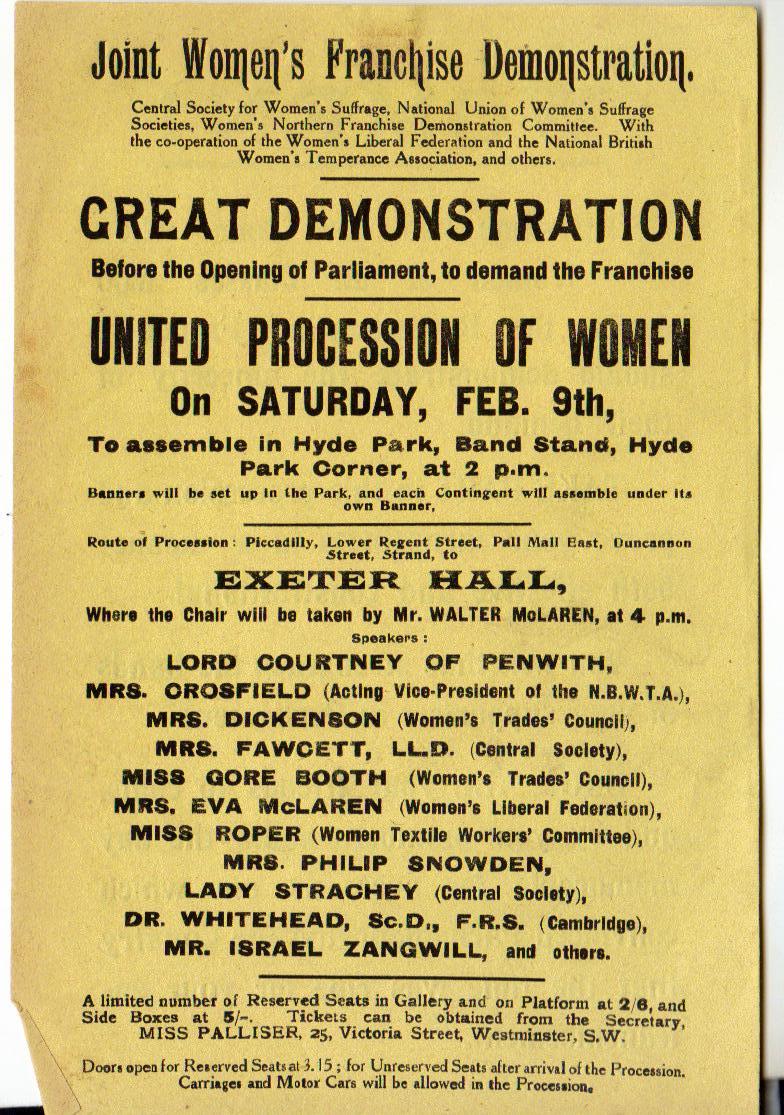 Flyer advertising the NUWSS ‘Mud March’
Up the Strand it was a great crowd watching – some of the remarks were most amusing. ‘Here comes the class’ and two quite smart men standing by the kerb ‘I say look at those nice girls – positively disgraceful I call it.’ Then ‘Ginger hair – dark hair – and fair hair’ ‘Oh! What nice girls’ to Miss Doake, Agnes and I. Several asked if we had brought our sweethearts and made remarks to express their surprise at our special little band. ‘All the prizes in this lot’ etc. The mud was awful. Agnes and I wore galoshes so our feet were alright but we got dreadfully splashed. It was quite a business turning into the Exeter Hall. A band was playing merrily all the time – the one which had led the procession – and there was one not far off us. Three altogether, I was told.
 Exeter Hall in 1905
We got good seats and of course had to wait some time before the meeting started – it was just after 4 pm when it did – but there was a ladies’ orchestra performing and playing very well and a lady at the organ in between whiles. The meeting was splendid. Mr Walter McLaren in the Chair and Israel Zangwill as chief speaker – he was so splendid and most witty. Miss Gore Booth – Mrs Fawcett – Mrs Eva McLaren – Lady Strachey and several other ladies spoke and Keir Hardie made an excellent speech. It was altogether a wonderful and memorable afternoon – and felt we were making history – but after all I don’t know, I am sure, what will come of it. The MPs seem to have cheated and thoroughly ‘had’ us all over it. They wanted the Liberal Women’s help to get into the House and now they don’t care two straws or they are frightened of us. We walked up to Tottenham Court Road and came home by bus. It was nearly 7 o’clock when we got in. .. I felt bitterly tired all the evening after the excitement.
Dramatis Personae for this entry
Agnes, Kate’s elder sister
Mickie, Kate’s beloved dog
Alexandra and her sister, Gladys, lived at 10 Linden Gardens. It was under their influence that Kate had joined the London Society for Women’s Suffrage.
Violette Mary Doake (b 1888) her parents were Irish, which may account for the red hair. Her mother, Mary Elizabeth Doake, was also a suffragist. Her father, Richard Baxter Doake, described in the 1911 census as a ‘tea planter’, was elected as a Progressive party member in 1892 to the LCC seat relinquished by Frederick Frye. In 1901 the Doakes lived at 24 Stanley Gardens, close to the Fryes. By 1911 they had moved to 25 Ladbroke Gardens.
Walter McLaren and his wife, Eva were members of a family of long-standing supporters of women’s suffrage. He had been Liberal MP for Crewe in the 1890s and regained the seat in 1910.
Israel Zangwill, Jewish novelist and very effective writer and speaker in support of women’s suffrage
Lady Strachey had worked for women’s suffrage since the 1860s. She remarked that after this march she had to boil her skirt.
Keir Hardie, first Independent Labour Party MP. He had strongly supported a motion in favour of women’s suffrage at the Labour party conference on 26 January
Campaigning for the Vote: Kate Parry Frye’s Suffrage Diary edited by Elizabeth Crawford
For a full description of the book click here
Wrap-around paper covers, 226 pp, over 70 illustrations, all from Kate Frye’s personal archive.
ISBN 978 1903427 75 0
Copies available from Francis Boutle Publishers, or from Elizabeth Crawford – elizabeth.crawford2017@outlook.com (£14.99), or from all good bookshops.
-
‘Campaigning for the Vote’ – Front and back cover of wrappers
- Campaigning for the Vote– Front and back cover of wrappers
You can also listen here to a Radio 4 programme as Anne McElvoy and I follow the route of the ‘Mud March’.
Copyright
Am I Not A Woman And A Sister: Women and the Anti-Slavery Campaign
Posted by womanandhersphere in Uncategorized on October 1, 2012
Am I Not a Woman and a Sister: women and the anti-slavery campaign
 ‘Am I not a woman and a sister’ reads the legend arching over the female figure of Justice as she reaches towards a kneeling black slave woman, who holds her chained hands up in supplication. In the 1830s this powerful emblem was used on printed matter and on artifacts associated with women-only, or ‘ladies’, anti- slavery associations. It very consciously echoed the motto, ‘Am I Not a Man and a Brother’, adopted in 1787 by the founders of the Society for the Abolition of the Slave Trade. Throughout the long years of abolitionist campaigning women were always participants, their role becoming, over the years, increasing prominent. Experience gained in a movement of such social, economic and political importance was to prove valuable when, in the 1860s, they launched the campaign to gain their own political freedom.
In 1787, however, women could take no direct part in politics, their role confined to that of exercising influence on those who did have political power. One such woman was Lady Middleton, a member of the evangelical Clapham Sect, who conducted a country-house salon at Barham Court in Kent. It was she who, according to Thomas Clarkson, in 1786 persuaded both William Wilberforce and himself to take up the anti-slavery cause. Lady Middleton’s own interest in the subject was not new. In 1782 she had been among the subscribers to Letters of Late Ignatius Sancho, the first prose work by an African to be published in England. Ignatius Sancho, born on a slave ship, had, as a child, been a house slave in London, at Greenwich.
Women’s influence extended to rather more than cajolery over the dinner table. Another member of the Clapham Sect, Lady Middleton’s close friend the writer Hannah More, was asked, in late 1787, to write a poem to draw attention to the discussion soon to take place in Parliament. She quickly composed Slavery, a Poem, published as a large, handsomely printed, 20-page book. She was just one of many women writers who wielded their pens in the abolitionist cause. Although they did not have direct power women could exercise their influence through the medium considered most suitable to their sex, poetry.
Women were also a valuable source of the finance necessary for the funding of the campaign. Although the Society for the Abolition of the Slave Trade was formed and officered by men, there was no attempt to prevent women from becoming subscribers. Subscriptions ranged from one to five guineas, sizeable sums, indicating that those donating were drawn from the middling to wealthy section of society. Fortunately for us, the Society printed a report listing by name all its subscribers. Women clearly had no more qualms at having their names listed in such a quasi-political publication than they did in appearing as subscribers to a novel or volume of poetry. It is possible, therefore, to study the names of 206 women, comprising about ten per cent of the total, who in the late-18th century made public their condemnation of the slave trade.
The main, London-based, committee attracted members from all around the country. It is noticeable that there are few obviously upper-class or aristocratic women on the list. Only three titled ladies subscribed: Lady Hatton of Longstanton, the Dowager Countess Stanhope (who gave £50), and the Dowager Viscountess Galway. A superficial investigation would indicate that all three were women associated with families with radical sympathies. Indeed the Dowager Countess Stanhope’s son, who had succeeded her husband as earl, was soon to style himself ‘Citizen Stanhope’ to demonstrate his support for revolution in France. Two others of those listed, ‘Miss Pelham and Miss Mary Pelham of Esher’ were members of an influential Whig family, counting a former prime minister amongst their forebears.
The names of some subscribers have entered the literary canon. Prominent are Elizabeth Carter (writer and ‘blue stocking’), Sarah Trimmer (evangelical educationalist and writer) and Mary Scott of Milborne Port, Dorset, who in 1774 had written a lengthy poem, The Female Advocate, in which she drew attention to Phillis Wheatley, the first slave and black woman to have a book of poetry published in Britain.
Phillis Wheatley, as depicted on the frontispiece to her ‘Poems on Various Subjects’
Information can, with some application, be teased out about many of the other names on the list. A quick Google search reveals that, at random,’ Mrs Elizabeth Prowse of Wicken Park, Northampton’ was the sister of Granville Sharp, a leading member of the Abolition Committee. That ‘Mrs Peckard, Cambridge’ was, probably Martha, the wife of Peter Peckard, vice chancellor of Cambridge University and a preacher of sermons against the slave trade. It was he who, he in 1785 had set the question, ‘Is it lawful to make slaves of others against their will?’, for the University’s Latin essay won by Thomas Clarkson, the first step in his abolitionist career.
Through the Will Search facility at DocumentsOnline on the National Archives website it is possible to read the wills of some of the subscribers and discover a little more about their lives. For example, ‘Mary Belch, Ratcliffe’ was a corn chandler of Broad Street, Ratcliffe, in east London and ‘Deborah Townsend, Smithfield Bars’ was either the wife or the daughter of a Smithfield grocer. The wills may not reveal much about their abolitionist sympathies but they do demonstrate that women from this sector of society were committed to the cause.
The will of another subscriber, ‘Elizabeth Freeman, Woodbridge’, reveals that she was a Quaker and that she left ‘to my poor relations in America twenty pounds to be disposed of by friends of the Monthly Meeting in North Carolina’. It might be presumed that with these connections she knew something of conditions in an American slave state. Further research might indicate that other women subscribers from Woodbridge were also Quakers. Some names, of course, do indicate clear Quaker connections. Five female member of the well-known Fox family of Falmouth were subscribers and, with their fellow Quakers, are likely to be traceable through the records kept by the Society of Friends.
Women were also subscribers to the separate local committees formed in provincial towns. In Manchester 68 out of total of 302 subscribers were women. However few of the names include any indication of address and are, therefore, more difficult to identify. Some were wives of men involved with the Manchester committee. One such was ‘Mrs Bayley of Hope’, wife of Thomas Bayley, Unitarian, JP and penal reformer. Here too many the female subscribers were likely to have been nonconformists, particularly Unitarians and Quakers, a large number having connections with Manchester’s manufacturing interests.
In Bristol, notorious as a slave port, subscribers to the local committee included Miss Anna Goldney and ‘Mrs Goldney’. It has to be remembered that ‘Mrs’ at that time was a title given to unmarried as well as married women and, therefore, that the latter was probably Ann Goldney, who was unmarried and had recently inherited the family’s Clifton estate from her brother. The Goldneys were Quakers although an ancestor, Thomas Goldney, had, in the early 18th century, been the principal investor in a venture leading to the capture of slaves, the family fortune enhanced by investment in the manufacturing of guns for trade with Africa. Between them, Ann and Anna Goldney, a cousin living in the Clifton household, gave a generous six guineas.
Other Bristol women subscribers were Mrs Esther Ash, Mrs Frampton, Mrs Olive and Mrs Merlott, all of whom had at least one other thing in common, being subscribers in 1787 to a translation of Persian poems by Charles Fox. It is likely some were Quakers, but ‘Mrs Merlott’ was probably the unmarried sister of John Merlott, a Presbyterian sugar refiner.
Named women also subscribed to local committees in Birmingham, Exeter, Leeds and Leicester, some of which were probably set up with the encouragement of Thomas Clarkson as he acted as roving ambassador for the Abolition Society. He also organized mass petitions that were such a novelty of this campaign, an early manifestation of the method to be used by popular protest groups throughout the 19th century. Women, however, were not signatories. It was presumably thought that if they were the value of the petition would be diminished.
Women did, though, on occasion take part in public debates about the slave trade. One such was held in 1788 in La Belle Assemblée, a concert hall in Brewer Street, Soho, London, where ‘ladies were permitted to speak in veils’. In 1792 women were also present at a debate at the Coach-makers’ Hall, Foster Lane, Cheapside calling for the boycott of West Indian sugar and rum. The motion was carried by a unanimous vote of 600.
The subject of this latter meeting was one that women were making their own. For, although denied political power, they were able, at least in theory, to influence the economy. As early as 1788 Hannah More had urged a friend ‘to taboo the use of West Indian sugar in your tea’. Women, as chief purchasers of household goods, were encouraged to boycott slave-produced sugar from the West Indies, shopping instead for that grown in the East Indies by free labour. It is thought that by 1791-92 the sugar boycott affected as many as 300,000 people.
As well as redirecting their spending power to ‘free’ produce, women were also encouraged to purchase items that would proclaim their support for the abolitionist cause.
Wedgwood jasper-ware cameo. By courtesy of the Wedgwood Museum Trust, Barlaston, Staffordshire
Thousands of Josiah Wedgwood’s ‘Am I Not a Man and a Brother’ jasperware cameos were incorporated into brooches, bracelets, earrings and hair ornaments, allowing the wearer to indicate sympathy with the abolitionist cause. The ‘kneeling slave’ image was also rendered on a variety of other artefacts and was considered a very suitable subject for young girls to embroider on their samplers.
Women could also buy china bearing anti-slavery messages. The tea table was the sphere of influence particular to the woman of the house and, while entertaining her friends, she could pass round a sugar bowl bearing the motto, ‘East India Sugar not made/By Slaves/By Six families using/East India, instead of/West India Sugar, one/Slave less is required’. By boycotting West Indian sugar and displaying articles such as this she turned herself from a passive consumer into a political activist.
Women were able to demonstrate their sensibility by buying and subscribing to the slim volumes of abolitionist poetry that were finding a popular readership. These were written by women of all sorts and conditions, by, as already noted, the evangelical Hannah More, by her working-class protogée, Ann Yearsley, by Mary Robinson, ex-mistress of the Prince of Wales, and by a succession of young women, such as Mary Birkett of Dublin. Women were also able to educate the younger generation by purchasing works such as The Negro Boy’s Tale: a poem addressed to children, published by Amelia Opie in 1802.
By then, however, the mass popular campaign had collapsed. In 1792 the British public had watched in horror as the French monarchy was overthrown by the mob and, in the same year, slaves in Saint-Domingue (Haiti) rose up against their masters. Whatever its theoretical sympathy with the anti-slavery campaign, the British public had no wish to unleash similar forces. When the act abolishing Britain’s direct involvement in the slave trade was passed in 1807 it was as a result, not of popular protest, but of parliamentary manoeuvrings, in which, of course, women played no part.
There was no further popular agitation against slavery until 1823 when Wilberforce and Clarkson once again took the lead in the formation of the Society for the Mitigation and Gradual Abolition of Slavery Throughout the British Dominions. Over the intervening years there had been a decided change in the position of women who now had no inhibition about founding their own anti-slavery societies. The first such was formed in Birmingham in 1825. Here Lucy Townsend, the wife of an Anglican clergyman, worked with a Quaker, Mary Lloyd. Contact was made through their various denominational networks and soon towns such as Manchester, Sheffield, Liverpool, Bristol, Newcastle, York, Southampton and Plymouth, as well as London, supported ladies’ associations. There were also groups in Scotland, Wales and Ireland.
The formation of these societies and the activities they undertook did not escape criticism. Wilberforce expressed what one imagines was a very common view: ‘All private exertions for such an object become their character, but for ladies to meet, to go from house to house stirring up petitions – these appear to me proceedings unsuited to the female character as delineated in Scripture’.
For women were now, indeed, a petitioning force. In the early 1830s hundreds of thousands of women signed petitions. Those presented in 1833 alone bore the signatures of 298,785 women, nearly a quarter of the total. A large number – 187,157 – were on a single petition circulated by the London Female Anti-slavery Society and presented to the House of Commons on 14 May 1833, the day the emancipation bill was produced.
 Women were not only, by petitioning, participating in the political process, but were now even questioning the aims of the movement. In 1824 Elizabeth Heyrick, a Leicester Quaker, published a pamphlet, Immediate not Gradual Abolition, calling for immediate emancipation of slaves, in contradistinction to the Anti-Slavery Society’s aim of gradual emancipation. In 1830, at Elizabeth Heyrick’s suggestion, the influential Birmingham women’s society threatened to withdraw its funding from the Anti -Slavery Society if it did not agree to change its aim to immediate abolition. The change was agreed.
Elizabeth Heyrick was also the leader of a new campaign to boycott West Indian produce, especially sugar. Like that of the late-18th century, the 19th-century campaign appealed to the woman of the family to exercise her economic power. In 1828 the Peckham Ladies’ African and Anti-Slavery Association published Reasons for Using east India Sugar, demonstrating to its readers ‘that by substituting east India for west India sugar, they are undermining the system of slavery, in the safest, most easy, and effectual manner, in which it can be done’. ‘If we purchase the commodity, we participate in the crime. The laws of our country may hold the sugar-cane to our lips, steeped in the blood of our fellow-creatures; but they cannot compel us to accept the loathsome potion.’
Women also exercised their talents in order to raise funds for the cause. The bazaar became a particularly womanly form of demonstrating support. As ever, this activity was regarded in some quarters as a waste of effort. In a letter of 22 September 1828 the salon hostess, Mary Clarke Mohl, wrote: ‘My niece spends all her time making little embroidered bags to be sold for the Anti-Slavery Society …which would be all very well if, instead of turning seamstress to gain £10 a year, she put some poor woman in the way of work’.
Only three years after the Anti-Slavery Society had agreed to change its agenda, the 1833 Anti-Slavery Act abolished slavery within the British colonies. Although a period of apprenticeship was imposed on former slaves before they could obtain freedom, a determined effort by the abolitionists led, in 1838, to the early termination of this system. A national women’s petition on behalf of the apprentices addressed to the newly crowned Queen Victoria had carried the signatures of 7000,000 women, a number described as ‘unprecedented in the annals of petitioning’.
Although Britain no longer allowed slavery within its own territories the anti-slavery campaign continued, with the aim of abolishing slavery world wide. In 1840 the British and Foreign Anti-Slavery Society organized the first World Anti-Slavery Convention. Women delegates, among them a grand-daughter of Lady Middleton, arrived in London from all parts of Britain. From across the Atlantic came women belonging to a section of the US abolitionist movement that wished to combine anti-slavery activity with campaigns for women’s rights. All women were, however, denied participation in the proceedings. As might be expected that decision led not only to a split in the British anti-slavery movement but, indirectly, to the beginning of the US campaign for women’s suffrage. Several of the British women who were barred, women such Elizabeth Nicholls (later Pease), Hannah Webb, Maria Waring, and Matilda Ashurst Biggs, were among those who 26 years later signed the first women’s suffrage petition.
Both factions of the American anti-slavery movement were keen to gain support from British activists and throughout the 1840s and 1850s strong transatlantic links were developed. As in Britain, bazaars became a particular field of endeavour for American abolitionist women, with the British societies keen to supply boxes of goods for sale. In 1846 the Glasgow Society reported that at the Boston Anti-Slavery fair ‘every one of the great plaid shawls sold instantly. The beautiful cloaks sold, and also the bonnets. Aprons do well. The shawls sent by the Duchess of Sutherland sold immediately.’
Sarah Parker Remond
The societies organized lecture tours for members of the American movement. In 1853 the Glasgow Society sponsored Harriet Beecher Stowe, whose novel Uncle Tom’s Cabin had already sold 1.5 million copies in Britain and in 1861 the Edinburgh Society organized a series of lectures by Sarah Remond, whom they described as ‘a lady of colour from America.’ She wrote: ‘I have been received here as the sister of the white woman’.
Even after the ending of the American Civil War and the freeing of slaves in the US, British women’s societies continued their work, concentrating now on providing aid for the ‘Freedmen’. The Birmingham women’s anti-slavery society continued to meet until 1919.
Over the years many of the women’s anti-slavery societies printed reports, listing the members of their committees. It is now possible to study these, together with publications such as the Anti-Slavery Reporter, to discover not only who the women were who worked for this cause, but also to examine the clear links between the members of the abolitionist and of the women’s suffrage movements.
Further Reading
C. Midgley, Women Against Slavery: the British campaigns 1780-1870, Routledge, 1992.
Anti-Slavery International: http://www.antislavery.org .
Wilberforce House Museum, Hull: details of materials relating to the anti-slavery campaign can be found by searching for ‘Wilberforce House’ at http://www.cornucopia.org.uk .
http://www.quaker.org.uk contains an article on the Quaker involvement in the anti-slavery campaign. The library at Friends’ House, London, contains useful biographical records.
BBC History: Elizabeth Crawford, Women: From Abolition to the Vote
Kate Frye’s Suffrage Diary: Spring 1908 – Suffrage Hope – WSPU in Albert Hall ‘a little too theatrical but very wonderful’
Posted by womanandhersphere in Kate Frye's suffrage diary on September 26, 2012
Another extract from Kate Frye’s manuscript diary. An edited edition of later entries (from 1911), recording her work as a suffrage organiser, is published as Campaigning for the Vote: Kate Parry Frye’s suffrage diary.
H.Y. Stanger’s Bill, 1908
Kate’s MP, Henry Yorke Stanger, was the promoter of the current Enfranchisement Bill – the latest in the long line that stretched back through the latter half of the 19th century. Despite, as Kate describes, the bill passing its second reading, the government eventually refused to grant facilities to further the debate. However, that blow was yet to come as Kate records in these entries details of the suffrage meetings she attended in February and March 1908. She had the knack of always being present on the great occasions – and on 19 March was in the Albert Hall to witness the rousing – and profitable – reception given to Mrs Pankhurst on her release from prison.
Dramatis personae:
Miss Harriet Cockle, was 37 years old, an Australian woman of independent means, lving at 34 de Vere gardens, Kensington.
Mrs Philip Snowden – Ethel Snowden (1880-1951) wife of the ILP politician, Philip Snowden.
Mrs Clara Rackham (1875-1966) was regarded as on the the NUWSS’s best speakers. In 1910 she became president of the NUWSS’s Eastern Federation, was founder of the Cambridge branch of the Women’s Co-operative Guild, and was sister-in-law to Arthur Rackham, the book illustrator.
Margery Corbett (1882-1981- later Dame Margery Corbett-Ashby) was the daughter of a Liberal MP. At this time she was secretary of the NUWSS.
Mrs Fanny Haddelsey,wife of a solicitor, lived at 30 St James’s Square, Holland Park.
Mrs Stanbury had been an organiser for NUWSS as far back as 1890s.
Tuesday February 25th 1908 [London-25 Arundel Gardens]
We got home at 5.15 and had tea. Then I did my hair and tidied myself and Agnes and I ate hot fish at 6.30 and left soon after in a downpour of rain for the Kensington Town Hall – we did get wet walking to the bus and afterwards. We got there at 7 o’clock to steward – the doors were opening at 7.30 and the meeting started at 8.15. I was stewarding in the hall downstairs and missed my bag – purse with 6/- and latch Key etc – very early in the evening which rather spoilt the evening for me as I felt sure it had been stolen. It was a South Kensington Committee of the London Society for Woman’s Suffrage and we were stewarding for Miss Cockle. It was a good meeting but not crowded but, then, what a night. Miss Bertha Mason in the Chair. The speech of the evening was Mrs Philip Snowdon, who was great, and Mrs Rackham, who spoke well. The men did not do after them and poor Mr Stanger seemed quite worn out and quoted so much poetry he made me laugh. Daddie had honoured us with his presence for a little time and had sat on the platform – so I feel he has quite committed himself now and will have no right to go back on us. We were not in till 12.20 and then sat some time over our supper.
Wednesday February 26th 1908
Before I was up in the morning Mother came up in my room with my bag and purse and all quite safe. It had been found and the Hall Door Keeper had brought it. I was glad because of the Latch Key. Daddie generously had paid me the 6/- which I was able to return.
Friday February 28th 1908
Mr Stanger’s Woman’s Suffrage Bill has passed the second reading. I had to wait to see the Standard before going to my [cooking] class. That is very exciting and wonderful – but of course we have got this far already in past history. Oh! I would have liked to have been there.
MargWednesday March 11th 1908
To 25 Victoria Street and went to the 1st Speakers Class of the N.[ational] S.[ociety] of W.[omen’s] S.[uffrage]. I was very late getting there and there was no one I knew so I did not take any part in the proceedings and felt very frightened. But Alexandra Wright came in at the end and I spoke to Miss Margery Corbett and our instructoress, Mrs Brownlow. And then I came home with Alexandra from St James’s Park station to Notting Hilll Gate.
Thursday March 12th 1908
Mother went to a Lecture for the NKWLA [North Kensington Women’s Liberal Association] at the Club and Agnes and I started at 8 o’clock and walked to Mrs Haddesley [sic] for a drawing-room Suffrage Meeting at 8.30. Agnes and I stewarded and made ourselves generally useful. The Miss Porters were there and a girl who I saw at the Speakers’ Class on Wednesday. Alexandra was in the Chair and spoke beautifully – really she did. And Mrs Stanbury spoke. Mrs Corbett and Mrs George – all very good speakers. Mrs Stanbury was really great and there were a lot of questions and a lot of argument after, which made it exciting. It was a packed meeting but some of the people were stodgy. Miss Meade was there with a friend – her first appearance at anything of the kind she told us and she said it was all too much for her to take in all at once. The “class” girl walked with us to her home in HollandPark and we walked on home were not in till 11.45. I was awfully tired and glad of some supper and to get to bed.
Mrs Pankhurst had been arrested on 13 February as she led a deputation from the ‘Women’s Parliament’ in Caxton Hall to the House of Commons. She was released from her subsequent imprisonment on 19 March, going straight to the Albert Hall where the audience waiting to greet her donated £7000 to WSPU funds. Kate was there.
Thursday March 19th 1908
I had a letter in the morning from Miss Madge Porter offering me a seat at the Albert Hall for the evening and of course I was delighted….just before 7 o’clock I started for the Albert Hall. Walked to Notting Hill gate then took a bus. The meeting was not till 8 o’clock but Miss Porter had told me to be there by 7 o’clock. We had seats in the Balcony and it was a great strain to hear the speakers. It was a meeting of the National Women’s Social and Political Union – and Mrs Pankhurst, newly released from Prison with the other six was there, and she filled the chair that we had thought to see empty. It was an exciting meeting. The speakers were Miss Christabel Pankhurst, Mrs Pethick Lawrence, Miss Annie Kenney, Mrs Martel and the huge sums of money they collected. It was like magic the way it flowed in. It was all just a little too theatrical but very wonderful. Miss Annie Kenney interested me the most – she seems so “inspired” quite a second Joan of Arc. I was very pleased not to be missing so wonderful an evening and I think it very nice of Miss Porter to have thought of me. She is quite a nice girl of the modern but “girlie” sort – a Cheltenham girl and quite clever – but very like a lot of other girls. Coming out we met, strangely enough, Mrs Wright and Alexandra (Gladys was speaking at Peckham) and after saying good-bye to Miss Porter I walked home with them as far as Linden Gardens. Got in at 11.30 very tired indeed and glad of my supper. Mother was waiting up.
Campaigning for the Vote: Kate Parry Frye’s Suffrage Diary edited by Elizabeth Crawford
For a full description of the book click here
Wrap-around paper covers, 226 pp, over 70 illustrations, all drawn from Kate Frye’s personal archive.
ISBN 978 1903427 75 0
Copies available from Francis Boutle Publishers, or from Elizabeth Crawford – e.crawford@sphere20.freeserve.co.uk (£14.99 +UK postage £3. Please ask for international postage cost), or from all good bookshops. In stock at London Review of Books Bookshop, Foyles, National Archives Bookshop.
- ‘Campaigning for the Vote’ – Front and back cover of wrappers
Kate Frye’s Diary: Canvassing for the Progressives in North Kensington,1907
Posted by womanandhersphere in Kate Frye's suffrage diary on September 13, 2012
Another extract from Kate Frye’s manuscript diary. An edited edition of later entries (from 1911), recording her work as a suffrage organiser, is published as Campaigning for the Vote: Kate Parry Frye’s suffrage diary.
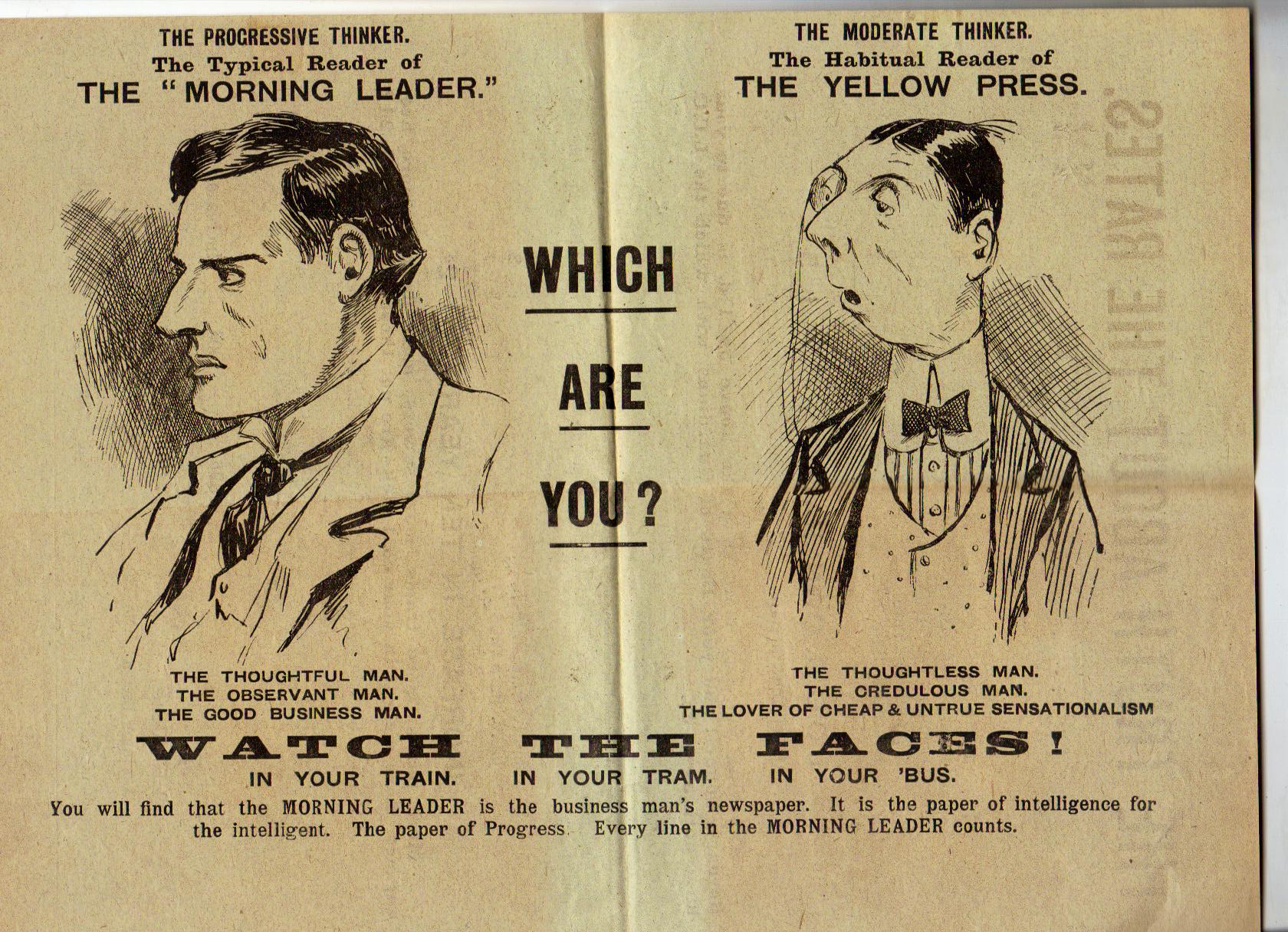
The ‘Morning Leader’ supported the Progressives and in late-February 1907 Kate laid this leaflet in between the pages of her diary
The LCC elections were due to be held on 2 March 1907; Kate and her family supported the Progressive Party. In fact, before becoming an MP, her father had been an LCC councillor on the Progressive ticket.
Dramatis Personae for these entries:
Sir Weetman Pearson, Lady Denman’s father, in 1910 became Lord Cowdray and it was as ‘Lady Cowdray’ that his wife was to be involved with a number of suffrage organisations. Lady Pearson was, according to Lady Denman’s biographer, ‘determined to become a leading political and social hostess’ and the Pearsons’ house at 16 Carlton House Terrace, its opulent interior decorated in the mid-19th century by Owen Jones in the islamic style, provided a perfect setting. As we shall read, Kate, who was something of an expert on these matters, rated the Pearsons’ tea very highly.
H.Y. Stanger: Liberal MP for North Kensington, the seat once held by Kate’s father, in February 1908 introduced a women’s suffrage bill, which passed its second reading before being blocked. This was the greatest progress a bill had made since 1897.
Thomas McKinnon Wood: member of the London County Council for Central Hackney (1892-1909) – leader of Progressive Party (1898-1907). Elected MP for a Glasgow constituency, 1906.
Mr Jephson: Henry Jephson, retired civil servant, who was standing again as a Progressive member for North Kensington on the LCC.
Violette Mary Doake (b c. 1888): lived with her parents at 24 Stanley Gardens, Kensington. In 1892 her father had been elected as a Progressive member of the LCC for Kensington North; unsurprisingly the Doake family was staunchly suffragist.
Thursday February 21st 1907
At 2.30 Mother and I went by train from Notting Hill Gate to Charing Cross and walked through the Horse Guards and up the Duke of Yorks steps to Carlton House Terrace – Sir Wheetman [sic] Pearson’s house – by invitation of Lord and Lady Denman to a drawing Room meeting to hear Mr McKinnon Wood – Mr Wilks and the work we could do for the Progressives at the L.C.C. elections.
Nearly all ladies there. Lord Denman was a sort of Chairman & both he and Lady Denman spoke – she seems very nice. My dear friend Mr McKinnon Wood spoke again most beautifully – I do admire him. Of course I knew it all but I dare say some the facts came new to a good many there. Mr Stanger, Mr Jephson and Mr Percy Harris were there.
There was a most gorgeous tea downstairs afterwards it really was quite perfect – such cakes – in such quantities – I made a pig of myself and eat [ate] three and I had my tea and milk poured out of solid gold articles. I really did enjoy the party and the house is wonderful – what a position – looking out on the Park.
Friday February 22nd 1907
I dressed myself. John [her fiance] came at 7.30 to dinner and afterwards Daddie took he, Agnes and I up to the Horbury Rooms [Ladbroke Road] to the Opposition L.C.C. Candidates’ meeting – Mr Davis and Major Skinner. Well I thought it would be interesting but I never expected to be so thoroughly amused.
The Chairman was so funny and Harcourt-Smith such a noodle – a Dickens character with an eye glass. And as for Major Skinner I have never seen or heard the like really. He didn’t seem sharp and made quite an object of himself. He tried to propitiate the ladies – I never heard anything so awful. I blushed for him. He kept right away from the question of the L.C.C. altogether. The only decent man there, for though Mr Whittiker Hampson speaks well, I wouldn’t trust him, was Mr Hume-Williams who opposed Mr Stanger at the Parliamentary Elections. He is a gentleman and speaks well, but he was not convincing – none of them were – they all talked nonsense – have no programme of work at all to bring forward. Their great cry is ‘give us a chance’ and they tell awful stories about the rates, which have really nothing to do with the County Council. It will be a real grief to me if those two dreadful people get in.
John, a thoroughly conservative spirit, doggedly tory, to the backbone was quite turned over by them though he thinks he upholds their views. I do so hate him to be a ‘Moderate’ thinker. We came back and talked them over and laughed merrily at their expense till John had to go at 11 o’clock.
Wednesday February 27th 1907
When I got home at 5 o’clock I found a note and bundle from Gladys Wright asking me to deliver some Women’s Suffragist things. So after tea Agnes went out with me and we did Arundel Gardens and Elgin Crescent – a tremendous number of Women Voters in both. They were papers urging the Women to use their Vote. I feel rather shaky as they are sure to Vote Conservative but that is a cowardly way of looking at the matter, I know.
Thursday February 28th 1907
Went off to the [North Kensington Liberal] Club – Mother, Agnes and Florence [the Fryes’ maid] were there – and the room was full. Miss Jephson, Miss Doake, Mr McArthur, Mr Lewis, Mr Hatt and the usual workers and lots of people I did not know all working at top speed.
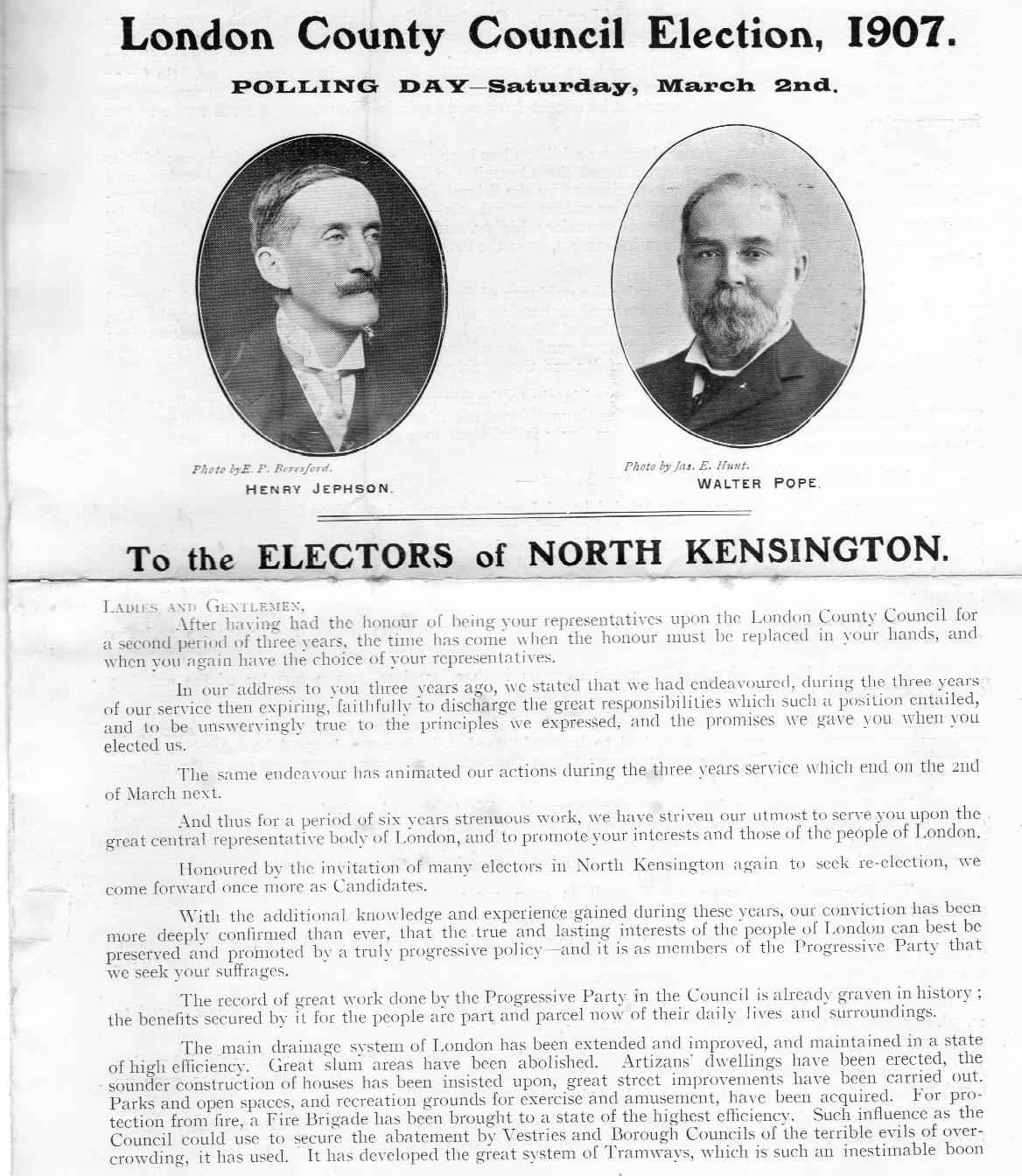 Saturday March 2nd 1907
The great London County Council Election day at last and, very fortunately, a beautiful day for it. I should have been canvassing all this week, much as I hate the work – but I am so interested in the Election – but I have felt so awfully seedy I simply hadn’t the strength for it…Agnes and I went to the Pembridge Ward Committee Room and got some work to do. I had Westbourne Grove to do and it took me till 4.30. Mother and Agnes went together. I got so tired I felt nearly dead when I had taken the cards back and came home to tea. But I couldn’t rest and after tea Mother and I walked up to the Golborne Ward Committee Room.
It is depressing work in this Ward. There is no enthusiasm – but up there there was very little excitement amongst the workers – and my heart sank though most of them were cheerful. We saw Mr Jephson in the Committee Room. Miss Jephson, Mrs and Miss Doake, Mrs Willis and lots of workers. Mr Jephson was flying about madly in his Motor Car. Mother and I did three streets – Blagrove Road and two other long ones and kept on till within a few minutes of eight o’clock.
I got so excited and interested that I don’t know how I managed to keep going as I did. I did feel ill but I did some good work. Got one woman to vote who had never used her vote before. I had almost to hold her by force and interest her by telling her how I worked to get a vote. She decided she would go if she was driven. So I sent Mother off to find a carriage and I waited and hung on to her. It was so long coming I flew into the middle of the road and managed to stop Mr Jephson’s car almost by main force it seemed to me – but just then Mrs Widgery drove up in a carriage and she took the woman and a man who went to look after her.
Sunday March 3rd 1907
Florence brought me the news and later the paper. Jephson and Pope beaten and the whole of London swept clear by the Moderates. ‘God help London’ I say since London does not seem inclined to help itself.
Campaigning for the Vote: Kate Parry Frye’s Suffrage Diary edited by Elizabeth Crawford
For a full description of the book click here
Wrap-around paper covers, 226 pp, over 70 illustrations, all drawn from Kate Frye’s personal archive.
ISBN 978 1903427 75 0
Copies available from Francis Boutle Publishers, or from Elizabeth Crawford – e.crawford@sphere20.freeserve.co.uk (£14.99 +UK postage £3. Please ask for international postage cost), or from all good bookshops. In stock at London Review of Books Bookshop, Foyles, National Archives Bookshop.
- ‘Campaigning for the Vote’ – Front and back cover of wrappers
Kate Frye’s Diary: ‘Paddington Pandemonium’
Posted by womanandhersphere in Kate Frye's suffrage diary on August 23, 2012
In the following diary entry Kate describes the pandemonium that occurred at a December 1907 suffrage meeting organised by the North Kensington Local Committee of the Central Society for Women’s Suffrage – the non-militant London NUWSS society – chaired by Mrs Millicent Fawcett. From Kate’s account the main culprits were medical students from nearby St Mary’s Hospital and from University College Hospital in Bloomsbury, such student having had, through the ages, a reputation for unruly behaviour. From Kate’s observation, the stories of stinkbombs and the release of mice, specifically intended to upset the genteel female audience at suffrage meetings, were all too true.
Lady Grove (1862 -1926) was a leading Liberal suffragist and author of The Human Woman, 1908. The Paddington Baths, in Queen’s Road, Bayswater, were soon to be demolished to make way for an enlarged Whiteley’s department store.
Thursday 5th December 1907 [25 Arundel Gardens, North Kensington]
‘ At 2 o’clock Agnes and I started off to Linden Gardens and called for Alexandra Wright and several of her helpers and we all walked to the Paddington Baths to help arrange the room for the meeting in the evening. There was a good bit to do – numbering the chairs – partitioning them off and hanging up banners and posters etc. Left [home again] just before 7 o’clock in a bus to Royal Oak and went to the Paddington Baths for the London (Central) Society’s meeting for Women’s Suffrage. Gladys and Alexandra have been weeks getting it up and I did no end of clerical work for it at Bourne End. We were the first Stewards to arrive after Gladys and Alexandra and were decorated with rosettes and given our directions. Lots of the women were very nervous of a row. My department was the gallery, to look after people up there and give invitations for a private meeting next week.
The people came in thick and fast and the doors were opened at 7.30 and with the first group of young men below in the free seats I knew what would happen. The place was soon hot, bubbling over with excitement, and I had my work cut out keeping gangways clear and looking after people and telling them they would be safe. We had expected an exciting evening but this realised our worst expectations. It was Bedlam let loose. A couple of hundred students from St Mary’s and University College Hospitals arrived and insisted on sitting together and never ceased all the evening singing, shouting, blowing tin trumpets, letting off crackers, letting loose mice and, what is worse, scenting the floor with a most terrible-smelling chemical.
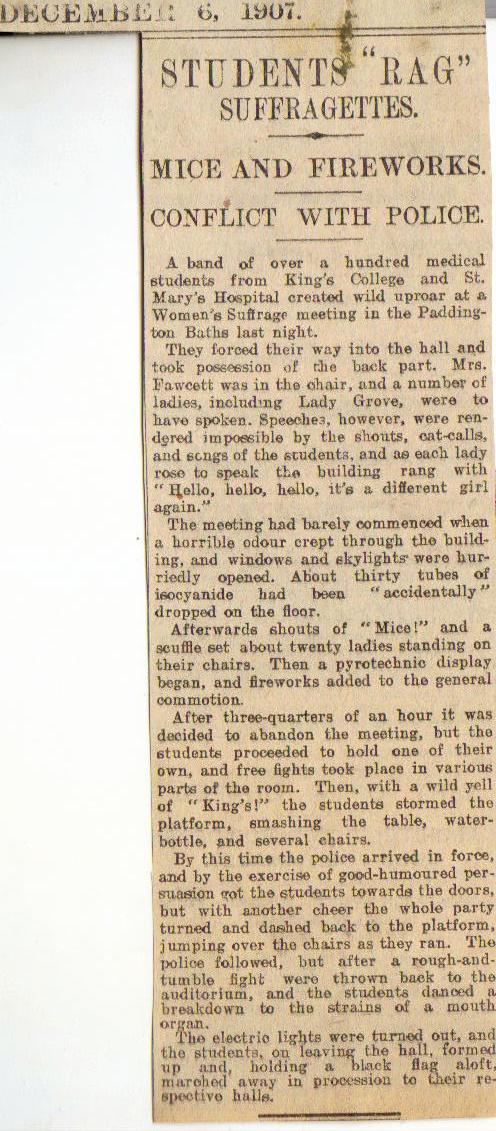
Report from the ‘Daily Mail’ 6 December 1907, clipped by Kate and laid in her diary
From the very start they never gave a single speaker a moments hearing. Mrs Fawcett was in the Chair and Lady Groveand others spoke and they went on with the meeting to the bitter end – and bitter it must have been to the speakers. I never heard a word. I felt too angry to be frightened though I must own I did not like the fireworks and saw the most appalling possibilities in that frantic howling mob of mad animals. Agnes owns to being terrified – all the more credit to her for sticking to her place amongst them and she was with them all the evening. I felt mad at not being there in the midst of them. When I could leave I just went down and spoke to John, who I saw standing near Agnes. She had decorated him as a Steward to help in case the worst happened.
I went back to my post until I was no longer any good there and then I went into the very midst of the seething mass and talked to any of them I could get at. Just to silence them, as I did for a few minutes at a time, was a triumph. Cries of ‘Oh I think I like Suffragettes’ as I went amongst them and, then, ‘He is flirting with a Suffragette’ taken up and sung by them all. I spoke like a Mother to several and smiled at them. If they had only known my true feelings I don’t think they would have been so polite to me. Great credit to all the women in the building is due – not only the Stewards – but the audience there. There was never any excitement or panic amongst them and only one Stewardess failed us. She, poor thing, was so terrified she bolted without waiting for hat or coat – but of course we keep that dark. The men Stewards were very good but quite powerless to stop the noise and hubbub. And what could four policemen do? It was an organised ‘Rag’ and nothing but a force of police to outnumber them could have stopped them. They longed for a fight and said so – and no end of them had most terrible looking clubbed sticks which they brandished. We did the only possible thing, I consider. Kept as much order as we could and tried to avoid bloodshed. We had a little unfortunately when, after the meeting was over, they charged for the Platform, sweeping everyone before them. Very fortunately there were large exit doors each side of the platform and most of the people got out of them. I was flung aside and then followed them up. They tore down as many banners as they could and stole one and tore down all the posters. They were like wild cats. The policemen chased them round a little but we would not allow any arrests to be made. The firework ringleader was caught but allowed to go. I spoke to Mrs Wright – red with rage. Poor things, we were all either red or white. Mr Willis, Mrs and Miss Doake and several others. Mr Percy Harris was Stewarding. One man Steward got a most awful crack on the ear and was considerably blooded – he looked awful. Several of the boys had their collars torn off and became very proud in consequence. It was a great wonder and a still greater mercy that more damage was not done. I felt so responsible for the ordinary public who had paid their money. I could only hope to get over the evening safely for their sakes. Personally I wished and still wish to smash the Boys, though at times I could not help laughing. They were not nice boys – all plain and common looking – mostly undersized and no gentlemanly looking one amongst them. I was glad to notice that as I hope they are not the best we can show in our hospitals.
After the general public had gone the police sent word that it was impossible to clear the hall while there was a woman left in it so we left with Mrs and Miss Doake and all came back in the bus with Mrs Willis. Miss Doake said she had never enjoyed a night so much in her life before. I cannot say the same. It was a terrible experience. We could not lose that terrible smell from our noses and mouths. I could taste it through everything at supper. John came home with us and did not leave till after 12o’clock. Agnes and I were too excited to go to bed and sat talking of our experiences. Lots of people will be made all the keener through it, but a great many will be very disgusted I fear.’
 As you can see from this note, carefully preserved by Kate, Mrs Fawcett’s meeting was re-arranged for early 1908 – to be held in the safety of Bertha Mason’s house in nearby Hyde Park Square.
Campaigning for the Vote: Kate Parry Frye’s Suffrage Diary edited by Elizabeth Crawford
For a full description of the book click here
Wrap-around paper covers, 226 pp, over 70 illustrations, all drawn from Kate Frye’s personal archive.
ISBN 978 1903427 75 0
NOW OUT OF PRINT, ALAS
KATE’S DIARIES AND ASSOCIATED PAPERS ARE NOW HELD BY ROYAL HOLLOWAY COLLEGE ARCHIVE
- ‘Campaigning for the Vote’ – Front and back cover of wrappers
Collecting Suffrage: Punch cartoon
Posted by womanandhersphere in Collecting Suffrage on August 8, 2012
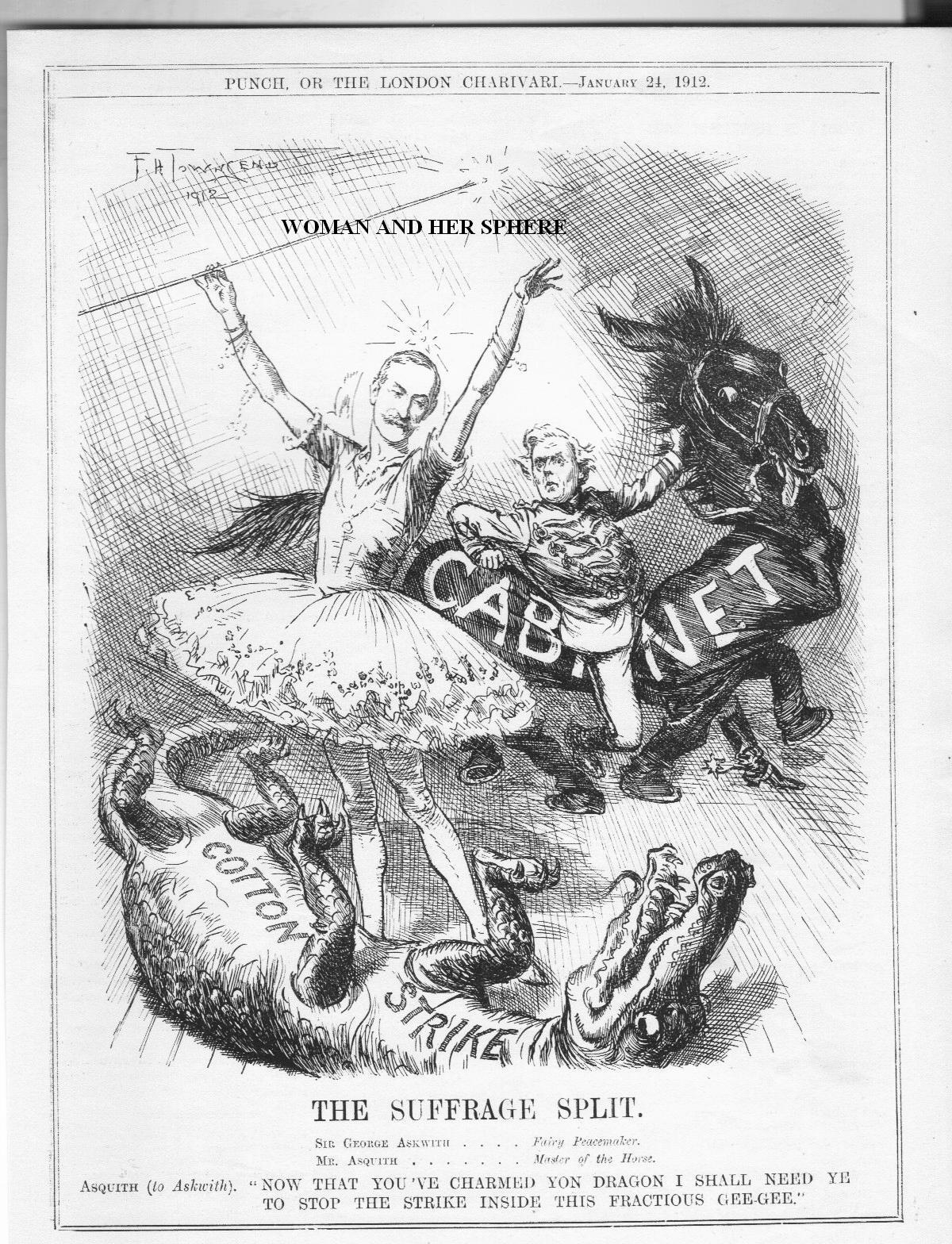 21 January 1912 – full page – ‘The Suffrage Split’. Sir George Askwith (the charismatic industrial conciliator), as ‘Fairy Peacemaker’, has tamed the dragon of the Cotton Strike – and Asquith, wrestling to keep a seat on the Cabinet horse turns to him ‘Now that you’ve charmed yon dragon I shall need ye to stop the strike inside this fractious gee-gee.’
In very good condition £10 plus £1 postage.
To buy contact: e.crawford@sphere20.freeserve.co.uk
Suffrage Stories: ‘Madame Mantalini’
Posted by womanandhersphere in 1911 Census, Suffrage Stories, The Garretts and their Circle on July 30, 2012
Since 2009, when details of the 1911 census were released, I have (with, for a time, Dr Jill Liddington) been investigating how the women of the country responded to the call issued by the more militant suffrage societies to boycott the census. In the process I have discovered women of a suffrage inclination of whom, until now, suffrage history has known nothing.
One of these was a ‘Miss S. Marsden’, whose census form was delivered to her at 69 Church Street, Kensington, and who refused the enumerator any details about herself. However, Miss Marsden did not leave the form blank, writing on it one of the longest statements that I have so far encountered. Although the right edge of the census form is badly damaged, creating gaps in her comments, I think we can get the gist.
‘I, Mdme Mantalini, a municipal voter and tax payer, refuse to fill in this census paper, as I have no intention of furnishing this government with information and thereby helping them to legislate for women without obtaining their consent or first consulting them in the [missing words] effective way possible & extending the franchise to duly qualified women. As a responsible, law-abiding citizen I have conducted my business for sixteen years; as an employer of labour I have [contributed?] to the wealth of the state and in return I have been taxed for the upkeep of no 10 Downing Street. No 10 Downing Street, the official residence of the prime minister, but converted by his wife into a show-room for a French [dress maker?] (free of all duty and taxation) to exhibit his Paris models and take orders from them to be executed in Paris. I [missing words] with very few exceptions the dressmaking establishments in England are all owned by women, & only women & [missing words] workers. It therefore comes to this, that the only way open to us to protest at ‘our trade’ being ruined in [missing words] our taxes, is to drive home to the government by every method available that women are determined [missing words – perhaps ‘not to be governed’] without their consent.’
Would that not whet any researcher’s appetite? Who was Miss Marsden/Mdme Mantalini? What had Margot Asquith been up to?
In fact the second question was the easier to answer. An inspection of The Times archive revealed that in May 1909 Margot Asquith had been called to task by drapers’ associations from around the country for inviting the Parisian designer Paul Poiret to show dresses in 10 Downing Street.
Poiret then was the epitome of chic – designing dresses that relied on draping, rather than tailoring – so much easier to wear – and promoting hobble skirts, harem pants and kimono coats – designs such as these.
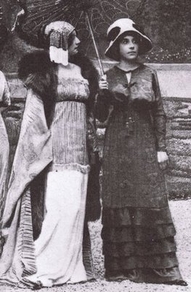
In response to a letter of complaint from an MP, Mrs Asquith explained, ‘I received in my private rooms at tea from 20 to 25 of my personal friends and a well-known French costumier, whose models can be bought in any London shop, brought some specimens for the inspection of myself and my guests. It was a purely personal occasion.’ In fact, such was the rumpus, that henceforward Margot Asquith was obliged to patronize British costumiers, such as Lucile although probably not, I fear, Madame Mantalini.
I thought at first that when Miss Marsden referred to herself on the census paper as ‘Mdme Mantalini’ it was merely as short-hand to describe her position as a dressmaker – that being the name of the dressmaking establishment at which, in Nicholas Nickleby, Kate Nickleby is apprenticed. But, consulting my 1908 London street directory, I found that the shop at 69 Church Street (which is still there) was, indeed, that of ‘Mrs Sybil Mantalini’. It was then only a short step to establish that Mrs Mantalini was, in fact, Miss Sybil Marsden, who was on the London Electoral Register by dint of her occupation of those premises, and the question of’ ‘Who was Miss S. Marsden?’ was solved.
But now I was hooked. Who was Miss Sybil Marsden? Why was she such an outspoken dressmaker?
I discovered that she had 9 siblings and in 1911 was living at the family home, 82 RedcliffeGardens in South Kensington, with her mother and one unmarried sister. Her father, Algernon Moses Marsden, had been a fine art dealer but, by 1901, had been declared bankrupt several times. His background was most interesting; he had declined to enter the family’s successful clothing business, clearly preferring the more elevated association with ‘art’.
 Algernon Moses Marsden by James Tissot
Marsden was by all accounts – mainly in the bankruptcy reports – an engaging fellow – as is evident in the portrait of him by James Tissot, painted in 1877, when Sybil was four-years-old. At that time Marsden was Tissot’s dealer, but gambling and high-living proved his downfall. It would appear that after his final bankruptcy in 1901 he removed himself to New York, where he died in 1920. I can now see that the choice of the name ‘Madame Mantalini’ may have been even more to the point than I first thought. In Nicholas Nickleby it is Mr Mantalini’s extravagance that resulted in the bankruptcy of his wife’s business – an awful warning to Sybil Marsden. No wonder Algernon’s daughter had little faith in the ability of men to manage her affairs.
Epilogue
The cinéaste members of my family play the Six Degrees of Kevin Bacon game (whereby any named film actor has to be connected with fellow-actor KB by links covering no more than 6 films). I am hopeless at that – but think I might be a contender in Six Degrees of Garrett. This particular case is easy: Sybil Marsden, Algernon Marsden, James Tissot, J.M. Brydon, Agnes and Rhoda Garrett. As I discuss in Enterprising Women: the Garrets and their circle, the two young women were undergoing their architectural training with Brydon in 1873, at a time when he was working on the design of a new studio for Tissot, attached to the artist’s St John’s Wood house. Did they go on a site visit? Had they perhaps even seen in the flesh, as it were, the tiger skin and the fashionable blue vase, that serve to emphasise Algenon Marsden’s exoticism and good taste.
Kate Frye’s Suffrage Diary: 3 December 1906
Posted by womanandhersphere in Kate Frye's suffrage diary on July 26, 2012
 Kate’s family had always taken an interest in politics; her father had been Liberal MP for North Kensington in the 1890s and into the 20th century her mother was the president of the North Kensington Women’s Liberal Association. However, the meeting described below is the first occasion that Kate mentions in her diary her attendance at a specifically ‘suffrage’ meeting and of the disturbances that had been caused by the WSPU’s ‘rowdy attacks’.
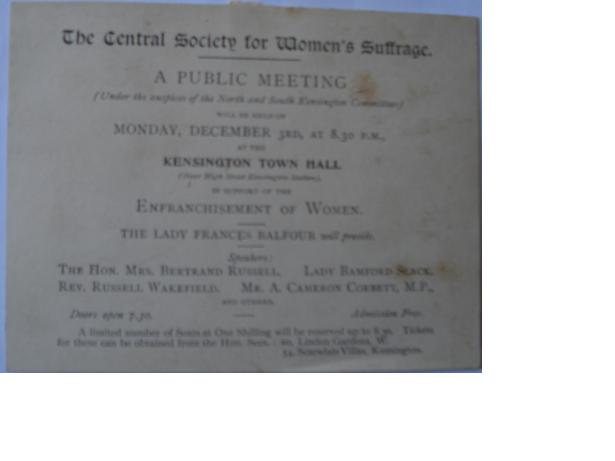 Monday 3 December 1906
At 8 o’clock [evening] Agnes [Kate’s elder sister] and I went off to KensingtonTown Hall to a Woman’s Suffrage meeting – got up by the Central Society. Lady Frances Balfour was presiding. We went by bus – when we got there the large hall was packed. Alexandra Wright was at the top of the stairs and directed us up to the overflow meeting and that was packed too. After a bit the speakers came in to us – the Hon Mrs Bertrand Russell, Miss Gore Booth, Lady Frances Balfour and Mr Cameron Corbett M.P. I heard excellent speeches all of them – they really did put the case in a nutshell and were most instructive and interesting.
Then Gladys Wright came and fetched me out and came and asked me to act as a Steward and collect – then later she went in for Agnes – and we both did what we could. We collected in the Gallery first – then later I was stationed to get the people as they came out. It was very amusing really – and I got so hot and excited – off my head with it – we certainly are in the thick of things always. Some of the people gave a lot – others shook their heads and frowned. One man said I wanted too much – to marry as well as a Vote. I had quite a flirtation on the stairs with a big smart young man – who stopped to ask me a question – he didn’t seem to know anything about anything and when he said the speaker had referred to Earl Percy as ‘half asleep’ – I said ‘That is true about a great many people’ – he did laugh.
I am afraid I felt I was more like a helper at a Bazaar than at so grave a thing as a Woman’s Suffrage Meeting – but then it is so hard for me to be serious about anything – but I am in earnest – I really do feel a great belief in the need of the Vote for Women if only as a means of Education. I feel my prayer for Women in the words of George Meredith ‘More brains, Oh Lord, more brains.’ But we are coming along and not slowly by any means. Of course all these rowdy attacks on the Ministers and these imprisonments have sounded coarse and unpleasant and the jokery made of it most bad for the cause – but women have waited patiently for so long the sort of women who have gone for the matter in this rowdy method are not the best educated or most refined amongst our members.
At this meeting every thing passed off in a most orderly dignified spirit – and the speeches from the women were delightful and must have come as a revelation to many of the audience. There was a declaration there for any working woman there who cared to sign – a number did – I did – as I have a profession [Kate was a rather unsuccessful actress]. Naturally they don’t want crowds of names without any meaning or strength in them. We came home after hearing the amount collected nearly £20 – about the cost of getting up a meeting – the reason for the collection. Bus to Notting Hill – got in soon after 10.30 – in a frenzy of excitement.
Campaigning for the Vote: Kate Parry Frye’s Suffrage Diary edited by Elizabeth Crawford
For a full description of the book click here
Wrap-around paper covers, 226 pp, over 70 illustrations, all drawn from Kate Frye’s personal archive.
ISBN 978 1903427 75 0
Copies available from Francis Boutle Publishers, or from Elizabeth Crawford – elizabeth.crawford2017@outlook.com (£14.99 +UK postage £3. Please ask for international postage cost), or from all good bookshops – and Amazon.
- ‘Campaigning for the Vote’ – Front and back cover of wrappers
Suffragette postcards: suffragettes and policemen 2
Posted by womanandhersphere in Collecting Suffrage on July 25, 2012
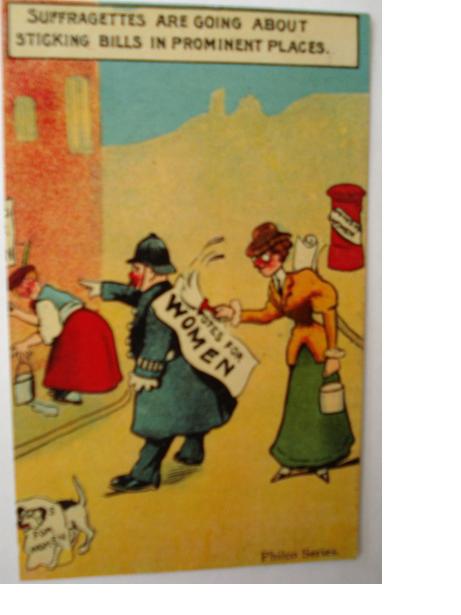 Here is another card in the ‘Philco Series’, titled ‘SUFFRAGETTES ARE GOING ABOUT STICKING BILLS IN PROMINENT PLACES’ and in this particular case that is pasting a ‘Votes for Women’ on the back of a policeman, who is in the process of accosting another bill-sticking suffragette. Needless to say the women are the usual stereotypical trilby-wearing, bespectacled harridens. In the scene a pillar box and a dog have also been plastered with V f W posters. The message on the reverse – written in pencil from the same sender to the same recipient as that of the card in the previous ‘Collecting Suffrage’ post – that is Win to Mrs James – reads ‘And the best of wishes for a happy Christmas. The suffragettes what and how they do things in London.’ Very good – unposted £45 post free. NOW SOLD
Suffragette postcards: suffragettes and policemen
Posted by womanandhersphere in Collecting Suffrage on July 24, 2012
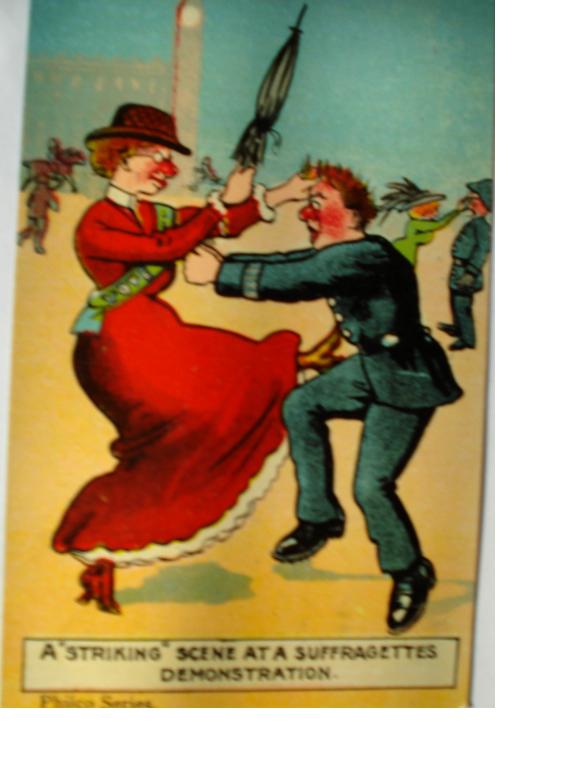 The increased activity of the women’s suffrage campaign in the early years of the 20th century coincided with the golden age of the postcard. It proved to be a subject very popular with the burgeoning number of commercial postcard publishers and cards with a ‘suffragette’ theme outnumber those relating to other contemporary campaigns – such as Tariff Reform and Home Rule.
Without too much effort, anyone interested can still build up a collection of cards reflecting the varying views of Edwardian society on women’s desire for citizenship – and their methods of achieving it. The suffrage societies themselves all produced cards – portraits of their leaders or photographs of great suffrage occasions – although they are vastly outnumbered by cards produced by the commercial publishers.
The incongruence of women battling with policemen – as on ‘Black Friday’ in November 1910 – certainly caught the publishers’ attention and there are many variations on the theme. This card was published by Philco Publishers, whose office was in Holborn Place – very close to WSPU headquarters. This card was not posted but is written to ‘Mrs James’. The message reads ‘I do not know what you will think of this. But this is suffragettes in vengeance and in their battle array.’
The stereotypical harridan (trilby hat, glasses, high-colouring, big nose) wearing ‘Votes for Women’ sash wields her umbrella as she kicks a policeman. In the background another, similar, scene is enacted. There is a tall clock tower – which might just be intended as Big Ben – at the very back of the scene, attached to a misty building. This card, which is in good condition, was one of a series. It is available for sale from me: £45 post free. NOW SOLD
See the August 2012 issue of BBC History Magazine for Prof June Purvis’s article on ‘suffragette’ cards published by commercial publishers and click here for details of her very interesting and informative accompanying podcast (June’s piece begins 20 minutes into the recording).
 Woman and her Sphere