Archive for category British Women’s Suffrage Campaign in 100 Objects
YOU CAN NOW TAKE A LOOK INSIDE – The British Women’s Suffrage Movement in 100 Objects: a material history – FORTHCOMING 23 JULY
Posted by womanandhersphere in 100 Suffrage Objects -NEW BOOK, British Women's Suffrage Campaign in 100 Objects on June 16, 2026
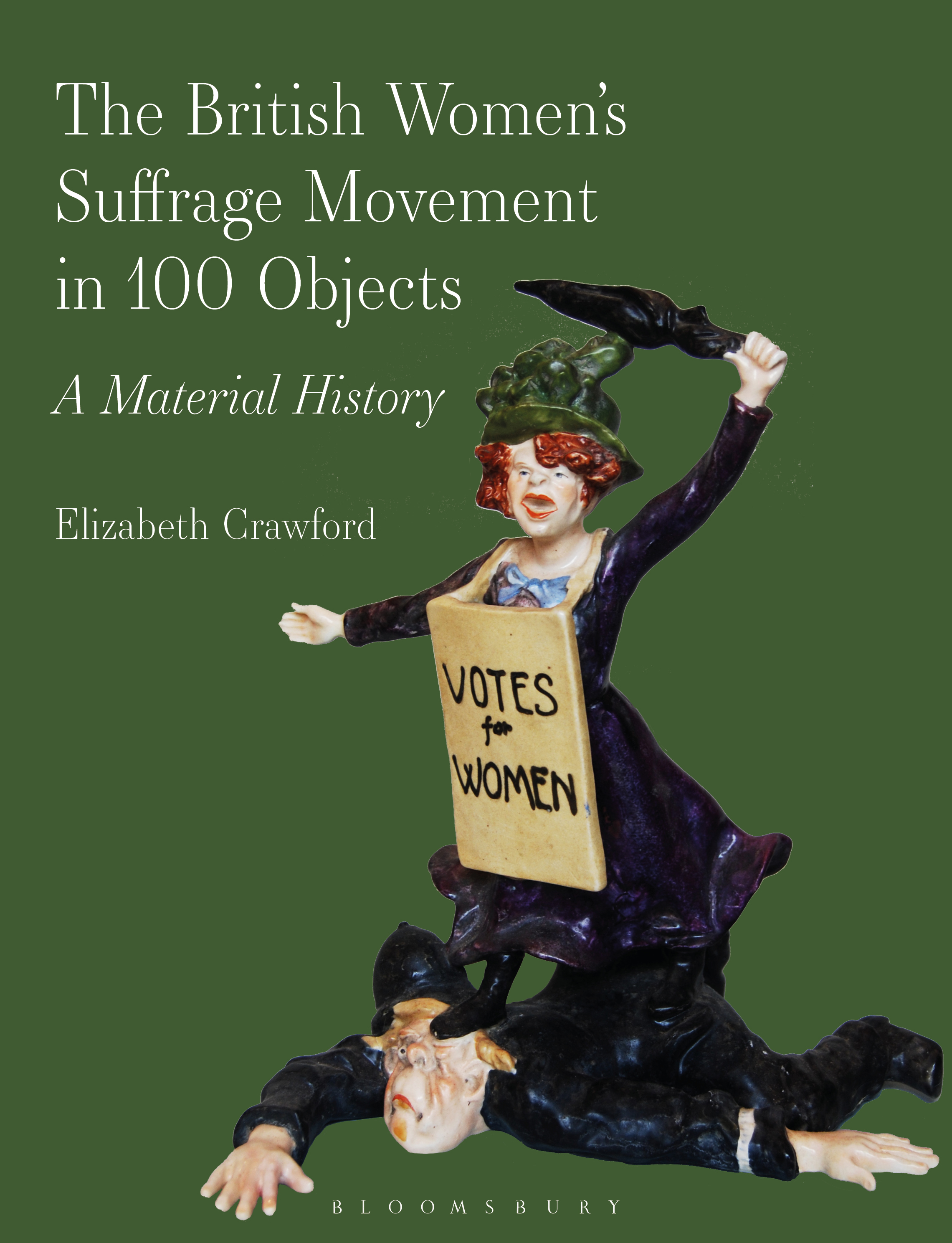
TO BE PUBLISHED ON 23 JULY – IN PAPERBACK (£24.99), HARDBACK AND AS AN EBOOK
You can pre-order from Bloomsbury at a reduced price here – or from Amazon here – or place an order with your local bookshop.
FOR A LOOK INSIDE THE BOOK CLICK https://bloomsburycp3.codemantra.com/viewer/6a2a751677490b000131217c
I had no thought of producing another book when, one day in October 2023, I opened up my laptop, ready to watch an online auction mounted by Bonhams. This Votes for Women sale was devoted to suffrage memorabilia from the collection put together by a couple I’ve known ever since I began dealing in books and ephemera in the mid-1980s. I had no intention of bidding for anything in the auction as by 2023 the prices reached for suffrage material at such auctions had soared into the stratosphere. But, naturally, I took a professional interest in seeing what was up for sale – and the prices they would achieve. And I had a personal interest in that some of the items were ones I had myself sold to the vendors many years ago.
Watching the bidding was absorbing, but as the sale progressed I realised I was experiencing a niggling conflict between what might be termed my instinct as a trader and my instinct as an historian. Bonhams had organised the lots in the sale in a way as to appeal to bidders, grouping together items of a similar type, such as textile rosettes or china or badges or books – but this arrangement by no means coincided with what I knew to be the dates of their production. In my mind I was itching to reorder the lots into an historically coherent order. Well, there lay the germ of an idea …and it slowly gained traction..and, in due course, a publishing contract with Bloomsbury Academic. The result of my labours will be published in July.
For the book tells the story of the British ‘votes for women’ campaign in a sequence of 100 objects. From the beginning of the campaign in 1866 until all women were granted the vote on the same terms as men in 1928, women used every means in their power to persuade the government to allow them the right to elect members of parliament. Through the analysis of an astonishing array of objects – including books, bags, petitions, posters, plays, photographs, china, leaflets, newspapers, games, jewellery, sashes, films, and figurines – all of which are illustrated – The British Women’s Suffrage Movement in 100 Objects explores the role that material culture played in this vital struggle. Each of the 100 objects is illustrated, the accompanying text setting it in its context to explain the campaign’s politics and the part played by key personalities.
I must say that when I began work on the book it had not occurred to me that the suggestion could be voiced in any western democracy that women should be relieved of the right to the vote. But, that day having come (see here), although not yet here, there is all the more reason for understanding why and how British women won that right.
The book will be published in July in paperback at £24.99. To discover more details – as set out on the Bloomsbury website – including a special pre-order price and some most heart-warming reviews from readers who have viewed the text of the book in advance – see here.
My cup overflows – in that Bloomsbury will only accommodate six endorsements on their webpage – and nine readers were kind enough to give feedback on the book. I, as blushingly as self-promotion permits, set out below the final three to arrive. As you may imagine, I am immensely heartened – and hopeful that the 100 Objects will give a new clarity to the chronology, politics and personalities of the women’s suffrage campaign.
‘Drawing on a lifetime of groundbreaking scholarship on the British Suffrage movement and its materiality, Crawford’s new book is an essential read for anyone interested in the history of women’s campaigns for the vote. The British Women’s Suffrage Movement in 100 Objects brings to life in unprecedented detail the material world in which campaigners strove for social and political change, conveying this to new audiences with a lightness of erudition and a treasure trove of vivid detail. The extraordinary creativity and complexity of women’s activism during this era is made tangible through Crawford’s expert guidance.’ Dr Zoë Thomas, Associate Professor of Modern History, University of Birmingham
‘Beautifully illustrated and exceptionally curated, Crawford’s The British Women’s Suffrage Movement in 100 Objects is an essential and defining resource for the ways technological advances, community building, and popular culture played in the British campaign for “Votes for Women.” In clearly written and focused essays on everything from the intersection of the automobile and women’s rights to the ubiquity of comic suffragette ceramics, Crawford’s book will be of interest to scholars and general public alike.’ Heidi Herr Librarian for English, Philosophy, The Writing Seminars, & Student Engagement for Special Collections The Johns Hopkins University
‘The British Women’s Suffrage Movement in 100 Objects powerfully demonstrates the richness that material culture brings to the study of women’s histories. By centring objects, it reveals the political struggle as something lived, worn, exchanged, and displayed, rather than simply written or spoken. Together, the 100 objects offer an engaging, vivid and very human perspective on the suffrage movement, recovering voices and experiences that often remain muted in conventional narratives.’ Dr Miranda Garrett
SUFFRAGE OBJECTS: ‘VOTES FOR WOMEN’ HOOKS & EYES
Posted by womanandhersphere in British Women's Suffrage Campaign in 100 Objects, Suffrage Objects on May 19, 2026
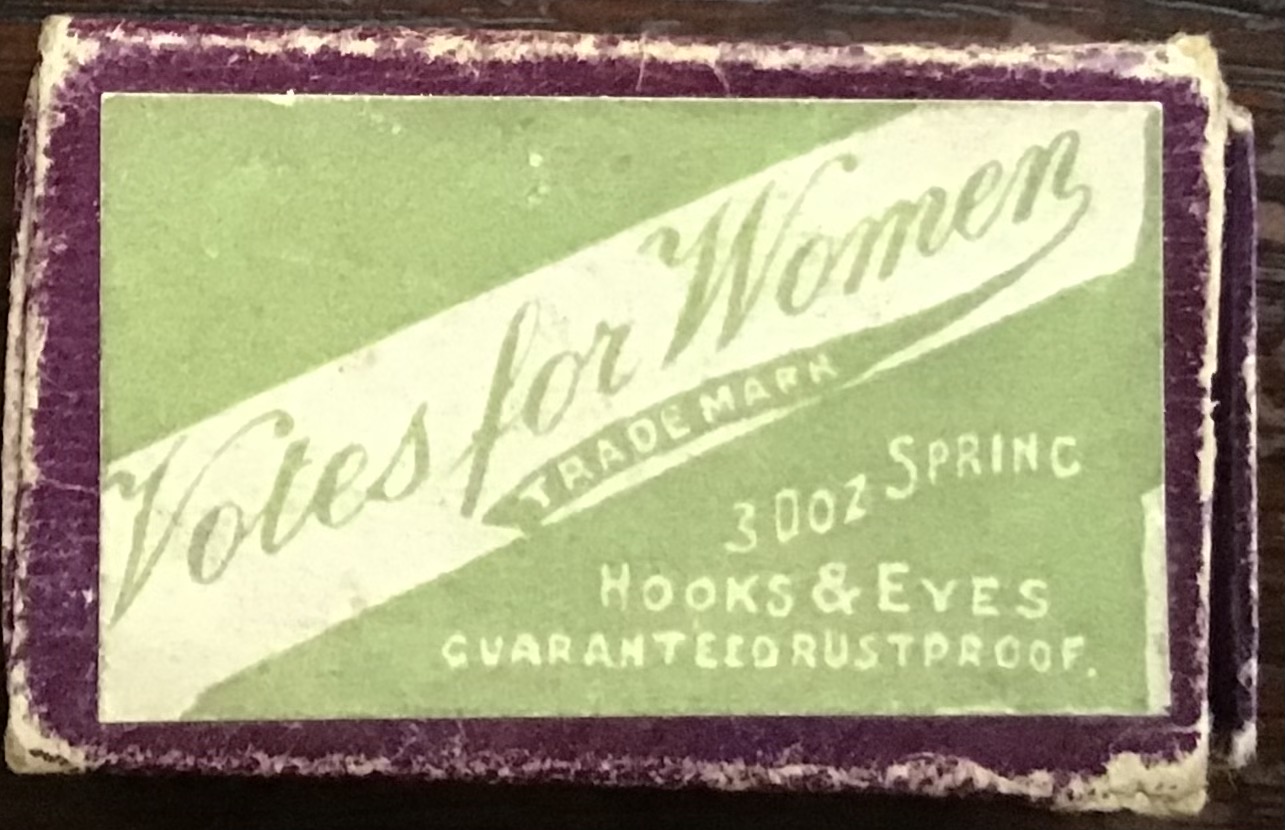
In over 40 years spent hunting for and selling objects related to the women’s suffrage campaign, this little box is the only example I have ever found of ‘Votes for Women’ Hooks and Eyes. It is a perfect ‘suffrage object’, hitching to a political slogan a utility that was particularly personal to women. For how else were figure-hugging jackets, skirts or, indeed, corsets to be held together without a generous number of hooks and eyes? And who else would be sewing them on? The majority of suffragettes and suffragists were, of necessity, also needlewomen. So here was an opportunity to back the Cause while sewing fastenings onto their skirt plackets or bodices.
When, sometime in the mid-1990s, I first acquired the box, it was empty. The 36 ‘hooks and eyes’ it had once contained had been put to use c. 90 years previously and the garment to which they had been attached had doubtless long since gone to landfill. But the little cardboard box had survived. Was this by accident or because it had been put aside as a souvenir of a long-ago commitment to the cause of ‘votes for women’? I remember being amazed to find it on a stall at the monthly market that was then held in Alexandra Palace in north London. I duly catalogued it, sold it and then, five years or so ago, bought it back and placed it in a new home, where I am sure it is also much appreciated.
It has proved impossible to establish the name of the manufacturer and, though I would have loved to be able to establish whether ‘Votes for Women’ really had been trademarked to these hooks and eyes, I’m unable to undertake the research necessary, For this would involve ‘needle in the haystack’ searching through records held at the National Archives (I hope you enjoy the choice of metaphor). There are, however, two interesting points to notice about the one-time contents of the box. For the label tell us that the hooks and eyes were ‘sprung’, meaning tension kept the connection closed until released manually – very necessary to prevent a costume malfunction. We are also told that they were rustproof, an important consideration if the garment was to be washed or was caught in a shower while the wearer was demonstrating outside parliament.
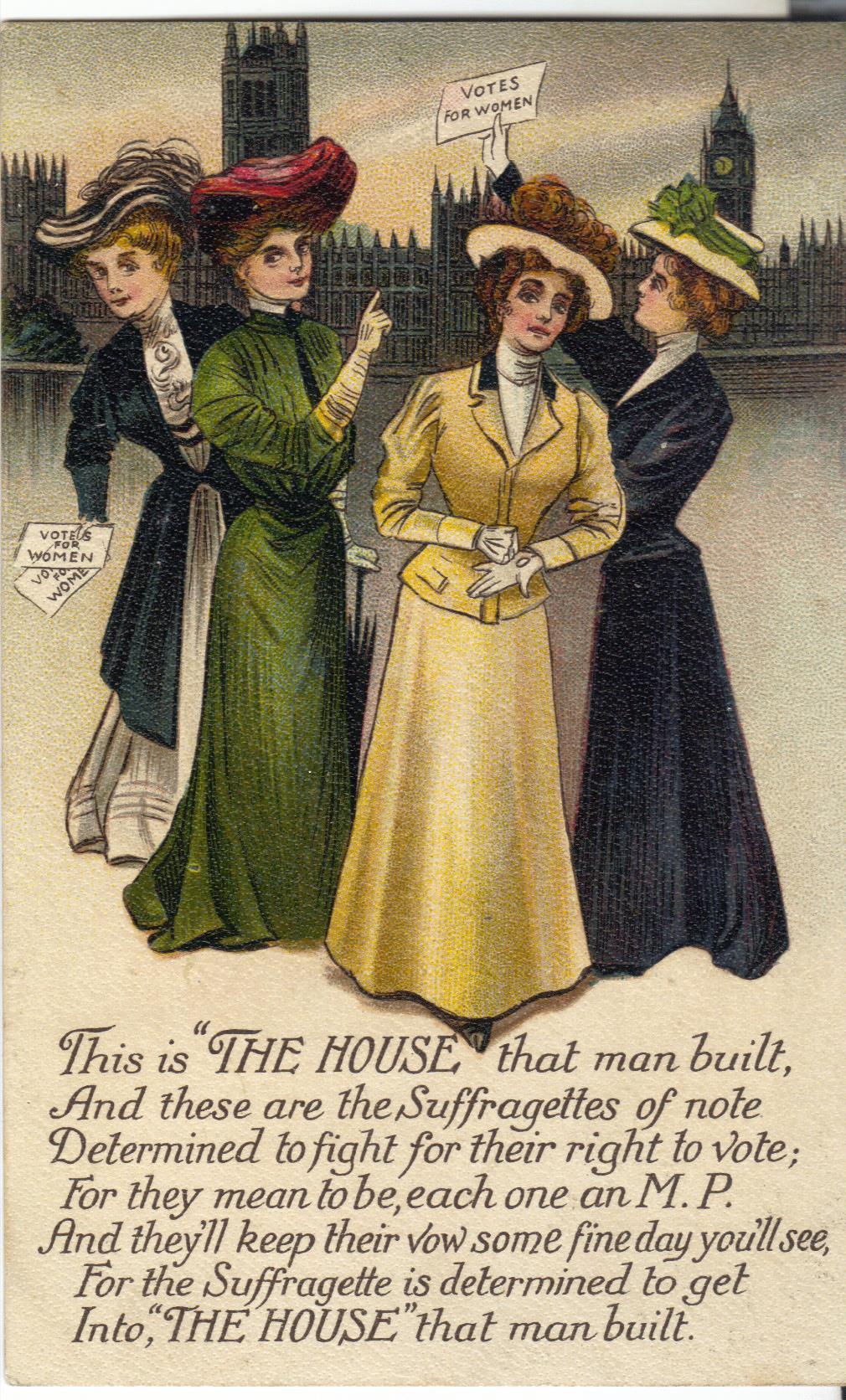
Just think of the number of hooks and eyes keeping these figures in place
Surprisingly, no advertisement for ‘Votes for Women’ hooks and eyes appears in any of the suffrage papers. It could be – although there is no proof – that this addition to the suffragette sewing basket was commissioned to supply the WSPU shops or for a fund-raising fair. Moreover, it is to be noted that the hooks and eyes were sold in a box – and not, as was usual in the early years of the 20th century, on cards. In fact, the women stitching hooks and eyes onto cards were the very type of sweated labourers on whose behalf suffrage campaigners protested. Mind you, matchbox makers were also very ill-rewarded and one can only wonder whether that ‘Votes for Women’ label was perhaps not slapped on with some resentment.
The manufacturer registering ‘Votes for Women’ as its trademark was not the only maker of hooks and eyes to discern a market for its goods among the supporters of the suffrage cause. Votes for Women (eg issue for 23 April 1909, p 26) carried advertisements for ‘Smart’s invisible hooks and eyes ‘ which were the ‘patented invention and property of two members and supporters of the Women’s Social and Political Union.’ The firm was, indeed, on occasion noted as giving a donation to a WSPU fund-raising campaign. Smart’s’ was making hooks and eyes in the 1890s but I have been unable to discover anything about the firm. Most such items were manufactured around Birmingham, but Smart’s advertisements give no address,
Copyright
In The British Women’s Suffrage Movement in 100 Objects: a material history – to be published in July – you can discover how all manner of objects were caused to be created in the furtherance of the campaign for ‘Votes for Women’. You can pre-order the book – at an enticing reduced price – here .
SUFFRAGE OBJECT: A PALMIST’S BUSINESS CARD: WHO WAS ‘LA YENDA’?
Posted by womanandhersphere in British Women's Suffrage Campaign in 100 Objects, Kate Frye's suffrage diary, Suffrage Objects on May 14, 2026
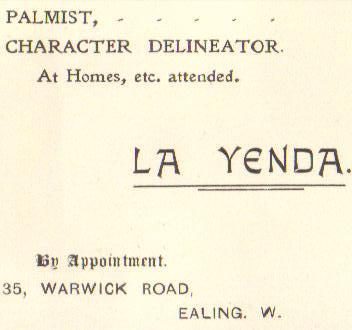
This card was given to Kate Frye at the Women’s Freedom League ‘Green, White and Gold Fair’, held in Caxton Hall, London, in April 1909. She then preserved it within the pages of her fabulous diary (now held by by Royal Holloway College Archives) .
At this time Kate was a member of the constitutional London Society for Women’s Suffrage but was happy to offer her varied services to other societies – such as the WFL. And for this fund-raising Fair she had volunteered to read palms. For palmistry was a fashionable Edwardian pastime – just the kind of thing that Kate, with her theatrical proclivities, enjoyed. She was, of course, an amateur; whereas, as she notes, Madame Yenda was ‘the real thing’.
Kate’s diary entry for Thursday 15 April 1909 relates that she went to ‘the Caxton Hall for the 1st day of the Women’s Freedom League Bazaar. Got there about 11.30 – everything in an uproar, of course. I had to find out who was in authority over me and where I was to go to do my Palmistry. I had to find a Miss Marie Lawson first and then was taken to a lady who had charge of my department and she arranged where I was to go.. Then another Palmist hurried up – the real thing who donned a red robe. I was jealous. Madame Yenda.
We got on very well, however, and exchanged cards (I have had some printed) it was all about as funny as anything I have ever done and I have had some experiences.
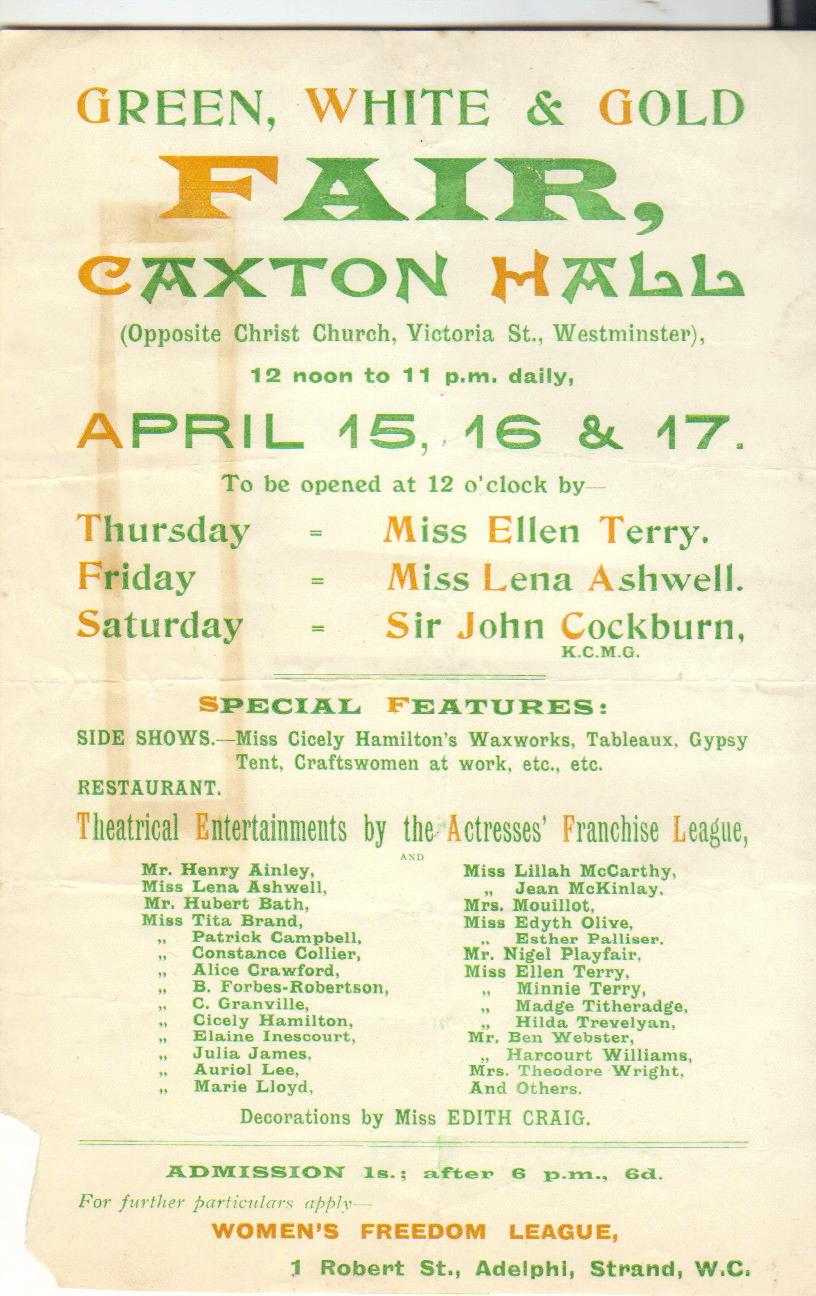
The next day Kate returned to the Fair – to the Gypsy Tent mentioned in the WFL flyer – and wrote in her diary
Madame Yenda was there but no other Palmists. Clients did not come very early – they were all following Lena Ashwell – so I had 1/- [meaning a shilling’s-worth of palm-reading] from Madame Yenda myself. I think she was clever but, of course, I am rather a hard critic at it.
She told me a great many things I know to be absolutely true and she gave me some good advice especially about morbid introspective thoughts and I think she is quite right. I do over worry. I am to beware of scandal which is all round me just now. She predicts a broken engagement, a rich alliance and always heaps of money. I should have immense artistic success in my profession if only I had more confidence in myself and if only I had some favourable influence (a sort of back patter, I take it) to help me but such an influence is far away. I shall never live a calm uneventful existence. I shall always spend so much of myself with and for others. I am rather glad of that.
I was just beginning to tell her her hand but I wouldn’t let her pay as she told me she was very poor – and I could see it – when some clients came for us both and we both had to start our work. I didn’t feel a bit inclined for work at first but got into it and had wonderful success.
Kate mentions meeting La Yenda once more – a year later – as they both walked in the WSPU 21 June 1910 ‘Prison to Citizenship’ Procession through London – so I thought it likely that the palmist had more interest in the suffrage campaign than merely reading the hands of its supporters. In fact, years later, in 2022, I spotted her entry in a ‘suffragette’ autograph album that came up for auction at Bonhams. To this she had added her own name (Louise Till) against ‘La Yenda’ – and I thought then that when the moment came I would try and discover the identity of the ‘real thing’.
Anyway, now is the moment and of course, nowadays, nothing could be easier. There was the clue of the name (but there are a number of Edwardian Louise Tills) and the address (but no Till showed up in the 1911 census nor in any electoral roll at Warwick Road). However, the answer lay in the digitized Newspaper Archive. For there I found any number of references to ‘La Yenda’, who had progressed from printing an Edwardian calling card to taking out newspaper advertisements in the 1920s.
So, the beaded curtain of the palmist’s tent can be lifted to reveal:
Jacobina Louise Till (1861-1930), born in Gourock, Renfrewshire, Scotland, was living with widowed Mrs Florence Finlay (who had been born in Grahamstown, Cape Colony) at 35 Warwick Road, Ealing, by the time she encountered Kate. Neither she nor Mrs Finlay are recorded in the 1911 census. Louise Till’s obituary states that between the two women ‘the closest friendship existed’ (Middlesex County Times, 15 February 1930). This account also tells us that Louise Till ‘was a psychic of a high order, and she used her gifts with the sole object of helping those who consulted her to develop their characters and minds to the best and fullest extent’. ‘La Yenda’ tended to carry out her practice at Worthing in the summer, returning to Ealing in the autumn – and the obituary also refers to extended professional visits to Italy and France. Like so many other suffrage campaigners, Louise Till was an active Theosophist. Her funeral service was conducted by a minister of the Theistic Church who reminded the congregation that ‘thoughts of grief and misery hindered the soul on its pilgrimage upward in its new surroundings. To remember in love was something very different from bland despair’.
So, now, nearly 100 years later, we are remembering ‘La Yenda’ simply because she thought to go to a printer, order a business card for herself, and, by association, create a ‘suffrage object’.
For more about Kate see Kate Parry Frye: the long life of an Edwardian actress and suffragette (ITV – eBook_
Copyright
All the articles on Woman and Her Sphere are my copyright. An article may not be reproduced in any medium without my permission and full acknowledgement. You are welcome to cite or quote from an article provided you give full acknowledgement
In The British Women’s Suffrage Movement in 100 Objects: a material history – to be published in July – you can discover how all manner of objects were caused to be created in the furtherance of the campaign for ‘Votes for Women’. You can pre-order the book – at an enticing reduced price – here .
SUFFRAGE OBJECTS: MAGIC LANTERN SLIDES
Posted by womanandhersphere in British Women's Suffrage Campaign in 100 Objects, Suffrage Objects on May 7, 2026
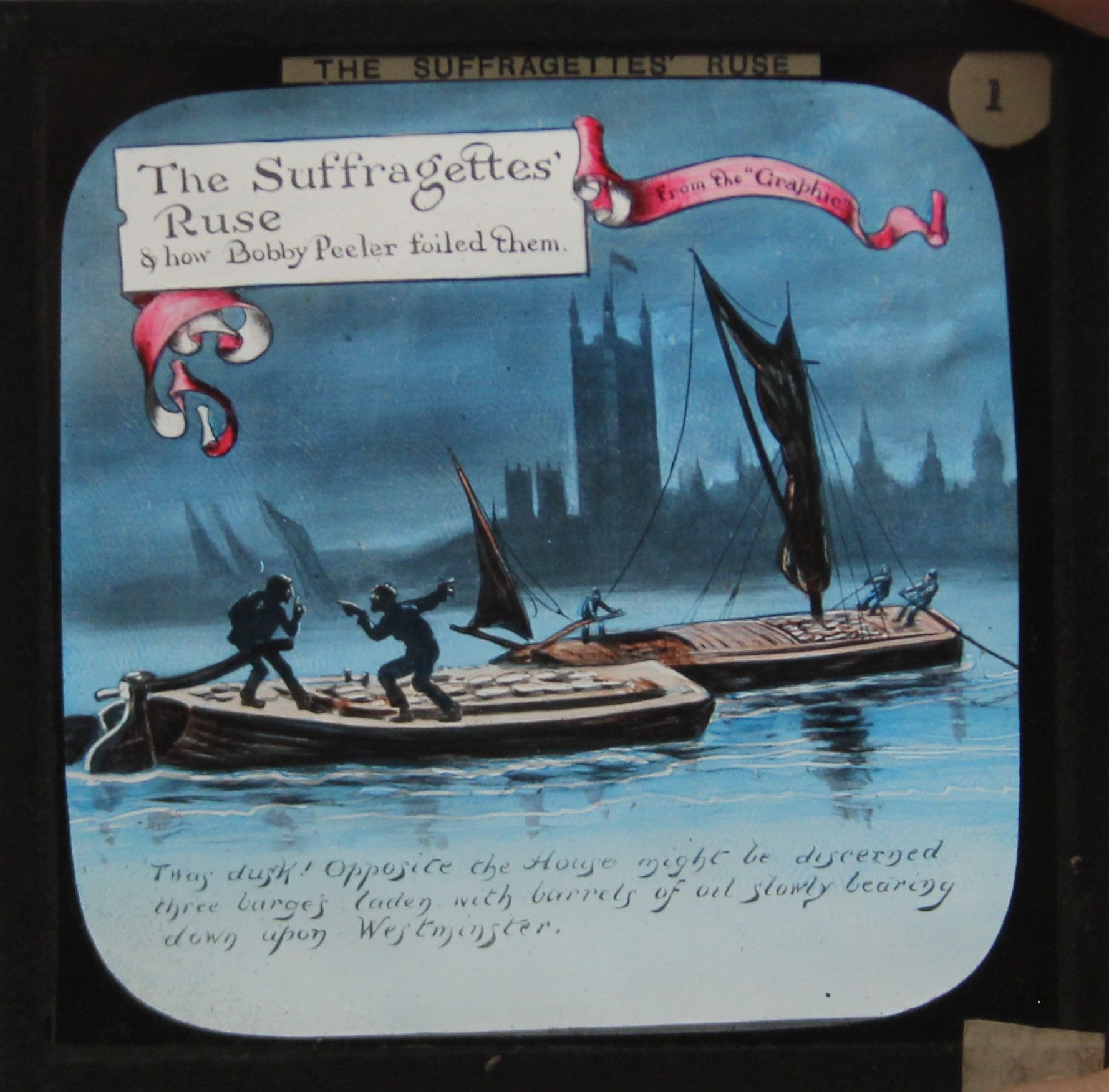
As we women make our way to the polling stations to cast our votes in the various elections being held today – Thursday 7 May 2026 – spare a thought for the efforts made by women 120 years ago to get into Parliament – by hook or by crook.
For c. 1907 it was definitely by subterfuge that the suffragettes depicted in ‘The Suffragettes’ Ruse & How Bobby Peeler Foiled Them’ – a set of ten lantern slides – sought to infiltrate the Palace of Westminster.
Their nefarious plan was to hide in barrels onboard Thames barges and when they reached Westminster to be unloaded onto the Terrace and storm the House of Commons.
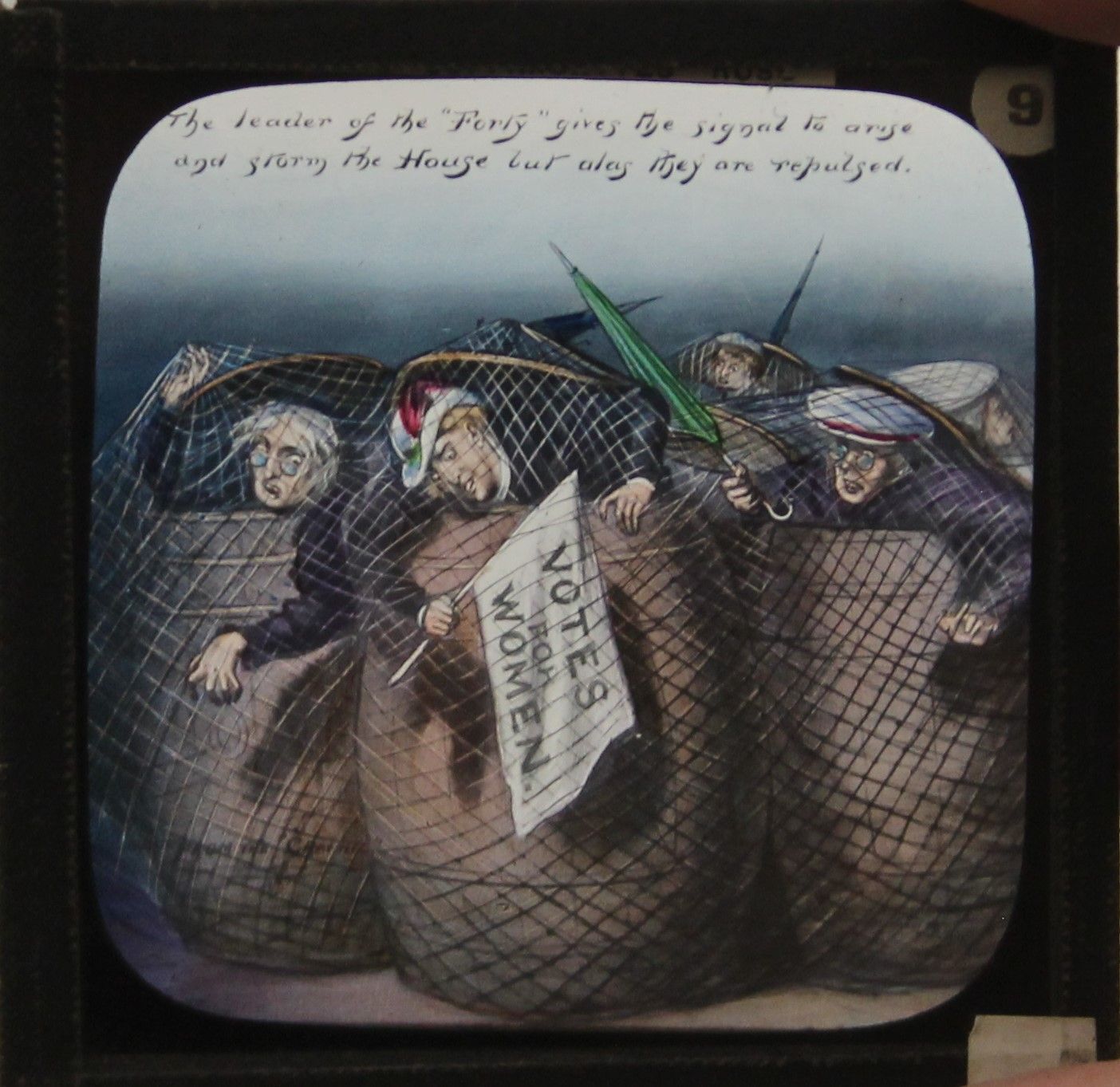
But, alas, their plan was foiled by two burly policemen who, alert to the inability of women to resist the joys of a ‘fashion paper’, entice them out of hiding and haul them off to Cannon Row police station. But, as we all know, these women and their kind lived to fight another day.
This set of slides once passed through my hands – and my catalogue. My research – via The Lucerna Magic Lantern Web Resource (University of Exeter) – revealed that the set was manufactured no later than 1907 by York & Son, based in Bayswater, London. One of the partners, William York, was a ‘photographic artist’ and may possibly have been responsible for this topical number. I had never before or since seen this set -or, indeed, any other suffragette lantern-slide story. In fact, ‘The Suffragettes’ Ruse’ is the only suffrage-related item on the Lucerna website.
Copyright
All the articles on Woman and Her Sphere are my copyright. An article may not be reproduced in any medium without my permission and full acknowledgement. You are welcome to cite or quote from an article provided you give full acknowledgement.
In The British Women’s Suffrage Movement in 100 Objects: a material history – to be published in July – you can discover how all manner of objects were caused to be created in the furtherance of the campaign for ‘Votes for Women’. You can pre-order the book – at an enticing reduced price – here .
Suffrage Stories: The WSPU Illuminated Address. Is This Sylvia Pankhurst’s Original Design?
Posted by womanandhersphere in British Women's Suffrage Campaign in 100 Objects, Suffrage Stories on April 17, 2026
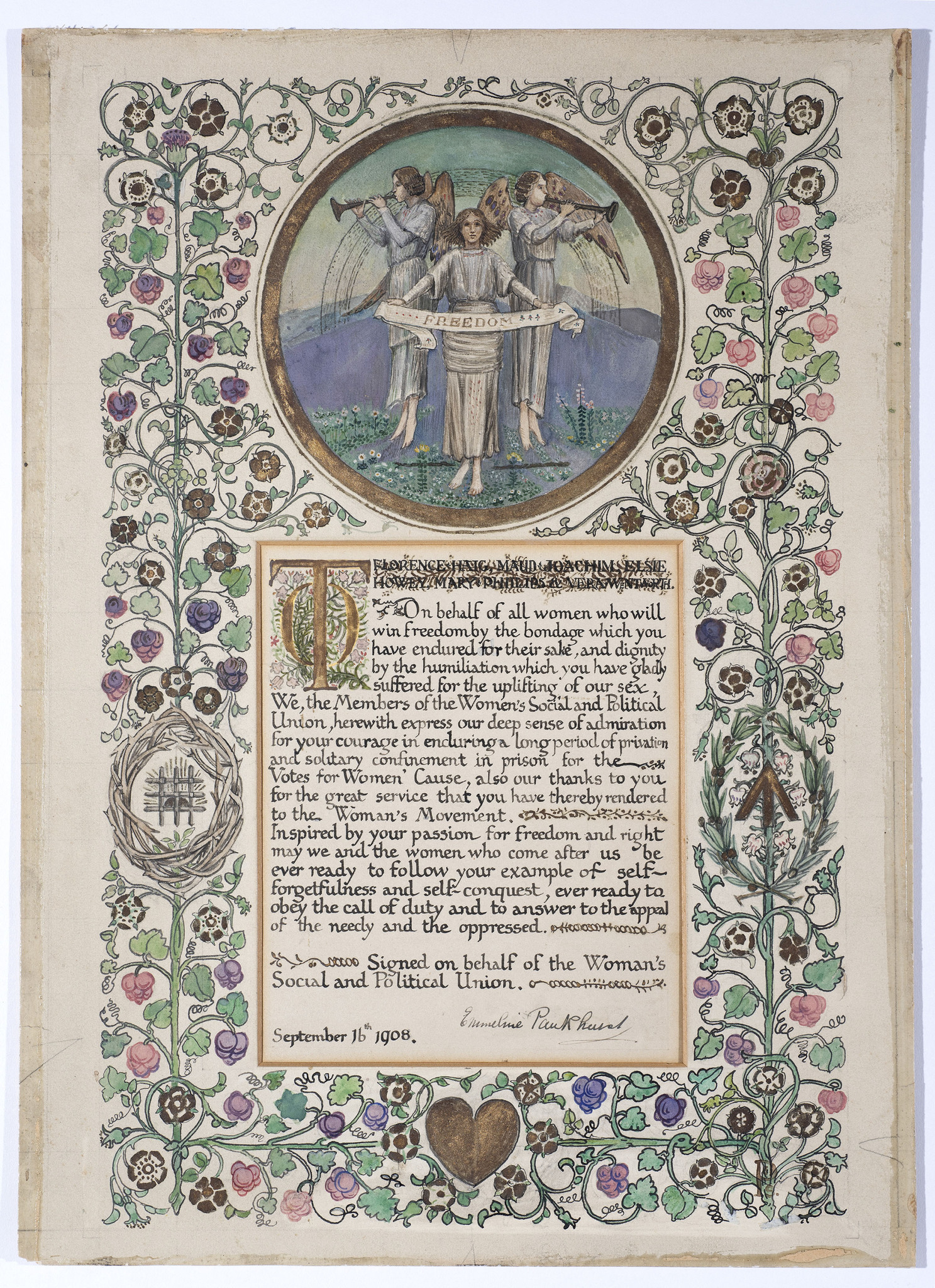
Material owned by the Metropolitan Police Service Museum, licensed under the Metropolitan Police Service Non-Commercial Licence. (This image must not be reproduced without permission from the Metropolitan Police Service.)
Twelve years ago I paid a visit to what was then the Metropolitan Police Heritage Centre in West Kensington on the off-chance that any records held there might allow the WSPU campaign to be viewed through a police prism. In this I was disappointed – but one item I was incidentally shown did stick in my mind – an illuminated certificate such as the WSPU presented to their imprisoned members. Nobody in the Centre was able to tell me how they came to have this item in their collection and as this visit took place just a few days before I knew what was awaiting me – a cancer diagnosis – I did not follow it up.
However, thanks to the care I receive from University College London Hospital, suffrage detecting continues and four years later, in June 2018, while researching in the National Archives for a chapter on Suffrage Collecting (published in The Routledge Companion to British Women’s Suffrage), I discovered what I thought might be a clue to the certificate’s presence in the police museum. For among the items listed in MEPO/3/2407, an application from the WSPU for the return of their property seized by the police in a raid on Lincoln’s Inn House in April 1913, are ‘2 framed Suffragette certificates’ against which an official marked ‘retained Museum 30 April 1913’.
I made a note of this but, what with one thing and another, took the matter no further – until this week when the Metropolitan Police Museum (which removed some time ago from West Brompton to Sidcup) posted on Bluesky a fragment from the illuminated WSPU certificate they held. With communication now so much easier, I asked if they could tell me the name on the certificate – and they quickly responded with an image of not one name but of the five names that appeared at the head of the certificate.
Now that got me wondering. All the certificates I have ever seen are dedicated to one WSPU prisoner only. Why did this one list five – Florence Haig, Maud Joachim, Elsie Howey, Mary Phillips and Vera Wentworth? Well, thanks to the wonders now at our fingertips, it took only a moment of searching digitized Votes for Women to realise that the one time these five women were grouped together around the time of the date on the certificate (16 September 1908) concerned the three-month sentence of imprisonment they each had received after taking part in a WSPU demonstration on 29 June 1908. This was the longest term that had yet been served by suffragette prisoners and the WSPU was determined to gain as much publicity as possible from the prisoners’ eventual release – due to take place on 16 September.
In this photograph (held by the London Museum) you can see four of women (Florence Haig, Vera Wentworth, Elsie Howey and Maud Joachim) as they emerge from Holloway; Mary Phillips had to wait a couple of days longer. As massed crowds lined the route the four women were escorted in triumph through the streets of north London to Queen’s Hall in Langham Place. Sitting in a carriage decorated with banks of heather and purple and white flowers, the carriage was drawn by horses for part of the way but then the traces were taken over by 50 suffragettes ‘in full uniform ‘ who conducted the prisoners to their final destination. A brass band playing ‘The Women’s Marseillaise’ accompanied the procession, while silk banners proclaiming ‘Strong souls live like fire-hearted suns to spend their strength’, Freedom’s wings in prison grow stronger’ and ‘We oppose the Government which has imprisoned over 300 women’ fluttered behind. From a press cart the public could buy copies of Votes for Women, for the WSPU was always alive to a fund-raising opportunity.
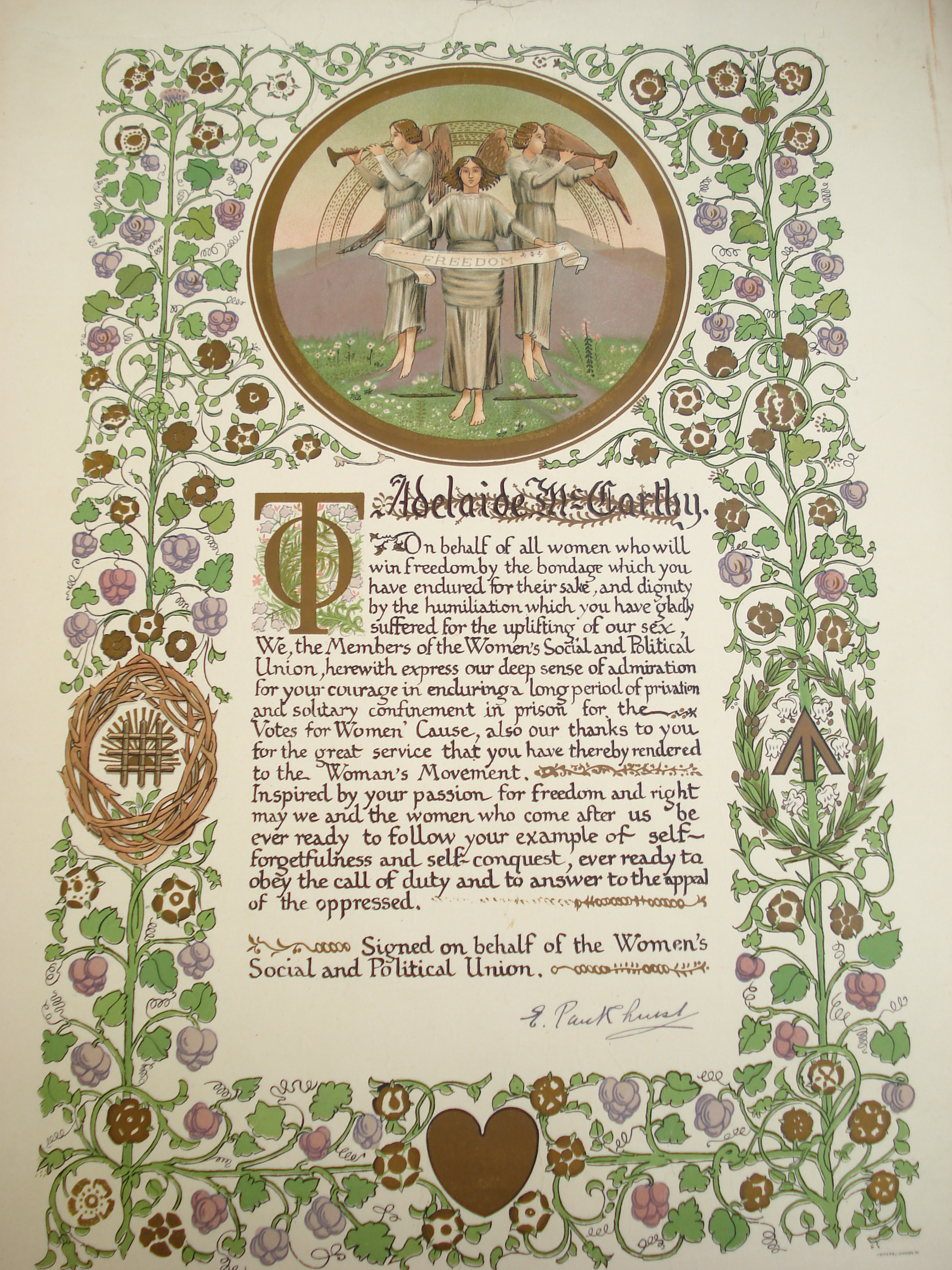
The procession was met at the Queen’s Hall by both Mrs Pankhurst and Mrs Pethick-Lawrence and there followed an enthusiastic, consciousness-raising meeting, addressed by all four released prisoners, with militant methods extolled. Votes for Women (24 September 1908) contains a full report of the procession, with a photograph of the carriage as it was drawn by the 50 suffragettes. This was on Wednesday16th and on Friday 18th Mary Phillips received similar treatment, drawn in triumph from Holloway to a reception in the Portman Rooms – with tartan very much in evidence as a nod to her Scottish heritage. At this meeting all five women were presented with an illuminated address, the wording set out in Votes for Women, 24 September 1908 (p. 472).
In the following week’s issue (Votes for Women, 1 October 1908, p. 5) readers were given a full description of the ‘illuminated address’. It was ‘the work of Miss Sylvia Pankhurst, is truly a labour of love, and represents many hours of thought and careful workmanship generously given to the Union. At the top of the design are three messengers, one bearing the scroll of freedom, the other two blowing the trumpets of the new day. The sun is seen in the distance rising over the blue hills, and the messengers have their feet upon the flowers. The rose, shamrock, and thistle are introduced as a border, and on one side is a medallion with a crown of thorns surrounding a barred gate, behind which is the rising sun, while opposite this is a wreath of laurel circling a broad arrow. The words of the address are: ‘To Florence Haig, Maud Joachim, Elsie Howey, Mary, Phillips, and Vera Wentworth …’ The report then sets out the wording as you see it in the image above.
This report also contains one other important item of information: ‘Readers..will like to know that the original may be seen at the N.W.S.P.U. offices, 4 Clement’s Inn, W.C.’ It is this sentence that leads me to think that the Metropolitan Police Museum holds the original artwork created by Sylvia Pankhurst for the illuminated addresses. I suggest that in 1912 this design, framed, moved with the WSPU from Clement’s Inn to Lincoln’s Inn House and was then, on 30 April 1913, during a police raid was down from the wall and packed into a pantechnicon with the other contents of the WSPU offices. [For a short article about the raid (written in 2013) see https://wp.me/p2AEiO-lK.] As noted in MEPO/3/2407 an official, for whatever reason (liked the look of it?, decided that the framed address should be retained for the Museum.
And there it has remained for 113 years. The fact that it is Sylvia Pankhurst’s original artwork was probably not appreciated by the raiding police and, as far as I know, is not now suspected by the curators of the Metropolitan Police Museum. But, having guarded it for all this time, I hope they will be a little thrilled to know they hold in their collection an object with such an interesting provenance. Of course, I imagine the fact that it is the original and not a printed design could easily be confirmed if viewed by a conservation expert.
Printed versions of the illuminated address were subsequently annotated with the names of other WSPU prisoners – such as the one below that passed through my hands a few years ago. The printed versions were then signed personally by either Emmeline Pankhurst or Emmeline Pethick-Lawrence, sometimes by both. However, unlike the original they were never dated.
Copyright
All the articles on Woman and Her Sphere are my copyright. An article may not be reproduced in any medium without my permission and full acknowledgement. You are welcome to cite or quote from an article provided you give full acknowledgement.
The British Women’s Suffrage Movement in 100 Objects: a material history – FORTHCOMING 23 JULY
Posted by womanandhersphere in British Women's Suffrage Campaign in 100 Objects on February 9, 2026
TO BE PUBLISHED ON 23 JULY – IN PAPERBACK (£24.99), HARDBACK AND AS AN EBOOK
You can pre-order from Bloomsbury at a reduced price here – or from Amazon here – or from your local bookshop.
I had no thought of producing another book when, one day in October 2023, I opened up my laptop, ready to watch an online auction mounted by Bonhams. This Votes for Women sale was devoted to suffrage memorabilia from the collection put together by a couple I’ve known ever since I began dealing in books and ephemera in the mid-1980s. I had no intention of bidding for anything in the auction as by 2023 the prices reached for suffrage material at such auctions had soared into the stratosphere. But, naturally, I took a professional interest in seeing what was up for sale – and the prices they would achieve. And I had a personal interest in that some of the items were ones I had myself sold to the vendors many years ago.
Watching the bidding was absorbing, but as the sale progressed I realised I was experiencing a niggling conflict between what might be termed my instinct as a trader and my instinct as an historian. Bonhams had organised the lots in the sale in a way as to appeal to bidders, grouping together items of a similar type, such as textile rosettes or china or badges or books – but this arrangement by no means coincided with what I knew to be the dates of their production. In my mind I was itching to reorder the lots into an historically coherent order. Well, there lay the germ of an idea …and it slowly gained traction..and, in due course, a publishing contract with Bloomsbury Academic. The result of my labours will be published in July.
For the book tells the story of the British ‘votes for women’ campaign in a sequence of 100 objects. From the beginning of the campaign in 1866 until all women were granted the vote on the same terms as men in 1928, women used every means in their power to persuade the government to allow them the right to elect members of parliament. Through the analysis of an astonishing array of objects – including books, bags, petitions, posters, plays, photographs, china, leaflets, newspapers, games, jewellery, sashes, films, and figurines – all of which are illustrated – The British Women’s Suffrage Movement in 100 Objects explores the role that material culture played in this vital struggle. Each of the 100 objects is illustrated, the accompanying text setting it in its context to explain the campaign’s politics and the part played by key personalities.
I must say that when I began work on the book it had not occurred to me that the suggestion could be voiced in any western democracy that women should be relieved of the right to the vote. But, that day having come (see here), although not yet here, there is all the more reason for understanding why and how British women won that right.
The book will be published in July in paperback at £24.99. To discover more details – as set out on the Bloomsbury website – including a special pre-order price and some most heart-warming reviews from readers who have viewed the text of the book in advance – see here.
My cup overflows – in that Bloomsbury will only accommodate six endorsements on their webpage – and nine readers were kind enough to give feedback on the book. I, as blushingly as self-promotion permits, set out below the final three to arrive. As you may imagine, I am immensely heartened – and hopeful that the 100 Objects will give a new clarity to the chronology, politics and personalities of the women’s suffrage campaign.
‘Drawing on a lifetime of groundbreaking scholarship on the British Suffrage movement and its materiality, Crawford’s new book is an essential read for anyone interested in the history of women’s campaigns for the vote. The British Women’s Suffrage Movement in 100 Objects brings to life in unprecedented detail the material world in which campaigners strove for social and political change, conveying this to new audiences with a lightness of erudition and a treasure trove of vivid detail. The extraordinary creativity and complexity of women’s activism during this era is made tangible through Crawford’s expert guidance.’ Dr Zoë Thomas, Associate Professor of Modern History, University of Birmingham
‘Beautifully illustrated and exceptionally curated, Crawford’s The British Women’s Suffrage Movement in 100 Objects is an essential and defining resource for the ways technological advances, community building, and popular culture played in the British campaign for “Votes for Women.” In clearly written and focused essays on everything from the intersection of the automobile and women’s rights to the ubiquity of comic suffragette ceramics, Crawford’s book will be of interest to scholars and general public alike.’ Heidi Herr Librarian for English, Philosophy, The Writing Seminars, & Student Engagement for Special Collections The Johns Hopkins University
‘The British Women’s Suffrage Movement in 100 Objects powerfully demonstrates the richness that material culture brings to the study of women’s histories. By centring objects, it reveals the political struggle as something lived, worn, exchanged, and displayed, rather than simply written or spoken. Together, the 100 objects offer an engaging, vivid and very human perspective on the suffrage movement, recovering voices and experiences that often remain muted in conventional narratives.’ Dr Miranda Garrett

