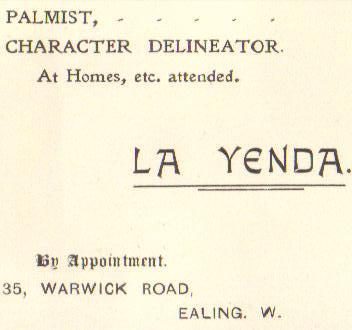
This card was given to Kate Frye at the Women’s Freedom League ‘Green, White and Gold Fair’, held in Caxton Hall, London, in April 1909. She then preserved it within the pages of her fabulous diary (now held by by Royal Holloway College Archives) .
At this time Kate was a member of the constitutional London Society for Women’s Suffrage but was happy to offer her varied services to other societies – such as the WFL. And for this fund-raising Fair she had volunteered to read palms. For palmistry was a fashionable Edwardian pastime – just the kind of thing that Kate, with her theatrical proclivities, enjoyed. She was, of course, an amateur; whereas, as she notes, Madame Yenda was ‘the real thing’.
Kate’s diary entry for Thursday 15 April 1909 relates that she went to ‘the Caxton Hall for the 1st day of the Women’s Freedom League Bazaar. Got there about 11.30 – everything in an uproar, of course. I had to find out who was in authority over me and where I was to go to do my Palmistry. I had to find a Miss Marie Lawson first and then was taken to a lady who had charge of my department and she arranged where I was to go.. Then another Palmist hurried up – the real thing who donned a red robe. I was jealous. Madame Yenda.
We got on very well, however, and exchanged cards (I have had some printed) it was all about as funny as anything I have ever done and I have had some experiences.
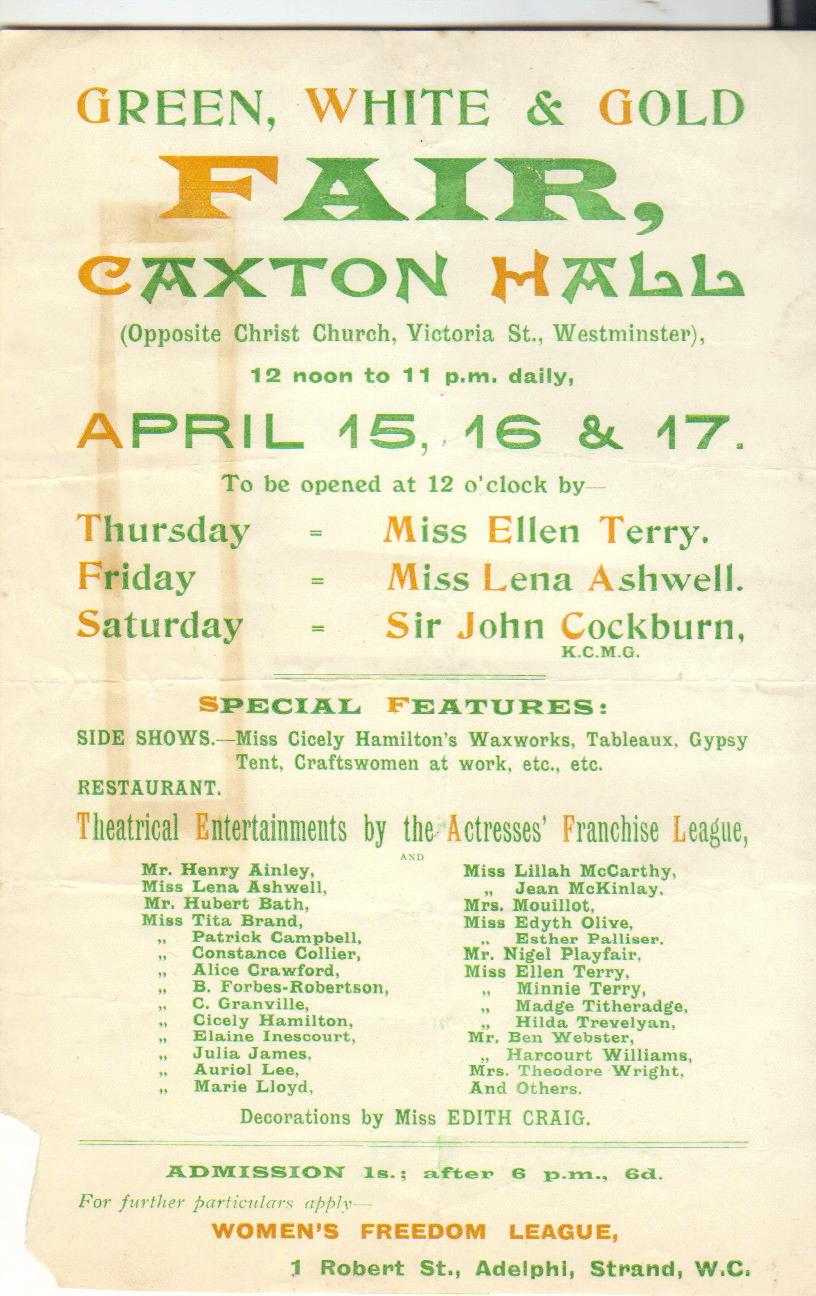
The next day Kate returned to the Fair – to the Gypsy Tent mentioned in the WFL flyer – and wrote in her diary
Madame Yenda was there but no other Palmists. Clients did not come very early – they were all following Lena Ashwell – so I had 1/- [meaning a shilling’s-worth of palm-reading] from Madame Yenda myself. I think she was clever but, of course, I am rather a hard critic at it.
She told me a great many things I know to be absolutely true and she gave me some good advice especially about morbid introspective thoughts and I think she is quite right. I do over worry. I am to beware of scandal which is all round me just now. She predicts a broken engagement, a rich alliance and always heaps of money. I should have immense artistic success in my profession if only I had more confidence in myself and if only I had some favourable influence (a sort of back patter, I take it) to help me but such an influence is far away. I shall never live a calm uneventful existence. I shall always spend so much of myself with and for others. I am rather glad of that.
I was just beginning to tell her her hand but I wouldn’t let her pay as she told me she was very poor – and I could see it – when some clients came for us both and we both had to start our work. I didn’t feel a bit inclined for work at first but got into it and had wonderful success.
Kate mentions meeting La Yenda once more – a year later – as they both walked in the WSPU 21 June 1910 ‘Prison to Citizenship’ Procession through London – so I thought it likely that the palmist had more interest in the suffrage campaign than merely reading the hands of its supporters. In fact, years later, in 2022, I spotted her entry in a ‘suffragette’ autograph album that came up for auction at Bonhams. To this she had added her own name (Louise Till) against ‘La Yenda’ – and I thought then that when the moment came I would try and discover the identity of the ‘real thing’.
Anyway, now is the moment and of course, nowadays, nothing could be easier. There was the clue of the name (but there are a number of Edwardian Louise Tills) and the address (but no Till showed up in the 1911 census nor in any electoral roll at Warwick Road). However, the answer lay in the digitized Newspaper Archive. For there I found any number of references to ‘La Yenda’, who had progressed from printing an Edwardian calling card to taking out newspaper advertisements in the 1920s.
So, the beaded curtain of the palmist’s tent can be lifted to reveal:
Jacobina Louise Till (1861-1930), born in Gourock, Renfrewshire, Scotland, was living with widowed Mrs Florence Finlay (who had been born in Grahamstown, Cape Colony) at 35 Warwick Road, Ealing, by the time she encountered Kate. Neither she nor Mrs Finlay are recorded in the 1911 census. Louise Till’s obituary states that between the two women ‘the closest friendship existed’ (Middlesex County Times, 15 February 1930). This account also tells us that Louise Till ‘was a psychic of a high order, and she used her gifts with the sole object of helping those who consulted her to develop their characters and minds to the best and fullest extent’. ‘La Yenda’ tended to carry out her practice at Worthing in the summer, returning to Ealing in the autumn – and the obituary also refers to extended professional visits to Italy and France. Like so many other suffrage campaigners, Louise Till was an active Theosophist. Her funeral service was conducted by a minister of the Theistic Church who reminded the congregation that ‘thoughts of grief and misery hindered the soul on its pilgrimage upward in its new surroundings. To remember in love was something very different from bland despair’.
So, now, nearly 100 years later, we are remembering ‘La Yenda’ simply because she thought to go to a printer, order a business card for herself, and, by association, create a ‘suffrage object’.
For more about Kate see Kate Parry Frye: the long life of an Edwardian actress and suffragette (ITV – eBook_
Copyright
All the articles on Woman and Her Sphere are my copyright. An article may not be reproduced in any medium without my permission and full acknowledgement. You are welcome to cite or quote from an article provided you give full acknowledgement
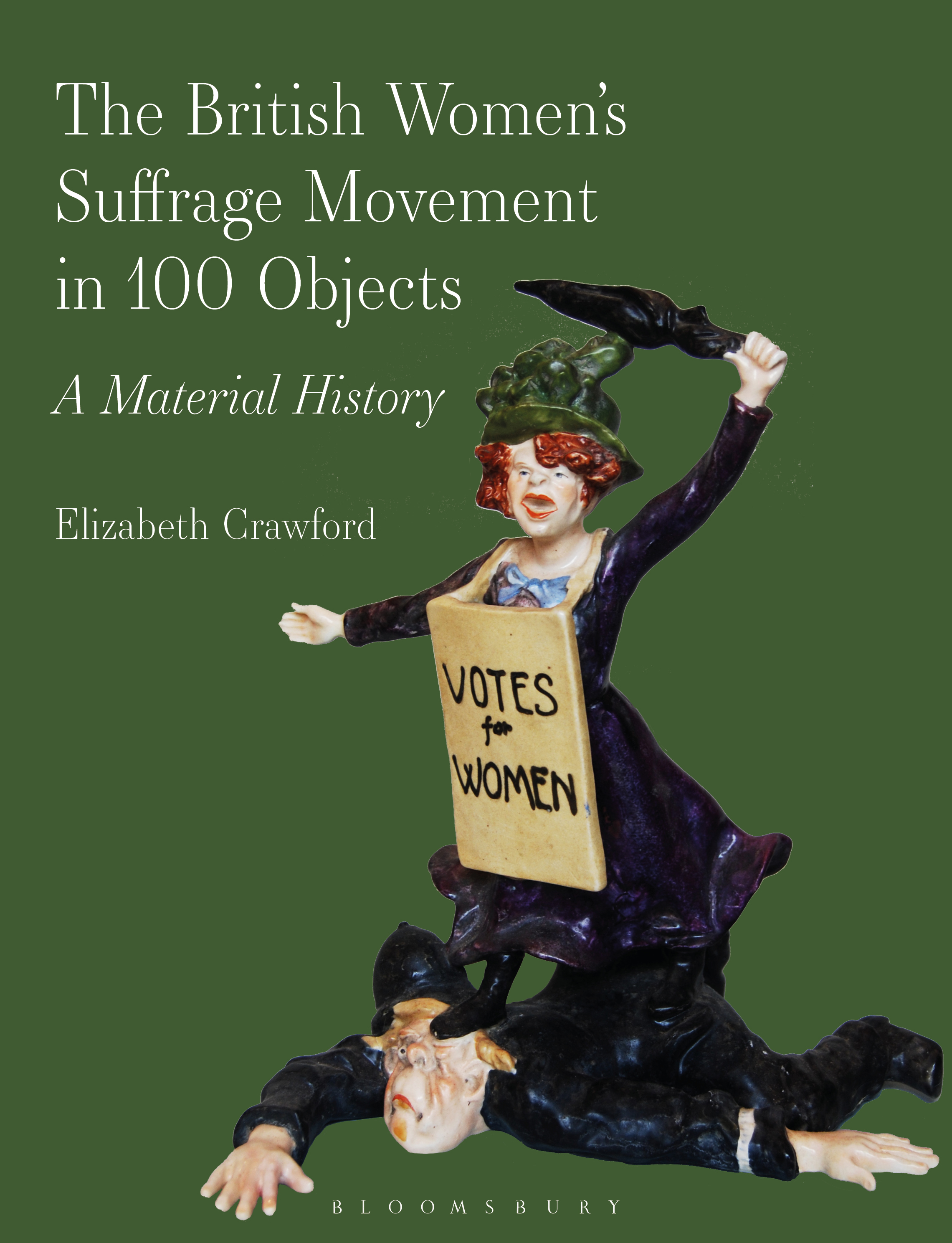
In The British Women’s Suffrage Movement in 100 Objects: a material history – to be published in July – you can discover how all manner of objects were caused to be created in the furtherance of the campaign for ‘Votes for Women’. You can pre-order the book – at an enticing reduced price – here .


#1 by jrkelly2013 on May 14, 2026 - 9:42 pm
Wonderful. These micro histories of the small players illustrate so much about the bigger movements they were part of. Thank you for ongoing curiosity and your detailed research.
#2 by womanandhersphere on May 15, 2026 - 2:50 pm
And thank you…your message is much appreciated…Elizabeth