Archive for category Suffrage Objects
SUFFRAGE OBJECTS: ‘VOTES FOR WOMEN’ HOOKS & EYES
Posted by womanandhersphere in British Women's Suffrage Campaign in 100 Objects, Suffrage Objects on May 19, 2026
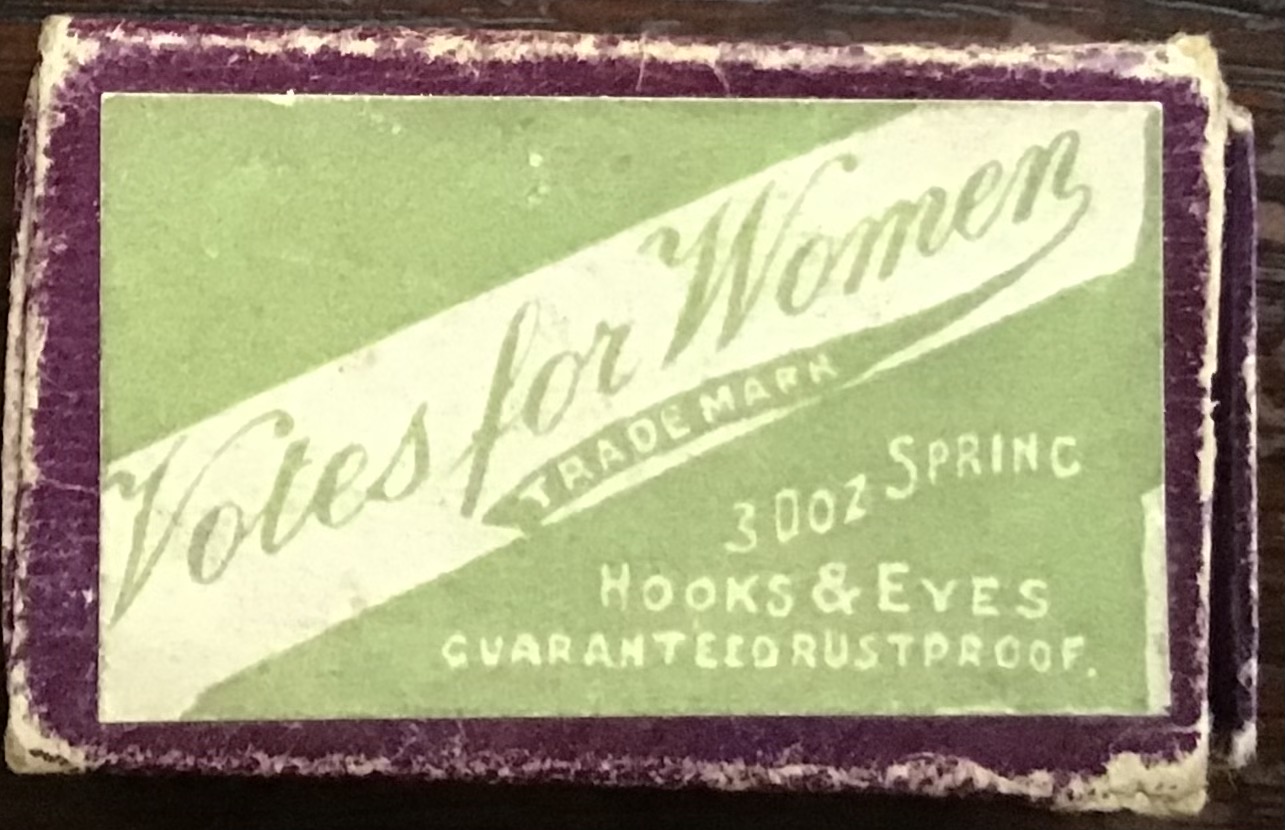
In over 40 years spent hunting for and selling objects related to the women’s suffrage campaign, this little box is the only example I have ever found of ‘Votes for Women’ Hooks and Eyes. It is a perfect ‘suffrage object’, hitching to a political slogan a utility that was particularly personal to women. For how else were figure-hugging jackets, skirts or, indeed, corsets to be held together without a generous number of hooks and eyes? And who else would be sewing them on? The majority of suffragettes and suffragists were, of necessity, also needlewomen. So here was an opportunity to back the Cause while sewing fastenings onto their skirt plackets or bodices.
When, sometime in the mid-1990s, I first acquired the box, it was empty. The 36 ‘hooks and eyes’ it had once contained had been put to use c. 90 years previously and the garment to which they had been attached had doubtless long since gone to landfill. But the little cardboard box had survived. Was this by accident or because it had been put aside as a souvenir of a long-ago commitment to the cause of ‘votes for women’? I remember being amazed to find it on a stall at the monthly market that was then held in Alexandra Palace in north London. I duly catalogued it, sold it and then, five years or so ago, bought it back and placed it in a new home, where I am sure it is also much appreciated.
It has proved impossible to establish the name of the manufacturer and, though I would have loved to be able to establish whether ‘Votes for Women’ really had been trademarked to these hooks and eyes, I’m unable to undertake the research necessary, For this would involve ‘needle in the haystack’ searching through records held at the National Archives (I hope you enjoy the choice of metaphor). There are, however, two interesting points to notice about the one-time contents of the box. For the label tell us that the hooks and eyes were ‘sprung’, meaning tension kept the connection closed until released manually – very necessary to prevent a costume malfunction. We are also told that they were rustproof, an important consideration if the garment was to be washed or was caught in a shower while the wearer was demonstrating outside parliament.
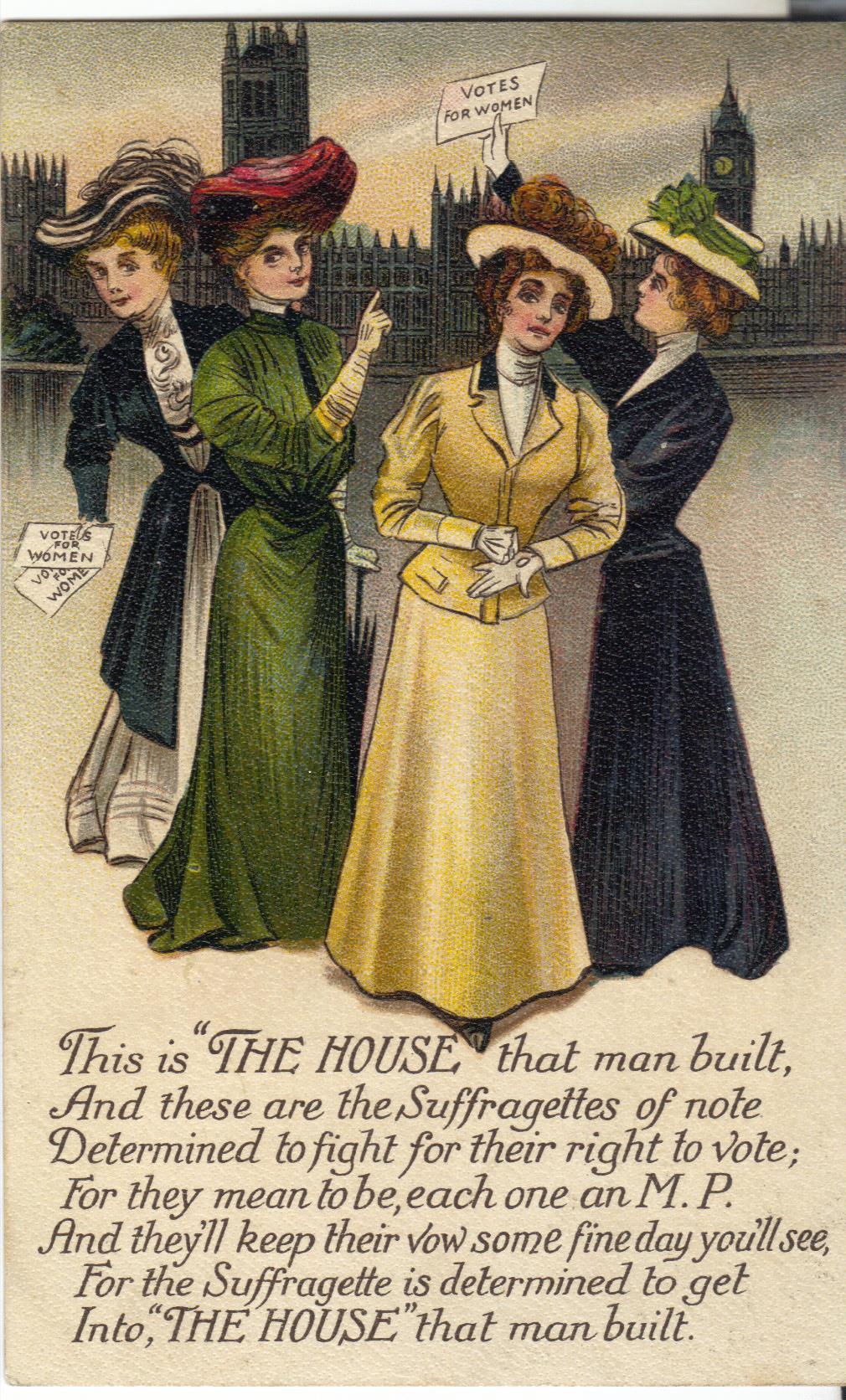
Just think of the number of hooks and eyes keeping these figures in place
Surprisingly, no advertisement for ‘Votes for Women’ hooks and eyes appears in any of the suffrage papers. It could be – although there is no proof – that this addition to the suffragette sewing basket was commissioned to supply the WSPU shops or for a fund-raising fair. Moreover, it is to be noted that the hooks and eyes were sold in a box – and not, as was usual in the early years of the 20th century, on cards. In fact, the women stitching hooks and eyes onto cards were the very type of sweated labourers on whose behalf suffrage campaigners protested. Mind you, matchbox makers were also very ill-rewarded and one can only wonder whether that ‘Votes for Women’ label was perhaps not slapped on with some resentment.
The manufacturer registering ‘Votes for Women’ as its trademark was not the only maker of hooks and eyes to discern a market for its goods among the supporters of the suffrage cause. Votes for Women (eg issue for 23 April 1909, p 26) carried advertisements for ‘Smart’s invisible hooks and eyes ‘ which were the ‘patented invention and property of two members and supporters of the Women’s Social and Political Union.’ The firm was, indeed, on occasion noted as giving a donation to a WSPU fund-raising campaign. Smart’s’ was making hooks and eyes in the 1890s but I have been unable to discover anything about the firm. Most such items were manufactured around Birmingham, but Smart’s advertisements give no address,
Copyright
In The British Women’s Suffrage Movement in 100 Objects: a material history – to be published in July – you can discover how all manner of objects were caused to be created in the furtherance of the campaign for ‘Votes for Women’. You can pre-order the book – at an enticing reduced price – here .
SUFFRAGE OBJECT: A PALMIST’S BUSINESS CARD: WHO WAS ‘LA YENDA’?
Posted by womanandhersphere in British Women's Suffrage Campaign in 100 Objects, Kate Frye's suffrage diary, Suffrage Objects on May 14, 2026
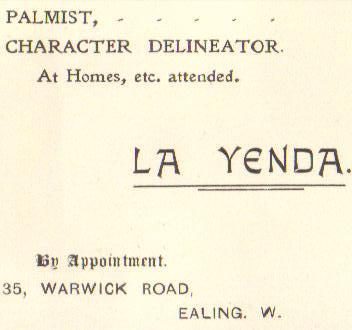
This card was given to Kate Frye at the Women’s Freedom League ‘Green, White and Gold Fair’, held in Caxton Hall, London, in April 1909. She then preserved it within the pages of her fabulous diary (now held by by Royal Holloway College Archives) .
At this time Kate was a member of the constitutional London Society for Women’s Suffrage but was happy to offer her varied services to other societies – such as the WFL. And for this fund-raising Fair she had volunteered to read palms. For palmistry was a fashionable Edwardian pastime – just the kind of thing that Kate, with her theatrical proclivities, enjoyed. She was, of course, an amateur; whereas, as she notes, Madame Yenda was ‘the real thing’.
Kate’s diary entry for Thursday 15 April 1909 relates that she went to ‘the Caxton Hall for the 1st day of the Women’s Freedom League Bazaar. Got there about 11.30 – everything in an uproar, of course. I had to find out who was in authority over me and where I was to go to do my Palmistry. I had to find a Miss Marie Lawson first and then was taken to a lady who had charge of my department and she arranged where I was to go.. Then another Palmist hurried up – the real thing who donned a red robe. I was jealous. Madame Yenda.
We got on very well, however, and exchanged cards (I have had some printed) it was all about as funny as anything I have ever done and I have had some experiences.
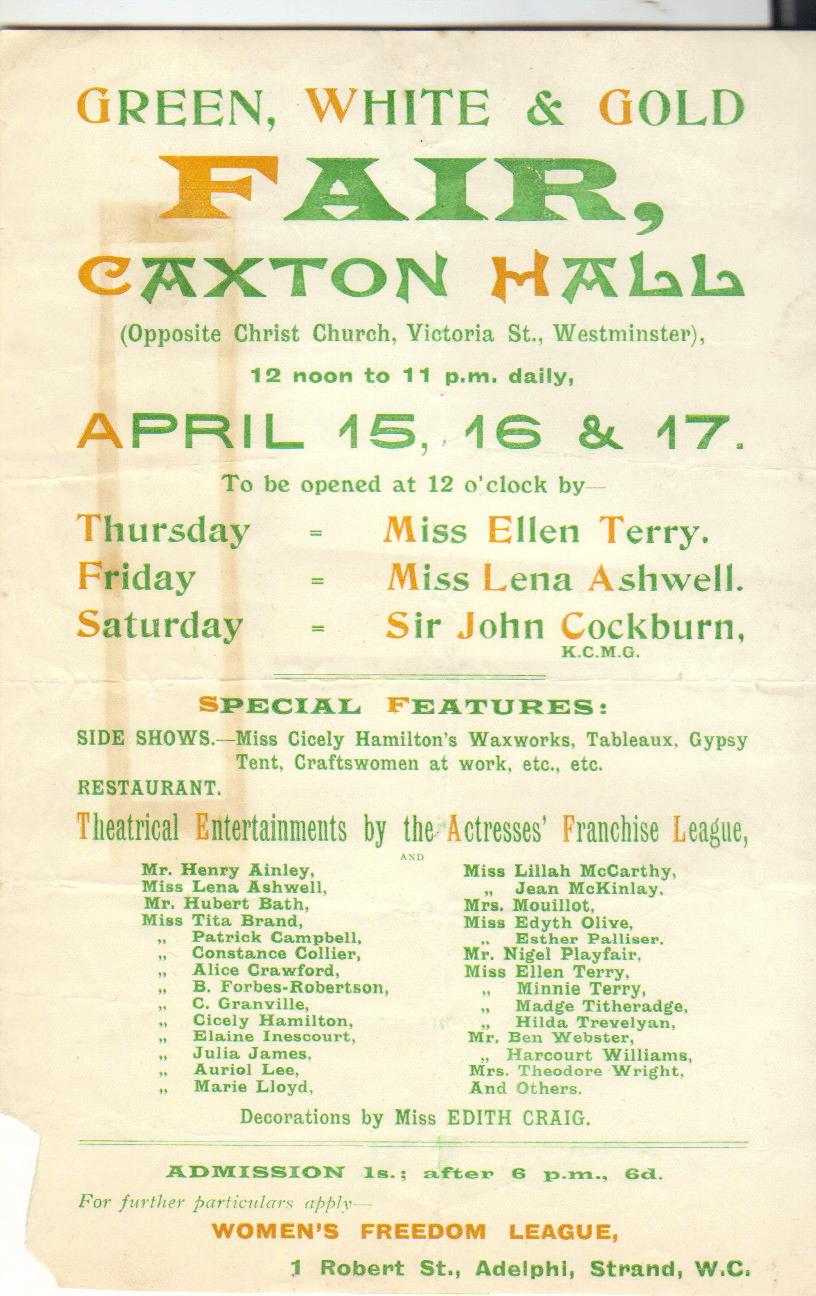
The next day Kate returned to the Fair – to the Gypsy Tent mentioned in the WFL flyer – and wrote in her diary
Madame Yenda was there but no other Palmists. Clients did not come very early – they were all following Lena Ashwell – so I had 1/- [meaning a shilling’s-worth of palm-reading] from Madame Yenda myself. I think she was clever but, of course, I am rather a hard critic at it.
She told me a great many things I know to be absolutely true and she gave me some good advice especially about morbid introspective thoughts and I think she is quite right. I do over worry. I am to beware of scandal which is all round me just now. She predicts a broken engagement, a rich alliance and always heaps of money. I should have immense artistic success in my profession if only I had more confidence in myself and if only I had some favourable influence (a sort of back patter, I take it) to help me but such an influence is far away. I shall never live a calm uneventful existence. I shall always spend so much of myself with and for others. I am rather glad of that.
I was just beginning to tell her her hand but I wouldn’t let her pay as she told me she was very poor – and I could see it – when some clients came for us both and we both had to start our work. I didn’t feel a bit inclined for work at first but got into it and had wonderful success.
Kate mentions meeting La Yenda once more – a year later – as they both walked in the WSPU 21 June 1910 ‘Prison to Citizenship’ Procession through London – so I thought it likely that the palmist had more interest in the suffrage campaign than merely reading the hands of its supporters. In fact, years later, in 2022, I spotted her entry in a ‘suffragette’ autograph album that came up for auction at Bonhams. To this she had added her own name (Louise Till) against ‘La Yenda’ – and I thought then that when the moment came I would try and discover the identity of the ‘real thing’.
Anyway, now is the moment and of course, nowadays, nothing could be easier. There was the clue of the name (but there are a number of Edwardian Louise Tills) and the address (but no Till showed up in the 1911 census nor in any electoral roll at Warwick Road). However, the answer lay in the digitized Newspaper Archive. For there I found any number of references to ‘La Yenda’, who had progressed from printing an Edwardian calling card to taking out newspaper advertisements in the 1920s.
So, the beaded curtain of the palmist’s tent can be lifted to reveal:
Jacobina Louise Till (1861-1930), born in Gourock, Renfrewshire, Scotland, was living with widowed Mrs Florence Finlay (who had been born in Grahamstown, Cape Colony) at 35 Warwick Road, Ealing, by the time she encountered Kate. Neither she nor Mrs Finlay are recorded in the 1911 census. Louise Till’s obituary states that between the two women ‘the closest friendship existed’ (Middlesex County Times, 15 February 1930). This account also tells us that Louise Till ‘was a psychic of a high order, and she used her gifts with the sole object of helping those who consulted her to develop their characters and minds to the best and fullest extent’. ‘La Yenda’ tended to carry out her practice at Worthing in the summer, returning to Ealing in the autumn – and the obituary also refers to extended professional visits to Italy and France. Like so many other suffrage campaigners, Louise Till was an active Theosophist. Her funeral service was conducted by a minister of the Theistic Church who reminded the congregation that ‘thoughts of grief and misery hindered the soul on its pilgrimage upward in its new surroundings. To remember in love was something very different from bland despair’.
So, now, nearly 100 years later, we are remembering ‘La Yenda’ simply because she thought to go to a printer, order a business card for herself, and, by association, create a ‘suffrage object’.
For more about Kate see Kate Parry Frye: the long life of an Edwardian actress and suffragette (ITV – eBook_
Copyright
All the articles on Woman and Her Sphere are my copyright. An article may not be reproduced in any medium without my permission and full acknowledgement. You are welcome to cite or quote from an article provided you give full acknowledgement
In The British Women’s Suffrage Movement in 100 Objects: a material history – to be published in July – you can discover how all manner of objects were caused to be created in the furtherance of the campaign for ‘Votes for Women’. You can pre-order the book – at an enticing reduced price – here .
SUFFRAGE OBJECT: ANNIE KENNEY’S BRACELET
Posted by womanandhersphere in Suffrage Objects on May 11, 2026
Many years ago I was briefly the owner of a most remarkable suffrage object, a tangible record of a very real friendship. This 9- ct gold bracelet, conventionally pretty in its outer appearance, is within engraved with a revealing message.
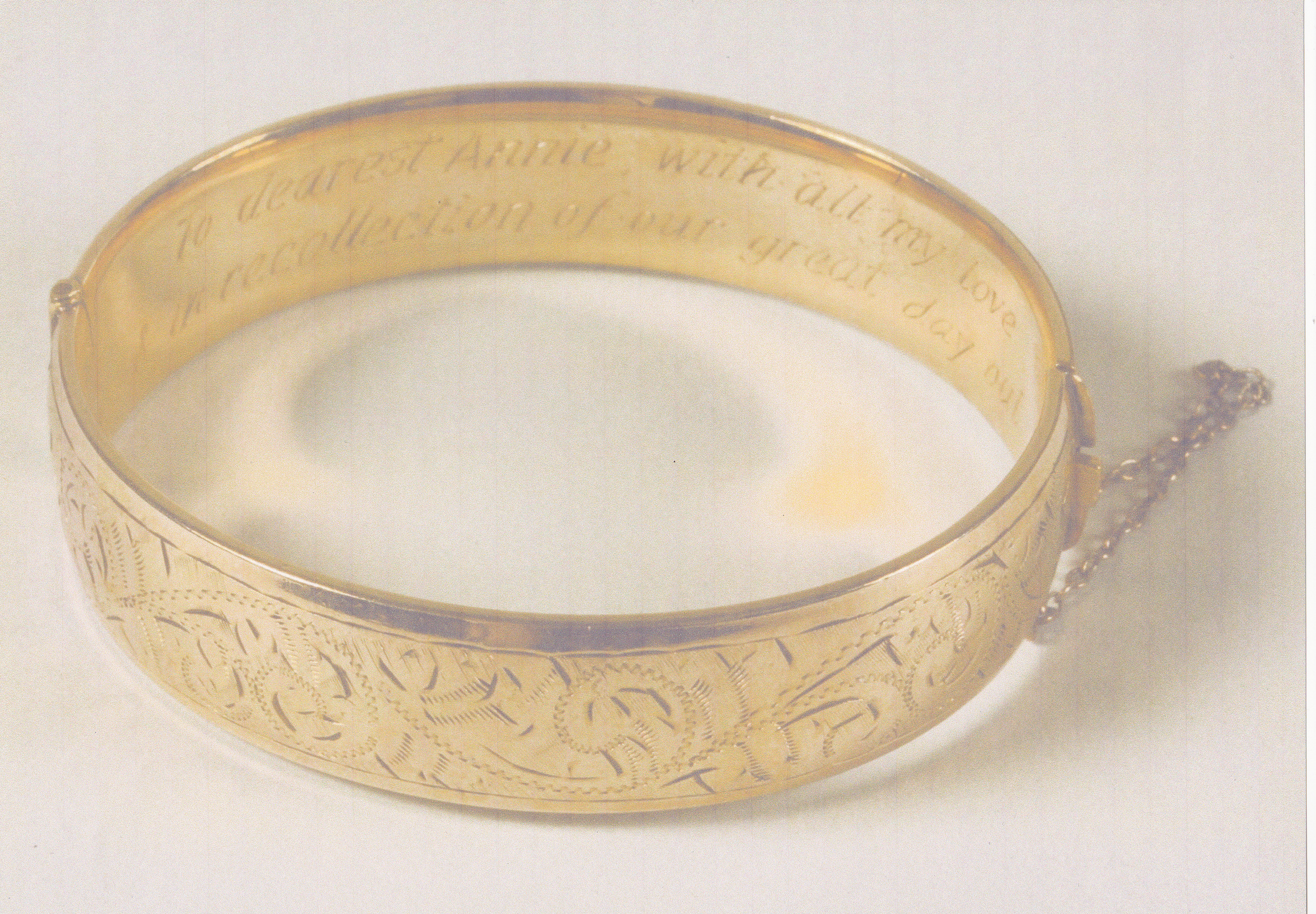
Inside, one arc of the circle reads:
‘To dearest Annie with all my love & in recollection of our great day out’
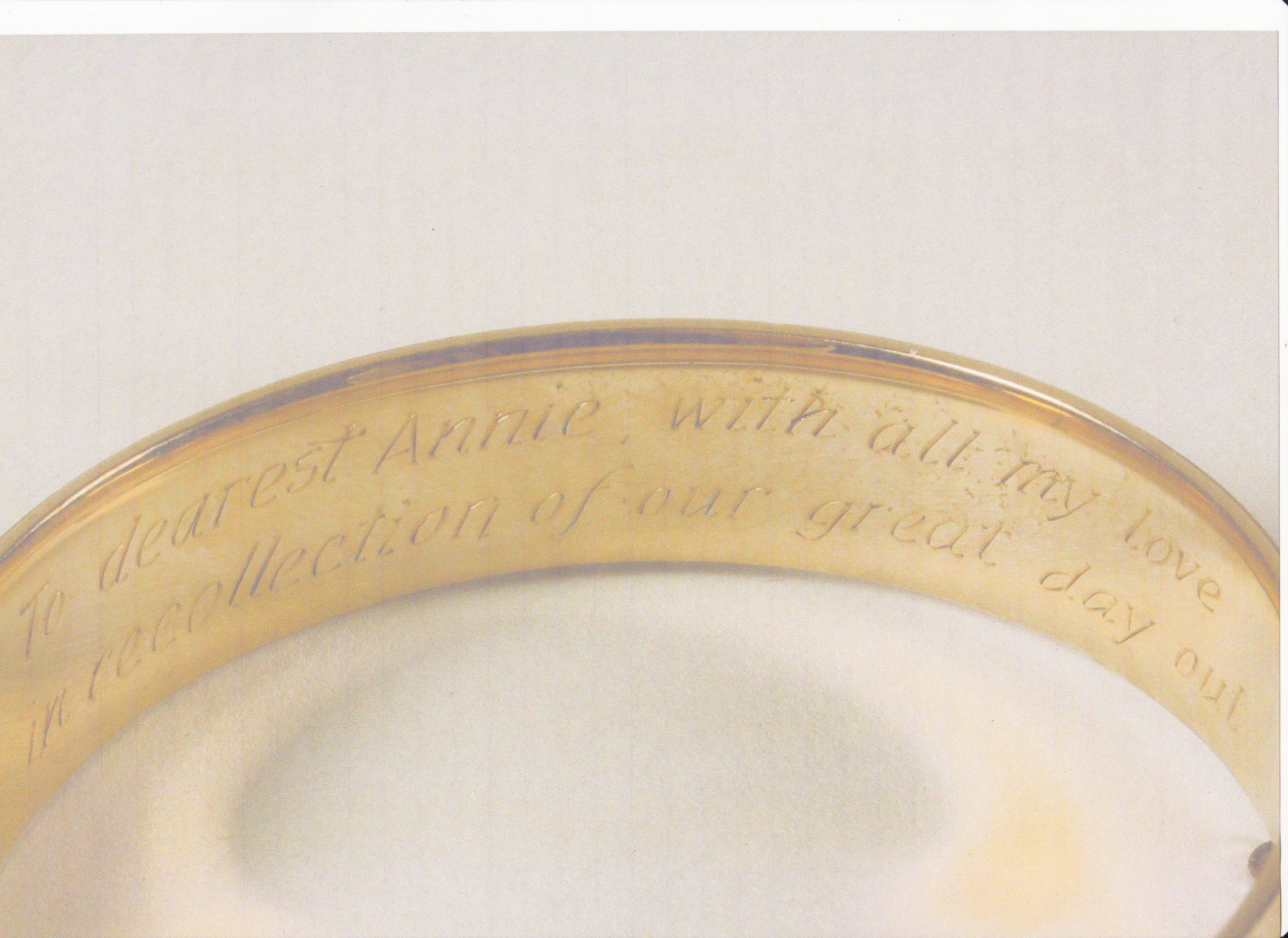
and, on the other,
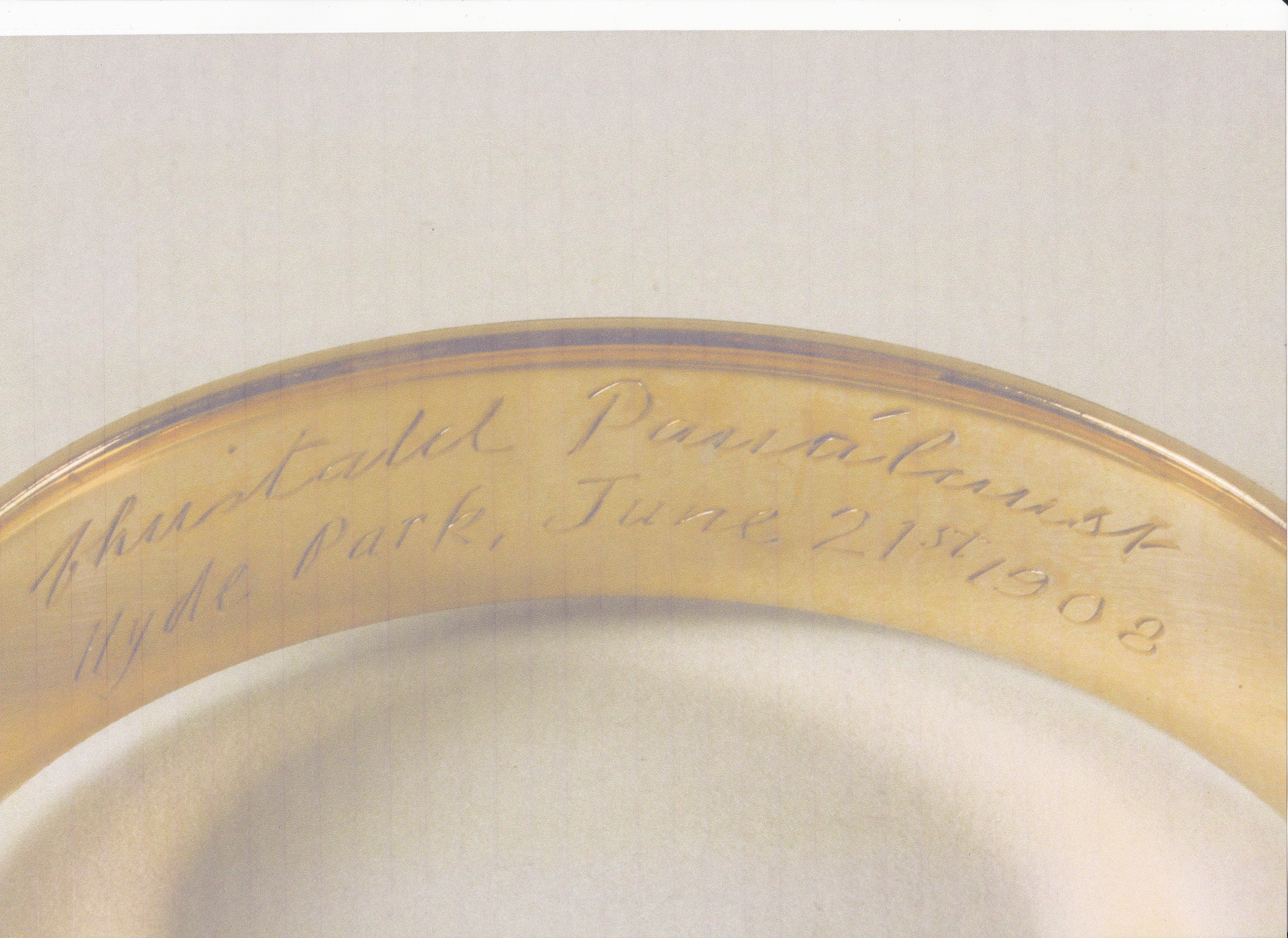
‘Christabel Pankhurst, Hyde Park June 21st 1908’.
Annie Kenney was Christabel’s most faithful follower, her love and admiration for Christabel – and Christabel’s acceptance and acknowledgment of this loyalty – made clear in letters and in Annie’s autobiography (Memoirs of a Militant). But this bracelet is, as far as I know, the only object that testifies to the peculiar bond between the two young women.
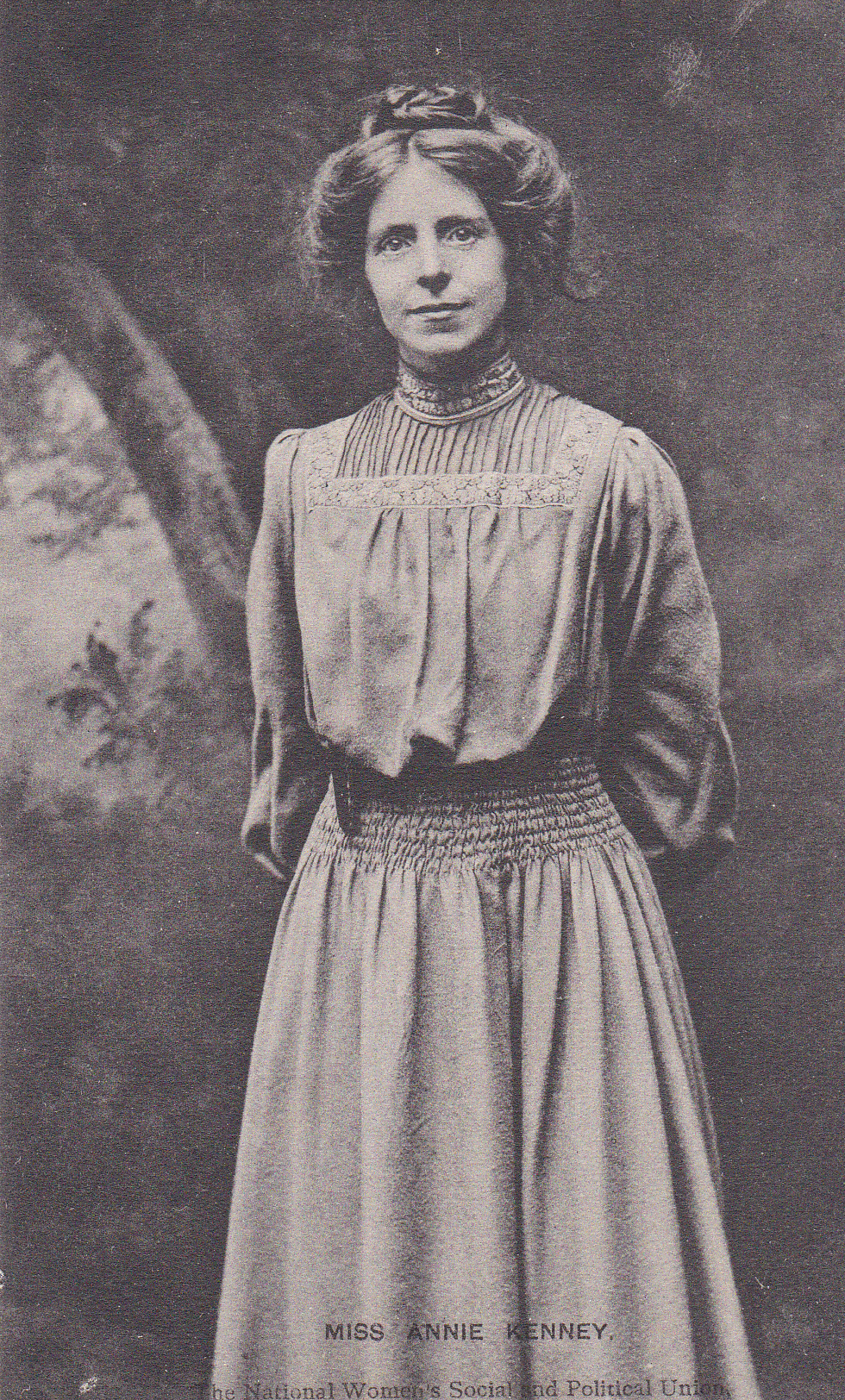
Annie, who had worked in a mill from the age of 10, had first come under Christabel’s spell in the spring of 1905 and a few months later, in October, spent a week in prison with her after they had heckled a Liberal meeting in Manchester. This imprisonment marks the beginning of the WSPU’s militant campaign.
Annie’s life was changed for ever. As she wrote, ‘My pleasure came from seeing Christabel’s face light up with a light that later in life I discovered meant victory. Her confidence in me gave me confidence in myself.’ And when they were together in prison – ‘I remember going to Church and sitting next to Christabel who looked very coy and pretty in her prison cap. She took my hand tenderly and just held it, as though I were a lost child.’
Nevertheless that ‘lost child’, backed by Christabel’s confidence, became one of the WSPU’s leading organisers. Indeed, after Christabel left for Paris, Annie acted as her deputy, putting into effect the absent leader’s commands.
But before that, for the ‘great day out’, ‘Women’s Sunday’, the first great WSPU rally, held in Hyde Park on 21 June 1908, Annie, who was at that time WSPU organiser in the West of England, bought a hat (£1/2/6) from Liberty’s Bristol branch (28 Park Street) and led the procession that started at Paddington. Once in the Park she was the principal speaker on Platform 3.
Christabel’s gift of the bracelet recognises the significance of the ‘great day out’, marking the WSPU’s entry into a world of polished performance and Annie as one of its stars.
As Annie wrote many years later in her memoir, ‘There is a cord between Christabel and me that nothing can break – the cord of love. Distance or absence makes no difference.’ This bracelet is a material – and unique -emblem of that affection.
Copyright
In The British Women’s Suffrage Movement in 100 Objects: a material history – to be published in July – you can discover how all manner of objects were caused to be created in the furtherance of the campaign for ‘Votes for Women’. You can pre-order the book – at an enticing reduced price – here .
SUFFRAGE OBJECTS: MAGIC LANTERN SLIDES
Posted by womanandhersphere in British Women's Suffrage Campaign in 100 Objects, Suffrage Objects on May 7, 2026
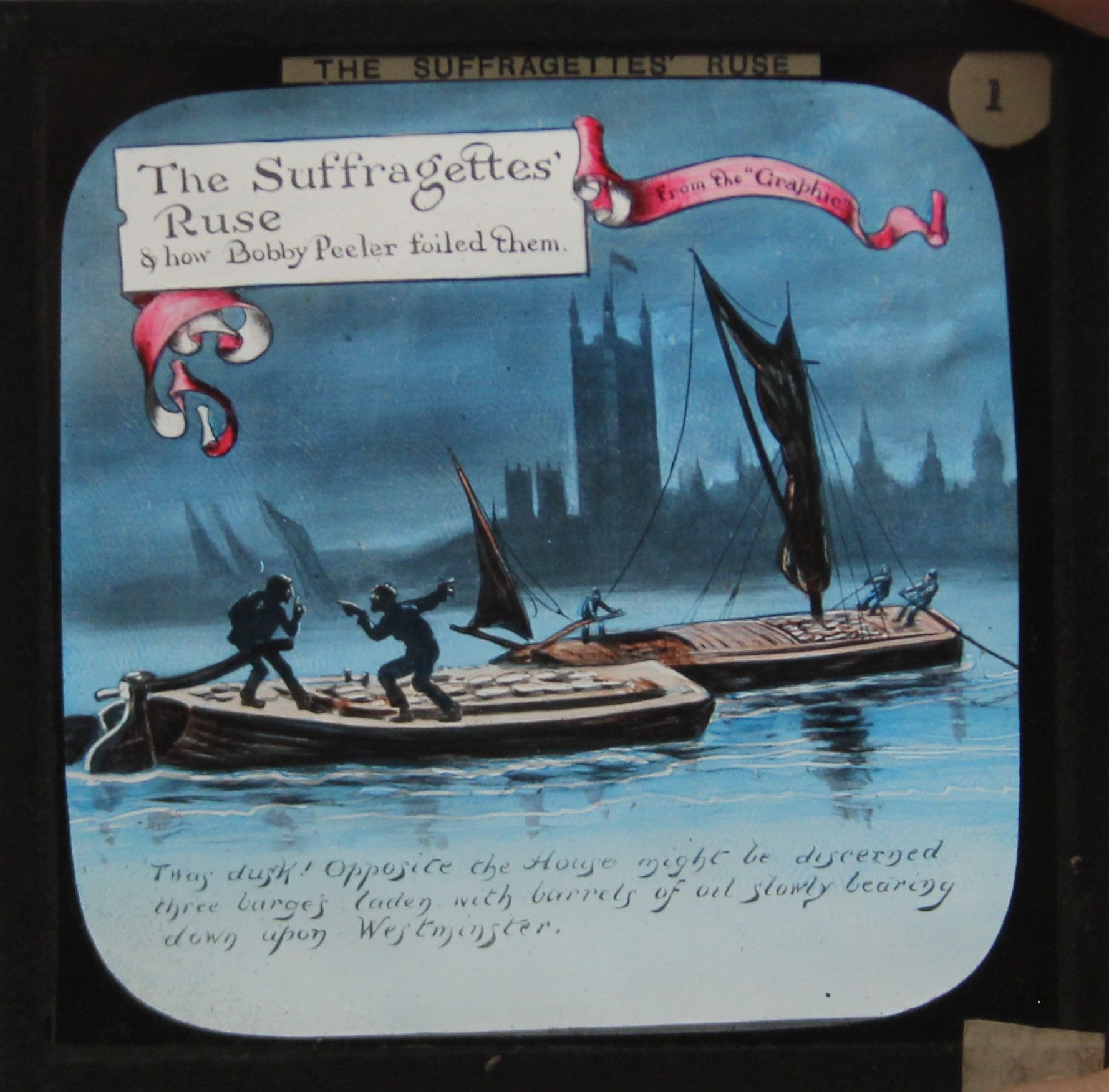
As we women make our way to the polling stations to cast our votes in the various elections being held today – Thursday 7 May 2026 – spare a thought for the efforts made by women 120 years ago to get into Parliament – by hook or by crook.
For c. 1907 it was definitely by subterfuge that the suffragettes depicted in ‘The Suffragettes’ Ruse & How Bobby Peeler Foiled Them’ – a set of ten lantern slides – sought to infiltrate the Palace of Westminster.
Their nefarious plan was to hide in barrels onboard Thames barges and when they reached Westminster to be unloaded onto the Terrace and storm the House of Commons.
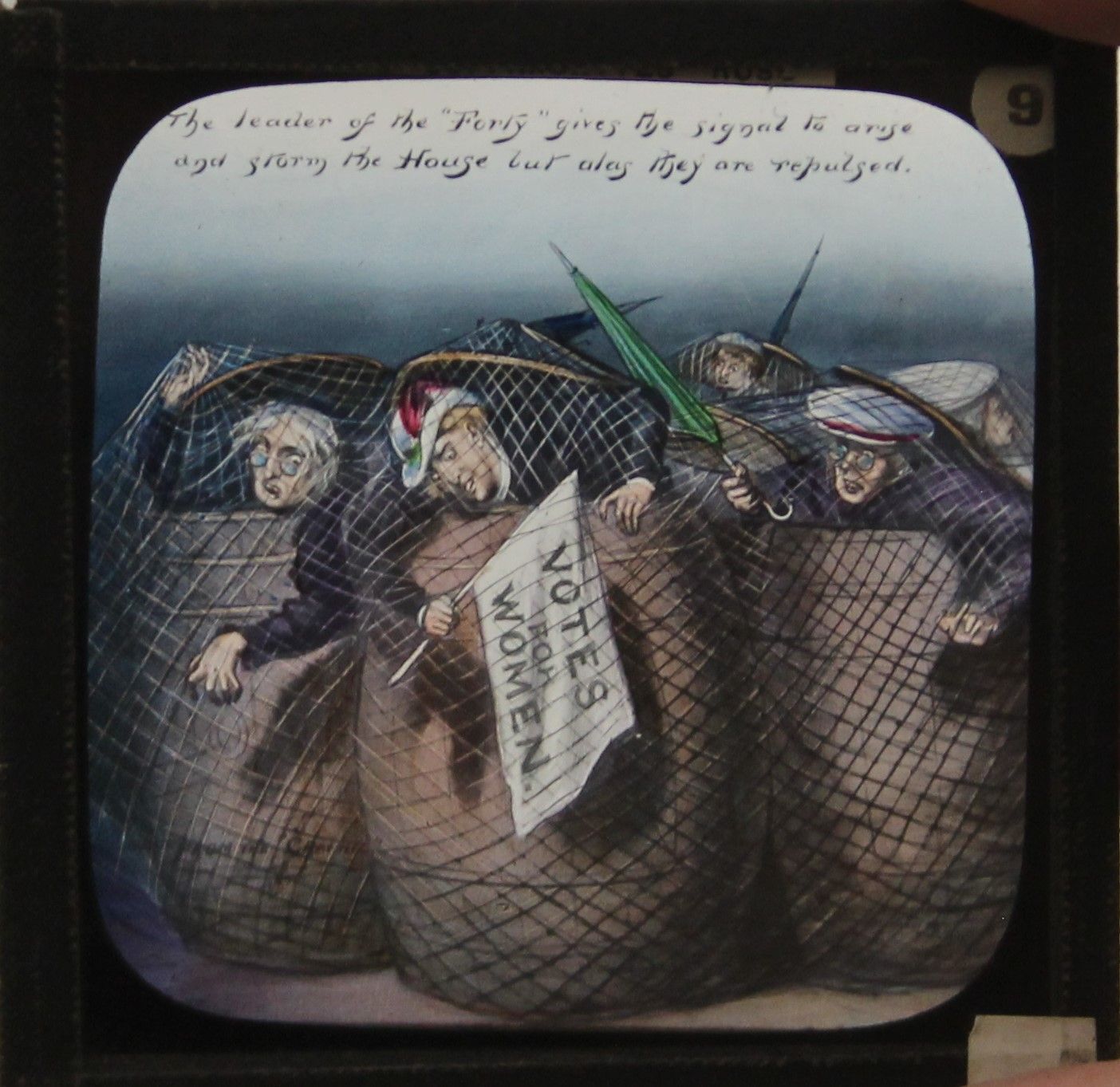
But, alas, their plan was foiled by two burly policemen who, alert to the inability of women to resist the joys of a ‘fashion paper’, entice them out of hiding and haul them off to Cannon Row police station. But, as we all know, these women and their kind lived to fight another day.
This set of slides once passed through my hands – and my catalogue. My research – via The Lucerna Magic Lantern Web Resource (University of Exeter) – revealed that the set was manufactured no later than 1907 by York & Son, based in Bayswater, London. One of the partners, William York, was a ‘photographic artist’ and may possibly have been responsible for this topical number. I had never before or since seen this set -or, indeed, any other suffragette lantern-slide story. In fact, ‘The Suffragettes’ Ruse’ is the only suffrage-related item on the Lucerna website.
Copyright
All the articles on Woman and Her Sphere are my copyright. An article may not be reproduced in any medium without my permission and full acknowledgement. You are welcome to cite or quote from an article provided you give full acknowledgement.
In The British Women’s Suffrage Movement in 100 Objects: a material history – to be published in July – you can discover how all manner of objects were caused to be created in the furtherance of the campaign for ‘Votes for Women’. You can pre-order the book – at an enticing reduced price – here .
SUFFRAGE OBJECTS: ‘THE SUFFRAGETTE’, BRITANNIA FILMS, 1913
Posted by womanandhersphere in Suffrage Objects on April 30, 2026
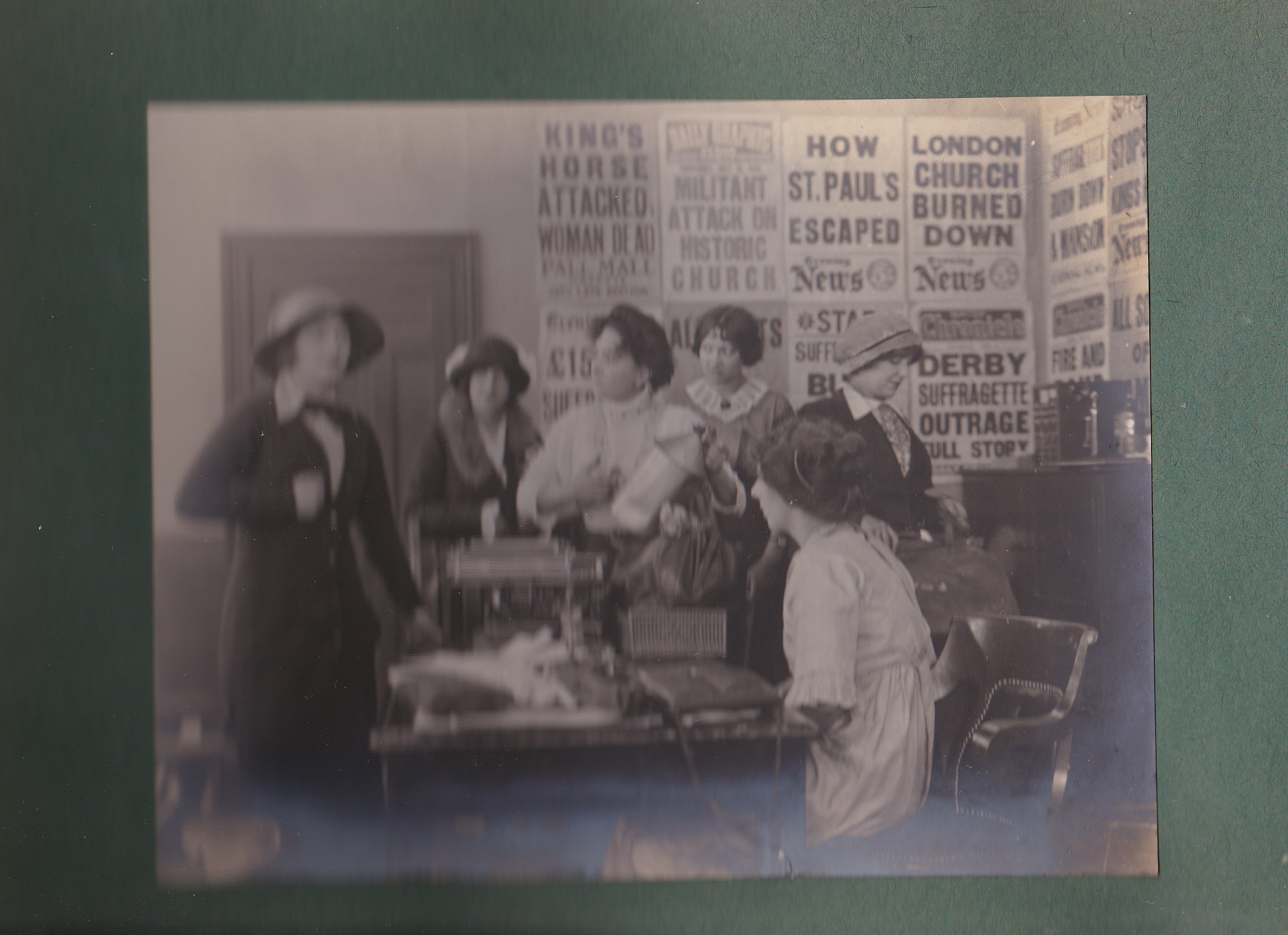
One of the more remarkable objects that has passed through my hands was a photograph album with, on the cover, the remains of a printed label for ‘Britannia Films’ and, inside, a sequence of staged scenes. A quick search revealed that Britannia Films was set up by Pathé at the end of 1911 to produce British feature films, while Pathé continued to produce newsreels.
Now, back in the 1990s when I was researching The British Women’s Suffrage Movement: a reference guide, one of my ports of call was the archive of the British Film Institute in Stephen Street, off Tottenham Court Road. There I trawled through records in the hope of identifying films with a suffrage theme and then published in chronological order the resulting list of newsreels and feature films under the section ‘Films’.
Thus, when I had bought the ‘Britannia Films’ album of photographs the first thing I did was to look myself up – and sure enough there it was, released by Britannia Films in November 1913, a film named The Suffragette. The description of the film given by the BFI was of the vaguest – ‘A disowned schoolmistress’s uncle destroys her father’s amended will ‘ And yet this hokum plot can be followed through the first seventeen film stills in the ‘Britannia Films’ album.
One scene is set, as you see above, in a suffragette office, its walls lined with (real) newspaper posters – such as one recording the death of Emily Davison at the 1913 Derby. In another, as you see below, the heroine is setting light to a fuse leading inside a house – a veritable suffragette arsonist.
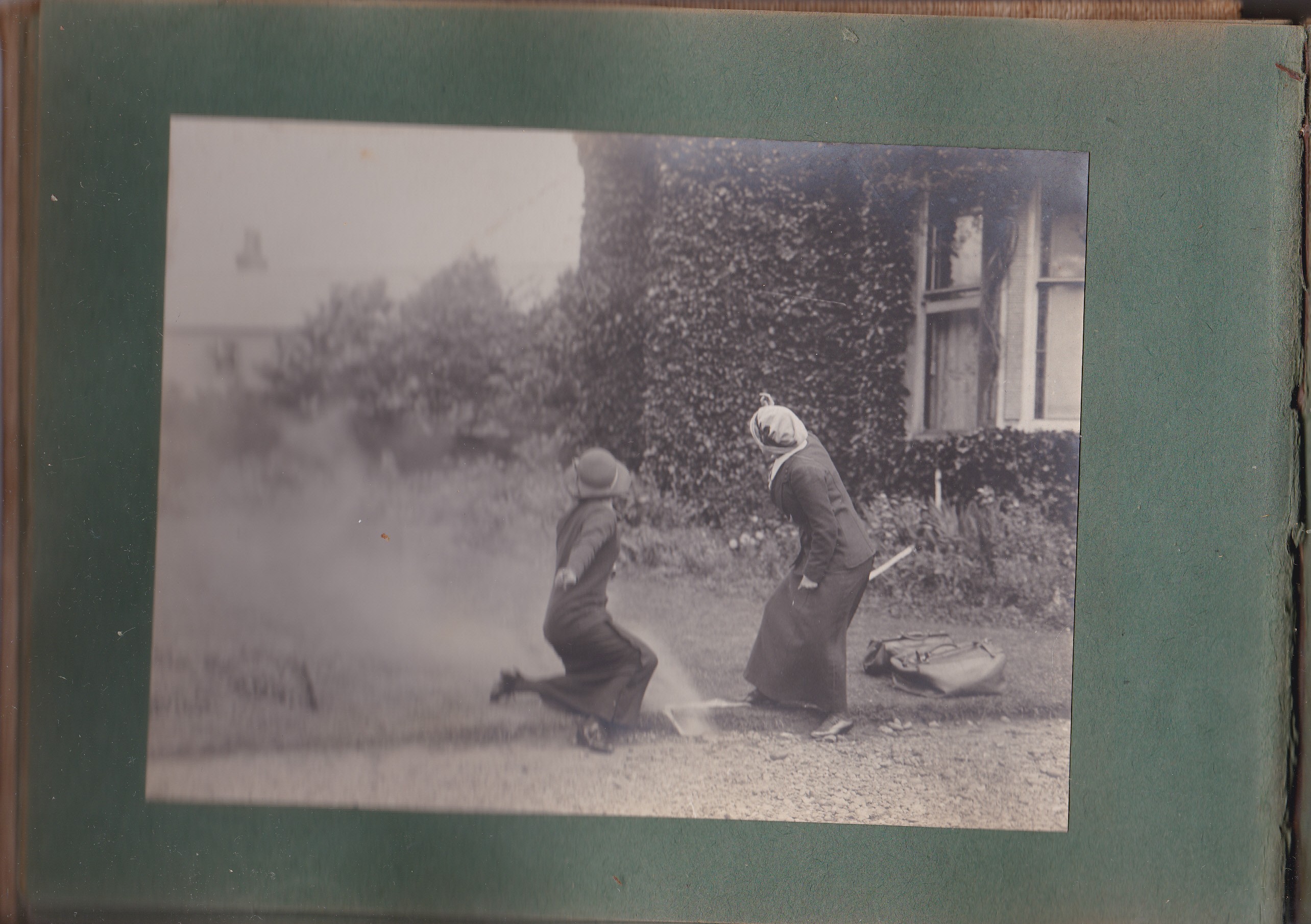
The International Movie Data Base names the actress playing the heroine as Agnes Glynne (1894-1981) and the male lead as James Carew (1876-1938), who, despite a thirty-year age difference, had married Ellen Terry in 1907. Although they had separated by the time this film was made, they remained friends.
The film must have been made sometime between June, as evidenced by the ‘Derby Suffragette Outrage’ poster in the office scene, and its release in November/December 1913. It doesn’t appear to have received much attention from the press, although the Folkestone Electric Theatre did advertise it in the Folkestone Express (14 February 1914) as ‘A Thrilling Drama, showing how a villain was unmasked’. The advertisement noted that the film starred ‘Mr James Carew, the popular English actor’. He was in fact American, but of course the film was silent.
As there is no extant copy of The Suffragette and the British Film Institute holds no archival stills, so the images in this album are the only known surviving record of this once topical film. Alas, no interest was forthcoming from a British institution, but the album was acquired by a discerning US university library.
As Object 75 in The British Women’s Suffrage Movement in 100 Objects: a material historyI have selected another suffragette film. You can pre-order the book – at an enticing reduced price – here .
All the articles on Woman and Her Sphere are my copyright. An article may not be reproduced in any medium without my permission and full acknowledgement. You are welcome to cite or quote from an article provided you give full acknowledgement.
SUFFRAGE OBJECTS: MISS CHAPMAN’S WSPU EVENING BAG
Posted by womanandhersphere in Suffrage Objects on April 25, 2026
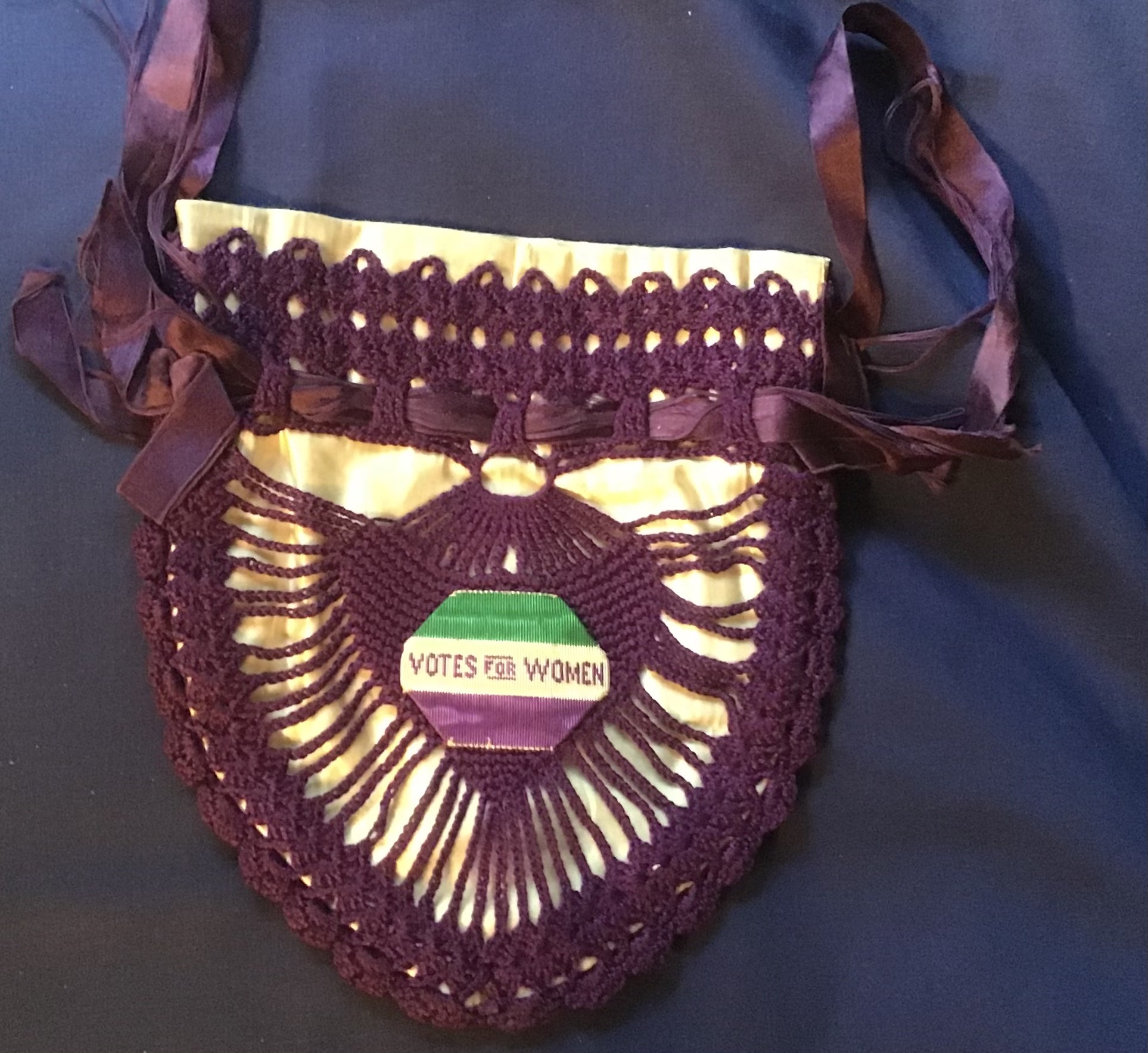
A crocheted bag that once belonged to Miss Louisa Chapman
You will all by now know the pleasure I take in objects – as evidenced by the creation of The British Women’s Suffrage Movement in 100 Objects: a material history (to be published in July by Bloomsbury Academic). However, many more suffrage objects have passed across my vision – as well as through my hands – in the last 40 years than could ever be contained in any one book and, now that I’ve ceased trading in books and ephemera, I’ve more time to describe some of them here on this website. And so I will begin with items I bought at auction a few years ago that originally belonged to a ‘Miss Chapman’.
Helpfully, within the collection were a few postcards addressed to her at ’11 Bristol Gardens, Maida Vale, London W’. From this I was able to establish, from the London Electoral Register, that she was ‘Miss Louisa Chapman’.
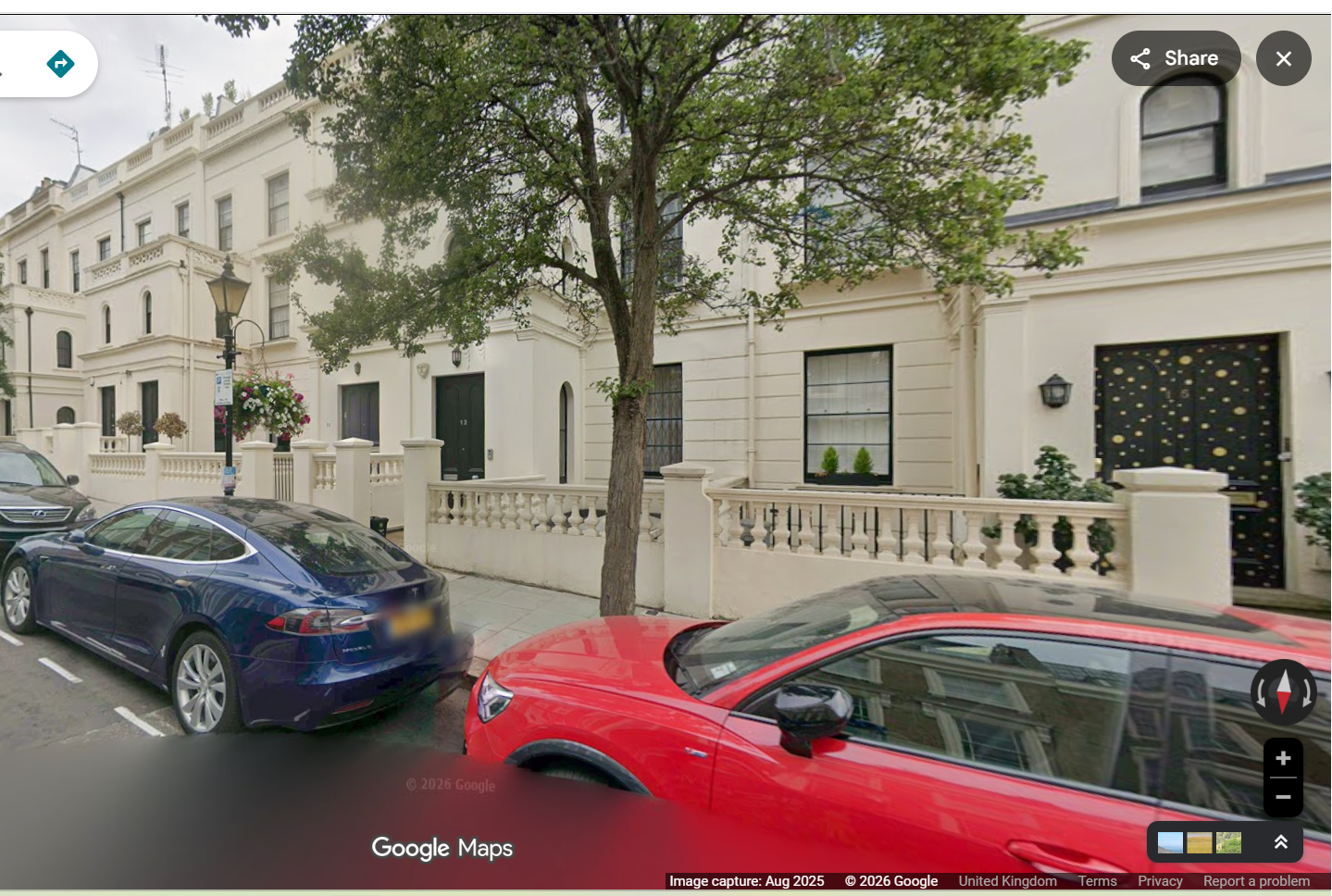
11 Bristol Gardens (in the centre of the screenshot) is a large, stuccoed house, built c 1840s/1850s and now exceedingly smart, but by the early years of the 20th century was in multiple occupation. The fact that Louisa Chapman was on the electoral register means that she was over 21, was a ratepayer, and probably occupied one or two unfurnished rooms in the house. However, single, independent women with a not-uncommon name and with no obvious links in the official records to family or friends are as ghosts. Despite many hours of determined effort, following all possibilities, I have been unable to furnish Louisa Chapman with a reliable back story. She is not at the Bristol Gardens address on the night of the 1911 census (in his listing the enumerator has noted as ‘uninhabited’ one of the apartments in the property). I, of course, immediately assumed that, as she was clearly a WSPU supporter, she was boycotting the census. But, equally, she may just happened that night to be visiting family or a friend.
From the evidence of the items in the collection I am sure that Louisa Chapman was an early London supporter of the WSPU. Some of the postcards she collected date to 1907, before the break with the WFL. She may have been the Miss Chapman who the early suffrage paper, The Women’s Franchise, noted as helping to organise the WSPU canvass of women householders in Paddington in September 1907. This Miss Chapman was living then at 53 Walterton Road, a 15-minute walk from Bristol Gardens, although she doesn’t appear there on the Electoral Register.
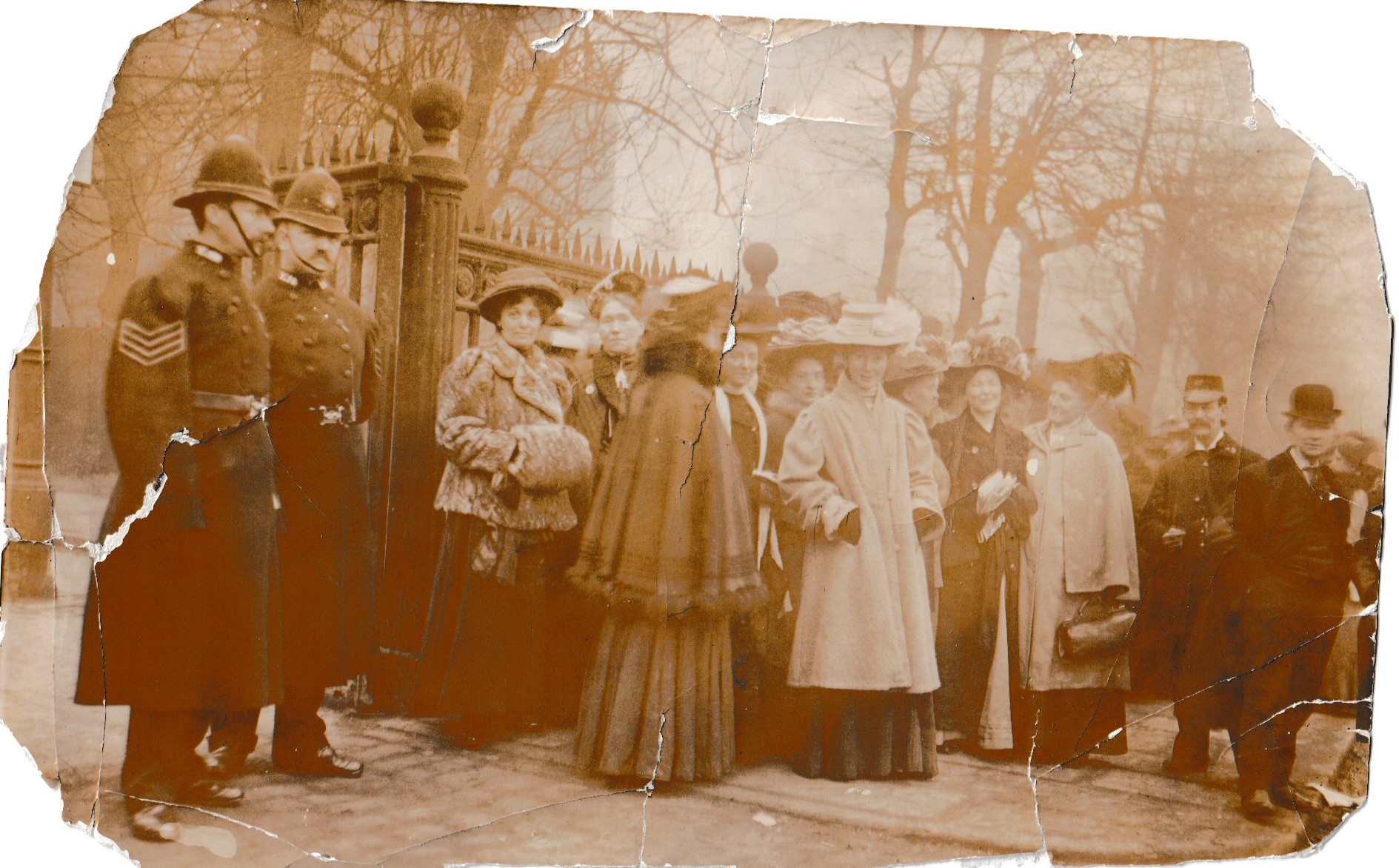
A photograph in the collection, which from the attire of the subjects and the leaf-less trees, I think probably dates from the winter of 1907 or 1908, shows Christabel Pankhurst surrounded by a group of women with, I think, Inspector Jarvis, standing to the right of the group. It is to be assumed that Miss Chapman is one of the party – but which one? I haven’t been able to identify where they are standing (I thought the shape of the railings might provide a clue), which might explain why they were there. The photograph is creased and torn, mended with Sellotape. It was taken by Bolak, a photographer at 10 Bolt Court, Fleet Street, and on the back is written in ink, presumably by Miss Chapman, ‘Taken about 45 years ago’. This would suggest that Miss Chapman was still alive in the early 1950s.
But, certainly, by June 1908 ‘our’ Miss Louisa Chapman was a devoted WSPU follower – purchasing other items to wear, probably for walking in the ‘Women’s Sunday’ procession. I will discuss these in my next posts. The name ‘Miss L. Chapman’ does appear occasionally in the list of contributions to WSPU funds, but whether they were from ‘our’ Miss Chapman it’s impossible to tell. There is no mention of ‘our’ Miss Chapman in either Votes for Women or The Suffragette. Nor does she appear on listings of arrested suffragettes. In fact, I can find no mention of any likely Miss Louisa Chapman in any newspapers in the British Newspaper Archive.
Cards written to her indicate that as late as 1913 Miss Chapman was still very much a WSPU supporter. Alas, the names of the senders – ‘Nannie’ and ‘Austen’ (the latter perhaps a child) – provide no substantial clues as to Miss Chapman’s identity.
I don’t, of course, know whether it was Miss Chapman herself who crocheted the ‘Votes for Women’ evening bag or whether she bought it at a fund-raising fair– but it certainly indicates a certain sense of style. The ‘Votes for Women’ hexagon has, of course, been fashioned from one of the woven badges sold by the WSPU. I noted from a couple of the postcards that Miss Chapman did have French friends living in London – and, from one of the cards a hint is given that she may have had a slight knowledge of the French language which led me to wonder if she might have been associated with the dressmaking or millinery trade.
The little bag is beautifully preserved, suggesting that it was little used. Perhaps it was made for one special occasion – and then laid aside to await its 21st century reawakening.
Copyright
All the articles on Woman and Her Sphere are my copyright. An article may not be reproduced in any medium without my permission and full acknowledgement. You are welcome to cite or quote from an article provided you give full acknowledgement.

