Posts Tagged suffragette film
SUFFRAGE OBJECTS: ‘THE SUFFRAGETTE’, BRITANNIA FILMS, 1913
Posted by womanandhersphere in Suffrage Objects on April 30, 2026
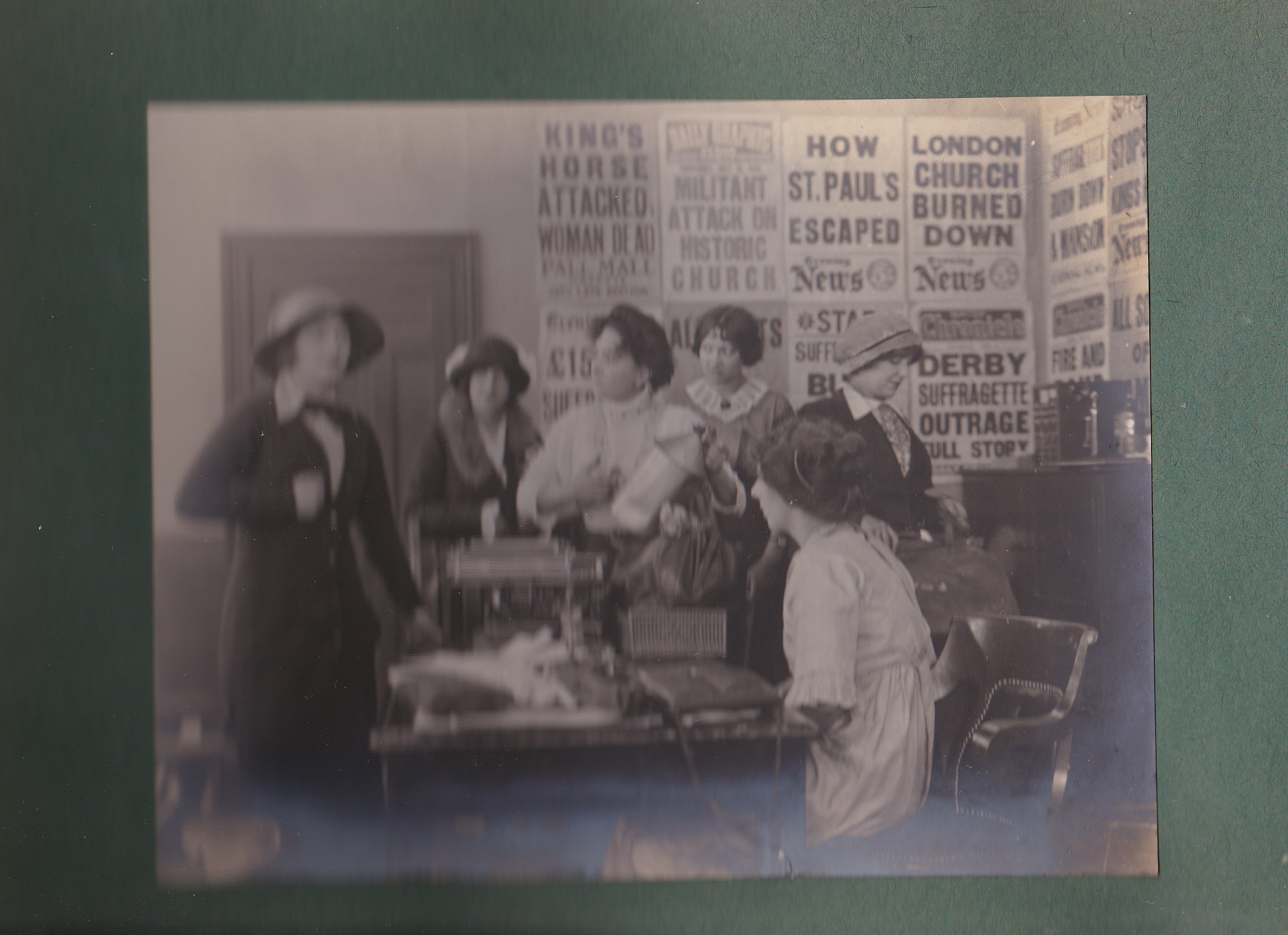
One of the more remarkable objects that has passed through my hands was a photograph album with, on the cover, the remains of a printed label for ‘Britannia Films’ and, inside, a sequence of staged scenes. A quick search revealed that Britannia Films was set up by Pathé at the end of 1911 to produce British feature films, while Pathé continued to produce newsreels.
Now, back in the 1990s when I was researching The British Women’s Suffrage Movement: a reference guide, one of my ports of call was the archive of the British Film Institute in Stephen Street, off Tottenham Court Road. There I trawled through records in the hope of identifying films with a suffrage theme and then published in chronological order the resulting list of newsreels and feature films under the section ‘Films’.
Thus, when I had bought the ‘Britannia Films’ album of photographs the first thing I did was to look myself up – and sure enough there it was, released by Britannia Films in November 1913, a film named The Suffragette. The description of the film given by the BFI was of the vaguest – ‘A disowned schoolmistress’s uncle destroys her father’s amended will ‘ And yet this hokum plot can be followed through the first seventeen film stills in the ‘Britannia Films’ album.
One scene is set, as you see above, in a suffragette office, its walls lined with (real) newspaper posters – such as one recording the death of Emily Davison at the 1913 Derby. In another, as you see below, the heroine is setting light to a fuse leading inside a house – a veritable suffragette arsonist.
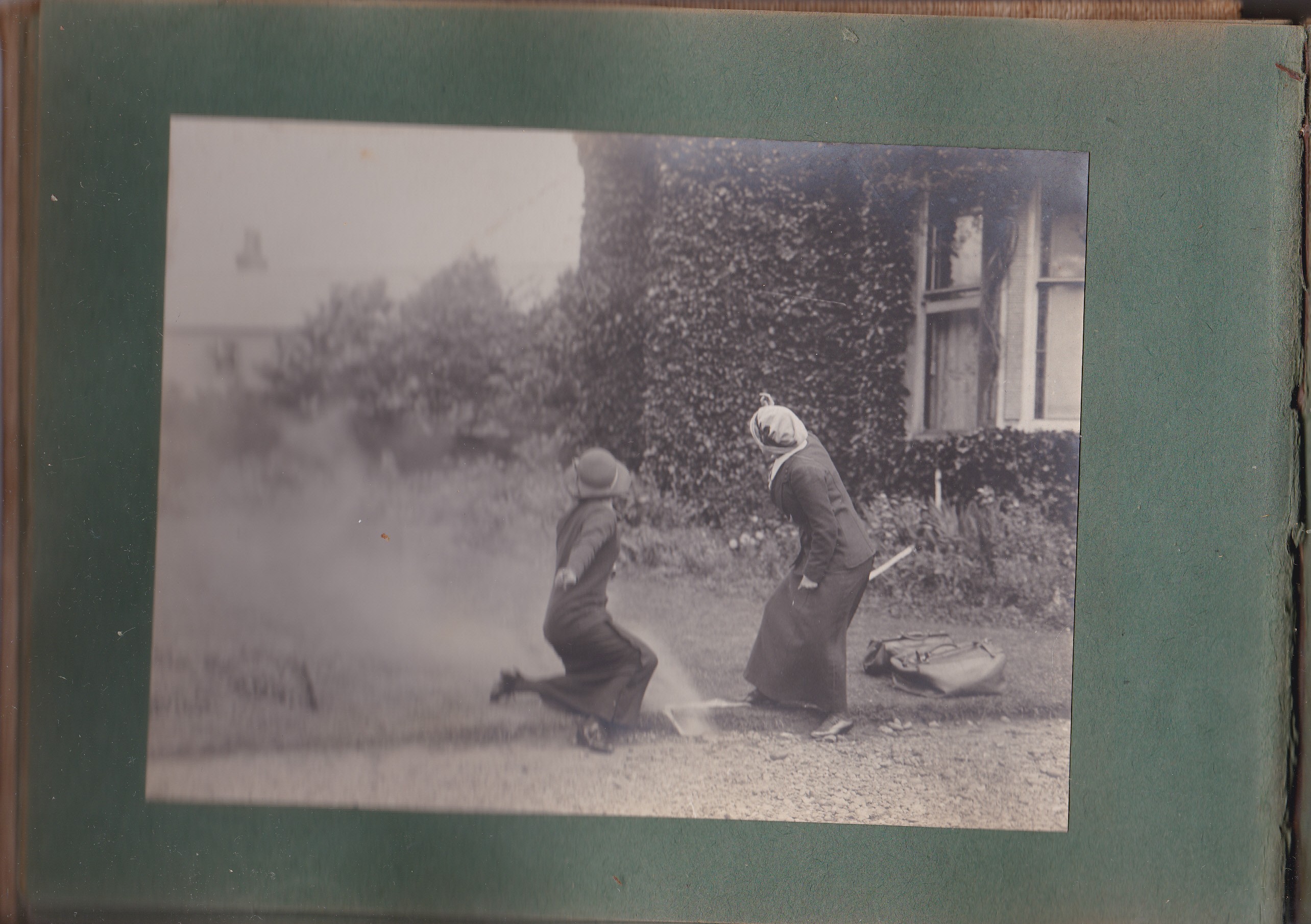
The International Movie Data Base names the actress playing the heroine as Agnes Glynne (1894-1981) and the male lead as James Carew (1876-1938), who, despite a thirty-year age difference, had married Ellen Terry in 1907. Although they had separated by the time this film was made, they remained friends.
The film must have been made sometime between June, as evidenced by the ‘Derby Suffragette Outrage’ poster in the office scene, and its release in November/December 1913. It doesn’t appear to have received much attention from the press, although the Folkestone Electric Theatre did advertise it in the Folkestone Express (14 February 1914) as ‘A Thrilling Drama, showing how a villain was unmasked’. The advertisement noted that the film starred ‘Mr James Carew, the popular English actor’. He was in fact American, but of course the film was silent.
As there is no extant copy of The Suffragette and the British Film Institute holds no archival stills, so the images in this album are the only known surviving record of this once topical film. Alas, no interest was forthcoming from a British institution, but the album was acquired by a discerning US university library.
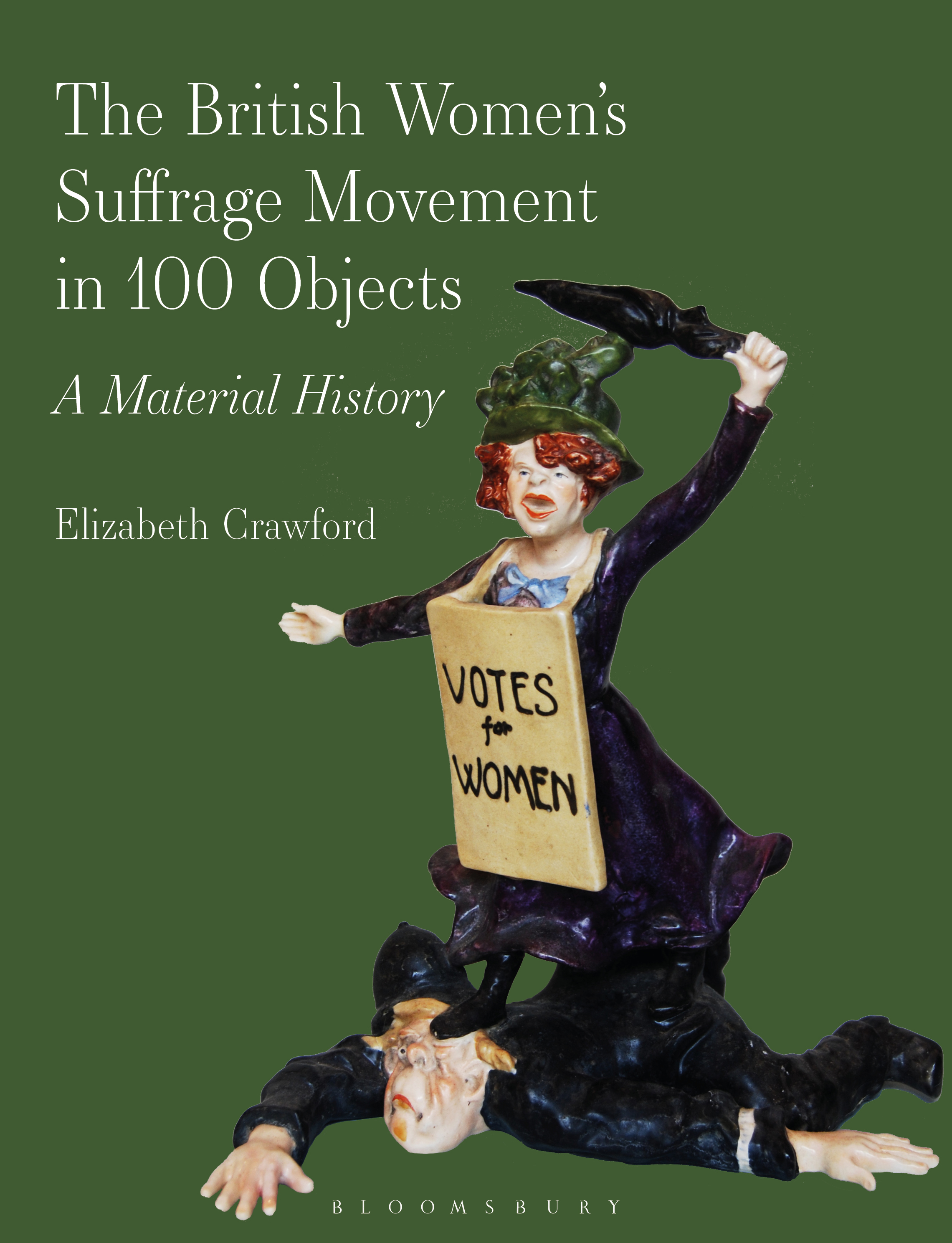
As Object 75 in The British Women’s Suffrage Movement in 100 Objects: a material historyI have selected another suffragette film. You can pre-order the book – at an enticing reduced price – here .
All the articles on Woman and Her Sphere are my copyright. An article may not be reproduced in any medium without my permission and full acknowledgement. You are welcome to cite or quote from an article provided you give full acknowledgement.
Suffrage Stories: My Experience Of Watching The Filming of A Scene From ‘Suffragette’
Posted by womanandhersphere in Suffrage Stories on October 12, 2015
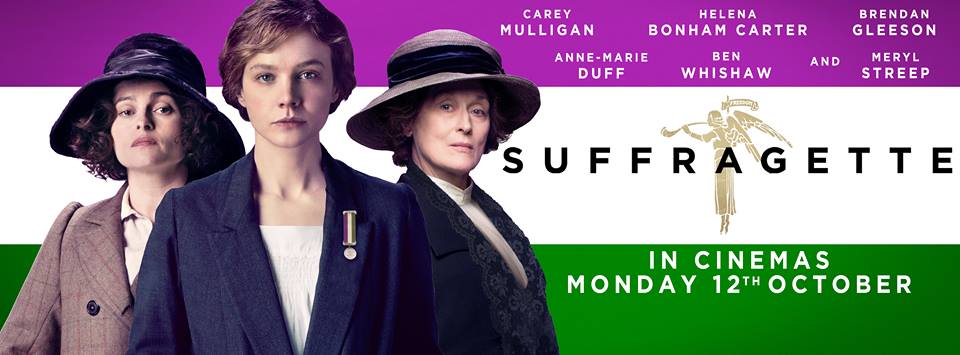
After all that counting down – the day has arrived when all in the UK can see ‘Suffragette’. See here to find where it is showing in a cinema near you.
I’m one of four people who appears at the end of the credits as an ‘historical consultant’ – there is also an ‘historical adviser’ – and very much enjoyed answering questions that were put to me during – and after – the making of the film. The production company also bought from me some ‘suffragette’ postcards – both commercial comic and real photographic ones – to give as presents to members of the cast.
The production team had kindly invited me to be an extra during the filming – but, for one reason or another – not least because I’d already once before been a ‘suffragette’ extra in a TV programme – I thought I’d prefer the alternative – which was an invitation to watch an evening’s shooting of a crucial scene in the film.
By complete coincidence the scene took place about two minutes’ walk from my house – and about two minutes the other way from the production company’s office. Thus, one rather chilly March evening in 2014, I set out after dinner to take my seat in a tent on the roadside in Myddleton Square, opposite the house where, the previous evening, Meryl Streep as Mrs Pankhurst had appeared on a balcony to address her devoted followers.
I wondered about inserting here a ‘Spoiler Alert’ – but decided against it as the scene I mention appears in the trailer.
This evening’s shooting was to recount the aftermath of that speech. The police are closing in, intending to arrest Mrs Pankhurst, who is ‘on the run’ after having been released from prison under the ‘Cat and Mouse’ Act. A decoy – a woman dressed as Mrs Pankhurst – comes out of the front door and is set upon by the police. When they discover their mistake the chase resumes – featuring all the main female leads – Carey Mulligan, Anne-Marie Duff, Helena Bonham-Carter and, of course, Meryl Streep.(The other lead, Romola Garai, who played ‘my’ Kate Frye last year in ITV’s The Great War: The People’s Story, didn’t, I think, feature in this particular scene.)
I watched as the scene was shot over and over again – from different angles – all to be spliced together in one short, sharp vignette. ‘Maud Watts’, ‘Violet Miller’ and ‘Edith Ellyn’ ensure that ‘Mrs Pankhurst’ reaches the safety of her motor car and, as she climbs in, turns to tell ‘Maud Watts’ ‘Never surrender, never give up the fight.’
I was very struck by the kindness of the production team towards me, the director’s assistant taking particular care to explain to me what was happening. In the tent at various stages of the evening were the film’s writer, Abi Morgan, one of its producers, Faye Ward, and Don Gummer, Meryl Streep’s husband. How very supportive of him, I thought.
In between these numerous takes, as the evening advanced and the cold seeped into bones there was one ultra-surreal moment as, to keep warm, the four actresses linked arms and did high kicks on the doorstep. So appealing.
I say that was ‘ultra-surreal’ only because the whole experience had a surreality of its own. I have researched the suffrage movement in depth – in all its variety – for the past 20 years and during the last 25 have walked on innumerable occasions past the very spot where now I was watching Mrs Pankhurst being brought back, fleetingly, to life.
When I eventually left, with the filming winding down, I walked out of the past into the present, turning the corner from Myddleton Square into Chadwell Street, leaving that ghostly parallel world behind.
Copyright

