One of the more remarkable objects that has passed through my hands was a photograph album with, on the cover, the remains of a printed label for ‘Britannia Films’ and, inside, a sequence of staged scenes. A quick search revealed that Britannia Films was set up by Pathé at the end of 1911 to produce British feature films, while Pathé continued to produce newsreels.
Now, back in the 1990s when I was researching The British Women’s Suffrage Movement: a reference guide, one of my ports of call was the archive of the British Film Institute in Stephen Street, off Tottenham Court Road. There I trawled through records in the hope of identifying films with a suffrage theme and then published in chronological order the resulting list of newsreels and feature films under the section ‘Films’.
Thus, when I had bought the ‘Britannia Films’ album of photographs the first thing I did was to look myself up – and sure enough there it was, released by Britannia Films in November 1913, a film named The Suffragette. The description of the film given by the BFI was of the vaguest – ‘A disowned schoolmistress’s uncle destroys her father’s amended will ‘ And yet this hokum plot can be followed through the first seventeen film stills in the ‘Britannia Films’ album.
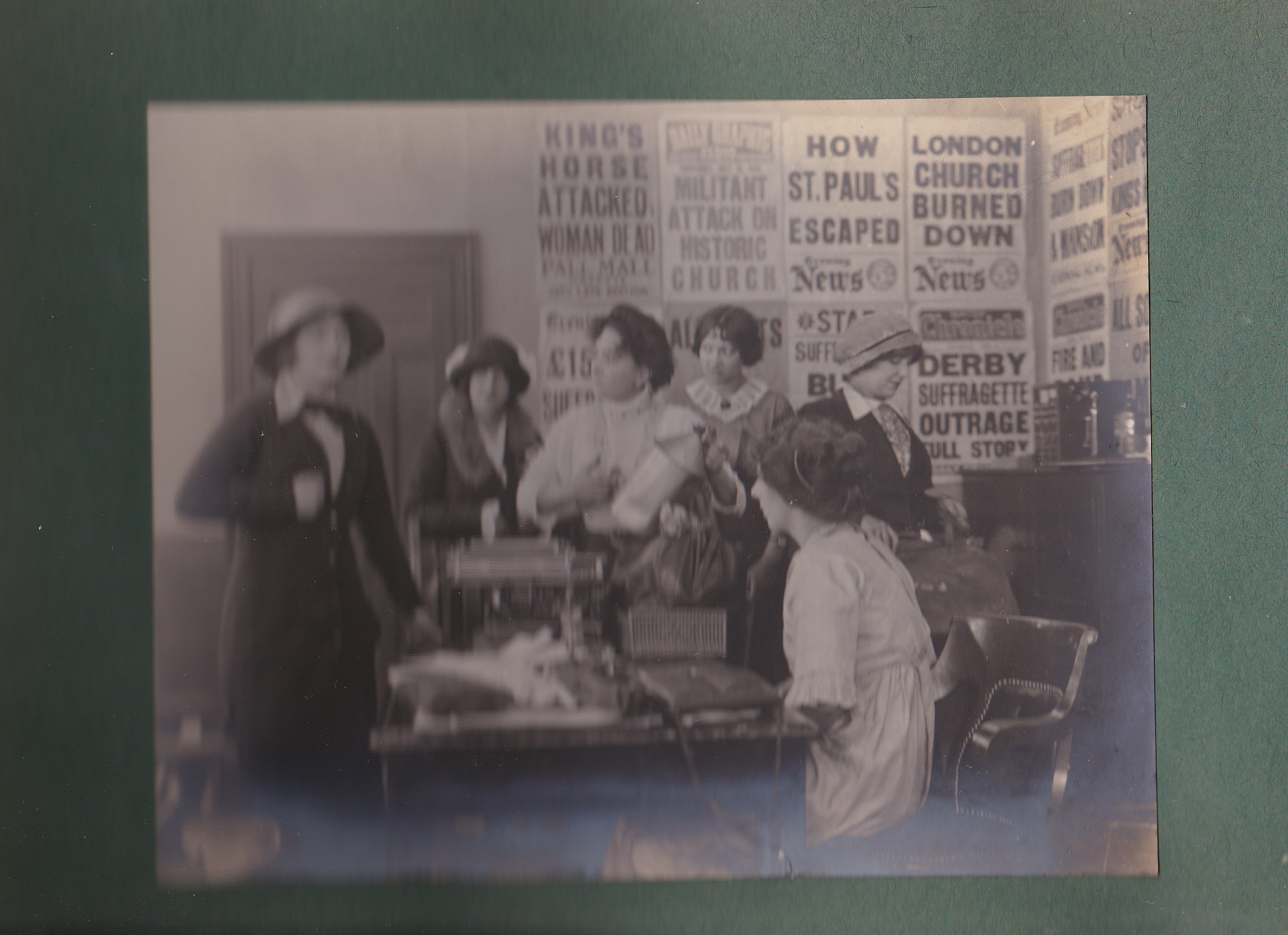
One scene is set, as you see above, in a suffragette office, its walls lined with (real) newspaper posters – such as one recording the death of Emily Davison at the 1913 Derby. In another, as you see below, the heroine is setting light to a fuse leading inside a house – a veritable suffragette arsonist.
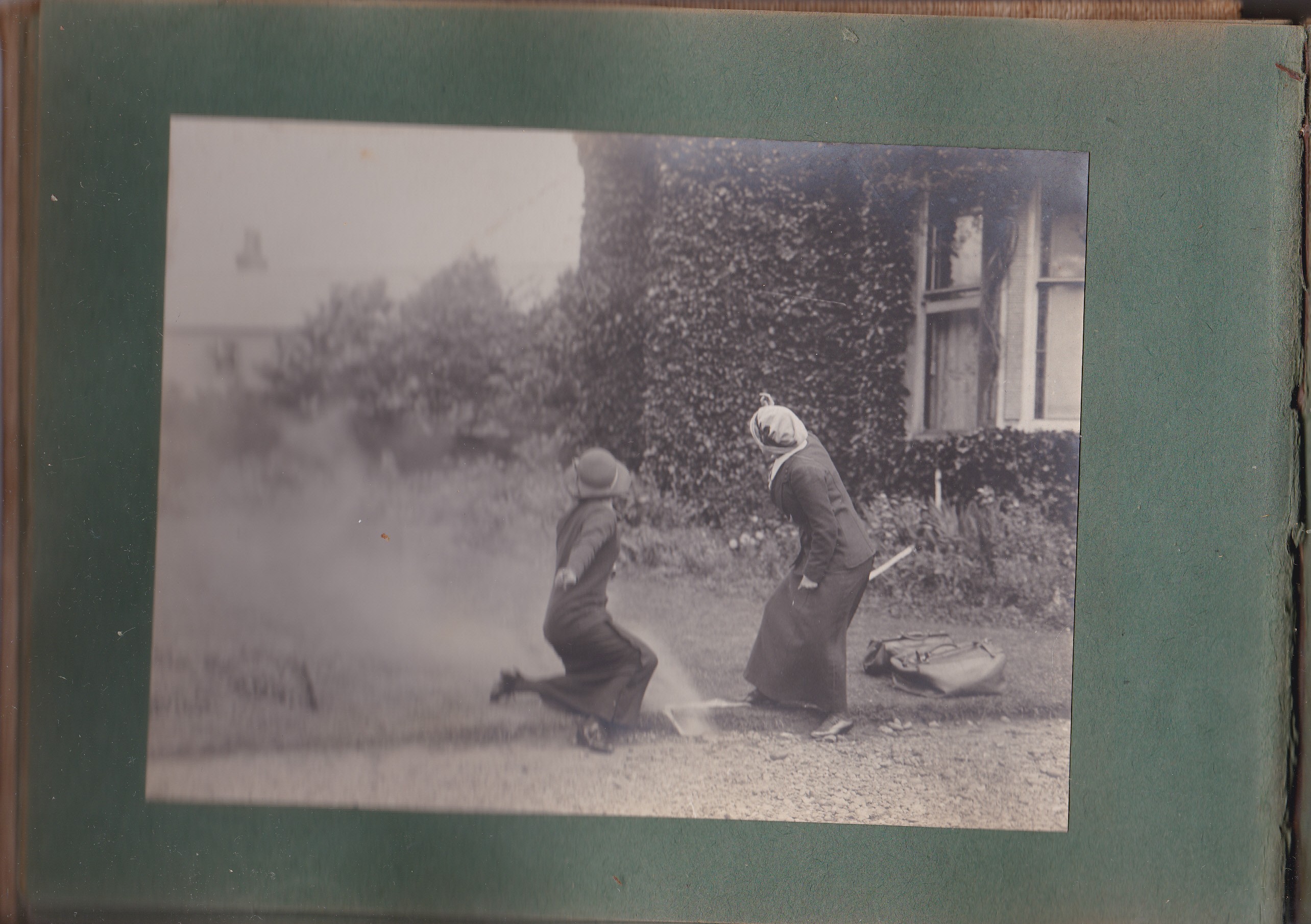
The International Movie Data Base names the actress playing the heroine as Agnes Glynne (1894-1981) and the male lead as James Carew (1876-1938), who, despite a thirty-year age difference, had married Ellen Terry in 1907. Although they had separated by the time this film was made, they remained friends.
The film must have been made sometime between June, as evidenced by the ‘Derby Suffragette Outrage’ poster in the office scene, and its release in November/December 1913. It doesn’t appear to have received much attention from the press, although the Folkestone Electric Theatre did advertise it in the Folkestone Express (14 February 1914) as ‘A Thrilling Drama, showing how a villain was unmasked’. The advertisement noted that the film starred ‘Mr James Carew, the popular English actor’. He was in fact American, but of course the film was silent.
As there is no extant copy of The Suffragette and the British Film Institute holds no archival stills, so the images in this album are the only known surviving record of this once topical film. Alas, no interest was forthcoming from a British institution, but the album was acquired by a discerning US university library.
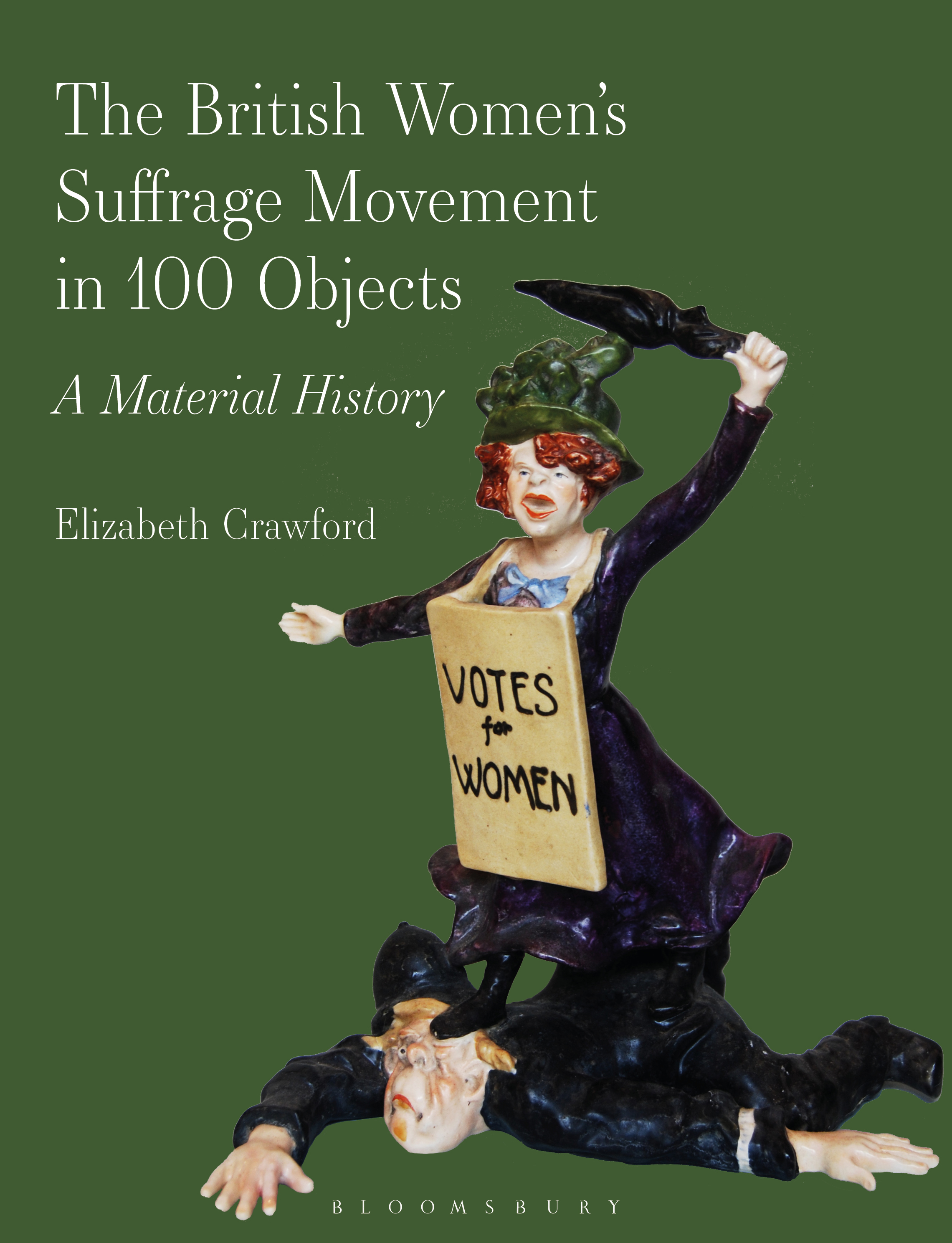
As Object 75 in The British Women’s Suffrage Movement in 100 Objects: a material historyI have selected another suffragette film. You can pre-order the book – at an enticing reduced price – here .
All the articles on Woman and Her Sphere are my copyright. An article may not be reproduced in any medium without my permission and full acknowledgement. You are welcome to cite or quote from an article provided you give full acknowledgement.