Archive for category Collecting Suffrage
Suffrage Stories/Collecting Suffrage: The Evolution Of The Hunger-Strike Medal
Posted by womanandhersphere in Collecting Suffrage, Suffrage Stories on June 30, 2023
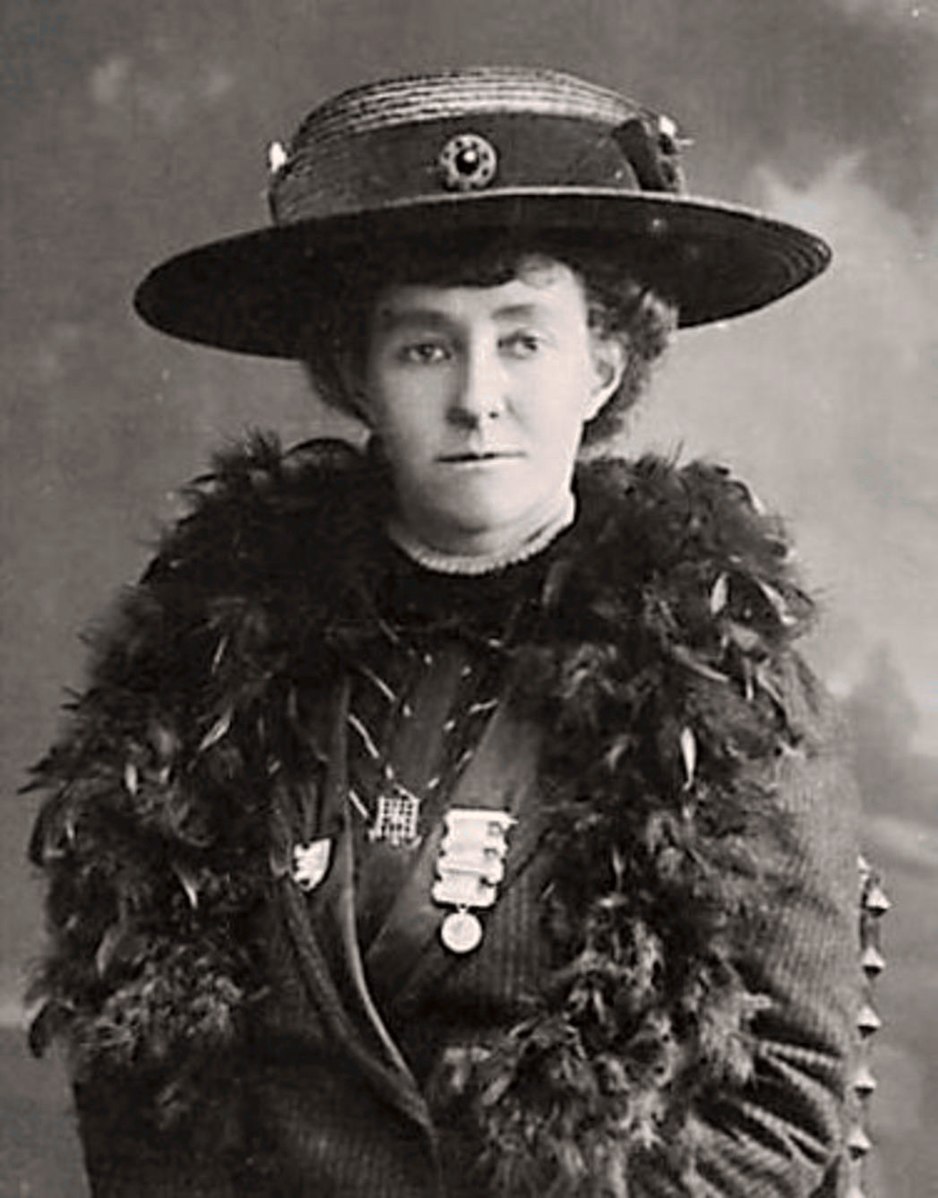
Here we see Emily Wilding Davison, one of the most famous suffragettes, wearing her Hunger Strike Medal c. 1912. Now, well over a century later, these medals are a familiar sight, appearing surprisingly often at auction, as the price they attract tempts descendants to sell. But the history of the WSPU Hunger-Strike Medal is not uncomplicated.
My research would indicate that the first WSPU members to be awarded medals as a reward for hunger striking stood in the dock at Bow Street Police Court on 30 June 1909, 114 years ago today. The previous evening they had been arrested when taking part in a deputation to the Houses of Parliament, led by Mrs Pankhurst, who was carrying a petition from a large WSPU meeting in Caxton Hall.

WSPU flyer advertising the 29 June deputation (from my collection)
The case was adjourned and on 12 July thirteen women were found guilty of stone-throwing – breaking windows in Whitehall. They duly served their sentence in Holloway and, following the example of Marion Wallace-Dunlop, who had recently been imprisoned for a a different offence, went on hunger strike. Like Wallace-Dunlop, the 13 hunger strikers were released without being forcibly fed. The authorities had not yet arrived at the solution to that particular problem.
I will now take you back to an event that took place a few weeks earlier, on 16 June 1909, when WSPU member Patricia Woodlock, who had been imprisoned for three months in Holloway – but had not been on hunger strike – was presented with a ‘For Valour’ medal at a ceremony described in Votes for Women (18 June 1909, p. 810). I think that this was the very first medal presented to a WSPU ‘foot soldier’ and, although there is now no trace of it, I assume that it took its name from ‘For Valour’ engraved on the medal’s top bar.
Although I can find no contemporary reference to the sequence of events, my thinking is that when the women who had taken part in the 29 June 1909 deputation were eventually released, after their hunger strike, the WSPU chose to honour them with medals identical to that designed for Patricia Woodlock.
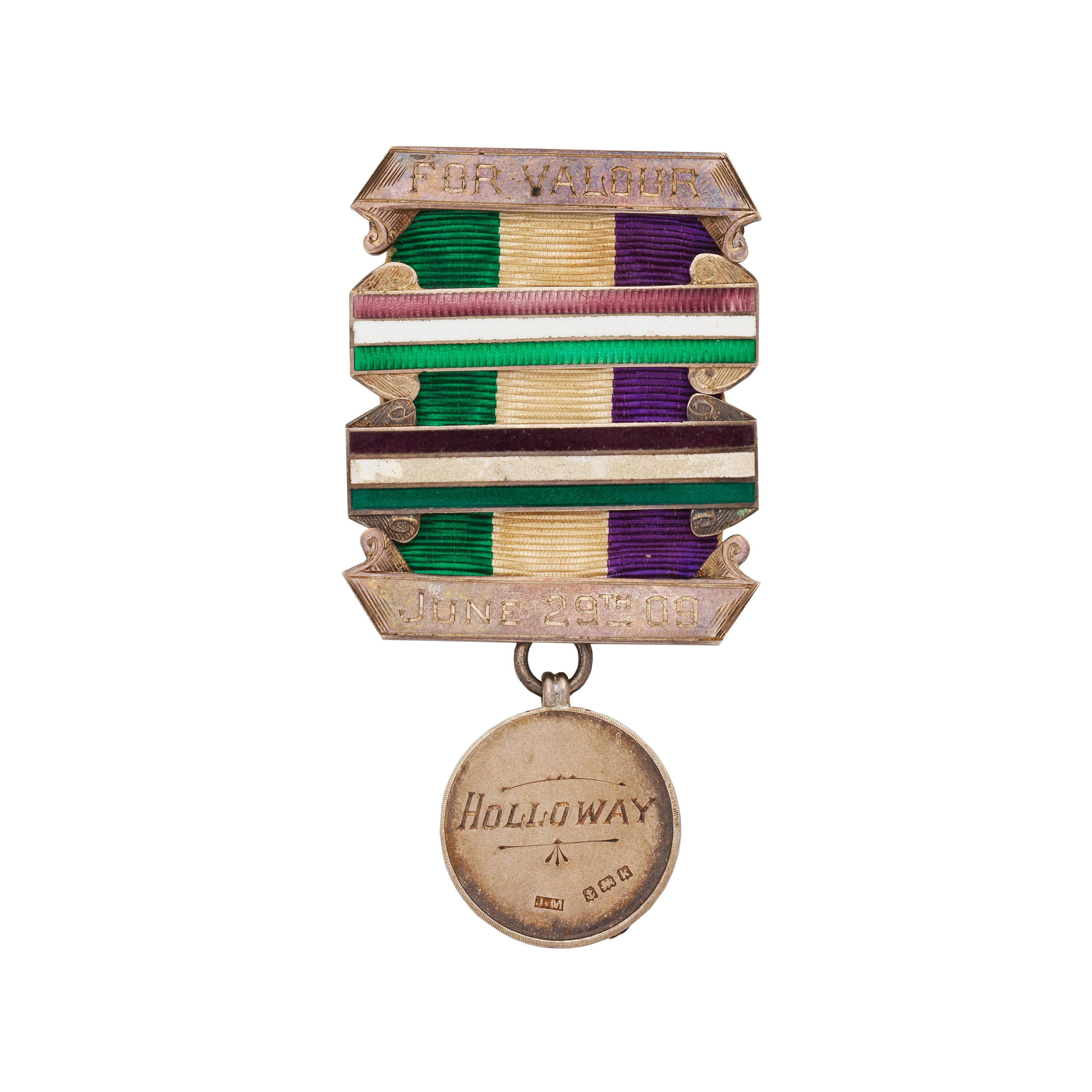
Ada Wright’s ‘Holloway’ medal (Image courtesy of Bonhams)
These medals were presented by Mrs Pankhurst at a ceremony at St James’ Hall, Great Portland Street, as reported in Votes for Women, 6 August 1909. Two of the medals have resurfaced. That awarded to Theresa Garnett is held by the Museum of London and that to Ada Wright was recently sold at auction. This batch of medals makes no mention of the hunger-strike (unlike the later, more common, more famous version); instead, the roundel depending from the bottom bar is engraved with the word ‘Holloway’. The fact that the recipients had been on hunger strike was not yet commemorated in the medal wording.
However, in early November 1909 another medal presentation ceremony took place, held in Birmingham Town Hall (see Votes for Women 5 Nov 1909, p 84) . As far as I can discover this was only the second such medal presentation. The recipients were WSPU members who had protested at the meeting held by Asquith in Bingley Hall in September, had been arrested, sentenced and had gone on hunger strike and been forcibly fed in Winson Green Prison.
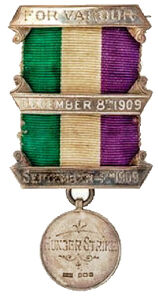
Mabel Capper’s medal, commemorating her hunger strike, presented to her in Birmingham in November 1909
Although the medal is described in Votes for Women as the ‘For Valour’ medal, I am sure this was the first occasion on which the medal with the ‘Hunger Strike’ roundel was presented – for research reveals a photo of the medal presented on this occasion to Mabel Capper, with the ‘Hunger Strike’ inscription on the roundel.
By the way, if you wonder what happened to Emily Wilding Davison’s hunger-strike medal, you might like to read a piece I wrote about it a while ago
And be very careful to research for authenticity any hunger-strike medal offered for sale.
Copyright
All the articles on Woman and Her Sphere are my copyright. An article may not be reproduced in any medium without my permission and full acknowledgement. You are welcome to cite or quote from an article provided you give full acknowledgement
Collecting Suffrage: Fake Flags – Or Why Researching Material Culture Matters
Posted by womanandhersphere in Collecting Suffrage on June 19, 2023

Led by Miss Kerr, who is carrying a WSPU flag, suffragettes parade outside the WSPU offices in Clement’s Inn (image courtesy of Women’s Library@LSE)
When I started in business nearly 40 years ago as a dealer in books and ephemera, specialising in the lives of women, there was little need to think twice about the authenticity of any appealing object. I do remember being very careful to check that a signature on, say, a photograph of Mrs Pankhurst was penned rather than printed but, in those days, ‘women’ as a class had not attracted the attention of scammers. How times have changed. And that change is particularly manifest in objects associated with the suffragette movement.
Nowadays I take extreme care, perhaps bordering on paranoia, to check the authenticity and provenance of any object before I add it to stock. For unscrupulous dealers are now ridiculing the suffragette movement by creating and selling objects that claim to be associated with the WSPU. Perhaps, unsurprisingly, the NUWSS has not attracted this attention, scammers knowing where lies the popular appeal.
This trade disturbs me on several levels. I am upset to see those with no knowledge or interest in the suffrage movement traducing the historical record, I am upset to see buyers disappointed when, thinking they have acquired an original object, they discover they have not, and I am particularly worried when, as has happened, a public collection acquires a spurious suffrage artefact.
It may be useful to present the history of one element of suffragette material culture that currently concerns me: the phenomenon of the WSPU flag currently flooding the market.
It was probably three or four years ago that a purple, white, and green flag first appeared on an eBay site. Along the white side selvedge strip was printed the legend ‘WPSU 3 & 4 Clement’s Inn, Strand W.C.’. I have not kept a record of the price this object fetched, but it was, if memory serves, several hundred pounds. Another book dealer contacted the seller to point out that this flag was unlikely to be original, as the initials were incorrect – ie ‘WPSU’ rather than ‘WSPU’. He did not receive a reply, but answer was made in kind as another flag then appeared – with the middle two letters cut out – leaving only the ‘W’ and the ‘U’ – and the (correct) address. Laughable, really. In fact, at the moment (June 2023) one of these flags is available for sale on eBay – for £260 – although now the whole of ‘WPSU’ has been raggedly removed, leaving only the address.
Most of the flags now boast a ‘Votes for Women’ slogan across the central white stripe and have a variety of marks on the white webbing at the side. Currently (June 2023) there are 7 WSPU flags for sale on eBay: one is marked with ‘1912’, two with ‘London 1908’, one with ‘London 1910’, and two with ‘1910 WSPU’ (both of these listed by the same dealer). The flags are priced at between £149 and £895.
Between March and June 2023 27 ‘original’ WSPU flags were sold on eBay– their prices ranging from £58 to £310. Again, they are printed on the selvedge with dates and places – such as ‘Bath 1912’, ‘London 1914’ etc. They variously claim to have been found in ‘a box at an antiques fair’ or from ‘a deceased estate’.
A number of these flags have moved from eBay to terrestrial auctions and, on the whole, auctioneers do remove them from a sale once doubts are expressed as to their originality. I note that one auctioneer who initially refused to withdraw one of the flags from sale – and has since sold several more – does at least now note that their authenticity cannot be guaranteed. The flags have, of course, moved out of salerooms and are now to be found at antiques markets and fairs and I accept that, as they move further from their source, vendors may well not realise that they are selling fakes.
I have not inspected any of these flags in person – my reasons for knowing that they are not ‘right’ is based on my many years of archival research and on my hard-acquired knowledge of the trade in suffrage ephemera. At the most basic level, if you study the Flickr account of the Women’s Library@LSE, perhaps the most extensive photographic record of the suffrage movement available to view on the internet, you will note that there is no evidence of the WSPU flag as is currently being traded. At the head of this post is one of the few photographs to show a WSPU flag (we presume it is purple, white, and green but, of course, the photograph is in black and white). However, you will note that the orientation of the stripes is such that one of the colours (purple or green?) lies against the carrying pole, whereas on that of the fake flag all the colours meet the pole. That is to say, the stripes on the flags currently being sold are lying horizontally, whereas they should be positioned vertically. In addition, I do not remember seeing a ‘Votes for Women’ slogan imposed on a purple, white and green flag; they are invariably plain. I suspect that any analysis of the material and method of manufacture would indicate a 21st rather than early-20th century provenance.
The Women’s Library photographs do, of course, contain innumerable images of all manner of other banners and it was exactly because I am always so worried about fakery that when, in 2017, I spotted an amazing Manchester banner coming up for sale at a little-known auction house, I alerted first the Working Class Library and, through their archivist, the People’s History Museum because I thought it essential for a textile expert to inspect it in person in case somebody had taken it upon themselves to fake it. Fortunately, it was ‘right’ and now hangs in pride of place in the PHM.
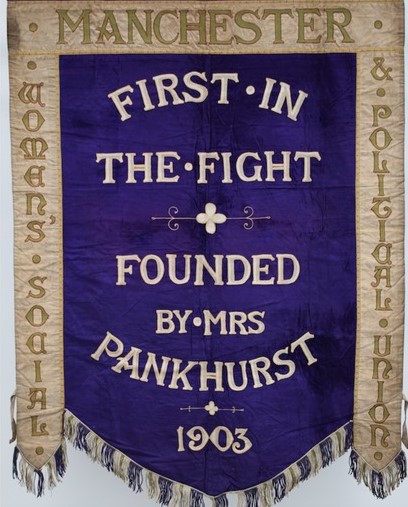
The Manchester WSPU banner (image courtesy of the People’s History Museum)
And that is why I hope that no well-meaning donor will think of presenting their local museum with one of the spurious ‘Votes for Women’ flags for, by allowing the scammers to muscle in on our history, we are demeaning everything that is ‘right’.
Cynic that I am in such matters, I only hope this post does not encourage scammers to create more accurate reproductions.
Copyright
All the articles on Woman and Her Sphere are my copyright. An article may not be reproduced in any medium without my permission and full acknowledgement. You are welcome to cite or quote from an article provided you give full acknowledgement
Collecting Suffrage: Suffragette Fakery
Posted by womanandhersphere in Collecting Suffrage on December 2, 2021
Over the years I have expressed concern about the practice of dealers and auctioneers in labelling as ‘suffragette’ any piece of jewellery that combines stones approximating to suffragette colours of purple, white and green. I explained in another post [see https://wp.me/p2AEiO-nd] that such jewellery would have had no association with the suffragette movement, the colours were merely harmonious and fashionable, which was why they had been chosen by the Women’s Social and Political Union as their ‘brand’. This practice is, I am afraid, still rife, but at least I have tried to warn the trade and the public.
However, I am now increasingly worried by the number of deliberately faked suffragette objects that are being sold both on eBay and by British auction houses, often for high prices. Fake ‘suffragette’ flags, watches, cigarette cases, car badges, defaced coins, and woven cloth badges are the latest items to appear in auction house sales. Having specialised in suffrage ephemera – as an historian and a dealer – for over 35 years I can assure my readers that most of these objects either never existed in the ‘suffrage’ years and are being dreamed up – and manufactured – by unscrupulous sellers, or are modern copies. I do occasionally protest to terrestrial auction houses about individual items and they then invariably withdraw them from sale – but I cannot hope to stem the tide alone.
While I hate the idea of private buyers being duped, not only by spending large sums but also by thinking, erroneously, that they own an artefact with a real connection to the suffrage movement, my principal fear is that such objects will end up in public collections; indeed, I know this to have happened. If the institution is made aware of its mistake and removes the object from display, it has lost money; if the object passes into the collection unchallenged, it is legitimising a fiction. I would ask potential buyers to think carefully – and even consult an expert – before spending money on artefacts labelled as ‘suffragette’. Better still, research the movement carefully so that you can exercise your own judgment. There are still plenty of ‘right’ objects to be found but, as ever, this maxim holds: ‘If an item looks too good to be true, it probably is’.
Caveat Emptor
To see something of the marvellous range of suffrage artefacts that were actually produced by suffrage societies do consult Ken Florey’s site. Although treating, in the main, items produced to publicise the US suffrage movement, he also includes a wide range of British items.
My website also includes a number of articles that may prove useful – under the ‘Collecting Suffrage’ heading. And, if you would like advice about an item you are thinking of buying, you can always ask for my opinion.
‘Collecting The Suffragettes’: A Fully-Illustrated Video Talk
Posted by womanandhersphere in Collecting Suffrage, Suffrage Stories on July 23, 2021
If you are interested in discovering something about the wide range of objects produced during the course of the women’s suffrage campaign in the 19th and early 20th centuries, you may like to view a talk I gave recently, hosted by the Antiquarian Booksellers Association and the Institute of English Studies, University of London. Click here to watch.
Collecting Suffrage: Free Online Talk 22 June
Posted by womanandhersphere in Collecting Suffrage on June 15, 2021

On Tuesday 22 June at 6pm London Time I shall be giving a free online (Zoom) talk on ‘Collecting Suffragettes’,, under the auspices of the Antiquarian Booksellers Association and the Institute of English Studies (University of London.
The very fully illustrated talk will discuss suffrage memorabilia – of all types – created in the course of the women’s suffrage campaign that ran from 1866 until all women in Britain were granted the parliamentary vote in 1928.
If interested, you can book here
Collecting Suffrage: The ‘Census Resisted’ Badge
Posted by womanandhersphere in 1911 Census, Collecting Suffrage on September 25, 2020
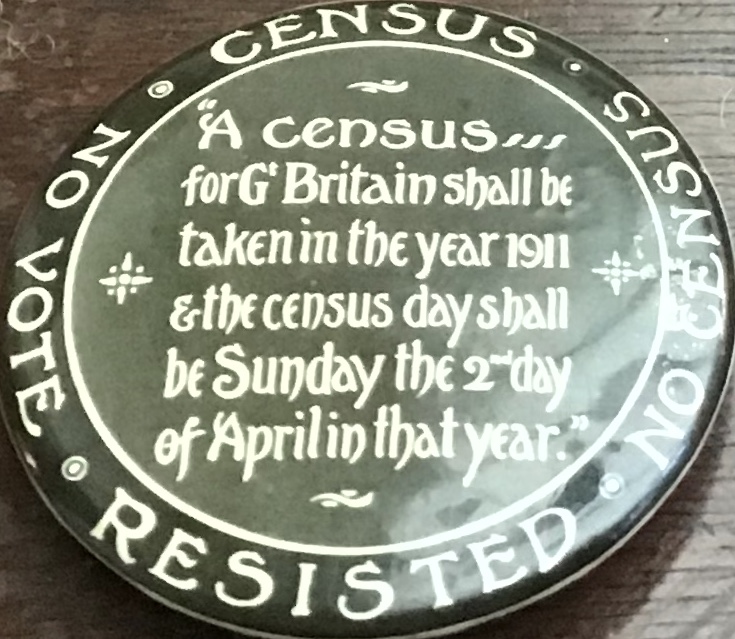
NO VOTE – NO CENSUS – CENSUS RESISTED BADGE
Metal badge worn by suffragettes who boycotted the April 1911 census. Around the outside of the badge is ‘No Vote – No Census – Census Resisted and in the centre ‘A census for Gt Britain shall be taken in the year 1911 & the census day shall be Sunday the 2nd day of April in that year’.
The census boycott was an important act of civil disobedience and you can find many posts on this website about the suffragette resisters. Just key ‘census’ into the Search Box.
The round black and grey badge still carries on its reverse the maker’s paper ‘Merchants Portrait Co.’. This badge is extremely scarce and is in fine condition £1100
If interested in buying, email elizabeth.crawford2017@outlook.com
Collecting Suffrage: Gladice Keevil Photographed by Lena Connell
Posted by womanandhersphere in Collecting Suffrage on September 21, 2020

Portrait photograph of Miss Gladice Keevil, The ‘National Women’s Social and Political Union, 4 Clement’s Inn, WC’.
The photographer was Lena Connell, who, in an interview in the Women’s Freedom League paper, The Vote, dated her involvement with the suffrage movement to this commission. When she arrived at Lena Connell’s St John’s Wood studio in 1908 Gladice Keevil had not long been released from prison and was soon appointed National Organizer for the WSPU in the Midlands.
She was a speaker in the WSPU’s summer campaign in Ireland in 1910 and was described by a member of one of her open-air meetings in Belfast as ‘Clever speaker and knows her subject’. She was also one of the WSPU’s prettiest activists.
Postcard in fine condition – unposted £120 + VAT in UK and EU. Email me if interested in buying. elizabeth.crawford2017@outlook.com
Collecting Suffrage: Mrs Amy Sanderson, Scottish Speaker For The Women’s Freedom League
Posted by womanandhersphere in Collecting Suffrage on September 18, 2020

Mrs Amy Sanderson, born in Bellshill, Lanarkshire, joined the Women’s Social and Political Union in 1906 and took part in the deputation in February 1907 from the first Women’s Parliament in Caxton Hall to the House of Commons, was arrested and served a Holloway prison term.
She actively campaigned in Scotland for the WSPU before, in October 1907, joining those who broke away to form the Women’s Freedom League. becoming for 3 years a member of the WFL executive committee. In 1908 she served another prison term.
She was a very popular speaker for the WFL and, in 1912, for the ‘Women’s March’ from Edinburgh to London.
In this photograph she is wearing her ‘Holloway brooch’, given by the WFL in recognition of her imprisonment.
The card, issued by the WFL no later than November 1909, after which date the Scottish Glasgow headquarters moved from Gordon Street to Sauchiehall Street, is in fine, unposted condition. £130 + VAT in UK and the EU.
Email me if interested in buying. elizabeth.crawford2017@outlook.com
Collecting Suffrage: Anna Munro, Organizer For The Scottish Council Of The Women’s Freedom League
Posted by womanandhersphere in Collecting Suffrage on September 17, 2020
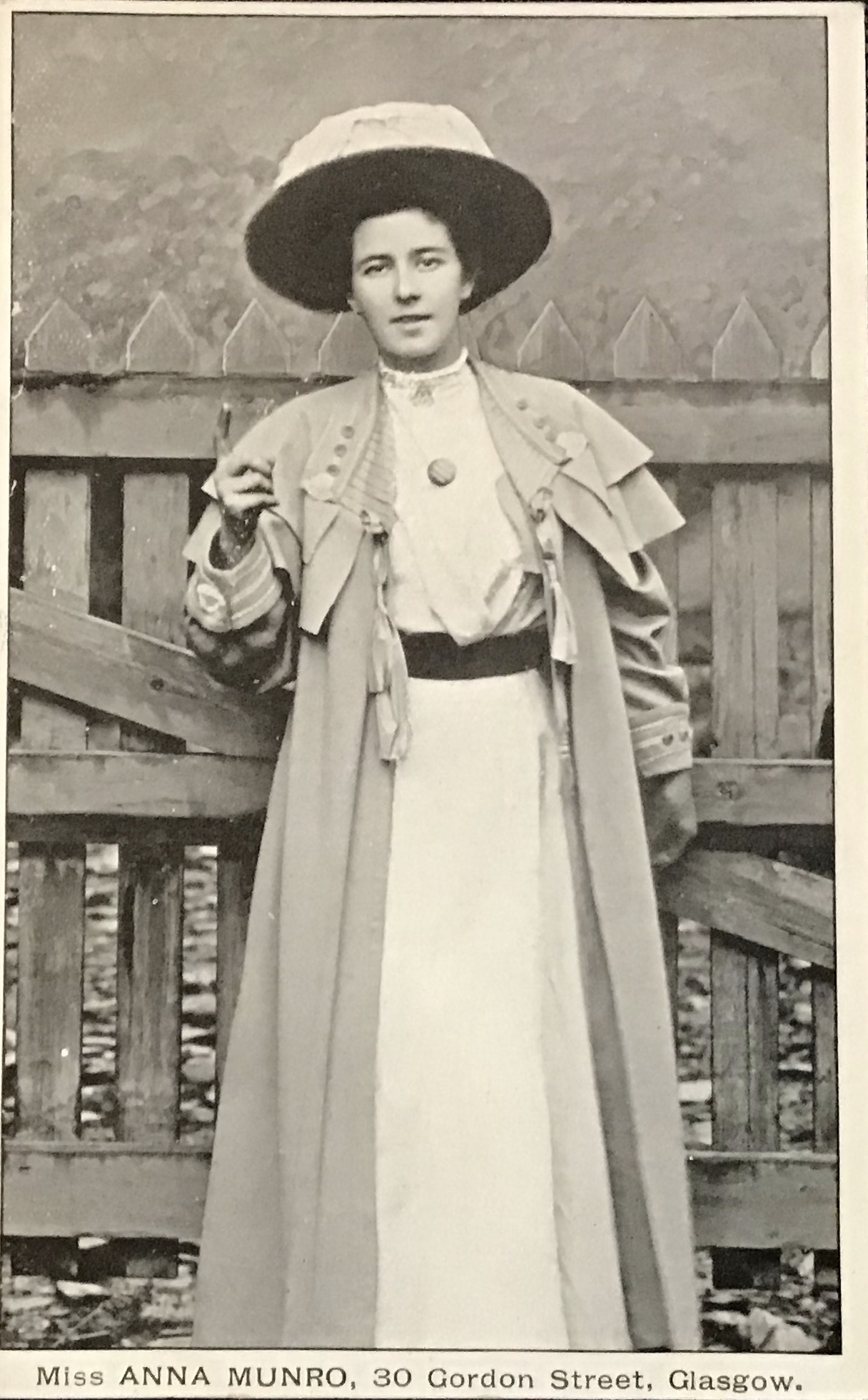
Full-length portrait photograph of Anna Munro (1881-1962) Scottish organiser for the Women’s Freedom League. The address is that of the WFL Scottish headquarters.
Anna Munro had joined the WSPU in 1906, becoming its organizer in Dunfermline. The following year she followed Teresa Billington-Greig into the WFL, becoming her private secretary. She was imprisoned in Holloway in early 1908 before being appointed organizing secretary of the Scottish Council of the WFL.
After the First World War Anna Munro (now Mrs Ashman) became a magistrate in England and was later president of the WFL in which she remained active until its disbanding in 1961.
Photographic postcards of Scottish suffragettes are relatively uncommon. This one is in fine, unposted condition. £130 + VAT in UK and EU. Email me if interested in buying. elizabeth.crawford2017@outlook.com
Collecting Suffrage: Photograph Of Cicely Hamilton By Lena Connell For The Suffrage Shop
Posted by womanandhersphere in Collecting Suffrage on September 14, 2020
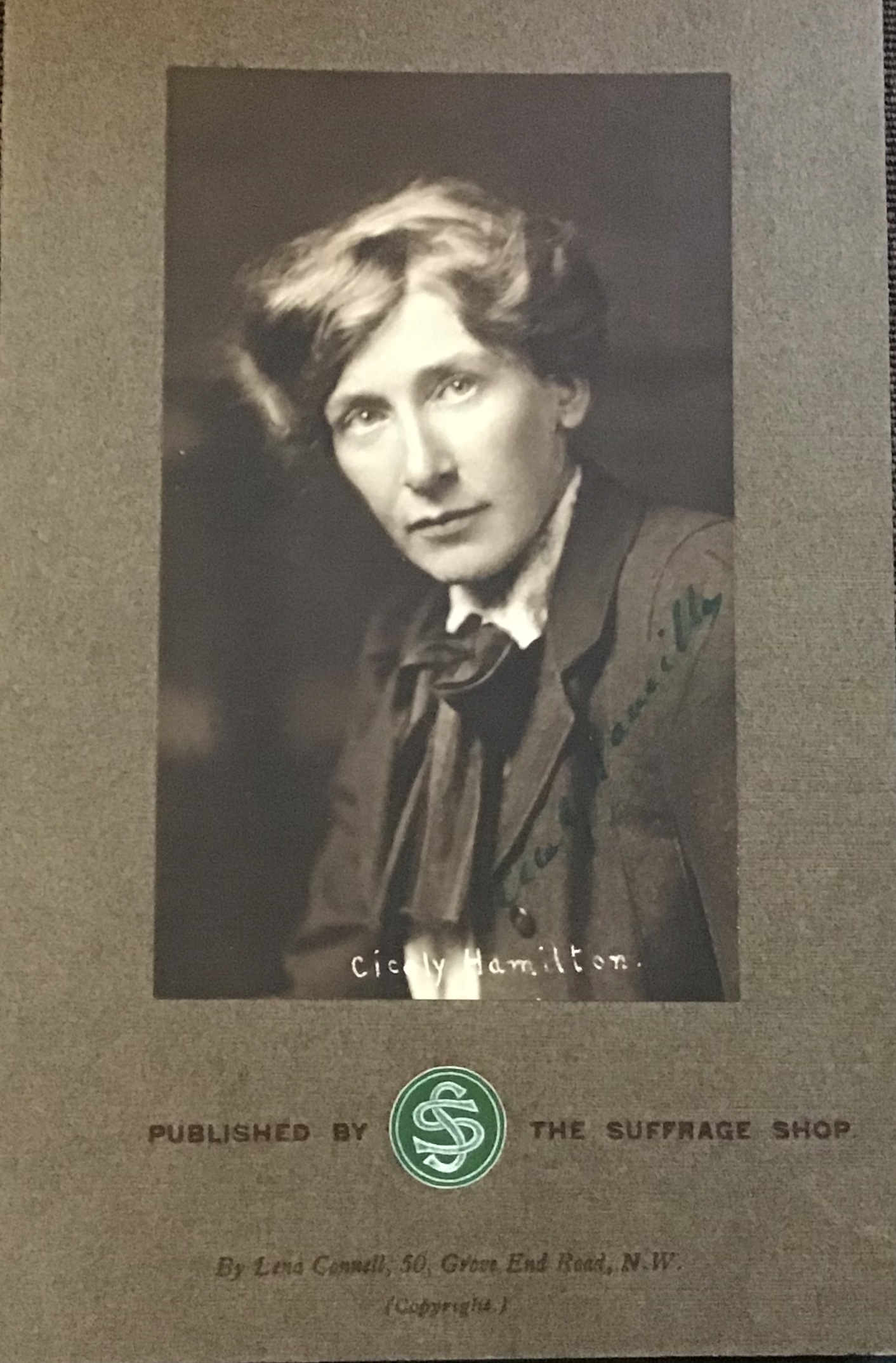
Photograph of a luminous Cicely Hamilton, writer, actor and suffrage activist, taken by Lena Connell, the renowned photographer.
The close-up photograph is mounted on stiff card, which carries the logo of The Suffrage Shop, 15 Adam Street, Strand, London. Hamilton was closely associated with the Suffrage Shop, which in 1910 published her Pageant of Great Women.
The photograph was probably taken c 1910/1911. Hamilton’s name has been scratched on the emulsion, presumably by the photographer, and it is signed by Cicely Hamilton. SOLD
If interested in buying, do email me. elizabeth.crawford2017@outlook.com
Collecting Suffrage: Mrs Charlotte Despard Photographed by Christina Broom
Posted by womanandhersphere in Collecting Suffrage on September 9, 2020

A lovely photograph of Mrs Charlotte Despard, leader of the Women’s Freedom League. It was taken on a rooftop, possibly at the time of the WFL’s White, Gold and Green Fair in 1909.
The photographer and publisher of the resultant postcard was Mrs Albert Broom (Christina Broom), who photographed several groups of those participating in that WFL Fair.
In fine, unposted, condition. A scarce image. Sold
Email me if interested in buying. elizabeth.crawford2017@outlook.com
Collecting Suffrage: This Is The House That Man Built
Posted by womanandhersphere in Collecting Suffrage on September 8, 2020
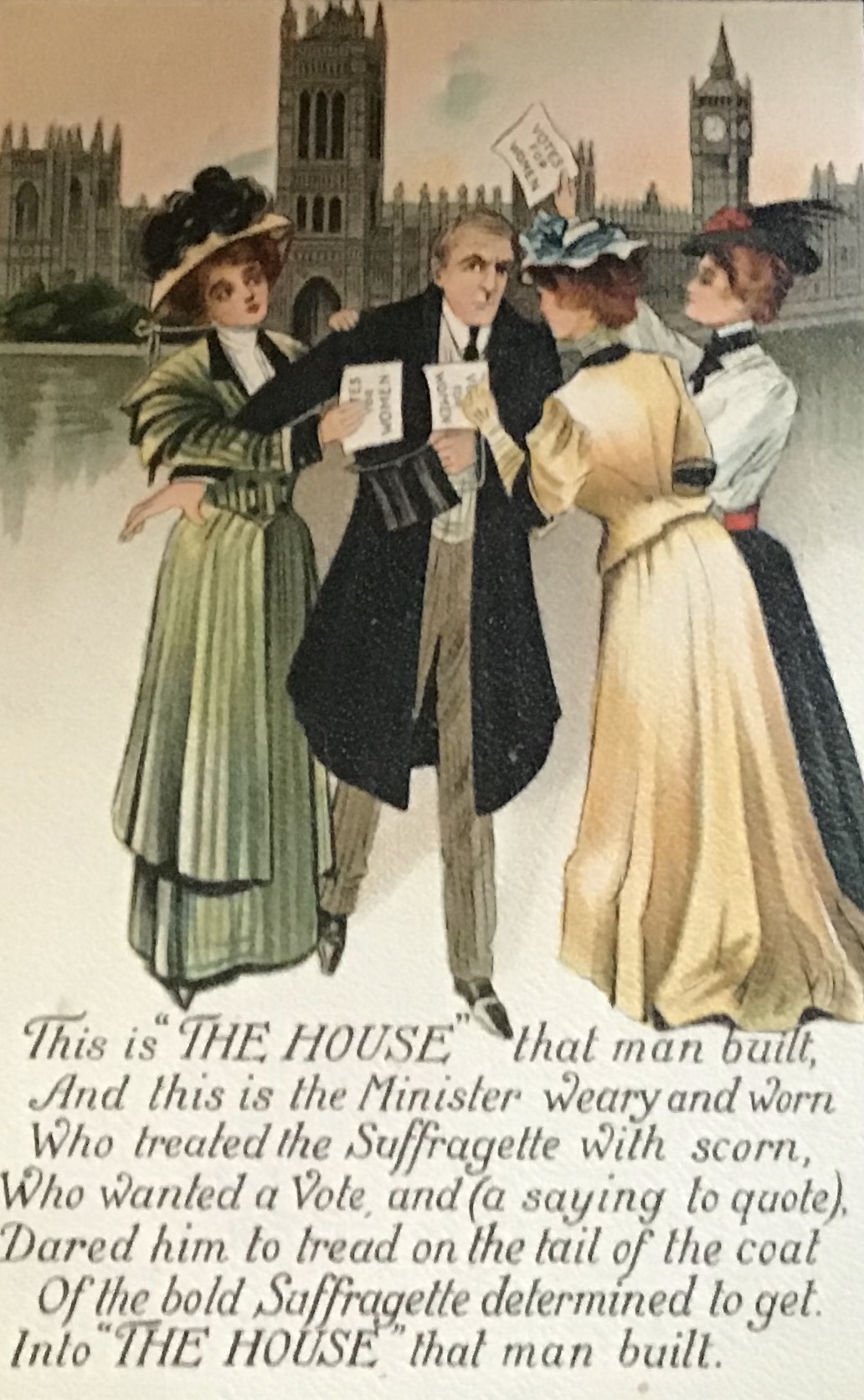
And this is the Minister weary and worn/Who treated the Suffragette with scorn,/Who wanted a Vote, and (a saying to quote),/ Dared him to tread on the tail of the coat/Of the bold Suffragette determined to get,/Into ‘THE HOUSE’ that man built.’
The Minister is surrounded by elegant suffragettes – with the House of Commons in the background.
One in the BB Series of 6 postcards showing suffragettes in a dignified light.
Fine – unposted £30 + VAT in UK and EU
Email me if interested in buying. elizabeth.crawford2017@outlook.com
Collecting Suffrage: Portrait Postcard Of Christabel Pankhurst, c. 1908
Posted by womanandhersphere in Collecting Suffrage on September 7, 2020
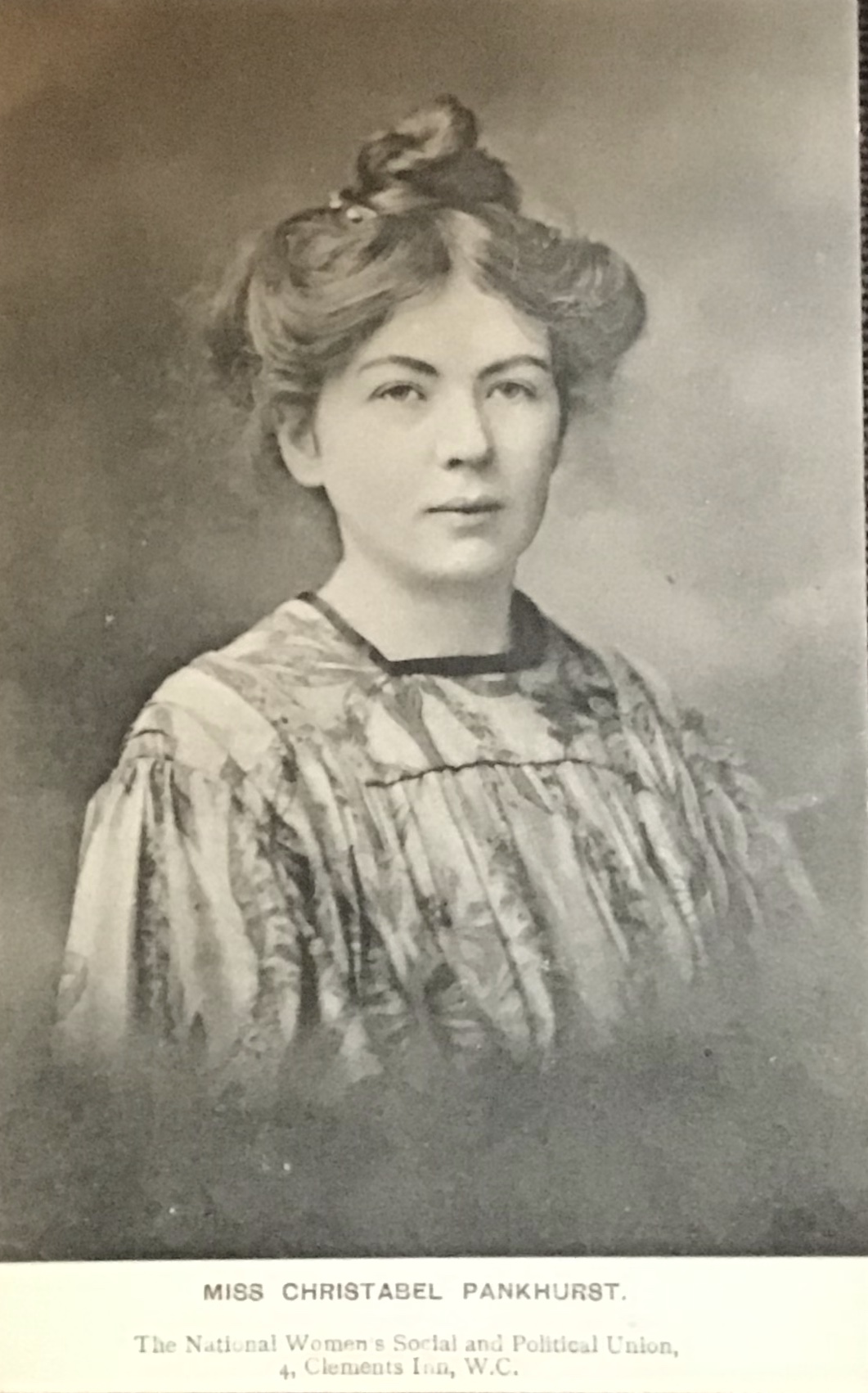
Head and shoulders photographic portrait of Christabel Pankhurst, probably dating from c. 1908.
She is wearing a rather attractive loose, square-necked dress, with her hair up in her characteristic knot. When Kate Frye attended a meeting of the Actresses’ Franchise League addressed by Christabel in February 1910 she commented, ‘Her hair was very untidy and I think would suit her so much better done low than on top in an ugly little knob.’ But I always think the hint of dishevelment is rather endearing.
The postcard is captioned ‘Miss Christabel Pankhurst. The National Women’s Social and Political Union. 4 Clement’s Inn, WC’, indicating that it was issued after some members, led by Mrs Charlotte Despard, broke away to form the Women’s Freedom League in the autumn of 1907. For a time they hoped to keep the ‘WSPU’ name, which led the Pankhursts to rename their faction ‘The National WSPU’.
The card was published by Sandle Bros. and would have been for sale in WSPU shops. This copy came from a collection put together by three suffragette sisters. Fine – unposted – £40 + VAT in UK and EU. Email me if interested in purchasing. elizabeth.crawford2017@outlook.com
Collecting Suffrage: Photograph of Mrs Fawcett, 1890
Posted by womanandhersphere in Collecting Suffrage on September 3, 2020

Today I offer you a studio photograph of Millicent Garrett Fawcett by W & D Downey. Published by Cassell & Co, 1890. She was 43 years old and had already been a leading light of the women’s suffrage movement for over 20 years.
A very good image – mounted. Suitable for framing. £40 + VAT in UK & EU.
In the past I have been concerned about the low profile afforded popularly to Mrs Fawcett. Indeed, in 2013 I wrote a post on the subject: Make Millicent Fawcett Visible.
And in 2016 when there was a suggestion that there should be a statue of a ‘suffragette’ in Parliament Square I did point out that there was already one nearby to Mrs Pankhurst (which I was also determined would not be moved) and one, so often forgotten, to the suffragette movement in general, just down Victoria Street in Christchurch Gardens. That resulted in another post – on Suffragette Statues.
As we all know, the idea of a ‘suffragette’ statue in Parliament Square morphed, thanks to input from Sam Smethers and the Fawcett Society, into the already well-loved statue of Mrs Fawcett. So that she is now indeed publicly visible.
Yesterday’s photograph of Mrs Pankhurst proved very popular, but if you would like demonstrate your loyalty to Mrs Fawcett, here is an excellent opportunity to acquire a photograph of her with which to adorn your desk or wall.
Do email me if you’re interested in buying. elizabeth.crawford2017@outlook.com
Collecting Suffrage: Photograph Of Mrs Emmeline Pankhurst c 1907
Posted by womanandhersphere in Collecting Suffrage on September 2, 2020
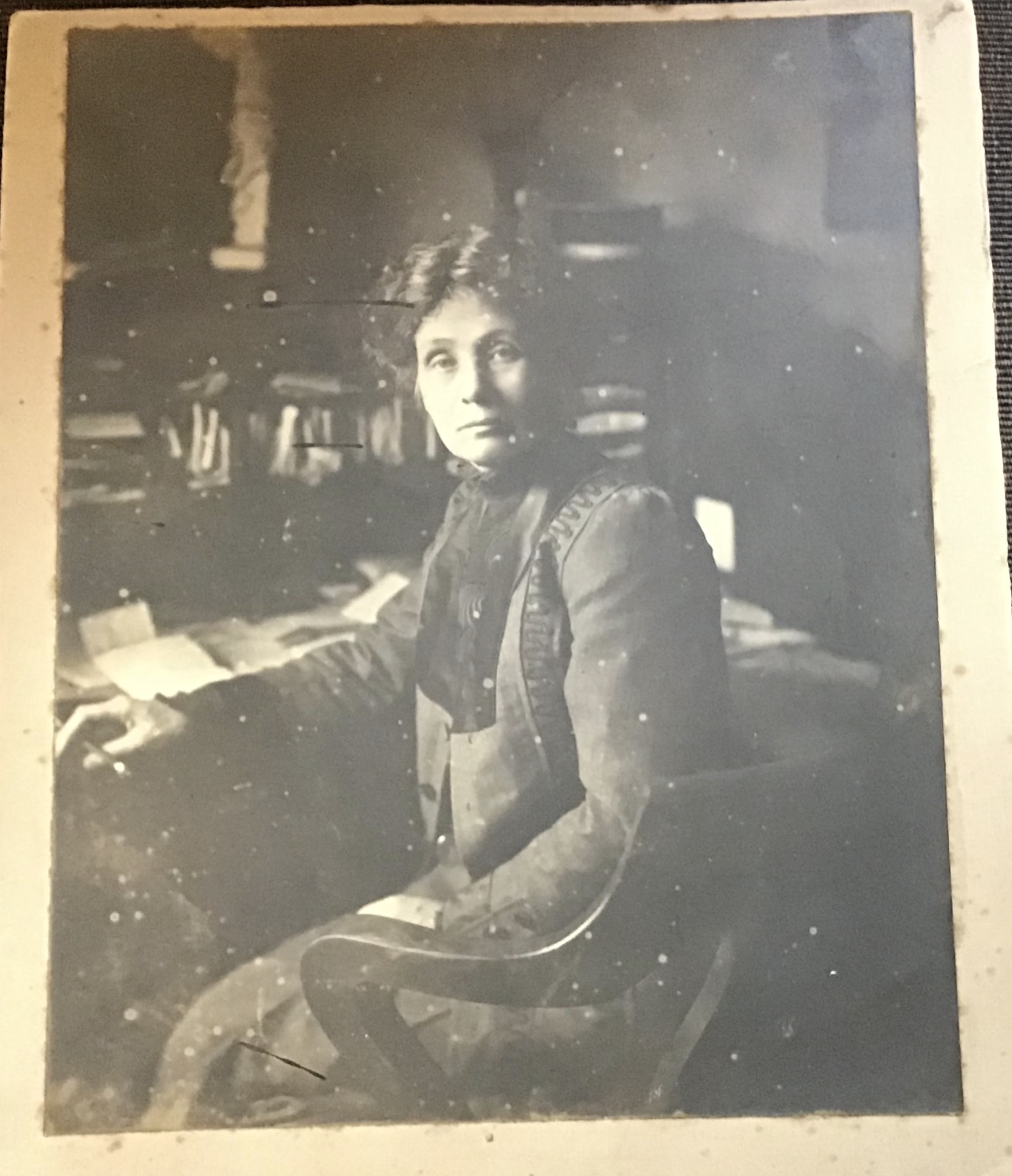
This photograph of Mrs Emmeline Pankhurst probably dates from c 1907, taken at her desk in Clement’s Inn, headquarters of the Women’s Social and Political Union.
The photograph comes from the collection of Isabel Seymour, who was an early WSPU supporter working in the WSPU office.
The photograph is mounted and is 15 x 20 cm (6″ x 8″) and is in good condition for its age. SOLD
Do email me if interested in buying. elizabeth.crawford2017@outlook.com
Collecting Suffrage: Questions To Lloyd George Asked By The Women’s Social And Political Union
Posted by womanandhersphere in Collecting Suffrage on August 26, 2020

A leaflet on which the WSPU set out eleven questions concerning Lloyd George’s behaviour in introducing a Government measure for Manhood Suffrage in 1913.
Among the many other pertinent questions: ‘Why do you expect us to accept your personal and unofficial advocacy of Woman Suffrage as a substitute for united and official action on the part of the Government as a whole?
Two-sided leaflet, printed in purple. In good condition – some creasing. £100
If interested in buying – email me – elizabeth.crawford2017@outlook.com
Collecting Suffrage: 1907 Programme For ‘Votes for Women’, Play By Elizabeth Robins
Posted by womanandhersphere in Collecting Suffrage on August 19, 2020
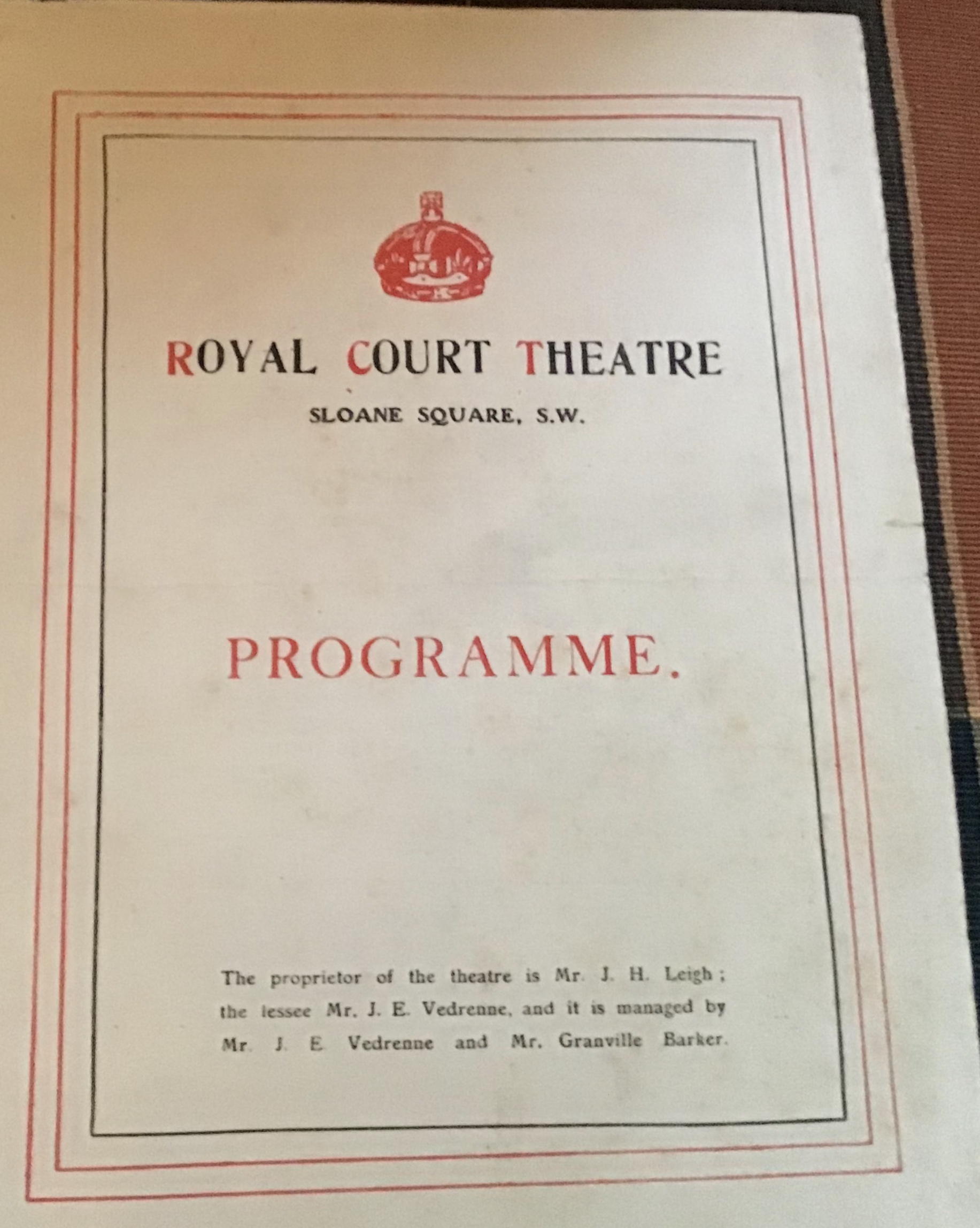
4-page programme for one of the 8 matinée performances of this so-popular play, staged in April and May 1907 at the Royal Court Theatre, Sloane Square, under the joint management of John Vedrenne and Harley Granville Barker.
The programme includes the cast list, of course, and a notice that ‘At these Matinées, Ladies are earnestly requested to remove Hats, Bonnets, or any kind of head dress. This rule is framed for the benefit of the audience…’
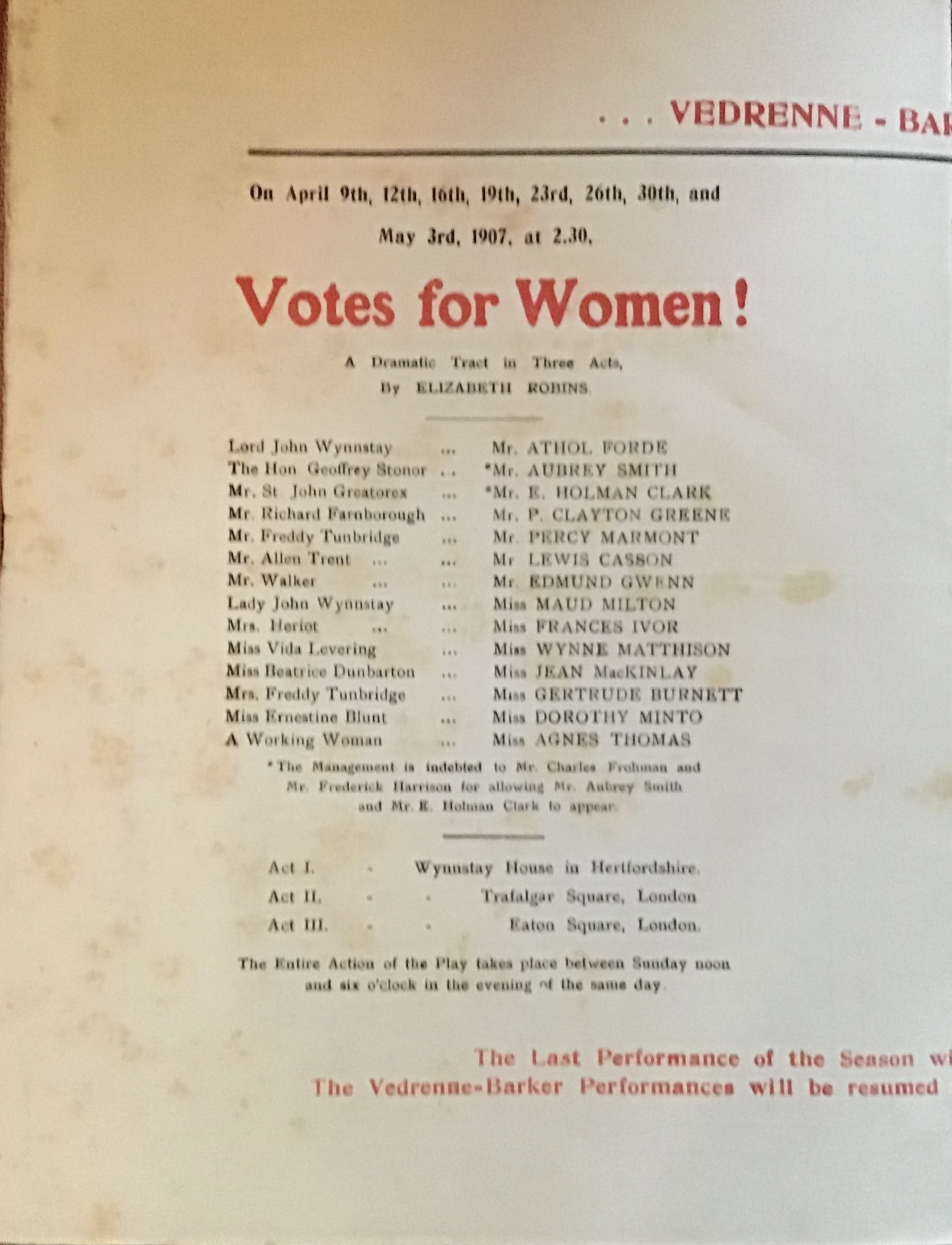
Kate Frye (suffrage diarist) saw the play on 16 April and wrote a long entry that night in her diary where, including, amongst other comments, ‘I loved the piece – it is quite fine – most cleverly written and the characters are so well drawn. Needless to say the acting was perfection as it generally is at the Court Theatre and the second act – the meeting in Trafalgar Square – ought to draw the whole of London. I was besides myself with excitement over it ‘
This programme belonged to Isabel Seymour, an early worker in the WSPU Clement’s Inn office, She folded the programme into her pocket or handbag and then kept it for the rest of her life.
In good condition – extremely scarce £500
Email me if interested in buying – elizabeth.crawford2017@outlook.com
THIS ARTICLE AND PHOTOGRAPHS ARE MY COPYRIGHT.
PLEASE CONTACT ME IF YOU WISH TO USE ANYTHING POSTED HERE.
Collecting Suffrage: The Women’s Guild Of Empire
Posted by womanandhersphere in Collecting Suffrage on August 12, 2020
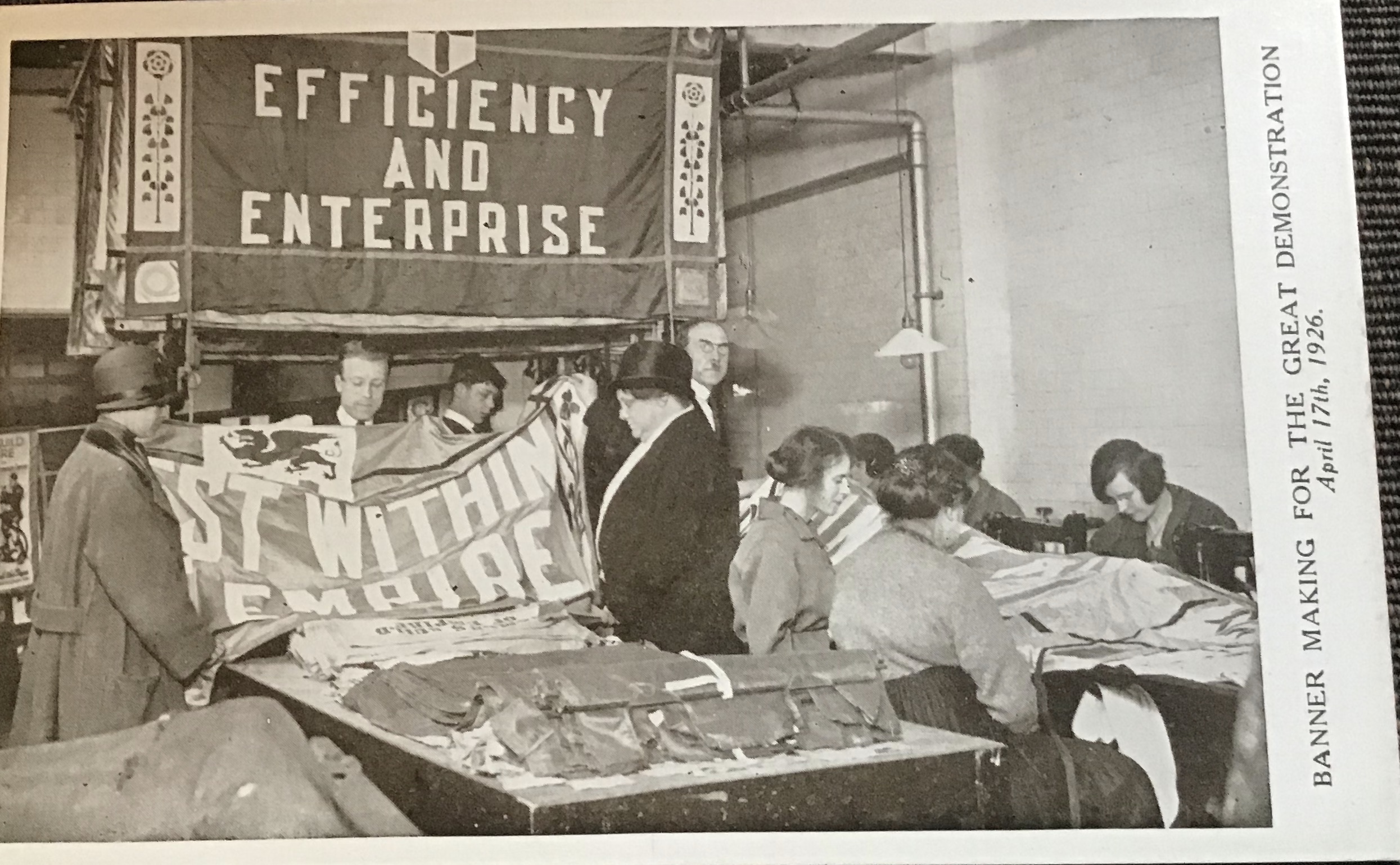
The Women’s Guild of Empire organised a demonstration at a critical time just before the General Strike in April 1926. Here we see Flora Drummond supervising the making of the banners that were to be paraded on the Day. The march brought together ‘wives of working men who have had personal experience of strikes’ (as Elsie Bowerman wrote to the editor of ‘The Spectator‘) from all regions of the country, culminating in an Albert Hall meeting, chaired by Mrs Drummond.
A scarce and unusual image – a postcard In fine, unposted, condition SOLD
email me if interested in buying elizabeth.crawford2017@outlook.com
Collecting Suffrage: ‘Punch’ Cartoon, 17 January 1906
Posted by womanandhersphere in Collecting Suffrage on August 11, 2020
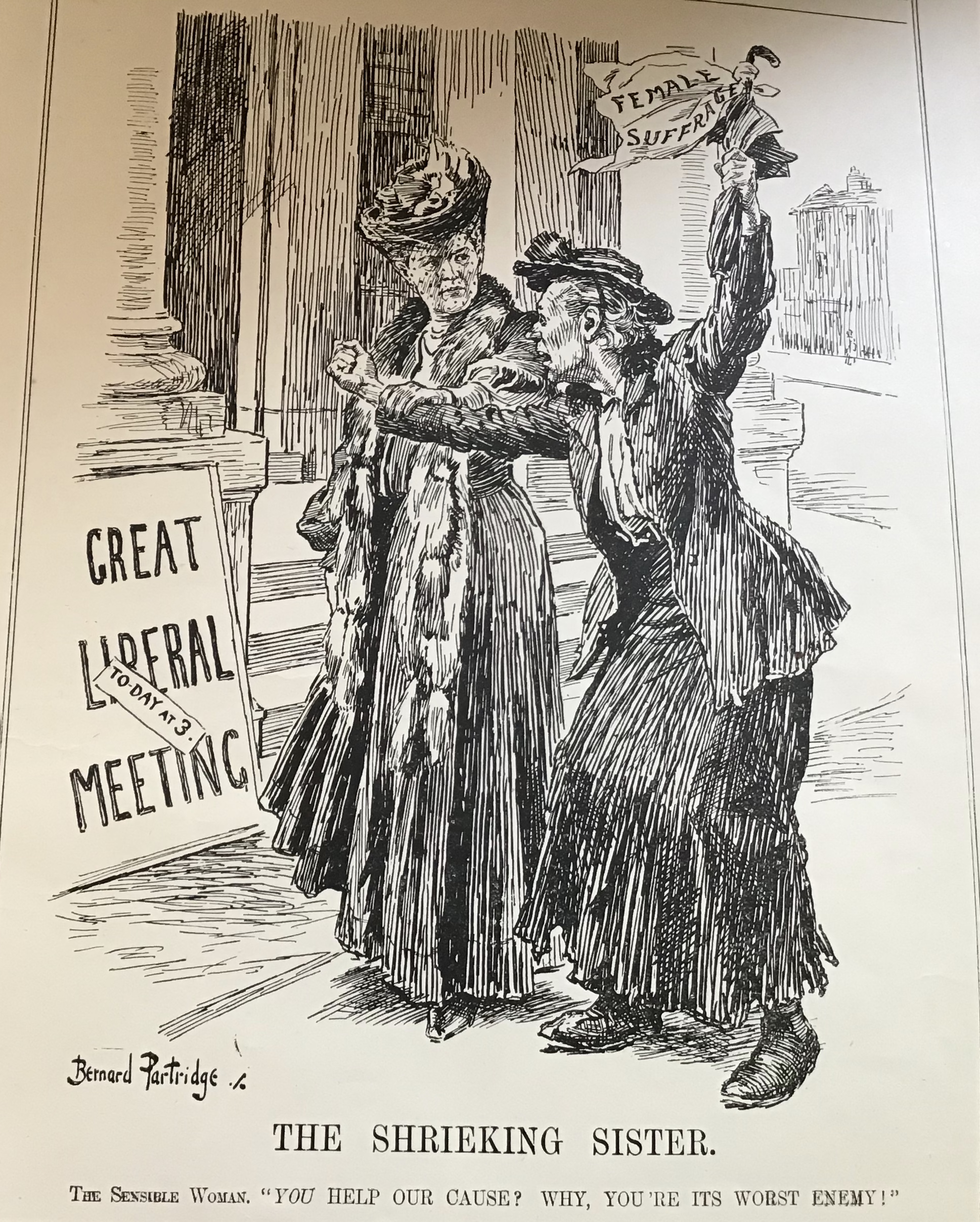
Punch cartoon from the issue for 17 January 1906. ‘The Shrieking Sister’. The Sensible Woman (with her fur stole around her neck) addresses the dishevelled ‘suffragette’ (with a ‘Female Suffrage’ flag tied to her umbrella) – ‘You – help our cause? Why, you’re its worst enemy!’ They are standing outside a hall that advertises ‘Great Liberal Meeting’.
Mrs Pankhurst’s Women’s Social and Political Union had recently appeared on the national scene. Just over two months previously Christabel Pankhurst and Annie Kenney had been imprisoned after interrupting a Liberal party meeting – and this is how the WSPU is now personified. The General Election, which resulted in a Liberal landslide, was in full swing when the cartoon was published.
A full-page Bernard Partridge cartoon. SOLD
If interested in buying, do email me elizabeth.crawford2017@outlook.com
Collecting Suffrage: Photographs Of The Equal Rights Rally, 3 July 1926
Posted by womanandhersphere in Collecting Suffrage on August 10, 2020
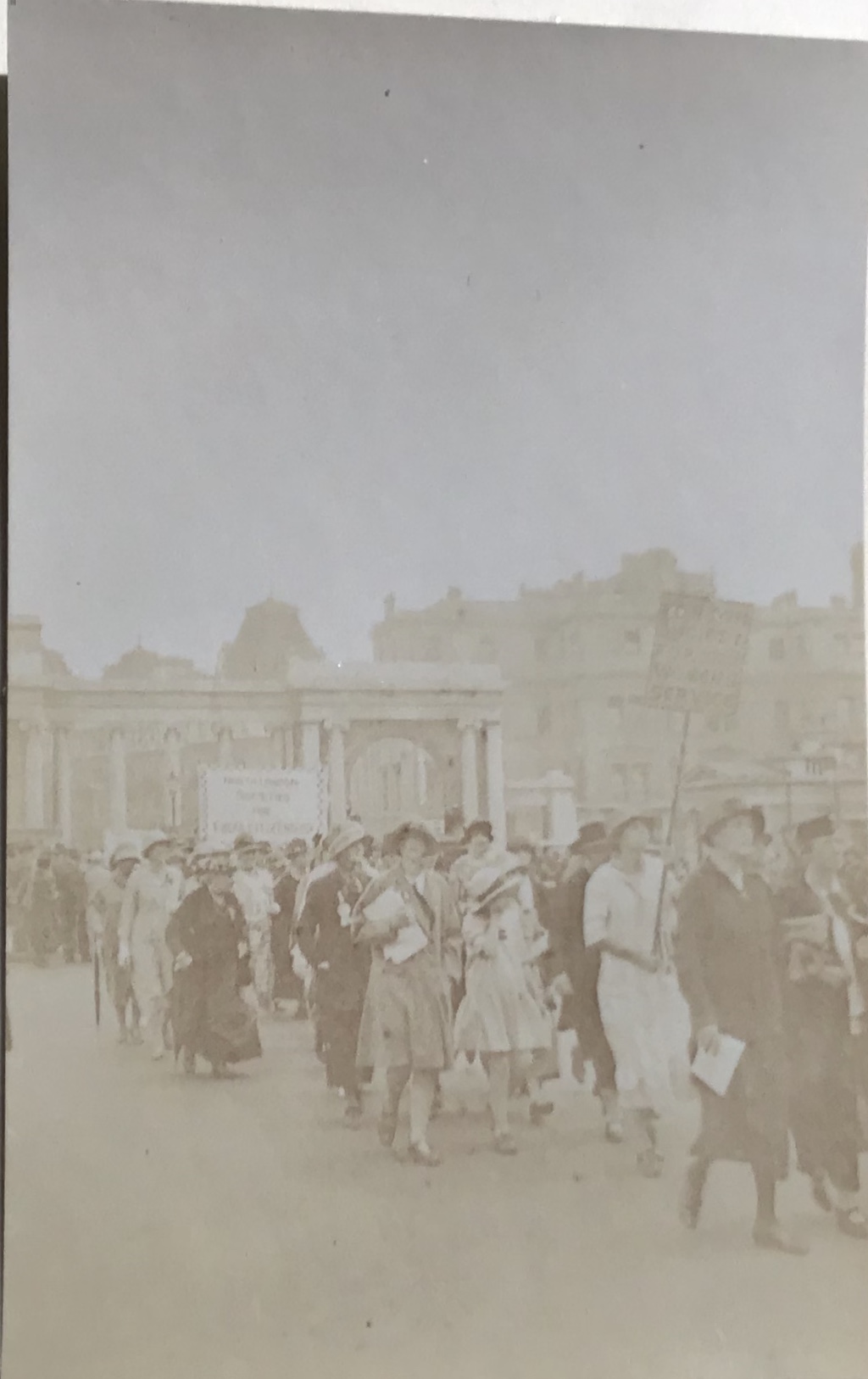

Two snapshots – taken at the rally by John Collins, Kate Frye’s husband.
Here’s an excerpt from Kate’s diary entry for the day, as reproduced in Campaigning for the Vote: Kate Parry Frye’s suffrage diary (now out of print).
Saturday July 3rd 1926 [London: Flat C, 57 Leinster Square]
[After lunch] changed, off with J[ohn] – bus to Marble Arch and walked to Hyde Park Corner. Sat a little then saw the procession of women for Equal franchise rights and to the various meetings and groups. Heard Mrs Pankhurst and she was quite delightful. Also saw Ada Moore – getting very old. Saw Mrs Despard 82 and walked all the way. And the Actresses’ Franchise League.
The tiny snapshots show women and men walking into Hyde Park, with banners. If anyone else was taking photos that day, they do not seem to have made their way into public collections. Very good – very scarce. £20 the two together.
Do email me if you’re interested in buying these shadows of the past. elizabeth.crawford2017@outlook.com
SOLD
Collecting Suffrage: ‘Punch’ Cartoon, 21 October 1908
Posted by womanandhersphere in Collecting Suffrage on August 6, 2020

Punch cartoon, 21 October, 1908. Two burglars on their way to ‘suburban night-work’ watch a line of policemen marching the opposite way, into Town, to deal with the Votes for Women demonstration advertised on the poster.
The burglars agree that the ‘sufferajits’ are a good thing, keeping the police occupied as they do. This was the time of the ‘Rush the House of Commons’ demo.
FOR SALE – Full page cartoon by Bernard Partridge. Fine condition £12 SOLD
Collecting Suffrage: The Church League For Women’s Suffrage Paper
Posted by womanandhersphere in Books And Ephemera For Sale, Collecting Suffrage on August 5, 2020
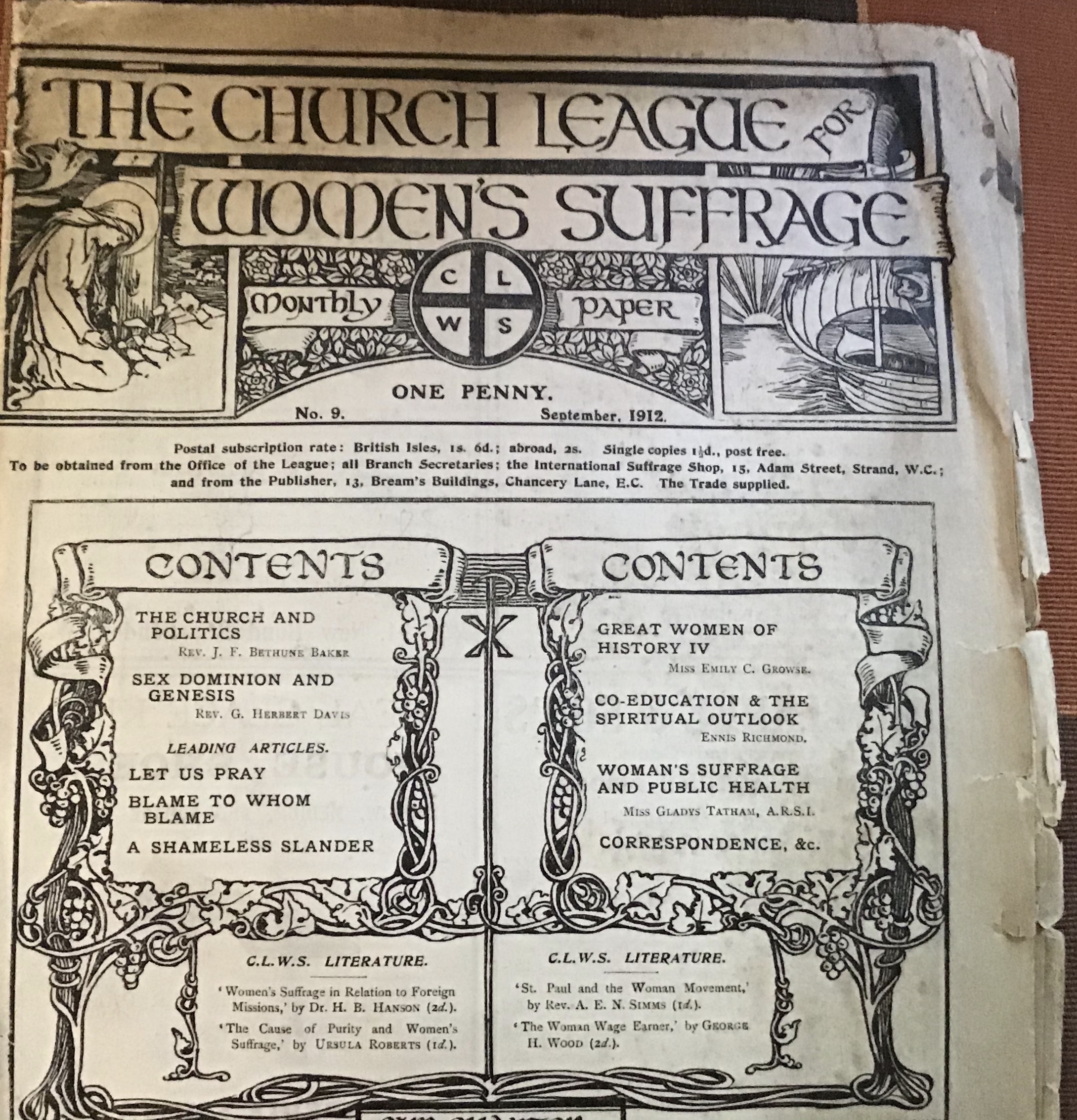
The paper of the Church League for Women’s Suffrage was published monthly from January 1912. This is the issue for 9 September 1912. Issues of the paper are scarce and this one is in good condition for its age – packed with information. For sale – SOLD
If interested email me: elizabeth.crawford2017@outlook.com
Suffrage Stories: Celebrating The Centenary Of The Representation Of The People Act, 6 February 2018
Posted by womanandhersphere in Art and Suffrage, Collecting Suffrage, Kate Frye's Diary, Suffrage Stories on February 7, 2018
Well, 6 February 2018 was well and truly celebrated. I’m not sure if I ever remember the media getting behind another political anniversary with such verve – the coverage was akin to that of a royal wedding. All the talking heads that could talk, talked.
You can catch me talking about the suffrage campaign on Woman’s Hour
And talking about my new book, Art and Suffrage: a biographical dictionary of suffrage artists on the Robert Elms Show on Radio London (starting at c. 2hrs 37 mins)
Kate Frye, whose diaries I edited as Campaigning for the Vote: Kate Frye’s suffrage diary and whose biography I wrote as Kate Parry Frye: the long life of an Edwardian actress and suffragette, had a starring role on BBC Radio 4’s PM Programme (from c 23mins) – preceded by an excellent exposition of the Representation of the People Act 1918 by Dr Mari Takayanagi (from c 18.40 mins)

Kate Frye also featured in yesterday’s special suffrage edition of Stylist. She would have been amazed and thrilled to think of her daily round being immortalised in this way.
I also gave interviews to Radio Stoke, Radio Northampton, Radio Bristol, Radio Sheffield, Radio Lincolnshire, and Radio Derby – talking about suffrage activists in their areas.
Clare Balding’s programme Secrets of a Suffragette – about Emily Wilding Davison – in which I make an appearance – was shown again last night on Channel 4 and is available for 29 days on catch-up.
And, in my dealing capacity, I put together this list of the Top Twenty Collectable Suffrage Antiques for an antiques website.
What a day!
Suffrage Stories/Collecting Suffrage: Countdown To 12 October And Release Of The Film ‘Suffragette’: The WSPU Car
Posted by womanandhersphere in Collecting Suffrage, Suffrage Stories on October 9, 2015
To celebrate the release on 12 October of the film ‘Suffragette’ (for which I was an historical consultant) I will post each day an image of a suffrage item that has passed through my hands.
For my current catalogue – No 189 – which contains a good deal of suffrage material – as well as general books and ephemera by and about women – see here.
Today’s image:
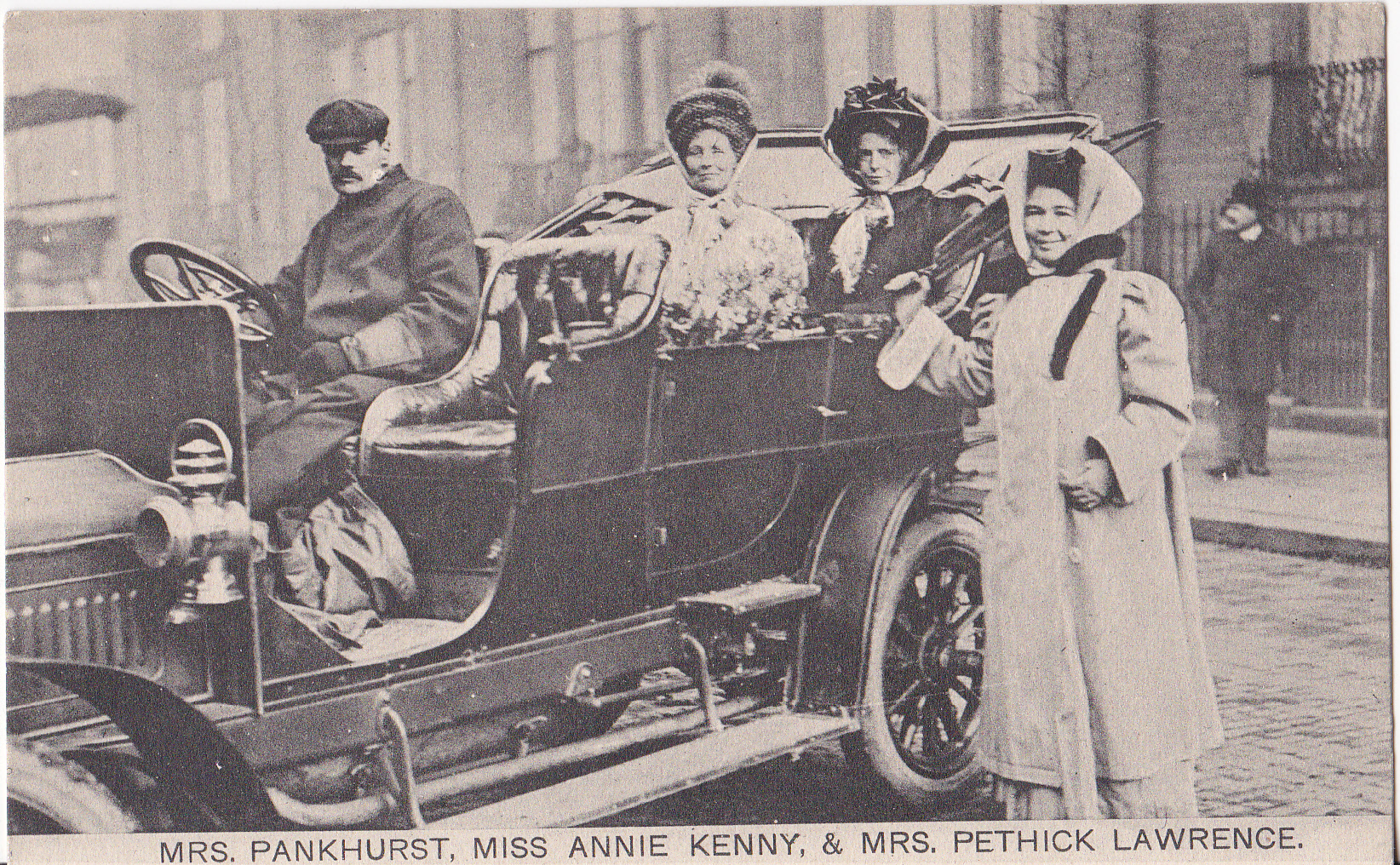
Emmeline Pankhurst, Emmeline Pethick-Lawrence and Annie Kenney
Most of the previous items that I have described in the daily ‘Countdown to the Release of the Film “Suffragette”‘ posts over the past month have already been sold – but for this final week I shall describe items that are currently for sale.
All three women are wearing motor scarves to protect their hats.
The card was published by Sandle Bros and the type face used for the caption is the same as that for the ‘Rush the House of Commons’ postcards that date from October 1909 – so I would deduce that this card was published around the same time.
 Copyright
Suffrage Stories/Collecting Suffrage: Countdown To 12 October And Release Of The Film ‘Suffragette’:’The Empire Car’ In The Suffrage Coronation Procession 1911
Posted by womanandhersphere in Collecting Suffrage, Suffrage Stories on October 8, 2015
To celebrate the release on 12 October of the film ‘Suffragette’ (for which I was an historical consultant) I will post each day an image of a suffrage item that has passed through my hands.
For my current catalogue – No 189 – which contains a good deal of suffrage material – as well as general books and ephemera by and about women – see here.
Today’s image:
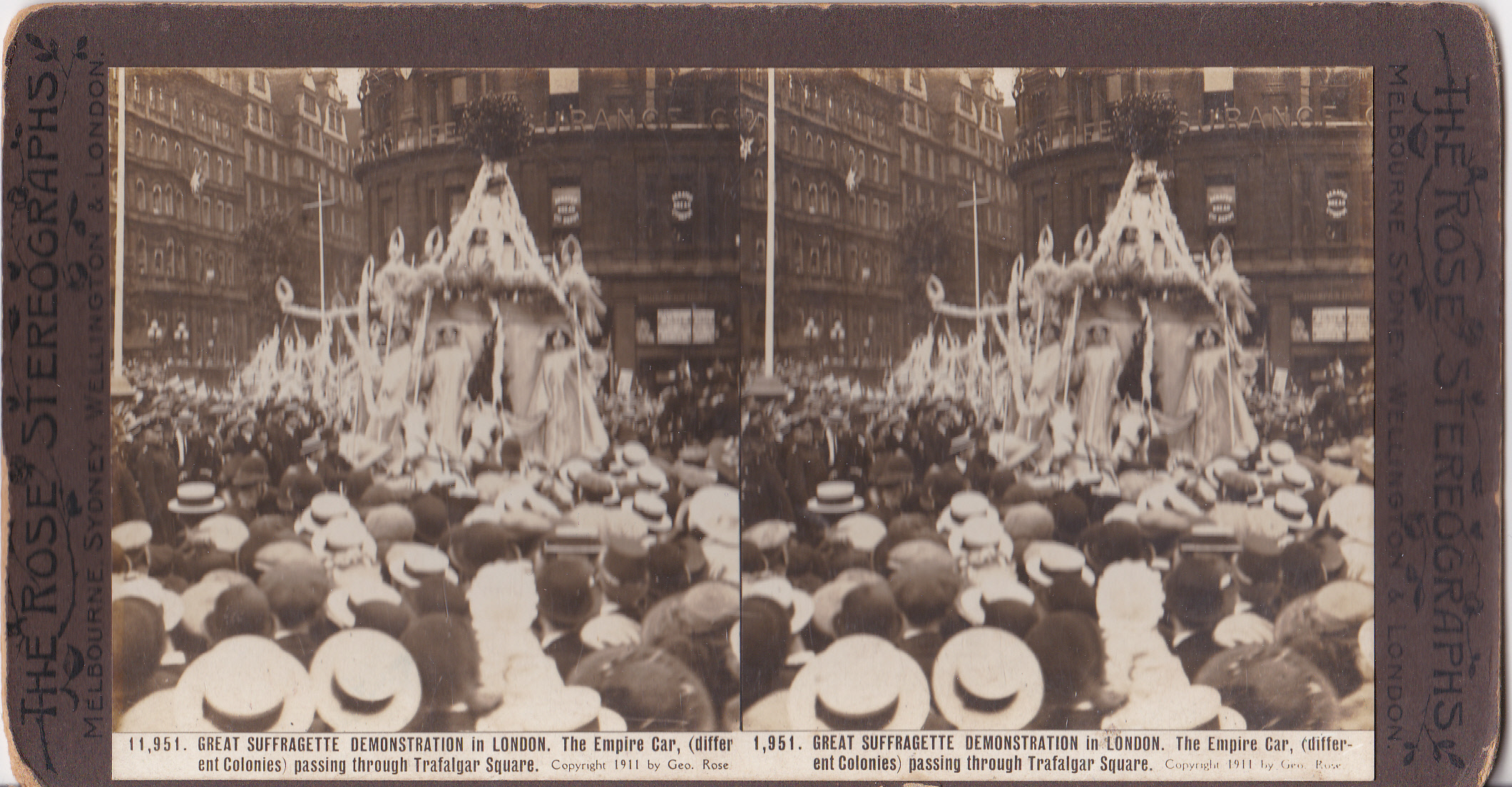
The ‘Empire Car’ – Suffrage Coronation Procession, 1911
Most of the previous items that I have described in the daily ‘Countdown to the Release of the Film “Suffragette”‘ posts over the past month have already been sold – but for this final week I shall describe items that are currently for sale.
This is a stereoscope photograph of ‘The Empire Car’ – one of the elements of the ‘Pageant of Empire’ that was included in the procession staged by the suffrage societies on 17 June 1911 to mark the Coronation of George V.
To stage the procession the Women’s Social and Political Union, the Women’s Freedom League and the National Union of Women’s Suffrage Societies worked together, alongside a wide range of smaller societies – bringing together militants and constitutionalists in one grand, consciousness-raising display.
This particular image is interesting, for with the imminent release of ‘Suffragette’ there has been a minor flurry on Twitter deprecating the lack of inclusion of women of colour in the film and particularly citing a couple of images, such as this, as evidence that supporters of the movement did include women from India.
That is true. However the handful of wealthy, aristocratic Indian ladies who were supporters lived lives far removed from that of Maud, the East End laundry worker whose story is central to the film, and there is no plausible reason why their paths should have overlapped.
Indeed, there are thousands of women – including all the members of the NUWSS – whose stories do not feature in the film. This in no way detracts from the engrossing story of Maud Watts, whose fictional life makes explicit to us just why it was that women did need the vote.
Copyright
Suffrage Stories/Collecting Suffrage: Countdown To 12 October And Release Of The Film ‘Suffragette’: Selling ‘The Suffragette’ Paper
Posted by womanandhersphere in Collecting Suffrage, Suffrage Stories on October 7, 2015
To celebrate the release on 12 October of the film ‘Suffragette’ (for which I was an historical consultant) I will post each day an image of a suffrage item that has passed through my hands.
For my current catalogue – No 189 – which contains a good deal of suffrage material – as well as general books and ephemera by and about women – see here.
Today’s image:
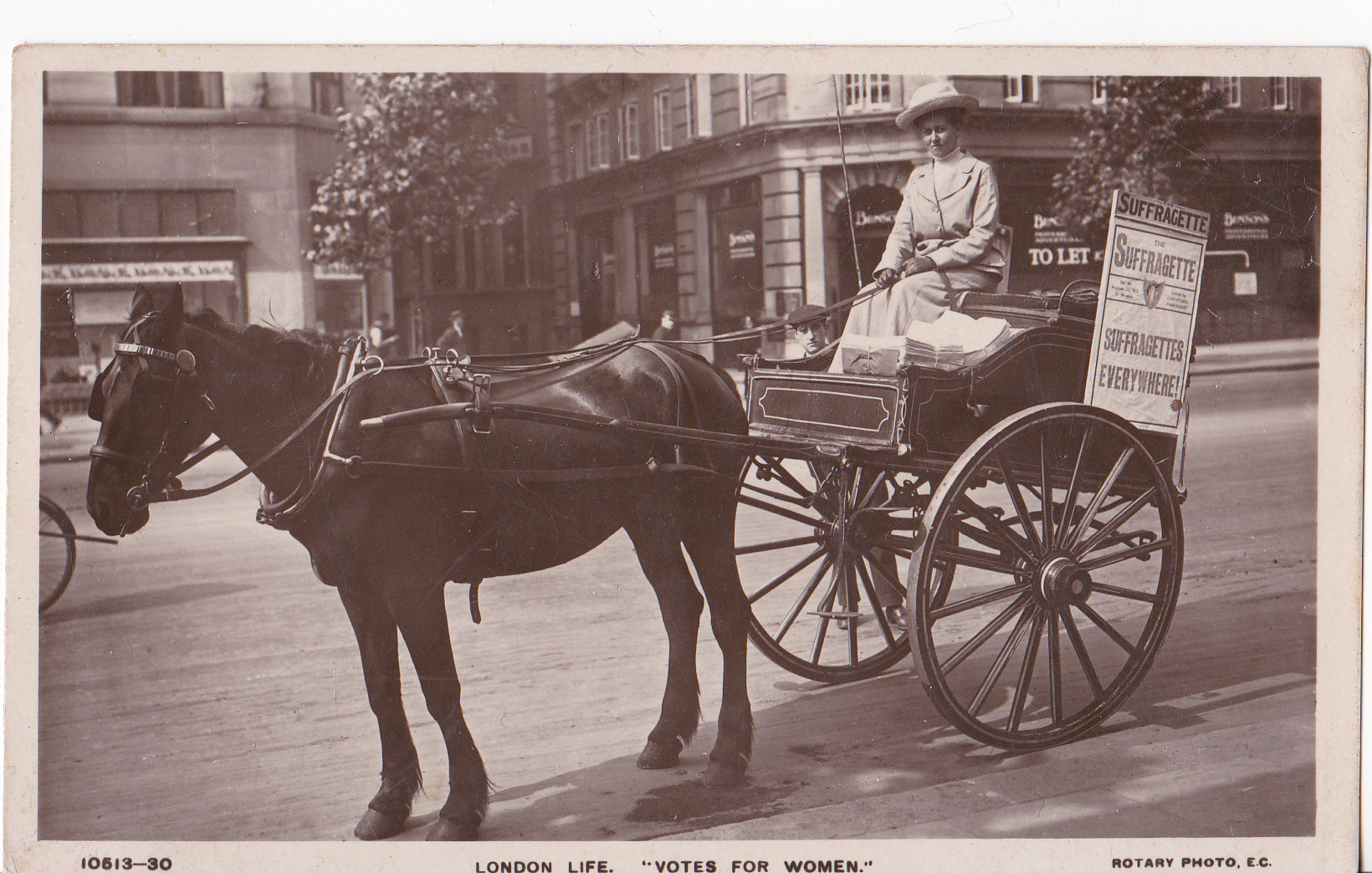
Selling ‘The Suffragette’
All the previous items that I have described in the daily ‘Countdown to the Release of the Film “Suffragette”‘ posts over the past month have already been sold – but for this final week I shall describe items that are currently for sale.
Thus I begin with this photographic postcard depicting a small, smart cart carrying an advertising hoarding for The Suffragette, the paper published by the Women’s Social and Political Union (WSPU) and edited by Christabel Pankhurst.
The cart is stationary, the horse waiting patiently as his lady driver poses for a photograph, piles of the newspaper at her feet.
My observations leave me to think that the photograph was taken in Kingsway – close to the WSPU office in Lincoln’s Inn House – opposite the entrance to Wild Court. The building on the corner of that street (now a Belgo) has changed little since 1913 when this photograph would have been taken.
The postcard is in very good condition, despite having been posted, on 11 November 1913, to South Africa. It carried no message – proving that, as the hoarding proclaims, it appealed to ‘Suffragettes Everywhere’.
The card is for sale – £150. To buy email me: e.crawford@sphere20.freeserve.co.uk
Copyright
Suffrage Stories/Collecting Suffrage: Countdown To 12 October And Release Of The Film ‘Suffragette’: Christabel Pankhurst In Her Office In Clement’s Inn
Posted by womanandhersphere in Collecting Suffrage, Suffrage Stories on October 6, 2015
To celebrate the release on 12 October of the film ‘Suffragette’ (for which I was an historical consultant) I will post each day an image of a suffrage item that has passed through my hands.
For my current catalogue – No 189 – which contains a good deal of suffrage material – as well as general books and ephemera by and about women – see here.
Today’s image:
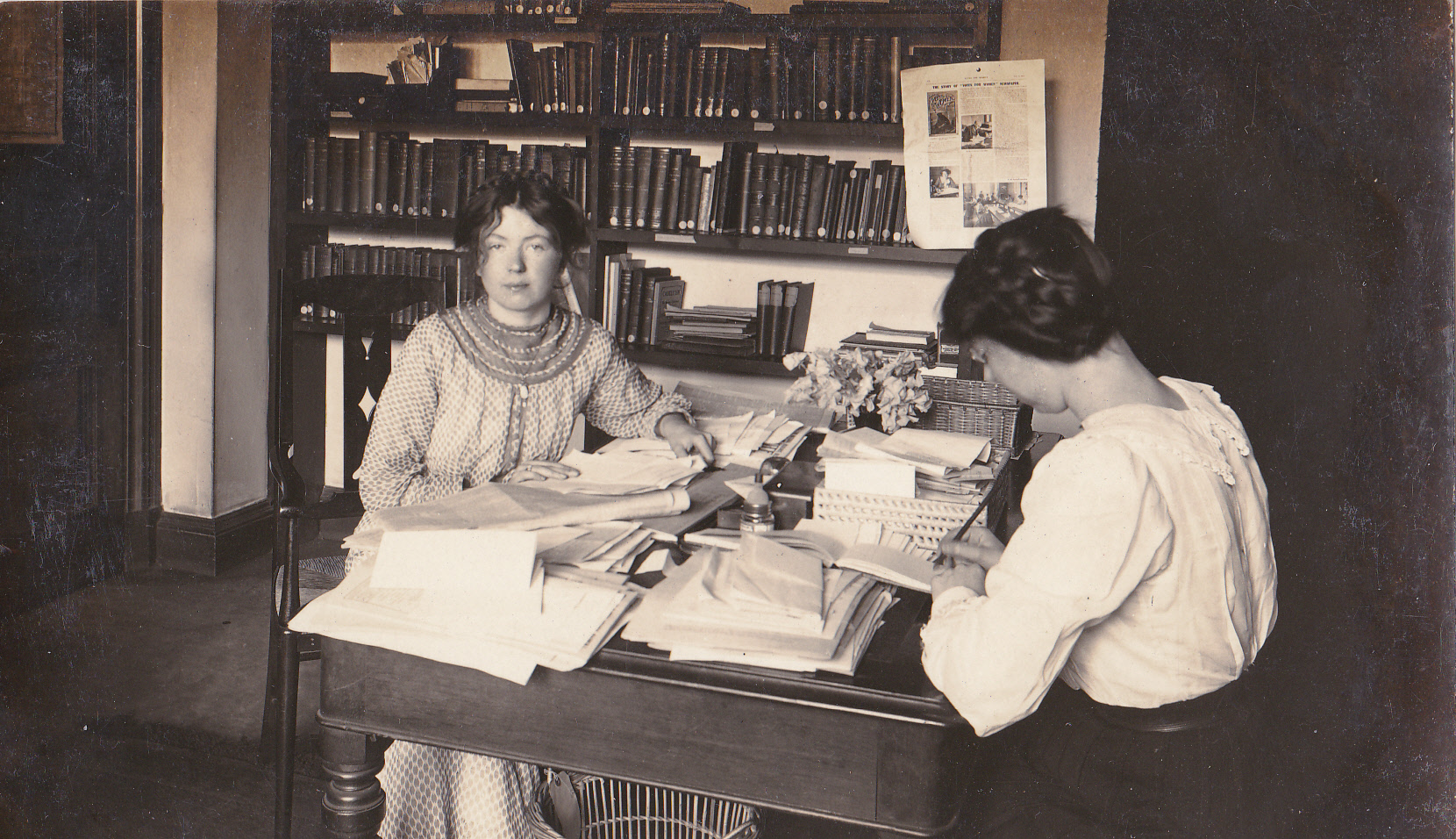
Christabel Pankhurst photographed in her office in Clement’s Inn
The postcard was published by H. Sergeant of Ladbroke Grove and the photograph would have been taken on the occasion of his visit to Clement’s Inn in 1910/1911 when he also photographed Mrs Pankhurst in her office.
Christabel’s room – or at least that section of it in shot – betrays little of the homeliness that her mother had added to hers – although there is a vase of flowers on the desk. Behind her is a bookcase filled with serious-looking books – as befits a lawyer – with a page from Votes for Women pinned to it.
While Christabel looks directly at the camera, her young secretary keeps working, bent over her notebook, pen in hand.
Copyright
Suffrage Stories/Collecting Suffrage: Countdown To 12 October And Release Of The Film ‘Suffragette’:Mrs Pankhurst In Her Clement’s Inn Office
Posted by womanandhersphere in Collecting Suffrage, Suffrage Stories on October 5, 2015
To celebrate the release on 12 October of the film ‘Suffragette’ (for which I was an historical consultant) I will post each day an image of a suffrage item that has passed through my hands.
For my current catalogue – No 189 – which contains a good deal of suffrage material – as well as general books and ephemera by and about women – see here.
Today’s image:

Mrs Emmeline Pankhurst and Mrs Mabel Tuke photographed in Mrs Pankhurst’s office in Clements Inn – probably in 1910/11.
Mrs Pankhurst and Mrs Tuke are sitting at a paper-laden desk. Mabel Tuke was honorary secretary of the Women’s Social and Political Union. Very pretty – as we can see – her nickname was ‘Pansy’.
This photograph gives us an opportunity to deconstruct the surroundings. What pictures did Mrs P. have on the walls? Well there is a poster for a Suffrage Fair and above that a portrait sketch that looks very like that of Christabel Pankhurst by Richard Mathews that is now in the National Portrait Gallery.
There is at least one photograph and one sculptured bust of a child – probably by Desiderio da Settignano. And a small vase of flowers on the mantlepiece. A wonderful picture.
The publisher of the card was H. Sergeant, 159 Ladbroke Grove – who took many photographs for the WSPU.
Copyright
Suffrage Stories/Collecting Suffrage: Countdown To 12 October And Release Of The Film ‘Suffragette’: Dora Meeson Coates’ Poster
Posted by womanandhersphere in Collecting Suffrage, Suffrage Stories on October 2, 2015
To celebrate the release on 12 October of the film ‘Suffragette’ (for which I was an historical consultant) I will post each day an image of a suffrage item that has passed through my hands.
For my current catalogue – No 189 – which contains a good deal of suffrage material – as well as general books and ephemera by and about women – see here.
Today’s image:

Poster designed by Dora Meeson Coates
In 1907, with this design, Dora Meeson Coates (c 1870-1955), an Australian artist living with her husband in Chelsea, won a competition organised by the National Union of Women’s Suffrage Societies and the Artists’ Suffrage League.
The poster shows ‘Mrs John Bull’ holding an empty dish labelled ‘Votes for Women’ while six boys – ‘Primrose League’, Trade Unions’, ‘Liberal Federation’, ‘Women’s Liberal Association’, ‘S.D.F’ and ‘I.L.P’ – clamour for more soup from a large bowl labelled ‘Political Help’. She says: “Now you greedy boys I shall not give you any more until I have helped myself.”
It was one of three exceedingly rare posters that I bought at auction a few years ago,
Dora continued to work closely with leading members of the Artists’ Suffrage League, such as Mary Lowndes and C. Hedley Charlton as well as designing the ‘Commonwealth Australia’ banner that was carried in the 1911 suffrage ‘Coronation Procession’. That banner is now on display in Parliament House, Canberra.
You can read much more about Dora Meeson Coates’ association with the suffrage movement in my The Women’s Suffrage Movement: a reference guide.
Copyright
Suffrage Stories/Collecting Suffrage: Countdown To 12 October And Release Of The Film ‘Suffragette’: Flyer for WSPU Window-Smashing Demo on 21 Nov 1911
Posted by womanandhersphere in Collecting Suffrage, Suffrage Stories on October 1, 2015
To celebrate the release on 12 October of the film ‘Suffragette’ (for which I was an historical consultant) I will post each day an image of a suffrage item that has passed through my hands.
For my current catalogue – No 189 – which contains a good deal of suffrage material – as well as general books and ephemera by and about women – see here.
Today’s image:
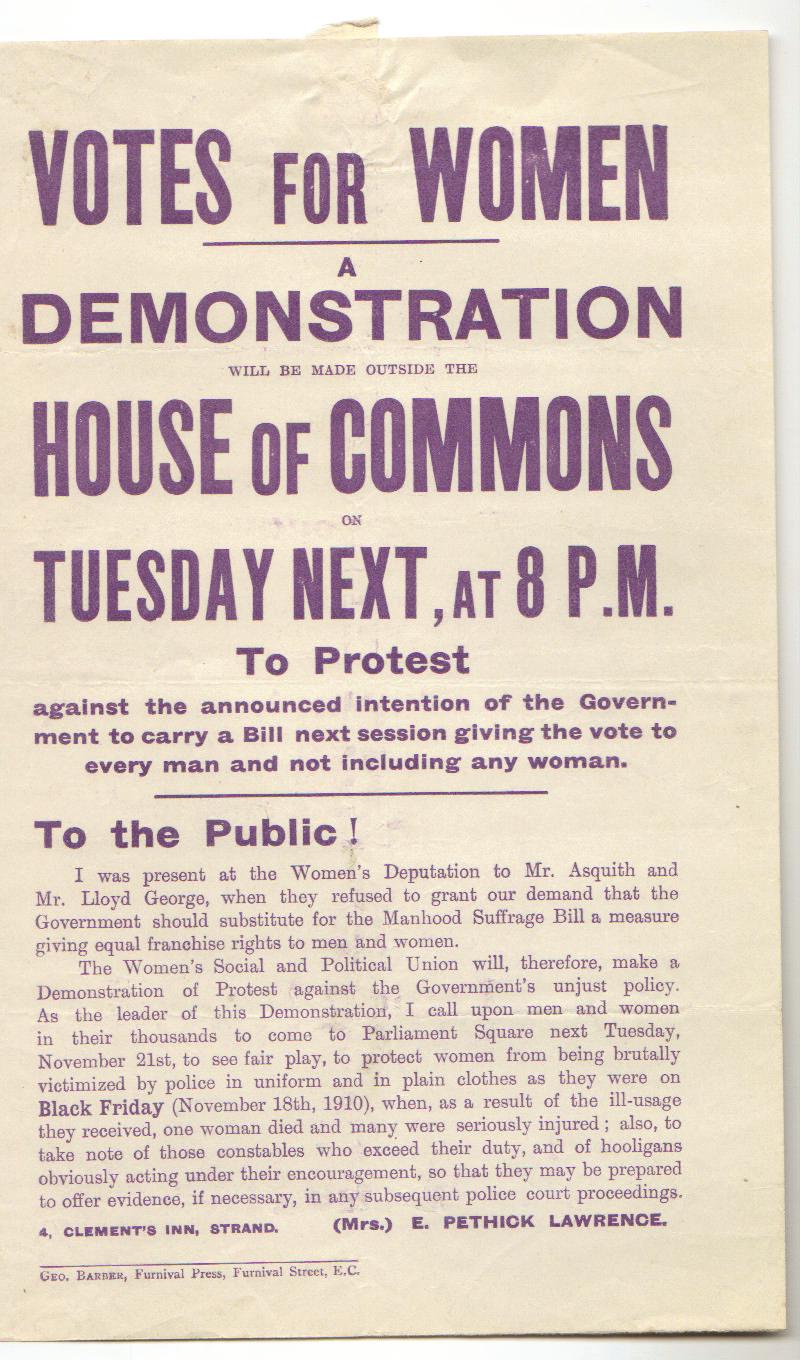
WSPU invitation to demonstrate outside the House of Commons on Tuesday 21 Nov 1911
As Emmeline Pethick-Lawrence mentions in this leaflet, she – with Christabel Pankhurst, Annie Kenney, Mabel Tuke, Lady Constance Lytton and Elizabeth Robins – had represented the WSPU in a joint deputation from all suffrage societies to Asquith and Lloyd George to protest against the government’s intention to introduce a manhood suffrage bill, which just might, if the House of Commons desired, be amended to include women. This had been a bitter blow to suffrage campaigners who had pinned their hopes on putting before Parliament a Conciliation Bill – which would have enfranchised a proportion of women.
The deputation had received no comfort from Lloyd George and Asquith and this flyer was the WSPU’s response.
Kate Frye, whose diary I have edited as Campaigning for the Vote: Kate Parry Frye’s suffrage diary (click here for details), went along to Parliament Square that Tuesday evening. In fact it was she who laid this very flyer between the pages of her diary and thus preserved it. She was an organiser for the New Constitutional Society for Women’s Suffrage [NCSWS] but rather sympathetic to the WSPU – and always liked to be on the scene of any dramatic action.
This is what she wrote of the evening in her diary:
‘I went in to Lyons and had coffee and a sandwich. Who should I happen to sit next but Miss Ada Moore [an actress and active member of the WSPU] and 2 ladies – ready for the fray. I wonder I wasn’t arrested as one – for I soon realised I was dressed for the part to the life. Long cloth ulster or coat, light hat and veil was the correct costume – no bag purse – umbrella or any extra. I only had enough money to get home with in my coat pocket – the rest I had put in the suit case – the latch key was slung round my neck. It was awfully exciting – one felt like a red revolutionist.
Miss Moore & party left at 7.30 – her work lay in Whitehall, she told me – but she looked very white and strained and we did not talk much. I began to feel pretty green with all the force of strife in the air – I felt I too should only be in my rightful place when officially performing.
I left Lyons at 7.45 and strolled about. At the stroke of eight there was smashing of glass at some government office – the War Office I took it for – and I saw several – 8 or 9 or more – ladies led off – all very quietly done – no rough usage – no struggling. I followed them down Whitehall to Canon Row. More arrests – more broken glass – more crowds, a little jostling – people being moved on this way or that way – for the most part silent crowds – growing bigger and bigger – a rush to see another arrest – a bigger crowd surging up the street following the policeman with the arrested women but oh! what a different scene from last year when the women were so brutally knocked about.
I suppose the crowd was worse over the other side of Parliament Square but I was too timid to wander far, and I met Mrs Hartley [a founder of the NCSWS], her daughter, 2 friends and Miss Green and we all kept together, and we shouted whenever a prisoner was led along – “Bravo” “Well Done”. People took it up – but for the most part stood and watched silently. As far as I could see there no ill feeling whatever from the crowd to the women – the men stared solemnly at the proceedings.
We met Mrs Chapman and Miss Forsyth. Mrs Chapman [president of the NCSWS] was anxious as her daughter, Mrs Mansel, was ‘in’ it. We stood talking and got a crowd round us so had to “move on”.
We saw Mrs Pethick Lawrence led into Canon Row. There was a good deal of excitement then a huge crowd pushing along with her and other ladies. It was awfully cold and it was all very dreadful but I have never seen work better done – nearly every window in Whitehall with a large round hole right in the centre. Downing St was guarded. No one was allowed near.
Then people seemed drifting away so I made my way to Charing Cross – got my suitcase from the cloak room.’
This demonstration was the first to use mass window-smashing tactics – a later, similar, event is shown near the beginning of the film ‘Suffragette’. On 21 November 1911 220 women and 3 men were arrested and the next day around 150 of these were sentenced to period of between five days’ and two months’ imprisonment.

Copyright
Suffrage Stories/Collecting Suffrage: Countdown To 12 October And Release Of The Film ‘Suffragette’: The ‘Woman’s Rights’ Kerchief
Posted by womanandhersphere in Collecting Suffrage, Suffrage Stories on September 30, 2015
To celebrate the release on 12 October of the film ‘Suffragette’ (for which I was an historical consultant) I will post each day an image of a suffrage item that has passed through my hands.
For my current catalogue – No 189 – which contains a good deal of suffrage material – as well as general books and ephemera by and about women – see here.
Today’s image:
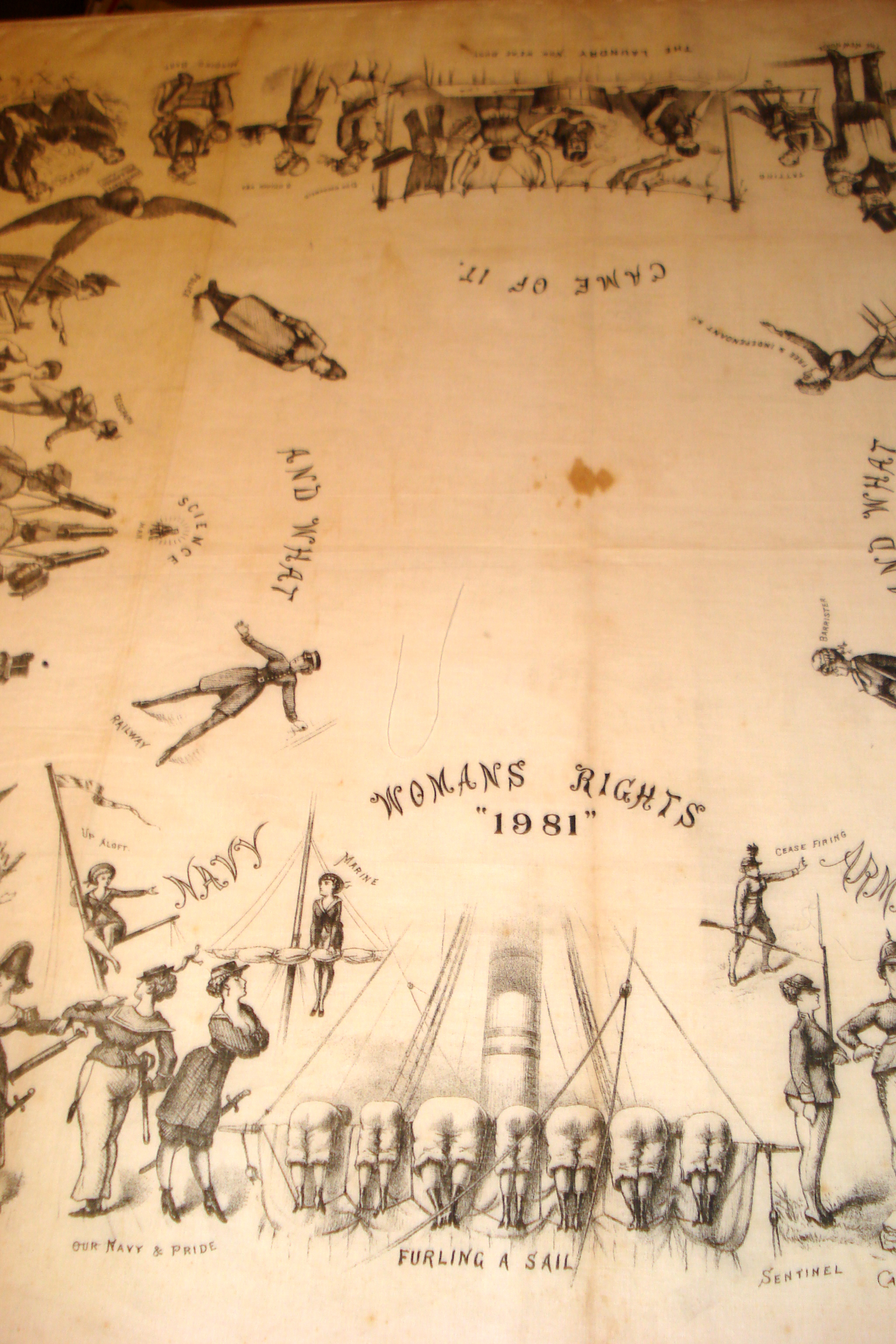
‘Woman’s Rights 1861/1981 And What Came Of It’
This is a white cotton kerchief ,measuring 22.5″ x 24″. It dates – presumably – from 1861 (the Design Registration No is 364805) and the very stylish illustrations printed on it show what the world would be like 120 years into the future – ie in 1981 – when women had won their Rights.
Thus women appear as barristers and judges, as admirals, captains and sailors, as athletes, as telegraph girls, as astronomers, scientists and – and who can now restrain their laughter – as politicians. The men, meanwhile, mind the babies, do the tatting and are parlour maids and house maids.
The kerchief – designed four years before the presentation of the first suffrage petition – contains all the tropes – the embodiment of light-hearted, but deeply-rooted prejudice – that are now so familiar to us through the comic postcards that were produced in response to the suffragette campaign in the years before the First World War.
Copyright
Suffrage Stories/Collecting Suffrage: Countdown To 12 October And Release Of The Film ‘Suffragette’: The WSPU Flag
Posted by womanandhersphere in Collecting Suffrage, Suffrage Stories on September 29, 2015
To celebrate the release on 12 October of the film ‘Suffragette’ (for which I was an historical consultant) I will post each day an image of a suffrage item that has passed through my hands.
For my current catalogue – No 189 – wfor which I was an historical consultanthich contains a good deal of suffrage material – as well as general books and ephemera by and about women – see here.
Today’s image:
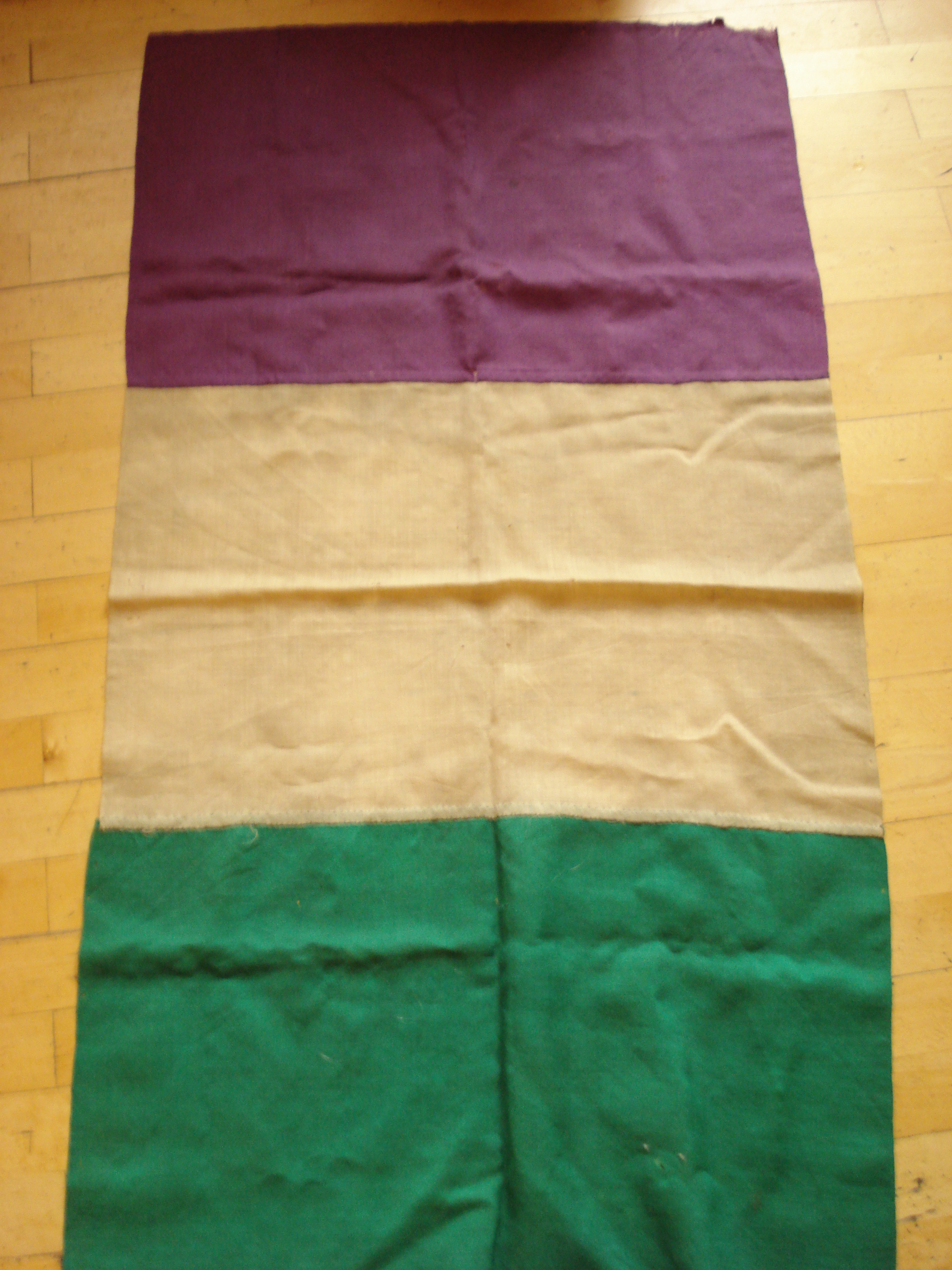
A WSPU Flag
The flag is 68.5cm ( 27 “) wide x 132cm (52”) long and comprises three linen sections, stitched together very neatly – one each of purple, white and green (from the top in that order).
This item would not, I have thought, been free flying – but rather pinned up at a WSPU meeting or in a shop or at a bazaar.
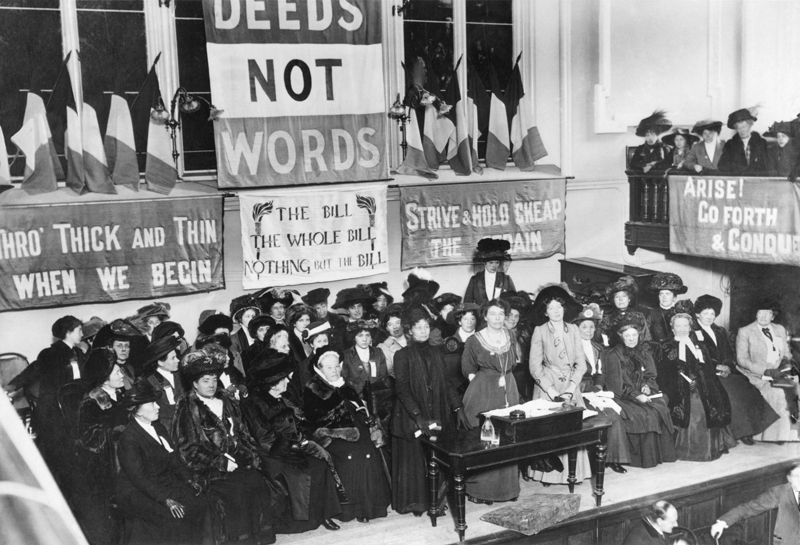
One can see such flags draped here behind the platform where Mrs Pankhurst, Christabel and Mrs Pethick-Lawrence are addressing a suffrage meeting (with Elizabeth Garrett Anderson sitting immediately to Mrs Pankhurst’s right).
Presumably after it had had its day, the flag was neatly folded up and consigned to an attic – to reappear 100 years later. This is the only example of a WSPU flag that – in over 30 years of dealing – I have ever had for sale and I’m pleased to report that it went to a very good home – the House of Commons.
Copyright
Suffrage Stories/Collecting Suffrage: Countdown To 12 October And Release Of The Film ‘Suffragette’: ‘The Suffragette’ – A 1913 Feature Film
Posted by womanandhersphere in Collecting Suffrage, Suffrage Stories on September 28, 2015
To celebrate the release on 12 October of the film ‘Suffragette’ (for which I was an historical consultant) I will post each day an image of a suffrage item that has passed through my hands.
For my current catalogue – No 189 – which contains a good deal of suffrage material – as well as general books and ephemera by and about women – see here.
Today’s image:
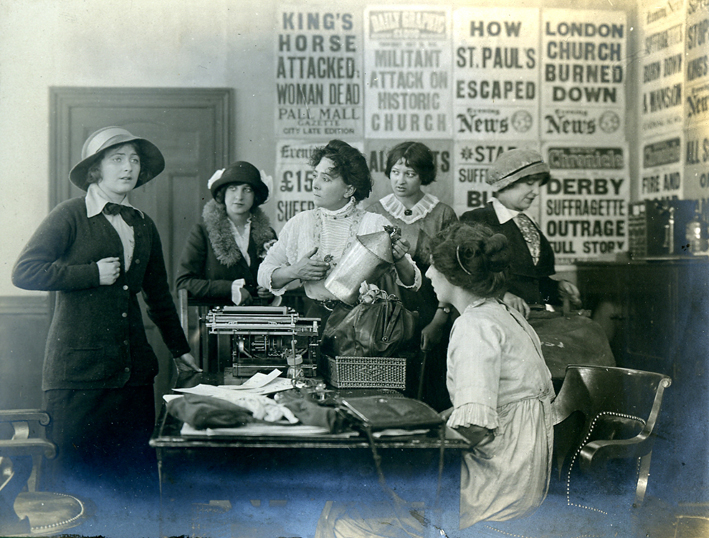
Yesterday I was invited to the cast and crew screening of ‘Suffragette’ and had my second opportunity to see the film. It gets better each time. Travelling home on the bus I realised that today’s post just had to be about a 1913 film coincidentally – although perhaps not surprisingly – called ‘The Suffragette’.
Above is a still from the film – one of a sequence in a photograph album that I discovered.
On the front cover of the album was the remains of a printed label for ‘Britannia Films’. This film company was set up by Pathé at the end of 1911 to produce British feature films, while Pathé continued to produce newsreels.
At the end of 1913 ‘The Suffragette’ was one of the films released by Britannia Films. The description given of the film by the British Film Institute – which I faithfully recorded in the list of ‘suffragette films’ in The Women’s Suffrage Movement: a reference guide– is of the vaguest – ‘A disowned schoolmistress’s uncle destroys her father’s amended will ‘ And yet this hokum plot can be followed through the first 17 film stills in this ‘Britannia Films’ album.
The scene shown above is set in a suffragette office, its walls lined with (real) newspaper posters – such as one recording the death of Emily Davison at the 1913 Derby. In another the heroine is setting light to a fuse leading inside a house – suffragette arson.
Another still shows two women lighting a fuse that trails back into a house. I don’t think it’s giving too much away to say that there is a rather similar scene in ‘our’ ‘Suffragette’.
The International Movie Data Base (see here for details) names the actress playing the heroine as Agnes Glynne and a male lead as James Carew (who was, or had been, the very much younger husband of Ellen Terry).
As there is no extant copy of the film and the British Film Institute holds no archival stills – these images are the only known surviving record of this once topical film. As so few records survive of the spate of films that featured suffragette themes this one, clearly filmed between June 1913 (because it features the Derby poster) and December 1913 (its release), is an important survivor.
Suffrage Stories/Collecting Suffrage: Countdown To 12 October And Release Of The Film ‘Suffragette’: ‘The Suffragette Puzzle’
Posted by womanandhersphere in Collecting Suffrage, Suffrage Stories on September 25, 2015
To celebrate the release on 12 October of the film ‘Suffragette’ (for which I was an historical consultant) I will post each day an image of a suffrage item that has passed through my hands.
For my current catalogue – No 189 – which contains a good deal of suffrage material – as well as general books and ephemera by and about women – see here.
Today’s image:

The Suffragette Puzzle
Yet another game based on the difficulties encountered by suffrage campaigners.
‘The Suffragette Puzzle’ was produced by F.H. Ayres Ltd, 111 Aldersgate Street, London and was launched in 1908. It required considerable dexterity ‘To get the Women’s Suffrage Bill through the Houses of Parliament’ – although rather less than the real-life effort demanded of the suffrage societies;
This game is extremely scarce – I’ve only had this one example for sale in over thirty years of dealing in suffrage ephemera.
Copyright
Suffrage Stories/Collecting Suffrage: Countdown To 12 October And Release Of The Film ‘Suffragette’: ‘Panko’
Posted by womanandhersphere in Collecting Suffrage, Suffrage Stories on September 24, 2015
To celebrate the release on 12 October of the film ‘Suffragette’ (with which I had a slight association) I will post each day an image of a suffrage item that has passed through my hands.
For my current catalogue – No 189 – which contains a good deal of suffrage material – as well as general books and ephemera by and about women – see here.
Today’s image:
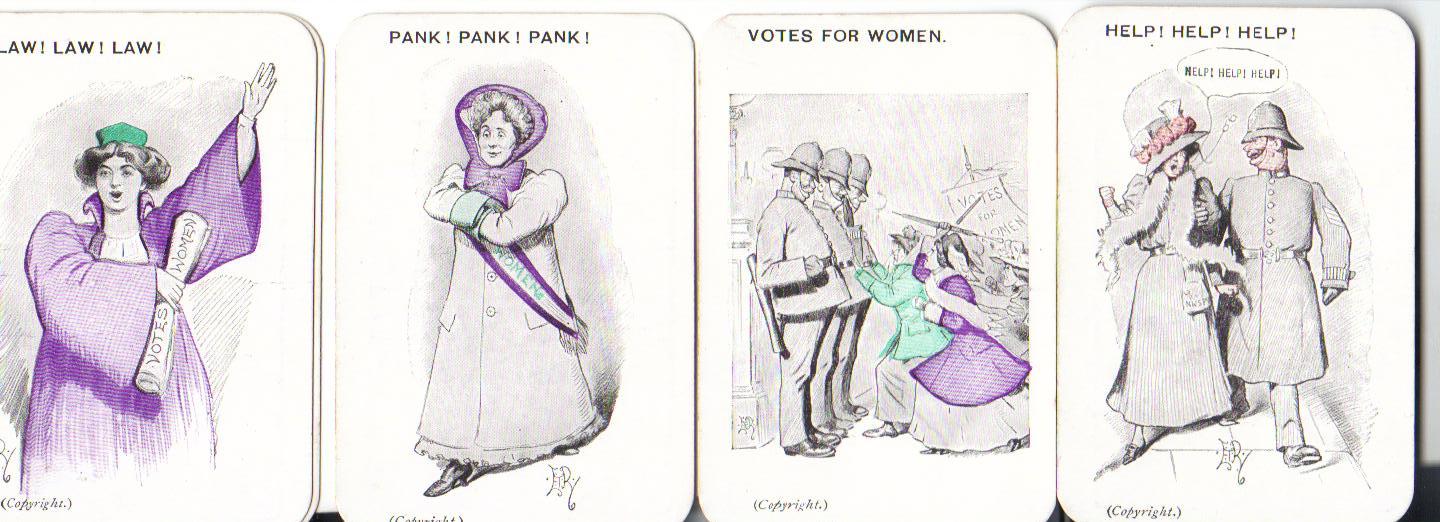
Panko
Panko was a card game, published by Messrs Peter Gurney Ltd. The cards were designed by E.T. Reed, a Punch cartoonist.
Panko was first advertised in the issue of Votes for Women for 10 December 1909, claiming ‘Not only is each picture in itself an interesting memento, but the game produces intense excitement without the slightest taint of bitterness’.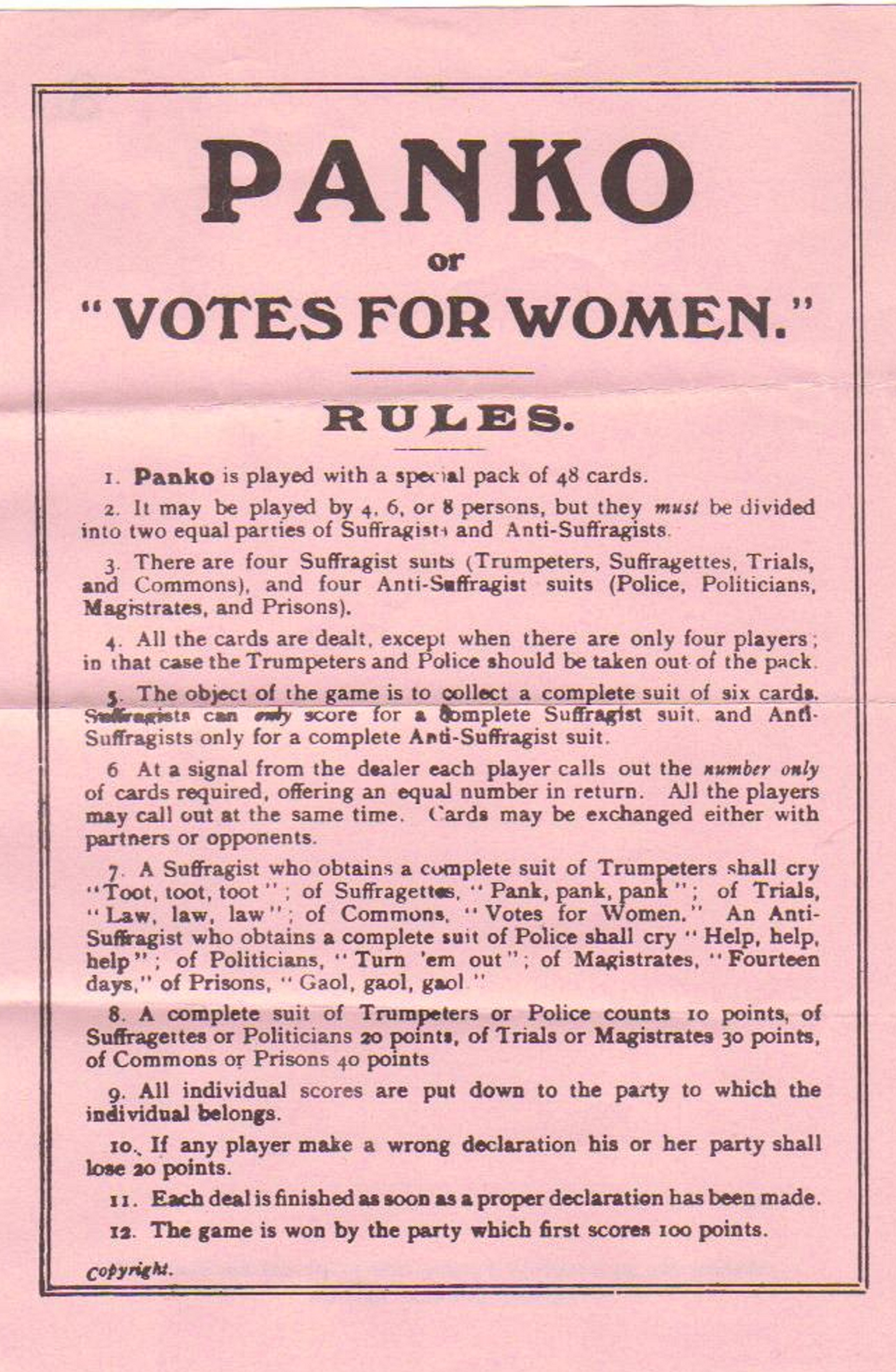
Mary Blathwayt – the ardent Bath suffragette – gave her mother a pack as her Christmas present and I’ve no doubt that Panko was in many another suffragette’s Christmas stocking that year.
Copyright
Suffrage Stories/Collecting Suffrage: Countdown To 12 October And Release Of The Film ‘Suffragette’: ‘Elusive Christabel’
Posted by womanandhersphere in Collecting Suffrage, Suffrage Stories on September 23, 2015
To celebrate the release on 12 October of the film ‘Suffragette’ (for which I was an historical consultant) I will post each day an image of a suffrage item that has passed through my hands.
For my current catalogue – No 189 – which contains a good deal of suffrage material – as well as general books and ephemera by and about women – see here.
Today’s image:

Elusive Christabel
‘Elusive Christabel’ is an optical toy produced by the Flashograph Co in 1912. It alludes to Christabel Pankhurst’s escape to France in March 1912 as the police closed in on Clement’s Inn and arrested the other leaders of the Women’s Social and Political Union and charged them with conspiracy to commit criminal damage.
When – as commanded – you move the paper control ‘up and down gently’ the scene changes to this:
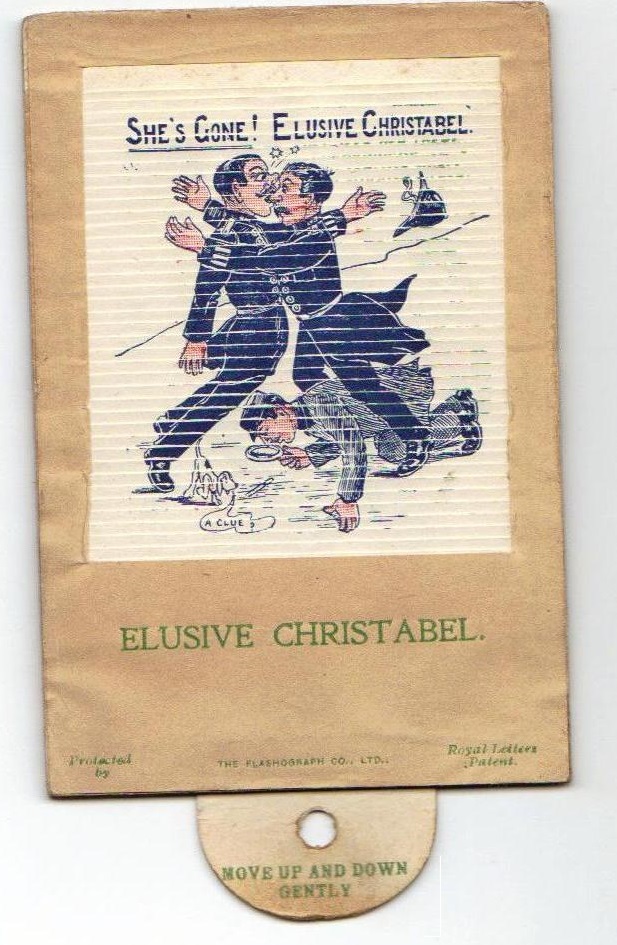
The WSPU had a lot of fun at the expense of the police, publishing photographs of Christabel in Votes for Women and asking readers to guess where she might be. The Flashograph Co clearly had an eye for topicality.
Needless to say ‘Elusive Christabel’ lives up to its name and is exceptionally elusive nowadays. I’ve only ever had one pass through my hands in over thirty years of dealing in suffragette material.
Copyright
Suffrage Stories/Collecting Suffrage: Countdown To 12 October And Release Of The Film ‘Suffragette’: ‘Pank-A-Squith’
Posted by womanandhersphere in Collecting Suffrage, Suffrage Stories on September 22, 2015
To celebrate the release on 12 October of the film ‘Suffragette’ (for which I was an historical consultant) I will post each day an image of a suffrage item that has passed through my hands.
For my current catalogue – No 189 – which contains a good deal of suffrage material – as well as general books and ephemera by and about women – see here.
Today’s image:
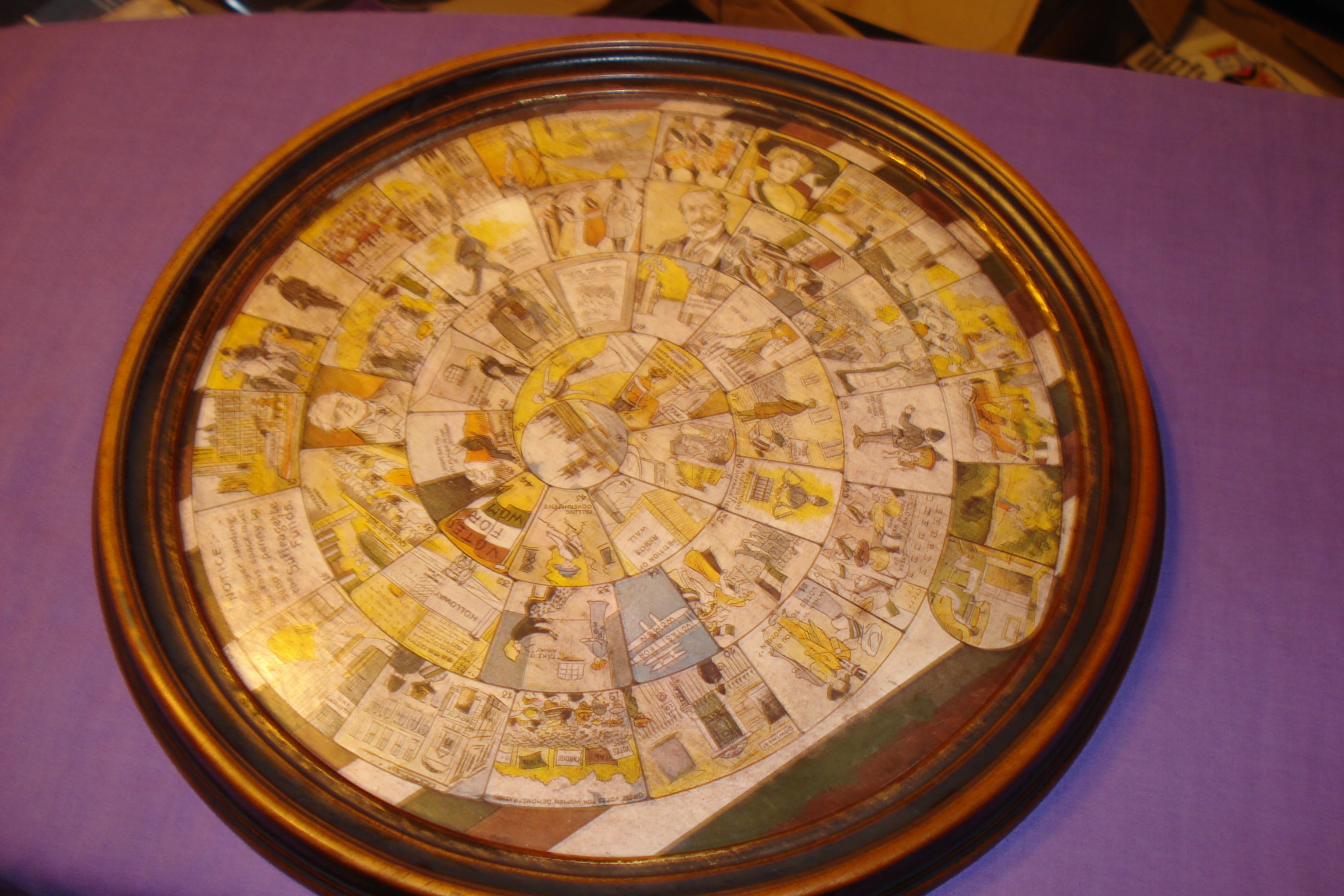
Pank-A-Squith
Pank-A-Squith was a board game, first advertised in Votes for Women, 22 October 1909.
The board is green and purple and the spiral track illustrates the difficulties encountered by Mrs Pankhurst and her supporters. It is played by throwing a die to move figures around the board – like Snakes and Ladders.
As issued the board was square but this particular board was altered at some point in order to set it within a circular wooden frame.
All too often the figures that were issued with the game – and were moved around the board – are missing.
In December 1909 Mary Blathwayt, a keen WSPU supporter from Bath, recorded in her diary that she had bought a game of Pank-A-Squith and in July 1910 that she and Annie Kenney played it together as they passed an anxious time while Annie’s sister, Jennie Kenney, was being operated on at Mary’s home, Eagle House, Batheaston.
Copyright
Suffrage Stories/Collecting Suffrage: Countdown To 12 October And Release Of The Film ‘Suffragette’: The WFL ‘Holloway’ Brooch
Posted by womanandhersphere in Collecting Suffrage, Suffrage Stories on September 21, 2015
To celebrate the release on 12 October of the film ‘Suffragette’ (for which I was an historical consultant) I will post each day an image of a suffrage item that has passed through my hands.
Today’s image:
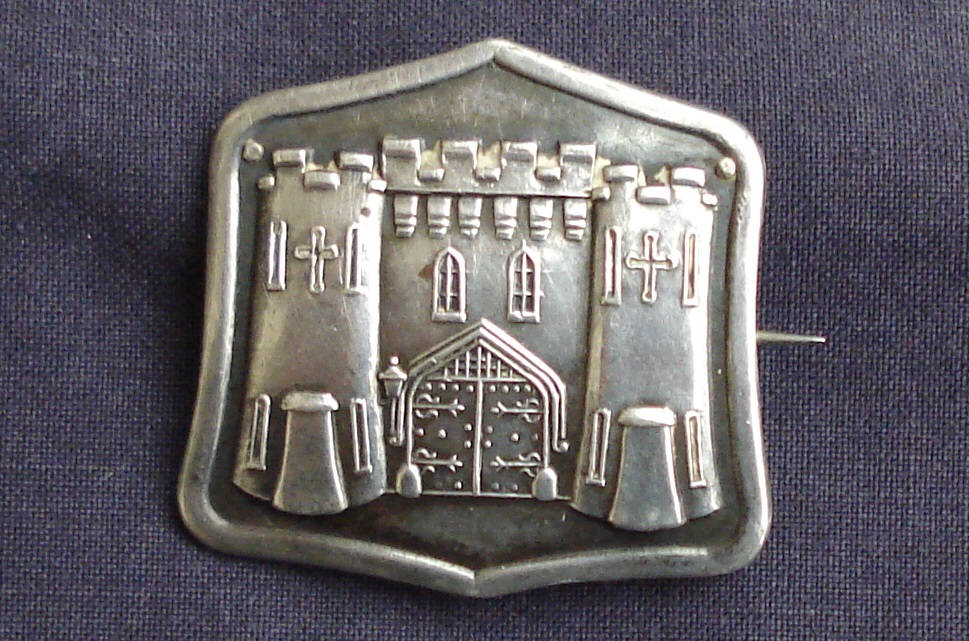
Women’s Freedom League ‘Holloway’ brooch
This is the award that was given by the Women’s Freedom League to its members who had been imprisoned. The brooch is in silver with the reverse engraved with the name of the prisoner and the date of arrest. The one in the picture was presented to Elsie Cummin upon her release from Holloway in July 1909.
Elsie Cummin had been born in 1877, one of the large family of Rev Joseph Cummin and his wife, Elizabeth. By 1901 the family had moved into Easebourne Vicarage, where Joseph Cummin was vicar. Mrs Cummin, who died in 1910, had been a suffrage supporter and gave the West Sussex branch of the Women’s Freedom League its velvet banner. Elsie Cummin was both honorary sec and honorary treasurer of the branch, which had been founded in 1908. She spoke at local WFL meetings and held WFL ‘At Homes’ at Easebourne Vicarage.
The Times, July 13, 1909
‘Four members of the Women’s Freedom League were charged on remand with obstruction. [Among] the defendants were ….Elsie Cummin, 32, Easebourne Vicarage, Midhurst….
Chief Inspector Rolfe said that on Friday afternoon he saw the defendants Hicks and Cummin standing by the doorway of the Prime Minister’s residence in Downing-street. They were carrying a roll of paper bearing the word ‘Petition’ and they said that they wished to present their petition personally to Mr Asquith. They were afterwards joined by the other two defendants. Meanwhile Miss Hicks had handed her petition personally to Mr Asquith when he alighted from a motor-car at his residence. At one time there were 300 people in Downing-street, and considerable obstruction was caused. After seeing Mr Asquith’s private secretary the witness told the defendants that Mr Asquith could tell them nothing further, but would send them an acknowledgment in due course. The defendants said that they wanted a date and time fixed for the reply; otherwise they would wait until they got it..
Police Constable 109A said that when Mr Asquith drove up one of the defendants said, ‘We have a petition, will you receive it?’. Mr Asquith asked her to hand it to his messenger, and Miss Hicks replied, ‘No, we want to hand it to you personally.’ Mr Asquith then said, ‘Very well, hand it to me,’ and he then received the petition from Miss Hicks.
[Defence counsel] submitted that the defendants did nothing but stand upon the pavement in a perfectly orderly manner.
The magistrate said that if the defendants would undertake that there should be no kind of disturbance of any description until the appeal in the somewhat similar case of Mrs Pankhurst had been decided he would adjourn the case sine die.
[Defence counsel] said that he could not give any undertaking on behalf of the defendants.
The defendants, on oath, denied that they caused any obstruction.
The magistrate imposed a fine of £3 in each case, with the alternative of three weeks’ imprisonment in the second division.’
Elsie Cummin and her three co-defendants refused to pay the fine and went to Holloway – and it was on her release that she was presented with the ‘Holloway’ brooch.
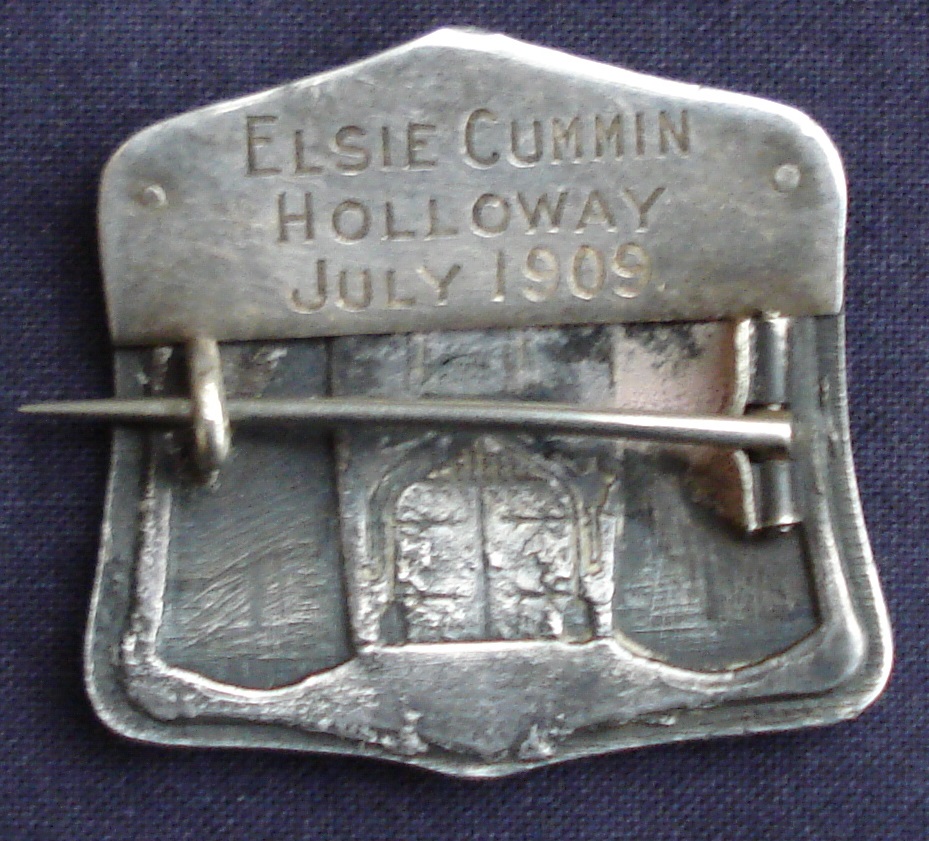
The reverse of Elsie Cummin’s Holloway brooch
Elsie continued her association with the WFL for at least two more years. On the night of the 1911 census she was at home with her father and one sister. However, the census enumerator recorded two other of the sisters, who were not present, as ‘Suffragettes wandering about all night’. Elsie Cummin reported that seven members of the branch had boycotted the census. Clearly the Cummin family took the question of women’s suffrage seriously.
The Women’s Freedom League had first presented these brooches as early as December 1908 when Muriel Matters and Mrs Emily Duval received theirs from Mrs Despard at a ceremony in St James’s Hall, Piccadilly. The Women’s Social and Political Union copied the idea and in April 1909 instituted a Sylvia Pankhurst-designed ‘Holloway’ brooch to reward their members who had been to prison. As so often, however, it is the WSPU’s insignia which has had the wider publicity.

Sarah Benett, sometime treasurer of the WFL, photographed by Lena Connell wearing her WFL ‘Holloway’ brooch
Copyright
Suffrage Stories/Collecting Suffrage: Countdown To 12 October And Release Of The Film ‘Suffragette’: The WSPU ‘Flag’ Brooch
Posted by womanandhersphere in Collecting Suffrage, Suffrage Stories on September 18, 2015
To celebrate the release on 12 October of the film ‘Suffragette’ (with which I had a slight association) I will post each day an image of a suffrage item that has passed through my hands.
For my current catalogue – No 189 – which contains a good deal of suffrage material – as well as general books and ephemera by and about women – see here.
Today’s image:
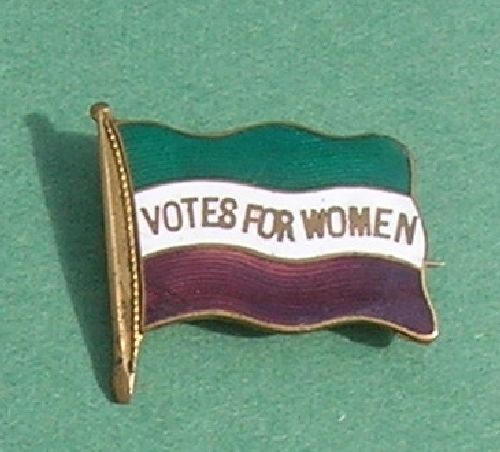
An enamelled WSPU brooch – in the shape of a purple, white and green flag.
Unusually, it’s possible to date this brooch pretty accurately. It is marked on the back with the maker’s name ‘Toye’, which was in usage between 1898 and 1909 when the passing of a new Companies’ Act meant that henceforward it was known as ‘Toye & Co. Toye produced much of the WSPU merchandise, including the hunger-strike medals. The company is still in business and re-produced the hunger-strike medals that you will able to see being worn in the film ‘Suffragette’.
The 31 December 1908 issue of Votes for Women lists all merchandise that the WSPU was selling at that time – and the flag design is not listed.
However we can see from the 14 May 1909 issue, dating from the time that the WSPU was about to launch its big fund-raising event – the Exhibition at Prince’s Skating Rink in Knightsbridge -, that the number of items the WSPU was selling had increased – and now included this brooch.
It is described as ‘Flag (words “Votes for Women”) 1/- each.’ I fear that over the last 108 years the brooch has rather risen in value. But I think we can be pretty certain that this design was manufactured no later than the Spring of 1909.
Copyright
Suffrage Stories/Collecting Suffrage: Countdown To 12 October And Release Of The Film ‘Suffragette’: Christina Broom Photographs The Putney and Fulham WSPU Shop
Posted by womanandhersphere in Collecting Suffrage, Suffrage Stories on September 17, 2015
To celebrate the release on 12 October of the film ‘Suffragette’ (for which I was an historical consultant) I will post each day an image of a suffrage item that has passed through my hands.
For my current catalogue – No 189 – which contains a good deal of suffrage material – as well as general books and ephemera by and about women – see here.
Today’s image:
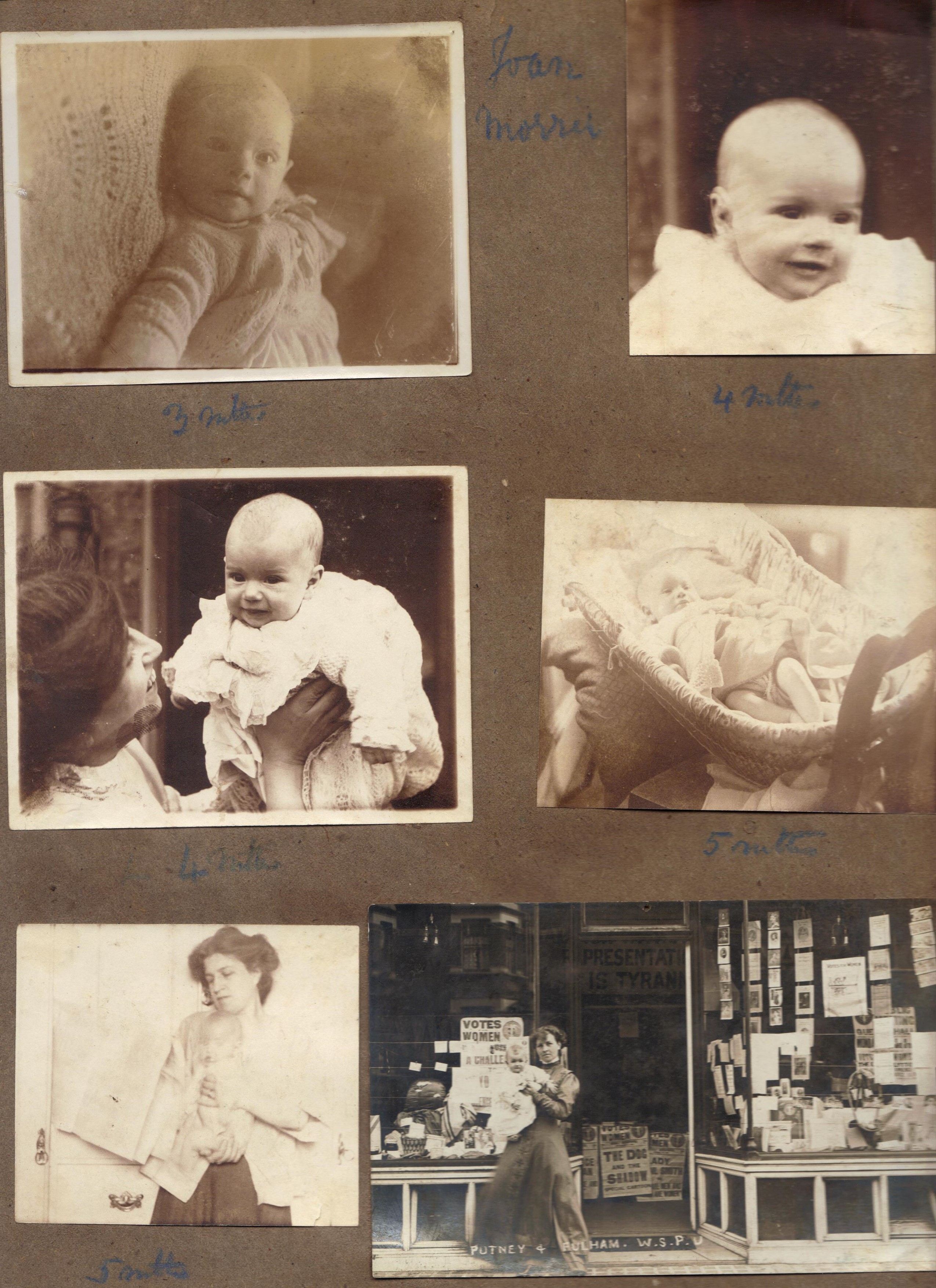
My visit yesterday to the exhibition of photographs by Christina Broom at the Museum of London (which I highly recommend – for details see here) reminded me of an intriguing page of photographs that passed through my hands a little while ago.
The key that unlocks the story behind the photographs is the postcard of the Putney and Fulham WSPU shop, positioned in the bottom right-hand corner. This photograph, taken by Mrs Broom, is shown in the exhibition and is discussed in detail by Diane Atkinson in Joannou & Purvis (eds), Women’s Suffrage Movement: feminist perspectives.
The photograph shows a young mother holding her baby, standing outside the shop, which opened at 905 Fulham Road in February 1910. The baby looks to be about 9 or 10 months old. I have identified the copy of Votes for Women that is displayed in the window as the issue for 9 September 1910. The shop windows are packed with WSPU propaganda items – much of which, especially the postcards – such as ones of Christabel Pankhurst, Lady Constance Lytton, Charlotte Marsh and Mary Gawthorpe – are readily recognisable. A poster advertises a meeting to be held by Lady Constance in the Queen’s Hall on 3 October 1910 and there are items of merchandise, such as WSPU scarves and stationery, together with the more homely items, such as eggs and jam that the local branch reported it was pleased to accept to sell for the Cause.
You can see into the shop (the door is open) and there in the background is the banner ‘Taxation Without Representation.is Tyranny’, just as described in the 18 February 1910 Votes for Women issue.
Adjacent on the sheet to the photograph of the shop is a loving shot of the same mother with her baby – annotated ‘5 months’ – photographed, I would think, in a bedroom. Above that is the same woman and baby, photographed, I think, outside and annotated ‘4 months’. The other three photos are of the baby alone, photographed at 3, 4 and 5 months. Although the photos are glued to the page I’ve peered into their backs and think they were sent to the baby’s grandfather.
The sheet is captioned ‘Joan Morris’ in the same hand as the annotations of the baby’s age, Or, at least, I think it is ‘Joan Morris’. The last two letters of the surname read more like ‘ei’ or ‘el’ than ‘is’ – but there was no ‘Joan ‘born in the baby’s timeframe with a name such as ‘Morrel’, which might be a reading.
There was, however, a Joan Morris born in Fulham on 6 January 1910. In April 1911 she was living with her parents at 19 Arundel Mansions, Fulham Road. If my identification is correct, they are an interesting couple.
The baby’s father was Geoffrey Bright Morris, son of William Bright Morris, the artist (not to be confused with the other William Morris) and his first wife, who was a grand-daughter of Leigh Hunt and who may well have died at his birth.
Baby Joan’s mother was Helen Kathleen Morris (née Macleod), who in the 1901 census, was an actress boarding with William Bright Morris and his family. She would have been about 31 years old in 1910, which, again, accords with the apparent age of the woman standing outside the WSPU shop. The couple had married in January 1909; they had clearly known each other for a long time for William Bright Morris’s second wife was Helen’s aunt. Helen McLeod’s father was a paymaster in the Royal Navy. William Bright Morris died in 1912 – so could have been the grandfather to whom the snaps were sent.
I wish I had been able to find a mention of Helen Morris in the reports for the Putney & Fulham branch of the WSPU – but I must admit that I cannot. She does seem just the kind of person to have taken an interest in suffrage – but, with a young baby to care for, may not in 1910-1911 have been able to devote much of her time to it. However, as Diane mentions in her discussion of the photo, the woman – without coat or hat – and the baby, dressed in a light frock, do seem to have come out from the shop specifically to have been photographed.
In ‘Votes for Women’ the co-organiser of the branch and the shop is given as ‘Mrs H. Roberts’, although no further information about her activities is, as far as I can see from reading through successive copies, ever given and I have been able to find out nothing about her.
So, all in all, an interesting story to be deduced from what might at first glance have appeared to have been an anonymous sheet of photographs. Mrs Broom’s photograph is, of course, the prize. Photographs of suffrage shops are always delightful and this image – taken on an early autumn day more or less exactly 105 years ago – is both artfully arranged and very crisp and clear.
Copyright
Suffrage Stories/Collecting Suffrage: Countdown To 12 October And Release Of The Film ‘Suffragette’: Christina Broom Photographs The 1911 Suffrage Coronation Procession
Posted by womanandhersphere in Collecting Suffrage, Suffrage Stories on September 15, 2015
To celebrate the release on 12 October of the film ‘Suffragette’ (for which I was an historical consultant) I will post each day an image of a suffrage item that has passed through my hands.
For my current catalogue – No 189 – which contains a good deal of suffrage material – as well as general books and ephemera by and about women – see here.
Today’s image:
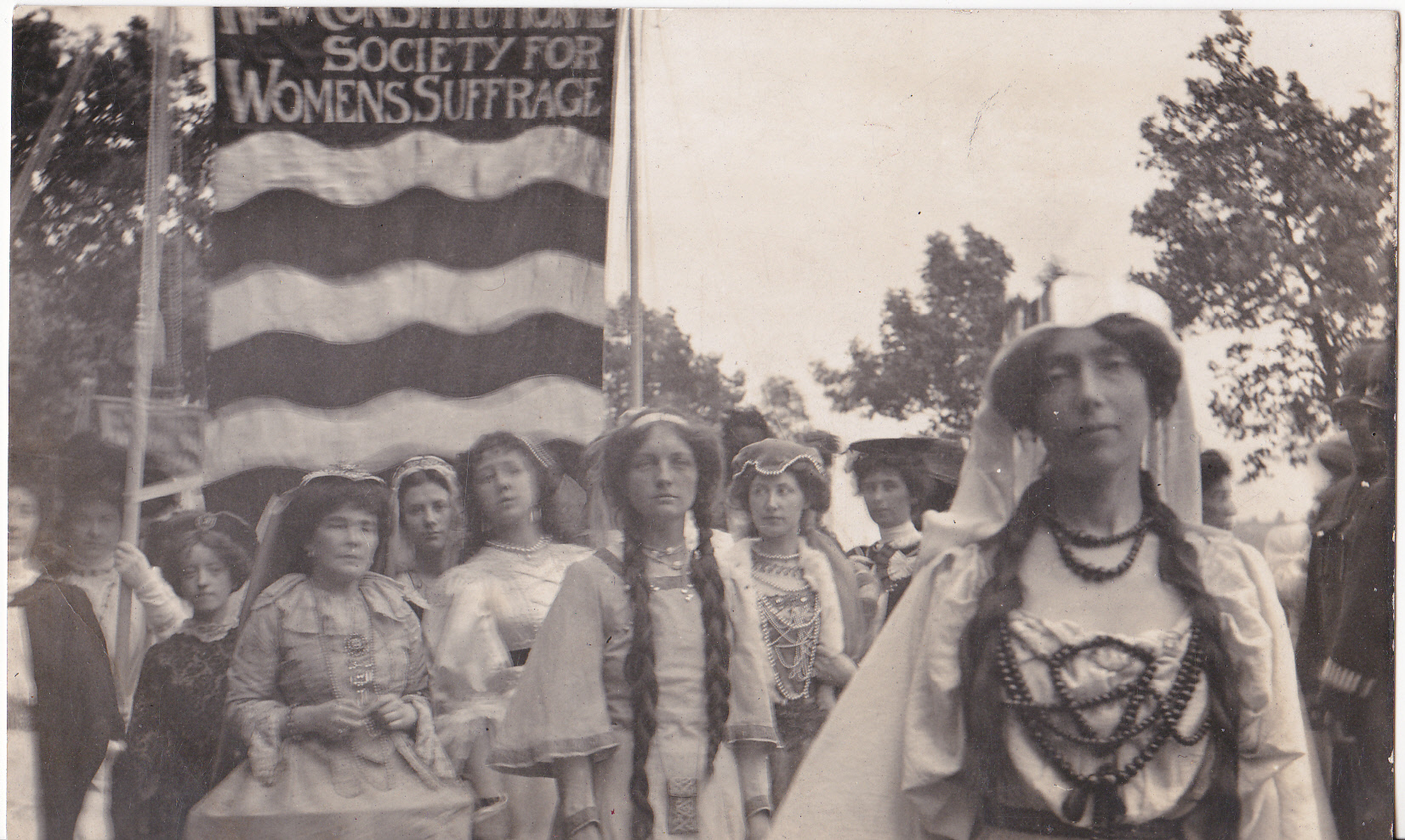
A close-up photograph by Mrs Albert Broom of a section of the 1911 suffrage Coronation Procession showing the tail-end of the ‘Pageant of Queens’. Immediately behind, as decreed in the plan for the day, is the banner of the New Constitutional Society for Women’s Suffrage, one of only two images of it that I have ever seen.
The queens are, mainly, dressed in medieval costume and the photograph allows a clear image of faces, dresses and jewellery. At the head of the New Constitutional contingent can be seen a couple of figures in graduate dress – and I wonder if they are Alexandra and Gladys Wright – for more of whom see Campaigning for the Vote: Kate Parry Frye’s suffrage diary.
I am going this very day to visit the Museum of London Docklands exhibition ‘Suffragettes and Soldiers: The Photography of Christina Broom’. See here for details.
Copyright
Suffrage Stories/Collecting Suffrage: The 1866 Women’s Suffrage Petition
Posted by womanandhersphere in Collecting Suffrage, Suffrage Stories on September 15, 2015
Today – 7 June 2016 – marks the 150th anniversary of the first petition presented in Parliament in support of an attempt to gain for women the parliamentary vote.
I have just attended an event sponsored by the Fawcett Society to celebrate this anniversary – held in the Speaker’s House in Parliament. At this event it was announced that efforts would be made to erect a statue to Millicent Fawcett in Parliament Square. See also my post published some time ago – Make Millicent Fawcett Visible – http://wp.me/p2AEiO-qD
Below is a short article I published earlier setting out the facts behind the petition.
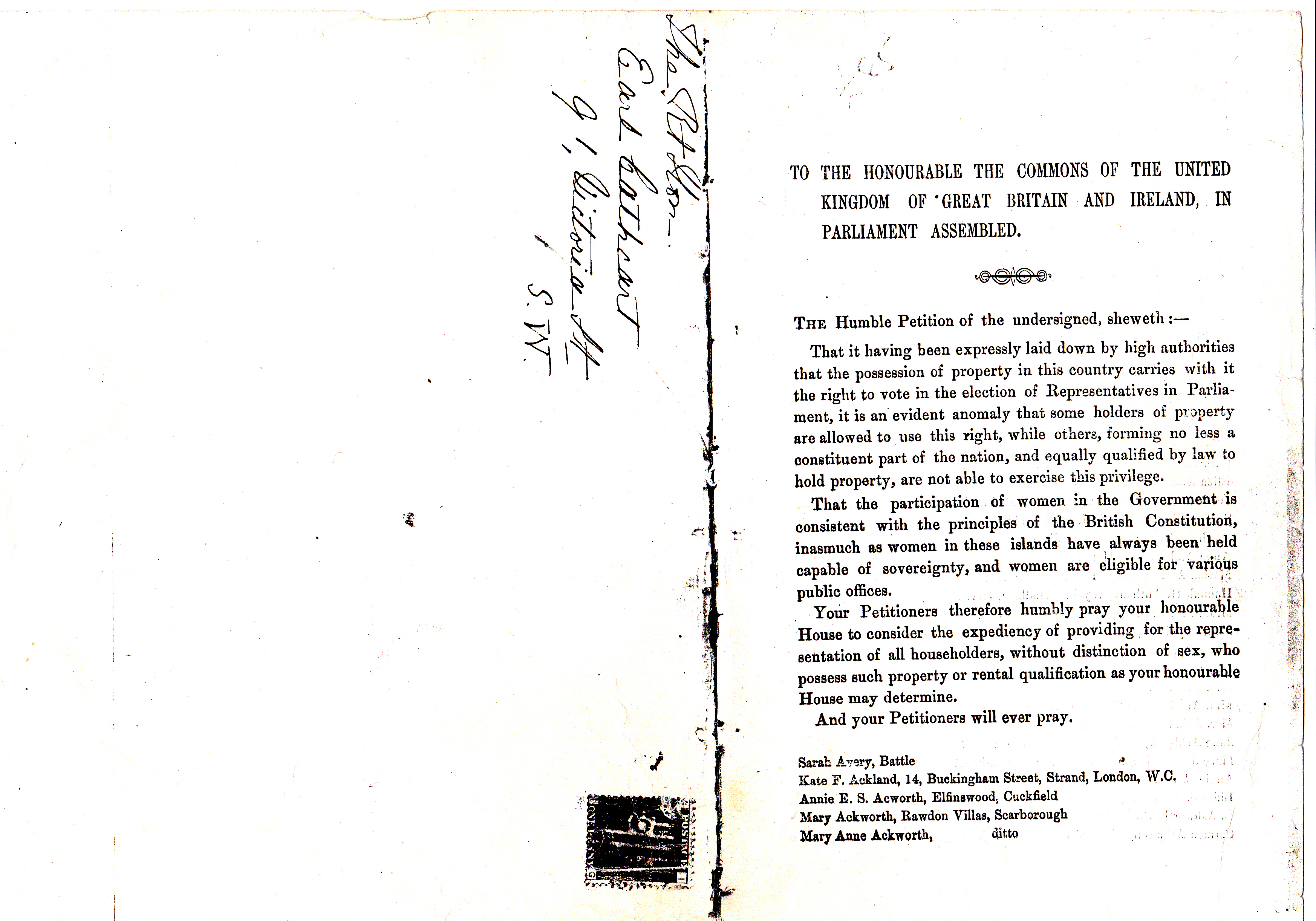
First page of the 1866 women’s suffrage petition
This is – I think – the most important document of the women’s suffrage campaign. It was the foundation for all that came after.
Back in the days when the world was young, there was no internet, and antiquarian booksellers – as well as the layman/woman book-buyer – had to search their quarry among the stacks of brick and mortar bookshops, my time, when not engaged in child care, was spent touring London and the market towns of southern England in search of the books and ephemera with which I and my customers might resurrect the women that were famously ‘hidden from history’.
These days have long passed away – now we need only sit at home and search internet book-selling sites, trawling through the print-on-demand dross in the increasingly forlorn hope of finding the odd nugget of treasure. The corollary, of course, is that there are now precious few brick and mortar bookshops selling second-hand/antiquarian books.
In those olden days I even thought it occasionally worthwhile to take a tour down Portobello Road on a Saturday morning, not something I have done for a long time, now that Portobello’s landlords are handing the antiques arcades over to fashion chain stores. But that particular Saturday-morning visit was memorable because it was in a bookselling alcove in the warrens that stretch behind Portobello Road that I came across one of the most interesting finds of my bookselling career – a copy of the pamphlet edition of the 1866 women’s suffrage petition.
The petition itself comprised a long scroll onto which were pasted the signatures of the (circa) 1500 women who, in the spring of 1866, were prepared to put their names to a request (it was certainly not yet a demand) that women who met the requisite property qualifications , as set out in the Reform bill then under discussion, should be able to cast a parliamentary vote alongside men. The petition had been organised by a group of women who formed themselves into a small informal committee – among their number being Barbara Bodichon, Bessie Rayner Parkes, Elizabeth Garrett, and Emily Davies. John Stuart Mill, for whom they had campaigned when he had contested – and won – the Westminster parliamentary seat the previous year, had agreed to present the petition.
Emily Davies was the businesswoman of the group and it was she who decided that the names of those who had signed the petition should be printed in pamphlet form and sent to the weekly papers so that, as she wrote on 18 July 1866 to Helen Taylor (Mill’s step-daughter), ‘ in case they take any notice, they make know what they are commenting on.’ Copies of the petition pamphlet were also sent to members of the House of Commons and the House of Lords.
The copy of ‘my’ 1866 petition pamphlet is, as you see, addressed to Earl Cathcart – the 3rd Earl, Alan Frederick Cathcart. I suspect he was not overly interested in the rights of women.
I did sell the pamphlet almost as soon as I found it but, before parting with it, had the sense to take a photocopy. That sounds nothing extraordinary, but back in those days photocopiers were not the casual desk accessory that they are today and in order to process the petition’s 38 pages I had to visit the machine in the local library. How glad I am that I bothered to do so. For having easy access to those 1499 names allowed me not only to build up the pattern of political and friendship networks supporting the suffrage campaign that lies at the heart of The Women’s Suffrage Movement: a reference guide, but also provided a starting-point for researching The Women’s Suffrage Movement: a regional survey, in which the part each region, county and town played in the campaign is detailed.

You can see, if your mind works along the same way as mine, what pleasure can be had in attempting to identify all these women. For instance, on this page – chosen at random:
Mrs Kenrick of 9 Dorset Square in 1873 was a member of the executive committee of the Ladies’ Association for the Education of Women for the Medical Association.
Gertrude King of 18 Carlton Hill East, was a member of the Kensington Society (a group of women who met and corresponded in order to discuss the position and prospects for women) and by 1874 was secretary of the Society for the Employment of Women.
Fanny and Jane King, 9 Eden Grove, Holloway, were the wife and daughter of John King, a pianoforte maker, who was one of the oldest acquaintances of William Lovett, the Chartist leader (one of King’s sons had ‘Lovett’ as a middle name). King was a long-standing member of Lovett’s National Association for Promoting the Political and Social Improvement of the People. Artisan radicals such as the Kings were one of the groups contacted by the organisers of the 1866 women’s suffrage petition.
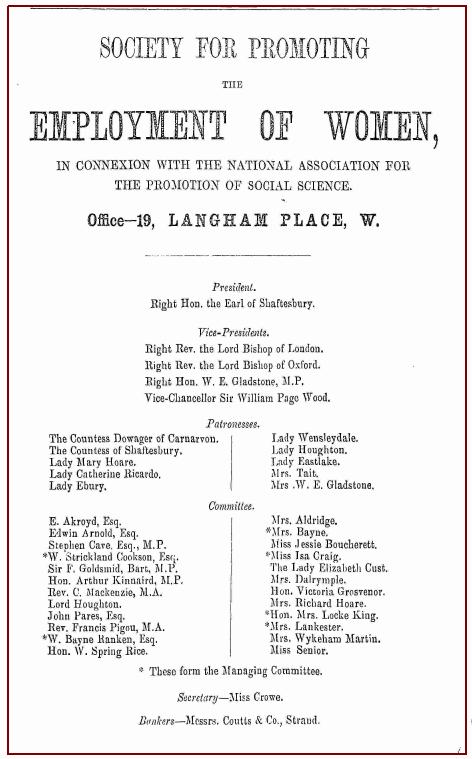
Notice that appeared in the Alexandria Magazine, May 1st, 1864. NB Isa Craig as member of the committee
Isa Craig Knox of 14 Clyde Terrace, New Cross – a close friend of Bessie Rayer Parkes – was assistant secretary of the National Association for the Promotion of Social Science, a founder of the Kensington Society and a leading member of the Society for the Employment of Women. For more on Isa Craig see her entry in my Women’s Suffrage Movement: a reference guide.
Fanny Aiken Kortright of 21 Eldon Road, Kensington, was a writer of sensational novels. She must quite soon have regretted signing this petition, for in 1869 she printed for private circulation a pamphlet AGAINST the Woman’s Right movement, entitled Pro Aris et Focis, which won the approval of Queen Victoria and the sympathy of the then Prime Minister. Eliza and Harriet were her older sisters. Another, married, sister also signed the petition.
Miss Kunz (Miss Mina Kunz) of 19 Royal Circus, Edinburgh was in 1868 on the executive committee of the Edinburgh Ladies’ Educational Association and by 1874 was a member of the Edinburgh Ladies’ Debating Society.
Philippine Kyllman, Fallowfield, Manchester, was the wife of Max Kyllman, a wealthy young Manchester businessman interested in Co-operative matters. Kyllmann provided capital for a mill established in Manchester by George Holyoake and Edward Owen Greening on a profit-sharing basis – though it quickly failed. For more about Philippine Kyllman see her entry in my Women’s Suffrage Movement: a reference guide.
As for Sarah Kersey of Aldeburgh you can find a little more about her in an earlier post I published about Aldeburgh and the petition.
And for many of the others on these two pages – as on all the others that comprise the petition – something can be discovered about the lives of most of the women who were sufficiently bold as to sign it.
As far as I know the only printed copy of the Petition held in a public collection is that which resides in the Emily Davies Papers in the Girton Archive.
The Parliamentary Archives have now digitised the petion – using my ancient photocopy – see http://www.parliament.uk/documents/parliamentary-archives/1866SuffragePetitionNamesWebJune16.pdf > Many happy hours can now be sent searching to see who the women were who were prepared to put their name to this revolutionay document.
STOP PRESS: THE COPY THAT I SOLD HAS BEEN LENT TO THE ‘ENDLESS ENDEAVOURS’ EXHIBITION SHOWING AT LSE – http://www.lse.ac.uk/library/exhibitions/home.aspx.
Copyright
Suffrage Stories/Collecting Suffrage: Countdown To 12 October And Release Of The Film ‘Suffragette’: Edith Downing’s Hunger Strike Medal
Posted by womanandhersphere in Collecting Suffrage, Suffrage Stories on September 14, 2015
To celebrate the release on 12 October of the film ‘Suffragette’ (with which I had a slight association) I will post each day an image of a suffrage item that has passed through my hands in the very many years that I have been dealing in suffrage-related books and ephemera.
For my current catalogue – No 189 – which contains a good deal of suffrage material – as well as general books and ephemera by and about women – see here.
Today’s image:
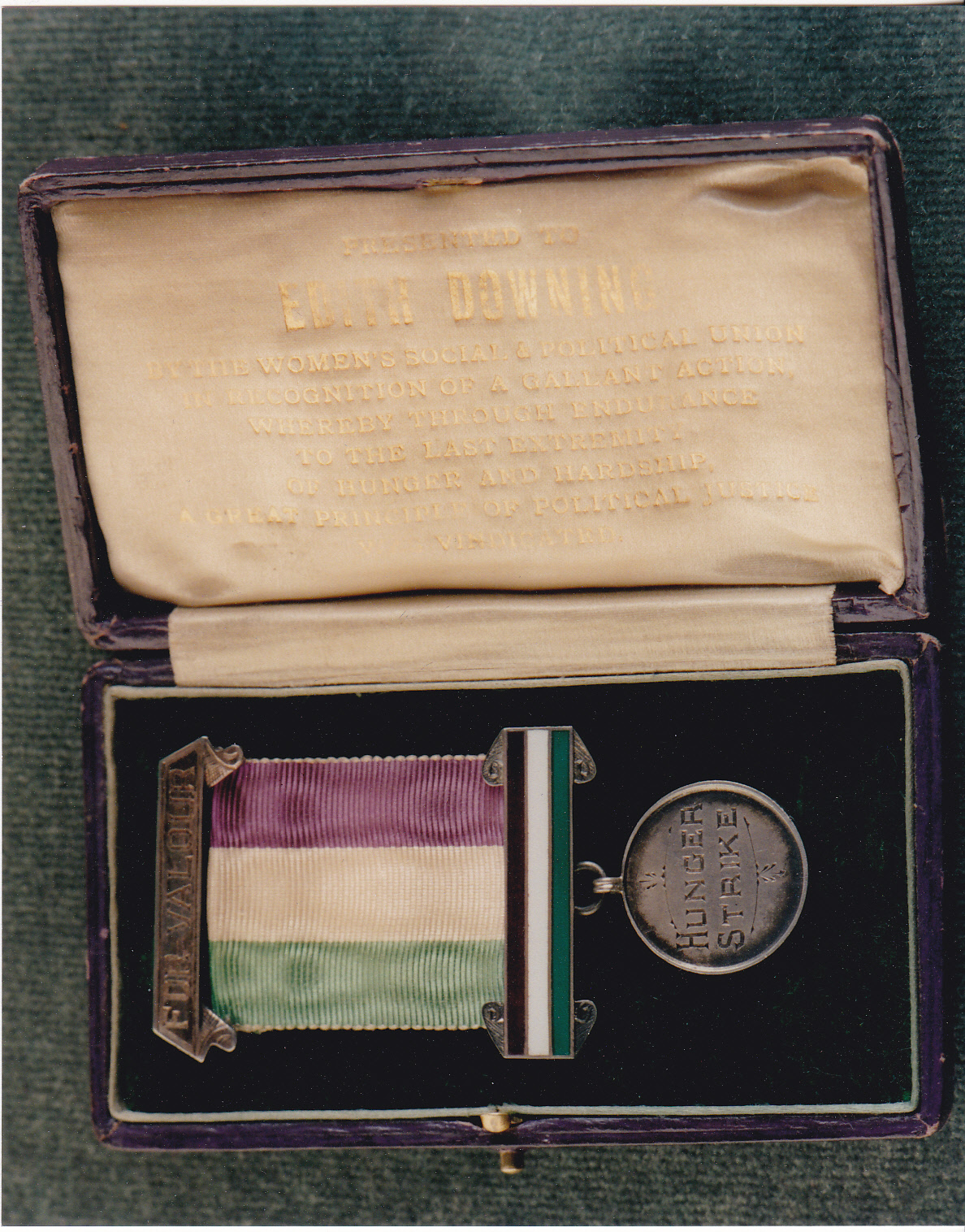
Edith Downing’s Hunger Strike Medal
Edith Downing was a sculptor, living in Tite Street, Chelsea, who joined the Women’s Social and Political Union in 1908. Earlier, certainly as early as 1903 – if not before – she had been a member of the London society associated with the non-militant National Union of Suffrage Societies.
Edith Downing in her studio
She put her artistic talent to the suffrage cause and in June 1910 she was one of the organisers of the WSPU/WFL’s spectacular ‘Prison to Citizenship’ Procession. As well as the hunger strike medal I also once, quite coincidentally, acquired a small statuette that she had sold at a suffrage bazaar held to raise money for the WSPU.
Edith Downing was, however, equally prepared to take militant action and in March 1912 took part in the WSPU’s West-End window-smashing raid. As a result she was imprisoned and while in Holloway took part in the hunger-strike and was forcibly fed.
She was awarded the WSPU’s hunger strike medal on her release. For more details of Edith Downing’s involvement with the suffrage cause see her entry in my The Women’s Suffrage Movement: a reference guide.
Scenes of both the window-smashing raid and of forcible feeding are shown very effectively in the film ‘Suffragette’. And I don’t think it’s giving too much away to say that a hunger strike medal plays a small part in the lead character’s conversion to the cause.
The hunger strike medal awarded to Edith’s sister, Caroline Lowder Downing, is now held in the Houses of Parliament collection – see here. For details about the Suffragette Season of talks and tours (which will, I’m sure, include a chance to see Caroline Downing’s medal) that Parliament has launched to coincide with the release of ‘Suffragette’ see here.
Copyright
Suffrage Stories/ Palmisting For The Cause At A Café Chantant – December 1909
Posted by womanandhersphere in Collecting Suffrage, Kate Frye's Diary, Kate Frye's suffrage diary, Suffrage Stories on September 11, 2015
December was always a good month for fund-raising suffrage parties.

For the suffrage movement was not all about militancy and processions. Money had to be raised to pay for the campaigning and for the management of the rapidly-developing organisations – and much of it was done in the time-honoured way of bazaars and balls. Here is a flyer for a Café Chantant organised by the London Society for Women’s Suffrage in December 1909.
The flyer comes from the collection of Kate Parry Frye, where it lay between the pages of her diary in which she describes the event itself.
She was living at home in North Kensington and had already had some experience as a reader of palms at earlier suffrage fund-raising events. On 6 December 1909 Kate wrote:
‘Agnes [her sister] and Katie [Finch-Smith – neé Gilbey -her cousin] arrived about 12.30. I had lent Katie a white dress as she had not got one and she had brought up the regulation white cap and apron and I also supplied the colours. I wore my best. We started off just before 2.30. One bus to the Grove [that is, Westbourne Grove] and another to Kensington and to the Town Hall for the Café Chantant got up for the Funds of the London Society and National Union.
It began at 3 o’clock. Katie left her things in the cloak room and we all went upstairs together. Agnes had to pay her 3/- to go in and for tea but Katie and I went in free. I found Mrs Rowan Hamilton who had charge of the Palmists and she hadn’t got me a table and I would not begin till she had one brought. I had told her two chairs and a table would be required. I had a little spot close by screens – my name up – ‘Katharine Parry’ – spelt wrong of course. I was just beside the tea tables so I could be near Katie till the fun began. We introduced her to lots of people. I hoped she enjoyed it but I think she got very tired.
Miss Lockyer [she had been housekeeper to the murdered storekeeper, William Whiteley] with a friend came very early and I am afraid did not enjoy herself much. I just spoke to her but could not leave my corner and she thought 2/6 too much to consult me – it was a lot. There was another Palmist ‘Ravario’ and my crystal gazer – Clare Crystal. Agnes and Katie consulted her and found her rather poor. The Wrights were there, of course. Alexandra only a simple ‘Tea Girl’ but she selected Agnes to have tea with her – such an honour for Agnes. Miss Carl Hentschel was a Tea Girl and her Mother helping everywhere and lots of people I know.
At first I could not get any clients – no-one knew me. The first was a man about 3.30 – a funny sort of thing – then a lady, who was so delighted she went out to boom me and she did – for, for the rest of the day, I was besieged. I could have gone on all night. It was hard work but I enjoyed it. I had such nice interesting people – a few made me feel miserable, they were so unhappy – but some were charming – two insisted upon having my address. One said she would try and get me some engagements – a Miss May Oakley. I kept on till 20 minutes to 6 when Agnes dragged me out to have some tea – and John [Collins, her fiancé] came upstairs – he had been taking tickets from 2.30.
So I had some tea and he had a second tea. We had it from Miss Doake’s table as Katie was away. I had promised to go back at 6 o’clock and there was already a client sitting in the retreat. I kept on till 6.30 when the affair was over for the afternoon and we all four went home feeling very tired. John had to be back before 8 o’clock and we were not back till after 7 – so had to rush about and he had a meal as quickly as it could be got and go off.
Leaving Agnes behind, Katie and I left again at 8 o’clock and went by bus to Kensington. It was all in full swing again. The entertainment going on as before and more theatrical and Ju Jitsu displays and heaps of people. John was taking tickets again as happy as a cricket. I had said I would be back 9 till 10 – but I was pounced upon straight away. I had a horrid few moments when I missed my muff but John found it for me.
We worked till I was nearly done and told about 14 or 16 – and 17 to 20 in the afternoon. I had to refuse more as it was 10.30 and I was so tired – though the people came and begged me to go on. Gladys herself honoured me – and she told me that people were giving up their tickets for the other Palmists to come to me. John seemed playing about all the evening and Katie was serving coffee and cakes. There was an auction of cakes – and I bought a lovely Fullers cake. All the cakes had been given and were simply lovely ones. It was pouring with rain and we had to have a cab to the flat. Got in about 11.30.’
Interesting to see that Edith Garrud was happy to give jujitsu displays for the non-militant society.
For more about Kate Frye and the suffrage movement see here:
For more about the entirety of Kate Frye’s life see here
Kate was very sympathetic towards the Women’s Social and Political Union and was, briefly, a member. She was particularly concerned about improving the life of her poorer sisters and without a doubt would have loved the film ‘Suffragette’.
Copyright
Suffrage Stories/Collecting Suffrage: Countdown To 12 October And Release Of The Film ‘Suffragette’: The Morrison Collection
Posted by womanandhersphere in Collecting Suffrage, Suffrage Stories on September 10, 2015
To celebrate the release on 12 October of the film ‘Suffragette’ (for which I was an historical consultant) I will post each day an image of a suffrage item – or, in the case of today, items – that have passed through my hands.
For my current catalogue – No 189 – which contains a good deal of suffrage material – as well as general books and ephemera by and about women – see here.
Today’s images: The Morrison Suffrage Collection.
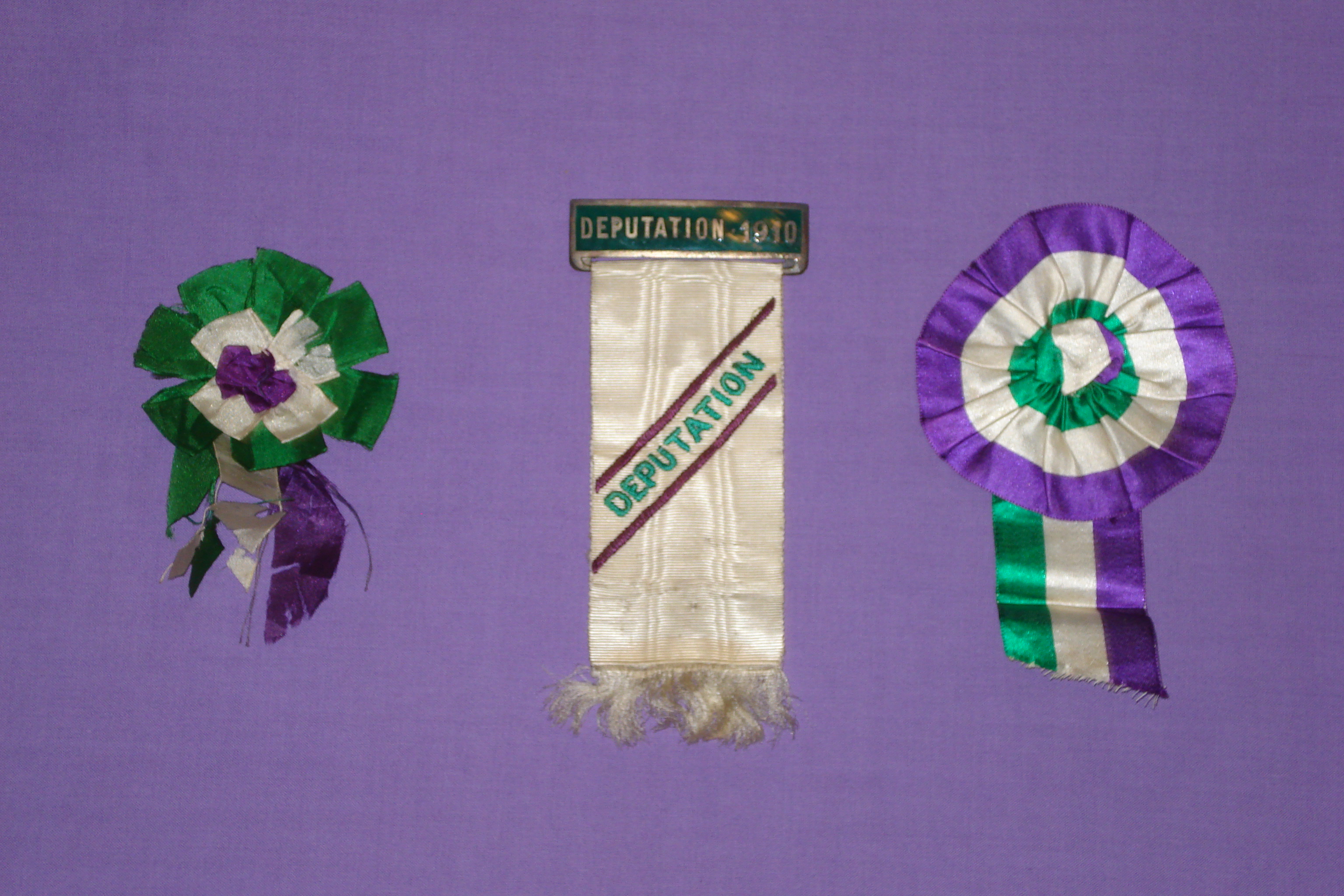
The Morrisons’ WSPU regalia
Evelyn Mary Fanny Matilda Murray was born in New South Wales, Australia, c 1850. She was the daughter of Sir Terence Murray, (President of the NSW Legislative Council) by his first wife. She was, therefore, half-sister to Sir Gilbert Murray, later to become Regius Professor of Greek at Oxford, who was a son of the father’s second marriage. [Gilbert Murray’s wife was a daughter of Lady Carlisle and for many years president of the Oxford Women’s Liberal Association.]
By the mid-1870s Evelyn Murray was married to a Robert Morrison. They had a daughter, also named Evelyn Morrison, born c 1881. At some point Robert Morrison died and it was as a widow that Mrs Morrison, with her daughter, Evelyn, arrived in Britain sometime between 1891 and 1901. Mrs Morrison ‘worked’ for the Liberal Party before becoming involved with the WSPU.
Her daughter, Evelyn, was a university graduate (possibly of Bedford College, but I am not sure. Certainly she was not a graduate of an Oxford or Cambridge college because she was able to style herself ‘BA.’)
The younger Evelyn was a WSPU speaker and in February 1910 was elected joint honorary secretary of the Kensington WSPU.
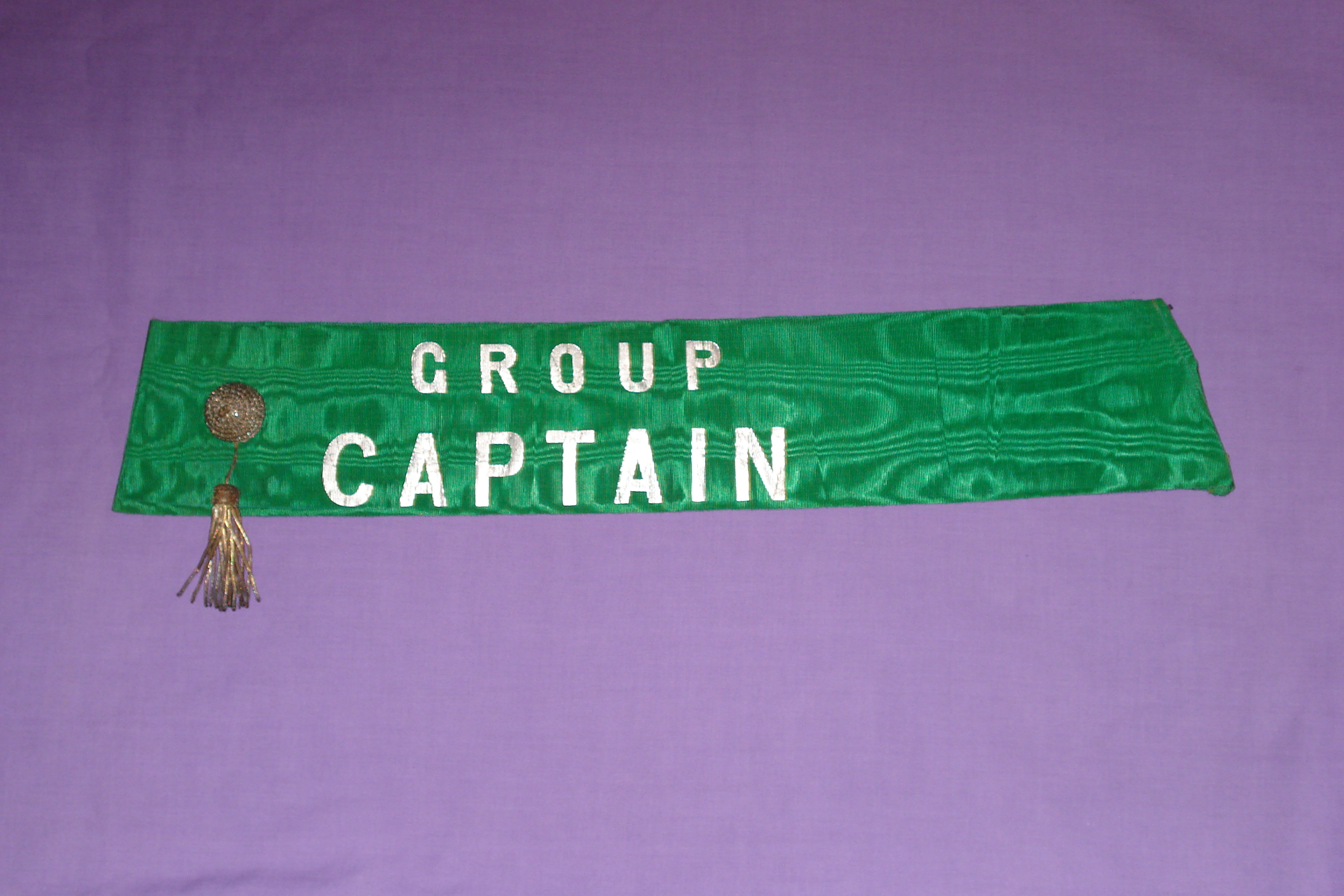
Miss Evelyn Morrison was a ‘Group Captain’ in charge of Section One of the WSPU’s spectacular procession to Hyde Park on 21 June 1908.
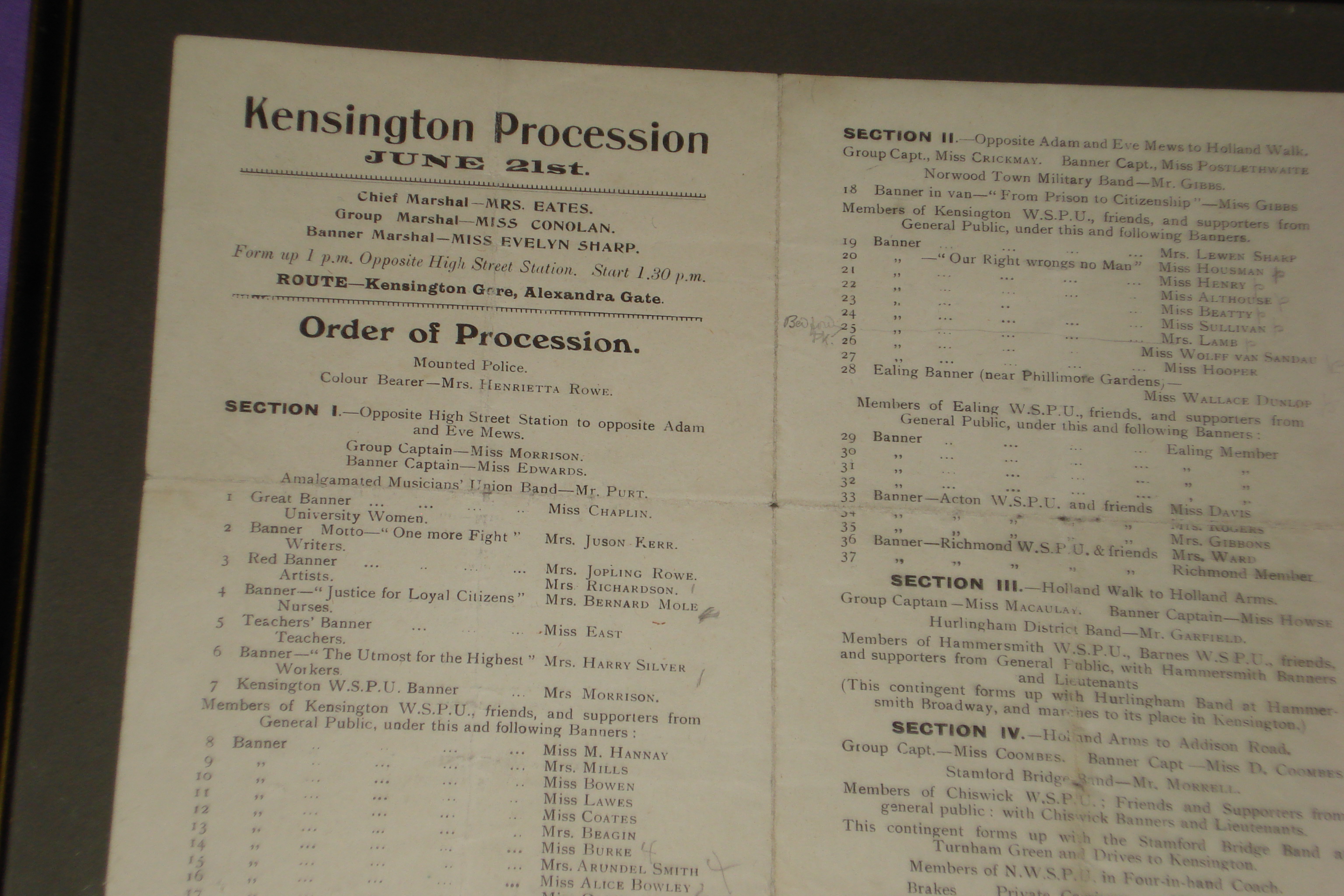
It would be for this that she made the ‘Group Captain’ sash.
 I am pretty sure that the ‘Votes for Women’ sash also belonged to her.
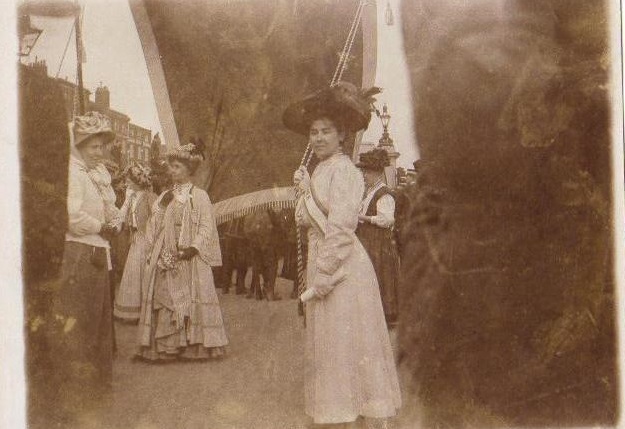
Here is Miss Evelyn Morrison wearing just such a sash – in a procession alongside Mrs Pankhurst.
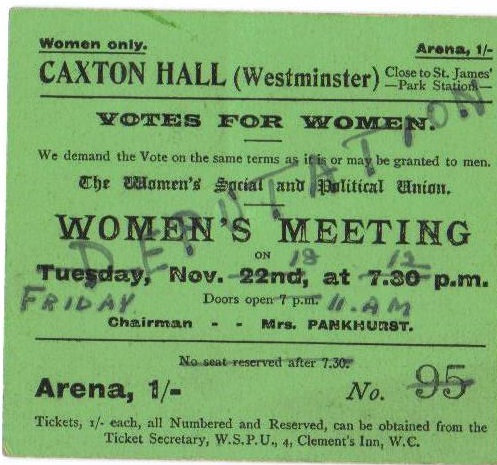
This is the ticket issued to Mrs Morrison for a 22 November 1910 WSPU meeting in Caxton Hall. However, as we can see from the hand alterations to the ticket, the date was brought forward. The collection included two telegrams to Mrs Morrison, dated 15 Nov 1910, rescheduling the date of deputation to Parliament in which she was to take part.
The new date of Friday 18 November became notorious in suffragette history as ‘Black Friday’ when Parliament Square became the scene of a near riot and many women were assaulted by the police. Mrs Morrison was there, wearing the ‘Deputation’ silk insignia that appears in the first photograph. Incidentally, the film’ Suffragette’ includes a scene of frantic suffragette protest immediately outside Parliament
Mrs Morrison was arrested and the collection included the order issued by the Metropolitan Police, ordering her the appear the next day at Bow Street Police Court. The charge was one of ‘wilfully obstructing Police whilst in the due execution of their duty’. The charge against her, as against all the other women arrested on Black Friday was dropped and Mrs Morrison was discharged.
Another telegram was included in the collection, sent from Mrs Morrison to her daughter from Southampton Street close to Bow Street court, dated 19 November, to say that she and all the others arrested with her the previous day had been discharged. The Home Office had decided it was not politic to charge so many women – 220 had been arrested on ‘Black Friday’.
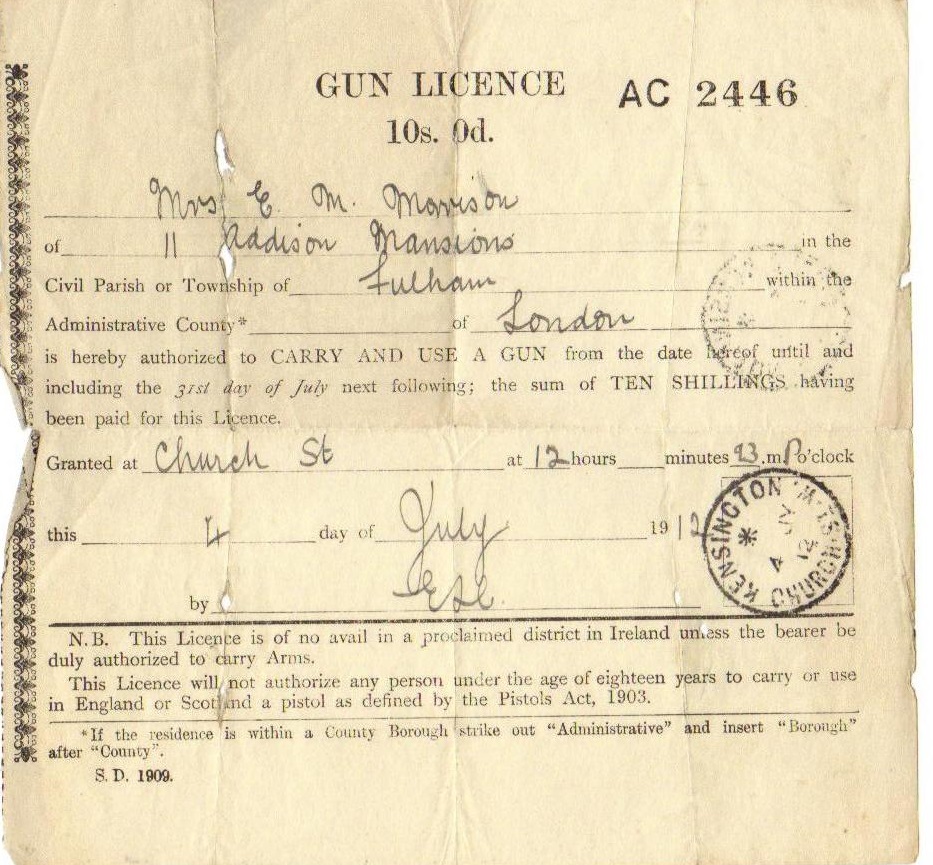
On 4 July 1912, in the genteel setting of Church Street, Kensington, Mrs Morrison was issued with a gun licence. Why should she require to carry a pistol? At this time WSPU militancy was reaching fever pitch – with Mrs Pankhurst being regularly arrested and then released after hunger striking. It is interesting that this particular piece of paper has survived alongside the other, solely suffrage, material. The inference is that the issuing of the licence was not unconnected with Mrs Morrison’s involvement in the suffrage movement.
Copyright
- Letter from Evelyn Sharp to Miss Morrison, dated 21 March 1909 thanking her for organising a WSPU meeting (at which Christabel Pankhurst had been the main speaker)
- Cyclostyled letter from Christabel Pankhurst – probably to Mrs Morrison – it dates from November 1910 and refers to meetings being held at the beginning of the week after the deputation in which she took part.
- Gun Licence issued to Mrs Morrison on 4 July 1912. This was at a time when WSPU militancy was reaching fever pitch – with Mrs Pankhurst being regularly arrested and then released after hunger striking. It is interesting that this particular piece of paper has survived alongside the suffrage material. The inference is that the issuing of the licence was not unconnected with Mrs Morrison’s involvement in the suffrage movement.
Framed items
1) Together in one frame – three telegrams
Two telegrams to Mrs Morrison, dated 15 Nov 1910, rescheduling date of deputation to Parliament in which she was to take part. This was to become notorious as ‘Black Friday’ when there was a near riot in Parliament Square and many women were assaulted by the police.
The third telegram (the one in the centre) is from Mrs Morrison to her daughter, sent from Southampton St close to Bow Street court, dated 19 November, to say that she and all the others arrested with her the previous day had been discharged. (The Home Office had decided it was not politic to charge so many women – 220 had been arrested on ‘Black Friday’.
- In the second frame
The order issued by the Metropolitan Police when Mrs Morrison was arrested in the course of ‘Black Friday’, ordering her the appear the next day at Bow Street Police Court. The charge was one of ‘wilfully obstructing Police whilst in the due execution of their duty’. As we have seen the charge was dropped and Mrs Morrison was discharged. NB Inspector Crocker, who signed the charge sheet, was involved for many years in pursuing suffragettes.
Suffrage Stories/Collecting Suffrage: Countdown To 12 October And Release Of The Film ‘Suffragette’:’Justice Demands The Vote’ Poster
Posted by womanandhersphere in Collecting Suffrage, Suffrage Stories on September 9, 2015
To celebrate the release on 12 October of the film ‘Suffragette’ (for which I was an historical consultant) I will post each day an image of a suffrage item that has passed through my hands.
For my current catalogue – No 189 – which contains a good deal of suffrage material – as well as general books and ephemera by and about women – see here.
Today’s image:
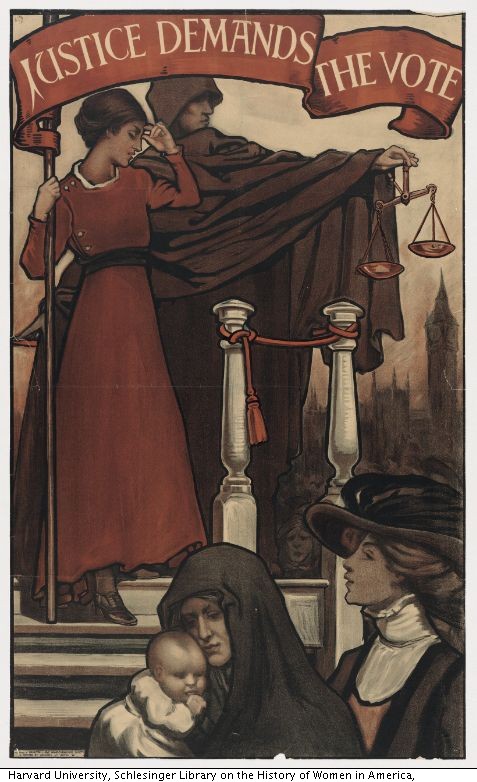
This image (courtesy of Schlesinger Library) is of an English poster. I was fortunate enough to buy one of the originals of this poster at auction some years ago. This was before the days of digital cameras, which is why I, alas, don’t have my own record of it.
The poster was issued by the Brighton and Hove Women’s Franchise Society c 1908. This society had been founded – or re-founded, because there had been an earlier suffrage society in the town in the late 19th century – in 1906. The Brighton and Hove Women’s Franchise Soceity was a local committee of the non-militant London Society for Women’s Suffrage – that is, a member of Mrs Fawcett’s National Society for Women’s Suffrage.
The artist of the poster is not recorded – but there were no shortage of women artists living in and around Brighton. It was printed by Weiners Ltd of Acton, who also printed posters for the Artists’ Suffrage League.
The message that the poster conveys – that middle-class women were campaigning alongside and on behalf of their poorer sisters – is a theme developed in the film, ‘Suffragette’.
For more about suffrage in Brighton see my The Women’s Suffrage Movement: a regional survey (Routledge, 2006)
Copyright
Suffrage Stories/Collecting Suffrage: Countdown To 12 October And Release Of The Film ‘Suffragette’: Annie’s Bracelet
Posted by womanandhersphere in Collecting Suffrage, Suffrage Stories on September 8, 2015
To celebrate the release on 12 October of the film ‘Suffragette’ (for which I was an historical consultant) I will post each day an image of a suffrage item that has passed through my hands.
For my current catalogue – No 189 – which contains a good deal of suffrage material – as well as general books and ephemera by and about women – see here.
Today’s image:
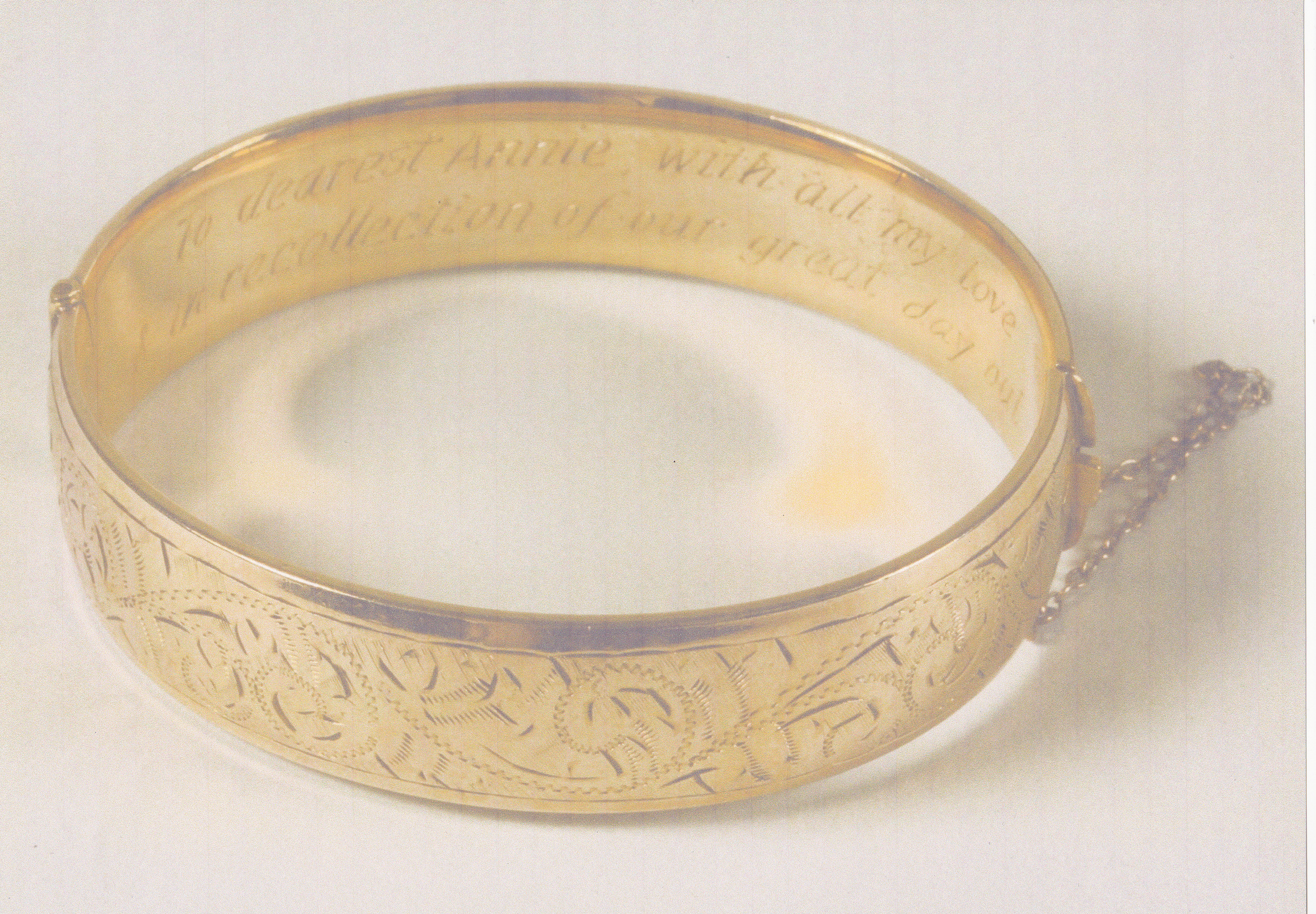
A 9 ct gold bracelet, very pretty, the outer engraved on one side with decorative scrolls. But it is what is engraved inside that is the secret of the bracelet’s significance..
On one arc of the circle:
‘To dearest Annie with all my love & in recollection of our great day out’
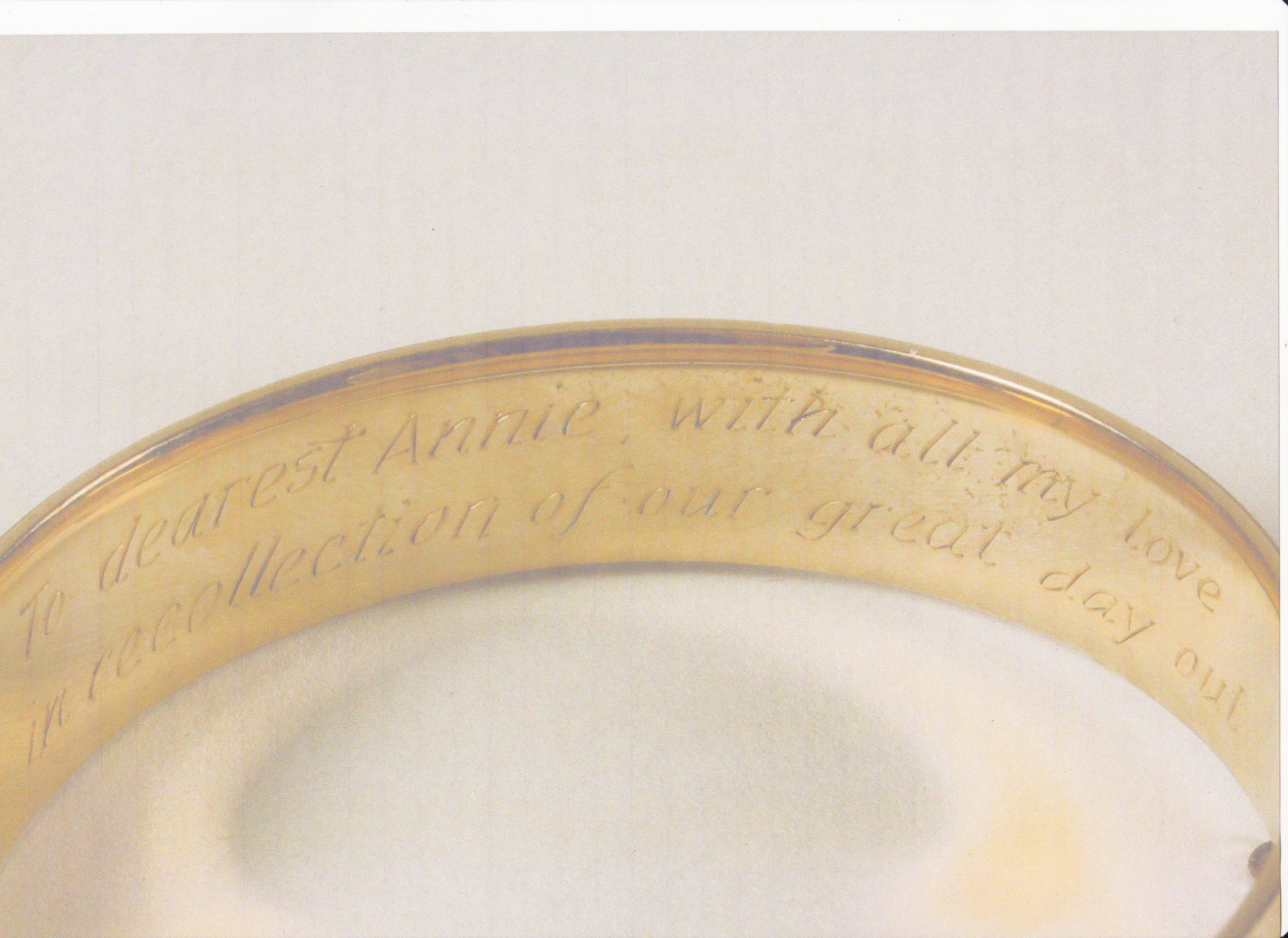
and, on the other,
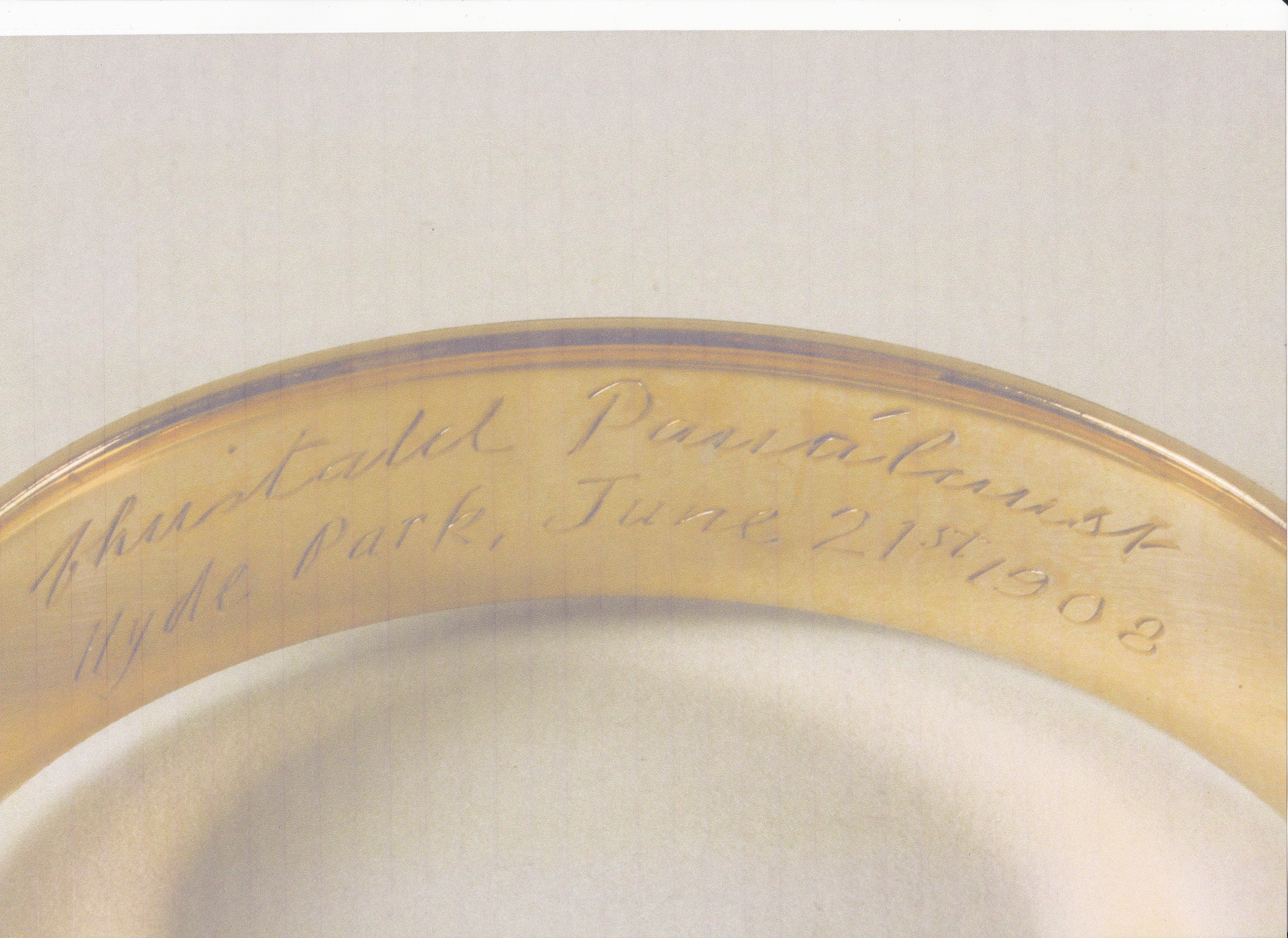
‘Christabel Pankhurst, Hyde Park June 21st 1908’.
Annie Kenney was Christabel’s most faithful follower, her love and admiration for Christabel – and Christabel’s acceptance and acknowledgment of this loyalty – made clear in letters and in Annie’s autobiography. But this bangle is, as far as I know, the only object that testifies to the peculiar bond between the two young women.
Annie, who had worked in a mill from the age of 10, had first come under Christabel’s spell in the spring of 1905 and a few months later, in October, spent a week in prison with her after they had heckled a Liberal meeting in Manchester. This imprisonment marks the beginning of the WSPU’s militant campaign.
Annie’s life was changed for ever. As she wrote, ‘My pleasure came from seeing Christabel’s face light up with a light that later in life I discovered meant victory. Her confidence in me gave me confidence in myself.’ And when they were together in prison – ‘I remember going to Church and sitting next to Christabel who looked very coy and pretty in her prison cap. She took my hand tenderly and just held it, as though I were a lost child.’
Nevertheless that ‘lost child’, backed by Christabel’s confidence, became one of the WSPU’s leading organisers. Indeed, after Christabel left for Paris, Annie acted as her deputy, putting into effect the absent leader’s commands.
But before that, for the ‘great day out’, ‘Women’s Sunday’, the first great WSPU rally, held in Hyde Park on 21 June 1908, Annie bought a hat from Liberty’s (£1/2/6) and led the procession that started at Paddington – being at the time WSPU organiser in the West of England. Once in the Park she was the principal speaker on Platform 3.
Christabel’s gift of the bracelet recognises the significance of the ‘great day out’, marking the WSPU’s entry into a world of polished performance and Annie as one of its stars.
As Annie wrote many years later in her memoir, ‘There is a cord between Christabel and me that nothing can break – the cord of love. Distance or absence makes no difference.’ Here is a tangible – and unique -emblem of that affection.
Copyright
Suffrage Stories/Collecting Suffrage: Countdown To 12 October And Release Of The Film ‘Suffragette’: Mrs Albert Broom And The WFL
Posted by womanandhersphere in Collecting Suffrage, Suffrage Stories on September 7, 2015
To celebrate the release on 12 October of the film ‘Suffragette’ (for which I was an historical consultant) I will post each day an image of a suffrage item that has passed through my hands.
For my current catalogue – No 189 – which contains a good deal of suffrage material – as well as general books and ephemera by and about women – see here.
Today’s image:
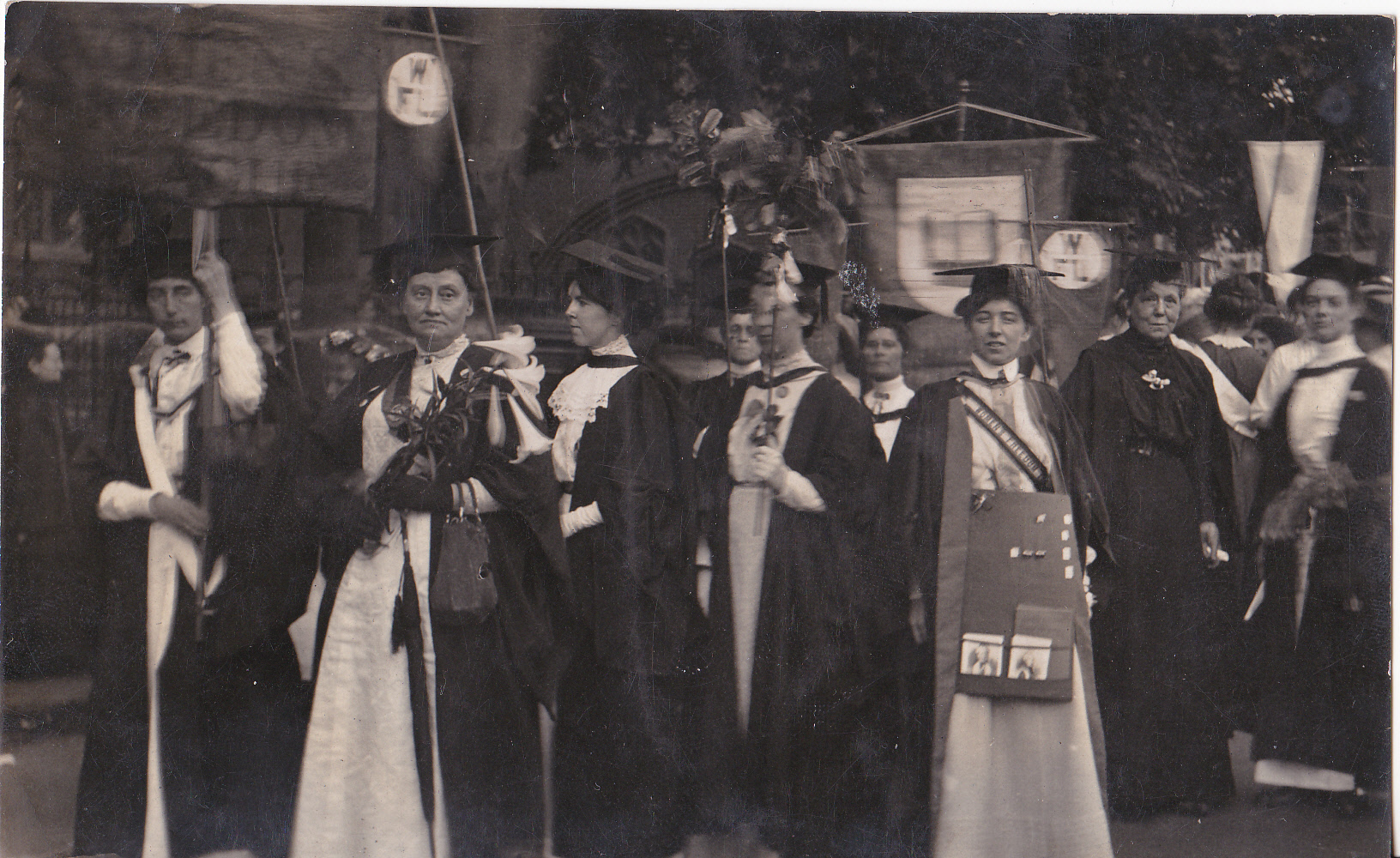
A ‘close-up’ photograph by Mrs Albert Broom of women from the Women’s Freedom League section of the suffragette ‘Coronation Procession’ held on 17 June 1911. The image is very crisp and clear. Many of the women are wearing academic robes – one is carrying a satchel from which to sell WFL badges and postcards of the WFL leader, Mrs Despard. I think that the figures in the lead (to the left of the picture) are carrying a banner, doubtless that of the WFL, and other smaller banners are also there in the picture.
For details of the exhibition ‘Soldiers and Suffragettes’ featuring the photography of Mrs Albert Broom see here.
Copyright
Collecting Suffrage: ‘Votes For Women’ Hooks And Eyes
Posted by womanandhersphere in Collecting Suffrage on January 16, 2015

In over 30 years spent hunting for and selling objects related to the women’s suffrage campaign, this little box is the only example I have ever found of ‘Votes for Women’ Hooks and Eyes. Although I had it photographed in black and white back in the 1990s, the box in reality is tricked out in the WSPU colours of purple, white and green.
The manufacturer registering ‘Votes for Women’ as its trademark was not the only maker of hooks and eyes to discern a market for its goods among the supporters of the suffrage cause. Votes for Women (eg issue for 23 April 1909, p 26) carried advertisements for ‘Smart’s invisible hooks and eyes ‘ which were the’ patented invention and property of two members and supporters of the Women’s Social and Political Union.’
These items might well have been found amongst the stock of the suffrage shops opened by the various suffrage societies.
As well as being campaigners, the majority of suffragettes and suffragists were, of necessity, also needlewomen. So here was an opportunity to back the Cause while sewing fastenings onto their skirt plackets or bodices.
Copyright
Suffrage Stories: Words – As Well As Deeds
Posted by womanandhersphere in Collecting Suffrage, Suffrage Stories on May 7, 2014
This article was published in the March 2003 issue of Antiquarian Book Review.
‘Deeds Not Words’ was Mrs Pankhurst’s motto. The slogan flourished in the early 20th century – it was even embroidered on a banner – a reaction to the apparently unproductive campaign for the enfranchisement of women that had already been waged for nearly 40 years.
 The debate as to whether the vote was won by the slow drip of reasoned argument or by the sharp crack of breaking glass is one that still occupies historians. Although it is the deeds of Mrs Pankhurst’s suffragettes – the spectacle of processions, the breaking of windows, the burning of houses and churches – that has coloured the popular perception of the suffrage campaign, without the ‘words’ that had over many years shaped the idea that women had an equal right with men to citizenship, the ‘deeds’ would have been committed in a vacuum. The women’s suffrage campaign was, during its entire 62 years, underpinned by ‘Literature’ in all its guises.
Works written in support of women’s enfranchisement had little difficulty in achieving publication. The instigators of the movement were members of the articulate radical middle class and were in close contact with communicators. A tentative beginning had been made in 1851 with Harriet Taylor’s article The Enfranchisement of Women, which, shortly after her marriage to John Stuart Mill, was published anonymously in the Westminster Review ( a journal of which Mill had in the past been editor). This was followed in 1855 by a pamphlet, The Right of Women to the Elective Franchise, written by Agnes Pochin, wife of a future Liberal MP, and published by John Chapman, that ‘Publisher of Liberalisms’.
Among the names of the 1500 women who signed the suffrage petition that Mill presented to parliament in June 1866 (marking the formal beginning of the campaign), were several with connections to the publishing or bookselling trades – including Elspet Strahan, sister of Alexander Strahan, a liberal with a zeal for social reform and the publisher of the eponymous publishing house. He had recently launched the Contemporary Review, in which he published an article on ‘female suffrage’ in March 1867, written by Lydia Becker.

Lydia Becker – with books
Based in Manchester, Lydia Becker was to be the driving force behind the 19th-century campaign. Among other signatories to the petition were Louisa Farrah, wife of a radical publisher and bookseller (282 Strand, London); Eliza Embleton, a bookseller from Leeds (Burley Street); the wife of James Renshaw Cooper, a radical Manchester bookseller (1 Bridge Street); and the wife and daughter (both named ‘Harriet’) of Edward Truelove, radical publisher and antiquarian bookseller (2240 Strand), who had been imprisoned for publishing Robert Owen’s Physiology in Relation to Morals. (See here for an interesting blog by Dr Tony Shaw about Truelove and his grave, on which the two Harriets both appear.)

Edward Truelove’s grave in Highgate Cemetery. Photo courtesy Dr Tony Shaw
Once the campaign had been launched, ‘words’ in support of women’s enfranchisement multiplied rapidly. The societies that had formed to promote the cause published a plethora of pamphlets – one of the first, of which 4500 copies were distributed, was a reprinting of the speech made by Mill to Parliament during the debate on the second reform bill in May 1867.
The accounts of the earliest Enfranchisement of Women Committee show that in its first year of existence over £94 was spent on printing. This was set against receipts from the sale of pamphlets of only £6 11s. Political publishing was not a profitable business. In reality, political publishers who were prepared to put their imprint on books and journals to promote the woman’s cause were not so unworldly as to risk their money. A study of the ledgers of companies, such as Trubner and H.S. King, reveals that many of the suffrage publications, including Lydia Becker’s The Women’s Suffrage Journal, were published only on a commission basis.
Under this arrangement, the author or the society undertook all the risk of publication, while the publishers merely provided the service of printing, binding and distribution, for which they gave the book their imprint, charged a fee and took a percentage of sales. Publishers’ ledgers, where they have survived, provide an interesting keyhole through which to view the suffrage campaign. Lists of payments make it possible to identify an author who published anonymously, the print order for a book, journal or pamphlet can give us an idea of the ambition of the author or society; and the number of pulped gives a reason why so many of the items are now extremely scarce – and expensive.
The suffrage campaign appeared to have made such considerable progress in its first years that Mill, a canny businessman as well as philosopher, felt the time was ripe to publish the work that he had first drafted in the early 1860s on ‘the woman question’. As he wrote in a letter to The Times on 9 April 1869: ‘It is not specially on the Suffrage question, but on all the questions relating to women’s domestic subordination and social disabilities, all of which it discusses more fully than has been done hitherto. I think it will be useful, and all the more, it is sure to be bitterly attacked’. Mill knew full well the publicity value of controversy.

John Stuart Mill remained a hero to the more constitutionally-minded elements in the suffrage campaign
The Subjection of Women was published by Longmans in May 1869, went into a second edition in the same year, and has remained ever since a central text of the women’s movement.
Helen Blackburn, Women’s Suffrage, 1902
It took until 1902 for the first history of the campaign to appear. Women’s Suffrage: a record of the women’s suffrage movement in the British Isles with biographical sketches of Miss Becker was painstakingly compiled by Helen Blackburn, who had for many years worked as secretary of the Central Committee for Women’s Suffrage.
The new force that emerged in 1903, Mrs Emmeline Pankhurst’s Women’s Social and Political Union, did not delay so long before giving itself a distinctive history. A series of articles written by Sylvia Pankhurst, daughter of Emmeline, as The History of the Suffrage Movement, appeared in the WSPU’s new paper, Votes for Women, starting in the first issue in October 1907 and concluding in September 1909.
 This history was, naturally, shaped to emphasise the Pankhursts’ centrality to the movement. Bibliophiles might like to note that the book that emerged from the articles, The Suffragette: the history of the women’s militant movement, was first published in America in 1911 by Sturgis & Walton and sheets where only then shipped back to Britain, where it was subsequently published by Gay & Hancock.
The publication in 1912 of Women’s Suffrage: a short history of a great movement (TC & EC Jack), written by Millicent Fawcett, did something to redress the balance. She had been involved with the campaign since its earliest days and since 1907 had been leader of those who described themselves as ‘law-abiding’ in contradistinction to the militants.
 Agnes Metcalfe’s Woman’s Effort: a chronicle of British Women’s Fifty Years Struggle for Citizenship (1865-1914), published in 1917, gives a detailed overview of the campaign, concentrating on the efforts of the militants.
In 1920 Mrs Fawcett completed her history of the suffrage campaign, begun in A Short History, with another pithy summary of events that had led to the passing of the Representation of the People Act, 1918, granting the vote to women over the age of 30.
All these books were bought (as ownership inscriptions found in them testify) by sympathisers to the cause, were part of the stock of the small lending libraries run by many of the local suffrage societies and also found their way into the public library systems and even into prison libraries. While imprisoned, suffragettes were able to read lives, such as those of Joan of Arc and Garibaldi, that they considered (by analogy) relevant to their cause – the cult of the ‘hero’ clearly appealed to those conscious of their role in history.

Daniel Maclise, John Francis Maguire
Alongside the polemics, the women’s suffrage campaign also provided a rich seam mined by writers of fiction. John Francis Maguire, MP for Cork and an active supporter of the woman’s cause, was the first, publishing in 1871, a year before his death, a three-decker, The Next Generation (Hurst & Blackett). The action was set in 1891, by which time the ‘Rights of Woman’ movement..was a wonderful success [and had] long since been accepted with satisfaction almost universal’. Eighty-nine women MPs sat in parliament and Mrs Bates was chancellor of the exchequer.
The following year, ‘Arthur Sketchley’ in Mrs Brown on Women’s Rights (George Routledge) worked what Maguire had correctly identified as a ‘fruitful theme’, and demonstrated that his comic heroine, Martha Brown, had already got the measure of ‘women’s sufferages’. Mrs Brown surveys her first suffrage meeting: ‘Why, surely no Members of Parlyment aint a-coming to sich a ‘ole as this; for I’d ‘eard Miss Snapley a-braggin’ as Professor Fairplay were a-goin’ to take up the question in the chair, along with a old lady in the name of Mill, and a good many more as all ‘oped to be in Parlyment afore they died.’
The subject also, of course, lent itself to melodrama as well as to comedy. Emily Spender published in 1871 a novel, Restored (Hurst & Blackett, 1871) dedicated to the leader of the Bath society for women’s suffrage, of which she herself was an active member. In the novel a wicked husband, repossessing his young wife, declaims ‘If you had read your Bible a bit more, and John Stuart Mill, a little less, you would have been a better woman, Frederica.’ [Incidentally Emily Spender, the great-aunt of Sir Stephen Spender, spent her later years in Italyand was the model for E.M. Forster’s ‘Miss Lavish’ in Room with a View.]
Throughout the 19th century, a stream of novels used support for, or antipathy to, the suffrage cause as a shorthand by which to delineate characters or to put plot machinery into gear. An indication that the campaign was losing its momentum at the end of the century may be surmised from the fact that between 1900 and 1906 no ‘suffrage’ novels were published.

Robins, The Convert. Photo courtesy of Lorne Bair (click here to find a 1st US ed for sale)
However, in 1907, the year after the WSPU took its campaign to London, three novels appeared. The most famous of these is The Convert (Methuen) written by Elizabeth Robins, who was a keen supporter of the WSPU and based her scenes and personalities on activities of which she had been an eyewitness. Describing a suffrage rally in Trafalgar Square she drummed home the argument for the existence of the WSPU:
‘You’re in too big a hurry’, someone shouted, ‘All the Liberals want is a little time.’
‘Time! You seem not to know that the first petition in favour of giving us the Franchise was signed in 1866…We must try some other way. How did you working men get the suffrage?, we asked ourselves. Well, we turned to the records and we say. We don’t want to follow such a violent example. We would much rather not – but if that’s the only way we can make the country see we’re in earnest – we are prepared to show them.’
The Convert was in fact Elizabeth Robins’ novelisation of her play Votes for Women!, written during the autumn of 1906 and first staged at the Royal Court Theatre in April 1907. For Kate Parry Frye’s description of a visit to see the play on 16 April 1907 click here.
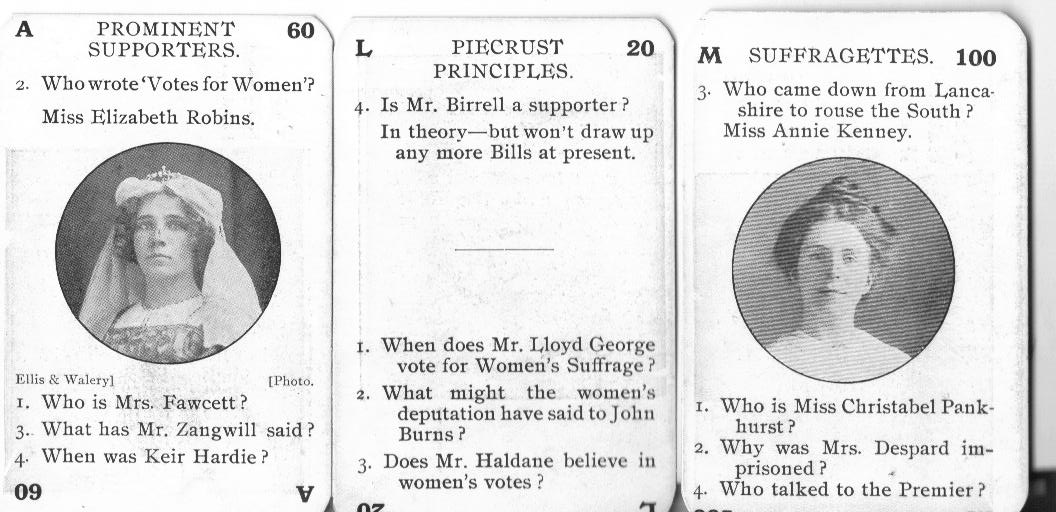
Elizabeth Robins, as author of ‘Votes for Women!’, featured on a card in ‘The Game of the Suffragette’
In the years that followed, the real-life activities of the suffragettes were reflected by the derring-do of their fictional equivalents in a steady stream of novels. Novelists could now take their middle-class readers into places they might not previously have sought to enter – even the prison cell – and were given legitimate reason to describe the indignities that might be wrought on women’s bodies, whether through the horrors of force-feeding or at the hands of policemen in battle outside the House of Commons. A hero of one such tale (A. Mollwo, A Fair Suffragette) is racked by ‘the picture of [a] fragile, slender little body at the mercy of this yelling, excited crowd, torn first one way, then another, insulted by angry policemen, knocked under the feet of horses.’

Words describing the WSPU Deeds – from Kate Frye’s diary
All in all, the wide range of ‘suffrage’ literature published during the course of the campaign – histories, tracts, speeches, leaflets and novels – offers historians and collectors a fascinating lens through which to view not only the political battle in all its complication, but also the changing perception of the position of women that in the end was so necessary to the winning the vote.
Suffrage Stories/Suffrage Collecting: WSPU Illuminated Address
Posted by womanandhersphere in Collecting Suffrage, Suffrage Stories on April 30, 2014
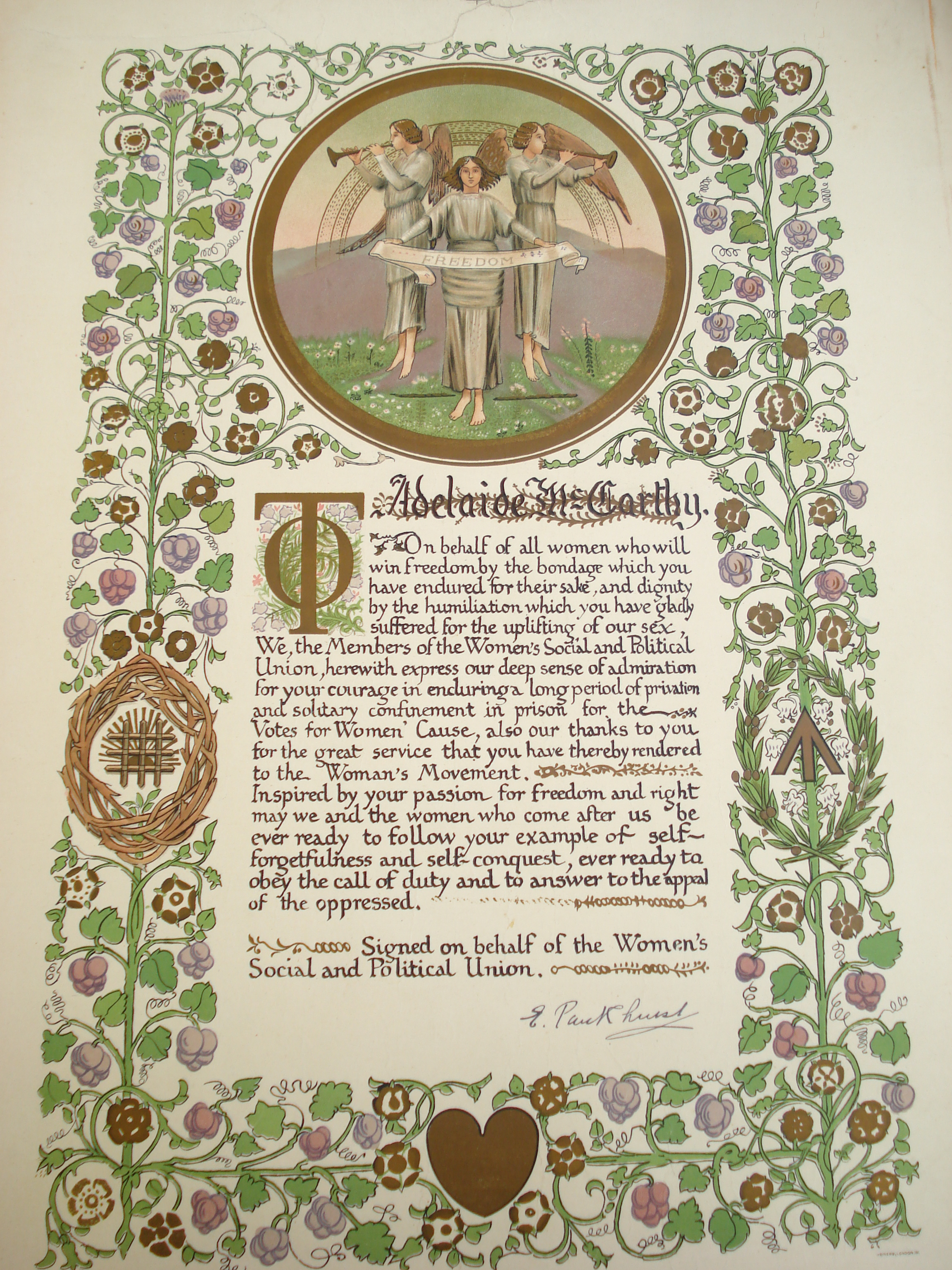
Illuminated address presented to Adelaide McCarthy
Illuminated addresses such as this were first presented to WSPU prisoners on their release from Holloway in September 1908.
The addresses, signed by Emmeline Pankhurst, were designed by Sylvia Pankhurst and incorporate the purple, white and green colours that the WSPU had adopted three months earlier, in June 1908. The ‘angel of freedom’ device was one that Sylvia was to use on other WSPU artefacts – a neat piece of WSPU ‘branding’.
As ever, the suffrage collector needs to be on guard against modern reproductions that pass as the original. As a dealer I was once offered what appeared to be the address presented to suffragette Clara Codd. However, always rather suspicious, my research quickly revealed it to be a copy sold, entirely legitimately, by Bath-in-Time (the gallery of Bath Central Library). I was told that the unfortunate person offering the address to me had bought it as the real thing from a (presumably) rather unscrupulous source. Caveat Emptor.
Suffrage Stories: Women’s Tax Resistance League Sale, Hampstead, May 1914
Posted by womanandhersphere in Collecting Suffrage, Suffrage Stories on July 8, 2013

The photograph above was taken on Monday 18 May 1914 at the sale in Hampstead of goods belonging to Mrs Louisa Thomson Price and others – all of whom had refused to pay their tax. ‘No Taxation Without Representation’ was the motto of the Tax Resistance League.
The Vote (the paper of the Women’s Freedom League with which Mrs Thomson Price was closely associated) reported (22 May 1914) ‘At Hampstead on May 18 a large group of tax resisters had their goods sold at Fitzjohns Estate Auction Rooms. They were Mrs Thomson Price, Mrs and Miss Hicks, Mrs How Martyn , Mrs Milligan, Mrs Hartley, the Misses Collier, and the Misses Dawes Thompson. A procession with a band marched from Finchley Road station to the auction rooms at Swiss Cottage and after the sale an excellent meeting was held at the corner of the Avenue Road. From a gaily decorated wagonette speeches were made by Mrs Thomson Price, Mrs Nevinson and Mrs Kineton Parkes, explaining the reason of the protest.
Below is the note made by Louisa Thomson Price on the reverse of the photographic postcard.

Mrs Louisa Thomson Price was born Louisa Catherine Sowdon in 1864 and died in 1926. She was the daughter of a Tory military family but from an early age rebelled against their way of thinking and became a secularist and a Radical. She was impressed by Charles Bradlaugh of the National Secular Society. In 1888 she married John Samson, who was a member of the executive of the NSS. She worked as a journalist from c 1886 – as a political writer, then a very unusual area for women, and drew cartoons for a radical journal, ‘Political World’. She was a member of the Council of the Society of Women Journalists. After the death of her first husband, in 1907 she married George Thomson Price. She had no children from either marriage.
Louisa Thomson Price was an early member of the Women’s Freedom League, became a consultant editor of its paper, The Vote, and was a director of Minerva Publishing, publisher of the paper. She contributed a series of cartoons to The Vote, which were then produced as postcards. The ‘Jack Horner’ cartoon was also issued as a poster for, I think, the January 1910 General Election. Louisa Thomson Price took part in the WFL picket of the House of Commons and was very much in favour of this type of militancy. In her will she left £250 to the WFL. and £1000 to endow a Louisa Thomson Price bed at the Elizabeth Garrett Anderson Hospital.
I have a very rare suffrage artefact – a Women’s Freedom League postcard album once owned by Mrs Thomson Price -for sale in my catalogue 185.
Collecting Suffrage: 14 June 1913 Emily Wilding Davison’s Funeral Programme: Updated
Posted by womanandhersphere in Collecting Suffrage, Suffrage Stories on June 14, 2013
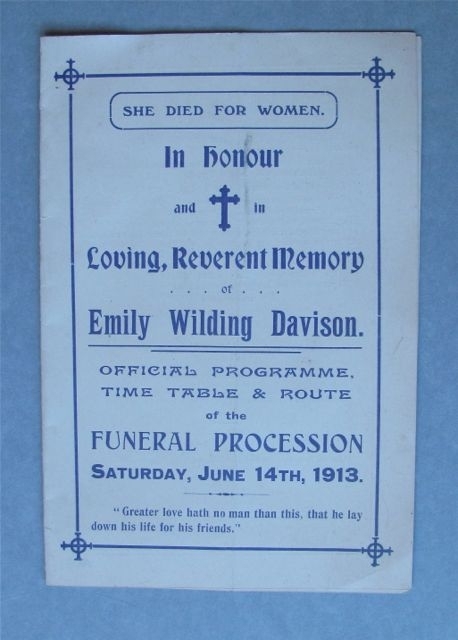
Official Programme for Emily WIlding Davison’s Funeral Procession
I published this post last October, before the extent of interest in the 100th anniversary celebrations of the event commemorated in this 4-pp pamphlet had become clear. I am relieved to report that no suspicious flurry of spurious Emily Davison-related items has appeared on the market. Although the main text of this post is as it first appeared I have updated it with two extra scans of the inside and back cover of the programme. They were made merely for my own research purposes some time before I had a visually-sophisticated blog audience to amuse – so – apologies for their appearance – but I think you will find the details of interest.
For the last 100 years the strange death of Emily Wilding Davison has transfixed the public. It is likely to be the one thing that the ‘man – or woman – in the street’ knows about the suffragette movement. Bizarrely the last seconds of her conscious life are still with us –growing in impact as the internet allows everyone to view footage of film that was in the past relatively difficult to access. In this piece by Andrew Marr the BBC has worked its wonders on the Pathé News original, allowing us to see details that the passing years had blurred. I have always wondered if it was by chance that she chose to position herself alongside a section of the Derby racecourse that was in full view of the film camera. The camera was mounted on a stand and would have been clearly visible. However the camera was, presumably, positioned there in order to capture pictures of the horses entering the final straight and Emily Davison may have chosen to be there for the very same reason. You will now have had the opportunity of viewing the enhanced footage of the film broadcast by Channel 4 in Clare Balding’s Secrets of a Suffragette.
All material related to Emily Wilding Davison’s funeral is scarce – and very collectable – however one of the scarcest is the 4-page ‘Official Programme, Timetable and Route of the Funeral Procession, Saturday June 14th 1913.
I must say that I do find it rather odd that this item should be so very scarce for, as you can see from film and photographs, the streets of London were packed on the day. The hordes must have failed to arm themselves with the Programme or, if they did, to have then discarded it.

Inside pages of the programme for Emily Davison’s funeral procession
In Campaigning for the Vote, Kate Frye, who followed the procession through Piccadilly to Bloomsbury and then on to Kings Cross, in her long diary entry comments on the vastness of the crowd. But even she, who was an inveterate hoarder of suffrage memorabilia, does not seem to have acquired a copy of the Funeral Procession Programme. The result is that, in nearly 30 years of dealing in suffrage artefacts, I have only seen one copy of this item for sale. In fact, if a spate of them were now to hit the market, I shall be very suspicious!

Back cover of the Emily Davison funeral procession
Collecting Suffrage: Suffragette Jewellery And ‘The Antiques Trade Gazette’
Posted by womanandhersphere in Collecting Suffrage on May 17, 2013
This week’s issue of the Antiques Trade Gazette contains a letter from me protesting against the mis-describing of random pieces of Victorian/Edwardian jewellery that have a combination of metals and/or stones approximating to the purple, white and green of the WSPU, as ‘suffragette’.

Here is the text of the letter:
‘As a long-established dealer in suffragette memorabilia I must try once again to take a stand against the mis-labelling as ‘suffragette’ of any pieces of jewellery that contain stones approximating to some shade of purple (or pink or red), white and green.
I see on page 32 of this week’s ATG that two auction houses so described 3 brooches/pendants. I have no idea if the intrinsic value of the items was commensurate with the sale price achieved, but of one thing I am certain – there was nothing in the lot descriptions that convinced me that these pieces had any association with the suffragette movement. I only hope that those bidding were not doing so with any thought that they were acquiring a piece of suffragette history. It should be obvious to anyone with any historical sense that it is necessary to have a much more detailed provenance – a documented history – other than some woolly description about ‘purple, white and green’.
The ‘colours’ were the invention of one of the leaders of the WSPU, Mrs Emmeline Pethick-Lawrence, as a way of creating a ‘brand’ for the WSPU and were first used in June 1908 at a grand rally held by the WSPU in Hyde Park.‘The Public Meeting Act’ of December 1908, mentioned in the ATG piece, was intended, although notably unsuccessful, to prevent suffragettes from heckling ministers – not to prevent suffragettes themselves from holding meetings. It was not until years later – in April 1913 – that there was any prohibition on the WSPU holding meetings in public parks. Moreover, Britain was never such a repressive country that suffragettes found it necessary to wear jewellery ‘in the colours’ as a secret token of allegiance. Quite the reverse; women wore their badges (also now very collectable) proudly –advertising the WSPU and many other suffrage societies.
Since each of these societies followed the WSPU lead and adopted an individual combination of colours of their own I am surprised that auction houses and dealers have not yet leaped onto that bandwagon. For instance, the colours of the main suffrage society – the National Union of Women’s Suffrage Societies – were red, white and green. Just think how many pieces of jewellery with stones in those colours could be described as ‘suffragette’ if we were seriously to follow the ‘purple, white and green’ rule.
I have studied the suffragette movement in depth – in all its manifestations – and can report that there is no evidence that ‘suffragette’ jewellery was made in anything like the quantity flooding the auction houses and, of course, Ebay. Moreover the only commercial company known to have made and retailed ‘suffragette jewellery’ as such was Mappin and Webb (Stanley Mappin was a convinced supporter of the WSPU – joining in the suffrage boycott of the 1911 census). I would be interested to learn of any documentation citing any other commercial company as maker of ‘suffragette jewellery’.
Other jewellery was made by individual artist craftswomen- such as the well-known enameller Ernestine Mills – to sell at fund-raising suffragette bazaars and may well have included references to suffragette colours and motifs. On occasion one can find pieces that demonstrate clearly their suffragette provenance. One such is a pendant made – in purple, white and green enamel – from a design by Sylvia Pankhurst. The pendant is long since sold but I use the image of it as the identifier on my website – womanandhersphere.com – on which those who really want to know about ‘suffragette’ jewellery can find more information – as they can in the entry under ‘Jewellery and Badges’ in my The Women’s Suffrage Movement; a reference guide, published by Routledge. Ignorance should not be a reason for allowing auction houses and dealers to perpetuate the ‘suffragette jewellery’ myth. As I say, I specialize in suffragette memorabilia but could not possibly bring myself to sell something as ‘suffragette’ if I was not certain that it had an authentic provenance.’
I don’t suppose this will make a jot of difference – but I try. A suffrage collector told me recently that, after buying an item on Ebay and then doing a little research, he realised that the item was not of original suffragette provenance. When he protested to the Ebay seller, he was told, ‘Prove it’. That was not a valuable item, so it was not worth the trouble of engaging in a prolonged battle with a seller who lacked both historical knowledge and a conscience. However, I am sure there are cases, particularly of jewellery, where sales are made that would not have been without the spurious ‘suffragette’ description.
Caveat Emptor
Buy only from a reputable dealer.
Suffrage Stories: Mrs Alice Singer, Miss Edith New And The Suffragette Doll
Posted by womanandhersphere in Collecting Suffrage, Suffrage Stories on May 2, 2013
The arrival of the first issue of the admirable Swindon Heritage magazine has reminded me of a slight connection I had some years ago with an interesting object created by Edith New – the subject of one of its articles.
It was in 2006 that I was approached by a BBC TV producer planning a spin-off of the Antiques Roadshow -to be called the Antiques Roadshow Greatest Finds. The idea was that they would take a few of the more intriguing items that had been brought to Roadshows in the previous year and research and discuss them in greater depth. The item that was brought to my attention was a Suffragette Doll. My research into its history and that of the woman who had owned it proved utterly fascinating. In addition I had a most enjoyable couple of days making the film that developed from the research.
I am only sorry that I do not have a photograph of the doll, which was dressed as a suffragette in prison uniform. Items such as this may occasionally appear on ebay or at auction but it is not that difficult to ‘forge’ a Suffragette Doll and what one needs is provenance, linking it to its original owner. This ‘Roadshow’ doll was just such a treasure – handed down through a family. What is more to my great pleasure I was able to discover more of the original owner, Mrs Alice Singer, than, when given the commission, I thought would be possible. For, like Kate Frye (the subject of my latest book, Campaigning for the Vote). Mrs Singer had kept a diary which, although a very much more sketchy affair than Kate’s, did reveal a good deal of her involvement with the Women’s Social and Political Union. The diary is now held in Israel by a branch of the family, but they were kind enough to let me have a look at it for the purpose of researching the programme.
Mrs Alice Singer (1873-1955) was born Alice Emma Isabel Isaac, the eldest of three daughters of Stephen Hart Isaac (1850-1877) and his wife Sime Seruya Isaac. Sime Seruya was of Portuguese extraction, although she was living in London when they married in 1872 at Bayswater Synagogue. At this time, and presumably later, when Alice was born, Stephen Isaac was working as the assistant manager of a coal mine at Colwick in Nottinghamshire. When he married he was living at Colwick Hall with his uncle, Saul Isaac, who was the lessee of the mine. Saul Isaac, was at this time MP for Nottingham (1874-80).
When Stephen Isaac died, aged 26, (at 31 Warrington Crescent, Paddington) on 2 January 1877, he was a widower. His death certificate shows that he had been ill for c. 9 months, probably with TB. His wife had died in Lisbon on 4 September 1876, a week after the birth of her third child. It is possible that they were in Lisbon for the sake of Stephen’s health. Lisbon was a place favoured by those suffering from TB. The fact that Sime had family there would have been an obvious attraction.
The three young girls, Alice, Daisy and Sime Seruya Isaac (who was now more than 6 months old) were left under the guardianship of their grandfather, Samuel Isaac, although Sime was brought up by her Portuguese grandparents. Alice, therefore, was orphaned by the time she was 4 years old. She lived at Warrington Crescent until her marriage, I think. [NB across the road, at no 2 Warrington Crescent, there is a plaque to Alan Turing. Interestingly – and the ghosts pile up in London – that was also the address in 1866 of Louisa Garrett Smith (eldest sister of Millicent Garrett Fawcett and Elizabeth Garrett Anderson) the very first secretary of the first London women’s suffrage society.]
Samuel Isaac was an army contractor – his firm was the largest European supporter of the southern (Confederate) states during the American Civil War – and failed on the fall of the Confederacy. After a while he became the main promoter of the Mersey Tunnel, which he was responsible for building.
Samuel (1812-86) and his wife, Emma (nee Hart), with the 2 elder girls, continued living at 31 Warrington Crescent until at least 1881. By 1886, when Samuel died, they were living at 29 Warrington Crescent. [Warrington Crescent, north of Paddington, was a smart address – houses were then new, large and italianate]. In 1891 Sime Seruya Isaac was boarding at a school at Kew. She went on to become an actress – a leading member of the Actresses’ Franchise League and one of the founders of the International Suffrage Shop.
Alice was educated at home by a governess and in 1895 married Julius Singer (1870-1926), son of Simeon and Charlotte Singer. In 1899 her sister, Daisy, married Julius’ brother, David.
Simeon Singer (1846-1906) was a leading light in the Jewish establishment in England, minister of the New West End Synagogue, St Petersburgh Place, Bayswater, from 1878 until his death. He was the translator and editor of the Authorized Daily Prayer Book, still the standard prayer book of Orthodox Jews in Britain. He is clearly still, a hundred years after his death, a strongly felt presence in the synagogue. Julius had four brothers and a sister and the family was clearly at the heart of Anglo-Jewry. Julius died in 1926 (18 Reynolds Close, Golders Green). During the course of the diary Alice is definitely anti-religion – of any kind.
When the census was taken in 1901 Alice and Julius Singer were living at Darby Green Farm, Darby Green, Yateley, Hampshire, which Alice had bought in 1900. Julius was described as a ‘wine and spirit merchant’. However, around 1908 his work seems to have involved the tea industry in some way –probably Lyons – and by then the family had moved to London. In 1911 they were living at 18 Reynolds Close, Golders Green where, on the day of the census, only two servants were at home. There is no trace elsewhere of the Singers – were they evading the enumerator to join in the suffragette boycott of the census?
In 1906 Alice and Julius appear to have been Conservative supporters. In later life Alice lamented that she wished she had been brought up in Fabian circles and, like her sister, Sime, moved dramatically to the Left. She visited Russia in the 1930s. She was keen to use women doctors (Dr Honor Bone) and opticians (Amy Sheppard – who worked at the Elizabeth Garrett Anderson Hospital for Women). She was keen on passing fads – such as vegetarianism, psychology etc – which clearly infuriated her children!
Alice Singer joined the WSPU after attending one of their meetings on 18 February 1907 and by November was prepared to give some time to the cause, addressing envelopes in the office at Clement’s Inn. A week later, when she and her husband attended a WSPU rally in the Queen’s Hall, Julius bought a copy of the new card game – ‘Suffragette’. for my post about this game click here. At the end of the month the Singers took the momentous decision to adopt a child – being themselves still childless. In the casual fashion typical of the time a girl, Mary, was found for them by Mrs Ernestine Mills, a fellow suffragist. (For an example of Ernestine’s work as a jeweller, see here). The Singers were on very friendly terms with the Ernestine and her husband, on occasion staying with them at their Dorset home at Studland.
The Singers continued to be involved members of the WSPU, Alice’s activities only briefly curtailed in 1909 by a long-awaited pregnancy. Emmeline Christabel Kenney Singer (known as ‘Christabel) was born on 10 December. A studio photograph, taken by Lena Connell, is still held by the family, showing Alice with Mary and Christabel. Baby Christabel has a WSPU badge pinned to the hem of her frock.
It was in 1908/9 that Alice Singer bought the Suffragette Doll – presumably at a WSPU fund-raising event. Remarkably in a diary entry of 1931 she reveals that she had met again, at a Suffragette party, the maker of the doll – Miss Edith New. It was such luck that she chose to put this connection on paper – such an ephemeral link but one that gives the doll such an excellent provenance.
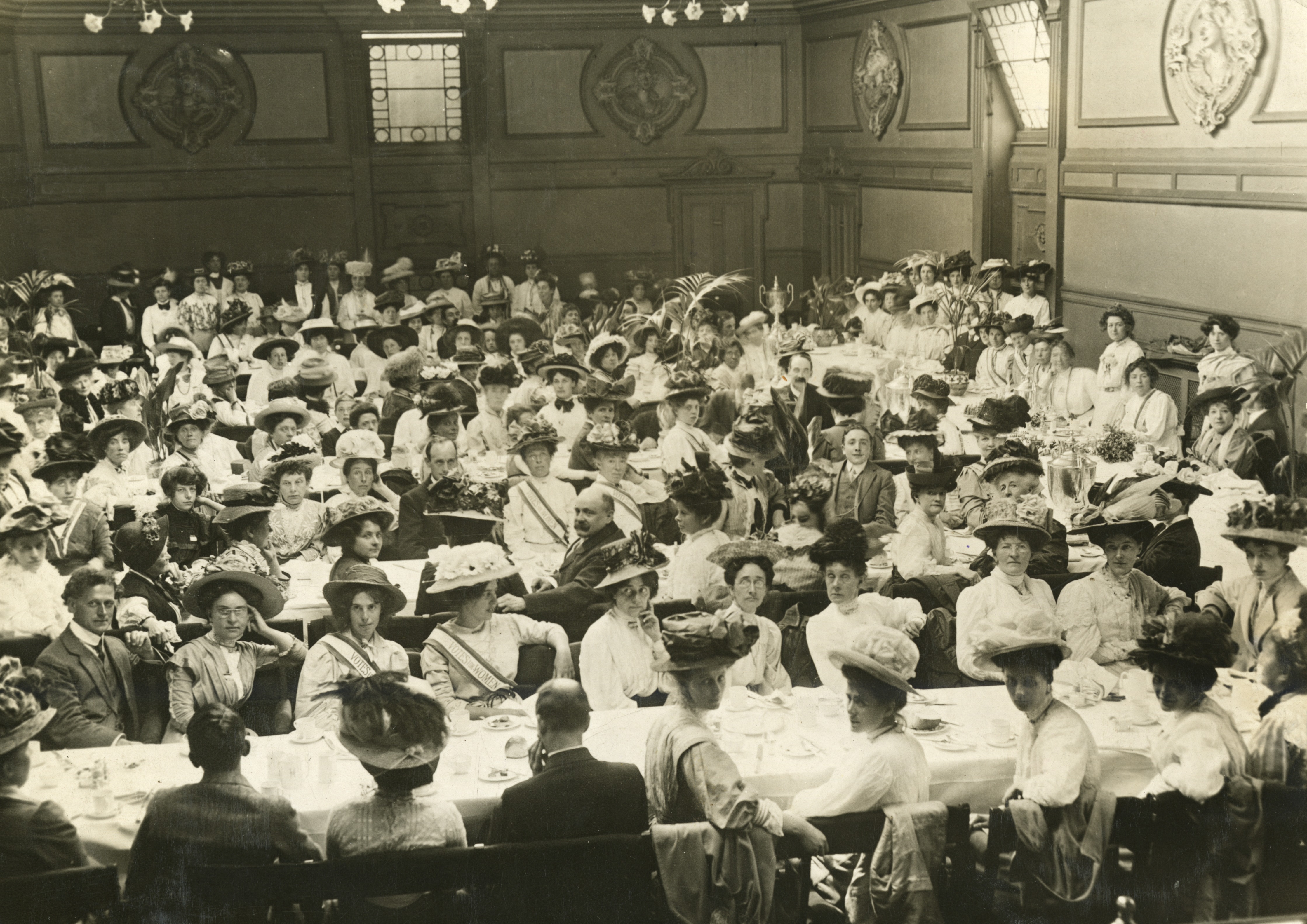
WSPU Breakfast celebrating the release of Edith New and Mary Leigh from Holloway Prison, held at the Queen’s Hall on 22 August 1908 (courtesy of LSE Library)
On 22 August 1908 Alice Singer had attended the WSPU breakfast honouring Edith New and Mary Leigh on their release from Holloway. For much more about Edith New do read the Spring 2013 edition of ‘Swindon Heritage’ – and in her entry in my The Women’s Suffrage Movement: a reference guide
There is a strong Antiques Roadshow connection linking Edith New and Alice Singer’s Suffragette Doll – for in 2011 a quantity of Edith’s suffragette memorabilia, now held in the Swindon Heritage Centre (see http://www.swindonheritage.com), was brought to the Roadshow when it visited Swindon. Coincidentally it was the Roadshow expert Hilary Kay who discussed this collection, as she had the Suffragette Doll a few years earlier.
In March 1912 Alice Singer was arrested after taking part in the WSPU window-smashing campaign. When arrested she had a hammer in her hand and when charged said of the windows, ‘I thought it was only one, they seemed like marble, not going to break.’ Alice had chosen to break three windows in the West Strand Telegraph Office, close to Trafalgar Square. Her family thought it appropriate that she, essentially law abiding and a respecter of property, should have chosen quasi-official premises, rather than privately-owned property.
Alice was remanded in Holloway until she appeared in court on 13 March. By now the Singers were living in Golders Green and a solicitor was organised by Mrs Lilian Hicks to represent the Hampstead women. Alice was charged under the Malicious Damage to Property Act and in court declared, ‘I only did it as a political protest. I admit I did it, but not for malice. I plead not guilty to malice.’ She agreed to be bound over – that is, not to commit any other such acts – for 12 months. Only one other woman also agreed to be bound over – all the other women (over 100 had been arrested) were sentenced to prison – their sentences varying but some repeat offenders getting as long as six months. Most of the other women were either single or with older families. Christabel was only 2 years old and I imagine Alice could not contemplate being away from home – in prison – for any length of time. The diary does not reveal any guilt at not opting for imprisonment.
Julius was very supportive while Alice was in prison – he visited her – but was kept waiting for 2 hours before seeing her for a short time ‘We forgot all we really wished to say in the fluster of the time limit and presence of wardresses..’
Alice Singer continued to work actively for the WSPU, in 1913 becoming treasurer of the Hendon and Golders Green branch. In November 1918 she was at last able to cast her first parliamentary vote – ‘I recorded for Mrs Edith How-Martyn for the new constituency of Hendon’. Edith How-Martyn, who had been a leader of the Women’s Freedom League, was standing as a Labour candidate but was unsuccessful.
The Suffragette Doll, treasured by Alice’s descendants, is silent testimony to her involvement in the ‘votes for women’ campaign and her indirect connection to Edith New, Swindon’s own suffragette.
Copyright
Suffrage Stories: Arson at Tunbridge Wells, April 1913
Posted by womanandhersphere in Collecting Suffrage, Suffrage Stories on April 15, 2013

The Nevill Pavilion, Tunbridge Wells, on the morning of 11 April 1913
On Friday 11 April 1913 Percy Lankester, one of Tunbridge Wells’ leading photographers, forsook his studio at 38 High Street and, on a day as cold as that 100 years later, set off with his camera for the Nevill Cricket Ground, a brisk 15 minute walk away.
He was on his way to photograph a scene very different from his usual views of the elegant and harmonious streets of Tunbridge Wells. For what he recorded, from several different angles, was the all-but destruction of the cricket pavilion – and the complete destruction of the club’s archives. Percy Lankester published his photographs of the ruined Nevill Pavilion as postcards, souvenirs of one incident in Tunbridge Well’s history.
The arson attack was ascribed to the action of militant suffragettes – although no-one was ever held responsible. With Mrs Pankhurst on hunger strike in prison, April 1913 saw an intensifying in the WSPU campaign of protest – with arson becoming an increasingly popular weapon. The Nevill Pavilion was one of the first casualties in this new stage in the long fight for ‘votes for women’.
The above photograph is one of the postcards published by Percy Lankester- and I have it in stock at the moment. It has never been posted and – 100 years old – is in fine condition and, a crisp and clear image, is a tribute to Mr Lankester’s photographic skills. NOW SOLD
Other arson attacks -on churches, houses, railway stations etc – were recorded in other localities by other photographers – who then issued the result, as did Mr Lankester, on a photographic postcard. Such scenes make an interesting sub-genre for the collector of suffragette postcards.
Suffrage Stories/Suffragette Jewellery: Mary Leigh’s Emily Wilding Davison Brooch
Posted by womanandhersphere in Collecting Suffrage, Suffrage Stories on February 18, 2013
 This circular brooch, containing a photograph of Emily Wilding Davison in academic dress, formerly belonged to her friend and champion, Mary Leigh. The photograph of Emily Wilding Davison (for the photographer/publisher of the postcard see here) is rather worn and has a little ink scribble on it – though what the intention – if any – of this is, I cannot say.
The photo is held in the brooch frame by a card showing Sylvia Pankhurst’s WSPU design, in purple, white and green, of ‘the sower’. This may originally been a component in a WSPU badge. Written on it in capital letters, in Mary Leigh’s idiosyncratic style, is ‘LIBERTY. NO SURRENDER. E.W.D.’.
This is a piece that, unlike so much else on the market, clearly merits the description ‘suffragette jewellery’. I do not think that this commemoration photo of Emily Wilding Davison was issued by the WSPU in this particular style of circular brooch, but suspect that Mary Leigh herself put the photo in it. The brooch is edged with alternating little pink and white stones. It is worth noting that Mary Leigh, even with her close acquaintance with WSPU imagery and branding, did not bother to select or commission a brooch with stones reflecting more closely the WSPU colours.
Suffragette Autograph Album To Be Auctioned: Save It For The Nation – And Future Researchers
Posted by womanandhersphere in Collecting Suffrage on December 8, 2012
A very interesting autograph album is to be auctioned by Dominic Winter Auctions on Wednesday, 12 December 2012. How I wish it would be bought by a British library or museum so that all researchers would have access to it. It would be an ideal fit in the collections of either the Museum of London or the Women’s Library. Neither, alas, are likely to be bidding. Is there any other institution that could come to the rescue?
Below is the entry from the Dominic Winter catalogue.
 Lot 380* Suffragettes. A rare and historically important autograph album containing approx. fifty autographs of suffragettes and sympathisers, 1909 and later, but many dated from the time of the WSPU’s second window-breaking campaign, March/May 1912, the majority signed below quotations and epithets relating to the cause, written mostly in pen and occasionally pencil and inscribed to thirty-four leaves (mostly rectos) with some leaves blank, prisoner (?) pencil number 94472186/3 to front free endpaper, contemp. cloth, rubbed and soiled, oblong small 8vo, 11 x 14.5 cm, together with an Edwardian 9ct gold circular locket, engraved with initials M.E.P. within a shield cartouche amongst foliate scrolls, enclosing two colour portrait photographs of a lady (possibly wearing this locket) and a gentlemen of similar age and social status, Birmingham, 1905, suspended on a 9ct gold belcher link chain, plus an Edwardian 9ct rose gold bar brooch, set with a facet cut blue stone within pierced wavy gold mount, stamped ‘9ct’, 8cm wide with gold safety chain, plus a vignette b&w photo postcard portrait (cut down), showing an unidentified woman and on the verso the same identification number (94472186) as the autograph album, all included in an early 20th-century Mackintosh’s rectangular toffee tin, lid embossed with heraldic knights, sides with geometric scrolls, base printed with retailer’s logo and ‘John Mackintosh & Sons Limited, Toffee Town, Halifax, Eng’, 15 x 23 x 6 cm
In order, the autographs are as follows, (names in bold are given separate biographical entries in Elizabeth Crawford, ‘The Women’s Suffrage Movement: A Reference Guide 1866-1928’: Emily Redfern, 8th December 1909; Adeline Redfern Wilde, 18th March 1911; J. L. Guthrie (Laura Grey), quotation by Robert Louis Stevenson in pencil, and possibly not in Guthrie’s hand as her name was Joan Baillie Guthrie; Charlotte Despard, 22 October 1911; Emily Diederichs Duval; Sarah Benett, in pencil, 2 March 1912; Janet A. Boyd, in blue pencil; E. Sylvia Pankhurst, ‘Bravely and willingly we bear our share of the world’s burdens. Why then deny us the right to vote which would dignify our labour and increase our power of service?’, below which Pankhurst family friend George Bernard Shaw has inscribed: ‘Ungrateful Sylvia! Did I ever deny it?, Hanley, 15/2/11; Helen A. Archdale, 2nd March 1912; Jennie (?)Itenmy; M. Violet Aitken, Holloway Prison, 6th March 1912; Dorothea Benson, Holloway Prison, 1st March 1912; Anna F. Hutchinson, Bow Street, 6th March 1912 (and details of three previous imprisonments at Holloway); Kitty Marion, Bow Street Station, 6th March 1912; Vera Wentworth, 6th March 1912; Ethel Haslam, 6th March 1912; Janie Tererro, in pencil; Isabella J. A. Casey; Olive Fargus, window breaker, 1st March 1912; L. Caron (?), Winson Green Prison, 1st May 1912; Winifrid Bray, May Day, 1912, Birmingham Prison; Hilda Burkitt, Winson Green, 1909 (one month), Holloway, March 1912 (4 months); Elizabeth Redfern; Clara Giveen, Birmingham Prison, 1st May 1912; V[iolet] H. Friedlaender, Winson Green Prison, 1st May 1912; a further autograph of V. H. Friedlaender to verso of the same leaf with a previously published poem titled ‘The Road’ written in her holograph noting it was published in ‘Votes for Women’ on 19th August 1910 and set to music in the Fabian Songbook, 1912; L. Archibald, Winson Green, May 1912; John Watts; W. Leonard Page; Josiah C. Wedgwood, 9th December 1923; G. M. Cook, Winson Green Prison, 28th April 1912; Cynthia Mosley; Florence Ward, Winson Green, 1st May 1912; Kathleen O’Kell, Birmingham, 1st May 1912; Cicely Neale; Olive Wharry, Winson Green, Birmingham, 1912; Edith M. (?) Begbie, Winson Green, 1st May 1912; Janet Green, in pencil, Winson Green Prison, April 1912; Evelyn Hudleston, Winson Green, March 1912, Charlotte Blacklock, Birmingham Prison, 1st May 1912, with V. H. Friedlaender initialled pencil riposte below; Alice Farmer, 1st May 1912, Emma Bowen; Caroline L. Downing; Aida Knott; Fred J. Kepple, 28 February 1924; Norah Kathleen Lackey, Birmingham Prison, 1st May 1912; Constance Bryer, 2nd May 1912, Birmingham Prison (4 months); Madeleine Caron Rock (in pencil), DX.1.30, March 1912; Hugh Graeme Topping.
Following a WSPU window-breaking campaign on 21 November 1911, some 220 women and three men were arrested, about 150 of whom were given short sentences of imprisonment. Subsequently, Lloyd George joined Herbert Asquith in opposition to women’s suffrage furthering outrage among the suffragettes. Mrs Pankhurst told members of the WSPU that ‘the argument of the broken pane of glass is the most valuable argument in modern politics’. A protest planned to take place in Parliament Square on 4 March 1912 was pre-empted when, without warning on 1 March 150 women armed with hammers and instructions as to their timing and use, broke shop and office windows in London’s West End causing an estimated £6,600 worth of damage. This time around 220 arrests were made and sentences of up to six months handed out. The sheer number of imprisoned suffragettes caused disruption to the prison service with an overflow from Holloway being dispersed to Aylesbury and Winson Green in Birmingham. On 5 April the members held in Aylesbury went on hunger strike and were quickly followed by members in London and Birmingham, including members noted here. This led to the contentious force feeding of hunger strikers, and a year later the ‘Cat and Mouse Act’, where weakened prisoners were released to recover and immediately arrested again upon any further wrong-doing.
Provenance: The tin with contents originally come from a house in Stoke-on-Trent, but the identity (or identities) of the owner of the locket, the woman in the photograph and the owner of the album have not been established. The most likely suggestion is that the autograph album was compiled by one or other of the Redfern sisters. Adeline, Elizabeth and Emily (whose rallying call begins the album) were the daughters of Frederick and Elizabeth Redfern of Hanley, Stoke. (George Bernard Shaw signed the album in Hanley while there lecturing on the ‘Ideals of Socialism’ in February 1911). The sisters were all active in the Birmingham area and Adeline Redfern-Wilde founded the Stoke-on-Trent WSPU in 1908. The last autograph page in the album has a pencil note: ‘Left Stoke for Birmingham October 16th 1919’. The journal ‘Votes for Women’ (15 March 1912, pp. 380-81) gives details of some of court cases at Bow Street on 7 March, noting several of the names above including Adelaide (sic) Redfern Wilde: ‘charged with breaking windows value £20 at 129, New Bond Street, said: “It was one more blow for freedom”. She was committed for trial.’
(5)
£3000-5000
Collecting Suffrage: The WSPU Holloway Brooch
Posted by womanandhersphere in Collecting Suffrage on October 19, 2012
This is the ‘Holloway Brooch’ presented to members of the Women’s Social and Political Union who had undergone imprisonment. As such it is now a very desirable addition to any suffrage collection. If you are hoping to own one of your own, I have one for sale – see https://wp.me/p2AEiO-1CV
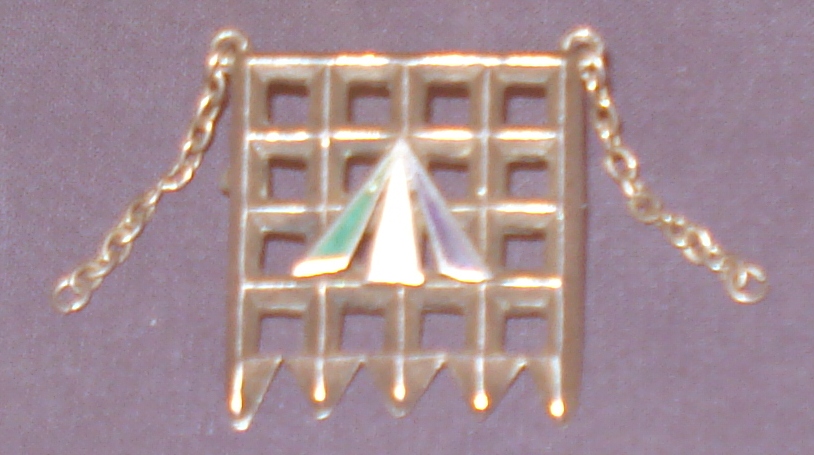
The first presentation of the brooches took place at a mass demonstration organised by the WSPU in the Albert Hall on 29 April 1909. It was held to coincide with the meeting in London of the International Woman Suffrage Alliance. The presence on the platform of a large number of ex-WSPU prisoners and,to honour their sacrifice, the ceremonial presentation to them of the first ‘Holloway’ brooches was designed to make an international impression.
The brooch was designed by Sylvia Pankhurst. The portcullis symbol of the House of Commons, the gate and hanging chains are in silver, and the superimposed broad arrow (the convict symbol) is in purple, white and green enamel. Some of the brooches, but by no means all, are marked with dates of imprisonment.
The brooch was first mentioned in Votes for Women, the WSPU newspaper, in the issue of 16 April 1909, described as ‘the Victoria Cross of the Union’. However, in April 1909 WSPU prisoners had not yet begun using the hunger strike as a tool in their battle with the authorities. In recognition of that, which was considered the greater sacrifice, the WSPU instituted the hunger strike medal, the first of which was presented four months later.
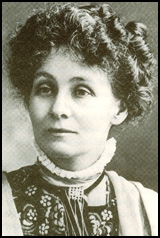 Mrs Pankhurst chose to be photographed wearing her ‘Holloway’ brooch in this photograph- as, 65 years later, did the elderly suffragettes, Leonora Cohen and Grace Roe . The latter two, like many other women, had received both of the WSPU accolades.
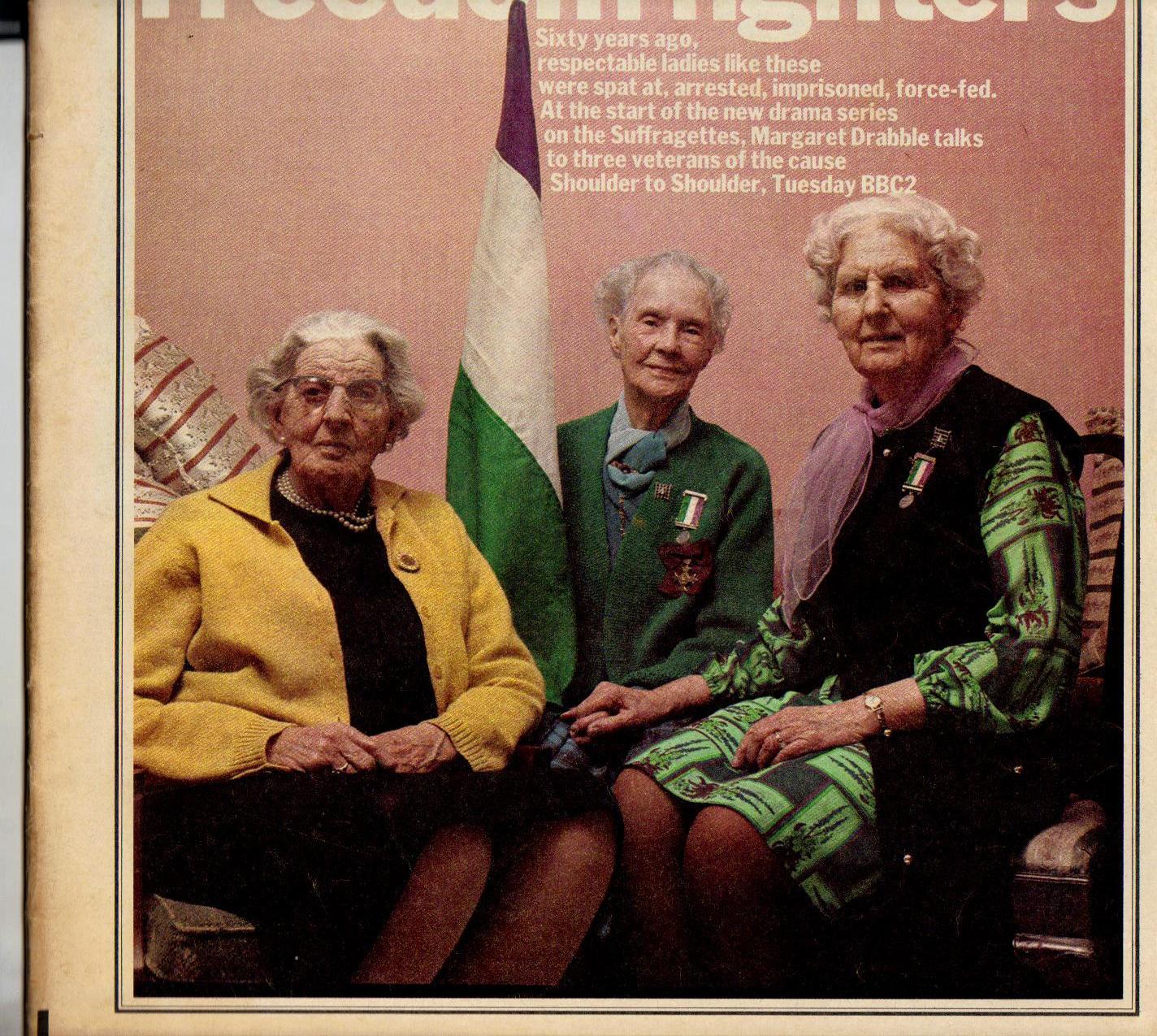
Collecting Suffrage: Emily Wilding Davison’s Funeral Programme
Posted by womanandhersphere in Collecting Suffrage on October 4, 2012
Official Programme for Emily WIlding Davison’s Funeral Procession
For the last 100 years the strange death of Emily Wilding Davison has transfixed the public. It is likely to be the one thing that the ‘man – or woman – in the street’ knows about the suffragette movement. Bizarrely the last seconds of her conscious life are still with us –growing in impact as the internet allows everyone to view footage of film that was in the past relatively difficult to access. In this piece by Andrew Marr the BBC has worked its wonders on the Pathé News original, allowing us to see details that the passing years had blurred. I have always wondered if it was by chance that she chose to position herself alongside a section of the Derby racecourse that was in full view of the film camera. The camera was mounted on a stand and would have been clearly visible. However the camera was, presumably, positioned there in order to capture pictures of the horses entering the final straight and Emily Davison may have chosen to be there for the very same reason.
With the 100th anniversary less than a year away media attention is mounting. All material related to Emily Wilding Davison’s funeral is scarce – and very collectable – however one of the scarcest is the 4-page ‘Official Programme, Timetable and Route of the Funeral Procession, Saturday June 14th 1913.
I must say that I do find it rather odd that this item should be so very scarce for, as you can see from film and photographs, the streets of London were packed on the day. The hordes must have failed to arm themselves with the Programme or, if they did, to have then discarded it.
Inside pages of the programme for Emily Davison’s funeral procession
In Campaigning for the Vote, Kate Frye, who followed the procession through Piccadilly to Bloomsbury and then on to Kings Cross, in her long diary entry comments on the vastness of the crowd. But even she, who was an inveterate hoarder of suffrage memorabilia, does not seem to have acquired a copy of the Funeral Procession Programme. The result is that, in nearly 30 years of dealing in suffrage artefacts, I have only seen one copy of this item for sale. In fact, if a spate of them were now to hit the market, I shall be very suspicious!
Back cover of the Emily Davison funeral procession
Collecting Suffrage: The Game of ‘Suffragette’
Posted by womanandhersphere in Collecting Suffrage on September 17, 2012
I will shortly be issuing a new book and ephemera catalogue – number 175. It will comprise books and ephemera by and about women – with special sections on Women’s Suffrage and Women in the First World War. If you would like a copy of the printed or email version please let me know. A short time after these have been sent out, I shall post the catalogue on this website.

The Rules of the Game. ‘The Haunted House’ appears on the reverse of every card
Amongst several rare items that I shall be including in the ‘Women’s Suffrage’ section is ‘The Game of “Suffragette”‘.
This card game was invented by the Kensington branch of the WSPU, probably in the late summer of 1907, and, as such, is, I think, the earliest of the games that were marketed as a tool of suffragette propaganda. It was described in the second issue of ‘Votes for Women’, November 1907.
The first issue of ‘Votes for Women’, October 1907, had on its cover the picture of the ‘Haunted House’ by David Wilson, which had first appeared in the ‘Daily Chronicle’ in April 1907. Depicting a seated woman brooding over the Houses of Parliament, a demand for ‘Votes for Women’ in her hand, this image appears on the reverse of every card in this game – and on the base of the box. David Wilson (1873-1935) was an Irish-born illustrator, soon to become chief cartoonist for ‘The Graphic’.
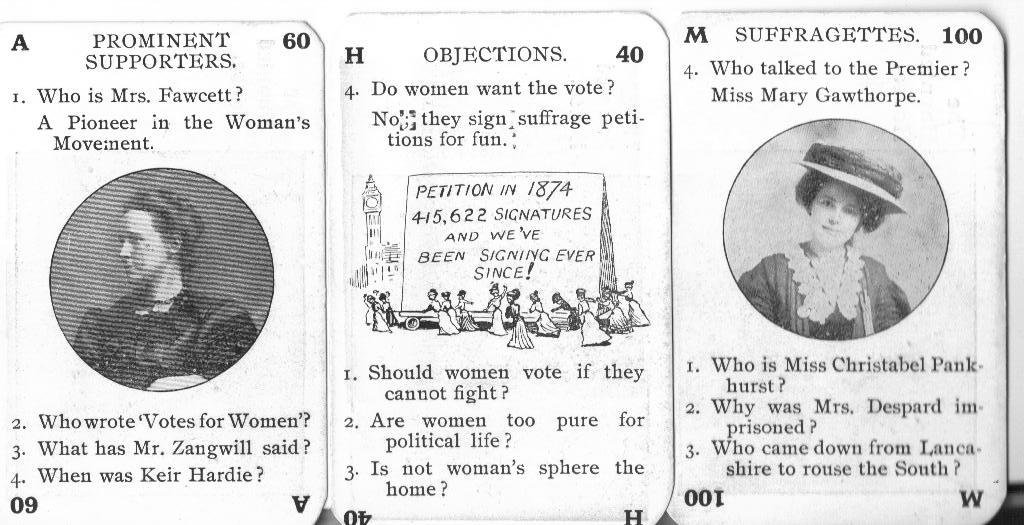 The game comprises 54 cards (all present) divided into 13 sets of 4 cards each – one of the odd ones being known as ‘The Bill’ – and the other a spare which has been used to record the score of a game played long ago by 6 people, designated by their initials. All the sets have names: eg. Prominent Supporters, Arguments, Freewomen, Voteless Women etc – and each card poses a series of questions. Some of the cards also carry photographs – of Christabel Pankhurst, Annie Kenney, Mrs Fawcett, Elizabeth Robins, Israel Zangwill, and Mary Gawthorpe.
Along with the cards – and the original box – is the original, all-important, set of rules. These describe in detail the various ways in which the game can be played – it seems very inventive.
This is an incredibly scarce item. Although I wrote of it in The Women’s Suffrage Movement: a reference guide, this is the first set I have ever seen. An amazing survival.
Book of the Week: A Nest of Suffragettes in Somerset
Posted by womanandhersphere in Book of the Week, Collecting Suffrage on September 12, 2012
A Nest of Suffragettes in Somerset: Eagle House, Batheaston by B.M. Willmott Dobbie for The Batheaston Society, 1979. Soft covers – very good condition (with a newspaper cutting of an obituary of Bristol suffragette, Victoria Lidiard, laid in). £26 (plus postage) For sale – from my stock of books and ephemera about the suffrage movement. To buy – email e.crawford@sphere20.freeserve.co.uk
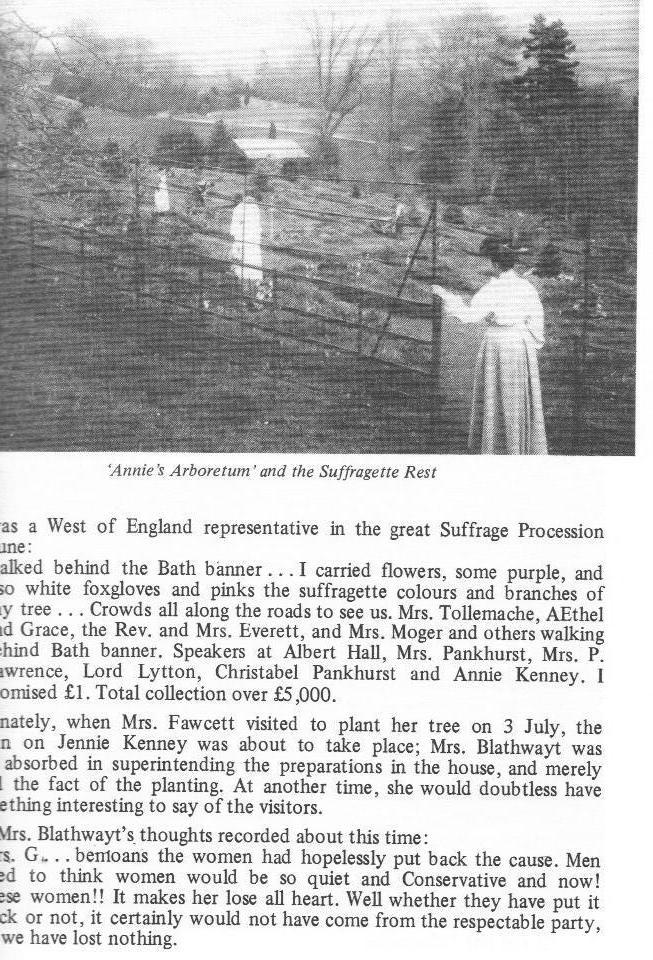
‘Annie’s Arboretuem’ and the Suffragette Rest
The story of the Blathwayt family – Col Linley Blathwayt, his wife Emily and daughter Mary -who lived at Eagle House, Batheaston, where for some years they offered a haven to WSPU activists. Annie Kenney – and her sisters – were particular favourites.
Col Blathwayt organised the planting of trees to commemorate visits by both suffragists and suffragettes – such as Lady Constance Lytton.
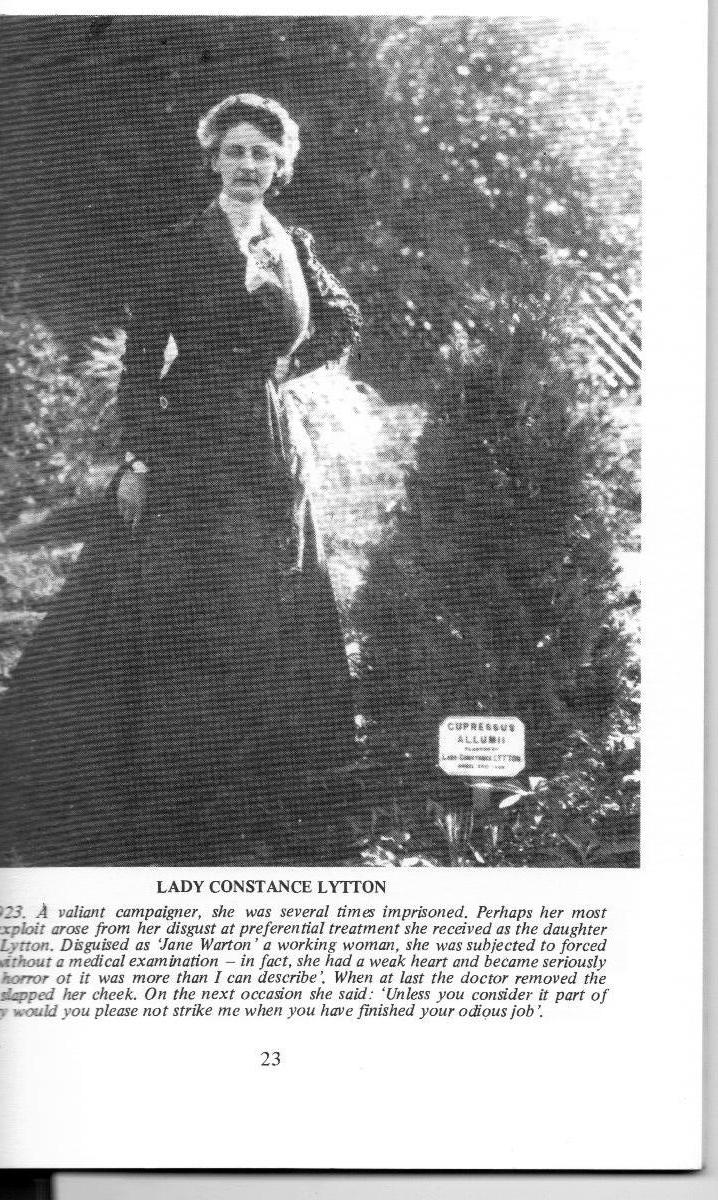
Lady Constance Lytton photographed by Col Blathwayt
‘Annie’s Arboreteum’ and ‘Pankhurst Pond’ were just two of the features created on the estate. Col Blathwayt was a keen photographer and many of the photographs he took of visiting suffragettes are included in this book. The text includes extracts from the diaries that the Blathwayts kept and which provide us with such a disingenuous view of some of the leading suffragette personalities
For more about Eagle House (and a little about Rose Lamartine Yates and Dorset Hall, Merton, of whom, coincidentally, I wrote in yesterday’s post) see here. For ‘Suffragettes in Bath’ see here. The diaries of Col. Blathwayt, Mrs Emily Blathwayt, and dear Mary Blathwayt, who I describe in the Women’s Suffrage Movement: a reference guide, as the ‘Mr Pooter of the suffrage movement’, are held in Gloucestershire Archives.
Suffrage Stories: Suffragettes and Tea Rooms: Suffragette Tea from Suffragette China
Posted by womanandhersphere in Collecting Suffrage, Suffrage Stories on September 11, 2012
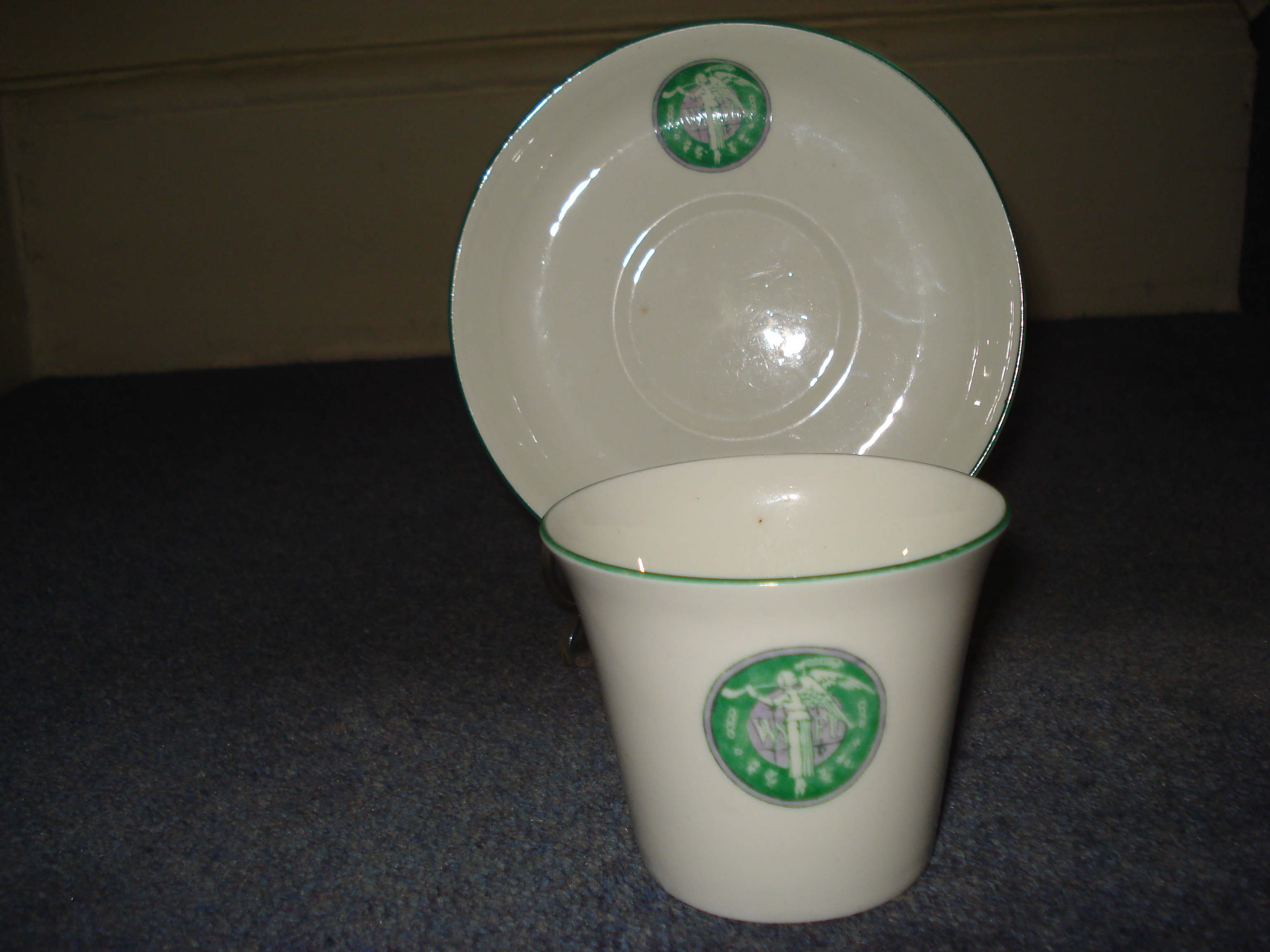 WSPU china – ‘Angel of Freedom’ design, 1909
A week of posts on ‘Suffragettes and Tea Rooms’ cannot end without looking at the tea rooms that the suffragette societies themselves ran – in their shops and at their fund-raising bazaars – and the china they commissioned in which to serve that tea .
The best known of the fund-raising events is probably the WSPU exhibition held at the Prince’s Skating Rink at Knightsbridge in May 1909. There the tea room was run by Mrs Henrietta Lowy, with help from her four daughters and another young upper-class suffragette, Una Dugdale. In the spirit of exuberance and professionalism that marked this the first of the WSPU’s fund-raising bazaars, a decision was taken – presumably reasonably well in advance of the Exhibition – to commission a Staffordshire pottery – H.M. Williamson of Longton – to make the china from which the tea would be served in the Exhibition’s Tea Room.
The white china has strikingly clean, straight lines, rimmed in dark green and with angular green handles. The shape is, I am sure, a Williamson standard – but how very different the WSPU pieces look from, say, Williamson’s Rosary design–in which pink and grey ribbons and roses are applied to the same shape and every edge is gilded. In contrast, the WSPU china design is pared back, almost stark.
It is more than likely that, from the range offered by Williamson, Sylvia Pankhurst chose this shape, keeping the design simple so that the ‘angel of freedom’ motif that she had designed specifically for the Exhibition should be shown to best effect. Each piece of the tea service carries this motif; behind the angel and accompanying banner and trumpet, are the initials ‘WSPU’ set against dark prison bars, surrounded by thistle, shamrock, rose – and dangling chains. At the end of the Exhibition, the china – tea pots, cups, saucers, tea plates, sugar bowls etc – was offered for sale, made up into sets of 22 pieces. Many years ago, early in my ephemera-dealing days I bought – and, of course, immediately sold – a comprehensive service. Although I have subsequently sold individual pieces of the china, I have never again seen such a complete set. Ah well.
Pieces of this design are held in archives such as the Museum of London and the Women’s Library – but one variation design is not, as far as I know, represented in any public collection.
 This cup – its design based on Sylvia Pankhurst’s ‘portcullis’ motif which, used on the WSPU’s ‘Holloway brooch’, can be dated to the spring of 1909 – came from a collection that also contained items of the ‘angel of freedom’ china. I bought this wonderful haul some years ago at auction and, although the provenance was not divulged by the auctioneer, I am pretty sure that the china had once been belonged to Mrs Rose Lamartine Yates who held fund-raising teas for the Wimbledon WSPU on the lawn of Dorset Hall, her 18th-century Merton house. This ‘portcullis’ cup does not carry any maker’s mark but, as the shape is identical to the Williamson pieces, I think we can be pretty certain that they probably also made this. As, in the early 19th-century, when women set their tea trays with ‘anti-slavery’ china, so in the early 20th, suffragettes who bought these tea services could – like Mrs Lamartine Yates – use them as propaganda tools -promoting the movement, most elegantly, in a bid to convert their ‘anti’ neighbours.
 I have only ever had in stock – and that only fleetingly – this cup and saucer (see left), part of the third identifiable range of WSPU-commissioned china. I believe, however, that the People’s Palace in Glasgow holds a similar two pieces . They formed part of the Scottish version of the Prince’s Rink tea service, commissioned from the Diamond China Co, another Longton pottery, for use at the refreshment stall at the Scottish WSPU Exhibition held in Glasgow at the end of April 1910. Here the ‘angel of freedom’ is allied, on white china, with the Scottish thistle, handpainted, in purple and green, inside transfer outlines. After the exhibition this china, too, was sold – Votes for Women, 18 May 1910, noting that ‘a breakfast set for two, 11s; small tea set 15s , whole tea set £2, or pieces may be had singly’. It will hardly surprise readers to learn that WSPU china – now so very rare – commands a very high price. But what a wonderful addition a piece would make to any suffrage collection.
Although the china they used was probably more basic, some of the shops and offices run by both suffragette and suffragist societies offered their members – and the general public – a tea room. For instance, the Birmingham NUWSS office at 10 Easy Row included a shop at which tea could be taken and suffrage papers read. And the Glasgow WFL shop, at 302 Sauchiehall Street, as befitting the city in which Miss Cranston perfected the art of the tea room, served tea in its ‘artistic hall’, decorated in the WFL colours. (By the way, when in Glasgow do not fail to visit the De Luxe Room in The Willow Tea Rooms, also on Sauchiehall Street, originally designed by Charles Rennie Mackintosh for Miss Cranston – it may be a reconstruction, but it’s lovely).
As a final thought, the WSPU not only sold their own china, but also their own tea – much advertised in Votes for Women. Unfortunately, the only reference I have ever come across to anyone buying the tea was an aside by Mary Blathwayt, who noted in her diary that she had had to return a bag that was ‘off’ to the Bath WSPU shop. But I am sure that merely reflects the fact that the hundreds of satisfied customers had no need to comment and I will end this sequence of posts by conjuring up the image of a WSPU tea party, cucumber sandwiches sitting delicately on the elegant WSPU plates, as the assembled company receive WSPU tea into their WSPU cups from the WSPU pot. How, then, could the ensuing conversation be of anything other than ‘Votes for Women’?
Suffrage Stories/Collecting Suffrage: Suffragette Jewellery
Posted by womanandhersphere in Collecting Suffrage, Suffrage Stories on August 27, 2012
 Pendant made for Margaret Murphy by Ernestine Mills
‘Prison to Citizenship’ – Three pendants earned by two Irish suffragettes
In previous posts I have mentioned how necessary it is to observe the provenance of an item of jewellery in order to be able to label it with certainty as ‘suffrage’. In that way the collector is less likely of falling into the trap of buying an item – vaguely Edwardian with vaguely purple, white and green stones – that an auction house or dealer has chosen to label ‘suffragette’ In this post I will bring to your attention three items of jewellery – made for two Dublin sisters – that are indisputably ‘suffrage’.
‘Margaret’ and ‘Jane Murphy’ were the pseudonyms of two middle-class women from Dublin – whose real names were Leila (b. 1887) and Rosalind Cadiz (b. 1886). They were members of the Irish Women’s Franchise League. They both took part in the window-smashing campaign in London in March 1912 and were sentenced to two months in Holloway. They went on hunger strike (c 16 April) and were forcibly fed. They were released c 15 May. The pendant above is engraved – “Holloway Prison No. 15474, Maggie Murphy, 2 months hard Labour, E.4 Cell.12., Hunger Strike 16th April 1912, Forcibly Fed – and was made by the suffragist and enameller, Ernestine Mills. As you can see the lily motif is rendered in purple, white and green – in this case a ‘true’ use of the colours.
 Margaret and Jane Murphy, top row far right and second from right, pictured in Votes for Women, 25 June 1912.
A couple of months later the Murphy sisters took part in the first window-smashing campaign in Dublin and were again sentenced to two months’ imprisonment – but in Dublin they were given the status of political prisoners.
Margaret Murphy requested to be treated by her own doctor, Kathleen Maguire, ‘as I am undergoing treatment owing to having been forcibly fed in Holloway,… Dr Maguire understands my constitution.’ To this the Medical Officer in Mountjoy replied (5 July 1912) ‘I beg to report that I regard her [Margaret Murphy] as a woman of neurotic temperament who suffers from indigestion, an ailment frequently complained of by women of this type.’
The Murphys eventually succeeded in not only getting a suffragist doctor, Kathleen Maguire, to treat them, but also in getting their own dentist. ‘Miss Jane Murphy will attend her own dentist at her own expense’ (July 1912).
The Murphys clearly had a way about them for ‘with reference to Margaret Murphy’s complaints of the possible effect of the whitewashed walls of her cell on her eyes, the governor agreed to have the walls recoloured, and to have a new gas burner fitted in lieu of the existing one, and her request for a special kind of disinfectant to be used in her cell was referred to the Medical Officer.’ 25 July 1912 Minutes of Mountjoy Prison.
Finally the sisters went on hunger strike for the last 92 hours of their sentence (along with 2 other Irish suffragettes) in sympathy with three English suffragettes (Mary Leigh, Gladys Evans and Jennie Baines) who had received harsh prison sentences in Dublin and who had not been given political prisoner status. The Murphys were not forcibly fed – the end of their sentence arriving before this became necessary. They were released, together, from Mountjoy Prison on 19 August, welcomed by members of the Irish Women’s Franchise League.
Here are the pendants that the sisters either commissioned for themselves or, more likely, with which they were presented after their release. Each pendant is of shield shape, surmounted by a green enamelled shamrock, hallmarked Dublin, Hopper and Hannay, 1912. One is engraved on the obverse “From Prison to Citizenship” and on reverse “J. Murphy 20.6.12 to 19.8.12” and the other “M. Murphy 20.6.12 to 19.8.12”. Thus do three items of jewellery commemorate the efforts of two Irish sisters to win ‘Votes for Women’.
Suffrage Stories/Collecting Suffrage: Mrs Pankhurst’s portrait
Posted by womanandhersphere in Collecting Suffrage, Suffrage Stories on August 13, 2012
In a previous post on Suffragette Jewellery I commented on the danger of assuming that any piece of jewellery that a dealer described as ‘suffragette’ had, in fact, anything to do with the suffragette movement. However it is still possible to discover items the provenance of which cannot be doubted.
Below is one such.
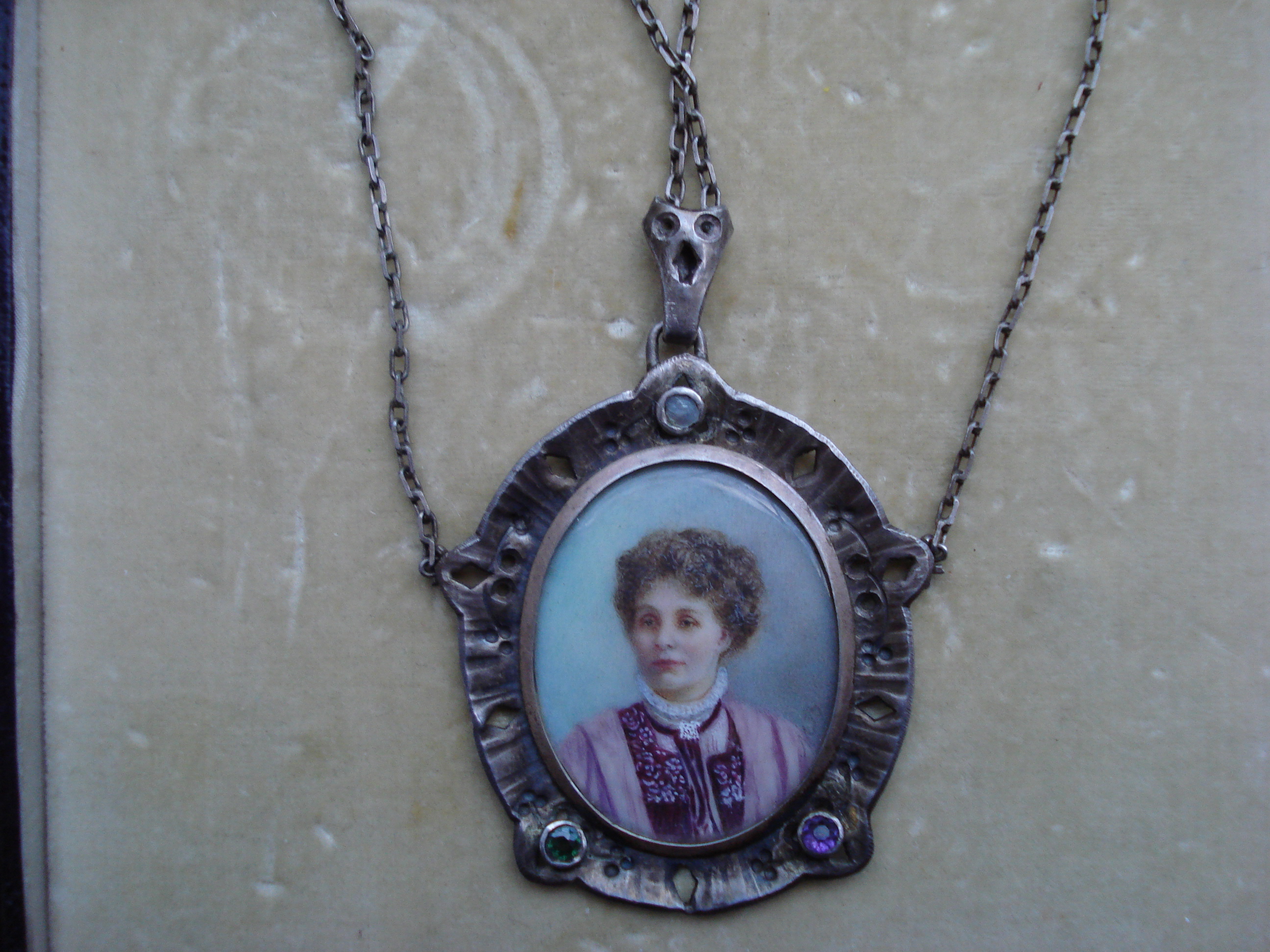
PENDANT – MRS PANKHURST – ICONIC PAINTED PORTRAIT MINIATURE -presented to Mary Leigh, leader of the WSPU Drum and Fife Band, devoted friend of Emily Wilding Davison, and ardent suffragette.
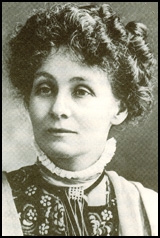
The image for this original painted miniature portrait of Mrs Pankhurst is derived from the photograph of her by the Kensington photographer, Martin Jacolette (see above). In it she is wearing a Holloway brooch, which dates the photograph to no earlier than April 1909.
The portrait miniature is very pleasingly painted and, although no artist’s signature is visible, I did wonder if it might not be by one of the Brackenbury sisters (Georgiana’s much later portrait of Mrs Pankhurst is in the National Portrait Gallery). The portrait is set in a metal pendant, on the back of which is inscribed ‘Presented to Mrs Marie Leigh Drum Major by the N.W.S.P.U. Drum and Fife Band in memory of her courageous fight for woman’s freedom December 1909’.
In the autumn of 1909 Mary Leigh had been forcibly fed while serving sentences in Winson Green and Strangeways prisons and in December an action for damages was brought on her behalf by the WSPU against the Home Secretary. The WSPU newspaper, Votes for Women, reported that, on 16 December 1909, ‘Ushered to the strains of “See the Conquering Hero Comes” , played by the WSPU Band, Mrs Leigh, the Drum Major received a royal welcome at St James’s Hall. Looking rather pale but as determined as ever, she delivered a stirring address.’ As Christabel Pankhurst, who was presiding, commented, ‘The Government did not know with whom they were dealing.’ The pendant was probably presented on this occasion.
The pendant, which has its original chain, has set around its edge three little stones – one white, one purple and one green. In this case the choice of stones clearly did have WSPU relevance. The pendant is in its original box – similar in material to that used for the hunger strike medals. Contemporary painted portraits of Mrs Pankhurst are exceedingly rare and with this particular provenance – unique. I have never seen another pendant like this, but wonder whether Mary Leigh was the only recipient of such an object. Might there be others waiting to be discovered?
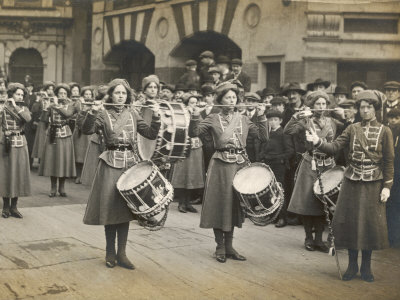
Collecting Suffrage: The Hunger Strike Medal
Posted by womanandhersphere in Collecting Suffrage on August 11, 2012
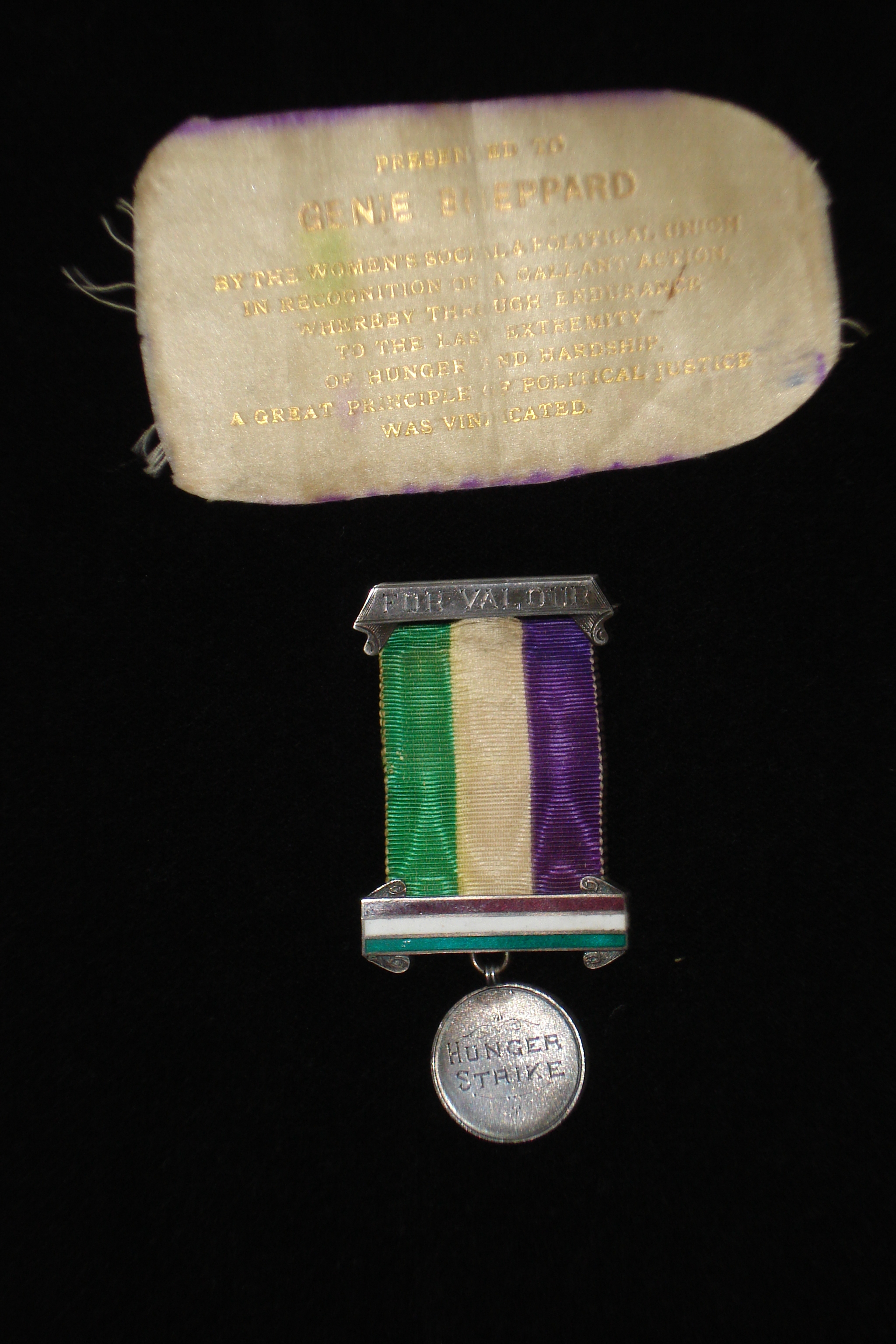 One of the most iconic items to add to a suffrage collection is a WSPU hunger-strike medal.
These medals were first presented by the WSPU at a ceremony in early August 1909, given to women who had gone on hunger strike while serving a prison sentence handed down as punishment for an act of suffrage militancy.
The medals comprise a silver pin bar engraved ‘For Valour’, a hanging length of ribbon in the purple, white and green colours, and either a silver or a striped enamel bar, from which hangs a silver circle with the name of the presentee on one side and ‘Hunger striker’ on the other. If the ribbon terminates in a silver bar, this is engraved with a date denoting the day of the owner’s arrest. The enamelled purple, white and green bars are engraved on the reverse, for example sculptor Edith Downing’s medal that I once sold is engraved with ‘Fed by Force 1/3/12’. This was the date of her imprisonment that resulted in a hunger strike and forcible feeding.
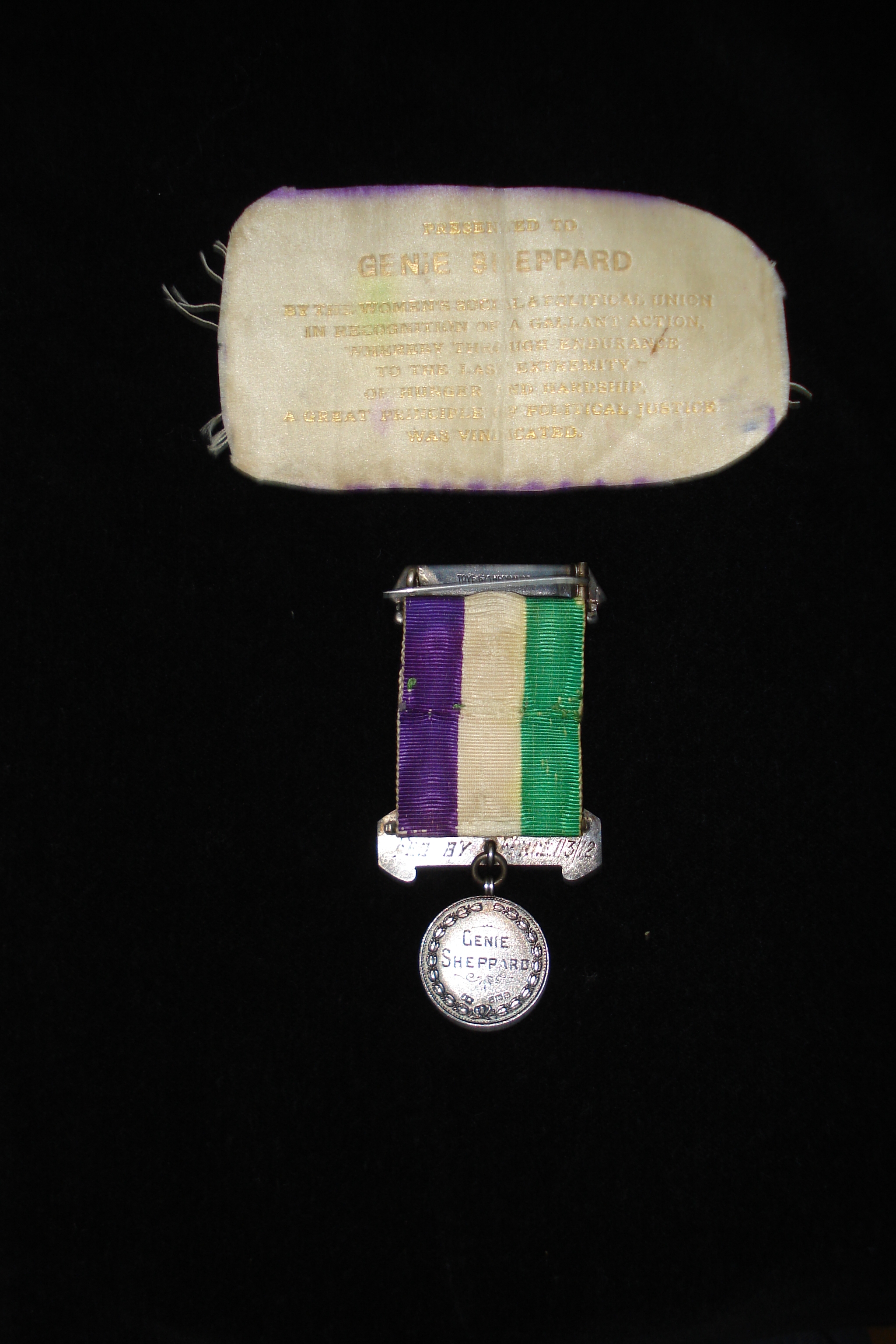
The reverse side of the medal
Some medals, such as the one Emily Wilding Davison is wearing in my 6 August ‘Suffrage Stories’ post, carry more than one bar, indicating multiple hungerstrikes.
Each medal was presented in a purple box, with a green velvet lining. As can be seen in the photograph, a piece of white silk that originally went inside the lid was printed in gold with: ‘Presented to [name] by the Women’s Social and Political Union in recognition of a gallant action, whereby through endurance to the last extremity of hunger and hardship a great principle of political justice was vindicated’.
These medals were made by Toye, a well-known Clerkenwell firm, and cost the WSPU £1 each – the medals now sell for thousands of pounds. They were treasured by their recipients who , in their old age, still proudly wore them on suffrage occasions; they are treasured today by collectors who recognise the bravery of the women to whom they were awarded.
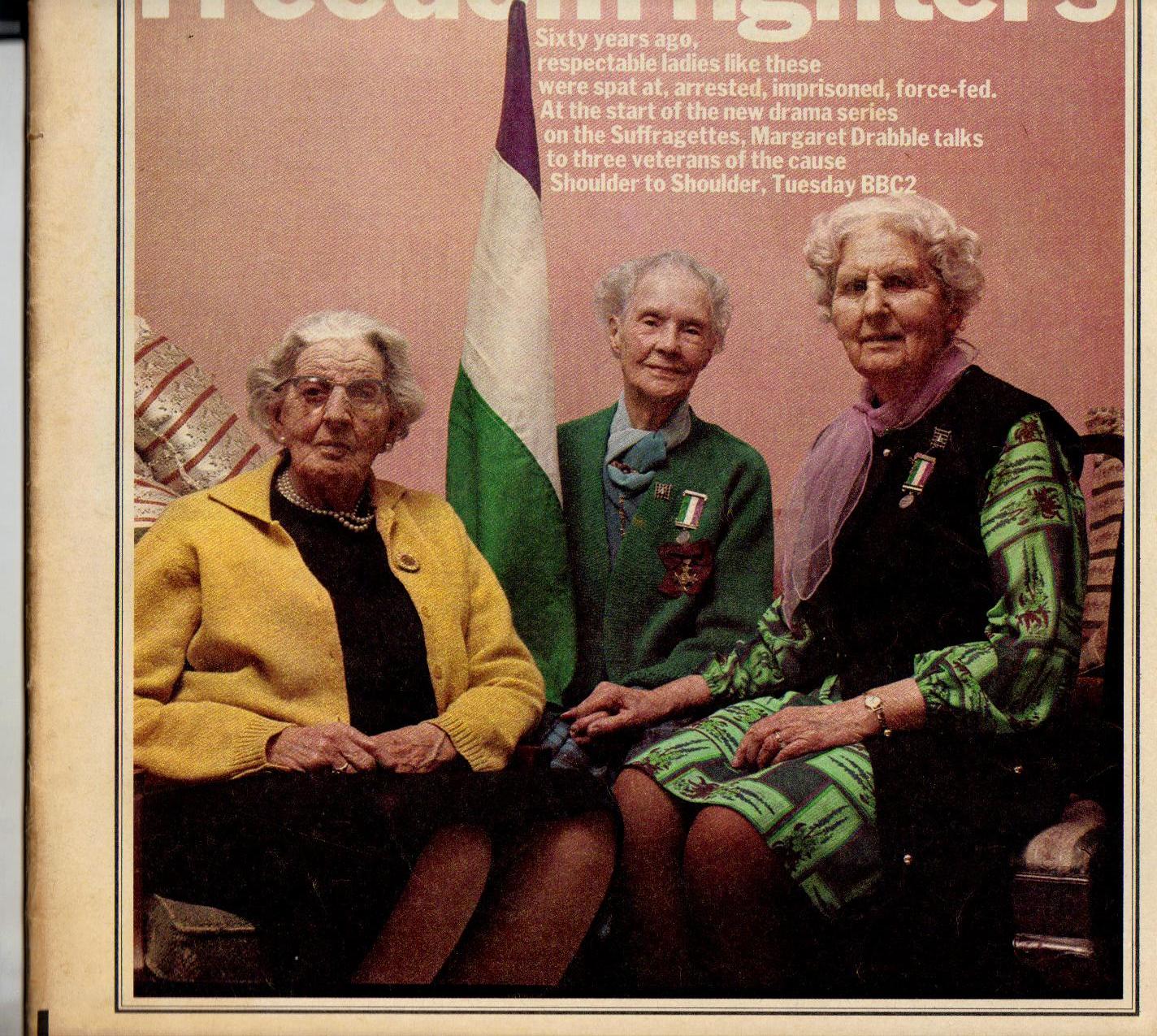
Grace Roe (right) and Leonora Cohen (centre)wearing their hunger strike medals in 1974
Collecting Suffrage: Punch cartoon: Ulysses and the Steam Sirens
Posted by womanandhersphere in Collecting Suffrage on August 10, 2012
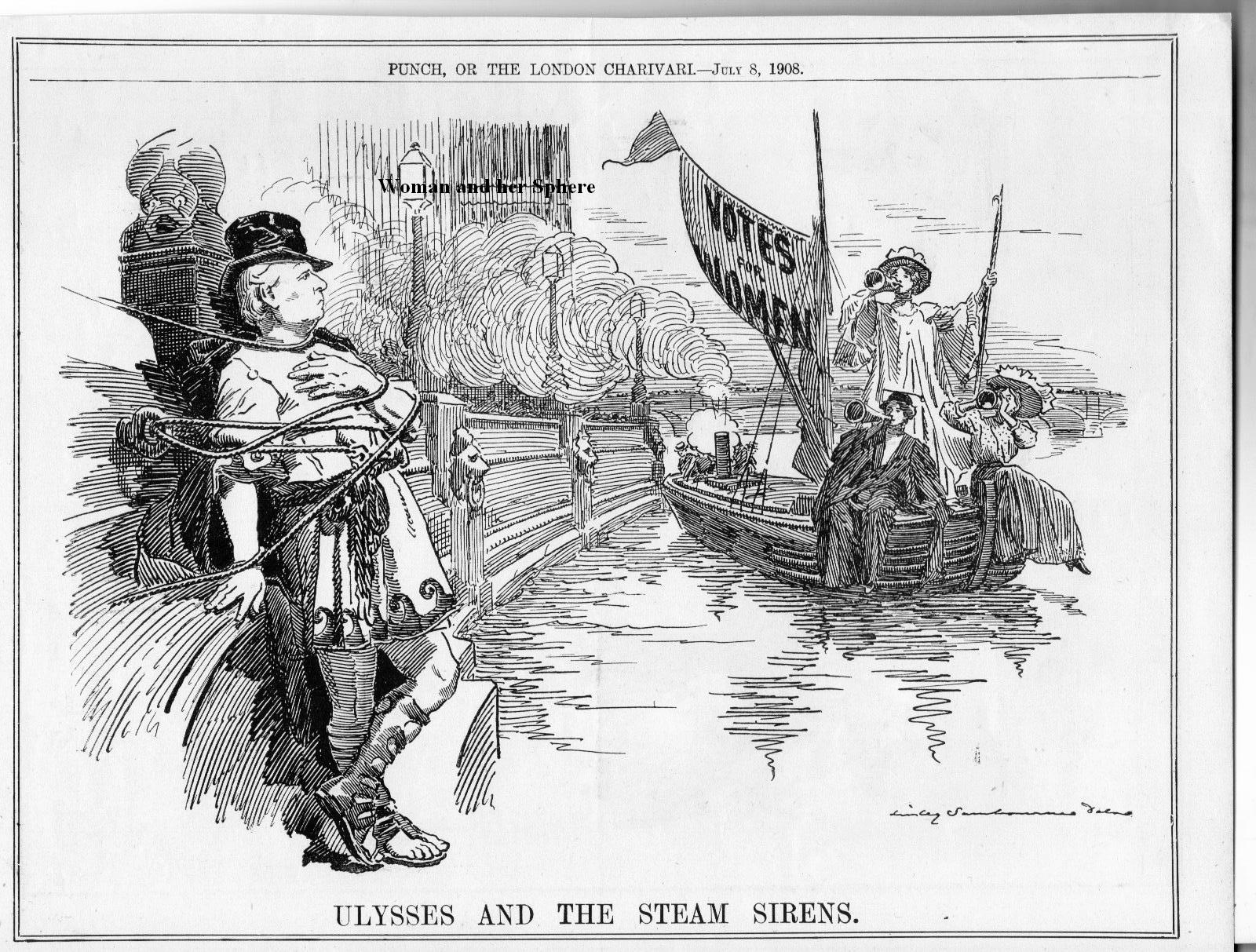 ULYSSES AND THE STEAM SIRENS -full page from 8 July 1908 issue of Punch.
Asquith is tied to the Embankment as a tug bearing suffragettes with loudhailers and a ‘Votes for Women’ saild approaches. The reference is to the boat the WSPU used to announce to the House of Commons, from the river, their forthcoming Hyde Park demonstration.
Very good condition – £12 post free. NOW SOLD
To buy contact e.crawford@sphere20.freeserve.co.uk
Collecting Suffrage: Belfort Bax, The Legal Subjection of Men
Posted by womanandhersphere in Collecting Suffrage on August 9, 2012
E. Belfort Bax, The Legal Subjection of Men, The New Age Press, new edition, 1908.
There have been few agitations in history which have been characterised by such hard lying and shameless perversions of fact as the so-called ‘Woman’s Movement’.. The ‘Woman’s rights’ (?) agitator has succeeded by a system of pure impudent, brazen, ‘bluff’, alternately of thh whimpering and the shrieking order, in inducing a credulous public to believe that in some mysterious way the female sex is groaning under the weight of the tyranny of him whom they are pleased to term ‘man the brute’. Bax, who wrote extensively on socialism, acknowledges the part played by an Irish barrister, now deceased, in the writing of this anti-suffrageist apologia. Together they set out all the legal advantages enjoyed by women – such as ‘the punishment of hanging has been practically abolished for women who murder mere men. If they murder some other woman or babies of some other woman it is quite a different thing. They are, however, exempt from hanging if they murder their own babies.’
Very good – 64pp – rebound in cloth – with original paper covers bound in. £28 plus postage.
To buy: contact e.crawford@sphere20.freeserve.co.uk
Collecting Suffrage: Punch cartoon
Posted by womanandhersphere in Collecting Suffrage on August 8, 2012
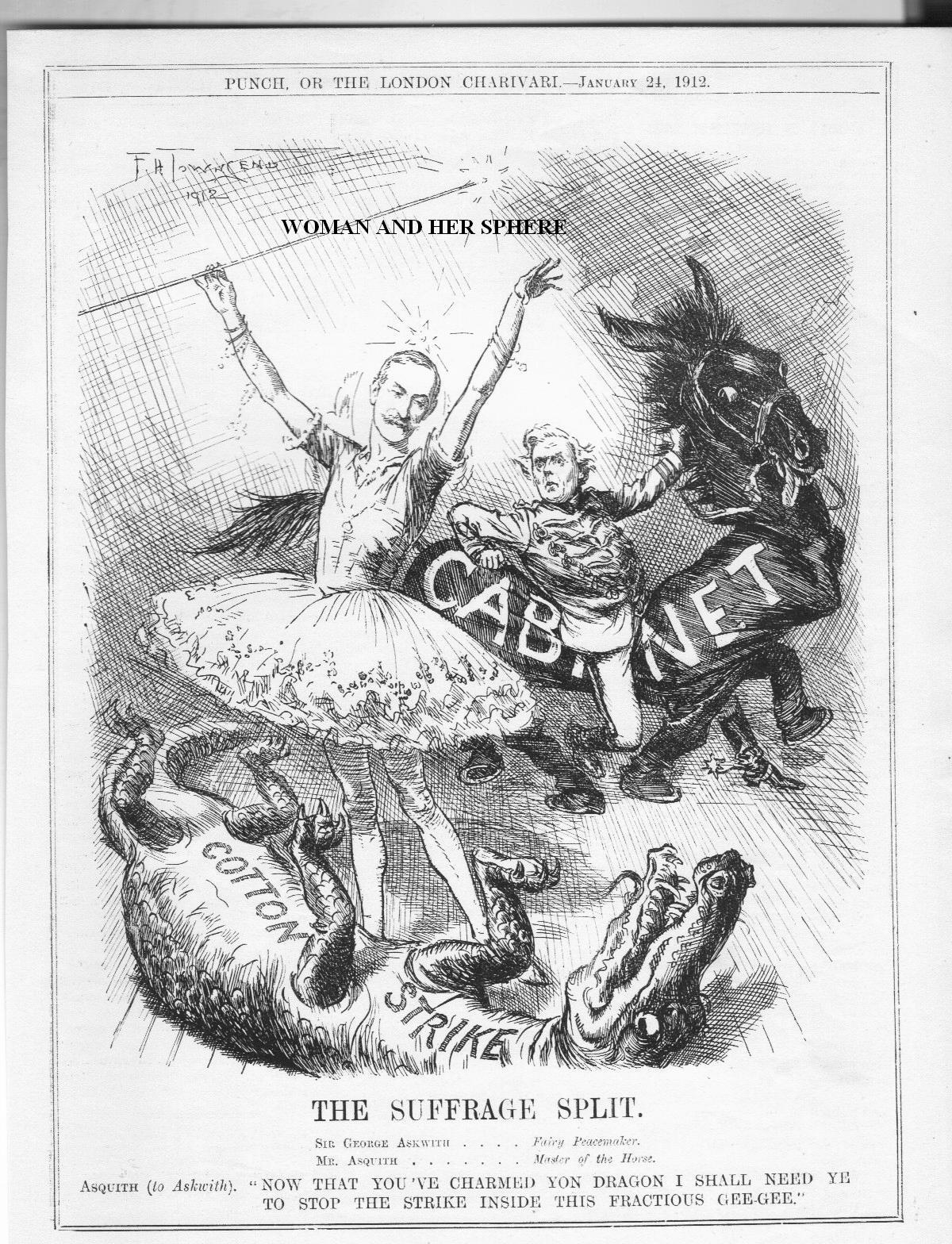 21 January 1912 – full page – ‘The Suffrage Split’. Sir George Askwith (the charismatic industrial conciliator), as ‘Fairy Peacemaker’, has tamed the dragon of the Cotton Strike – and Asquith, wrestling to keep a seat on the Cabinet horse turns to him ‘Now that you’ve charmed yon dragon I shall need ye to stop the strike inside this fractious gee-gee.’
In very good condition £10 plus £1 postage.
To buy contact: e.crawford@sphere20.freeserve.co.uk
Collecting Suffrage: Punch cartoon
Posted by womanandhersphere in Collecting Suffrage on August 7, 2012
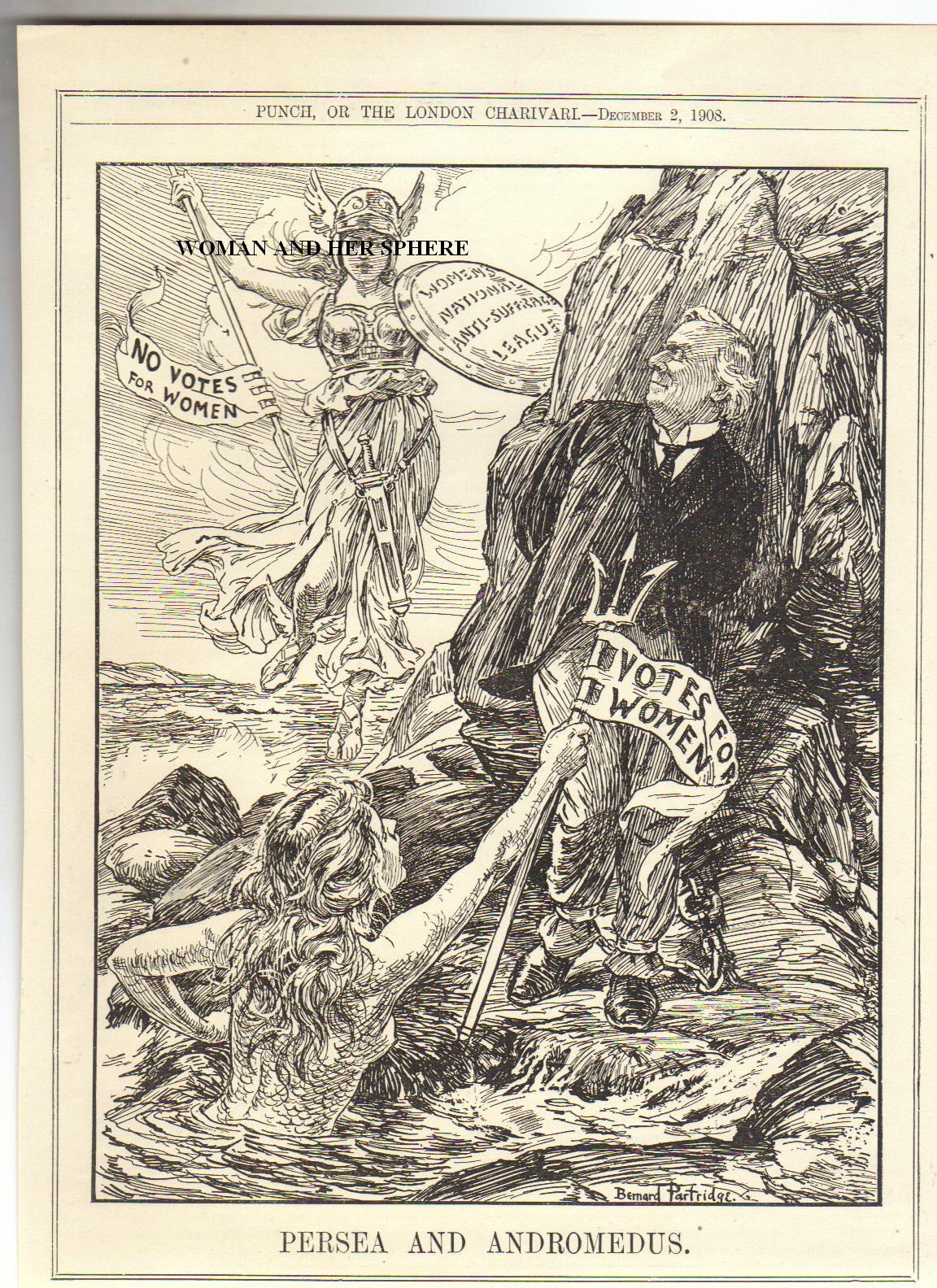 PUNCH CARTOOON – 2 December 1908 – a Bernard Partridge full-length illustration shows Asquith (Andromedus) chained to his rock – beset by the sea monster taunting him with her Votes for Women triton and searching for salvation from Persea – the Women’s National Anti-Suffrage League.
In very good condition £12 post free
To buy: contact e.crawford@sphere20.freeserve.co.uk
[The Women and her Sphere logo is not, of course, on the original]
Suffragette postcards: When Women Vote: Washing Day
Posted by womanandhersphere in Collecting Suffrage on August 6, 2012
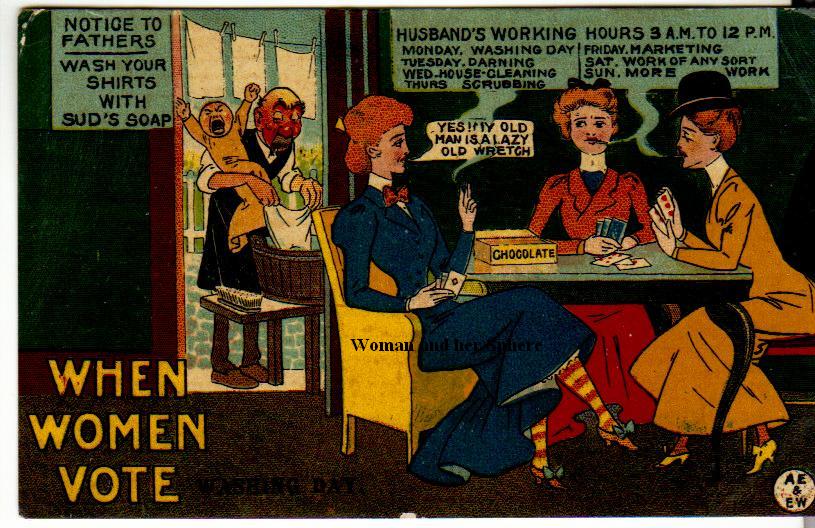 WHEN WOMEN VOTE
Father is in the kitchen bathing baby, while his wife and her friends sit in the parlour playing cards and eating chocolates – commenting ‘Yes, my old man is a lazy old wretch’.
And that’s what will happen when women have the vote.
The card was published by Mitchell & Watkins, who had been producing postcards – both topographical photographic and artist-drawn – from c 1906.
This card was posted – on 10 September 1907 – to Miss Ida Currell – who had been born in 1882 and was one of 4 surviving children of the 10 born to a Hertfordshire farmer and his wife. The Currells farm, at 2 Ware Road, Hertford, was called ‘The Chaplains’.
The card is in very good condition and is £45 post free.
To buy: contact e.crawford@sphere20.freeserve.co.uk
Suffragette Jewellery
Posted by womanandhersphere in Collecting Suffrage on August 4, 2012
 One of my bêtes noires is the misnaming of any vaguely Edwardian piece of jewellery that comprises stones approximating to some shade of purple (or pink or red), white and green as ‘suffragette’. I have long ago ceased remonstrating with reputable auction houses – they should know better. Ebay, of which one cannot expect very much, is, of course, rife with a lack of historical awareness.
While such pieces may be decorative and even of some intrinsic value, I would be very sorry if anyone paid over the odds for a piece of such jewellery thinking that they were buying an association with the suffrage movement. There are plenty of unscrupulous or ignorant dealers who peddle such notions. I think the term ‘suffragette jewellery’ should be reserved for pieces that have a provenance associated with a suffrage society or an individual who either made or wore it with ‘suffrage’ intent.
Above is an example of what I mean – a ‘true’ piece of suffragette jewellery – a silver and enamel pendant, bearing the ‘Angel of Freedom’ device designed in 1908 by Sylvia Pankhurst. I bought – and sold it – some years ago – and have never found another. As second best to owning the real thing, I have ever since used the image on my trade cards.
I will tell the stories of some other pieces of ‘true’ suffragette jewellery in future ‘Collecting Suffrage’ posts.
Here and here are two articles that attempt to demistify the subject of ‘suffragette jewellery’. Or you can read the entry on ‘Jewllery and Badges’ in my The Women’s Suffrage Movement: a reference guide.
Suffragette postcards: ‘Who said Votes for Women!!!’
Posted by womanandhersphere in Collecting Suffrage on August 3, 2012
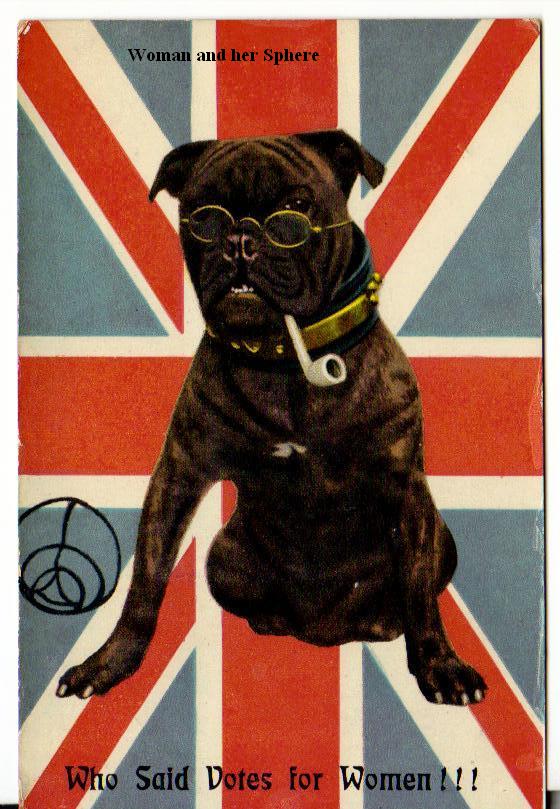 Very British Bulldog – with specs and a pipe – sits foursquare against a background of the Union Jack. It doesn’t look as though he would be interested in allowing women to vote.
The handwritten message on the reverse – from Will – begins ‘Dear Alf, I think the back of this card describers the question of the age.’ Good – posted from Cowes to Rotherhithe in February 1909.
In very good condition. £12 post free. [The ‘Woman and her Sphere’ logo does not, of course, appear on the original.]
To buy: contact e.crawford@sphere20.freeserve.co.uk
Collecting Suffrage: Victory 1918
Posted by womanandhersphere in Collecting Suffrage on August 2, 2012
Women Suffragists’ Celebrations
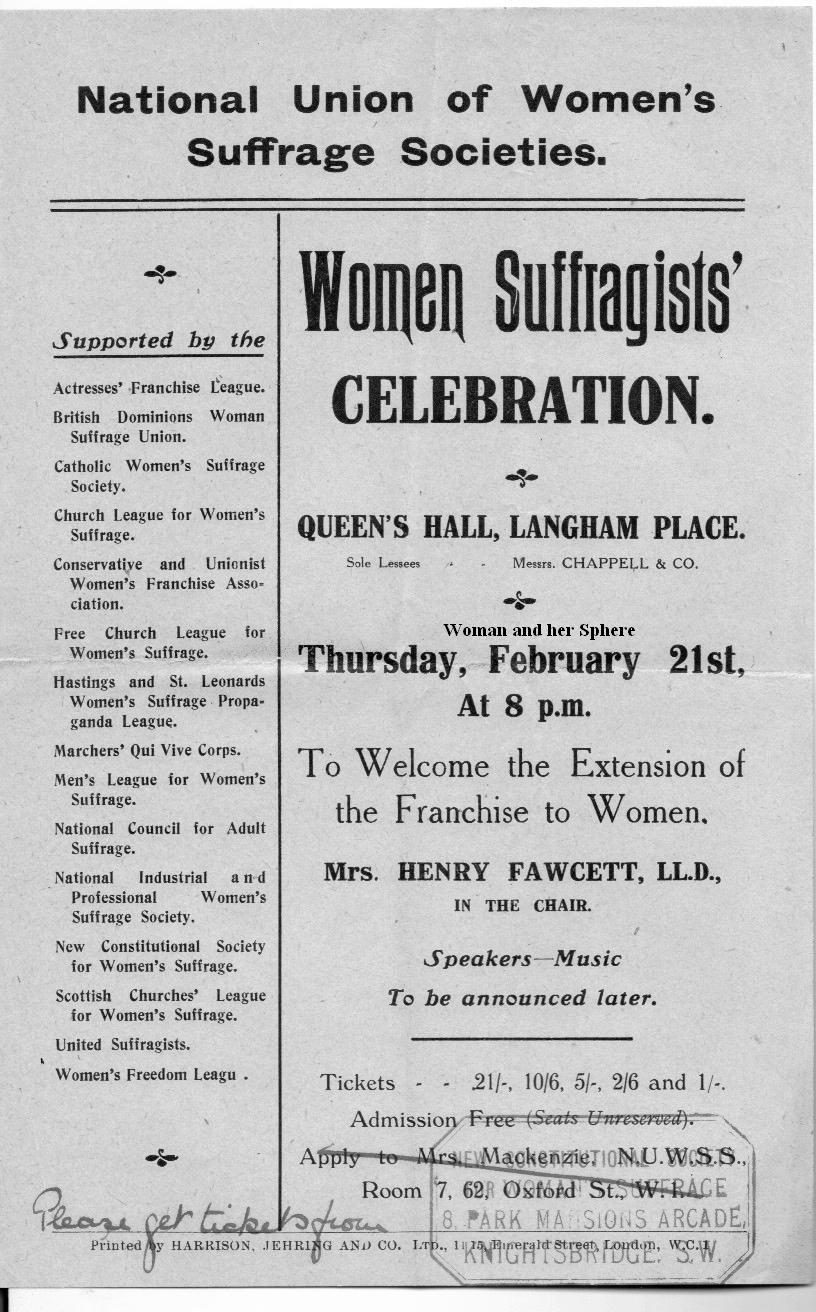 Flyer for the celebrations held at Queen’s Hall, Langham Place on Thursday 21 February 1918 – ‘To Welcome the Extension of the Franchise to Women’. The flyer includes the long list of societies that were taking part – the WSPU was a notable exception. On the list was the New Constitutional Society for Women’s Suffrage – and this flyer bears the annotation in ink ‘Please get tickets from’ followed by the NCWS’s rubber stamp with their address in Knightsbridge.
The leaflet is in very good condition and is rather rare. £55 post free.
[The ‘Women and her Sphere’ marking is not, of course, on the original]
Suffragette postcards: harem pants 2
Posted by womanandhersphere in Collecting Suffrage on August 1, 2012
‘Not In Those Trousers’  is the caption to a hand-painted postcard (the artist has initialed it ‘K.S.’). The subject of the remark is a lady in a purple and green outfit – a long tunic over ‘harem’ trousers – wearing a green and purple hat and carrying an umbrella. The author of the remark, a dapper gentleman, stands in the background.
I think that, in this case, the deliberate choice of colours may indicate that a suffrage inference might be drawn. The style of dress is, again, very Paul Poiret – see this week’s ‘Suffrage Stories: ‘Madame Mantalini’ post.
Very good – unposted. The reverse of the card has a rectangle marked – in the top right – to receive a stamp ‘Inland Postage 1/2d. Foreign Postage 1d.’ £15 post free.
To buy: email e.crawford@sphere20.freeserve.co.uk
[Woman and her Sphere logo on the image here is not, of course, on the original card]
Suffragette postcards: What Women Want
Posted by womanandhersphere in Collecting Suffrage on July 31, 2012
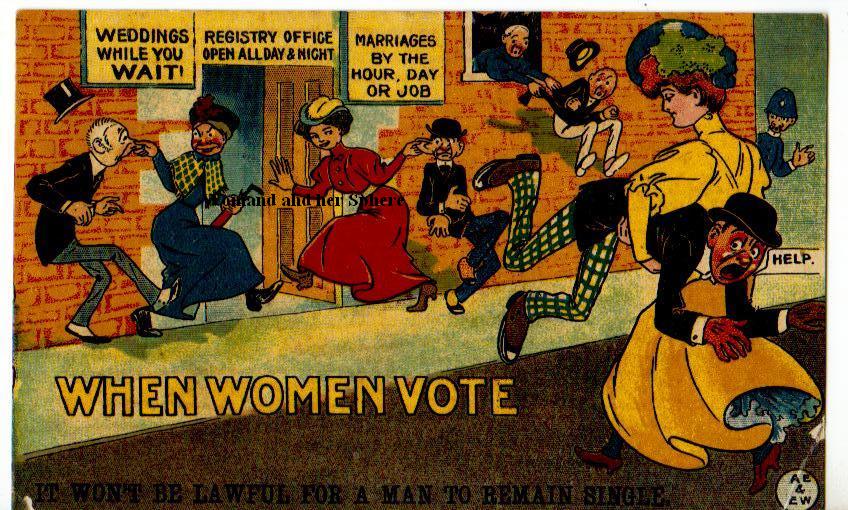 ‘WHEN WOMEN VOTE It won’t be lawful for a man to remain single’. All the men are being rushed into marriage – tweaked by the nose and carried under the arms of women – and all because they have a vote!
The card was published by Mitchell & Watkins, who had been producing postcards – both topographical photographic and artist-drawn – from c 1906.
This card was posted – in, I think, 1913 (the postmark is obscured) – to Miss Ida Currell – who had been born in 1882 and was one of 4 surviving children of the 10 born to a Hertfordshire farmer and his wife. The Currells farm, at 2 Ware Road, Hertford, was called ‘The Chaplains’.
The card is in very good condition and is £45 post free.
To buy: email e.crawford@sphere20.freeserve.co.uk
Suffragette postcards: harem pants
Posted by womanandhersphere in Collecting Suffrage on July 30, 2012
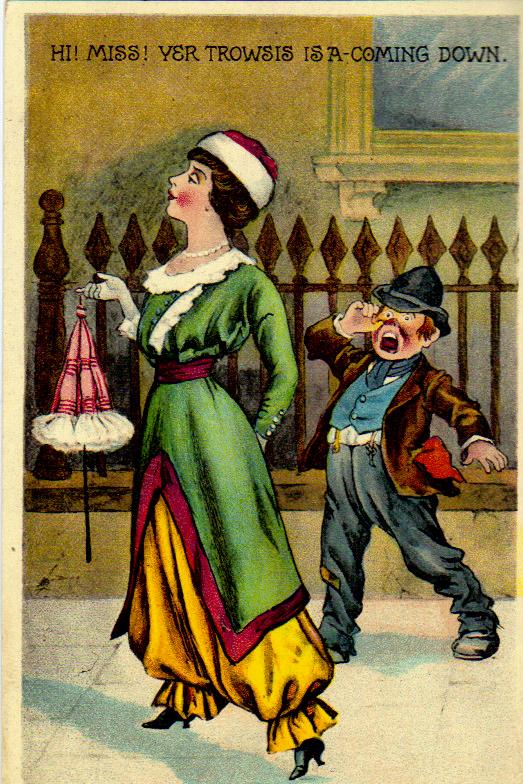 A comment on the ‘look’ that Paul Poiret was promoting c 1909 – although perhaps not to Margot Asquith – see ‘Suffrage Stories’ post -‘Madame Mantalini’.
‘HI! MISS! YER TROWSERS IS A-COMING DOWN’ shouts tyke to elegant young woman sporting ‘harem’ trousers. Pre-First World War, published by Felix McGlennon, who having been a rather successful song writer and music publisher, jumped on the bandwagon and added the publication of postcards to his repertoire as the postcard craze swept Edwardian Britian.
Not actually ‘suffrage’ but very much of its time. In very good condition – very glossy- £25 post free.
To buy email e.crawford@sphere20.freeserve.co.uk
Suffragette postcards: real photographic portrait
Posted by womanandhersphere in Collecting Suffrage on July 28, 2012
 Here is an example of a real photographic postcard issued by a suffrage society – in this case by the Women’s Freedom League. Its subject is Mrs Lilian Hicks (1853-1924) who, with her daughter, Amy, was at that time of its publication a leading member of the WFL – as well as a supporter of the Church League for Women’s Suffrage, the New Constitutional Society for Women’s Suffrage and the Tax Resistance League. Both mother and daughter, by then members of the Women’s Social and Political Union, heeded the call to boycott the 1911 census.
The Hicks’ association with a wide range of suffrage societies, of which I had written a few years earlier in their joint entry in my Women’s Suffrage Movement: a reference guide, was made manifest in the magnificent collection of badges and awards – including a hunger-strike medal – that many years ago I acquired from a woman to whom they had been indirectly bequeathed. They are now held in a private collection.
 Lilian and Amy Hicks lived here, at 33 Downside Crescent, Hampstead. At the other end of the street was the home – probably the rather unhappy home – of Margaret Wynne Nevinson, a fellow member of the Women’s Freedom League. I realised that a bond of friendship existed between the two women when, all those years ago, I recognised – hanging on the wall of the sitting-room in the small cottage of the woman from whom I was buying the collection of Hicks’ memorabilia – a large painting by Margaret’s son, C.R. Nevinson. It was in the guise of ‘the mother of the Futurists’ that Margaret went when she attended a dinner given by the Women Writers’ Suffrage League at the Hotel Cecil on 29 June 1914. Unfortunately there is no record of the form of dress that this witty allusion took.
The photograph of Mrs Hicks on this official Women’s Freedom League postcard was taken by Lena Connell and probably issued around 1909/10.
Mrs Lilian Hicks was a member of the Women’s Freedom League
Suffragette postcards: suffragettes and policemen 3
Posted by womanandhersphere in Collecting Suffrage on July 27, 2012
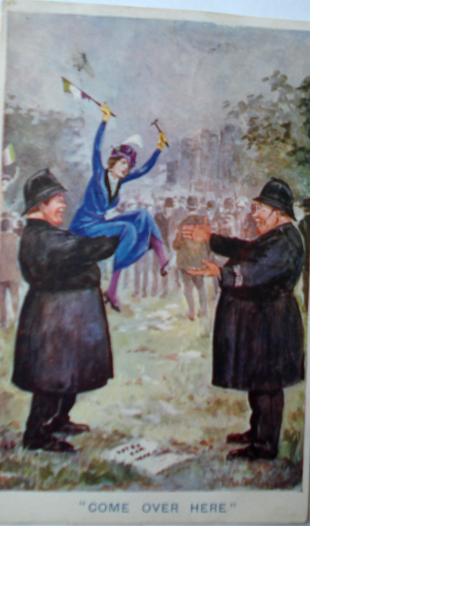 Another in this week’s theme of ‘suffragettes and policemen’.
Two burly policeman are playing games with tiny (elegant, for a change) suffragette. Waving the tools of her trade – a hammer and flags, she is held aloft by one who looks as though he intends to lob her over to the other, who is waiting with outstretched arms. A ‘Votes for Women’ placard lies on the ground between them. Published by Inter-Art Co., Red Lion Sq, London WC. Good – slightly rubbed at edges – posted in 1913. £35 post free.
Suffragette postcards: suffragettes and policemen 2
Posted by womanandhersphere in Collecting Suffrage on July 25, 2012
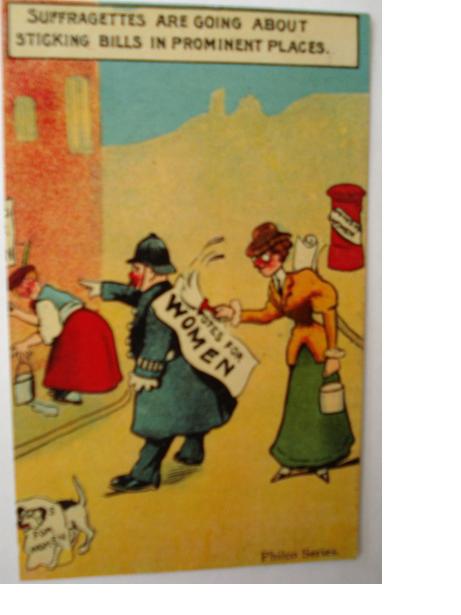 Here is another card in the ‘Philco Series’, titled ‘SUFFRAGETTES ARE GOING ABOUT STICKING BILLS IN PROMINENT PLACES’ and in this particular case that is pasting a ‘Votes for Women’ on the back of a policeman, who is in the process of accosting another bill-sticking suffragette. Needless to say the women are the usual stereotypical trilby-wearing, bespectacled harridens. In the scene a pillar box and a dog have also been plastered with V f W posters. The message on the reverse – written in pencil from the same sender to the same recipient as that of the card in the previous ‘Collecting Suffrage’ post – that is Win to Mrs James – reads ‘And the best of wishes for a happy Christmas. The suffragettes what and how they do things in London.’ Very good – unposted £45 post free. NOW SOLD
Suffragette postcards: suffragettes and policemen
Posted by womanandhersphere in Collecting Suffrage on July 24, 2012
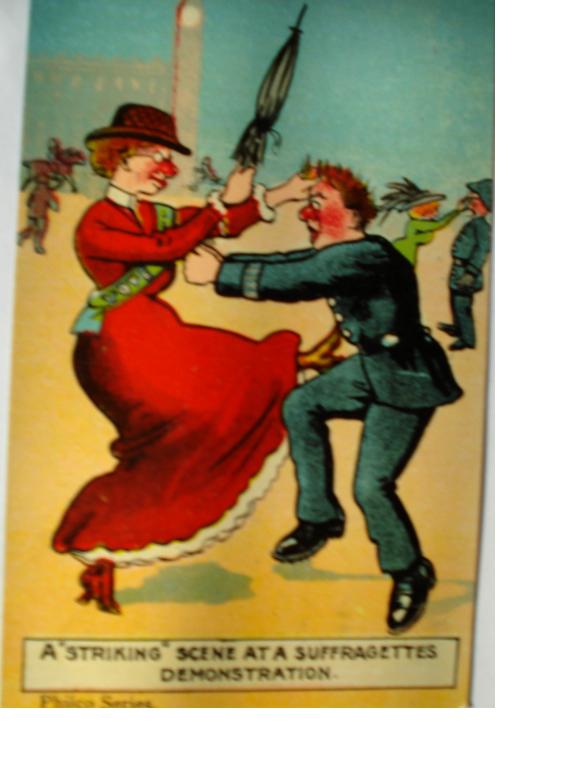 The increased activity of the women’s suffrage campaign in the early years of the 20th century coincided with the golden age of the postcard. It proved to be a subject very popular with the burgeoning number of commercial postcard publishers and cards with a ‘suffragette’ theme outnumber those relating to other contemporary campaigns – such as Tariff Reform and Home Rule.
Without too much effort, anyone interested can still build up a collection of cards reflecting the varying views of Edwardian society on women’s desire for citizenship – and their methods of achieving it. The suffrage societies themselves all produced cards – portraits of their leaders or photographs of great suffrage occasions – although they are vastly outnumbered by cards produced by the commercial publishers.
The incongruence of women battling with policemen – as on ‘Black Friday’ in November 1910 – certainly caught the publishers’ attention and there are many variations on the theme. This card was published by Philco Publishers, whose office was in Holborn Place – very close to WSPU headquarters. This card was not posted but is written to ‘Mrs James’. The message reads ‘I do not know what you will think of this. But this is suffragettes in vengeance and in their battle array.’
The stereotypical harridan (trilby hat, glasses, high-colouring, big nose) wearing ‘Votes for Women’ sash wields her umbrella as she kicks a policeman. In the background another, similar, scene is enacted. There is a tall clock tower – which might just be intended as Big Ben – at the very back of the scene, attached to a misty building. This card, which is in good condition, was one of a series. It is available for sale from me: £45 post free. NOW SOLD
See the August 2012 issue of BBC History Magazine for Prof June Purvis’s article on ‘suffragette’ cards published by commercial publishers and click here for details of her very interesting and informative accompanying podcast (June’s piece begins 20 minutes into the recording).
 Woman and her Sphere