womanandhersphere

This user hasn't shared any biographical information
Homepage: https://womanandhersphere.wordpress.com
Kate Frye’s Diary: Canvassing for the Progressives in North Kensington,1907
Posted in Kate Frye's suffrage diary on September 13, 2012
Another extract from Kate Frye’s manuscript diary. An edited edition of later entries (from 1911), recording her work as a suffrage organiser, is published as Campaigning for the Vote: Kate Parry Frye’s suffrage diary.
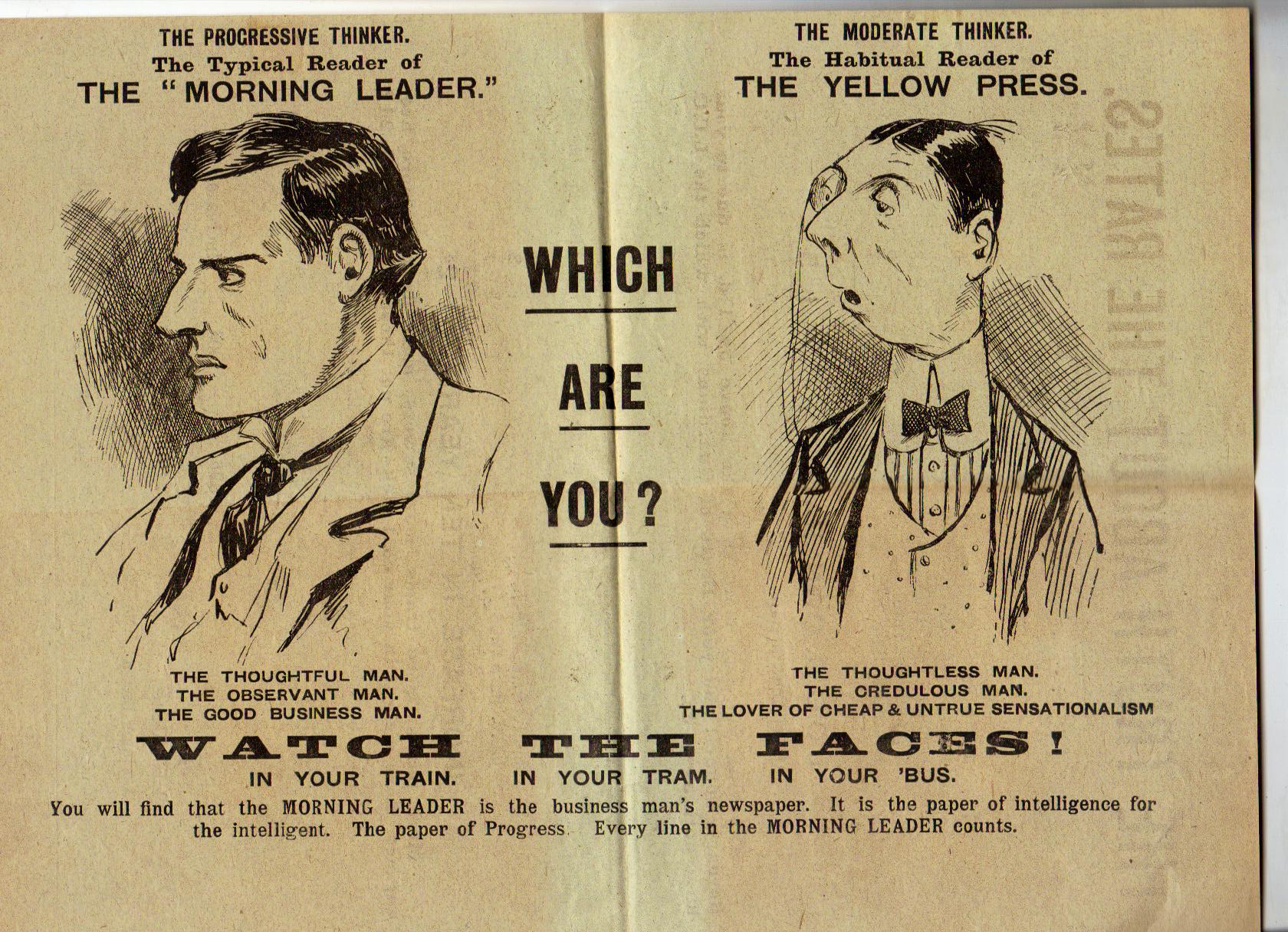
The ‘Morning Leader’ supported the Progressives and in late-February 1907 Kate laid this leaflet in between the pages of her diary
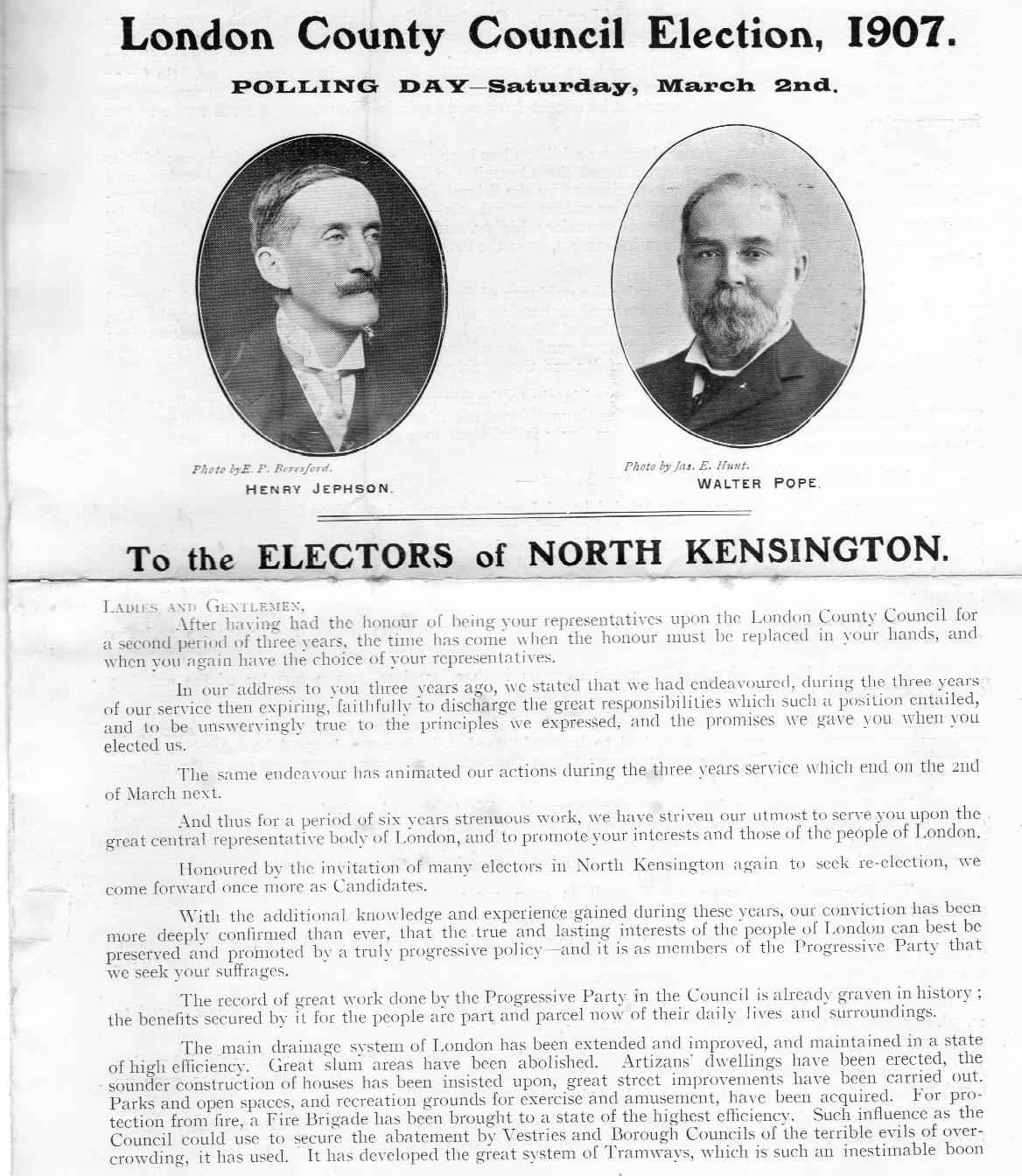
The LCC elections were due to be held on 2 March 1907; Kate and her family supported the Progressive Party. In fact, before becoming an MP, her father had been an LCC councillor on the Progressive ticket.
Dramatis Personae for these entries:
Sir Weetman Pearson, Lady Denman’s father, in 1910 became Lord Cowdray and it was as ‘Lady Cowdray’ that his wife was to be involved with a number of suffrage organisations. Lady Pearson was, according to Lady Denman’s biographer, ‘determined to become a leading political and social hostess’ and the Pearsons’ house at 16 Carlton House Terrace, its opulent interior decorated in the mid-19th century by Owen Jones in the islamic style, provided a perfect setting. As we shall read, Kate, who was something of an expert on these matters, rated the Pearsons’ tea very highly.
H.Y. Stanger: Liberal MP for North Kensington, the seat once held by Kate’s father, in February 1908 introduced a women’s suffrage bill, which passed its second reading before being blocked. This was the greatest progress a bill had made since 1897.
Thomas McKinnon Wood: member of the London County Council for Central Hackney (1892-1909) – leader of Progressive Party (1898-1907). Elected MP for a Glasgow constituency, 1906.
Mr Jephson: Henry Jephson, retired civil servant, who was standing again as a Progressive member for North Kensington on the LCC.
Violette Mary Doake (b c. 1888): lived with her parents at 24 Stanley Gardens, Kensington. In 1892 her father had been elected as a Progressive member of the LCC for Kensington North; unsurprisingly the Doake family was staunchly suffragist.
Thursday February 21st 1907
At 2.30 Mother and I went by train from Notting Hill Gate to Charing Cross and walked through the Horse Guards and up the Duke of Yorks steps to Carlton House Terrace – Sir Wheetman [sic] Pearson’s house – by invitation of Lord and Lady Denman to a drawing Room meeting to hear Mr McKinnon Wood – Mr Wilks and the work we could do for the Progressives at the L.C.C. elections.
Nearly all ladies there. Lord Denman was a sort of Chairman & both he and Lady Denman spoke – she seems very nice. My dear friend Mr McKinnon Wood spoke again most beautifully – I do admire him. Of course I knew it all but I dare say some the facts came new to a good many there. Mr Stanger, Mr Jephson and Mr Percy Harris were there.
There was a most gorgeous tea downstairs afterwards it really was quite perfect – such cakes – in such quantities – I made a pig of myself and eat [ate] three and I had my tea and milk poured out of solid gold articles. I really did enjoy the party and the house is wonderful – what a position – looking out on the Park.
Friday February 22nd 1907
I dressed myself. John [her fiance] came at 7.30 to dinner and afterwards Daddie took he, Agnes and I up to the Horbury Rooms [Ladbroke Road] to the Opposition L.C.C. Candidates’ meeting – Mr Davis and Major Skinner. Well I thought it would be interesting but I never expected to be so thoroughly amused.
The Chairman was so funny and Harcourt-Smith such a noodle – a Dickens character with an eye glass. And as for Major Skinner I have never seen or heard the like really. He didn’t seem sharp and made quite an object of himself. He tried to propitiate the ladies – I never heard anything so awful. I blushed for him. He kept right away from the question of the L.C.C. altogether. The only decent man there, for though Mr Whittiker Hampson speaks well, I wouldn’t trust him, was Mr Hume-Williams who opposed Mr Stanger at the Parliamentary Elections. He is a gentleman and speaks well, but he was not convincing – none of them were – they all talked nonsense – have no programme of work at all to bring forward. Their great cry is ‘give us a chance’ and they tell awful stories about the rates, which have really nothing to do with the County Council. It will be a real grief to me if those two dreadful people get in.
John, a thoroughly conservative spirit, doggedly tory, to the backbone was quite turned over by them though he thinks he upholds their views. I do so hate him to be a ‘Moderate’ thinker. We came back and talked them over and laughed merrily at their expense till John had to go at 11 o’clock.
Wednesday February 27th 1907
When I got home at 5 o’clock I found a note and bundle from Gladys Wright asking me to deliver some Women’s Suffragist things. So after tea Agnes went out with me and we did Arundel Gardens and Elgin Crescent – a tremendous number of Women Voters in both. They were papers urging the Women to use their Vote. I feel rather shaky as they are sure to Vote Conservative but that is a cowardly way of looking at the matter, I know.
Thursday February 28th 1907
Went off to the [North Kensington Liberal] Club – Mother, Agnes and Florence [the Fryes’ maid] were there – and the room was full. Miss Jephson, Miss Doake, Mr McArthur, Mr Lewis, Mr Hatt and the usual workers and lots of people I did not know all working at top speed.
 Saturday March 2nd 1907
The great London County Council Election day at last and, very fortunately, a beautiful day for it. I should have been canvassing all this week, much as I hate the work – but I am so interested in the Election – but I have felt so awfully seedy I simply hadn’t the strength for it…Agnes and I went to the Pembridge Ward Committee Room and got some work to do. I had Westbourne Grove to do and it took me till 4.30. Mother and Agnes went together. I got so tired I felt nearly dead when I had taken the cards back and came home to tea. But I couldn’t rest and after tea Mother and I walked up to the Golborne Ward Committee Room.
It is depressing work in this Ward. There is no enthusiasm – but up there there was very little excitement amongst the workers – and my heart sank though most of them were cheerful. We saw Mr Jephson in the Committee Room. Miss Jephson, Mrs and Miss Doake, Mrs Willis and lots of workers. Mr Jephson was flying about madly in his Motor Car. Mother and I did three streets – Blagrove Road and two other long ones and kept on till within a few minutes of eight o’clock.
I got so excited and interested that I don’t know how I managed to keep going as I did. I did feel ill but I did some good work. Got one woman to vote who had never used her vote before. I had almost to hold her by force and interest her by telling her how I worked to get a vote. She decided she would go if she was driven. So I sent Mother off to find a carriage and I waited and hung on to her. It was so long coming I flew into the middle of the road and managed to stop Mr Jephson’s car almost by main force it seemed to me – but just then Mrs Widgery drove up in a carriage and she took the woman and a man who went to look after her.
Sunday March 3rd 1907
Florence brought me the news and later the paper. Jephson and Pope beaten and the whole of London swept clear by the Moderates. ‘God help London’ I say since London does not seem inclined to help itself.
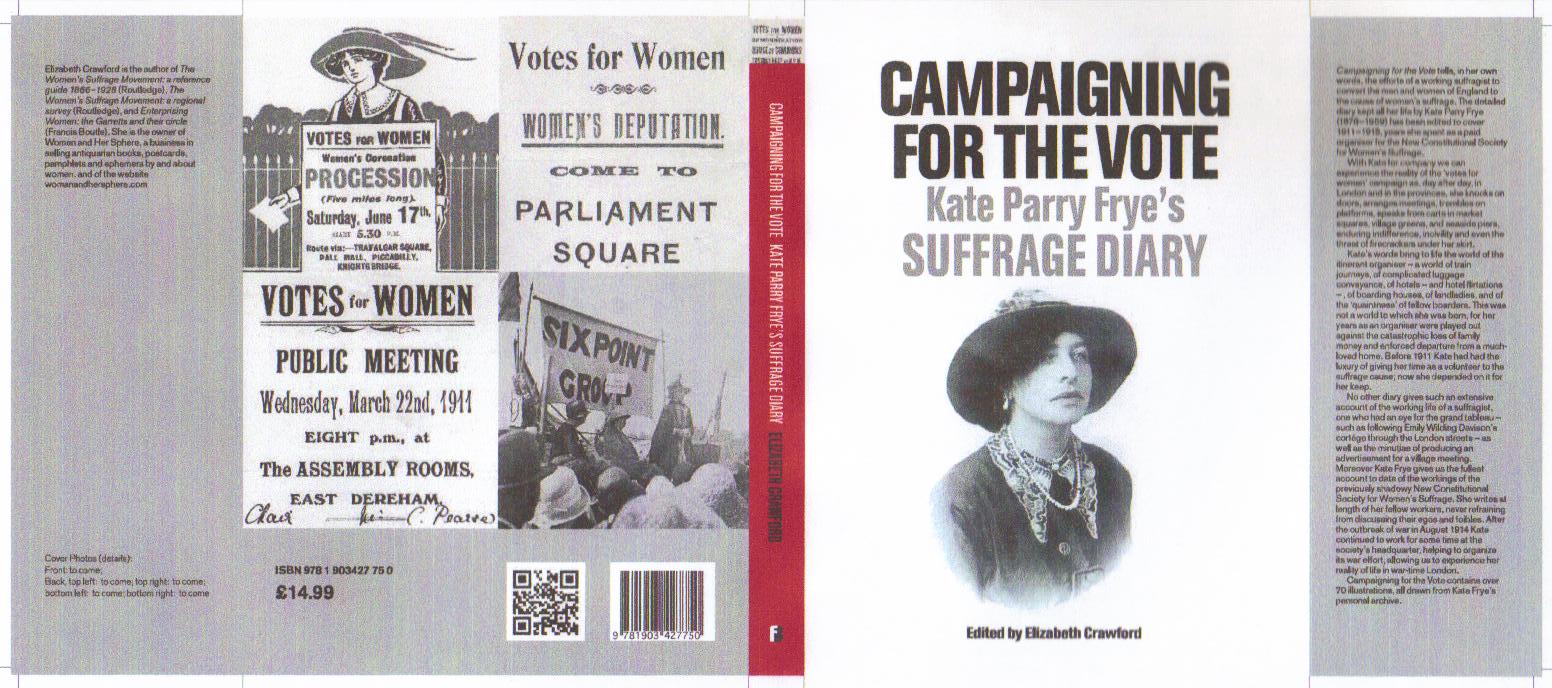
Campaigning for the Vote: Kate Parry Frye’s Suffrage Diary edited by Elizabeth Crawford
For a full description of the book click here
Wrap-around paper covers, 226 pp, over 70 illustrations, all drawn from Kate Frye’s personal archive.
ISBN 978 1903427 75 0
Copies available from Francis Boutle Publishers, or from Elizabeth Crawford – e.crawford@sphere20.freeserve.co.uk (£14.99 +UK postage £3. Please ask for international postage cost), or from all good bookshops. In stock at London Review of Books Bookshop, Foyles, National Archives Bookshop.

- ‘Campaigning for the Vote’ – Front and back cover of wrappers
Book of the Week: A Nest of Suffragettes in Somerset
Posted in Book of the Week, Collecting Suffrage on September 12, 2012
A Nest of Suffragettes in Somerset: Eagle House, Batheaston by B.M. Willmott Dobbie for The Batheaston Society, 1979. Soft covers – very good condition (with a newspaper cutting of an obituary of Bristol suffragette, Victoria Lidiard, laid in). £26 (plus postage) For sale – from my stock of books and ephemera about the suffrage movement. To buy – email e.crawford@sphere20.freeserve.co.uk
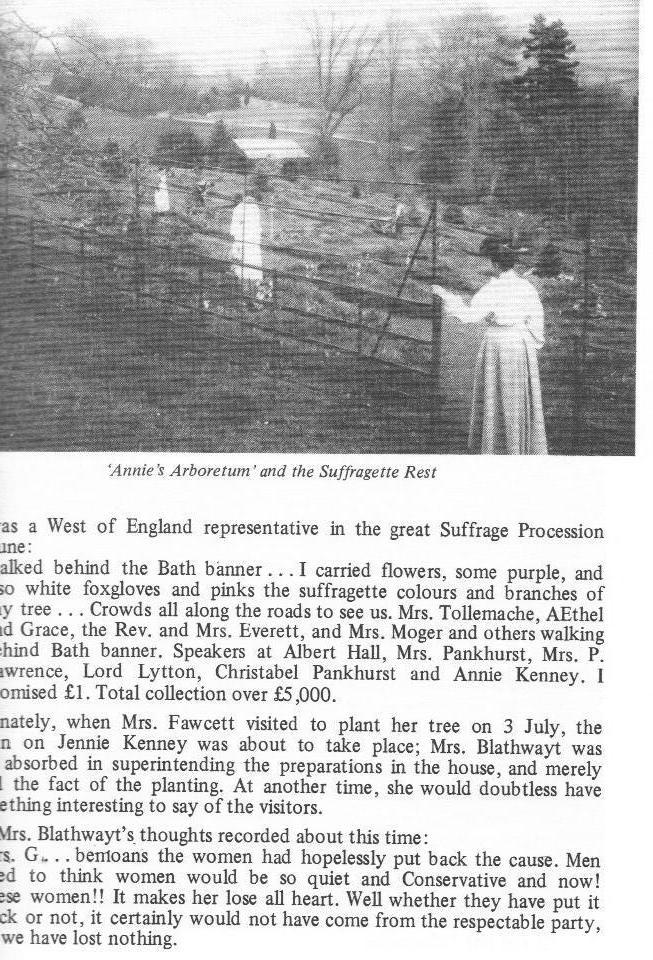
‘Annie’s Arboretuem’ and the Suffragette Rest
The story of the Blathwayt family – Col Linley Blathwayt, his wife Emily and daughter Mary -who lived at Eagle House, Batheaston, where for some years they offered a haven to WSPU activists. Annie Kenney – and her sisters – were particular favourites.
Col Blathwayt organised the planting of trees to commemorate visits by both suffragists and suffragettes – such as Lady Constance Lytton.
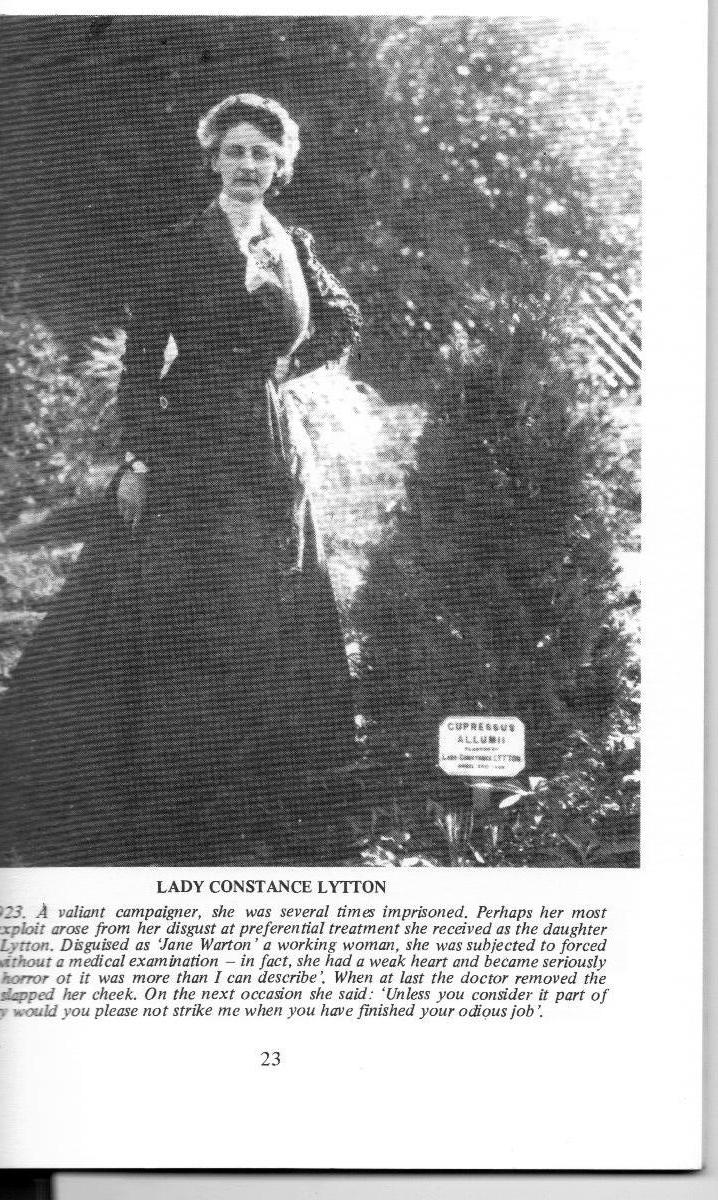
Lady Constance Lytton photographed by Col Blathwayt
‘Annie’s Arboreteum’ and ‘Pankhurst Pond’ were just two of the features created on the estate. Col Blathwayt was a keen photographer and many of the photographs he took of visiting suffragettes are included in this book. The text includes extracts from the diaries that the Blathwayts kept and which provide us with such a disingenuous view of some of the leading suffragette personalities
For more about Eagle House (and a little about Rose Lamartine Yates and Dorset Hall, Merton, of whom, coincidentally, I wrote in yesterday’s post) see here. For ‘Suffragettes in Bath’ see here. The diaries of Col. Blathwayt, Mrs Emily Blathwayt, and dear Mary Blathwayt, who I describe in the Women’s Suffrage Movement: a reference guide, as the ‘Mr Pooter of the suffrage movement’, are held in Gloucestershire Archives.
Suffrage Stories: Suffragettes and Tea Rooms: Suffragette Tea from Suffragette China
Posted in Collecting Suffrage, Suffrage Stories on September 11, 2012
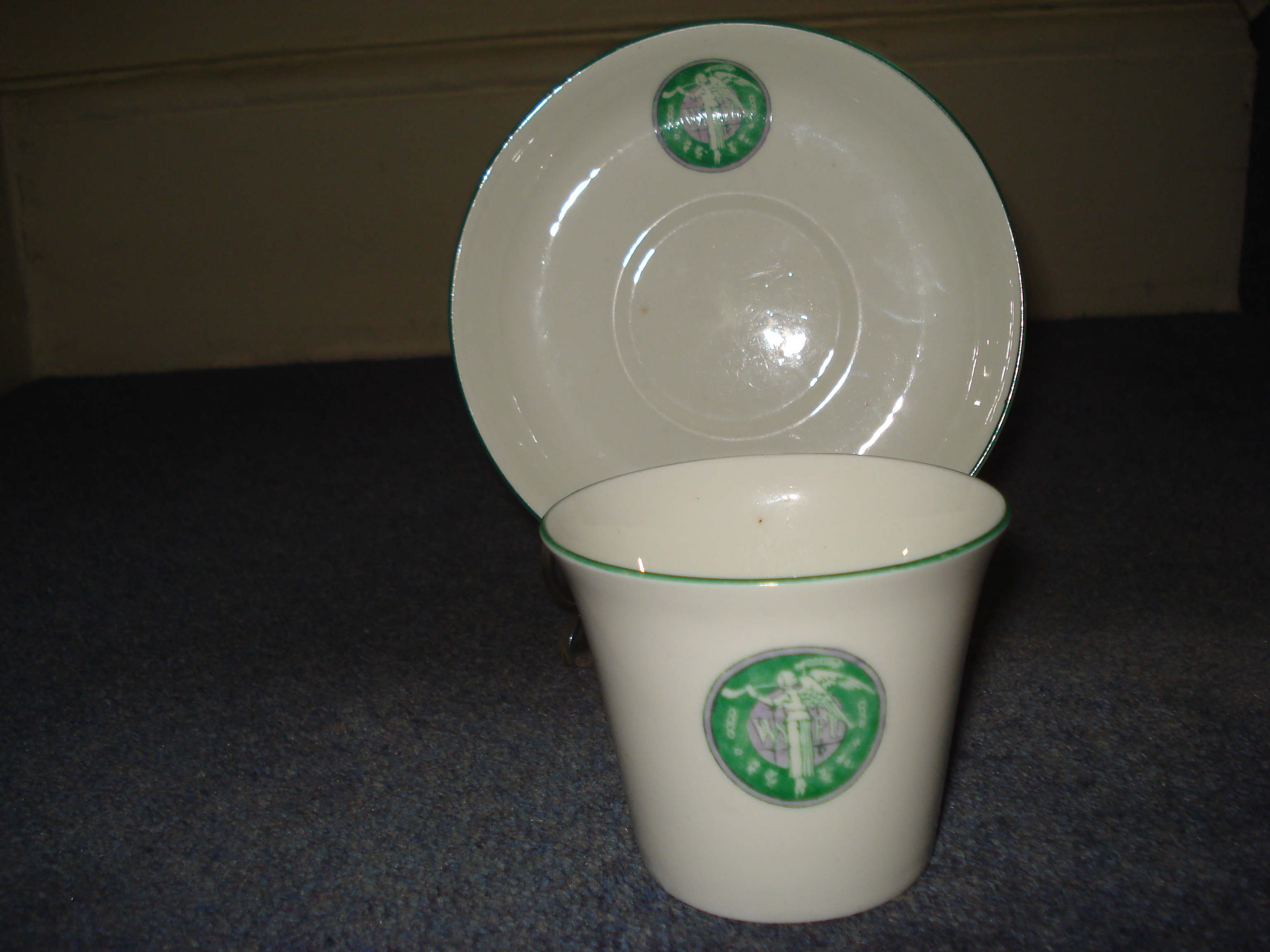 WSPU china – ‘Angel of Freedom’ design, 1909
A week of posts on ‘Suffragettes and Tea Rooms’ cannot end without looking at the tea rooms that the suffragette societies themselves ran – in their shops and at their fund-raising bazaars – and the china they commissioned in which to serve that tea .
The best known of the fund-raising events is probably the WSPU exhibition held at the Prince’s Skating Rink at Knightsbridge in May 1909. There the tea room was run by Mrs Henrietta Lowy, with help from her four daughters and another young upper-class suffragette, Una Dugdale. In the spirit of exuberance and professionalism that marked this the first of the WSPU’s fund-raising bazaars, a decision was taken – presumably reasonably well in advance of the Exhibition – to commission a Staffordshire pottery – H.M. Williamson of Longton – to make the china from which the tea would be served in the Exhibition’s Tea Room.
The white china has strikingly clean, straight lines, rimmed in dark green and with angular green handles. The shape is, I am sure, a Williamson standard – but how very different the WSPU pieces look from, say, Williamson’s Rosary design–in which pink and grey ribbons and roses are applied to the same shape and every edge is gilded. In contrast, the WSPU china design is pared back, almost stark.
It is more than likely that, from the range offered by Williamson, Sylvia Pankhurst chose this shape, keeping the design simple so that the ‘angel of freedom’ motif that she had designed specifically for the Exhibition should be shown to best effect. Each piece of the tea service carries this motif; behind the angel and accompanying banner and trumpet, are the initials ‘WSPU’ set against dark prison bars, surrounded by thistle, shamrock, rose – and dangling chains. At the end of the Exhibition, the china – tea pots, cups, saucers, tea plates, sugar bowls etc – was offered for sale, made up into sets of 22 pieces. Many years ago, early in my ephemera-dealing days I bought – and, of course, immediately sold – a comprehensive service. Although I have subsequently sold individual pieces of the china, I have never again seen such a complete set. Ah well.
Pieces of this design are held in archives such as the Museum of London and the Women’s Library – but one variation design is not, as far as I know, represented in any public collection.
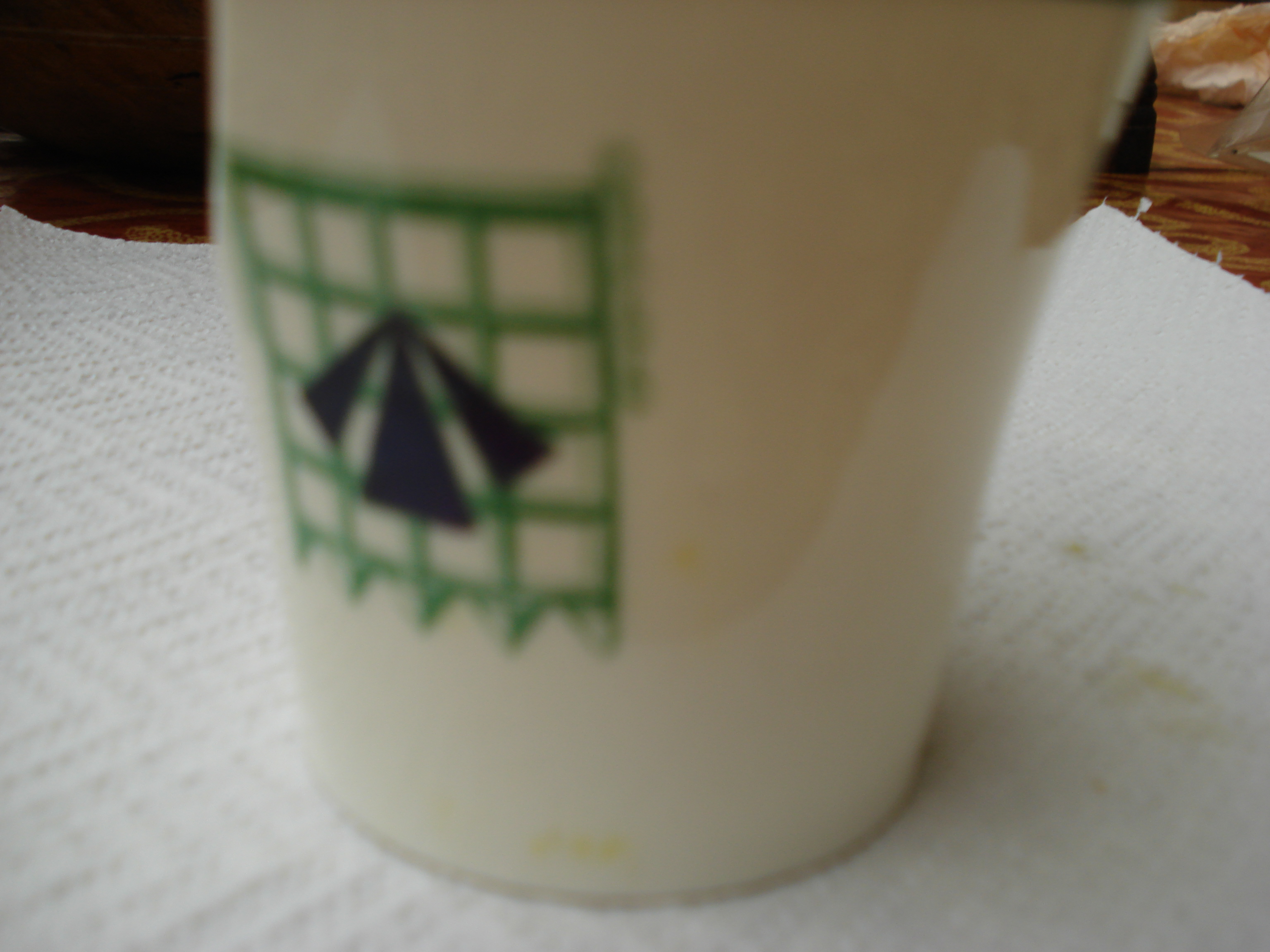 This cup – its design based on Sylvia Pankhurst’s ‘portcullis’ motif which, used on the WSPU’s ‘Holloway brooch’, can be dated to the spring of 1909 – came from a collection that also contained items of the ‘angel of freedom’ china. I bought this wonderful haul some years ago at auction and, although the provenance was not divulged by the auctioneer, I am pretty sure that the china had once been belonged to Mrs Rose Lamartine Yates who held fund-raising teas for the Wimbledon WSPU on the lawn of Dorset Hall, her 18th-century Merton house. This ‘portcullis’ cup does not carry any maker’s mark but, as the shape is identical to the Williamson pieces, I think we can be pretty certain that they probably also made this. As, in the early 19th-century, when women set their tea trays with ‘anti-slavery’ china, so in the early 20th, suffragettes who bought these tea services could – like Mrs Lamartine Yates – use them as propaganda tools -promoting the movement, most elegantly, in a bid to convert their ‘anti’ neighbours.
 I have only ever had in stock – and that only fleetingly – this cup and saucer (see left), part of the third identifiable range of WSPU-commissioned china. I believe, however, that the People’s Palace in Glasgow holds a similar two pieces . They formed part of the Scottish version of the Prince’s Rink tea service, commissioned from the Diamond China Co, another Longton pottery, for use at the refreshment stall at the Scottish WSPU Exhibition held in Glasgow at the end of April 1910. Here the ‘angel of freedom’ is allied, on white china, with the Scottish thistle, handpainted, in purple and green, inside transfer outlines. After the exhibition this china, too, was sold – Votes for Women, 18 May 1910, noting that ‘a breakfast set for two, 11s; small tea set 15s , whole tea set £2, or pieces may be had singly’. It will hardly surprise readers to learn that WSPU china – now so very rare – commands a very high price. But what a wonderful addition a piece would make to any suffrage collection.
Although the china they used was probably more basic, some of the shops and offices run by both suffragette and suffragist societies offered their members – and the general public – a tea room. For instance, the Birmingham NUWSS office at 10 Easy Row included a shop at which tea could be taken and suffrage papers read. And the Glasgow WFL shop, at 302 Sauchiehall Street, as befitting the city in which Miss Cranston perfected the art of the tea room, served tea in its ‘artistic hall’, decorated in the WFL colours. (By the way, when in Glasgow do not fail to visit the De Luxe Room in The Willow Tea Rooms, also on Sauchiehall Street, originally designed by Charles Rennie Mackintosh for Miss Cranston – it may be a reconstruction, but it’s lovely).
As a final thought, the WSPU not only sold their own china, but also their own tea – much advertised in Votes for Women. Unfortunately, the only reference I have ever come across to anyone buying the tea was an aside by Mary Blathwayt, who noted in her diary that she had had to return a bag that was ‘off’ to the Bath WSPU shop. But I am sure that merely reflects the fact that the hundreds of satisfied customers had no need to comment and I will end this sequence of posts by conjuring up the image of a WSPU tea party, cucumber sandwiches sitting delicately on the elegant WSPU plates, as the assembled company receive WSPU tea into their WSPU cups from the WSPU pot. How, then, could the ensuing conversation be of anything other than ‘Votes for Women’?
Suffrage Stories: Suffragettes and Tea Rooms: From ‘Sheltered Anonymity’ to Sites of Protest
Posted in Kate Frye's suffrage diary, Suffrage Stories on September 10, 2012
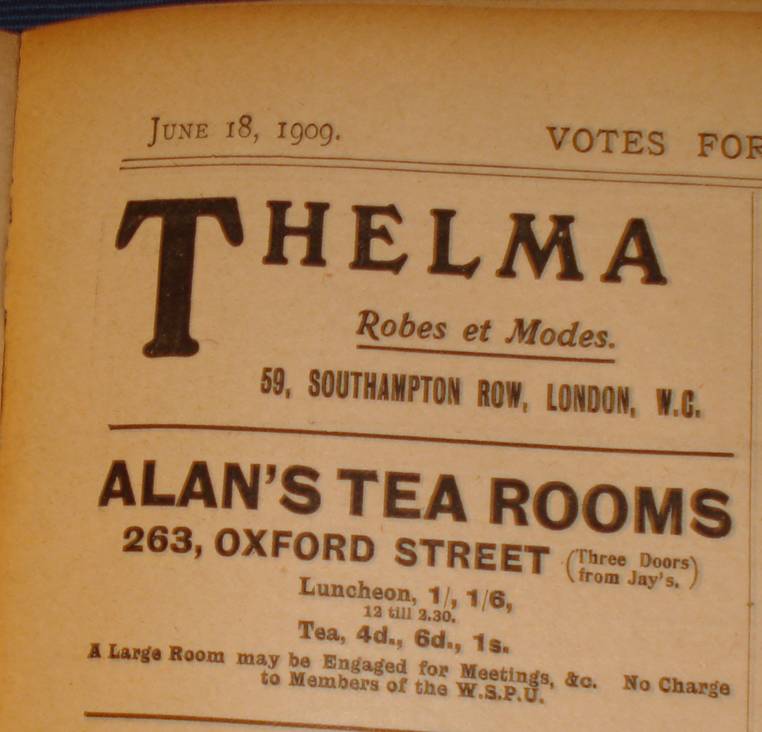
Advertisement for Alan’s Tea Rooms in ‘Votes for Women’.
Last week’s posts on ‘Suffragettes and Tea Rooms’ were based on the research I had done for the item that aired on Woman’s Hour on 4 September. The posts gave details of a few of the London tea rooms and restaurants – – some of them vegetarian – that we know were favoured by suffragettes. I had been curious to know more about the reality – the geographical position and the look of the interiors – of the cafes whose names are scattered through the columns of the suffragette newspapers. I had wondered ‘Why were suffragettes attracted to one place rather than another?’ ‘Whose businesses were they?’ – and hope that in last week’s posts I have, at least partially, answered these questions. In the absence of any other information, I was pleasantly surprised by how much detail could be gleaned from such superficially dull sources as rate books and the files of liquidated companies. I now have a much clearer image in my mind – as I walk around London – of the places in which militant activity was discussed – and indeed practised – by suffragettes a hundred years ago.

Corner of Alan’s Tea Rooms – as pictured in ‘The Idler’, 1910
For political movements need sheltering spaces – of all sizes – in which those involved can exchange views. In the 19th century women could attend the hundreds of formal suffrage meetings and conscious-raising talks that were held in Britain’s town halls and assembly halls – or, if suitably couth, the ‘drawing-room’ meetings held in the houses of the better-off. But until the late 1880s there were very few places outside the home in which respectable women could congregate – for refreshment – to meet their friends – or to discuss politics. The coffee houses, chop houses, ale houses and public houses that had for centuries enabled men to congregate, do business and eat and drink – had been socially barred to respectable women. It was only towards the end of the century that middle-class women were able to move independently– without any vestige of social censure – out of the home and around the streets of the metropolis. One practical element lining the path to freedom was a new type of business – the café, tea room or restaurant designed with women in mind. These were places that women could visit – either alone or in company – where their presence was not seen as an invitation to molestation – where they could eat and drink – and, most importantly, use the lavatory – without breaking any social taboos.

Kate Frye – suffrage organizer and frequenter of restaurants and tea rooms
That there were indeed still taboos around the presence of a woman in some places of public refreshment, even as late as 1911, is evident in one of the entries from Kate Frye’s diary. (My edition of her suffrage diary, Campaigning for the Vote, will be published in the autumn). She is staying in a hotel in a small Norfolk market town, while organising meetings for a suffrage society. :
22 March 1911 ‘Came in, had my lunch [in the hotel dining room] in company with four motorists. It is funny the way men come in here and, seeing me, shoot out again and I hear whispered conversations outside on the landing with the waitress. Then they come in very subdued and make conversation one to another and try not to look at me. Awfully funny – they might never have seen a woman before – but I suppose it does seem a strange place to find one.’
For, by the 1900s, the situation in larger towns and cities had changed. When not out organising meetings in the provinces, Kate lived and worked in London and there she paid daily visits to cafes, restaurants and tea rooms where she never felt out of place. Aimed particularly at the woman shopper – or woman clerical worker – here she could feel comfortable – both physically and mentally. Some of the cafes were part of chains – such as the ABC, founded in the 1880s, and Lyons in 1894. For a rare photograph of a Lyons interior – dating from the 1920s -see here. These chains catered for upper-working-class and lower- middle-class women who could enter their premises with equanimity and sit in sheltered anonymity at separate tables – and be served, not by waiters, but by waitresses. Kate Frye, belonging to a slightly higher strata of society, favoured rather smarter chain restaurants – such as Slaters’ – or tea rooms such as Fullers’. However it was in a Lyons tea room close to Parliament Square that she sat on the evening of 21 November 1911 with a group of suffragettes who were poised to embark on the smashing of the windows of government offices.
And quite apart from the chains, the first decade of the 20thcentury saw a proliferation of small refreshment rooms – ‘Tea Rooms’ – that were even more closely aimed at a female clientele. These were likely to be run – as were Alan’s Tea Rooms and the Tea
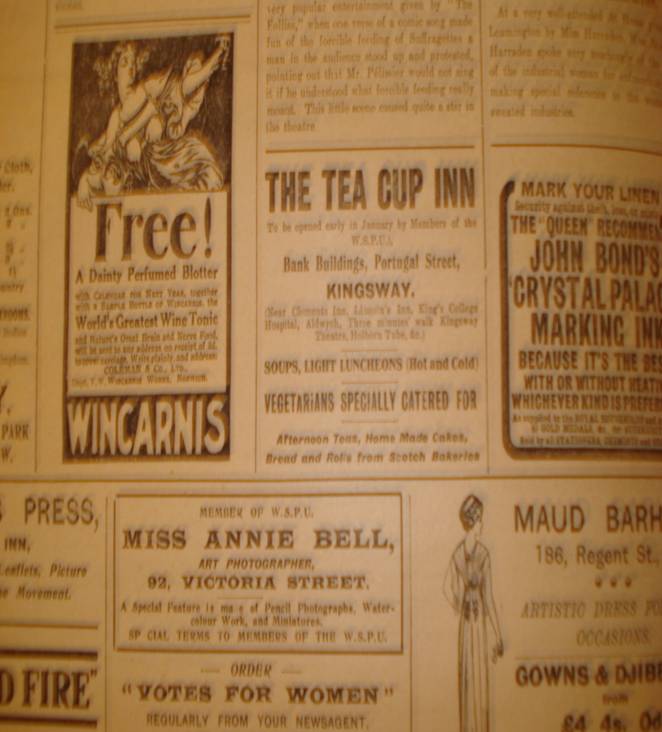
Advertisement for The Tea Cup Inn in ‘Votes for Women’.
Cup Inn – by a woman or a couple of women friends – and allowed women, who may have had no training in anything other than ‘home responsibilities’, the possibility of running a business, while at the same time allowing other women the ability to enjoy the freedom of moving around the city – or town – by providing a space in which they could pause for refreshment.
As we have seen, a few London tea rooms and restaurants were particularly favoured by suffragettes – as, similarly, were they in provincial towns. In Newcastle, Fenwick’s cafe was the venue of choice of the group of women, including Dr Ethel Bentham and Lisbeth Simm, set up the ‘Drawing-Room Cafe’ meetings where women could meet to discuss discuss politics. In Nottingham the WSPU held meetings at Morley’s Cafe, a teetotal establishment, originally opened to provide an alternative to the pub. In Edinburgh the Cafe Vegetaria was particularly favoured by the local Women’s Freedom League society – and it was on its premises on the night of 2 April 1911 that suffragettes gathered – as they did at the vegetarian Gardenia in London – to evade the census enumerator
A year later, however, although so popular with women, tea rooms were not immune from the effects of the 1 March 1912 WSPU window-smashing campaign. Two ABC shops were attacked – one in The Strand and one in Bond Street – here is the photographic evidence.
When, from the end of 1913, the WSPU campaign became ever more desperate, the tea rooms and restaurants that women had made their own themselves became sites of protest. On December 20th a suffragette dining at the vegetarian, suffrage-sympathising, Eustace Miles restaurant was able to make a long speech castigating the government’s treatment of suffragette prisoners – and was, so The Suffragette reported, listened to with eager attention, while her companion distributed leaflets. And althougb the management did eventually ask the speaker to stop she was allowed to continue with her ‘meeting’ and, afterwards, to remain in the restaurant. However, most cafes were not so amenable. When, on the same day, at Fullers’ in Regent Street, a woman began to address the crowded restaurant from the gallery and her two companions showered down leaflets, they were very quickly asked to leave. The newspaper report reveals that the subject of the woman’s address was a comparison of the treatment by the government of Sir Edward Carson and Ulster rebels with that meted on suffragettes. A few days later, when another interruption took place at Fullers’, the management had their answering tactic in place; the orchestra immediately struck up to drown out the speaker.
Soon after, The Suffragette reported an incident at a Lyons Corner House when a woman rose and spoke for a few moments – amid both applause and criticism. When two uniformed Lyons men tried to drag her roughly from the building they met with determined opposition and she finally left, the paper reported, with quiet dignity- escorted to the exit –to murmurs of ‘Isn’t she plucky’.
These protests carried on all through the spring and summer of 1914. Although similar interruptions were made in churches and theatres, it is singularly apposite that customers in tea rooms and restaurants, as they ate their lunch or tea, should have had their attention drawn to the forcible feeding of suffragette prisoners. In fact one of the very last militant action came at the end of July 1914 when women interrupted lunch at the Criterion Restaurant, imploring customers to attend a meeting to be held by Mrs Pankhurst in Holland Park. That, I think, was the final WSPU rally, before the outbreak of war in early August put an end to militancy.
Even as restaurants came under attack there were still some establishments that felt it worthwhile to advertise in The Suffragette. One such was one I had not come across before – Molinari’s Restaurant at 25 Frith Street in Soho., which advertised (January 1914) that they would ‘donate 5 % of their takings to the Cause for suffragists who wear the badge.’ Molinari’s was still advertising in suffrage papers in 1915 and I was amused to discover that in the 1920s the Home Office reported that its proprietor, Angelo Molinari, was the proprietor of ‘doubtful’ restaurants – suspected of running brothels in upstairs rooms. Thus, although the credentials of such suffrage-sympathising refreshment rooms as Alan’s Tea Rooms, the Eustace Miles and the Gardenia are beyond reproach, there were always those commercial operators prepared to take advantage of trusting suffragettes. I suspect, though, that the atmosphere of Molinari’s was not that of Alan’s Tea Rooms Angelo Molinari was not often called to donate any percentage of their profits to the Cause.
.Here is link to Woman’s Hour ‘Suffragettes and Tea Rooms’ item aired on 4 September. It begins at c 27 mins – and is available for 2 more days only.
WALKS/Suffrage Stories: Suffragettes and Tea Rooms: The Eustace Miles Restaurant – and the Tea Cup Inn
Posted in Suffrage Stories on September 7, 2012
The Gardenia Restaurant, subject of yesterday’s post, was by no means the only vegetarian restaurant favoured by suffragettes. Close by, at 40-42 Chandos Place, at the western end of Covent Garden, was the rather more famous – and successful – Eustace Miles Restaurant.
Eustace Miles was a Cambridge-educated health guru – a real tennis player – prolific author – and vegetarian. He opened the restaurant, with his wife, Hallie, – as a ‘Food Reform’ restaurant – in May 1906, a few months after their marriage. Among the restaurant’s shareholders were his close friend, the writer E.F. Benson, the headmaster of Eton, Bernard Shaw and his wife, Dr Helen Wilson, a Sheffield-based doctor and suffragist, and Mrs Ennis Richmond, a suffragette who ran West Heath, a progressive school in Hampstead.
Ellen Terry’s daughter, Edith Craig, who lived nearby in Bedford Street, sold Votes for Women from a pitch outside the Eustace Miles. It was a sensible spot to choose; vegetariansm and suffragism went hand in hand for those whom H.G. Wells characterized – caricatured – in Ann Veronica as ‘a small but energetic minority, the Children of Light’, for whom ‘ everything…was “working up”.. “coming on” – ‘the Higher Thought, the Simple Life, Socialism, Humanitarianism’.
Opening just as the WSPU arrived in London, the Eustace Miles grew up alongside the suffragette movement. In March 1907 the WSPU chose it as the venue for a breakfast celebrating the release from Holloway of the prisoners who had been arrested when taking part in the deputation from the first Women’s Parliament. Similar breakfasts were also held there– including, a year later, one for women who had taken part in the pantechnicon raid on Parliament. (another suffragette episode hijacked by Wells for use in Ann Veronica – see my article, ‘The Woman’s Bond of Freedom’: H.G. Wells, Ann Veronica and the suffragettes, published in the 2011 edition of The Wellsian, the journal of the H.G. Wells Society.)
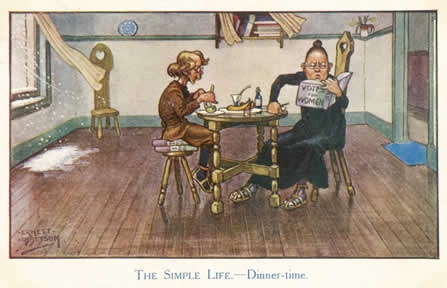
Comic card – one of a series – poking gentle fun at the ‘Simple Life’ suffragettes
As with Alan’s Tea Rooms and the Gardenia, so the Eustace Miles had a space to rent – an offer taken up, on occasion, by those giving women-related talks. The Eustace Miles, however, went one better than the other two, offering their ‘Simple Life’ audiences ‘ozonized air’ to breathe as they listened to, for example in 1912, Miss Hoskyns-Abrahall lecture on ‘The Religion of the Great Mother’, to the accompaniment of a lantern show operated by Vera Holme. In January 1910 the Men’s Political Union for Women’s Enfranchisement held its inaugural meeting at the Eustace Miles – the owner surely being a member of the MPU – and in October 1914 it was the venue for committee meetings of the United Suffragists.
The Eustace Miles was by all accounts an attractive place in which to lunch or dine; Kate Frye – by no stretch of the imagination a vegetarian – often ate there – as readers of my Campaigning for the Vote: Kate Parry Frye’s Suffrage Diary will discover. The restaurant did very well during the First World War – when meatless cookery was more or less a necessity – staying in business for over 30 years.
Alas, Hallie Miles’ Untold Tales of Wartime London, the source of the words spoken by Alison Steadman in The Great War: The People’s Story, is out-of-print. But for much more about the life and times of Kate Frye do read Kate Parry Frye: the long life of an Edwardian actress and suffragette. In this I tell the whole story of Kate – and of John Collins, her soldier husband. For details see here. I hope you will find it a Good Read.
Teacup Inn
While not specifically a vegetarian café, the Teacup Inn, much frequented by suffragettes, made sure that its vegetarian credentials were mentioned in its advertisements in the WSPU paper, Votes for Women – ‘Dainty luncheons and Afternoon teas at moderate charges. Home cookery. Vegeterian dishes and sandwiches. Entirely staffed and managed by women.’ The café was opened in January 1910 in Bank Buildings, Portugal Street, just off Kingsway, in a new building in area that was, as I have stressed in recent posts, still under development
The Tea Cup Inn occupied a ground-floor shop and basement in the building – then, as it name suggests – mainly given over to a bank – and now occupied by the Chaplaincy of LSE. In this photograph, taken c 1915, I am sure, after peering at it with a magnifying glass, that a sign ‘Tea Cup Inn’ is visible, hanging just above the smart open-topped car.
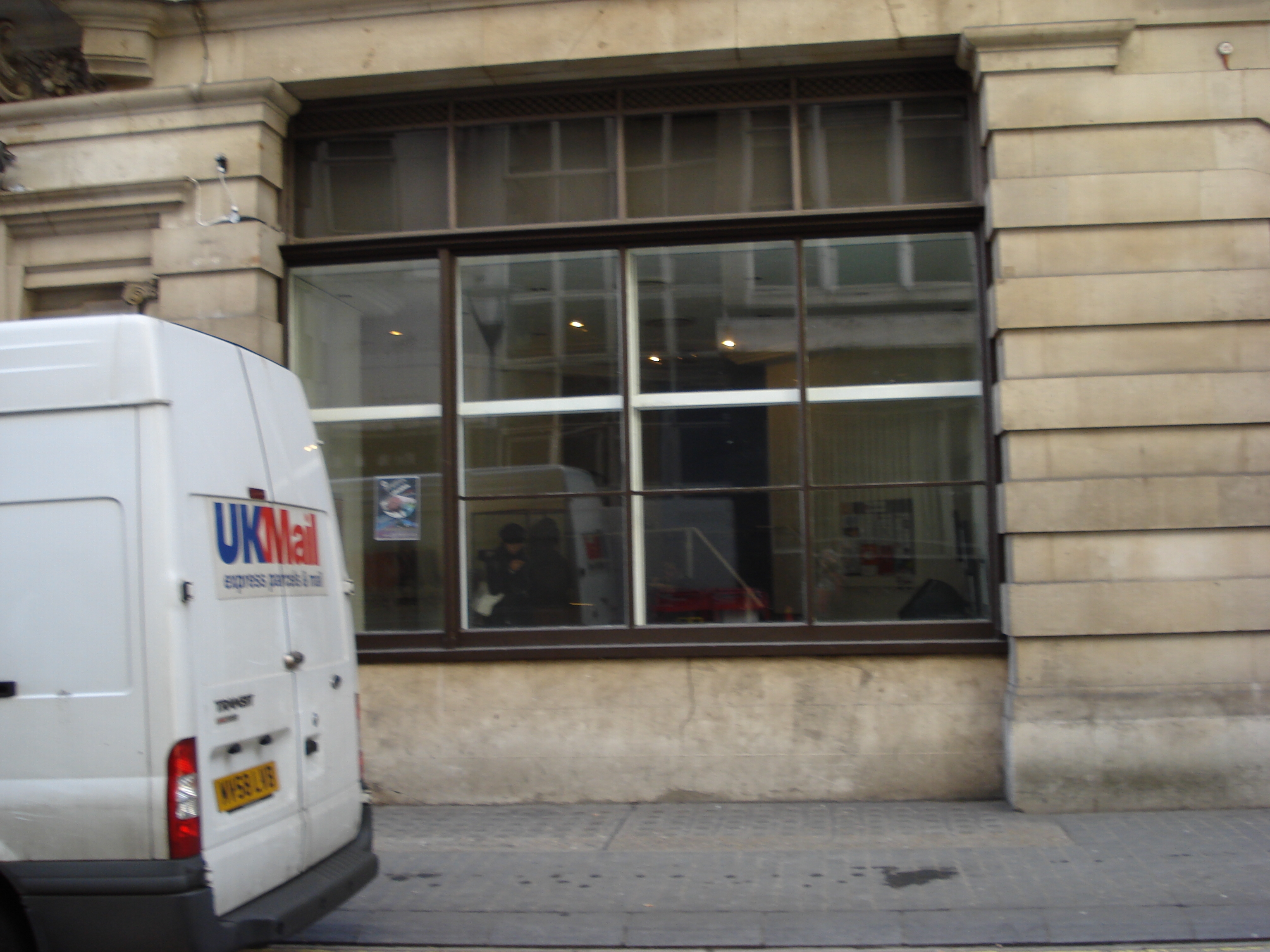
The site today of the Tea Cup inn
When it opened its owners were Mrs Alice Mary Hansell (c 1859-1923) and Miss Marion Shallard. However Miss Shallard quickly disappears and the rate books from then on show Mrs Hansell as sole proprietor. She had been born in Yorkshire, was about 52, and long a childless widow when she opened the café. Her husband, a traveller for a coal factor, had died in 1897, leaving only £87. I do not know what Mrs Hansell was doing in the intervening years – the 1901 shows her a visitor, with ‘no occupation, in a household in the Lake District..
Once the cafe was opened – certainly by April 1910- Mrs Hansell lost no time in advertising the Tea Cup Inn in Votes for Women – taking care to mention its proximity to the WSPU office in Clement’s Inn. In 1912 the WSPU moved to Lincoln’s Inn House in Kingsway, making the Teacup Inn probably the nearest place of refreshment. I am pretty certain that Mrs Hansell was a member of the WSPU; in 1909 someone of that name advertised in Votes for Women a cottage to let in Henley, but I have not been able to find conclusive evidence. Unfortunately I cannot trace her on the 1911 census – perhaps this is an indication that she was taking part in the boycott, but it may just be that her name has been mistranscribed. After the 1912 Peth-Pank split, the Teacup Inn advertised at least once in the Pankhurst paper, The Suffragette – in June 1914 – stressing: ‘Kitchens open for inspection’.
Across Portugal Street, the Tea Cup Inn faced the London Opera House (now the site of the Peacock Theatre). This theatre had opened in November 1911 and, again, handily situated for the WSPU office, was the scene of many suffrage meetings. One can imagine that the Tea Cup Inn may well have benefited from the thirsts engendered by a rousing rally.
Mrs Hansell continued running the Tea Cup Inn until her death in 1923. Her estate amounted to £2098 – which might suggest that, as her husband had left so little, she had made some money from her business. It would be good to think so.
More ‘Suffragettes and Tea Rooms’ posts to come….
Here is the link to Woman’s Hour (4 Sept) podcast that includes the item on ‘Suffragettes and Tea Rooms’ (starts c 27 mins).
WALKS/Suffrage Stories: Suffragettes and Tea Rooms: The Gardenia Restaurant
Posted in Suffrage Stories on September 6, 2012
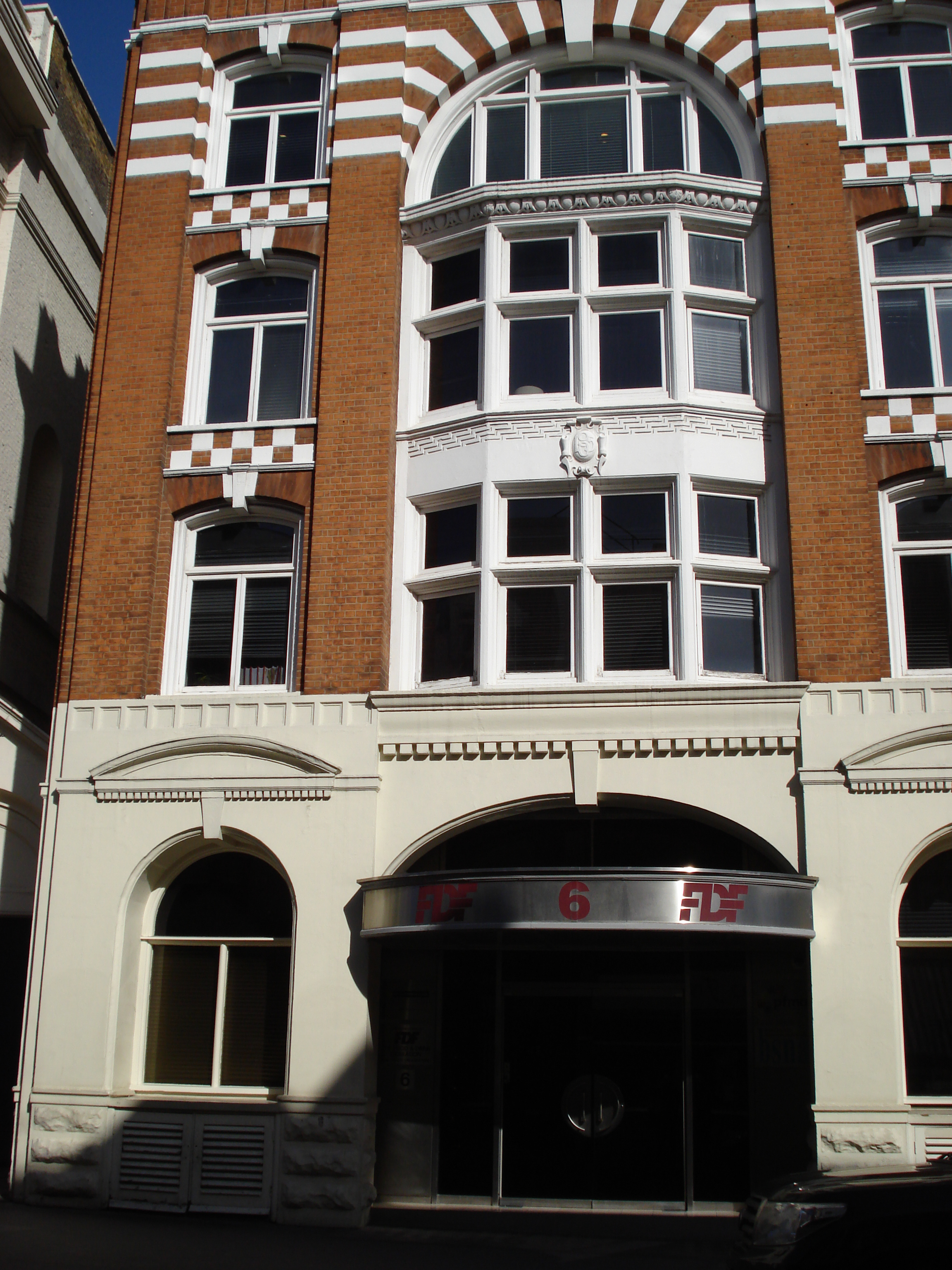 6 Catherine Street – home of the Gardenia Restaurant c 1908-13
The Gardenia Restaurant, at 6 Catherine Street, Covent Garden – off the north-western curve of the Aldwych – was, between c 1908 and 1913, a vegetarian cafe much frequented by suffragettes. Unlike Alan’s Tea Rooms – in Oxford Street – and the Criterion – at Piccadilly Circus – the Gardenia was situated in the heart of militant suffrage territory. The Women’s Freedom League headquarters lay just south of the Strand in Robert Street and those of the WSPU just to the east of Aldwych in Clement’s Inn.
The Gardenia was opened c 1908 by Thomas Smith, a young man from Morpeth, who lived with his wife and two children in rooms above the restaurant. By early 1910 it would seem that the Gardenia was in some financial difficulty because it was then formed into a limited company with three additional directors. Two of these were from the Newcastle area – and were presumably known to Smith. One was Herbert Joseph Armstrong – a chartered accountant. The other, the major shareholder, was Godfrey Hastings, a photographer from Tynemouth, a member of a Quaker family, educated at Ackworth, the Quaker boarding school in Yorkshire. The third director was Richard James, who published – and sold – temperance and vegetarian books from the Central Temperance Rooms in Paternoster Row. It would, therefore, seem safe to deduce that those running the Gardenia were advocates of vegetarianism and temperance in particular – and of social reform in general.
As I emphasise in my post on the part played by the Aldwych Skating Rink in the 1911 census boycott, this area of London was undergoing extensive redevelopment at the beginning of the 20th century. No 6 Catherine Street, a tall, rather dramatic, building, had been erected in 1905 and it is likely that the Gardenia was one of its first tenants. Its frontage of stone-banded red brick echoes that used in the construction of no 2 – which was designed in 1902 by the editor of the Builder, as offices for the journal. By now this corner of Covent Garden was taking on a rather Arts and Craftsy look – making it just the place for a vegetarian restuarant.
Unlike the Criterion – or even Alan’s Tea Rooms – I have been unable to find any image to tell us what the interior of the Gardenia looked like. However the file in the National Archives giving details of the 1913 winding up of the company does contain a list of the company’s assets – including the restaurant’s fittings. From this I think it would be safe to say that the general impression of the interior was of mahogany and mirrors. – long mahogany serving counters and quantities of mirrors. The rooms were lit with electroliers – some four-branched and others three. Customers sat at tables, marble-topped on metal stands – rather like those used today by Pizza Express.
Having noted that the Gardenia’s financial situation was somewhat precarious, one imagines that the company’s directors would have been keen to develop a niche clientele to boost passing trade. And so it was; the company accounts reveal that they hired out upper rooms in the building to societies whoe interests would seem to coincide with their own – for instance, to the Syndicalists, to a Vegetarian Club, to the National Union of Shop Assistants, and to the University Fabian Society.
The militant suffrage societies also figure regularly in the Gardenia’s accounts as customers for the hired rooms. In her autobiography, My Own Story, Mrs Pankhurst refers to the Gardenia as a place where many WSPU breakfasts and teas were held – and the accounts show specific hirings of rooms by the WFL (for instance,7 March 1912, 5 guineas). In fact the Gardenia seems to have been a particular favourite with the WFL, which did its best to advertise the delights of the restaurant. The Gardenia was included in The Vote Directory –the WFL newspaper’s list of recommended retailers – and was written up in the 6 May 1911 issue when – in the course of a suffragists’ shopping day – the author has tea at the Gardenia – ’a fragrant cup of tea and some cress sandwiches made with Hovis bread’ – [Hovis was also advertised in The Vote]’ –reporting that ‘she would eat no other.’In 1912 the WFL rented a room in the Gardenia in which to hold its weekly discussions – on such subjects as ‘Jane Eyre and its relation to the Woman’s Movement’ and Mrs Brownlow on ‘Local Government’ and on 17 February 1912 three of the Gardenia’s floors were hired by the WFL for a fundraising sit-down supper, with dancing and performances by the Actresses’ Franchise League.
It was doubtless no hardship for suffragettes to attend such suppers; a vegetarian restaurant would have been particularly popular with suffragettes – many of whom had embraced this cause – and the associated anti-vivesectionist campaign – along with that of women’s rights. For Leah Leneman’s excellent article on the subject – ‘The Awakened Instinct; vegetarianism and the women’s suffrage movement in Britain’ – see here.
For its part the Gardenia management was clearly committed to the suffragette cause over and above its use as a source of income. The directors were prepared on occasion, to turn a blind eye to the use to which the WSPU put its rooms. Thus, on 2 April 1911 – census night – the Gardenia’s management allowed the restaurant to be used by suffragettes attempting to evade the enumerator. One census schedule for 6 Catherine Street shows Thomas Smith, the manager, in his flat there that night with his wife and two children, together with the restaurant manageress, two waitresses, a male chef, female cook, a male baker and a kitchen maid. But a separate Gardenia schedule, completed by the Census Office from information supplied by the police, shows that the restaurant was packed with 200 women and 30 men. These defiant evaders had moved to the Gardenia at c 3.30 am for breakfast, having spent the earlier part of the night in the Aldwych Skating Rink.
A year later the Gardenia again played its part in a dramatic WSPU publicity campaign when, on the night of 4 March 1912, women taking part in a WSPU-organinised window-smashing campaign gathered there. In her autobiography Mrs Pankhurst notes that the police thought that about 150 women went to the Gardenia that evening, arriving in twos and threes from a large meeting at the London Pavilion at Piccadilly Circus. They were followed to the restaurant by a number of detectives who then waited around outside in Catherine Street And what was it that the women were doing in the Gardenia?
At the ensuing trial Miss Jessie McPherson, a still-room maid, testifed that on the following day, 5 March, she found a dozen on so stones – on one of which was written ‘Votes for Women’ – lying in a grate in a big room on the second-floor. Godfrey Hastings, the Gardenia’s major shareholder, gave evidence that the room had been engaged by the WSPU for the afternoon and evening of 29 February and 1 and 4 March – at a charge of 45 shillings on each occasion.
The evidence pointed to the Gardenia as the WSPU’s ammunition arming station. Once they had received their supply of stones, the suffragettes led the police a merry dance.
One policeman testified that he followed Miss Wolff van Sandau and Miss Katie Mills as they left the Gardenia, went to an ironmonger’ shop in Covent Garden and then walked to Westminster, along Victoria Street to the Howick Street Post Office, where the former broke a window with a hammer and the latter with stones. It transpired in court that it was at the Covent Garden ironmongers, with the policeman in tow, that they had bought the hammer.
Another policeman reported that on 4 March he waited outside the Gardenia Restaurant for three women [Nellie Crocker, Miss Roberts and Miss Taylor]. When they emerged he followed along the Strand, to Charing Cross and then on District Line to Royal Court Theatre. A few minutes after the performance began they left and went along to 9 King’s Road – a post office – where they smashed the plate glass windows with three hammers.
Another policeman followed Elizabeth Thompson and another woman from the Gardenia to Parliament Square,where Miss Thompson threw a stone at a window of Home Office.
There does not appear to have been any legal repercussions for the Gardenia but, sadly, despite support from the suffrage movement, the business could not be made to pay and the restaurant closed in March 1913.
However 6 Catherine Street today still has a primary connection to the food trade – as the home of the Food and Drink Federation. The FDF were very generous in allowing access to their building in order to record a section of the Woman’s Hour item on ‘Suffragettes and Tea Rooms’ in the rooms where the WSPU plotted their militancy over tea and brown rice.
WALKS/Suffrage Stories: Suffragettes and Tea Rooms: The Criterion Restaurant, Kate Frye, and the Actresses’ Franchise League
Posted in Kate Frye's suffrage diary, Suffrage Stories on September 5, 2012
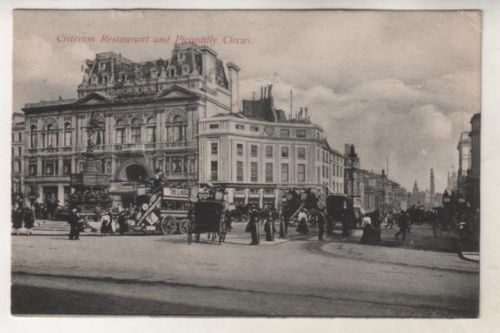 Criterion Restaurant and Piccadilly Circus c 1910
The glamorous Criterion Restaurant lies at the heart of theatreland, facing onto Piccadilly Circus. Owned by Spiers and Pond, it had been built, together with the adjoining theatre, in 1874 and during the last century and a quarter has undergone many changes – although now restored to glory. Before the First World War Spiers and Pond’s empire encompassed railway refreshment rooms as well as other large London restaurants, such as the Holborn, at the north end of Kingsway, the setting for many breakfasts held by the WSPU to celebrate the release of their prisoners from Holloway.
 The Criterion today
Although the Criterion has now only one restaurant – on the ground floor – in its Edwardian heyday it offered many more spaces – not only in which to dine – but also for hire; the Victoria Hall and the Grand Hall, on the first floor, were two such spaces. The Grand Hall, magnificently decorated, ran across the front of the building, overlooking Piccadilly Circus. The lavish interiors were very much a hallmark of the Spiers and Pond establishments – renowned especially for the high standard of their ladies’ cloakrooms – a point, I would imagine, our suffagists and suffragettes would have appreciated.
The Actresses’ Franchise League was founded at the end of 1908 and by the spring of 1909 began to hold its meetings at the Criterion, which was conveniently placed so as to allow its members to spend the afternoon listening to rousing speeches and yet be close at hand to give their own performances in the evening. By all accounts the meetings were extremely well attended, the AFL having no trouble in filling either of the two main halls.
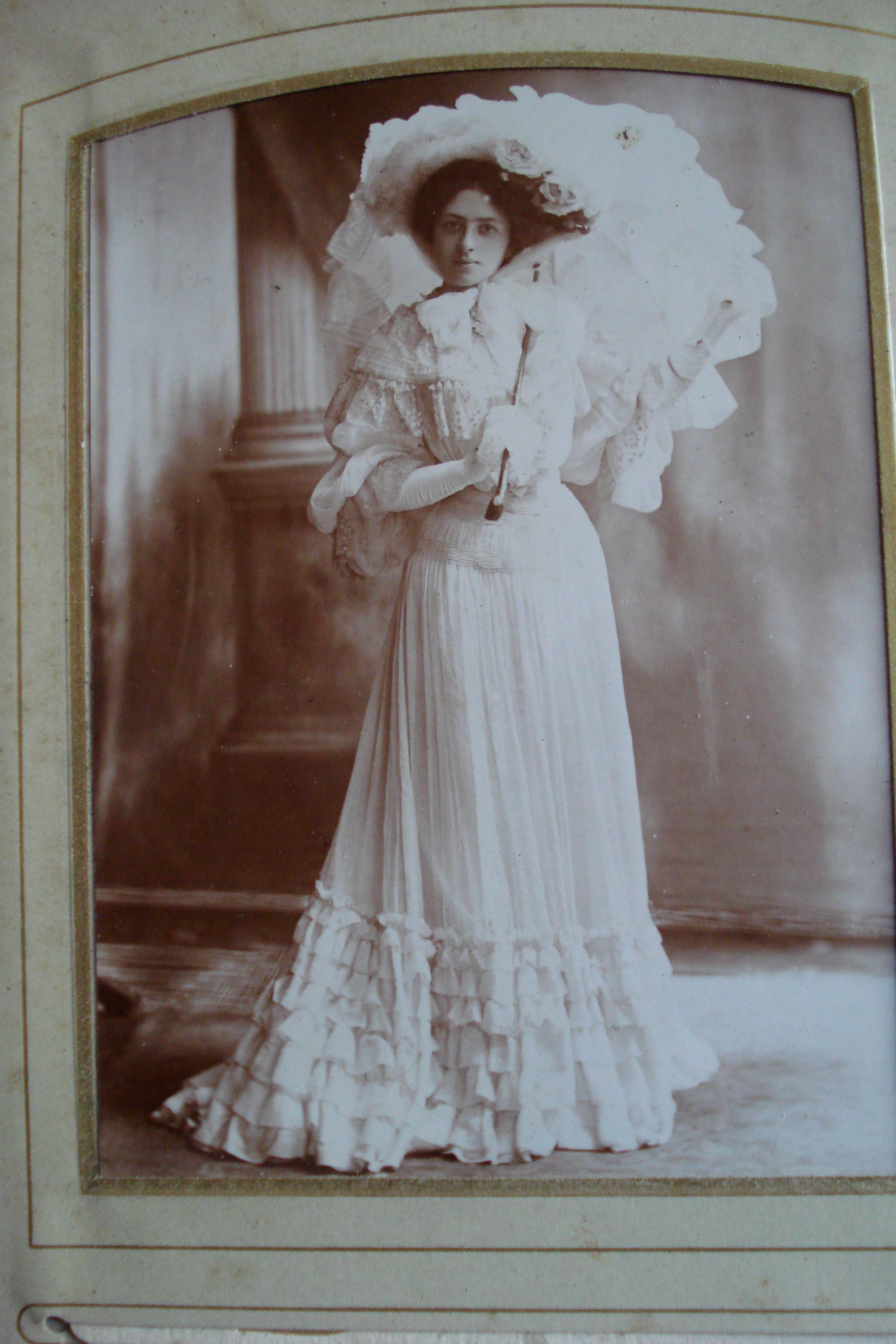 Kate Frye on tour in J.M. Barrie’s ‘Quality Street’.
Kate Frye (whose post-1911 suffrage diary, Campaigning for the Vote, is published by Francis Boutle ), was a proud member of the AFL, having spent two or three years treading the boards of provincial theatres. Her diary entries allow us to eavesdrop on some of those Criterion meetings.
‘Friday April 2nd 1909
Out at 2 o’clock – bus to Piccadilly Cicus and to the Actresses’ Franchise League meeting at the Criterion Restaurant. Miss Eva Moore was receiving and gave me a gracious handshake and Ada Moore was there. Also Eve, Mr Stanger [a sympathetic Liberal MP] and Miss [Frances] Sterling I heard speak. Lady Strachey was in the Chair and Lady Grove had spoken. I also heard Miss [Lillah] McCarthy, the Treasurer, speak and Miss Adeline Bourne, the Secretary, and I went up and spoke to Mr Stanger after the meeting.. His wife was also there. It was a huge meeting – no end of the profession there and they seemed enthusiastic but I have never got much faith in them. …
Friday February 4th 1910
Started off about 1.45 for the Victoria Hall Criterion Restaurant – went by bus. We went early as we wanted a good seat to see Miss Pankhurst. The place was packed before they began at 3 o’clock. Miss Granville took the chair and Miss Adeline Bourne as Secretary and Miss Maud Hoffman as Treasurer spoke in a more or less business-like fashion and Lt Col Sir something Turner spoke – an old dodderer. I could hardly keep my face straight he looked in such a loving fashion at the ladies but of course the thing of the afternoon was Christabel Pankhurst. She is a little wonder. So young and girlish looking – I suppose she is only 22 or 23 with such a charming way with her. She spoke very nicely too. It was not a brilliant speech but she was suiting herself to her audience I have no doubt – but it was so sincere and so fair. I have only heard her once before – at the Albert Hall – and one cannot judge like that – so I am glad to have been at such close quarters with her. She is not really pretty – has a crooked mouth and bad chin but her eyes are nice and she has a pretty forehead. Her hair was very untidy and I think would suit her so much better done low than on top in an ugly little knob. But though so faulty her face lights up so when she speaks and she has such a charming way with her that is very superior to mere prettiness….
Friday November 4th 1910
A bitterly cold day –had lunch then left at 1.15 – took a bus to Oxford Circus and went to steward at The Actresses’ Franchise League meeting at The Grand Hall Criterion. It was great fun.. A Mrs Fagan was in the Chair, Lady Constance Lytton, Mrs Pertwee , Mr Cecil Chapman and Mr M Campbell-Johnston were the speakers.. Then, amongst the audience, Hilda Fletcher – an old Ben Greet companion – the girl who helped me with the Banner at the second march and I chatted to lots of people – made 17/6 and had great fun. Two old gentlemen who were very taken with the Actresses and attending their first Suffrage meeting were most amusing.
Friday December 16th 1910
Changed my dress – at 2.15 bus to Oxford Circus and walked to the Criterion – to the Birthday Tea of the Actresses’ Franchise League. It was packed – a huge success. Eva Moore recited, Bertha Moore and daughter sang.’
The Criterion was used by women’s societies other than those campaigning for suffrage. Here is a photograph of a Women Writers’ Dinner held in the Grand Hall in 1900. Of the suffrage societies, it would seem that the AFL was the most regular user of the Criterion, although in April 1909 the WSPU held a breakfast there for released prisoners and in February 1910 and June 1911 the Women Writers’ Suffrage League held meetings in the Victoria Hall. It is interesting to note that on 26 October 1911, when the International Women’s Franchise Club held a dinner at the Criterion, a vegetarian option was chosen by a fairly high proportion of the guests – 25 out of the 130 who attended.
Although the suffrage sympathisers who attended such meetings were overwhelmingly middle class, one would like to imagine (as one can in a blog) that, through their association with, perhaps, the AFL, less well-off women would have had the opportunity to luxuriate in the splendid surroundings of the Criterion, enjoy a wash and brush up in the opulent Ladies’, and fill up on the tea that brought the afternoon to a close.
Based on her diary, I published Campaigning for the Vote: Kate Parry Frye’s suffrage diary. This is now out of print. The complete collection of Kate’s diaries is now held by Royal Holloway College Archive.
WALKS/Suffrage Stories: Suffragettes and Tearooms: Alan’s Tearooms
Posted in Suffrage Stories on September 4, 2012
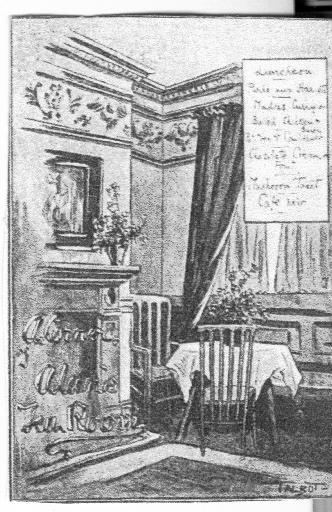 A corner of Alan’s Tea Rooms, as illustrated in ‘The Idler’, 1910.
One of the London tearooms most popular with suffragettes and suffragists was Alan’s Tea rooms at 263 Oxford Street. In my Women’s Suffrage Movement: a reference guide,I suggested that the owner, ‘Mr Alan Liddle’, while not charging the rent of the room for such meetings, doubtless made his profit from the sale of the accompanying tea and buns, conjuring up the image in my mind of a suave male entrepreneur cashing in on the need of campaigners for a safe haven in which to meet in Central London. How mistaken I was.
What I did not then realize, and my researches have only recently revealed, was that the owner was not ‘Mr Alan Liddle’, but ‘Miss Marguerite Alan Liddle’ (1873-1946), the daughter of a Shropshire solicitor. It would seem that she chose to be known by her second, presumably a family, name, signing her will, for example, as ‘M. Alan Liddle’. She does not seem to have taken a direct part in the suffrage movement, but certainly did lend her support, first advertising in the WSPU newspaper, Votes for Women, in, I think, the issue of 31 December 1908.. However, a little research has revealed that she was the sister of Helen Gordon Liddle (note, again, the use of a family name, in this case their mother’s maiden name) who was an active member of the Women’s Social and Political Union. Helen was the author of The Prisoner, one of the more sought-after suffragette memoirs, describing the month she spent in Strangeways prison, Manchester, in October and November 1909.
Although her sister, Alan, already knew of the WSPU and Votes for Women, Helen writes that she herself only became aware of the WSPU in February 1909 when she read about a deputation to Parliament led by Mrs Pethick-Lawrence. In June 1909 she was a member of one of the deputations sent to the Prime Minister and was arrested – but not prosecuted. She wrote ‘my time was not my own to give absolutely to the WSPU’ –she was a teacher of music and singing – but she did spend three weeks in Edinburgh in September helping to prepare for grand demonstration there. In October she protested at a Cabinet Minister’s meeting in Manchester and was ejected. The next night, 20 October, women were excluded from the meeting – so she broke a post office window in protest, for which she was sentenced to one month’s imprisonment with hard labour in the third division. Her companion in this was Emily Wilding Davison, whose will she had witnessed earlier that day. In her book she states that she wanted to describe the atmosphere of prison and its effect upon a prisoner who is forcibly fed. So, while Alan Liddle was advertising her luncheons etc in Votes for Women her sister was on hunger strike in Strangeways.
Alan Liddle had opened the Tea Room in November 1907 in a building on the south side of Oxford Street, very slightly to the west of Oxford Circus, and, as was mentioned in advertisements, ‘three doors away from Jays’. This was a large fashion store on the south-western quadrant of Oxford Circus, the site now occupied by a Benetton store. So, as a business, it was certainly very centrally placed, its only drawback being that it was not on street level but on the first floor. Presumably customers entered through a door to one side of the shop front (which was the dry cleaners Achille Serre) and went up a staircase – which might be thought of as something of a deterrent as there was a wealth of competition from other cafes, tea rooms and restaurants around.
For instance, there was a Liptons refreshment room at no 265-7, another restaurant at 269, a Lyons tea room at nos 277-81 and an ABC at no 283. So I am imagining that Alan Liddle felt the necessity to carve out a niche market – to attract customers through the door and up the stairs – over and above any passing trade – who might find it easier to enter one of the larger, ground-floor cafes close by. And I imagine that the niche market she aimed at was ‘the suffragette’.
I don’t know what Marguerite Liddle did before setting up the teashop – when she was 34 – or who was in her friendship circles. In 1911, unlike her sister, Helen, she did complete a census return. This shows her, a ‘proprietoress of tea rooms’, living at 8a Holland St, Kensington as a lodger in the apartment of Miss Emilie Chapman, a nurse. She ran the tearooms until about 1916.
Besides suffragettes, she also sought to attract women out clothes shopping in the West End – the obvious clientele. In 1910 the ‘Vanity Pages’ of The Idler, a popular magazine, edited by Jerome K. Jerome, Mrs Edward Talbot, while discussing clothes shopping in Conduit St and New Bond St , wrote ‘We then had the nicest little luncheon, with the comforting knowledge that everything was homemade, at Alan’s Tea Rooms (263 Oxford St) for the modest sum of 1/6.We send you a sketch and a menu, so you can see for yourself. The rooms are charmingly decorated; one is set apart for smoking, while another, which is large and sunny, can be hired for At Homes and meetings. You can lunch, also, for a shilling, and for afternoon tea Alan’s popularity is undoubted.’
I was curious to know what Alan’s Tea Room looked like and managed to find a photograph of that block of Oxford Street -now redeveloped -that revealed that the red brick building was probably built in the 1860s. The first-floor room looking over Oxford Street had a semi-circular arcaded window – rather Venetian in style. It was an amazing piece of luck that Mrs Talbot accompanied her piece in The Idler with a small line drawing of a corner of Alan’s Tea Rooms. So we can see that the room had a ceiling cornice above a frieze of garlands. The walls were probably papered with a small-patterned wallpaper. There was a plain, early-19thc-style fireplace and panelling under the window. The windows were draped with two sets of curtains. One was a set of short – to the sill – lightweight material ones – and then, over these, there were heavy drapes – probably velvet- looped back at the sides. There was a vase of flowers on the mantelpiece and a picture over it. The furniture was sort of arts and crafts. The tea table, covered with a table cloth, shown is of the ‘gipsy’type – typically Edwardian – with slightly splayed legs. The chairs were high stick-backs – perhaps with rush seats. The Luncheon menu (for one shilling) was:
Puree aux haricots
Madras Curry
Boiled Chicken and Bacon
Potatoes and Cauliflower
Chocolate Cream
Fruit
Mushroom Toast
Café Noir
Advertisements revealed that luncheons cost 1s or 1s 6d (served between 12 and 2.30) and Teas were set at 4d, 6d and 1s. Mention was made of the food being home-made – so perhaps we can assume that there was a kitchen on the premises – and that Alan employed a cook – as well, probably, as at least one waitress?
In another 1910 issue of The Idler there was another ‘editorial’ piece in The Vanity Pages:
‘Hostess [ie the questioner, who as asked for suggestion of a place in central London to hold an ‘At Home’]. I’m always pleased to be of any help if I can, in your case I know of the very place you want. At Alan’s Tea rooms, 263 Oxford St, there is a nice room available for at Homes. It is large, sunny and charmingly furnished, and can be hired at a moderate figure.’
This would have been the room hired by suffrage societies – for whom, as I have mentioned, it was advertised that no charge was made. And the societies did take advantage of the offer. The Tax Resistance League held its first members’ conference there on 14 November 1910, the Catholic Women’s Suffrage Society its inaugural meeting in March 1911, the Forward Cymric Union –a militant Welsh suffrage society– held monthly meetings (c 1912) at Alan’s, attracting 50 to its first meeting. Visits of individual women to the Tea Room are, of course, very much more elusive to pinpoint – though we do know that on 26 July 1913, at the end of the NUWSS Suffrage Pilgrimage, Margory Lees and her companions went there for dinner.
Alan Liddle ran her Tea Rooms for about nine years – probably until 1916 – providing pleasant surroundings and home-cooked food to members of both wings of the suffrage campaign.
WALKS/Suffrage Stories: The Suffragette 1911 Census Boycott: Where and What Was the Aldwych Skating Rink?
Posted in 1911 Census, Suffrage Stories on September 3, 2012
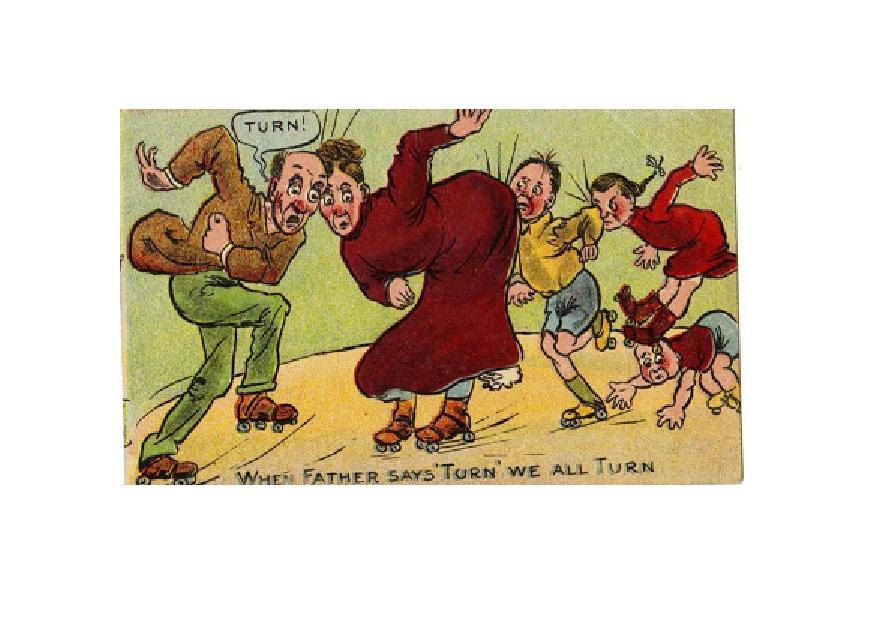 Roller skating was one of Edwardian Britain’s ‘crazes’ – to be enjoyed, as this comic card shows us, by all the family. One could, of course, as I did as a child in the 1950s, roller skate in the streets, but in the years before the First World War entrepreneurs hoping to cash in on the craze ventured to erect roller skating rinks in towns the length and breadth of Britain.
While I am sure that many individual suffragettes and suffragists enjoyed a spin around their local rink, there was one episode of suffragette history that centred on a specific London roller skating rink. For on census night 1911 – 2 April – it was at the Aldwych Skating Rink that the militant suffrage societies – the Women’s Social and Political Union and the Women’s Freedom League, together with related societies such as the Tax Resistance League – urged their supporters to muster. Here, out of their homes, they would escape detailed enumeration.
When interviewed in the 1970s by Sir Brian Harrison (Women’s Library 8 SUF/B/024), Marie Lawson, an important figure in the Women’s Freedom League, remembered that ‘We formed immediately a census resistance group – women who said ‘we don’t count; we won’t be counted’ – that they would stay out somehow – out of a house or roof during the period when you had to be recorded. Our group took the Aldwych skating rink for the night – we hired it. Nobody was supposed to be sleeping there. We had roller skates and we spent the night on roller skates and there was no-one to declare us and when we went away in the morning we were very weary, very tired with our roller skating but we felt we had done the government out of so many names on the census resistance. It wasn’t very useful really but it was something to do. We used to grab at every little thing, you know, that we could make a protest about. It was advertising really.’
So it was that, after a late-evening rally in Trafalgar Square, the suffragettes promenaded down the Strand to the Aldwych where it was estimated by the Census Office that 500 women and 70 men gathered at the Skating Rink. Although the numbers were recorded, the identity of most of that 570 is lost – only those whose names are mentioned in the Votes for Women report (7 April 1911) can be placed there with certainty. These included Mrs Pankhurst, Ethel Smyth and, among members of the Actresses’ Franchise League who provided the entertainment, Decima Moore and her sister, Ada, Adeline Bourne, Winifred Mayo, Inez Bensusan, Rosa Leo, Sidney Keith, Miss Laing and Natalia de Meix. Emmeline Pethick-Lawrence was also there. She certainly did her bit to disrupt the census, being enumerated in three separate places- once in her Clement’s Inn flat, once in her Surrey country cottage and, again, here at the Aldwych. By way of contrast, no trace of a census paper for Christabel Pankhurst has been found – but she was there in the Skating Rink, bringing the entertainments to a rousing conclusion at 3.30 am.
Here is Decima Moore photographed that night inside the Skating Rink. I am pretty certain that she is captured doing her party piece -Laurence Housman’s ‘Women This and Women That’. In the photograph we can see, behind the audience and the NWSPU ‘No Vote No Census’ banner, the walls of the skating rink – rather bare as one might expect. ‘What kind of structure was it?’, I wondered and, moreover, ‘where was it?’ ‘Aldwych’ was a rather vague address.
I discovered that the Aldwych Skating Rink was first listed in the rate books in 1911, provisionally numbered 10 Aldwych. The Kingsway/Aldwych area that to us today looks so solidly Edwardian was, in 1911, still in a state of flux.
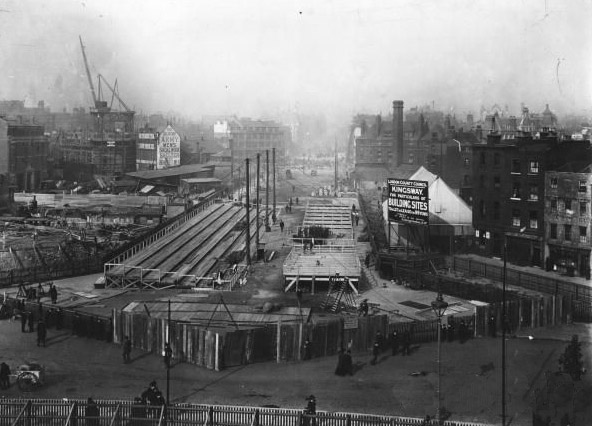
Looking up Kingsway from the Aldwych, 1905
Kingsway had been driven through – it was formally opened in 1905 – and the curve of the Aldwych formed, but it was not until well into the 1920s that all the plots were sold and developed. Thus, from the rate book, I could see that no 10 Aldwych was surrounded by vacant lots enclosed in advertising hoardings, the hoarding company paying a rent for their advertisements.
But I was still unclear as to precisely where no 10 was. However, the rate book came to the rescue, recording that on one side of no 10 the lot was owned by the London County Council and was ‘used for advertising station on frontage line from Houghton Street to roller skating rink. On its other side –provisionally numbered no 8 – was an advertising station north-east on the frontage line east of the roller skating rink. So this seemed to establish that the skating rink was on the north-east curve of Aldwych, to the east of Houghton Street. Clement’s Inn, the WSPU headquarters, virtually abutted the rear of the plot. What more suitable venue to book for such an evening than this, probably the nearest large hall?
The owner of the skating rink was Edward Johnson Wilson who had formed his company, ‘Rinkeries’, in 1909. In 1911 the company also ran ‘ideal skating palaces’ on the Holloway Road, as well as in Exeter, Plymouth and St Leonards. Like many other roller-skating rink companies, whose liquidations, as recorded in the London Gazette, are a sad testament to so many lost hopes, ‘Rinkeries’ does not appear to have been very successful; Edward Wilson was doubtless glad of the windfall of a night’s rent from the WSPU.
But I still did not know what the skating rink looked like. It is difficult now to conjure up the appearance of that A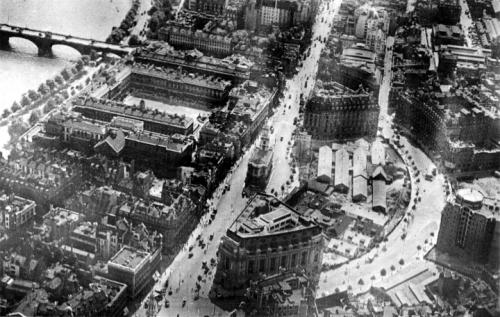 ldwych curve before the arrival of the imperial solidity of the buildings we see today. From looking at contemporary photographs of Kingsway, dominated by empty plots and high advertising hoardings, I could imagine that the area must have felt strange and impermanent. The old higgledy-piggledy rookery streets around Holywell Street and Houghton Street – that many of the suffragettes would have remembered – had been swept away, but the new order had not yet arrived. In this aerial photograph, probably taken c 1918 after the completion of Australia House (in the centre foreground), the Aldwych Skating Rink would have been – and perhaps still was – one of the low buildings in the bottom right of the picture.
But in 1911 the southern side of the road had not been developed at all. With few buildings to throw out light, the area was doubtless rather dark. What kind of building was it that the suffragettes waited outside that night – surrounded by, in effect, a building site – while posses of hooligans attempted to storm the rink’s doors?
I have not been able to locate a photograph, but, as luck would have it, I found the answer in the ‘Rinkeries’ file in the National Archives – its presence there a consequence of the company’s eventual liquidation. There, as a heading to ‘Rinkeries’ notepaper, was an engraving of the Aldwych Skating Rink. I could now see that it comprised four linked, gabled structures –chalet-type – single storey. The effect, for all the panache of many flying union flags, was somewhat temporary – as it was no doubt in reality. What a contrast to its successors.
During the First World War the Aldwych Skating Rink was used as a clearing house for Belgian refugees. This watercolour, in the Imperial War Museum collection, shows the building after it was hit in a Zeppelin raid on 13 October 1915. The church in the background is St Clement Danes. The Rink must have been swept away by the end of the war, to make way for the monumental buildings that still occupy the central section of that Aldwych curve. It takes an effort to reimagine its former appearance – but to do so helps us to enter the 1911 worldview of the census evaders.
To listen to a talk I gave on the suffragette boycott at a National Archives conference on the 1911 census click here
Copyright
Suffrage Stories/Collecting Suffrage: Suffragette Jewellery
Posted in Collecting Suffrage, Suffrage Stories on August 27, 2012
 Pendant made for Margaret Murphy by Ernestine Mills
‘Prison to Citizenship’ – Three pendants earned by two Irish suffragettes
In previous posts I have mentioned how necessary it is to observe the provenance of an item of jewellery in order to be able to label it with certainty as ‘suffrage’. In that way the collector is less likely of falling into the trap of buying an item – vaguely Edwardian with vaguely purple, white and green stones – that an auction house or dealer has chosen to label ‘suffragette’ In this post I will bring to your attention three items of jewellery – made for two Dublin sisters – that are indisputably ‘suffrage’.
‘Margaret’ and ‘Jane Murphy’ were the pseudonyms of two middle-class women from Dublin – whose real names were Leila (b. 1887) and Rosalind Cadiz (b. 1886). They were members of the Irish Women’s Franchise League. They both took part in the window-smashing campaign in London in March 1912 and were sentenced to two months in Holloway. They went on hunger strike (c 16 April) and were forcibly fed. They were released c 15 May. The pendant above is engraved – “Holloway Prison No. 15474, Maggie Murphy, 2 months hard Labour, E.4 Cell.12., Hunger Strike 16th April 1912, Forcibly Fed – and was made by the suffragist and enameller, Ernestine Mills. As you can see the lily motif is rendered in purple, white and green – in this case a ‘true’ use of the colours.
 Margaret and Jane Murphy, top row far right and second from right, pictured in Votes for Women, 25 June 1912.
A couple of months later the Murphy sisters took part in the first window-smashing campaign in Dublin and were again sentenced to two months’ imprisonment – but in Dublin they were given the status of political prisoners.
Margaret Murphy requested to be treated by her own doctor, Kathleen Maguire, ‘as I am undergoing treatment owing to having been forcibly fed in Holloway,… Dr Maguire understands my constitution.’ To this the Medical Officer in Mountjoy replied (5 July 1912) ‘I beg to report that I regard her [Margaret Murphy] as a woman of neurotic temperament who suffers from indigestion, an ailment frequently complained of by women of this type.’
The Murphys eventually succeeded in not only getting a suffragist doctor, Kathleen Maguire, to treat them, but also in getting their own dentist. ‘Miss Jane Murphy will attend her own dentist at her own expense’ (July 1912).
The Murphys clearly had a way about them for ‘with reference to Margaret Murphy’s complaints of the possible effect of the whitewashed walls of her cell on her eyes, the governor agreed to have the walls recoloured, and to have a new gas burner fitted in lieu of the existing one, and her request for a special kind of disinfectant to be used in her cell was referred to the Medical Officer.’ 25 July 1912 Minutes of Mountjoy Prison.
Finally the sisters went on hunger strike for the last 92 hours of their sentence (along with 2 other Irish suffragettes) in sympathy with three English suffragettes (Mary Leigh, Gladys Evans and Jennie Baines) who had received harsh prison sentences in Dublin and who had not been given political prisoner status. The Murphys were not forcibly fed – the end of their sentence arriving before this became necessary. They were released, together, from Mountjoy Prison on 19 August, welcomed by members of the Irish Women’s Franchise League.
Here are the pendants that the sisters either commissioned for themselves or, more likely, with which they were presented after their release. Each pendant is of shield shape, surmounted by a green enamelled shamrock, hallmarked Dublin, Hopper and Hannay, 1912. One is engraved on the obverse “From Prison to Citizenship” and on reverse “J. Murphy 20.6.12 to 19.8.12” and the other “M. Murphy 20.6.12 to 19.8.12”. Thus do three items of jewellery commemorate the efforts of two Irish sisters to win ‘Votes for Women’.
La Bella Libertà: Anna Miller crosses Mont Cenis
Posted in Women Writers and Italy on August 24, 2012
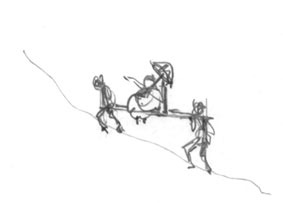 In 1770 Anna Miller and her husband crossed into Italy via Mont Cenis., the route used for centuries by tourists – and armies – to travel from France into Italy It being another 30 years or so before Napoleon carved out a road through the pass and so allowed for coach travel, the Millers and their contemporaries enjoyed a very much more energetic adventure.
[The drawing is a reimagining, by Sandy Nightingale, of a crossing of Mont Cenis ]
The Millers spent the night before the ascent at Lanebourg where, Anna reported, ‘There are about an hundred porters, whose names are upon a list; the Syndics take care that they carry travellers in their turn, and are referred to, in case of any dispute that may arise amongst them. ‘While we were eating a very bad supper, composed of liver and brains, (to what animal they belonged, I do not pretend to decide) the Syndic of the Porters came in, to judge how many of the latter we should have occasion for. Four were assigned for me, and six for M —‘
Having passed a sleepless night, partly owing to a mountain torrent that descends close to the window, we set out at five o’clock the next morning in our chairs, the ascent not being ten paces from the door. These chairs are constructed in the most simple and portable manner. There are two small bars of wood for arms, and another bar behind which rises but little higher than the arms, and which serves as a support to the back of the person in the chair; the seat is matted with bark of trees and ropes twisted together, which yields to the weight of those thus carried. You are so near the ground, that there is not the least difficulty in stepping out of the chair at pleasure; there are no legs to these chairs, but in their room a board is tied on by ropes to the seat, which the feet being placed upon, and the cords as much shortened as can conveniently be, the legs and feet are well supported, being sufficiently raised to clear them entirely of any shock from uneven or rocky ground. The chairs are fixt on poles.. The chairmen are aided by straps over their shoulders, in the same manner as they carry in England.
I liked this manner of travelling very much. You are conveyed along surprisingly fast on the plain; the porters run rather than walk’
‘Our chaise being taken to pieces, it was carried on the mules’ backs. These animals make a droll appearance, with a wheel on each side, and the body of a chaise on their back.
Just before we gain the plain, the ascent augments in rapidity. The air was very keen on the plain; and I was obliged to wrap myself up in a pelice, lined through with fur, although the day was remarkably fine for that country.
The descent is extremely rapid for about 300 yards. I don’t know any thing this road resembles more than a broken stone staircase, which occasions the porteurs to turn so suddenly by its windings, that the person in the chair passes clear over the sharp angles, cutting them, as it were, across. Notwithstanding the novelty of this manner of travelling, the steepness of the road, and the velocity with which I descended, my porteurs running almost the whole way, I never once felt myself sufficiently frightened to lay hold of the arms of the chair, my attention was so much engaged with the singularity and variety of the prospect below. At some moments during the the descent, I could not help fancying myself a witch upon a broomstick.

18th-century Turin, comfortable civilisation after the rigours of Cenis
Having crossed over into Italy ‘on the finest day imaginable’ Anna Miller assures the recipient of her letter that ‘we are safely arrived without having met with the least accident, and are well lodged in the house of Countess d’Or-b-ns at Turin.’
Kate Frye’s Diary: ‘Paddington Pandemonium’
Posted in Kate Frye's suffrage diary on August 23, 2012
In the following diary entry Kate describes the pandemonium that occurred at a December 1907 suffrage meeting organised by the North Kensington Local Committee of the Central Society for Women’s Suffrage – the non-militant London NUWSS society – chaired by Mrs Millicent Fawcett. From Kate’s account the main culprits were medical students from nearby St Mary’s Hospital and from University College Hospital in Bloomsbury, such student having had, through the ages, a reputation for unruly behaviour. From Kate’s observation, the stories of stinkbombs and the release of mice, specifically intended to upset the genteel female audience at suffrage meetings, were all too true.
Lady Grove (1862 -1926) was a leading Liberal suffragist and author of The Human Woman, 1908. The Paddington Baths, in Queen’s Road, Bayswater, were soon to be demolished to make way for an enlarged Whiteley’s department store.
Thursday 5th December 1907 [25 Arundel Gardens, North Kensington]
‘ At 2 o’clock Agnes and I started off to Linden Gardens and called for Alexandra Wright and several of her helpers and we all walked to the Paddington Baths to help arrange the room for the meeting in the evening. There was a good bit to do – numbering the chairs – partitioning them off and hanging up banners and posters etc. Left [home again] just before 7 o’clock in a bus to Royal Oak and went to the Paddington Baths for the London (Central) Society’s meeting for Women’s Suffrage. Gladys and Alexandra have been weeks getting it up and I did no end of clerical work for it at Bourne End. We were the first Stewards to arrive after Gladys and Alexandra and were decorated with rosettes and given our directions. Lots of the women were very nervous of a row. My department was the gallery, to look after people up there and give invitations for a private meeting next week.
The people came in thick and fast and the doors were opened at 7.30 and with the first group of young men below in the free seats I knew what would happen. The place was soon hot, bubbling over with excitement, and I had my work cut out keeping gangways clear and looking after people and telling them they would be safe. We had expected an exciting evening but this realised our worst expectations. It was Bedlam let loose. A couple of hundred students from St Mary’s and University College Hospitals arrived and insisted on sitting together and never ceased all the evening singing, shouting, blowing tin trumpets, letting off crackers, letting loose mice and, what is worse, scenting the floor with a most terrible-smelling chemical.
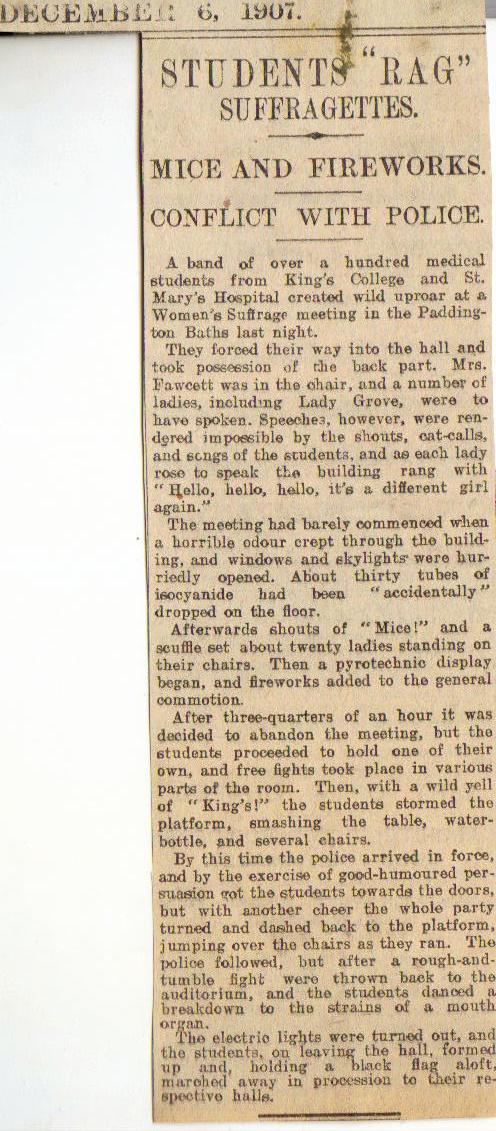
Report from the ‘Daily Mail’ 6 December 1907, clipped by Kate and laid in her diary
From the very start they never gave a single speaker a moments hearing. Mrs Fawcett was in the Chair and Lady Groveand others spoke and they went on with the meeting to the bitter end – and bitter it must have been to the speakers. I never heard a word. I felt too angry to be frightened though I must own I did not like the fireworks and saw the most appalling possibilities in that frantic howling mob of mad animals. Agnes owns to being terrified – all the more credit to her for sticking to her place amongst them and she was with them all the evening. I felt mad at not being there in the midst of them. When I could leave I just went down and spoke to John, who I saw standing near Agnes. She had decorated him as a Steward to help in case the worst happened.
I went back to my post until I was no longer any good there and then I went into the very midst of the seething mass and talked to any of them I could get at. Just to silence them, as I did for a few minutes at a time, was a triumph. Cries of ‘Oh I think I like Suffragettes’ as I went amongst them and, then, ‘He is flirting with a Suffragette’ taken up and sung by them all. I spoke like a Mother to several and smiled at them. If they had only known my true feelings I don’t think they would have been so polite to me. Great credit to all the women in the building is due – not only the Stewards – but the audience there. There was never any excitement or panic amongst them and only one Stewardess failed us. She, poor thing, was so terrified she bolted without waiting for hat or coat – but of course we keep that dark. The men Stewards were very good but quite powerless to stop the noise and hubbub. And what could four policemen do? It was an organised ‘Rag’ and nothing but a force of police to outnumber them could have stopped them. They longed for a fight and said so – and no end of them had most terrible looking clubbed sticks which they brandished. We did the only possible thing, I consider. Kept as much order as we could and tried to avoid bloodshed. We had a little unfortunately when, after the meeting was over, they charged for the Platform, sweeping everyone before them. Very fortunately there were large exit doors each side of the platform and most of the people got out of them. I was flung aside and then followed them up. They tore down as many banners as they could and stole one and tore down all the posters. They were like wild cats. The policemen chased them round a little but we would not allow any arrests to be made. The firework ringleader was caught but allowed to go. I spoke to Mrs Wright – red with rage. Poor things, we were all either red or white. Mr Willis, Mrs and Miss Doake and several others. Mr Percy Harris was Stewarding. One man Steward got a most awful crack on the ear and was considerably blooded – he looked awful. Several of the boys had their collars torn off and became very proud in consequence. It was a great wonder and a still greater mercy that more damage was not done. I felt so responsible for the ordinary public who had paid their money. I could only hope to get over the evening safely for their sakes. Personally I wished and still wish to smash the Boys, though at times I could not help laughing. They were not nice boys – all plain and common looking – mostly undersized and no gentlemanly looking one amongst them. I was glad to notice that as I hope they are not the best we can show in our hospitals.
After the general public had gone the police sent word that it was impossible to clear the hall while there was a woman left in it so we left with Mrs and Miss Doake and all came back in the bus with Mrs Willis. Miss Doake said she had never enjoyed a night so much in her life before. I cannot say the same. It was a terrible experience. We could not lose that terrible smell from our noses and mouths. I could taste it through everything at supper. John came home with us and did not leave till after 12o’clock. Agnes and I were too excited to go to bed and sat talking of our experiences. Lots of people will be made all the keener through it, but a great many will be very disgusted I fear.’
 As you can see from this note, carefully preserved by Kate, Mrs Fawcett’s meeting was re-arranged for early 1908 – to be held in the safety of Bertha Mason’s house in nearby Hyde Park Square.
Campaigning for the Vote: Kate Parry Frye’s Suffrage Diary edited by Elizabeth Crawford
For a full description of the book click here
Wrap-around paper covers, 226 pp, over 70 illustrations, all drawn from Kate Frye’s personal archive.
ISBN 978 1903427 75 0
NOW OUT OF PRINT, ALAS
KATE’S DIARIES AND ASSOCIATED PAPERS ARE NOW HELD BY ROYAL HOLLOWAY COLLEGE ARCHIVE
- ‘Campaigning for the Vote’ – Front and back cover of wrappers
Mariana Starke: Great-grandfather’s house
Posted in Mariana Starke on August 22, 2012
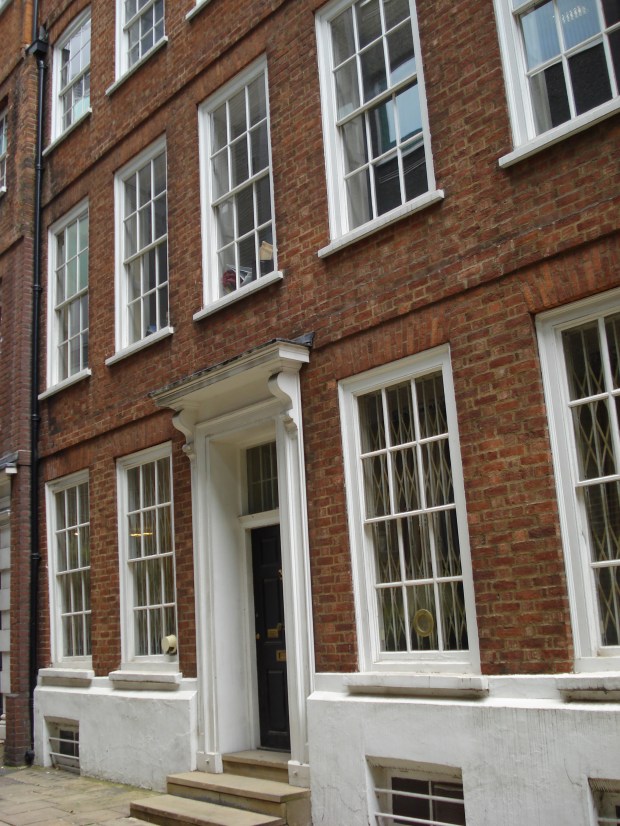
House similar to that lived in by Thomas Starke and his family in the late-17th century
In the late-17th century Thomas Starke, the slave trader, lived and, I think, carried on his business in Mincing Lane in a house rebuilt in the 1670s – after the Great Fire of London. Starke’s house – and all the others in that street- have long since disappeared – now replaced by a Gotham City simulacrum, politely described as a ‘post-modern gothic complex’. However a few London houses built by Mincing Lane’s post-Fire-of London developer, Nicholas Barbon, do remain, including – pictured here – 5-6 Crane’s Court, just off Fleet Street – giving a rough idea of the manner of house in which Starke and his family lived.
Fortunately for us, when Starke – a freeman of the city of London – died in early 1706 several of his children were not yet 21 years old. This meant that the London Court of Orphans was required to draw up an itemized list of his household goods, assets and debts in order to supervise the division of the estate. This inventory provides a marvellous picture of the furnishing of the Mincing Lane house – at least some of which were purchased with the profits from Starke’s slave-trading activity, as well as an insight into Starke’s complicated finances. Moreover, the inventory, made on 18 April 1706, is held in the London Metropolitan Archives, very close to my home, a short walk collapsing the centuries.
Although the inventory does not reveal who was living in the house in 1706, a 1695 tax assessment showed that besides Starke, his wife, and two daughters, the household then comprised two apprentices (both of whom were to figure in later Starke litigation) and three servants – two of them women, one a boy.
The 1706 inventory begins at the top of the house – in the fore garrett – [perhaps a bedroom for the apprentices?] which contained:
One corded bedstead and rods, printed stuff curtains and valance, and flock bed and feather bolster and pillow, 2 blankets and 2 rugs, a table, 2 chests of drawers, a pallet bedstead, 2 chairs, one box – value £2 2s
I assume that ‘corded bedstead’ meant a bed with cords to support the mattress and that ‘rods’ are curtain-type rods from which hung the printed stuff curtains that surrounded the bed to exclude draughts.
The back garrett [perhaps a bedroom for 2 servants?] contained::2 chests, a horse for clothes, a few candles, 2 little bedsteads, a feather bed, 2 flock bolsters, two blankets, two rugs, a quilt, some lumber – value £2 1s
In the room 2 pairs of stairs forwards [perhaps Stark’s daughters’ room]: One sacking bedstead and rods, camblett curtains and valance lined with silk. Feather bed, a bolster, 2 pillows, 2 blankets, a rug, one counterpane. Corded bedstead and rods, curtains, 1 feather bed, bolster, 6 pillows, 4 blankets, a rug, 7 chairs, 1 chest of drawers, a table, 2 looking glasses, 5 window curtains, 3 rods, 2 pairs of dogs [ ie for the fireplace], a fender shovel, and tongs, a pair of bellows, 4 hangings of the room – value £15 7s.
Apart from the value, we can tell that this room was used by more important members of the household than the two garrets because of the use of ‘camblett’ to make the curtains, ‘camblett’ being a fine dress fabric of silk and camel-hair, or wool and goat’s hair, which was a lighter material, replacing broadcloth and serge and quite newly fashionable.. Similarly the lining of the valance with silk was a newish and fashionable furnishing style.
Back room: 1 corded bedstead, printed stuff curtains and valance, feather bed, bolster, 1 pillow, 1 blanket, a rug, 1 chest of drawers, 1 table, 2 matted chairs, grate, fender, shovel and tongs, a warming pan, a pair of bellow, 1 boll printed stuff. Hangings of the room, 3 chairs – value £5 2s
Middle room: 1 corded bedstead and rods, a pair of old curtains and valance, 1 feather bed, bolster, 1 pillow, a blanket and rug – value £1 15
In the room 1 pair of stairs backwards: [perhaps Starke’s bedroom – to be used for entertaining as well as sleeping.] 1 sacking bedstead, silk and damask curtains and valance lined with silk, a quilt and feather bed bolster, some calico curtains, 1 table, a looking glass, 6 chairs and cushions, a slow grate, shovel, tongs and poker, a brass hearth shovel and tongs, 3 pairs of tapestry hangings – value £36 6s [Peter Earle in The Making of the English Middle Class: Business, Society and Family Life in London 1660-1730 (1989) gives the average value of the furnishings of a merchant’s bedroom as £23.3, positioning Starke’s as rather above average.]
The silk and damask curtains and the valance lined with silk were smart and fashionable, while the presence of the tapestry hangings suggest a room intended for comfort in a slightly old-fashioned style..
On the staircase: 3 pictures, clock and case, 2 sconces – value £5
In the Dining room [Earle denotes the dining room as the ‘best’ living room in a house of this type, giving the average value of the contents of such a room as £12 2s – making Starke’s furnishings a little above the average in value.]: Gilded leather hangings, 2 tables, a looking glass, 1 side table, 11 cane chairs, 12 cushions, a pallet case, 2 glass sconces, a pair of tables, brass hearth dogs, shovel and tongs – value £13 12s.
The gilded leather hangings were, by the early 18th-century, perhaps a little old fashioned, but the possession of cane chairs marked the Starkes out as a family who were prepared to buy new and fashionable styles. Cane chairs had been new in aristocratic homes in the 1660s, and were taken up by ‘middling men ’ from the 1680s. It would seem that the Starkes’ cane-bottomed chairs required cushions to make them acceptably comfortable.
In the parlour [the ‘second best’ living room]: Cane chairs, 2 cushions, a boll – value £2 10s.
In the Kitchen: An iron back grate, fender, 2 spit racks, an iron crane, 3 hooks, 2 shovells, tongs and poker, 1 gridiron, 2 iron dripping pans, 2 dish rings, 1 shredding knife, 2 frying pans, 2 box irons and heaters, jack chain and weight and pulley,. 4 spits, a beef fork, a brass mortar and pestle, 7 candlesticks, a pair of snuffers, a ladle and scummer, 2 iron bottles, 4 brass pots and covers, 1 bottle, 2 sauce pans, 1 copper stew pan, 3 chairs, 2 folding boards, 1 pair of bellows and napkin press, a table, a lanthorn, 196lbs of pewter, some tin wooden and earthenware – value £19 12s 10d .
Earle mentions that the average value of kitchen goods in this period was between £10-£20, putting the Starkes’ batterie de cuisine at the top end of the scale.
In the cellar and yard: A few coals, a beer stilling, 2 brass corks, some fire wood, a leaden cistern, 1 boll, 2 doz glass bottles – value £7 1s.
The inventory goes on to give the value of Starke’s wearing apparel (£5), household linen, and plate (292 oz, value £74 –presumably including the silver salver and caudle cup that Starke specifically mentioned in his will) – before moving on to monies owed to him and his own debts.
All in all, this is a house of a middling London merchant, one who, with his family, wished to be comfortable but was not desperate to adopt the very newest fashions. I do not think it would have been as elegant as the parlour room set, dating from 1695, that one can see at the Geffrye Museum. Here you can see the Starkes’ cane chairs, but Thomas Starke presumably preferred the older-fashioned tapestries and gilded leather hangings. which many of his fellow merchants – as in the Geffrye Museum re-creation -would have been taking down and replacing with pictures. In fact only three pictures are listed in the Starke inventory, all hanging on the stair case, alongside the household’s only clock. Similarly, the Starkes were, presumably, still eating off pewter and had not been tempted by the more newly fashionable china.
I did find two omissions interesting. The first is that no room is specifically denoted as a counting-house, although at the time of Starke’s death the sum of £245 19s 13/4 [=£32,000 purchasing power in today’s terms] was held in cash in the house. So, perhaps I was incorrect in assuming that, as he was living in Mincing Lane, in the very heart of the trading district, his business would have been done on the premises. And, secondly, I suppose I might have expected a merchant’s possessions to have included at the very least a quantity of ledgers – and, perhaps, some books and a globe.
Sometime after Thomas’ death, his widow and her daughters – Sarah, Martha, Frances and Elizabeth moved out of the City. There no longer being any necessity to live close to business, they chose Chelsea as their new home– more rural, more fashionable. It is possible that they were the first occupants of a newly-built house in Upper Cheyne Row, close to their great friend Lady Mary Rawlinson, widow of a a close associate of Thomas Starke and a former Lord Mayor of the City of London. The Survey of London suggests that this house and its immediate neighbours were built c 1716 and Lady Mary and her daughter, also Mary, lived at 16 Upper Cheyne Row between 1717 and her death in 1725. Between 1748 and 1757 Thomas Starke’s daughter, Martha, and the younger Mary Rawlinson lived together at 12 Upper Cheyne Row. They were evidently very close; in her will Martha, who died in 1758, left everything to Mary and asked to be buried with her in the same grave in Ewell parish churchyard. However, Mary Rawlinson lived on to 1765 and in a codicil to her will, made in 1764, changed her preferred place of burial from Ewell to the Rawlinson family vault in St Dionis Church Backhurch in the City (demolished 1868)..
I imagine that Thomas Starke’s tapestries and gilded leather hangings did not make the move from Mincing Lane to Chelsea and that his widow and daughters took the opportunity to furnish the new – airier and lighter – house with new china and new materials to complement the modern fireplaces and panelling. As we shall discover, in the early 18th-century the Starke family began a close association with India and goods – gifts – from the East would have travelled back to decorate these Chelsea rooms, perhaps, eventually coming into the possession of Mariana Starke.
Copyright
Book of the Week: Cairnes: Political Essays – Millicent Fawcett’s copy
Posted in Book of the Week on August 21, 2012
Cairnes, Political Essays, Macmillan, 1873.

Presentation copy to Millicent Fawcett
The Irish economist John Cairnes had long been a friend of Henry Fawcett, both part of the Blackheath circle centring on John Stuart Mill. When Millicent Fawcett (aged 23) published her ‘Political Economy for Beginners’ in 1870 Cairnes took it seriously, reviewed it and wrote to her ‘I have just finished my study of your useful little book and send you by this post my notes upon it. You will find I have some serious controversies with you.’ Three years later, when he published ‘Political Essays’ , he sent Millicent a copy – inscribing it ‘MG Fawcett from the author’.
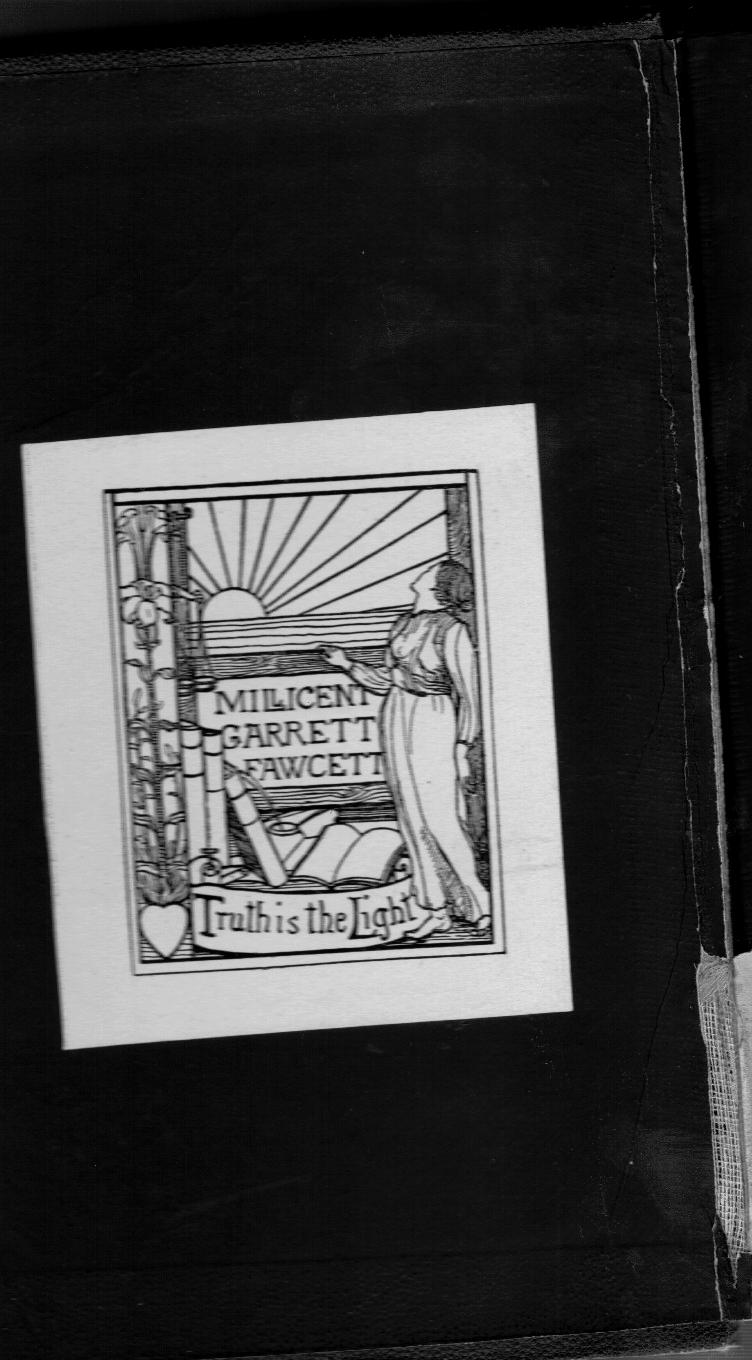
Millicent Fawcett’s bookplate
A ‘From the Author’ slip has survived the handling of the last 140 years – and Millicent Fawcett has added her delightful bookplate to the front pastedown. However, an inquisitive inspection reveals that not all the pages are cut.
Latterly the book was in the library of O.R. McGregor (Professor Lord McGregor of Durris) author of ‘Divorce in England’ which had, for its time, 1957, an excellent bibliography – revealing the author’s wide interest in ‘women’s history’. On the spine the cloth binding is chipped – missing in parts – would benefit from rebacking. Otherwise a good copy – and a very interesting association copy £150.
To buy contact e.crawford@sphere20.freeserve.co.uk
Suffrage Stories: ‘The Putney Caravans’
Posted in 1911 Census, Suffrage Stories on August 20, 2012
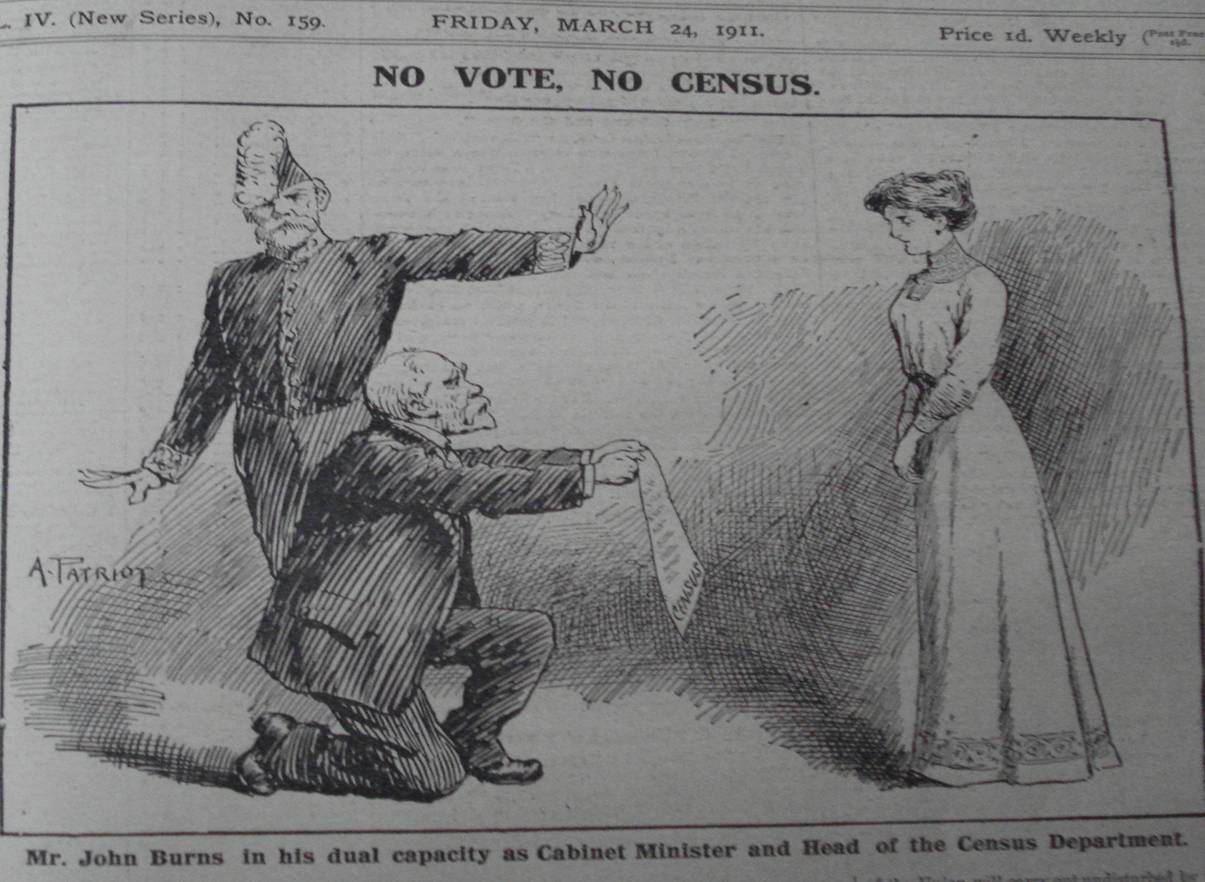
John Burns, the suffragettes and the census boycott
As I have already described here, one of the most inclusive acts of civic resistance undertaken by the militant suffrage societies was the boycott of the 1911 census. The argument was that, if the government was not prepared to grant them full rights of citizenship, women would not fulfill the duties of a citizen. On the night of the census – 2 April – those who obeyed the call either went to considerable lengths to evade the enumerator – or, like ‘Madame Mantalini’, refused to supply the required details on their census paper.
There are many stories to be told, but one of the more flamboyant adventures was that of Arthur Marshall, the WSPU’s solicitor, who with his wife, Kitty and nine other rented from a Paddington firm, Rickards, what were described as ‘smart Pullman caravans’. The caravans, horse-drawn, of course, were then driven in the dark from Paddington and into and round Trafalgar Square, where the main suffragette protest was taking place – and then down Whitehall and out to the west, eventually coming to a halt on Putney Common.
As the journalist Henry Nevinson, writing in the suffragette newspaper, Votes for Women, wrote, ‘I had noticed three gypsy caravans….they were driven by women, who whispered me the names of woodland regions not very far off in Surrey. Whether statistics will add them to Surrey’s glorious army of vagrants I don’t know, but they vanished silently down the road, past the decorated windows of the Home Office and the Local Government Board.’ The last office was singled out for mention because it was the LGB – under its minister, John Burns – that was charged with organising the census.
Once they had arrived at Putney Common, not exactly deepest Surrey, the women – and Arthur Marshall – all appeared to have had a jolly dinner and reported that they had refused all information to the police who turned up to take their particulars. In the morning they decorated their caravans with placards saying – ‘If we don’t count we shall not be counted.’ and, thus adorned, travelled back into London.
Although this excursion doubtless attracted publicity, the police knew quite well who the leaders of that ‘suffragette party’, as they described it, were – and the Marshalls’ details were duly entered on a census form. The other nine women did, however, manage to remain anonymous.
It may be that Henry Nevinson was embroidering reality a little – and that it was not the women themselves who were driving the caravans – because a week or so later three men – presumably Rickards drivers – were charged with driving the caravans unlawfully on the turf of Putney Common. This was one of the very few prosecutions brought that related to the census boycott; women who had evaded or resisted were not charged, the government realising there was little to be gained by giving the protest the oxygen of publicity. However, the local Putney magistrate clearly thought the case a nonsense and it was dismissed with the defendants merely having to pay 2s in costs. And the image painted by Nevinson of the caravans with their bohemian crew remains in the memory.
Book of the Week: Betham, A Biographical Dictionary of Celebrated Women, 1804
Posted in Book of the Week on August 14, 2012
Matilda Betham: A Biographical Dictionary of the Celebrated Women of Every Age and Country, printed for E. Crosby, 1804..
‘I was induced to believe that a General Dictionary of Women, who had been distinguished by their actions or talents, i various nations, or at different periods of teh world, digested under an alphabetical arrangement, which had never been done in our language, might meet with a favourable reception.’
Matilda Betham (1776-18520, poet, artist and biographer, was a friend of Coleridge, Southey and the Lambs. Celebrated Women begins with an entry on ‘Abassa, an Arabian Princess of the Eighth Century’ and ends with ‘Zoe, fourth of Emperor Leo VI’ taking in on the way a hundred stars, their light now a little dimmed, only waiting the discerning eye to burst into life. ‘Authenticity, and impartiality have been my aim throughout, conceiving thsoe principles to be of most consequence in a work of this kind, than ornamental writing.’ A fascinating compilation – not only for itself, but for the thought of a young woman at the end of the 18th and beginning of the 19th centuries taking the trouble to amass so much information.
First edition – 852pp – bound in half leather and marbled boards – very good – scarce – £200.
To buy contact e.crawford@aphere.20.freeserve.co.uk
Suffrage Stories/Collecting Suffrage: Mrs Pankhurst’s portrait
Posted in Collecting Suffrage, Suffrage Stories on August 13, 2012
In a previous post on Suffragette Jewellery I commented on the danger of assuming that any piece of jewellery that a dealer described as ‘suffragette’ had, in fact, anything to do with the suffragette movement. However it is still possible to discover items the provenance of which cannot be doubted.
Below is one such.
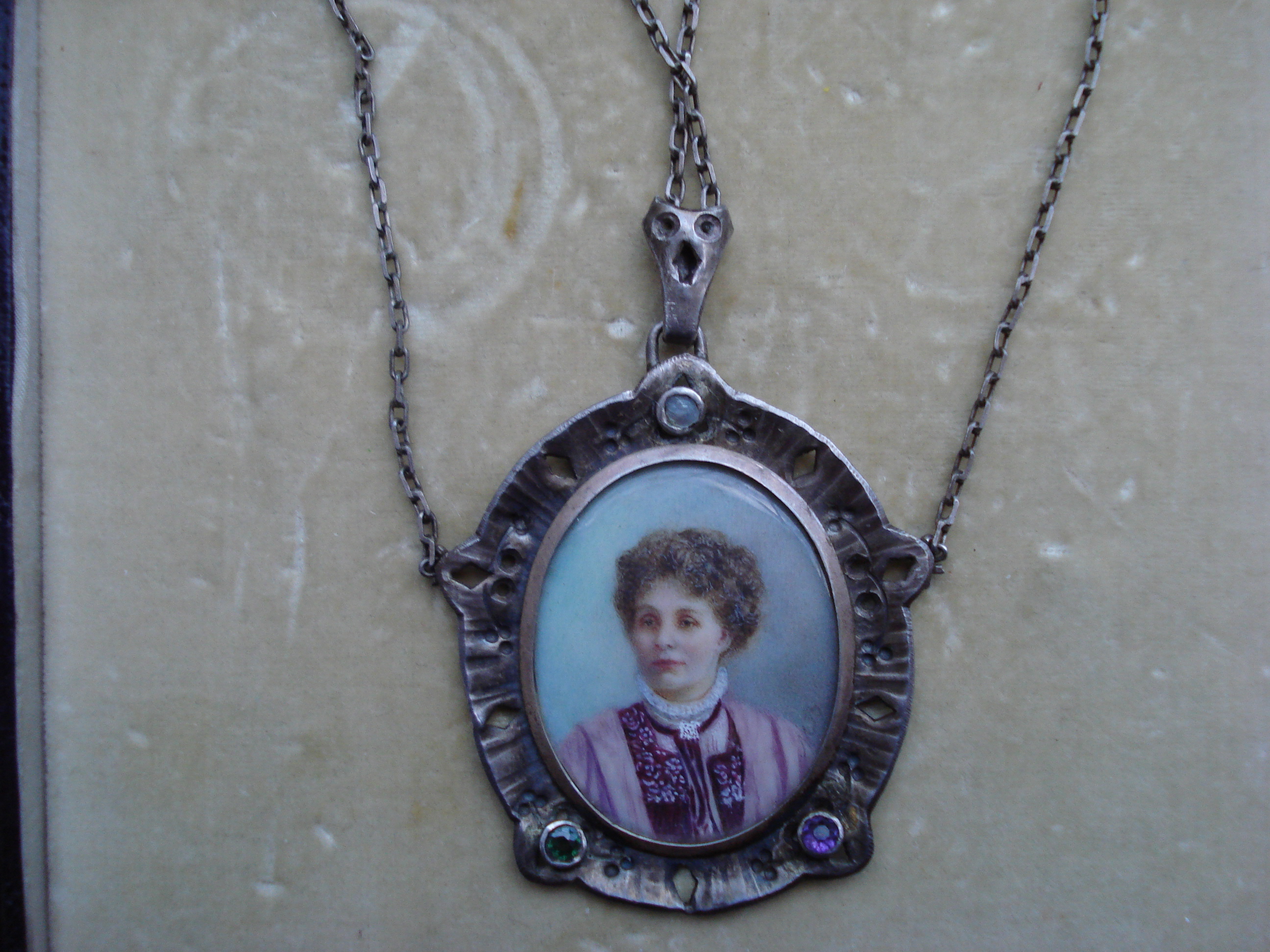 PENDANT – MRS PANKHURST – ICONIC PAINTED PORTRAIT MINIATURE -presented to Mary Leigh, leader of the WSPU Drum and Fife Band, devoted friend of Emily Wilding Davison, and ardent suffragette.
The image for this original painted miniature portrait of Mrs Pankhurst is derived from the photograph of her by the Kensington photographer, Martin Jacolette (see below). In it she is wearing a Holloway brooch, which dates the photograph to no earlier than April 1909. 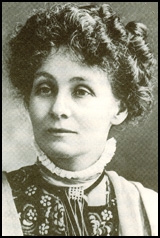
The portrait miniature is very pleasingly painted and, although no artist’s signature is visible, I did wonder if it might not be by one of the Brackenbury sisters (Georgiana’s much later portrait of Mrs Pankhurst is in the National Portrait Gallery). The portrait is set in a metal pendant, on the back of which is inscribed ‘Presented to Mrs Marie Leigh Drum Major by the N.W.S.P.U. Drum and Fife Band in memory of her courageous fight for woman’s freedom December 1909’.
In the autumn of 1909 Mary Leigh had been forcibly fed while serving sentences in Winson Green and Strangeways prisons and in December an action for damages was brought on her behalf by the WSPU against the Home Secretary. The WSPU newspaper, Votes for Women, reported that, on 16 December 1909, ‘Ushered to the strains of “See the Conquering Hero Comes” , played by the WSPU Band, Mrs Leigh, the Drum Major received a royal welcome at St James’s Hall. Looking rather pale but as determined as ever, she delivered a stirring address.’ As Christabel Pankhurst, who was presiding, commented, ‘The Government did not know with whom they were dealing.’ The pendant was probably presented on this occasion.
The pendant, which has its original chain, has set around its edge three little stones – one white, one purple and one green. In this case the choice of stones clearly did have WSPU relevance. The pendant is in its original box – similar in material to that used for the hunger strike medals. Contemporary painted portraits of Mrs Pankhurst are exceedingly rare and with this particular provenance – unique. I have never seen another pendant like this, but wonder whether Mary Leigh was the only recipient of such an object. Might there be others waiting to be discovered?
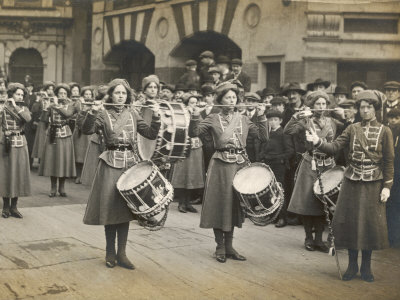
Collecting Suffrage: The Hunger Strike Medal
Posted in Collecting Suffrage on August 11, 2012
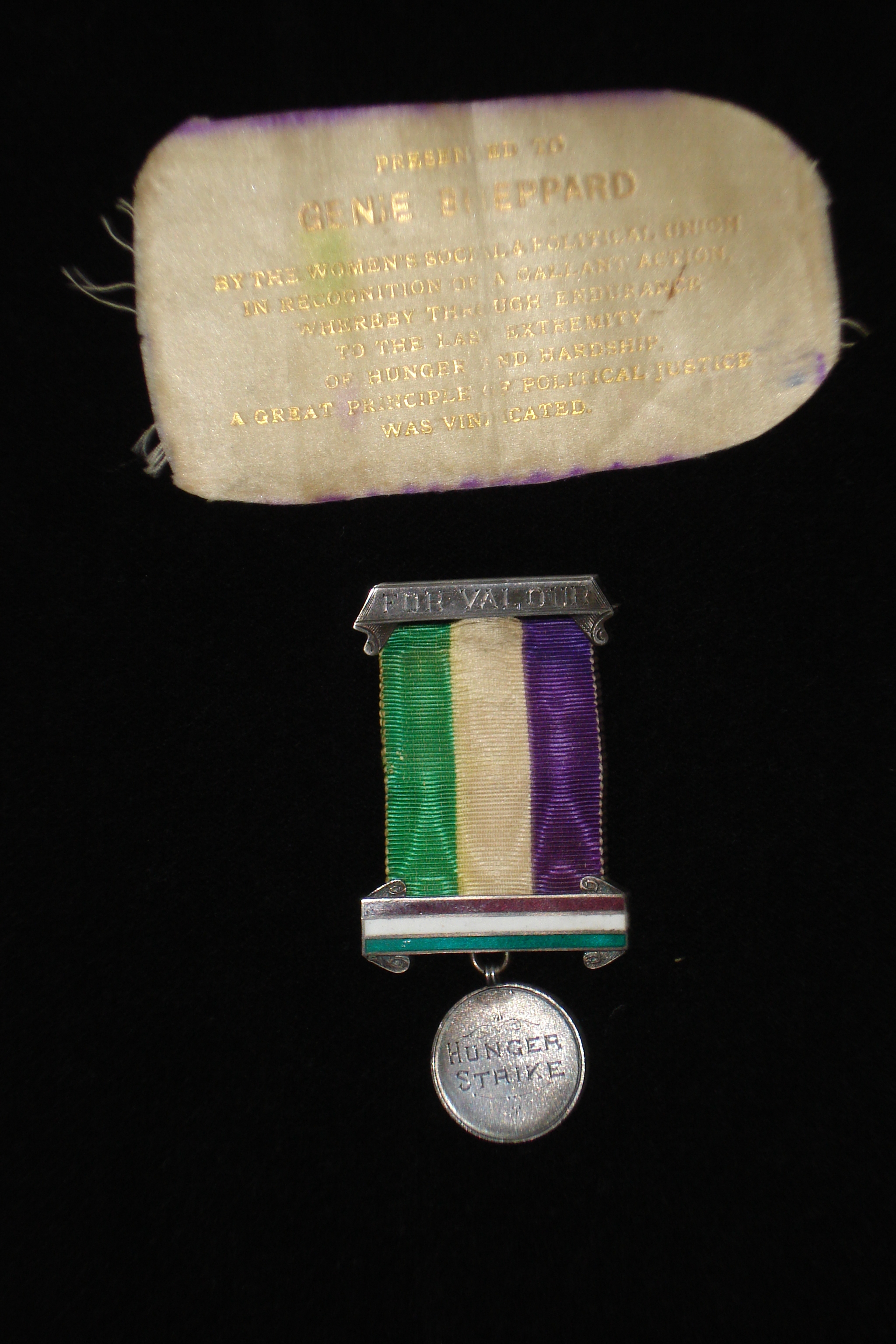 One of the most iconic items to add to a suffrage collection is a WSPU hunger-strike medal.
These medals were first presented by the WSPU at a ceremony in early August 1909, given to women who had gone on hunger strike while serving a prison sentence handed down as punishment for an act of suffrage militancy.
The medals comprise a silver pin bar engraved ‘For Valour’, a hanging length of ribbon in the purple, white and green colours, and either a silver or a striped enamel bar, from which hangs a silver circle with the name of the presentee on one side and ‘Hunger striker’ on the other. If the ribbon terminates in a silver bar, this is engraved with a date denoting the day of the owner’s arrest. The enamelled purple, white and green bars are engraved on the reverse, for example sculptor Edith Downing’s medal that I once sold is engraved with ‘Fed by Force 1/3/12’. This was the date of her imprisonment that resulted in a hunger strike and forcible feeding.
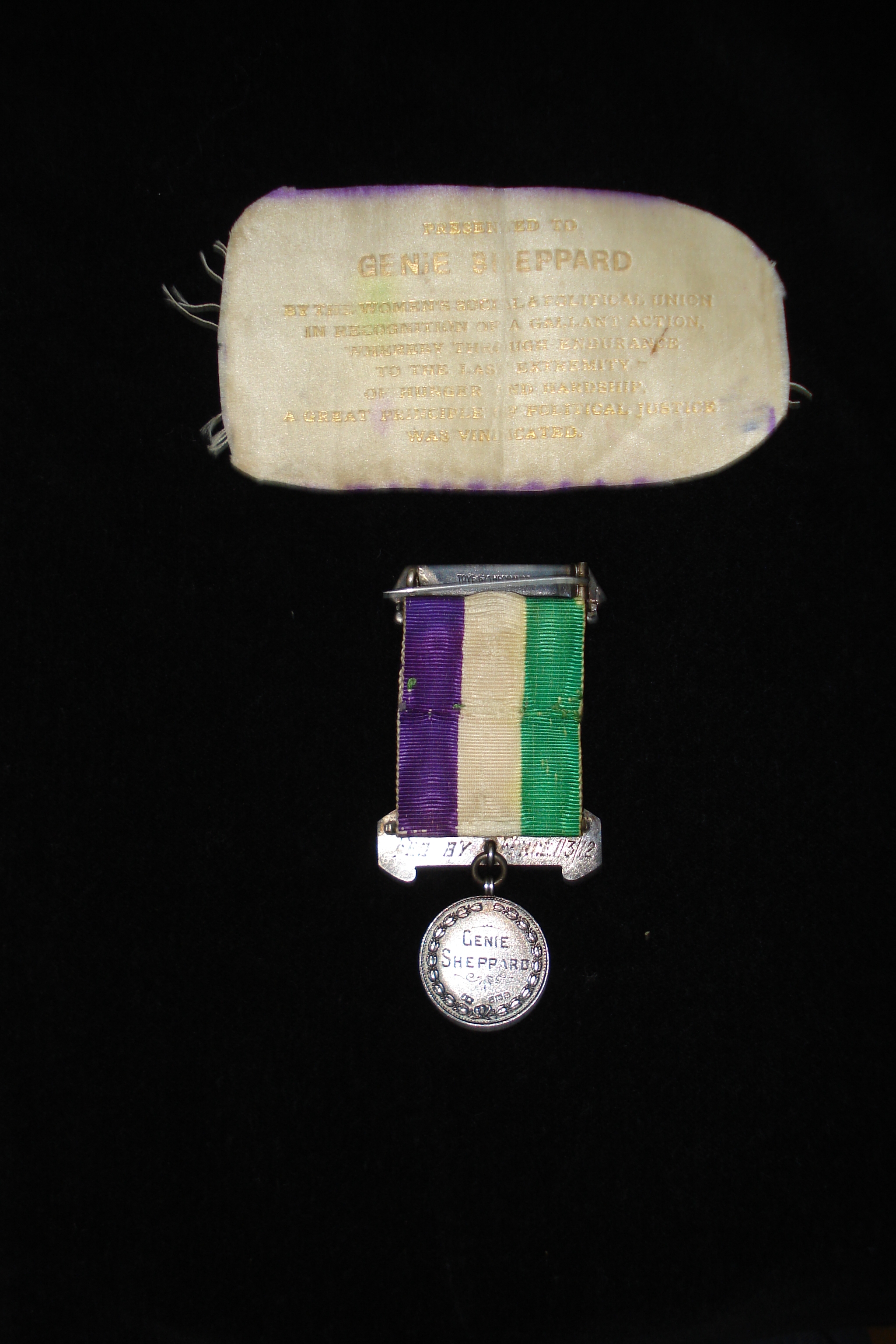
The reverse side of the medal
Some medals, such as the one Emily Wilding Davison is wearing in my 6 August ‘Suffrage Stories’ post, carry more than one bar, indicating multiple hungerstrikes.
Each medal was presented in a purple box, with a green velvet lining. As can be seen in the photograph, a piece of white silk that originally went inside the lid was printed in gold with: ‘Presented to [name] by the Women’s Social and Political Union in recognition of a gallant action, whereby through endurance to the last extremity of hunger and hardship a great principle of political justice was vindicated’.
These medals were made by Toye, a well-known Clerkenwell firm, and cost the WSPU £1 each – the medals now sell for thousands of pounds. They were treasured by their recipients who , in their old age, still proudly wore them on suffrage occasions; they are treasured today by collectors who recognise the bravery of the women to whom they were awarded.
Grace Roe (right) and Leonora Cohen (centre)wearing their hunger strike medals in 1974
Collecting Suffrage: Punch cartoon: Ulysses and the Steam Sirens
Posted in Collecting Suffrage on August 10, 2012
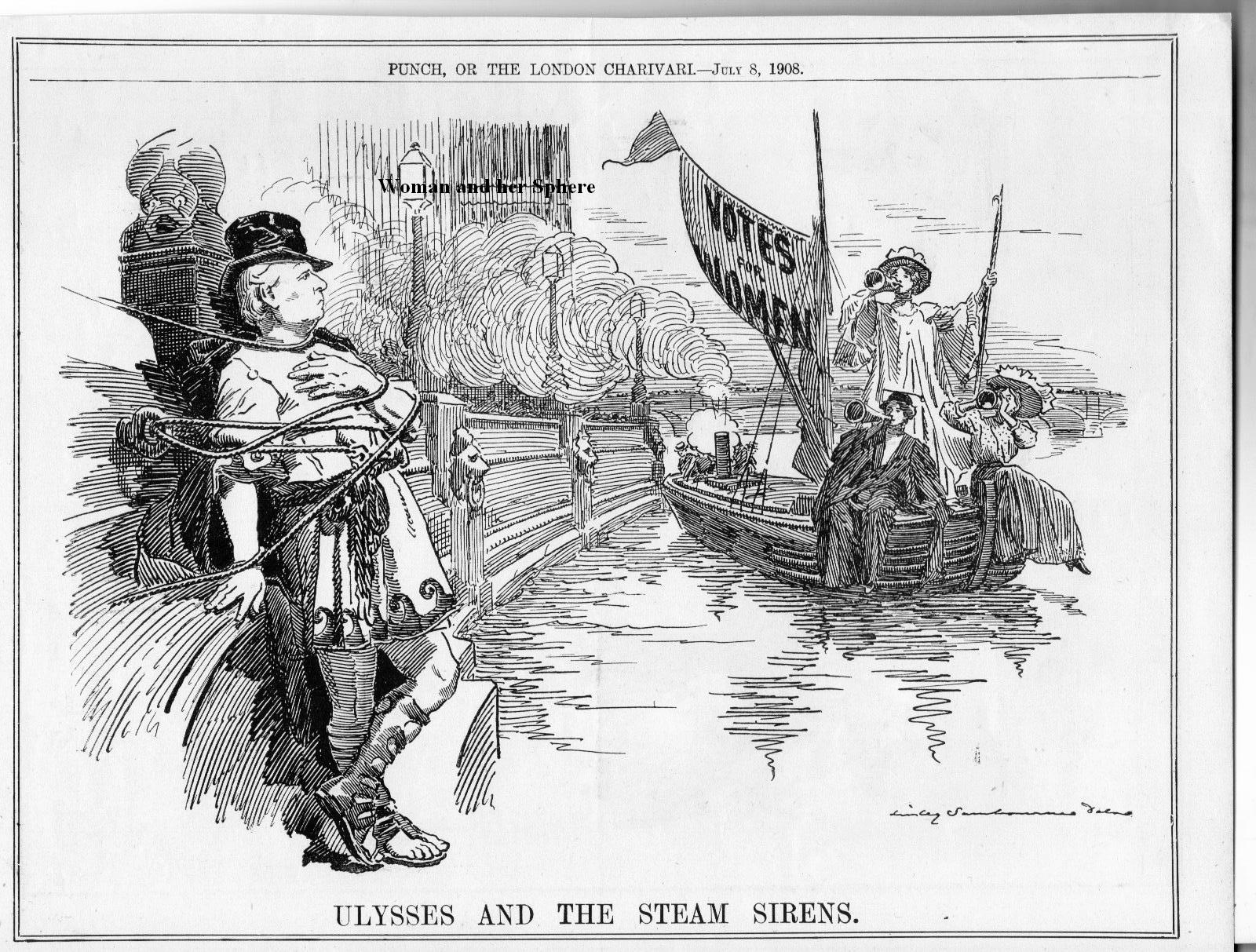 ULYSSES AND THE STEAM SIRENS -full page from 8 July 1908 issue of Punch.
Asquith is tied to the Embankment as a tug bearing suffragettes with loudhailers and a ‘Votes for Women’ saild approaches. The reference is to the boat the WSPU used to announce to the House of Commons, from the river, their forthcoming Hyde Park demonstration.
Very good condition – £12 post free. NOW SOLD
To buy contact e.crawford@sphere20.freeserve.co.uk
La Bella Libertà: Anna Miller
Posted in Women Writers and Italy on August 10, 2012
 ‘I love the sun and the hotter he shines, the more health and spirits are dealt me. However, this luminary is no friend to the complexion, and I have contrived to make a hat of pasteboard, and trimmed it with blond and pink ribbon. I believe I shall find it extremely convenient in the mornings when we are walking among the Ruins, for constantly going out in the Roman Fashion, with nothing to shade my face, has tanned me to such a degree, that I know not whether all the strawberry-water in Rome will be able to whiten me again.’ How different from the preoccupations of those – men – undertaking the Grand Tour was this observation, made by the first Englishwoman to publish an account of her travels in Italy, – in Letters from Italy Describing the Customs, Antiquities, Paintings etc of that Country, in the years MDCCLXX and MDCCLXXI to a Friend Residing in France (E & C Dilly, 1776). How such comments irritated the literati of her day; how they appeal to me.
The woman who had the temerity so publicly to set herself – and her complexion – amidst the glories of Italy was Anna Miller, wife of a somewhat impoverished Irishman. Her portrait, above, was painted by another Italophile Englishwoman, Ellis Cornelia Knight. Having exhausted her small fortune in building a villa near Bath, the Millers had, for reasons of economy, retired to the Continent. Leaving their infant children in France in the care of her mother, to whom the original letters were written, they then repaired to Italy. The Letters were published five years after their return to England. In the interim Mrs Miller’s reign over her literary salon at Batheaston had resulted in several volume of Poetical Amusements, published by the Dilly brothers.
It is likely that Anna Miller, as well as prizing her inclusion in the Dilly list alongside such bluestockings as Elizabeth Montagu and Catherine Macaulay, saw the publication of her Letters as an opportunity to aid the family finances. The book clearly enjoyed some success, being bought in numbers sufficient for Dilly to issue a slightly revised two-volume edition in 1777. Mrs Miller was soon identified as the author and her work received some attention, not least from that waspish derider, Horace Walpole, to whom, of the book, Mrs Delaney commented, ‘very conceited, they say, and not worth buying.’ It was doubtless considered ‘conceited’ for a woman such as Mrs Miller to propound her views on taste, interposing herself between the reader and the art canon. In addition one can imagine Walpole’s reaction to the description of the pasteboard hat or to Anna Miller’s comment of the passage into Italy over Mon Cenis: ‘At some moments during the descent, I could not help fancying myself a witch upon a broomstick.’
Today, looking at Italy through Mrs Miller’s keen and sympathetic eyes, we bridge the centuries, experiencing everyday details of the traveller’s life and relishing the people and sights she encountered. She is a diligent reporter, telling us that ‘for fear of error, I take my notes upon the spot, which I assure you is often very troublesome, as I am frequently obliged to write in my pocket-books standing, and at times placing it on the pedestal of a statue, or the moulding of a surbase’. She displays all the inquisitiveness of a tabloid hack. In the Queen’s apartments in the Royal Palace in Turin, noticing shelves of books, ‘My curiosity urged me to open two or three, amongst which I found the Female Spectator translated from English; a book enitled A Monitor for Sovereigns, doubled down and marked in several places.’ She brings immediacy to every experience, detailing the food, furnishings and service at inns the length of Italy. Dining at ‘a village called Maschieri in the dirtiest of all possible inns [we] supped upon, what think you? A pork soup with the Bouilliée in it, namely a hog’s head, with the eye-lashes, eyes, and nose on ; the very food the wretched animal and last eat of before he made his exit remained sticking about its teeth.’
A theatrical costumier could treat as patterns Anna Miller’s descriptions of dress. At a wedding in Venice, ‘The ladies walked two and two; they were all dressed in thin black silk gowns (excepting the bride), with large hoops; the gowns were strait-bodies, with very long trains…tucked up on one side of the hoop, with a prodigious large tassel of diamonds. Their sleeves were covered up to the shoulders with falls of the finest Brussels lace, a drawn tucker of the same round the bosom, adorned with rows of the finest pearl, such as large as a moderate gooseberry, till the rows descended below the top of the stomacher; then two ropes of pearl, which came from the back of the neck, were caught up at the left side of the stomacher, and finished in two fine tassels.’

Piazza di Spagna as Anna Miller would have known it
Of Rome Mrs Miller wrote: ‘’The part of the town we are in is by much the best for strangers, and the accommodation any where else extremely bad; for you know one cannot occupy the palaces nor the churches, which latter abound’. They were staying ‘at Pio’s Hotel, strada della Croce, Piazza di Spagna. Our table is served rather in the English style, at least there abounds three or four homely English dishes (thanks to some kind English predecesssors who have taught them), such as bacon and cabbage, boiled mutton..’ To Mrs Miller’s pleasure, they mingled with Roman nobility. On one occasion when the Pope was due to appear her hostess asked her not to speak to him as the Pope did not wish any stranger, particularly an English stranger to speak to him. ’I assured her my principles were diametrically opposite to those of the Stuart family and their party.. but concluded with saying, that if he spoke to me, I could not, as a gentlewoman, refrain from answering him.. and should treat him as I would do any other foreigner or native, with that general civility requisite on such occasions.’ And that put the Pope in his place. For Mrs Miller took a light-hearted approach to religion – writing at the end of Holy Week, on 4 April 1771: ’ At length the functions are finished; and now I may avail myself of the indulgence of sinning for three hundred years to come, having been in St Peter’s church every day during the Santa Settimana.’
Collecting Suffrage: Belfort Bax, The Legal Subjection of Men
Posted in Collecting Suffrage on August 9, 2012
E. Belfort Bax, The Legal Subjection of Men, The New Age Press, new edition, 1908.
There have been few agitations in history which have been characterised by such hard lying and shameless perversions of fact as the so-called ‘Woman’s Movement’.. The ‘Woman’s rights’ (?) agitator has succeeded by a system of pure impudent, brazen, ‘bluff’, alternately of thh whimpering and the shrieking order, in inducing a credulous public to believe that in some mysterious way the female sex is groaning under the weight of the tyranny of him whom they are pleased to term ‘man the brute’. Bax, who wrote extensively on socialism, acknowledges the part played by an Irish barrister, now deceased, in the writing of this anti-suffrageist apologia. Together they set out all the legal advantages enjoyed by women – such as ‘the punishment of hanging has been practically abolished for women who murder mere men. If they murder some other woman or babies of some other woman it is quite a different thing. They are, however, exempt from hanging if they murder their own babies.’
Very good – 64pp – rebound in cloth – with original paper covers bound in. £28 plus postage.
To buy: contact e.crawford@sphere20.freeserve.co.uk
Kate Frye’s Suffrage Diary: first canvassing
Posted in Kate Frye's suffrage diary on August 9, 2012
Kate lived in Arundel Gardens, North Kensington
Another extract from Kate Parry Frye’s manuscript diary. These entries dates from the period two years before Campaigning for the Vote – the edited version of her diary published by Francis Boutle Publishers – begins. This episode marks the first time Kate is involved in active doorstep – or, at least, letterbox – campaigning. She was to do a great deal more of it over the next few years.
Gladys Wright was a university-educated young woman, a fellow Kensington resident, and already an active suffragist, working for the London NUWSS – non-militant – society.
‘The Grove’ was Westbourne Grove, the local shopping mecca, home of Whiteleys, the Universal Provider.
Kate preserved mementoes of Whiteley’s funeral
The Fryes were – or had been – very friendly with William Whiteley, who had been gunned down in his own store just two months earlier.
Monday 19 March 1907 [25 ArundelGardens, Notting Hill]
Up to breakfast and found a letter from Gladys Wright asking me to do some work with them for the Suffrage. A Motor Bus to Strakers in the Edgware Road where I bought 500 envelopes. Changed my things and wrote letters till dinner time – then after dinner started addressing my envelopes and did about half until 11.30 when I went to bed very tired.
Thursday March 19th 1907
Changed my dress after lunch then wrote some letters till tea time. Our At Home day but no visitors arrived. After tea I sat and finished directing my envelopes.
Thursday March 20th 1907
Up at 11.30. The notices had come for the envelopes so I filled Lansdowne Road and Lansdowne Crescent. Sent Agnes [her sister] out with them. I took out ArundelGardens and Powis Square – a most awful place – high flats – and Powis something else. After lunch Agnes and I went out again delivering – more Powis and Colvilles. Colville Mansions nearly killed us the stairs were awful. We got in about 4 o’clock feeling very tired.
Thursday March 21st 1907
Mother went to Committee [Liberal] meeting in the afternoon. Agnes and I went out at 3 o’clock and delivered the last two streets of the meeting notices – then went to the Grove and did a little shopping.
Campaigning for the Vote: Kate Parry Frye’s Suffrage Diary edited by Elizabeth Crawford
For a full description of the book click here
Wrap-around paper covers, 226 pp, over 70 illustrations, all drawn from Kate Frye’s personal archive.
ISBN 978 1903427 75 0
Copies available from Francis Boutle Publishers, or from Elizabeth Crawford – e.crawford@sphere20.freeserve.co.uk (£14.99 +UK postage £3. Please ask for international postage cost), or from all good bookshops. In stock at London Review of Books Bookshop, Foyles, National Archives Bookshop.
- ‘Campaigning for the Vote’ – Front and back cover of wrappers
Collecting Suffrage: Punch cartoon
Posted in Collecting Suffrage on August 8, 2012
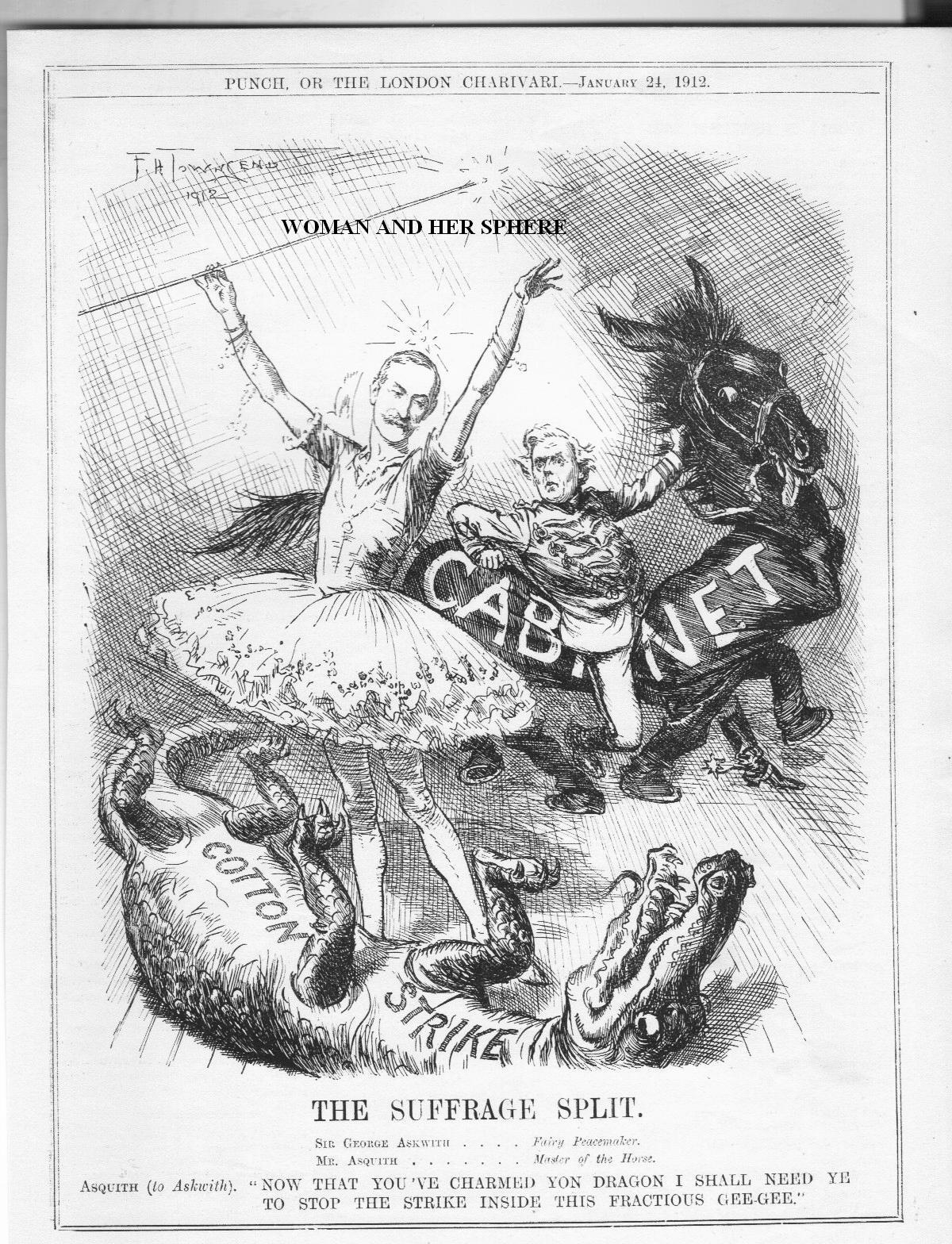 21 January 1912 – full page – ‘The Suffrage Split’. Sir George Askwith (the charismatic industrial conciliator), as ‘Fairy Peacemaker’, has tamed the dragon of the Cotton Strike – and Asquith, wrestling to keep a seat on the Cabinet horse turns to him ‘Now that you’ve charmed yon dragon I shall need ye to stop the strike inside this fractious gee-gee.’
In very good condition £10 plus £1 postage.
To buy contact: e.crawford@sphere20.freeserve.co.uk
Mariana Starke: Great-grandfather’s will
Posted in Mariana Starke on August 8, 2012
I am interested in trying to build up a picture of the physical reality of the lives of Mariana Starke and her forefathers.

Now a picturesque ruin, St Dunstans, where so many Starkes were christened and buried
Although it is well nigh impossible to know what memory, if any, of Thomas Starke, slave trader, descended to his daughter, Mariana Starke – she, the ‘celebrated tourist’, was born a little under 60 years after his death – I wondered if links might be discerned through a tracing of worldy goods as they descended through the family. I made a start with Thomas Starke’s will. Through this, at the very least, we become acquainted, more closely than in any baptism register, with his surviving children and with the friends – fellow merchants – to whom he entrusted the will’s execution.
‘To my dear & loving wife Sarah one full third part of all my personal estate ..if estate does not amount to sum of £2000 [2012: £ 261,000] leaves to Sarah all my estate in co of Suffolk lying in the hundreds during her natural life and after to my son John Starke and his heirs forever. But if one third part shall amount to £2000 then my will and mind is that the said estate shall immediately go to said son. I likewise give to my wife all her jewels ? of gold and her gold watch and a large silver salver and caudle cup and cover. I give unto my son John Starke and to his heirs for ever all my reall estate in Virginia consisting of 5 plantations. I give to my said son the sum of £500 and the diamond ring I wear. I give unto my loving daughter Mary Sherman the sum of £200 and likewise forgive her all such sums of money as she stands indebted to me for. I give to my said son John Starke a full one fifth of my personal estate after my just debts are paid and my wife’s one third part deducted. I give to my loving daughter Sarah Starke the sum of £300 and also one fifth part of all my personal estate [etc] provided that said one fifth part shall not exceed the sum of £1500 [2005: £209,000] and what shall appear to be more than that sum I give unto my said son. I give to my said daughter Sarah all her jewels and my gold watch and 2 brooch [?] pieces of gold which were my Aunt Dennis’s. I give to my loving daughter Martha Starke the full one fifth part of my personal estate [etc]. I give unto my loving daughters Frances and Elizabeth unto both of them the full fifth part of my personal estate [etc]. I give unto my daughter Sarah a large gilt spoon. to Martha one ?? of gold that was my Aunts and I give to Frances one old Nobb (?) spoon. I give to Francis Lee and William Downer the sum of £10 apiece to buy them mourning and a ring of 20s value and I desire them to be aiding and assisting my wife and son. And my will is that my daughters’ legacy shall be paid them as they shall arrive to the age of 21. And make my wife and son jointly my executors and appoint my said loving friends Francis Lee and William Downer to be the overseers of my will.
30th Jan 4th yr of Ann (1706)
Witnessed by Ann Stephens, W. Ford, John Hodgkin, Jeffery Bass (?) Probate 4 March 1706.
So, even from this cursory transcription of the will, we can visualise Thomas Starke’s most prized – or most expensive – possessions – the jewellery, gold and silver – the salver and the caudle cup – and know that he still held five Virginia plantations. In the next ‘Mariana Starke’ post I will be able to reveal vastly more of the possessions with which Thomas Starke was surrounded as he lay on his death bed in the house in Mincing Lane.
Copyright
Book of the Week: Bulley & Whitley, Women’s Work
Posted in Book of the Week on August 7, 2012
 WOMEN’S WORK by Miss A. Amy Bulley and Miss Margaret Whitley. With a Preface by Lady Dilke. Published by Methuen in the Social Questions of the Day series, 1894.
Amy Bulley (1852-1939) was an early student at Girton, Cambridge, going from there to Manchester, where she taught at Manchester High School for Girls and was involved in the campaign that eventually, in 1883, saw women allowed to sit for Owens College degrees. She then took a very active interest in women’s employement and the labour movement, becoming chair of the council of the recently-formed Manchester, Salford and District Trades Council, 1897-1906, investigating the dire conditions of the ‘sweated’ trades.
Lady Dilke had been involved with the women’s trade union movement since the 1870s
 The book affords a comprehensive coverage of the new ‘white blouse’ employment open to women – to professions – such as medicine – and to clerical work – such as typewriting and post office work – as well as the trades and vocations with which they had been associated in the past. The authors include much discussion of conditions of employment and the rise of women’s trade unions.
Women’s Work is a thorough piece of research – the authors do not shrink from using statistics and advocating the reforms they think necessary in the future.
In good condition – some marginal pencil markings, showing how involved one previous reader has been in the subject. An unblinking view of the position of working women at the end of the 19th century. £55 plus postage.
To buy: contact e.crawford@sphere20.freeserve.co.uk
Collecting Suffrage: Punch cartoon
Posted in Collecting Suffrage on August 7, 2012
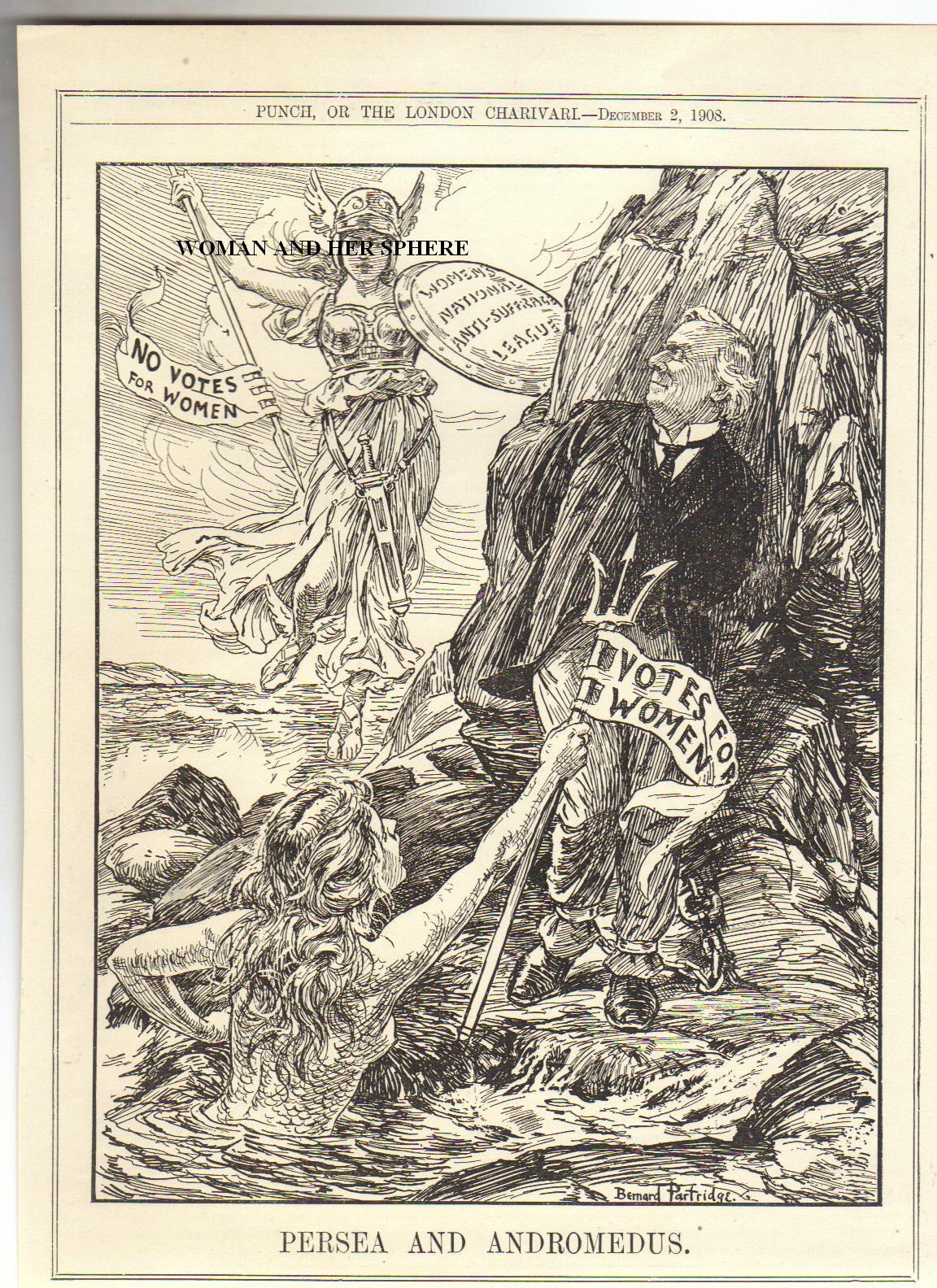 PUNCH CARTOOON – 2 December 1908 – a Bernard Partridge full-length illustration shows Asquith (Andromedus) chained to his rock – beset by the sea monster taunting him with her Votes for Women triton and searching for salvation from Persea – the Women’s National Anti-Suffrage League.
In very good condition £12 post free
To buy: contact e.crawford@sphere20.freeserve.co.uk
[The Women and her Sphere logo is not, of course, on the original]
Suffragette postcards: When Women Vote: Washing Day
Posted in Collecting Suffrage on August 6, 2012
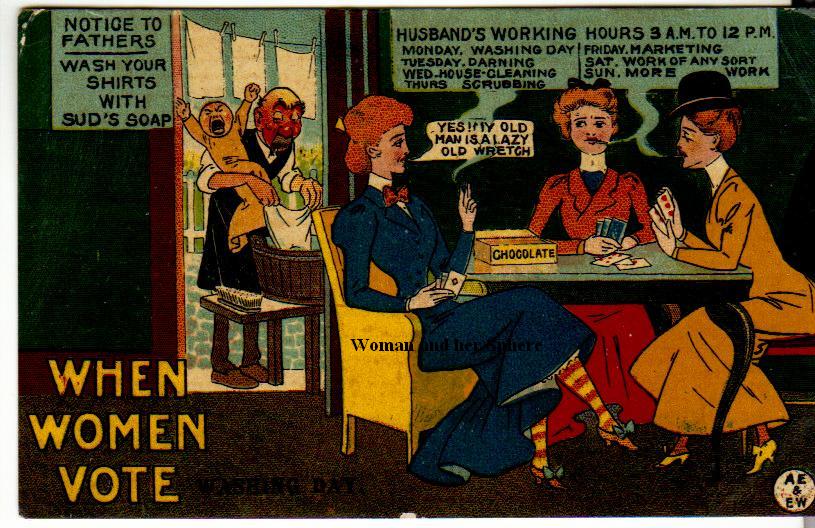 WHEN WOMEN VOTE
Father is in the kitchen bathing baby, while his wife and her friends sit in the parlour playing cards and eating chocolates – commenting ‘Yes, my old man is a lazy old wretch’.
And that’s what will happen when women have the vote.
The card was published by Mitchell & Watkins, who had been producing postcards – both topographical photographic and artist-drawn – from c 1906.
This card was posted – on 10 September 1907 – to Miss Ida Currell – who had been born in 1882 and was one of 4 surviving children of the 10 born to a Hertfordshire farmer and his wife. The Currells farm, at 2 Ware Road, Hertford, was called ‘The Chaplains’.
The card is in very good condition and is £45 post free.
To buy: contact e.crawford@sphere20.freeserve.co.uk
Suffrage Stories: What else is in Emily Wilding Davison’s grave?
Posted in Suffrage Stories on August 6, 2012
 A while ago I acquired a small collection of items that had once belonged to Mrs Mary Leigh, the leader of the WSPU fife and drum band and close friend and life-long supporter of Emily Wilding Davison. Among these was a copy of Walt Whitman, Song of the Open Road, published by the Arden Press, Letchworth (1912), containing a lengthy inscription by Mary Leigh on the free front endpaper.
From studying the handwriting I deduced that her comments had been made at two different times – probably decades apart. At the top of the page is an ink inscription ‘From E.W.D. 1912’.- which, I think, was not a presentation inscription from Emily Wilding Davison, but a note by Mary Leigh to commemorate the gift to her. The Emily Wilding Davison archive held by the Women’s Library contains another volume of Whitman’s verse, given by ‘Comrade Davison to Comrade Leigh’. Whitman was clearly a favourite, a poet who spoke to the women – eulogising their bond of close comradeship – and in The Song of the Road Mary Leigh, as in the Whitman in the Women’s Library, has annotated particular verses with some vehemence. The little book itself had clearly been well used; laid in the title-page fold of this copy was a pressed flower.
However it is another piece of information that Mary Leigh added to her endpaper writings that particularly interested me. She wrote: ‘I placed one [i.e. a book] like this from L C. Lytton in E.W.D.’s hand. ‘ In biro, at a later date, as though giving a fuller explanation, she has amplified these details – so that the whole now reads: ‘1913 June 14 in her coffin at Epsom Mortuary I placed one like this (Walt Whitman) from L C. Lytton (Lady Constance Lytton) in E.W.D’s hand open at the page she loved so well. I also placed her Hunger Strike Medals and the 8 Bars of Forcible Feeding also the Medal of Jeanne D’Arc to Fight on God will give the Victory’. 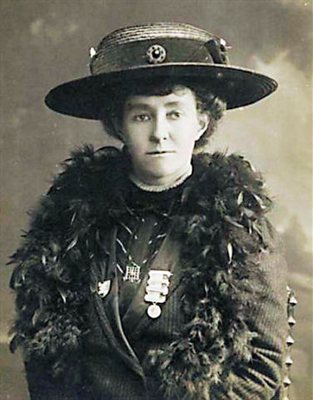
‘Fight on God will give Victory’, Joan of Arc’s assurance, given at her trial, is the message emblazoned on the banner carried at Emily Wilding Davison’s funeral, both in London and then draping the grave in Morpeth.
Here is Emily Wilding Davison wearing her Hunger Strike Medal, with still, I think, four bars, each commemorating a hunger strike and consequent episode of forcible feeding. Further imprisonment lay in the future. It is interesting that Mary Leigh specifically writes of ‘Medals’ in the plural. As well as the Hunger Strike Medal, with its 8 bars, she may have been referring to the ‘Holloway’ badge, received for an earlier imprisonment, that Emily is wearing in the photograph. In addition, I suspect, but cannot be sure, that she may also have, pinned on her other lapel, a WSPU ‘Boadicea’ brooch.
However I have not yet been able to deconstruct Mary Leigh’s mention of the ‘Jeanne d’Arc’ Medal’. As far as I know there was no WSPU medal directly associated with Joan of Arc – although, 1912 having been the 500th anniversary of her death, she loomed large in the popular – particularly suffragette – imagination, Elsie Howey rode as ‘Joan of Arc’ in Emily Wilding Davison’s funeral procession. It may have been that EWD particularly treasured a medal – there were many issued – acquired in the quincentenary year.
Mary Leigh remained Emily Wilding Davison’s champion for the remainder of her life. Out of a meagre income she arranged each year for a Morpeth florist to supply an expensive bouquet of flowers and travelled north every June- even well into old age – to lay them at EWD’s grave in St Mary’s Churchyard. The rather pathetic correspondence concerning these arrangements may be read in the Mary Leigh Papers at the Women’s Library. The florist was a credit to her profession, entirely kind and helpful.
Little would Mary Leigh have expected – although she may well have approved (you can never be sure – she was a contrary character) – that into the 21st century EWD’s grave would have become a shrine – the plot now immaculately restored. So many myths have accrued to the memory of Emily Wilding Davison that it is something of a relief to be able to produce a piece of primary evidence, in the form of this copy of Song of the Road, that allows the visitor standing in front of the Morpeth obelisk to picture, with some assurance, the moment in the Epsom Mortuary as Mary Leigh laid in the open coffin Lady Constance Lytton’s copy of this small volume of verse, together with the hard-earned Hunger Strike Medal.
Suffragette Jewellery
Posted in Collecting Suffrage on August 4, 2012
 One of my bêtes noires is the misnaming of any vaguely Edwardian piece of jewellery that comprises stones approximating to some shade of purple (or pink or red), white and green as ‘suffragette’. I have long ago ceased remonstrating with reputable auction houses – they should know better. Ebay, of which one cannot expect very much, is, of course, rife with a lack of historical awareness.
While such pieces may be decorative and even of some intrinsic value, I would be very sorry if anyone paid over the odds for a piece of such jewellery thinking that they were buying an association with the suffrage movement. There are plenty of unscrupulous or ignorant dealers who peddle such notions. I think the term ‘suffragette jewellery’ should be reserved for pieces that have a provenance associated with a suffrage society or an individual who either made or wore it with ‘suffrage’ intent.
Above is an example of what I mean – a ‘true’ piece of suffragette jewellery – a silver and enamel pendant, bearing the ‘Angel of Freedom’ device designed in 1908 by Sylvia Pankhurst. I bought – and sold it – some years ago – and have never found another. As second best to owning the real thing, I have ever since used the image on my trade cards.
I will tell the stories of some other pieces of ‘true’ suffragette jewellery in future ‘Collecting Suffrage’ posts.
Here and here are two articles that attempt to demistify the subject of ‘suffragette jewellery’. Or you can read the entry on ‘Jewllery and Badges’ in my The Women’s Suffrage Movement: a reference guide.
The Garretts And Their Circle: What was hanging in the drawing-room of 6 Gower Street in 1898?
Posted in The Garretts and their Circle on August 4, 2012
One day in 1898 Dr William Garnett, secretary to the Technical Board of the London County Council, called at 6 Gower Street, home of Louisa and Fanny Wilkinson, close friends of their next-door-but -one neighbours, Millicent Fawcett and Agnes Garrett.
Dr Garnett was there to assess whether Louisa Wilkinson could qualify as a professional bookbinder and, hence, be eligible to attend bookbinding classes at the recently-founded Central School of Arts and Crafts.
In theory, women were not barred from these classes, but as, so often, practical difficulties were put in their way. In this case, the powerful (male) bookbinding trade unions threatened to forbid their members to work at the School if women were allowed to undergo the training offered. They feared that the entry of women into the trade would drive down wages. The threat was sufficient; women were excluded.
Louisa Wilkinson, who had taken lessons from Douglas Cockerell and had exhibited two books bound by her at Goupil’s Gallery, had challenged the decision not to allow her entry to the bookbinding classes. If she could prove that she was a professional bookbinder, the School would find it rather more difficult to refuse her. Hence the purpose of Dr Garnett’s visit; he was there to discover, from observation of her surroundings, her status – whether professional or amateur.
Dr Garnett was kept waiting in the drawing room for Louisa to appear. He had time to make his judgment of the house, which he included in his report:. ‘Its appearance inside and out was that of a residence of a professional man with an income of not less than £1000 a year.’ In fact no man lived on the premises – 6 Gower Street was the home – and work place – of two women, although one, Fanny, was certainly a professional – a landscape gardener. Dr Garnett’s attention was particularly attracted to a portrait hanging in the room, so much so that he included mention of it in his report, noting that it appeared to him to be a ‘far above the average painting in oils.’ Once she had arrived, Louisa informed Dr Garnett that the painting was by Gainsborough. Perhaps the possession of such a painting was one more nail in the coffin of her hopes: could a woman who owned such an object be considered to be a trade worker?
This is the painting in question – a portrait of Mrs Sarah Walker – in 1936 given by Fanny Wilkinson to the Tate Gallery, associating Louisa, who had recently died, with the gift. .Sarah Walker, who looks an interesting, perhaps rather sardonic and stubborn woman, was their mother’s great-grandmother; born in 1714 she had died in Manchester in 1789. Sarah’s grandson, George Walker (1789-1838), apparently an ardent republican, had emigrated to the US, where, near Philadelphia, he had set up the first practical farm school in America. It may be that Fanny inherited her interest in horticulture from this grandfather, as surely she and her sister inherited something of their great-grandmother’s evidently strong character.
After George Walker’s death his daughter, [Letitia] Louisa, made the journey back to Manchester, where she married a prominent local physician, Matthew Eason Wilkinson, becoming the mother of several children, including Fanny and Louisa,. It is probable that the portrait of Mrs Sarah Walker had also criss-crossed.the Atlantic, to then spend 40 years or so gazing down on the company that assembled in 6 Gower Street – a company of female horticulturalists, educationalists and suffragists. Now, re-catalogued ‘in the manner of Thomas Gainsborough’ it forms part of the Tate Collection. Alas, there, Sarah Walker may well be confined to the darkness of a storeroom; I do not remember ever seeing her in the flesh, as it were. If so, she is in good company; the Annie Swynnerton’s portrait of Millicent Fawcett being another permanent fixture in the same store .
For more about Fanny and Louisa Wilkinson see Enterprising Women: the Garretts and their circle.
Suffragette postcards: ‘Who said Votes for Women!!!’
Posted in Collecting Suffrage on August 3, 2012
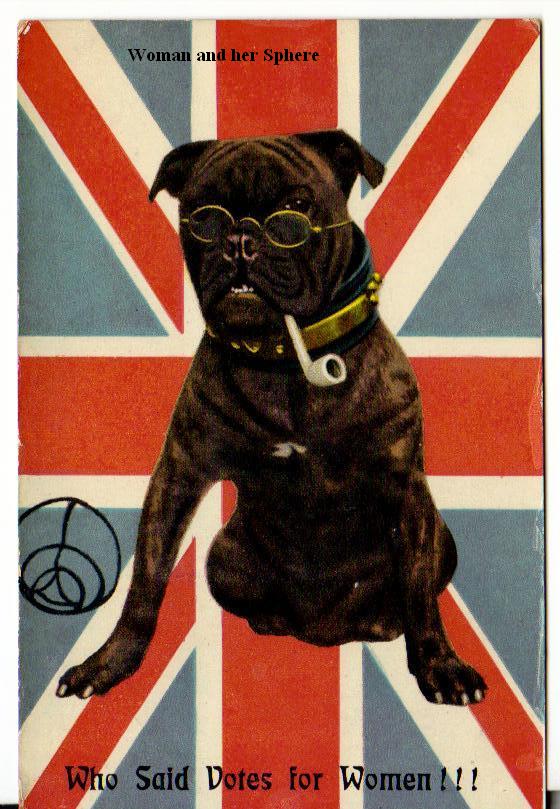 Very British Bulldog – with specs and a pipe – sits foursquare against a background of the Union Jack. It doesn’t look as though he would be interested in allowing women to vote.
The handwritten message on the reverse – from Will – begins ‘Dear Alf, I think the back of this card describers the question of the age.’ Good – posted from Cowes to Rotherhithe in February 1909.
In very good condition. £12 post free. [The ‘Woman and her Sphere’ logo does not, of course, appear on the original.]
To buy: contact e.crawford@sphere20.freeserve.co.uk
La Bella Libertà: ‘Dearest Bess’
Posted in Women Writers and Italy on August 3, 2012
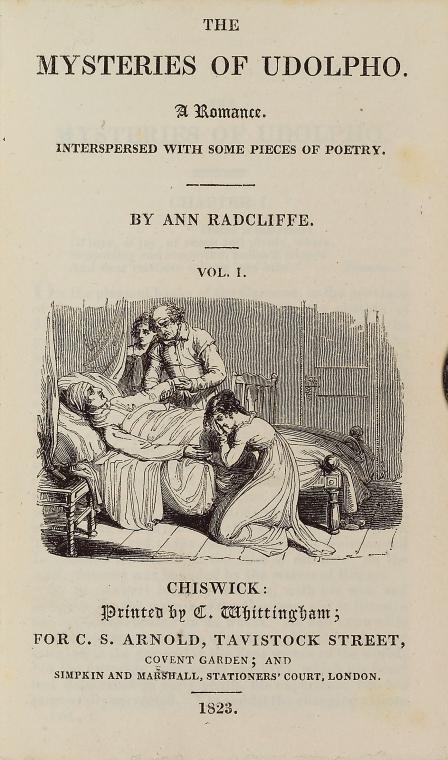 Ann Radcliffe’s Mysteries of Udolpho, published in 1794, captivated the British reading public – particularly its female portion – painting Italy as picturesquely gothic, something of a tour de force from a writer whose continental travels had never extended further than Holland and Germany, and then only after the success of her Italian novels. It was from the travel writing of others and from the work of mid-17th century Rome-based painters, such as Claude Lorrain, Poussin and Salvator Rosa that Mrs Radcliffe created the landscapes in which her heroine adventured.
My first vignette in ‘La Bella Libertà’ is of a woman whose real-life Italian adventures, undertaken in the last quarter of the 18th century, are more than worthy of Mrs Radcliffe’s pen. While not a published writer, she commended her daily experience to 128 volumes of journals, excerpts of which have been used in recreating both her life and that of her dearest friend, Georgiana, Duchess of Devonshire. A biography of Georgiana has in recent years received almost as much media hype as did the works of Mrs Radcliffe at the end of the 18th century, however, its dramas and excesses pale into insignificance beside those of her ‘Dearest Bess’. Lady Elizabeth Hervey’s ‘sweet freedom’ lay in being her loveable, incalcitrant, self-indulgent self and Italy allowed her to be so. 
[Lady Elizabeth Foster by Sir Joshuia Reynolds, 1787]
She had married young, becoming Lady Elizabeth Foster, but after five years separated from her husband who consequently forbade her to see their two sons, whom she did not meet again for a further 14 years – but who still remained devoted. Returning to England from the marital home in Ireland, she cast her spell on the Devonshire House circle. In fact the circle became a triangle when Lady Elizabeth, while remaining the Duchess’s most intimate friend, in the autumn of 1784 also became the lover of the Duke. Unsurprisingly she soon became pregnant; surprisingly there was no hint of any scandal as she took herself off to Italy, from whence she had only very recently returned. By April 1785, keeping up her diary, which served as a confessional, Lady Elizabeth was in Pisa, Florence, and then Rome, where she wrote: ‘Sometimes I look at myself in the glass with pity. Youth, beauty, I see I have; friends I know I have; reputation I still have; and perhaps in two months, friends, fame, life and all future peace may be destroyed and lost for ever to me. If so, my proud soul will never, never return to England –But it was not his fault. Passion has led us both awry – his heart suffers for me I know’. Entries such as this – and there are very many more – would not disgrace a gothic novel.
After a stay in Naples, at the end of June she was accompanied to Ischia by her brother, Jack Hervey, himself something of a rake, who was living a racketty life at the Naples court and, like everybody else, appears quite oblivious of her condition.. She had thought the island suitably remote and settled there to await the birth, but after a couple of weeks discovered that friends from Naples were coming to the island and that she would no longer be able to conceal her condition – and disgrace. She now revealed her predicament in a letter to her brother, who hastily returned to Ischia and appears to have been entirely supportive, although, ‘I could not – dared not name the dear Author of my child’s existence’ Jack told her she would have to leave Ischia and, with her faithful servant, Louis, they set sail for the mainland in an open boat. ‘How calm the Sea is – it scarce is heard as it beats against the rocks, the air is perfum’d with herbs, the sky is clear, at a distance blazes Vesuvius – oh were I happy’.
They landed at Salerno and then travelled to nearby Vietri, a little town now swallowed up in greater Salerno. When, many years ago, I read the following entry from her journal – written over 200 years before that – it made an impression such that I have never forgotten it . ‘With no woman at hand, encumbered by the weight of my child, enfeebled by long ill health, fearing every person I met, and, for the first time in my life, wishing only to hide myself, I arrived at last.’ The place to which brother Jack directed her appears to have been at best a kind of baby farm, at worst a brothel – perhaps a bit of both. Her description of the ‘seraglio’, as she called it, is gothic –run by ‘The Arch-Priest of Lovers, his woman-servant, a coarse, ugly and filthy creature, the doctor (his brother) and his wife, two young girls, pretty enough but weeping all day, the nurse who was to take charge of my child; and some babies which cried from morning to night.’ One wonders quite how it was that it was her brother knew of this place. She passed as Louis’ wife, as a servant’s wife dishonoured by Jack Hervey. A few days later a daughter was born and, as so often in gothic novels, the heroine now showed resilience in a time of extremity. Thinking her attendants quite ignorant, she immediately took care of the new-born baby but then, instead of the usual lying-in period of a month or so, which she had enjoyed after the birth of her previous children, was back on the road after six days, leaving the baby behind, eventually arriving at her brother’s house at Naples. Louis later fetched the baby, Caroline, from Vietri and brought her to Naples – where she was looked after by foster parents. I always thought this a memorably Italian episode.
Georgiana died in 1806 and in 1809 Lady Elizabeth married the Duke. He died in 1811 and in 1815, after peace had returned to Europe, Elizabeth, now Dowager Duchess of Devonshire returned to Italy, living in Rome until her death in 1824, keeping a very elegant salon, packed with diplomats, painters and sculptors. During her earliest visit to Italy in 1784 she had described in her journal, with impressive diligence, the paintings and antiquities she had seen. Now, in this new stage of life, she really did become a lady of letters, commissioning de luxe editions of Virgil and of Horace.
 [The Dowager Duchess of Devonshire by Thomas Lawrence, 1819]
She took up antiquities, under the guidance of Cardinal Consalvi, her last love, secretary of state and spy master to Pius VII. Of her excavating, Lady Spencer, the sister-in-law of the first Duchess, wrote ‘That Witch of Endor the Duchess of Devon has been doing mischief of another kind to what she has been doing all her life by pretending to dig for the public good in the Forum’. Mrs Charlotte Ann Eaton, who had travelled to Italy with her brother and sister and published her observations in 1820 as Rome in the Nineteenth Century, commented apropos the reclamation of the Forum, ‘the English, as far as I see, are at present the most active excavators. There is the Duchess of D— at work in one corner, and the Pope, moved by a spirit of emulation, digging away in another’. Italy had certainly allowed Lady Elizabeth the freedom to develop in ways she found unconventionally satisfying.
Further reading: D.M. Stuart: Dearest Bess: the life and times of Lady Elizabeth Foster, Methuen, 1955.
Collecting Suffrage: Victory 1918
Posted in Collecting Suffrage on August 2, 2012
Women Suffragists’ Celebrations
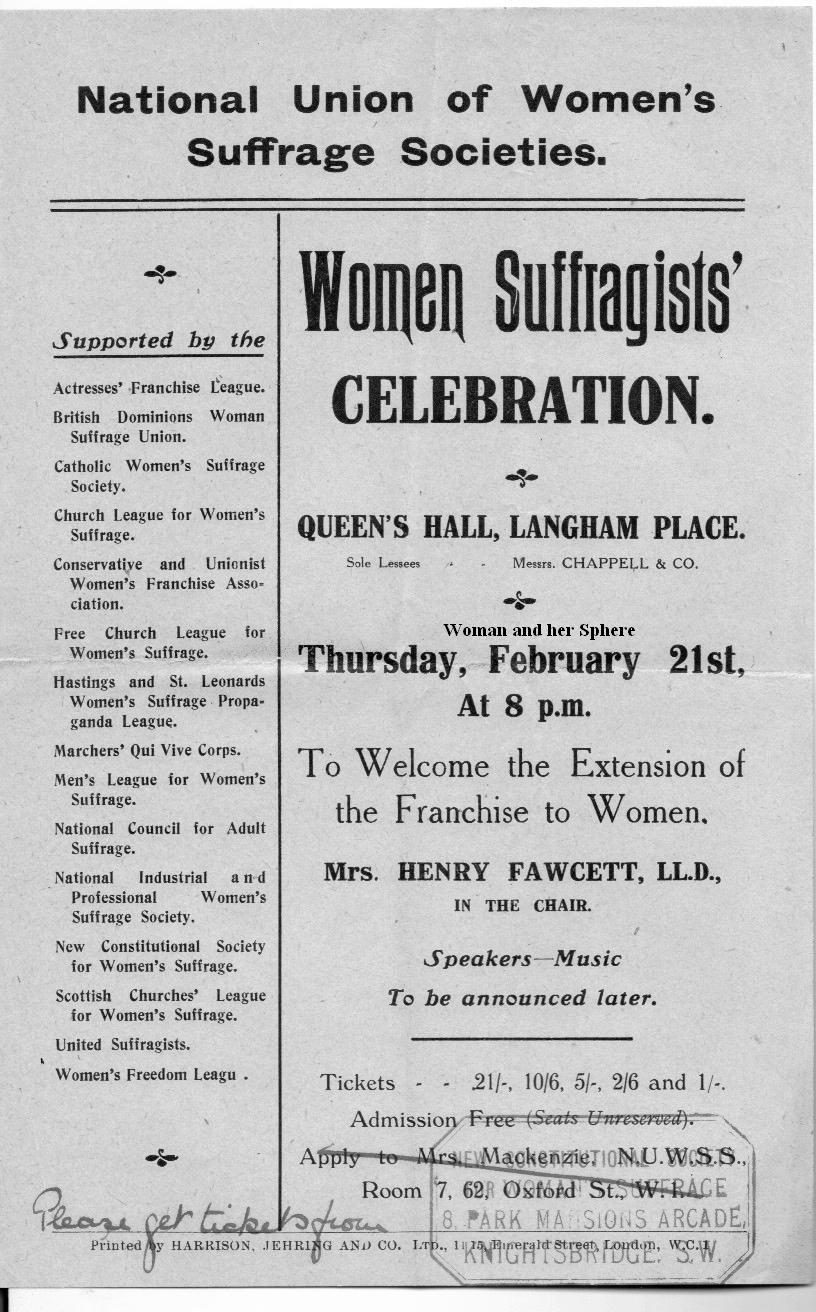 Flyer for the celebrations held at Queen’s Hall, Langham Place on Thursday 21 February 1918 – ‘To Welcome the Extension of the Franchise to Women’. The flyer includes the long list of societies that were taking part – the WSPU was a notable exception. On the list was the New Constitutional Society for Women’s Suffrage – and this flyer bears the annotation in ink ‘Please get tickets from’ followed by the NCWS’s rubber stamp with their address in Knightsbridge.
The leaflet is in very good condition and is rather rare. £55 post free.
[The ‘Women and her Sphere’ marking is not, of course, on the original]
Kate Frye’s Suffrage Diary: 14 March 1907
Posted in Kate Frye's suffrage diary on August 2, 2012
 Kate is now being swept up into general suffrage enthusiasm – as a member of the NUWSS London society. The hostess of this meeting at 60 Onslow Gardens was Mariana (c 1853-1933), wife of Hylton Dale, a coke and coal merchant.. She was a University of London graduate, a member of the Fabian Society, author of Child Labour under Capitalism and active in many causes, such as the National Association of Women’s Lodging Houses, as well as the suffrage movement. As Kate mentions, one of the purposes of the meeting was to gather signatures for ‘Miss Black’s Declaration’.
  Clementina Black [left], journalist and author and, like Mrs Dale, always concerned for the working woman, had formed a Women’s Franchise Declaration Committee four months earlier, in November 1906, in one of the many, alas futile, attempts to disprove the statement that women did not really want the vote. It sent out forms to women engaged in business and the professions and at the time of Kate’s contribution the Committee had already gathered nearly 31,000 signatures – drawn particularly from the fields of education, social work, office work, trade, and art. Needless to say, the resulting Declaration, with its 257,000 signatures, was brushed aside by the government, as had so many other attempts to reason made by suffrage societies over the previous 40 years. It is little wonder that the call to militancy met with such success.
Of the speakers, Mrs Stanbury was a member of the Fabian Women’s Group and an organiser for NUWSS; Frances Sterling, another Kensington resident, was joint honorary secretary of the NUWSS.
Thursday March 14th 1907 [25 Arundel Gardens, North Kensington]
Changed my dress after lunch and soon after 3 o’clock Agnes and I walked to Notting Hill Gate and went by train to South Kensington and went to Mrs Hylton Dale’s house in Onslow Gardens to a Woman’s Suffrage Meeting. Alexandra and Gladys Wright were to have done all the work of getting it up and asked us to act as Stewards. So we had to get there punctually at 3.45 to receive instructions, leave our coats, put on badges etc and get some tea. Tea was at 4 o’clock, the meeting at 4.30. Such a lovely house, a beautiful tea – everything so nice – and a glorious room upstairs for the meeting and it was packed. One of the doors had to be taken out and the people sat up and down the stairs and crowded the landings. Such a rich, fashionable, beautifully-dressed audience for the most part. I was busy getting signatures before the meeting began and after it was over and Gladys and I collected. It really didn’t seem to matter asking those rich people to give. We collected £3 3s and got signatures to Miss Black’s Declaration. They want a million names to it. At present there are only about the first hundred thousand. It was a most interesting meeting – such an unusual class of people and I loved working. A Mrs Stanbury was in the Chair. She was fine. Miss Clementina Black, Miss Sterling and Mr Walter McLaren MP were amongst the speakers and the questions asked and answered afterwards were most amusing. One girl I was very taken with – she really did look beautiful and her sister was most fascinating – I got them to sign and found the one was Lilias Waldegrave the actress. Agnes and I didn’t realise how tired we were till we came away – we had been standing all the time and getting so excited. We were not in till after 7 o’clock.
Campaigning for the Vote: Kate Parry Frye’s Suffrage Diary edited by Elizabeth Crawford
For a full description of the book click here
Wrap-around paper covers, 226 pp, over 70 illustrations, all drawn from Kate Frye’s personal archive
NOW, ALAS, OUT OF PRINT
- ‘Campaigning for the Vote’ – Front and back cover of wrappers
What Mariana Starke’s Great-Grandfather Was
Posted in Mariana Starke on August 1, 2012
Mariana Starke’s great-grandfather was a Virginia landowner and slave trader.
A slave shackle recovered from Thomas Starke’s ship.
In the last ‘Mariana Starke’ post I gutted the red herring that had Mariana born in India. This, if a red herring could be said to be put to such a use, had been a hook on which some scholars had hung critiques of her two India-set plays. While I am certain that an interest in Anglo-Indian affairs permeated Hyland House, which had been purchased with the proceeds of her grandfather’s engagement with India, I am wondering if the shade of Thomas Starke, her great-grandfather, did not also, perhaps, linger? If so, that may well give an added spice to the abolitionist sub-plot of The Sword of Peace (1788) and to two of Mariana’s creations in it, the slaves Caesar and (offstage) Pompey.
Thomas Starke (c 1649-1704), was probably born in Suffolk and in the early 1670s spent some time in Kings and Queens County, Virginia, where he (and perhaps another member of his family) owned land – land devoted to tobacco production. On his return to England he married Sarah Newson, possibly in 1676 at Pettistree in Suffolk. Those facts are interesting – if a little hazy – but what is definite is that by 1678 the family was living in London, in the parish of St Dunstan in the East, where a son was christened. Their surviving children – several died in infancy – included Mariana’s grandfather, John (1685-1765) and several daughters, some who were to make alliances with fellow merchant families.
The Starkes lived in Mincing Lane, in a house built after the recent Great Fire. The premises also served as Thomas’ counting house; I will relate more of this interesting establishment in a subsequent post.
The counting house was the hub of Starke’s business empire; he is first recorded as importing tobacco (24,252lb) from Virginia in 1677. Many of the records regarding his business may be found here. The ships plying the Atlantic to pick up the tobacco did not, of course, travel empty, but carried over a wide variety of goods to tempt the settlers. On 10 October 1677, one of Starke’s ships – the Merchant’s Consent – set sail for Virginia carrying, amongst other consignments, 2 cwt nails; 10 lbs Norwich stuffs; 5 doz Irish hose; 35 lbs wrought brass; 1 cwt hops; 1 small saddle; 3 castor, 2 felt hats; 3/4cwt haberdashery wares (to a value of 4s 6 1/2d) . On another occasion Starke’s consignment included ‘Indian cargo’ – that is tomahawks to sell to Indians – plus clothing, hardware, flints and gunpowder.
By 1679 Starke was sufficiently prosperous to be admitted as a freeman of the Haberdashers’ Company and by 1686 was the third largest importer of tobacco in London. As the owner of tobacco plantations he would have been well aware of the problem of finding labour to tend the crop; the number of indentured white servants was declining and the importation of slaves from Africa had been interrupted by the 1689 war with the French. In 1692 he found a solution, heading a group of London merchants that petitioned for the right to send a ship (the Concord) to the Guinea coast to transport slaves back to work on their plantations in Chesapeake. After that, Starke’s ships – such the Endeavour, African Galley and Two Brothers -regularly plied the triangular route between London, Africa and Virginia. Fortunately for us such ventures frequently did not go to plan and resulted in litigation, because it is in the case reports that details of Starke’s business are laid bare. For instance in 1698, with others, he charted the African Galley, for a voyage first to Guinea, travelling on to Maryland or Jamaica. However, the ship’s master was very slow in fitting out the vessel and, to compound his disobedience, called in at St Thomas, off the Guinea coast, delaying arrival in Virginia until July 1699, where he then stayed, rather than going directly to Maryland to deliver the Guinea cargo. The case was brought to recover the monies lost because many of the ‘negroes’ died as a result of the delays and because much of the cargo was carried off the ship by the crew and sold for their own benefit. Similarly, in 1700 Starke charted the Two Brothers for a voyage to Guinea and Virginia, putting on board in London a cargo sufficient to purchase 400 ‘negroes’, There was some dispute and the ship’s master refused to leave until three weeks after ship was ready to sail. As a result, by the time they got to Guinea, they were forced to pay very high prices for the ‘negroes, since many vessels had arrived before them and got the best of the trade. They obtained only 75 slaves, 16 of which [sic not ‘whom’] the master maintained were for his own account’. Starke brought the case because he doubted that he would ever see some of the money earned from the sale of the ‘negroes’. It is now a truism, but the ledgers in that Mincing Lane counting house noted only the financial, not the human, cost.
As luck would have it, it is one of Thomas Starke’s ships, the Henrietta Marie that has, more than any other project, been responsible for exposing the intimate horrors of the late-17th-century slave trade. The ship left London in September 1699, travelling to the Bight of Biafra, buying there about 235 slaves, of whom 190 survived to disembark at Jamaica on 18 May 1700. The Henrietta Marie was then shipwrecked off Key West, Florida, lying forgotten on the sea bed until 1972, archaeological research finally beginning in 1983. It is the earliest shipwrecked slave ship to be identified by name and it is this fact that has allowed for extensive archival research – in addition to the study of the recovered artifacts.
 Among these many objects are a large number of shackles – which require little explanation – and thousands of glass beads, which perhaps might. Beads were the currency in which slaves were bought. Thomas Starke had consigned a quantity of these beads to the Henrietta Marie and the bartering had presumably been so effective that the beads brought up the from the sea bed 300 years later were those that were surplus to requirements. Analysis by shape and colour has helped unravel another mystery of the slave trade. Thus, in the ledger in that Mincing Lane counting house, the entry for so many ‘Venetian glass beads’ would have its contra, ‘negroes’.
Thomas Starke died in 1705, leaving a number of law suits unresolved with which his widow and son were forced to grapple. That son, John, Mariana’s grandfather, may have paid one visit, in 1707, to the 920 acres his father had held in Virginia at the time of his death, but then, c 1710, rejected the West for the East, sailing to India as purser on an East Indian merchantman, Averilla. The motivation is unexplained, but it is salutary to note that in his will, dated 1763, John Starke left £2000 [2012 = £229,000] to the Incorporated Society for the Propagation of the Gospel, specifying that part of the money was to be applied ‘by the Society towards such charitable purposes as they shall judge most efficacious towards converting the savage Indians in our American colonies and late Acquisition’ [ie territory gained up to the Mississippi following victory over the French in 1763]. It seems as though John Starke felt the necessity of making amends – one takes it that conversion to Christianity was intended as a gift – to at least one group affected by his family’s business dealings in North America.
It is hardly worth mentioning that in 2012 we surely know far more about Thomas Starke’s trade and the contents of his ships than his great-grandaughter ever did. But something of his acumen and derring-do – and, I imagine, his irascibility and ruthlessness – may have passed into family legend.
For further reading on the 17th-century slave trade, in which glimpses may be caught of Thomas Starke, see here, here and here.
Copyright
Suffragette postcards: harem pants 2
Posted in Collecting Suffrage on August 1, 2012
‘Not In Those Trousers’  is the caption to a hand-painted postcard (the artist has initialed it ‘K.S.’). The subject of the remark is a lady in a purple and green outfit – a long tunic over ‘harem’ trousers – wearing a green and purple hat and carrying an umbrella. The author of the remark, a dapper gentleman, stands in the background.
I think that, in this case, the deliberate choice of colours may indicate that a suffrage inference might be drawn. The style of dress is, again, very Paul Poiret – see this week’s ‘Suffrage Stories: ‘Madame Mantalini’ post.
Very good – unposted. The reverse of the card has a rectangle marked – in the top right – to receive a stamp ‘Inland Postage 1/2d. Foreign Postage 1d.’ £15 post free.
To buy: email e.crawford@sphere20.freeserve.co.uk
[Woman and her Sphere logo on the image here is not, of course, on the original card]
Book of the Week: Frances Hays: Women of the Day
Posted in Book of the Week on July 31, 2012
 Frances Hays (ed), Women of the Day: A Biographical Dictionary of Notable Women Contemporaries, published by J.B. Lippincott & Co (Philadelphia), 1885. This is a copy of the American edition, published in the same year as the London, Chatto & Windus, edition.
This is a superb biographical source on interesting 19th-century women. The first entry is on Lea Lundgren Ahlborn, a Swedish artist, and the last is on Helen Zimmern, a German-born British journalist and writer. The hundreds of entries in between give biographical details of women who were ‘notable’ – for their work rather than their position in society – in the latter half of the 19th century but who have now rather faded from view.
This books is, therefore, a very useful vademecum for those researching the period. The general reader, too, will find plenty to interest her in this biographical bran tub.
Frances Hays clearly did much of her research in the Reading Room of the British Museum, thanking both ‘Mr John P. Anderson, Assistant in the British Museum, for much valuable aid’ and noting her indebtedness to Dr Garnett (who was assistant keeper of printed books at the Museum).
This is a copy of the American edition, first published by J.B. Lippincott & Co (Philadelphia), in the same year, 1885, as the London, Chatto & Windus, edition. In fact, apart from the title page, the editions are likely to have been identical. Although the title page of this copy dates it to 1885, bound in at the back is a 32-page section listing Chatto & Windus books dated June 1891. I doubt that the book actually ever saw Philadelphia: it was presented to The City of York Public Library by C.J. [Cuthbert Joseph] Kleiser (1855-1929), a Yorkshire-born watchmaker. What an excellent choice; it makes one want to know more about Mr Kleiser.
The copy is in good conditon, in its original binding, with the City of York Public Library bookplate on the front pastedown and relatively discreet shelf mark on the spine. £75 plus postage.
To buy: email e.crawford@sphere20.freeserve.co.uk
Suffragette postcards: What Women Want
Posted in Collecting Suffrage on July 31, 2012
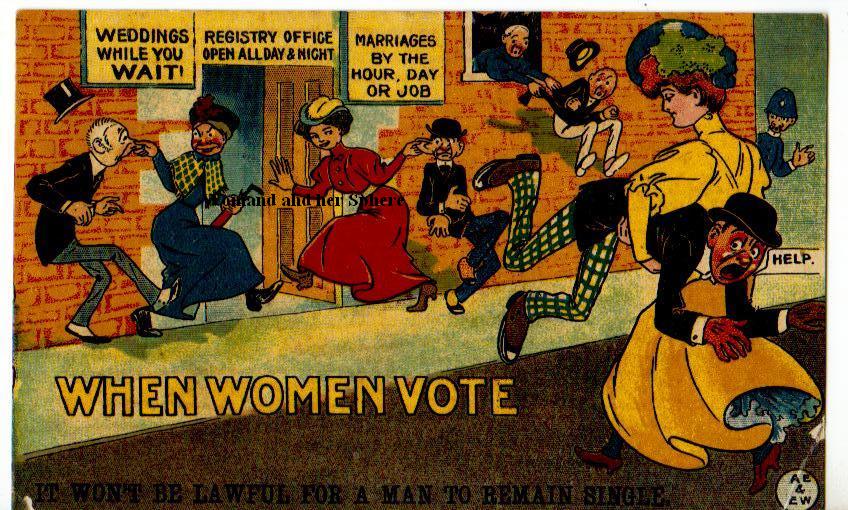 ‘WHEN WOMEN VOTE It won’t be lawful for a man to remain single’. All the men are being rushed into marriage – tweaked by the nose and carried under the arms of women – and all because they have a vote!
The card was published by Mitchell & Watkins, who had been producing postcards – both topographical photographic and artist-drawn – from c 1906.
This card was posted – in, I think, 1913 (the postmark is obscured) – to Miss Ida Currell – who had been born in 1882 and was one of 4 surviving children of the 10 born to a Hertfordshire farmer and his wife. The Currells farm, at 2 Ware Road, Hertford, was called ‘The Chaplains’.
The card is in very good condition and is £45 post free.
To buy: email e.crawford@sphere20.freeserve.co.uk
Suffragette postcards: harem pants
Posted in Collecting Suffrage on July 30, 2012
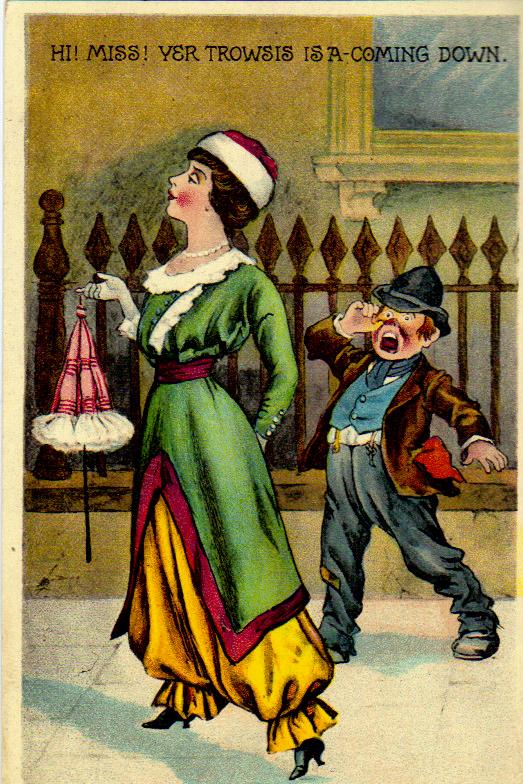 A comment on the ‘look’ that Paul Poiret was promoting c 1909 – although perhaps not to Margot Asquith – see ‘Suffrage Stories’ post -‘Madame Mantalini’.
‘HI! MISS! YER TROWSERS IS A-COMING DOWN’ shouts tyke to elegant young woman sporting ‘harem’ trousers. Pre-First World War, published by Felix McGlennon, who having been a rather successful song writer and music publisher, jumped on the bandwagon and added the publication of postcards to his repertoire as the postcard craze swept Edwardian Britian.
Not actually ‘suffrage’ but very much of its time. In very good condition – very glossy- £25 post free.
To buy email e.crawford@sphere20.freeserve.co.uk
Suffrage Stories: ‘Madame Mantalini’
Posted in 1911 Census, Suffrage Stories, The Garretts and their Circle on July 30, 2012
Since 2009, when details of the 1911 census were released, I have (with, for a time, Dr Jill Liddington) been investigating how the women of the country responded to the call issued by the more militant suffrage societies to boycott the census. In the process I have discovered women of a suffrage inclination of whom, until now, suffrage history has known nothing.
One of these was a ‘Miss S. Marsden’, whose census form was delivered to her at 69 Church Street, Kensington, and who refused the enumerator any details about herself. However, Miss Marsden did not leave the form blank, writing on it one of the longest statements that I have so far encountered. Although the right edge of the census form is badly damaged, creating gaps in her comments, I think we can get the gist.
‘I, Mdme Mantalini, a municipal voter and tax payer, refuse to fill in this census paper, as I have no intention of furnishing this government with information and thereby helping them to legislate for women without obtaining their consent or first consulting them in the [missing words] effective way possible & extending the franchise to duly qualified women. As a responsible, law-abiding citizen I have conducted my business for sixteen years; as an employer of labour I have [contributed?] to the wealth of the state and in return I have been taxed for the upkeep of no 10 Downing Street. No 10 Downing Street, the official residence of the prime minister, but converted by his wife into a show-room for a French [dress maker?] (free of all duty and taxation) to exhibit his Paris models and take orders from them to be executed in Paris. I [missing words] with very few exceptions the dressmaking establishments in England are all owned by women, & only women & [missing words] workers. It therefore comes to this, that the only way open to us to protest at ‘our trade’ being ruined in [missing words] our taxes, is to drive home to the government by every method available that women are determined [missing words – perhaps ‘not to be governed’] without their consent.’
Would that not whet any researcher’s appetite? Who was Miss Marsden/Mdme Mantalini? What had Margot Asquith been up to?
In fact the second question was the easier to answer. An inspection of The Times archive revealed that in May 1909 Margot Asquith had been called to task by drapers’ associations from around the country for inviting the Parisian designer Paul Poiret to show dresses in 10 Downing Street.
Poiret then was the epitome of chic – designing dresses that relied on draping, rather than tailoring – so much easier to wear – and promoting hobble skirts, harem pants and kimono coats – designs such as these.
In response to a letter of complaint from an MP, Mrs Asquith explained, ‘I received in my private rooms at tea from 20 to 25 of my personal friends and a well-known French costumier, whose models can be bought in any London shop, brought some specimens for the inspection of myself and my guests. It was a purely personal occasion.’ In fact, such was the rumpus, that henceforward Margot Asquith was obliged to patronize British costumiers, such as Lucile although probably not, I fear, Madame Mantalini.
I thought at first that when Miss Marsden referred to herself on the census paper as ‘Mdme Mantalini’ it was merely as short-hand to describe her position as a dressmaker – that being the name of the dressmaking establishment at which, in Nicholas Nickleby, Kate Nickleby is apprenticed. But, consulting my 1908 London street directory, I found that the shop at 69 Church Street (which is still there) was, indeed, that of ‘Mrs Sybil Mantalini’. It was then only a short step to establish that Mrs Mantalini was, in fact, Miss Sybil Marsden, who was on the London Electoral Register by dint of her occupation of those premises, and the question of’ ‘Who was Miss S. Marsden?’ was solved.
But now I was hooked. Who was Miss Sybil Marsden? Why was she such an outspoken dressmaker?
I discovered that she had 9 siblings and in 1911 was living at the family home, 82 RedcliffeGardens in South Kensington, with her mother and one unmarried sister. Her father, Algernon Moses Marsden, had been a fine art dealer but, by 1901, had been declared bankrupt several times. His background was most interesting; he had declined to enter the family’s successful clothing business, clearly preferring the more elevated association with ‘art’.
 Algernon Moses Marsden by James Tissot
Marsden was by all accounts – mainly in the bankruptcy reports – an engaging fellow – as is evident in the portrait of him by James Tissot, painted in 1877, when Sybil was four-years-old. At that time Marsden was Tissot’s dealer, but gambling and high-living proved his downfall. It would appear that after his final bankruptcy in 1901 he removed himself to New York, where he died in 1920. I can now see that the choice of the name ‘Madame Mantalini’ may have been even more to the point than I first thought. In Nicholas Nickleby it is Mr Mantalini’s extravagance that resulted in the bankruptcy of his wife’s business – an awful warning to Sybil Marsden. No wonder Algernon’s daughter had little faith in the ability of men to manage her affairs.
Epilogue
The cinéaste members of my family play the Six Degrees of Kevin Bacon game (whereby any named film actor has to be connected with fellow-actor KB by links covering no more than 6 films). I am hopeless at that – but think I might be a contender in Six Degrees of Garrett. This particular case is easy: Sybil Marsden, Algernon Marsden, James Tissot, J.M. Brydon, Agnes and Rhoda Garrett. As I discuss in Enterprising Women: the Garrets and their circle, the two young women were undergoing their architectural training with Brydon in 1873, at a time when he was working on the design of a new studio for Tissot, attached to the artist’s St John’s Wood house. Did they go on a site visit? Had they perhaps even seen in the flesh, as it were, the tiger skin and the fashionable blue vase, that serve to emphasise Algenon Marsden’s exoticism and good taste.
Suffragette postcards: real photographic portrait
Posted in Collecting Suffrage on July 28, 2012
 Here is an example of a real photographic postcard issued by a suffrage society – in this case by the Women’s Freedom League. Its subject is Mrs Lilian Hicks (1853-1924) who, with her daughter, Amy, was at that time of its publication a leading member of the WFL – as well as a supporter of the Church League for Women’s Suffrage, the New Constitutional Society for Women’s Suffrage and the Tax Resistance League. Both mother and daughter, by then members of the Women’s Social and Political Union, heeded the call to boycott the 1911 census.
The Hicks’ association with a wide range of suffrage societies, of which I had written a few years earlier in their joint entry in my Women’s Suffrage Movement: a reference guide, was made manifest in the magnificent collection of badges and awards – including a hunger-strike medal – that many years ago I acquired from a woman to whom they had been indirectly bequeathed. They are now held in a private collection.
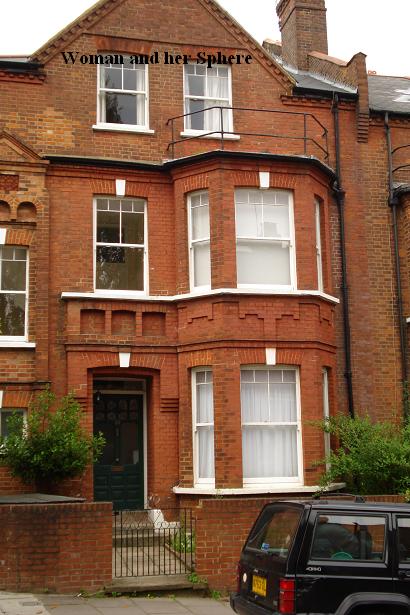 Lilian and Amy Hicks lived here, at 33 Downside Crescent, Hampstead. At the other end of the street was the home – probably the rather unhappy home – of Margaret Wynne Nevinson, a fellow member of the Women’s Freedom League. I realised that a bond of friendship existed between the two women when, all those years ago, I recognised – hanging on the wall of the sitting-room in the small cottage of the woman from whom I was buying the collection of Hicks’ memorabilia – a large painting by Margaret’s son, C.R. Nevinson. It was in the guise of ‘the mother of the Futurists’ that Margaret went when she attended a dinner given by the Women Writers’ Suffrage League at the Hotel Cecil on 29 June 1914. Unfortunately there is no record of the form of dress that this witty allusion took.
The photograph of Mrs Hicks on this official Women’s Freedom League postcard was taken by Lena Connell and probably issued around 1909/10.
Mrs Lilian Hicks was a member of the Women’s Freedom League
Suffragette postcards: suffragettes and policemen 3
Posted in Collecting Suffrage on July 27, 2012
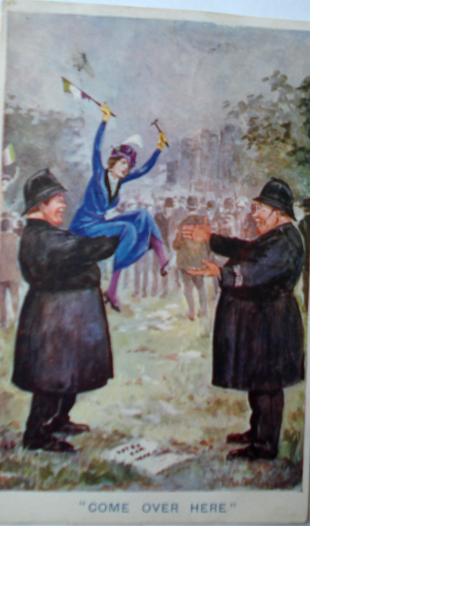 Another in this week’s theme of ‘suffragettes and policemen’.
Two burly policeman are playing games with tiny (elegant, for a change) suffragette. Waving the tools of her trade – a hammer and flags, she is held aloft by one who looks as though he intends to lob her over to the other, who is waiting with outstretched arms. A ‘Votes for Women’ placard lies on the ground between them. Published by Inter-Art Co., Red Lion Sq, London WC. Good – slightly rubbed at edges – posted in 1913. £35 post free.
What Mariana Starke was not
Posted in Mariana Starke on July 26, 2012
Mariana Starke was not born in India
Since its first edition the printed edition of the DNB has stated that Mariana Starke was born in India, where her father, Richard Starke, was governor of Fort St George and that she spent her early years there. Furthermore ,the latest edition – when issued – went on to say that this early observation of Anglo-Indian life bore fruit in two of her plays, The Sword of Peace (1788) and The Widow of Malabar (1791). This information has been accepted without investigation by the increasing number of scholars who have become interested in Mariana Starke but it is incorrect. My researches – and those of one or two others who independently reached the truth – have led to an amendment to Mariana’s entry in the online edition of the ODNB. Mariana Starke, although eventually earning for herself the soubriquet ‘The Celebrated Tourist’ was born in Surrey – in late-September 1762 at Hylands House in Epsom.
Nor did Mariana, although well-travelled, ever live in or visit India. However her family did have a long association with the continent, dating back to c 1711 – and India and the East India Company would have been a topic much discussed in the Starke household.
In a similar fashion there may have been family reminisces about the success in business of Mariana’s great-grandfather, Thomas Starke, who in the late-17th century, was a Virginia landowner and one of the first – and leading – London slave traders. One of Mariana’s plays, The Poor Soldier (1789), recounts the story of Charles Short, American Loyalist of South Carolina. I do not know that any scholar has yet made the connection between America and her family’s history – and it is not one I would want to labour. I am, however, very interested in Thomas Starke’s life and work and will recount something of it in the next ‘Mariana Starke’ post.
UPDATE
Information about the reality of Mariana’s early life was passed to the ODNB and her entry duly altered.
Copyright
Kate Frye’s Suffrage Diary: 3 December 1906
Posted in Kate Frye's suffrage diary on July 26, 2012
Kate’s family had always taken an interest in politics; her father had been Liberal MP for North Kensington in the 1890s and into the 20th century her mother was the president of the North Kensington Women’s Liberal Association. However, the meeting described below is the first occasion that Kate mentions in her diary her attendance at a specifically ‘suffrage’ meeting and of the disturbances that had been caused by the WSPU’s ‘rowdy attacks’.
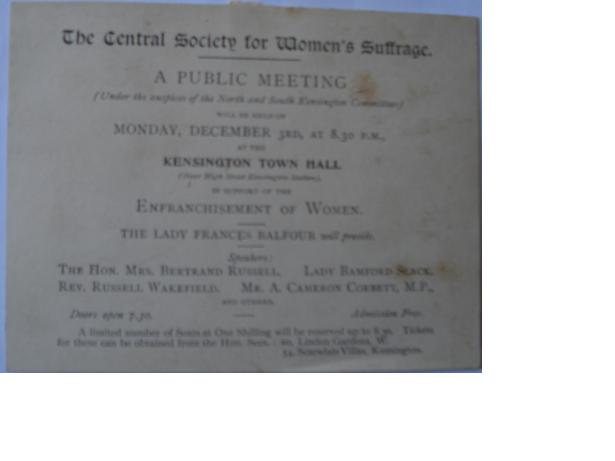 Monday 3 December 1906
At 8 o’clock [evening] Agnes [Kate’s elder sister] and I went off to KensingtonTown Hall to a Woman’s Suffrage meeting – got up by the Central Society. Lady Frances Balfour was presiding. We went by bus – when we got there the large hall was packed. Alexandra Wright was at the top of the stairs and directed us up to the overflow meeting and that was packed too. After a bit the speakers came in to us – the Hon Mrs Bertrand Russell, Miss Gore Booth, Lady Frances Balfour and Mr Cameron Corbett M.P. I heard excellent speeches all of them – they really did put the case in a nutshell and were most instructive and interesting.
Then Gladys Wright came and fetched me out and came and asked me to act as a Steward and collect – then later she went in for Agnes – and we both did what we could. We collected in the Gallery first – then later I was stationed to get the people as they came out. It was very amusing really – and I got so hot and excited – off my head with it – we certainly are in the thick of things always. Some of the people gave a lot – others shook their heads and frowned. One man said I wanted too much – to marry as well as a Vote. I had quite a flirtation on the stairs with a big smart young man – who stopped to ask me a question – he didn’t seem to know anything about anything and when he said the speaker had referred to Earl Percy as ‘half asleep’ – I said ‘That is true about a great many people’ – he did laugh.
I am afraid I felt I was more like a helper at a Bazaar than at so grave a thing as a Woman’s Suffrage Meeting – but then it is so hard for me to be serious about anything – but I am in earnest – I really do feel a great belief in the need of the Vote for Women if only as a means of Education. I feel my prayer for Women in the words of George Meredith ‘More brains, Oh Lord, more brains.’ But we are coming along and not slowly by any means. Of course all these rowdy attacks on the Ministers and these imprisonments have sounded coarse and unpleasant and the jokery made of it most bad for the cause – but women have waited patiently for so long the sort of women who have gone for the matter in this rowdy method are not the best educated or most refined amongst our members.
At this meeting every thing passed off in a most orderly dignified spirit – and the speeches from the women were delightful and must have come as a revelation to many of the audience. There was a declaration there for any working woman there who cared to sign – a number did – I did – as I have a profession [Kate was a rather unsuccessful actress]. Naturally they don’t want crowds of names without any meaning or strength in them. We came home after hearing the amount collected nearly £20 – about the cost of getting up a meeting – the reason for the collection. Bus to Notting Hill – got in soon after 10.30 – in a frenzy of excitement.
Campaigning for the Vote: Kate Parry Frye’s Suffrage Diary edited by Elizabeth Crawford
For a full description of the book click here
Wrap-around paper covers, 226 pp, over 70 illustrations, all drawn from Kate Frye’s personal archive.
ISBN 978 1903427 75 0
Copies available from Francis Boutle Publishers, or from Elizabeth Crawford – elizabeth.crawford2017@outlook.com (£14.99 +UK postage £3. Please ask for international postage cost), or from all good bookshops – and Amazon.
- ‘Campaigning for the Vote’ – Front and back cover of wrappers
‘Glad were they to rest on Australia’s shore’
Posted in Emigration research, Uncategorized on July 26, 2012
This article was first published in March 2008 in Ancestors, a magazine, now, alas, defunct, published by The National Archives.
‘From old Scotland’s shore a vessel set sail
Old ocean to cross mid tempest and gale
Full laden with souls bound to a strange shore
Australia’s bright land never seen before’
The vessel was the India, sailing from Greenock on 4 June 1841, bound for Australia. Among the ‘souls’ aboard were my great-great-great-great grandfather, Phillip Shillinglaw, and four of his children. I trace my descent from a daughter who, already married, remained in Scotland. Although, in the course of research for books and articles, I have spent years investigating the history of others, only recently have I looked at my own family. I was delighted to discover this Australian link, no hint of which had passed down to me. After a little internet detective work I had the amazing good fortune of making contact with a (very) distant Melbourne relative, Margaret Ball. With her help I have been able to piece together a remarkably full picture of the Shillinglaw family’s traumatic voyage and their subsequent life in Australia.
The above lines open an epic poem describing the disaster that befell the India, the near miraculous rescue of the majority of its passengers, and their eventual arrival at Port Phillip, then in New South Wales. The author of the poem was Phillip Shillinglaw’s grandson and namesake. The manuscript, as in all the best tales of genealogical research, lay unregarded in a tin box until inherited in 1984 by Margaret Ball, great-great-great granddaughter of Phillip Shillinglaw the emigrant. She wrote that ‘This tin box started me on a great chase and a love for family history which is never ending’ and of the poem, ‘It took me a while to work it out but when I started to check public records it all made sense’. It is certainly unusual to be able to trace so dramatically the experience of steerage emigrants of this period. Much of the information in the poem tallies well with that held in public records. Phillip Shillinglaw the versifier was, of course, retelling the story he had heard from his mother and father, who had both, then unmarried, travelled out on the India, rather than recounting an official history. I am very grateful to Margaret Ball for permission to quote from the poem.
The Shillinglaws represent the ‘everyman’ and ‘everywoman’ of the mid-19th century emigrant movement to Australia. Indeed the year 1841 has come to be regarded as a watershed in the peopling of Australia. The colonies were keen to break from their convict-peopled past and introduce a different kind of settler. Britain’s industrious, virtuous working-class, suffering in a severely depressed economy, provided the ideal candidates.
The cost of a steerage passage to Australia was around £17, almost the average annual wage of a rural labourer and about twice the wage of a young female domestic servant. In order to supply Australia with this type of worker a series of schemes were devised to assist their passage, all requiring candidates to fulfil occupation, health, age, and character criteria set by the colonial legislatures. There was a bias towards family groupings, ‘protected’ single females, and those from rural counties.
The Shillinglaws certainly qualified on that score. They were travelling to Australia from Aberdalgie, a village in Perthshire. My suspicion, mentioned when this article was first published, that Phillip Shillinglaw worked in some specialist area of horticulture, perhaps fruit growing, rather than as a general agricultural labourer has proved correct. In 1826, for instance, as gardener to the Earl of Kinnoul, of Duplin Castle, Perthshire, he was awarded a prize for his ‘Queen Pineapple’ and an extra medal for ‘uncommonly fine Black Hamburgh grapes’ by the Caledonian Horticultural Society, meeting in Edinburgh . Two of the daughters he left behind in Scotland were married to estate gardeners and, as we will see, when they reached Australia it was as gardeners, rather than as agricultural labourers or sheep hands, that both he and his son found employment.
Phillip was born in Berwickshire in 1777, probably moving to Maidstone, Kent, with his parents and siblings in the mid-1790s. Certainly he was living in England when he married in St Martin’s-in-the-Fields on 25 October 1807. Several of his older children were born in Kent but the birth in Perthshire of the younger ones indicates that the family had returned to Scotland around the mid-1820s. It was at Aberdalgie that three of the older daughters were married. I have found no trace of their mother’s death, but assume that in 1841 Philip was a widower. The little I have been able to deduce from this genealogical study suggests that Philip Shillinglaw was not a man to limit his horizons and that he could write his name. I might have been able to discover more about the family were it not for the irony that the India set sail a mere two days before the taking of the first census.
Of the Shillinglaw party, Phillip’s son, William, and two of his daughters, Martha and Elizabeth, appear in the Index to Assisted British Immigrants, although with their surname rendered as ‘Shillingham’. William was in his mid-20s. Elizabeth’s age was given as 21 on her arrival, although she may have been considerably younger. Martha’s age is recorded on arrival as 16, which tallies with her death at the age of 65 in 1891.
A slight mystery surrounds the identity of the third female member of the party. Her name is clearly written as ‘Catherine Shillinglaw’ on a list of passengers. However, nothing is known of a family member of that name and Caroline Shillinglaw, one of Phillip’s elder daughters, certainly did travel to Australia. Caroline would have been 31 in 1841 and it is possible that the fifth named member of the party, James Shillinglaw, was her illegitimate son. Neither Catherine/Caroline nor James is recorded on arrival as an assisted passenger.
Phillip, too, is missing from this record, his absence explained by the fact that, at 64, he was well above the qualifying age. It was considered part of the success of the emigration scheme that ‘ship-room’ was given to elderly family members. This was important in persuading the younger people to emigrate. In this case, however, I rather think that Phillip may himself have been a driving force. He could quite well have stayed quietly in Perthshire with his married daughters.
How would the Shillinglaws have heard about the possibilities of emigration and of the bounty scheme? Emigrant guides, aimed at the working class, had been published since the 1830s. It is quite possible that the Shillinglaws had studied one of these. Also at this time the emigration scheme was being vigorously promoted in the various regions of rural Scotland. The official responsible for selecting emigrants travelled around, holding meetings, posting broadsheets and distributing circulars.
It was no simple business to apply for an assisted passage. Medical certificates and references were required, as well as money for a deposit, specified clothing and equipment, and the cost of travel to the port of embarkation. But well-informed, self-selecting, literate individuals with initiative could, and clearly did, overcome bureaucratic hurdles.
The voyage of the India was handled by Glasgow shipping agents McNeill and Somervall. The ship, described as ‘A 1 copper-bottomed’, was a three-masted barque of 493 tonnes, relatively new, having been built in Greenock in 1839. It had already completed one round trip to Australia. Passengers in 1841 were advised to be in Greenock by 28 May, ready for the 4 June departure.
It has been calculated that 172 passengers embarked. The ship had a poop cabin, accommodating 20 passengers, but the majority of the emigrants, including the Shillinglaws, travelled steerage. Thus, around 150 men, women and children lived and slept on the lower deck, in what was in effect one dormitory. Although the exact layout of the interior of the India’s steerage accommodation is unknown, it was usual for married couples and children to be housed in the centre, with the single women and girls in the ‘after berths’, and the single males and boys in the ‘fore-part’. Headroom was just over 6 feet, allowing for two tiers of bunks running along each side of a central table. These berths, usually fitted by the ship’s carpenter, were temporary so that they could be removed to make way for cargo on the return journey.
The passengers formed themselves into messes of six at meal times, with a mess captain appointed to collect the rations and take them to the galley for cooking. The India was well supplied with fresh meat, having live chicken, geese, pigs and sheep on board.Life in such close quarters could be fraught, but also led to friendships and, indeed, marriages. Seven months after their arrival at Port Phillip, William Shillinglaw married Jean Blamire, a fellow passenger. Their son, Phillip, the versifier, was born three months later.
The motion of the ship, causing, for many, incapacitating sea-sickness, the noise from wind, waves, sails and creaking wood, the threat of disease, and the increasing heat from the sun, combined with the discomfort of living packed together in such a confined space, made life on an emigrant ship at best uncomfortable. The passengers on the India were later to look back on the early stage of the voyage as blessedly uneventful.
The first indication that this journey was not to be without complication came when, according to Phillip’s poem, the crew mutinied. There is no mention of this incident in official sources, but I am prepared to give credence to his report that:
Now mutiny comes: crew refuses to work
So passengers have to handle the Barque
The crew’s dissatisfaction is unexplained and, according to the poem, the mutiny collapsed when they realised the punishment that would result from endangering the ship.
Near two hundred souls on that vessel’s deck
Having no knowledge of how life to save,
Constitutes a crime most fearfully grave.
After mutiny, the India and its passengers next had to contend with the threat of being pillaged by a Spanish pirate ship, the Gabriel.
Soon sea robbers hove in sight of the ship
But do not molest, though round her they slip
For, having established that the India carried a worthless cargo – emigrants – the Gabriel lost interest and sailed away. Shortly afterwards, however, she was involved in a four-hour gun battle with HM Brig Acorn and her crew captured.
It was about a fortnight after this encounter that, on 19 July, the India met its nemesis. As Phillip Shillinglaw put it:
At two of the clock, on the India they dined.
At six of the clock she was left behind
A glowing ball, burnt down to the water
To disappear, when the winds had caught her.
The disaster, he wrote, was due to the actions of the second mate (another report says the third mate), ‘a drunken fiend’, who went into the hold to fill a two-gallon measure with rum for the occupants of the state cabin.
But he could not stand
Steady, staggering with candle in hand..
At last he let fall
His candle…
[Then]
Seizing the full measure with might and main
He dashed its contents right onto the flame
So quickly it caught, blazed up and flared
Beyond all control. For no-one dared
To face that inferno
The rather more prosaic report in the Times, provided by a cabin passenger, corroborates this story. The ship, 600 miles from the nearest land, was quickly ablaze. Death would have been inevitable for all had it not been for the fortuitous presence, about nine miles away, of a French whaler, the Roland. Even so, the blazing India was only spotted when the Roland’s carpenter climbed its rigging to make a repair. The Roland hurried to the rescue, lowering all her boats. The India’s boats, too, had been launched, but the first upturned when swamped by those desperate to clamber aboard, drowning 17 passengers and the boatswain. There was, anyway, only capacity for a third of the India’s passengers in its own long-boats. The India’s first mate then took charge of a second boat and used it to ferry passengers to those of the Roland.
To the ship they rowed
Returning-discharged-taking load after load,
Until, all were saved from the wreck, at last.
A fearful ordeal. But now it is past
Both my Father and my Mother were there
But they were not yet made into a pair.
The Times reporter wrote that ‘all was one scene of confusion and despair, the women were wringing their hands in the most heart rending manner, and this, mingled with screaming of children, presented a scene it would be vain to attempt describing.’ He also noted that the long-boat had to be cleared of ‘pigs, goats, &c., which were tossed overboard. ‘He described how, with his fellow passengers, he had doubted that the Roland would reach them in time as the India ‘was now one glowing mass of flame from stem to stern below, and rising through the hatches, and running up the rigging with incredible velocity. In less than one hour from the commencement of the fire her mainmast was lying over her lee-side.’ The surviving passengers were eventually picked up, many naked. Steerage and cabin passengers alike, they had lost all their possessions. It is salutary to note that during the 19th century at least 26 ships foundered on the voyage to Australia. Click here to see the watercolour of ‘The Burning of the Barque India of Greenock’, painted by Samuel Elyard and now in the Australian National Maritime Museum
On deck of the Roland, now, safely they stand
In mid Atlantic, a fortunate band…
Rio-Janaro’s the port – the name of the town
Where landed, and left to wander alone.
The Roland arrived at Rio de Janeiro on 26 July. There the emigrants were fortunate to be looked after by a remarkably considerate consul. Robert Hesketh’s correspondence with the Foreign Secretary, Lord Palmerston, records the effort made to ensure the comfort of the survivors and to find and equip a ship to carry them on to Australia. Hesketh found lodgings for all and, as he reported, ‘The British residents most charitably and liberally contributed Clothes’. For the sum of £1549 he chartered another ship, the Grindlay, writing to Palmerston, ’I shall have to draw on Her Majesty’s Treasury for the Sum, and also for the cost of Victualling the Emigrants during the Voyage. The expense of lodging, Victualling and Clothing in the place will form another item for which I shall also have to draw on Her Majesty’s Treasury. By thus acting, I hope to afford the assistance required from me by those unfortunate individuals in a manner that will meet your Lordship’s approval.’ Palmerston did not approve. However wiser counsels prevailed. It was pointed out that if this group of emigrants was left destitute in Rio all schemes for colonial emigration would be brought into disrepute.
The Grindlay sailed from Rio on 22 August. The widows of three drowned passengers returned to Scotland with their children. In addition, three women and two men had ‘absconded’, presumably tempted by the bright lights of Rio.
Hesketh appointed one of the India’s passengers, William Lilburne, as Superintendent of the Grindlay, giving ‘him charge of all the provisions, furnishing him with General Instructions, and with a set of regulations and Diet Scale which were notified to the Emigrants’. Hesketh wrote to the Governor of Port Phillip, ‘I consider myself fortunate in having had the assistance of such a person as Mr Lilburne to superintend on shore, in this Place, such a collection of persons under such trying circumstances, and his respectability, Discrimination and firmness makes me confident that the Passengers will be comfortable.’ Lilburne, who had been born in Perth in 1811, was given a testimonial to further his prospect of employment in Port Phillip.
It is noteworthy that Hesketh considered Lilburne better able to ensure the welfare of the passengers than the ship’s surgeon, Mr Houston, to whom, as was usual, they had previously been entrusted. Houston later appealed against the loss of gratuity resulting from this demotion, finally being offered half the money he might otherwise have received. William Lilburne received a free passage and a gratuity of £36.
British residents in Rio had raised a fund which provided the emigrants with clothing, some tools and Mr Houston with some medical instruments. The fund must have been substantial because a balance of £501 7s was left to be divided amongst the emigrants on their arrival at Port Phillip. A sum had also been given to the returning widows. The master of the Roland was presented with a gold chronometer and his crew a reward, shared between them, of £40.
There were no more adventures and the Grindlay disembarked at Port Phillip on 22 October 1841, one of 42 ships, carrying 7716 emigrants, which arrived that year from Britain.
Glad were they to rest on Australia’s shore.
But thankful indeed, the voyage is o’er.
Some came as servants, engaged ere they came,
As station hands some, all treated the same.
‘Tis a wild new land: Native tribes abound
“Plenty Blackfellow”, there wand’ring around
Port Phillip, soon to be renamed Melbourne, was clearly very different from Aberdalgie.
Phillip worked as a market gardener at Merri Creek, on the outskirts of Melbourne, until his death in 1852. In 1847 William was a gardener to ‘Government gardens’, the precursor of what is now the world-famous Melbourne Botanical Gardens. Caroline married in 1843 and had at least four children before dying in 1856. Elizabeth married in Melbourne in 1846, with her father present at the wedding. William Lilburne, a widower when he embarked on the India with at least two of his children, had married, soon after his arrival at Port Phillip, a fellow passenger, Christina Mcdougall. They had three children before divorcing. In 1853 he married Martha Shillinglaw.
The Shillinglaws thrived in Australia, the family increasing rapidly down the generations. Phillip the versifier settled in the Melbourne suburb of Eltham, where the brick house in which he and his family lived has been restored and preserved as Shillinglaw Cottage. In 1991 Margaret Ball organised a reunion for the descendants of those Shillinglaws who had, ‘with hearts all elate at what is before’, endured such danger to travel to that ‘wild new land’.
Taking It Further
Index to Assisted British Immigrants 1839-1871 http://www.prov.vic.gov.au
Australian Family History and Genealogy. http://www.nla.gov.au/oz/genelist.html
Australian Vital Records Index 1788-1905. Available for purchase on CD, or can be freely accessed at The National Archives, Kew
Read More About It
M. Cannon, Perilous Voyages to the New Land, Today’s Australia Publishing Co, 1997
R. Haines, Emigration and the Labouring Poor: Australian recruitment in Britain and Ireland 1831-60, Macmillan, 1997
R. Haines, Life and Death in the Age of Sail: the passage to Australia, NationalMaritimeMuseum, 2003.
Suffragette postcards: suffragettes and policemen 2
Posted in Collecting Suffrage on July 25, 2012
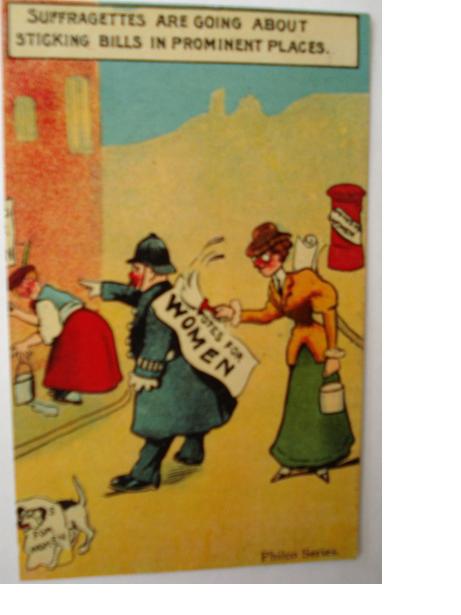 Here is another card in the ‘Philco Series’, titled ‘SUFFRAGETTES ARE GOING ABOUT STICKING BILLS IN PROMINENT PLACES’ and in this particular case that is pasting a ‘Votes for Women’ on the back of a policeman, who is in the process of accosting another bill-sticking suffragette. Needless to say the women are the usual stereotypical trilby-wearing, bespectacled harridens. In the scene a pillar box and a dog have also been plastered with V f W posters. The message on the reverse – written in pencil from the same sender to the same recipient as that of the card in the previous ‘Collecting Suffrage’ post – that is Win to Mrs James – reads ‘And the best of wishes for a happy Christmas. The suffragettes what and how they do things in London.’ Very good – unposted £45 post free. NOW SOLD
Suffragette postcards: suffragettes and policemen
Posted in Collecting Suffrage on July 24, 2012
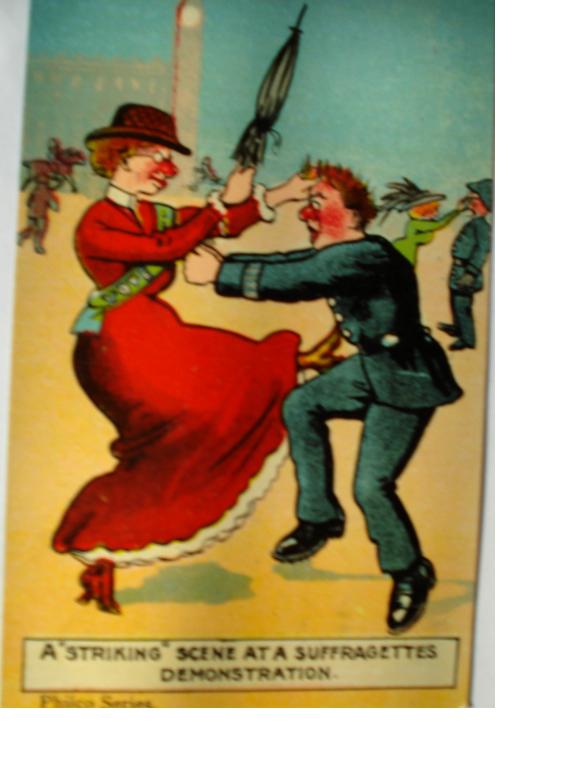 The increased activity of the women’s suffrage campaign in the early years of the 20th century coincided with the golden age of the postcard. It proved to be a subject very popular with the burgeoning number of commercial postcard publishers and cards with a ‘suffragette’ theme outnumber those relating to other contemporary campaigns – such as Tariff Reform and Home Rule.
Without too much effort, anyone interested can still build up a collection of cards reflecting the varying views of Edwardian society on women’s desire for citizenship – and their methods of achieving it. The suffrage societies themselves all produced cards – portraits of their leaders or photographs of great suffrage occasions – although they are vastly outnumbered by cards produced by the commercial publishers.
The incongruence of women battling with policemen – as on ‘Black Friday’ in November 1910 – certainly caught the publishers’ attention and there are many variations on the theme. This card was published by Philco Publishers, whose office was in Holborn Place – very close to WSPU headquarters. This card was not posted but is written to ‘Mrs James’. The message reads ‘I do not know what you will think of this. But this is suffragettes in vengeance and in their battle array.’
The stereotypical harridan (trilby hat, glasses, high-colouring, big nose) wearing ‘Votes for Women’ sash wields her umbrella as she kicks a policeman. In the background another, similar, scene is enacted. There is a tall clock tower – which might just be intended as Big Ben – at the very back of the scene, attached to a misty building. This card, which is in good condition, was one of a series. It is available for sale from me: £45 post free. NOW SOLD
See the August 2012 issue of BBC History Magazine for Prof June Purvis’s article on ‘suffragette’ cards published by commercial publishers and click here for details of her very interesting and informative accompanying podcast (June’s piece begins 20 minutes into the recording).
2 Gower Street – Royal Holloway College – and a Sense of Place
Posted in The Garretts and their Circle on July 23, 2012
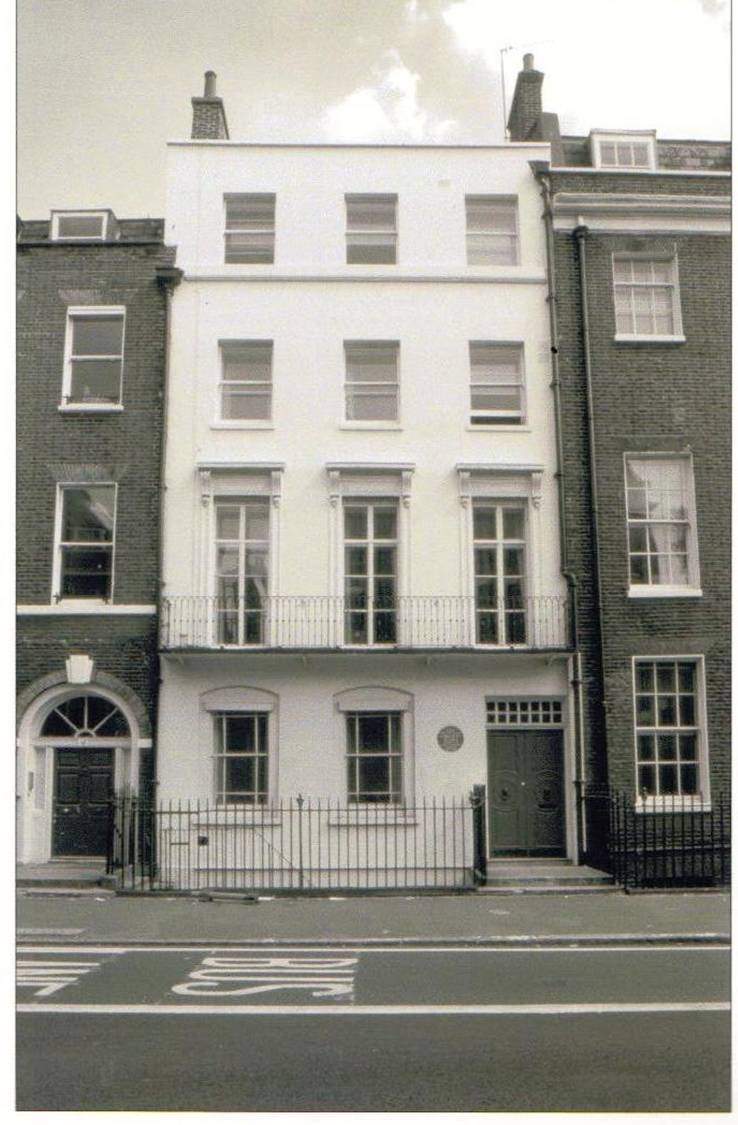
Number 2 Gower Street – just past the north-east corner of Bedford Square in Bloomsbury – was home to Agnes Garrett from 1874. She lived there first with her cousin and partner, Rhoda, and then with her widowed sister, Millicent Fawcett, and Millicent’s daughter, Philippa. Rhoda died in the house in 1882, as did Millicent in 1929 and Agnes in 1935. Philippa continued to live there alone for several more years. The Garretts, thus, had an association with this one house for well over 60 years. The fact that it was the home of Dame Millicent Fawcett, ‘pioneer of women’s suffrage’, is marked by the blue plaque on the front of the house.
2 Gower Street is now the central London campus of Royal Holloway College which was most generous in allowing me access when I was researching the work of Rhoda and Agnes Garrett. In addition, in January 2012 I had the pleasure of spending an evening there, giving a talk on the Garretts’ interior design business to members of the Camden History Society. Afterwards we all had a chance to wander around, spotting the elements of design that might be attributed to the Garretts. One of the best rooms is the first-floor back, the ceiling of which was painted by Rhoda and Agnes. Seen by lamplight on a dark wintery night it did look most attractive.
Although an effort has been made to make the interior of the house look a little less institutional than in the recent past, it did strike me how strange it was that there was not one visual reference to the long Garrett occupation. For instance, a series of etchings (I think) of what appeared to be northern European market towns, while being attractive, do nothing to give meaning to the rooms in which they are hung.
Coincidentally, a few days after that talk, I saw an advertisement for Royal Holloway’s MA in Creative Writing, one of the ‘pathways’ of which is ‘Environmental Writing’ (‘Place, Environment, Writing’). Looking at the website I saw that the accompanying photograph shows Prof Andrew Motion, the biographer of Keats, whose portrait the Garretts included in the ceiling next door, conducting a seminar in the Garretts’ drawing room. How ironic, I thought, that they should be discussing a sense of place in a place from which all sense of a past has been excluded.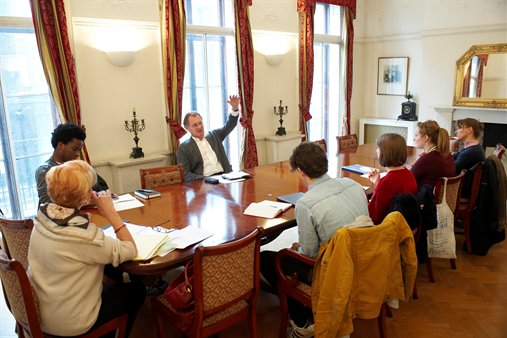
I emailed Andrew Motion to make this point and received an immediate and very supportive reply – suggesting I write to his head of department. Well, I did so, but met with silence. I suppose universities have more pressing matters to attend to.
But how easy and inexpensive it would be to add a few pictures to that seminar room and show an awareness of its past history.
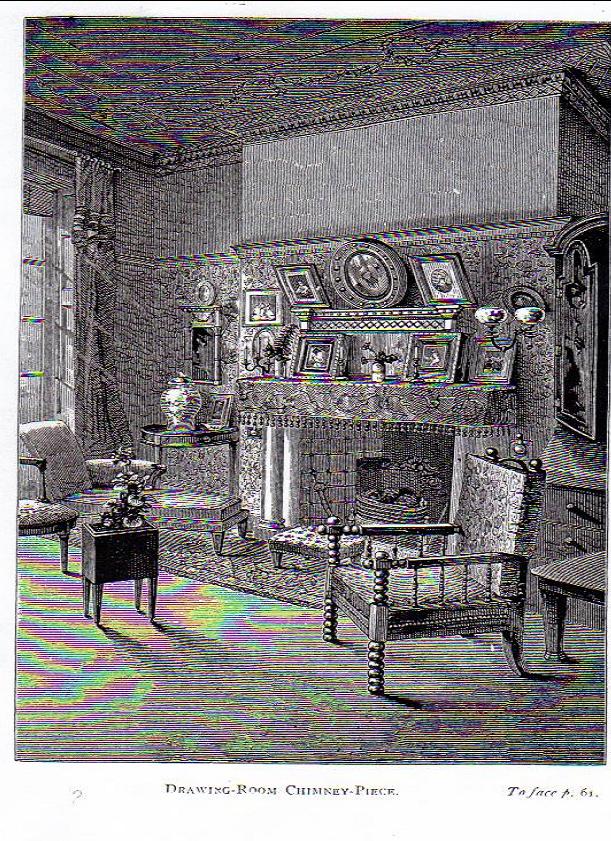
For instance, an enlargment of this – showing the same room in 1875 – as depicted in Rhoda and Agnes’s book, House Decoration.
And here is a photograph, held in the National Portrait Gallery, of Agnes attending to the grandfather clock in the corner just to the left of the fireplace. The portrait in the background is that of Philippa Fawcett by Harold Rathbone. And here is Millicent Fawcett conducting the women’s suffrage campaign from her desk in the corner on the fireplace’s right.
That is just a beginning – I could suggest many more illustrations – all inexpensive to access – of designs, people and occasions that would bring a sense of place back to the house that was the centre of so much activity during the last quarter of the 19th century and the first quarter of the 20th. How pleased I would be if Royal Holloway were to take my suggestion seriously.
For much more about Millicent Fawcett and Agnes Garrett see Elizabeth Crawford, Enterprising Women: the Garretts and their circle
Music For Garrett Rooms: Hubert Parry’s ‘English Lyrics’
Posted in The Garretts and their Circle on July 22, 2012
 The most detailed account of Rhoda and Agnes Garrett at work as ‘house designers’ is, as far as I have been able to establish, recorded in the diary of the composer, Hubert Parry. He was their close friend and in May 1876 stayed with them for a fortnight in 2 Gower Street, afterwards writing in his diary:
’To live in their house is a very great deal of happiness in itself. The quiet and soothing colour of the walls and decoration and the admirable taste of all things acts upon the mind in the most comforting manner. I was quite excised of the vulgar idea that everything ought to be light & gaudy & covered with gilt in London. All these are a sure element of discomfort in a house, ones eye wants rest & nothing shows the dirt & dust of London so soon as light colours & gilding’.
Later in 1876 Rhoda and Agnes were commissioned to decorate Parry’s new house in Phillimore Place, Kensington.
In 1881 Parry chose to build his country house, Knights Croft, just across from the back garden of Rhoda and Agnes’s cottage in Rustington, Sussex.. There he provided members of the Garrett circle with many evenings of musical entertainment. In my first draft of Enterprising Women I included the suggestion that while reading Chapter 4 – that discussing Rhoda and Agnes’s careers as interior designers – a background accompaniment of Parry’s Songs might be appropriate. This suggestion was excised by a (prosaic) editor and I did not have the gumption to remonstrate.
Here, however, I can now suggest you listen to some excerpts from ‘Parry’s English Lyrics’.
Don’t you think that they add another dimension to a study of the work of ‘R & A Garrett’?
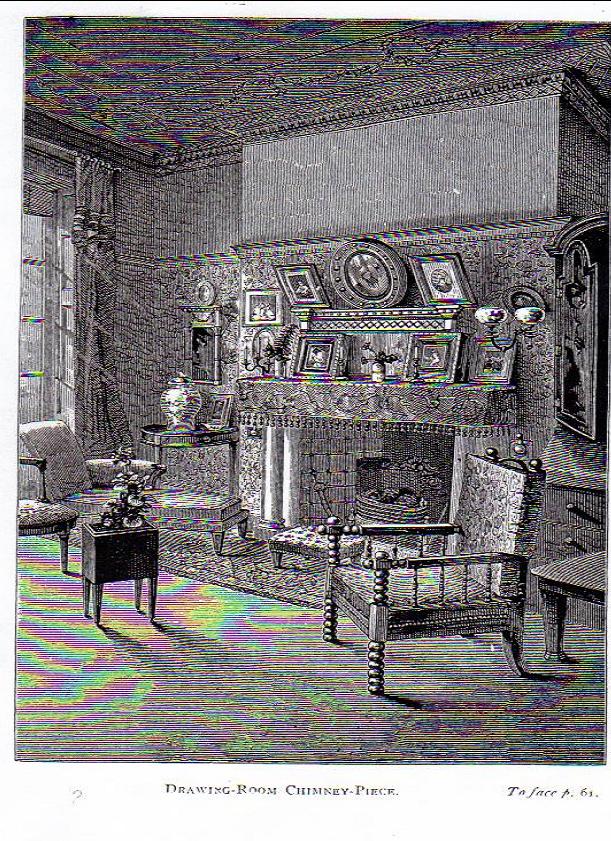
Rhoda and Agnes Garrett’s drawing room, 2 Gower Street, Bloomsbury
This music, so fluent, so English, was made to be played in the rooms that the cousins designed, composer and decorator each in their own way bringing comfort and harmony to the middle classes. The music also speaks of the patriotism and imperialism that was dear to the Garretts and their circle.
For more about Rhoda and Agnes Garrett and their work see:
Elizabeth Crawford, Enterprising Women: the Garretts and their circle, published by Francis Boutle
Click here for details
£25
Mrs Millicent Vince: Pupil of Agnes Garrett And Interior Decorator
Posted in The Garretts and their Circle on July 22, 2012
 In the post ‘Garrett Laburnum’ I mentioned that I had come across a sliver of wallpaper designed by Rhoda and Agnes Garrett as a photo in a book by one of Agnes’ pupils, Millicent Vince. Being curious, I wondered what I could find out about Mrs Vince and her work.
I discovered that she had been born Emily Cohen in Birmingham in 1868, the daughter of Adolph Cohen, a Hamburg-born watchmaker and diamond dealer. There was clearly artistry in the family; one of Adolph’s watch case designs (1871) is held in the National Archives Design Register. Her mother, Juliana, was Scottish. Emily, who was known as ‘Millie’ or ‘Millicent’, had 3 sisters and a brother, the family living for many years at 27 Frederick Street, in the city’s Jewellery Quarter. Her brother, David, also became a diamond dealer, eventually moving out of Birmingham to live at The Old Stone Manor, Upper Oddington, Gloucestershire.
I would imagine that the family was Jewish, although it would seem doubtful that Millicent, at least, was observant. There is no hint of the sisters having any paid occupation until, after their father’s death, in the 1901 census the eldest sister, Jessie, is shown as running a typewriting agency. Emily is living at home.
However, in the 1911 census Jessie no longer has an occupation, while the 1908 London Directory that I happen to have to hand shows ‘Miss M. Cohen’ running her own business as an Interior Decorator from Oakley House (14,16,18 Bloomsbury Street).There is no trace of Emily Cohen in the 1911 census, either under her given name or her diminutives. She was at that time living at 68 Great Russell Street, just round the corner from her office, but is not listed in the enumerator’s book as being expected to be there on census night. I would not, however, jump to the conclusion that she is absent because she heeded the suffragette call to boycott the census. There is likely to be a more prosaic explanation – such as a holiday abroad.
So in 1908 Millicent Cohen was living just down the road from Agnes Garrett’s house at 2 Gower Street. Did her pupillage with Agnes Garrett occur after 1901? – perhaps between then and Agnes’ retirement in 1905? The fact that she chose to set up business so close by might indicate that she inherited the goodwill of Agnes’s business. She clearly was very fond of her, dedicating Decorating and Care of the Home to ‘Agnes Garrett Pioneer of Women House-Decorators My Teacher and Friend’ and writing of her in the feminist paper, The Woman’s Leader, in 1925.
Millicent’s training probably followed closely that which Rhoda and Agnes had enjoyed. In a footnote she reveals that as a student she made drawings of the woodwork – mantelpieces and panelling – from building such as Aston Hall, Juniper Hall and Kew Palace; Rhoda and Agnes had had entry for just such a purpose to many of the great houses of England.
On reading Decorating and Care of the Home it is obvious that Millicent Vince shared many of the views on what constituted an ideal home as set out by Rhoda and Agnes Garrett nearly 50 years earlier in House Decoration (Macmillan, 1875). The emphasis is always on light and simplicity.
For instance, for country cottages Mrs Vince recommends the Swedish style – light-painted furniture, perhaps decorated with discreet stencils – thinking this preferable to the dark ‘country’ furniture usually thought suitable. This is a timeless look: today’s ‘country decorating’ magazines such as Country Living and Homes and Antiques usually feature at least one home dressed in such a style. In fact Mrs Vince clearly had a penchant for Sweden – leaving bequests in her will to two Swedish friends, one being the 1912 Olympic tennis player, Ebba Hay.
After setting up in business Miss Cohen soon made a name for herself, being quoted thus in article by Sarah Tooley, published in the Everywoman Encyclopaedia around 1910. ‘Are you not afraid of your workmen?” a lady asked Miss M. Cohen, one of our most accomplished designers and decorators. “Afraid of my workmen?” replied Miss Cohen. “Why, I count them all among my friends. They are willing, polite, and obliging, and it has done me good to know them.” This was very much the attitude to her workforce that Agnes Garrett had displayed throughout her working life.
Having probably not commenced in business until she was in her mid-30s, Millicent Cohen’s life took an interesting turn when, in 1915, she married Charles Vince. He was the son of a Cambridge fellow (and former headmaster of Mill HillSchool), had been educated in Birmingham and, when they married, was 28 to her 48. I am not sure whether or not she continued in business. After her marriage she no longer appears to have an office address, but the telephone directory lists ‘Mrs M. Vince’ rather than Charles. After the war he was in full-time employment as publicity secretary of the Royal Naval Lifeboat Institution and may not have needed the listing for professional purposes – while Millicent did. But that is perhaps a deduction too far.
After a brief sojourn in Hampstead Garden Suburb (Mrs Vince, while finding the Suburb’s cottages agreeably quaint on the outside, is a little scathing about their practicality), the couple lived in Brunswick Gardens, Kensington, first at 42 and, after 1936, at 27.
 Although in her book Mrs Vince mentions in passing many decorating commissions that she had undertaken, all of them are anonymous. If it was difficult to identify Agnes Garrett’s clients, it seems impossible now to discover those to whom Mrs Vince brought the luxury of tranquil surroundings. For that was her aim. This photograph is taken from Decorating and Care of the Home and I rather think is of a room in her own apartment. The wallpaper looks very much like Morris’s ‘Willow Bough’, the paper she had selected for illustration alongside ‘Garrett Laburnum’.
Apart from her books, Millicent Vince’s will is the only document I have seen that gives any other clue to her personal life. In that she makes clear her affection for her husband and siblings and, among many bequests, are ones to the woman-run Lady Chichester Hospital at Hove and one of its doctors, Dr Helen Boyle, and to Kensington feminist designer and enameller, Mrs Ernestine Mills.
Mrs Vince’s other two books are Furnishing and Decorating Do’s and Don’ts, Methuen, 1925 and Practical Home Decorating: how to choose your decorations and how to carry them out yourself, Pitman, 1932. Here are details of the copy of Decorating and Care of the Home that I have for sale.
For more on Rhoda and Agnes Garrett ‘House Decorators’ see Elizabeth Crawford, Enterprising Women: the Garretts and their circle.
‘Garrett Laburnum’
Posted in The Garretts and their Circle on July 17, 2012

One of the pleasures in working on the creation of the Elizabeth Garrett Anderson Gallery was to be able to help bring back to life the only surviving wallpaper created by the firm of ‘Rhoda and Agnes Garrett Household Decorators’.
I first came across the design in the form of a small, rather indistinct, black and white photograph in Decoration and Care of the Home by Mrs Millicent Vince.
 The book was published in 1923 and is dedicated to Agnes Garrett, with whom Millicent Vince had trained. The photograph labelled ‘Garrett Laburnum’ appears alongside one of ‘Willow Bough’, created by William Morris in 1887. ‘Garrett Laburnum’ is likely to date from around the same time..
Although we do not know exactly how the original wallpaper was coloured, wallpaper artist Pip Hall did a wonderful job of re-creating ‘Garrett Laburnum’ using the soft greens and yellows that surviving comments indicate were predominant in Agnes Garrett’s palette.
Click here to see how ‘Garrett Laburnum’ is displayed in the Elizabeth Garrett Anderson Gallery.
For Pip Hall click here
For much more information about Rhoda and Agnes Garrett as the first women professional decorators see Elizabeth Crawford, Enterprising Women: the Garretts and their circle.
 Woman and her Sphere


