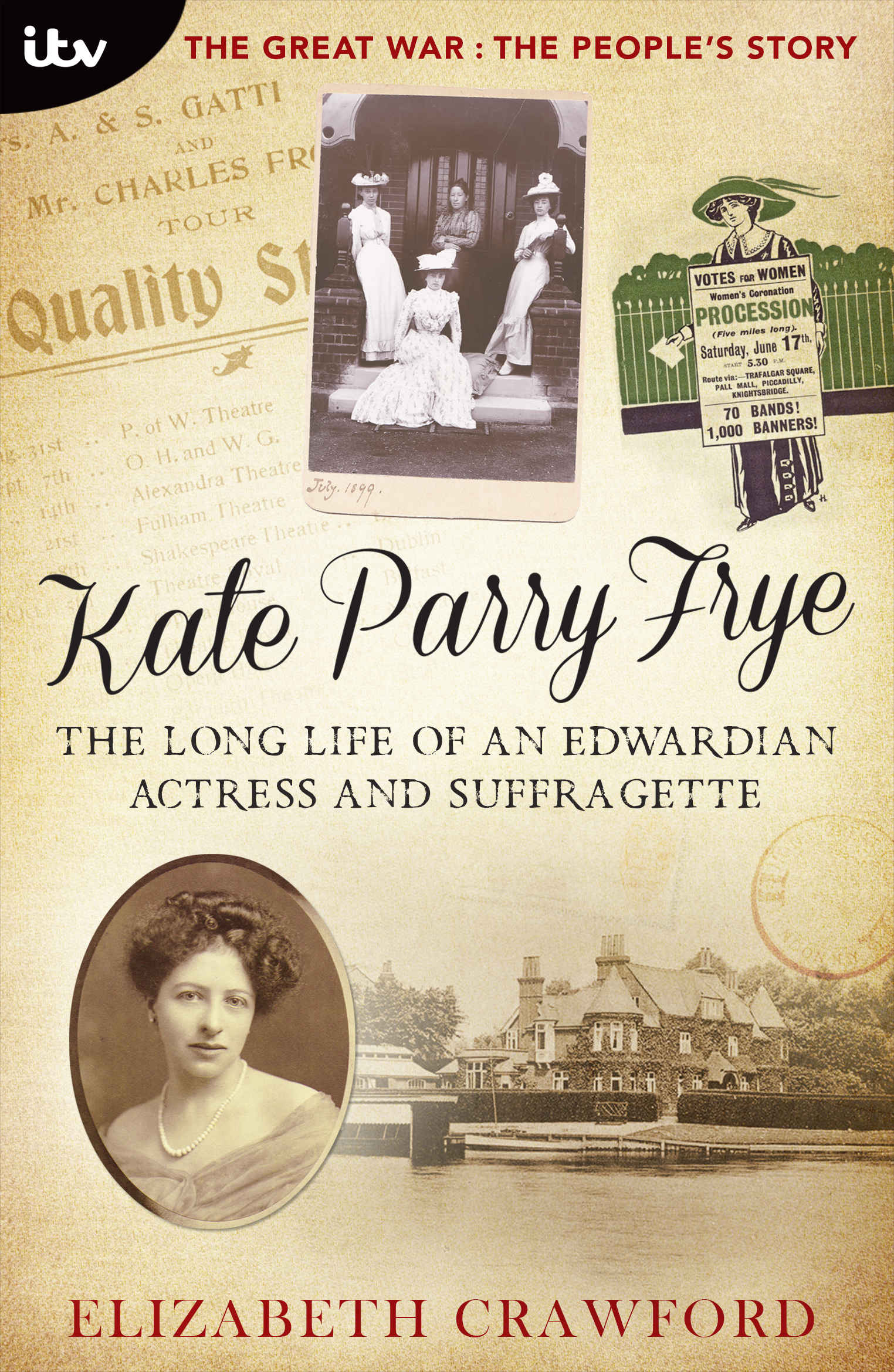
TO BE PUBLISHED ON 23 JULY – IN PAPERBACK (£24.99), HARDBACK AND AS AN EBOOK
You can pre-order from Bloomsbury at a reduced price here – or from Amazon here – or from your local bookshop.
I had no thought of producing another book when, one day in October 2023, I opened up my laptop, ready to watch an online auction mounted by Bonhams. This Votes for Women sale was devoted to suffrage memorabilia from the collection put together by a couple I’ve known ever since I began dealing in books and ephemera in the mid-1980s. I had no intention of bidding for anything in the auction as by 2023 the prices reached for suffrage material at such auctions had soared into the stratosphere. But, naturally, I took a professional interest in seeing what was up for sale – and the prices they would achieve. And I had a personal interest in that some of the items were ones I had myself sold to the vendors many years ago.
Watching the bidding was absorbing, but as the sale progressed I realised I was experiencing a niggling conflict between what might be termed my instinct as a trader and my instinct as an historian. Bonhams had organised the lots in the sale in a way as to appeal to bidders, grouping together items of a similar type, such as textile rosettes or china or badges or books – but this arrangement by no means coincided with what I knew to be the dates of their production. In my mind I was itching to reorder the lots into an historically coherent order. Well, there lay the germ of an idea …and it slowly gained traction..and, in due course, a publishing contract with Bloomsbury Academic. The result of my labours will be published in July.
For the book tells the story of the British ‘votes for women’ campaign in a sequence of 100 objects. From the beginning of the campaign in 1866 until all women were granted the vote on the same terms as men in 1928, women used every means in their power to persuade the government to allow them the right to elect members of parliament. Through the analysis of an astonishing array of objects – including books, bags, petitions, posters, plays, photographs, china, leaflets, newspapers, games, jewellery, sashes, films, and figurines – all of which are illustrated – The British Women’s Suffrage Movement in 100 Objects explores the role that material culture played in this vital struggle. Each of the 100 objects is illustrated, the accompanying text setting it in its context to explain the campaign’s politics and the part played by key personalities.
I must say that when I began work on the book it had not occurred to me that the suggestion could be voiced in any western democracy that women should be relieved of the right to the vote. But, that day having come (see here), although not yet here, there is all the more reason for understanding why and how British women won that right.
The book will be published in July in paperback at £24.99. To discover more details – as set out on the Bloomsbury website – including a special pre-order price and some most heart-warming reviews from readers who have viewed the text of the book in advance – see here.
My cup overflows – in that Bloomsbury will only accommodate six endorsements on their webpage – and nine readers were kind enough to give feedback on the book. I, as blushingly as self-promotion permits, set out below the final three to arrive. As you may imagine, I am immensely heartened – and hopeful that the 100 Objects will give a new clarity to the chronology, politics and personalities of the women’s suffrage campaign.
‘Drawing on a lifetime of groundbreaking scholarship on the British Suffrage movement and its materiality, Crawford’s new book is an essential read for anyone interested in the history of women’s campaigns for the vote. The British Women’s Suffrage Movement in 100 Objects brings to life in unprecedented detail the material world in which campaigners strove for social and political change, conveying this to new audiences with a lightness of erudition and a treasure trove of vivid detail. The extraordinary creativity and complexity of women’s activism during this era is made tangible through Crawford’s expert guidance.’ Dr Zoë Thomas, Associate Professor of Modern History, University of Birmingham
‘Beautifully illustrated and exceptionally curated, Crawford’s The British Women’s Suffrage Movement in 100 Objects is an essential and defining resource for the ways technological advances, community building, and popular culture played in the British campaign for “Votes for Women.” In clearly written and focused essays on everything from the intersection of the automobile and women’s rights to the ubiquity of comic suffragette ceramics, Crawford’s book will be of interest to scholars and general public alike.’ Heidi Herr Librarian for English, Philosophy, The Writing Seminars, & Student Engagement for Special Collections The Johns Hopkins University
‘The British Women’s Suffrage Movement in 100 Objects powerfully demonstrates the richness that material culture brings to the study of women’s histories. By centring objects, it reveals the political struggle as something lived, worn, exchanged, and displayed, rather than simply written or spoken. Together, the 100 objects offer an engaging, vivid and very human perspective on the suffrage movement, recovering voices and experiences that often remain muted in conventional narratives.’ Dr Miranda Garrett
To mark the centenary of the coming into being of the treasure that is now the Women’s Library, the Friends of the Women’s Library are holding a free one-day conference on 14 January. The venue is LSE’s Shaw Library. If you would like to attend please email anniversarywomenslibrary@protonmail.com
The speakers will include Kelly Bosomworth on the Six Point Group, Clara Jones on Virginia Woolf and the Adult Suffragists, Carmen Mangion on the religious women and feminist activism to be found in the Women’s Library collections, Caroline Derry on Fighting the sexual double standard and raising the age of consent, 1885-1922 and a discussion between Sally Alexander and Mary Evans on ‘What questions will the future ask of our past?’.
For my part, I’ve been invited to talk about my forthcoming book – The British Women’s Suffrage Movement in 100 Objects: a material history – to be published in paperback by Bloomsbury Academic in July. When making my selection of objects I was able to draw deeply from the marvellous Women’s Library collection as well as from other institutions and from private collections.
To those attending the conference, Bloomsbury is offering a 20% pre-order discount on the published price of £24.99.
I am delighted to report that two more of my ‘Enterprising Women’ have just been recognised with an English Heritage Blue Plaque. For the work of Rhoda and Agnes Garrett is now highlighted, this new plaque joining that of their sister/cousin, Millicent Fawcett, on the outside of their home and business premises, 2 Gower Street, Bloomsbury.
The first published study of their work is detailed in a section headed ‘The Home’ in my Enterprising Women: the Garretts and their circle (2002). Having continued the research in the intervening years, most recent discoveries were revealed in an online talk I gave last month for the Victorian Society. If you are interested it is, I believe, possible to buy a recording.
Thus, Rhoda and Agnes Garrett are now memorialized by two blue plaques, the other being by the gate to their Rustington, Sussex, house, then known as ‘The Firs’. I had the pleasure of unveiling that one in 2018.
And while Blue Plaques are on my mind, I’ll mention that Fanny Wilkinson, entirely forgotten before I made her the subject of the section ‘The Land’ in Enterprising Women, is also now memorialised by two. One is the English Heritage version, on her one-time flat in Bloomsbury
The other is in the garden of her former family home, Middlethorpe Hall, now a delightful hotel. I had the pleasure of giving a talk about Fanny and her work to accompany that unveiling in 2022.
I may say that I initiated none of these commemorations – I just didn’t think to do so – but how delighted I am that the work of these interesting women has touched the imagination of those who launched the four proposals.
And here’s the book that started it all:
330 pages, 75 illustrations £25 +pp (can be ordered directly from me – elizabeth.crawford2017@outlook.com).
For the Pascal Theatre Company I am giving a talk on 8 March:
Gower Street’s ‘Enterprising Women’:transforming the home, the land, and politics, 1875-1928
The event is free and already fully booked – but, of course, people who have signed up for it may drop out – so, if you are interested, do add your name to the waiting list. To accompany my talk Senate House Library is amounting a small Garrett/Fawcett-related exhibition, to include sections from the ceiling from 2 Gower Street that was decorated by Rhoda and Agnes Garrett.
Millicent Fawcett standing on the doorstep of 2 Gower Street, Bloomsbury, on her way to receive her DBE, 12 February 1925
Rhoda and Agnes Garrett
Gower Street’s’ Enterprising Women’: transforming the home, the land, and politics, 1875-1928
RHODA GARRETT (1841-1882)
AGNES GARRETT (1845-1935)
FANNY WILKINSON (1855-1951)
MILLICENT FAWCETT (1847-1929)
A FULLY ILLUSTRATED TALK by Elizabeth Crawford
In the late-19th and early-20th centuries four pioneering women lived at 2 and 6 Gower Street, Bloomsbury. These houses were their homes as well as the sites of their commercial and campaigning enterprises.
The firm of ‘R & A Garrett House Decorators’ operated from number 2, which was first the home of the cousins Rhoda and Agnes Garrett. After Rhoda’s death, it housed Agnes and her sister Millicent Fawcett, leader of the constitutional women’s suffrage movement.
Fanny Wilkinson lived and worked next door but one, at number 6. She was the first professional woman landscape gardener, responsible for laying out over 75 of London’s public parks and gardens.
All four women were also involved, together with an intriguing assortment of friends and relations, in any number of other campaigns. All worked to improve the position of women.
This fully-illustrated talk will describe the life and work of Rhoda Garrett, (1841-1882), Agnes Garrett (1845-1935), Fanny Wilkinson (1855-1951), and Millicent Fawcett (1847-1929).
Elizabeth Crawford is the author of a number of books on aspects of women’s history. Of particular relevance to this talk is Enterprising Women: the Garretts and their circle.
Venue:Seng Tee Lee Seminar Room, Senate House Library, 4th floor, Senate House, Malet Street, WC1E 7HU
Timing: The talk 4pm-5.00pm will include a Q & A session.
You are also invited to join an introduction to the library at 5.15pm.
Registration (free) (access will be given at reception to those who have registered)
Excellent News: Millicent Garrett Fawcett has now entered Parliament. A portrait of Millicent Garrett Fawcett by Annie Swynnerton, acquired by The Speaker’s Advisory Committee on Works of Art, was ‘unveiled’ on 27 March 2023. The event, chaired (vivaciously) by Jess Phillips MP, was notable for talks on the sitter and the artist by Prof. Melissa Terras and Dr Emma Merkling.
UPDATE
I wrote a long post earlier this month – revealing the existence of previously unknown collection of Swynnerton portraits, the existence of which enhances our knowledge of the artist. Since then I have tracked down one further associated portrait. Rather than merely issuing a short post with the new information, I thought it best, for completeness, to update the existing post. The ‘new’ portrait is discussed towards the end of this article, the main body of which has been amended where necessary.
Millicent Garrett Fawcett by Annie Swynnerton (Courtesy of The Speaker’s Advisory Committee on Works of Art)
It was in July 2022 that I noticed the portrait had appeared in an art dealer’s listing and immediately alerted Melanie Unwin, who until recently was Deputy Collector of the Palace of Westminster Collection – exclaiming, ‘Now, wouldn’t this be an excellent addition to the Parliamentary Collection?’ And – it has come to pass. Public recognition of Millicent Fawcett is something in which I have taken a personal interest – for ten years ago I posted on this website a plea – ‘Make Millicent Fawcett Visible’. And now, lo – the veil has been lifted – she now has a statue in Westminster Square, her portrait, by Annie Swynnerton, is on show in the Tate,[i] and this other version will now hang in Parliament.
This version, which presumably was painted around the same time (1910) as that bought for the Tate by the Chantrey Bequest in 1930 (the year after Fawcett’s death), remained, for whatever reason, in Annie Swynnerton’s studio and was sold in the February 1934 posthumous sale of her ‘Artistic Effects’. After that it passed through the auction rooms on several occasions but since the early 1970s has remained out of sight. However, thanks to the fact that the National Portrait Gallery archive holds a black-and-white photograph, Melissa Terras and I were able to include this image in Millicent Fawcett: selected writings.[ii]
In Enterprising Women: the Garretts and their circle I hazarded a guess that the Tate’s portrait might have been painted in a first-floor back room at Fawcett’s home, 2 Gower Street, Bloomsbury. However, I’ve now discovered, in a recently-digitised newspaper (the wonder of our age), that ‘Mrs Swynnerton told a Daily Herald representative that half of the portrait was painted in the garden of Dame Millicent’s house in Gower Street and the other half at her own home’.[iii]
Which leads me neatly to the bland, but intriguing, observation that a narrative is shaped by the available information. Thus, in biography, an author takes ‘facts’ about a subject and turns them into a ‘life’. If the ‘facts’ comprise primary sources, such as letters, diaries, newspaper articles, society minutes, oral interviews etc, so much the better – or, at least, easier. But if the subject has left no written trace, information must be wrung from whatever material comes to hand.
And, thus, I leap to the particular. For, in the case of the artist Annie Swynnerton (née Robinson), although there is very little documented information about her early life, serendipity – in the shape of a previously unrecorded collection of family portraits – has recently allowed me to focus the biographical lens on one connection made at the start of her career, that ran as a thread through its entirety, ensured her a place in the canon, and effected the link between the artist and the sitter of Parliament’s latest acquisition.
We know Annie Louisa Robinson was born in Manchester in 1844, the eldest of seven daughters. Her father, Francis Robinson (1814-89), the son of a Yorkshire carpenter,[iv] had risen from what one assumes were relatively humble beginnings, to become a solicitor, with a practice in central Manchester. By the mid-1850s he was sufficiently successful to be able to move his growing family from inner Manchester to a newly-built, detached house in leafy Prestwich Park, 5 km north of the city.[v] In fact Robinson was one of the first house-owners in this development which, guarded by two entrance lodges and with fine views, was intended to appeal to the burgeoning Manchester middle-class.[vi] For some years Robinson involved himself in Manchester affairs; in 1863 he was vice-president of the Manchester Law Association and from at least 1861 was a councillor for St Ann’s Ward and by 1868 its chairman. However, in 1869 disaster struck; he was declared bankrupt. The effect on the family was momentous. In March the entire contents of the home – from a ‘Splendid Walnutwood Drawing-Room Suite, ‘’a sweet-toned cottage pianoforte’, ‘stuffed Australian birds under glass shade’ to a ‘patent coffee percolator’, ‘large brass preserving pans’, and ‘300 choice greenhouse and other plants’ – were all sold at auction.[vii] Stripped from the walls were oil paintings by, among others, Sam Bough, John Brandon Smith, and David Cox, and, from the bookshelves, about 500 volumes, among which were Bryan’s Dictionary of Painters and Engravers.
In June the house itself, with its drawing-room, two dining rooms, breakfast room, library, nine bedrooms, bathrooms, pantries, sculleries, and about half an acre of land, was sold.[viii] The family was then split up. The 1871 census shows Annie (27, Artist), living with her sisters Emily (26, Artist), Julia (24, Artist), Mary (Scholar 16) and Frances (Scholar, 14) in lodgings at 28 Upper Brook Street, back in central Manchester, while Sarah (22) and Adela (19) were visiting with Mrs Sarah Robinson, an elderly widowed relation, and their aunt Mary on the other side of the same street, at number 13.[ix] There is no trace of the Robinson parents in the census but, wherever they were, on census night at least, they were not living with any of their daughters. We must assume that the older sisters now had responsibility for the younger two, who were still at school.
We have no information as to where or how Annie and her sisters were educated. The 1861 Robinson household census does not include a governess, so we can probably conclude that the girls attended a school.[x] Published 30 years later, a brief biographical article in The Queen gives us a rare insight into the Robinson sisters’ early life.[xi]
‘Curiously enough, whilst neither parent had any taste in that direction, Mrs Swynnerton’s two sisters Emily and Julia, were, like herself, born artists, and are both practising their profession in Manchester. When of the tender age of from eleven to thirteen years, Miss Annie used to delight her playfellows, visitors to the house, and the servants with exhibitions of specimens of her very juvenile skill in the shape of water-colour drawings. These primitive works were produced without the advantage of any instruction, and were simply the spontaneous efforts of an inborn, absorbing love of art.’
The Queen commends Francis Robinson for recognising his eldest daughter’s talent and states that ‘she was early placed in the art school at her native city, Manchester’, making no mention of the family’s financial disaster that probably necessitated, or, at least, precipitated, this development. Bankruptcy was unlikely to have struck suddenly and Annie and her sisters may well have been aware of impending disaster. That may be why, from sometime from 1868, Emily, Annie and Julia enrolled as students at the Manchester School of Art. Sensible young women knew a training was necessary if a living was to be earned. Certainly by 1870/1871, with the security they had once enjoyed swept away, the three oldest Robinson sisters were all attending classes at Manchester School of Art.[xii] Here Annie excelled and in 1873 was awarded one of the 10 national gold medals and a Princess of Wales scholarship worth £11 for ‘Group in oils’.[xiii] Julia was presented with a bronze medal and Emily a book prize.[xiv]
In tracing Annie’s developing career I will continue with the known facts and return later to suppositions. Thus, the narrative runs that in 1874 Annie Robinson travelled to Rome with her friend Isabel Dacre to study and paint, returning to Manchester in 1876. We do not know exactly when in 1874 they left Manchester, nor exactly when in 1876 they returned. But we do know that Annie exhibited a painting at the Manchester exhibition in March 1877.[xv]
Mrs Louisa Wilkinson by Annie Swynnerton (credit Kenneth Northover)
Annie was again successful the following March (1878) in having another painting selected to hang in the Manchester exhibition. Most importantly, this was the first of her works to which the name of the subject was attached, a name that was then included in the press reports. [xvi] The painting was a full-length portrait of Mrs Louisa Wilkinson and is the first, dated, evidence of Annie’s lifelong friendship with the Wilkinson family, about which I write in Enterprising Women. When researching and writing that book, I guessed that the Wilkinsons, a leading Manchester family, were likely to have been the conduit through whom Annie entered the Garrett Circle, but until recently I had no material proof of when the connection might first have been made.
Revelation struck in June 2022 on a particularly serendipitous occasion, held to mark the installation, on her one-time Bloomsbury apartment, of an English Heritage Blue Plaque to Fanny Wilkinson (1855-1951), Britain’s first professional woman landscape gardener. It was my research on Fanny, published in Enterprising Women, that directed attention to her work, and I was delighted to listen as a descendant of her youngest sister gave a talk about the Wilkinson family – and was astounded when a portrait of Fanny, by none other than Annie Swynnerton, appeared on the accompanying Powerpoint. During the reception that followed I was thrilled to discover that a South African branch of the family held other portraits of family members painted by Annie, both before and after her marriage. This cache of paintings, previously unknown to the art world, presents us with a key to unlock more information about Annie’s career.
For among these family portraits is the painting of Mrs Louisa Wilkinson (1823-89) that was exhibited in Manchester in 1878. Here she is, fashionably attired in satin, lace, and jewels, her dress, with its swagging, rosettes, ruches, and train, affording Annie every opportunity of displaying a bravura technique. The Wilkinsons were wealthy and philanthropic; there is no doubt that Annie would have been well paid for the portrait. In addition, by permitting her portrait to be exhibited and allowing herself to be named, Mrs Wilkinson was furthering Annie’s cause by advertising her skill. To attract clients from Manchester’s prosperous middle-class an artist had to be able to display their work. Were the Wilkinsons Annie Robinson’s first significant clients?
It may be that Annie received similar portrait commissions at this time but because they were not exhibited by name (or, indeed, have subsequently passed through the auction rooms with no name attached) they are now unknown. The one portrait by Annie that did receive attention in the late 1870s was that of the Rev. W. Gaskell, widower of the novelist Elizabeth Gaskell, which was commissioned by the Portico Library. It was the Rev. Gaskell himself who in 1879 chose to be painted by Annie, remarking ‘My daughters tell me that she has painted a portrait which they like very much.’[xvii]Could it have been the portrait of Mrs Louisa Wilkinson to which they were referring?[xviii]
For the Gaskells and Wilkinsons must surely have known each other. Dr Matthew Eason Wilkinson (1813-78) was Manchester’s leading doctor and his wife, although born in the US, was descended from a radical Manchester family. The Wilkinsons took an interest in art; Fanny, the eldest, put an artistic ‘eye’ and practical ability to good use in forging a novel career, while both Louisa (1859-1936) and Gladys (1864-1957) studied art in London and had works exhibited.
But, to return to the portrait of Mrs Louisa Wilkinson. To have been exhibited in March 1878, this portrait must have been painted sometime earlier, which places Annie firmly in Manchester for at least some of 1877 and, probably, part of 1876. It so happens that the ‘manly, intellectual head’ of Mrs Wilkinson’s husband, Dr Matthew Eason Wilkinson, was, in the autumn of 1877, on display in the studio exhibition of a sculptor, Joseph Swynnerton.[xix] I think, therefore, we can be certain that, whether or not they had known each other previously (and surely they had), the artist and the sculptor must have encountered each other at this time, as they each immortalised Wilkinson père and mère, a pattern repeated the following year when they both produced portraits of the Rev. Gaskell, one in oils and one in marble.
Louisa Wilkinson – second daughter of the Wilkinson family (credit Kenneth Northover)
It was another eleven years before another Annie Swynnerton portrait of a fully-named member of the Wilkinson family was exhibited – and that is this full-length portrait of Louisa Mary Wilkinson, shown at the New Gallery in April/May 1889 . The change of style is remarkable. Louisa was described in the Pall Mall Gazette as ‘a slim figure with an old-fashioned face out of a Dutch picture standing among bluebells and clasping an illuminated missal,[xx] while the Birmingham Daily Post considered it a ‘very original and unconventional portrait, which we found a great deal more human and interesting than the silk and satin gowns with long trains, the feather-fans ad bric-a-brac, with figure-heads attached’.[xxi]
It is now possible to insert a biographical ‘fact’ that may give a slight narrative depth to this picture. For when it was painted, 1888/9, although renting a studio at 6 The Avenue (76 Fulham Road), Annie and Joseph were actually living in Bedford Park, the ‘Queen Anne’, ‘Sweetness and Light’, suburb so popular with artists, their house, 18 St Anne’s Grove, having a purpose-built studio on the top floor.[xxii] At the same time, Mrs Louisa Wilkinson was also a resident of Bedford Park. Although Fanny was living in Bloomsbury, it’s likely that Louisa and her younger sisters lived, at least some of the time, with their mother.[xxiii] I don’t think it too fanciful to suggest that the younger Louisa Wilkinson may have been painted in Bedford Park – standing amongst bluebells (the image I reproduce is, perforce, cropped) either in the garden of Annie’s house or that of her mother.
A few years earlier Louisa had been recorded in the 1881 census as an art student, exhibited that year in the Dudley Gallery and in 1882 at the Walker Gallery, and later turned her hand to book binding. Thus, it’s fitting she’s depicted wearing Artistic Dress, her loose linen garment, with tucks, shoulder embroidery and bodice smocking, cinched by an embroidered belt, hinting at an artist’s smock. She wears no necklace or earrings, the illuminated missal offering sufficient jewelled colours. Perhaps she had bound the missal herself.
In 1894 Annie exhibited the portrait again, including it in a Society of Lady Artists exhibition. Fortunately, the review in The Queen allows us to identify this as the same portrait, by including a description of ‘Portrait of Miss Louisa Wilkinson’: ‘a finely executed picture of a lady facing the spectator, holding, apparently, an illuminated missal in her hands. There is a strong sense of harmony in the scheme of colour, in which a reddish-brown costume plays a not inconspicuous part’.[xxiv] The Manchester Evening News described the portrait as a ‘very “new English” full-length study’.[xxv] Although Annie was not elected a member of the New English Art Club until 1909, she had long been responsive to works by such earlier members as George Clausen.
The two paintings, so different in style – that of Mrs Louisa Wilkinson exhibited in 1878 and her daughter, Louisa, in 1889 – are the only two of Annie’s Wilkinson portraits that were exhibited by name. But they are not the only family portraits by her still held by Wilkinson descendants. As I’m keen to keep supposition separate from known facts, I’m now discussing these separately, rather than inserting them into the known Annie Robinson/Swynnerton chronology.
Jean (on the left) and Gladys Wilkinson (credit Kenneth Northover)
It is possible that the above portrait could have been the first that the Wilkinson family commissioned from Annie. The biographical article published in The Queen mentions that Annie’s ‘.. first picture was a profile picture of a girl’s head, and this she followed with a group, two half-length portraits, called “Gladys and Jean”, which was in the Manchester exhibition.’
Gladys and Jean were the youngest members of the Wilkinson family, born in 1863 and 1876. How old do you think they look in this painting? To me it doesn’t seem possible they could be older than 11 and 7 respectively and that, if so, the double portrait must have been painted no later than 1873/1874, before Annie’s departure abroad.[xxvi] Even in this imperfect photo, we can see that the girls’ satin and lace dresses – and the fashionable Japanese fan held by Gladys – have been lovingly detailed by Annie. It seems plausible that the Wilkinson parents would have commissioned a smaller portrait of their youngest daughters, as a test run, before incurring the expense of a full-length painting of their mother. If TheQueen journalist was correctly informed and the painting was indeed exhibited in Manchester, it could have been included in the 1875 Royal Manchester exhibition, the first for which ‘lady exhibitors’, of whom Annie was one, were eligible.[xxvii] Or could it even have been the ‘group in oils’ (which is an echo of the term used of ‘Gladys and Jean’ in The Queen)for which Annie won her Princess of Wales scholarship in 1873? But that is probably too fanciful – and an illustration of how dangerous it is to view a ‘biography’ through a single lens.
Fanny Wilkinson by Annie Swynnerton (credit Kenneth Northover)
Here, now, is the portrait of a demure Fanny Wilkinson that put me on the trail of the cache of ‘Wilkinson’ paintings. Although it probably does carry a date, that cannot be seen at the moment, and, although it’s possible to gauge the age of young children such as Gladys and Jean, it’s more difficult to do so for a young woman. Although I cannot decide whether it was painted before or after Annie’s stay in Rome (1874-6), I think we can be certain that the portrait was painted before the death of Dr Wilkinson in Autumn 1878 and the family’s consequent move from Manchester to Middlethorpe Hall in Yorkshire.
Fanny is depicted as decidedly ‘Artistic’, the sleeves of her dress bound in a quasi-medieval style, a lace fichu flowing over the bodice, complementing the frothing cuffs. Although we cannot see the whole shape of her dress, it certainly appears more relaxed than her mother’s ruched and flounced costume. The peacock feathers were, of course, the height of Aesthetic accessorizing. The accomplished painting of the yellow satin and the lace once again advertised the artist’s skill. I wonder if the portrait was ever exhibited? I don’t think it can be the ‘profile picture of a girl’s head’ mentioned in the 1890 Queen article – as it’s so much more than ‘a head’.
Louisa Wilkinson by Annie Swynnerton (credit Kenneth Northover)
This is the last of this particular collection of Wilkinson portraits – a sketch of Louisa in a sun bonnet. It is signed ‘A.L. Swynnerton’ and so can be dated to no earlier than 1883 – and her marriage to Joseph – but could perhaps be any time after 1887 (for in that year she was still signing paintings as ‘Robinson’) but before Louisa’s marriage to George Garrett in 1900 (because the title on the frame refers to her as ‘Wilkinson’).[xxviii]
This marriage merely formalised the link between the Garrett and Wilkinson families, the women having already been bound for over two decades in friendship and shared enterprises, with Annie as their preferred portraitist. However, besides the portraits noted above, I knew that Annie Swynnerton had painted another portrait of Louisa Garrett/Wilkinson because I had, very much in passing, seen it when researching Enterprising Women, well over 20 years ago. It was then hanging in a house in Aldeburgh, the home of the widow of a descendant of the wider Garrett family who had inherited ‘Greenheys’ (the Snape home of George and Louisa Garrett). I was there attempting to track down information on the work of Rhoda and Agnes Garret and, although noting the portrait with interest, did not, at the time, record it in any way. But, its existence, if not its form, remained in my memory and in very early 2020, shortly before Covid descended, I set out to try and track it down – and yesterday succeeded.
Louisa Wilkinson (later Mrs George Garrett) by Annie Swynnerton (credit Peter Wood)
The portrait of Louisa Wilkinson is particularly interesting for having Annie Robinson’s monogram prominently displayed in the top left corner. Moreover, I believe it is the painting, catalogued as ‘Louise’, that Swynnerton exhibited at the Walker Gallery, Liverpool, in September 1878. The critic in the Liverpool Mercury (23 September 1878) praised it as ‘A very pleasing and clever picture, unassuming in character of both work and individual; no ostentation, no gilding of nothingness, but a really fine painting. A young and thoughtful face, neat costume, chaste subdued colouring, and good workmanship, make it a work of beauty and promise much to be admired.’
I think, too, that this is ‘Portrait of a Lady’ that Swynnerton exhibited at the Royal Academy in 1879. I make this deduction from an intriguing comment made in the course of an article about Swynnertonthat appeared in the 1890 Queen article. In it the writer remarks of her work that ‘An excellent picture, “Louise”, was placed on the line at the RA, this being succeeded by “The Tryst”.’
It is difficult to interpret this remark. Although ‘The Factory Girl’s Tryst’ was shown at the RA in 1881, preceded in 1879 by ‘Portrait of a Lady’ and in 1880 by ‘Portrait of Miss S. Isabel Dacre’, Annie doesn’t appear ever to have exhibited any ‘Louise’ (or ‘Louisa’) at the RA. Unless, of course, the Queen journalist was told that the 1879 ‘Portrait of a Lady’ was that of a particular ‘Louise’ (or ‘Louisa’), in which case it must surely be the portrait exhibited in Liverpool the previous year.
In 1879 The Athenaeum’s reviewer described the RA portrait as of a ‘lady in a grey citron dress, standing against a grey background [which] shows profitable studies of old Italian portraiture with Dutch vraisemblance, and is the first-rate example of the harmonious treatment of low tints and tones in a manner that is not decorative ‘[xxix] What do you think? Could this accord with what you see in the portrait of Louisa Wilkinson? After Liverpool in 1878, was she re-shown at the RA in 1879? As we can see, from the three known portraits, Louisa Wilkinson/Garrett was one of Swynnerton’s favourite subjects. If this was the first, Louisa would have been c 19 in 1878, an age consonant with the sitter of ‘Louise’, Knowing that Swynnerton had also recently painted her mother and three of her sisters, it seems entirely credible that this portrait of Louisa would have been painted in 1878 and, hence, that it is the portrait exhibited at the Walker Gallery and the Royal Academy.
I also know that, over the years, Swynnerton painted Louisa Garrett Anderson (daughter of Elizabeth Garrett Anderson and niece of Millicent Fawcett) and Rhoda Garrett (cousin and partner of Agnes Garrett), although their whereabouts is not now known. However, in the course of researching this article I think I have made one discovery.
Agnes Garrett by Annie Swynnerton (courtesy of Lacy Scott and Knight)
For, on Jonathan Russell’s excellent website, under details of the paintings shown at the 1923 exhibition of Annie’s works, I came across this – described as ‘Portrait of a lady standing by flowering ivy’. It was sold, unframed, at auction twice, in quick succession, in 2014.[xxx] I am certain that this is the portrait that Annie painted of Agnes Garrett – at Agnes’ holiday home in Rustington, in the summer of 1885. The subject not only looks like Agnes, but I can see Sussex knapped flints in the wall behind her. This painting was included in the 1923 Manchester exhibition of Annie’s works – and I know that Agnes’ portrait was also there, in Room 7, lent by her sister-in-law, Louisa Garrett. This must surely be it.
In Enterprising Women I describe in detail how the Wilkinsons, the Garretts, and other members of their circle did so much – through their ‘matronage’ – to ensure Annie Swynnerton’s presence on art gallery walls. And she, in turn, has ensured that her friends and associates, as they hang on the walls of family homes, are still known to their descendants.
You can find other posts about Annie Swynnerton on this website by putting ‘The Garretts and their Circle’ into the Searchbox.
For International Women’s Day 2023 the Pre-Raphaelite Society invited me to talk about Annie Swynnerton. You can find the resulting 2 podcasts here.
[i] When, c. 2000, I was researching Enterprising Women:the Garretts and their circle (Francis Boutle, 2002) the I had to visit the Tate storage facility in order to view the Swynnerton portrait of Millicent Fawcett. It was subsequently shown in Wales, at Bodelwydden Castle, but returned to London for the suffrage centenary in 2018.
[iii]Daily Herald, 7 May 1930, 1. Swynnerton’s home and studio in 1910 was 1a The Avenue, 76 Fulham Road, London W.
[iv] Information from Francis Robinson’s Articles of Clerkship, 1836 via Ancestry.
[v] I note that the two youngest Robinson daughters were both born in Prestwich. The elder, Mary, was baptised at St Mary’s, Prestwich, on 3 March 1856.
[vi] For something on the history of Prestwich Park see https://www.bury.gov.uk/CHttpHandler.ashx?id=5382&p=0. In the advertisement for the sale of the Robinsons’ household goods in the Manchester Courier, 6 March 1869, the house was described as ‘the second house from the Bottom Lodge, Prestwich Park.
[ix] C. Allen and P. Morris, Annie Swynnerton: painter and pioneer, Sarsen Press, 2018, identifies the widowed relation as Francis Robinson’s stepmother
[x] In 1861 Miss Hannah Dickinson’s Ladies’ College opened at Hill-side House, in Prestwich Park, close to the Robinsons’ home. Although Annie would have been then too old, it’s unlikely that even her younger sisters were pupils, as Its fees, even for day girls, were high, 16-20 guineas per annum. Miss Dickinson stressed that she had chosen Prestwich Park for its ‘beautiful scenery, its rural glens, its retired walks, and salubrious breezes – as well as ‘its kind-hearted inhabitants’. Miss Dickinson, Thoughts on Woman and Her Education, Longman Green, 1861, p2
[xii] No firm, primary, evidence has come to light as to when exactly the sisters – either individually or together – enrolled at the School of Art. However, Allen and Morris (p. 19) have established very persuasively that Emily ‘was certainly there from at least autumn 1868’ and that Annie, too, had probably been enrolled in 1868, and Julia certainly by 1869-70.
[xv] It was only in 1875 that 9 ‘Lady exhibitors’ were elected for the first time – among whom were Annie Robinson and Isabel Dacre.
[xvi]‘Miss Annie L. Robinsonhas a large full-length portrait of Mrs. Eason Wilkinson … and although defective in some respects, gives promise of better work in the future.’ (The Manchester Courier, and Lancashire General Advertiser, 8 March 1878.)
[xvii] Rev. Gaskell quoted in B. Brill, William Gaskell, 1805-84: a portrait, Manchester Literary and Philosophical Publications, 110-11.
[xix]Manchester Times, 6 October 1877. Dr Wilkinson was that year president of the British Medical Association, whose meeting had been held that summer in Manchester. The portrait bust may have been intended to mark this achievement. I have no knowledge of what has become of it. Swynnerton’s studio was at 35 Barton Arcade. In 1880 the address of the Manchester Society for Women Painters was 10 Barton House, Deansgate, which must have been close to the Arcade.
[xx]Pall Mall Gazette, 1 May 1889. At this time both artist and sitter had moved from Manchester; Annie had a London base at the Avenue Studios, 76 Fulham Road, W. and Louisa Wilkinson was living, with her sister Fanny, at 15 Bloomsbury St, WC.
[xxii] Annie gave th e St Anne’s Grove address when she submitted work in 1888 to the Society of Women Artists and the Swynnertons were still living there in 1891. However, it is only Annie’s name – and that of her Aunt Mary and their one servant – that appears on the census because the previous page, which must include Joseph as the last entry, is missing – or has been missed when scanning. The page reference that shows Annie’s presence at 18 Queen Anne’s Grove is RG12/1038 folio 8 page 33 schedule 193. Information on the Swynnertons’ occupation of these addresses can be found in the London Electoral Register via Ancestry.
[xxiii] Mrs Wilkinson was living in Bedford Park from at least 1886 and died there in 1889. Her house is only referred to as ‘The Chestnuts’ and I have been unable to discover the exact address.
[xxvi] The double portrait of ‘Gladys and Jean’ may be dated, but at the moment that information is not accessible.
[xxvii] Alas, I have not yet been able to consult the catalogue for this exhibition. If anyone does know if a portrait by Miss Robinson of two young girls was included do, please, let me know.
[xxix] Thanks to Julie Foster for pinpointing the Liverpool Mercury reference. The Atheneum, 5th and concluding notice of RA Summer Exhibition, 7 June 1879,734.
[xxx] . Unfortunately, neither of the East Anglian auction houses who sold the painting holds records as far back as 2014 and I’ve been unable to discover any more information about the painting, or its current whereabouts.
Following on from my previous post on Annie Swynnerton – ‘New Revelations’ – the Pre-Raphaelite Society have released, for International Women’s Day, my podcast talk on Annie – and Isabel Dacre.
The podcast is in two parts and you can listen here:
Millicent Garrett Fawcett by Annie Swynnerton. (Courtesy of The Speaker’s Advisory Committee on Works of Art)
Excellent News: Millicent Fawcett is entering Parliament.A portrait of Millicent Garrett Fawcett by Annie Swynnerton has been acquired by The Speaker’s Advisory Committee on Works of Art .
Last summer I noticed that this painting had appeared in an art dealer’s listing and immediately alerted Melanie Unwin, who until recently was Deputy Collector of the Palace of Westminster Collection – exclaiming, ‘Now, wouldn’t this be an excellent addition to the Parliamentary Collection?’ And – it has come to pass. The portrait is due to be ‘unveiled’ at the end of this month (March 2023). Public recognition of Millicent Fawcett is something in which I have taken a personal interest – for ten years ago I posted on this website a plea – ‘Make Millicent Fawcett Visible’. And – the veil has been lifted – she now has a statue in Westminster Square, her portrait, by Annie Swynnerton, is on show in the Tate,[i] and this other version will now hang in Parliament.
This version, which presumably was painted around the same time (1910) as that bought for the Tate by the Chantrey Bequest in 1930 (the year after Fawcett’s death), remained, for whatever reason, in Annie Swynnerton’s studio and was sold in the February 1934 posthumous sale of her ‘Artistic Effects’. After that it passed through the auction rooms on several occasions but since the early 1970s has remained out of sight. However, thanks to the fact that the National Portrait Gallery archive holds a black-and-white photograph, Melissa Terras and I were able to include this image in Millicent Fawcett: selected writings.[ii]
In Enterprising Women: the Garretts and their circle I hazarded a guess that the Tate’s portrait might have been painted in a first-floor back room at Fawcett’s home, 2 Gower Street, Bloomsbury. However, I’ve now discovered, in a recently-digitised newspaper (the wonder of our age), that ‘Mrs Swynnerton told a Daily Herald representative that half of the portrait was painted in the garden of Dame Millicent’s house in Gower Street and the other half at her own home’.[iii]
Which leads me neatly to the bland, but intriguing, observation that a narrative is shaped by the available information. Thus, in biography, an author takes ‘facts’ about a subject and turns them into a ‘life’. If the ‘facts’ comprise primary sources, such as letters, diaries, newspaper articles, society minutes, oral interviews etc, so much the better – or, at least, easier. But if the subject has left no written trace, information must be wrung from whatever material comes to hand.
And, thus, I leap to the particular. For, in the case of the artist Annie Swynnerton (née Robinson), although there is very little documented information about her early life, serendipity – in the shape of a previously unrecorded collection of family portraits – has recently allowed me to focus the biographical lens on one connection made at the start of her career, that ran as a thread through its entirety, ensured her a place in the canon, and effected the link between the artist and the sitter of Parliament’s latest acquisition.
We know Annie Louisa Robinson was born in Manchester in 1844, the eldest of seven daughters. Her father, Francis Robinson (1814-89), the son of a Yorkshire carpenter,[iv] had risen from what one assumes were relatively humble beginnings, to become a solicitor, with a practice in central Manchester. By the mid-1850s he was sufficiently successful to be able to move his growing family from inner Manchester to a newly-built, detached house in leafy Prestwich Park, 5 km north of the city.[v] In fact Robinson was one of the first house-owners in this development which, guarded by two entrance lodges and with fine views, was intended to appeal to the burgeoning Manchester middle-class.[vi] For some years Robinson involved himself in Manchester affairs; in 1863 he was vice-president of the Manchester Law Association and from at least 1861 was a councillor for St Ann’s Ward and by 1868 its chairman. However, in 1869 disaster struck; he was declared bankrupt. The effect on the family was momentous. In March the entire contents of the home – from a ‘Splendid Walnutwood Drawing-Room Suite, ‘’a sweet-toned cottage pianoforte’, ‘stuffed Australian birds under glass shade’ to a ‘patent coffee percolator’, ‘large brass preserving pans’, and ‘300 choice greenhouse and other plants’ – were all sold at auction.[vii] Stripped from the walls were oil paintings by, among others, Sam Bough, John Brandon Smith, and David Cox, and, from the bookshelves, about 500 volumes, among which were Bryan’s Dictionary of Painters and Engravers.
In June 1869 the Robinsons’ house , with its drawing-room, two dining rooms, breakfast room, library, nine bedrooms, bathrooms, pantries, sculleries, and about half an acre of land, was sold.[viii] The family was then split up. The 1871 census shows Annie (27, Artist), living with her sisters Emily (26, Artist), Julia (24, Artist), Mary (Scholar 16) and Frances (Scholar, 14) in lodgings at 28 Upper Brook Street, back in central Manchester, while Sarah (22) and Adela (19) were visiting with Mrs Sarah Robinson, an elderly widowed relation, and their aunt Mary on the other side of the same street, at number 13.[ix] There is no trace of the Robinson parents in the census but, wherever they were, on census night at least, they were not living with any of their daughters. We must assume that the older sisters now had responsibility for the younger two, who were still at school.
We have no information as to where or how Annie and her sisters were educated. The 1861 Robinson household census does not include a governess, so we can probably conclude that the girls attended a school.[x] Published 30 years later, a brief biographical article in The Queen gives us a rare insight into the Robinson sisters’ early life.[xi]
‘Curiously enough, whilst neither parent had any taste in that direction, Mrs Swynnerton’s two sisters Emily and Julia, were, like herself, born artists, and are both practising their profession in Manchester. When of the tender age of from eleven to thirteen years, Miss Annie used to delight her playfellows, visitors to the house, and the servants with exhibitions of specimens of her very juvenile skill in the shape of water-colour drawings. These primitive works were produced without the advantage of any instruction, and were simply the spontaneous efforts of an inborn, absorbing love of art.’
The Queen commends Francis Robinson for recognising his eldest daughter’s talent and states that ‘she was early placed in the art school at her native city, Manchester’, making no mention of the family’s financial disaster that probably necessitated, or, at least, precipitated, this development. Bankruptcy was unlikely to have struck suddenly and Annie and her sisters may well have been aware of impending disaster. That may be why, from sometime from 1868, Emily, Annie and Julia enrolled as students at the Manchester School of Art. Sensible young women knew a training was necessary if a living was to be earned. Certainly by 1870/1871, with the security they had once enjoyed swept away, the three oldest Robinson sisters were all attending classes at Manchester School of Art.[xii] Here Annie excelled and in 1873 was awarded one of the 10 national gold medals and a Princess of Wales scholarship worth £11 for ‘Group in oils’.[xiii] Julia was presented with a bronze medal and Emily a book prize.[xiv]
In tracing Annie’s developing career I will continue with the known facts and return later to suppositions. Thus, the narrative runs that in 1874 Annie Robinson travelled to Rome with her friend Isabel Dacre to study and paint, returning to Manchester in 1876. We do not know exactly when in 1874 they left Manchester, nor exactly when in 1876 they returned. But we do know that Annie exhibited a painting at the Manchester exhibition in March 1877.[xv]
Mrs Louisa Wilkinson by Annie Swynnerton (credit Kenneth Northover)
Annie was again successful the following March (1878) in having another painting selected to hang in the Manchester exhibition. Most importantly, this was the first of her works to which the name of the subject was attached, a name that was then included in the press reports. [xvi] The painting was a full-length portrait of Mrs Louisa Wilkinson and is the first, dated, evidence of Annie’s lifelong friendship with the Wilkinson family, about which I write in Enterprising Women. When researching and writing that book, I guessed that the Wilkinsons, a leading Manchester family, were likely to have been the conduit through whom Annie entered the Garrett Circle, but until recently I had no material proof of when the connection might first have been made.
Revelation struck in June 2022 on a particularly serendipitous occasion, held to mark the installation, on her one-time Bloomsbury apartment, of an English Heritage Blue Plaque to Fanny Wilkinson (1855-1951), Britain’s first professional woman landscape gardener. It was my research on Fanny, published in Enterprising Women, that directed attention to her work, and I was delighted to listen as a descendant of her youngest sister gave a talk about the Wilkinson family – and was astounded when a portrait of Fanny, by none other than Annie Swynnerton, appeared on the accompanying Powerpoint. During the reception that followed I was thrilled to discover that a South African branch of the family held other portraits of family members painted by Annie, both before and after her marriage. This cache of paintings, previously unknown to the art world, presents us with a key to unlock more information about Annie’s career.
For among these family portraits is the painting of Mrs Louisa Wilkinson (1823-89) that was exhibited in Manchester in 1878. Here she is, fashionably attired in satin, lace, and jewels, her dress, with its swagging, rosettes, ruches, and train, affording Annie every opportunity of displaying a bravura technique. The Wilkinsons were wealthy and philanthropic; there is no doubt that Annie would have been well paid for the portrait. In addition, by permitting her portrait to be exhibited and allowing herself to be named, Mrs Wilkinson was furthering Annie’s cause by advertising her skill. To attract clients from Manchester’s prosperous middle-class an artist had to be able to display their work. Were the Wilkinsons Annie Robinson’s first significant clients?
It may be that Annie received similar portrait commissions at this time but, because they were not exhibited by name (or, indeed, have subsequently passed through the auction rooms with a name attached), they are now unknown. The one portrait by Annie that did receive attention in the late 1870s was that of the Rev. W. Gaskell, widower of the novelist Elizabeth Gaskell, which was commissioned by the Portico Library. It was the Rev. Gaskell himself who in 1879 chose to be painted by Annie, remarking ‘My daughters tell me that she has painted a portrait which they like very much.’[xvii]Could it have been the portrait of Mrs Louisa Wilkinson to which they were referring?[xviii]
For the Gaskells and Wilkinsons must surely have known each other. Dr Matthew Eason Wilkinson (1813-78) was Manchester’s leading doctor and his wife, although born in the US, was descended from a radical Manchester family. The Wilkinsons took an interest in art; Fanny, the eldest, put an artistic ‘eye’ and practical ability to good use in forging a novel career, while both Louisa (1859-1936) and Gladys (1864-1957) studied art in London and had works exhibited.
But, to return to the portrait of Mrs Louisa Wilkinson. To have been exhibited in March 1878, this portrait must have been painted sometime earlier, which places Annie firmly in Manchester for at least some of 1877 and, probably, part of 1876. It so happens that the ‘manly, intellectual head’ of Mrs Wilkinson’s husband, Dr Matthew Eason Wilkinson, was, in the autumn of 1877, on display in the studio exhibition of a sculptor, Joseph Swynnerton.[xix] I think, therefore, we can be certain that, whether or not they had known each other previously (and surely they had), the artist and the sculptor must have encountered each other at this time, as they each immortalised Wilkinson père and mère, a pattern repeated the following year when they both produced portraits of the Rev. Gaskell, one in oils and one in marble.
As an addendum to the discussion of the portrait of Mrs Louisa Wilkinson, I will just mention here a rather intriguing comment made in the 1890 article about Annie that appeared in TheQueen. In it the writer remarks that ‘An excellent picture, “Louise”, was placed on the line at the RA, this being succeeded by ”The Tryst”.’ It is difficult to interpret this remark. Although ‘The Factory Girl’s Tryst’ was shown at the RA in 1881, preceded in 1879 by ‘Portrait of a Lady’ and in 1880 by ‘Portrait of Miss S. Isabel Dacre’, Annie doesn’t appear ever to have exhibited any ‘Louise’ (or ‘Louisa’) at the RA. Unless, of course, the Queen journalist was told that the 1879 ‘Portrait of a Lady’ was that of a particular ‘Louise’ (or ‘Louisa’). In 1879 The Athenaeum’s reviewer described the portrait as of a ‘lady in a grey citron dress, standing against a grey background [which] shows profitable studies of old Italian portraiture with Dutch vraisemblance, and is the first-rate example of the harmonious treatment of low tints and tones in a manner that is not decorative ‘[xx] What do you think? Could this accord with what you see in Mrs Louisa Wilkinson portrait? After Manchester in 1878, was she re-shown at the RA in 1879? Or was the portrait of another ‘Louise’ entirely?
Louisa Wilkinson – second daughter of the Wilkinson family (credit Kenneth Northover)
It was another eleven years before we can be certain that another portrait by Annie Swynnerton of a member of the Wilkinson family was exhibited – and that is this full-length portrait of Louisa Mary Wilkinson, shown at the New Gallery in April/May 1889. The change of style is remarkable. Louisa was described in the Pall Mall Gazette as ‘a slim figure with an old-fashioned face out of a Dutch picture standing among bluebells and clasping an illuminated missal,[xxi] while the Birmingham Daily Post considered it a ‘very original and unconventional portrait, which we found a great deal more human and interesting than the silk and satin gowns with long trains, the feather-fans ad bric-a-brac, with figure-heads attached’.[xxii]
It is now possible to insert a biographical ‘fact’ that may give a slight narrative depth to this picture. For when it was painted, 1888/9, although renting a studio at 6 The Avenue (76 Fulham Road), Annie and Joseph were actually living in Bedford Park, the ‘Queen Anne’, ‘Sweetness and Light’, suburb so popular with artists, their house, 18 St Anne’s Grove, having a purpose-built studio on the top floor.[xxiii] At the same time, Mrs Louisa Wilkinson was also a resident of Bedford Park. Although Fanny was living in Bloomsbury, it’s likely and Louisa and her younger sisters lived, at least some of the time, with their mother.[xxiv] I don’t think it too fanciful to suggest that the younger Louisa Wilkinson may have been painted in Bedford Park – standing amongst bluebells (the image I reproduce is, perforce, cropped) either in the garden of Annie’s house or that of her mother.
A few years earlier Louisa had been recorded in the 1881 census as an art student, exhibited that year in the Dudley Gallery and in 1882 at the Walker Gallery, and later turned her hand to book binding. Thus, it’s fitting she’s depicted wearing Artistic Dress, her loose linen garment, with tucks, shoulder embroidery and bodice smocking, cinched by an embroidered belt, hinting at an artist’s smock. She wears no necklace or earrings, the illuminated missal offering sufficient jewelled colours. Perhaps she had bound the missal herself.
In 1894 Annie exhibited the portrait again, including it in a Society of Lady Artists exhibition. Fortunately, the review in The Queen allows us to identify this as the same portrait, by including a description of ‘Portrait of Miss Louisa Wilkinson’: ‘a finely executed picture of a lady facing the spectator, holding, apparently, an illuminated missal in her hands. There is a strong sense of harmony in the scheme of colour, in which a reddish-brown costume plays a not inconspicuous part’. [xxv] The Manchester Evening News described the portrait as a ‘very “new English” full-length study’.[xxvi] Although Annie was not elected a member of the New English Art Club until 1909, she had long been responsive to works by such earlier members as George Clausen.
The two paintings, so different in style – that of Mrs Louisa Wilkinson exhibited in 1878 and her daughter, Louisa, in 1889 – are the only two of Annie’s Wilkinson portraits that were exhibited by name. But they are not the only family portraits by her still held by Wilkinson descendants. As I’m keen to keep supposition separate from known facts, I’m now discussing these separately, rather than inserting them into the known Annie Robinson/Swynnerton chronology.
Jean (on the left) and Gladys Wilkinson (credit Kenneth Northover)
It is possible that the above portrait could have been the first that the Wilkinson family commissioned from Annie. The biographical article published in The Queen mentions that Annie’s ‘.. first picture was a profile picture of a girl’s head, and this she followed with a group, two half-length portraits, called “Gladys and Jean”,which was in the Manchester exhibition.’
Gladys and Jean were the youngest members of the Wilkinson family, born in 1863 and 1876. How old do you think they look in this painting? To me it doesn’t seem possible they could be older than 11 and 7 respectively and that, if so, the double portrait must have been painted no later than 1873/1874, before Annie’s departure abroad.[xxvii] Even in this imperfect photo, we can see that the girls’ satin and lace dresses – and the fashionable Japanese fan held by Gladys – have been lovingly detailed by Annie. It seems plausible that the Wilkinson parents would have commissioned a smaller portrait of their youngest daughters, as a test run, before incurring the expense of a full-length painting of their mother. If TheQueen journalist was correctly informed and the painting was indeed exhibited in Manchester, it could have been included in the 1875 Royal Manchester exhibition, the first for which ‘lady exhibitors’, of whom Annie was one, were eligible.[xxviii] Or could it even have been the ‘group in oils’ (which is an echo of the term used of ‘Gladys and Jean’ in The Queen)for which Annie won her Princess of Wales scholarship in 1873? But that is probably too fanciful – and an illustration of how dangerous it is to view a ‘biography’ through a single lens.
Fanny Wilkinson by Annie Swynnerton (credit Kenneth Northover)
Here, now, is the portrait of a demure Fanny Wilkinson that put me on the trail of the cache of ‘Wilkinson’ paintings. Although it probably does carry a date, that cannot be seen at the moment, and, although it’s possible to gauge the age of young children such as Gladys and Jean, it’s more difficult to do so for a young woman. Although I cannot decide whether it was painted before or after Annie’s stay in Rome (1874-6), I think we can be certain that the portrait was painted before the death of Dr Wilkinson in Autumn 1878 and the family’s consequent move from Manchester to Middlethorpe Hall in Yorkshire.
Fanny is depicted as decidedly ‘Artistic’, the sleeves of her dress bound in a quasi-medieval style, a lace fichu flowing over the bodice, complementing the frothing cuffs. Although we cannot see the whole shape of her dress, it certainly appears more relaxed than her mother’s ruched and flounced costume. The peacock feathers were, of course, the height of Aesthetic accessorizing. The accomplished painting of the yellow satin and the lace once again advertised the artist’s skill. I wonder if the portrait was ever exhibited? I don’t think it can be the ‘profile picture of a girl’s head’ mentioned in the 1890 Queen article – as it’s so much more than ‘a head’.
Louisa Wilkinson by Annie Swynnerton (credit Kenneth Northover)
This is the last of this batch of Wilkinson portraits – a sketch of Louisa in a sun bonnet. It is signed ‘A.L. Swynnerton’ and so can be dated to no earlier than 1883 – and her marriage to Joseph – but could perhaps be any time after 1887 (for in that year she was still signing paintings as ‘Robinson’) but before Louisa’s marriage to George Garrett in 1900 (because the title on the frame refers to her as ‘Wilkinson’).[xxix]
This marriage merely formalised the link between the Garrett and Wilkinson families, the women having already been bound for over two decades in friendship and shared enterprises, with Annie as their preferred portraitist. Besides the portraits noted above, I know she painted an earlier portrait of Louisa Wilkinson (the younger), probably dating from the late 1870s, but at the moment am unable to contact the owner in order to ask permission to reproduce the image of it that I have.It has even crossed my mind to wonder if this could be the portrait of ‘Louise’ that The Queen journalist was so sure had been exhibited at the RA. I also know Annie painted Louisa Garrett Anderson (daughter of Elizabeth Garrett Anderson and niece of Millicent Fawcett) and Rhoda Garrett (cousin and partner of Agnes Garrett), although the whereabouts of these portraits is not now known. However, in the course of researching this article I think I have made one discovery.
Agnes Garrett? by Annie Swynnerton (courtesy of Lacy Scott and Knight)
For, on Jonathan Russell’s excellent ‘Annie Swynnerton’ website, under details of the paintings shown at the 1923 exhibition of Annie’s works, I came across this painting– described as ‘Portrait of a lady standing by flowering ivy’, which, as I then saw from Saleroom.com, had been sold twice, in quick succession, in 2014. I am certain that this is the portrait that Annie painted of Agnes Garrett – at Agnes’ holiday home in Rustington, in the summer of 1885. The subject not only looks like Agnes (wearing a dress with an apron front fashionable at that date) but I can see Sussex knapped flints in the wall behind her. This painting was included in the 1923 Manchester exhibition of Annie’s works – and I know that Agnes’ portrait was also there, although without her name attached. This must surely be it.
The Wilkinsons’ connection to Annie Swynnerton continued until her death. Louisa Garrett sent a wreath – and her sister, Fanny Wilkinson, was one of the few mourners named as attending her burial.
In Enterprising Women I describe in detail how the Wilkinsons, the Garretts, and other members of their circle did so much – through their ‘matronage’ – to ensure Annie Swynnerton’s presence on art gallery walls. And she, in turn, has ensured that her friends and associates, as they hang on the walls of family homes, are still known to their descendants.
You can find other posts about Annie Swynnerton on this website by putting ‘The Garretts and their Circle’ into the Searchbox.
For International Women’s Day 2023 the Pre-Raphaelite Society invited me to talk about Annie Swynnerton. You can find the resulting 2 podcasts here
Copyright
All the articles on Woman and Her Sphere are my copyright. An article may not be reproduced in any medium without my permission and full acknowledgement. You are welcome to cite or quote from an article provided you give full acknowledgement
[i] When, c. 2000, I was researching Enterprising Women:the Garretts and their circle (Francis Boutle, 2002) I had to visit the Tate storage facility in order to view the Swynnerton portrait of Millicent Fawcett. It was subsequently shown in Wales, at Bodelwydden Castle, but returned to London for the suffrage centenary in 2018.
[iii]Daily Herald, 7 May 1930, 1. Swynnerton’s home and studio in 1910 was 1a The Avenue, 76 Fulham Road, London W.
[iv] Information from Francis Robinson’s Articles of Clerkship, 1836 via Ancestry.
[v] I note that the two youngest Robinson daughters were both born in Prestwich. The elder, Mary, was baptised at St Mary’s, Prestwich, on 3 March 1856.
[vi] For something on the history of Prestwich Park see https://www.bury.gov.uk/CHttpHandler.ashx?id=5382&p=0. In the advertisement for the sale of the Robinsons’ household goods in the Manchester Courier, 6 March 1869, the house was described as ‘the second house from the Bottom Lodge, Prestwich Park.
[ix] C. Allen and P. Morris, Annie Swynnerton: painter and pioneer, Sarsen Press, 2018, identifies the widowed relation as Francis Robinson’s stepmother
[x] In 1861 Miss Hannah Dickinson’s Ladies’ College opened at Hill-side House, in Prestwich Park, close to the Robinsons’ home. Although Annie would have been then too old, it’s unlikely that even her younger sisters were pupils, as Its fees, even for day girls, were high, 16-20 guineas per annum. Miss Dickinson stressed that she had chosen Prestwich Park for its ‘beautiful scenery, its rural glens, its retired walks, and salubrious breezes – as well as ‘its kind-hearted inhabitants’. Miss Dickinson, Thoughts on Woman and Her Education, Longman Green, 1861, p2
[xii] No firm, primary, evidence has come to light as to when exactly the sisters – either individually or together – enrolled at the School of Art. However, Allen and Morris (p. 19) have established very persuasively that Emily ‘was certainly there from at least autumn 1868’ and that Annie, too, had probably been enrolled in 1868, and Julia certainly by 1869-70.
[xv] It was only in 1875 that 9 ‘Lady exhibitors’ were elected for the first time – among whom were Annie Robinson and Isabel Dacre.
[xvi] ‘Miss Annie L. Robinsonhas a large full-length portrait of Mrs. Eason Wilkinson … and although defective in some respects, gives promise of better work in the future.’ (The Manchester Courier, and Lancashire General Advertiser, 8 March 1878.)
[xvii] Rev. Gaskell quoted in B. Brill, William Gaskell, 1805-84: a portrait, Manchester Literary and Philosophical Publications, 110-11.
[xix]Manchester Times, 6 October 1877. Dr Wilkinson was that year president of the British Medical Association, whose meeting had been held that summer in Manchester. The portrait bust may have been intended to mark this achievement. I have no knowledge of what has become of it. Swynnerton’s studio was at 35 Barton Arcade. In 1880 the address of the Manchester Society for Women Painters was 10 Barton House, Deansgate, which must have been close to the Arcade.
[xx]The Atheneum, 5th and concluding notice of RA Summer Exhibition, 7 June 1879,734.
[xxi]Pall Mall Gazette, 1 May 1889. At this time both artist and sitter had moved from Manchester; Annie had a London base at the Avenue Studios, 76 Fulham Road, W. and Louisa Wilkinson was living, with her sister Fanny, at 15 Bloomsbury St, WC.
[xxiii] Annie gave the St Anne’s Grove address when she submitted work in 1888 to the Society of Women Artists and the Swynnertons were still living there in 1891. However, it is only Annie’s name – and that of her Aunt Mary and their one servant – that appears on the census (as shown on Ancestry and Findmypast) because the previous page, which must include Joseph as the last entry, is missing – or has been missed when scanning. The page reference that shows Annie’s presence at 18 Queen Anne’s Grove is RG12/1038 folio 8 page 33 schedule 193. Information on the Swynnertons’ occupation of these addresses can be found in the London Electoral Register via Ancestry.
[xxiv] Mrs Wilkinson was living in Bedford Park from at least 1886 and died there in 1889. Her house is only referred to as ‘The Chestnuts’ and I have been unable to discover the exact address.
[xxvii] The double portrait of ‘Gladys and Jean’ may be dated, but at the moment that information is not accessible.
[xxviii] Alas, I have not yet been able to consult the catalogue for this exhibition. If anyone does know if a portrait by Miss Robinson of two young girls was included do, please, let me know.
[xxx] . Unfortunately, neither of the East Anglian auction houses which sold the painting holds records as far back as 2014 and I’ve been unable to discover any more information about the portrait, or its current whereabouts.
Here is a link to the recording of the Zoom Book Launch of Millicent Garrett Fawcett: Selected Writings.
My co-editor, Prof Melissa Terras, and I discuss, in some detail, Millicent Fawcett’s life, work, and writings – and the importance of the digital to the archival as a means of undertaking this act of feminist interpretation and exposition. There are pictures!
We are in conversation with Prof Fiona Mackay (University of Edinburgh School of Political Science), the event hosted by the University of Edinburgh Centre for Data, Culture and Society.
Millicent Garrett Fawcett: Selected Writings is published by UCL Press and is available to download, with free open access, or to buy in hard copy – for details see here.
This International Women’s Day I would like to celebrate, once again, the work of the women of the Garrett family.
In a couple of months’ time UCL Press will be publishingMillicent Garrett Fawcett: Selected Writings on which I have had the pleasure of working, alongside the lead editor, Prof Melissa Terras. In the volume, which will be open access as one of the publishing options, 35 texts and 22 images are contextualised and linked to contemporary news coverage, as well as to historical and literary references. This is the first opportunity to study in one volume Millicent Fawcett’s thinking on a range of topics concerning the advancement of women, of which the women’s suffrage campaign is only one.
In the photograph we chose as the cover for the book you see Millicent Fawcett seated at her desk in a corner of the first-floor front drawing-room of her home at 2 Gower Street, Bloomsbury. It may be the very same desk as that of which we catch a glimpse, to the right of the fireplace in the illustration below, taken from Suggestions for House Decoration (1876) by Rhoda and Agnes Garrett. Many years ago, after visiting 2 Gower Street when researching Enterprising Women: the Garretts and their circle, I came to the conclusion that the illustrations in House Decoration were taken directly from real life, that is they were pictures of the rooms in 2 Gower Street, as arranged by Rhoda and Agnes. Recently I have been delighted to have my educated guess vindicated by discovering that Lady Maude Parry, a friend of the Garretts, stated in an obituary article on Rhoda, published in Every Girls’ Annual 1884, that in Suggestions for House Decoration ‘are illustrations of their house in Gower Street’.
Rhoda died in 1882, but Agnes carried on the business of ‘R & A Garrett’, house decorators, until 1905, although in 1899 the lease on the firm’s warehouse in Morwell Street came to an end, necessitating the sale of its contents and, presumably, a reduction in the work undertaken. Incidentally the Morwell Street building and its neighbours has recently, 2022, been approved for demolition, to be replaced by a 6-storey building. When I first noted it c 2000, the Garrett’s ‘warehouse’ retained its original façade (illustrated in Enterprising Women), which has subsequently been altered – now another Garrett link will be utterly obliterated. However, that furniture sale, held at Phillips, Son and Neale on 27 July 1899, has provided me with considerable scope for research – allowing me to identify a number of individuals keen to buy furniture and house accoutrements that had the Garrett seal of approval – in that they had passed through Agnes’ hands – and to muse a little on the state of the ‘house furnishing’ market at the end of the 19th century. That research will appear in a subsequent post on this website.
Copyright
All the articles on Woman and Her Sphere are my copyright. An article may not be reproduced in any medium without my permission and full acknowledgement. You are welcome to cite or quote from an article provided you give full acknowledgement
Today I offer you a studio photograph of Millicent Garrett Fawcett by W & D Downey. Published by Cassell & Co, 1890. She was 43 years old and had already been a leading light of the women’s suffrage movement for over 20 years.
A very good image – mounted. Suitable for framing. £40 + VAT in UK & EU.
In the past I have been concerned about the low profile afforded popularly to Mrs Fawcett. Indeed, in 2013 I wrote a post on the subject:Make Millicent Fawcett Visible.
And in 2016 when there was a suggestion that there should be a statue of a ‘suffragette’ in Parliament Square I did point out that there was already one nearby to Mrs Pankhurst (which I was also determined would not be moved) and one, so often forgotten, to the suffragette movement in general, just down Victoria Street in Christchurch Gardens. That resulted in another post – on Suffragette Statues.
As we all know, the idea of a ‘suffragette’ statue in Parliament Square morphed, thanks to input from Sam Smethers and the Fawcett Society, into the already well-loved statue of Mrs Fawcett. So that she is now indeed publicly visible.
Yesterday’s photograph of Mrs Pankhurst proved very popular, but if you would like demonstrate your loyalty to Mrs Fawcett, here is an excellent opportunity to acquire a photograph of her with which to adorn your desk or wall.
Do email me if you’re interested in buying. elizabeth.crawford2017@outlook.com
Those of you who might happen to be passing through the Atrium of Parliament’s Portcullis House between now and early November can view a compact display that I have curated there. The subject is Millicent Garrett Fawcett and the Early Women’s Suffrage Movement: 1867-1897.
There is also an online version of the exhibition – which you can view here.
In the week that marked the 150th anniversary of the presentation of the first women’s suffrage petition, Woman’s Hour invited June Purvis and me to ‘debate’ the issue of whether the vote was won by the constitutional Suffragist campaign or by that of the millitant Suffragettes.
I spoke for the Suffragists.
You can listen to the conversation here (at c 28 min).
With Ann Dingsdale and Jane Grant I shall be talking suffrage at LSE today – entry free, unticketed – just come along – see here for details.
Last year I was delighted when The Women’s Library@LSE asked if I would help to shape an exhibition planned to celebrate the 150th anniversary of the presentation of the first women’s suffrage petition on 7 June 1866. Ever since discovering a printed copy of that petition on a stall in the Portobello Road over 25 years ago I have been very fond of all it represented and of the treasury of names it contains, so it was a particular pleasure to be asked to suggest ways of highlighting its importance.
The LSE team (Indy Bhullar, Heather Dawson, Gillian Murphy and Eleanor Payne) and I had several very enjoyable and productive meetings during which we selected items to include in the exhibition and brainstormed ideas for the moving background to the main showcase and for wallboards. It is a real pleasure to be able to show items of what we now know to call ‘material culture’ – such as Lydia Becker’s dress and Millicent Fawcett’s gladstone bag – alongside the very letters in which the idea for the petition developed. The personal adds particularity to the political.
This is the petition exhibited in ‘Endless Endeavours’.
In addition, the descendants of the couple to whom I sold that printed copy of the petition have been kind enough to lend it to the exhibition. It is the only known copy other than that held in Girton Archives. The latter was Emily Davies’ own copy and it was she who had organised its printing. What became of the hundreds of others that Miss Davies arranged to be sent to all newspaper editiors, MPs and members of the House of Lords? Straight into the wastepaper basket I shouldn’t wonder.
Two sample pages from the Petition
The LSE designer has done an excellent job of translating our ideas for demonstrating the range both geographically and socially of the women who signed the petition and of giving a clear rendering of the complicated ‘family tree’ of suffrage societies that carried the campaign from 1866 to 1928 and then, in the shape of the Fawcett Society, on into 2016.
For the ‘1866 petition’ part of the exhibition morphs into a celebration of the Fawcett Society, which traces its foundation back to 1866 and is, therefore, this year celebrating its 150th anniversary. To mark the occasion Jane Grant has written a history of the Fawcett Society, In the Steps of Exceptional Women – for full details see here.
To accompany ‘Endless Endeavours’ The Women’s Library@LSE has launched a Flickr Album, which includes scans of many of the letters that flew backwards and forwards as the idea for the petition gathered momentum, as well as of the personalities attracted to the campaign and artefacts produced over the years.
Brooch presented by the NUWSS to Millicent Fawcett in 1913 (image courtesy of the Fawcett Society)
One of the most beautiful of the latter is a brooch that recently surfaced in the Fawcett Society office. It was presented to Millicent Fawcett in 1913 and is rendered in the NUWSS colours of red, white and green. For a lively account of why, where and how the brooch was presented see here. This is a real piece of ‘suffrage jewellery’ – to put all the spurious examples so catalogued by auction houses, Ebay etc in the shade. [For my gripe about the mis-cataloguing of suffragette jewellery see here.]
For full details of the ‘Endless Endeavours’ exhibition see here.
STOP PRESS 7 June 2016 I have just discovered a studio photograph by the celebrated photograper Lena Connell that shows Millicent Fawcett wearing the Fawcett Society ‘brooch’ as a pendant. She was making her ass ociation with the NUWSS visible.
When we booked to stay for a few days at a Landmark Trust apartment (see here) at the top of a venerable building in The Close in Salisbury I was relishing a brief immersion in the world of Trollope and had entirely forgotten that even here I would be treading on the heels, as I do in London, of one of my heroines – Millicent Garrett Fawcett.
But I soon remembered that at the end of 2013 (a lot has happened in between) I had travelled down to Salisbury to give a talk on the Garretts to the Salisbury Local History Group. I had come and gone in the dark and had seen nothing of Salisbury. But now, in February 2016, armed with my research for that talk, I was able to follow a brief Garrett/Fawcett trail around the city.
27 The Close, Salisbury
For this is the house in which 23-year-old Millicent Fawcett was staying on the night of 2 April 1871. The census records her here, together with her husband, Henry, his sister, Sarah Maria, and her parents-in-law, William and Mary Fawcett. The household was supported by one 16-year-old housemaid. William Fawcett is described as ‘J.P. and Alderman’ and Henry as ‘Professor of Political Economy’; the women have no occupation. Millicent and Henry’s daughter, Philippa, who would have been nearly three years old, is not visiting her grandparents on this occasion. She had been left at home in London in the care of three servants.
Nor, ten years later, did she join her parents when, on 3 April 1881, Millicent and Henry are once again paying a visit to Salisbury and staying in this house with his parents. Philippa, now a 12-year-old schoolgirl, is back home at 51 The Lawn, Vauxhall. Henry is now ‘Postmaster General and MP’, Millicent is ‘Authoress’ and the elderly Fawcetts now have two servants.
These sightings on the census forms demonstrate that Millicent was no stranger to Salisbury and its Cathedral. The Close is a quiet world, dominated by the soaring building at its centre – a building that would all too soon have a poignant association for her. For Henry did not live to feature in another census, dying in 1884.
Here is the memorial tablet placed on the interior Cathedral wall, together with one to his sister, with whom Millicent was always on friendly terms.
Henry’s parents did not long outlive him.
Besides his tablet inside the Cathedral Henry was given a very much more prominent memorial – a statue in Salisbury’s Market Place. It so happened that his back was at the centre of my view as I ate a celebratory meal at a restaurant in Ox Row overlooking the Market Place – clearly I am fated never to be far from the world of the Garretts. Rather oddly, however, Henry Fawcett is positioned on the edge of the large open space and appears to be addressing a crowd waiting at the bus stop outside Debenhams. One might have imagined that he could have been placed facing the other way, into the Market Place where crowds might have gathered to listen to him. But I did note that the elucidatory plaque at the foot of the statue (which is also written in Braille) does include mention of his wife, Millicent, as leader of the National Union of Women’s Suffrage Societies.
Another Garrett associate – the sculptor Ellen Rope – has a work in Salisbury Cathedral – although you’d be hard pressed to find it if you didn’t know it was there.
Here it is. Although they knew nothing of it by name, the Cathedral staff have access to a list of the building’s memorials and were very helpful in taking me to find it. The rectangular plaque is the work of Ellen Rope and is dedicated to the memory of Mrs Moberly, wife of George Moberly, bishop of Salisbury. As you see, it is hidden behind a cupboard (in the Vestry). I wonder if there are pieces by any other woman sculptor in the Cathedral? Is it just fate that it is a woman’s work that is hidden in this way?
You might also be interested in reading my book – Enterprising Women: the Garretts and their circle – for details see here.
Copyright
All the articles on Woman and Her Sphere are my copyright. An article may not be reproduced in any medium without my permission and full acknowledgement. You are welcome to cite or quote from an article provided you give full acknowledgement.
In four programmes shown on BBC 2 Dr Amanda Foreman has roamed the globe and travelled through the millenia to uncover stories of women who have made and changed human history from 10,000 BC to the present day.
You can – for a short time – view all four programmes on the BBC iPlayer – click here.
Episode 4 – ‘Revolution’ – includes a section in which I talk to Amanda about Millicent Fawcett – highlighting her work as a champion of women’s education.
The filming was done in my drawing room – and it was an interesting and enjoyable way to spend a morning – talking about such an agreeable subject with someone so passionate and knowledgeable. Especially so as barely a month previously I had been lying on an operating theatre table. It was good to get back to ‘work’.
All the articles on Woman and Her Sphere are my copyright. An article may not be reproduced in any medium without my permission and full acknowledgement. You are welcome to cite or quote from an article provided you give full acknowledgement
In a chapter on ‘Decorative Art in England (Travels in South Kensington, 1882) Moncure Conway commended Rhoda and Agnes Garrett for their ‘admirable treatment of the new female colleges connected with English Universities’. It has always been a niggle that neither I – or anyone else – as far as I know – has ever been able to find any evidence that the Garretts did work on the interior of any women’s college.
As one member of the Garrett family, Elizabeth, was a close friend and supporter of Emily Davies, founder of Girton, another, Millicent, was a founder of Newnham, and Rhoda and Agnes had received their training in the office of J.M. Brydon, sharing an office with Newnham’s architect, Basil Champneys, it would not have been at all surprising if they had been involved with the interior decoration of one or other of the colleges. But neither in Garrett family letters nor in the press is there any mention of Rhoda and Agnes working on the interior of Newnham – or of Girton.
Merton Hall, Cambridge. (Photo courtesy of Cambridge 2000)
In fact the only mention of work being done by women interior decorators on a Cambridge women’s college relates to furnishings for an early incarnation of Newnham – when, between October 1871 and 1874, it was housed in an ancient, rambling house, Merton Hall. The house belonged (and still belongs) to St John’s College, whose Master was very sympathetic to the Lectures for Ladies’ scheme that had been instigated in Cambridge by Millicent Fawcett, Henry Sidgwick and Jemima Anne Clough.
Merton Hall is first mentioned by Moncure Conway in ‘Decorative Art and Architecture in England’, an article published in Harpers New Monthly Magazine, November 1874. In this, after discussing the work of Rhoda and Agnes Garrett, he tells us that Mrs Hartley Brown and Miss Townshend had set up in the same business as the Garretts, in premises at 12 Bulstrode Street. He then goes on to say that ‘These ladies, who have been employed to decorate the new ladies’ College (Merton) at Cambridge, have not only devised new stuffs for chairs, sofas and wall panels, but also for ladies’ dresses.’ The fact that he uses the past tense seems to indicate that the work was already complete.
A further allusion to this partnership is made by Emily Faithfull when discussing new trade opportunities that have been opening for women. In Three Visits to America (1884) she mentions that ‘Mrs Hartley Brown and Miss Townshend, soon after entering into partnership, were appropriately employed in decorating Merton College, and devised with much success some new stuffs for the chairs and sofas for the use of Cambridge girl graduates.’
That seems quite clear: Mrs Hartley Brown and Miss Townshend had been involved with furnishing Merton Hall (later Newnham) and neither Conway or Faithfull, although discussing the Garretts’ work, made any mention of the Garrtts being similarly employed.
However, when Moncure Conway came to publish Travels in South Kensington in 1882 the Garretts were going from strength to strength and, if the silence in the press is anything to go by, Mrs Hartley Brown and Miss Townshend had gone out of business. One construction might be that, while making no mention of the latter two, Conway lauds the success of the Garretts and, carelessly assigns to them the ‘admirable treatment of female Colleges’. It may be that only one firm of female interior decorators worked on the furnishings of a female college – and that was the partnership of Mrs Hartley Brown and Miss Townshend.
But who were Mrs Hartley Brown and Miss Townshend? I have to confess to drawing a blank on Mrs Hartley Brown – but can make an educated guess at the identity of Miss Townshend.
In his Harper’s 1874 article Conway (who, as we see was prone to getting things a bit muddled) mistakenly describes Mrs Hartley Brown as ‘a sister of Chambray Brown, Esq – a very distinguished architect’. In fact what he meant was that ‘Miss Townshend was a sister of Chambray Townshend…’. The latter was indeed an architect, although not even his wife – indeed particularly not his wife – would have called him distinguished. Unfortunately for us Chambray Townshend had eight sisters. And the question is ‘which one went into business as an interior decorator?’
Well three can be discounted, being in 1874 already married. Of the remaining five, very little is known of the lives of three, although Alicia, who didn’t marry until 1880, is known to have studied art at the Slade and is I suppose a possibility. However I suspect that the two strongest candidates of the five are Isabella (1847-1882) and Anne (1842-1929).
Anne certainly seems to have the most productive work record. According to family information she trained as a nurse at London’s Foundling Hospital and was later Matron at the Hospital for Hip Disease in Childhood (Queen’s Square). When and for how long she was engaged in nursing I don’t know. By 1882 she had moved into philanthropic administration and was secretary of the Metropolitan Association for Befriending Young Servants (MABYs).
Then in 1888 she became the first secretary of the Ladies’ Residential Chambers Co (the founders of which included Agnes Garrett and Millicent Fawcett) and remained involved with the company until 1910. In 1890, when the company was planning a new set of chambers in York Street, Marylebone, it was Anne Townshend who was deputed to consult with Thackeray Turner, the architect, over the company’s specifications for the new building. However nowhere in the minutes of the Ladies’ Residential Co is there any suggestion that she was ever involved with the interior design of either of the buildings.
Isabella Townshend is the more artistic candidate – and she does have a very clear Cambridge connection- being one of the Girton Pioneers. In 1869 she was one of the first five to join Emily Davies at her new college at Hitchin (it was not yet ‘Girton’). She left without taking a Tripos at Easter 1872. Could she then have gone into the interior decorating business?
In Girton College, Barbara Stephen comments that ‘Miss Townshend was not striking in either appearance or manner‘, while reporting Barbara Bodichon’s opinion that [Isabella’s] ‘interests were wide and her mind original’ Barbara Stephen was too young ever to have met Isabella; perhaps she made her rather harsh judgement on the basis of this photograph she included in her book
However, Isabella certainly made a very strong impression on her fellow Pioneers – particularly on Emily Gibson. When Isabella left Hitchin in the 1872 without taking a Tripos (perhaps it was this high-handed approach to all that Miss Davies had to offer that attracted Barbara Stephen’s disapproval) Emily followed suit and the following year married Isabella’s brother, Chambray Townshend.
In Some Memories for Her Friends., Emily wrote of Isabella: ‘She was more mature than many of us, and in quite a different stage of development, but the sort of position she held among us, the sort of influence she exercised over me was chiefly due to her having been swept over by a very early wave of that current of aestheticism which was then just beginning to gather force. The sort of doctrine she taught, or rather that she gave living expression to, was, that the most valuable means of culture was to be found in the enjoyment of the beautiful in nature and art, that a beautiful combination of colours, a delicate bit of decorative work seen and cared for in a reverent and appreciative spirit, could do more for us in the way of training and development than much steady grinding away at mathematics and classics.’
‘She had considerable ability, indeed, many of us gave her credit for a touch of genius, yet she never accomplished much definite work of any kind.’..Isabel took the utmost pains to live from hand to mouth. She would work hard now and again when she felt the subject in hand to be worth working at, but she scorned to tie herself down to do things against inclination for the sake of obtaining some definite mundane good.’
Isabella Townshend, self-portrait, (c) Girton College, University of Cambridge. Supplied by The Public Catalogue Foundation
Isabella Townshend was undoubtedly ‘artistic’. Isn’t this a wonderful self-portrait – bequeathed to Girton by Emily Townshend? It wouldn’t at all surprise me if Isabella had not ‘devised new stuff’ for her dress and designed it herself. But did she have the stamina to set up in business? Emily Gibson mentions that in the period between leaving Cambridge and her marriage to Chambray Townshend, he and Isabella were particularly friendly with Walter and Lucy Crane – so she was certainly moving in art design circles.
There is no doubt that interior decorating ran in the family veins. In his Harper’s article Moncure Conway wrote ‘I have become convinced by a visit to a beautiful house which Chambrey Townshend arranged at Wimbledon, that there can be nothing so suitable for somewhat dark corridors and staircases as a faint rose tint. In Mr Townshend’s house, however cold and cheerless the day may be, there is always a glow of morning light. This gentleman has shown that a sage-gray paper with simple small squares (such as Messrs Marshall & Morris make) furnishes a good dado to support the light tints upon walls not papered.’
The house may well have been the Townshend family home at 12 Ridgway Place, Wimbledon, where the unmarried sisters lived with their mother.
Unfortunately Chambray Townshend took the same laissez-faire approach to work as did Isabella. Of him Emily, his wife, later wrote ‘Chambrey Townshend had little push and no business ability to back up his remarkable artistic abilities.’ After his death she regretted she hadn’t devised some opening for his remarkable talent for house decoration ‘when architectural work was not forthcoming’.
If the interior decoration business was run by Mrs Hartley Brown and Isabella Townshend, it may be that Isabella soon lost interest. In the early 1880s she went to Italy to study painting and died in 1882. The Girton Register has it that she died in Italy, ‘of typhoid fever contracted at Capri’. It may well be that she became ill in Italy, but the Probate Register shows that she died on 20 July 1882 at Ealing and was buried at Perivale on 25 July 1882.
So, although Anne Townsend had the stamina and application to run a business, I’m inclined to think that it was Isabella Townshend who, for a brief period, was in partnership as an interior decorator with Mrs Hartley Brown and who provided the furnishings for Merton Hall, the early incarnation of Newnham.
For more about the interior decoration business run by Rhoda and Agnes Garrett see here.
Copyright
All the articles on Woman and Her Sphere are my copyright. An article may not be reproduced in any medium without my permission and full acknowledgement. You are welcome to cite or quote from an article provided you give full acknowledgement.
One hundred years ago today – on 17 July 1914 – a suffragette, Margaret Gibb, who also went by the name of Ann Hunt, took a cleaver to a portrait of Thomas Carlyle that was hanging in the National Portrait Gallery. See the damaged portrait here.
Margaret Gibb was held by an attendant, charged and, on 21 July, sentenced to six months imprisonment. She was released on 27 July – presumably under the Cat and Mouse Act, having gone on hunger strike. See here for a surveillance picture of Margaret Gibb taken in the exercise yard at Holloway. On 31 August she was spotted again at the Gallery and, although the WSPU had called a halt to its campaign, was refused admission then – and in the future.
One hundred years later the NPG has mounted al display case exhibition – in Room 31 – showing something of the effect of WSPU militancy on the National Gallery and National Portrait Gallery. Margaret Gibb’s story is related and includes a comment to the effect that it was doubted that the picture’s attacker knew that Carlyle was a particular hero of Emmeline Pankhurst – an aperçu I remember making when referring to the damaged portrait in the entry on Emmeline Pankhurst’ in my The Women’s Suffrage Movement: a reference guide. I’d be rather thrilled if I was the originator of the comment – but I daresay others have thought of it independently. I was particularly struck by two small photographs of Mary Richardson in the display that date from 1918 and show her sitting, delicate and pretty, in a room neatly furnished with flowers and 18th-century furniture. This is an image far removed from the chopper-wielding attacker of the ‘Rokeby Venus’ – (see here for a post on Mary Richardson).
Christabel Pankhurst by Ethel Wright, 1909 (c) National Portrait Gallery, London; Supplied by The Public Catalogue Foundation
In the entrance – Room 30 – to the gallery that contains this display case the National Portrait Gallery has now hung the full-length portrait of Christabel Pankhurst by Ethel Wright – opposite the Brackenbury portrait of her mother – Emmeline Pankhurst. Christabel’s portrait, in which she is wearing a green dress – apparently a favourite colour – was painted in 1909 and first shown at the WSPU Skating Rink Exhibition. It was bought by Una Duval and remained in her family before being bequeathed recently to the NPG.
Good as it is to raise the profile of the women’s suffrage campaign – all this attention on the WSPU only highlights for me the lack of attention given to the constitutional campaigners – those who worked for sixty years without wielding cleavers. So let me take the opportunity here of repeating my mantra – and drawing attention to my post on the subject – Make Millicent Fawcett Visible.
Copyright
All the articles on Woman and Her Sphere and are my copyright. An article may not be reproduced in any medium without my permission and full acknowledgement. You are welcome to cite or quote from an article provided you give full acknowledgement.
Elizabeth Crawford – researcher and writer – dealer in books and ephemera
Kate Frye’s Diary: The Lead-Up To War: 17 July 1914
On 7 August 2014 ITV will publish an e-book, Kate Parry Frye: The Long Life of an Edwardian Actress and Suffragette. Based on her prodigious diary, this is my account of Kate Frye’s life and is a tie-in with the forthcoming ITV series ‘The Great War: The People’s Story’. For details of the TV series and its accompanying books see here.
As a lead-up to publication I thought I’d share with you some entries from Kate’s diary from the month before the outbreak of war. Through her day-to-day experience we can see how the war stole up on one Everywoman.
Kate was at this time 36 years old, living in a room at 49 Claverton Street in Pimlico and working in the Knightsbridge headquarters of the New Constitutional Society for Women’s Suffrage. It was now nine years since she had become engaged to (minor) actor John Collins. Her father died in March 1914 and her mother and sister, Agnes, now all but penniless, are living in rented rooms in Worthing. John has a room along Claverton Street, at number 11.
Friday July 17th 1914
John arrived unexpectedly early, before I was up, but I just let him in to hear the news – he has had a letter from Benson saying he would see him, so was off. I had received a letter from Mr Dingle saying he could not speak – so as soon as I was up I went off to the Men’s League at Westminster and saw someone there who called Mr McKillop in from an office next door, and he like a lamb said he would come to Isleworth in Mr Dingle’s place. I expected to have to rush round London.
So I walked up to the A.A. and found John just having lunch with a very pretty woman and joined them as I wanted to hear what Benson said, but it was a very short interview. John saw me to Charing Cross then went off to a meeting and I came back to Victoria and bought some food then came in and had a rest and fell asleep.
John came in at 5 and we had a meat tea and then off together, Bus to Victoria – train to Hammersmith – train to Isleworth arriving at 7.15 – at the Upper Square. There were hundreds of children ready to greet us, I got a friendly feeling and they were very good but a great nuisance. John went off to find the Lorry as it was not punctual, but he missed it and it arrived alright and I got it fixed up.
By the time the speakers, Miss Dransfield in the Chair, Mrs Merivale Mayer and Mr McKillop and Miss Fraser to help had arrived we were absolutely mobbed – and we got a huge gathering. The first Suffrage meeting of any kind which had been held in Isleworth.
Mrs Mayer as usual was very disagreeable when she arrived, but it was really such a magnificent meeting she was quite pleased at the end, and as usual she spoke splendidly and we quite got the people round.
Having settled up early well came away together – Mr McKillop left us from the train, we parted from Mrs M.M. at Hammersmith and Miss Fraser at Victoria.
John and I were starving and we went into a restaurant at Victoria. John had salmon and cucumber – at 11.15! It was a lovely day.
John Collins was ‘resting’ at the moment – as is clear from the amount of time he was able to devote this month to helping Kate with her suffrage work. He would have been very excited about the prospect of employment in Frank Benson’s Company. The A.A., where Kate surprised him lunching with ‘a very pretty women’, was the Actors’ Association, the club in Covent Garden to which they both belonged.
The Men’s League for Women’s Suffrage to whose office Kate went for help when her speaker had failed was at 136 St Stephen’s House on the Embankment. The massive building was demolished, apparently in the early 1990s. We have already met the obliging Mr McKillop, who had for some years earlier been librarian to the fledgling London School of Economics. Kate had warmed to him after he praised her public speaking.
Well, this must have been the site of Isleworth’s first ‘Votes for Women’ meeting – or, at least, the first of which Kate had heard tell. Presumably during her canvassing she had met with plenty of local people who would have given her this kind of information. By ‘fixing up’ the Lorry Kate meant that she decorated it with posters – inquisitive children were suffragettes’ constant companions.
You can read about Mrs Merivale Mayer in Campaigning for the Vote – suffice it to say that Kate found her a great trial and, I am sure, knew nothing of her somewhat scandalous history. If she had known she would doubtless have felt vindicated in her dislike for this most difficult of the New Constitutional Society’s speakers. But Kate gave credit where it was due and often commented, as she does here, that despite the ructions she caused Mrs Mayer was an excellent speaker.
Copyright
All the articles on Woman and Her Sphere and are my copyright. An article may not be reproduced in any medium without my permission and full acknowledgement. You are welcome to cite or quote from an article provided you give full acknowledgement.
This article was published in the March 2003 issue of Antiquarian Book Review.
‘Deeds Not Words’ was Mrs Pankhurst’s motto. The slogan flourished in the early 20th century – it was even embroidered on a banner – a reaction to the apparently unproductive campaign for the enfranchisement of women that had already been waged for nearly 40 years.
The debate as to whether the vote was won by the slow drip of reasoned argument or by the sharp crack of breaking glass is one that still occupies historians. Although it is the deeds of Mrs Pankhurst’s suffragettes – the spectacle of processions, the breaking of windows, the burning of houses and churches – that has coloured the popular perception of the suffrage campaign, without the ‘words’ that had over many years shaped the idea that women had an equal right with men to citizenship, the ‘deeds’ would have been committed in a vacuum. The women’s suffrage campaign was, during its entire 62 years, underpinned by ‘Literature’ in all its guises.
Works written in support of women’s enfranchisement had little difficulty in achieving publication. The instigators of the movement were members of the articulate radical middle class and were in close contact with communicators. A tentative beginning had been made in 1851 with Harriet Taylor’s article The Enfranchisement of Women, which, shortly after her marriage to John Stuart Mill, was published anonymously in the Westminster Review ( a journal of which Mill had in the past been editor). This was followed in 1855 by a pamphlet, The Right of Women to the Elective Franchise, written by Agnes Pochin, wife of a future Liberal MP, and published by John Chapman, that ‘Publisher of Liberalisms’.
Among the names of the 1500 women who signed the suffrage petition that Mill presented to parliament in June 1866 (marking the formal beginning of the campaign), were several with connections to the publishing or bookselling trades – including Elspet Strahan, sister of Alexander Strahan, a liberal with a zeal for social reform and the publisher of the eponymous publishing house. He had recently launched the Contemporary Review, in which he published an article on ‘female suffrage’ in March 1867, written by Lydia Becker.
Lydia Becker – with books
Based in Manchester, Lydia Becker was to be the driving force behind the 19th-century campaign. Among other signatories to the petition were Louisa Farrah, wife of a radical publisher and bookseller (282 Strand, London); Eliza Embleton, a bookseller from Leeds (Burley Street); the wife of James Renshaw Cooper, a radical Manchester bookseller (1 Bridge Street); and the wife and daughter (both named ‘Harriet’) of Edward Truelove, radical publisher and antiquarian bookseller (2240 Strand), who had been imprisoned for publishing Robert Owen’s Physiology in Relation to Morals. (See here for an interesting blog by Dr Tony Shaw about Truelove and his grave, on which the two Harriets both appear.)
Edward Truelove’s grave in Highgate Cemetery. Photo courtesy Dr Tony Shaw
Once the campaign had been launched, ‘words’ in support of women’s enfranchisement multiplied rapidly. The societies that had formed to promote the cause published a plethora of pamphlets – one of the first, of which 4500 copies were distributed, was a reprinting of the speech made by Mill to Parliament during the debate on the second reform bill in May 1867.
The accounts of the earliest Enfranchisement of Women Committee show that in its first year of existence over £94 was spent on printing. This was set against receipts from the sale of pamphlets of only £6 11s. Political publishing was not a profitable business. In reality, political publishers who were prepared to put their imprint on books and journals to promote the woman’s cause were not so unworldly as to risk their money. A study of the ledgers of companies, such as Trubner and H.S. King, reveals that many of the suffrage publications, including Lydia Becker’s The Women’s Suffrage Journal, were published only on a commission basis.
Under this arrangement, the author or the society undertook all the risk of publication, while the publishers merely provided the service of printing, binding and distribution, for which they gave the book their imprint, charged a fee and took a percentage of sales. Publishers’ ledgers, where they have survived, provide an interesting keyhole through which to view the suffrage campaign. Lists of payments make it possible to identify an author who published anonymously, the print order for a book, journal or pamphlet can give us an idea of the ambition of the author or society; and the number of pulped gives a reason why so many of the items are now extremely scarce – and expensive.
The suffrage campaign appeared to have made such considerable progress in its first years that Mill, a canny businessman as well as philosopher, felt the time was ripe to publish the work that he had first drafted in the early 1860s on ‘the woman question’. As he wrote in a letter to The Times on 9 April 1869: ‘It is not specially on the Suffrage question, but on all the questions relating to women’s domestic subordination and social disabilities, all of which it discusses more fully than has been done hitherto. I think it will be useful, and all the more, it is sure to be bitterly attacked’. Mill knew full well the publicity value of controversy.
John Stuart Mill remained a hero to the more constitutionally-minded elements in the suffrage campaign
The Subjection of Women was published by Longmans in May 1869, went into a second edition in the same year, and has remained ever since a central text of the women’s movement.
Helen Blackburn, Women’s Suffrage, 1902
It took until 1902 for the first history of the campaign to appear. Women’s Suffrage: a record of the women’s suffrage movement in the British Isles with biographical sketches of Miss Becker was painstakingly compiled by Helen Blackburn, who had for many years worked as secretary of the Central Committee for Women’s Suffrage.
The new force that emerged in 1903, Mrs Emmeline Pankhurst’s Women’s Social and Political Union, did not delay so long before giving itself a distinctive history. A series of articles written by Sylvia Pankhurst, daughter of Emmeline, as The History of the Suffrage Movement, appeared in the WSPU’s new paper, Votes for Women, starting in the first issue in October 1907 and concluding in September 1909.
This history was, naturally, shaped to emphasise the Pankhursts’ centrality to the movement. Bibliophiles might like to note that the book that emerged from the articles, The Suffragette: the history of the women’s militant movement, was first published in America in 1911 by Sturgis & Walton and sheets where only then shipped back to Britain, where it was subsequently published by Gay & Hancock.
The publication in 1912 of Women’s Suffrage: a short history of a great movement (TC & EC Jack), written by Millicent Fawcett, did something to redress the balance. She had been involved with the campaign since its earliest days and since 1907 had been leader of those who described themselves as ‘law-abiding’ in contradistinction to the militants.
Agnes Metcalfe’s Woman’s Effort: a chronicle of British Women’s Fifty Years Struggle for Citizenship (1865-1914), published in 1917, gives a detailed overview of the campaign, concentrating on the efforts of the militants.
In 1920 Mrs Fawcett completed her history of the suffrage campaign, begun in A Short History, with another pithy summary of events that had led to the passing of the Representation of the People Act, 1918, granting the vote to women over the age of 30.
All these books were bought (as ownership inscriptions found in them testify) by sympathisers to the cause, were part of the stock of the small lending libraries run by many of the local suffrage societies and also found their way into the public library systems and even into prison libraries. While imprisoned, suffragettes were able to read lives, such as those of Joan of Arc and Garibaldi, that they considered (by analogy) relevant to their cause – the cult of the ‘hero’ clearly appealed to those conscious of their role in history.
Daniel Maclise, John Francis Maguire
Alongside the polemics, the women’s suffrage campaign also provided a rich seam mined by writers of fiction. John Francis Maguire, MP for Cork and an active supporter of the woman’s cause, was the first, publishing in 1871, a year before his death, a three-decker, The Next Generation (Hurst & Blackett). The action was set in 1891, by which time the ‘Rights of Woman’ movement..was a wonderful success [and had] long since been accepted with satisfaction almost universal’. Eighty-nine women MPs sat in parliament and Mrs Bates was chancellor of the exchequer.
The following year, ‘Arthur Sketchley’ in Mrs Brown on Women’s Rights (George Routledge) worked what Maguire had correctly identified as a ‘fruitful theme’, and demonstrated that his comic heroine, Martha Brown, had already got the measure of ‘women’s sufferages’. Mrs Brown surveys her first suffrage meeting: ‘Why, surely no Members of Parlyment aint a-coming to sich a ‘ole as this; for I’d ‘eard Miss Snapley a-braggin’ as Professor Fairplay were a-goin’ to take up the question in the chair, along with a old lady in the name of Mill, and a good many more as all ‘oped to be in Parlyment afore they died.’
The subject also, of course, lent itself to melodrama as well as to comedy. Emily Spender published in 1871 a novel, Restored (Hurst & Blackett, 1871) dedicated to the leader of the Bath society for women’s suffrage, of which she herself was an active member. In the novel a wicked husband, repossessing his young wife, declaims ‘If you had read your Bible a bit more, and John Stuart Mill, a little less, you would have been a better woman, Frederica.’ [Incidentally Emily Spender, the great-aunt of Sir Stephen Spender, spent her later years in Italyand was the model for E.M. Forster’s ‘Miss Lavish’ in Room with a View.]
Throughout the 19th century, a stream of novels used support for, or antipathy to, the suffrage cause as a shorthand by which to delineate characters or to put plot machinery into gear. An indication that the campaign was losing its momentum at the end of the century may be surmised from the fact that between 1900 and 1906 no ‘suffrage’ novels were published.
Robins, The Convert. Photo courtesy of Lorne Bair (click here to find a 1st US ed for sale)
However, in 1907, the year after the WSPU took its campaign to London, three novels appeared. The most famous of these is The Convert (Methuen) written by Elizabeth Robins, who was a keen supporter of the WSPU and based her scenes and personalities on activities of which she had been an eyewitness. Describing a suffrage rally in Trafalgar Square she drummed home the argument for the existence of the WSPU:
‘You’re in too big a hurry’, someone shouted, ‘All the Liberals want is a little time.’
‘Time! You seem not to know that the first petition in favour of giving us the Franchise was signed in 1866…We must try some other way. How did you working men get the suffrage?, we asked ourselves. Well, we turned to the records and we say. We don’t want to follow such a violent example. We would much rather not – but if that’s the only way we can make the country see we’re in earnest – we are prepared to show them.’
The Convert was in fact Elizabeth Robins’ novelisation of her play Votes for Women!, written during the autumn of 1906 and first staged at the Royal Court Theatre in April 1907. For Kate Parry Frye’s description of a visit to see the play on 16 April 1907 click here.
Elizabeth Robins, as author of ‘Votes for Women!’, featured on a card in ‘The Game of the Suffragette’
In the years that followed, the real-life activities of the suffragettes were reflected by the derring-do of their fictional equivalents in a steady stream of novels. Novelists could now take their middle-class readers into places they might not previously have sought to enter – even the prison cell – and were given legitimate reason to describe the indignities that might be wrought on women’s bodies, whether through the horrors of force-feeding or at the hands of policemen in battle outside the House of Commons. A hero of one such tale (A. Mollwo, A Fair Suffragette) is racked by ‘the picture of [a] fragile, slender little body at the mercy of this yelling, excited crowd, torn first one way, then another, insulted by angry policemen, knocked under the feet of horses.’
Words describing the WSPU Deeds – from Kate Frye’s diary
All in all, the wide range of ‘suffrage’ literature published during the course of the campaign – histories, tracts, speeches, leaflets and novels – offers historians and collectors a fascinating lens through which to view not only the political battle in all its complication, but also the changing perception of the position of women that in the end was so necessary to the winning the vote.
Now that the Women’s Library Reading Room is open on the 4th floor of LSE Library, here is another idea for those who might want to stretch their legs during their visit.
Why not take a gentle meander along Fleet Street and visit Queen Elizabeth I as she stands in her niche over what was the entrance to the Parochial School attached to the church of St Dunstans in the West? Not only is this thought to be the only surviving statue of the Queen carved in her lifetime, but she has a very close connection to Millicent Fawcett, in whose honour the Fawcett Library (as the Women’s Library was originally known) was named.
Statue of Queen Elizabeth I at St Dunstan’s in the West
It is thought that the statue was carved in 1586. It then led a rather adventurous life before coming to rest in this niche on the facade of St Dunstans in the West when the church was rebuilt here in the 1830s. Nearly a century later it was in a dilapidated state and its restoration was financed by Dame Millicent Fawcett and her sister, Agnes Garrett, together with ‘Miss Jones of Lincoln’s Inn’ and Gwen John. The latter was not, as is sometimes stated, Gwen John the artist, but Gwen John, playwright and actress, author of a biography ‘Queen Elizabeth’ and a play ‘Gloriana’. Gwen John, whose real name was Gladys Jones, lived with Winifred Jones (‘Miss Jones’), presumably her sister, at 9 Old Square, Lincoln’s Inn. See here for National Portrait Gallery of this Gwen John.
Millicent Fawcett, c 1928
In a rather neat sequence of events, on 28 June 1928 Dame Millicent Fawcett presided at the Annual General Meeting of the Society for the Protection of Ancient Buildings, at which the preservation of old churches was the topic of discussion, on 2 July the Representation of the People (Equal Franchise) Act, for which she had been campaigning since 1866, became law, and on 31 July she unveiled the restored statue of Queen Elizabeth I. See the unveiling here, although Millicent Fawcett, modest as ever, cannot be seen. However the curtain she caused to be moved, moves. Which is sort of symbolic of the influence she exerted during her long life.
While the statue was undergoing restoration it was discovered that it had originally been coloured. So, the statue was repainted, following the original colours as closely as possible. The farthingale and corsage were white, the face was tinted a flesh colour and her crown was gilded. Alas, this colouring is no longer obvious to the passer-by and the Queen has rather faded back into the facade of the building.
Millicent Fawcett died just a few days over a year after unveiling the statue and in her will left £700 towards its upkeep, although that fund may now have been exhausted and wound up.
If you wanted to pause, you could combine veneration of the Virgin Queen and thoughts of the venerable suffrage campaigner with a coffee from the stall that is now a permanent fixture just below her niche.
Ever since the decision was made for the Women’s Library to move to LSE (now open as the Women’s Library @ LSE) I have been writing posts that draw attention to the many locations associated with the women’s movement in the area around Aldwych and the Strand. My hope is that researchers in the Women’s Library, when taking a break from their labours, will welcome some information that will allow them to see the surrounding area with fresh eyes. Or even, as in the case of Buckingham Street, draw them to an area they may never have thought of visiting.
Buckingham Street, Strand, by John Edmund Niemann, 1854. From the Museum of London Collection, courtesy of the Public Catalogue foundation
Buckingham Street runs south from the Strand, parallel with Villiers Street, close to Charing Cross Station. In this picture Niemann positions us with our backs to the Strand, viewing the length of the street down towards the 17th-century Watergate which, before the building of the Embankment, marked the northern bank of the Thames. In the distance, looming over the Watergate, we can see the towers of Brunel’s Hungerford Suspension bridge, demolished in 1863. This view had, therefore, changed by the beginning of the 20th century, but from it we can glean an idea of the busy-ness of the narrow street,. There is probably less traffic now – at the moment, as London perpetually renews itself, this consists mainly of builders’ trucks – but the street still ends at the Watergate, by the side of which steps lead down into the Embankment Gardens.
The Survey of London, published in 1937, gives a thorough building history of the street and today’s London guides – such as this one– mention that Pepys lived at number 12 and Dickens at number 15 (his house now bombed and replaced), but campaigning women, too, have a claim to the street’s history.
18 Buckingham Street, Strand, first home of the WFL, 1907-08
It was here – at no 18 (at the quieter, river-end of Buckingham Street) that in the autumn of 1907, after the dramatic break with Mrs Pankhurst’s Women’s Social and Political Union, the newly formed Women’s Freedom League opened its office. This was always probably only intended as a temporary solution – the WFL moved to larger premises in nearby Robert Street the following year. I have always wondered whether billiards was not the reason for alighting on no 18 – which at this time also housed the office of the Billiards Association. Teresa Billington-Greig, one of those leading the break with the WSPU, had that year married Frederick Greig, a manufacturer of billiard tables – so, perhaps, when it was clear that they would have to depart Clement’s Inn in a hurry, it was through him that the rebels heard of an office for rent. I’ve not, however, been able to find any proof for this – doubtlessly wild – supposition. Perhaps, rather, the Strand Liberal and Radical Association, also tenants of number 18, effected the introduction to Buckingham Street.
The WFL lost no time in advertising their existence – issuing several photographic cards during the few months they were operating from number 18.
WSL card published from 18 Buckingham Street 13 Buckingham Street, Strand, office of the Men’s Political Union for Women’s Enfranchisement
On the other side of the street the Men’s Political Union for Women’s Enfranchisement was based at number 13. The MPU had been founded at a meeting held at the Eustace Miles Restaurant (just the other side of the Strand) in 1910. One of the founders – and the hon. organising secretary of the MPU – was Victor Duval. The premises were also, I think, the offices of his family firm, Duval & Co. Victor’s mother, Emily Duval, had been one of those who transferred allegiance from the WSPU to the WFL and would doubtless have been a regular visitor to number 18.
19 Buckingham Street, Strand
Back on the eastern side of the street, number 19, now under scaffolding as it is remodelled as ‘luxury apartments’, is a considerably larger building than its neighbour, no 18. Among its many tenants was the Emerson Club which in 1908 was described as a ‘Ladies’ Club’ but from 1911 welcomed both men and women members. This was still rather unusual. The Emerson remained at this address until 1925 and numbered among its members the WFL activists Elizabeth Knight, Amy Hicks and Alison Neilans, as well as Mrs Pankhurst’s brother, Walter, and Margaret Bondfield, the future Labour cabinet minister. Sarah Bennet, the WFL’s treasurer, was one of the Emerson’s early shareholders.
By 1908 number 19 also housed the office of the architect Basil Champneys, while Thackeray Turner and Eustace Balfour (the latter the husband of the suffragist Lady Frances Balfour) had their architectural practice next door at number 20. All three architects brought to fruition – mainly in Queen-Anne style red brick – the dreams of campaigning women. Champneys was the long-time architect of Newnham College and In the 1890s Turner and Balfour designed the York Street Ladies’ Residential Chambers – one of Agnes Garrett’s projects (for which see much more in Crawford, Enterprising Women). Thackeray Turner was also secretary to the Society for the Protection of Ancient Buildings, at this time also based at number 20. The architects were working out of the type of late-17th/early-18th-century houses so much admired by Agnes and Rhoda Garrett in House Decoration.
Opposite, at number 12, were the offices of the Incorporated Society of Trained Masseuses, the premises of the Midwives’ Institute and Trained Nurses’ Club and the Association of Clerks and Secretaries.
So, a 100 years ago, many different types of women would have had many reasons to make their way down Buckingham Street, stopping off at any one of these addresses. Some might, of course, have carried on down the steps at the end of the street and into the Victoria Embankment Gardens – where two major heroes of the suffrage movement are commemorated.
The WFL, based on the south side of the Strand, was very well placed to honour, as they did every year, their particular hero, John Stuart Mill, whose statue is one of several in the Embankment Gardens. (Incidentally you will note from the caption to this card that the WFL had moved into the new Robert Street office by May 1908.) Well into the 1920s women laid tribute before the statue – one 1927 photograph in the Women’s Library collection shows Millicent Fawcett present on such an occasion.
Henry Fawcett’s memorial, erected 1886
And it is Millicent’s husband, Henry Fawcett, who is the other hero memorialised in the Embankment Gardens. The sculptor of the bronze bust was a woman – Mary Grant, the fountain’s designer was Basil Champneys and the whole was funded, as the inscription testifies, by Henry Fawcett’s ‘grateful countrywomen’.
‘Illusions’ by Annie Swynnerton, Collection Manchester City Galleries, courtesy of BBC Your Paintings & ArtUK
This painting was left to the City Art Gallery, Manchester, by Louisa Garrett (nee Wilkinson, sister-in-law to Elizabeth Garrett Anderson, Millicent Fawcett and Agnes Garrett.
‘Illusions’ would once have hung in Louisa’s home at Snape in Suffolk. Her house was named ‘Greenheys’ after the area of Manchester in which she and her sister, Fanny, grew up.
The way in which the Garrett circle did their best to ensure that Annie Swynnerton’s work was included in major public collections is discussed in my book – Enterprising Women: the Garretts and their circle- available online from me, or Francis Boutle Publishers or from all good bookshops..
The Dreamer by Annie Swynnerton, 1887. (c) Manchester City Gallery – image courtesy of BBC Paintings and ArtUK
In yesterday’s post I drew attention to Annie Swynnerton’s portrait of Millicent Fawcett. It was hardly chance that brought that artist and that sitter together; both were central figures in what I term ‘the Garrett circle’.
Today’s painting by Annie Swynnerton, The Dreamer, was originally owned by Millicent Fawcett’s sister-in-law, Louisa Garrett (nee Wilkinson) who for a while lived next-door-but-one to Millicent Fawcett and Agnes Garrett in Gower Street (the latter at no 2 and the Wilkinsons at no 6). The Dreamer was owned jointly by Louisa and her sister, Fanny, and may for a time have graced the walls of 6 Gower Street. Louisa only moved out of no 6 on her marriage to Millicent and Agnes’ youngest brother, George Garrett.
Fanny Wilkinson and Louisa Garrett did all in their power to ensure that, after their deaths, Annie Swynnerton was represented in public collections. In her will Louisa specifically left her share in this painting to Fanny and expressed ‘the desire that she will bequeath the said picture to the City Art Gallery, Manchester.’
Discover much more about the way in which the Garrett circle did their best to ensure Annie Swynnerton’s continuing reputation in my Enterprising Women: the Garretts and their circle- available online from me, or Francis Boutle Publishers or from all good bookshops..
Millicent Fawcett wearing a pendant given to her by the NUWSS in recognition of her service
Because of copyright issues, I don’t feel able to show you the portrait of Mrs Pankhurst that hangs in the National Portrait Gallery. But I wonder how many of you know without looking here which one I mean?
As I thought, a great many. That is doubtless because the portrait is on permanent display.
Mrs Pankhurst’s presence is also kept before us in the shape of her statue in Victoria Tower Gardens, right next to the House of Commons.Both of these images are not where they are by chance. Immediately after her death former suffragettes determined to memorialise their leader in this time-honoured tradition – a portrait painted for the national collection and a statue erected in a prominent and relevant position.
Therefore, it’s unsurprising that Mrs Pankhurst is remembered.
But what of Mrs Millicent Fawcett, whose method of campaigning for the vote for women differed from that of Mrs Pankhurst, but who was in many ways the more effective politician. Indeed, it was she who finally delivered ‘votes for women’.
Mrs Fawcett has no statue. The National Portrait Gallery’s only painted portrait of Mrs Fawcett is this one by Ford Maddox Brown that depicts her as the tender young wife of Henry Fawcett, the blind politician. Incidentally this painting hangs, not in London, but in Bodelwydden Castle. UPDATE: the portrait was moved back to the main London gallery in 2018.
Tate Britain does hold this portrait of Millicent Fawcett, painted at the end of her life by her friend Annie Swynnerton. Mrs Fawcett is shown wearing academic dress, her honorary degree robes from St Andrews.
This painting is permanently in storage. It was shown at the Royal Academy in 1930 and, after being bought for the nation as a Chantrey Bequest purchase, has never been seen in public since. When I was writing Enterprising Women I arranged to see the painting in the Tate’s store. There was no difficulty – beyond making an appointment – in gaining access – but how very different from saying ‘hallo’ to Mrs Pankhurst every day, if one so chose, in the National Portrait Gallery.
Why can’t this portrait be brought out of storage and, if it doesn’t fit into the Tate Britain hanging policy, be transferred to the National Portrait Gallery where it would admirably complement Mrs Pankhurst?
Mrs Fawcett was not, of course, without staunch memorialising supporters. But, rather than a statue, they put their efforts into a building – Women’s Service House in Marsham Street, Westminster – and named the large hall inside for Mrs Fawcett. Financial exigency has long since separated the building from the women’s movement (although we are thankful that it has been given a new lease of life by Westminster School). For many years Millicent Fawcett’s name was synonymous with the wonderful library that originated in Women’s Service House but was at the beginning of the 21st century given the much less resonant name of The Women’s Library.
However Mrs Fawcett’s lifelong work for the women’s cause is still commemorated in the vigorous efforts of The Fawcett Society. I am sure, sensible woman that she was, she would much rather that that was the case than that her portrait should hang in the National Portrait Gallery. And, yet, knowing how responsive the public is to the visual image, I do wish she might be allowed to share Mrs Pankhurst’s limelight.
Because it would be too ironic to devote a post to bemoaning the lack of visual representation of Mrs Fawcett, here she is, wearing an National Union of Women’s Suffrage Societies badge.
UPDATE: And if there were to be a statue of a woman in Parliament Square (see here) to commemorate the women’s suffrage campaign, why should it not be of Millicent Fawcett?
MUCH LATER UPDATE: And there is now, of course, a remarkable statue of Millicent Fawcett now standing in Parliament Square, unveiled in 2018. So she is definitely becoming more visible.
ALAS, IT WOULD APPEAR THAT THE GALLERY HAS FAILED TO REOPEN AFTER COVID CLOSURE. PLEASE PHONE UNISON TO ENQUIRE.
The Elizabeth Garrett Anderson Gallery at the UNISON Centre tells the story of Elizabeth Garrett Anderson, of the hospital she built, and of women’s struggle to achieve equality in the field of medicine.
HAElizabeth Garrett Anderson
Elizabeth Garrett Anderson (1836-1917) was determined to do something worthwhile with her life. In 1865 she qualified as a doctor. This was a landmark achievement. She was the first woman to overcome the obstacles created by the medical establishment to ensure it remained the preserve of men.
Elizabeth Garrett Anderson then helped other women into the medical profession, founding the New Hospital for Women where women patients were treated only by women doctors.
Elizabeth Garrett Anderson, by her example, demonstrated that a woman could be a wife and mother as well as having a professional career.
Elizabeth Garrett Anderson worked to achieve equality for women, being especially active in the campaigns for higher education and ‘votes for women’.
In the early 1890s the New Hospital for Women (later renamed the Elizabeth Garrett Anderson Hospital) was built on the Euston Road and continued to treat women until 2000. For some years this building then lay derelict until a campaign by ‘EGA for Women’ won it listed status. UNISON has now carefully restored the building, bringing it back to life as part of the UNISON Centre.
Two important rooms in the original 1890 hospital building have been dedicated to the Elizabeth Garrett Anderson Gallery. One is the
ORIGINAL ENTRANCE HALL
of the hospital which has been carefully restored to its original form. Here you can study an album, compiled specially for the Gallery, telling the history of the Elizabeth Garrett Anderson Hospital in words and pictures, while, in the background you can listen to a soundscape evocative of hospital life. This is interwoven with the reminiscences of hospital patients, snippets from the letters of Elizabeth Garrett Anderson and sundry other sounds to stimulate your imagination.
The main gallery
The other Gallery room is what was known when the hospital opened as
THE MEDICAL INSTITUTE
This was a room, running along the front of the hospital, parallel to Euston Road, set aside for all women doctors, from all over the country, at a time when they were still barred from the British Medical Association. It was intended as a space in which they could meet, talk and keep up with the medical journals.
Here you can use a variety of media to follow the story of women, work and co-operation in the 19th and 20th centuries.
A BACK-LIT GRAPHIC LECTERN RUNS AROUND THE MAIN GALLERY:
allowing you to see in words and pictures a quick overview of the life of Elizabeth Garrett Anderson and of her hospital.
AT INTERVALS ARE SET SIX INTERACTIVE TOUCH-SCREEN MONITORS
-named – Ambition, Perseverance, Leadership, Equality, Power in Numbers and Making Our Voices Heard –allowing you to access more information about Elizabeth Garrett Anderson, about the social and political conditions that have shaped her world and ours, and about the building’s new occupant – UNISON..
Each monitor contains:
TWO SHORT VIDEO SEGMENTS.
‘Elizabeth’s Story’. Follow the video from screen to screen. Often speaking her own words, the video uses images and voices to tell the story of Elizabeth Garrett Anderson’s life.
‘UNISON Now’ UNISON members tell you what the union means to them.
and four
INTERACTIVES
‘Campaigns for Justice’ and ‘Changing Lives’.
Touch the screen icons to discover how life in Britain has changed since the birth of Elizabeth Garrett Anderson.
AMBITION
Campaigns for justice
Victorian Britain: a society in flux
Victorian democracy: who could vote, and who couldn’t
Did a woman have rights?
Workers organised
Changing lives
The people’s lives in Victorian Britain
The medical profession before Elizabeth Garrett
Restricted lives, big ambitions: middle-class women in the Victorian era
Women workers in the first half of the 19th century
PERSEVERANCE
Campaigns for justice
The changing political landscape
Widening the franchise: can we trust the workers?
Women want to vote: the beginnings of a movement
Trade unions become trade unions
Changing lives
A new concept of active government: Victorian social reform
Women as nurses and carers
Living a life that’s never been lived before: women attempt to enter medicine
International pioneers: women study medicine abroad
LEADERSHIP
Campaigns for justice
Contagious Diseases Acts
Trade unions broaden their vision
Women and education
Women trade unionists
Changing lives
The middle-class century
Working women in the second half of the 19th century
Social reform, philanthropy and paternalism
Women doctors for India
EQUALITY
Campaigns for justice
The women’s suffrage movement
The Taff Vale decision hampers the unions
The founding of the Labour party
The People’s Budget
Changing lives
Work and play
Marylebone and Somers Town
Did the working classes want a welfare state?
1901 – Who were the workers in the NewHospital for Women?
POWER IN NUMBERS
Campaigns for justice
The General Strike – 1926
The first Labour governments
Feminist campaigns between the wars
1901: The lives of working women in London
Changing lives
Work of women doctors in the First World War
Can we afford the doctor? Health services before the NHS
Wartime demand for social justice
The creation of the National Health Service 1945-1948
MAKING OUR VOICES HEARD
Campaigns for justice
Equality campaigns
Public sector unions before UNISON
UNISON brings public service workers together
Are trade unions still relevant?
Changing lives
The National Health Service becomes sacrosanct
Did the welfare state change the family?
Women’s equality today
Women in medicine now
IN THE CENTRE OF THE GALLERY YOU WILL FIND:
ENTERPRISING WOMEN
an interactive table containing short biographies of over 100 women renowned for their achievements in Britain in the 19th-21st centuries. Up to four visitors can use the table at any one time. Drag a photograph towards the edge of the table to discover details of that individual’s life. Or search by name or vocation, using the alphabetical or subject lists.
ON THE WALLS OF THE GALLERY
PROJECTIONS
show a changing display of pictures of the hospital as it was and of Elizabeth Garrett Anderson and some of the other women whose stories the Gallery tells.
THE GARRETT CORNER
is designed in the style associated with the work of Elizabeth Garrett Anderson’s sister, the architectural decorator Agnes Garrett, who was in charge of the original interior decoration of the hospital in 1890. The Gallery’s fireplace is the only surviving example of Agnes Garrett’s work. Next to this hangs a length of wallpaper, ‘Garrett Laburnum’, re-created from one of her designs.
In the Garrett Corner a display case and a low table contain a small collection of objects relevant to Elizabeth Garrett Anderson, the hospital and early women doctors.
While here do sit down and browse the library of books. These relate to the history of women – in society, in medicine, in the workplace, and in trade unions – and to the Somers Town area.
Plaque commemorating a substantial donation to the hospital by Henry Tate, industrialist and philanthropist
ACROSS FROM THE GARRETT CORNER IS A DISPLAY OF CERAMIC PLAQUES
Decorative plaques that used to hang beside patients’ beds, each commemorating a donor’s generosity.
You can read in detail about the work of the Garrett family in the fields of medicine, education, interior design, landscape design, citizenship and material culture in Elizabeth Crawford, Enterprising Women: the Garretts and their circle, published by Francis Boutle Publishers, £25. The book can be bought direct from womanandhersphere.com or click here to buy from the publisher
DO VISIT:
Elizabeth Garrett Anderson Gallery at the UNISON Centre
130 Euston Road
London NW1 2AY
Telephone: 0800 0 857 857
Open Wednesday to Friday 9.00am to 6.00pm
and the third Saturday of every month 9.00am to 4.00pm
In the following diary entry Kate describes the pandemonium that occurred at a December 1907 suffrage meeting organised by the North Kensington Local Committee of the Central Society for Women’s Suffrage – the non-militant London NUWSS society – chaired by Mrs Millicent Fawcett. From Kate’s account the main culprits were medical students from nearby St Mary’s Hospital and from University College Hospital in Bloomsbury, such student having had, through the ages, a reputation for unruly behaviour. From Kate’s observation, the stories of stinkbombs and the release of mice, specifically intended to upset the genteel female audience at suffrage meetings, were all too true.
Lady Grove (1862 -1926) was a leading Liberal suffragist and author of The Human Woman, 1908. The Paddington Baths, in Queen’s Road, Bayswater, were soon to be demolished to make way for an enlarged Whiteley’s department store.
Thursday 5th December 1907 [25 Arundel Gardens, North Kensington]
‘At 2 o’clock Agnes and I started off to Linden Gardens and called for Alexandra Wright and several of her helpers and we all walked to the Paddington Baths to help arrange the room for the meeting in the evening. There was a good bit to do – numbering the chairs – partitioning them off and hanging up banners and posters etc. Left [home again] just before 7 o’clock in a bus to Royal Oak and went to the Paddington Baths for the London (Central) Society’s meeting for Women’s Suffrage. Gladys and Alexandra have been weeks getting it up and I did no end of clerical work for it at Bourne End. We were the first Stewards to arrive after Gladys and Alexandra and were decorated with rosettes and given our directions. Lots of the women were very nervous of a row. My department was the gallery, to look after people up there and give invitations for a private meeting next week.
The people came in thick and fast and the doors were opened at 7.30 and with the first group of young men below in the free seats I knew what would happen. The place was soon hot, bubbling over with excitement, and I had my work cut out keeping gangways clear and looking after people and telling them they would be safe. We had expected an exciting evening but this realised our worst expectations. It was Bedlam let loose. A couple of hundred students from St Mary’s and University College Hospitals arrived and insisted on sitting together and never ceased all the evening singing, shouting, blowing tin trumpets, letting off crackers, letting loose mice and, what is worse, scenting the floor with a most terrible-smelling chemical.
Report from the ‘Daily Mail’ 6 December 1907, clipped by Kate and laid in her diary
From the very start they never gave a single speaker a moments hearing. Mrs Fawcett was in the Chair and Lady Groveand others spoke and they went on with the meeting to the bitter end – and bitter it must have been to the speakers. I never heard a word. I felt too angry to be frightened though I must own I did not like the fireworks and saw the most appalling possibilities in that frantic howling mob of mad animals. Agnes owns to being terrified – all the more credit to her for sticking to her place amongst them and she was with them all the evening. I felt mad at not being there in the midst of them. When I could leave I just went down and spoke to John, who I saw standing near Agnes. She had decorated him as a Steward to help in case the worst happened.
I went back to my post until I was no longer any good there and then I went into the very midst of the seething mass and talked to any of them I could get at. Just to silence them, as I did for a few minutes at a time, was a triumph. Cries of ‘Oh I think I like Suffragettes’ as I went amongst them and, then, ‘He is flirting with a Suffragette’ taken up and sung by them all. I spoke like a Mother to several and smiled at them. If they had only known my true feelings I don’t think they would have been so polite to me. Great credit to all the women in the building is due – not only the Stewards – but the audience there. There was never any excitement or panic amongst them and only one Stewardess failed us. She, poor thing, was so terrified she bolted without waiting for hat or coat – but of course we keep that dark. The men Stewards were very good but quite powerless to stop the noise and hubbub. And what could four policemen do? It was an organised ‘Rag’ and nothing but a force of police to outnumber them could have stopped them. They longed for a fight and said so – and no end of them had most terrible looking clubbed sticks which they brandished. We did the only possible thing, I consider. Kept as much order as we could and tried to avoid bloodshed. We had a little unfortunately when, after the meeting was over, they charged for the Platform, sweeping everyone before them. Very fortunately there were large exit doors each side of the platform and most of the people got out of them. I was flung aside and then followed them up. They tore down as many banners as they could and stole one and tore down all the posters. They were like wild cats. The policemen chased them round a little but we would not allow any arrests to be made. The firework ringleader was caught but allowed to go. I spoke to Mrs Wright – red with rage. Poor things, we were all either red or white. Mr Willis, Mrs and Miss Doake and several others. Mr Percy Harris was Stewarding. One man Steward got a most awful crack on the ear and was considerably blooded – he looked awful. Several of the boys had their collars torn off and became very proud in consequence. It was a great wonder and a still greater mercy that more damage was not done. I felt so responsible for the ordinary public who had paid their money. I could only hope to get over the evening safely for their sakes. Personally I wished and still wish to smash the Boys, though at times I could not help laughing. They were not nice boys – all plain and common looking – mostly undersized and no gentlemanly looking one amongst them. I was glad to notice that as I hope they are not the best we can show in our hospitals.
After the general public had gone the police sent word that it was impossible to clear the hall while there was a woman left in it so we left with Mrs and Miss Doake and all came back in the bus with Mrs Willis. Miss Doake said she had never enjoyed a night so much in her life before. I cannot say the same. It was a terrible experience. We could not lose that terrible smell from our noses and mouths. I could taste it through everything at supper. John came home with us and did not leave till after 12o’clock. Agnes and I were too excited to go to bed and sat talking of our experiences. Lots of people will be made all the keener through it, but a great many will be very disgusted I fear.’
As you can see from this note, carefully preserved by Kate, Mrs Fawcett’s meeting was re-arranged for early 1908 – to be held in the safety of Bertha Mason’s house in nearby Hyde Park Square.
Campaigning for the Vote: Kate Parry Frye’s Suffrage Diary edited by Elizabeth Crawford
The Irish economist John Cairnes had long been a friend of Henry Fawcett, both part of the Blackheath circle centring on John Stuart Mill. When Millicent Fawcett (aged 23) published her ‘Political Economy for Beginners’ in 1870 Cairnes took it seriously, reviewed it and wrote to her ‘I have just finished my study of your useful little book and send you by this post my notes upon it. You will find I have some serious controversies with you.’ Three years later, when he published ‘Political Essays’ , he sent Millicent a copy – inscribing it ‘MG Fawcett from the author’.
Millicent Fawcett’s bookplate
A ‘From the Author’ slip has survived the handling of the last 140 years – and Millicent Fawcett has added her delightful bookplate to the front pastedown. However, an inquisitive inspection reveals that not all the pages are cut.
Latterly the book was in the library of O.R. McGregor (Professor Lord McGregor of Durris) author of ‘Divorce in England’ which had, for its time, 1957, an excellent bibliography – revealing the author’s wide interest in ‘women’s history’. On the spine the cloth binding is chipped – missing in parts – would benefit from rebacking. Otherwise a good copy – and a very interesting association copy £150.
Number 2 Gower Street – just past the north-east corner of Bedford Square in Bloomsbury – was home to Agnes Garrett from 1874. She lived there first with her cousin and partner, Rhoda, and then with her widowed sister, Millicent Fawcett, and Millicent’s daughter, Philippa. Rhoda died in the house in 1882, as did Millicent in 1929 and Agnes in 1935. Philippa continued to live there alone for several more years. The Garretts, thus, had an association with this one house for well over 60 years. The fact that it was the home of Dame Millicent Fawcett, ‘pioneer of women’s suffrage’, is marked by the blue plaque on the front of the house.
2 Gower Street is now the central London campus of Royal Holloway College which was most generous in allowing me access when I was researching the work of Rhoda and Agnes Garrett. In addition, in January 2012 I had the pleasure of spending an evening there, giving a talk on the Garretts’ interior design business to members of the Camden History Society. Afterwards we all had a chance to wander around, spotting the elements of design that might be attributed to the Garretts. One of the best rooms is the first-floor back, the ceiling of which was painted by Rhoda and Agnes. Seen by lamplight on a dark wintery night it did look most attractive.
Although an effort has been made to make the interior of the house look a little less institutional than in the recent past, it did strike me how strange it was that there was not one visual reference to the long Garrett occupation. For instance, a series of etchings (I think) of what appeared to be northern European market towns, while being attractive, do nothing to give meaning to the rooms in which they are hung.
Coincidentally, a few days after that talk, I saw an advertisement for Royal Holloway’s MA in Creative Writing, one of the ‘pathways’ of which is ‘Environmental Writing’ (‘Place, Environment, Writing’). Looking at the website I saw that the accompanying photograph shows Prof Andrew Motion, the biographer of Keats, whose portrait the Garretts included in the ceiling next door, conducting a seminar in the Garretts’ drawing room. How ironic, I thought, that they should be discussing a sense of place in a place from which all sense of a past has been excluded.
I emailed Andrew Motion to make this point and received an immediate and very supportive reply – suggesting I write to his head of department. Well, I did so, but met with silence. I suppose universities have more pressing matters to attend to.
But how easy and inexpensive it would be to add a few pictures to that seminar room and show an awareness of its past history.
For instance, an enlargment of this – showing the same room in 1875 – as depicted in Rhoda and Agnes’s book, House Decoration.
And here is a photograph, held in the National Portrait Gallery, of Agnes attending to the grandfather clock in the corner just to the left of the fireplace. The portrait in the background is that of Philippa Fawcett by Harold Rathbone. And here is Millicent Fawcett conducting the women’s suffrage campaign from her desk in the corner on the fireplace’s right.
That is just a beginning – I could suggest many more illustrations – all inexpensive to access – of designs, people and occasions that would bring a sense of place back to the house that was the centre of so much activity during the last quarter of the 19th century and the first quarter of the 20th. How pleased I would be if Royal Holloway were to take my suggestion seriously.
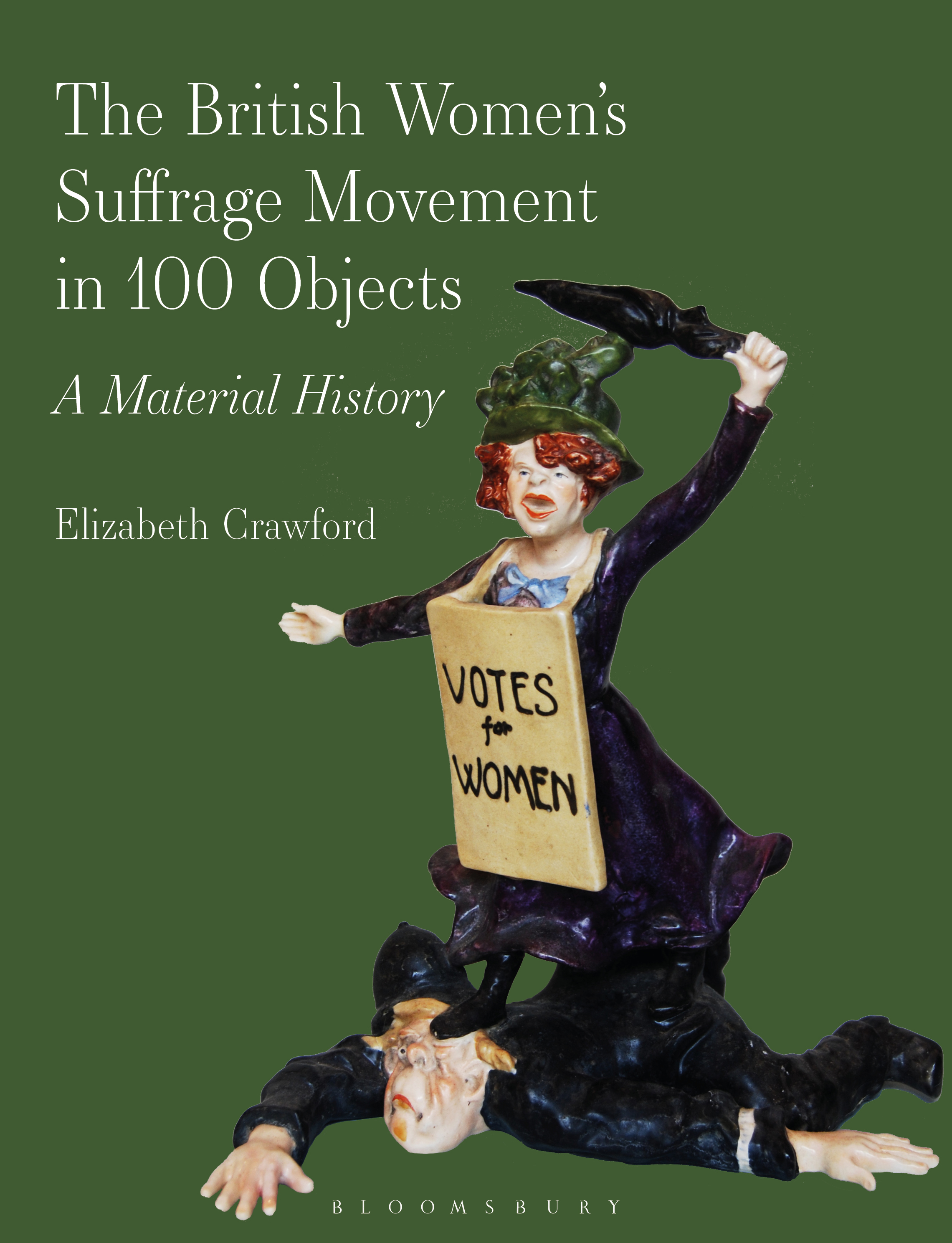


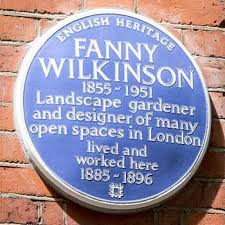





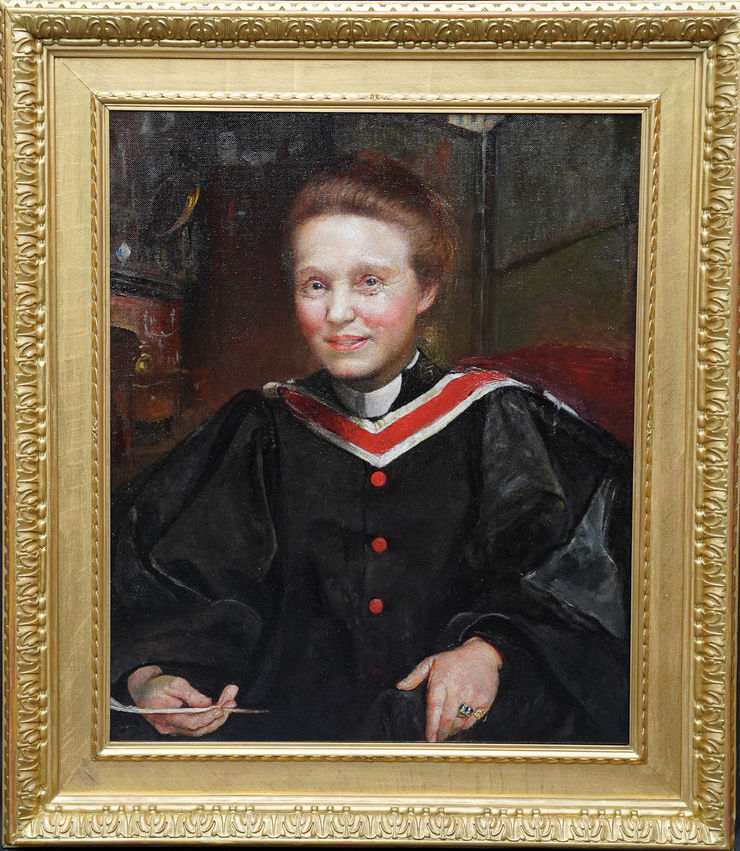


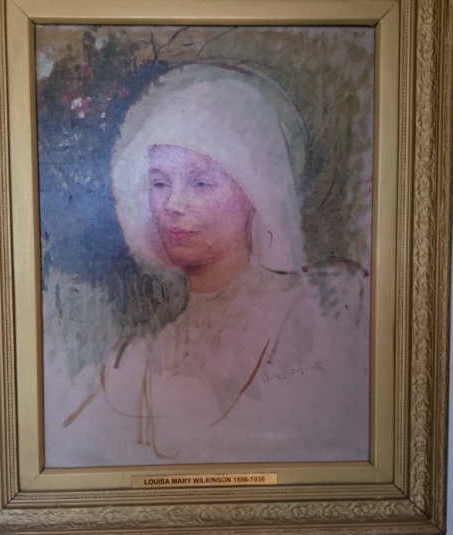


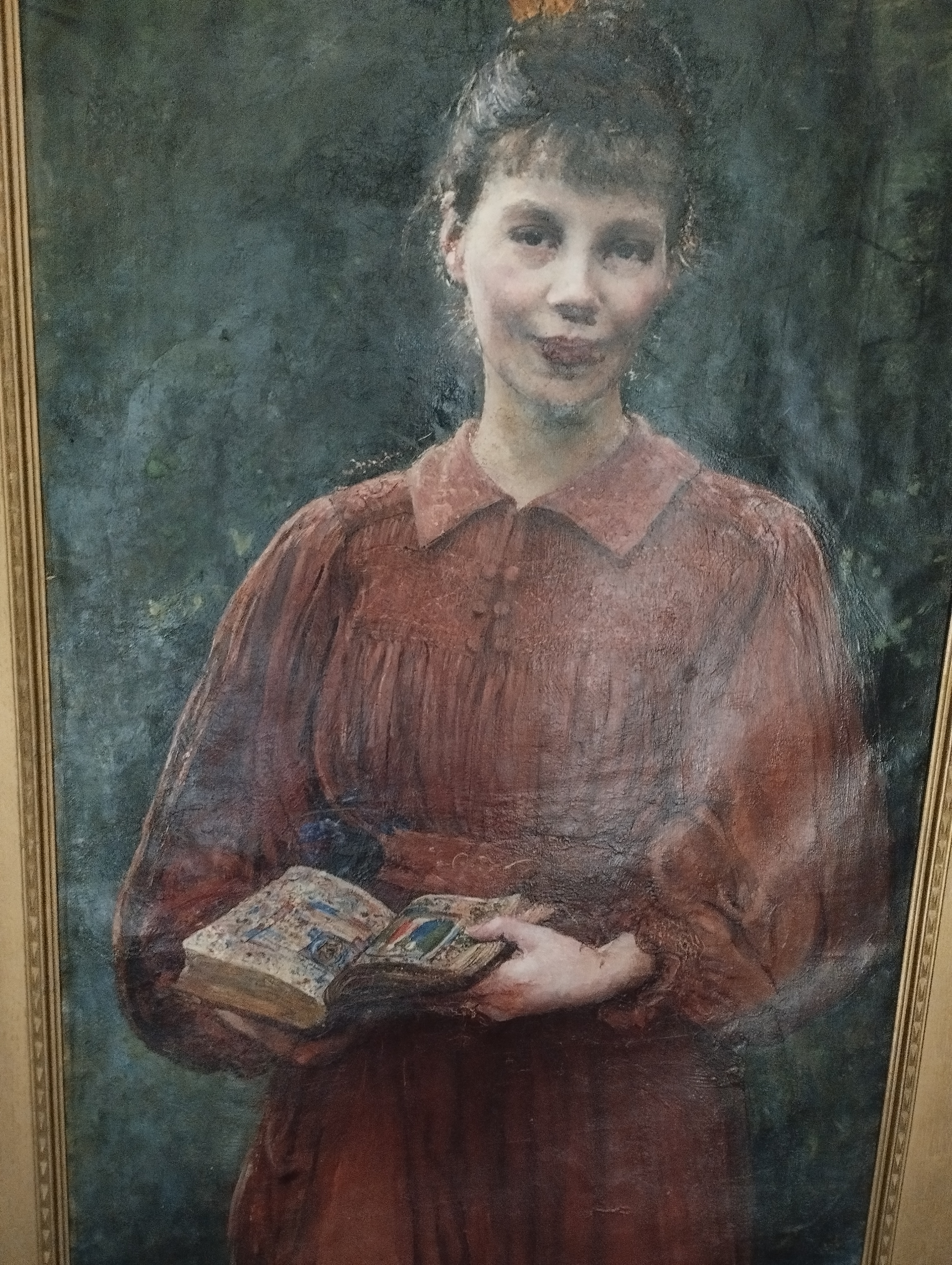
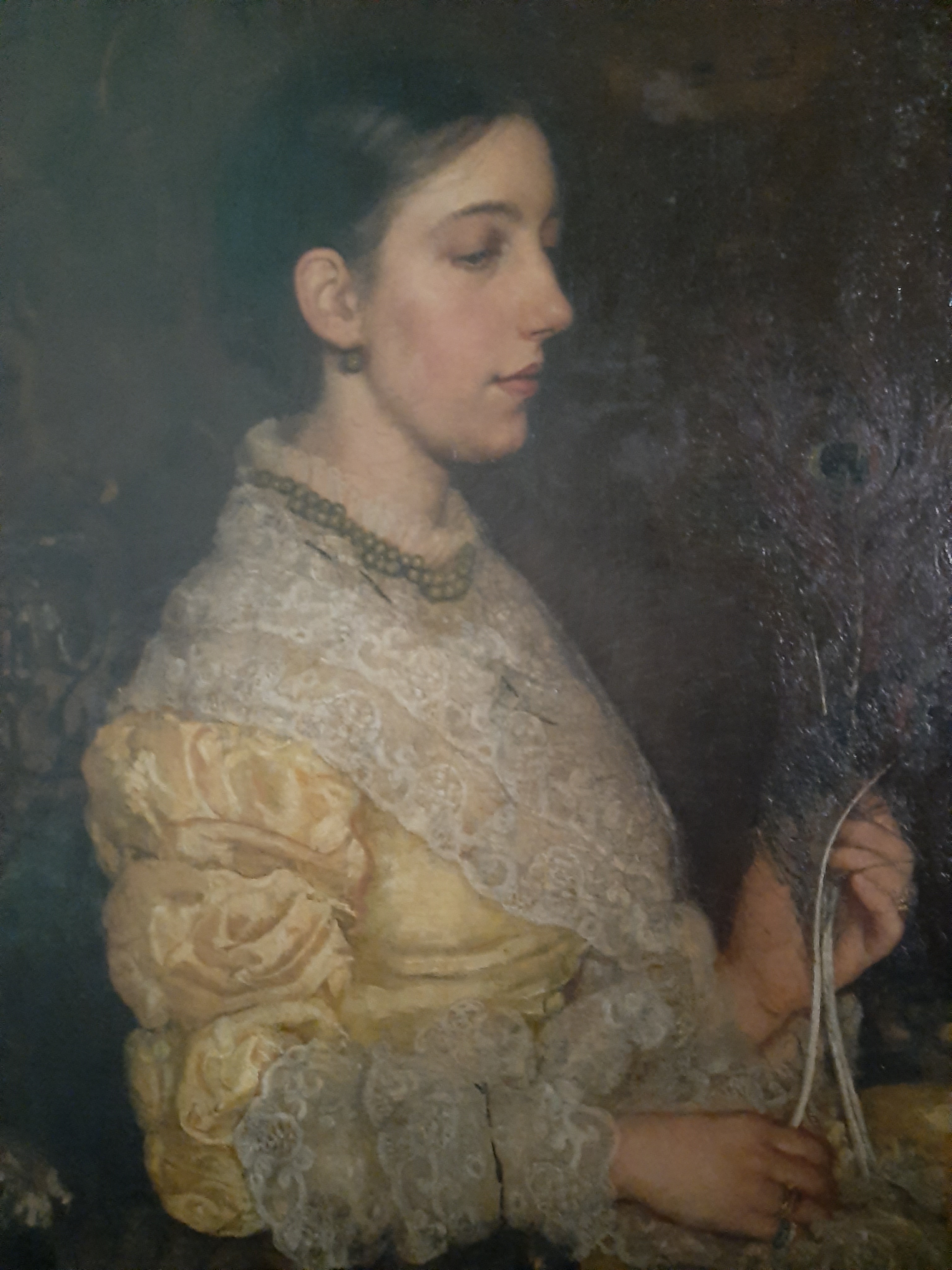


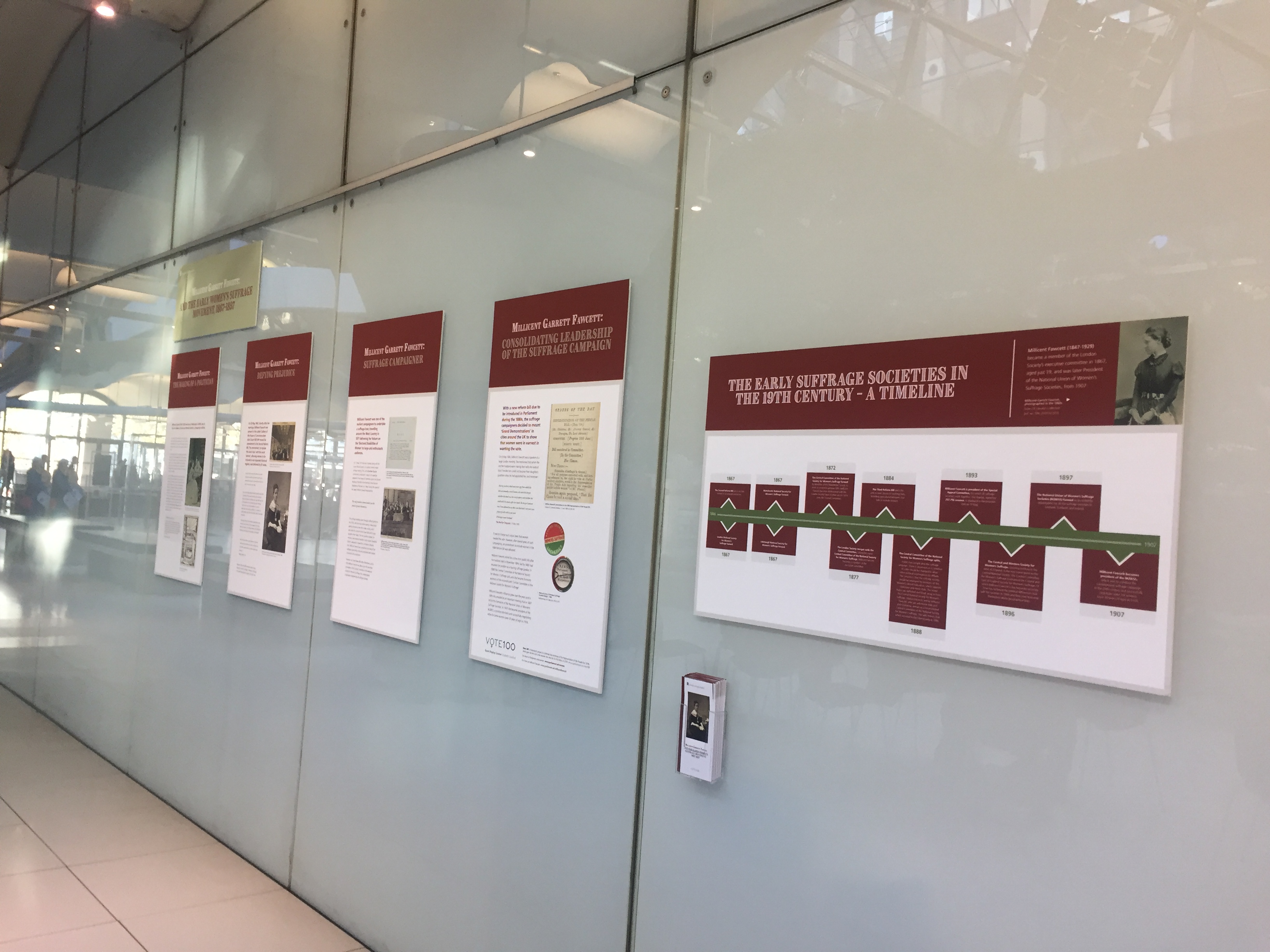
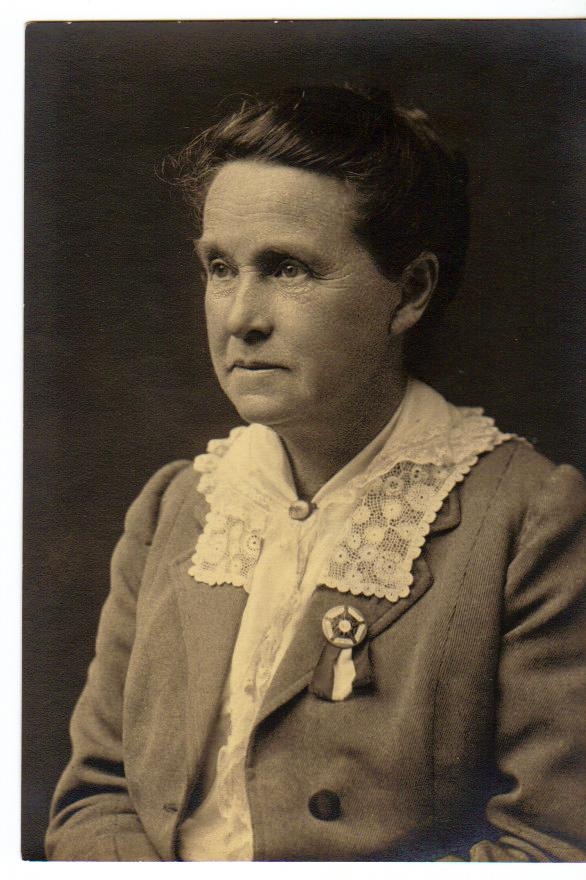
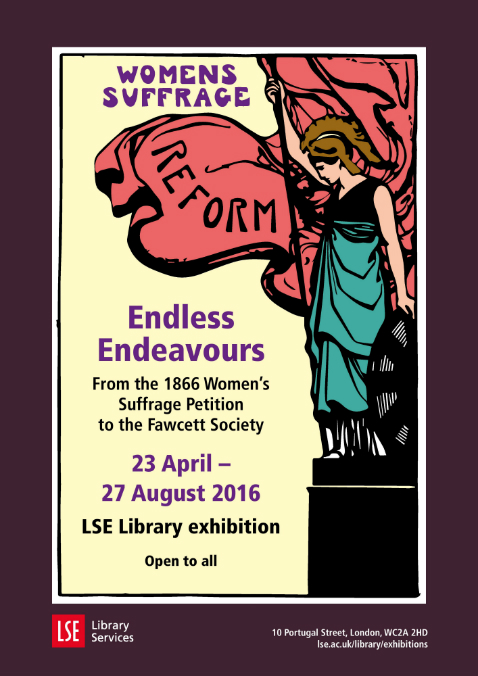
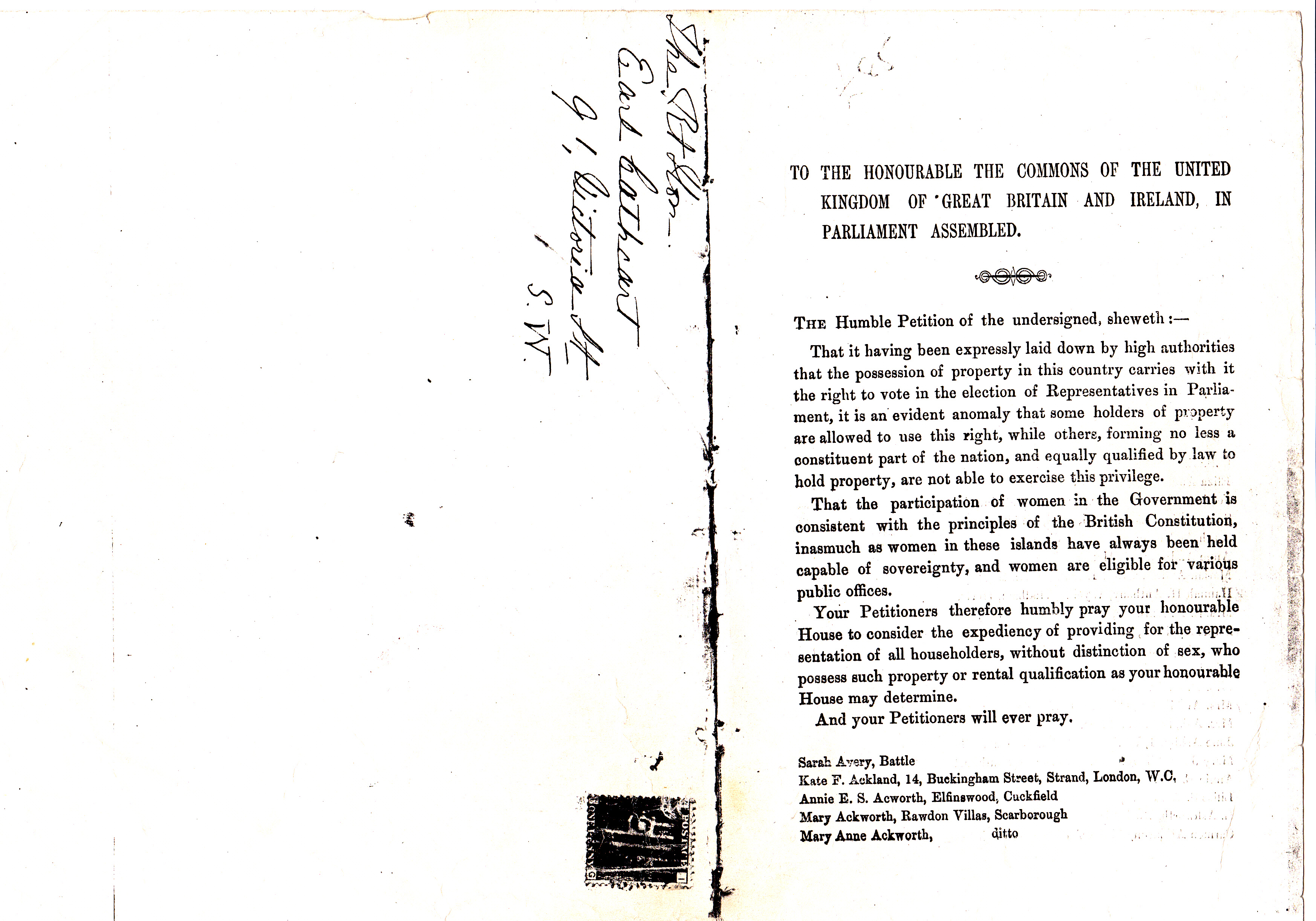


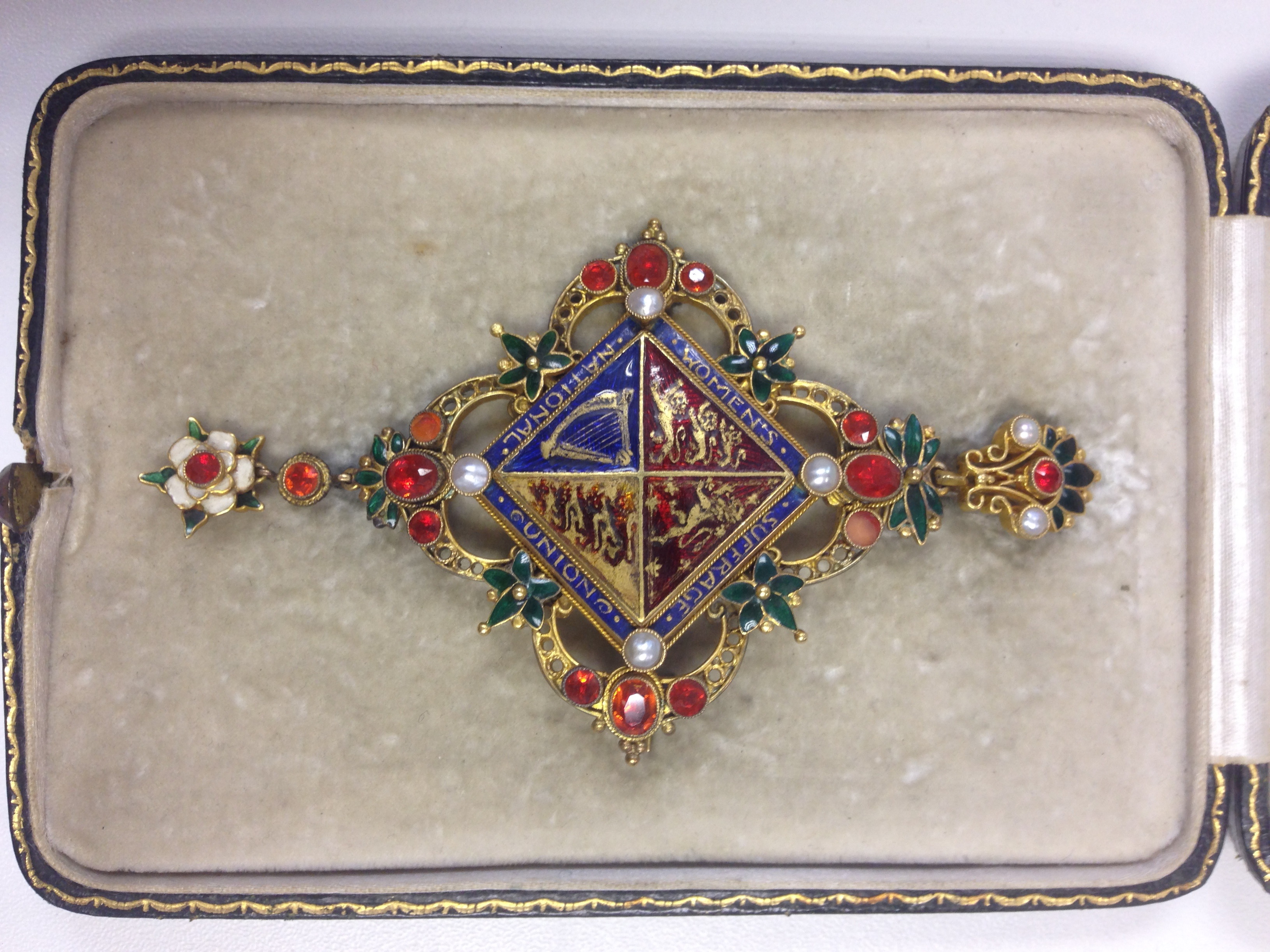
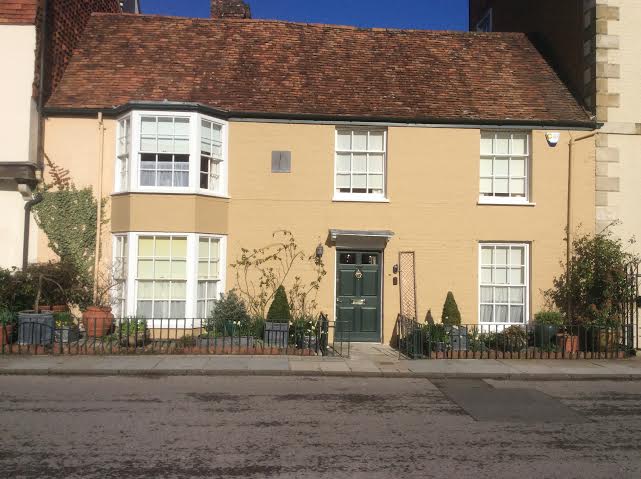
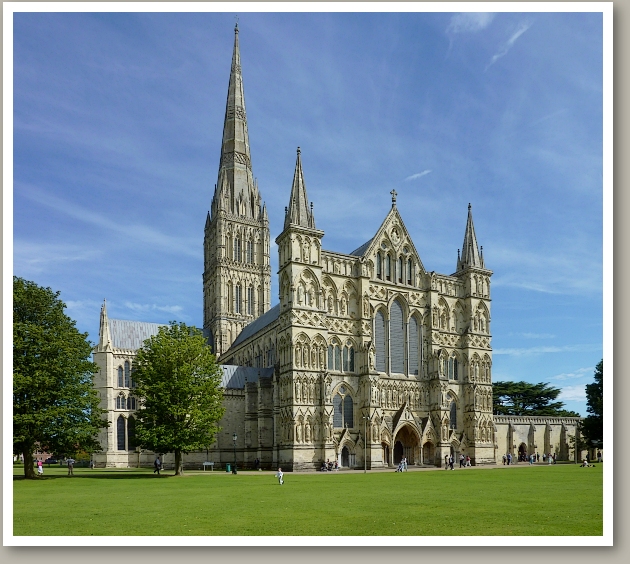
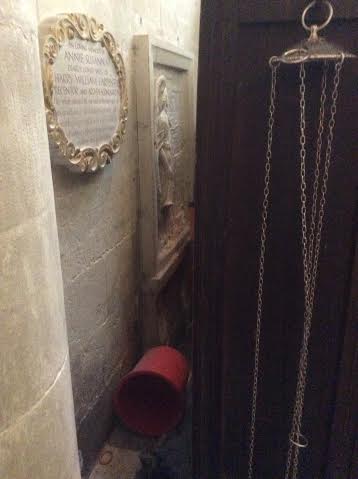
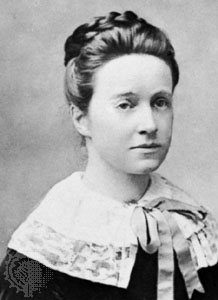

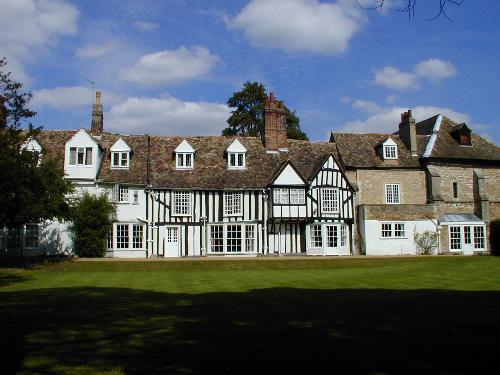


 As a lead-up to publication I thought I’d share with you some entries from Kate’s diary from the month before the outbreak of war. Through her day-to-day experience we can see how the war stole up on one Everywoman.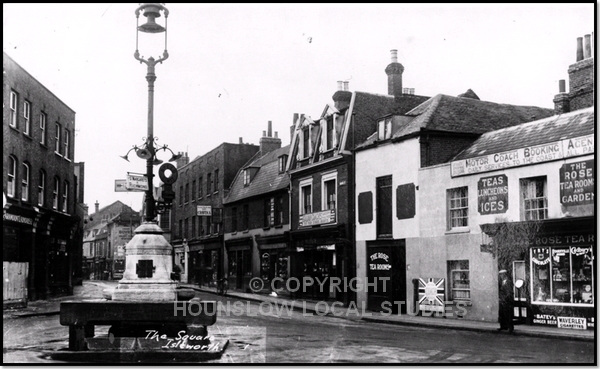

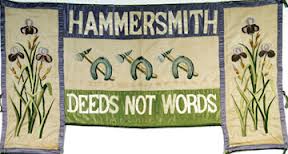


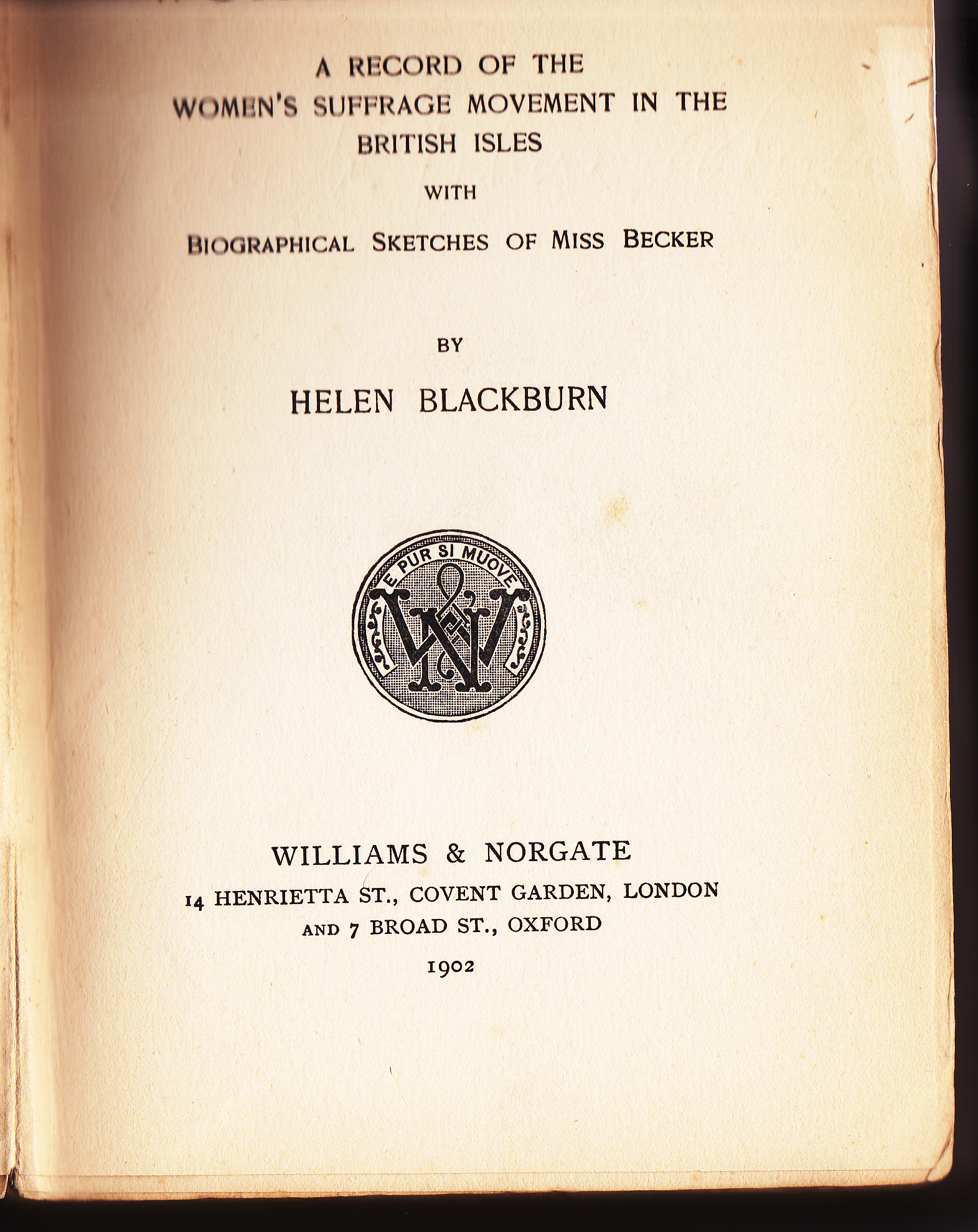




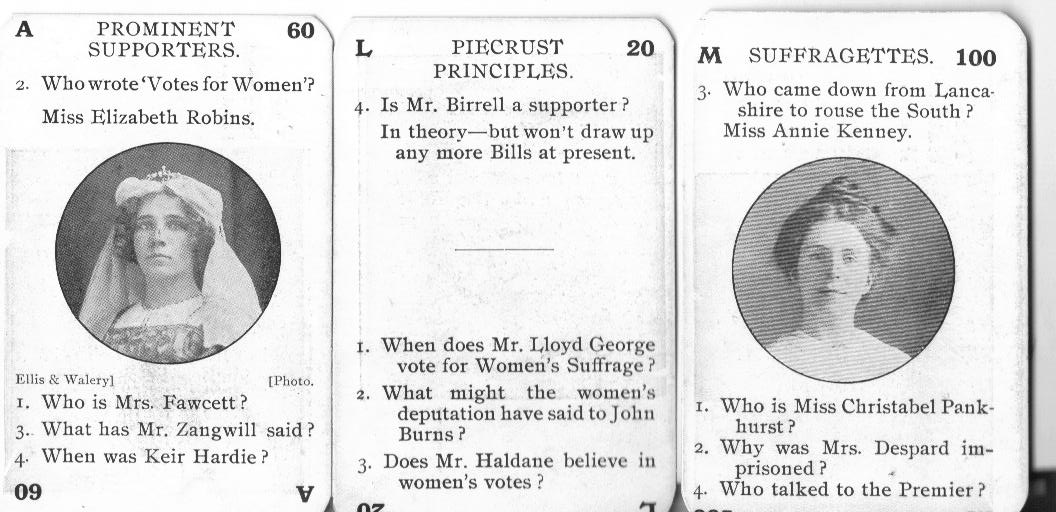


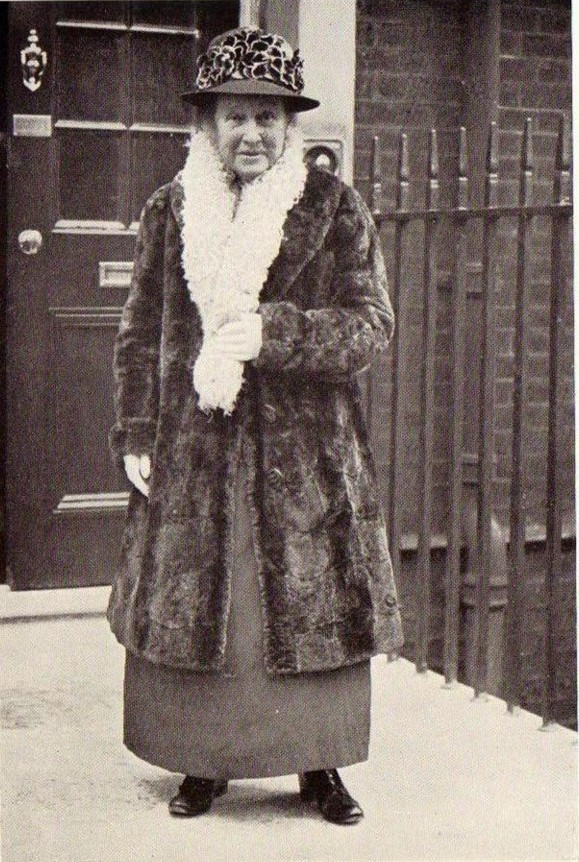
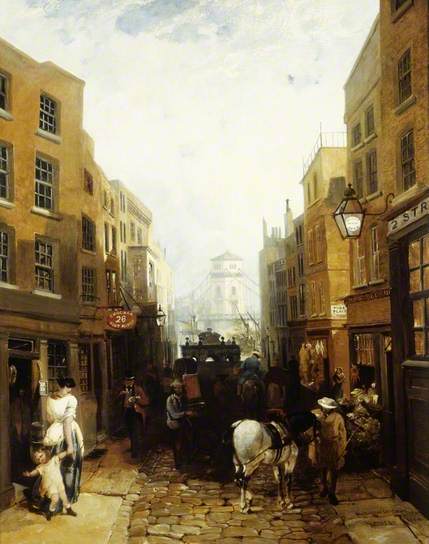
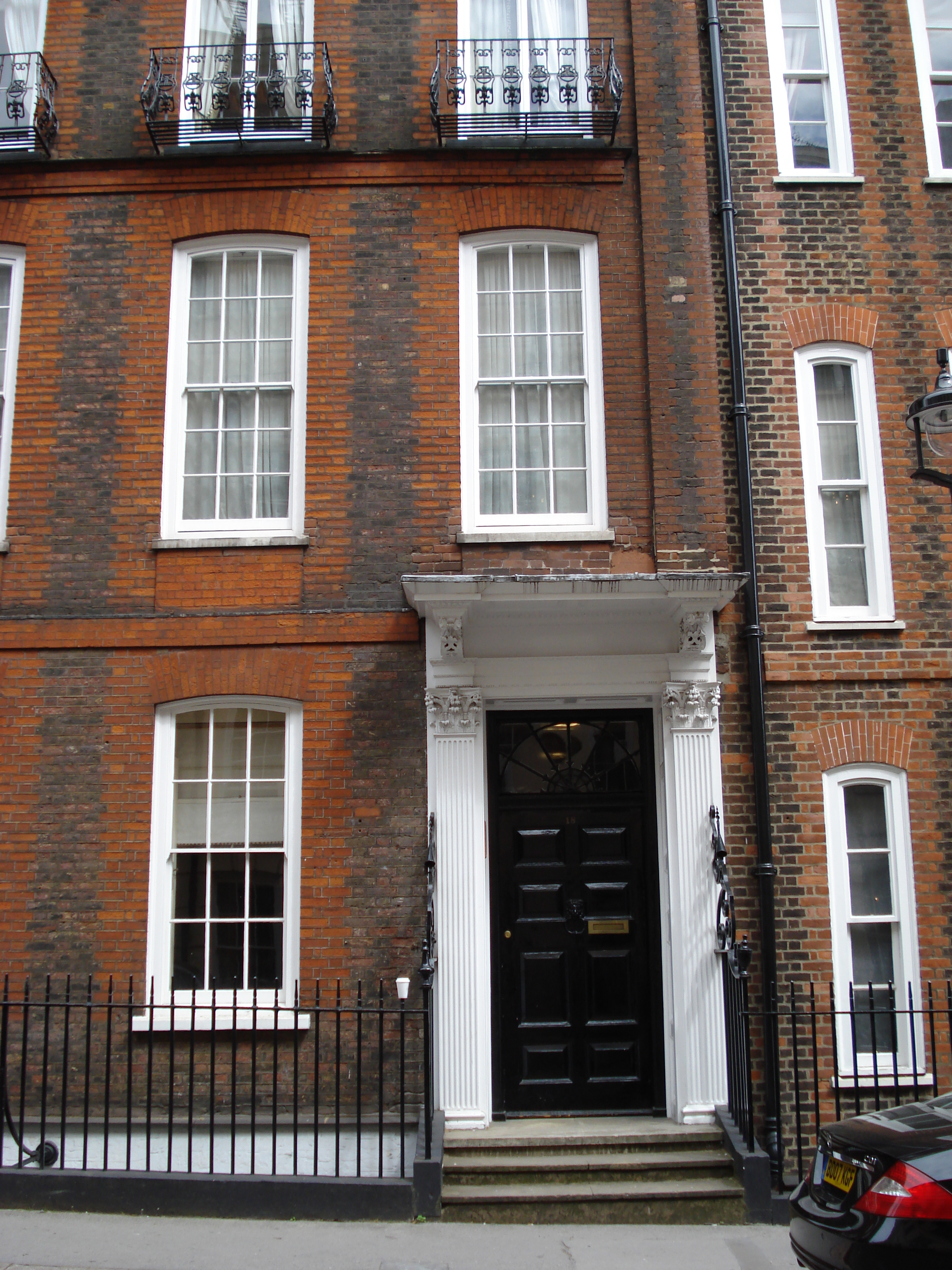
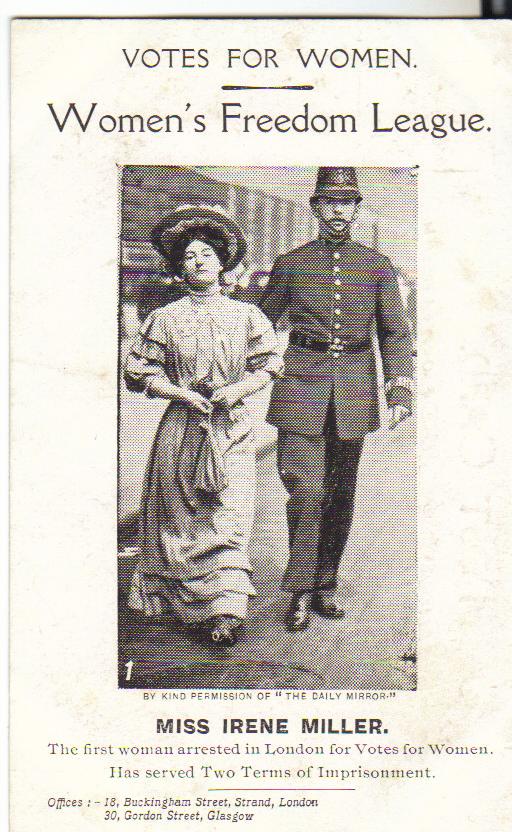

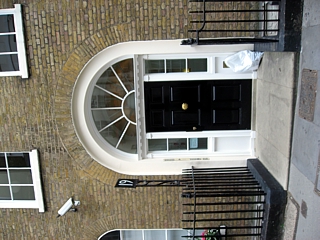


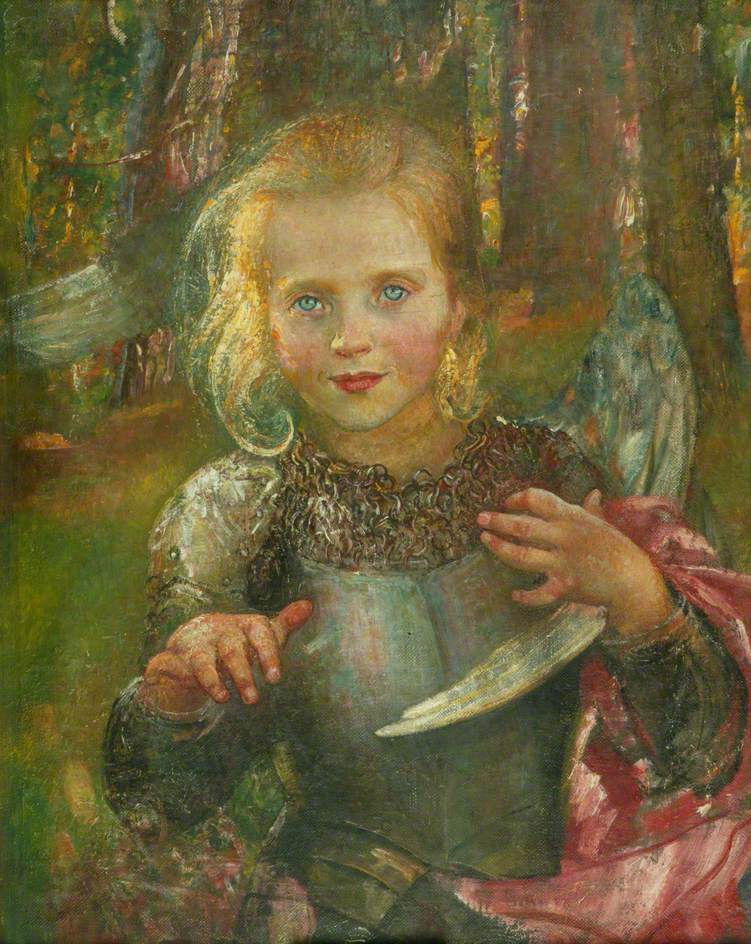
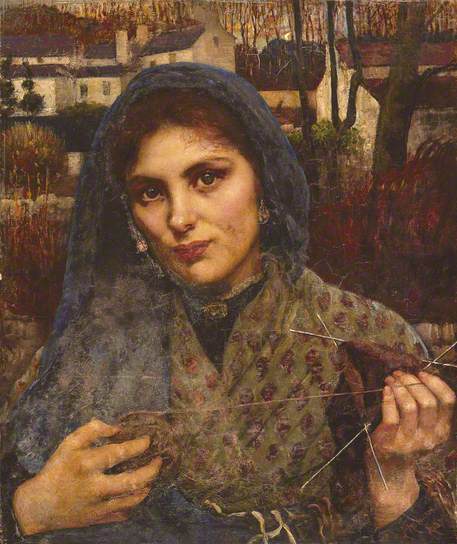

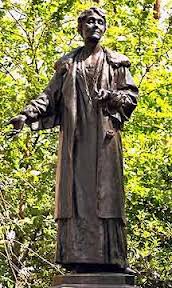

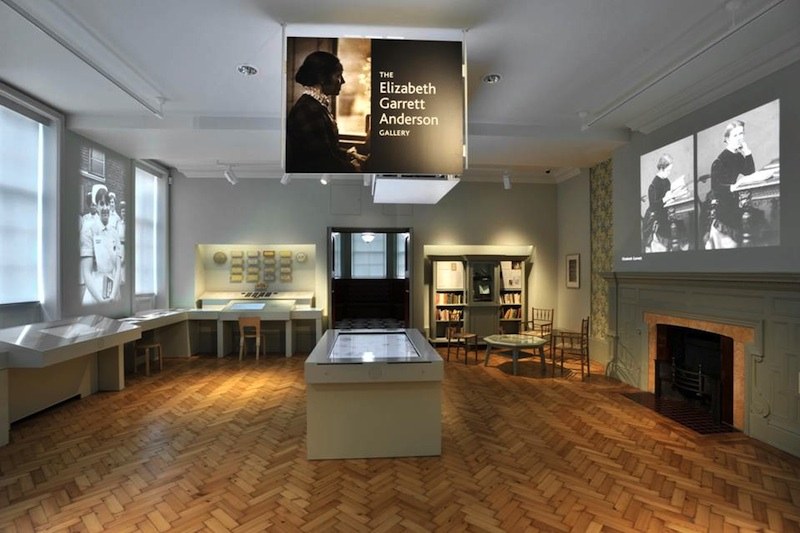

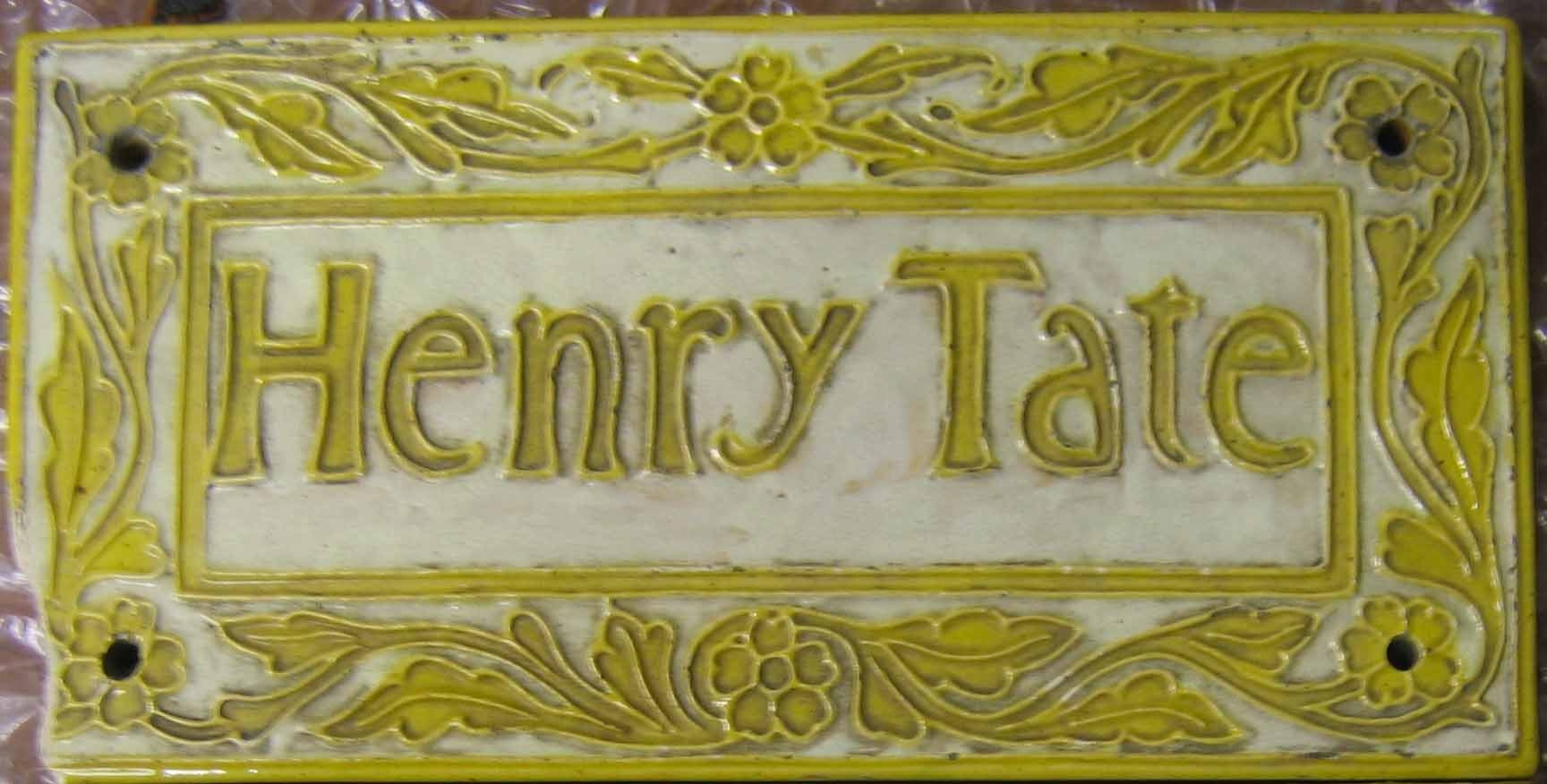

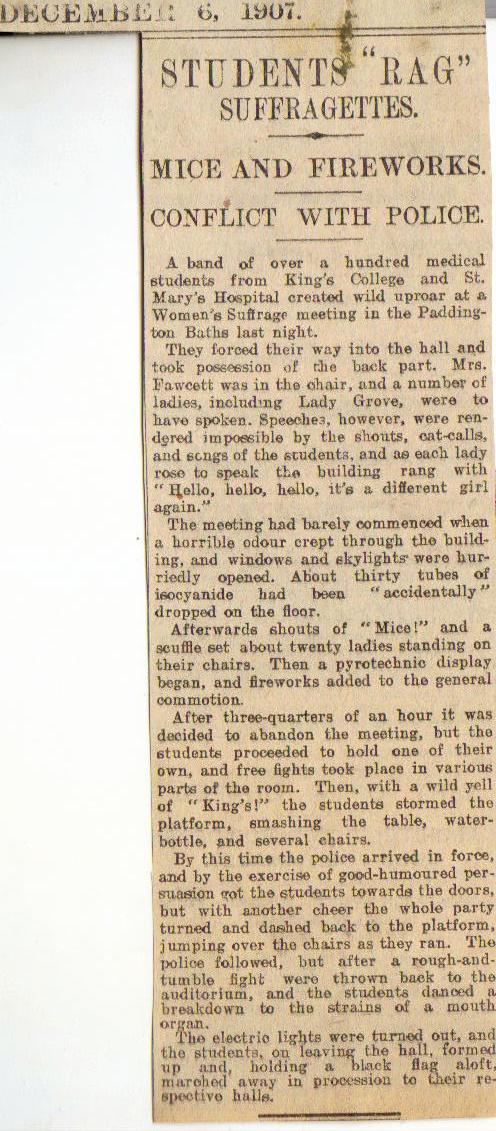

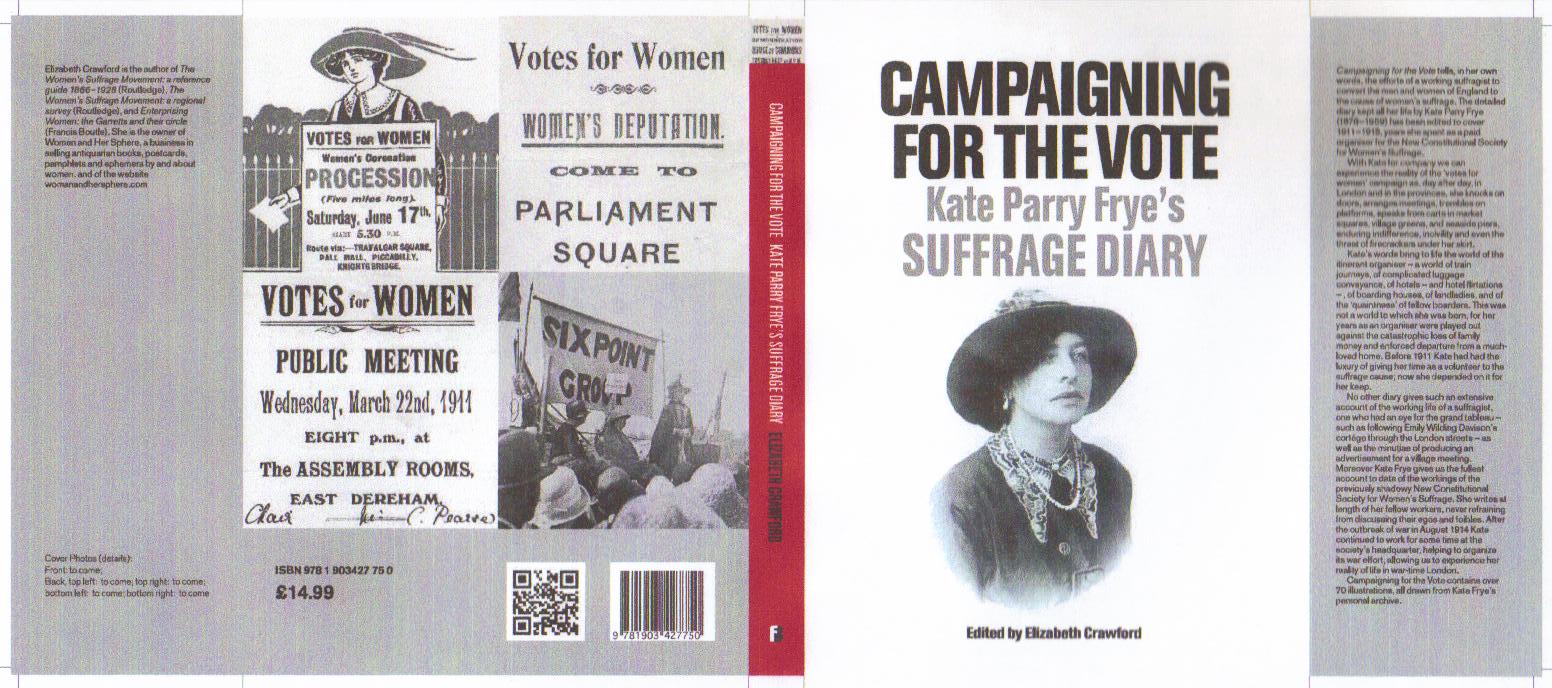

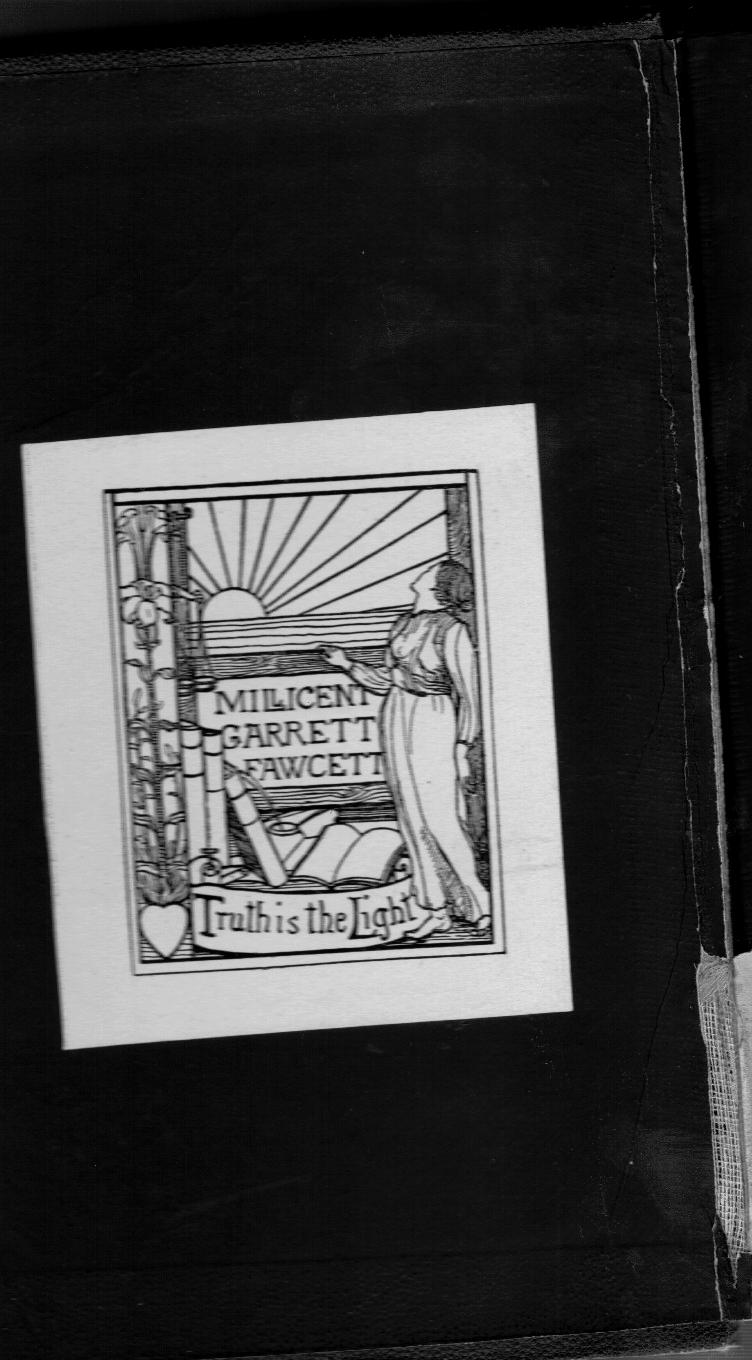
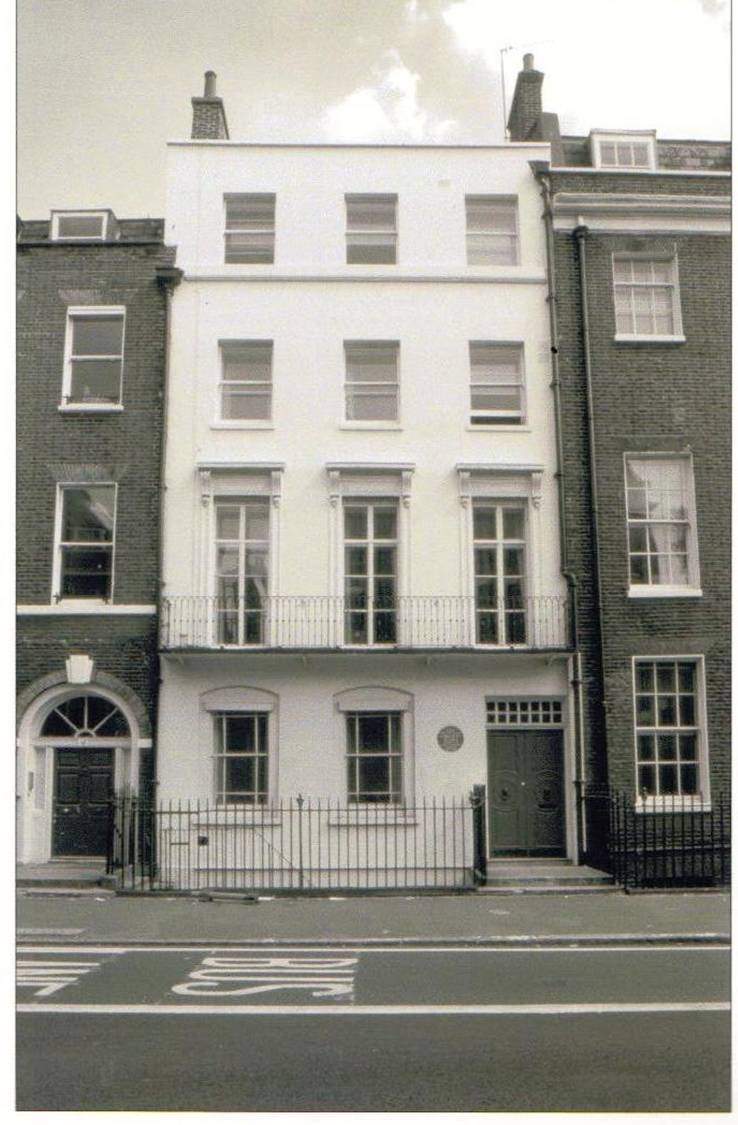
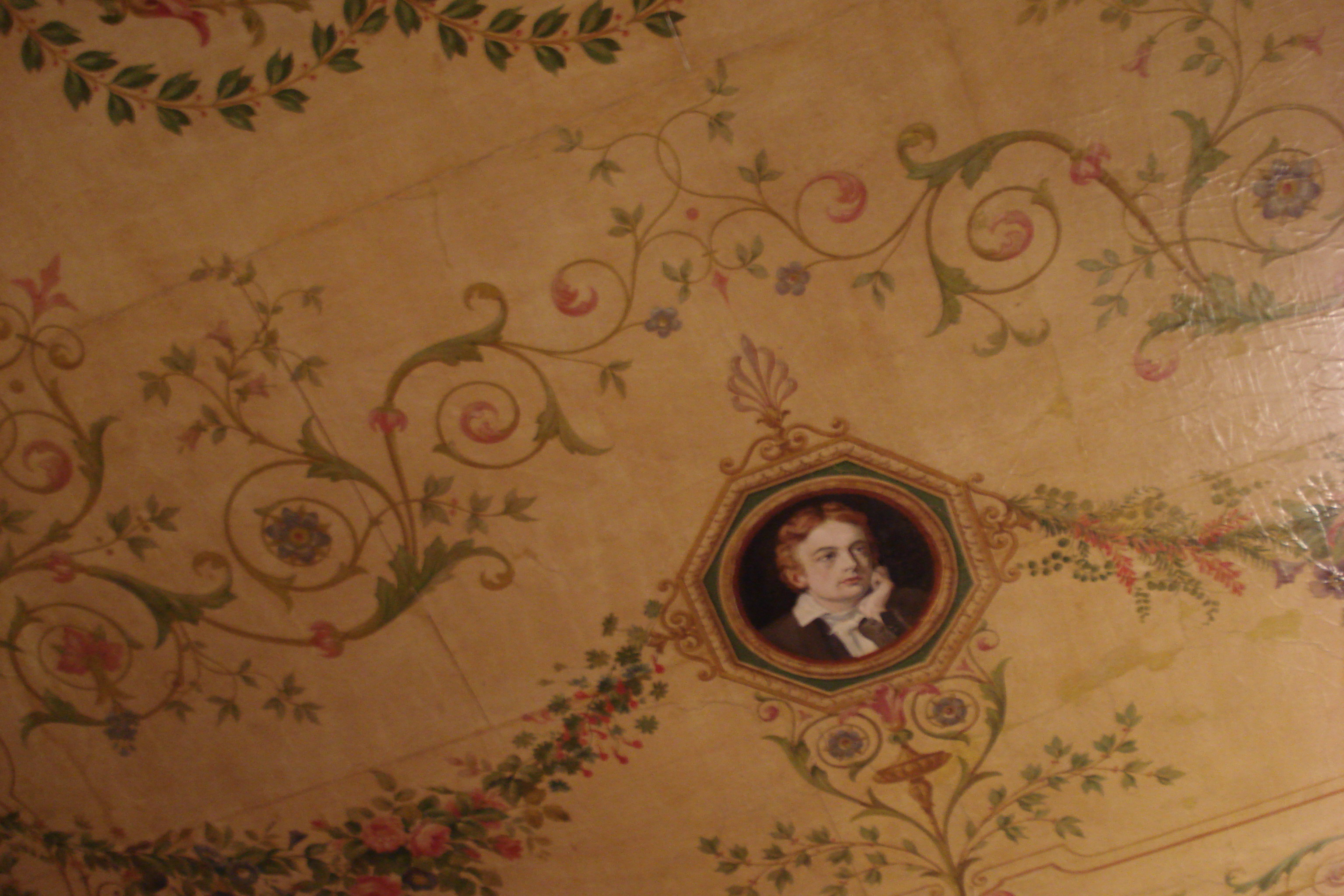
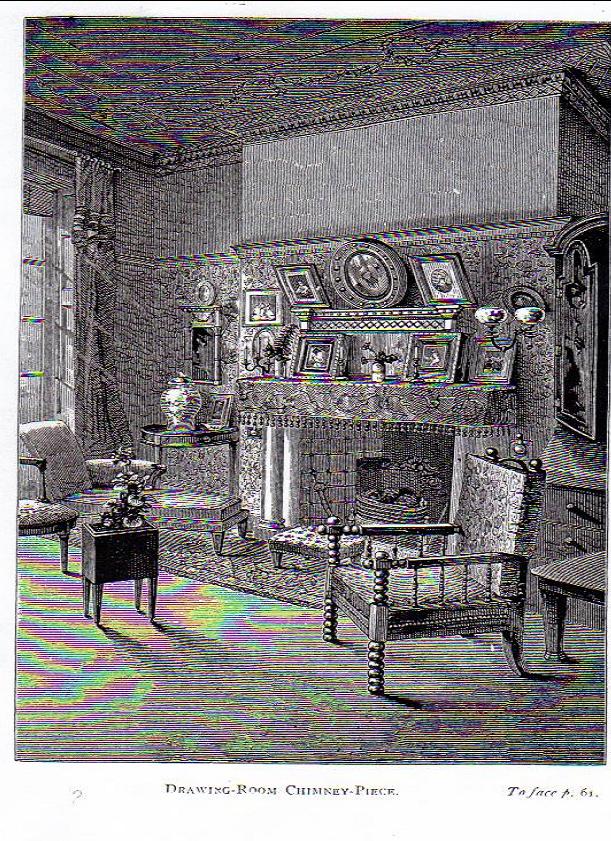
 Woman and her Sphere