Posts Tagged Kate Frye
Kate Frye’s Diary: VE Day 1945
Posted by womanandhersphere in Kate Frye's Diary on May 8, 2020

Kate as writer – at home in Berghers HIll
Kate Frye (or, rather Mrs Kate Collins), one-time actress and suffragist activist – and an excellent diarist – spent the Second World War at her home, ‘Hill Top’, in the tiny hamlet of Berghers Hill, perched on the ridge above Wooburn Green, Buckinghamshire. Even in this remote spot they were not spared bombing.
On 1 September 1940 Kate noted in her diary ‘German planes – hour after hour – that nasty heavy jerky drone.’ 8 September ‘German planes droning over head – terrific search lights – a great red glow over London – flashes of gunfire and bombs. About 3am things seemed to get quieter and I went to sleep. London had its biggest raid from 5am till daylight – fires, killings and maiming and making people homeless. Most of it down by docks and East End.’ 26 September ‘The sirens went about 12 midnight. German planes have been going round and round for an hour and I heard bombs and gunfire in the distance.’
15 October 1940 ‘Had my bath before 9.30. A raid warning. I could not help thinking of the change from a year ago, when no bombs and a warning put one all in a flutter and now I got into a bath and took no notice.’ 16 October 1940 ‘Evening. Germans had been circling and dropping bombs and then three crumps. I thought our end had come. Folks came from next door and John went out with them to put out paraffin incendiary bomb in The Heights garden. One in our garden by the Woodman’s Hut. I started sweeping up glass and nailing up dust sheet to keep rain out.’ Next day ‘I saw the trees down round the bomb crater. The miracle is we are alive and as far as we can tell the house, except for one window, safe. A great deal of damage to the cottages and to the Kennels [this was a large house owned by Kate’s much richer relations, the Gilbey family].
The Woodman’s Hut Theatre was the local entertainment centre, for it was here that Kate and John staged short community plays. One was ‘a war-time German scene which I am at present calling “Heil Hitler” It is really Brenda Gilbey’s plight visiting in Bavaria.’ Kate had not been impressed by Brenda’s discipleship of Hitler. ‘Heil Hitler’ was staged in the Woodman’s Hut Theatre in January 1940, together with ‘Recalled to Life’, a sketch John had carved from A Tale of Two Cities.
The manuscripts for these sketches haven’t survived, but others have, all designed, in one way or other, to raise morale. One, ‘Go To Pot: a sketch of silly people for silly people’, alludes to wartime conditions, such as paper shortages, as well as to local Wooburn places and people. Another, ‘Babes in the Wood with the Blessed Gerard’, was written for performance by the St John’s Ambulance Brigade cadets, Blessed Gerard being the founder of the Knight’s Hospitallers. The manuscript indicates that over a number of performances lines were updated so that, early in the war, gas was cited as Hitler’s secret weapon but, by 1944, that had been changed by hand to read ‘the pilotless aircraft.’
A third sketch, ‘Time Is with Us’, has as its protagonists two wandering masons whom Kate based on the wooden figures on the front of an ancient building that was once Wooburn’s Royal Oak pub. Through these characters she tells a tale of a witch burned at the top of Windsor Hill, which leads up from Wooburn Green to Berghers Hill. That witch had cursed, ‘As I go up in flames – down shall I come one day in flames to punish you. Bombs – Bombs that’s what ‘twill be.’ ‘If any mother son of you shall be alive until that day or any of the kith and kin of you who stand and laugh shall be on Beggars Hill when Bombs are falling down – then woe to them.’
While John manned an Observation Post and ran the local St John’s Ambulance group, Kate entered, of necessity, into the wartime spirit of ‘make-do-and-men’.For instance, before the war they had often eaten rabbit, a cheap meat, bought from the butcher. But during the war John set out to catch rabbits himself. As Kate wrote: ‘It’s really dreadful work and John has had to kill them’. But she was able to spread the largesse so that ‘all around have all had pies.’ She was remarkably stoical in playing her part in the process, writing in her diary ‘John found he’d snared two bunnies. One dead the other he had to kill. However he was awfully good – got the jackets off beautifully and disembowelled them. I then washed them, cut them up and left them to soak. Cold work.’
Finally, after five and a half years of life such as this, came her diary entry for 8 May 1945 – ‘VE Day and it’s All Over. The wireless has been on and it is so wonderful one is not utterly cut off. John at decoration – what we have in stock and bits of wire and string and a great do and the getting ready to hear the Prime Minister at 3 o’clock.’
Later Kate was ‘on Wooburn Common to see John set light to the Bonfire and try and get some bangs going.’
Back at Hill Top, they heard the ‘relay of King’s Speech at 9pm. He got along well – here and there some terrible pauses. Then the news and description of all the seething masses of people cheering and it’s just fine. What we have always looked forward to and knew must happen one day – even in our darkest hour, but that it has happened is just a miracle. Then to light flood lamp and all walk round and admire and the house did look pretty. John has worked on it. Then cocoa and biscuits and more wireless at midnight and afterwards.’
You can read the story of Kate’s life here. It will make good lock-down reading. Kate’s diaries, recounting her experience of the Second World War day by day, are now held in the Archives of Royal Holloway, University of London.
Copyright
Kate Frye’s Diary: The Influenza Pandemic, 1919
Posted by womanandhersphere in Uncategorized on April 3, 2020
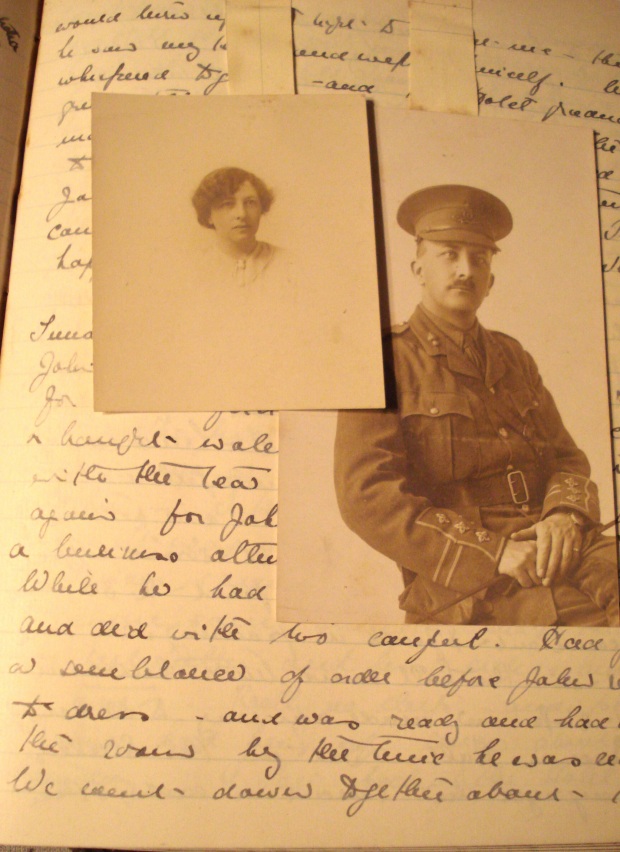
Part of Kate’s diary entry for 9 January 1915, in which she describes her wedding day. It was she who attached the photographs of herself and John.
Kate Frye’s diary, which she kept from the late 1890s until 1958 is very much the diary of a middle-class, albeit impoverished, ‘Everywoman’ of that period. Her experiences, although so particular to her, were shared by millions of others. Thus it was that, in 1919, she had a first-hand encounter with the Influenza – ‘Spanish ‘Flu’ – Pandemic, which, because it could prove quickly lethal, was rightly feared.
John Collins, husband of Kate (nee Frye) had come through the First World War, collecting a Military Cross on the way, and they were about to settle back into civilian life in a small rented flat in Notting Hill when, in February 1919, disaster struck.
On 12 February, to Kate’s horror, John was rushed to hospital – ‘The Prince of Wales Hospital in Marylebone. The old Great Central Hotel where our brief honeymoon was spent.’ The hotel (now the Landmark Hotel, had been taken over in 1916 by the War Office and turned into a military hospital for officers. ‘I had heard the doctor -“Influenza and pneumonia – both lungs”. ‘He is very ill, it is a toss-up if he pulls through.’

The Winter Garden, Great Central Hotel, Marylebone – a postcard kept by Kate all her life as a memento of her one-day honeymoon
So, rather than home-making, Kate’s first days back in London revolved around visits to the hospital.
Thursday 13 February 1919 [London: Notting Hill]
To Hospital 1.45 up to day sister’s room as she had promised the doctor’s report. But she was frightfully cross and rude to me. Sat with John 2 till 4 then was turned out. He looks very bad and is lying propped up by a back rest and in a pneumonia jacket. He is quite sensible but I would not let him talk much. They are frightfully rushed and not enough sisters – 800 patients and many dying of pneumonia.
A ‘pneumonia jacket’ was used to warm the patient’s chest, then one of the few treatments available.
Friday 14 February 1919 [London: Notting Hill]
No one can ever know but those who go through it what these hours of waiting are like and then the Hospital with its inhospitable airs and snubbing attendants. They are bound to answer enquiries concerning the ‘serious’ cases but that is as much as they will do. I stayed until I was driven away. He hates me to go and to leave him like that was so distressing.
Anecdotally, the hospital was not a happy place and, following the ‘flu outbreak, complaints were made in Parliament that patients with flu were being nursed in the same rooms as those recovering from wounds, thus causing a serious possibility of the infection spreading.
John remained in this Marylebone hospital for a month and then, having more or less recovered, was sent to a military convalescent home in Bournemouth. It was housed in the former Mont Dore Hotel (now Bournemouth Town Hall). Kate followed him, staying in digs.
Saturday 12 April 1919 [Bournemouth]
John had been before a Board and been granted 3 weeks sick leave, so that is alright – he is due to leave the Mont Dore today but can arrange to stay until Monday.
Monday 14 April 1919 [London: 12a Colville Terrace]
[Back to London flat] It is very wonderful to be home in our dear little flat and with John practically well again.
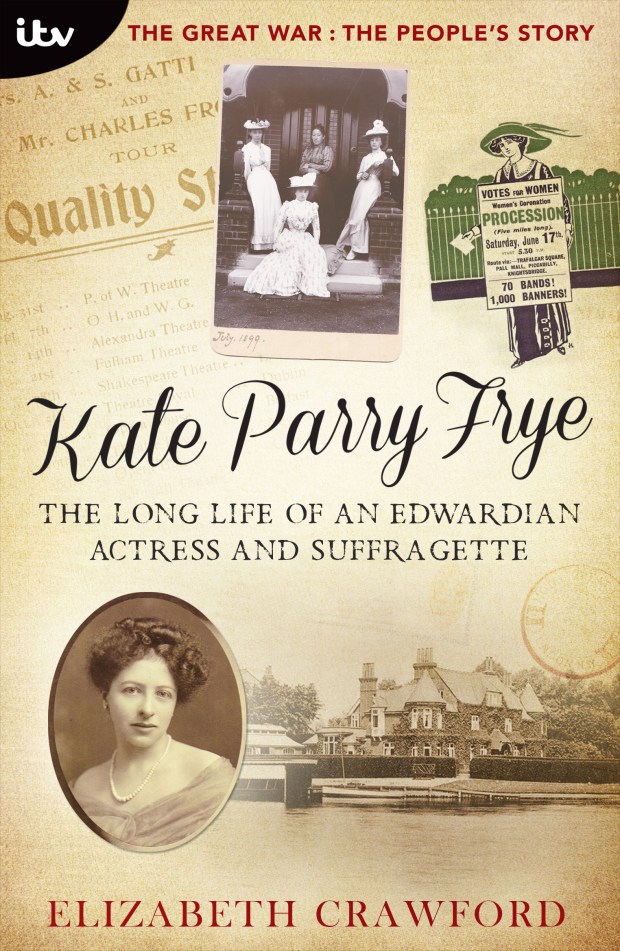
Kate’s diary is now housed in the Archives of Royal Holloway College, University of London. I only transcribed a few of the Influenza entries when writing her biography – Kate Frye: the long life of an Edwardian Actress and Suffragette – published as an ebook by ITV – see https://tinyurl.com/qn7rhxq. More useful information can be found in the diary if anyone is writing a study of the Post World War One influenza pandemic.
Copyright
Kate Frye’s Diary: Armistice Day 1918
Posted by womanandhersphere in First World War, Kate Frye's Diary on November 11, 2018
Kate Frye had worked as an organiser for the New Constitutional Society for Women’s Suffrage from 1911 until the summer of 1915. In January 1915 she had married her long-time fiancé, John Collins, an actor who had for many years been a member of the Territorial Army. Now an officer, John was stationed at Shoeburyness with the Essex and Suffolk Royal Garrison Artillery until shipping out for France in December 1916. He spent the next two years on the Western Front and in June 1917 was awarded the Military Cross. His letters home to Kate are held by the Imperial War Museum.
One of the pages from her diary in which Kate describes her wedding day. It was she who attached the photographs of herself and John
Letter from John 1 Nov 1918
Dearest
So it is all over or practically so I wonder what happens next. Please to look for a flat for us duckie. I am longing now to get home to my dear one for good. Oh, won’t it be lovely.
It is a very wet day and I have been running about all day expecting anything but I don’t think we shall ever move again except to go home. There is practically no great excitement here over this morning’s news. Everyone seems to take as a matter of course. It feels just like the end of a term at School where one does not quite know the time the train goes home or how to employ ones time until that is known. It is a most peculiar feeling. I expect the feeling will suddenly burst out however. I wonder how the people at home are taking it. Oh dear Muzz you don’t know how lovely it is to think I shall soon be home with you. It is almost unthinkable after all these years but it’s going to come true after all. I am quite well and safe and fancy I have heard the last shell burst that I shall ever hear. I am now thinking of getting up some of the plays and a concert. What about my mustache – shall I take it off yet, or when I get home? There used to be a German Captain in this house. He was in charge of a German Dog School and he had an English wife who was here with him. The old party who owns the house says that his wife hated the Germans much more than the Belgians did. They left one Doberman behind a great big wolf dog not a bad party but a bit wild. Well dearest there is no more news except that I do love you ever so much.
Fondest love
John
On the day the War ended Kate was at home in her cottage at Berghers Hill in Buckinghamshire and wrote in her diary:
Monday November 11th 1918 [Berghers Hill]
I was thinking and wondering every inch of the morning, and could not settle to anything. Was cleaning a collection of shoes about 11.30 in my room, the windows were open – I sat up and listened. Boom-Boom-Boom – then a Hooter and then I thought it time to bestir myself and went in to Agnes then downstairs to Kathleen [the daily maid] and out to listen to the various sounds proclaiming that the Armistice has been signed. And thank God for our many and great mercies. Mother was down the hill and had called at the Manor House – the news was all over the green and soon up here – and the remarks of the hill were marvellous. As soon as I could settle to anything I sat me down and wrote to John. Is he safe, and will he really be spared to come home to me? [She eventually manages to buy a copy of the Daily Telegraph] ‘Yes, the glorious news, as announced ‘Surrender of Germany’ Armistice signed at 5 a.m. Cease fire at 11 a.m. The D.T. has news of Abdication of the Kaiser and Crown Prince, and flight to Holland. The whole of Germany is seething with revolution. It seems as if it will be a second Russia.
Sunday November 17th 1918 [Berghers Hill]
A fine day, though cold. Woke up at 7 and went off to Church as a beginning to my day of Thanksgiving. I did wish I could have had a letter from John but I tried to give a whole hearted thanksgiving for our many and great mercies….[After Church] When I got in the Postie has just been bringing me a letter from John, written on the 11th. Oh I was thankful and feel indeed to have a grateful heart. He is safe and well and of course very very pleased and looking forward to coming home. [In afternoon] Mother, Agnes and I off to the special service of Thanksgiving at 3 o’clock. The Church was just packed, every one there including Sir John and Lady Thomas. Such singing and the reading of that wonderful and extraordinary lesson from Isaiah – a nice sermon from the Vicar and the singing by him more or less of ‘Land of Hope and Glory’.
Kate wrote many plays during her lifetime but the only one published, Cease Fire!, was set at the Front, in a cellar of a ruined house ‘Somewhere in France’, during the final hour before the Armistice was declared. One of the main protagonists is clearly based on John, the character’s military career following the same somewhat idiosyncratic pattern as had his, his deep love for his wife driving the plot. Published by Samuel French in 1921, ‘Cease Fire!’ reads very well today.
You can read more about Kate – and John – in Campaigning for the Vote: Kate Parry Frye’s Suffrage Diary and Kate Parry Frye: The Long Life of an Edwardian Actress and Suffragette. Both books are drawn from Kate’s voluminous diary, now held by the archives of Royal Holloway College
Suffrage Stories: Kate Frye On BBC Three Counties Radio
Posted by womanandhersphere in Kate Frye's Diary, Suffrage Stories on May 8, 2018
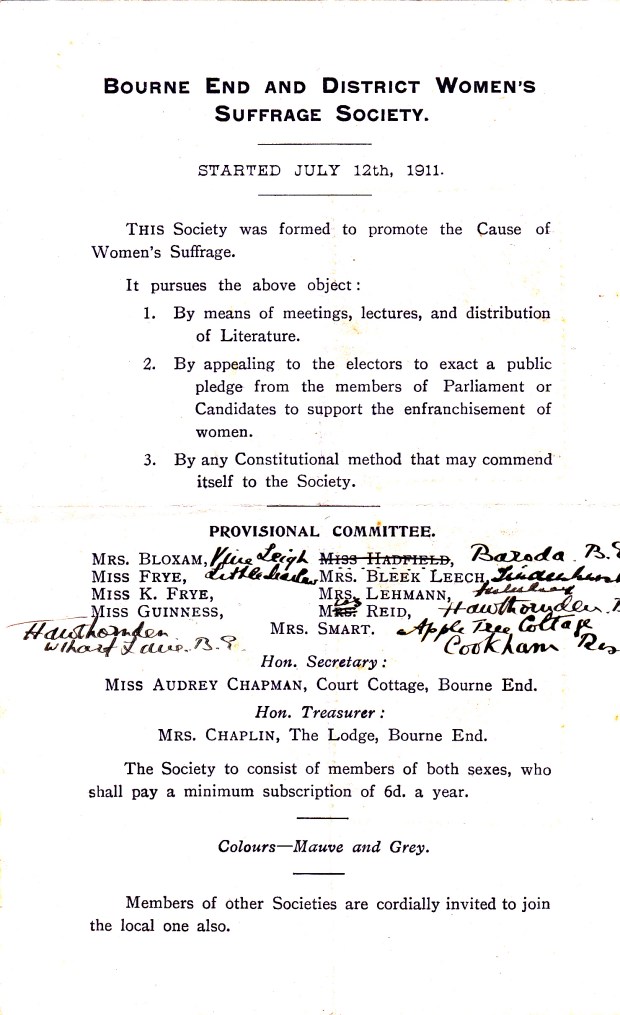
BBC Three Counties Radio have broadcast an hour-long programme about the suffrage campaign – suffragist and suffragette – in the area that they cover. Kate Frye, who lived at Bourne End, was selected as Buckinghamshire’s representative – and the programme includes several quotations from her diaries.
You can listen to the programme here
And read all about Kate –
Kate Frye’s Suffrage Diary: Rousing Rye
Posted by womanandhersphere in Kate Frye's suffrage diary on July 21, 2016
Although I am no longer the guardian of Kate’s diaries, I am still able walk in her footsteps. The hottest day of the year earlier this week found me in Rye in Sussex. I was recovering from a short, sharp illness but the overnight visit had been booked ages ago and I really didn’t want to forfeit the outing. However, rather than wafting around Rye as I had envisaged, I managed only to place myself for a brief moment outside the digs in which Kate Frye had stayed in April 1911 and take in the scene before retiring to enjoy a lady-like recline.
Kate had been sent by the New Constitutional Society for Women’s Suffrage to rouse Rye to the Cause. She had booked two rooms in the digs – the other was for one of the NCSWS ‘s founders – and Kate’s ‘sort-of’ friend – Alexandra Wright.
Their landlady was a widow, Mrs Jane Harvey, who lived in the house with her 23-year-old daughter, Lilian, who worked as a clerk.
Like the Rev Llewellyn Smith we were staying at the Mermaid Inn. I doubt it has changed much since Kate escorted him there 105 years ago. If you have a feel for these things – that time is only a thin layer – you might sense the Rye of Kate Frye merging with that of Mapp and Lucia.
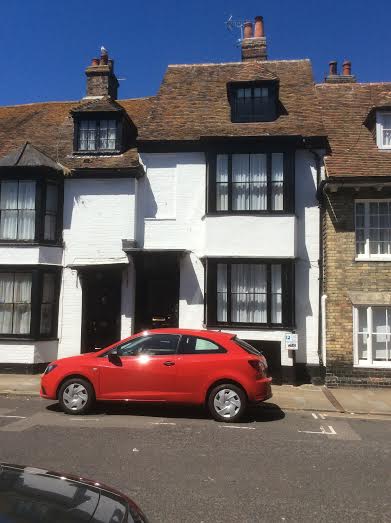
13 Market Street Rye (there is always a car in the foreground of this type of pic nowadays)
Wednesday April 19th 1911
Did not stop before Ashford and changed there for Rye. Got a porter to bring up my Trunk and walked to Mrs Harvey, 13 Market St. What will happen to me with such a number?
Real lodgings – but nice and clean and two nice large bed-rooms – much larger than the sitting-rooms. I went out for a few minutes stroll – came in about 7. Unpacked my bag – had supper at 7.30 – then my box and arrived so I went up and unpacked that – then wrote letters & diary till 10 o’clock. Felt rather tired – and very on Tour – the Sunday night feeling in a strange town being intensified by the Church Bells being practised.
[The last comment harks back to Kate’s days as an actress – on tour].
Thursday April 20th 1911
Up in good time to breakfast – wrote a little then out the shops – and then back to fetch Bills, which had been sent in last night – and to start my canvassing. Did all up and down the High St and Mint as a beginning. Didn’t feel very impressed with my work but suppose it is alright. In to lunch at 1 – then at 2.30 out to Playden where I had some addresses and found a lot more. It was a good way so I stuck to that district. No real success – so many people out. In to tea at 5.30.
A little more Bill distributing – then to the station to meet Alexandra, who arrived at 6.30. We walked straight up and a man came up with the box. She unpacked and we chatted. Had dinner at 7.30. Talked till 11 o’clock, then to bed. A lovely day.
Friday April 21st 1911
Breakfast at 8.30 – a little writing then Alexandra and I went out to the shops and bought lunch. She came in to do some writing for the rest of the morning and I went paying calls. Met with some success. Got in the Nonconformist set and kept on till 1 o’clock. Alexandra went out again from 2.30 till 3.30 – then came back and a Miss Harris, Winchelsea, and Miss Spalding, the nurse, here came to tea. Out at 5.30 till 7 again – more calls. A lot of people out but we got hold of the Vicar who promised to come. It was very windy all day and rather cold but the view was nice.
[Miss Margaret Spalding was the district nurse, who lived at Church Cottage. She joined the NCSWS.]
Saturday April 22nd 1911
A glorious day – really beautiful. Breakfast 8.30. Some writing – then I went out. Did the marketing – some canvassing – set Alexandra’s feet in the right direction for Playden and continued my canvassing unto past 1.
Came in very tired. Alexandra did not get in till past 1.30. At 3.30, having changed, we went out on business to station & Hotel etc – then tea at a Mrs Clements and her two daughters at 4.30. 4 other ladies were there to meet us. It was rather appalling – but I think I was given a gift. More calls after shopping. Tea at 7. Supper. Talk & writing.
[Mrs Elizabeth Clements, 56 year old widow of a leading Rye estate agent and valuer . One daughter, Katherine (Kitty), was a teacher of music. They lived at 6 High Street.]
Monday April 24th 1911
Alexandra had some writing to do – so I did the shopping and then more calls all the morning about town. After lunch, to Playden more calls, more success, and one fearful & furious Anti. It was a lovely day. A few more calls after tea with Alexandra and bearded one very notorious lady but found her quite nice. Then to tidy ourselves and to have our supper. More letters afterwards. Met and had a long chat with Miss Spalding
Tuesday April 25th 1911
Another nice day. To the shops in the morning and then canvassing again. But we are getting to the end of our list, and I really had to slack in a bit. I began to feel very tired – yesterday I was at it all day long. So after lunch I did not go out but had all the Literature to see to.
In the evening Alexandra and I went out together. A few successful calls – especially good with the school master. I think Alexandra converted him. Both awfully tired but in to change to go and have supper with Miss Spalding. There was another lady there. We talked all ‘Suffrage’ and came away at 10 – a little warm over our fire and then to bed.
Wednesday April 26th 1911
Alexandra was very nervous all the evening as to the result of the meeting but I felt sure it would be alright. Showers in the morning but the day was fine. Alexandra & I went out, bought dinner, paid Bills etc and did some jobs. After lunch Alexandra lay down on her bed and went to sleep and I did some of my packing up etc.
To the Hall at 4 o’clock to get it settled to our taste – a long job – to put out Literature etc. Back at 5.30. Miss Ogston had arrived and we began on the arrangements. She had had some tea – so we had ours – an egg. Then to change – leaving Miss Ogston to have some dinner at 7. Alexandra and I went to meet the Rev Llewellyn-Smith at 6.30 and take him to the Mermaid Inn. A chubby, cheerful young clergyman who seemed quite ridiculous when he spoke, as he constantly did, of ‘my wife’.
Leaving him to dine, we went on to the hall soon after 7. A Mrs Harrison and a Miss Mac Munn had arrived from Hastings so Alexandra took them back to Market St to have a rest – while I waited. [I] received the Stewards – two Miss Harrisons of Winchelsea, Miss Spalding and Miss Clements. They sold Literature and the Misses Harrison and I took the collection – £1-3-7. Lady Brassey took the Chair and her daughter came with her in a lovely car – they had to drive 50 miles so it was awfully decent of her, but she is very keen. A Lieut Col A Savile came to assist Lady Brassey take the Chair and spoke after her. Then Miss Ogston – then Mr Smith.
I didn’t hear the speeches as I was outside with the boys – then in amongst some rather troublesome youths. But nothing happened and we had an excellent meeting – quite full and overflowing. The Vicar came, bringing Miss Proctor, who had vowed she would not come. I was very glad when it was over. Every one congratulated us and seemed to think it was a record for Rye. Miss Ogston went off with the Harrisons of Winchelsea. Mr Smith and Miss Spalding walked up with us – then went on to their respective houses. Alexandra and I had an egg each and some bread & butter. Then I went through the Literature and collection and we did accounts til midnight. Then to bed.
[Mrs Darent Harrison and Miss Lettice MacMunn were both member of the committee of the Hastings and St Leonard’sW.S. Propaganda League.]
Thursday April 27th 1911
We woke to a pouring wet day and it kept on till after 12. The Rev Mr Smith appeared before breakfast was over – buoyant as ever. Then Miss Spalding came in and we all talked. She did not wait long, but he did not go till 11.30 or after and then we had to drive him forth. I went out about 10.30 to buy the dinner after I had packed up the Literature Box, and then we sat talking. Alexandra and I at last got upstairs to finish our packing – and left our boxes to come by Advance Luggage. Had lunch at 12. Then to the station for the 12.55 train – after parting with Mrs Harvey, our most kind and moderate landlady.
Kate was sent back to Rye later in the year but unfortunately Mrs Harvey’s digs were unavailable and the new ones not nearly so agreeable. Amongst all the other details of this second visit, she did record one incident in Market Street – outside the Guildhall. The ‘hot penny’ ceremony is associated with that of the election of the new mayor – and is still carried out today.
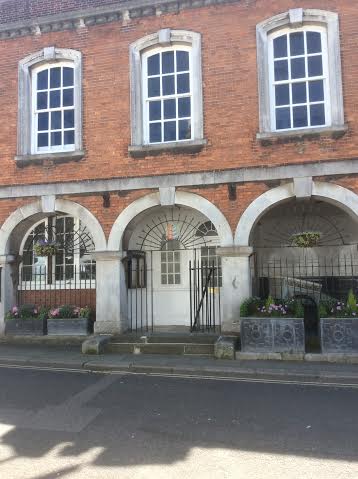
Rye Guildhall, Market Street
Thursday November 9th 1911
Did my shopping and met Miss White. We were just against the Guildhall and saw the Mayor & Corporation come forth. It was so funny. I laughed till I cried – such frock coats and top hats on such heads. Then we watched the ancient custom of throwing pennies from the Hotel Balcony to the crowds below – such a scramble as good many got hard bumped. A good many pounds must have been thrown away like that – some of the coppers were thrown out hot on a shovel. Then out 3 till 5.30 to Playden. Met two very violent ladies – one good Christian woman, entertaining a working party for the Church, pushed me out.

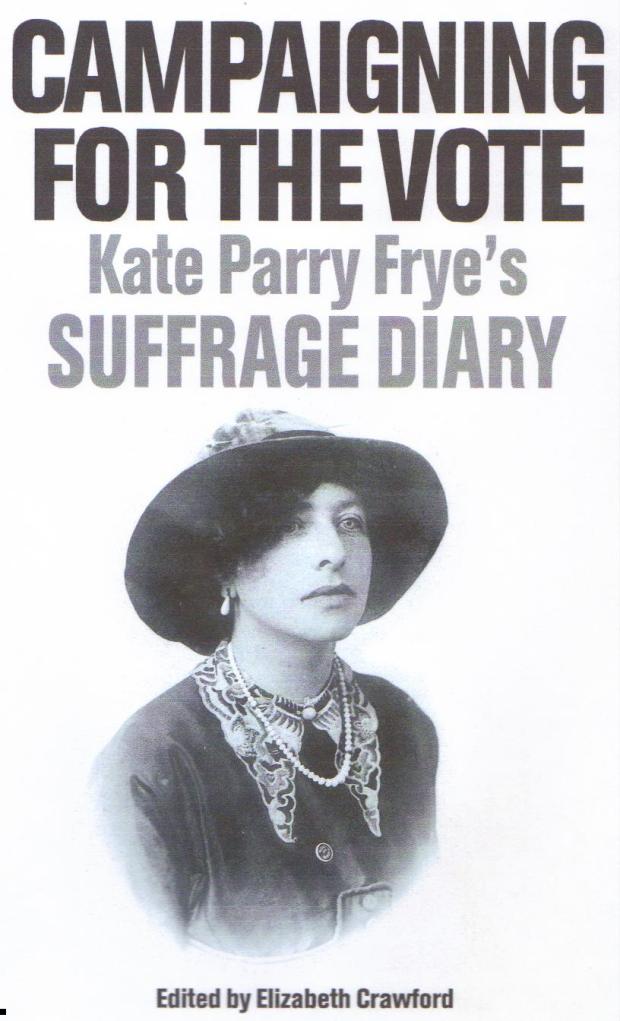
‘Campaigning for the Vote’ – Front and back cover of wrappers
For more about Kate Frye’s suffrage campaigning see here
For more about Kate Frye’s life story see here
Copyright
Kate Frye’s Diary: Christmas 1897 – A True Victorian Christmas
Posted by womanandhersphere in Kate Frye's Diary on December 22, 2015

By the summer of 1897 alterations had been made to The Plat, the house leased by Frederick Frye on the banks of the river Thames at Bourne End. It was substantially expanded, acquiring two circular-roofed turrets which housed additional reception and bed rooms. Now, for the first time, the family – Frederick, his wife, Kezia, and their daughters, Agnes and Kate – were to spend Christmas there. In past years they had come down from London to stay for Christmas at the much grander home of Aunt Agnes Gilbey at Wooburn – a short distance from Bourne End. On these occasions Kate Frye had moaned in her diary about the boredom she had endured but now, in 1897, she was at last able to enjoy a Christmas untrammelled by another family’s conventions.
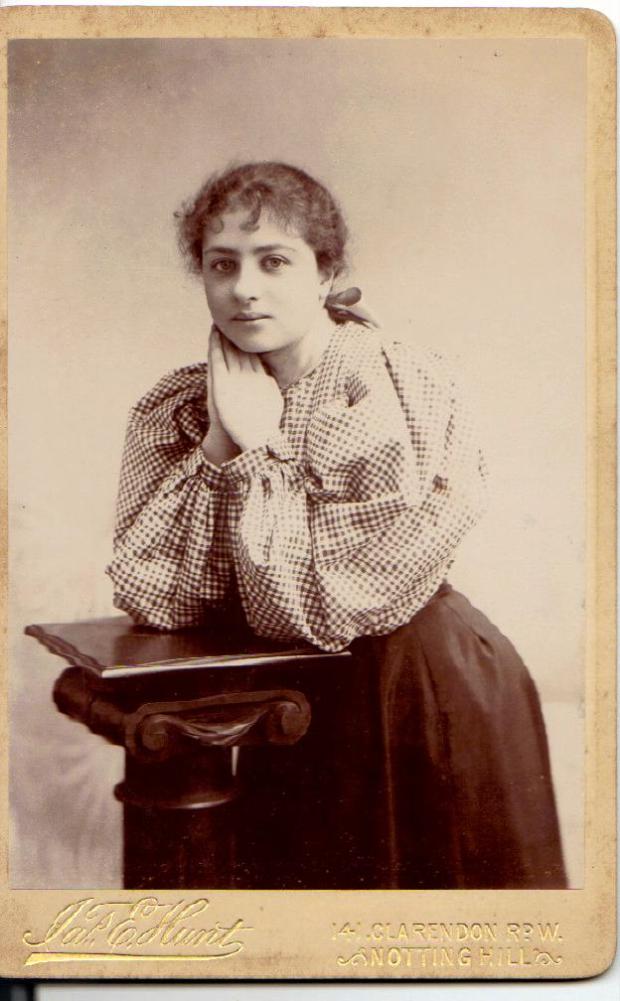
Kate Frye photographed in 1896
From Kate Frye’s diary
Wednesday December 22nd 1897
I have bought Mother a jolly purse and today I have bought Agnes a silver thimble in a case – a thing she very much wants. Daddie a splendid pocket book – a real beauty and a pair of braces. The servants – Cook a purse – Emily a writing case – Alice a work case and Lotty Grey, the new microbe [such was the epithet Kate used at this time for the ‘tweenie’ maid] a silk neck handkerchief. Mother has bought Agnes a gilt chain purse by special request and me by desire a travelling case holding boot cleaning appliances, brown and white cream and brushes and leather. [We have bought] 10 shillings’ worth of toys from Aunt Anne’s [charity] bazaar for our Tree – a fairy for the top – glass balls amd birds – drums – trumpets and penny toys of all kinds and many more little things. Small hampers and drums filled with cottons, needles etc for the Servants as extras.
Thursday December 23rd 1897
Directly after lunch Agnes and I started on the Christmas Tree. It is such a beauty and touches the Drawing Room ceiling. We did up part of the presents – the principal ones in coloured papers. Just as we were in the midst of it Constance and Katie [daughters of Aunt Agnes Gilbey] arrived down – we just let them peep in the room which was in a fine muddle. .. Aunt Agnes’ presents arrived in the evening – a huge lampshade for Mother and two pairs of silk stockings each for Agnes and I – such beauties – couldn’t have chosen anything nicer. We were obliged to look at them – then wrapped them up for the Tree. We allowed Mother in the room but she didn’t assist but Daddie we couldn’t allow in much to his annoyance really. The Tree looks lovely – it ought to be a huge success. I have never seen one look nicer and it is simply crammed with things.
Friday December 24th 1897
Christmas Eve
It was a beautiful morning though still most bitterly cold – ever so many degrees of frost – and we went out – the three of us – to try to get warm – the house is icy. It was very foggy early but the sun broke through and it was lovely..Then went up to Cores End for Mother to go and see old Mrs Nicholls and leave her Christmas present. Directly after lunch the three of us started decorating till four o’clock. Pratt [the gardener] cut up the Holly and we put it and lots of mistletoe up everywhere – except Daddie’s room – he is most disagreeable just now. Our turkeys haven’t arrived – they were to come from Leverett and Fryes at Finchley with lots of other foods. [Leverett and Frye was Frederick Frye’s grocery firm.]
[The Fryes’ rather glamorous friends, Norman and Stella Richardson, arrived from London to stay for the festivities.] Norman has brought us two lovely boxes of Fuller’s sweets and also presented his and Stella’s Christmas present to us in the evening. His is a silver backed manicure rubber each to Agnes and I and Stella’s a work bag made by herself each – such nice ones. Of course we won’t let them see the Tree – they are very funny over it and pretend to be very curious. We were all very jolly in the evening except Daddie.
Saturday December 25th 1897
Christmas Day
Agnes and I were called at a quarter to seven and got up and went to early service at St Mark’s Church. There were not many people. It was bitterly cold and very foggy. We didn’t have breakfast till about 9.30 as Mother and Daddie were late. Norman was down before we got in and Emi soon after but Stella of course had her breakfast in bed and had a fire to get up by. Mother, Emi and I walked to Wooburn Church for morning service – Agnes would have liked to go with us but went for a walk to Maidenhead with Stella and Norman – they were to see Mrs Quare and came back to lunch in a fly.
We met Katie just as we were going in Church so she made us go up to Aunt Agnes’ pew as only she, Aunt Agnes and Constance came to Church. I did enjoy the service – it was so bright and I think the Vicar is so nice. It was quite like old times and I felt we must be staying with them – especially as we walked up the hill with them after Church. It was simply lovely up there – no fog and perfect sunshine – quite thawing the frost on the treees it was so hot. We saw Southard and Gilbert [Gilbey] who has not been at all well – then Aunt Anne [a sister of Agnes Gilbey and Kezia Frye, Kate’s mother] came in – we had already met her on her way to Chapple [sic]. Then after a chat and inspection of everyone’s presents we came away home. Met Mrs Southard & Henry and Lola and her maid walking up the Hill. They had just got back from Marlow where they drive to church.
We had a quiet afternoon round the fire in the Morning Room – can’t let anyone in the Drawing Room as the Tree is there. I slipped off after tea to finish it all off. We have got up fair fun and excitement over it – and made them all curious. We were all very merry at dinner – except Daddie who is still seedy – although we had no Turkey. Had a pair of our own fowls killed as they have not arrived – I don’t like Christmas dinner without Turkeys – but we had the Pudding, mince pies and crackers alright. Then came the Christmas Tree which was a huge success and we all went quite mad.
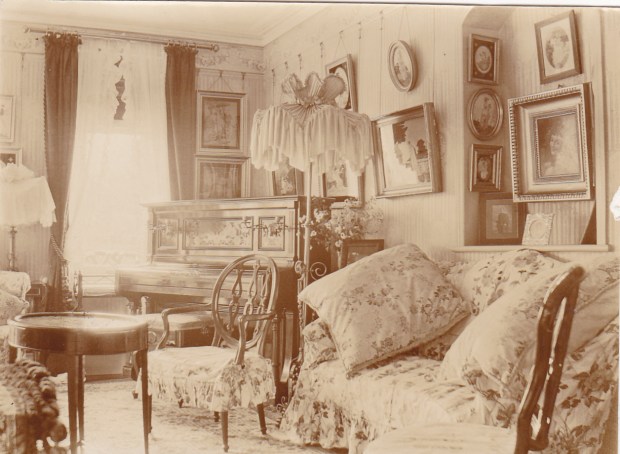
The Drawing Room at the Plat. I wonder where the Christmas Tree stood in 1897?
We had the servants in at the beginning and gave them their presents – Pratt has had a splendid knife off it. We played all the musical instruments and with all the toys. Then after we had carted our things away we went in the Morning Room again in the warm. Daddie went to his room and went early to bed – he has given the servants each a present of money. We had snap dragon later on but I got most fearfully tired and was glad to go to bed. We all went off about 11.30.
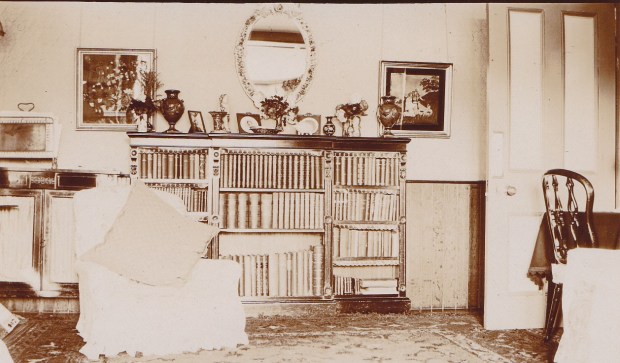
The Plat – the cosy Morning Room
Sunday December 26th 1897
We sat in the Morning Room round the fire – the Drawing Room is such a cold room and looks so miserable with the huge Christmas Tree stripped of all its glory. After tea Norman read ‘Alice In Wonderland’ aloud nearly through to us and we sat round and roared – it is a lovely book I think – most awfully clever.
**
With this depiction of a true Victorian Christmas I wish my readers – in the words of the Fryes –
a
‘Hearty Christmas Greeting
and Best Wishes
For a Happy & Prosperous New Year’
from
Elizabeth
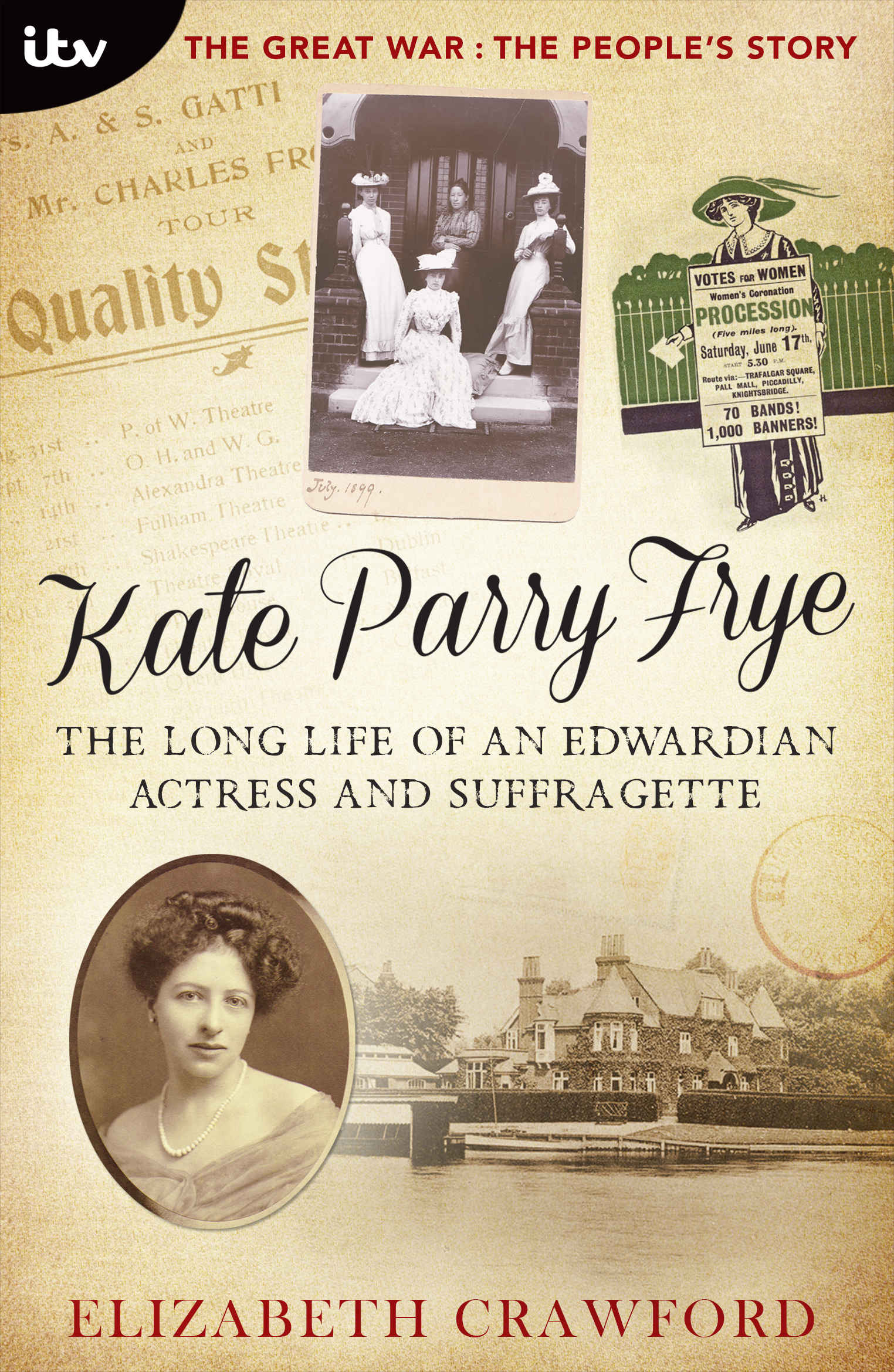
For the whole story of Kate’s life – as told in her diary – download this e-book from iTunes – : http://bit.ly/PSeBKPFITVal or from Amazon. It would make a good read over the Christmas period.
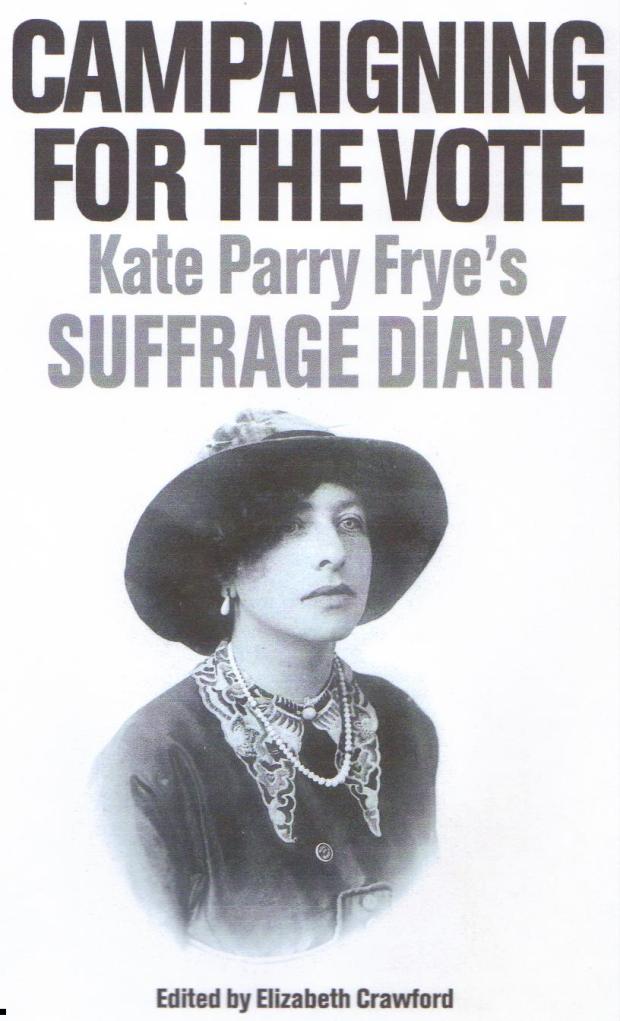
Kate Frye’s work as a suffrage campaigner in later years is fully covered in Campaigning for the Vote: Kate Parry Frye’s suffrage diary. – for full details see here. UPDATE Now out of print, alas
Copyright
Suffrage Stories/ Palmisting For The Cause At A Café Chantant – December 1909
Posted by womanandhersphere in Collecting Suffrage, Kate Frye's Diary, Kate Frye's suffrage diary, Suffrage Stories on September 11, 2015
December was always a good month for fund-raising suffrage parties.

For the suffrage movement was not all about militancy and processions. Money had to be raised to pay for the campaigning and for the management of the rapidly-developing organisations – and much of it was done in the time-honoured way of bazaars and balls. Here is a flyer for a Café Chantant organised by the London Society for Women’s Suffrage in December 1909.
The flyer comes from the collection of Kate Parry Frye, where it lay between the pages of her diary in which she describes the event itself.
She was living at home in North Kensington and had already had some experience as a reader of palms at earlier suffrage fund-raising events. On 6 December 1909 Kate wrote:
‘Agnes [her sister] and Katie [Finch-Smith – neé Gilbey -her cousin] arrived about 12.30. I had lent Katie a white dress as she had not got one and she had brought up the regulation white cap and apron and I also supplied the colours. I wore my best. We started off just before 2.30. One bus to the Grove [that is, Westbourne Grove] and another to Kensington and to the Town Hall for the Café Chantant got up for the Funds of the London Society and National Union.
It began at 3 o’clock. Katie left her things in the cloak room and we all went upstairs together. Agnes had to pay her 3/- to go in and for tea but Katie and I went in free. I found Mrs Rowan Hamilton who had charge of the Palmists and she hadn’t got me a table and I would not begin till she had one brought. I had told her two chairs and a table would be required. I had a little spot close by screens – my name up – ‘Katharine Parry’ – spelt wrong of course. I was just beside the tea tables so I could be near Katie till the fun began. We introduced her to lots of people. I hoped she enjoyed it but I think she got very tired.
Miss Lockyer [she had been housekeeper to the murdered storekeeper, William Whiteley] with a friend came very early and I am afraid did not enjoy herself much. I just spoke to her but could not leave my corner and she thought 2/6 too much to consult me – it was a lot. There was another Palmist ‘Ravario’ and my crystal gazer – Clare Crystal. Agnes and Katie consulted her and found her rather poor. The Wrights were there, of course. Alexandra only a simple ‘Tea Girl’ but she selected Agnes to have tea with her – such an honour for Agnes. Miss Carl Hentschel was a Tea Girl and her Mother helping everywhere and lots of people I know.
At first I could not get any clients – no-one knew me. The first was a man about 3.30 – a funny sort of thing – then a lady, who was so delighted she went out to boom me and she did – for, for the rest of the day, I was besieged. I could have gone on all night. It was hard work but I enjoyed it. I had such nice interesting people – a few made me feel miserable, they were so unhappy – but some were charming – two insisted upon having my address. One said she would try and get me some engagements – a Miss May Oakley. I kept on till 20 minutes to 6 when Agnes dragged me out to have some tea – and John [Collins, her fiancé] came upstairs – he had been taking tickets from 2.30.
So I had some tea and he had a second tea. We had it from Miss Doake’s table as Katie was away. I had promised to go back at 6 o’clock and there was already a client sitting in the retreat. I kept on till 6.30 when the affair was over for the afternoon and we all four went home feeling very tired. John had to be back before 8 o’clock and we were not back till after 7 – so had to rush about and he had a meal as quickly as it could be got and go off.
Leaving Agnes behind, Katie and I left again at 8 o’clock and went by bus to Kensington. It was all in full swing again. The entertainment going on as before and more theatrical and Ju Jitsu displays and heaps of people. John was taking tickets again as happy as a cricket. I had said I would be back 9 till 10 – but I was pounced upon straight away. I had a horrid few moments when I missed my muff but John found it for me.
We worked till I was nearly done and told about 14 or 16 – and 17 to 20 in the afternoon. I had to refuse more as it was 10.30 and I was so tired – though the people came and begged me to go on. Gladys herself honoured me – and she told me that people were giving up their tickets for the other Palmists to come to me. John seemed playing about all the evening and Katie was serving coffee and cakes. There was an auction of cakes – and I bought a lovely Fullers cake. All the cakes had been given and were simply lovely ones. It was pouring with rain and we had to have a cab to the flat. Got in about 11.30.’
Interesting to see that Edith Garrud was happy to give jujitsu displays for the non-militant society.
For more about Kate Frye and the suffrage movement see here:

For more about the entirety of Kate Frye’s life see here
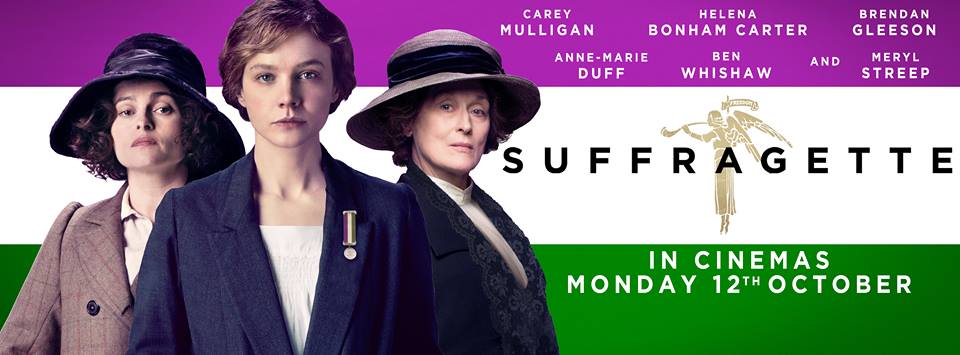
Kate was very sympathetic towards the Women’s Social and Political Union and was, briefly, a member. She was particularly concerned about improving the life of her poorer sisters and without a doubt would have loved the film ‘Suffragette’.
Copyright
Kate Frye’s Suffrage Diary: Kate And The ‘Right To Work’ March, 17 July 1915
Posted by womanandhersphere in Kate Frye's suffrage diary on August 3, 2015
This summer is passing so quickly that I realise that I’ve missed – by two weeks or so- the 100th anniversary of Kate Frye’s final involvement with the New Constitutional Society for Women’s Suffrage. Still – better late than never -it would be a pity not to record an eye-witness account of the final ‘suffrage’ procession, which had morphed into one claiming for women a ‘Right to Work’ for the war effort.
Kate has been married for six months and is now ‘Mrs John Collins’ – but ever since the wedding John has been based at army camps on the east coast so she is, as before, living alone in her digs at 49 Claverton Street, Pimlico.
You can read about Kate Frye’s work as an organiser with the New Constitutional Society for Women’s Suffrage in Campaigning for the Vote: Kate Parry Frye’s suffrage diary. – for full details see here.
Saturday July 17th 1915
A very dull morning and it just started to rain as I went out. I was prepared for wild weather as the wind too was very fierce – a short grey linen dress – a woollen coat to keep me warm – Aquascutum – boots and rubbers – a small cap tied on – and an umbrella. It was fortunate I was so prepared as it turned out a wicked day and rained till 4 o’clock.
I went by bus to Westminster and walked along the Embankment to see if there were any signs of preparation but it was pouring by then so there was nothing. I went to Slaters in the Strand and had some lunch and back on the Embankment by one. There from the paving stones sprang up marshalls and assistant marshalls (I was a marshall with a broad red sash) all like me hurrying to posts. Mine was 101 and only 100 were given out – so I claimed mine and stood behind the last soldier with 101 until nearly 3.30.
But the rain kept the people away who would have filled the last of the 125 sections and we marshalls and assistant marshalls had very little to do. Our section commander never came along at all so we had to organise ourselves. Miss Barnes of the Knitting Dept came along to be in my section. She is a thoroughly good sort. Just before 3.30 we discovered if we were to march we must arrange ourselves – so a few people did one thing – a few another. I ran down the line telling people to come along and so we caught up with the front.
Banners and bannerettes were hastily pulled out of carts and we were off. I went up and down giving directions and making us as trim as possible. We were a motley crew but we had some fine banner bearers and the greater number of us looked very neat in rainproof coats. And so off again on the great Women’s Patriotic Procession organised by Mrs Pankhurst and led by her. Mr Lloyd George received a deputation of women concering Munitions. Mrs Chapman [president of the New Constitutional Society for Women’s Suffrage] walked all the way in the first section and went in with the deputation.
It was a long and interesting procession but would have been longer had the weather been better. But the rain stopped about 4 o’clock and actually just as I got back to the Embankment at 6 o’clock the sun came out. The procession started off at 3.30 sharp. There were no end of Bands and they helped one tremendously. The route was long – Embankment, Whitehall, Cockspur St, Pall Mall, St James, Piccadilly, Park Lane, Oxford St, Regent’s St, Haymarket, Northumberland Avenue on to the Embankment again when we gave up banners and those who could went along on to hear Mr Lloyd George speak from a balcony looking over the Embankment. I saw him watching the whole thing from there as we went along.
Such a crowd to watch us all along the route and the Clubs packed with people. At intervals tables with ladies taking signatures of women ready to do munition work. It was very inspiring and invigorating and though I felt very tired and seedy before I think the walk did me good. I was a bit stiff and glad to sit down. I made my way to the Strand and had some tea.

Kate Frye (1878-1959) – was resurrected by ITV who put her (played by Romola Garai) in a series – The Great War: The People’s Story – and commissioned me to write her life. This story of an ordinary Englishwoman will appeal to all those interested in a real life lived – from the palmy days of Victoria to the New Elizabethan age. For more details read here.
Download the e-book from iTunes – : http://bit.ly/PSeBKPFITVal or from Amazon.
Copyright
Kate Frye’s Diary: Christmas 1914: 25 December
Posted by womanandhersphere in First World War, Kate Frye's Diary on December 25, 2014
Kate is spending Christmas with her mother and sister in digs at 58 Portland Road, Hove. This is their first Christmas since the death of Kate’s father, Frederick Frye, and very different from the glorious festivities that they enjoyed in the days of wealth and plenty. John Collins, Kate’s fiancé, is in the Army, stationed at Shoeburyness. They are to be married at All Saints Hove on 9 January 1915. Miss Green, who lives in Warwick Avenue, London, and is very well-off, is a very keen and active supporter of the New Constitutional Society for Women’s Suffrage.
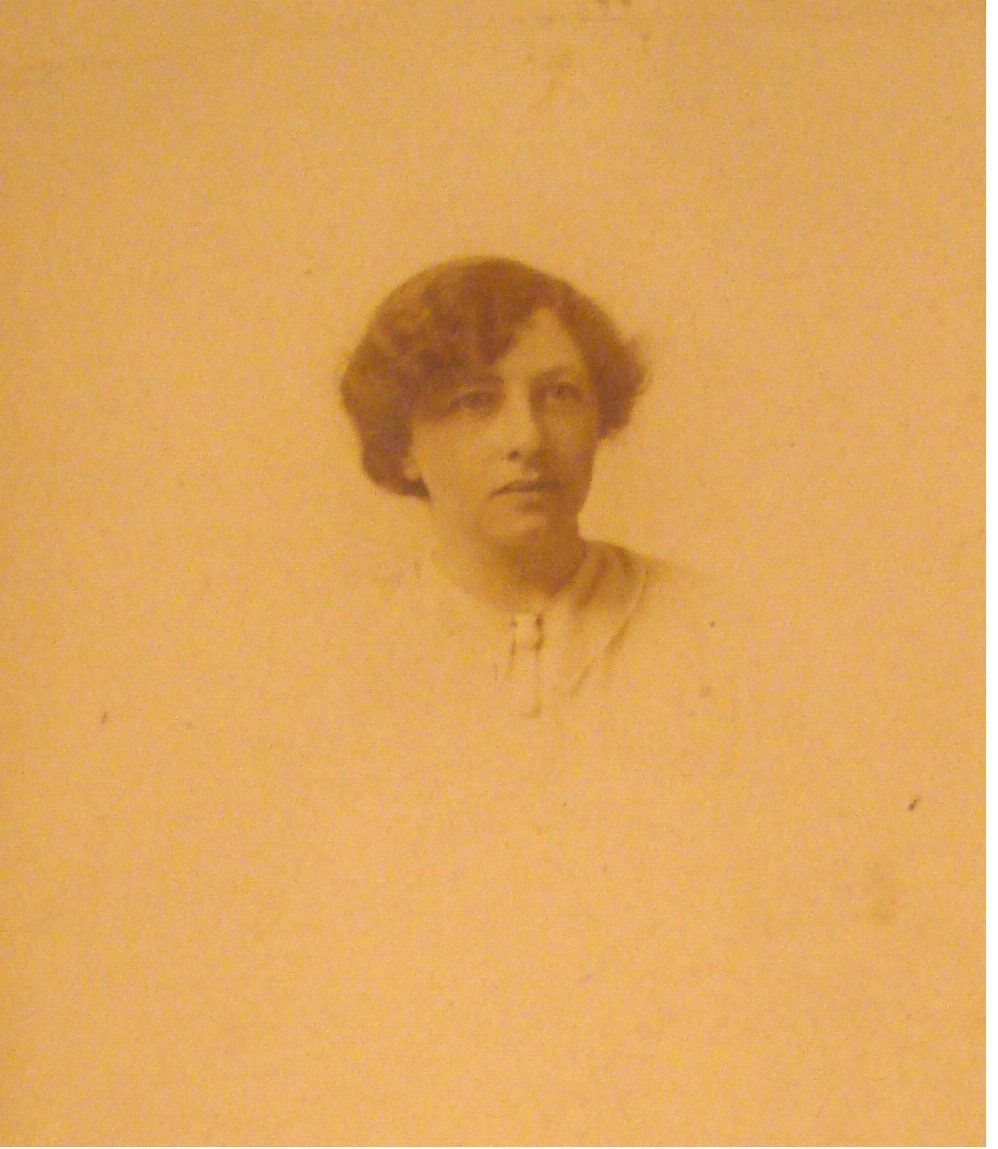
Kate c. Christmas 1914
Friday December 25th 1914 – Christmas Day
Called at 7 – and off to All Saints Hove for Communion at 8. Such a gorgeous Church – like a small Cathedral – I am glad its a nice Church.
Back again and Mother and I had breakfast together – then leaving dear love [Kate’s little dog – aka ‘Mickie’] for Miss Miles to look after the 3 of us to morning service. Agnes came back for Mickie and Mother and I went on the Parade and met Agnes coming back. In at 1.20 to a Christmas Dinner of hot Roast Beef and a weird pudding pretending to be a Christmas Plum.
The meal was brought to a sudden close by my opening one of the parcels which had arrived in the morning by post. I didn’t know the writing but it was a registered parcel and I found a pair of silver Table Napkin rings from Miss Green for a wedding present. We had so laughed about wedding presents of such a nature that we roared with laughter and I went on reading her letter aloud and then as it was so sad burst into tears. She had once been going to be married on the 4th January but her man had died. Really it was most pathetic. So then we quieted down and sat over the fire and read our letters etc. Nothing from John – when last I heard he was preparing for a Christmas present from the Germans. Dover has already had one – a bomb dropped from an Aeroplane but it fell into a garden and did no damage.
We had a quiet day and my cold came on with great violence and I felt very tired and seedy altogether and not at all Christmassy. I have had £10 from Aunt Agnes [Gilbey] for a wedding present and £7 from Constance [her cousin, daughter of Aunt Agnes] for Christmas and wedding. Mother has given me 5 shillings and Mickie a sponge bag and Agnes a little Jewel Box. Last year this time our Christmas was over – John was on the point of departure. I wonder how Daddie is enjoying his Christmas – I hope his is a peaceful one.
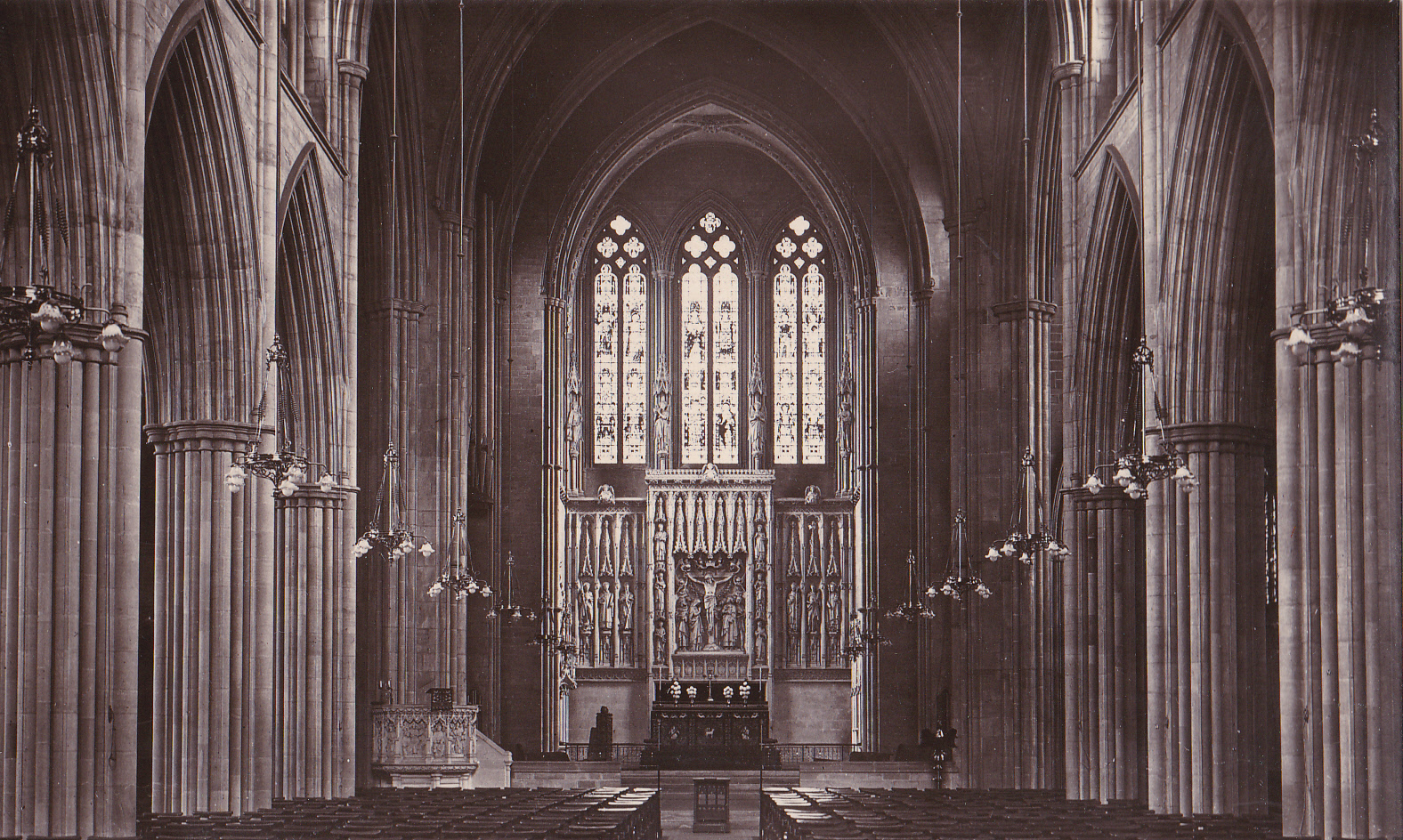
All Saints Hove 1914 – postcard from Kate’s archive
For much more about Kate’s life – as told in her biography, based entirely on her own diary, – see here. I rather think you might find it an enthralling Christmas read.
Copyright
Kate Frye’s Diary: Christmas 1914: 24 December 1914
Posted by womanandhersphere in First World War, Kate Frye's Diary on December 24, 2014
Kate is beginning her Christmas holiday. ‘Young Bernard Shaw’ was the son of her cousin, Agnes Shaw (née Gilbey) Shaw. Almost exactly a year later another of Agnes’s sons, Arthur, was killed in France; he was only 19.
The purchases that, with diffidence, Kate showed her mother, were modest items of clothing – mainly underwear – that she had put together as her trousseau. She felt rather guilty about spending money on herself.
Kate c. Christmas 1914
Thursday December 24th 1914
Up 7.30. Breakfast 8.30 and packed up by 9.30. Off soon after in a Taxi for Victoria and the 10.15 train to Hove. A crowded carriage – otherwise a comfortable journey only so saddened by seeing in the Roll of Honour killed in action young Bernard Shaw – Agnes’s second boy – 21 years old. Such a radiant young life ended and done with and what a heart ache for Agnes. Got a porter to bring my luggage and walked to 58 Portland Road. It was a lovely day though wet under foot. Agnes [her sister] and I took dear love [her little dog] just to see the sea after I had seen my baggage in – my room is messy and bitterly cold.
We sat over the fire all afternoon. Agnes went out after tea and I unpacked and showed Mother my purchases – I was a little diffident – but it went very well. Then Agnes had to see them. Then to a little needlework. Very tired and bed early. It’s a queer sort of Christmas.
For much more about Kate’s life – as told in her biography, based entirely on her own diary, – see here. I rather think you might find it an enthralling Christmas read.
Copyright
Kate Frye’s Diary: Christmas 1914: 23 December
Posted by womanandhersphere in First World War, Kate Frye's Diary on December 23, 2014
Kate is working at the New Constitutional Society for Women’s Suffrage office in Knightsbridge, superintending the workroom that the society had set up to give employment to women dressmakers thrown out of work by the outbreak of war and the drop in demand for finery. She and John, her fiancé of many years, had at long last decided to get married. The chosen date was to be 9 January 1915, Kate’s birthday. At this time she was living in digs in Pimlico.
Kate c. Christmas 1914
Wednesday 23 December 1914
A real busy day at the office getting everything tidied and straightforward for my holiday. Had quite a surprise first thing by a presentation of an Ink Pot from all the girls – so really nice of them. They had given Miss Grey a flower stand – it’s most awfully generous of them. I told Miss Grey later on that I was going to get married and she was very interested and full of good wishes.
Miss Simeon left at lunch time and Gladys who had not come till about 11.30 left at 3.30 – so although I had accepted an invitation to tea up in the Work Room I had to give it up, but they brought mine down – a cup of cocoa and a lots of Scotch cakes made by Miss Grey. The girls were crazy with excitement all day. I had a thorough clear out and tidy up of everything – then locked up – at 5 o’clock. Had such a queer feeling as I came away – like locking my old self within – because probably my old self never will return – if I am married by then it will be so different.
I was rather tired but ate my supper – made up a big fire and started to pack up – had not finished before midnight.
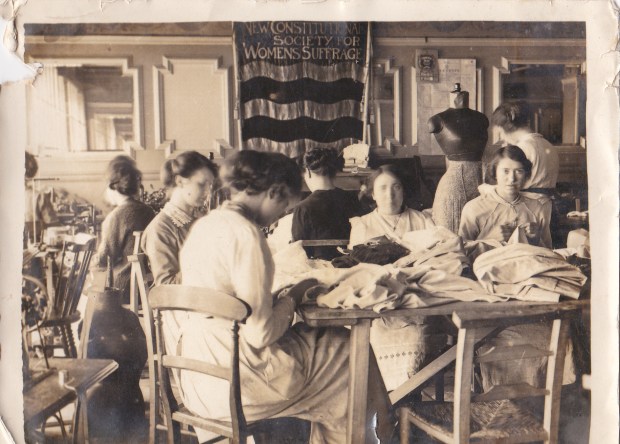
New Constitutional Society Workroom
For much more about Kate’s life – as told in her e-book biography – see here -only £1.19 to download from Amazon . I rather think you might find it an enthralling Christmas read.
Copyright
Kate Frye’s Diary: Talk at Wooburn Festival, 24 September 2014
Posted by womanandhersphere in Kate Frye's Diary, Kate Frye's suffrage diary, Suffrage Stories on September 23, 2014
Tomorrow – 24 September – I shall be presenting Kate Frye to the Wooburn Festival. I shall be talking about her life – from the age of Victoria to that of Elizabeth – in Bourne End and Berghers Hill – and describing her efforts to interest the area in ‘Votes for Women’.
The talk will be illustrated with many photographs from Kate’s extensive archive and there will be an opportunity to look at other items of local interest from her collection that I will bring with me.
See here for full details of the talk – 7.30 pm at Bourne End Library.
Copies of Campaigning for the Vote will be on sale – signed if you wish!
For full details of both the Kate Frye books see here and here.
Kate Frye’s Diary: What Was Kate Doing One Hundred Years Ago Today – The Day She Appears On Our TV Screens?
Posted by womanandhersphere in First World War, Kate Frye's Diary on August 17, 2014
Tonight Kate Parry Frye – in the guise of Romola Garai – appears on our television screens (Sunday 17 August, ITV at 9pm). What was she doing on this day 100 years ago?
Kate was still on holiday from her work with the New Constitutional Society for Women’s Suffrage, spending the time with her sister and mother in their rented rooms at 10 Milton Street, Worthing. However, this was no summer idyll such as the Fryes had enjoyed in days gone by. Then they had rented a large house and travelled down from London with their four servants, to spend a season by the sea. Now that they were virtually penniless, these rented rooms were all they could call home. In the life of Kate and, more tragically in that of her sister, we see the jarring disconnect when young women, brought up to a life where marriage was to be their only trade, are left with insufficient money to support their social position and expectations. As such Kate’s life story is very much a tale of its time.
Monday August 17th 1914
Gorgeous day. Up and at house work. Out 12.30- just to the shops. Wrote all the afternoon and after tea to 6. Papers full of interest. Preparing for the biggest battle in the World’s History. There is no doubt the English have landed over there. I hear from John most days – that he is very busy but not a word of what his work is. Mickie [her Pomeranian] and I went out after tea. Agnes still a bit limp.
John Collins, Kate’s fiancé, who had long been an officer in the Territorial Army, had already been recalled to his barracks at Shoeburyness – leaving his engagement with a touring repertory theatre company. Kate’s sister, Agnes, at the first hint of the European trouble had taken to her bed, prostrate. Kate, a would-be playwright, was busy writing – although exactly what she was writing at this time she doesn’t divulge. On her death forty-five years later she left behind a box of unpublished scripts – and one that was published. She hoped one day to achieve fame and fortune. As it was she would soon be back at work at her suffrage society’s headquarters – with a new role as organizer of their War Work Work Room.
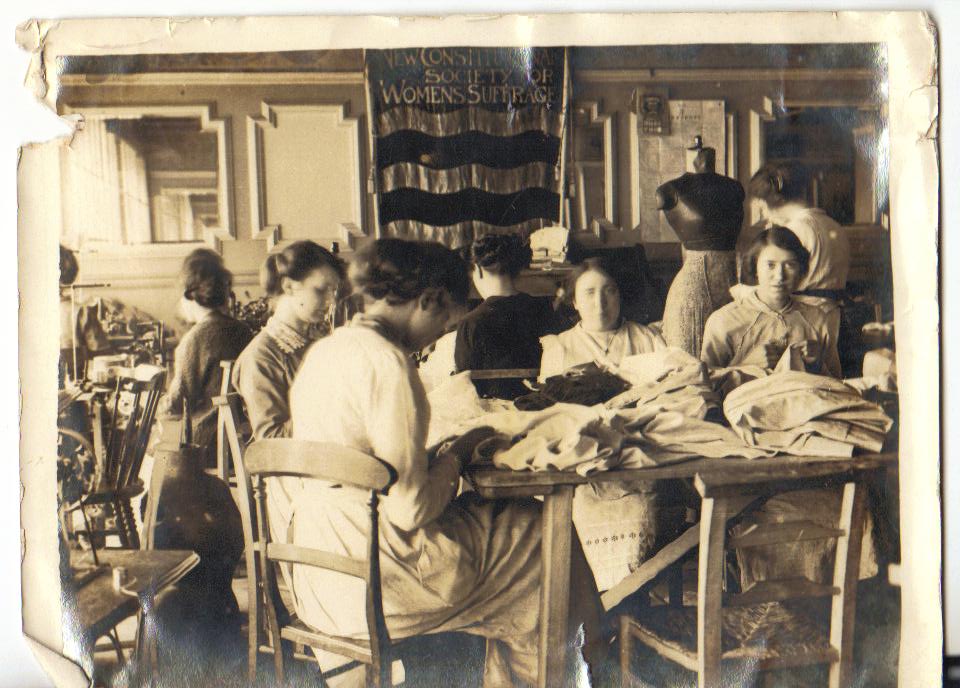
Work Room set up by the New Constitutional Society for Women’s Suffrage – of which Kate was in charge. Note the NCS flag in the background.
To discover more about the entirety of Kate’s life – her upbringing, her involvement with the suffrage movement, her marriage, her London flats, her life in a Buckinghamshire hamlet, her love of the theatre, her times as an actress, her efforts as a writer, her life on the Home Front during two world wars, her involvement with politics – and her view of the world from the 1890s until October 1958 – download the e-book – £4.99 – from iTunes – : http://bit.ly/PSeBKPFITVal. or £4.99 from Amazon.
I’d love to hear what you think of Kate and the life she lived.
To read in detail about Kate’s involvement in the women’s suffrage campaign – in a beautifully-produced, highly illustrated, conventional paper book – see Campaigning for the Vote: Kate Parry Frye’s Suffrage Diary.
Copyright
Kate Frye’s Diary: The Lead-Up To War: 1 August 1914
Posted by womanandhersphere in First World War, Kate Frye's Diary on August 1, 2014
On 7 August 2014 ITV will publish an e-book, Kate Parry Frye: The Long Life of an Edwardian Actress and Suffragette. Based on her prodigious diary, this is my account of Kate Frye’s life and is a tie-in with the forthcoming ITV series ‘The Great War: The People’s Story’, in which Romola Garai plays Kate.
To discover more about the entirety of Kate’s life – her upbringing, her involvement with the suffrage movement, her marriage, her London flats, her life in a Buckinghamshire hamlet, her love of the theatre, her times as an actress, her efforts as a writer, her life on the Home Front during two world wars, her involvement with politics – and her view of the world from the 1890s until October 1958 – download the e-book – £4.99 – from iTunes – : http://bit.ly/PSeBKPFITVal. or £4.99 from Amazon.
As a lead-up to publication I thought I’d share with you some entries from Kate’s diary from the month before the outbreak of war. Through her day-to-day experience we can see how the war stole up on one Everywoman. Kate was at this time 36 years old, living in a room at 49 Claverton Street in Pimlico and working in the Knightsbridge headquarters of the New Constitutional Society for Women’s Suffrage. It was now nine years since she had become engaged to (minor) actor John Collins. Her father died in March 1914 and her mother and sister, Agnes, now all but penniless, are living in rented rooms in Worthing. For the previous few weeks Kate’s fiancé, John Collins, had been renting a room in another house in Claverton Street but he has now left for the West Country, to take up a position with a touring repertory company. Kate is feeling rather bereft.
Kate has just begun her summer holiday – staying with her mother and sister in their rented rooms in Worthing.
Saturday August 1st 1914
Very warm. Up late. Agnes, Mickie and I to the Beach 12 to 1. Work in the afternoon. Rain in the evening so I went out by myself to the Library. But I can’t read – there is too much in the papers, and all this uncertainty makes one restless.
This must be one of the shortest entries in Kate’s entire life-time of diaries. As such, as she says ,it is an indication of the impossibility of concentrating on anything other than the hitherto inconceivable fact that a European war would not now be averted. It was merely a matter of waiting to see which countries would be involved.
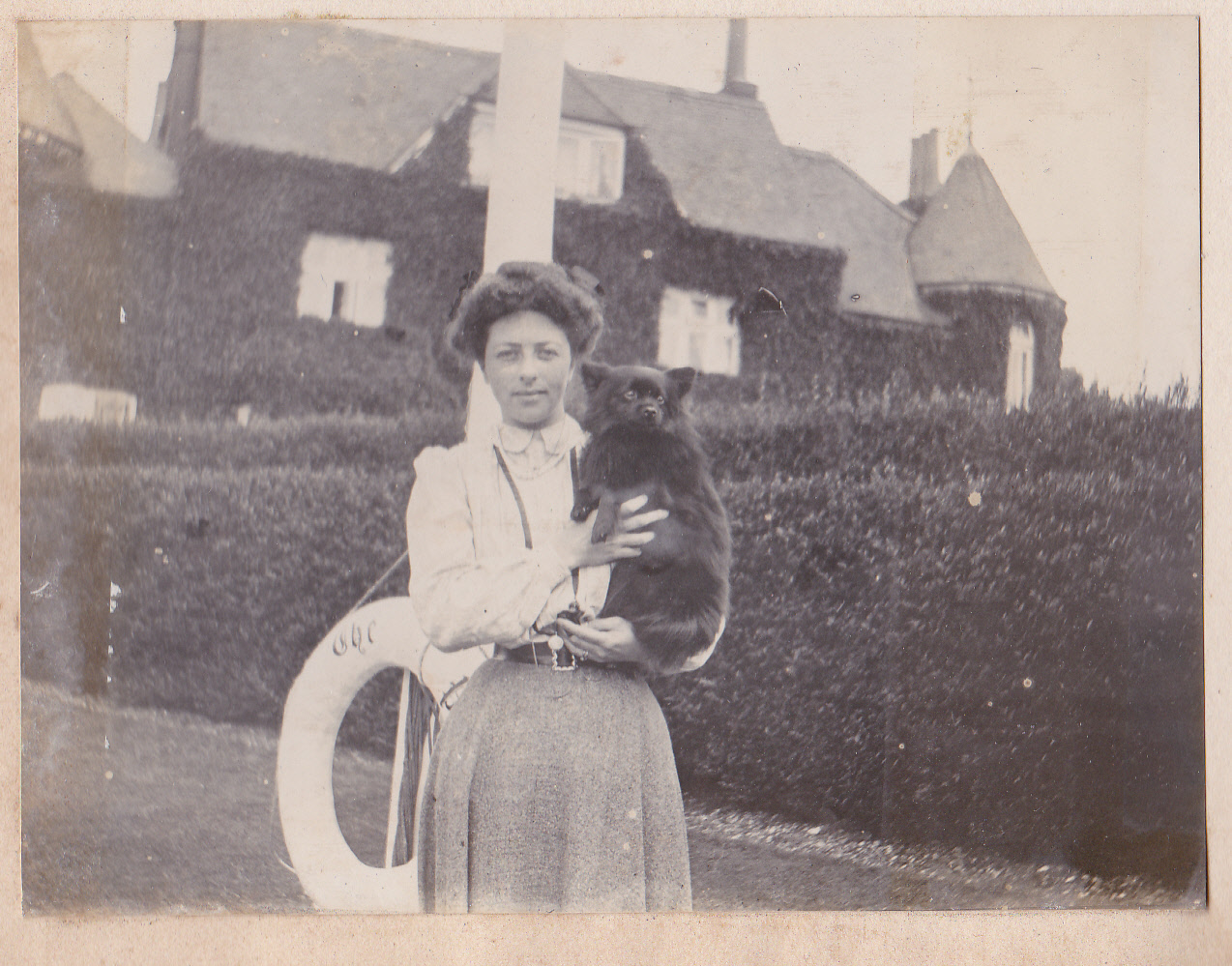
Kate with Mickie in happier days – beside the river Thames at The Plat, Bourne End
See also Campaigning for the Vote: Kate Parry Frye’s Suffrage Diary.
Copyright
Kate Frye’s Diary: The Lead-Up To War: 5 July 1914
Posted by womanandhersphere in Kate Frye's Diary on July 5, 2014
On 7 August 2014 ITV will publish an e-book, Kate Parry Frye: The Long Life of an Edwardian Actress and Suffragette. Based on her prodigious diary, this is my account of Kate Frye’s life and is a tie-in with the forthcoming ITV series ‘The Great War: The People’s Story’. For details of the TV series and its accompanying books see here.
As a lead-up to publication I thought I’d share with you some entries from Kate’s diary from the month before the outbreak of war. Through her day-to-day experience we can see how the war stole up on one Everywoman.
Kate was at this time 36 years old, living in Claverton Street in Pimlico and working in the Knightsbridge headquarters of the New Constitutional Society for Women’s Suffrage. It was now nine years since she had become engaged to (minor) actor John Collins. Her father died in March 1914 and her mother and sister, Agnes, now all but penniless, are living in rented rooms in Worthing. John and Kate have joined them there this weekend.
‘Sunday July 5th 1914
I felt very rotten from natural causes so did not mind the rain and the wet – it poured nearly all day. I came down late – then brushed Mickie, slept on the sofa in the afternoon, some writing in the evening, and Agnes, John and I went for a stroll about 6.30. Very grey and quite cold. What a change from last week.’
By ‘natural causes’ Kate, as you might guess, meant that she was suffering with her period. In Kate Parry Frye: Edwardian actress and suffragette I discuss the way that menstruation affected Kate and her close companions.
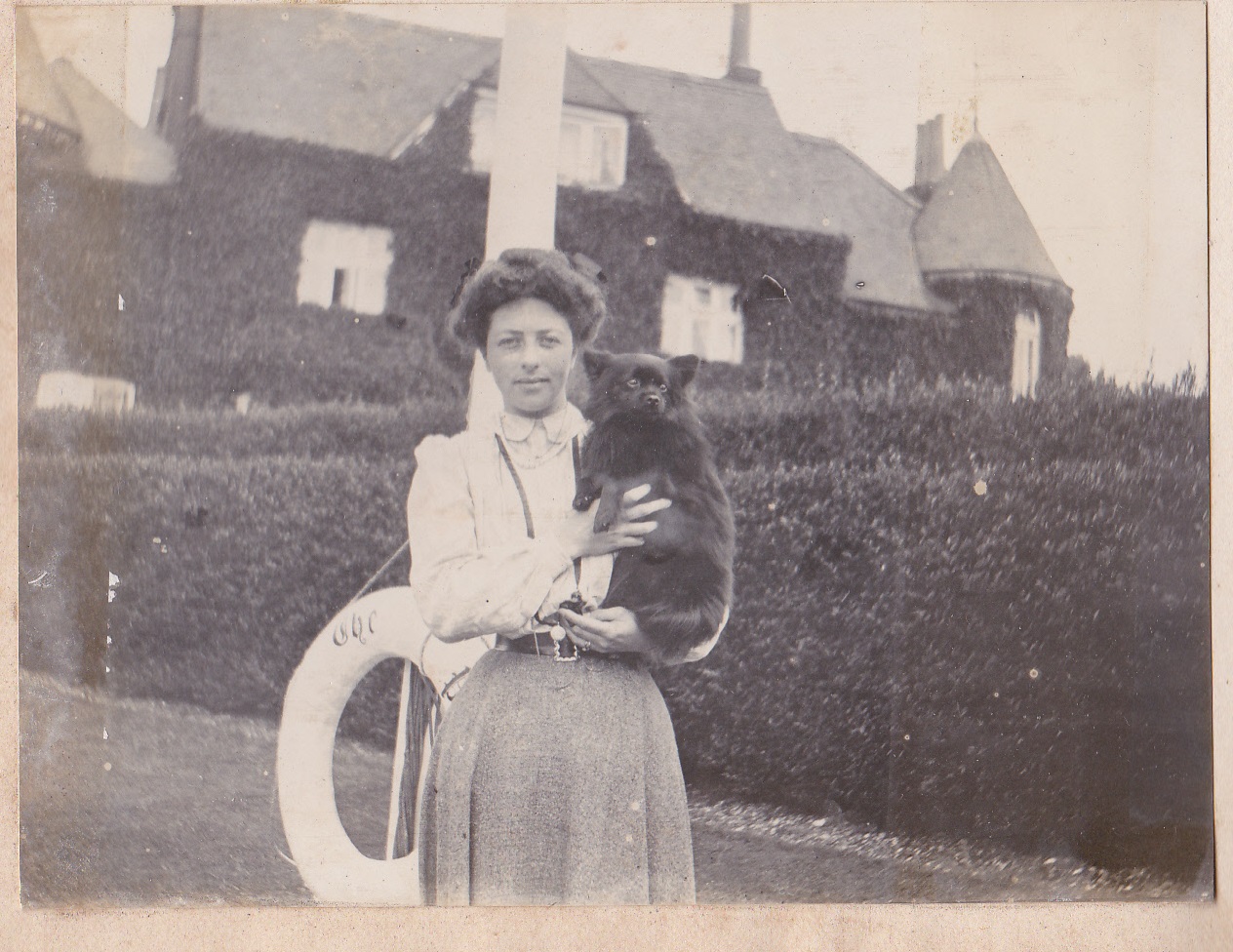
Kate with Mickie. Photographed on the riverside at Bourne End, with The Plat, which until 1913 was her home, in the background
Mickie was Kate’s dog – a Pomeranian – a type that required a good deal of grooming. Mickie was a ‘theatrical’ dog, acquired by Kate and John in 1904 to appear in the opening scene of a play they were touring. Mickie was adored.
Coincidentally, when Sylvia Pankhurst visited her sister in her Parisian exile in early 1914 she mentioned that during their interview Christabel was nursing a small Pomeranian.
Kate always had some ‘writing’ on the go. If she was not busy with her diary, there were always letters – and stories and plays – all but one of which were unpublished – to keep her occupied.
See also Campaigning for the Vote: Kate Parry Frye’s Suffrage Diary
Kate Frye’s Diary: The Lead-Up To War: 2 July 1914
Posted by womanandhersphere in Kate Frye's Diary, Suffrage Stories on July 2, 2014
On 7 August 2014 ITV will publish an e-book, Kate Parry Frye: The Long Life of an Edwardian Actress and Suffragette. Based on her prodigious diary, this is my account of Kate Frye’s life and is a tie-in with the forthcoming ITV series ‘The Great War: The People’s Story’. For details of the TV series and its accompanying books see here.
As a lead-up to publication I thought I’d share with you some entries from Kate’s diary from the month before the outbreak of war. She was at this time living in Claverton Street in Pimlico and working in the Knightsbridge headquarters of the New Constitutional Society for Women’s Suffrage. It was now nine years since she had become engaged to (minor) actor John Collins.
Thursday July 2nd 1914
To office. Attended the Committee. To lunch at Harrods with Mrs Hartley, Alexandra [Wright] and Gladys [Wright] and Miss Bessie Hatton. Work at the office all afternoon. John arrived for me at 5.30pm. I left with him and we came back in a bus to Claverton Street.
I tidied myself and then by bus to Tottenham Court Road where we had a mysterious fish dinner. We liked the first half as we were extremely hungry and then it palled.
Then we strolled to the Scala Theatre and John got 2 dress circle seats for ‘La Dame aux Camelias’. Lydia Yavorska. Parts of it were a scream as all her things are, but she was very lovely in parts – and especially just at the end – she did look so dead. Some of the characters were vilely played. Ambrose Flower – he is rather winning – just like an Elenor Glynn [ sic] man – but just a prop for the dear Princess to fall up against – or on to. She looked a picture – but some of her frocks were hideous. Back by bus.’
The Scala Theatre was just behind Tottenham Road, on the corner of Charlotte and Tottenham streets. The theatre was only ten years old in 1914, built to the architect Frank Verity’s design in 1904 on the site of a series of older theatres. .
Kate doesn’t put the design of this production of ‘La Dame Aux Camelias’ in an artistic pigeon hole – but in the 15 July 1914 issue of ‘Tatler’ it is described as ‘Futurist’. The article is titled ‘”Infernal Decorations or What Stripes and Squares a Love of Futurism is Leading Us.”‘ Perhaps it was the ‘stripes and squares’ that made some of the dresses appear ‘hideous’ in Kate’s eyes.
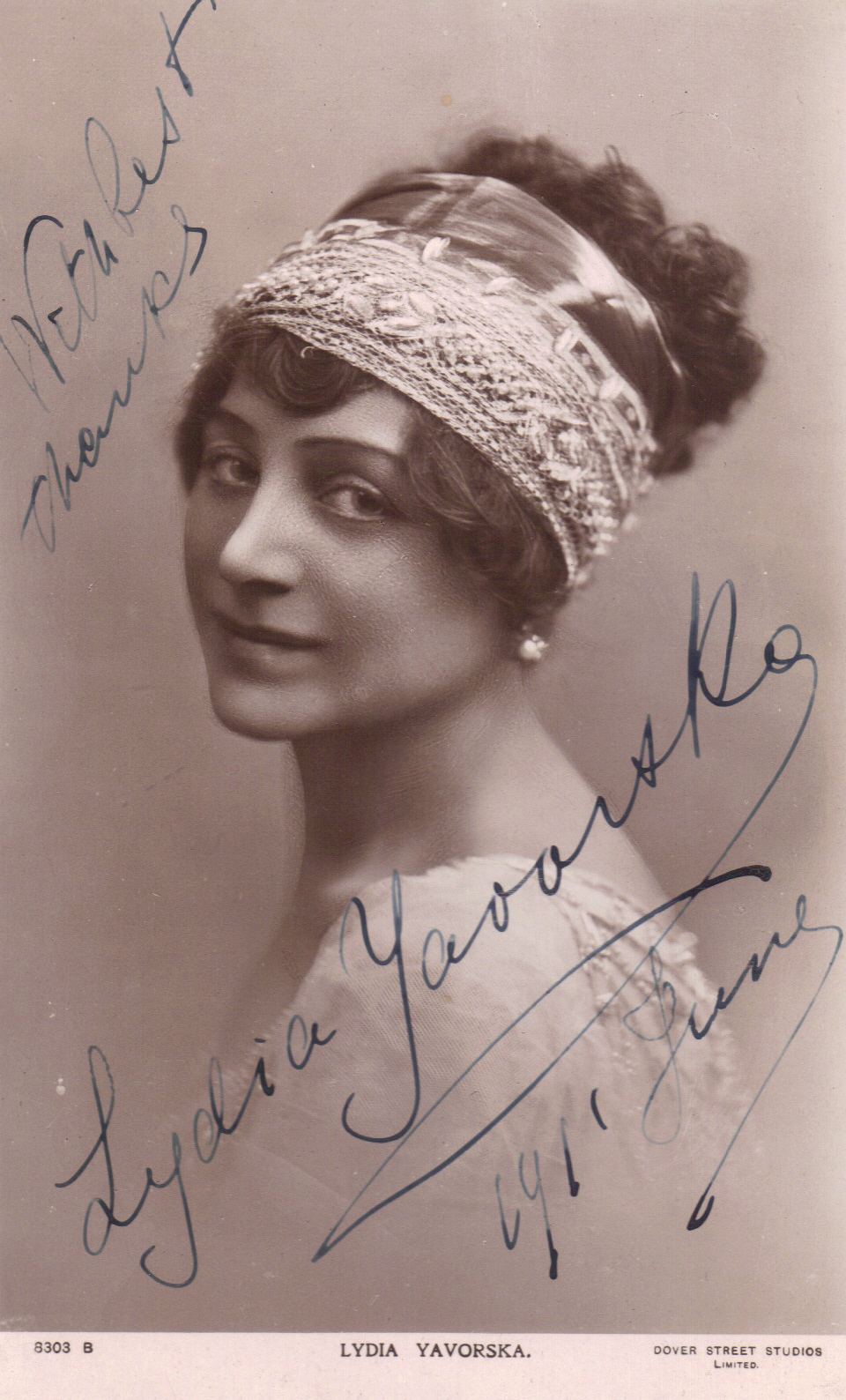
Kate refers to Lydia Yavorska (b. 1869) as ‘the dear Princess’ because the Russian-born actress had acquired by marriage the title Princess Bariatintsky. Of her performance as Marguerite in this production ‘The Times’ critic wrote ‘she is not the actress to spare herself in the forcible delineation of the part’s emotion. Indeed her third act gave the opportunity for more tears and cries than we have ever heard or seen in a single act before.’ Kate had seen her playing Nora in ‘The Doll’s House’ on 30 March 1911 when she had described her as ‘a pretty creature and – in spite of her very broken English, excellent and so fascinating.’
‘La Dame Aux Camelias’ ran at the Scala from 22 June to 4 July 1914.
Kate Frye’s Diary: Coming Soon: Kate Frye On Both The Small – And Even Smaller – Screens
Posted by womanandhersphere in Kate Frye's Diary, Kate Frye's suffrage diary on June 27, 2014
ITV have issued this press release which includes mention of my forthcoming e-book, to be published by ITV, Kate Parry Frye: the long life of an Edwardian actress and suffragette.
ITV marks First World War centenary by telling the people’s story in partnership with Imperial War Museums
The extraordinary stories of ordinary people whose lives were transformed during the First World War will be told in their own words in a landmark new series for ITV, made in partnership with Imperial War Museums
Marking the centenary of the outbreak of the war in 1914, the experiences of men and women, young and old, from across Britain and the social classes that divided society at the time, are vividly brought to life in 4×60 series The Great War: The People’s Story, produced by Shiver [ITV Studios].
As part of ITV’s partnership with IWM, a book accompanying the series will also be published as well as three e-books. In addition to its partnership with IWM, ITV is also announcing two other programmes to mark the First World War centenary.
With narration from Olivia Colman, The Great War: The People’s Story tells the real-life stories of soldiers, from privates to officers, their wives and girlfriends left behind, and people from Britain’s villages and cities. They are portrayed by a cast of actors including Alison Steadman, Daniel Mays, Claire Foy, Brian Cox, Romola Garai, MyAnna Buring and Matthew McNulty, who speak their words as they were written in their diaries and letters.
These moving accounts, revealing their intimate thoughts and feelings offer a raw insight into the profound impact of being caught up in a conflict that would change their lives – and Britain – forever. Sourced from archives and libraries across the country, selected in partnership with Imperial War Museums, which provided much of the material, and brought to life by actors – each story conveys the hopes, fears, heroism and tragedies of countless ordinary British people… made all the more powerful by the fact that every word is real.
Diane Lees, Director General of IWM, said: “IWM is pleased to have worked in partnership with ITV on the development of The People’s Story – The Great War. The Imperial War Museum was established while the First World War was still being fought, to ensure future generations would remember those who contributed during the conflict. This series, featuring a number of people whose diaries and letters are held in the museum’s archives, gives an insight into some of the experiences and innermost thoughts of individuals from the time. Now that the war is out of living memory, it is up to our generation to ensure that their stories are and continue to be told – the stories of ordinary people living through extraordinary times.”
Richard Klein, ITV Director of Factual, said: “This programme gives the stage to the authentic voice of the British people as they endured over four years of the greatest violence in human history. The diaries, letters and memoirs of privates and officers, wives and mothers, working class and the well-to-do all brilliantly and emotionally document the journey from the patriotism and positivity at the start of war to the gradual understanding of the deadly and mind-shattering realities of modern warfare to the final days of simple endurance and exhaustion. This is a beautifully composed portrait of a country during a war that changed everything for everyone.”
Ollie Tait, Executive Producer of The Great War: The People’s Story for Shiver added: “Alongside the heartbreak and horror of war, Britain was changing at an amazing pace for everyone and there is something hugely powerful about reliving this through the people who never thought their voices would be heard. We really wanted ‘The People’s Story’ to be a world apart from the usual approach to the First World War and to make it about us, to bring to life the treasured letters that are tucked away in attics across the nation.”
ITV Studios Global Entertainment (ITVS GE) and Imperial War Museums have signed a deal with Random House for The Great War: The People’s Story, a hardback non-fiction book to accompany the TV series. Written by Izzy Charman, the TV series producer, and published in partnership with Imperial War Museums, the book provides a narrative of the war years as seen through the eyes of the people featured in the show. The book will be available from 31st July.
ITVS GE will also be publishing three e-books based on three of the individuals in the TV series. Written by daughter Pamela Campbell, Reg Evans DCM – A Hero’s War In His Own Words is about a young soldier who was one of the first people to undergo facial surgery in Britain after a gunshot wound to the face. In Alan Lloyd – The Lost Generation, Izzy Charman tells the story of the just-married officer, a member of the privileged Lloyds banking family, who died in battle. Author Elizabeth Crawford explores the story of a working suffragette in Kate Parry Frye – The Long Life of an Edwardian Actress and Suffragette whose suffrage society turned to war work. All three e-books will be available from 31st July.
- Press contact:
************************************************************************************
Romola Garai plays Kate Parry Frye in The Great War: The People’s Story.
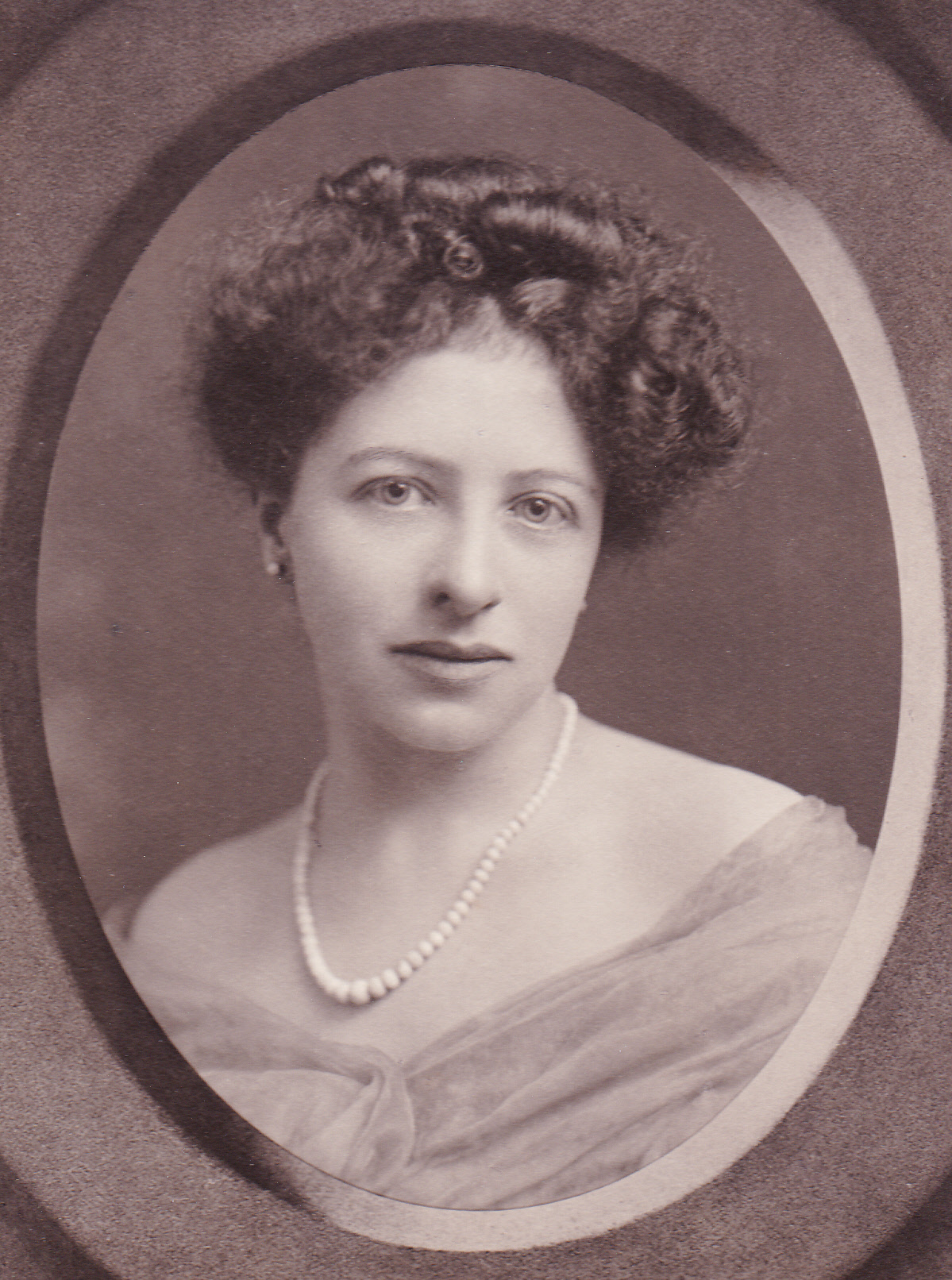 I tell the whole story of Kate’s life (1878-1959) – based on her own outstanding diaries – in Kate Parry Frye: The Long Life of an Edwardian Actress and Suffragette to be published by ITV as an e-book on 7 August 2014.
Kate’s years as the organizer for a suffrage society are told in Campaigning for the Vote: Kate Parry Frye’s Suffrage Diary, published by Francis Boutle in 2013.
Suffrage Stories/ Walks: The Actresses’ Franchise League – And Kate Frye
Posted by womanandhersphere in Kate Frye's suffrage diary, Suffrage Stories, Walks on June 11, 2014
The Actresses’ Franchise League was founded in December 1908. Its purpose was to stage propaganda plays, the majority of which were specially written by members, hold meetings, sell suffrage literature and give lectures. Kate Frye, who considered herself a professional actress, attended her first meeting of the AFL on 23 March 1909.
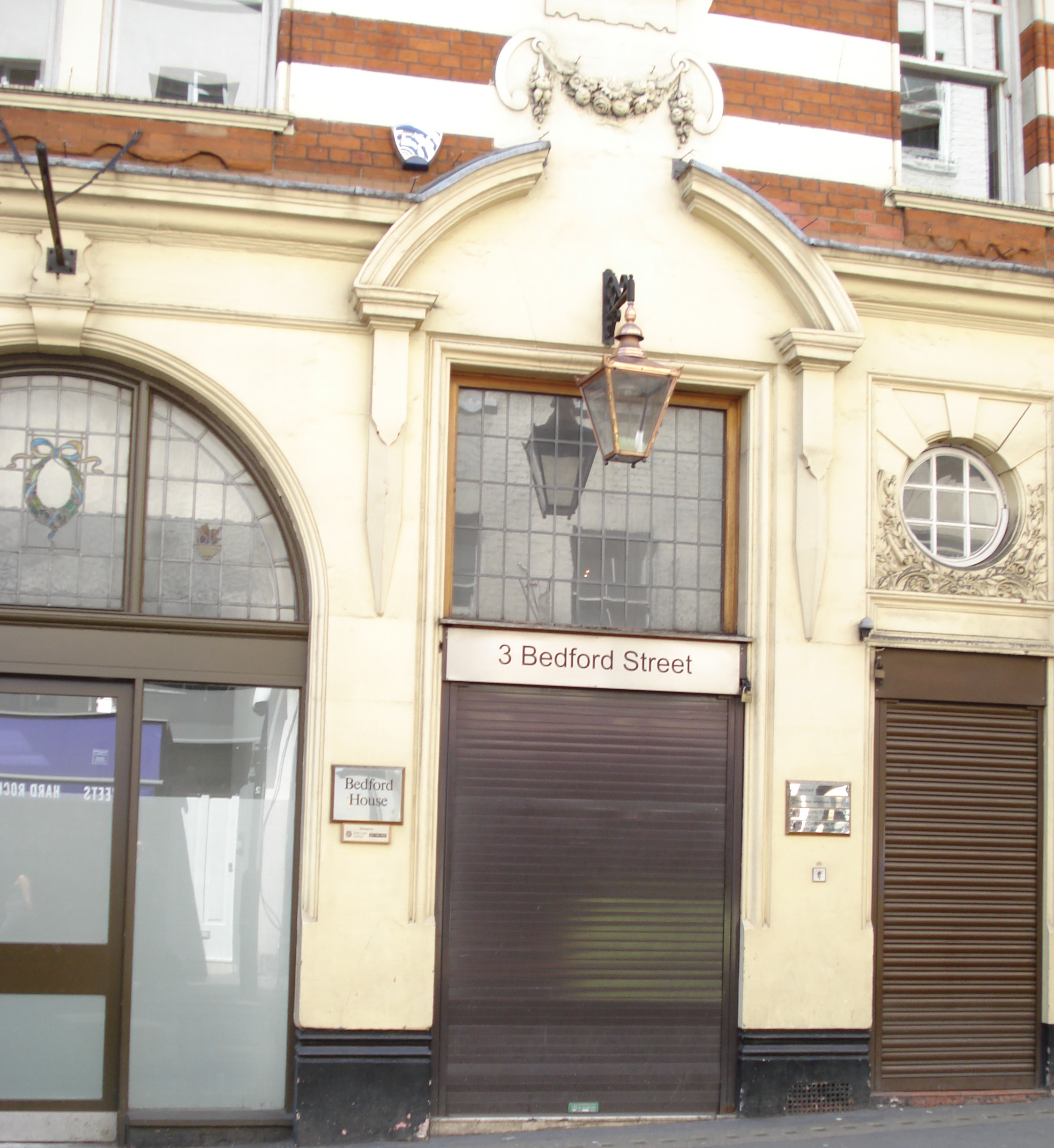
3 Bedford Street, Covent Garden
The venue for this first meeting, 3 Bedford Street, Covent Garden – just a few steps from The Strand – was very familiar to Kate. For on 11 December 1901 she had gone through that door and climbed the stairs to the studio and office near the top of the building where actor/manager Ben Greet ran his Acting Academy. There and then Kate had enrolled as a drama student. The story of her time at the Academy and her subsequent stage career is told in The Great War: The People’s Story – Kate Parry Frye: Edwardian actress and suffragette – which ITV will be publishing as an e-book in August to coincide with their The Great War: The People’s Story series.

Of that first AFL meeting Kate wrote in her diary:
‘Tuesday March 23rd 1909
[Afternoon] went by bus to Bedford Street, Strand – the old Ben Greet Academy Room where we used to rehearse – to the Actresses’ League for Women Franchise meeting. Who should be there but Miss [Ada] Moore, who introduced me to Eva Moore and as she is going to be on our Dance Committee we shall meet again on Monday. She didn’t seem to like me much but I am used to treating all Suffrage women as merely women not little Queens. I had a long talk to Miss Moore who was charming as ever.

Eva Moore with her husband, H.V. Esmond
Kate had known Ada Moore quite well since the late 1890s – and was rather entranced by all the Moore sisters. During her time as a suffrage organizer, she often arranged meetings at which another Moore sister, Mrs Emily Pertwee, was the speaker. Eva Moore had obviously been a little too distant for Kate’s liking when they met on this occasion. She eventually resigned from the AFL after a play written for them by her husband, H.V. Esmond, was deemed too light-hearted for its propaganda purpose.
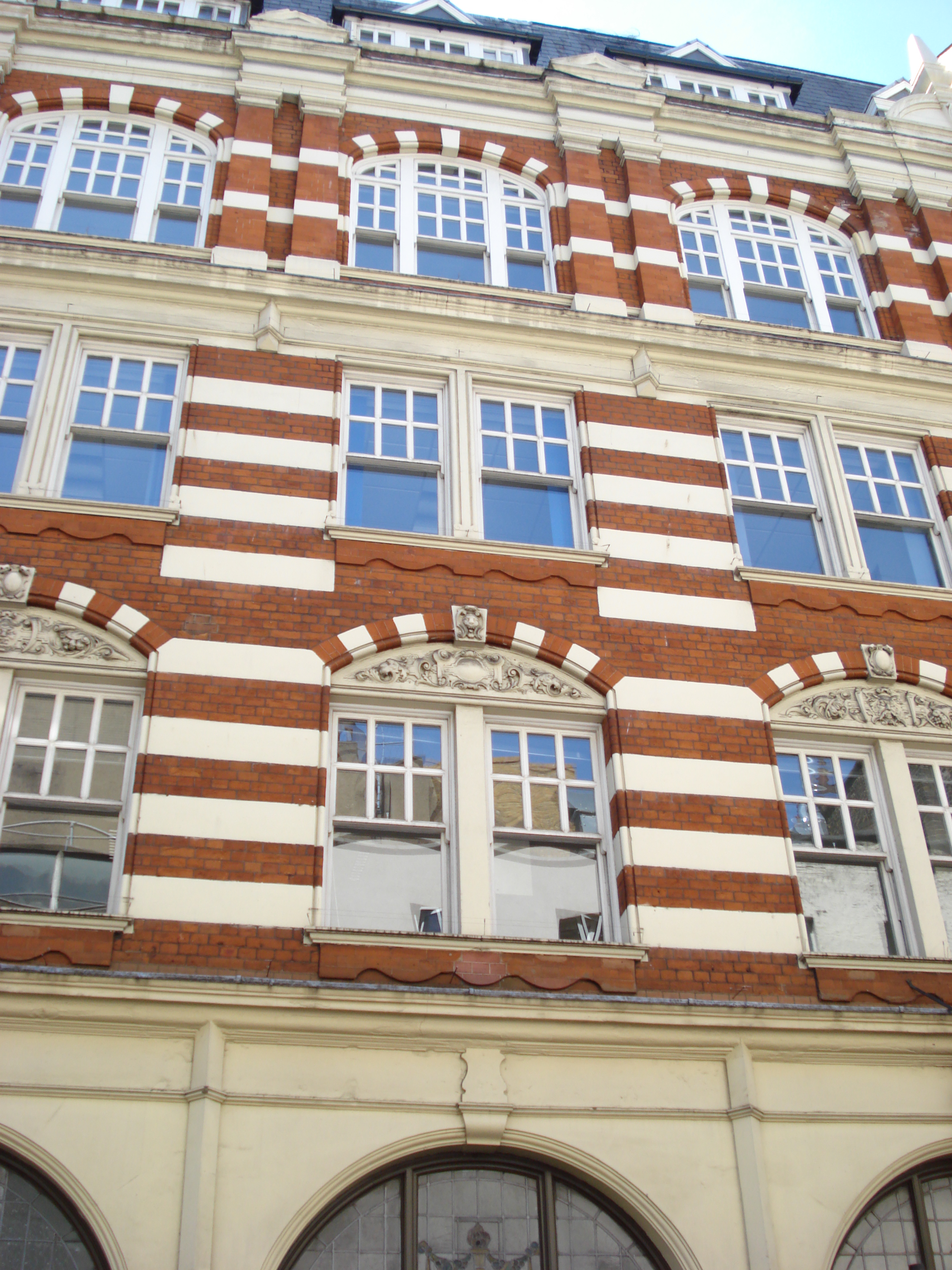
Although the lower half of the building appears to be empty at the moment – and a little sad – it’s not difficult to imagine the tyro actors and actresses – numbering among them Sybil Thorndike – climbing the stairs to the top of the building to be put through their paces by Ben Greet. Or the members of the AFL feeling at home in a building decorated with wreaths and swags.

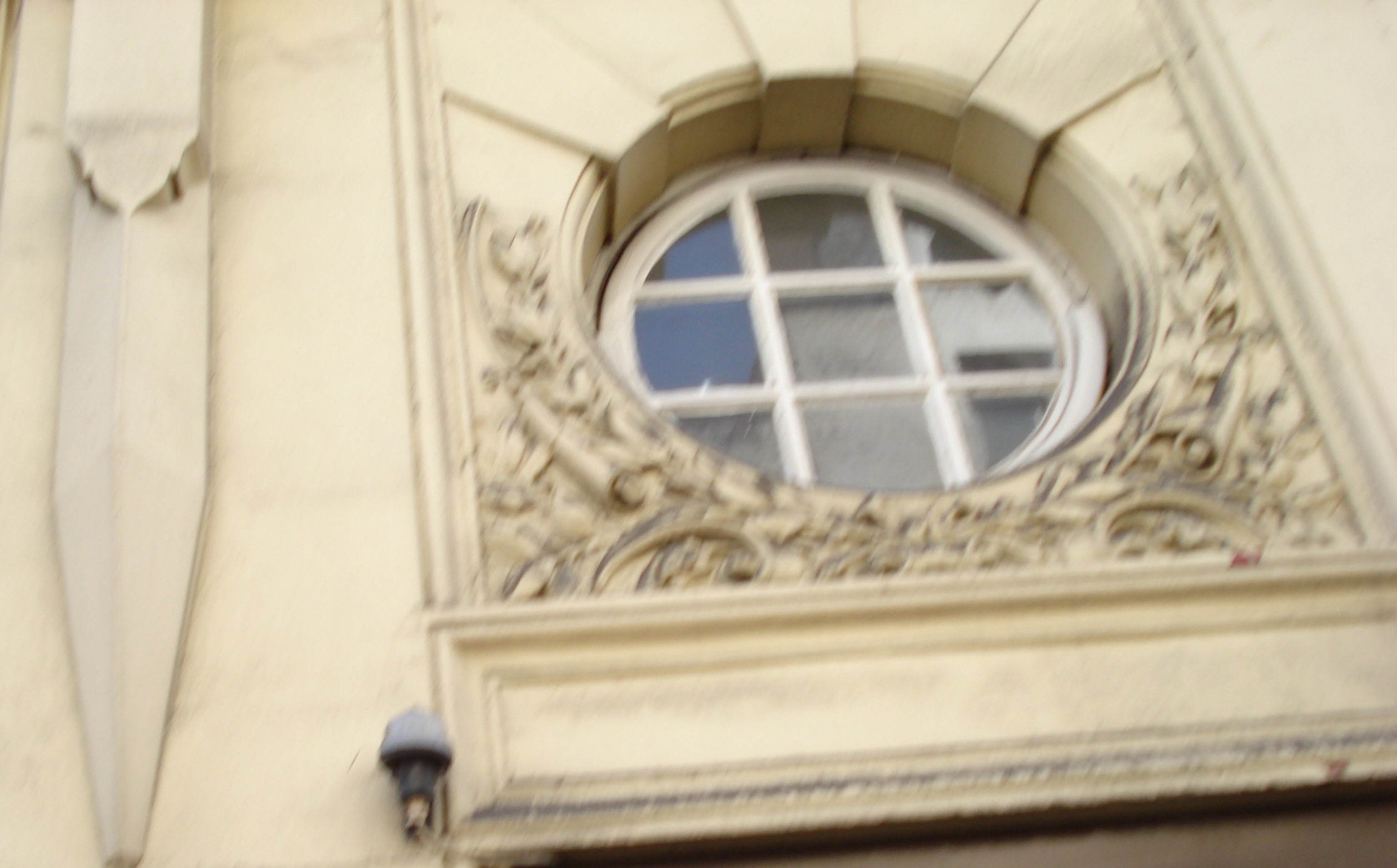
A month later – in April 1909 – the AFL began to hold their meetings in the Criterion Restaurant. Kate was a regular attender at these meetings, often acted as a steward and faithfully recorded in her diary her impression of the occasions. For more about the AFL at the Criterion see here.
For more about Kate Frye and her involvement in the suffrage campaign see here.
Kate Frye’s Suffrage Diary: Buckingham Palace, 21 May 1914
Posted by womanandhersphere in Kate Frye's suffrage diary on May 21, 2014
A hundred years ago today, on 21 May 1914, having failed to influence the government, Mrs Pankhurst’s Women’s Social and Political Union, decided to appeal directly to the King. Kate Frye, although not a militant suffragette, was there – outside Buckingham Palace – to witness the scene. This is the copy of the Daily Sketch that she bought that day and kept all her life.
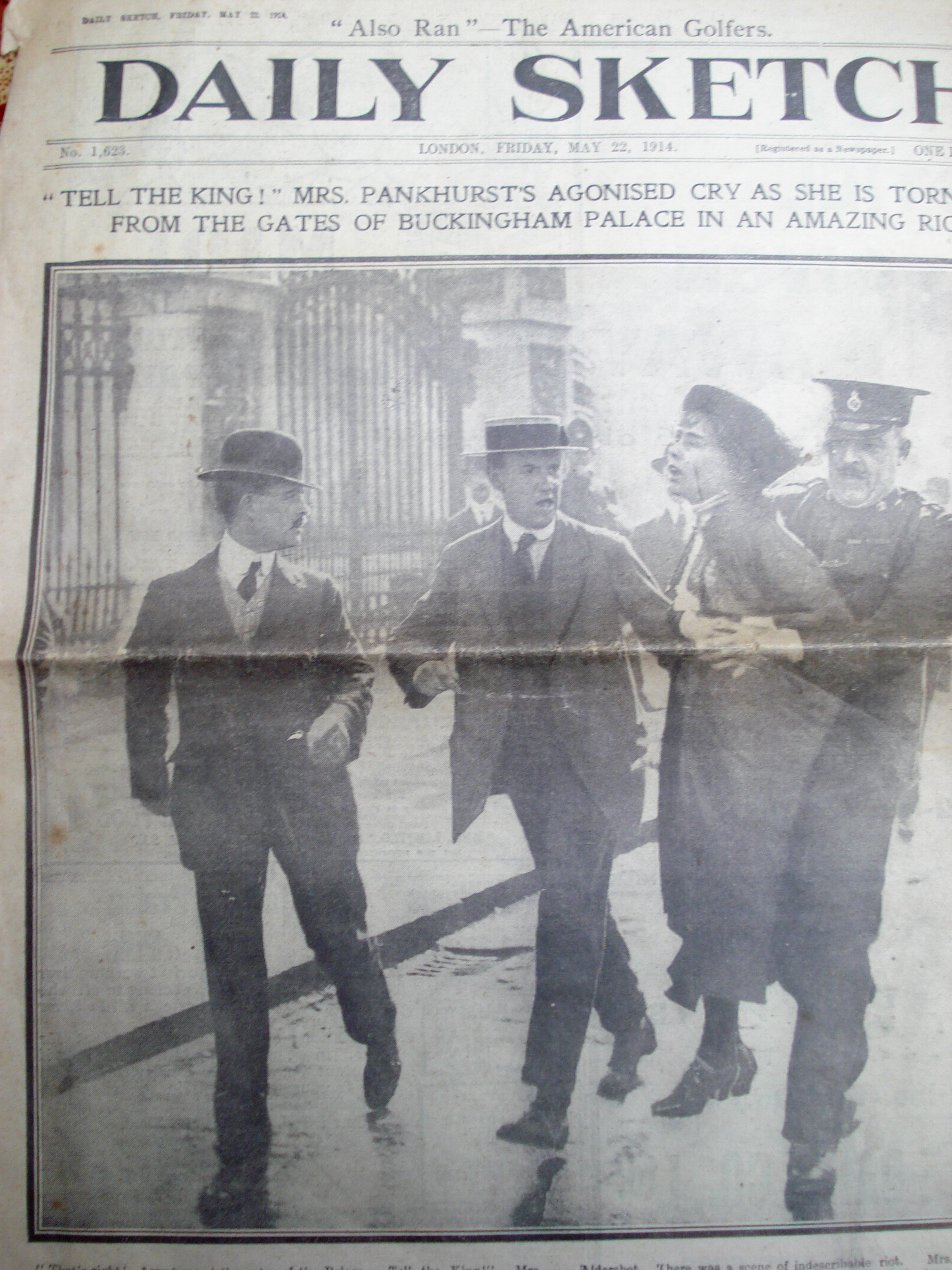
The following is Kate’s diary entry:
‘Thursday May 21st 1914
To Office. Then in the afternoon I went to Buckingham Palace to see the Women’s deputation – led by Mrs Pankhurst which went to try and see the King. It was simply awful – oh! those poor pathetic women – dresses half torn off – hair down, hats off, covered with mud and paint and some dragged along looking in the greatest agony. But the wonderful courage of it all. One man led along – collar torn off – face streaming with blood – he had gone to protect them. Fancy not arresting them until they got into that state. It is the most wicked and futile persecution because they know we have got to have ‘Votes’ – and to think they have got us to this state – some women thinking it necessary and right to do the most awful burnings etc in order to bring the question forward. Oh what a pass to come to in a so-called civilised country. I shall never forget those poor dear women.
The attitude of the crowd was detestable – cheering the police and only out to see the sport. Just groups of women here and there sympathising, as I was. I saw Mrs Merivale Mayer, Miss Bessie Hatton and a good many women I knew by sight. I stayed until there was nothing more to be seen. The crowds were kept moving principally by the aid of a homely water cart. It was very awful. Mrs Pankhurst herself was arrested at the gates of the Palace. I did not see her but she must have passed quite close to me.

At the Buckingham Palace railings, 21 May 1914
I went to Victoria and had some tea and tried to get cool, but I felt very sick. The King could have done something to prevent it all being so horrible – he isn’t much of a man. Back by bus [to the office of the New Constitutional Society where she was working]. They [Alexandra and Gladys Wright, friends and colleagues ] wanted to hear about it, but they don’t take quite the same view of it that I do. They seem so ‘material’ in all their deductions – it’s all so tremendously more than that.’
I edited Kate’s diary as Campaigning for the Vote: Kate Parry Frye’s suffrage diary – but that is now out of print. However you can read
Kate Parry Frye: the long life of an Edwardian actress and suffragette
Published by ITV Ventures as a tie-in with the series: ‘The Great War: The People’s Story’, this e-book tells Kate’s life story from her Victorian childhood to her brave engagement with the Elizabethan New Age. For details see here (and many more posts on my website).
Available to download from iTunes or Amazon
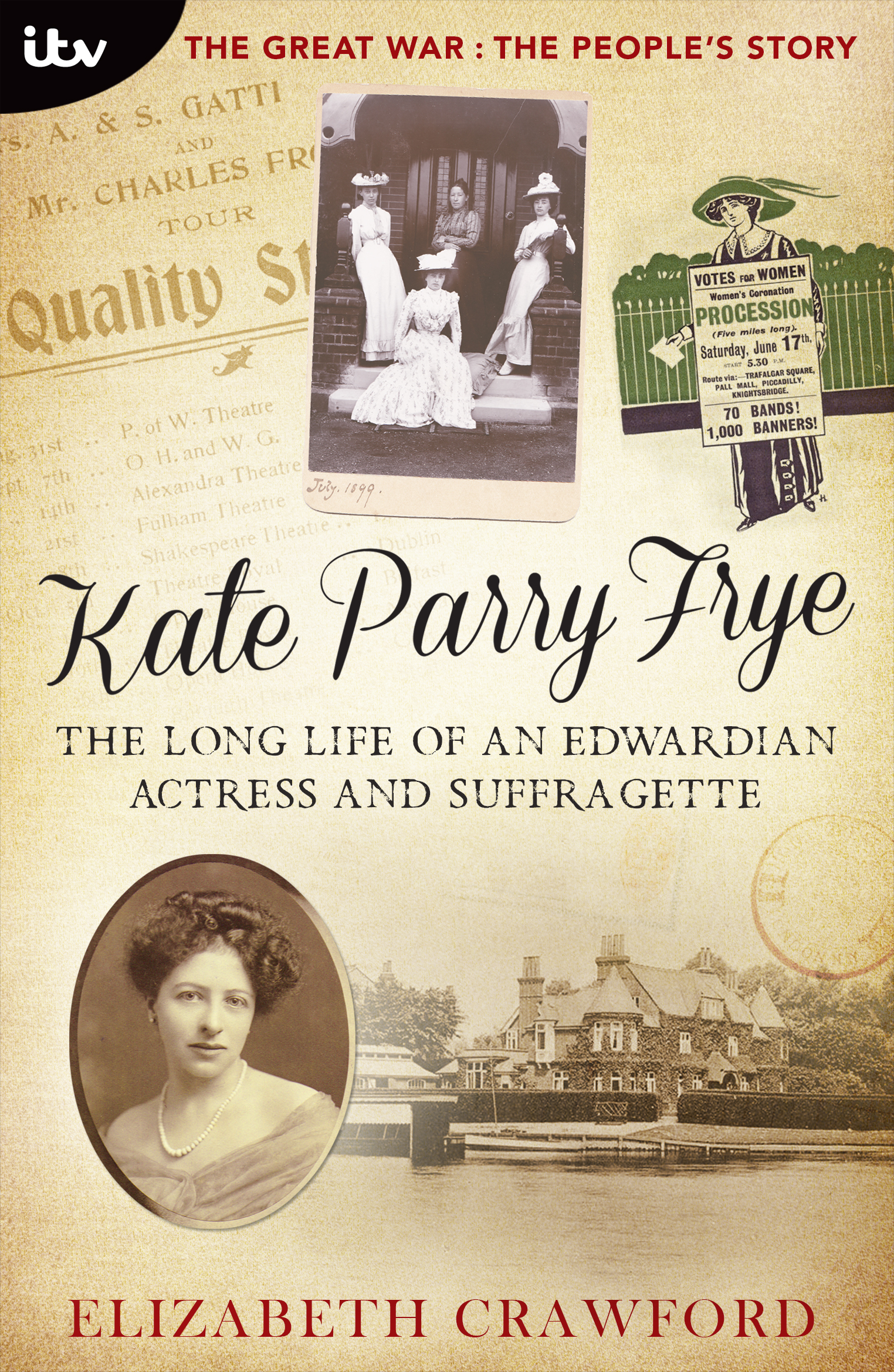
Kate Frye’s Diary: What Happened When The Thames Flooded At Bourne End?
Posted by womanandhersphere in Kate Frye's Diary on February 10, 2014
There is nothing new in Thames floods. Over 120 years ago (although from reading Kate Frye’s diary it seems like yesterday) the Thames overtopped the banks at Bourne End and flooded the garden of the Fryes’ home. Luckily the water did not enter the house, which is slightly raised from the lawn.
As Kate, then 13 years-old, noted –Saturday Oct 24th 1891. Woke to find the lawn flooded all over, right up to the bank. From ten until one we were on the water – which is quite deep – in canoes.
There was another flood in June 1903, when this photograph of Agnes (on the left) and Kate was taken. The image was used by Mr and Mrs Frye for their 1903 Christmas card.
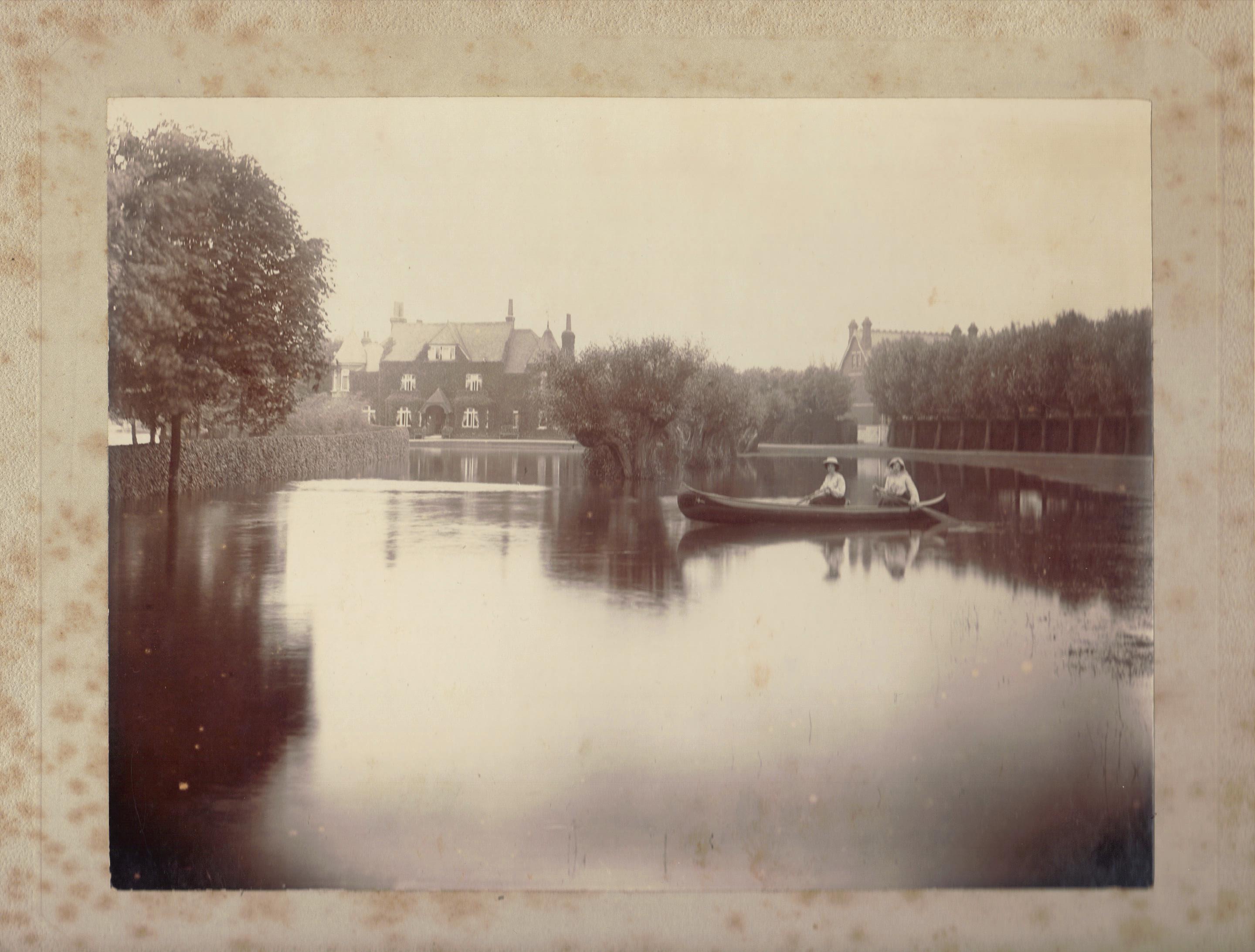 Kate Frye and her sister, Agnes, paddling a canoe on the lawn of their home, The Plat, at Bourne End, Buckinghamshire in June 1903. Photograph by A. Plummer, photographers, of 90 Queen Street, Maidenhead.
On 18 June 1903 Kate wrote in her diary: ‘Our lawn was covered and patches of water went nearly to the pigeon house. It came to the gate. It was so exciting. Agnes and I went to get to [Arthur] Wootten to get a canoe from Townsend’s for us – and we forthwith started. it was splendid sport – we were out all morning. Mrs Bird came along – then rushed back for her camera and photographed us – then Gilbert [Gilbey] arrived and did likewise – and then Plummers the photographer from Maidenhead who we had telegraphed for arrived and took several views.
The water is right in the Quarry Hotel now and up to the centre of the door at Bridge Bungalow. A day like this it is most picturesque but what a disastrous June. We have had to put off our Ascot party – the river won’t be in a fit state for weeks.’
Sunday 21 June 1903 ‘We went across to Cock Marsh in the afternoon and we had great fun. It was wonderful going down stream – we simply tore and going through the Bridge was like shooting the rapids. We had to go down to Mill House before we could get on to Cock Marsh.’
You can discover much more about Kate Frye’s life in Bourne End (and, later, in the nearby hamlet of Berghers Hill) in The Great War: The People’s Story – Kate Parry Frye: the long life of an Edwardian actress and suffragette. This is an e-book published by ITV as a tie-in with the new series The Great War: The People’s Story. Kate Frye, played by Romola Garai, appears in episode 2 – to be shown on ITV at 9pm on 17 August. Download the e-book – £4.99 – from iTunes – : http://bit.ly/PSeBKPFITVal. or £5. 14 from Amazon.
WALKS/Suffrage Stories: The London Opera House, Kingsway
Posted by womanandhersphere in Suffrage Stories, Walks on November 13, 2013
Ever since the decision was made for the Women’s Library to move to LSE (now open as the Women’s Library @ LSE) I have been writing posts that draw attention to the many locations associated with the women’s movement in the area around Aldwych and the Strand. My hope is that researchers in the Women’s Library, when taking a break from their labours, will welcome some information that will allow them to see the surrounding area with fresh eyes.
Today I would like to direct your attention to the site between Portugal Street and Sardinia Street that now houses the Peacock Theatre. Many readers will have been to that theatre, rather oddly sited in the basement of a modern office-type block – if only to take younger members of the family to the annual Christmas treat of ‘The Snowman’. Have you ever wondered why there is a theatre there – in what is now a rather untheatrical area? The answer is related to the wonderful building in the photograph below.
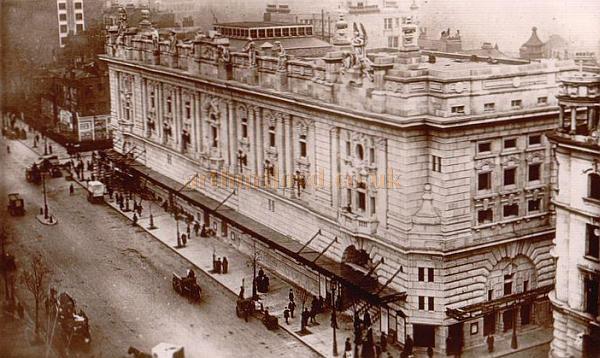 London Opera House, Kingsway. (Image courtesy of arthurlloyd.co.uk)
The London Opera House, its rooftop adorned with figures representing Melody and Harmony, opened 102 years ago today – on 13 November 1911. It occupied an entire block of Kingsway, between Portugal Street and Sardinia Street, and was built for Oscar Hammerstein (Sr) , whose idea was that it should rival the Covent Garden Opera House. The building was opulent and enormous, capable of seating over 2600 people.
Its first season ran from its opening until March 1912, when there was then a hiatus. It was this lack of a follow-up season that, I think, accounts for the fact that on Friday 15 March it was available to be hired for a ‘Suffragists’ non-militant and non-party demonstration’ by the New Constitutional Society for Women’s Suffrage. Kate Frye was its organizer and in Campaigning for the Vote you can read of her efforts, which included mustering the banners of the various suffrage societies – she collected that of the WSPU from Mrs Garrud’s gym – in order to decorate the auditorium. Eva Moore and May Whitty of the Actresses’ Franchise League were amongst the suffragists on the platform, very fitting in such a theatrical venue.
It was not the first time in its short life that the Opera House had held a suffragette meeting. The previous week, the police, on the hunt for Christabel Pankhurst who had given them the slip from nearby Clement’s Inn, searched the Opera House, where she was reported to be hiding. However the New York Times reported that all they found was ‘Oscar Hammerstein sitting alone in state at a big table in the vestibule, with a printed notice behind him reading “Subscriptions department for the Grand Opera Summer Season”.’ The reporter described how ‘Outside the Opera House were posters announcing tomorrow’s meeting’ ‘So you are a sympathiser’, said the correspondent to Mr Hammerstein. ‘I don’t know anything about it,’ he replied, ‘except that I let the opera house to them before they started on their stunts, and can’t break the contract, or else they might break up the opera house’.
The London Opera House was so well-placed in the middle of suffrage society territory – and right beside the Tea Cup Inn, a favourite haunt – that it was to be the venue for various other suffrage meetings.
Hammerstein’s Summer Season was his last at the London Opera House and in July he gave up and returned to America. The theatre re-opened in December, staging variety shows and showing films, but not before it had once again, on 4 November, been hired by the suffrage societies who held a joint meeting protesting at the proposed reform bill.
 It was at the London Opera House on 8 September 1914 that Christabel re-appeared when her exile came to an end, beginning her speech by saying ‘It is very good to be back in one’s own country again, amongst one’s own friends’ – and ending by promising ‘[The war] will sweep away, it must and shall sweep away, the superstition, the narrowness, the jealousy, the suicidal folly which have made of our country two opposing camps – the enfranchised men in one, and the voteless women in the other’.
From 1917 -1940 the building became a cinema – the Stoll Picture House – but from 1942 to 1957 reverted to live theatre – before being demolished in 1958. Planning permission for the replacement building required the incorporation of a theatre – hence The Peacock.
 The office block has now, I see, been taken over by King’s College, which is marching up Kingsway into LSE territory. It is now known as the ‘Virginia Woolf Building’. Which allows my imagination another suffrage spin – to visualise Mary Datchet returning down Kingsway from her suffrage society office in Russell Square to her flat near the Strand. She glances at the poster outside the London Opera House advertising a suffrage meeting (perhaps her society, the PDS, would have been taking part but perhaps, as it probably supported adult, rather than women’s suffrage, not). Little did she suspect that her creator’s name would 100 years later adorn its – rather less – opulent – successor.
The copy of Christabel Pankurst’s 8 September 1914 speech, The War, referred to above will be for sale in my next catalogue.
For much more about the London Opera House and its successors click here.
Kate Frye’s Suffrage Diary: Following In Kate’s Footsteps: Norfolk
Posted by womanandhersphere in Kate Frye's suffrage diary, Suffrage Stories on October 14, 2013
It was in this house, 65 Commercial Road, East Dereham, that on Thursday 16 March 1911 Kate Frye embarked on her career as an organizer for the New Constitutional Society for Women’s Suffrage
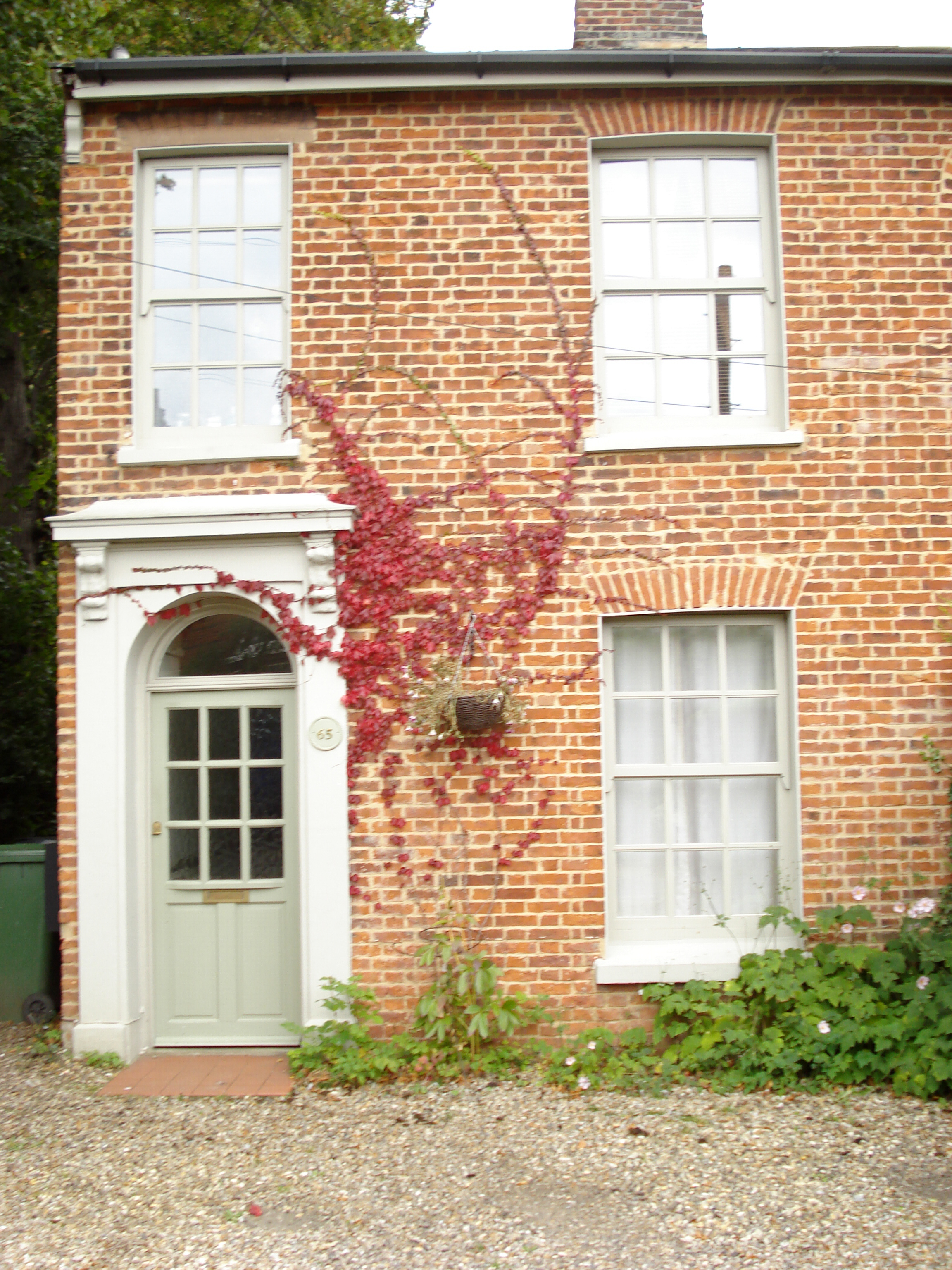
65 Commercial Road, East Dereham
In 1911 this was the home of Mrs Alice West, a widow, who lived here with her young daughter, Hilda, and was able to accommodate at least two paying guests. Over the next couple of years Kate was to be a frequent lodger, describing the rooms on that first night as ‘So nice – comfortable and so clean and a fire in my room to unpack by.’
I was paying a flying visit to Norfolk (to view ‘Houghton Revisited’, the once-in-a-lifetime rehang of Walpole’s pictures at Houghton Hall) and took the opportunity to follow Kate Frye around Dereham, Fakenham and Burnham Market. These were all places in which, between 1911 and 1913, she worked hard to spread the suffrage message.
During the several months that she spent, on and off, in Dereham, there were occasions when it was not possible for her to stay with Mrs West and she then took up residence around the corner from Commercial Road – at 63 Norwich Street, the home of another widow, Mrs Martha Cox. Kate gives the impression that this house was in a poorer condition and caused Mrs Cox, who was most well-meaning and attentive, a great deal of hard work to keep clean and in good order.
For instance, from Kate’s diary: ‘9 May 1912 I am really comfortable here, Mrs Cox is ever so good, too good and I hate to think of her work all day long in this rotten old house.’ I, therefore, wasn’t much surprised, as we walked down Norwich Street, to find that Mrs Cox’s house has been demolished.
Formerly the Dereham branch of the London and Provincial Bank
On the day that Kate commented on Mrs Cox’s ‘rotten old house’, this is where she had spent the afternoon – in the apartment above this bank – then the London and Provincial. Here lived the most reliable suffrage sympathisers that Kate encountered in Dereham – the family of the bank manager, Charles Cory. And, on that afternoon – 9 May 1912 – it was in their drawing room that Kate succeeded in setting up the Dereham branch of the New Constitutional Society. The Corys’ daughter, Violet, was honorary secretary. When compiling The Women’s Suffrage Movement: a reference guide I had wondered why this small Norfolk market town was one of the few places to boast a branch of the NCS.. Kate’s diary provides the answer. It was to Dereham that she was sent and so it was here that she went to work. Why, out of the whole of England, Dereham was selected by the NCS still remains a mystery.
A year earlier, less than a week after arriving in Dereham, Kate organised her first public ‘Votes for Women’ meeting. It was held in Dereham’s 18th-century Assembly Rooms. On 22 March 1911 Kate wrote in her diary: ‘I was over at the hall at 7. We opened the doors at 7.20 and in very little time the place was full. I had to stand at the door and kept the youths and maidens out till the police officer arrived and then went up to sell Literature.
Entrance to the Assembly Rooms, Dereham
Here is the door outside which Kate stood that evening in March 1911.
Having formalised the presence of the NCS in Dereham by setting up its branch, Kate lost no time in arranging another public meeting. The evening of Wednesday 12 June 1912 turned out to be one of the most personally exciting she ever enjoyed – she certainly kept evidence of it and occasionally referred to it in diary entries many years later.
Assembly Rooms, Dereham – front view
It was only by visiting the Assembly Rooms that I made proper sense of Kate’s description. Of that evening she remarks that ‘Miss Cory sold tickets downstairs and I was the doorkeeper and spoke to everyone coming in.’ I now realise that the main hall is upstairs – behind the windows in the first floor in this photograph. (A slimming club was using the hall when I visited and, in the circumstances, I didn’t like to take a photograph of the interior!). That evening Kate was probably stationed upstairs – welcoming the audience and waiting with bated breath for the arrival of the main speaker, the Rev Hugh Chapman. She had already met him at the station and taken him to the King’s Head in Norwich Street, where he was to stay, and had been swept off her feet (as she had in the past) by the apparent fervour of his greeting.
Chapman eventually arrived – brought along from the King’s Head by a fellow clergyman.. The two were friends – the Rev Harold Davidson, rector of nearby Stiffkey, was to become notorious in later years when, after having been defrocked, he met his death at Skegness when a lion turned on him while he was performing as ‘Daniel in the Lion’s Den’. It would appear that Kate could spot a wrong ‘un, describing Davidson, after this one brief meeting, as ‘a frivolous clergyman with a frivolous wife and a beyond-all whopping frivolous young lady – destined for the stage – the whole party seemed quite mad.’ Clearly an apt summation. Anyway that was just the beginning of what was to be for Kate a memorable evening in Dereham.
A month previously – in May 1912 – Kate had lived for a few weeks in Fakenham, campaigning for the NCS at a by-election. She stayed in digs at 1 Carlton Villas, Queen’s Road – an address that I wasn’t able to identify with certainty when I visited. The 1911 census is not very helpful – the Queen’s Road enumerator having failed to give addresses on the cover of the forms in his area.
Queen’s Road, Fakenham
But if I don’t know exactly where in Queen’s Road she stayed, I do know that she must have passed this jeweller’s shop – still here a hundred years later – as she walked to and from the centre of Fakenham each day.
W. Parker and Son, Norwich Street, Fakenham
The shop’s owner told me that the clock, too, has been there all that time -the only difference being that it now runs on a battery.
Fakenham Church
On Sunday 19 May 1912, while lodging at Carlton Villas, Kate wrote in her diary ‘Had a great scramble to get to Church by 11 o’clock but I did it. I always think Suffragettes look such heathens if no one goes. I was the only representative. ‘
A few days earlier Kate had made a recce visit to Burnham Market – finding it ‘Such a quaint pretty spot’. She did all the things that a good organiser should do – identifying a room available for hire, the name of the local policeman, the name of likely supporters etc. These included Mr Hammill, the local doctor, who lived in this lovely house, and whom she described as ‘political’.
Burnham House, Burnham Market
Burnham House is just over the way from the Hoste Arms, where we stayed the night – most comfortably.
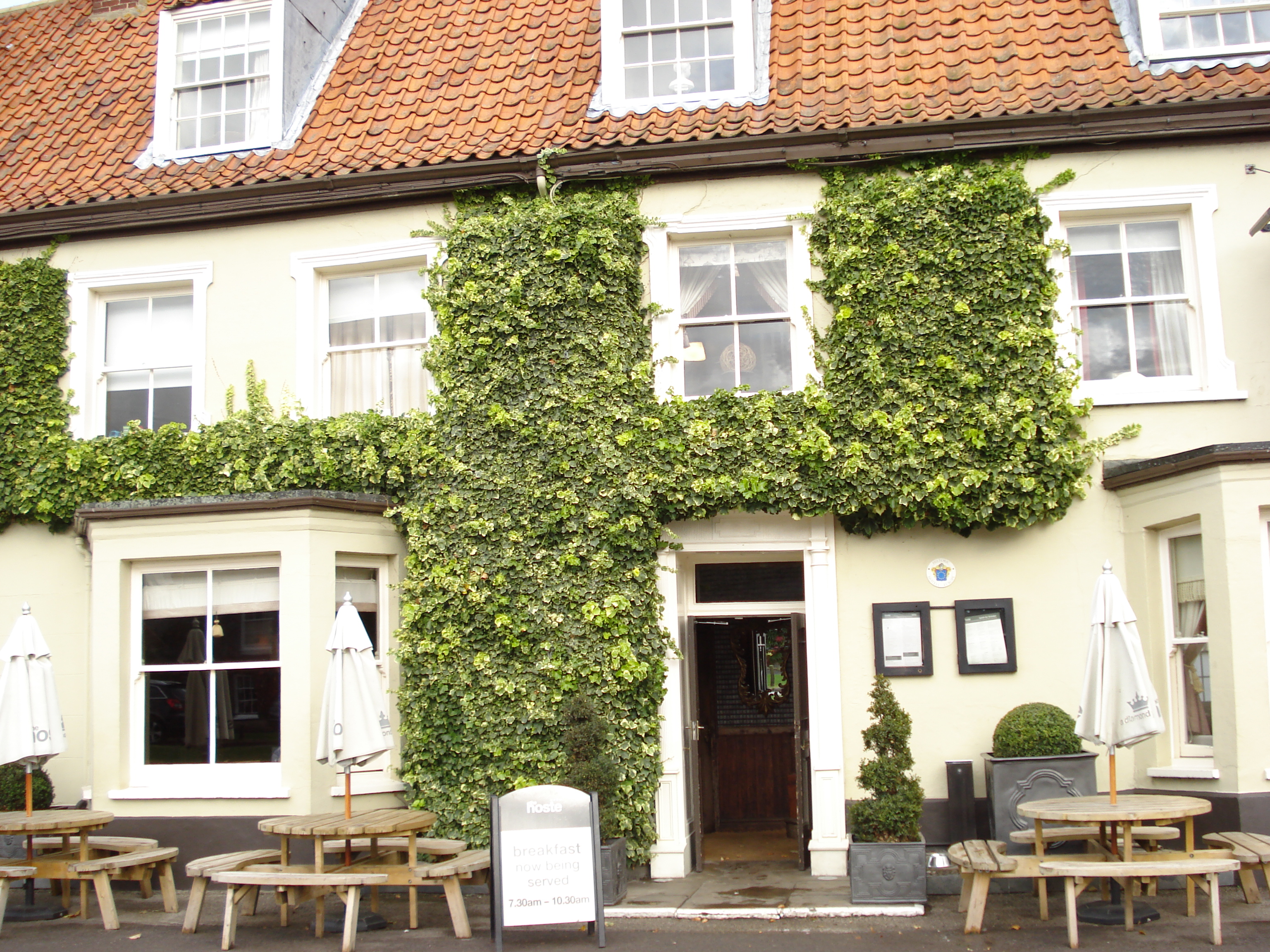
Hoste Arms, 2013
And It was in the Hoste Arms- on 23 May 1912 that Kate enjoyed a brief flirtation with a couple of Irish politicians – anti-Home Rulers. You can read more of this in a previous post – Campaigning for the Vote: Kate Wrestles With North Norfolk, 1912 and much more about Kate Frye in Campaigning for the Vote: Kate Parry Frye’s Suffrage Diary edited by Elizabeth Crawford. For a full description of the book click here Wrap-around paper covers, 226 pp, over 70 illustrations, all drawn from Kate Frye’s personal archive. ISBN 978 1903427 75 0 £14.99. Copies available from Francis Boutle Publishers, or from Elizabeth Crawford – e.crawford@sphere20.freeserve.co.uk or from all good bookshops.
Armed with Campaigning for the Vote you, too, can follow in Kate’s footsteps – not only in Norfolk, but also in London, Suffolk, Essex, Kent, Berkshire and Buckinghamshire.

- ‘Campaigning for the Vote’ – Front and back cover of wrappers
Kate Frye’s Diary: A Visit To Ditchling And Tea With Eric Gill, 1910
Posted by womanandhersphere in Kate Frye's suffrage diary on September 26, 2013
In January 1910 Kate Frye is paying a short visit to Ditchling in Sussex, staying with her dear cousin, Abbie, and her husband, Basil Hargrave, at their home, Chichester House, 11 High Street, Ditchling. Eric Gill, engraver, calligrapher, printmaker, typeface designer and sculptor had settled in Ditchling in 1907, attracting a community of craftsmen – and women – to the village.
Abbie was a prolific novelist, who wrote under the name of ‘L. Parry Truscott’.
 Ditchling, East Sussex, 1912 by G.D. Elms. Ditchling Museum, courtesy of Public Catalogue Foundation and BBC Your Paintings
Here we can see the parish church, St Margaret of Antioch, where Kate endured a ‘long dull sermon’. Abbie and Basil are both buried in the churchyard.
Eric Gill’s house, Sopers, was at 28 High Street. Much later, in 1930, Abbie’s son, Truscott Hargrave (b 1911) was to become secretary to the Saint Dominic’s Press, founded by Gill (who had by then left Ditchling).
Mr Wheelwright, whom Kate found ‘one of the most bitter and arrogant conservatives’, was William Wheelwright, an Australian-born worker in silver and copper. His wife, Helen Maud, was a Gloucestershire-born artist.
Dr Edwin Habberton Lulham, a medical doctor practising in Ditchling and Brighton, was also a poet and lecturer. He appears to have been living away from Ditchling at the time of Kate’s visit, his cottage available for rent. In 1911, when the census was taken, he was living in Margate . See here for more about him
From Kate’s Diary
Saturday 22 January 1910
Abbie busied herself after breakfast and I sat over the fire and read the papers and then wrote a couple of letters before helping Abbie arrange the dining room and drawing room for the afternoon. Then just before 12 o’clock we went out for an hour’s walk towards the Downs. We took the sheepdog, Bay, with us – he is at present the latest addition to the family party at Chichester House. Lunch at 1 o’clock – then we did a few more jobs – and Alice the maid began laying the tea and we put out the cakes and at 3 o’clock we went up and changed our dresses as the party commenced punctually at 4 o’clock.
We were 23 in all. only 3 men. Basil, the Vicar and the man, Mr Gill, who read the paper to start the debate. It was quite a clever paper – but he did not make it interesting really and it was not a popular subject – ‘The arts and crafts in the home’ – very few made any remarks at all and they were very far wide of the mark for the most part – some of them were very amusing. A Mr Davidson was really killing and the Vicar so pious. Basil’s speech was really the best as it did raise some points but no one took them up. It was over and everyone had gone soon after 6 o’clock.
 Eric Gill
Abbie hastened on the dinner – we changed our things again for walking apparel, had dinner about 7 o’clock – and then went off to a political meeting in the schools – but as a great concession by the Vicar (a rabid Conservative) to the Liberal Candidate, Mr Basil Williams. The place was very full of those who thought otherwise and they were so noisy they were a great trouble to the speaker. There were very few of his supporters there and I should think I was the only Liberal woman in the place. It is a most Tory village.
I much enjoyed the meeting but I must say I did not admire the spirit of some of the ‘hecklers’. One man who I found out was a friend of Abbie’s afterwards – a Mr Wheelwright was a fearful nuisance. There was a very good free-trade speaker first but he rather lost his temper with the folk and absolutely showed his teeth at them. Mr Basil Williams came on later from another meeting. A nice looking man and he spoke quite well. But he does not stand a chance – it is wonderful to get men to contest such seats, I think. A great crowd was waiting to hiss and boo him as he left in his motor car. What an ungrateful lot – to boo one of the party who gave them political emancipation.
Sunday January 23rd 1910
To the Parish Church where they have a pew by right with Chichester House. A bawling choir and a long dull sermon – but a beautiful old building. then for an hour’s walk. The roads very slippery until the rain started which it did just as we neared home. We went over Dr Lulham’s cottage which he has very nicely furnished but rather crowded. I should like to take it one day for a few weeks and stay in Ditchling.
Tidied ourselves and Mr and Mrs Wheelwright came to tea. I found him one of the most bitter and arrogant conservatives and Tariff Reformers I have ever come across and we talked politics all the time nearly and they stayed till quite 7 o’clock. I don’t think I could do with him myself – or with her for that matter. I do hate prejudice to that extent – but they are great friends here.’
See here for details of the published edition of Kate’s diary – Campaigning for the Vote.
The Ditchling Museum of Arts and Crafts has just re-opened after a major refit. See here for new opening hours and here for some of the Museum’s past projects.
 Ditchling Museum of Arts and Crafts
For the Eric Gill Society see here.
Kate Frye’s Suffrage Diary: The Suffrage Shop in Hythe High Street
Posted by womanandhersphere in Kate Frye's suffrage diary on August 9, 2013

In mid-1912 this shop at what was, before renumbering, 83 High Street, Hythe- now, rather suitably an animal welfare charity shop, opened as the local Suffrage Shop and Club, run by Miss Georgina Cheffins and Miss Eva Lewis, who, although members of the WSPU, were Kate Frye’s most active supporters in the area as she went about her business of organizing meetings for the New Constitutional Society for Women’s Suffrage. I visited it myself in the summer of 2011 and found that the shop is quite large and, as Kate Frye describes, has a room at the back in which the Suffrage Club held its meetings.
Georgina Cheffins (1863-1932) was the daughter of a Portland cement manufacturer. and In the 1901 census, when she was living with Eva Lewis in the St James’s Mission, Temple Street, Sedgley, Cheshire, they are both described as ‘lay sisters’. Eva (Evangeline) Lewis (1863-1928) had been born in Ontario, Canada, the daughter of John Lewis, Lord Bishop of Ontario. She lived with Georgina Cheffins, who was very much the wealthier of the two, from some time before 1901 until her death.
Both women successfully evaded the 1911 census and in 1912 Miss Cheffins was sentenced to four months’ imprisonment after taking part in a WSPU window-smashing raid in London – breaking windows in Gorringes’ store. In court she declared she was a suffragist by conviction, having worked amongst the poor for 20 years.
When Kate first met them the two women lived at ‘Dunedin’, Seabrook Road, the long road connecting Hythe and Folkestone, but in early 1912 they moved to ‘Cravenhurst’, Napier Gardens, Hythe. When I visited Hythe in 2011 I did not know which house in Napier Gardens had been ‘Cravenhurst’ – and it is only today that I have found a piece of information that links the name of the house to a number – 24 – which is ,I think, opposite the house below – one of several in the street that I photographed at random. Anyway, I think no 24 was at the more secluded end of the cul-de-sac that is Napier Gardens .
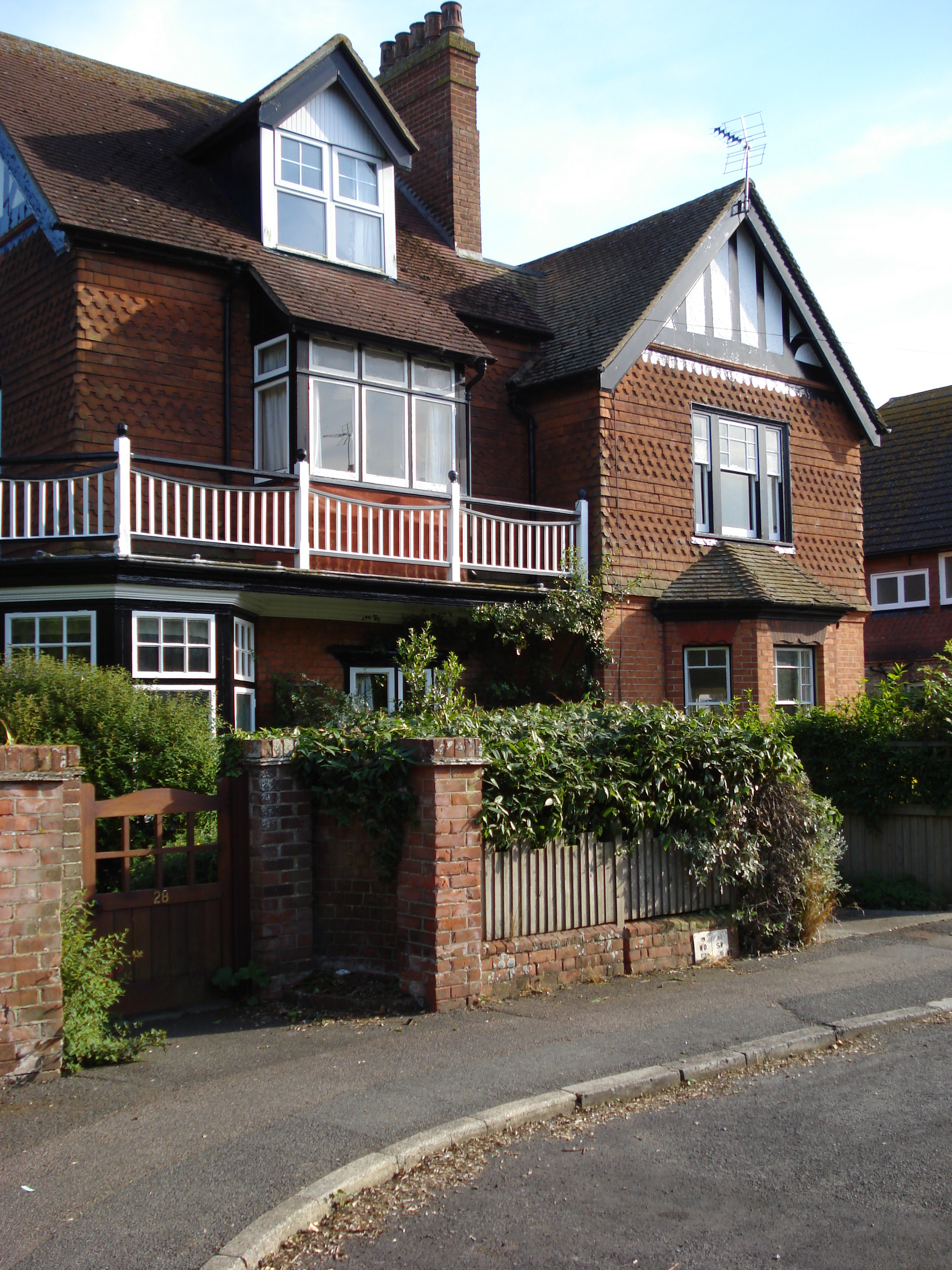
In the summer of 1912 Votes for Women, the WSPU newspaper, reported that the Hythe Suffrage Shop had been visited by many WSPU members on holiday in the area – and that many volunteers had been out selling copies of the paper.
Campaigning for the Vote: Kate Parry Frye’s Suffrage Diary is full of details of the delights – and tribulations – of spreading the ‘Votes for Women’ message in Hythe. Although Miss Cheffins and Miss Lewis could on occasion be prickly, Kate kept in touch with them well into the 1920s.
See here for much more about Campaigning for the Vote
PS. Update – Thanks to Betty Black for information on the renumbering of Hythe High Street. Nothing beats local knowledge.
Copyright
All the articles on Woman and Her Sphere and are my copyright. An article may not be reproduced in any medium without my permission and full acknowledgement. You are welcome to cite or quote from an article provided you give full acknowledgement
Kate Frye’s Suffrage Diary: In Bed – Photographed With Radio Headphones At The Ready – 1920s
Posted by womanandhersphere in Kate Frye's suffrage diary on July 20, 2013
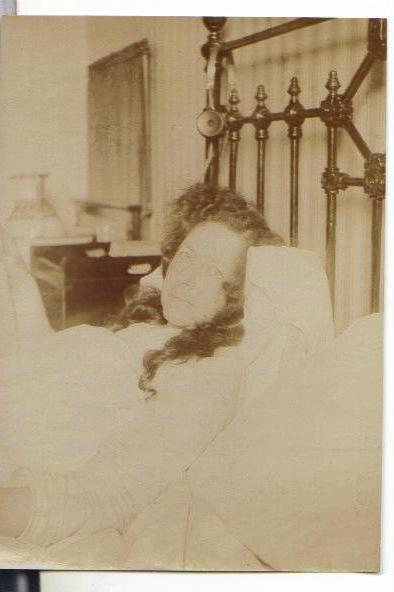
Working my way through Kate Frye’s extensive collection of photographs I have just come across this one. It is so unusual to see a photo of a woman lying in bed that I thought I must share it with you all. You’ll note the radio headphones hooked on the brass bedstead which probably dates the photo to the second half of the 1920s. The photo would have been taken by Kate’s husband, John Collins, who was a keen photographer. Kate, for her part, was a keen and early radio listener, delighting as she did in all forms of music and drama.
Campaigning For The Vote: Kate In Dover 100 Years Ago: A Sunday Visit From John, May 1913
Posted by womanandhersphere in Kate Frye's suffrage diary on May 23, 2013
Kate Frye is working in Dover, lodging at 26 Randolph Gardens with the Miss Burkitts’, who are WSPU sympathisers and aunts of Hilda Burkitt, a well-known suffragette. A vignette of life in ‘digs’.
‘Poor Gertie’ was, as Kate explains in a previous entry, ‘Miss Odames – a being from Leicester who used to work in a Factory but is now quite well to do. She is very common and very plain.’ ‘Gertie’ was ‘Agnes Gertrude Odames, born in Leicester c 1878 who, in 1901, was a ‘corset maker’ but who, with her sister, was in 1911 able to describe herself as ‘of private means’. Gertie married in 1917 and when she died in 1951 left over £1000, having probably lived a more comfortable life than Kate. I have, as yet, been unable to identify ‘Bertie Bowler’.
Sunday 25 May 1913
A glorious day and quite hot. The others all of to Church. I as usual on Sunday took my time in getting up. While I was in the bathroom the young gentleman who we have been hoping and longing for came to say he would take the rooms. Miss Minn was in. I had to wait until he had departed to get upstairs. We are very excited.
I wore my thin coat and skirt out for the first time without a top coat. Walked along the front to the Town station and met John [her fiance, an actor] at 12.30. He had come down by the Miss Burkitts’ invitation to spend the day. We had not met for 5 months. It was very exciting. I think he was pleased and I enjoyed having him. He looks alright though a trifle thin – came to London last Sunday at the close of the Repertory season at Liverpool.
We walked along the front in the blazing sun and up and got in at 1.15. John behaved very nicely but of course he was a stranger in that homely atmosphere – however the Miss Burkitts seemed to get on with him.
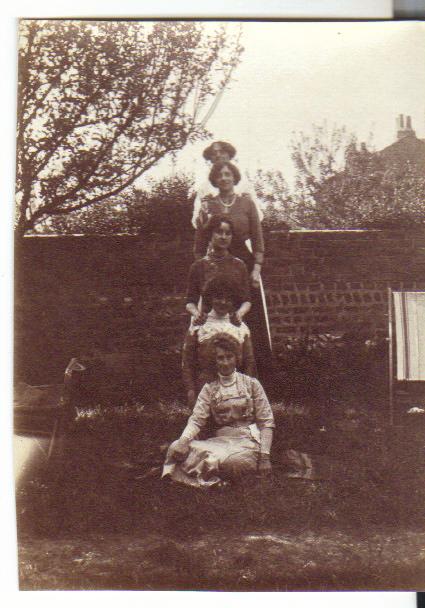
John Collins’ staged photo shoot in the Misses Burkitts’ garden
We went in the garden afterwards and John took snapshots of the group and Janet [Capell] came in to be introduced. Then John and I took a tram as far as it went and strolled about the Admiralty Pier. It was a gorgeous afternoon. We had permission to be late for tea so we walked along the front and took a photograph of Mrs Wilson’s house and then back to tea.

Mrs Wilson’s house at 5 East Cliff, Dover, photographed by John Collins while he and Kate were out for their walk
Then we sat in the garden and Bertie Bowler was there and sang his Ditties. I had told John to be nice to him – and BB said afterwards how nice he was. I don’t think John knew what to make of poor Gertie. Poor soul she looked hopeless in a stiffly starched white embroidery ready made gown. She says such amazing things.
Miss Minn took herself off to Church – a thing she never does in the evening but I think she is madly jealous. She was very nice when she said good-bye to John – said ‘I like you very much – I think you are almost good enough for our darling’ – but afterwards she never referred to him. Once or twice I dragged his name in but she wouldn’t say much. Poor Miss Minn. Miss Burkitt on the other hand chatted of him and said how much she liked him.
We had to walk as the trams were packed to the roof. I was not allowed on to the station – it was like a bank holiday – so i did not wait but came straight back on a Tram – just missing Miss Minn who had gone down after Church to come back with me. When I said she was naughty to go to Church – she said she thought the others would have had the sense to leave us alone together. I was very tired.
Campaigning for the Vote: Kate Parry Frye’s Suffrage Diary edited by Elizabeth Crawford
For a full description of the book click here
Wrap-around paper covers, 226 pp, over 70 illustrations, all drawn from Kate Frye’s personal archive.
ISBN 978 1903427 75 0
£14.99
Copies available from Francis Boutle Publishers, or from Elizabeth Crawford – e.crawford@sphere20.freeserve.co.uk, from all good bookshops – especially Foyle’s, London Review Bookshop, Persephone Bookshop, British Library Bookshop, Daunts Bookshop, The National Archives Bookshop and Newham Bookshop. Also online – especially recommend very favourable price offered by Foyle’s Online (and they pay all taxes!)
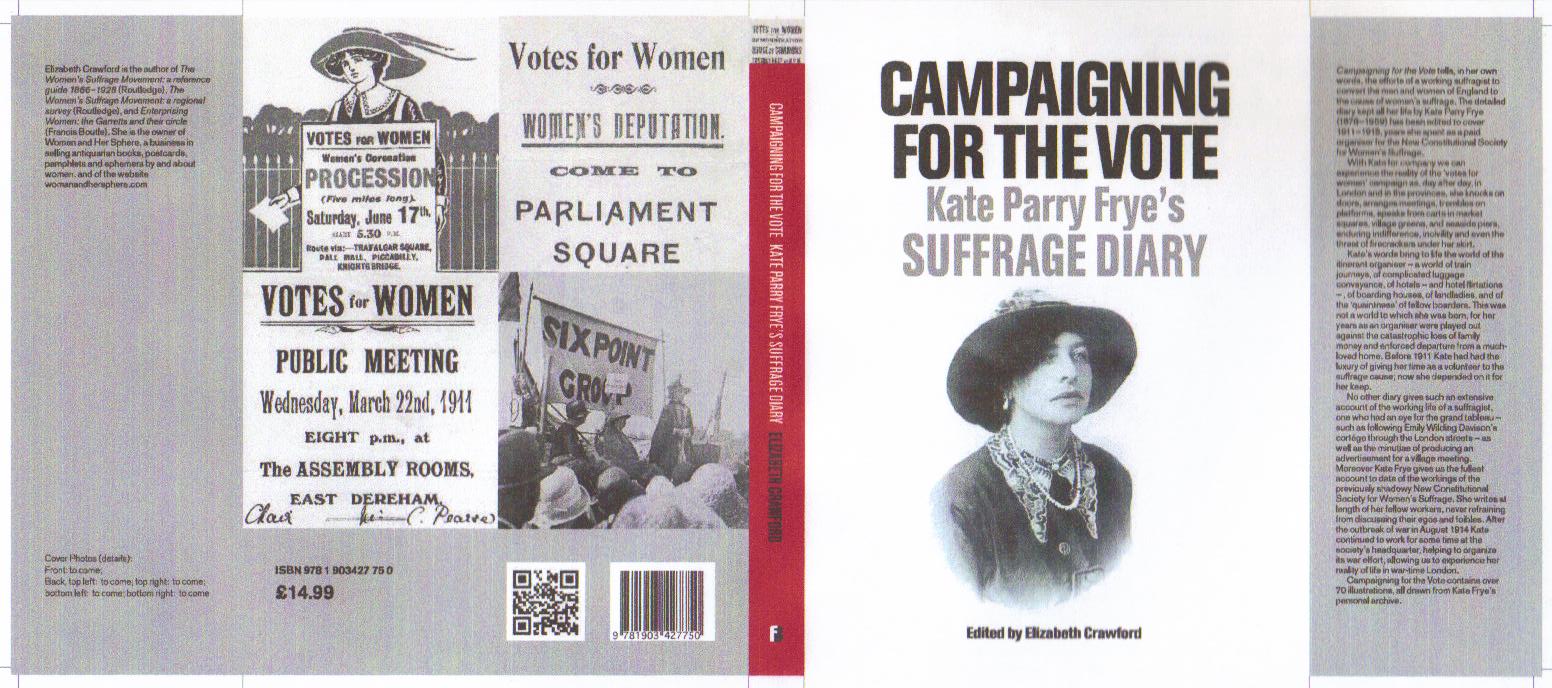
Suffrage Stories/Campaigning for the Vote: Selfridge’s and Suffragettes
Posted by womanandhersphere in Kate Frye's suffrage diary, Suffrage Stories on May 16, 2013
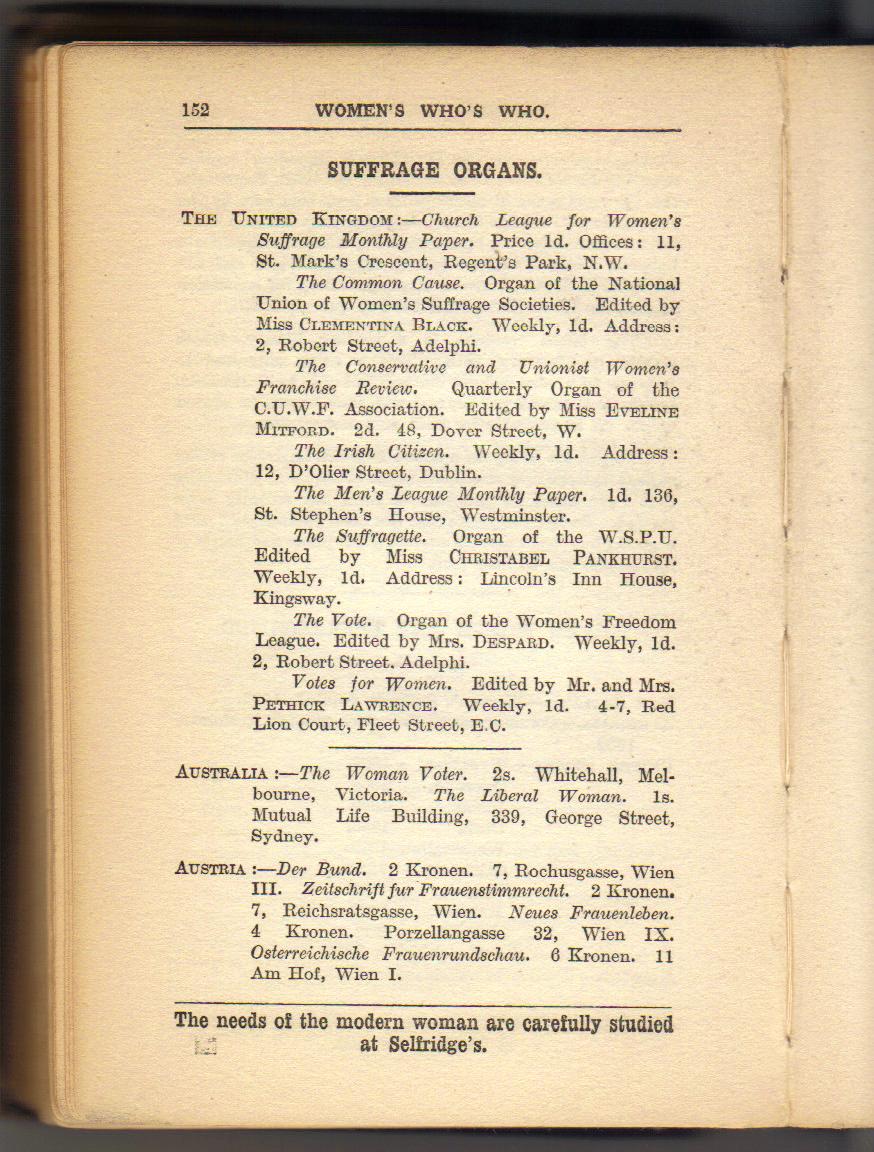
The Suffrage Annual and Women’s Who’s Who
Selfridge’s opened its glamorous, purpose-built store in Oxford Street on 15 March 1909 and Kate Frye, an ever curious shopper, paid her first visit there on 29 March. (For Kate’s published suffrage activities see here.)
In the morning Kate attended a meeting of the Dance Committee of which she, along with the actress Eva Moore, was a member – they were organising a fund-raising dance for the New Constitutional Society for Women’s Suffrage. Then she met her fiance, John Collins, and, together, they went along to inspect Selfridge’s.
‘We had some lunch there and did the roof and tried to make ourselves giddy – it was lovely up there. Then we systematically did the shop beginning with the top. We had 2d of gramophone each and generally played about and it was 4.30 by the time we had finished. It is a wonderful building but there is nothing in the goods to especially attract. The place was packed and a good many people were buying.’
Kate was, of course, a keen suffrage sympathiser and, although she may not, on that first visit, have appreciated it, Selfridge’s was to be generally supportive of the suffrage cause. For four years later, advertising itself as ‘Selfridge and Co: The Modern Woman’s Club-Store’ on the book’s purple cover, Selfridge’s put its stamp on what is now one of the most useful research tools available to suffrage historians.
The Suffrage Annual and Women’s Who’s Who, published in 1913, contains irreplaceable details about women involved in the suffrage campaign – both militants and constitutionalists. It is likely that Selfridge’s underwrote much of the expense of producing it for, as you see, besides its cover advertisement, the store took running advertisements along the foot of every page.
It is reported, but I have yet to verify, that on occasion Selfridge’s dressed their windows in the purple, white and green colours of the WSPU and even flew the WSPU purple, white and green flag from the store’s flagpole.
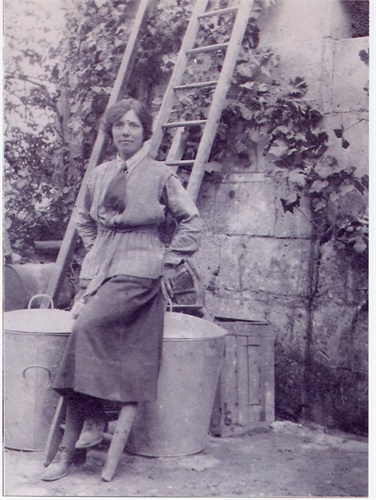
Gladys Evans (photo courtesy of Ward Skinner)
However, one clear link between Selfridge’s and the suffragettes is this woman, Gladys Evans, the daughter of a man, now dead, who had owned the British weekly magazine Vanity Fair –a very influential ‘society’ paper ( not to be confused with the Conde Naste magazine which in 1914 adopted the name). Gladys joined Selfridge’s in 1908 in preparation for the opening of the new store and worked there for over a year before leaving to take over a WSPU shop. In 1911 she emigrated to Canada, where a sister had settled, but returned in March 1912 after learning of the arrests of Mrs Pankhurst and Mr and Mrs Pethick Lawrence.
Firmly back on the WSPU warpath, in July 1912 Gladys went over to Dublin where Asquith was on a formal visit and, with other suffragettes, Mary Leigh and Jennie Baines, set fire to a theatre – empty at the time – but the one in which Asquith was due to speak that evening. Gladys Evans was given a long prison sentence, went on hunger strike and was forcibly fed for 58 days.
There was a good deal of lobbying to get her and her companions given the status of political prisoners – which would have allowed them better conditions. One of those who wrote on Gladys’ behalf was Selfridge’s staff manager, Mr Best. and 253 of the store’s employees signed a Memorial sent to the Lord Lieutenant of Ireland pleading for a remission of Gladys Evans’ sentence – see Votes for Women, 6 September 1912. Apparently, even Mr Selfridge himself was sympathetic, though reluctant to put pen to paper in Gladys’ support because, as an American, he thought it might look as though he were trying to interfere in matters that didn’t concern him. Gladys and Mary Leigh were eventually returned to England, where they promptly gave the police the slip and went on the run.
For most of her later life Gladys Evans lived in the US, dying at the age of 90 in Los Angeles. Evans’ family history relates that Gladys gave all her suffragette papers to the New York Public Library. I have not, however, been able to find a listing for them. That might be a research project for an interested New Yorker.
Selfridge’s suffrage sympathies may have stood the store in good stead when the WSPU went on its window-smashing campaigns in November 1911 and March 1912. Many department stores- even those which, like Swan and Edgar, were regular advertisers in Votes for Women – were targeted. But Selfridge’s windows – 21 in all, of which 12 contained the largest sheets of plate glass in the world – escaped unscathed.
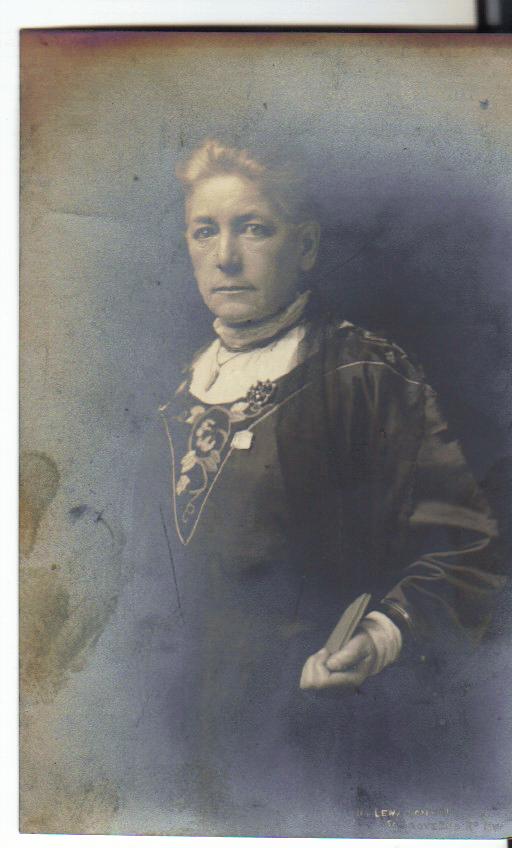
Sarah Bennet, photographed by Lena Connell
However in February 1913, in protest against the fact that the government had been withdrawn the proposed Franchise Bill, Sarah Benett, one-time treasurer of the Women’s Freedom League, was sentenced to six month’s imprisonment after breaking one of these windows. Incidentally, Sarah Benett in 1916 sent a donation to Maud Arncliffe Sennett towards the expense of employing Gladys Evans as an organizer for the Northern Men’s Federation for Women’s Suffrage.
Copyright
Campaigning For The Vote: Book Launch Invitation
Posted by womanandhersphere in Kate Frye's suffrage diary on May 9, 2013
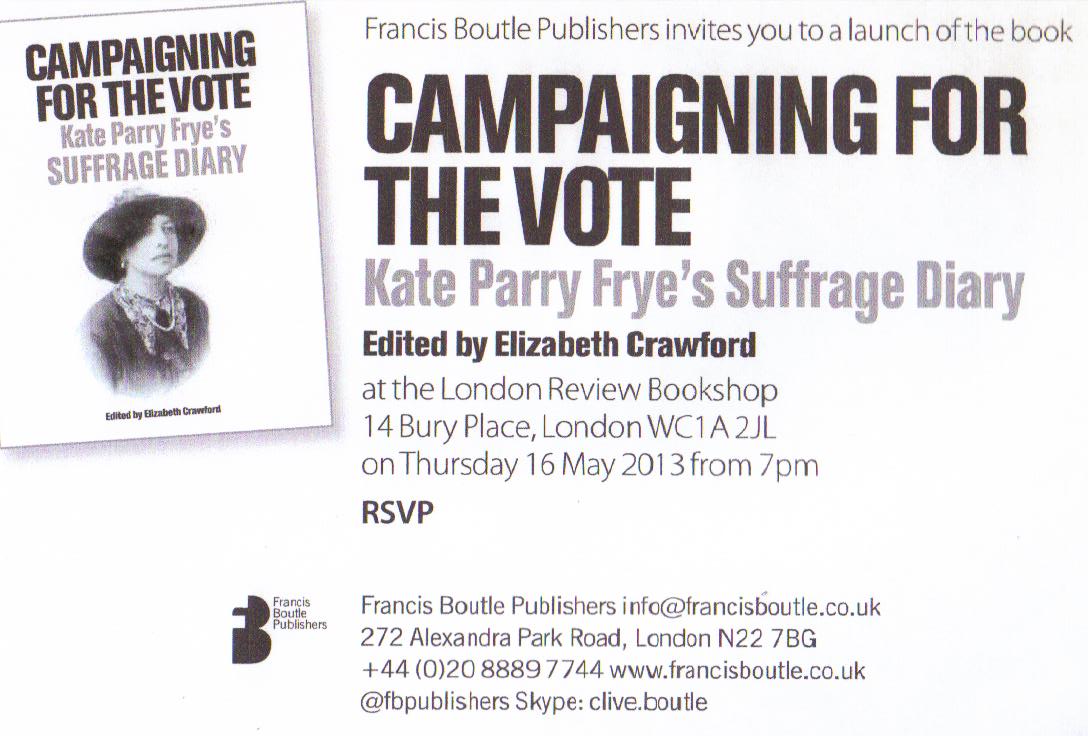
Campaigning For The Vote: Kate Wrestles With North Norfolk, 1912
Posted by womanandhersphere in Kate Frye's suffrage diary, Suffrage Stories on April 25, 2013
In early summer 1912 Kate Frye was in Norfolk, based in East Dereham, organizing the ‘votes for women’ campaign for the New Constitutional Society for Women’s Suffrage in Norfolk. In May the sitting MP for the Northwestern Division of Norfolk died and a by-election was called. Kate hurried to Hunstanton to organise the NCS campaign – rather at a disadvantage vis a vis the other suffrage societies, the WSPU and the NUWSS, both of which had many more organisers, money, and, above all, cars at their disposal to cover the constituency. But Kate did her best. For example:
On 28 May she hired a motor for 22/- from Johnson’s Garage in Hunstanton to take the Society’s speakers, Miss McGowan, Mrs Chapman (the Society’s president) and Mr Lloyd (supposedly an Australian although she began to have her doubts) to Burnham Market. Tuesday May 28th 1912 [lodging in Hunstanton at Palace House, Westgate] Had a lot of writing to do in the morning and had to go out to make arrangements and then a great rush to get something to eat and off to Burnham Market at mid-day. I took the Literature to the Hotel, left it here and ordered tea – then I canvassed hard and walked all the way to Burnham Overy.
Hoste Arms, 2013
Came [back to Burnham Market] to Hoste Arms Hotel – found one of my Irish friends [these were Irish political organisers also in the area campaigning for the by-election] still there- the younger married one- at least the other was married too – but I gathered he was separated from his wife. My friend greeted me quite tenderly – we met as old friends – there were two other Irishmen – Anti Home Rulers and two Liberals – a young coming-on Politician – quite nice looking – and an older man who, I was told afterwards, was Mr Ouithwaite – a candidate somewhere. We all had tea and eggs and Suffrage discussions – Mr Ouithwaite was quite violent – but I really had him every time – quite a roar went up at some some my answers – I enjoyed that tea party immensely. I think we all did – Mr Ouithwaite least of all, perhaps, but I felt I was scoring – and as only the two odd Irishmen were inclined for Votes for Women I had no help. No 1 Irish was not so rabid though.
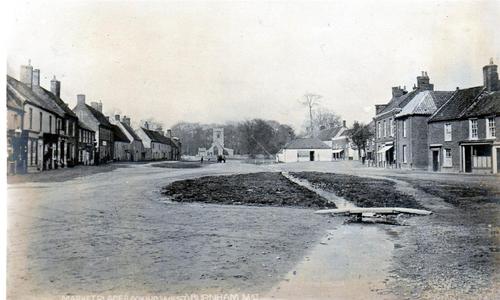
Burnham Market, 1912
I only got to the Schools just in time to have the doors open and let the crowd in – no policeman there so the boys had to go – it looked like a rowdy meeting from the first. The place was pretty full when the car arrived – Miss McGowan with Mrs Chapman and Mr Lloyd. Miss McGowan took the Chair – and they were fairly quiet while she spoke – but directly Mrs Chapman got up the trouble began. No one could hear her – she was feeling so dreadfully ill with a feverish cold – she must have had a miserable evening and I felt so sorry for her – and the people were so insolent. I went and stood right at the back amongst the rowdies and it was a lively evening – and so stuffy. Mr Lloyd (from Australia) stood on a Chair and bellowed – ‘Oh men of England’ over and over again – he tried his best and was cheery but not much of what he shouted could be heard. I took a collection – which was brave I think – but I felt I had to do something. I was so disappointed and we drove off amidst groans. A very Liberal place – but the boys were the mischief – once in they wouldn’t quiet. We motored back to Hunstanton – left Mrs Chapman at the ‘Golden Lion’ – then Mr Lloyd at the Temperance Hotel in our road – then home. The WSPU had been holding a meeting in the Town Hall and Miss Mansell had been down to help Steward – but only about 100 people turned up – some said 50 – so they had an open air afterwards as Mrs Massy and Mrs Haverfield were there. That was just over so we three tramped off to Roberts Room where Mr Hemmerde [the Liberal candidate] was speaking – a small room but well filled. He was just answering questions put to him by our lively friend Mr Lloyd – so when the people came out we gave away our handbills. ‘ Campaigning for the Vote: Kate Parry Frye’s Suffrage Diary edited by Elizabeth Crawford For a full description of the book click here Wrap-around paper covers, 226 pp, over 70 illustrations, all drawn from Kate Frye’s personal archive. ISBN 978 1903427 75 0 £14.99 Copies available from Francis Boutle Publishers, or from Elizabeth Crawford – e.crawford@sphere20.freeserve.co.uk or from all good bookshops.
- ‘Campaigning for the Vote’ – Front and back cover of wrappers
Campaigning For The Vote: Kate In Norfolk: East Dereham
Posted by womanandhersphere in Kate Frye's suffrage diary on April 18, 2013
Between 1911 and 1914 Kate Frye spent over 20 weeks organising the New Constitutional Society for Women Suffrage’s campaign in Norfolk. For the greater part of that time she was based in East Dereham.
In Campaigning for the Vote entries – such as these samples below relating – at random – two days in Kate’s Norfolk experience – are fully annotated, giving biographical details of most of the people she mentions. Thus Kate’s diary is of interest to local historians over and above the light it sheds on the suffrage campaign in the area. For instance, ‘Miss Cory’ was Violet, daughter of the London and Provincial bank manager. The Corys lived above the bank, now Lloyds TSB and still there at 38 Market Place. For a most interesting tour around Dereham’s Market Place – an area with which Kate became intimate – see here.
Tuesday March 25th 1913 [lodging at 63 Norwich Street, East Dereham]
Most of the day spent in hunting about for rooms for Mrs Mayer with no success – even the Kings Head refused to have her. Canvassing and bill distributing – beginning, as usual, to feel anxious about the success of next Monday’s meeting. Changed and out at 4 to Miss Cory’s to tea. I went to call on Mrs Pearse when I left there and saw Mr Pearse and asked him to take the Chair but he would none of it. We had all been so ‘naughty’ etc and of course the destruction of the golf links had been the last straw. He is a pasty-faced Villain. But I wish he would take the Chair for us because if he does not I don’t know who will and I shall have to do it – the very idea curdles my blood.
On 10 March 1914 a WSPU member, Mary Richardson, attacked the Velasquez painting, ‘Venus with a Mirror’, hanging in the National Gallery, in order to draw attention to what she saw as the slow destruction of Mrs Pankhurst, who had, on 9 March, yet again been arrested.
Wednesday March 11th 1914 [lodging at 3 Elvin Road, East Dereham]
Miss Cory here at 10.30 and we went through the people I am to call upon. Out 12 to 1. To see Miss Shellabear. Very off, of course, the latest – the Rokeby Velasquez – is upsetting everyone now. Out 2.45 to 6.15. Calls.

Quebec Hall is now a Christian Eventide Hall. Photo courtesy of Quebec Hall website
Happened on the new people at Quebec Hall who are keen WSPU. Had tea with Miss Louisa Gay who has done 8 months [in prison]– a very jolly girl – she means to do some waking up if she can. Then to see Mr and Mrs Hewitt – I do like them so. Miss Cory and Mrs Goddard here 8 to 10. Talking. Talking. Talking.
Campaigning for the Vote: Kate Parry Frye’s Suffrage Diary edited by Elizabeth Crawford
For a full description of the book click here
Wrap-around paper covers, 226 pp, over 70 illustrations, all drawn from Kate Frye’s personal archive.
ISBN 978 1903427 75 0
Copies available from Francis Boutle Publishers, or from Elizabeth Crawford – e.crawford@sphere20.freeserve.co.uk (£14.99 +UK postage £3. Please ask for international postage cost), or from all good bookshops. In stock at London Review of Books Bookshop, Foyles, National Archives Bookshop.
- ‘Campaigning for the Vote’ – Front and back cover of wrappers
Campaigning For The Vote: Kate In Kent: Folkestone
Posted by womanandhersphere in Kate Frye's suffrage diary on April 17, 2013
In the course of the years 1911-1914 Kate Frye spent over 20 weeks organising the New Constitutional Society for Women’s Suffrage’s campaign in Kent. She recorded every detail of her daily life in the entries she made in her diary and a selection, relating to the conduct of the campaign, are included in Campaigning for the Vote.
Kate spent time in Ashford, Folkestone, Hythe and Dover, canvassing house-by-house and organising meetings in drawing-rooms and public halls.
Below are three samples of Kate’s Folkestone experiences.
Saturday October 21st 1911 [Folkestone: 4 Salisbury Villas]
Quite a mild day and needed no fire till evening but inclined to shower. I wrote letters – then at 11 to Mrs Kenny’s – 63 Bouverie Road, Folkestone.
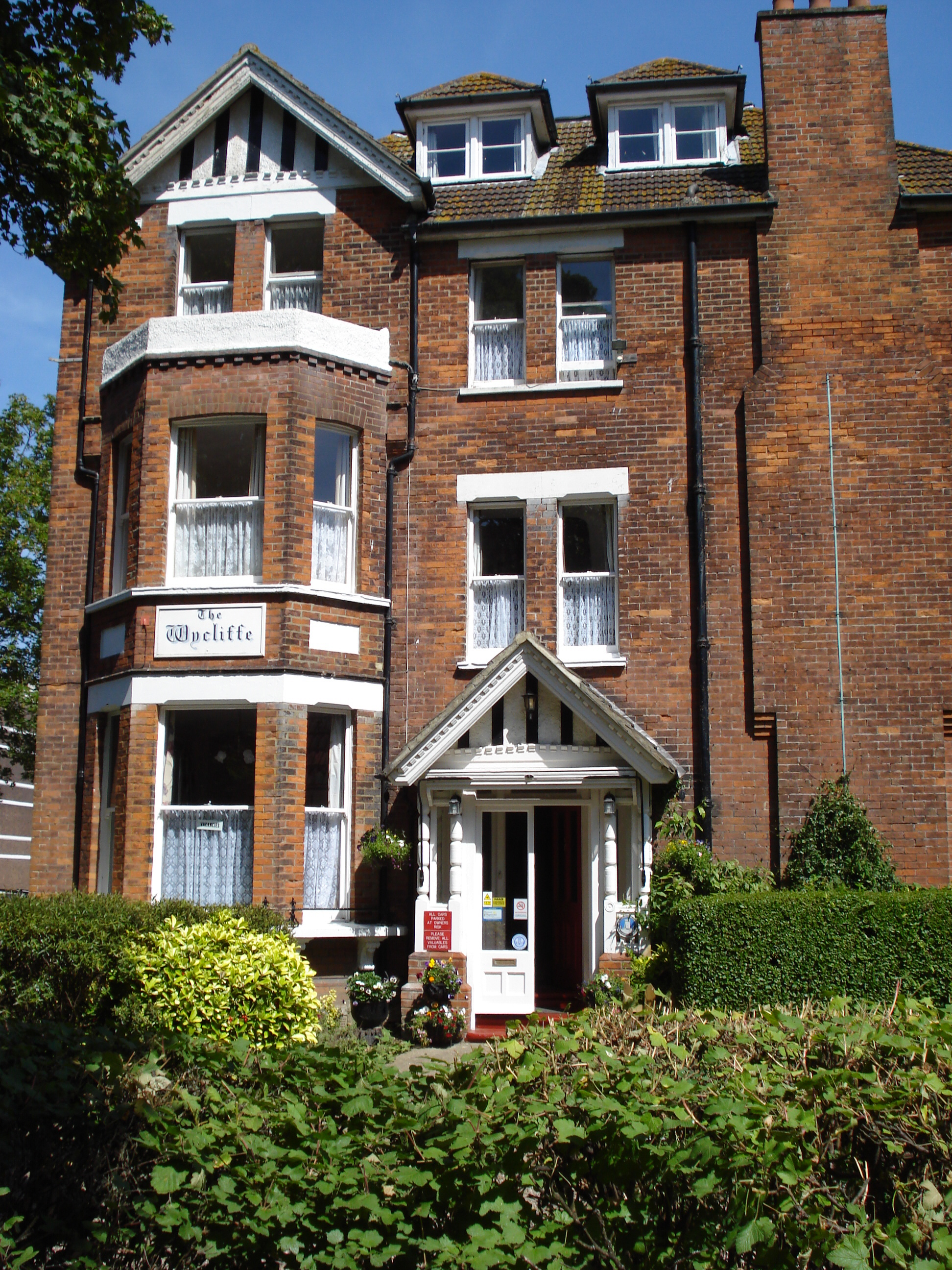
The Kennys’ house in Bouverie Road
She had asked me to lunch but Mrs Hill wanted me back again so, as there wasn’t much I could do, I just had a chat with her and Mrs Chapman, who is staying there, and came back again. Changed and got back to Mrs Kenny’s at 2.30 for her party at 4. Miss Lewis of Hythe took the Chair and Mrs Chapman spoke. There were between 70 and 80 people – mostly very smart – a military set. Mrs Kenny is very nice and Colonel Kenny is quite sweet. Some of the men were very amusing. I got a golf ball from one and sold it for 2/6. And got one young officer to buy The Subjection of Women. There was a most gorgeous tea, which no-one hardly touched. Mrs Hill and I walked home together – got in about 6.30. Another evening of gabbling chat and to bed about 10 o’clock. She is very nice but so intellectual. I feel sorry for the child. A most terrific gale raged all night. I thought the house must be blown in.
Kate spent two weeks in Folkestone on that occasion, returned for another two in February 1912 and that autumn spent a further three weeks attempting to galvanise the Kent campaign into a semblance of life.
Saturday October 5th 1912 [Folkestone: 33 Coolinge Road]
In my morning of calls, I only found two people at home. At 12.30 I gave it up. I did feel depressed. More so when, having met Mrs Kenny at the Grand Hotel at 3.30, where she was attending a wedding reception of a Miss Cooper, and whose good-byes I just came in for, Mrs Kenny and I called together upon the manager’s wife, Madame Gelardi, and to my horror I found that her husband would not contemplate for a moment letting us have a Suffrage At Home in the reception room. Well that does put the lid on things.The time is slipping away here – the days fly, I love the place and am very comfortable in my rooms but I cannot seem to work here and I feel utterly miserable about it.
Kate’s mention – in the entry below – of ‘this split’ refers to the announcement Mrs Pankhurst had made on 17 October at an Albert Hall meeting that the Pethick-Lawrences were no longer involved with the WSPU. The Pethick-Lawrences’ departure had been unilateral. Lady Irving was the – long-estranged – widow of the actor, Sir Henry Irving
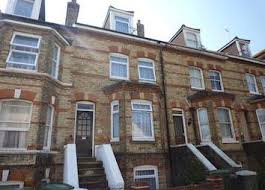
Coolinge Road, Folkestone
Tuesday October 22nd 1912 [Folkestone: 33 Coolinge Road]
As for the work I am doing here I am clean off it – I am doing nothing towards ‘Votes for Women’ – what do the people of Folkestone care and what is the good of trying to make them care? Propaganda may have had its uses in the past, it may still please some people, but I don’t want to go on talking about the Vote – I want to get it! And I am wondering more than ever what is the way to get it. This split, if split it is between the Pankhursts and Pethick-Lawrences is depressing, but I am not at all sure there it not more in it than meets the eye. Anyway here one feels so out of things – the Vote seems a very tiny speck in an ocean of talk and twaddle.
Back to tea and to write letters, then at 8 o’clock I tidied myself and went off to call on Lady Irving by appointment at 8.30. I was interested and so much enjoyed the interview, and she joined us as a member. I had been told of her powdered face, how, like the cat, she always walked alone, that all Folkestone hates her. I liked her immensely, she seems the only real person I have met, the only understanding person. I am told her temper is abnormal, that may be, she was sweet to me, and, after all, these sweet-tempered creatures can be temper trying enough for anything. That she and Henry Irving could not get on together I can quite understand. ‘No surrender’ is writ large in her composition – and after all why should the woman always give way. I imagine she had very strong views as to what was fitting for a wife and probably he did not live up to these. I did not stay long but we got a lot in the time and I think she liked me. How wonderfully young she is. Suffrage to her finger tips, and Suffrage before it was passably comfortable to be Suffrage.
Campaigning for the Vote: Kate Parry Frye’s Suffrage Diary edited by Elizabeth Crawford
For a full description of the book click here
Wrap-around paper covers, 226 pp, over 70 illustrations, all drawn from Kate Frye’s personal archive.
ISBN 978 1903427 75 0
Copies available from Francis Boutle Publishers, or from Elizabeth Crawford – e.crawford@sphere20.freeserve.co.uk (£14.99 +UK postage £3. Please ask for international postage cost), or from all good bookshops. In stock at London Review of Books Bookshop, Foyles, National Archives Bookshop.
- ‘Campaigning for the Vote’ – Front and back cover of wrappers
Now Published: Campaigning For The Vote: Kate Parry Frye’s Suffrage Diary, Edited By Elizabeth Crawford
Posted by womanandhersphere in Kate Frye's suffrage diary on April 15, 2013
An extract:
‘Saturday June 14th 1913. [Kate is lodging in Baker Street, London] I had had a black coat and skirt sent there for Miss Davison’s funeral procession and the landlady had given me permission to change in her room. I tore into my black things then we tore off by tube to Piccadilly and had some lunch in Lyons. But the time was getting on – and the cortege was timed to start at 2 o’clock from Victoria.
We saw it splendidly at the start until we were driven away from our position and then could not see for the crowds and then we walked right down Buckingham Palace Rd and joined in the procession at the end. It was really most wonderful – the really organised part – groups of women in black with white lilies – in white and in purple – and lots of clergymen and special sort of pall bearers each side of the coffin.
She gave her life publicly to make known to the public the demand of Votes for Women – it was only fitting she should be honoured publicly by the comrades. It must have been most imposing.
The crowds were thinner in Piccadilly but the windows were filled but the people had all tramped north and later on the crowds were tremendous. The people who stood watching were mostly reverent and well behaved. We were with the rag tag and bobtail element but they were very earnest people. It was tiring. Sometimes we had long waits – sometimes the pace was tremendous. Most of the time we could hear a band playing the funeral march.
Just before Kings Cross we came across Miss Forsyth (a fellow worker for the New Constitutional Society) – some of the New Constitutional Society had been marching with the Tax Resisters. I had not seen them or should have joined in. I had a chat with her.
Near Kings Cross the procession lost all semblance of a procession – one crowded process – everyone was moving. We lost our banner – we all got separated and our idea was to get away from the huge crowd of unwashed unhealthy creatures pressing us on all sides. We went down the Tube way. But I did not feel like a Tube and went through to the other side finding ourselves in Kings Cross station.
Saying we wanted tea we went on the platform and there was the train – the special carriage for the coffin – and, finding a seat, sank down and we did not move until the train left. Lots of the processionists were in the train, which was taking the body to Northumberland for interrment – and another huge procession tomorrow. To think she had had to give her life because men will not listen to the claims of reason and of justice. I was so tired I felt completely done. We found our way to the refreshment room and there were several of the pall bearers having tea. ‘
Campaigning for the Vote tells, in her own words, the efforts of a working suffragist to instil in the men and women of England the necessity of ‘votes for women’ in the years before the First World War.
The detailed diary kept all her life by Kate Parry Frye (1878-1959) has been edited to cover 1911-1915, years she spent as a paid organiser for the New Constitutional Society for Women’s Suffrage. A biographical introduction positions Kate’s ‘suffrage years’ in the context of her long life., a knowledge of her background giving the reader a deeper appreciation of the way in which she undertook her work. Editorial comment adds further information about the people Kate meets and the situations in which she finds herself.
Campaigning for the Vote constitutes that near impossibility – completely new primary material on the ‘votes for women’ campaign, published for the first time 100 years after the events it records.
With Kate for company we experience the reality of the ‘votes for women’ campaign as, day after day, in London and in the provinces, she knocks on doors, arranges meetings, trembles on platforms, speaks from carts in market squares, village greens, and seaside piers, enduring indifference, incivility and even the threat of firecrackers under her skirt. Kate’s words bring to life the world of the itinerant organiser – a world of train journeys, of complicated luggage conveyance, of hotels – and hotel flirtations – , of boarding houses, of landladies, and of the ‘quaintness’ of fellow boarders.
This was not a way of life to which she was born, for her years as an organiser were played out against the catastrophic loss of family money and enforced departure from a much-loved home. Before 1911 Kate had had the luxury of giving her time as a volunteer to the suffrage cause; now she depended on it for her keep. No other diary gives such an extensive account of the working life of a suffragist, one who had an eye for the grand tableau – such as following Emily Wilding Davison’s cortége through the London streets – as well as the minutiae of producing an advertisement for a village meeting.
Moreover Kate Frye gives us the fullest account to date of the workings of the previously shadowy New Constitutional Society for Women’s Suffrage. She writes at length of her fellow workers, never refraining from discussing their egos and foibles. After the outbreak of war in August 1914 Kate continued to work for some time at the society’s headquarters, helping to organize its war effort, her diary entries allowing us to experience her reality of life in war-time London.
ITV has selected Kate Frye – to be portrayed by a leading young actress – as one of the main characters in a 2014 documentary series to mark the centenary of the outbreak of the First World War.
See also ‘Kate Frye in “Spitalfields Life”‘ and ‘Kate Frye in “History Workshop Online”‘
Wrap-around paper covers, 226 pp, over 70 illustrations, all drawn from Kate Frye’s personal archive. ISBN 978 1903427 75 0 Copies available from Francis Boutle Publishers, or from Elizabeth Crawford – e.crawford@sphere20.freeserve.co.uk (£14.99 +UK postage £2.60. Please ask for international postage cost), or from all good bookshops. In stock at London Review Bookshop, Foyles, Daunt Books, Persephone Bookshop, Newham Bookshop and National Archives Bookshop.
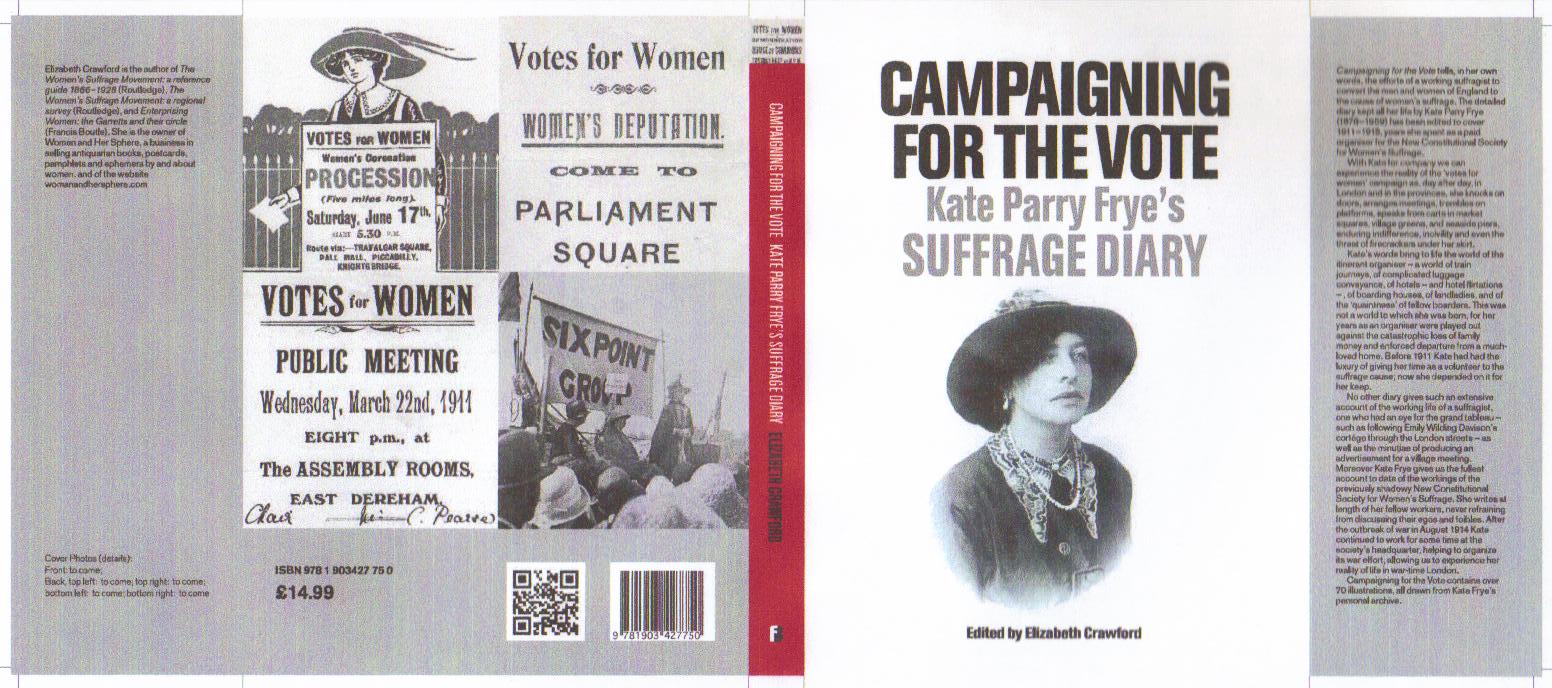
‘Campaigning for the Vote’ – Front and back cover of wrappers
Kate Frye’s Suffrage Diary: ‘Campaigning for the Vote’ Is Here
Posted by womanandhersphere in Kate Frye's suffrage diary, Suffrage Stories on March 13, 2013
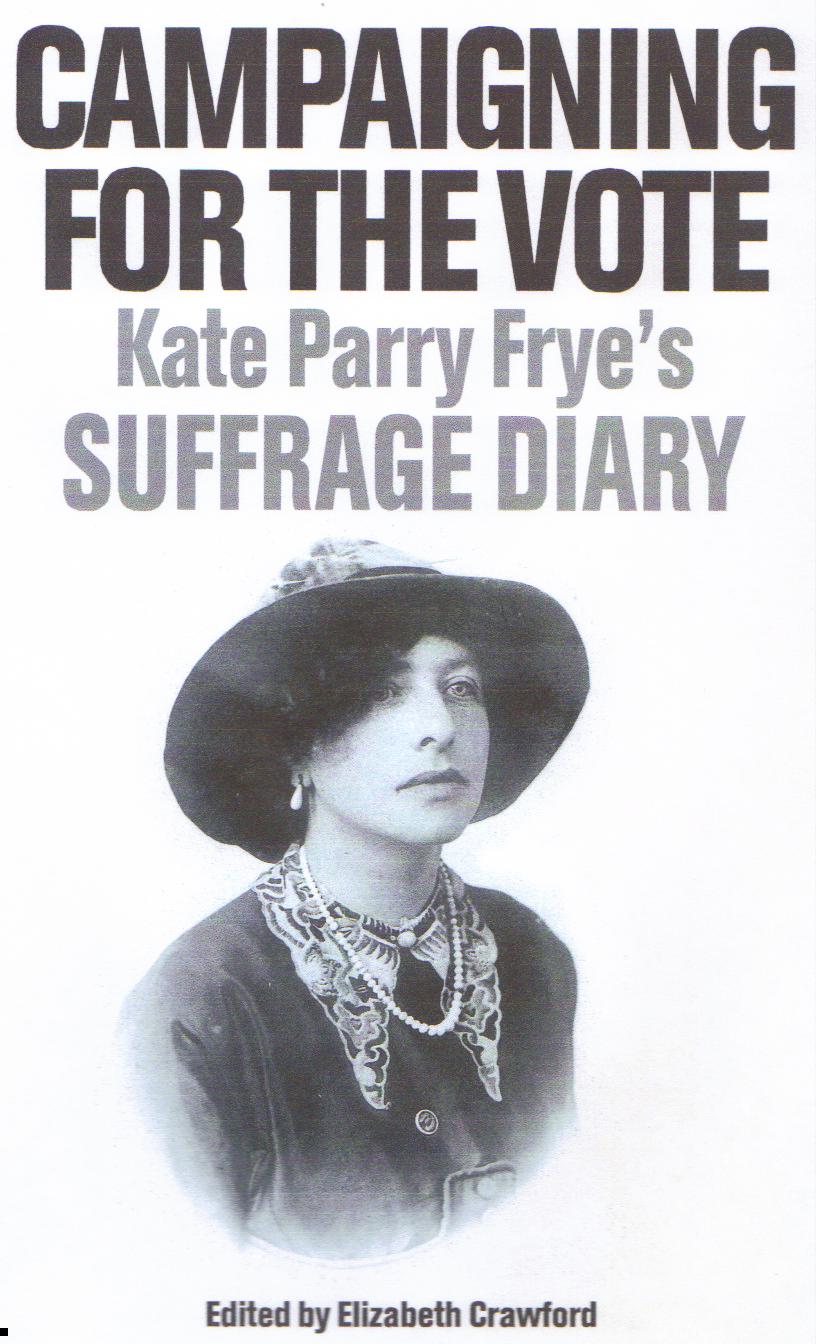 Here is the front cover of Campaigning for the Vote: Kate Parry Frye’s Suffrage Diary – published by Francis Boutle Publishers.
The key points about the book are:
- Drawn from a new primary source, Campaigning for the Vote tells, in her own words, the efforts of Kate Frye, a working suffragist, to convert the men and women of England to the cause of women’s suffrage. The detailed diary Kate kept all her life (1878-1959) has been edited to cover 1911-1915, years she spent as a paid organiser for the New Constitutional Society for Women’s Suffrage.
- No other diary gives such an extensive account of the working life of a suffragist, one who had an eye for the grand tableau – such as following Emily Wilding Davison’s cortége through the London streets – as well as the minutiae of producing an advertisement for a village meeting.
- With Kate for company we can experience the reality of the ‘votes for women’ campaign as, day after day, in London and in the provinces, she knocks on doors, arranges meetings, trembles on platforms, speaks from carts in market squares, village greens, and seaside piers, enduring indifference, incivility and even the threat of firecrackers under her skirt.
- Kate’s words bring to life the world of the itinerant organiser – a world of train journeys, of complicated luggage conveyance, of hotels – and hotel flirtations – , of boarding houses, of landladies, and of the ‘quaintness’ of fellow boarders. This was not a world to which she was born, for her years as an organiser were played out against the catastrophic loss of family money and enforced departure from a much-loved home. Before 1911 Kate had had the luxury of giving her time as a volunteer to the suffrage cause; now she depended on it for her keep.
- Kate Frye gives us the fullest account to date of the workings of the previously shadowy New Constitutional Society for Women’s Suffrage. She writes at length of her fellow workers, never refraining from discussing their egos and foibles.
- After the outbreak of war in August 1914 Kate continued to work for some time at the society’s headquarter, helping to organize its war effort, while allowing us to experience her reality of life in war-time London.
- Campaigning for the Vote is over 200pp long and contains over 70 illustrations, all drawn from Kate Frye’s personal archive. ISBN 978 1903427 75 0 £14.99
- Advance orders may be placed either with me or with the publisher – or with any good bookshop.
‘Campaigning for the Vote’ – Front and back cover of wrappers
Suffrage Stories: Kate Frye’s Suffrage Diary, The Royal Albert Hall, And The Importance of Gas
Posted by womanandhersphere in Suffrage Stories on March 5, 2013
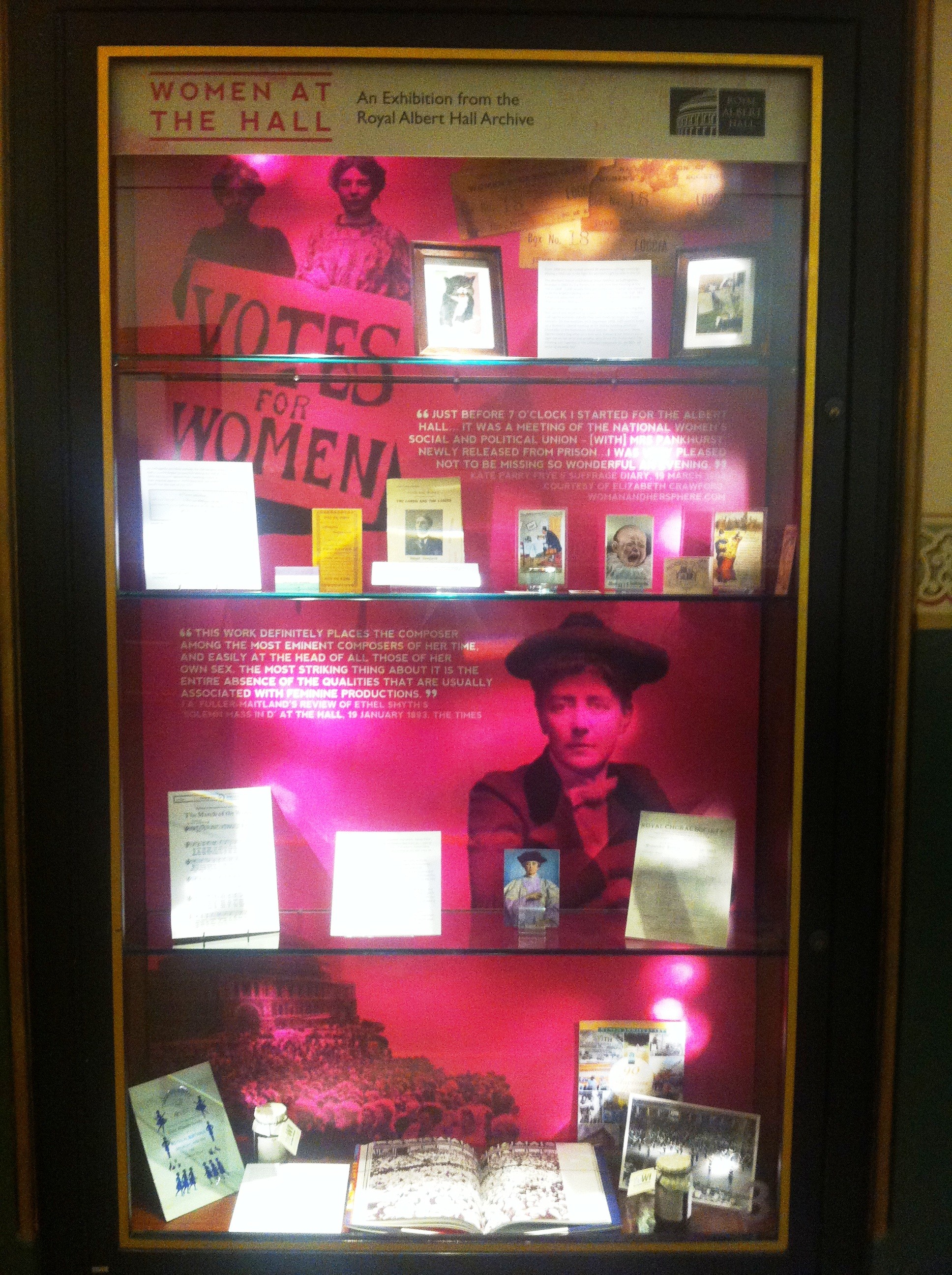 The Royal Albert Hall was the scene of many grand suffrage occasions – organised by both the constitutional and the militant suffrage societies. The management of the Hall has recognised this by supporting its archivists in mounting a small display relating to its suffrage past. The display may be viewed by anyone with a ticket to an event in the hall.
Researchers use the primary sources available and Suzanne Keyte, Project Archivist at the Royal Albert Hall, has mined what is known as the Hall’s ‘Gas Book’ to recreate a list of occasions on which the Hall was rented for suffrage-related meetings. The ‘Gas Book’ records the amount of cubic feet used each time the Hall was let for a concert or a political or a religious meeting and, with certain provisos, can be used as an indication of the size of the audience.
Kate Frye witnessed several grand suffrage occasions in the Hall. Here she describes an evening stewarding for the London Society for Women’s Suffrage at a Mass Meeting of suffrage societies in support of the Conciliation Bill
 Saturday November 12th 1910
I sat and sewed a red, green and white scarf for the evening. We had tea at 4.15 and I had a rush to dress and take Mickie [her dog] out and get off by soon after 5 o’clock. I was due at the Albert Hall at 5.30. Was given a job to do till 6.30 – or rather before – when we all went to our posts. Mine was Balcony – selling of programmes and ‘Common Causes’ [the NUWSS newspaper] & helping with the collections. The hall looked lovely – the banners were so beautifully arranged – but it wasn’t so full as I should have liked. The W.S.P.U. had a crowded meeting on Thursday and collected £8,000. Wonderful people one simply cannot hear from the Balcony. Mrs Swanwick was the only one I could really hear – her elocution is marvellous. It was so interesting seeing all the Societies – but [ie except for] the W.S.P.U. there – such lots of colours & badges – and I got very chatsome to some of my companions upstairs from the different societies.
When the meeting was nearly over I went down to the hall & tried to sell ‘Common Cause’. Old Major General Sir Alfred Turner, who was sporting around with Adeline Bourne, bought one of me with a beam and a handful of coin – he is a joke. It had come on to pour with rain and the Wrights insisted on bringing me as far as their place in their Taxi which was kind. ‘
The Hall’s ‘Gas Book’ shows that for this meeting the NUWSS consumed – and were charged for – 47,800 cubic feet of gas. On this November night one imagines that it would have been necessary to have lit all the Hall’s lamps. In fact, on 19 March 1908, when Kate Frye attended the first WSPU meeting to be held in the Albert Hall, that night’s gas consumption had been very similar- 46,800 cubic feet (click here to see Kate’s description of that meeting). From this idiosyncratic source we can deduce that the NUWSS did not lag behind the WSPU in ensuring that their evening meetings were brilliantly lit, even though, from Kate’s account, they were not necessarily able to muster as large an audience.
There was something to be said for staging meetings in the Albert Hall on summer evenings. For at the meeting held there that marked the finale to the NUWSS’s procession through London on 13 June 1908, gas consumption was only 16,000 cubic feet. We know when the meeting started because Kate Frye carefully noted in her diary that, after marching from the Embankment in the rearguard position which the Kensington branch had been allotted, she reached the Albert Hall at 5.10, just as the meeting was about to begin. Clearly less artificial illumination was required for a meeting held on an early evening in summer than for one in the winter, thereby reducing at least one element of the cost. (See here for the entry from Kate’s diary describing the procession).
Suzanne Keyte has identified c 30 suffrage meetings that were held at the Royal Albert Hall. By June 1913, however, after pressure had been exerted on hall owners throughout the country, the management of the Hall decided that they would refuse the WSPU any further lettings. What was in effect their last meeting had taken place a couple of months earlier, on 10 April.
Campaigning for the Vote: Kate Parry Frye’s Suffrage Diary edited by Elizabeth Crawford
For a full description of the book click here
Wrap-around paper covers, 226 pp, over 70 illustrations, all drawn from Kate Frye’s personal archive.
ISBN 978 1903427 75 0
Copies available from Francis Boutle Publishers, or from Elizabeth Crawford – e.crawford@sphere20.freeserve.co.uk (£14.99 +UK postage £3. Please ask for international postage cost), or from all good bookshops. In stock at London Review of Books Bookshop, Foyles, National Archives Bookshop.
- ‘Campaigning for the Vote’ – Front and back cover of wrappers
Kate Frye’s Suffrage Diary: Myra Luxmoore, Suffrage Artist
Posted by womanandhersphere in Kate Frye's suffrage diary, Uncategorized on February 4, 2013

57 Bedford Gardens (now renumbered as 77, courtesy of wikipage on William Magrath)
I first came across mention of ‘Miss Luxmoore’ in the pages of Kate Frye’s diary. Obviously a suffragist, with a Studio at 57 Bedford Gardens, Campden Hill, I presumed she was an artist. But who was she? Her name is not recorded in, for instance, Lisa Tickner’s Spectacle of Women, the vademecum on suffrage artists. Intrigued, I thought it worth finding out more about Miss Luxmoore and her world.
So, to begin at the beginning, here are three entries from Kate Frye’s diary in which she records meetings held at Miss Luxmoore’s Studio.
Tuesday February 9th 1909
Dinner at 7.30. Off at 8 o’clock to Bedford Gardens – Miss Luxmoore’s Studio to a Suffrage meeting. Got there in good time and started to work at once stewarding and trying to make converts. Got a young man student to join the Men’s League. Mr Mitchell and Miss Clementina Black were the speakers and did very well. Alexandra [Wright] was in the Chair. I waited at the end helped count the money etc and walked up to Notting Hill Gate with the Wrights and Miss Black and walked all the way home. Was not in till after 11 o’clock. Very much enjoyed the meeting and the Suffrage atmosphere and meeting all those students was like a page out of a book.
Tuesday March 30th 1909
I changed my dress had a bit of something to eat then off at 7.30. Walked to Richmond Road took a bus to Bedford Gardens and went to Miss Luxmoore’s Studio Suffrage meeting. Gladys was there. Mrs Graves took the chair. Miss Meyer helped and Mrs Stanbury spoke – but, besides ourselves, there were only 15 audience. Mrs Henry of the Camden Institute was there. I had sent her a card and she quite disgraced herself and made Mrs Stanbury very uncomfortable by hissing loudly, then walking out with her poor unfortunate daughter. Something Mrs Stanbury said upset her – she was only talking history but Mrs Henry took it to mean the Queen of Spain – but I could not understand it till I got home and found from Daddie that Mrs Henry has become a ‘pervert’ to the Roman Catholic Church. It made a nasty impression on us somehow. We had a chat afterwards and all got very low spirited. There has been another raid on the House – several arrests and the women much knocked about – it is all so awful.
Tuesday May 4th 1909
Went off at 7.30 [pm] Walked to Richmond Road – a bus from there to Bedford Gardens – and to Miss Luxmoore’s Studio for a Woman’s Suffrage meeting. Such a crush of people and no end of helpers. Mrs Carl Hentschel, Miss Abadam and Mr Walter McLaren were the speakers. Miss Hentschel [her father, Carl Hentschel, was a lithographic printer, responsible for some suffrage posters], Miss Porter, Miss Meyer and, of course, Gladys and Alexandra. I had sent Miss Lockyer [who had been the late William Whiteley’s housekeeper] a ticket and she was there with Miss Clara Whiteley – and who should be there but one of the Miss Hollingsworths (Jessie) taken by some friend. I made three members – which wasn’t bad – and I waited with the others to help clear up and walked to Notting Hill Gate with them. Then came home in a bus. Was so tired. Mother was waiting up. Supper & bed. Mrs Carl Hentschel’s maiden speech and she did it very well and I don’t think I ever heard a more rousing speech than Miss Abadam. Mr McLaren [Walter McLaren, Liberal MP] was stupid.’
My research has shown me that ‘Miss Luxmoore’ was Myra Elizabeth Luxmoore (1860-1918), born in Paddington, the only child of John and Jane Luxmoore. By her first marriage, however, Jane had at least three daughters, Myra’s elder half-sisters. John Luxmoore worked for the Great Western Railway as a superintendent locomotive engineer. After a period based in Paddington, the family followed John’s work to Newport in south Wales and finally to Newton Abbot in his native Devon.
By 1888, giving her address as Somerford, Newton Abbot, Myra Luxmoore was exhibiting as an Associate with the Society of Women Artists. By 1891 she had moved to London and was living at 32 Charlotte Street, Fitzroy Square. She then spent a brief time living at 87 Cadogan Gardens before moving, c 1905, to her studio at 57 Bedford Gardens. After that she began exhibiting regularly at the Royal Academy. Around 1912 Myra Luxmoore moved to 80 Redcliffe Square, Kensington, remaining there until her death in 1918.
You can see from the photograph (above) that 57 Bedford Gardens had been purpose-built with artists in mind, with large windows to provide ample light. A google search shows photographs of the inside of the apartments as they are today – lofty spaces, providing ample room for a suffrage meeting.
When researching suffrage boycotters of the 1911 census I was interested to note that, while the enumerator wrote in his book that Myra Luxmoore was the occupier of a studio at 57 Bedford Gardens, he marked the apartment as unoccupied on census night. Presumably she, along with several other of the artists who shared the address, had opted to spend the night elsewhere. Her distinctive name is to be found nowhere else in the census returns.
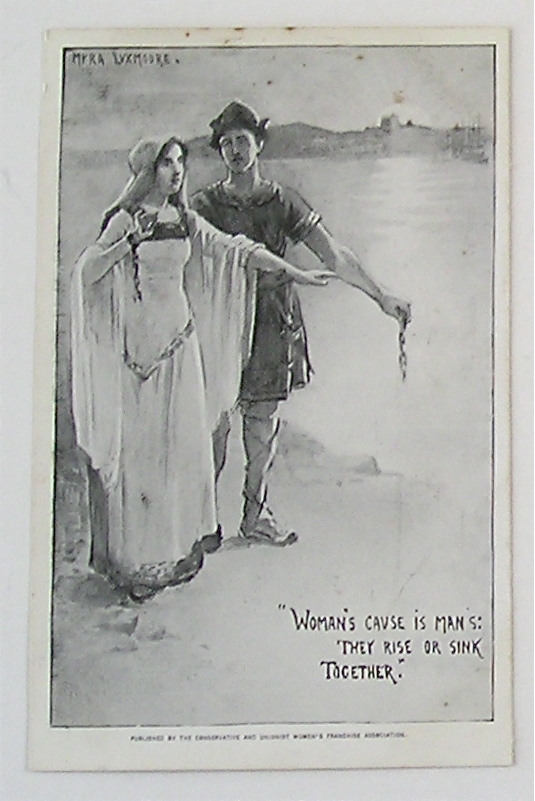
Myra Luxmoore’s card published by the Conservative and Unionist Women’s Franchise Association (photo courtesy of Ken Florey)
I had wondered where Myra Luxmoore’s suffrage allegiances lay and have recently discovered this card (left) illustrated by her and published by the Conservative and Unionist Women’s Franchise Association. I think, therefore, it would not be too far-fetched to think that she was a supporter of the CUWFA. Incidentally, as far as I remember, this is the only postcard issued by the CUWFA that I have ever seen.
The majority of Myra Luxmoore’s exhibited works bear rather wispy titles – such as ‘Roses and Sweet Lavender’, or ‘What’s O’Clock?’ – although a few portraits are noted. One such was the portrait of Norah, the 18-year-old daughter of Sir John Craggs MVO, exhibited at the Royal Academy in 1913. By 1910 another of Sir John’s daughters, Helen, was a full-time paid organiser for the WSPU. This was most definitely not a career move of which her father approved and I wonder if he would have commissioned the portrait if he had known that the artist had strong suffrage – although not militant – sympathies? [Incidentally Helen Craggs in 1957 married, as her second husband, the widowed Lord Pethick-Lawrence.]
One portrait by Myra Luxmoore is known to hang in a public collection, that of the Very Rev Edward McClure (1833-1906), Dean of Manchester.
Very Reverend Edward C. MClure, Manchester City Art Gallery, courtesy of BBC – Your Paintings
Other of her works were collected by Mother Agnes Mason, Foundress of the Community of the Holy Family. Click here to read about her connection with Myra Luxmoore and her works. The article also gives some, unverified, information about the Luxmoore family’s friendship with the family of Gerard Manley Hopkins.
Campaigning for the Vote: Kate Parry Frye’s Suffrage Diary edited by Elizabeth Crawford
For a full description of the book click here
Wrap-around paper covers, 226 pp, over 70 illustrations, all drawn from Kate Frye’s personal archive.
ISBN 978 1903427 75 0
Copies available from Francis Boutle Publishers, or from Elizabeth Crawford – e.crawford@sphere20.freeserve.co.uk (£14.99 +UK postage £3. Please ask for international postage cost), or from all good bookshops. In stock at London Review of Books Bookshop, Foyles, National Archives Bookshop.
- ‘Campaigning for the Vote’ – Front and back cover of wrappers
Kate Frye: A War-Time Birthday: 9 January 1917
Posted by womanandhersphere in Kate Frye's suffrage diary on January 9, 2013
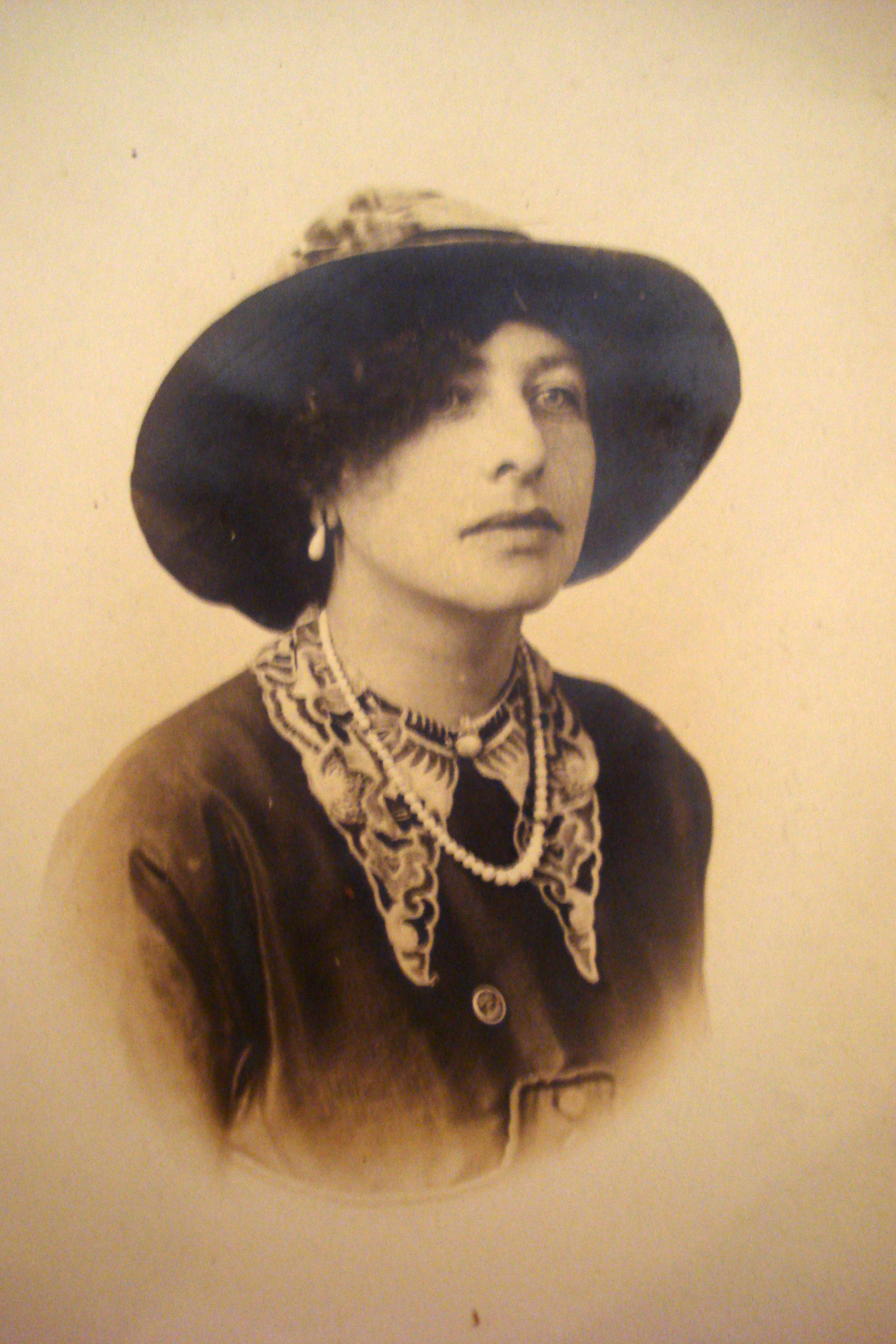
Kate
On her birthday – 9 January 1915 – Kate Frye had at last married her long-term fiance, John Collins. Two years later he was fighting in France and she was living with her mother and sister in a house at Berghers Hill, Buckinghamshire, courtesy of her mother’s sister, the wealthy Mrs Agnes Gilbey. A small cluster of cottages on a ridge at the top of a steep hill above Wooburn Green, Berghers Hill lay exposed to the elements. The wind whipped through Kate’s cottage, bedrooms were icy, the pipes froze – and burst. The walk down the hill to Wooburn Green and Cores End, whether by the road or the path through Wooburn Manor Park (the Gilbey property), was treacherous in winter.
Tuesday 9 January 1917
Woke to a terrible morning – dark & cold & sleet. It continued to sleet & snow & hail at intervals all day and the wind out was cruel. The anniversary of our wedding day. Two years ago at Hove. All day long & into the night I kept thinking at this time we were doing so & so and Oh it was sad to think of the present and to wonder whether John was alive or dead. It comes so suddenly – the death to them and it would be hours & days before I should hear.
Agnes [Kate’s sister] still seedy & in bed and so cross with both Mother & I. I went off soon after 10.30 to Cores End to seek a Cod’s Head for the cats & fish for her dinner. Couldn’t get the former, the latter she refused to eat when cooked and sent up.
Writing letters most of the evening and after supper sat over the fire trying to get warm & thinking, thinking. Fortunately Mother went to bed. A letter from John – the first since Friday.
For more on Kate – look out for Elizabeth Crawford (ed): Campaigning for the Vote: the suffrage diary of Kate Parry Frye to be published by Francis Boutle Publishers in February 2013
Kate Frye’s Suffrage Diary: Banner Bearer For The 13 June 1908 Procession
Posted by womanandhersphere in Kate Frye's suffrage diary on October 30, 2012
Asquith became prime minister in April 1908. In response to his claim that he needed proof that large numbers of women really wanted the vote, the National Union of Women’s Suffrage Societies – and the WSPU – decided to mount a spectacular summer procession through London. The magnificent banners, such as that for North Kensington, carried some of the way by Kate, were the work of the Artists’ Suffrage League, in particular of Mary Lowndes.

Mary Lowndes’ design for the North Kensington banner – with swatches of suggested material (courtesy of the Women’s Library@LSE)
The design of the North Kensington banner, held in the Women’s Library, can be seen
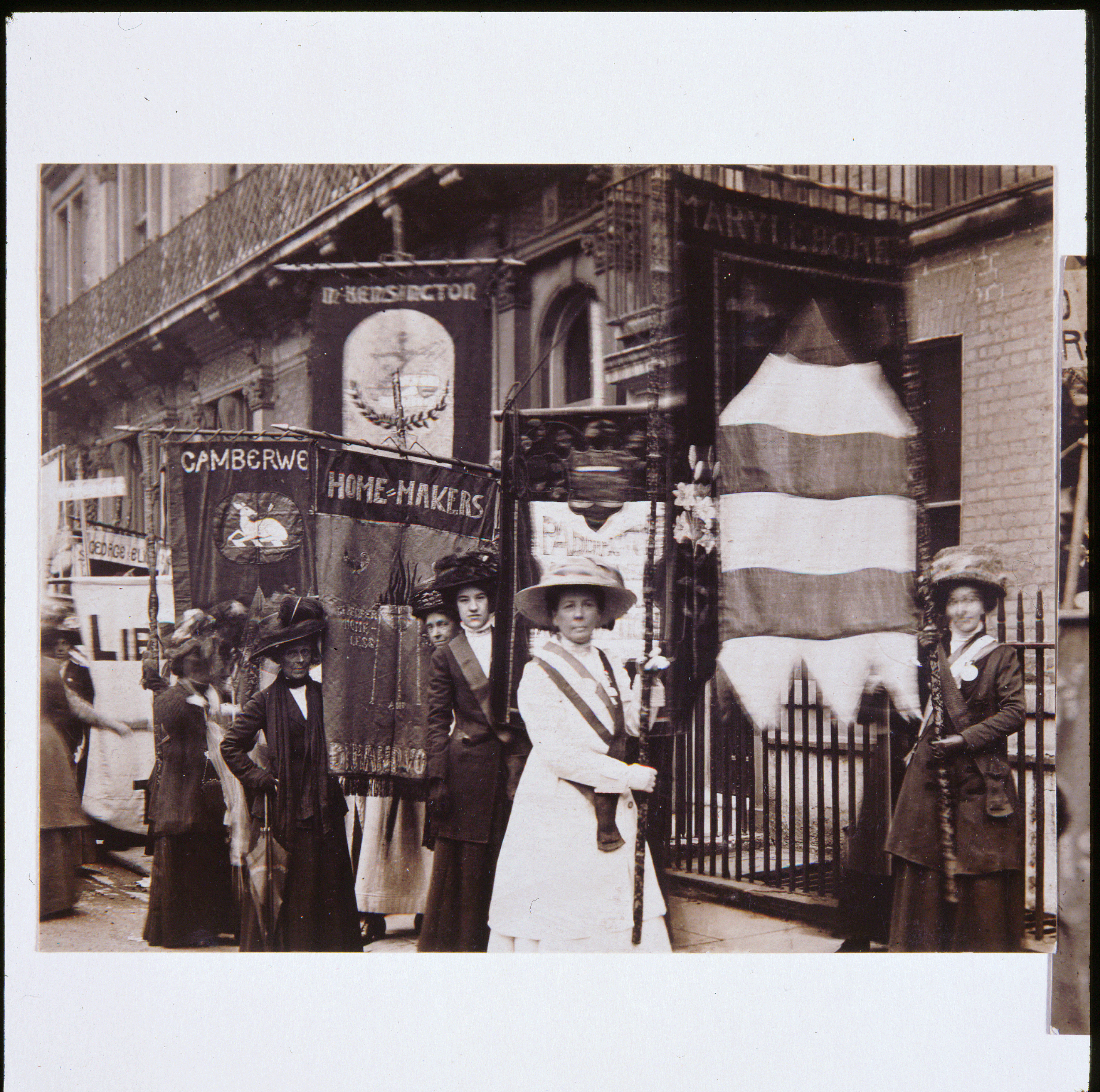
Banners – 13 June 1908 (courtesy of Women’s Library@LSE)
The banner itself was photographed during the course of the 13 June 1908 procession. ‘North Kensington’ is being held high; unfortunately the ‘Home Makers’ obscure the North Kensington banner bearers. Was one of them Kate?
Saturday June 13th 1908 [Bourne End]
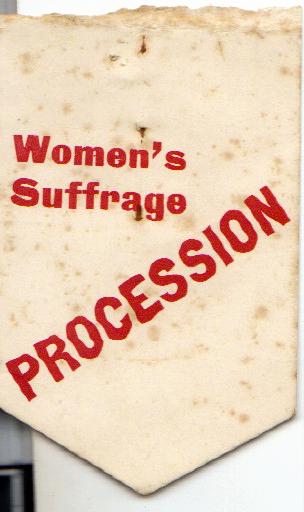
Kate’s ticket for the June 1908 Suffrage Procession
The great day dawned at last looking rather threatening – dull and very windy. I did not know quite what to wear but chanced the day wisely as it fell out and wore my best cream linen skirt and embroidery blouse and made myself look nice. I took a coat with me. Down to breakfast, had a chat to Agnes, who was very disappointed not to be going but really she was not up to it and it would have been no use attempting such an exacting and arduous day. It took it out of me. I was ‘going’ inside all day. Went up to London by the 9.53 train wearing my decorations – my ‘Votes for Women’ disk – my National Union Suffrage brooch and my red and white ribbon – the one that went through that exciting evening at the Paddington Baths. I wore them all day and it was most amusing to see the looks given to them. I went shopping in Whiteleys. Then a bus to Bond Street, walked through Burlington and along to the Strand – there I began to see some of my fellow marchers and the Lyons where I lunched was crowded with them – every one agog, of course, to see us.
Then I went to the A.A. [the Actors’ Association] tidied myself up and went upstairs. Quite an excitement there to see me and I found Eve Erskine wavering as to whether or not she should join the march. She rather aggravated me by some of the things she said about it. Then she is so tactless and really doesn’t know. It was from her I learned that there would be a contingent of Actresses headed by Gertrude Kingston, Lillah McCarthy and Mrs Pat [Campbell] and I must own I did feel deadly disappointed not to be going with them. I am sure Miss Gladys [Wright] kept it from me on purpose as she knew how eager I was to get the theatrical people to go and I said how I should like to march with them. So for that reason she did not send me a plan of the order of procession, I feel sure. Not quite straight because, any way, if she had said they really needed my help in Kensington I should have gone. But she and Alexandra went with the graduates and they wanted me responsible for N[orth] Kensington. There was really no-one else. Mrs Wright could not have carried the Banner or any of the small women if they could have it would not have looked right and comfortable. So I was offered up as a sacrifice. I think it was only right a Frye should be the Banner Bearer for North Kensington and I loved to do it and felt very proud but at first I must own to feeling a bit sick over it. I had a few words with Mr Halliwell Hobbs, who was crimson in the face with annoyance about it all. I said ‘will you shake hands though I am going to carry a banner.’ He simply could not bear himself – it so upset him to see my decorations. Eve walked or rather ran – we got so excited seeing the crowds – to the Embankment and there I lost her. I suppose she found her Block and marched with them for I saw her no more.

Kate preserved her programme
The crowds and the excitement was terrific and I really didn’t know how I should find my banner in it all. First I saw Miss Corbett who gave me a plan. Eve had one so I am sure Gladys ought to have sent her Banner Bearer one. And then I found I should be Block 8 – and a nice scamper I had right up Whitehall before I came to my place. Whitehall was quieter, but the crowds on the Embankment were terrific. At last I came to the Block for the London Society and found a messenger boy with the little White and Red Banners we had before. He gave it up to me on hearing my name and I was left alone. As I got there soon after 2 o’clock it was alright but I longed for some friendly face. I had had a glance at some of the Banners as I sped along – they were lovely. At last one or two women whose faces I knew turned up and then three girls with a huge and beautiful banner – one of the Artist League ones – the one Gladys meant me to carry and take the responsibility of. They were in too much of a hurry, the girls, to be off to tell me how to manage it and I had my flapping coat and the wind was terrific. I got one of the others to hold the little one till Mrs Wright and a lot of other people came. Then a tall girl carried the little one at the back of the Kensington Block. Some one very kindly carried my coat and I got the frog fixed round the banner more comfortably. Miss Madge Porter carried one cord, Miss Meyer the other.
We were immediately behind the Holborn section and Lady Grove’s pretty daughters carried that Banner – a huge one – but, lucky beggars, they had two poles to support it. Mine was fearfully heavy, especially in the wind – but I was given a gift with it I think. It was a beauty nauge cloth – brown and yellow silk and cloth of gold. Mrs Percy Harris was just behind. She had to fall out early as she went very strange and there were lots of people I know by sight. We were quite a smart collection – all in our best summer attire. The stewards marshalled us six abreast behind the Banner which had to stand out. The whole thing was most wonderfully organised.
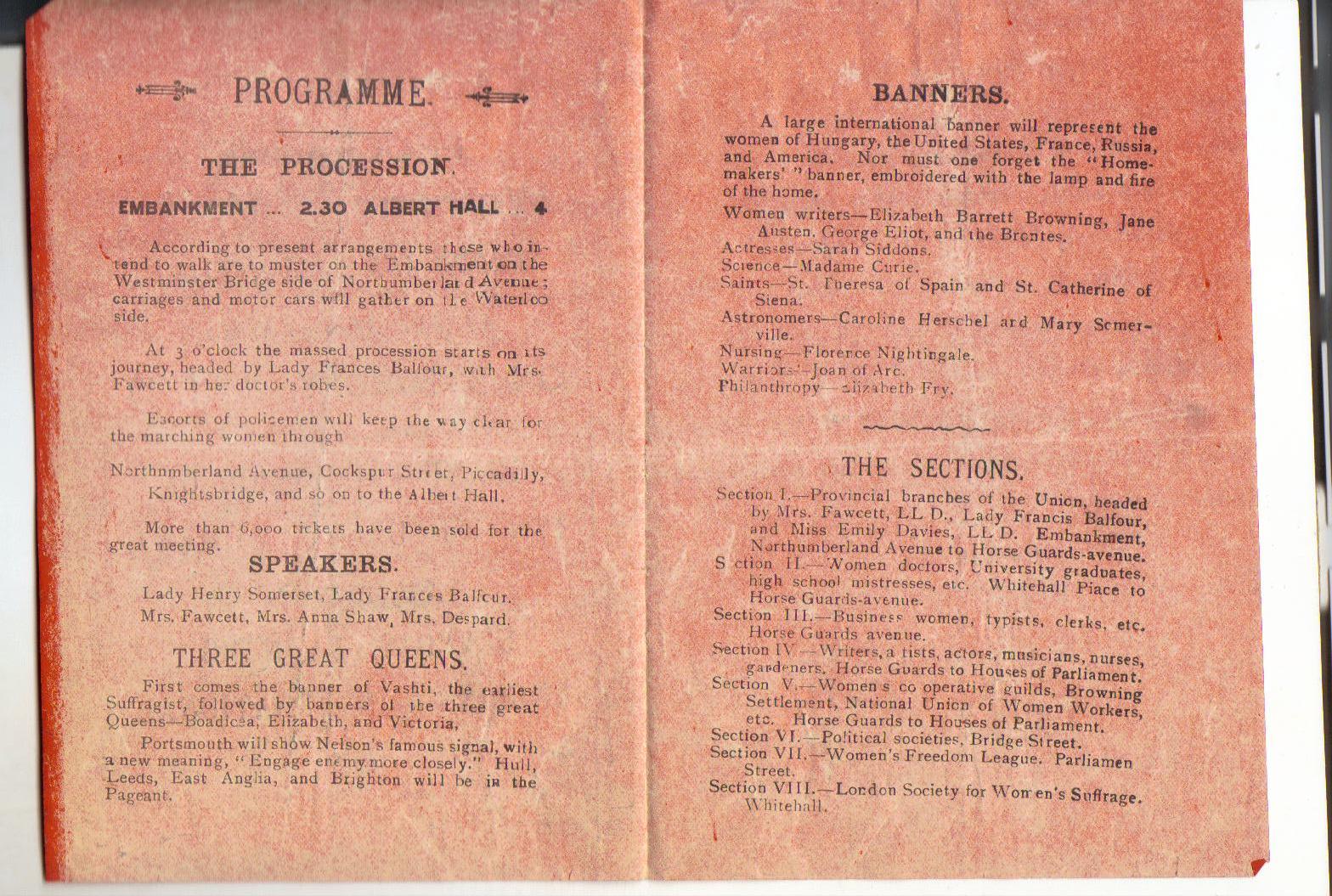
Programme details for the procession
Before we moved off John [her fiance] arrived on the scene with Mr Andrews [a friend] and was most proud to shake hands with me and I think the whole thing quite converted him. They went off to see the Banners, then took up their stand in Trafalgar Square and watched us go. John watched it over an hour. He saw me but I didn’t see him. He says I was laughing away and looked to be enjoying myself. Some of the remarks were enough to make one laugh. I saw Mr Dickenson [the M.P.] go past and G.B. Shaw while I was waiting and there were all sorts of weird and curious men – one dressed up like a Jack in the Box to represent Adam, I think – but I couldn’t make him out.
Before 2.30 we were off to the strains of a Band and marshalled in order and we reached one side of the Embankment. We were given 2.30 to assemble – so those who turned up then must have had a difficulty in finding us. It took some time – then there was half an hour’s wait in line – then we began to manoeuvre about – the police directed us. I don’t really know what we did but we turned back round the road while a stream passed us the other way then round me went again over to the side of the trams which made some of them nervous. The trams were packed with people to see us. Then a long wait again – 3.30 I should say before we moved off – and then a very slow procession up Northumberland Avenue – halts of five minutes at a time, it seemed. We were in the middle of two Bands so we were never dull and sometimes with the clamour of the two together it was terrific but the marches helped me along and we three kept step. Oh the crowds – packed like sardines the other side of Piccadilly – some of the roughest of the rough on the Embankment but for the most part quite friendly and polite. There seemed so few policemen in comparison that if the crowd had liked to be disagreeable it would have been awful. The clubs and hotel windows and steps were thronged. Most of the people seemed interested – some were laughing. We only had passage enough just to pass along till we got to the Square then our pace mended till it grew terrific and had almost to run to keep up and going up Waterloo Place was a great strain. From the bottom we could see the Banners winding up and up.
We were about 10,000 with 70 Artist League banners – lots of others and hundreds of Bannerettes shimmering in the wind. For the most part after Piccadilly the crowd was quite a different class and quiet and respectful – many men raised their hats to us and ladies clapped their hands – lots of children? were in the crowd and ‘Mother’ made one clap his hands at me. One nice old clergyman bared his silver locks to each Banner Bearer. Of course it was a very different thing from last year [ie the February ‘Mud March’] – gigantic in comparison and, as for the crowds, I had never seen anything like them except at Royal Weddings etc and a good long route we had. Up Northumberland Avenue, Lower Regent Street, Piccadilly, Knightsbridge, Exhibition Road to the Albert Hall. The first part of them must have been in the hall soon after we left the Embankment. I was in the last section – No 8, the London Society – but I could not see our end and after us came all the motor cars and carriages. The Social and Political Union people had a four in hand and were up and down distributing notices of their great demonstration on Sunday week in Hyde Park. The Graduates and Doctors looked simply lovely – I am sure they must have got some cheering ‘Well’ I heard one man say, ‘what I like about them is there isn’t one with a bit of powder on’.
‘Lucky you have dropped your garter’ ‘Have you mended the socks’ Have you washed the baby’ and such remarks as those were rife and, of course, lots of comments on one’s personal appearance – rather painful some of them –‘Oh look at this nice girl’ ‘isn’t she a beauty’ etc but really most of the people were quite kind and sympathetic. I think it must have been rather a stirring sight – it seemed to me ‘magnificent’. I felt it was moving the people. I heard people say in awestruck tones ‘I don’t believe it will ever end’ Miss Meyer took the Banner from me in Piccadilly and carried it to the end – she hadn’t had all that tiring first part and the long waits and she was strong and capable. I must say I was getting a bit done with it but I would have liked it again later only she seemed quite happy and I did not like to take it from her. Gladys had written to say she would help me with it. She took it in the hall and sat with it also.
The approach to the [Albert] hall was very slow again – but the pace all along Piccadilly had been tremendous. I think we must have been catching the first lot up where it had been broken at Trafalgar Square for the traffic. I got in the hall about 5.10 and they started the meeting just as I sank down. I must own to feeling completely done when I left the Banner. I got cramp in both feet at once and felt 1,000 but I dashed into the hall found the seat in my box with the Wrights and Alexandra, like an angel, got me a cup of tea. She, Gladys and another girl looking most awfully charming in cap and gown. Mrs Stanbury was there and Mrs Lambert and several people I knew. I had to keep my eye on the clock but I heard Lady Henry Somerset, Dr Anna Shaw, Mrs Fawcett and [then] Miss Sterling present the Bouquet to Mrs Fawcett – then the procession of Bouquets till the platform looked like a garden. They were just singing ‘For she’s a jolly good fellow’ when I came out. I got a cab, still very lame, and drove to Paddington. There I met John and Mrs Harris and the train was looking out for me – so we travelled down together, talking all the way…
The Actors Association, a club to which both Kate and John belonged, was at 10 King Street, Covent. Garden.
Halliwell Hobbs, 30-year-old actor, was clearly a young fogey.
Margery Corbett (1882-1981- later Dame Margery Corbett-Ashby) was the daughter of a Liberal MP. At this time she was secretary of the NUWSS
Lady Henry Somerset (1851-1921) was a wealthy philanthropist and leader of the temperance movement.
Mrs Percy Harris, née Marguerite Frieda Bloxam, wife of Percy Harris (later Sir Percy Harris), who became a Liberal MP in 1916, lived in Bourne End.
Anna Howard Shaw (1847-1919) US physician, temperance reformer and, at this time, leader of the National American Woman Suffrage Association.
Frances Sterling (1869-1943) joint honorary secretary of the NUWSS.
Campaigning for the Vote: Kate Parry Frye’s Suffrage Diary edited by Elizabeth Crawford
For a full description of the book click here
Wrap-around paper covers, 226 pp, over 70 illustrations, all drawn from Kate Frye’s personal archive.
ISBN 978 1903427 75 0
Copies available from Francis Boutle Publishers, or from Elizabeth Crawford – e.crawford@sphere20.freeserve.co.uk (£14.99 +UK postage £3. Please ask for international postage cost), or from all good bookshops. In stock at London Review of Books Bookshop, Foyles, National Archives Bookshop.
- ‘Campaigning for the Vote’ – Front and back cover of wrappers
Kate Frye’s Diary: Learning the ‘Two Step’ for Suffrage
Posted by womanandhersphere in Kate Frye's suffrage diary on September 19, 2012
Another extract from Kate Frye’s manuscript diary. An edited edition of later entries (from 1911), recording her work as a suffrage organiser, is published as Campaigning for the Vote: Kate Parry Frye’s suffrage diary.
Working for women’s suffrage involved taking part in many different kinds of social activities. In the first month of 1908 Kate danced, stewarded and was lectured by Ford Madox Hueffer – all in the suffrage cause.
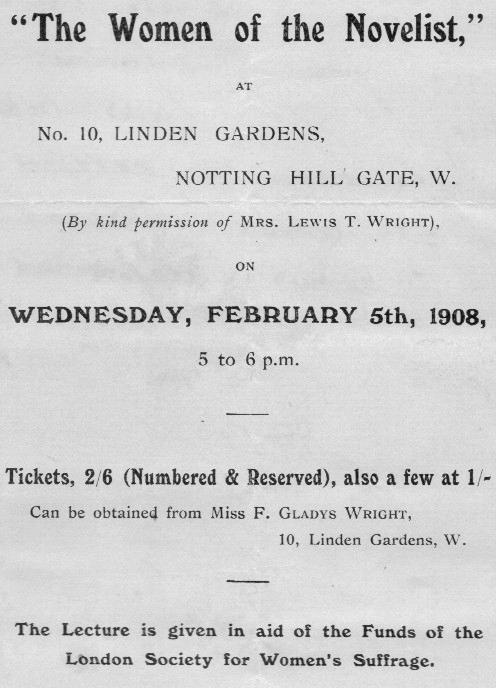
The flyer produced – presumably by the Wrights – for the lecture that Ford Madox Hueffer gave in their house. I wonder if the error in the spelling of his middle name was pointed out to them?
Dramatis personae for these entries:
‘Mrs Wright and the girls’: Mrs Lewis Wright and her daughters, Alexandra and Gladys, who then lived at 10 Linden Gardens. It was under their influence that Kate had joined the London Society for Women’s Suffrage, a constitutional suffrage society.
Geoffrey Stanger: the son of H.Y. Stanger, Liberal MP for North Kensington, who had introduced a women’s suffrage bill into the House of Commons.
Miss Mason: Bertha Mason, honorary treasurer of the National Union of Women’s Suffrage Socities – a suffragist of long-standing.
Miss Frances Sterling: joint honorary secretary of the NUWSS.
Ford Madox Hueffer (later Ford Madox Ford): author, then living in Kensington with Violet Hunt.
Friday January 10th 1908 [London: 25 Arundel Gardens, North Kensington]
I sat over the fire and had another little rest and got dressed early in my white satin dress. It is pretty – a charming frock – the nicest I have ever had, it seems to me. I did my hair Greek fashion with a silver and turquoise band round it which I have made myself – and though it’s me what says it and shouldn’t ‘I did look nice’. Even Mother said I did, I heard after from Agnes. Agnes’s dress was pretty too. And Mother has made hers beautifully but it hadn’t on a trace of style and she really did not look very nice……We had a private omnibus to the Grafton Galleries and got there about 9.15. Met Mrs Wright and her party just inside but by the time our four men had helped themselves we hadn’t many dances left. The girls introduced me to a few but I thought theirs rather a scratch lot – one boy wasn’t bad and Geoffrey Stanger, but one or two others I had I lost as soon as possible. It was a great pack – too many people for dancing in comfort somewhere about 300 and they have made for the London Society of Women’s Suffrage about £70…We stayed to the bitter end and I danced every dance except a few extra at supper time .. I learnt to do the Two Step with Mr Stanger and loved it. We reached home at 3.20 and were able to stir the fire into a blaze. John went off before 4 o’clock but we four sat over the fire talking till 4.30 and it was 5 o’clock before I was in bed as I always like to put some of my things away and tidy the room.
Thursday January 16th 1908
Changed at 6.30 and Agnes and I went off at 7.30 to Miss Mason’s (9 Hyde Park Place) for a Drawing-room Suffrage Meeting at which we had promised to Steward and get there at 8 o’clock for 8.30. We started to walk but we were all in our best and it started to drizzle and we took a cab from the top of the hill. The speakers were the Hon Bertrand Russell, Mr Mitchell Morton and Miss Frances Sterling. She made a most excellent speech and it was a most successful meeting. We did much good work in the way of getting members for the Society and it was all most encouraging and enthusiastic. They had a meeting here last night too – 70 people – but Alexandra said they were a most cold unenthusiastic audience – they could not do anything with them. She has paid Agnes and me a great compliment in saying ‘ I always like to see Agnes and you come into a room – then I know the thing will “go”’. I suppose we have a lot of personality and a lot of electrical excitement and it does help. John is quite in the movement now – though still apt to go back on us in the society of his own sex. .. These meetings are so exciting. I never feel like settling off after them.
Friday January 24th 1908
Changed after tea and at 5.30 Agnes and I went by motor bus from Notting Hill Gate to Oxford Circus and to the Queen’s Hall for the Liberal Federation Woman’s Suffrage Meeting. As we had been asked to act as Stewards and had to be there at 6 o’clock. We stewarded up in the Balcony but there was very little to be done. A good meeting, but not very full. But the audience was a very enthusiastic one and the speeches went well. Mrs Eva McLaren in the chair. Miss Balgarnie, Mrs Conybeare, Mrs Booth and the usual Liberal Women’s Federation people. It was a meeting for women only but there were a number of men stewards. The doors were opened at 7 o’clock and it commenced at 8 o’clock. Mother was there and we met at Oxford Circus and the three of us came home together by bus.
Wednesday February 5th 1908
They had quite a dozen awful Hampstead females there [at home] so we slipped quietly away and hurried to Notting Hill Gate so as to be at the Wrights (10 Linden Gardens) punctually at 4.45. Gladys had asked us to help them I stood in the hall and looked at tickets and sold others etc and later went up to hear the lecture from 5 to 6 by Mr Ford Maddox [sic] Heuffer on the Women of the Classical Novelist of England. It was most interesting and a breezy discussion followed. We got in at 6.30 .. I was very tired but I worked till 11 o’clock directing envelopes for the South Kensington Committee of the L.S.W.S. for a meeting to be held at the Town Hall on the 25th inst.
Campaigning for the Vote: Kate Parry Frye’s Suffrage Diary edited by Elizabeth Crawford
For a full description of the book click here
Wrap-around paper covers, 226 pp, over 70 illustrations, all drawn from Kate Frye’s personal archive.
ISBN 978 1903427 75 0
Copies available from Francis Boutle Publishers, or from Elizabeth Crawford – e.crawford@sphere20.freeserve.co.uk (£14.99 +UK postage £3. Please ask for international postage cost), or from all good bookshops. In stock at London Review of Books Bookshop, Foyles, National Archives Bookshop.
- ‘Campaigning for the Vote’ – Front and back cover of wrappers
WALKS/Suffrage Stories: Suffragettes and Tea Rooms: The Criterion Restaurant, Kate Frye, and the Actresses’ Franchise League
Posted by womanandhersphere in Kate Frye's suffrage diary, Suffrage Stories on September 5, 2012
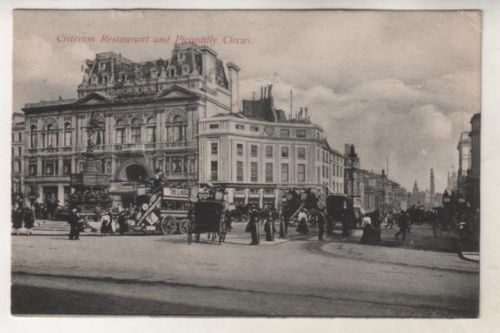 Criterion Restaurant and Piccadilly Circus c 1910
The glamorous Criterion Restaurant lies at the heart of theatreland, facing onto Piccadilly Circus. Owned by Spiers and Pond, it had been built, together with the adjoining theatre, in 1874 and during the last century and a quarter has undergone many changes – although now restored to glory. Before the First World War Spiers and Pond’s empire encompassed railway refreshment rooms as well as other large London restaurants, such as the Holborn, at the north end of Kingsway, the setting for many breakfasts held by the WSPU to celebrate the release of their prisoners from Holloway.
 The Criterion today
Although the Criterion has now only one restaurant – on the ground floor – in its Edwardian heyday it offered many more spaces – not only in which to dine – but also for hire; the Victoria Hall and the Grand Hall, on the first floor, were two such spaces. The Grand Hall, magnificently decorated, ran across the front of the building, overlooking Piccadilly Circus. The lavish interiors were very much a hallmark of the Spiers and Pond establishments – renowned especially for the high standard of their ladies’ cloakrooms – a point, I would imagine, our suffagists and suffragettes would have appreciated.
The Actresses’ Franchise League was founded at the end of 1908 and by the spring of 1909 began to hold its meetings at the Criterion, which was conveniently placed so as to allow its members to spend the afternoon listening to rousing speeches and yet be close at hand to give their own performances in the evening. By all accounts the meetings were extremely well attended, the AFL having no trouble in filling either of the two main halls.
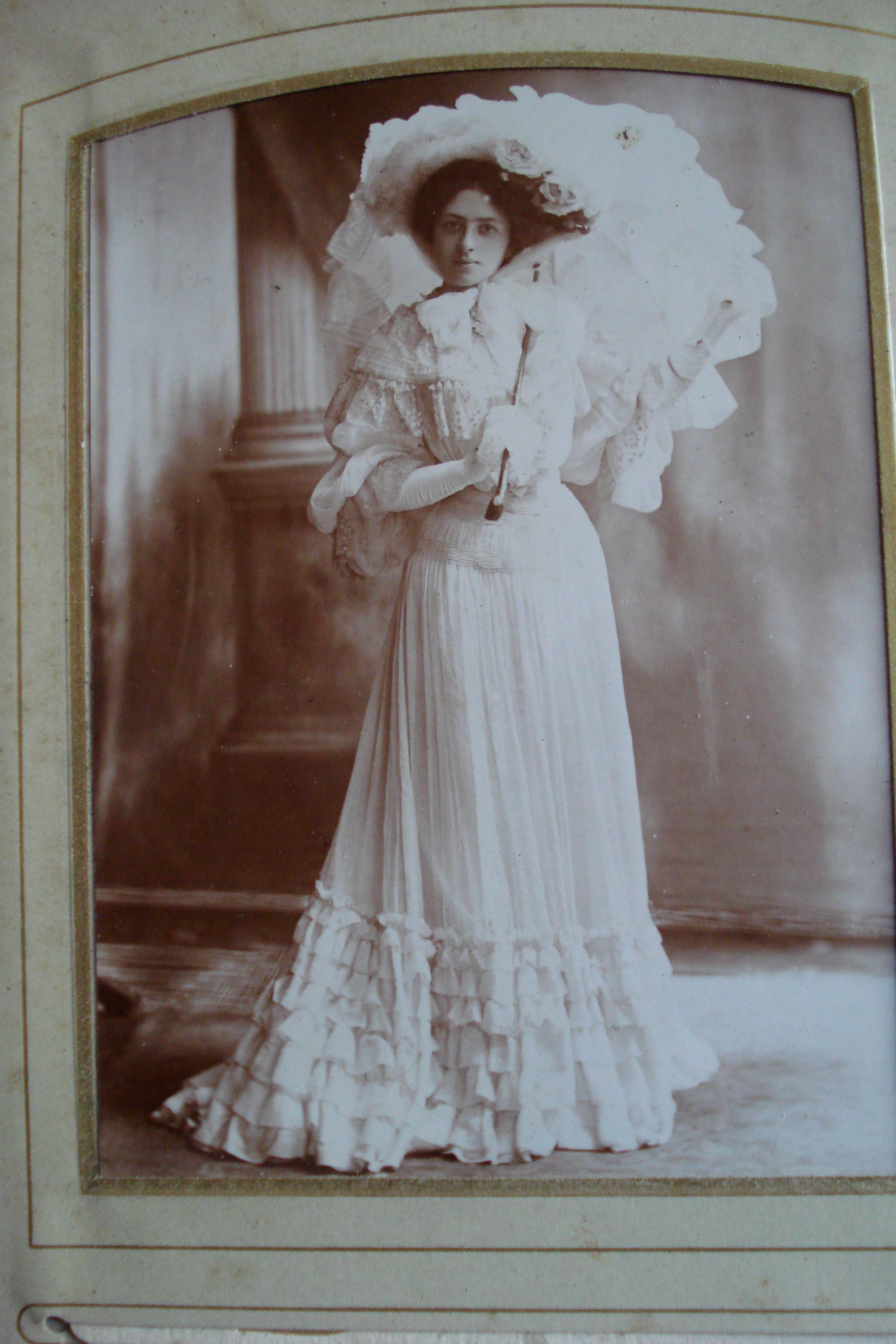 Kate Frye on tour in J.M. Barrie’s ‘Quality Street’.
Kate Frye (whose post-1911 suffrage diary, Campaigning for the Vote, is published by Francis Boutle ), was a proud member of the AFL, having spent two or three years treading the boards of provincial theatres. Her diary entries allow us to eavesdrop on some of those Criterion meetings.
‘Friday April 2nd 1909
Out at 2 o’clock – bus to Piccadilly Cicus and to the Actresses’ Franchise League meeting at the Criterion Restaurant. Miss Eva Moore was receiving and gave me a gracious handshake and Ada Moore was there. Also Eve, Mr Stanger [a sympathetic Liberal MP] and Miss [Frances] Sterling I heard speak. Lady Strachey was in the Chair and Lady Grove had spoken. I also heard Miss [Lillah] McCarthy, the Treasurer, speak and Miss Adeline Bourne, the Secretary, and I went up and spoke to Mr Stanger after the meeting.. His wife was also there. It was a huge meeting – no end of the profession there and they seemed enthusiastic but I have never got much faith in them. …
Friday February 4th 1910
Started off about 1.45 for the Victoria Hall Criterion Restaurant – went by bus. We went early as we wanted a good seat to see Miss Pankhurst. The place was packed before they began at 3 o’clock. Miss Granville took the chair and Miss Adeline Bourne as Secretary and Miss Maud Hoffman as Treasurer spoke in a more or less business-like fashion and Lt Col Sir something Turner spoke – an old dodderer. I could hardly keep my face straight he looked in such a loving fashion at the ladies but of course the thing of the afternoon was Christabel Pankhurst. She is a little wonder. So young and girlish looking – I suppose she is only 22 or 23 with such a charming way with her. She spoke very nicely too. It was not a brilliant speech but she was suiting herself to her audience I have no doubt – but it was so sincere and so fair. I have only heard her once before – at the Albert Hall – and one cannot judge like that – so I am glad to have been at such close quarters with her. She is not really pretty – has a crooked mouth and bad chin but her eyes are nice and she has a pretty forehead. Her hair was very untidy and I think would suit her so much better done low than on top in an ugly little knob. But though so faulty her face lights up so when she speaks and she has such a charming way with her that is very superior to mere prettiness….
Friday November 4th 1910
A bitterly cold day –had lunch then left at 1.15 – took a bus to Oxford Circus and went to steward at The Actresses’ Franchise League meeting at The Grand Hall Criterion. It was great fun.. A Mrs Fagan was in the Chair, Lady Constance Lytton, Mrs Pertwee , Mr Cecil Chapman and Mr M Campbell-Johnston were the speakers.. Then, amongst the audience, Hilda Fletcher – an old Ben Greet companion – the girl who helped me with the Banner at the second march and I chatted to lots of people – made 17/6 and had great fun. Two old gentlemen who were very taken with the Actresses and attending their first Suffrage meeting were most amusing.
Friday December 16th 1910
Changed my dress – at 2.15 bus to Oxford Circus and walked to the Criterion – to the Birthday Tea of the Actresses’ Franchise League. It was packed – a huge success. Eva Moore recited, Bertha Moore and daughter sang.’
The Criterion was used by women’s societies other than those campaigning for suffrage. Here is a photograph of a Women Writers’ Dinner held in the Grand Hall in 1900. Of the suffrage societies, it would seem that the AFL was the most regular user of the Criterion, although in April 1909 the WSPU held a breakfast there for released prisoners and in February 1910 and June 1911 the Women Writers’ Suffrage League held meetings in the Victoria Hall. It is interesting to note that on 26 October 1911, when the International Women’s Franchise Club held a dinner at the Criterion, a vegetarian option was chosen by a fairly high proportion of the guests – 25 out of the 130 who attended.
Although the suffrage sympathisers who attended such meetings were overwhelmingly middle class, one would like to imagine (as one can in a blog) that, through their association with, perhaps, the AFL, less well-off women would have had the opportunity to luxuriate in the splendid surroundings of the Criterion, enjoy a wash and brush up in the opulent Ladies’, and fill up on the tea that brought the afternoon to a close.
Based on her diary, I published Campaigning for the Vote: Kate Parry Frye’s suffrage diary. This is now out of print. The complete collection of Kate’s diaries is now held by Royal Holloway College Archive.
Kate Frye’s Diary: ‘Paddington Pandemonium’
Posted by womanandhersphere in Kate Frye's suffrage diary on August 23, 2012
In the following diary entry Kate describes the pandemonium that occurred at a December 1907 suffrage meeting organised by the North Kensington Local Committee of the Central Society for Women’s Suffrage – the non-militant London NUWSS society – chaired by Mrs Millicent Fawcett. From Kate’s account the main culprits were medical students from nearby St Mary’s Hospital and from University College Hospital in Bloomsbury, such student having had, through the ages, a reputation for unruly behaviour. From Kate’s observation, the stories of stinkbombs and the release of mice, specifically intended to upset the genteel female audience at suffrage meetings, were all too true.
Lady Grove (1862 -1926) was a leading Liberal suffragist and author of The Human Woman, 1908. The Paddington Baths, in Queen’s Road, Bayswater, were soon to be demolished to make way for an enlarged Whiteley’s department store.
Thursday 5th December 1907 [25 Arundel Gardens, North Kensington]
‘ At 2 o’clock Agnes and I started off to Linden Gardens and called for Alexandra Wright and several of her helpers and we all walked to the Paddington Baths to help arrange the room for the meeting in the evening. There was a good bit to do – numbering the chairs – partitioning them off and hanging up banners and posters etc. Left [home again] just before 7 o’clock in a bus to Royal Oak and went to the Paddington Baths for the London (Central) Society’s meeting for Women’s Suffrage. Gladys and Alexandra have been weeks getting it up and I did no end of clerical work for it at Bourne End. We were the first Stewards to arrive after Gladys and Alexandra and were decorated with rosettes and given our directions. Lots of the women were very nervous of a row. My department was the gallery, to look after people up there and give invitations for a private meeting next week.
The people came in thick and fast and the doors were opened at 7.30 and with the first group of young men below in the free seats I knew what would happen. The place was soon hot, bubbling over with excitement, and I had my work cut out keeping gangways clear and looking after people and telling them they would be safe. We had expected an exciting evening but this realised our worst expectations. It was Bedlam let loose. A couple of hundred students from St Mary’s and University College Hospitals arrived and insisted on sitting together and never ceased all the evening singing, shouting, blowing tin trumpets, letting off crackers, letting loose mice and, what is worse, scenting the floor with a most terrible-smelling chemical.
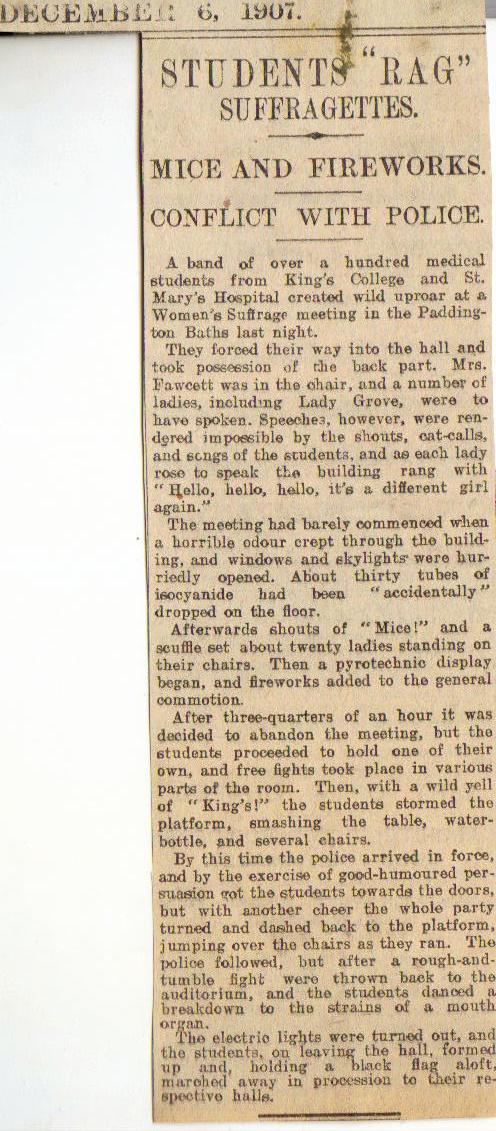
Report from the ‘Daily Mail’ 6 December 1907, clipped by Kate and laid in her diary
From the very start they never gave a single speaker a moments hearing. Mrs Fawcett was in the Chair and Lady Groveand others spoke and they went on with the meeting to the bitter end – and bitter it must have been to the speakers. I never heard a word. I felt too angry to be frightened though I must own I did not like the fireworks and saw the most appalling possibilities in that frantic howling mob of mad animals. Agnes owns to being terrified – all the more credit to her for sticking to her place amongst them and she was with them all the evening. I felt mad at not being there in the midst of them. When I could leave I just went down and spoke to John, who I saw standing near Agnes. She had decorated him as a Steward to help in case the worst happened.
I went back to my post until I was no longer any good there and then I went into the very midst of the seething mass and talked to any of them I could get at. Just to silence them, as I did for a few minutes at a time, was a triumph. Cries of ‘Oh I think I like Suffragettes’ as I went amongst them and, then, ‘He is flirting with a Suffragette’ taken up and sung by them all. I spoke like a Mother to several and smiled at them. If they had only known my true feelings I don’t think they would have been so polite to me. Great credit to all the women in the building is due – not only the Stewards – but the audience there. There was never any excitement or panic amongst them and only one Stewardess failed us. She, poor thing, was so terrified she bolted without waiting for hat or coat – but of course we keep that dark. The men Stewards were very good but quite powerless to stop the noise and hubbub. And what could four policemen do? It was an organised ‘Rag’ and nothing but a force of police to outnumber them could have stopped them. They longed for a fight and said so – and no end of them had most terrible looking clubbed sticks which they brandished. We did the only possible thing, I consider. Kept as much order as we could and tried to avoid bloodshed. We had a little unfortunately when, after the meeting was over, they charged for the Platform, sweeping everyone before them. Very fortunately there were large exit doors each side of the platform and most of the people got out of them. I was flung aside and then followed them up. They tore down as many banners as they could and stole one and tore down all the posters. They were like wild cats. The policemen chased them round a little but we would not allow any arrests to be made. The firework ringleader was caught but allowed to go. I spoke to Mrs Wright – red with rage. Poor things, we were all either red or white. Mr Willis, Mrs and Miss Doake and several others. Mr Percy Harris was Stewarding. One man Steward got a most awful crack on the ear and was considerably blooded – he looked awful. Several of the boys had their collars torn off and became very proud in consequence. It was a great wonder and a still greater mercy that more damage was not done. I felt so responsible for the ordinary public who had paid their money. I could only hope to get over the evening safely for their sakes. Personally I wished and still wish to smash the Boys, though at times I could not help laughing. They were not nice boys – all plain and common looking – mostly undersized and no gentlemanly looking one amongst them. I was glad to notice that as I hope they are not the best we can show in our hospitals.
After the general public had gone the police sent word that it was impossible to clear the hall while there was a woman left in it so we left with Mrs and Miss Doake and all came back in the bus with Mrs Willis. Miss Doake said she had never enjoyed a night so much in her life before. I cannot say the same. It was a terrible experience. We could not lose that terrible smell from our noses and mouths. I could taste it through everything at supper. John came home with us and did not leave till after 12o’clock. Agnes and I were too excited to go to bed and sat talking of our experiences. Lots of people will be made all the keener through it, but a great many will be very disgusted I fear.’
 As you can see from this note, carefully preserved by Kate, Mrs Fawcett’s meeting was re-arranged for early 1908 – to be held in the safety of Bertha Mason’s house in nearby Hyde Park Square.
Campaigning for the Vote: Kate Parry Frye’s Suffrage Diary edited by Elizabeth Crawford
For a full description of the book click here
Wrap-around paper covers, 226 pp, over 70 illustrations, all drawn from Kate Frye’s personal archive.
ISBN 978 1903427 75 0
NOW OUT OF PRINT, ALAS
KATE’S DIARIES AND ASSOCIATED PAPERS ARE NOW HELD BY ROYAL HOLLOWAY COLLEGE ARCHIVE
- ‘Campaigning for the Vote’ – Front and back cover of wrappers
 Woman and her Sphere

