Archive for October, 2012
Kate Frye’s Suffrage Diary: Banner Bearer For The 13 June 1908 Procession
Posted by womanandhersphere in Kate Frye's suffrage diary on October 30, 2012
Asquith became prime minister in April 1908. In response to his claim that he needed proof that large numbers of women really wanted the vote, the National Union of Women’s Suffrage Societies – and the WSPU – decided to mount a spectacular summer procession through London. The magnificent banners, such as that for North Kensington, carried some of the way by Kate, were the work of the Artists’ Suffrage League, in particular of Mary Lowndes.
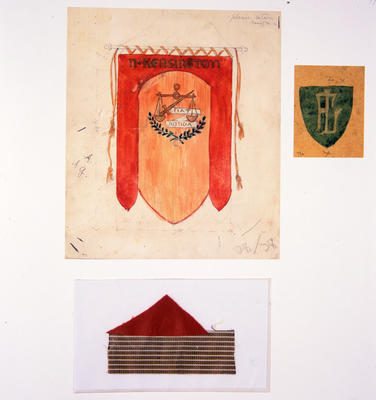
Mary Lowndes’ design for the North Kensington banner – with swatches of suggested material (courtesy of the Women’s Library@LSE)
The design of the North Kensington banner, held in the Women’s Library, can be seen
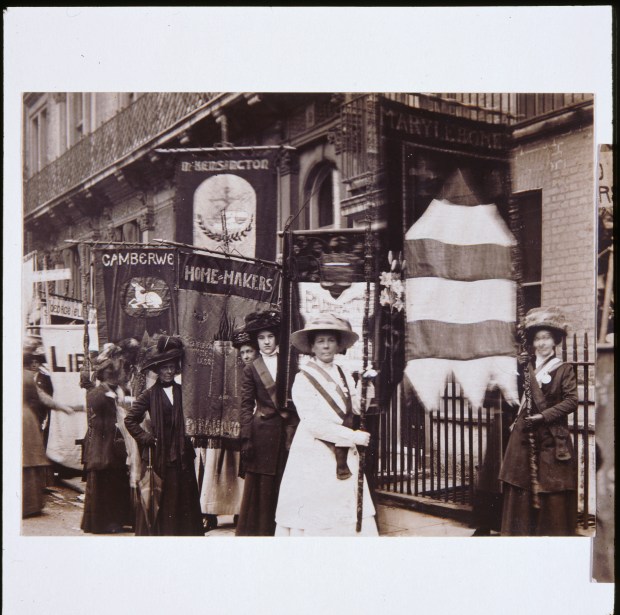
Banners – 13 June 1908 (courtesy of Women’s Library@LSE)
The banner itself was photographed during the course of the 13 June 1908 procession. ‘North Kensington’ is being held high; unfortunately the ‘Home Makers’ obscure the North Kensington banner bearers. Was one of them Kate?
Saturday June 13th 1908 [Bourne End]
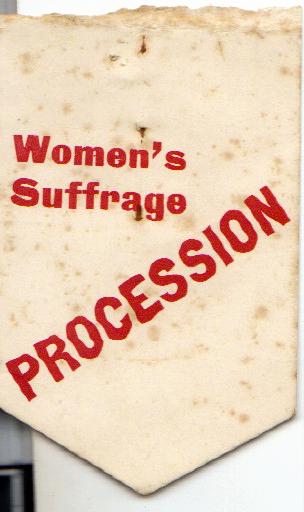
Kate’s ticket for the June 1908 Suffrage Procession
The great day dawned at last looking rather threatening – dull and very windy. I did not know quite what to wear but chanced the day wisely as it fell out and wore my best cream linen skirt and embroidery blouse and made myself look nice. I took a coat with me. Down to breakfast, had a chat to Agnes, who was very disappointed not to be going but really she was not up to it and it would have been no use attempting such an exacting and arduous day. It took it out of me. I was ‘going’ inside all day. Went up to London by the 9.53 train wearing my decorations – my ‘Votes for Women’ disk – my National Union Suffrage brooch and my red and white ribbon – the one that went through that exciting evening at the Paddington Baths. I wore them all day and it was most amusing to see the looks given to them. I went shopping in Whiteleys. Then a bus to Bond Street, walked through Burlington and along to the Strand – there I began to see some of my fellow marchers and the Lyons where I lunched was crowded with them – every one agog, of course, to see us.
Then I went to the A.A. [the Actors’ Association] tidied myself up and went upstairs. Quite an excitement there to see me and I found Eve Erskine wavering as to whether or not she should join the march. She rather aggravated me by some of the things she said about it. Then she is so tactless and really doesn’t know. It was from her I learned that there would be a contingent of Actresses headed by Gertrude Kingston, Lillah McCarthy and Mrs Pat [Campbell] and I must own I did feel deadly disappointed not to be going with them. I am sure Miss Gladys [Wright] kept it from me on purpose as she knew how eager I was to get the theatrical people to go and I said how I should like to march with them. So for that reason she did not send me a plan of the order of procession, I feel sure. Not quite straight because, any way, if she had said they really needed my help in Kensington I should have gone. But she and Alexandra went with the graduates and they wanted me responsible for N[orth] Kensington. There was really no-one else. Mrs Wright could not have carried the Banner or any of the small women if they could have it would not have looked right and comfortable. So I was offered up as a sacrifice. I think it was only right a Frye should be the Banner Bearer for North Kensington and I loved to do it and felt very proud but at first I must own to feeling a bit sick over it. I had a few words with Mr Halliwell Hobbs, who was crimson in the face with annoyance about it all. I said ‘will you shake hands though I am going to carry a banner.’ He simply could not bear himself – it so upset him to see my decorations. Eve walked or rather ran – we got so excited seeing the crowds – to the Embankment and there I lost her. I suppose she found her Block and marched with them for I saw her no more.

Kate preserved her programme
The crowds and the excitement was terrific and I really didn’t know how I should find my banner in it all. First I saw Miss Corbett who gave me a plan. Eve had one so I am sure Gladys ought to have sent her Banner Bearer one. And then I found I should be Block 8 – and a nice scamper I had right up Whitehall before I came to my place. Whitehall was quieter, but the crowds on the Embankment were terrific. At last I came to the Block for the London Society and found a messenger boy with the little White and Red Banners we had before. He gave it up to me on hearing my name and I was left alone. As I got there soon after 2 o’clock it was alright but I longed for some friendly face. I had had a glance at some of the Banners as I sped along – they were lovely. At last one or two women whose faces I knew turned up and then three girls with a huge and beautiful banner – one of the Artist League ones – the one Gladys meant me to carry and take the responsibility of. They were in too much of a hurry, the girls, to be off to tell me how to manage it and I had my flapping coat and the wind was terrific. I got one of the others to hold the little one till Mrs Wright and a lot of other people came. Then a tall girl carried the little one at the back of the Kensington Block. Some one very kindly carried my coat and I got the frog fixed round the banner more comfortably. Miss Madge Porter carried one cord, Miss Meyer the other.
We were immediately behind the Holborn section and Lady Grove’s pretty daughters carried that Banner – a huge one – but, lucky beggars, they had two poles to support it. Mine was fearfully heavy, especially in the wind – but I was given a gift with it I think. It was a beauty nauge cloth – brown and yellow silk and cloth of gold. Mrs Percy Harris was just behind. She had to fall out early as she went very strange and there were lots of people I know by sight. We were quite a smart collection – all in our best summer attire. The stewards marshalled us six abreast behind the Banner which had to stand out. The whole thing was most wonderfully organised.
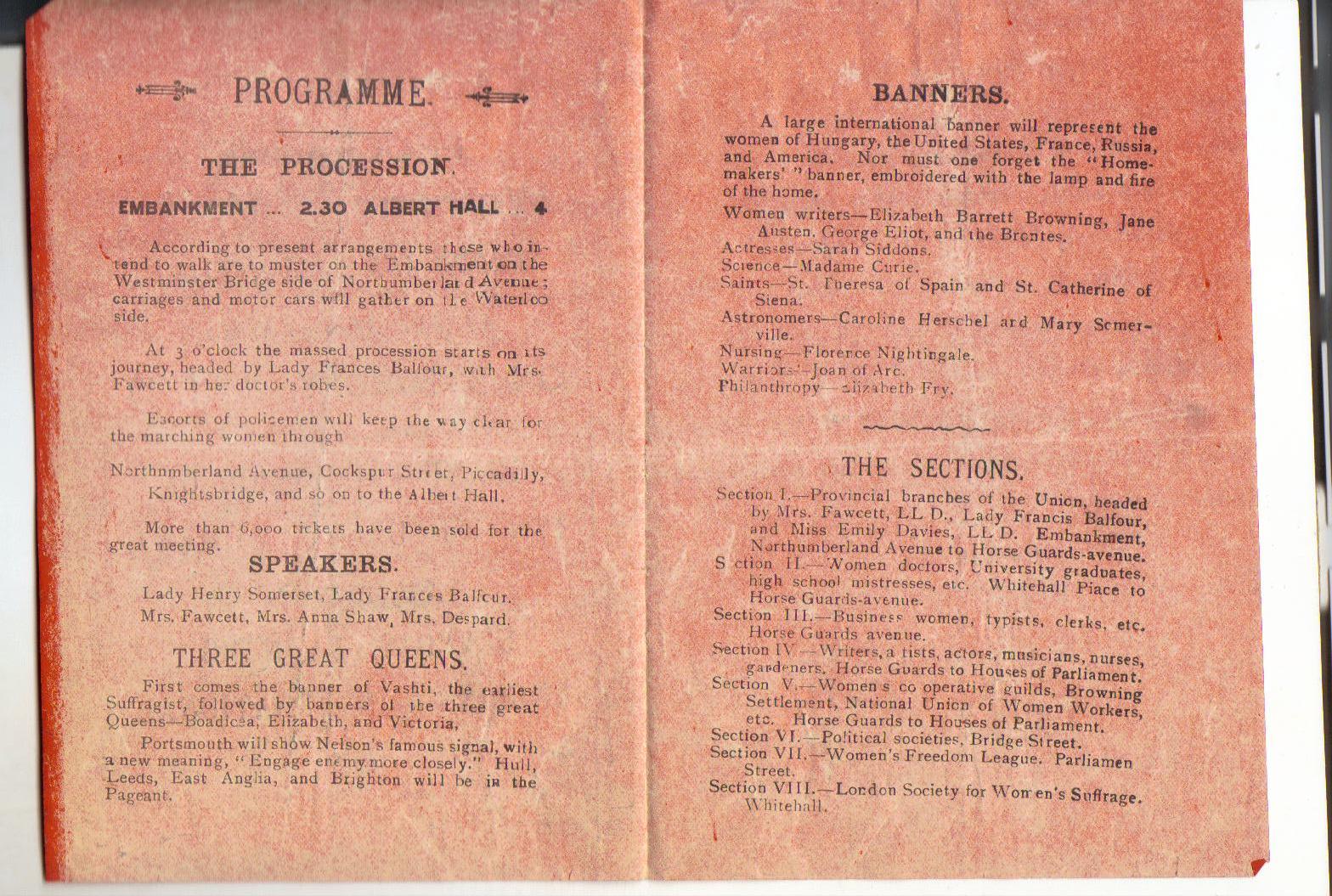
Programme details for the procession
Before we moved off John [her fiance] arrived on the scene with Mr Andrews [a friend] and was most proud to shake hands with me and I think the whole thing quite converted him. They went off to see the Banners, then took up their stand in Trafalgar Square and watched us go. John watched it over an hour. He saw me but I didn’t see him. He says I was laughing away and looked to be enjoying myself. Some of the remarks were enough to make one laugh. I saw Mr Dickenson [the M.P.] go past and G.B. Shaw while I was waiting and there were all sorts of weird and curious men – one dressed up like a Jack in the Box to represent Adam, I think – but I couldn’t make him out.
Before 2.30 we were off to the strains of a Band and marshalled in order and we reached one side of the Embankment. We were given 2.30 to assemble – so those who turned up then must have had a difficulty in finding us. It took some time – then there was half an hour’s wait in line – then we began to manoeuvre about – the police directed us. I don’t really know what we did but we turned back round the road while a stream passed us the other way then round me went again over to the side of the trams which made some of them nervous. The trams were packed with people to see us. Then a long wait again – 3.30 I should say before we moved off – and then a very slow procession up Northumberland Avenue – halts of five minutes at a time, it seemed. We were in the middle of two Bands so we were never dull and sometimes with the clamour of the two together it was terrific but the marches helped me along and we three kept step. Oh the crowds – packed like sardines the other side of Piccadilly – some of the roughest of the rough on the Embankment but for the most part quite friendly and polite. There seemed so few policemen in comparison that if the crowd had liked to be disagreeable it would have been awful. The clubs and hotel windows and steps were thronged. Most of the people seemed interested – some were laughing. We only had passage enough just to pass along till we got to the Square then our pace mended till it grew terrific and had almost to run to keep up and going up Waterloo Place was a great strain. From the bottom we could see the Banners winding up and up.
We were about 10,000 with 70 Artist League banners – lots of others and hundreds of Bannerettes shimmering in the wind. For the most part after Piccadilly the crowd was quite a different class and quiet and respectful – many men raised their hats to us and ladies clapped their hands – lots of children? were in the crowd and ‘Mother’ made one clap his hands at me. One nice old clergyman bared his silver locks to each Banner Bearer. Of course it was a very different thing from last year [ie the February ‘Mud March’] – gigantic in comparison and, as for the crowds, I had never seen anything like them except at Royal Weddings etc and a good long route we had. Up Northumberland Avenue, Lower Regent Street, Piccadilly, Knightsbridge, Exhibition Road to the Albert Hall. The first part of them must have been in the hall soon after we left the Embankment. I was in the last section – No 8, the London Society – but I could not see our end and after us came all the motor cars and carriages. The Social and Political Union people had a four in hand and were up and down distributing notices of their great demonstration on Sunday week in Hyde Park. The Graduates and Doctors looked simply lovely – I am sure they must have got some cheering ‘Well’ I heard one man say, ‘what I like about them is there isn’t one with a bit of powder on’.
‘Lucky you have dropped your garter’ ‘Have you mended the socks’ Have you washed the baby’ and such remarks as those were rife and, of course, lots of comments on one’s personal appearance – rather painful some of them –‘Oh look at this nice girl’ ‘isn’t she a beauty’ etc but really most of the people were quite kind and sympathetic. I think it must have been rather a stirring sight – it seemed to me ‘magnificent’. I felt it was moving the people. I heard people say in awestruck tones ‘I don’t believe it will ever end’ Miss Meyer took the Banner from me in Piccadilly and carried it to the end – she hadn’t had all that tiring first part and the long waits and she was strong and capable. I must say I was getting a bit done with it but I would have liked it again later only she seemed quite happy and I did not like to take it from her. Gladys had written to say she would help me with it. She took it in the hall and sat with it also.
The approach to the [Albert] hall was very slow again – but the pace all along Piccadilly had been tremendous. I think we must have been catching the first lot up where it had been broken at Trafalgar Square for the traffic. I got in the hall about 5.10 and they started the meeting just as I sank down. I must own to feeling completely done when I left the Banner. I got cramp in both feet at once and felt 1,000 but I dashed into the hall found the seat in my box with the Wrights and Alexandra, like an angel, got me a cup of tea. She, Gladys and another girl looking most awfully charming in cap and gown. Mrs Stanbury was there and Mrs Lambert and several people I knew. I had to keep my eye on the clock but I heard Lady Henry Somerset, Dr Anna Shaw, Mrs Fawcett and [then] Miss Sterling present the Bouquet to Mrs Fawcett – then the procession of Bouquets till the platform looked like a garden. They were just singing ‘For she’s a jolly good fellow’ when I came out. I got a cab, still very lame, and drove to Paddington. There I met John and Mrs Harris and the train was looking out for me – so we travelled down together, talking all the way…
The Actors Association, a club to which both Kate and John belonged, was at 10 King Street, Covent. Garden.
Halliwell Hobbs, 30-year-old actor, was clearly a young fogey.
Margery Corbett (1882-1981- later Dame Margery Corbett-Ashby) was the daughter of a Liberal MP. At this time she was secretary of the NUWSS
Lady Henry Somerset (1851-1921) was a wealthy philanthropist and leader of the temperance movement.
Mrs Percy Harris, née Marguerite Frieda Bloxam, wife of Percy Harris (later Sir Percy Harris), who became a Liberal MP in 1916, lived in Bourne End.
Anna Howard Shaw (1847-1919) US physician, temperance reformer and, at this time, leader of the National American Woman Suffrage Association.
Frances Sterling (1869-1943) joint honorary secretary of the NUWSS.
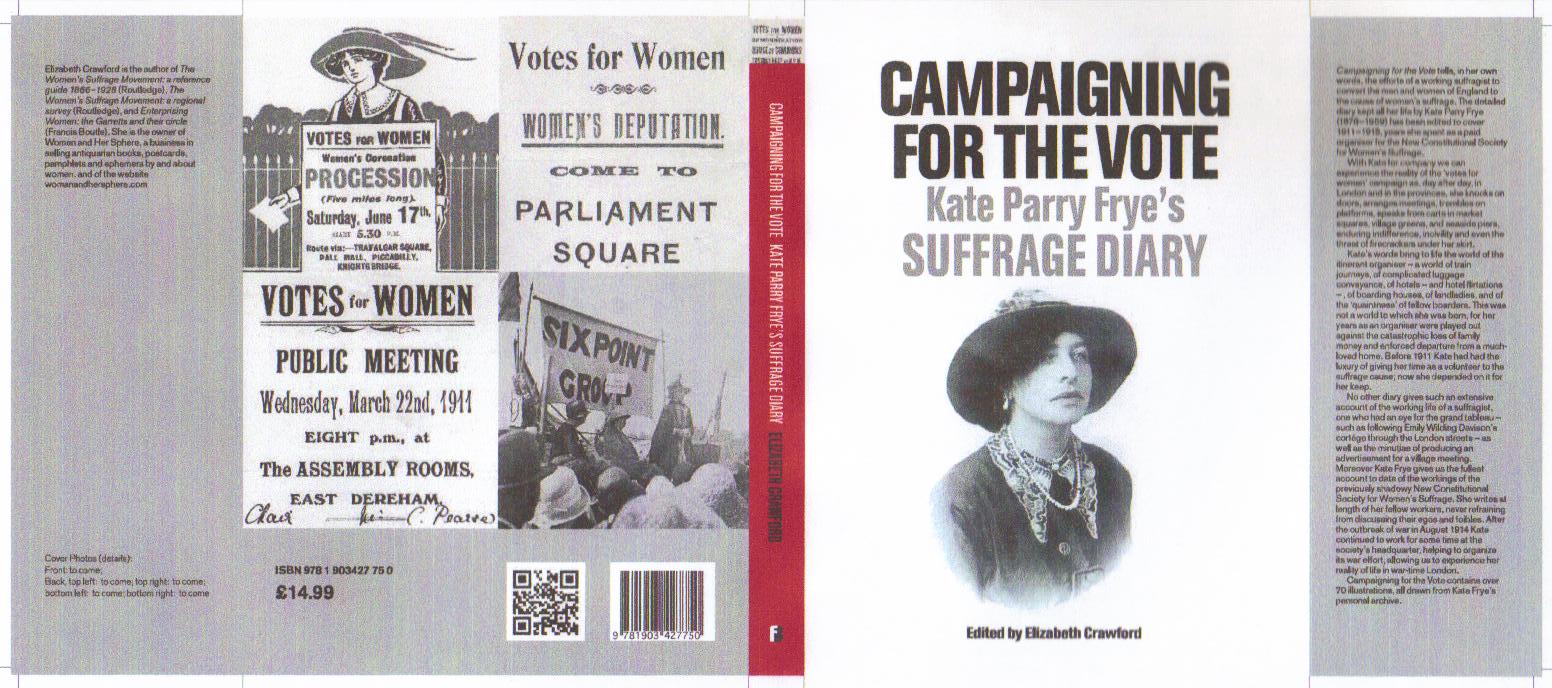
Campaigning for the Vote: Kate Parry Frye’s Suffrage Diary edited by Elizabeth Crawford
For a full description of the book click here
Wrap-around paper covers, 226 pp, over 70 illustrations, all drawn from Kate Frye’s personal archive.
ISBN 978 1903427 75 0
Copies available from Francis Boutle Publishers, or from Elizabeth Crawford – e.crawford@sphere20.freeserve.co.uk (£14.99 +UK postage £3. Please ask for international postage cost), or from all good bookshops. In stock at London Review of Books Bookshop, Foyles, National Archives Bookshop.

- ‘Campaigning for the Vote’ – Front and back cover of wrappers
Rooms Of Their Own: Victorian And Edwardian Women’s Clubs: Hesitant Beginnings
Posted by womanandhersphere in Rooms of their Own: Women's Clubs on October 24, 2012
Rooms of Their Own:Victorian and Edwardian Women’s Clubs
 ‘The Ladies’ Reading Room’ – the genesis of the woman’s club, c. 1858, as it appeared in an advertisement in Barbara Bodichon’s guide book, ‘Algeria Considered as a Winter Residence for the English.’
‘The multiplying of women’s clubs, and the accompanying facilities for social intercourse, is distinctly a latter-day feature of London society. Twenty years ago they were practically unknown: today they are to be met with on all sides. They are a sign of the times; women have awakened to the fact that they want something outside their domestic and home duties’. Thus observed a Lady’s Realm journalist in 1898. One might, indeed, go further and state that, 20 years earlier, not only were clubs for women practically unknown, but that the concept was all but inconceivable.
During the first three-quarters of the 19th century economic and social regulation had kept the majority of middle-class women in a family home, either that of their birth, that of a relative or that of their marriage. For those who had neither such support nor the wealth to maintain their own house-hold, the alternative was a life spent in rented rooms. Such lodgings controlled a woman’s social life just as strictly as any family. Under this regime there was little opportunity for women whose interests did not coincide with those of their family to make contact with one another. What were required were places in which women could relax in company, but yet be beyond society’s reproach.
In the mid-19th century the idea of ‘the club’ was synonymous with ‘a man’s club’, a development of the 18th-century coffee house where men gathered to discuss the news of the day. By the mid-19th century the number of clubs, their popularity and comforts had increased apace. Club culture was firmly established among the middle and upper classes, but was absolutely a male culture. The story of how women managed to create a parallel tradition is yet another strand in the history of women’s emancipation.
The idea had first been mooted in 1857 when Bessie Parkes and Barbara Bodichon thought of opening a club room on the same premises as that of the feminist journal they planned to publish. Initially their aim was very modest, merely to provide a room in which to make available the magazines and papers they knew women of cultivation but limited means would like to read but could not otherwise afford.
The club room did materialise, by 1860 known as the Ladies’ Institute. It was housed in premises in Langham Place, just north of Oxford Street, comprising a Reading Room, open from 11 in the morning to 10 at night, a Luncheon Room and a room for the reception of parcels. The latter was a boon for women travelling into central London to shop at the new department stores. Thus the club provided rest and recreation not only for London’s many middle-class working women, such as daily governesses, who were likely to be living alone in lodgings, but also for her like-minded, but more leisured, sister.
Needless to say the club room’s opening did not pass without criticism. The Saturday Review commented, ‘If all that is meant is a lounge for the unprotected female, in which she can daily meet her like-minded and strong-minded sisterhood to discuss the Divorce court till half-past one, and then console the inner woman with sandwiches and sherry, we can only hint to the ladies that this may be a mistake.’ However, despite this reprimand, the Ladies’ Institute proved popular for the seven years of its existence. The general subscription was one guinea a year, but for the category described as ‘professional ladies’ – such as daily governesses – it was reduced by half.
The Ladies’ Institute closed in 1867 but its spirit continued in the Berners Club, which opened in Berners Street, again just north of Oxford Street, and continued in existence until almost the end of the century. In the 1870s it shared premises and personnel with the leading London suffrage society. It followed the pattern set by the Ladies’ Institute, was principally aimed at working, middle-class women, had a reading room, a drawing room and a dining room and was open until 10.30 each evening.
From the 1880s, once the idea had been shattered that clubs were only for men, women’s clubs multiplied, two distinct types emerging. There were those that followed the tradition set by the Ladies’ Institute and the Berners, appealing to independent-minded working women, and those that provided ‘tea and shopping facilities’, social in their aims and fashionable in their membership.
I will consider both types of clubs in future posts.
WALKS/Suffrage Stories: St Clement’s Press
Posted by womanandhersphere in Suffrage Stories, Walks on October 22, 2012
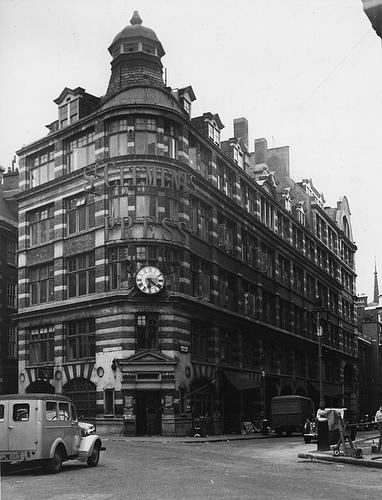
St Clement’s Press, c. 1959, courtesy of LSE Library
To mark the very welcome co-operation planned for the future between the Women’s Library and the London School of Economics the next few ‘Suffrage Stories’ will demonstrate the past importance to the women’s movement of streets and buildings in the vicinity of Houghton Street.
In the last ‘Suffrage Story’ I described why and how, from the autumn of 1906, the Women’s Social and Political Union came to have its offices at Clement’s Inn, a few hundred yards from the London School of Economics which, since 1902, had taken up residence in premises in Clare Market and Houghton Street.
In the previous post I also mentioned that Frederick Pethick Lawrence had had some experience as a newspaper proprietor and editor. It was, therefore, natural that he and his wife, Emmeline, should consider it useful for the suffrage society with which they were now so closely associated to have its own proselytizing organ. This would both broadcast the aims and actions of the WSPU and serve as a point of focus for its swiftly expanding membership.
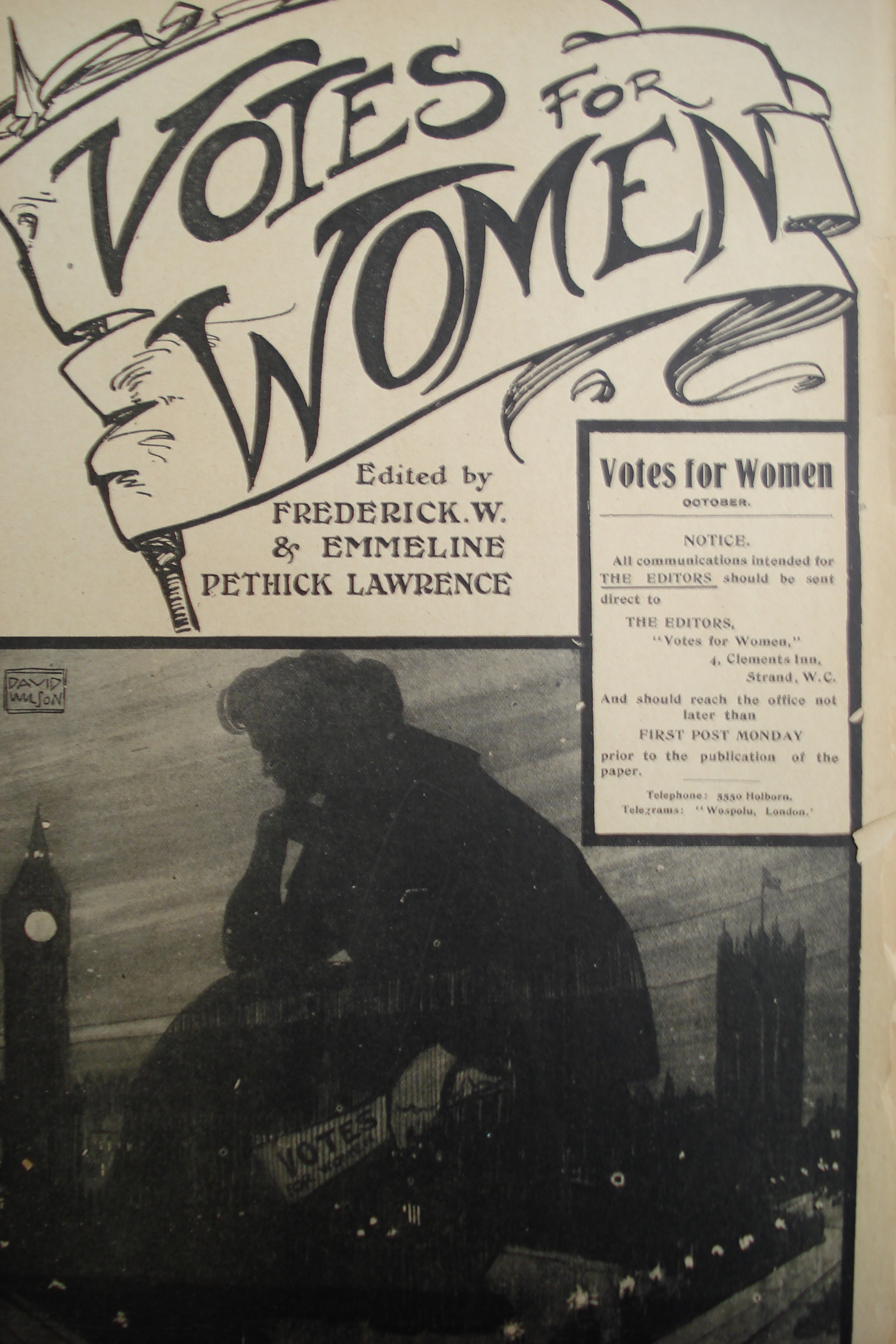
The first issue of ‘Votes for Women’
The first issue of Votes for Women, as the new paper was unequivocally named, appeared on 16 October 1907. It was financed and edited by Emmeline and Frederick Pethick Lawrence and published from the WSPU office at 4 Clement’s Inn.
The Pethick Lawrences had not had to look far for a printer for their new paper. Housed in ‘Newspaper Buildings’, at the junction of Clare Market and Portugal Street, opposite the end of Clement’s Inn Passage (now St Clement’s Lane), the late-19th-century bulk of St Clement’s Press towered over the maze of narrow streets bounded by the Strand and the swathe of Kingsway, still a raw building site. The Press had begun business in 1889 and was to be printer to a variety of other organisations sympathetic to the suffrage cause – from 1909, for instance, responsible for the Anti-Vivisectionist Review.
Votes for Women was published monthly until April 1908, after which it took on a larger format and became a weekly. This increase in frequency and size was a direct reflection of the WSPU’s great success in attracting members and creating interest in its campaign. By early 1910 Votes for Women had a weekly print run of c. 30,000 copies.

Grace Chappelow, a WSPU member from Essex, selling ‘Votes for Women’. Courtesy of Chelmsford Museum
The paper was sold in newsagents but also by members of the WSPU who were prepared to stand in the gutter (to stand on the pavement counted as obstruction) and sell it to passers by. St Clement’s not only printed Votes for Women but also a variety of posters to advertise the paper – such as this one, held in the Women’s Library collection.
This arrangement continued for three and a half years until March 1912. At the beginning of that month WSPU members embarked on a dramatic window-smashing campaign, attacking shops and offices in London’s West End. As a result Emmeline Pankhurst and Frederick and Emmeline Pethick Lawrence were all arrested on the charge of conspiracy to commit criminal damage. Christabel Pankhurst escaped from Clement’s Inn and fled to Paris. The first issue of Votes for Women to be issued after the arrests – the number for 8 March – appeared with blanks in the text. There was a note on the front page:”The Editors who are responsible for “Votes for Women” in the absence of Mr and Mrs Pethick Lawrence beg to inform their readers that the blank spaces in this week’s issue do not represent lack of interesting matter for publication, but mark the suppression by the printers of articles, comments, and historical facts considered by them to be of an inflammatory nature.’
Whether it was because the temporary editors considered it impossible to continue working with a printer who felt unable to print all the material supplied, or whether it was that St Clement’s Press declined to be associated with a publication that might bring them into direct conflict with the law – for whatever reason the 15 March 1912 and subsequent issues of Votes for Women were no longer printed by the St Clement’s Press but by Walbrook & Co of 14 & 15 Whitefriars Street, off Fleet Street.
After the Pethick Lawrences were ousted from the WSPU in the autumn of 1912 they retained ownership of Votes for Women, still printed by Walbrook, making the paper the focus of their new organisation, the Votes for Women Fellowship. I will discuss this organisation in a subsequent post.
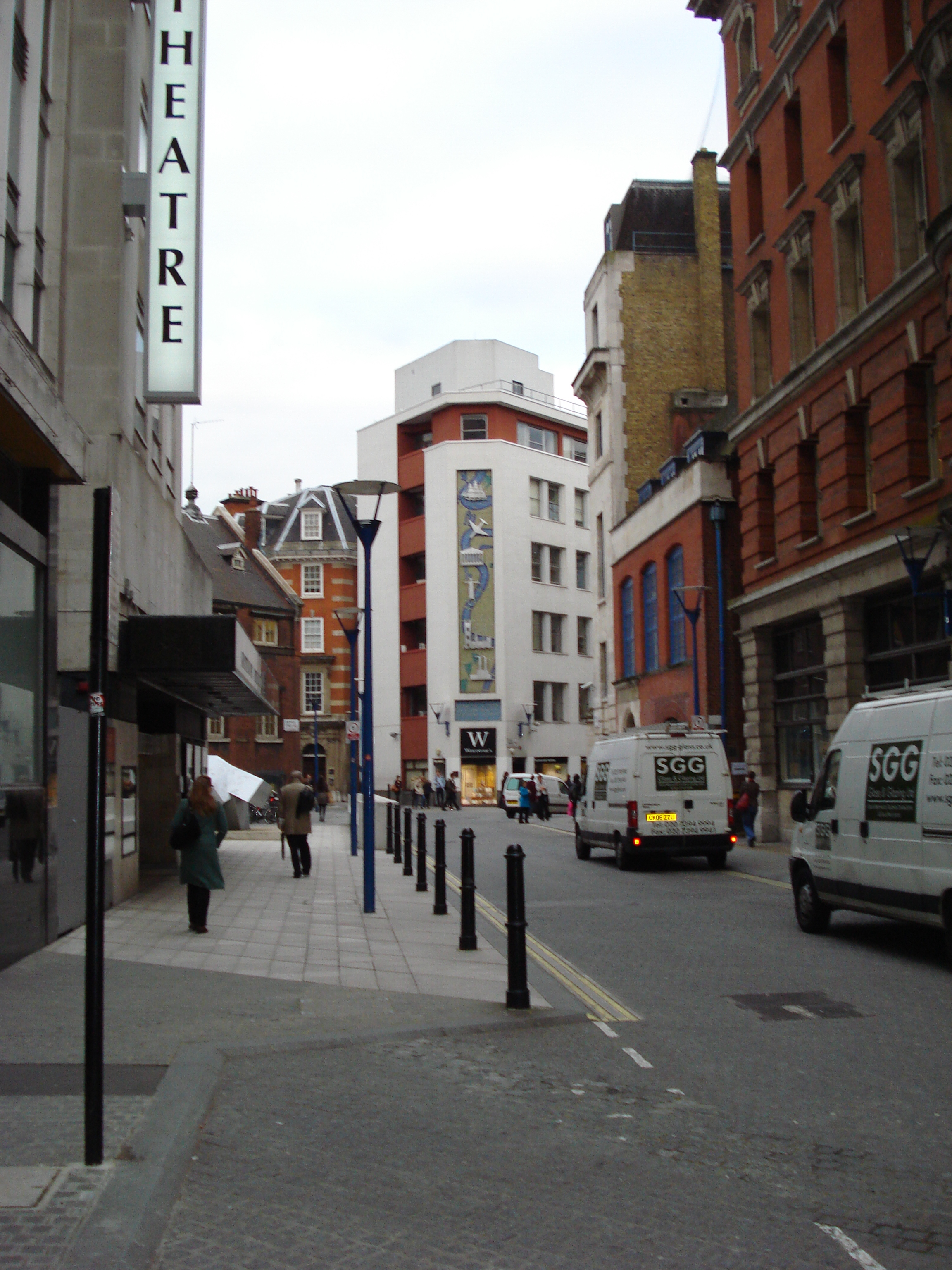
The Economists’ Bookshop, viewed from Kingsway
The site of the St Clement’s Press was occupied by Waterstone’s Economists’ Bookshop, very much an LSE institution – now itself history.
Collecting Suffrage: The WSPU Holloway Brooch
Posted by womanandhersphere in Collecting Suffrage on October 19, 2012
This is the ‘Holloway Brooch’ presented to members of the Women’s Social and Political Union who had undergone imprisonment. As such it is now a very desirable addition to any suffrage collection. If you are hoping to own one of your own, I have one for sale – see https://wp.me/p2AEiO-1CV
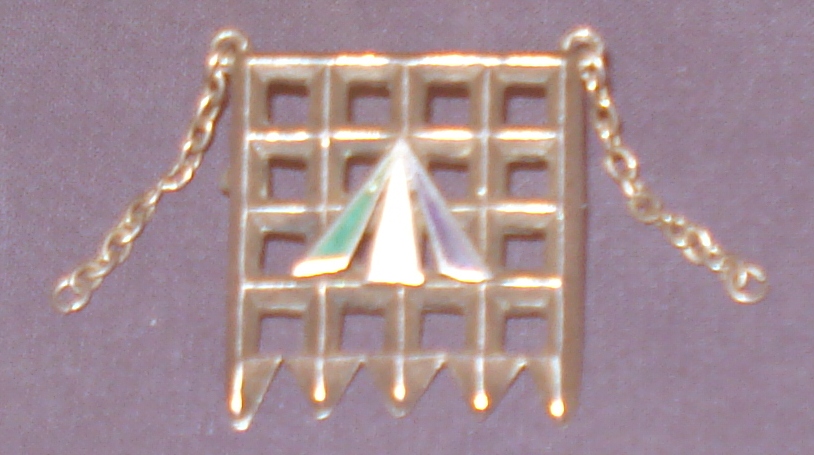
The first presentation of the brooches took place at a mass demonstration organised by the WSPU in the Albert Hall on 29 April 1909. It was held to coincide with the meeting in London of the International Woman Suffrage Alliance. The presence on the platform of a large number of ex-WSPU prisoners and,to honour their sacrifice, the ceremonial presentation to them of the first ‘Holloway’ brooches was designed to make an international impression.
The brooch was designed by Sylvia Pankhurst. The portcullis symbol of the House of Commons, the gate and hanging chains are in silver, and the superimposed broad arrow (the convict symbol) is in purple, white and green enamel. Some of the brooches, but by no means all, are marked with dates of imprisonment.
The brooch was first mentioned in Votes for Women, the WSPU newspaper, in the issue of 16 April 1909, described as ‘the Victoria Cross of the Union’. However, in April 1909 WSPU prisoners had not yet begun using the hunger strike as a tool in their battle with the authorities. In recognition of that, which was considered the greater sacrifice, the WSPU instituted the hunger strike medal, the first of which was presented four months later.
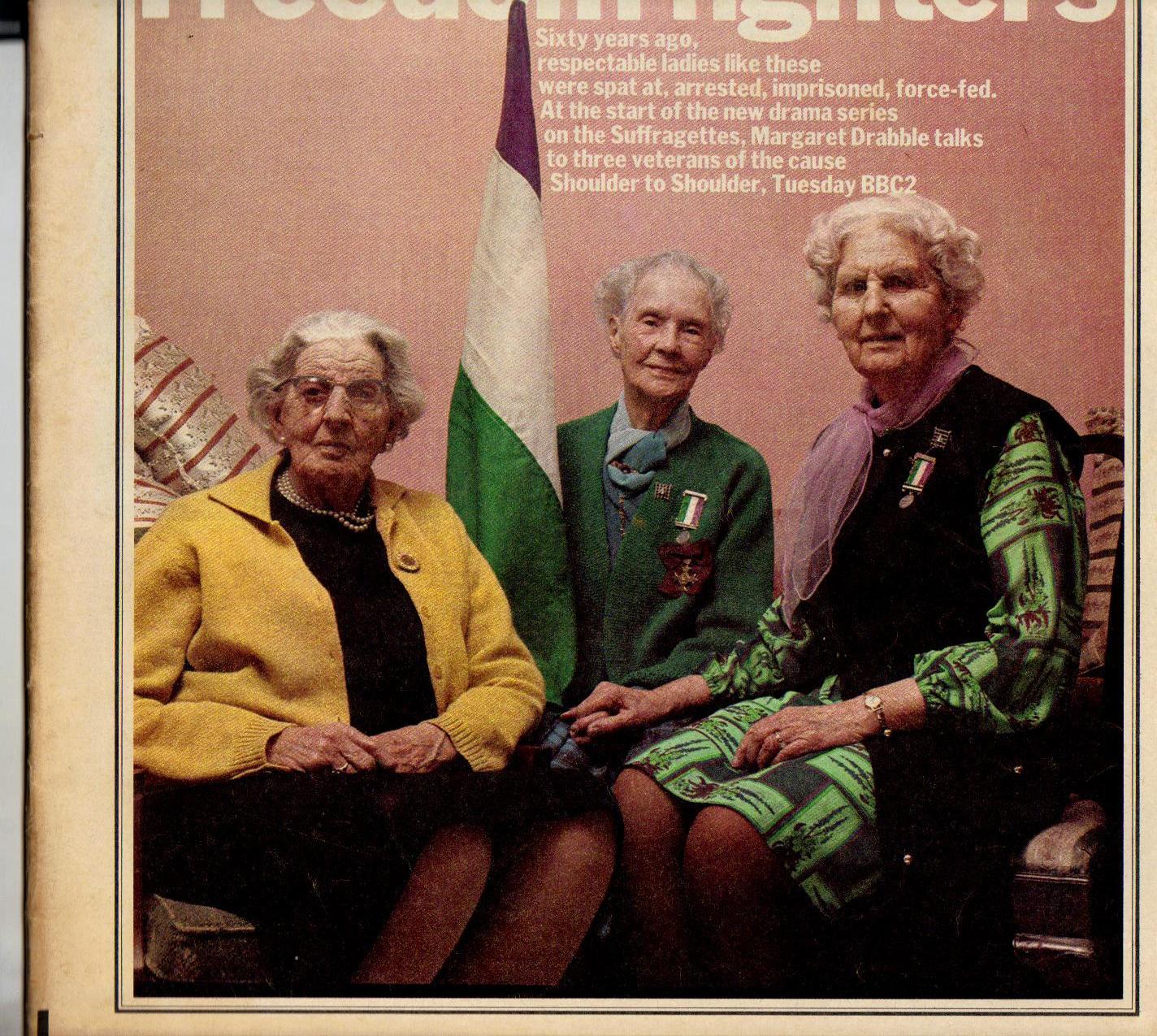
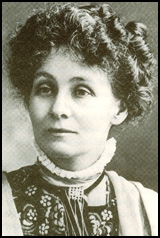 Mrs Pankhurst chose to be photographed wearing her ‘Holloway’ brooch in this photograph- as, 65 years later, did the elderly suffragettes, Leonora Cohen and Grace Roe . The latter two, like many other women, had received both of the WSPU accolades.
Kate Frye’s Suffrage Diary: Two Days in April 1908
Posted by womanandhersphere in Kate Frye's suffrage diary, Uncategorized on October 16, 2012
Kate Frye was a devoted theatre goer. She had trained as an actress and had toured for two or three years from 1904 and joined the Actresses’ Franchise League as soon as it was founded.
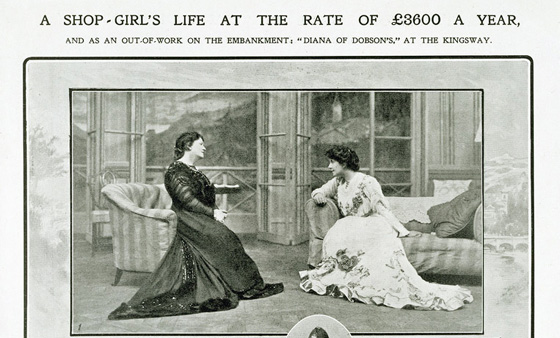
A scene from ‘Diana of Dobson’s’ – an article in ‘The Sketch’, 10 February 1908. Courtesy of the V & A
‘Diana of Dobson’s, a romantic comedy that also criticized the ‘live-in’ conditions that Edwardian drapery stores imposed on their staff, was written by Cicely Hamilton (1872-1952) actress, author, and active suffragist. Lena Ashwell (1862-1957) was both the leading actress in the production and the manager of the Kingsway Theatre. ‘Diana of Dobson’s was the second play in Ashwell’s first season at the Kingsway. She was later a vice-president of the Actresses’ Franchise League and a tax resister. Dennis Eadie, in the ‘elderly character part’ was then only 33 years old.
The walk from Tottenham Court Road to the Kingsway Theatre in Great Queen Street, to the west of Kingsway, would have taken the Fryes through the still relatively unsavoury St Giles and Seven Dials area.
Wednesday April 8th 1908
Mother, Agnes and I left just before 2 o’clock and went by bus to Tottenham Court Road and walked to the Kingsway Theatre just before 3 o’clock and we went in to the reserved seats to see ‘Diana of Dobsons’. It is nearly a month since I got the seats. We very much enjoyed our afternoon. The play is most interesting and amusing and sad too – underneath it all. Lena Ashwell, though her voice sounded tired, was very good – so was Hollard – and Dennis Eadie excellent in an elderly character part. It is quite a novel sort of play and I don’t wonder it is popular. It ought to make people think. The scene of the first act must be a revelation to lots of people.
The next day’s ‘Suffrage Discussion’ was organised under the aegis of the London Society for Women’s Suffrage – a constitutional society. Although it was to be several years before the founding of the Jewish League for Women’s Suffrage, there was obviously already an interest in the subject among the Jewish community.
Mrs Gertrude Spielman (1864-1949) born in Germany, was the wife of Meyer Spielman, who was later knighted. She was actively engaged in educational and other forms of social work, particularly with the Norwood Jewish Orphanage and was, in 1912, to be a founder of the Jewish League for Women’s Suffrage.
Aylmer Maude (1858-1938) translator of Tolstoy, Fabian, was renowned as a persuasive lecturer.
Mrs Campbell Lethbridge (1873 -1945), a woman of mystery, was born Sybil MacGregor Allen, in 1894 married William Lonergan, but by 1901 had become Sybil Campbell Lethbridge, a popular and prolific author. Find out more about her here.
Israel Zangwill, Jewish novelist, was always a great favourite of Kate’s.
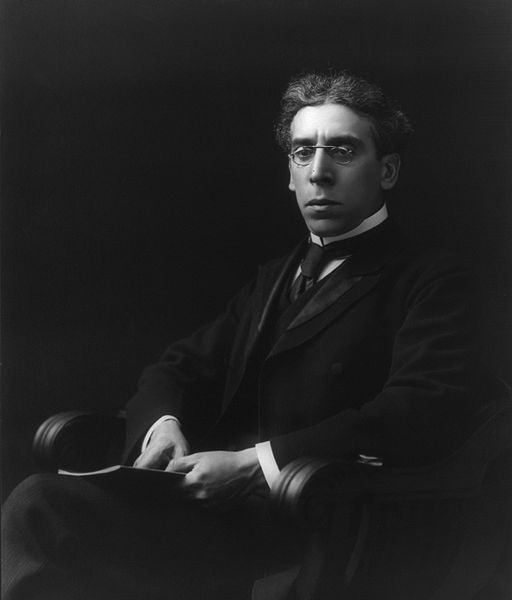
Israel Zangwill, photographed in 1905
Thursday April 9th 1908
Agnes and I left in a cab at 8 o’clock to Mrs Spielman, 38 Gloucester Square. Got there with Alexandra and Gladys [Wright] and some of the other stewards and we all went up together. There was nothing for us to do at first except make the people sit tight – such a pack it was – hundreds – nearly all Jews except our own friends. It was a Suffrage Discussion – Mr Aylmer Maude in the chair – Mrs Campbell Lethbridge spoke, Miss Spielman (oh! that was painful) and Mr Zangwill. He, of course, was beautiful – but I am much afraid too frivolous to do any converting. He was so funny he made me laugh until the tears ran down my face. The discussion was most amusing – such weird people got up and said things. Afterwards we went up and talked to people. I got five members and did better than anyone – but it was hard work. I didn’t give myself any rest and kept straight on – while Agnes looked after our guests and saw they got something to eat. We came back in a hansom. Got in at 11.45 and then had supper. It was past one before John [her fiancé] departed and 2.30 before we got off to bed. I was tired.
Campaigning for the Vote: Kate Parry Frye’s Suffrage Diary edited by Elizabeth Crawford
For a full description of the book click here
Wrap-around paper covers, 226 pp, over 70 illustrations, all drawn from Kate Frye’s personal archive.
ISBN 978 1903427 75 0
Copies available from Francis Boutle Publishers, or from Elizabeth Crawford – e.crawford@sphere20.freeserve.co.uk (£14.99 +UK postage £3. Please ask for international postage cost), or from all good bookshops. In stock at London Review of Books Bookshop, Foyles, National Archives Bookshop.
- ‘Campaigning for the Vote’ – Front and back cover of wrappers
WALKS/Suffrage Stories: Where And What Was Clements Inn?
Posted by womanandhersphere in Suffrage Stories on October 15, 2012
To mark the very welcome co-operation that now exists between the Women’s Library and the London School of Economics the next few ‘Suffrage Stories’ will demonstrate the past importance to the women’s movement of streets and buildings in the vicinity of Houghton Street.
In previous posts I have described the Tea Cup Inn, which was in Portugal Street in the building which, for the time being at least, houses the LSE Chaplaincy, and the Aldwych Skating Rink, in which the WSPU organized its grand 1911 census boycott meeting. In the latter post I remarked that, all but abutting onto the back of the Skating Rink, were the offices of the WSPU at 3 & 4 Clement’s Inn.
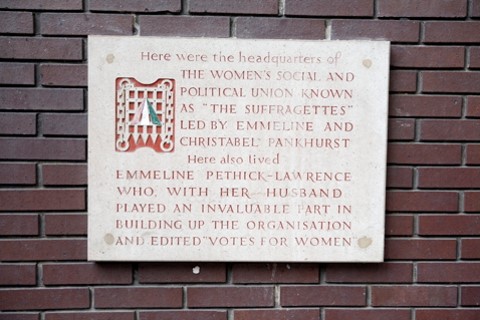
A commemorative plaque, placed on a building now occupied by LSE. marks the site, citing the words of Christabel Pankhurst: ”Clement’s Inn, our headquarters, was a hive seething with activity… As department was added to department, Clement’s Inn seemed always to have one more room to offer.’ [9 February 1907]
But what was ‘Clements Inn’?
The history of the late-19th-century Clement’s Inn buildings are surprisingly sketchy – although I daresay that archival research would uncover more detail. In its original incarnation Clement’s Inn had been one of the original Inns of Chancery, but its purpose and its buildings were swept away sometime during the second half of the 19th century. The exact date of its removal is vague; Pevsner merely puts it between 1868 and 1891, presumably meaning that it was demolished in stages. Suffice it to say that towards the end of the 19th century – probably in the 1880s – large blocks designed for both office and residential use were built on the site of the old Inn. They stretched in a line, just west of the Royal Courts of Justice – and on the west side of Clements Inn Passage – north from the Strand up to Clare Market. These blocks were given the name ‘Clement’s Inn’ and housed a medley of solicitors, architects, chartered accountants, surveyors, publishers and even, at 5 & 6 the Uruguayan Legation and Consulate. The southern-most blocks were numbered ‘1 & 2 Clement’s Inn’ and were still standing in 1977. By then the more northerly blocks – 3 & 4 – had already been demolished.
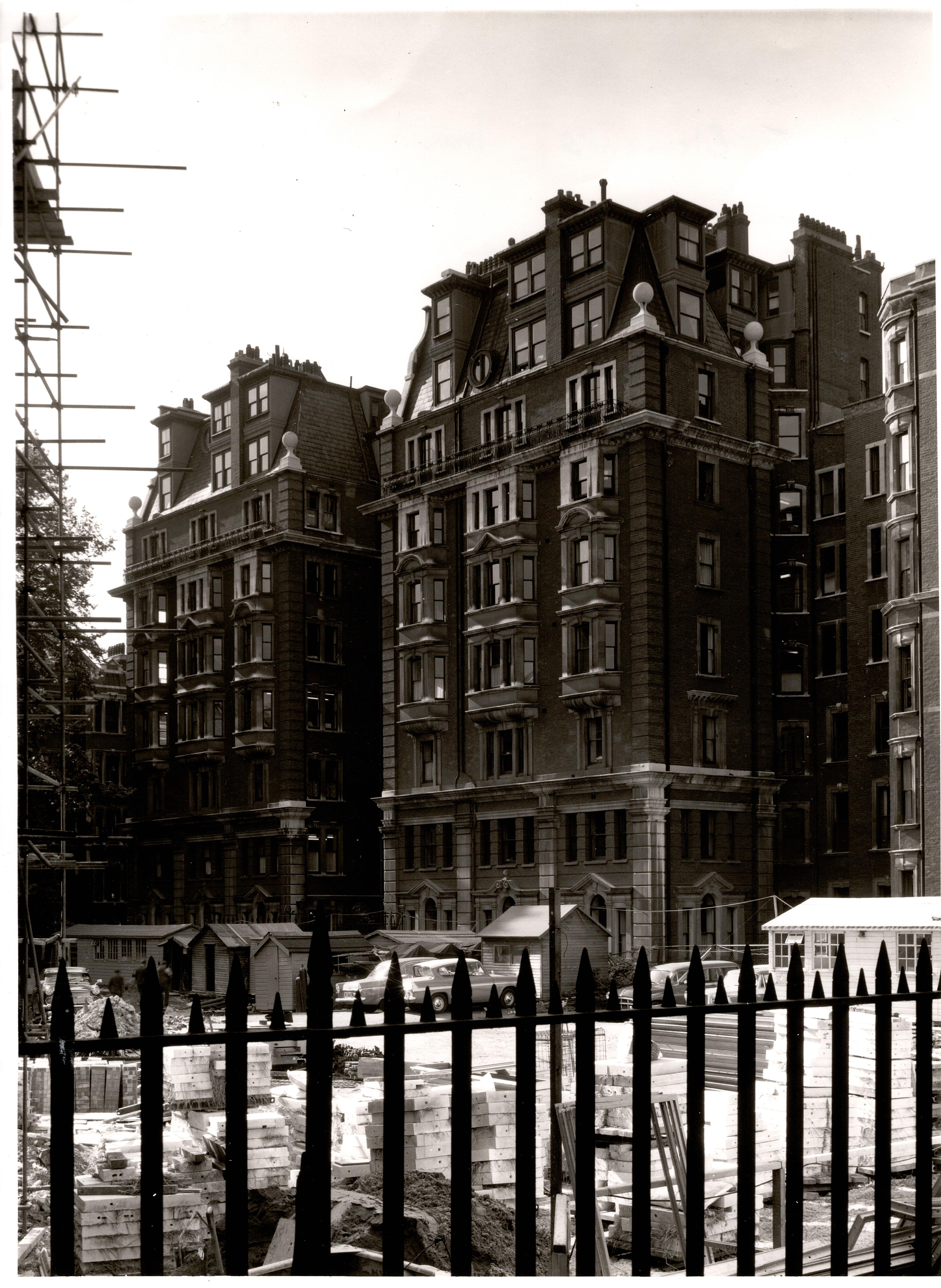
Extraordinary as it seems, photographs of the exterior of 3 & 4 Clement’s Inn seem all but non-existent, the one above one of very few I’ve been able to track down.
The photograph shows the Clement’s Inn buildings to have been rather imposing – five storeys high, rising in places to seven. They were built of brick – presumably once red, doubtless very quickly blackened in the London atmosphere, with facings of stone around the windows and doors. Detailing was gothic, doubtless a nod to the adjacent Royal College of Justice buildings. The ‘look’ was not unlike that of nearby Old Square, Lincolns Inn, where in later years Frederick and Emmeline Pethick-Lawrence, who are specifically noted on the WSPU plaque, had a flat.
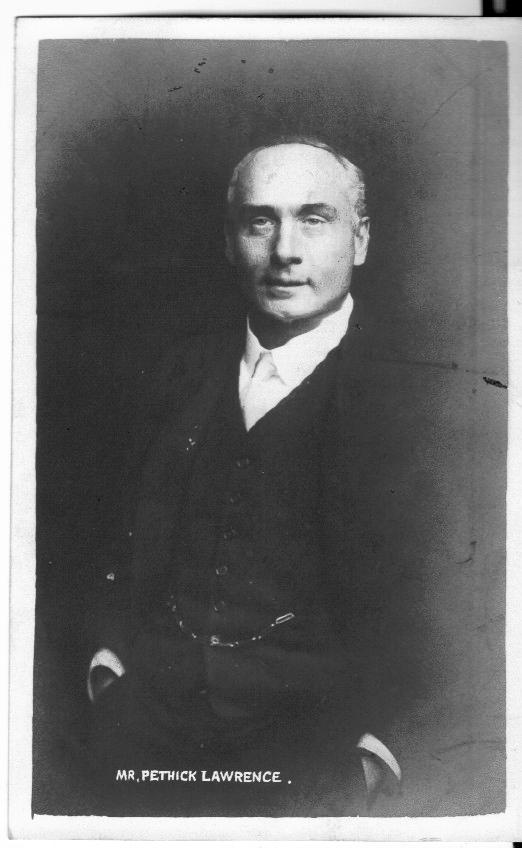
For it was entirely due to the Pethick Lawrences that the WSPU office came to be sited at 3 & 4 Clement’s Inn. Frederick Pethick Lawrence first appears on the London electoral register at 3 & 4 Clement’s Inn in 1904. He and Emmeline – they had married in 1901 -were living in what is termed in the rate book as ‘a residential suite’ – to differentiate this type of apartment from the offices that were also available for rent. The apartments were serviced; the Clement’s Inn building included a servants’ hall, servants’ dormitories and a kitchen in which meals were cooked for delivery to the tenants. This, I would imagine, was a style of living that entirely suited the Pethick Lawrences whose many interests surely precluded any time for domesticity.
The Pethick Lawrences had presumably chosen Clement’s Inn as their London address – they did also have a house in Surrey – because it was close to the office, at 19 St Bride Street, of The Echo, a newspaper bought by Frederick Pethick Lawrence c 1902. It had been a Liberal paper – with a bias towards the Liberal Unionist section of the party- but, under Pethick Lawrence was re-directed towards the Labour movement, with Ramsay MacDonald among its contributors. However The Echo ran at a loss and in 1905 Pethick Lawrence closed it and in May launched a new monthly publication, the Labour Record and Review. Pethick Lawrence was also the publisher of the Reformers’ Yearbook (called, before 1905, the Labour Annual and Reformers’ Yearbook). In the 1905 edition of the Yearbook, printed from information supplied in 1904, the ‘Directory of Useful Addresses’ lists the ‘Women’s Union’ , the secretary of which is Mrs Rachel Scott of Woodbine, Flixton, Manchester. This was the recently formed Women’s Social and Political Union. Its founders, Mrs E. Pankhurst and Miss C Pankhurst, of 62 Nelson St, Manchester, are also listed as ‘Useful’.

In her autobiography Emmeline Pethick Lawrence records that it was from her roof garden in Clement’s Inn that in January 1906 she saw the general election results ‘as they were thrown by a lantern-slide on the elevated-whitened board in the Strand’. This new technology was displaying a Liberal landslide. But it was, however, the success of Keir Hardie and the Labour Party that particularly pleased the Pethick Lawrences. A month later Hardie introduced Emmeline Pethic -Lawrence to Emmeline Pankhurst as ‘a practical and useful colleague who could develop in London the new society she had founded in Manchester’ – the WSPU.
Later that year the embryonic London campaign, which had been spearheaded by Annie Kenney and which for several months had held its business meetings around kitchen tables in various hospitable London homes, was given office premises by Frederick Pethick Lawrence in 3 & 4 Clement’s Inn. In the relevant rate book the WSPU is shown as taking up its tenancy at Michaelmas (29 September) 1906 in rooms 68,69 and 70.
This apartment was separate from number 119 shared jointly by the Pethick Lawrences; Frederick had given Emmeline the luxury of ‘a room of her own’.
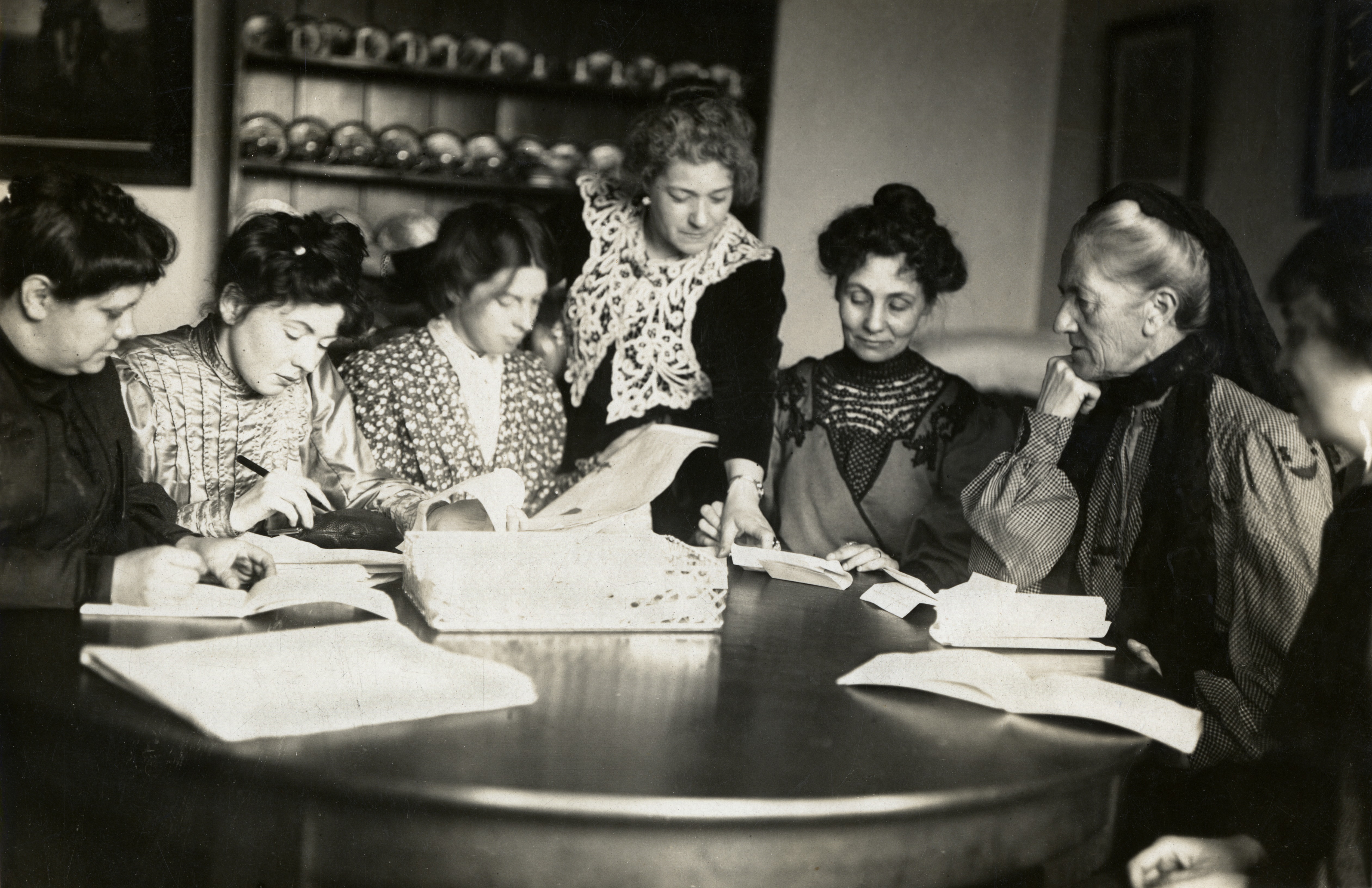
When, in July 1906, Christabel Pankhurst came to London, after gaining her first-class law degree in Manchester, she lived with the Pethick Lawrences – perhaps in Emmeline’s separate apartment. The rate books show that over the years the Pethick Lawrences occupied several different sets of rooms, the quantities and configuration varying from year to year.
When, in October 1908, warrants were issued for the arrest of Christabel and Emmeline Pankhurst after the WSPU had urged Londoners to ‘Rush the House of Commons’, the pair were photographed hiding from the police on Emmeline Pethick Lawrence’s roof terrace.
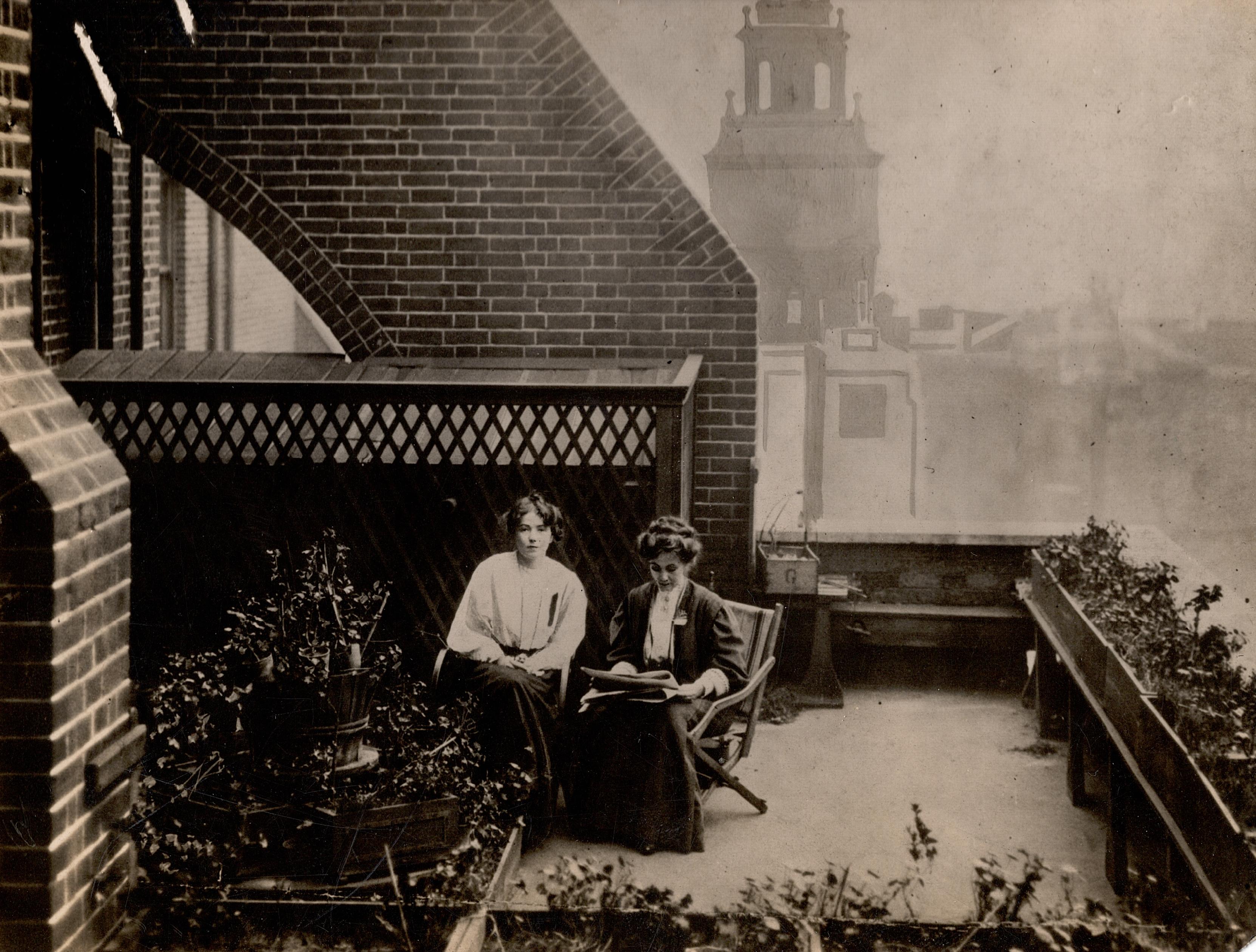
Emmeline and Christabel Pankhurst photographed on Clement’s Inn roof terrace, 1908 (courtesy of LSE Library)
After ensuring that their evasion had been captured on camera, they then went downstairs and were photographed in the course of being arrested by Inspector Jarvis.
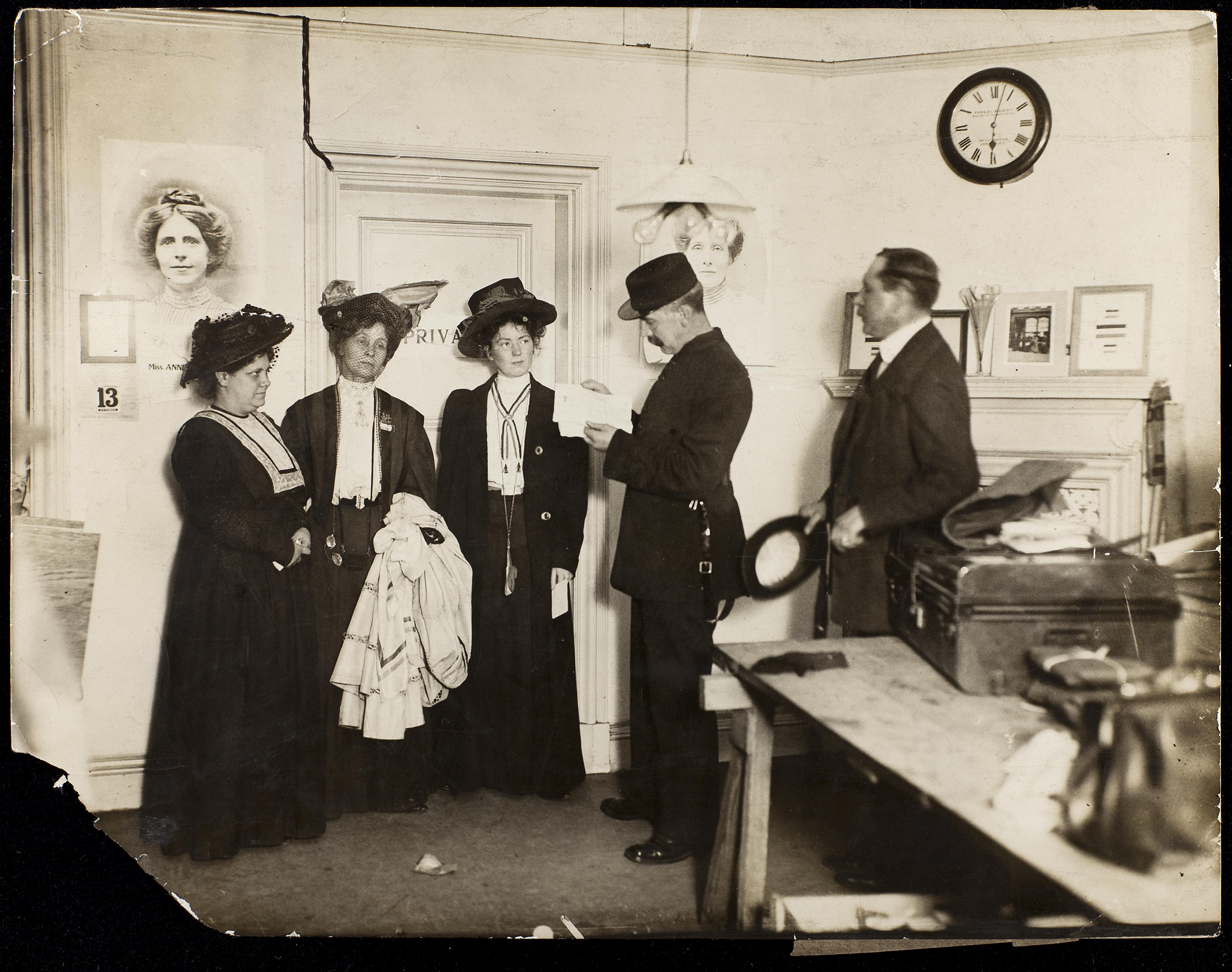
Other WSPU offices were photographed on other occasions. Here is Mrs Pankhurst’s. Note the pictures, posters, flowers, and mantlepiece items.

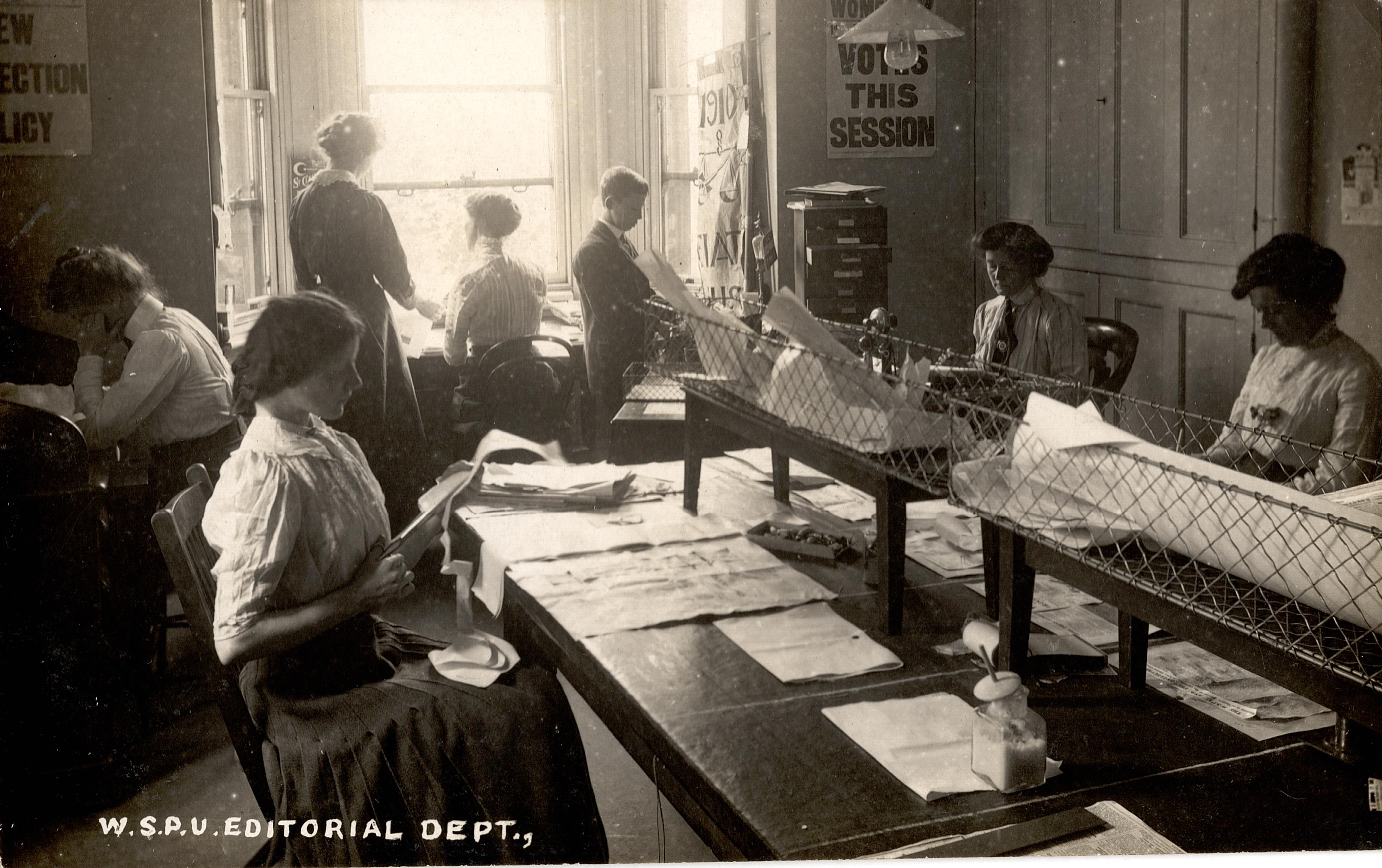
This ‘seething hive of activity’ is pictured in at least one contemporary novel. For in Ann Veronica, published in 1909, H.G. Wells furnishes the offices of the Woman’s Bond of Freedom – the suffrage society that sweeps his heroine off her feet and into prison – with ‘notice boards bearing clusters of newspaper slips, three or four posters of monster meetings..and a series of announcements in purple copying ink, and in one corner …a pile of banners’. Wells had no need to rely on photographs for his information; during the years when the WSPU was working from Clement’s Inn, it was doing so in close physical proximity to the Fabian Society, of which Wells was a leading member and which had been responsible for the founding of the LSE. Knowing from the rate book that the WSPU’s basement office was next door to that of the Fabian Society, it requires little stretch of the imagination to envisage Wells finding a reason to combine a visit to one with a brief sortie into the other, the result being good ‘copy’ for his novel.
It would be surprising if there had not been some tension between the two offices – the one campaigning for votes for some, not all, women while the other backed the cause of adult suffrage. For although, when they agreed to support the WSPU, the Pethick Lawrences were still committed to the Labour cause, as the women’s suffrage campaign developed its tactics changed and the association with Labour was considered by the Pankhursts no longer to be advantageous. Despite this, there were many connections between the WSPU, the Labour Party and the Fabian Society. For instance, Beatrice Sanders, working from an office in Clement’s Inn as financial secretary to the WSPU, was the wife of William Sanders, a Fabian Society lecturer, LCC alderman and Labour parliamentary candidate. Mrs Sanders was herself a member of the Fabian Women’s Group. However, William Sanders was one of what Wells termed the ‘Old Gang’ that ranged itself against him when he attempted to reform the Fabian Society and, in retaliation, probably took Sanders as his prototype for ‘Alderman Dunstable’ in Ann Veronica. Wells certainly found plenty to mock in the WSPU and its activities and, unsurprisingly, although Ann Veronica was listed among ‘Books Received’ in the WSPU newspaper, Votes for Women, it never received the accolade of a review.
A very powerful propaganda tool for the WSPU, Votes for Women was brought to life each week in a building even closer to Houghton Street than Clement’s Inn and will be the subject of the next of my ‘Suffrage Stories’.
Copyright All the articles on Woman and Her Sphere and are my copyright. An article may not be reproduced in any medium without my permission and full acknowledgement. You are welcome to cite or quote from an article provided you give full acknowledgement.Book Of The Week: Gilbert Stone (editor), Women War Workers, published 1917
Posted by womanandhersphere in Book of the Week on October 12, 2012
‘Woman and Her Sphere’ has had a long-standing interest in searching out – and cataloguing for sale – books and ephemera by and about women’s involvement in the First World War. With the 100th anniversary drawing nearer, radio and television producers already searching for new angles from which to approach the subject , and the Government heralding what is likely to be a long period of commemoration, it is, perhaps, appropriate to draw readers’ attention to some of the contemporary works that recorded ways in which women reacted to the disruption of their world. The first book I have chosen is:
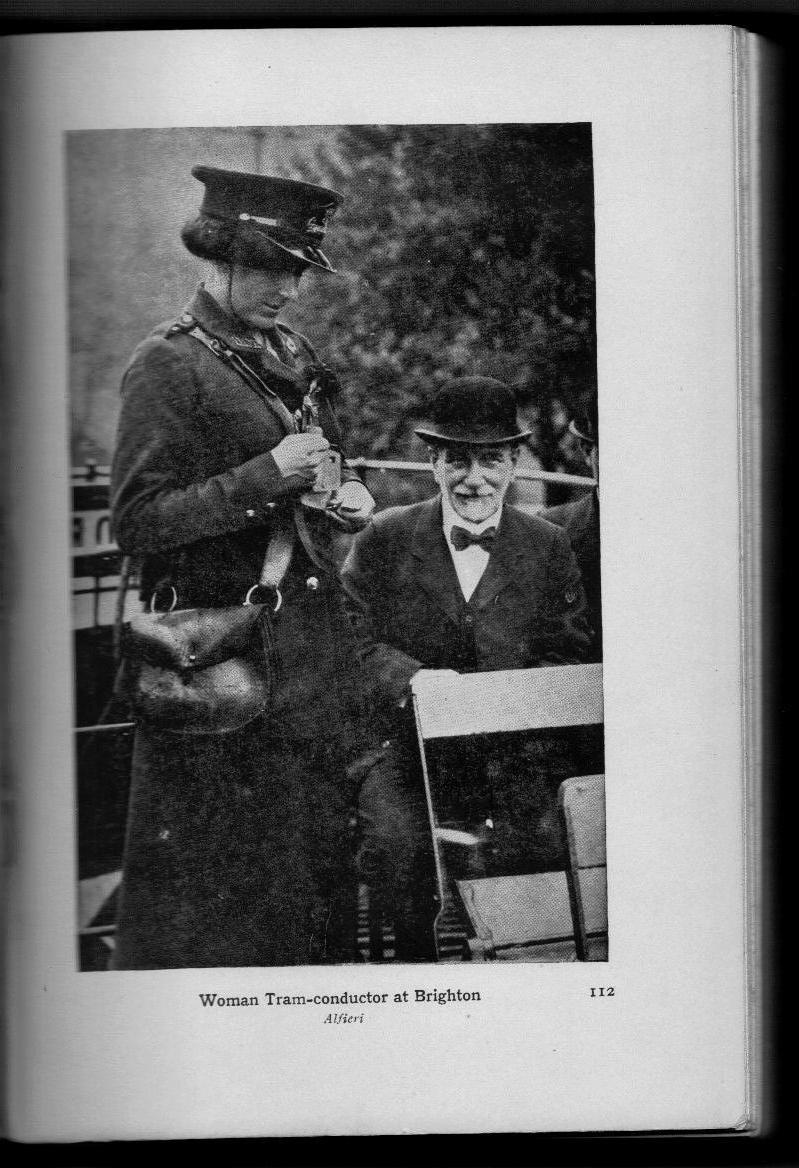
Woman tram-conductor in Brighton
Gilbert Stone (editor), Women War Workers: accounts contributed by representative workers of the work done by women in the more important branches of war employment, George G. Harrap & Co, 1917. With a foreword by Lady Jellicoe.
The book comprises articles written by women working in new areas of employment. The chapters are titled:
Munition Work; The Land; A Postwoman’s Perambulations; Banking; ‘Fares Please!’ [work as a bus conductor]; Deliverng the Goods [driver of butcher’s delivery cart]; Nursing at the French Front; The V.A.D. Nurse ; The Comforteers [working with ‘Concerts at the Front’] ; Welfare Work; The Women of Paris During the German Advance, and ‘War Organisations for Women’ – giving statistical information, together with the chief purposes and aims of the more prominent organizations connected with Women’s War Work.
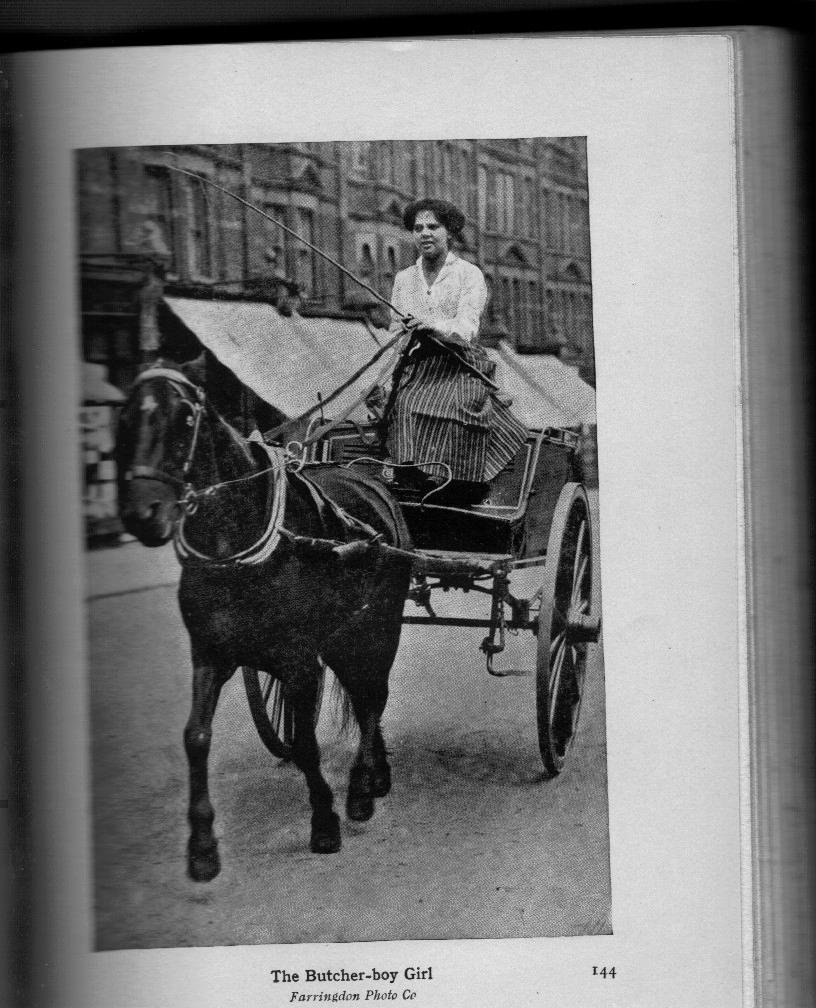
The butcher-boy girl
The book concludes with a very interesting chapter by Gilbert Stone in which he discusses the difficulties that women will face after the end of the war. ‘To coop them up at home without future, without outlook, without freedom, dependent on their father’s purse, yet with a memory of the wide world ever present, or, if possible it is a poor way of showing man’s sense of the meaning of the words Liberty, Equality, Fraternity.
The book – with 12 photographs – is surprisingly scarce. This copy is in good condition and is £60.
To buy: contact e.crawford@sphere20.freeserve.co.uk
Mariana Starke: An Epsom Education
Posted by womanandhersphere in Mariana Starke, Uncategorized on October 8, 2012
Mariana Starke was christened at Epsom Parish Church on 23 October 1762. On 19 June, barely four months earlier, and three years into their marriage, her parents had buried their first-born child – a son, John – in the church’s graveyard. Mariana was to be an only child for six years – until the birth of her brother, Richard Isaac Starke, in 1768 – and to be an only daughter until the birth of her sister, Louisa, in 1772. Although there is no record of other children having been born in the years between the births of these living children, the gaps are significantly long, suggesting the possibility that Mary Starke may have suffered miscarriages. Certainly Richard’s father, John Starke, while leaving his eldest son only Hylands House in his rather punitive 1763 will, seems to have expected him to sire at least five children – to all of whom the grandfather was prepared to leave handsome legacies.
We know no firm details of Mariana’s early life as she grew up in Epsom. She may have had a governess, but more likely was taught by her mother, who from her letters appears a competent, amusing woman, interested in literature and the world. The only extant reference I have found to the hiring of a teacher occurs in one of Mrs Starke’s letters, in which she mentions that she is thinking of engaging a music master for her daughters.
This letter written, probably, in 1781, is to Mrs Hayley, wife of William Hayley, an influential man of letters and, in his life-time at least, a highly-regarded poet, patron of William Blake, friend of Cowper, of Romney and of Mariana Starke, who was to him his ‘dear poetical daughter’. The earliest letter in the extant correspondence between the Starkes and the Hayleys dates from 1779 and it is clear from the tone and language employed by the writers that the two families were on close and affectionate terms – and would appear to have been so for some time. There is no indication, however, of how or when the introduction between the families took place. Mariana’s earliest letter in the sequence, dated 22 December 1780, is to Mrs Hayley inviting the Hayleys to ‘a little Hop’to be held by her family early in the new year – on Monday 8 January – and to dinner the day before. At this time the Hayleys lived at Eartham in Sussex, about 45 miles south of Epsom. Hylands House was on their route into Town; in another letter Mrs Starke mentions that she could look out for their chaise as it passes along the Dorking Road. When she wrote this letter of invitation Mariana was 18 years old and entirely at ease in corresponding with the older woman.
From her mother’s letters we can catch glimpses of this youthful Mariana. In November 1780 (?) when Mrs Starke suffered a a bout of illness, during which exertion ‘produced a spitting of blood’, she was ‘an affectionate un-wearied attendant under Providence’ ‘her tenderness contributes materially to my recovery….I can read a little, and so my daughter ransacks the circulating library for my amusement and has brought me the life of Garrick, written by Davies, the materials supplied by Johnson and the whole regulated by him. Tis very entertaining; it contains a history of the Theatre for 36 years. I remember many of the persons mentioned. It likewise comprehends an account of the contemporary dramatic Writers. What an assemblage of opposite qualities met in ‘Dr Goldsmith’ without one particle of common sense to rectify the composition.’ Davies’ life of Garrick was first published in 1780, suggesting that the Epsom circulating library was quick to offer the latest published works and that Mariana had been prompt in her ‘ransacking’. From the list of books catalogued when the stock of the Epsom circulating library [as far as I can establish this was the only circulating library in Epsom during this period] was put up for auction in 1823 it is clear that there was no shortage of reading matter likely to appeal to both mother and daughter. For instance, quantities of novels and book of travels dating from the 1780s were still held in the stock of the library at the time of its sale – novels such as Aspasia, the wanderer (1786), Alfred and Cassandra (1788), Letters of an Italian Nun (1789) and Adeline the Orphan (1790).
By the 1780s Epsom’s heyday as a spa town had passed but, in a healthy position close to the Downs and close to London, it attracted well-to-do merchants quite prepared then – as now – to commute into town on business. Although he had no necessity to make this journey regularly, ‘Governor Starke’ – by which slightly inflated version of his former title Richard Starke is often named in contemporary accounts – still some had business with the East India Company. By virtue of his stock holding in the Company he was able to vote for candidates to the Directorate of the Company and probably made periodic visits to their headquarters in Mincing Lane – a stone’s throw from the house in which his grandfather, Thomas Starke, the slave trader, had lived 100 years before. It is interesting – if useless – to speculate as to whether a knowledge of the lives of his forebears was incorporated into his perception of the world. Did he know – as we shall never – that his father had turned to India because he did not wish to be involved in the trade in Africans of which Thomas was a pioneer? Or, what is more likely, did he know that John Starke had seen that the Virginia tobacco trade was taking a downward turn – and was tediously prone to litigation – and that India was the new Virginia? Whatever his thoughts as he walked along Mincing Lane Richard Starke would have been well aware of the importance in Starke family history of the church of St Dunstans in the East, just three minutes walk away, down towards the river. Besides his grandfather – and all the late-17th- c infant Starkes buried there, it was here that his own mother had been interred in 1730 and here, five years later, that his wife, the daughter of a merchant, had been christened. That, at least, should have inculcated a proprietorial feeling for this small area of the City in a man who had spent his working life in India and now lived a rather secluded life in Surrey. Again, idle to speculate, but surely, on occasion, Mariana would have been taken to the City. Would she not have been curious to see the streets where her forebears lived?
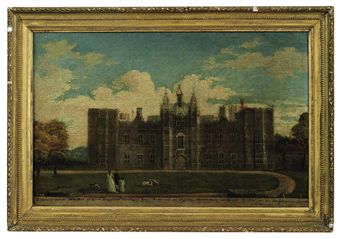 Cowdray Park, late 18th century, courtesy of Christies
For Mariana, we know, was in her youth passionate about ‘antiquity’. In 1781 her mother, writing to Mrs Hayley, mentions that they had visited ‘Cowdry’ [Cowdray, a Tudor house in Sussex that in 1793 was reduced to ruins by a fire but whose magnificence was still intact when the Starkes visited], remarking that ‘The outside is striking, fine, venerable and claims respect, but within tis unequal and disappoints the expectation. Perhaps altogether no ill emblem its owner. Marian was pleased; I am not so rapturously fond of antiquity as she is. At her age I was, but my passion for gothic structures, and tragedy, expired at the same moment. When the gaiety of youth is fled, lively scenes become necessary.’ So, here is a glimpse of a Mariana swept up in the zeitgeist for the gothic – her ‘sensibility’ a counterpoint to her mother’s ‘sense’.
‘Sense’ was, I am sure, a virtue with which Mariana’s closest contemporary companion of her youth was liberally endowed. Millecent Parkhurst, who was a few months younger than Mariana, lived with her parents in Church Street, Epsom.
[For details of the history of the Parkhursts’ house see here. After her marriage, now ‘Mrs Thomas’, Millecent lived in a house, Abele Grove, just on the other side of Dorking Road from Hylands. Then an elegant house, with coach house, stables and grounds of about 1 acre, Abele Grove was until recently associated with the Epsom Central branch of the Premier Inn chain. But it is there still – as is Hylands House – and you can still walk along the Dorking Road between the two- either on your own two feet or, thanks to Google Street View, on your computer.]
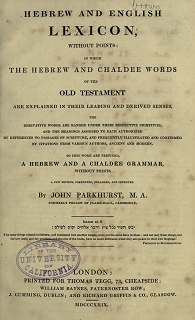 Millecent’s elderly father, John Parkhurst, had inherited valuable estates around Epsom and, although a clergyman, of the high Anglican variety, felt neither the necessity nor inclination to seek preferment. His life was devoted to scholarship; amongst other writings he had published both Hebrew/English and Greek/English Lexicons (the latter to the New Testament). When, in 1798, after his death, a new edition of this work was called for, it was published with Millecent as editor. In the preface to the 5th edition, a later editor recorded that she was ,’reared under the immediate inspection of her learned and pious father, by an education of the very first order, [and] has acquired a degree of classical knowledge which is rarely met with in the female world’. In a 1787 letter (to be considered at greater length in a subsequent post) Mariana mentions ‘the almost paternal regard that [Mr Parkhurst] has for me.’ It would, I think, be safe to assume that Mariana spent a considerable time in that household, that she was at home in John Parkhurst’s library and, with Millecent, benefited from his teaching. See here to view portraits of John Parkhurst and his wife – held at Clare College, Cambridge. If the date (1804) attributed to the paintings is correct they were commissioned some time after the pair had died – John in 1797 and Millecent in 1800.
The Rev Parkhurst was not only Mariana’s advisor and critic but, with William Hayley, was responsible for inducting Mariana into the literary world. In 1781 she was among the subscribers to Ann Francis’ Poetical Translation of the Song of Solomon, from the original Hebrew, published by J. Dodsley. John Parkhurst subscribed six copies and it is to him that the book was dedicated, with a credit for supplying Notes. Among the female Epsom subscribers were Mrs Foreman, Mrs E. Foreman, Miss Foreman and Mrs Phipps. The latter ladies, who were presumably of a literary incline, were unlikely to have been those of whom Mariana wrote to William Hayley on 1 October 1781, ‘I spent an afternoon a short time since in company with Mrs Francis. She appears perfectly good-natured and unaffected – our Epsom Ladies were quite astonished that she should be in the least degree like other people – one observed that she really dressed her hair according to the present fashion, another, that she had a very tolerable cap, and a third that she certainly conversed in a common way, in short they spoke of her, as tho’ they had expected to have seen a wild beast instead of a rational creature, & I felt myself very happy that they were perfectly ignorant of my ever having made a Poem in my life.’ In her preface Ann Francis had felt it necessary to defend her translation of this particular text on two counts – in case it might ‘be thought an improper undertaking for a woman [since] the learned may imagine it a subject above the reach of my abilities; while the unlearned may incline to deem it a theme unfit for the exercise of a female pen.’
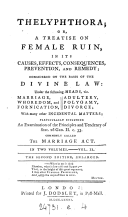 Besides John Parkhurst, the other male Epsom subscriber to The Song of Solomon was the Rev Martin Madan, who the previous year had raised considerable controversy with his publication of Thelyphthora; or a treatise on female ruin. In this Madan argued the social benefit of polygamy as a means of countering the evils of prostitution. He had been chaplain at the Hyde Park Corner Lock Hospital – a hospital for those afflicted with venereal disease – and may be considered to know of what he spoke. His treatise immediately attracted a series of ripostes. It was clearly a book – and, therefore, a subject much debated at this time and in the same 1 October 1781 letter to Hayley Mariana writes. Have you met with a book entitled ‘Whisper in the ear of the Author of Thelypthora’? The author Mr Greene did me the honor of sending it to me, and was it small enough to be enclosed in a frank, I would sent it to Earthham; tho I do not imagine it is a Book that would amuse either you, or Mrs Hayley much.’ Why, one wonders, did 40-year-old Edward Burnaby Greene send his work on this subject to 19-year-old Mariana Starke?
Greene was a translator and poet – though even in his lifetime not held in much regard – and at some time point his social or literary life must have intersected with that of Mariana to occasion this ‘honor’ . For, while the Ladies of Epsom may have been ignorant of the fact that they harboured a young Poet in their midst, her literary mentors were not – Mariana was in the custom of enclosing poems in her letters to Hayley. And to Hayley she made clear her feelings about Epsom society, writing at the end of a 7 January 1782 letter, ‘Pardon this hasty and stupid scrawl, as I am going to dress for an Epsom Party, the very thought of which, has benumbed my faculties.’ Both Mariana and her mother doubtless felt more stimulated at gatherings at which literature and ideas took precedence over discussions of hairdressing and caps. Not only did they utilise the circulating libraries but when in Town they made a point of visiting booksellers. In a letter to Mrs Hayley, dated 2 August 1781, Mrs Starke wrote, ‘Marian and I were at Dodsley’s the other day. The counter was covered by Mr Hayley’s poems, nothing sells so well. Dodsley did himself great credit with us, by his manner of speaking of Mr Hayley, second to none, now living, or that ever did live!’
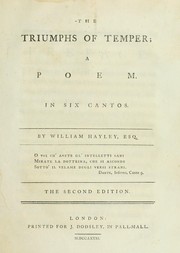 Dodsley – whose shop was in Pall Mall – had recently published Hayley’s Triumphs of Temper, a didactic work illustrating the usefulness of a good temper to a young woman in search of a husband. See here for a Dulwich Picture Gallery page setting Romney’s portrait of Hayley alongside one of his illustrations from Triumph of Temper
The literary Epsom ladies maintained their interest in furthering the publication of interesting new works by women, subscribing to two important works of the period. In 1785 Millecent Parkhurst (‘Miss Parkhurst, Epsom’) and ‘Mrs Starke, Epsom’ were subscribers to Poems by Ann Yearsley, the Bristol milkwoman and protegee of Hannah More and in 1786 Mariana, her mother and Mrs Parkhurst were all subscribers to Helen Maria Williams’ Poems. The women may well have supported other publications, their connection not yet brought to light by the digital scanner. We can, however, be certain that these were two works that, along with The Song of Solomon, Hayley’s poems and that oddity, Whisper in the ear of the author of Thelypthora’?, were definitely on the shelves in Hyland House in the late 1780s. It was not to be long before Mariana, together with Millecent Parkhurst,- put her own pen into public action.
Sources: William Hayley Papers, Fitzwilliam Museum, Cambridge
epsomandewellhistoryexplorer.org.uk
Copyright
Collecting Suffrage: Emily Wilding Davison’s Funeral Programme
Posted by womanandhersphere in Collecting Suffrage on October 4, 2012
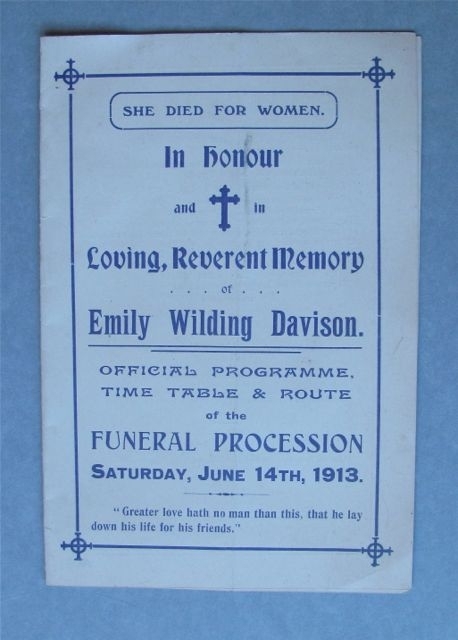
Official Programme for Emily WIlding Davison’s Funeral Procession
For the last 100 years the strange death of Emily Wilding Davison has transfixed the public. It is likely to be the one thing that the ‘man – or woman – in the street’ knows about the suffragette movement. Bizarrely the last seconds of her conscious life are still with us –growing in impact as the internet allows everyone to view footage of film that was in the past relatively difficult to access. In this piece by Andrew Marr the BBC has worked its wonders on the Pathé News original, allowing us to see details that the passing years had blurred. I have always wondered if it was by chance that she chose to position herself alongside a section of the Derby racecourse that was in full view of the film camera. The camera was mounted on a stand and would have been clearly visible. However the camera was, presumably, positioned there in order to capture pictures of the horses entering the final straight and Emily Davison may have chosen to be there for the very same reason.
With the 100th anniversary less than a year away media attention is mounting. All material related to Emily Wilding Davison’s funeral is scarce – and very collectable – however one of the scarcest is the 4-page ‘Official Programme, Timetable and Route of the Funeral Procession, Saturday June 14th 1913.
I must say that I do find it rather odd that this item should be so very scarce for, as you can see from film and photographs, the streets of London were packed on the day. The hordes must have failed to arm themselves with the Programme or, if they did, to have then discarded it.

Inside pages of the programme for Emily Davison’s funeral procession
In Campaigning for the Vote, Kate Frye, who followed the procession through Piccadilly to Bloomsbury and then on to Kings Cross, in her long diary entry comments on the vastness of the crowd. But even she, who was an inveterate hoarder of suffrage memorabilia, does not seem to have acquired a copy of the Funeral Procession Programme. The result is that, in nearly 30 years of dealing in suffrage artefacts, I have only seen one copy of this item for sale. In fact, if a spate of them were now to hit the market, I shall be very suspicious!

Back cover of the Emily Davison funeral procession
Book of the Week: Margaret Sanger, Woman And The New Race – Kitty Marion’s copy – rich with suffrage and Sanger associations
Posted by womanandhersphere in Book of the Week on October 2, 2012
Margaret Sanger, Woman And The New Race, published by Brentano’s (NY), 1921 (3rd printing) – Kitty Marion’s copy
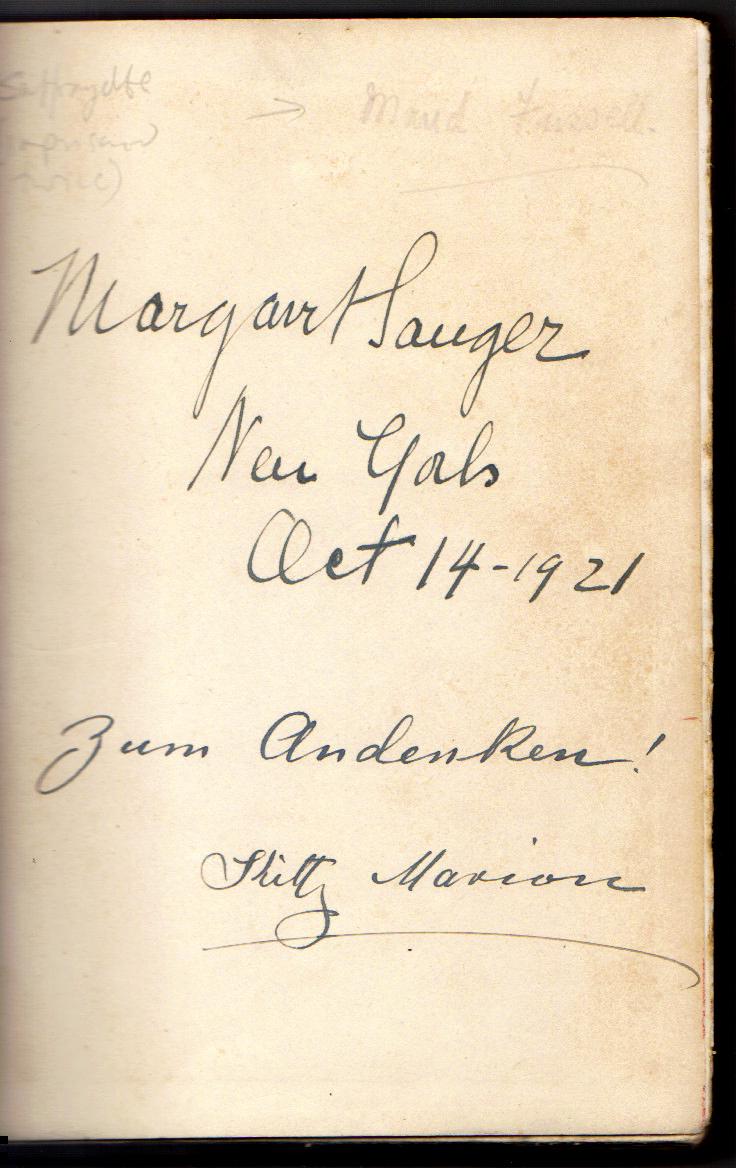
Inscription on free front endpaper of this copy of Woman and the New Race
Margaret Sanger spearheaded the birth-control campaign in the US. In this book, first published in 1920, she writes: ‘The most far-reaching social development of modern times is the revolt of woman against sex servitude. The most important force in the remaking of the world is a free motherhood’. The Introduction to the book is by Havelock Ellis, one of several leading thinkers with whom she had an affair.
In October 1914 Margaret Sanger fled from the US to England while on bail for violating US postal obscenity laws – the charge was that of sending through the post copies of her radical feminist journal, The Woman Rebel, which advocated the use of contraception. She remained in England until October 1915. Coincidentally it was in October 1915 that Kitty Marion, a former, German-born, militant suffragette, set sail for the US. Once in New York she worked for many years for Margaret Sanger, her role being that of street seller of Sanger’s Birth Control Review.
In England in 1913 Kitty Marion had been sentenced to three years’ imprisonment for her part in the burning of the grandstand at the Hurst Park racecourse (as retaliation for the death of Emily Wilding Davison)- although, after going on hunger and thirst strike, she was released under the Cat and Mouse Act. It would appear that, on the run, she was one of the WSPU’s most active arsonists, although she evaded detection for much of the destruction she committed. In New York, on 14 October 1918, she was again given a prison sentence – this time for distributing Birth Control Review.
This particular copy of this book brings together these various histories. The free front endpaper bears the ink inscription, in Margaret Sanger’s handwriting – ‘Margaret Sanger, New York, Oct 14-1921.
Underneath this is written ‘zum Andenken! Kitty Marion’ [translated from German: In Memory!]. This inscription obviously commemorates the 3rd anniversary of Kitty Marion’s imprisonment – of which Margaret Sanger had at the time written ‘We glory in her deed’. I think the second part of the endpaper inscription may be Kitty Marion’s hand. For although the ink looks much the same as the Sanger message, I think the writing is different.
Yet another layer of suffrage association is revealed by the ownership signature, written faintly in pencil in the top right corner of the same page. It is that of Maud Fussell, another former member of the WSPU – and, again, one who suffered imprisonment.
My reconstruction of the history of the book is that it was signed by Margaret Sanger for Kitty Marion and was subsequently given by Kitty Marion to Maud Fussell. It was sold to me along with other books that had been in Maud Fussell’s possession.
The book is in good condition and is a particularly interesting association copy. Price £165 plus postage.
To buy: please contact me at e.crawford@sphere20.freeserve.co.uk
Am I Not A Woman And A Sister: Women and the Anti-Slavery Campaign
Posted by womanandhersphere in Uncategorized on October 1, 2012
Am I Not a Woman and a Sister: women and the anti-slavery campaign
 ‘Am I not a woman and a sister’ reads the legend arching over the female figure of Justice as she reaches towards a kneeling black slave woman, who holds her chained hands up in supplication. In the 1830s this powerful emblem was used on printed matter and on artifacts associated with women-only, or ‘ladies’, anti- slavery associations. It very consciously echoed the motto, ‘Am I Not a Man and a Brother’, adopted in 1787 by the founders of the Society for the Abolition of the Slave Trade. Throughout the long years of abolitionist campaigning women were always participants, their role becoming, over the years, increasing prominent. Experience gained in a movement of such social, economic and political importance was to prove valuable when, in the 1860s, they launched the campaign to gain their own political freedom.
In 1787, however, women could take no direct part in politics, their role confined to that of exercising influence on those who did have political power. One such woman was Lady Middleton, a member of the evangelical Clapham Sect, who conducted a country-house salon at Barham Court in Kent. It was she who, according to Thomas Clarkson, in 1786 persuaded both William Wilberforce and himself to take up the anti-slavery cause. Lady Middleton’s own interest in the subject was not new. In 1782 she had been among the subscribers to Letters of Late Ignatius Sancho, the first prose work by an African to be published in England. Ignatius Sancho, born on a slave ship, had, as a child, been a house slave in London, at Greenwich.
Women’s influence extended to rather more than cajolery over the dinner table. Another member of the Clapham Sect, Lady Middleton’s close friend the writer Hannah More, was asked, in late 1787, to write a poem to draw attention to the discussion soon to take place in Parliament. She quickly composed Slavery, a Poem, published as a large, handsomely printed, 20-page book. She was just one of many women writers who wielded their pens in the abolitionist cause. Although they did not have direct power women could exercise their influence through the medium considered most suitable to their sex, poetry.
Women were also a valuable source of the finance necessary for the funding of the campaign. Although the Society for the Abolition of the Slave Trade was formed and officered by men, there was no attempt to prevent women from becoming subscribers. Subscriptions ranged from one to five guineas, sizeable sums, indicating that those donating were drawn from the middling to wealthy section of society. Fortunately for us, the Society printed a report listing by name all its subscribers. Women clearly had no more qualms at having their names listed in such a quasi-political publication than they did in appearing as subscribers to a novel or volume of poetry. It is possible, therefore, to study the names of 206 women, comprising about ten per cent of the total, who in the late-18th century made public their condemnation of the slave trade.
The main, London-based, committee attracted members from all around the country. It is noticeable that there are few obviously upper-class or aristocratic women on the list. Only three titled ladies subscribed: Lady Hatton of Longstanton, the Dowager Countess Stanhope (who gave £50), and the Dowager Viscountess Galway. A superficial investigation would indicate that all three were women associated with families with radical sympathies. Indeed the Dowager Countess Stanhope’s son, who had succeeded her husband as earl, was soon to style himself ‘Citizen Stanhope’ to demonstrate his support for revolution in France. Two others of those listed, ‘Miss Pelham and Miss Mary Pelham of Esher’ were members of an influential Whig family, counting a former prime minister amongst their forebears.
The names of some subscribers have entered the literary canon. Prominent are Elizabeth Carter (writer and ‘blue stocking’), Sarah Trimmer (evangelical educationalist and writer) and Mary Scott of Milborne Port, Dorset, who in 1774 had written a lengthy poem, The Female Advocate, in which she drew attention to Phillis Wheatley, the first slave and black woman to have a book of poetry published in Britain.
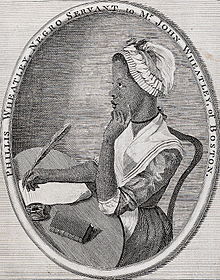
Phillis Wheatley, as depicted on the frontispiece to her ‘Poems on Various Subjects’
Information can, with some application, be teased out about many of the other names on the list. A quick Google search reveals that, at random,’ Mrs Elizabeth Prowse of Wicken Park, Northampton’ was the sister of Granville Sharp, a leading member of the Abolition Committee. That ‘Mrs Peckard, Cambridge’ was, probably Martha, the wife of Peter Peckard, vice chancellor of Cambridge University and a preacher of sermons against the slave trade. It was he who, he in 1785 had set the question, ‘Is it lawful to make slaves of others against their will?’, for the University’s Latin essay won by Thomas Clarkson, the first step in his abolitionist career.
Through the Will Search facility at DocumentsOnline on the National Archives website it is possible to read the wills of some of the subscribers and discover a little more about their lives. For example, ‘Mary Belch, Ratcliffe’ was a corn chandler of Broad Street, Ratcliffe, in east London and ‘Deborah Townsend, Smithfield Bars’ was either the wife or the daughter of a Smithfield grocer. The wills may not reveal much about their abolitionist sympathies but they do demonstrate that women from this sector of society were committed to the cause.
The will of another subscriber, ‘Elizabeth Freeman, Woodbridge’, reveals that she was a Quaker and that she left ‘to my poor relations in America twenty pounds to be disposed of by friends of the Monthly Meeting in North Carolina’. It might be presumed that with these connections she knew something of conditions in an American slave state. Further research might indicate that other women subscribers from Woodbridge were also Quakers. Some names, of course, do indicate clear Quaker connections. Five female member of the well-known Fox family of Falmouth were subscribers and, with their fellow Quakers, are likely to be traceable through the records kept by the Society of Friends.
Women were also subscribers to the separate local committees formed in provincial towns. In Manchester 68 out of total of 302 subscribers were women. However few of the names include any indication of address and are, therefore, more difficult to identify. Some were wives of men involved with the Manchester committee. One such was ‘Mrs Bayley of Hope’, wife of Thomas Bayley, Unitarian, JP and penal reformer. Here too many the female subscribers were likely to have been nonconformists, particularly Unitarians and Quakers, a large number having connections with Manchester’s manufacturing interests.
In Bristol, notorious as a slave port, subscribers to the local committee included Miss Anna Goldney and ‘Mrs Goldney’. It has to be remembered that ‘Mrs’ at that time was a title given to unmarried as well as married women and, therefore, that the latter was probably Ann Goldney, who was unmarried and had recently inherited the family’s Clifton estate from her brother. The Goldneys were Quakers although an ancestor, Thomas Goldney, had, in the early 18th century, been the principal investor in a venture leading to the capture of slaves, the family fortune enhanced by investment in the manufacturing of guns for trade with Africa. Between them, Ann and Anna Goldney, a cousin living in the Clifton household, gave a generous six guineas.
Other Bristol women subscribers were Mrs Esther Ash, Mrs Frampton, Mrs Olive and Mrs Merlott, all of whom had at least one other thing in common, being subscribers in 1787 to a translation of Persian poems by Charles Fox. It is likely some were Quakers, but ‘Mrs Merlott’ was probably the unmarried sister of John Merlott, a Presbyterian sugar refiner.
Named women also subscribed to local committees in Birmingham, Exeter, Leeds and Leicester, some of which were probably set up with the encouragement of Thomas Clarkson as he acted as roving ambassador for the Abolition Society. He also organized mass petitions that were such a novelty of this campaign, an early manifestation of the method to be used by popular protest groups throughout the 19th century. Women, however, were not signatories. It was presumably thought that if they were the value of the petition would be diminished.
Women did, though, on occasion take part in public debates about the slave trade. One such was held in 1788 in La Belle Assemblée, a concert hall in Brewer Street, Soho, London, where ‘ladies were permitted to speak in veils’. In 1792 women were also present at a debate at the Coach-makers’ Hall, Foster Lane, Cheapside calling for the boycott of West Indian sugar and rum. The motion was carried by a unanimous vote of 600.
The subject of this latter meeting was one that women were making their own. For, although denied political power, they were able, at least in theory, to influence the economy. As early as 1788 Hannah More had urged a friend ‘to taboo the use of West Indian sugar in your tea’. Women, as chief purchasers of household goods, were encouraged to boycott slave-produced sugar from the West Indies, shopping instead for that grown in the East Indies by free labour. It is thought that by 1791-92 the sugar boycott affected as many as 300,000 people.
As well as redirecting their spending power to ‘free’ produce, women were also encouraged to purchase items that would proclaim their support for the abolitionist cause.
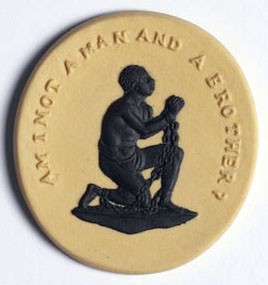
Wedgwood jasper-ware cameo. By courtesy of the Wedgwood Museum Trust, Barlaston, Staffordshire
Thousands of Josiah Wedgwood’s ‘Am I Not a Man and a Brother’ jasperware cameos were incorporated into brooches, bracelets, earrings and hair ornaments, allowing the wearer to indicate sympathy with the abolitionist cause. The ‘kneeling slave’ image was also rendered on a variety of other artefacts and was considered a very suitable subject for young girls to embroider on their samplers.
Women could also buy china bearing anti-slavery messages. The tea table was the sphere of influence particular to the woman of the house and, while entertaining her friends, she could pass round a sugar bowl bearing the motto, ‘East India Sugar not made/By Slaves/By Six families using/East India, instead of/West India Sugar, one/Slave less is required’. By boycotting West Indian sugar and displaying articles such as this she turned herself from a passive consumer into a political activist.
Women were able to demonstrate their sensibility by buying and subscribing to the slim volumes of abolitionist poetry that were finding a popular readership. These were written by women of all sorts and conditions, by, as already noted, the evangelical Hannah More, by her working-class protogée, Ann Yearsley, by Mary Robinson, ex-mistress of the Prince of Wales, and by a succession of young women, such as Mary Birkett of Dublin. Women were also able to educate the younger generation by purchasing works such as The Negro Boy’s Tale: a poem addressed to children, published by Amelia Opie in 1802.
By then, however, the mass popular campaign had collapsed. In 1792 the British public had watched in horror as the French monarchy was overthrown by the mob and, in the same year, slaves in Saint-Domingue (Haiti) rose up against their masters. Whatever its theoretical sympathy with the anti-slavery campaign, the British public had no wish to unleash similar forces. When the act abolishing Britain’s direct involvement in the slave trade was passed in 1807 it was as a result, not of popular protest, but of parliamentary manoeuvrings, in which, of course, women played no part.
There was no further popular agitation against slavery until 1823 when Wilberforce and Clarkson once again took the lead in the formation of the Society for the Mitigation and Gradual Abolition of Slavery Throughout the British Dominions. Over the intervening years there had been a decided change in the position of women who now had no inhibition about founding their own anti-slavery societies. The first such was formed in Birmingham in 1825. Here Lucy Townsend, the wife of an Anglican clergyman, worked with a Quaker, Mary Lloyd. Contact was made through their various denominational networks and soon towns such as Manchester, Sheffield, Liverpool, Bristol, Newcastle, York, Southampton and Plymouth, as well as London, supported ladies’ associations. There were also groups in Scotland, Wales and Ireland.
The formation of these societies and the activities they undertook did not escape criticism. Wilberforce expressed what one imagines was a very common view: ‘All private exertions for such an object become their character, but for ladies to meet, to go from house to house stirring up petitions – these appear to me proceedings unsuited to the female character as delineated in Scripture’.
For women were now, indeed, a petitioning force. In the early 1830s hundreds of thousands of women signed petitions. Those presented in 1833 alone bore the signatures of 298,785 women, nearly a quarter of the total. A large number – 187,157 – were on a single petition circulated by the London Female Anti-slavery Society and presented to the House of Commons on 14 May 1833, the day the emancipation bill was produced.
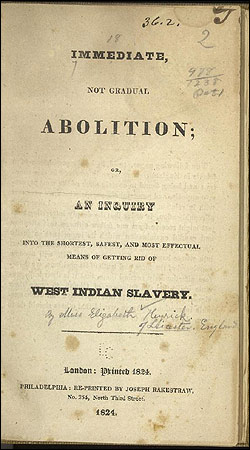 Women were not only, by petitioning, participating in the political process, but were now even questioning the aims of the movement. In 1824 Elizabeth Heyrick, a Leicester Quaker, published a pamphlet, Immediate not Gradual Abolition, calling for immediate emancipation of slaves, in contradistinction to the Anti-Slavery Society’s aim of gradual emancipation. In 1830, at Elizabeth Heyrick’s suggestion, the influential Birmingham women’s society threatened to withdraw its funding from the Anti -Slavery Society if it did not agree to change its aim to immediate abolition. The change was agreed.
Elizabeth Heyrick was also the leader of a new campaign to boycott West Indian produce, especially sugar. Like that of the late-18th century, the 19th-century campaign appealed to the woman of the family to exercise her economic power. In 1828 the Peckham Ladies’ African and Anti-Slavery Association published Reasons for Using east India Sugar, demonstrating to its readers ‘that by substituting east India for west India sugar, they are undermining the system of slavery, in the safest, most easy, and effectual manner, in which it can be done’. ‘If we purchase the commodity, we participate in the crime. The laws of our country may hold the sugar-cane to our lips, steeped in the blood of our fellow-creatures; but they cannot compel us to accept the loathsome potion.’
Women also exercised their talents in order to raise funds for the cause. The bazaar became a particularly womanly form of demonstrating support. As ever, this activity was regarded in some quarters as a waste of effort. In a letter of 22 September 1828 the salon hostess, Mary Clarke Mohl, wrote: ‘My niece spends all her time making little embroidered bags to be sold for the Anti-Slavery Society …which would be all very well if, instead of turning seamstress to gain £10 a year, she put some poor woman in the way of work’.
Only three years after the Anti-Slavery Society had agreed to change its agenda, the 1833 Anti-Slavery Act abolished slavery within the British colonies. Although a period of apprenticeship was imposed on former slaves before they could obtain freedom, a determined effort by the abolitionists led, in 1838, to the early termination of this system. A national women’s petition on behalf of the apprentices addressed to the newly crowned Queen Victoria had carried the signatures of 7000,000 women, a number described as ‘unprecedented in the annals of petitioning’.
Although Britain no longer allowed slavery within its own territories the anti-slavery campaign continued, with the aim of abolishing slavery world wide. In 1840 the British and Foreign Anti-Slavery Society organized the first World Anti-Slavery Convention. Women delegates, among them a grand-daughter of Lady Middleton, arrived in London from all parts of Britain. From across the Atlantic came women belonging to a section of the US abolitionist movement that wished to combine anti-slavery activity with campaigns for women’s rights. All women were, however, denied participation in the proceedings. As might be expected that decision led not only to a split in the British anti-slavery movement but, indirectly, to the beginning of the US campaign for women’s suffrage. Several of the British women who were barred, women such Elizabeth Nicholls (later Pease), Hannah Webb, Maria Waring, and Matilda Ashurst Biggs, were among those who 26 years later signed the first women’s suffrage petition.
Both factions of the American anti-slavery movement were keen to gain support from British activists and throughout the 1840s and 1850s strong transatlantic links were developed. As in Britain, bazaars became a particular field of endeavour for American abolitionist women, with the British societies keen to supply boxes of goods for sale. In 1846 the Glasgow Society reported that at the Boston Anti-Slavery fair ‘every one of the great plaid shawls sold instantly. The beautiful cloaks sold, and also the bonnets. Aprons do well. The shawls sent by the Duchess of Sutherland sold immediately.’
Sarah Parker Remond
The societies organized lecture tours for members of the American movement. In 1853 the Glasgow Society sponsored Harriet Beecher Stowe, whose novel Uncle Tom’s Cabin had already sold 1.5 million copies in Britain and in 1861 the Edinburgh Society organized a series of lectures by Sarah Remond, whom they described as ‘a lady of colour from America.’ She wrote: ‘I have been received here as the sister of the white woman’.
Even after the ending of the American Civil War and the freeing of slaves in the US, British women’s societies continued their work, concentrating now on providing aid for the ‘Freedmen’. The Birmingham women’s anti-slavery society continued to meet until 1919.
Over the years many of the women’s anti-slavery societies printed reports, listing the members of their committees. It is now possible to study these, together with publications such as the Anti-Slavery Reporter, to discover not only who the women were who worked for this cause, but also to examine the clear links between the members of the abolitionist and of the women’s suffrage movements.
Further Reading
C. Midgley, Women Against Slavery: the British campaigns 1780-1870, Routledge, 1992.
Anti-Slavery International: http://www.antislavery.org .
Wilberforce House Museum, Hull: details of materials relating to the anti-slavery campaign can be found by searching for ‘Wilberforce House’ at http://www.cornucopia.org.uk .
http://www.quaker.org.uk contains an article on the Quaker involvement in the anti-slavery campaign. The library at Friends’ House, London, contains useful biographical records.
BBC History: Elizabeth Crawford, Women: From Abolition to the Vote
 Woman and her Sphere