Archive for September, 2012
Kate Frye’s Suffrage Diary: Spring 1908 – Suffrage Hope – WSPU in Albert Hall ‘a little too theatrical but very wonderful’
Posted by womanandhersphere in Kate Frye's suffrage diary on September 26, 2012
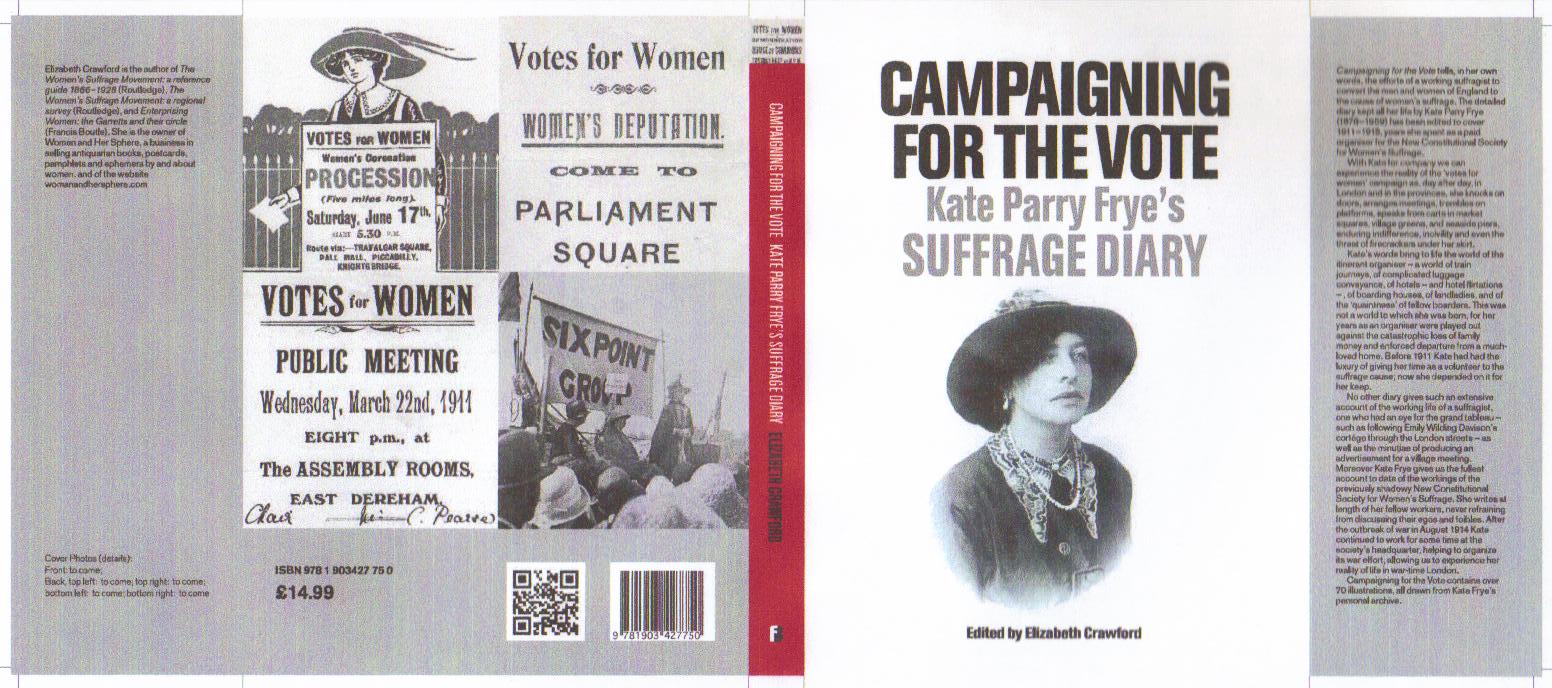
Another extract from Kate Frye’s manuscript diary. An edited edition of later entries (from 1911), recording her work as a suffrage organiser, is published as Campaigning for the Vote: Kate Parry Frye’s suffrage diary.
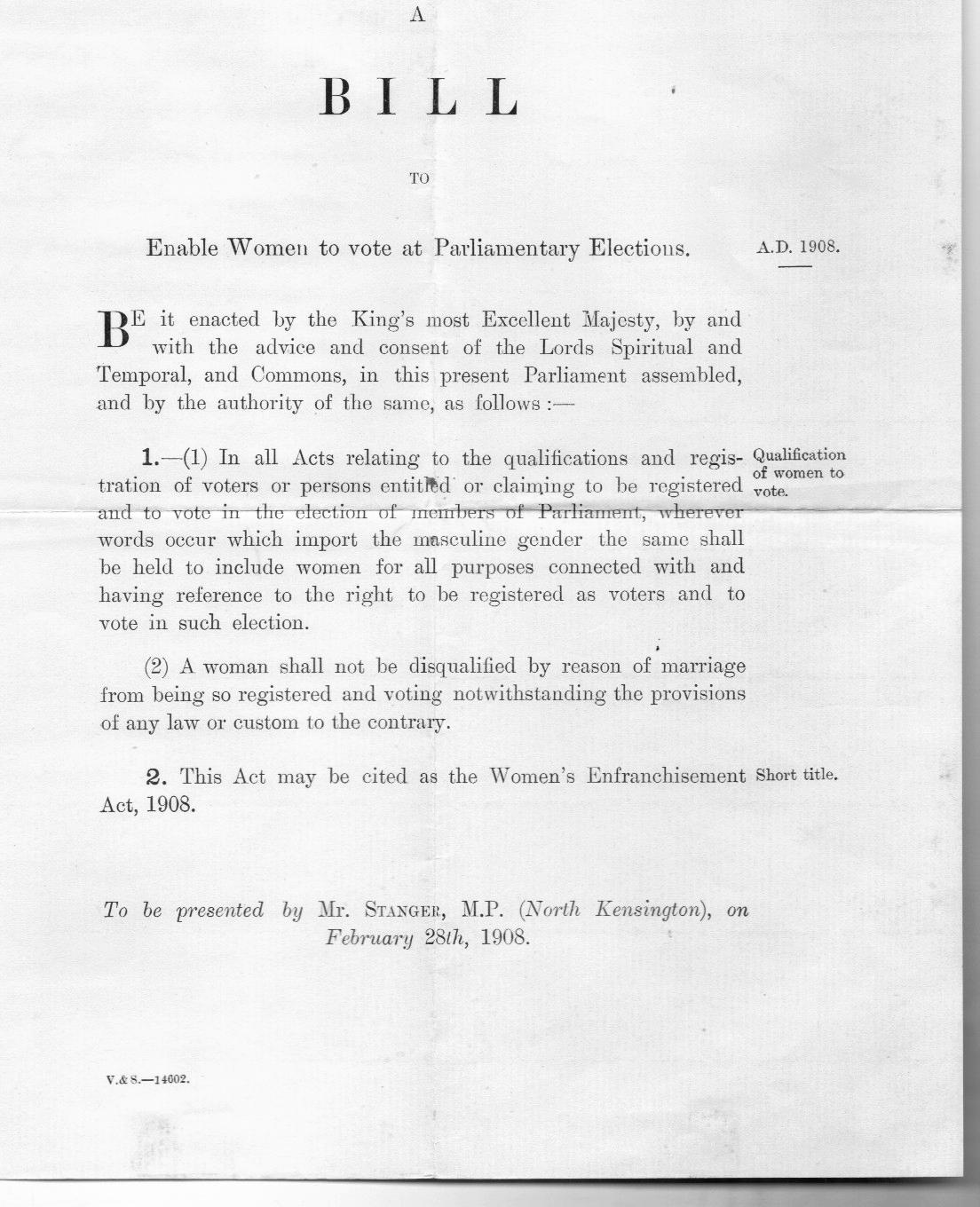
H.Y. Stanger’s Bill, 1908
Kate’s MP, Henry Yorke Stanger, was the promoter of the current Enfranchisement Bill – the latest in the long line that stretched back through the latter half of the 19th century. Despite, as Kate describes, the bill passing its second reading, the government eventually refused to grant facilities to further the debate. However, that blow was yet to come as Kate records in these entries details of the suffrage meetings she attended in February and March 1908. She had the knack of always being present on the great occasions – and on 19 March was in the Albert Hall to witness the rousing – and profitable – reception given to Mrs Pankhurst on her release from prison.
Dramatis personae:
Miss Harriet Cockle, was 37 years old, an Australian woman of independent means, lving at 34 de Vere gardens, Kensington.
Mrs Philip Snowden – Ethel Snowden (1880-1951) wife of the ILP politician, Philip Snowden.
Mrs Clara Rackham (1875-1966) was regarded as on the the NUWSS’s best speakers. In 1910 she became president of the NUWSS’s Eastern Federation, was founder of the Cambridge branch of the Women’s Co-operative Guild, and was sister-in-law to Arthur Rackham, the book illustrator.
Margery Corbett (1882-1981- later Dame Margery Corbett-Ashby) was the daughter of a Liberal MP. At this time she was secretary of the NUWSS.
Mrs Fanny Haddelsey,wife of a solicitor, lived at 30 St James’s Square, Holland Park.
Mrs Stanbury had been an organiser for NUWSS as far back as 1890s.
Tuesday February 25th 1908 [London-25 Arundel Gardens]
We got home at 5.15 and had tea. Then I did my hair and tidied myself and Agnes and I ate hot fish at 6.30 and left soon after in a downpour of rain for the Kensington Town Hall – we did get wet walking to the bus and afterwards. We got there at 7 o’clock to steward – the doors were opening at 7.30 and the meeting started at 8.15. I was stewarding in the hall downstairs and missed my bag – purse with 6/- and latch Key etc – very early in the evening which rather spoilt the evening for me as I felt sure it had been stolen. It was a South Kensington Committee of the London Society for Woman’s Suffrage and we were stewarding for Miss Cockle. It was a good meeting but not crowded but, then, what a night. Miss Bertha Mason in the Chair. The speech of the evening was Mrs Philip Snowdon, who was great, and Mrs Rackham, who spoke well. The men did not do after them and poor Mr Stanger seemed quite worn out and quoted so much poetry he made me laugh. Daddie had honoured us with his presence for a little time and had sat on the platform – so I feel he has quite committed himself now and will have no right to go back on us. We were not in till 12.20 and then sat some time over our supper.
Wednesday February 26th 1908
Before I was up in the morning Mother came up in my room with my bag and purse and all quite safe. It had been found and the Hall Door Keeper had brought it. I was glad because of the Latch Key. Daddie generously had paid me the 6/- which I was able to return.
Friday February 28th 1908
Mr Stanger’s Woman’s Suffrage Bill has passed the second reading. I had to wait to see the Standard before going to my [cooking] class. That is very exciting and wonderful – but of course we have got this far already in past history. Oh! I would have liked to have been there.
MargWednesday March 11th 1908
To 25 Victoria Street and went to the 1st Speakers Class of the N.[ational] S.[ociety] of W.[omen’s] S.[uffrage]. I was very late getting there and there was no one I knew so I did not take any part in the proceedings and felt very frightened. But Alexandra Wright came in at the end and I spoke to Miss Margery Corbett and our instructoress, Mrs Brownlow. And then I came home with Alexandra from St James’s Park station to Notting Hilll Gate.
Thursday March 12th 1908
Mother went to a Lecture for the NKWLA [North Kensington Women’s Liberal Association] at the Club and Agnes and I started at 8 o’clock and walked to Mrs Haddesley [sic] for a drawing-room Suffrage Meeting at 8.30. Agnes and I stewarded and made ourselves generally useful. The Miss Porters were there and a girl who I saw at the Speakers’ Class on Wednesday. Alexandra was in the Chair and spoke beautifully – really she did. And Mrs Stanbury spoke. Mrs Corbett and Mrs George – all very good speakers. Mrs Stanbury was really great and there were a lot of questions and a lot of argument after, which made it exciting. It was a packed meeting but some of the people were stodgy. Miss Meade was there with a friend – her first appearance at anything of the kind she told us and she said it was all too much for her to take in all at once. The “class” girl walked with us to her home in HollandPark and we walked on home were not in till 11.45. I was awfully tired and glad of some supper and to get to bed.
Mrs Pankhurst had been arrested on 13 February as she led a deputation from the ‘Women’s Parliament’ in Caxton Hall to the House of Commons. She was released from her subsequent imprisonment on 19 March, going straight to the Albert Hall where the audience waiting to greet her donated £7000 to WSPU funds. Kate was there.
Thursday March 19th 1908
I had a letter in the morning from Miss Madge Porter offering me a seat at the Albert Hall for the evening and of course I was delighted….just before 7 o’clock I started for the Albert Hall. Walked to Notting Hill gate then took a bus. The meeting was not till 8 o’clock but Miss Porter had told me to be there by 7 o’clock. We had seats in the Balcony and it was a great strain to hear the speakers. It was a meeting of the National Women’s Social and Political Union – and Mrs Pankhurst, newly released from Prison with the other six was there, and she filled the chair that we had thought to see empty. It was an exciting meeting. The speakers were Miss Christabel Pankhurst, Mrs Pethick Lawrence, Miss Annie Kenney, Mrs Martel and the huge sums of money they collected. It was like magic the way it flowed in. It was all just a little too theatrical but very wonderful. Miss Annie Kenney interested me the most – she seems so “inspired” quite a second Joan of Arc. I was very pleased not to be missing so wonderful an evening and I think it very nice of Miss Porter to have thought of me. She is quite a nice girl of the modern but “girlie” sort – a Cheltenham girl and quite clever – but very like a lot of other girls. Coming out we met, strangely enough, Mrs Wright and Alexandra (Gladys was speaking at Peckham) and after saying good-bye to Miss Porter I walked home with them as far as Linden Gardens. Got in at 11.30 very tired indeed and glad of my supper. Mother was waiting up.
Campaigning for the Vote: Kate Parry Frye’s Suffrage Diary edited by Elizabeth Crawford
For a full description of the book click here
Wrap-around paper covers, 226 pp, over 70 illustrations, all drawn from Kate Frye’s personal archive.
ISBN 978 1903427 75 0
Copies available from Francis Boutle Publishers, or from Elizabeth Crawford – e.crawford@sphere20.freeserve.co.uk (£14.99 +UK postage £3. Please ask for international postage cost), or from all good bookshops. In stock at London Review of Books Bookshop, Foyles, National Archives Bookshop.

- ‘Campaigning for the Vote’ – Front and back cover of wrappers
Mariana Starke: Father is Worsted by Robert Clive
Posted by womanandhersphere in Uncategorized on September 20, 2012

Fort St George in the 18th century
Although Mariana Starke’s grandfather, John Starke, was never an employee of the East India Company, both his sons, Richard and John, were. Richard Starke (1719 – 93) – yet to be the father of Mariana – sailed from London in 1734 as a passenger in the Onslow to Fort St George, taking with him wine, a chest of apparel and an escritoire. In Fort St George he could have resumed contact with his mother’s family, the Empsons.
On 29 December 1735 Richard Starke entered ‘the service of the Honourable Co on the coast of Coromandel as ‘Writer Entertained’. A 1736 note made clear that it was ‘out of regard for his father’ that he was ‘taken into our service’, a 10 May 1737 dispatch confirming that ‘Mr Richard Starke is so usefull a hand in the Secretary’s Office’. During the following years his father sent out to him several boxes ‘of apparel’ and in 1746 ‘two boxes of books’, in 1747 one box of books and a hat, in 1750 one box of pamphlets and pens, in 1752 a box of books and in 1753 a pair of scales, a lanthorn and books. In April 1747 Richard was joined as a writer in the EIC by his younger brother, John Starke (aged 22), who sailed out on the Houghton with one chest, one escritoire, and a bundle of bedding
A dispatch from Fort St George to England, dated 22 February 1749, stated that Richard Starke, who had been ‘upper searcher at Madras – now appointed to that position at Cuddalore [i.e. Fort St David]. By 2 November 1749 he had been appointed ‘second’ at Fort St George – that is ‘under deputy governor’ and in February 1752 he succeeded Mr Prince as deputy governor of Fort St David, formally taking office on 31 July 1752.
Fort St David, about a mile from Cuddalore, was a small fortified town, near to the sea and, by all accounts, a very comfortable billet. In The Life of Lord Clive Sir George Forrest quotes the following description of the area: ‘The country within the boundaries is very pleasant, and the air fine, having seldom any fogs. In the district are many neat houses with gardens; the latter were laid out with much good taste by the gentlemen, who either had been, or were in the company’s service. These gardens produce fruits of different sorts, such as pine-apples, oranges, limes, pomegranates, plantaines, bananoes, mangoes, guavas, (red and white,) bedams (a sort of almond), pimple-nose, called in the West Indies, chadocks, a very fine large fruit of the citron-kind, but of four or five times it’s size, and many others. At the end of each gentleman’s garden there is generally a shady grove of cocoanut trees.’

Ruined remainder of Fort St David. Courtesy of indiatravelfaq.com
Clearly it was all too comfortable to last. First we hear that John Starke, who was also working at Fort St David, under the Paymaster, received a peremptory dismissal for which no reason was given; a dispatch from London to Madras, 31 Jan 1755 merely noted: ‘The services of John Starke are dispensed with.’.’ Having no further occasion for the service of Mr John Starke he is upon receipt of this to be accordingly discharged from the Company’s service’.
A year later Richard Starke was compelled to write the following letter, dated 19 August 1756:
‘Honourable Sir and Sirs [to the President and Governors of Fort St George] I am to acquaint you that agreeable to your orders of the [lacuna] June I have delivered over the charge of the settlement of Fort St David to Col Robert Clive and as I imagine by the Company’s having been pleased to supersede me, by the appointment of that Gentleman so much my junior in their service, my conduct cannot have been so agreeable to them as I can assure Your Honour etc I have endeavoured to make it, I am to desire permission to resign their employ and return to Europe. Richard Starke.’
To the letter was subsequently appended a brief note: ‘In which the Board acquiesce’.
A dispatch of 21 November 1756 gave further information. ‘Starke handed over charge to Clive, returned to Madras in August, and requested leave to resign the service as he had been superseded by Clive.’ A further dispatch, 20 October 1757, gave a list of the passengers sailing to England on the Norfolk, among whom were Richard and John Starke.
Thus ended, rather ignominiously, Richard Starke’s Indian career, ousted by the very much more wily and ambitious Robert Clive. I am sure that a reading might be made of The Sword of Peace in the light of Mariana’s close knowledge of these events.
In 1759 Richard Starke married Mary Hughes, the 23-year-old daughter of Isaac Hughes, a merchant of Crutched Friars in the City of London, and Yewlands House, Banstead. Mariana, born in the last week of September 1762, was their first surviving child; I think a first son had died soon after birth. UPDATE (6 April 2014) I’ve just found a news report in ‘The Public Advertiser’ of 21 June 1762, to the effect that this young boy, aged 20 months, had died the previous week after falling out of the coach in which he was ‘taking an airing’ with some women servants and was then run over by the vehicle’s wheels.
Richard’s father, John Starke, died in a year later, in October, 1763. His will reveals some family dissension. Richard and his sister, Martha, appear to have been involved in a lawsuit, presumably involving John, the result being that, although John Starke left Hylands House at Epsom to Richard, the main part of his wealth was to bypass Richard, to be settled on Richard’s children. Thus, by the time she was a year old, Mariana Starke was living in a large, pleasant house in Epsom, where her father, who never again took up employment, could maintain a position in society on account of his Indian EIC service and, while probably not overburdened with great wealth, could live with a certain nabob style.
Copyright
Kate Frye’s Diary: Learning the ‘Two Step’ for Suffrage
Posted by womanandhersphere in Kate Frye's suffrage diary on September 19, 2012
Another extract from Kate Frye’s manuscript diary. An edited edition of later entries (from 1911), recording her work as a suffrage organiser, is published as Campaigning for the Vote: Kate Parry Frye’s suffrage diary.
Working for women’s suffrage involved taking part in many different kinds of social activities. In the first month of 1908 Kate danced, stewarded and was lectured by Ford Madox Hueffer – all in the suffrage cause.
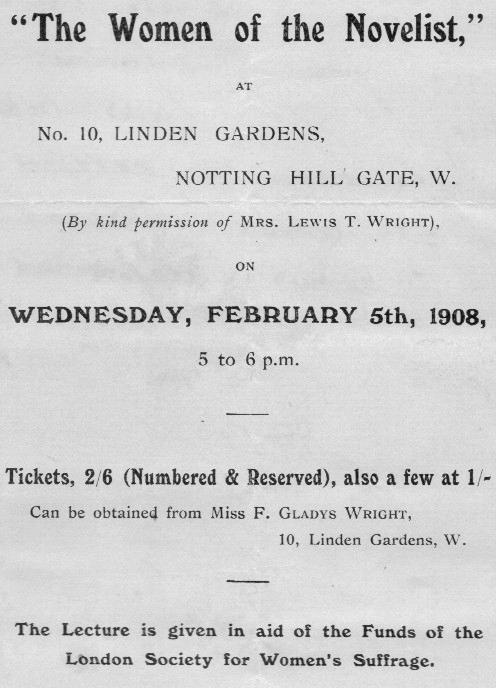
The flyer produced – presumably by the Wrights – for the lecture that Ford Madox Hueffer gave in their house. I wonder if the error in the spelling of his middle name was pointed out to them?
Dramatis personae for these entries:
‘Mrs Wright and the girls’: Mrs Lewis Wright and her daughters, Alexandra and Gladys, who then lived at 10 Linden Gardens. It was under their influence that Kate had joined the London Society for Women’s Suffrage, a constitutional suffrage society.
Geoffrey Stanger: the son of H.Y. Stanger, Liberal MP for North Kensington, who had introduced a women’s suffrage bill into the House of Commons.
Miss Mason: Bertha Mason, honorary treasurer of the National Union of Women’s Suffrage Socities – a suffragist of long-standing.
Miss Frances Sterling: joint honorary secretary of the NUWSS.
Ford Madox Hueffer (later Ford Madox Ford): author, then living in Kensington with Violet Hunt.
Friday January 10th 1908 [London: 25 Arundel Gardens, North Kensington]
I sat over the fire and had another little rest and got dressed early in my white satin dress. It is pretty – a charming frock – the nicest I have ever had, it seems to me. I did my hair Greek fashion with a silver and turquoise band round it which I have made myself – and though it’s me what says it and shouldn’t ‘I did look nice’. Even Mother said I did, I heard after from Agnes. Agnes’s dress was pretty too. And Mother has made hers beautifully but it hadn’t on a trace of style and she really did not look very nice……We had a private omnibus to the Grafton Galleries and got there about 9.15. Met Mrs Wright and her party just inside but by the time our four men had helped themselves we hadn’t many dances left. The girls introduced me to a few but I thought theirs rather a scratch lot – one boy wasn’t bad and Geoffrey Stanger, but one or two others I had I lost as soon as possible. It was a great pack – too many people for dancing in comfort somewhere about 300 and they have made for the London Society of Women’s Suffrage about £70…We stayed to the bitter end and I danced every dance except a few extra at supper time .. I learnt to do the Two Step with Mr Stanger and loved it. We reached home at 3.20 and were able to stir the fire into a blaze. John went off before 4 o’clock but we four sat over the fire talking till 4.30 and it was 5 o’clock before I was in bed as I always like to put some of my things away and tidy the room.
Thursday January 16th 1908
Changed at 6.30 and Agnes and I went off at 7.30 to Miss Mason’s (9 Hyde Park Place) for a Drawing-room Suffrage Meeting at which we had promised to Steward and get there at 8 o’clock for 8.30. We started to walk but we were all in our best and it started to drizzle and we took a cab from the top of the hill. The speakers were the Hon Bertrand Russell, Mr Mitchell Morton and Miss Frances Sterling. She made a most excellent speech and it was a most successful meeting. We did much good work in the way of getting members for the Society and it was all most encouraging and enthusiastic. They had a meeting here last night too – 70 people – but Alexandra said they were a most cold unenthusiastic audience – they could not do anything with them. She has paid Agnes and me a great compliment in saying ‘ I always like to see Agnes and you come into a room – then I know the thing will “go”’. I suppose we have a lot of personality and a lot of electrical excitement and it does help. John is quite in the movement now – though still apt to go back on us in the society of his own sex. .. These meetings are so exciting. I never feel like settling off after them.
Friday January 24th 1908
Changed after tea and at 5.30 Agnes and I went by motor bus from Notting Hill Gate to Oxford Circus and to the Queen’s Hall for the Liberal Federation Woman’s Suffrage Meeting. As we had been asked to act as Stewards and had to be there at 6 o’clock. We stewarded up in the Balcony but there was very little to be done. A good meeting, but not very full. But the audience was a very enthusiastic one and the speeches went well. Mrs Eva McLaren in the chair. Miss Balgarnie, Mrs Conybeare, Mrs Booth and the usual Liberal Women’s Federation people. It was a meeting for women only but there were a number of men stewards. The doors were opened at 7 o’clock and it commenced at 8 o’clock. Mother was there and we met at Oxford Circus and the three of us came home together by bus.
Wednesday February 5th 1908
They had quite a dozen awful Hampstead females there [at home] so we slipped quietly away and hurried to Notting Hill Gate so as to be at the Wrights (10 Linden Gardens) punctually at 4.45. Gladys had asked us to help them I stood in the hall and looked at tickets and sold others etc and later went up to hear the lecture from 5 to 6 by Mr Ford Maddox [sic] Heuffer on the Women of the Classical Novelist of England. It was most interesting and a breezy discussion followed. We got in at 6.30 .. I was very tired but I worked till 11 o’clock directing envelopes for the South Kensington Committee of the L.S.W.S. for a meeting to be held at the Town Hall on the 25th inst.
Campaigning for the Vote: Kate Parry Frye’s Suffrage Diary edited by Elizabeth Crawford
For a full description of the book click here
Wrap-around paper covers, 226 pp, over 70 illustrations, all drawn from Kate Frye’s personal archive.
ISBN 978 1903427 75 0
Copies available from Francis Boutle Publishers, or from Elizabeth Crawford – e.crawford@sphere20.freeserve.co.uk (£14.99 +UK postage £3. Please ask for international postage cost), or from all good bookshops. In stock at London Review of Books Bookshop, Foyles, National Archives Bookshop.
- ‘Campaigning for the Vote’ – Front and back cover of wrappers
Book of the Week: The Love-Letters of Mary Hays, ed A.F. Wedd
Posted by womanandhersphere in Book of the Week on September 18, 2012
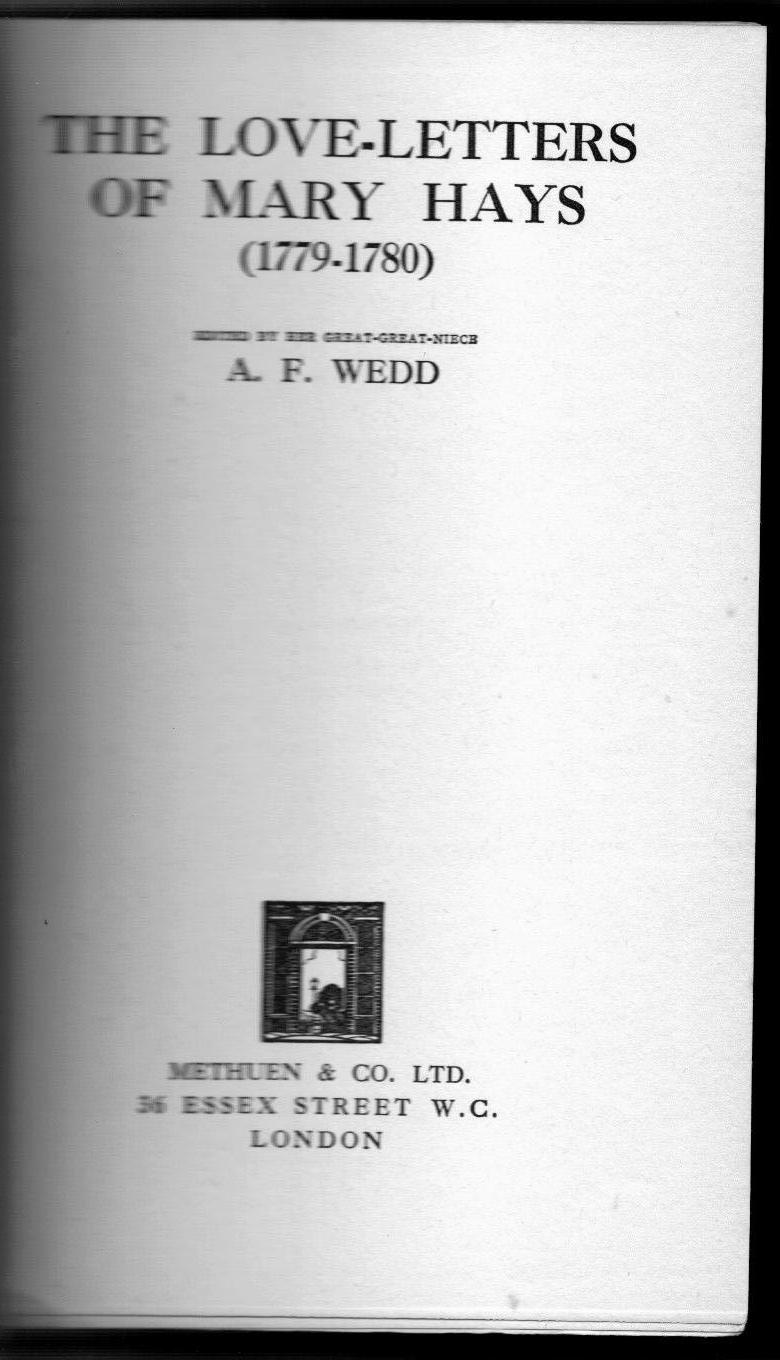 The Love-Letters of Mary Hays (1779-1780), edited by her great-great-niece A.F. Wedd, Methuen 1925.
Tortured by her sensibility, for one blissful year 17-year old Mary Hays enjoyed – or suffered – a romance with John Eccles, a fellow non-conformist who lodged close by her family home in Southwark. Initially opposed by their families, the romance appeared to be approaching a happy conclusion when, shortly before the marriage, John died. However that year had produced an abundance of correspondence, letters treasured by Mary Hays for the rest of her life. In her Introduction to the edited version, her great-great-niece explains how:
‘After many years of oblivion, the papers from which this book has been compiled were discovered stored away in a cupboard of the little old house inhabited by the descendants of Mary Hays’s sister “Sister Dunkin”. The Love-Letters, with Mary’s own introduction and notes, had been copied, in the exquisite writing of her friend Mrs Collier, into two volumes, from which the handsome morocco covers, stamped with the initials M.H. and J.E., had fallen.. The other letters, dusty, stained, and nibbled by mice, but still tied in packets and labelled with the names of their famous authors, were contained in a small wooden chest.’
Is that not a researcher’s dream? For, 230 years later, Mary Hays attracts attention. Having struggling to surface from her great grief – it took about 10 years – she turned from letter to book writing, producing novels, polemics – including Appeal to the Men of Great Britain on Behalf of the Women, 1798 – in which she refutes the contemporary rationale for the subjection of women – and, most importantly, her six volumes of Female Biography, 1802. In these years she moved in the London literary and philosophical circles that included Mary Wollstonecraft and William Godwin, letters from whom are printed at the end of Love-Letters.
By editing these letters Annie Frances Wedd played her part in the renaissance of Mary Hays. In her Introduction she noted that ‘Mary Hays is now unknown; her books are unread; even her connection with the literary celebrities of her day has been forgotten’. However, when the late 20th-century ‘female turn’ in literary studies ensured that novels such as Hays’s Emma Courtney were reprinted, The Love-Letters was there to provide quotable material to place Mary Hays firmly in Mary Wollstonecraft’s circle. Miss Wedd’s Introduction is delightfully tart. She makes clear that, while feeling a sympathy with her forebear, she did not herself suffer from the ‘exquisite sensibility’ that rendered Mary Hays’s days so melancholy – noting, for instance, that when, after Eccles’ death, Mary upbraids ‘the nightingale for not joining in her plaint, as the month was August this was hardly to be expected’.
The book is in very good condition, is quite scarce – £45 (plus postage). To buy contact: e.crawford@sphere20.freeserve.co.uk
Collecting Suffrage: The Game of ‘Suffragette’
Posted by womanandhersphere in Collecting Suffrage on September 17, 2012
I will shortly be issuing a new book and ephemera catalogue – number 175. It will comprise books and ephemera by and about women – with special sections on Women’s Suffrage and Women in the First World War. If you would like a copy of the printed or email version please let me know. A short time after these have been sent out, I shall post the catalogue on this website.

The Rules of the Game. ‘The Haunted House’ appears on the reverse of every card
Amongst several rare items that I shall be including in the ‘Women’s Suffrage’ section is ‘The Game of “Suffragette”‘.
This card game was invented by the Kensington branch of the WSPU, probably in the late summer of 1907, and, as such, is, I think, the earliest of the games that were marketed as a tool of suffragette propaganda. It was described in the second issue of ‘Votes for Women’, November 1907.
The first issue of ‘Votes for Women’, October 1907, had on its cover the picture of the ‘Haunted House’ by David Wilson, which had first appeared in the ‘Daily Chronicle’ in April 1907. Depicting a seated woman brooding over the Houses of Parliament, a demand for ‘Votes for Women’ in her hand, this image appears on the reverse of every card in this game – and on the base of the box. David Wilson (1873-1935) was an Irish-born illustrator, soon to become chief cartoonist for ‘The Graphic’.
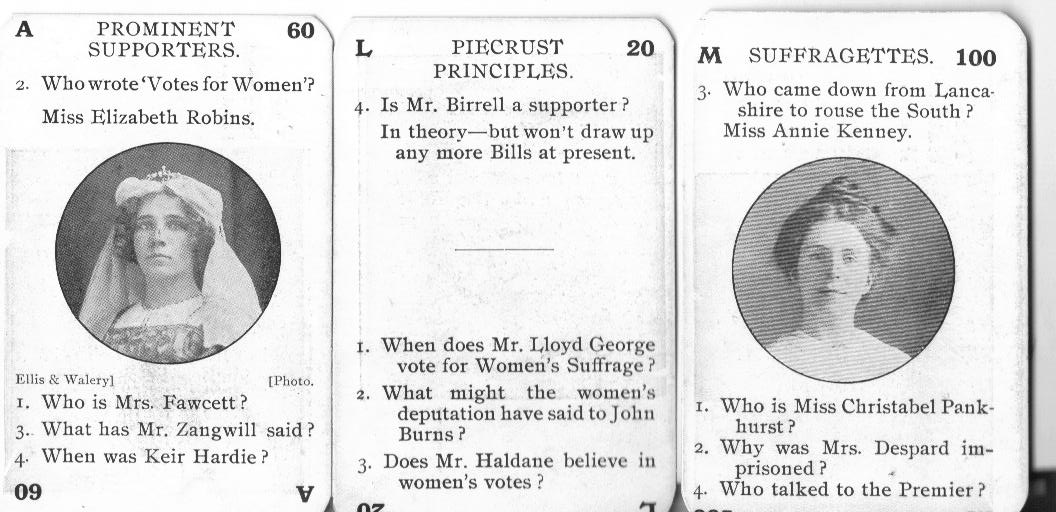
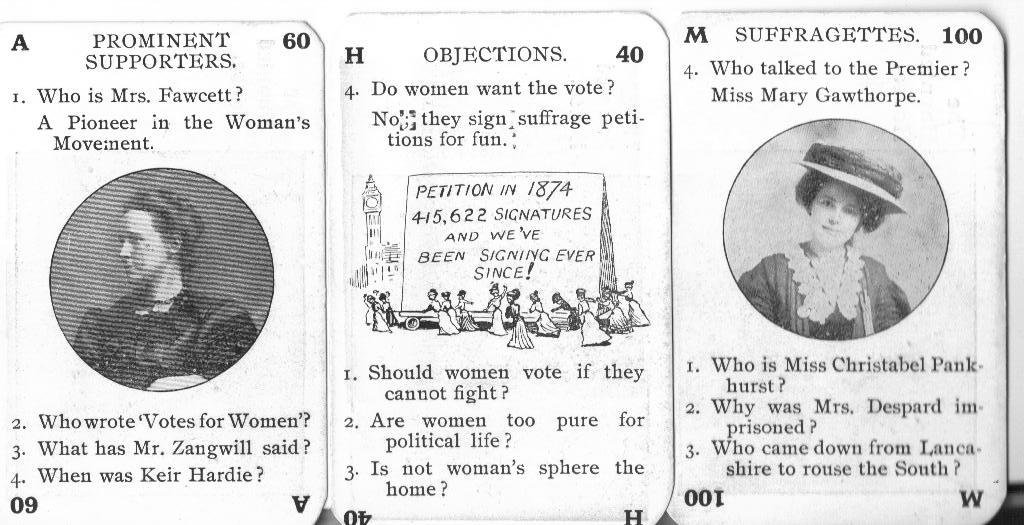 The game comprises 54 cards (all present) divided into 13 sets of 4 cards each – one of the odd ones being known as ‘The Bill’ – and the other a spare which has been used to record the score of a game played long ago by 6 people, designated by their initials. All the sets have names: eg. Prominent Supporters, Arguments, Freewomen, Voteless Women etc – and each card poses a series of questions. Some of the cards also carry photographs – of Christabel Pankhurst, Annie Kenney, Mrs Fawcett, Elizabeth Robins, Israel Zangwill, and Mary Gawthorpe.
 Along with the cards – and the original box – is the original, all-important, set of rules. These describe in detail the various ways in which the game can be played – it seems very inventive.
This is an incredibly scarce item. Although I wrote of it in The Women’s Suffrage Movement: a reference guide, this is the first set I have ever seen. An amazing survival.
Mariana Starke: Grandfather Spurns Virginia for India
Posted by womanandhersphere in Mariana Starke on September 14, 2012
In ‘What Mariana Starke was Not’ I explain that she was not – as has so often been cited – born in India. ‘India’ was, however, a formative presence in her worldview, a continent with which generations of her forebears had been associated. For, c 1710/11, it was to India that the young man who was to be her grandfather, John Starke (1685-1765), set sail. Having dealt with the many law suits he had inherited from his father, Thomas Starke, merchant and slave trader, John turned his back on the Virginia plantations and joined the East India ship, Averilla, heading for Madras.
Why did he forsake America for India? Doubtless the reasons were of the economic variety – he saw better prospects in the East. The fact that 25 years later the grandson of Micajah Perry, one of Thomas Starke’s most successful associates, was forced to sell his home, Hylands House in Epsom, and that the buyer was John Starke, would appear to vindicate the decision.
John Starke settled down to life in India, marrying, in 1713 at Fort St George, Martha Empson, whose father, now dead, had been an English merchant there. John Starke, described as a ‘seafaring man in the Madras service’, was not an employee of the East India Company but certainly travelled on their ships as supra cargo (or supercargo) – that is with responsibility for the management of the cargo and its trading.
It is possible still to catch glimpses of John Starke’s life as a free merchant at Fort St George. For instance in February 1724 an East India Company ship, the Lynn, travelling out to ‘the coast of Coromandel’, carried on it for his use 6 rheams of paper £12; 2 fowling pieces [guns] £5; 2 hatts and 2 wiggs £12. John and Martha Starke had a son, Richard, born in Madras in 1719 and a daughter, Martha. The family returned to England in early 1727, sailing on the ship Lyell. This may have been for the sake of the health of John’s wife, for she died in England, buried on 24 November 1730 at St Dunstan in the East, the churchyard that had in the previous half century received so many Starke bodies.
John travelling back east in 1731 and in 1732 was appointed supra cargo for a ship sailing to China.He was now, for a short time, associated with the developing China trade but by the end of 1734 had returned to England, buying and settling into Hylands House, Epsom, which comprised ‘a messuage, forecourt, coachouse, stables and other outhouses and garden, ¾ acre’.
His son, Richard, was not, however, able to enjoy the pleasures of Epsom for in 1735 he began his career with the East India Company. He still had family – the Empsons – in Fort St George. In 1736 John Starke had sent there to Matthew Empson (either his brother in law or his nephew) ‘a box of books and apparel’ Empsons continued through several generations to live in Madras and Mariana may have been aware of these Indian relations – although they are never mentioned in any extant correspondence.
Comfortably settled in Epsom, John Starke maintained his interest in travel, in 1745 subscribing to A New General Collection of Voyages and Travels in Europe, Asia, Africa etc by John Green. At some point (I have, as yet, been unable to trace the date) he remarried – taking as his second wife Honor, daughter of Sir Thomas Rawlinson and sister of Mary Rawlinson, devoted friend of his sister, Martha. Starke clearly was the uxorious type, losing no time, after Honor’s death in February 1751, in marrying in October, at Temple Church, Ann Clotterbooke. He died 14 years later and was buried at St Mary, Ewell, on 11 April 1765.
In John Starke’s will, among the usual bequests, was one leaving £2000 [2012 = £229,000] to the Incorporated Society for the Propagation of the Gospel, specifying that part of the money was to be applied ‘by the Society towards such charitable purposes as they shall judge most efficacious towards converting the savage Indians in our American colonies and late Acquisition’ [ie territory gained up to the Mississippi following victory over the French in 1763].He stresses the need to extend the Gospel ‘in all the remote and uncivilised parts of our settlement where providence has been graciously pleased to open a fair field to us (and probably for that purpose). It seems as though John Starke felt the necessity of making amends – one takes it that conversion to Christianity was intended as a gift – to at least one group affected by his family’s business dealings in North America – while blustering, even in his will, that English men were also the gift of providence.
On her death, also in 1765, his former sister-in-law, Mary Rawlinson left to John’s daughter, Martha, ‘my dressing table and the dressing stand in my own bedchamber, the bureau in the maid’s room and the black and gold Japan corner cabinet in my bed chamber, the Japan tea table in the parlour, the little mahogany table in ditto and likewise my tea board and writer and all my china ware except 6 blue and white cups and saucer… I give likewise to Miss Starke a pair of glass salts and the turkey carpet in my bed chamber.’ Martha Starke never married and I have wondered if any of these delightful pieces were eventually subsumed into the Hylands House furnishings, to be appreciated by Mariana Starke.
Source: The East India Company papers in the British Library provide a wealth of easily accessible details of life about individual ‘British in India’.
Copyright
Kate Frye’s Diary: Canvassing for the Progressives in North Kensington,1907
Posted by womanandhersphere in Kate Frye's suffrage diary on September 13, 2012
Another extract from Kate Frye’s manuscript diary. An edited edition of later entries (from 1911), recording her work as a suffrage organiser, is published as Campaigning for the Vote: Kate Parry Frye’s suffrage diary.
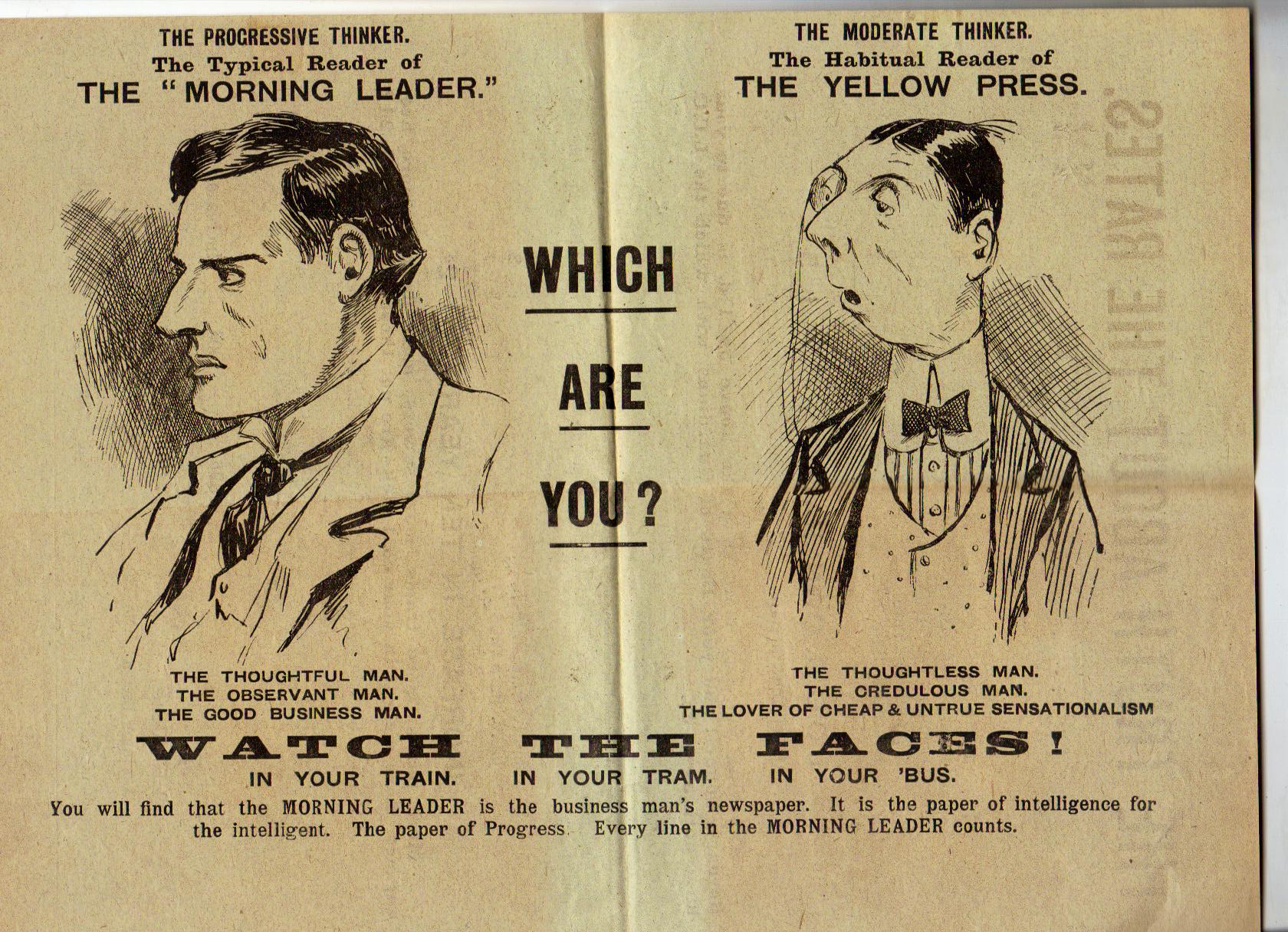
The ‘Morning Leader’ supported the Progressives and in late-February 1907 Kate laid this leaflet in between the pages of her diary
The LCC elections were due to be held on 2 March 1907; Kate and her family supported the Progressive Party. In fact, before becoming an MP, her father had been an LCC councillor on the Progressive ticket.
Dramatis Personae for these entries:
Sir Weetman Pearson, Lady Denman’s father, in 1910 became Lord Cowdray and it was as ‘Lady Cowdray’ that his wife was to be involved with a number of suffrage organisations. Lady Pearson was, according to Lady Denman’s biographer, ‘determined to become a leading political and social hostess’ and the Pearsons’ house at 16 Carlton House Terrace, its opulent interior decorated in the mid-19th century by Owen Jones in the islamic style, provided a perfect setting. As we shall read, Kate, who was something of an expert on these matters, rated the Pearsons’ tea very highly.
H.Y. Stanger: Liberal MP for North Kensington, the seat once held by Kate’s father, in February 1908 introduced a women’s suffrage bill, which passed its second reading before being blocked. This was the greatest progress a bill had made since 1897.
Thomas McKinnon Wood: member of the London County Council for Central Hackney (1892-1909) – leader of Progressive Party (1898-1907). Elected MP for a Glasgow constituency, 1906.
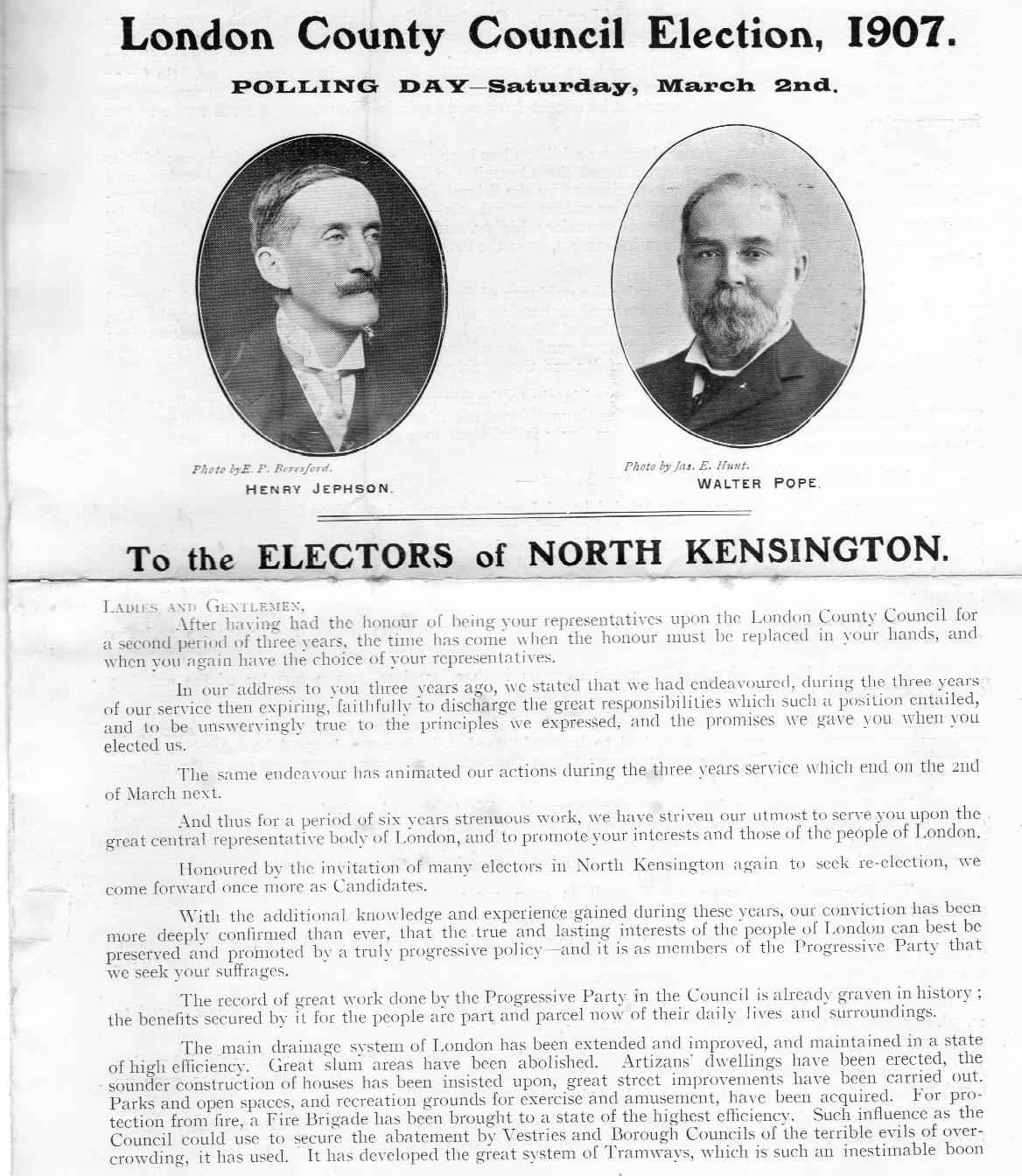
Mr Jephson: Henry Jephson, retired civil servant, who was standing again as a Progressive member for North Kensington on the LCC.
Violette Mary Doake (b c. 1888): lived with her parents at 24 Stanley Gardens, Kensington. In 1892 her father had been elected as a Progressive member of the LCC for Kensington North; unsurprisingly the Doake family was staunchly suffragist.
Thursday February 21st 1907
At 2.30 Mother and I went by train from Notting Hill Gate to Charing Cross and walked through the Horse Guards and up the Duke of Yorks steps to Carlton House Terrace – Sir Wheetman [sic] Pearson’s house – by invitation of Lord and Lady Denman to a drawing Room meeting to hear Mr McKinnon Wood – Mr Wilks and the work we could do for the Progressives at the L.C.C. elections.
Nearly all ladies there. Lord Denman was a sort of Chairman & both he and Lady Denman spoke – she seems very nice. My dear friend Mr McKinnon Wood spoke again most beautifully – I do admire him. Of course I knew it all but I dare say some the facts came new to a good many there. Mr Stanger, Mr Jephson and Mr Percy Harris were there.
There was a most gorgeous tea downstairs afterwards it really was quite perfect – such cakes – in such quantities – I made a pig of myself and eat [ate] three and I had my tea and milk poured out of solid gold articles. I really did enjoy the party and the house is wonderful – what a position – looking out on the Park.
Friday February 22nd 1907
I dressed myself. John [her fiance] came at 7.30 to dinner and afterwards Daddie took he, Agnes and I up to the Horbury Rooms [Ladbroke Road] to the Opposition L.C.C. Candidates’ meeting – Mr Davis and Major Skinner. Well I thought it would be interesting but I never expected to be so thoroughly amused.
The Chairman was so funny and Harcourt-Smith such a noodle – a Dickens character with an eye glass. And as for Major Skinner I have never seen or heard the like really. He didn’t seem sharp and made quite an object of himself. He tried to propitiate the ladies – I never heard anything so awful. I blushed for him. He kept right away from the question of the L.C.C. altogether. The only decent man there, for though Mr Whittiker Hampson speaks well, I wouldn’t trust him, was Mr Hume-Williams who opposed Mr Stanger at the Parliamentary Elections. He is a gentleman and speaks well, but he was not convincing – none of them were – they all talked nonsense – have no programme of work at all to bring forward. Their great cry is ‘give us a chance’ and they tell awful stories about the rates, which have really nothing to do with the County Council. It will be a real grief to me if those two dreadful people get in.
John, a thoroughly conservative spirit, doggedly tory, to the backbone was quite turned over by them though he thinks he upholds their views. I do so hate him to be a ‘Moderate’ thinker. We came back and talked them over and laughed merrily at their expense till John had to go at 11 o’clock.
Wednesday February 27th 1907
When I got home at 5 o’clock I found a note and bundle from Gladys Wright asking me to deliver some Women’s Suffragist things. So after tea Agnes went out with me and we did Arundel Gardens and Elgin Crescent – a tremendous number of Women Voters in both. They were papers urging the Women to use their Vote. I feel rather shaky as they are sure to Vote Conservative but that is a cowardly way of looking at the matter, I know.
Thursday February 28th 1907
Went off to the [North Kensington Liberal] Club – Mother, Agnes and Florence [the Fryes’ maid] were there – and the room was full. Miss Jephson, Miss Doake, Mr McArthur, Mr Lewis, Mr Hatt and the usual workers and lots of people I did not know all working at top speed.
 Saturday March 2nd 1907
The great London County Council Election day at last and, very fortunately, a beautiful day for it. I should have been canvassing all this week, much as I hate the work – but I am so interested in the Election – but I have felt so awfully seedy I simply hadn’t the strength for it…Agnes and I went to the Pembridge Ward Committee Room and got some work to do. I had Westbourne Grove to do and it took me till 4.30. Mother and Agnes went together. I got so tired I felt nearly dead when I had taken the cards back and came home to tea. But I couldn’t rest and after tea Mother and I walked up to the Golborne Ward Committee Room.
It is depressing work in this Ward. There is no enthusiasm – but up there there was very little excitement amongst the workers – and my heart sank though most of them were cheerful. We saw Mr Jephson in the Committee Room. Miss Jephson, Mrs and Miss Doake, Mrs Willis and lots of workers. Mr Jephson was flying about madly in his Motor Car. Mother and I did three streets – Blagrove Road and two other long ones and kept on till within a few minutes of eight o’clock.
I got so excited and interested that I don’t know how I managed to keep going as I did. I did feel ill but I did some good work. Got one woman to vote who had never used her vote before. I had almost to hold her by force and interest her by telling her how I worked to get a vote. She decided she would go if she was driven. So I sent Mother off to find a carriage and I waited and hung on to her. It was so long coming I flew into the middle of the road and managed to stop Mr Jephson’s car almost by main force it seemed to me – but just then Mrs Widgery drove up in a carriage and she took the woman and a man who went to look after her.
Sunday March 3rd 1907
Florence brought me the news and later the paper. Jephson and Pope beaten and the whole of London swept clear by the Moderates. ‘God help London’ I say since London does not seem inclined to help itself.
Campaigning for the Vote: Kate Parry Frye’s Suffrage Diary edited by Elizabeth Crawford
For a full description of the book click here
Wrap-around paper covers, 226 pp, over 70 illustrations, all drawn from Kate Frye’s personal archive.
ISBN 978 1903427 75 0
Copies available from Francis Boutle Publishers, or from Elizabeth Crawford – e.crawford@sphere20.freeserve.co.uk (£14.99 +UK postage £3. Please ask for international postage cost), or from all good bookshops. In stock at London Review of Books Bookshop, Foyles, National Archives Bookshop.
- ‘Campaigning for the Vote’ – Front and back cover of wrappers
Book of the Week: A Nest of Suffragettes in Somerset
Posted by womanandhersphere in Book of the Week, Collecting Suffrage on September 12, 2012
A Nest of Suffragettes in Somerset: Eagle House, Batheaston by B.M. Willmott Dobbie for The Batheaston Society, 1979. Soft covers – very good condition (with a newspaper cutting of an obituary of Bristol suffragette, Victoria Lidiard, laid in). £26 (plus postage) For sale – from my stock of books and ephemera about the suffrage movement. To buy – email e.crawford@sphere20.freeserve.co.uk
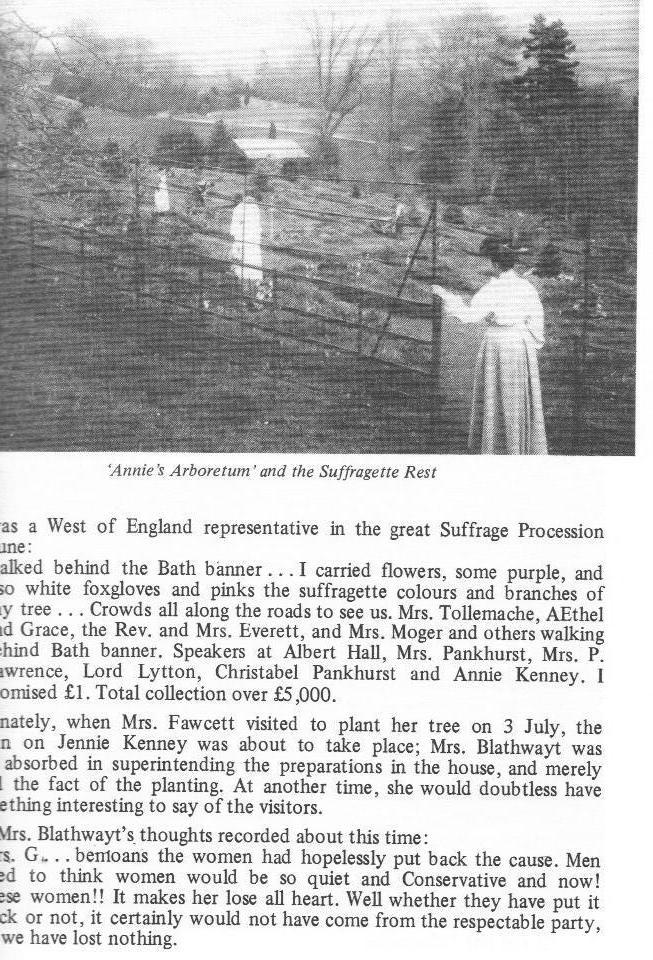
‘Annie’s Arboretuem’ and the Suffragette Rest
The story of the Blathwayt family – Col Linley Blathwayt, his wife Emily and daughter Mary -who lived at Eagle House, Batheaston, where for some years they offered a haven to WSPU activists. Annie Kenney – and her sisters – were particular favourites.
Col Blathwayt organised the planting of trees to commemorate visits by both suffragists and suffragettes – such as Lady Constance Lytton.
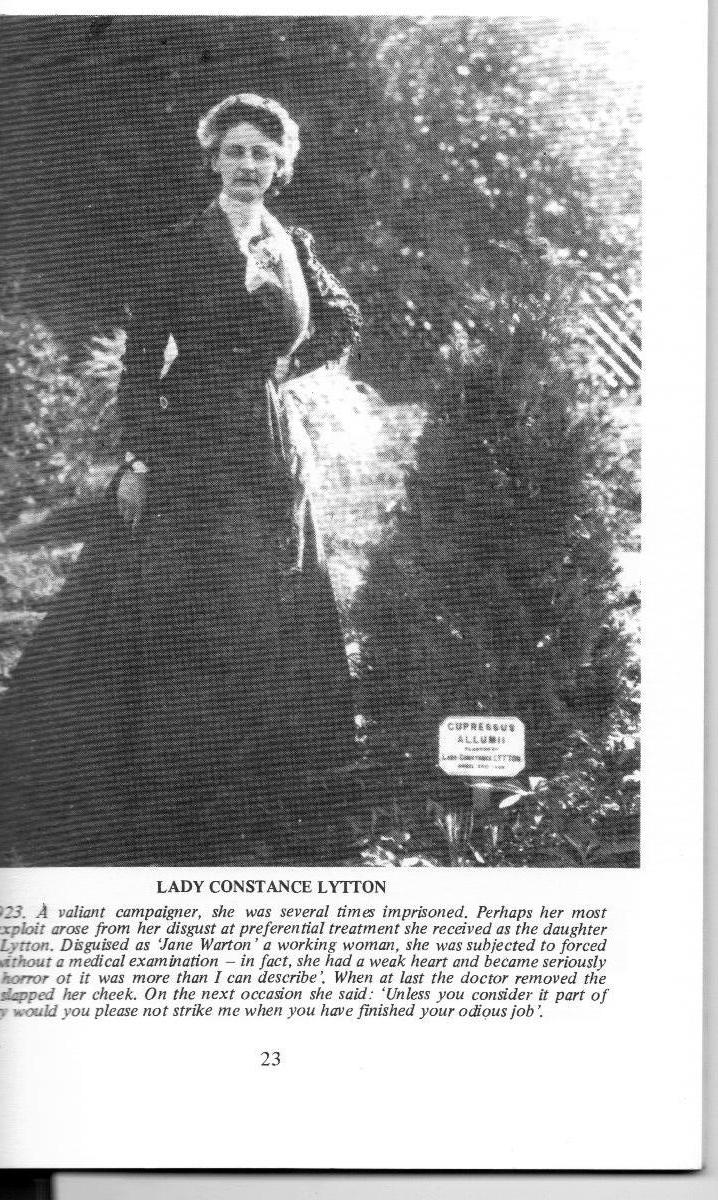
Lady Constance Lytton photographed by Col Blathwayt
‘Annie’s Arboreteum’ and ‘Pankhurst Pond’ were just two of the features created on the estate. Col Blathwayt was a keen photographer and many of the photographs he took of visiting suffragettes are included in this book. The text includes extracts from the diaries that the Blathwayts kept and which provide us with such a disingenuous view of some of the leading suffragette personalities
For more about Eagle House (and a little about Rose Lamartine Yates and Dorset Hall, Merton, of whom, coincidentally, I wrote in yesterday’s post) see here. For ‘Suffragettes in Bath’ see here. The diaries of Col. Blathwayt, Mrs Emily Blathwayt, and dear Mary Blathwayt, who I describe in the Women’s Suffrage Movement: a reference guide, as the ‘Mr Pooter of the suffrage movement’, are held in Gloucestershire Archives.
Suffrage Stories: Suffragettes and Tea Rooms: Suffragette Tea from Suffragette China
Posted by womanandhersphere in Collecting Suffrage, Suffrage Stories on September 11, 2012
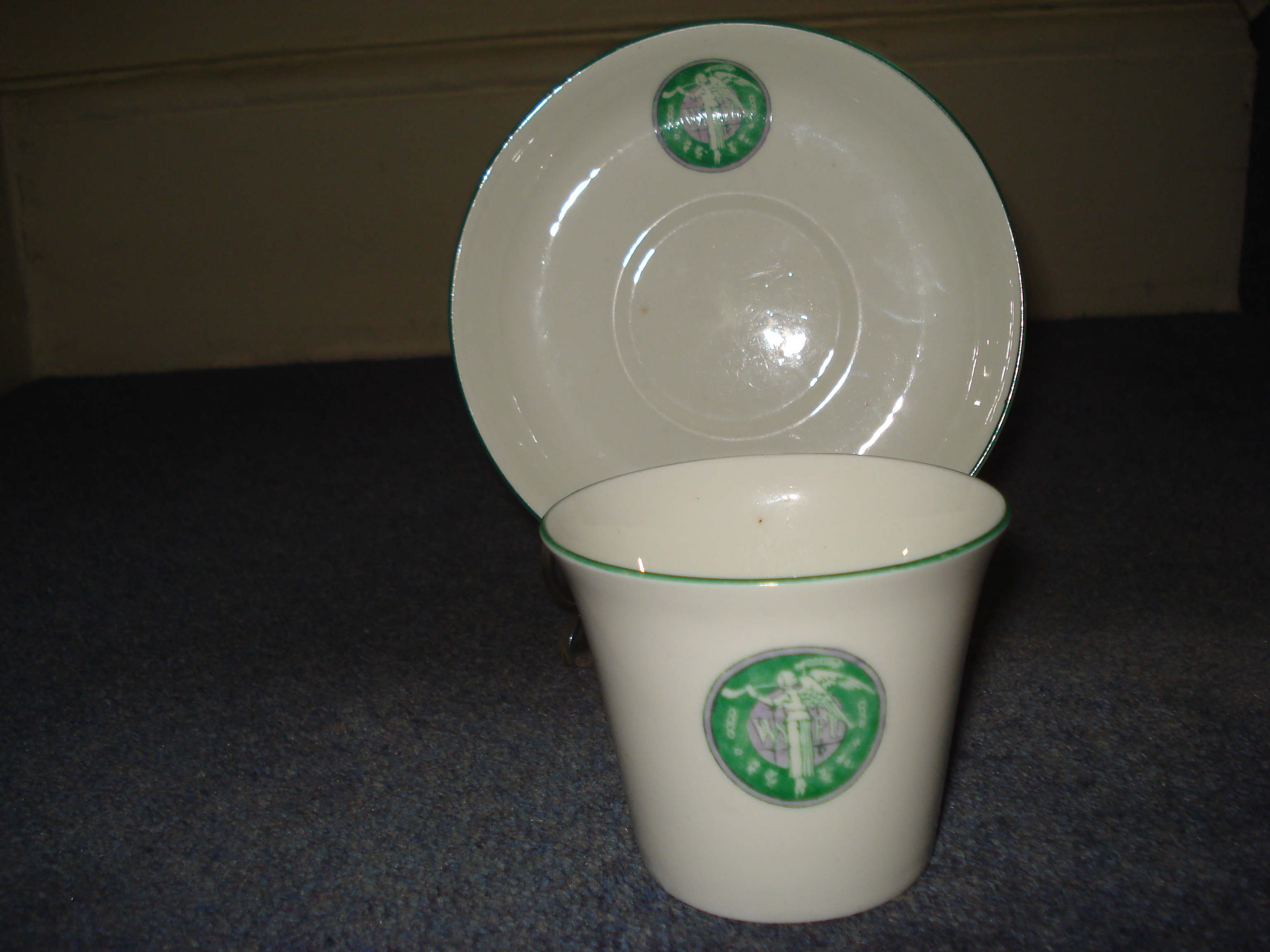 WSPU china – ‘Angel of Freedom’ design, 1909
A week of posts on ‘Suffragettes and Tea Rooms’ cannot end without looking at the tea rooms that the suffragette societies themselves ran – in their shops and at their fund-raising bazaars – and the china they commissioned in which to serve that tea .
The best known of the fund-raising events is probably the WSPU exhibition held at the Prince’s Skating Rink at Knightsbridge in May 1909. There the tea room was run by Mrs Henrietta Lowy, with help from her four daughters and another young upper-class suffragette, Una Dugdale. In the spirit of exuberance and professionalism that marked this the first of the WSPU’s fund-raising bazaars, a decision was taken – presumably reasonably well in advance of the Exhibition – to commission a Staffordshire pottery – H.M. Williamson of Longton – to make the china from which the tea would be served in the Exhibition’s Tea Room.
The white china has strikingly clean, straight lines, rimmed in dark green and with angular green handles. The shape is, I am sure, a Williamson standard – but how very different the WSPU pieces look from, say, Williamson’s Rosary design–in which pink and grey ribbons and roses are applied to the same shape and every edge is gilded. In contrast, the WSPU china design is pared back, almost stark.
It is more than likely that, from the range offered by Williamson, Sylvia Pankhurst chose this shape, keeping the design simple so that the ‘angel of freedom’ motif that she had designed specifically for the Exhibition should be shown to best effect. Each piece of the tea service carries this motif; behind the angel and accompanying banner and trumpet, are the initials ‘WSPU’ set against dark prison bars, surrounded by thistle, shamrock, rose – and dangling chains. At the end of the Exhibition, the china – tea pots, cups, saucers, tea plates, sugar bowls etc – was offered for sale, made up into sets of 22 pieces. Many years ago, early in my ephemera-dealing days I bought – and, of course, immediately sold – a comprehensive service. Although I have subsequently sold individual pieces of the china, I have never again seen such a complete set. Ah well.
Pieces of this design are held in archives such as the Museum of London and the Women’s Library – but one variation design is not, as far as I know, represented in any public collection.
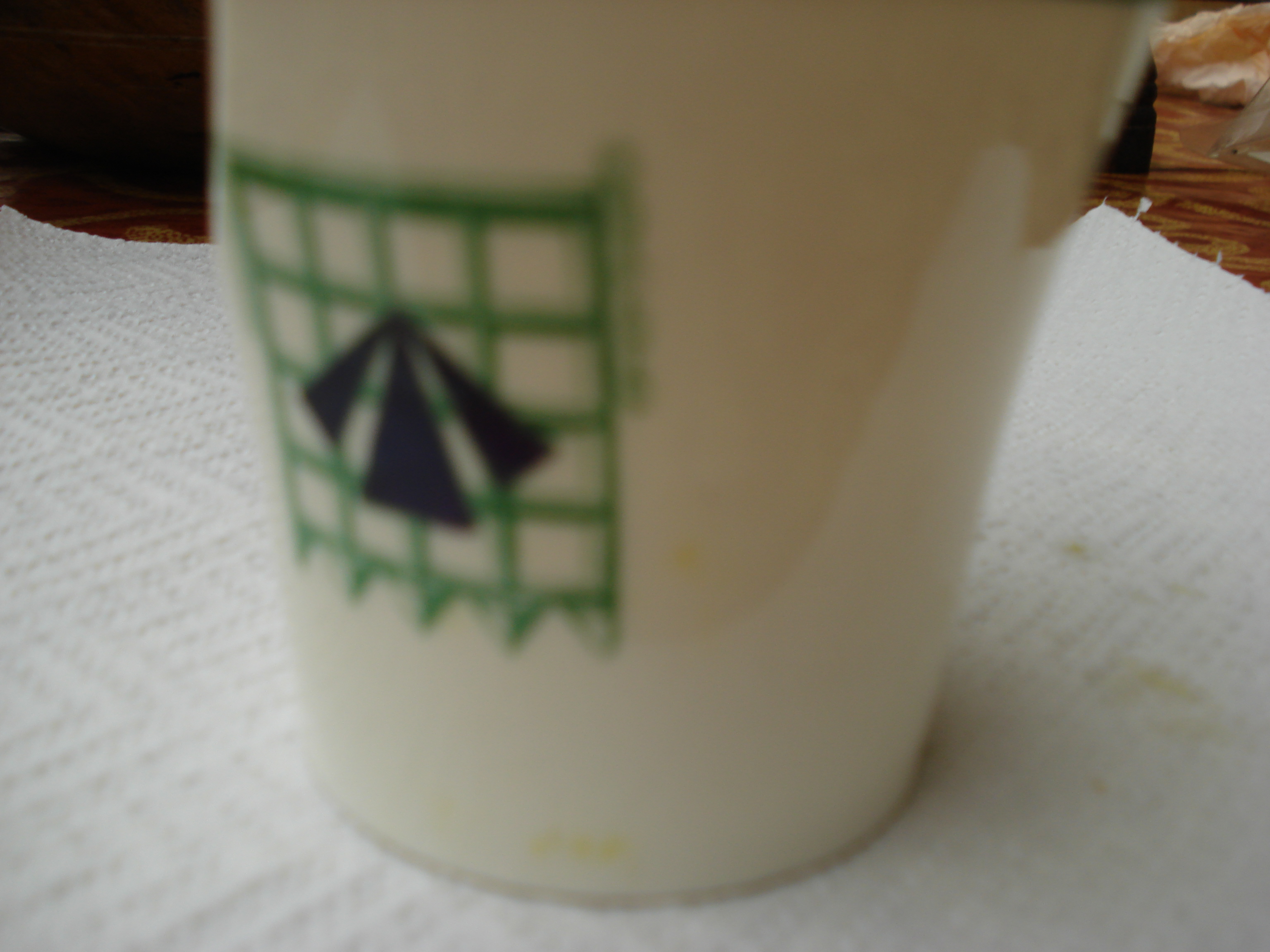 This cup – its design based on Sylvia Pankhurst’s ‘portcullis’ motif which, used on the WSPU’s ‘Holloway brooch’, can be dated to the spring of 1909 – came from a collection that also contained items of the ‘angel of freedom’ china. I bought this wonderful haul some years ago at auction and, although the provenance was not divulged by the auctioneer, I am pretty sure that the china had once been belonged to Mrs Rose Lamartine Yates who held fund-raising teas for the Wimbledon WSPU on the lawn of Dorset Hall, her 18th-century Merton house. This ‘portcullis’ cup does not carry any maker’s mark but, as the shape is identical to the Williamson pieces, I think we can be pretty certain that they probably also made this. As, in the early 19th-century, when women set their tea trays with ‘anti-slavery’ china, so in the early 20th, suffragettes who bought these tea services could – like Mrs Lamartine Yates – use them as propaganda tools -promoting the movement, most elegantly, in a bid to convert their ‘anti’ neighbours.
 I have only ever had in stock – and that only fleetingly – this cup and saucer (see left), part of the third identifiable range of WSPU-commissioned china. I believe, however, that the People’s Palace in Glasgow holds a similar two pieces . They formed part of the Scottish version of the Prince’s Rink tea service, commissioned from the Diamond China Co, another Longton pottery, for use at the refreshment stall at the Scottish WSPU Exhibition held in Glasgow at the end of April 1910. Here the ‘angel of freedom’ is allied, on white china, with the Scottish thistle, handpainted, in purple and green, inside transfer outlines. After the exhibition this china, too, was sold – Votes for Women, 18 May 1910, noting that ‘a breakfast set for two, 11s; small tea set 15s , whole tea set £2, or pieces may be had singly’. It will hardly surprise readers to learn that WSPU china – now so very rare – commands a very high price. But what a wonderful addition a piece would make to any suffrage collection.
Although the china they used was probably more basic, some of the shops and offices run by both suffragette and suffragist societies offered their members – and the general public – a tea room. For instance, the Birmingham NUWSS office at 10 Easy Row included a shop at which tea could be taken and suffrage papers read. And the Glasgow WFL shop, at 302 Sauchiehall Street, as befitting the city in which Miss Cranston perfected the art of the tea room, served tea in its ‘artistic hall’, decorated in the WFL colours. (By the way, when in Glasgow do not fail to visit the De Luxe Room in The Willow Tea Rooms, also on Sauchiehall Street, originally designed by Charles Rennie Mackintosh for Miss Cranston – it may be a reconstruction, but it’s lovely).
As a final thought, the WSPU not only sold their own china, but also their own tea – much advertised in Votes for Women. Unfortunately, the only reference I have ever come across to anyone buying the tea was an aside by Mary Blathwayt, who noted in her diary that she had had to return a bag that was ‘off’ to the Bath WSPU shop. But I am sure that merely reflects the fact that the hundreds of satisfied customers had no need to comment and I will end this sequence of posts by conjuring up the image of a WSPU tea party, cucumber sandwiches sitting delicately on the elegant WSPU plates, as the assembled company receive WSPU tea into their WSPU cups from the WSPU pot. How, then, could the ensuing conversation be of anything other than ‘Votes for Women’?
Suffrage Stories: Suffragettes and Tea Rooms: From ‘Sheltered Anonymity’ to Sites of Protest
Posted by womanandhersphere in Kate Frye's suffrage diary, Suffrage Stories on September 10, 2012
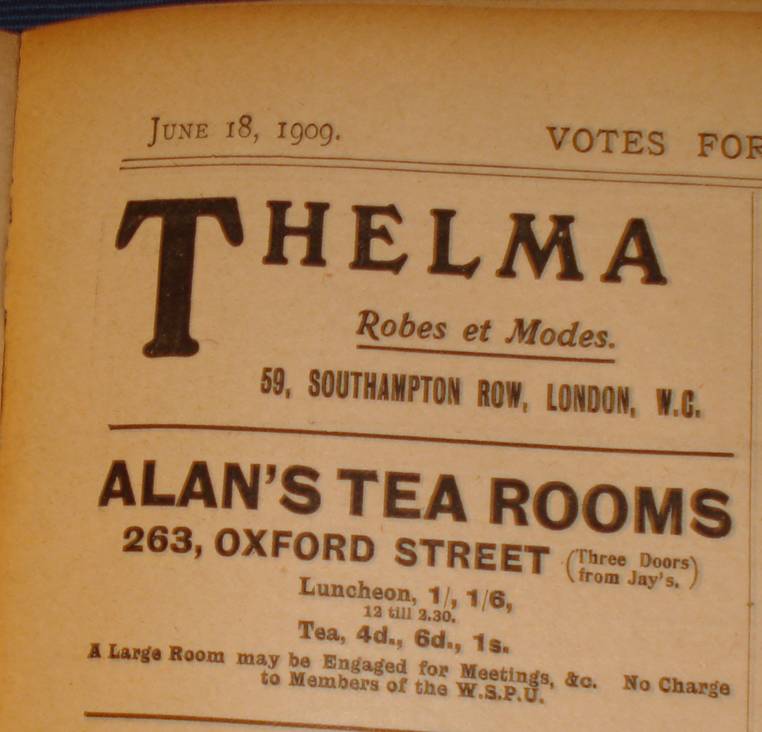
Advertisement for Alan’s Tea Rooms in ‘Votes for Women’.
Last week’s posts on ‘Suffragettes and Tea Rooms’ were based on the research I had done for the item that aired on Woman’s Hour on 4 September. The posts gave details of a few of the London tea rooms and restaurants – – some of them vegetarian – that we know were favoured by suffragettes. I had been curious to know more about the reality – the geographical position and the look of the interiors – of the cafes whose names are scattered through the columns of the suffragette newspapers. I had wondered ‘Why were suffragettes attracted to one place rather than another?’ ‘Whose businesses were they?’ – and hope that in last week’s posts I have, at least partially, answered these questions. In the absence of any other information, I was pleasantly surprised by how much detail could be gleaned from such superficially dull sources as rate books and the files of liquidated companies. I now have a much clearer image in my mind – as I walk around London – of the places in which militant activity was discussed – and indeed practised – by suffragettes a hundred years ago.

Corner of Alan’s Tea Rooms – as pictured in ‘The Idler’, 1910
For political movements need sheltering spaces – of all sizes – in which those involved can exchange views. In the 19th century women could attend the hundreds of formal suffrage meetings and conscious-raising talks that were held in Britain’s town halls and assembly halls – or, if suitably couth, the ‘drawing-room’ meetings held in the houses of the better-off. But until the late 1880s there were very few places outside the home in which respectable women could congregate – for refreshment – to meet their friends – or to discuss politics. The coffee houses, chop houses, ale houses and public houses that had for centuries enabled men to congregate, do business and eat and drink – had been socially barred to respectable women. It was only towards the end of the century that middle-class women were able to move independently– without any vestige of social censure – out of the home and around the streets of the metropolis. One practical element lining the path to freedom was a new type of business – the café, tea room or restaurant designed with women in mind. These were places that women could visit – either alone or in company – where their presence was not seen as an invitation to molestation – where they could eat and drink – and, most importantly, use the lavatory – without breaking any social taboos.

Kate Frye – suffrage organizer and frequenter of restaurants and tea rooms
That there were indeed still taboos around the presence of a woman in some places of public refreshment, even as late as 1911, is evident in one of the entries from Kate Frye’s diary. (My edition of her suffrage diary, Campaigning for the Vote, will be published in the autumn). She is staying in a hotel in a small Norfolk market town, while organising meetings for a suffrage society. :
22 March 1911 ‘Came in, had my lunch [in the hotel dining room] in company with four motorists. It is funny the way men come in here and, seeing me, shoot out again and I hear whispered conversations outside on the landing with the waitress. Then they come in very subdued and make conversation one to another and try not to look at me. Awfully funny – they might never have seen a woman before – but I suppose it does seem a strange place to find one.’
For, by the 1900s, the situation in larger towns and cities had changed. When not out organising meetings in the provinces, Kate lived and worked in London and there she paid daily visits to cafes, restaurants and tea rooms where she never felt out of place. Aimed particularly at the woman shopper – or woman clerical worker – here she could feel comfortable – both physically and mentally. Some of the cafes were part of chains – such as the ABC, founded in the 1880s, and Lyons in 1894. For a rare photograph of a Lyons interior – dating from the 1920s -see here. These chains catered for upper-working-class and lower- middle-class women who could enter their premises with equanimity and sit in sheltered anonymity at separate tables – and be served, not by waiters, but by waitresses. Kate Frye, belonging to a slightly higher strata of society, favoured rather smarter chain restaurants – such as Slaters’ – or tea rooms such as Fullers’. However it was in a Lyons tea room close to Parliament Square that she sat on the evening of 21 November 1911 with a group of suffragettes who were poised to embark on the smashing of the windows of government offices.
And quite apart from the chains, the first decade of the 20thcentury saw a proliferation of small refreshment rooms – ‘Tea Rooms’ – that were even more closely aimed at a female clientele. These were likely to be run – as were Alan’s Tea Rooms and the Tea
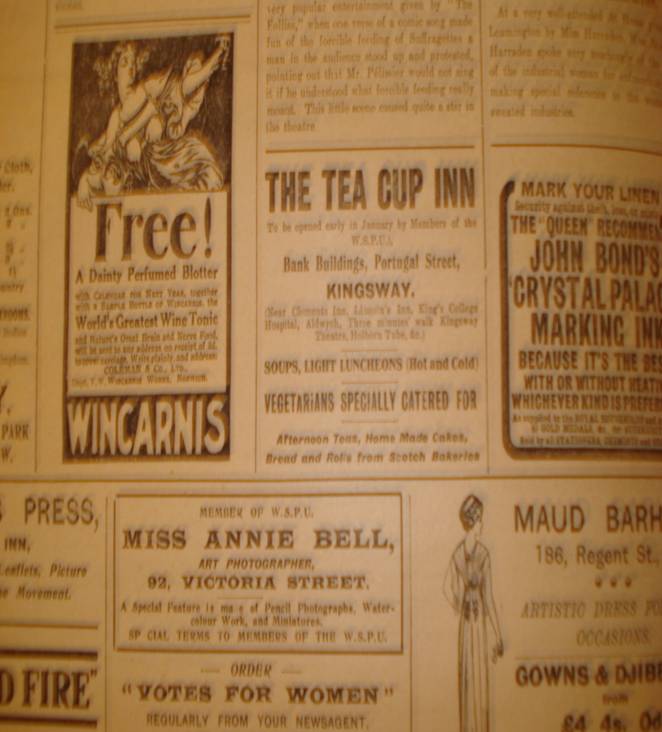
Advertisement for The Tea Cup Inn in ‘Votes for Women’.
Cup Inn – by a woman or a couple of women friends – and allowed women, who may have had no training in anything other than ‘home responsibilities’, the possibility of running a business, while at the same time allowing other women the ability to enjoy the freedom of moving around the city – or town – by providing a space in which they could pause for refreshment.
As we have seen, a few London tea rooms and restaurants were particularly favoured by suffragettes – as, similarly, were they in provincial towns. In Newcastle, Fenwick’s cafe was the venue of choice of the group of women, including Dr Ethel Bentham and Lisbeth Simm, set up the ‘Drawing-Room Cafe’ meetings where women could meet to discuss discuss politics. In Nottingham the WSPU held meetings at Morley’s Cafe, a teetotal establishment, originally opened to provide an alternative to the pub. In Edinburgh the Cafe Vegetaria was particularly favoured by the local Women’s Freedom League society – and it was on its premises on the night of 2 April 1911 that suffragettes gathered – as they did at the vegetarian Gardenia in London – to evade the census enumerator
A year later, however, although so popular with women, tea rooms were not immune from the effects of the 1 March 1912 WSPU window-smashing campaign. Two ABC shops were attacked – one in The Strand and one in Bond Street – here is the photographic evidence.
When, from the end of 1913, the WSPU campaign became ever more desperate, the tea rooms and restaurants that women had made their own themselves became sites of protest. On December 20th a suffragette dining at the vegetarian, suffrage-sympathising, Eustace Miles restaurant was able to make a long speech castigating the government’s treatment of suffragette prisoners – and was, so The Suffragette reported, listened to with eager attention, while her companion distributed leaflets. And althougb the management did eventually ask the speaker to stop she was allowed to continue with her ‘meeting’ and, afterwards, to remain in the restaurant. However, most cafes were not so amenable. When, on the same day, at Fullers’ in Regent Street, a woman began to address the crowded restaurant from the gallery and her two companions showered down leaflets, they were very quickly asked to leave. The newspaper report reveals that the subject of the woman’s address was a comparison of the treatment by the government of Sir Edward Carson and Ulster rebels with that meted on suffragettes. A few days later, when another interruption took place at Fullers’, the management had their answering tactic in place; the orchestra immediately struck up to drown out the speaker.
Soon after, The Suffragette reported an incident at a Lyons Corner House when a woman rose and spoke for a few moments – amid both applause and criticism. When two uniformed Lyons men tried to drag her roughly from the building they met with determined opposition and she finally left, the paper reported, with quiet dignity- escorted to the exit –to murmurs of ‘Isn’t she plucky’.
These protests carried on all through the spring and summer of 1914. Although similar interruptions were made in churches and theatres, it is singularly apposite that customers in tea rooms and restaurants, as they ate their lunch or tea, should have had their attention drawn to the forcible feeding of suffragette prisoners. In fact one of the very last militant action came at the end of July 1914 when women interrupted lunch at the Criterion Restaurant, imploring customers to attend a meeting to be held by Mrs Pankhurst in Holland Park. That, I think, was the final WSPU rally, before the outbreak of war in early August put an end to militancy.
Even as restaurants came under attack there were still some establishments that felt it worthwhile to advertise in The Suffragette. One such was one I had not come across before – Molinari’s Restaurant at 25 Frith Street in Soho., which advertised (January 1914) that they would ‘donate 5 % of their takings to the Cause for suffragists who wear the badge.’ Molinari’s was still advertising in suffrage papers in 1915 and I was amused to discover that in the 1920s the Home Office reported that its proprietor, Angelo Molinari, was the proprietor of ‘doubtful’ restaurants – suspected of running brothels in upstairs rooms. Thus, although the credentials of such suffrage-sympathising refreshment rooms as Alan’s Tea Rooms, the Eustace Miles and the Gardenia are beyond reproach, there were always those commercial operators prepared to take advantage of trusting suffragettes. I suspect, though, that the atmosphere of Molinari’s was not that of Alan’s Tea Rooms Angelo Molinari was not often called to donate any percentage of their profits to the Cause.
.Here is link to Woman’s Hour ‘Suffragettes and Tea Rooms’ item aired on 4 September. It begins at c 27 mins – and is available for 2 more days only.
WALKS/Suffrage Stories: Suffragettes and Tea Rooms: The Eustace Miles Restaurant – and the Tea Cup Inn
Posted by womanandhersphere in Suffrage Stories on September 7, 2012
The Gardenia Restaurant, subject of yesterday’s post, was by no means the only vegetarian restaurant favoured by suffragettes. Close by, at 40-42 Chandos Place, at the western end of Covent Garden, was the rather more famous – and successful – Eustace Miles Restaurant.
Eustace Miles was a Cambridge-educated health guru – a real tennis player – prolific author – and vegetarian. He opened the restaurant, with his wife, Hallie, – as a ‘Food Reform’ restaurant – in May 1906, a few months after their marriage. Among the restaurant’s shareholders were his close friend, the writer E.F. Benson, the headmaster of Eton, Bernard Shaw and his wife, Dr Helen Wilson, a Sheffield-based doctor and suffragist, and Mrs Ennis Richmond, a suffragette who ran West Heath, a progressive school in Hampstead.
Ellen Terry’s daughter, Edith Craig, who lived nearby in Bedford Street, sold Votes for Women from a pitch outside the Eustace Miles. It was a sensible spot to choose; vegetariansm and suffragism went hand in hand for those whom H.G. Wells characterized – caricatured – in Ann Veronica as ‘a small but energetic minority, the Children of Light’, for whom ‘ everything…was “working up”.. “coming on” – ‘the Higher Thought, the Simple Life, Socialism, Humanitarianism’.
Opening just as the WSPU arrived in London, the Eustace Miles grew up alongside the suffragette movement. In March 1907 the WSPU chose it as the venue for a breakfast celebrating the release from Holloway of the prisoners who had been arrested when taking part in the deputation from the first Women’s Parliament. Similar breakfasts were also held there– including, a year later, one for women who had taken part in the pantechnicon raid on Parliament. (another suffragette episode hijacked by Wells for use in Ann Veronica – see my article, ‘The Woman’s Bond of Freedom’: H.G. Wells, Ann Veronica and the suffragettes, published in the 2011 edition of The Wellsian, the journal of the H.G. Wells Society.)
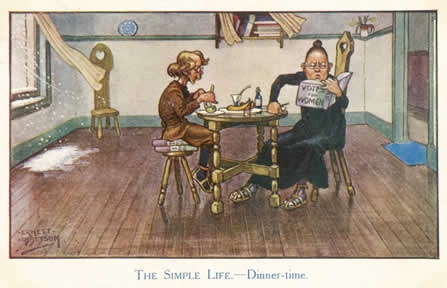
Comic card – one of a series – poking gentle fun at the ‘Simple Life’ suffragettes
As with Alan’s Tea Rooms and the Gardenia, so the Eustace Miles had a space to rent – an offer taken up, on occasion, by those giving women-related talks. The Eustace Miles, however, went one better than the other two, offering their ‘Simple Life’ audiences ‘ozonized air’ to breathe as they listened to, for example in 1912, Miss Hoskyns-Abrahall lecture on ‘The Religion of the Great Mother’, to the accompaniment of a lantern show operated by Vera Holme. In January 1910 the Men’s Political Union for Women’s Enfranchisement held its inaugural meeting at the Eustace Miles – the owner surely being a member of the MPU – and in October 1914 it was the venue for committee meetings of the United Suffragists.
The Eustace Miles was by all accounts an attractive place in which to lunch or dine; Kate Frye – by no stretch of the imagination a vegetarian – often ate there – as readers of my Campaigning for the Vote: Kate Parry Frye’s Suffrage Diary will discover. The restaurant did very well during the First World War – when meatless cookery was more or less a necessity – staying in business for over 30 years.
Alas, Hallie Miles’ Untold Tales of Wartime London, the source of the words spoken by Alison Steadman in The Great War: The People’s Story, is out-of-print. But for much more about the life and times of Kate Frye do read Kate Parry Frye: the long life of an Edwardian actress and suffragette. In this I tell the whole story of Kate – and of John Collins, her soldier husband. For details see here. I hope you will find it a Good Read.
Teacup Inn
While not specifically a vegetarian café, the Teacup Inn, much frequented by suffragettes, made sure that its vegetarian credentials were mentioned in its advertisements in the WSPU paper, Votes for Women – ‘Dainty luncheons and Afternoon teas at moderate charges. Home cookery. Vegeterian dishes and sandwiches. Entirely staffed and managed by women.’ The café was opened in January 1910 in Bank Buildings, Portugal Street, just off Kingsway, in a new building in area that was, as I have stressed in recent posts, still under development
The Tea Cup Inn occupied a ground-floor shop and basement in the building – then, as it name suggests – mainly given over to a bank – and now occupied by the Chaplaincy of LSE. In this photograph, taken c 1915, I am sure, after peering at it with a magnifying glass, that a sign ‘Tea Cup Inn’ is visible, hanging just above the smart open-topped car.
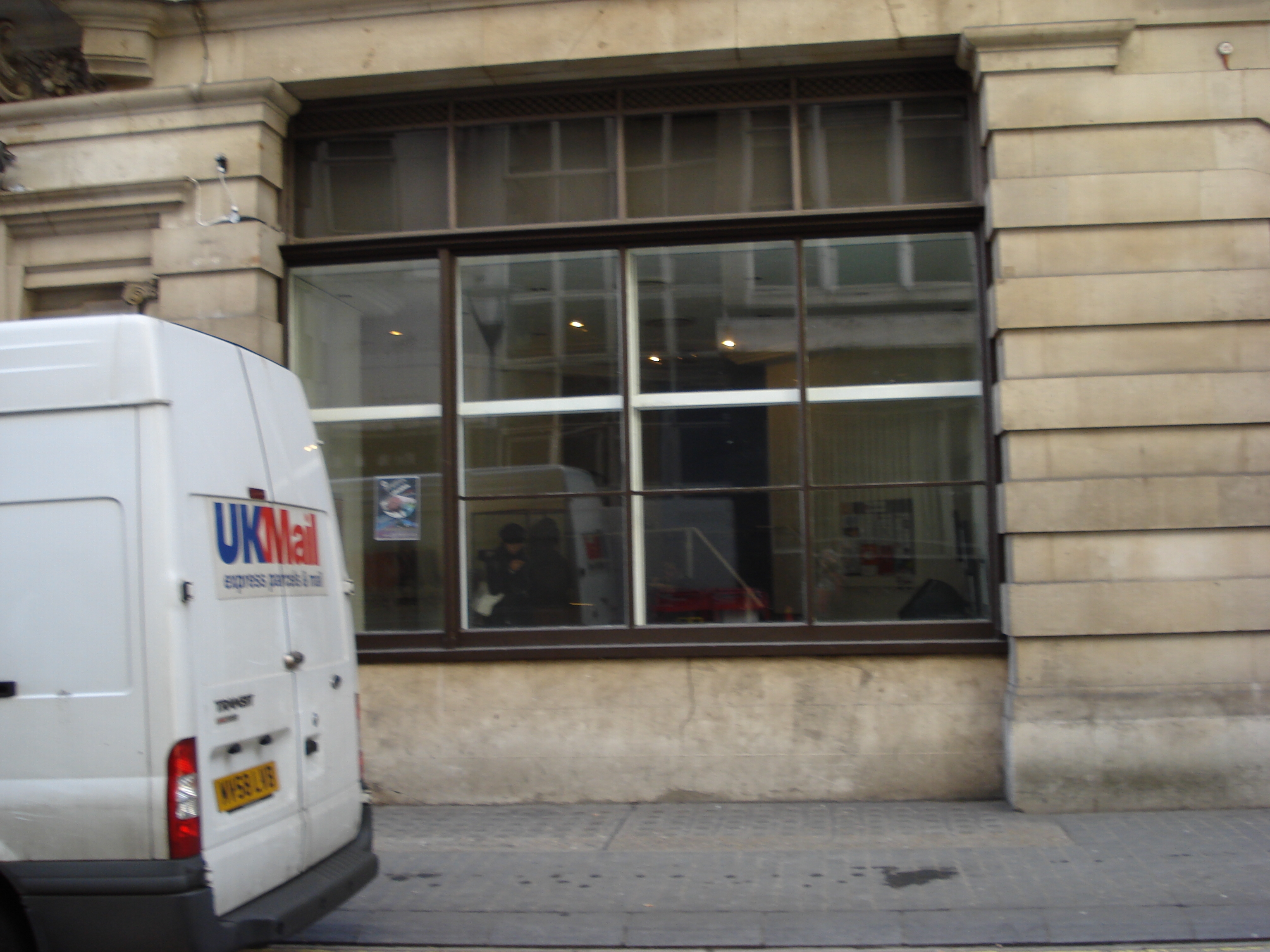
The site today of the Tea Cup inn
When it opened its owners were Mrs Alice Mary Hansell (c 1859-1923) and Miss Marion Shallard. However Miss Shallard quickly disappears and the rate books from then on show Mrs Hansell as sole proprietor. She had been born in Yorkshire, was about 52, and long a childless widow when she opened the café. Her husband, a traveller for a coal factor, had died in 1897, leaving only £87. I do not know what Mrs Hansell was doing in the intervening years – the 1901 shows her a visitor, with ‘no occupation, in a household in the Lake District..
Once the cafe was opened – certainly by April 1910- Mrs Hansell lost no time in advertising the Tea Cup Inn in Votes for Women – taking care to mention its proximity to the WSPU office in Clement’s Inn. In 1912 the WSPU moved to Lincoln’s Inn House in Kingsway, making the Teacup Inn probably the nearest place of refreshment. I am pretty certain that Mrs Hansell was a member of the WSPU; in 1909 someone of that name advertised in Votes for Women a cottage to let in Henley, but I have not been able to find conclusive evidence. Unfortunately I cannot trace her on the 1911 census – perhaps this is an indication that she was taking part in the boycott, but it may just be that her name has been mistranscribed. After the 1912 Peth-Pank split, the Teacup Inn advertised at least once in the Pankhurst paper, The Suffragette – in June 1914 – stressing: ‘Kitchens open for inspection’.
Across Portugal Street, the Tea Cup Inn faced the London Opera House (now the site of the Peacock Theatre). This theatre had opened in November 1911 and, again, handily situated for the WSPU office, was the scene of many suffrage meetings. One can imagine that the Tea Cup Inn may well have benefited from the thirsts engendered by a rousing rally.
Mrs Hansell continued running the Tea Cup Inn until her death in 1923. Her estate amounted to £2098 – which might suggest that, as her husband had left so little, she had made some money from her business. It would be good to think so.
More ‘Suffragettes and Tea Rooms’ posts to come….
Here is the link to Woman’s Hour (4 Sept) podcast that includes the item on ‘Suffragettes and Tea Rooms’ (starts c 27 mins).
WALKS/Suffrage Stories: Suffragettes and Tea Rooms: The Gardenia Restaurant
Posted by womanandhersphere in Suffrage Stories on September 6, 2012
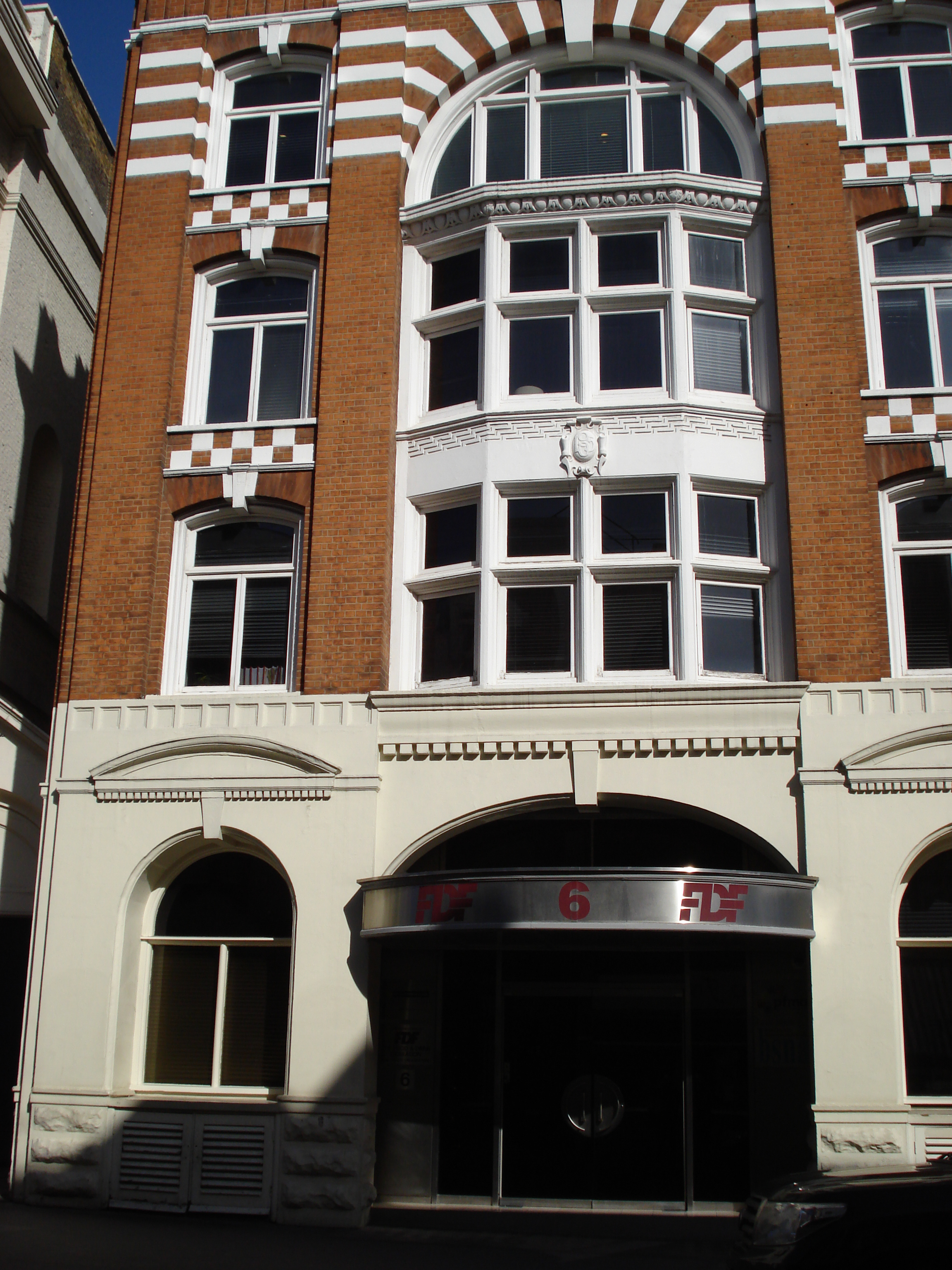 6 Catherine Street – home of the Gardenia Restaurant c 1908-13
The Gardenia Restaurant, at 6 Catherine Street, Covent Garden – off the north-western curve of the Aldwych – was, between c 1908 and 1913, a vegetarian cafe much frequented by suffragettes. Unlike Alan’s Tea Rooms – in Oxford Street – and the Criterion – at Piccadilly Circus – the Gardenia was situated in the heart of militant suffrage territory. The Women’s Freedom League headquarters lay just south of the Strand in Robert Street and those of the WSPU just to the east of Aldwych in Clement’s Inn.
The Gardenia was opened c 1908 by Thomas Smith, a young man from Morpeth, who lived with his wife and two children in rooms above the restaurant. By early 1910 it would seem that the Gardenia was in some financial difficulty because it was then formed into a limited company with three additional directors. Two of these were from the Newcastle area – and were presumably known to Smith. One was Herbert Joseph Armstrong – a chartered accountant. The other, the major shareholder, was Godfrey Hastings, a photographer from Tynemouth, a member of a Quaker family, educated at Ackworth, the Quaker boarding school in Yorkshire. The third director was Richard James, who published – and sold – temperance and vegetarian books from the Central Temperance Rooms in Paternoster Row. It would, therefore, seem safe to deduce that those running the Gardenia were advocates of vegetarianism and temperance in particular – and of social reform in general.
As I emphasise in my post on the part played by the Aldwych Skating Rink in the 1911 census boycott, this area of London was undergoing extensive redevelopment at the beginning of the 20th century. No 6 Catherine Street, a tall, rather dramatic, building, had been erected in 1905 and it is likely that the Gardenia was one of its first tenants. Its frontage of stone-banded red brick echoes that used in the construction of no 2 – which was designed in 1902 by the editor of the Builder, as offices for the journal. By now this corner of Covent Garden was taking on a rather Arts and Craftsy look – making it just the place for a vegetarian restuarant.
Unlike the Criterion – or even Alan’s Tea Rooms – I have been unable to find any image to tell us what the interior of the Gardenia looked like. However the file in the National Archives giving details of the 1913 winding up of the company does contain a list of the company’s assets – including the restaurant’s fittings. From this I think it would be safe to say that the general impression of the interior was of mahogany and mirrors. – long mahogany serving counters and quantities of mirrors. The rooms were lit with electroliers – some four-branched and others three. Customers sat at tables, marble-topped on metal stands – rather like those used today by Pizza Express.
Having noted that the Gardenia’s financial situation was somewhat precarious, one imagines that the company’s directors would have been keen to develop a niche clientele to boost passing trade. And so it was; the company accounts reveal that they hired out upper rooms in the building to societies whoe interests would seem to coincide with their own – for instance, to the Syndicalists, to a Vegetarian Club, to the National Union of Shop Assistants, and to the University Fabian Society.
The militant suffrage societies also figure regularly in the Gardenia’s accounts as customers for the hired rooms. In her autobiography, My Own Story, Mrs Pankhurst refers to the Gardenia as a place where many WSPU breakfasts and teas were held – and the accounts show specific hirings of rooms by the WFL (for instance,7 March 1912, 5 guineas). In fact the Gardenia seems to have been a particular favourite with the WFL, which did its best to advertise the delights of the restaurant. The Gardenia was included in The Vote Directory –the WFL newspaper’s list of recommended retailers – and was written up in the 6 May 1911 issue when – in the course of a suffragists’ shopping day – the author has tea at the Gardenia – ’a fragrant cup of tea and some cress sandwiches made with Hovis bread’ – [Hovis was also advertised in The Vote]’ –reporting that ‘she would eat no other.’In 1912 the WFL rented a room in the Gardenia in which to hold its weekly discussions – on such subjects as ‘Jane Eyre and its relation to the Woman’s Movement’ and Mrs Brownlow on ‘Local Government’ and on 17 February 1912 three of the Gardenia’s floors were hired by the WFL for a fundraising sit-down supper, with dancing and performances by the Actresses’ Franchise League.
It was doubtless no hardship for suffragettes to attend such suppers; a vegetarian restaurant would have been particularly popular with suffragettes – many of whom had embraced this cause – and the associated anti-vivesectionist campaign – along with that of women’s rights. For Leah Leneman’s excellent article on the subject – ‘The Awakened Instinct; vegetarianism and the women’s suffrage movement in Britain’ – see here.
For its part the Gardenia management was clearly committed to the suffragette cause over and above its use as a source of income. The directors were prepared on occasion, to turn a blind eye to the use to which the WSPU put its rooms. Thus, on 2 April 1911 – census night – the Gardenia’s management allowed the restaurant to be used by suffragettes attempting to evade the enumerator. One census schedule for 6 Catherine Street shows Thomas Smith, the manager, in his flat there that night with his wife and two children, together with the restaurant manageress, two waitresses, a male chef, female cook, a male baker and a kitchen maid. But a separate Gardenia schedule, completed by the Census Office from information supplied by the police, shows that the restaurant was packed with 200 women and 30 men. These defiant evaders had moved to the Gardenia at c 3.30 am for breakfast, having spent the earlier part of the night in the Aldwych Skating Rink.
A year later the Gardenia again played its part in a dramatic WSPU publicity campaign when, on the night of 4 March 1912, women taking part in a WSPU-organinised window-smashing campaign gathered there. In her autobiography Mrs Pankhurst notes that the police thought that about 150 women went to the Gardenia that evening, arriving in twos and threes from a large meeting at the London Pavilion at Piccadilly Circus. They were followed to the restaurant by a number of detectives who then waited around outside in Catherine Street And what was it that the women were doing in the Gardenia?
At the ensuing trial Miss Jessie McPherson, a still-room maid, testifed that on the following day, 5 March, she found a dozen on so stones – on one of which was written ‘Votes for Women’ – lying in a grate in a big room on the second-floor. Godfrey Hastings, the Gardenia’s major shareholder, gave evidence that the room had been engaged by the WSPU for the afternoon and evening of 29 February and 1 and 4 March – at a charge of 45 shillings on each occasion.
The evidence pointed to the Gardenia as the WSPU’s ammunition arming station. Once they had received their supply of stones, the suffragettes led the police a merry dance.
One policeman testified that he followed Miss Wolff van Sandau and Miss Katie Mills as they left the Gardenia, went to an ironmonger’ shop in Covent Garden and then walked to Westminster, along Victoria Street to the Howick Street Post Office, where the former broke a window with a hammer and the latter with stones. It transpired in court that it was at the Covent Garden ironmongers, with the policeman in tow, that they had bought the hammer.
Another policeman reported that on 4 March he waited outside the Gardenia Restaurant for three women [Nellie Crocker, Miss Roberts and Miss Taylor]. When they emerged he followed along the Strand, to Charing Cross and then on District Line to Royal Court Theatre. A few minutes after the performance began they left and went along to 9 King’s Road – a post office – where they smashed the plate glass windows with three hammers.
Another policeman followed Elizabeth Thompson and another woman from the Gardenia to Parliament Square,where Miss Thompson threw a stone at a window of Home Office.
There does not appear to have been any legal repercussions for the Gardenia but, sadly, despite support from the suffrage movement, the business could not be made to pay and the restaurant closed in March 1913.
However 6 Catherine Street today still has a primary connection to the food trade – as the home of the Food and Drink Federation. The FDF were very generous in allowing access to their building in order to record a section of the Woman’s Hour item on ‘Suffragettes and Tea Rooms’ in the rooms where the WSPU plotted their militancy over tea and brown rice.
WALKS/Suffrage Stories: Suffragettes and Tea Rooms: The Criterion Restaurant, Kate Frye, and the Actresses’ Franchise League
Posted by womanandhersphere in Kate Frye's suffrage diary, Suffrage Stories on September 5, 2012
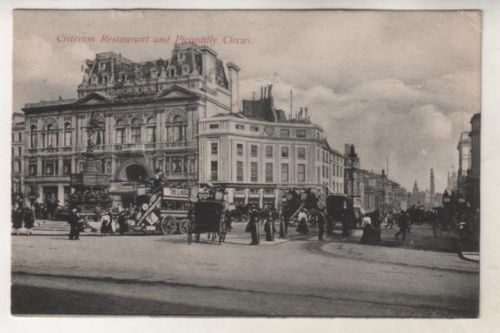 Criterion Restaurant and Piccadilly Circus c 1910
The glamorous Criterion Restaurant lies at the heart of theatreland, facing onto Piccadilly Circus. Owned by Spiers and Pond, it had been built, together with the adjoining theatre, in 1874 and during the last century and a quarter has undergone many changes – although now restored to glory. Before the First World War Spiers and Pond’s empire encompassed railway refreshment rooms as well as other large London restaurants, such as the Holborn, at the north end of Kingsway, the setting for many breakfasts held by the WSPU to celebrate the release of their prisoners from Holloway.
 The Criterion today
Although the Criterion has now only one restaurant – on the ground floor – in its Edwardian heyday it offered many more spaces – not only in which to dine – but also for hire; the Victoria Hall and the Grand Hall, on the first floor, were two such spaces. The Grand Hall, magnificently decorated, ran across the front of the building, overlooking Piccadilly Circus. The lavish interiors were very much a hallmark of the Spiers and Pond establishments – renowned especially for the high standard of their ladies’ cloakrooms – a point, I would imagine, our suffagists and suffragettes would have appreciated.
The Actresses’ Franchise League was founded at the end of 1908 and by the spring of 1909 began to hold its meetings at the Criterion, which was conveniently placed so as to allow its members to spend the afternoon listening to rousing speeches and yet be close at hand to give their own performances in the evening. By all accounts the meetings were extremely well attended, the AFL having no trouble in filling either of the two main halls.
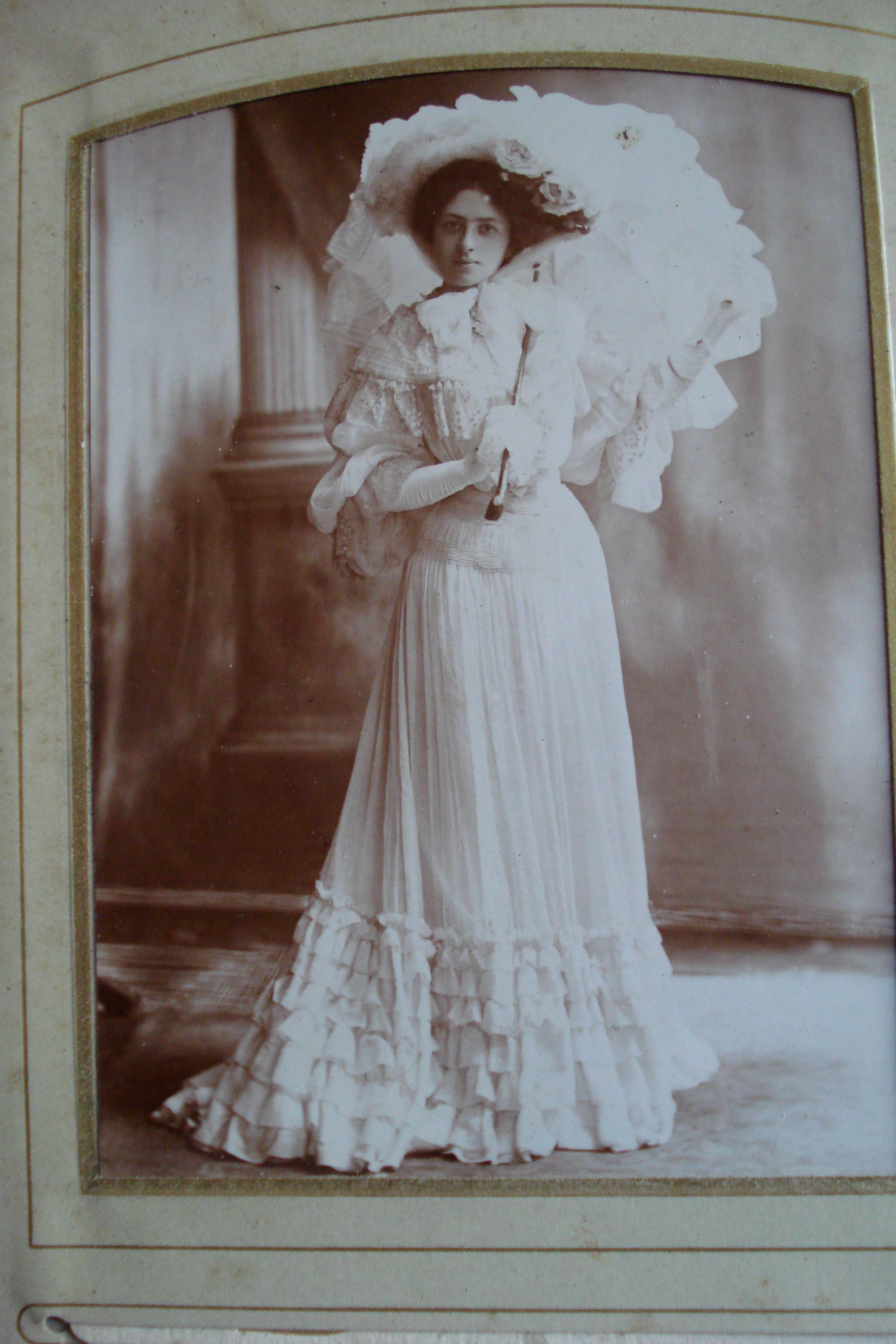 Kate Frye on tour in J.M. Barrie’s ‘Quality Street’.
Kate Frye (whose post-1911 suffrage diary, Campaigning for the Vote, is published by Francis Boutle ), was a proud member of the AFL, having spent two or three years treading the boards of provincial theatres. Her diary entries allow us to eavesdrop on some of those Criterion meetings.
‘Friday April 2nd 1909
Out at 2 o’clock – bus to Piccadilly Cicus and to the Actresses’ Franchise League meeting at the Criterion Restaurant. Miss Eva Moore was receiving and gave me a gracious handshake and Ada Moore was there. Also Eve, Mr Stanger [a sympathetic Liberal MP] and Miss [Frances] Sterling I heard speak. Lady Strachey was in the Chair and Lady Grove had spoken. I also heard Miss [Lillah] McCarthy, the Treasurer, speak and Miss Adeline Bourne, the Secretary, and I went up and spoke to Mr Stanger after the meeting.. His wife was also there. It was a huge meeting – no end of the profession there and they seemed enthusiastic but I have never got much faith in them. …
Friday February 4th 1910
Started off about 1.45 for the Victoria Hall Criterion Restaurant – went by bus. We went early as we wanted a good seat to see Miss Pankhurst. The place was packed before they began at 3 o’clock. Miss Granville took the chair and Miss Adeline Bourne as Secretary and Miss Maud Hoffman as Treasurer spoke in a more or less business-like fashion and Lt Col Sir something Turner spoke – an old dodderer. I could hardly keep my face straight he looked in such a loving fashion at the ladies but of course the thing of the afternoon was Christabel Pankhurst. She is a little wonder. So young and girlish looking – I suppose she is only 22 or 23 with such a charming way with her. She spoke very nicely too. It was not a brilliant speech but she was suiting herself to her audience I have no doubt – but it was so sincere and so fair. I have only heard her once before – at the Albert Hall – and one cannot judge like that – so I am glad to have been at such close quarters with her. She is not really pretty – has a crooked mouth and bad chin but her eyes are nice and she has a pretty forehead. Her hair was very untidy and I think would suit her so much better done low than on top in an ugly little knob. But though so faulty her face lights up so when she speaks and she has such a charming way with her that is very superior to mere prettiness….
Friday November 4th 1910
A bitterly cold day –had lunch then left at 1.15 – took a bus to Oxford Circus and went to steward at The Actresses’ Franchise League meeting at The Grand Hall Criterion. It was great fun.. A Mrs Fagan was in the Chair, Lady Constance Lytton, Mrs Pertwee , Mr Cecil Chapman and Mr M Campbell-Johnston were the speakers.. Then, amongst the audience, Hilda Fletcher – an old Ben Greet companion – the girl who helped me with the Banner at the second march and I chatted to lots of people – made 17/6 and had great fun. Two old gentlemen who were very taken with the Actresses and attending their first Suffrage meeting were most amusing.
Friday December 16th 1910
Changed my dress – at 2.15 bus to Oxford Circus and walked to the Criterion – to the Birthday Tea of the Actresses’ Franchise League. It was packed – a huge success. Eva Moore recited, Bertha Moore and daughter sang.’
The Criterion was used by women’s societies other than those campaigning for suffrage. Here is a photograph of a Women Writers’ Dinner held in the Grand Hall in 1900. Of the suffrage societies, it would seem that the AFL was the most regular user of the Criterion, although in April 1909 the WSPU held a breakfast there for released prisoners and in February 1910 and June 1911 the Women Writers’ Suffrage League held meetings in the Victoria Hall. It is interesting to note that on 26 October 1911, when the International Women’s Franchise Club held a dinner at the Criterion, a vegetarian option was chosen by a fairly high proportion of the guests – 25 out of the 130 who attended.
Although the suffrage sympathisers who attended such meetings were overwhelmingly middle class, one would like to imagine (as one can in a blog) that, through their association with, perhaps, the AFL, less well-off women would have had the opportunity to luxuriate in the splendid surroundings of the Criterion, enjoy a wash and brush up in the opulent Ladies’, and fill up on the tea that brought the afternoon to a close.
Based on her diary, I published Campaigning for the Vote: Kate Parry Frye’s suffrage diary. This is now out of print. The complete collection of Kate’s diaries is now held by Royal Holloway College Archive.
WALKS/Suffrage Stories: Suffragettes and Tearooms: Alan’s Tearooms
Posted by womanandhersphere in Suffrage Stories on September 4, 2012
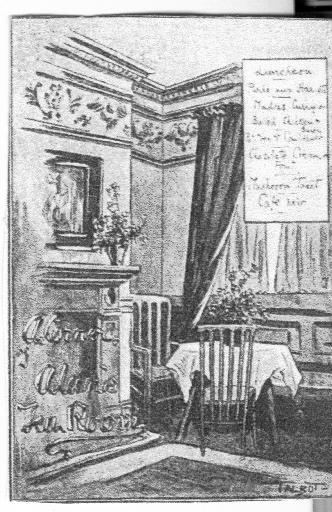 A corner of Alan’s Tea Rooms, as illustrated in ‘The Idler’, 1910.
One of the London tearooms most popular with suffragettes and suffragists was Alan’s Tea rooms at 263 Oxford Street. In my Women’s Suffrage Movement: a reference guide,I suggested that the owner, ‘Mr Alan Liddle’, while not charging the rent of the room for such meetings, doubtless made his profit from the sale of the accompanying tea and buns, conjuring up the image in my mind of a suave male entrepreneur cashing in on the need of campaigners for a safe haven in which to meet in Central London. How mistaken I was.
What I did not then realize, and my researches have only recently revealed, was that the owner was not ‘Mr Alan Liddle’, but ‘Miss Marguerite Alan Liddle’ (1873-1946), the daughter of a Shropshire solicitor. It would seem that she chose to be known by her second, presumably a family, name, signing her will, for example, as ‘M. Alan Liddle’. She does not seem to have taken a direct part in the suffrage movement, but certainly did lend her support, first advertising in the WSPU newspaper, Votes for Women, in, I think, the issue of 31 December 1908.. However, a little research has revealed that she was the sister of Helen Gordon Liddle (note, again, the use of a family name, in this case their mother’s maiden name) who was an active member of the Women’s Social and Political Union. Helen was the author of The Prisoner, one of the more sought-after suffragette memoirs, describing the month she spent in Strangeways prison, Manchester, in October and November 1909.
Although her sister, Alan, already knew of the WSPU and Votes for Women, Helen writes that she herself only became aware of the WSPU in February 1909 when she read about a deputation to Parliament led by Mrs Pethick-Lawrence. In June 1909 she was a member of one of the deputations sent to the Prime Minister and was arrested – but not prosecuted. She wrote ‘my time was not my own to give absolutely to the WSPU’ –she was a teacher of music and singing – but she did spend three weeks in Edinburgh in September helping to prepare for grand demonstration there. In October she protested at a Cabinet Minister’s meeting in Manchester and was ejected. The next night, 20 October, women were excluded from the meeting – so she broke a post office window in protest, for which she was sentenced to one month’s imprisonment with hard labour in the third division. Her companion in this was Emily Wilding Davison, whose will she had witnessed earlier that day. In her book she states that she wanted to describe the atmosphere of prison and its effect upon a prisoner who is forcibly fed. So, while Alan Liddle was advertising her luncheons etc in Votes for Women her sister was on hunger strike in Strangeways.
Alan Liddle had opened the Tea Room in November 1907 in a building on the south side of Oxford Street, very slightly to the west of Oxford Circus, and, as was mentioned in advertisements, ‘three doors away from Jays’. This was a large fashion store on the south-western quadrant of Oxford Circus, the site now occupied by a Benetton store. So, as a business, it was certainly very centrally placed, its only drawback being that it was not on street level but on the first floor. Presumably customers entered through a door to one side of the shop front (which was the dry cleaners Achille Serre) and went up a staircase – which might be thought of as something of a deterrent as there was a wealth of competition from other cafes, tea rooms and restaurants around.
For instance, there was a Liptons refreshment room at no 265-7, another restaurant at 269, a Lyons tea room at nos 277-81 and an ABC at no 283. So I am imagining that Alan Liddle felt the necessity to carve out a niche market – to attract customers through the door and up the stairs – over and above any passing trade – who might find it easier to enter one of the larger, ground-floor cafes close by. And I imagine that the niche market she aimed at was ‘the suffragette’.
I don’t know what Marguerite Liddle did before setting up the teashop – when she was 34 – or who was in her friendship circles. In 1911, unlike her sister, Helen, she did complete a census return. This shows her, a ‘proprietoress of tea rooms’, living at 8a Holland St, Kensington as a lodger in the apartment of Miss Emilie Chapman, a nurse. She ran the tearooms until about 1916.
Besides suffragettes, she also sought to attract women out clothes shopping in the West End – the obvious clientele. In 1910 the ‘Vanity Pages’ of The Idler, a popular magazine, edited by Jerome K. Jerome, Mrs Edward Talbot, while discussing clothes shopping in Conduit St and New Bond St , wrote ‘We then had the nicest little luncheon, with the comforting knowledge that everything was homemade, at Alan’s Tea Rooms (263 Oxford St) for the modest sum of 1/6.We send you a sketch and a menu, so you can see for yourself. The rooms are charmingly decorated; one is set apart for smoking, while another, which is large and sunny, can be hired for At Homes and meetings. You can lunch, also, for a shilling, and for afternoon tea Alan’s popularity is undoubted.’
I was curious to know what Alan’s Tea Room looked like and managed to find a photograph of that block of Oxford Street -now redeveloped -that revealed that the red brick building was probably built in the 1860s. The first-floor room looking over Oxford Street had a semi-circular arcaded window – rather Venetian in style. It was an amazing piece of luck that Mrs Talbot accompanied her piece in The Idler with a small line drawing of a corner of Alan’s Tea Rooms. So we can see that the room had a ceiling cornice above a frieze of garlands. The walls were probably papered with a small-patterned wallpaper. There was a plain, early-19thc-style fireplace and panelling under the window. The windows were draped with two sets of curtains. One was a set of short – to the sill – lightweight material ones – and then, over these, there were heavy drapes – probably velvet- looped back at the sides. There was a vase of flowers on the mantelpiece and a picture over it. The furniture was sort of arts and crafts. The tea table, covered with a table cloth, shown is of the ‘gipsy’type – typically Edwardian – with slightly splayed legs. The chairs were high stick-backs – perhaps with rush seats. The Luncheon menu (for one shilling) was:
Puree aux haricots
Madras Curry
Boiled Chicken and Bacon
Potatoes and Cauliflower
Chocolate Cream
Fruit
Mushroom Toast
Café Noir
Advertisements revealed that luncheons cost 1s or 1s 6d (served between 12 and 2.30) and Teas were set at 4d, 6d and 1s. Mention was made of the food being home-made – so perhaps we can assume that there was a kitchen on the premises – and that Alan employed a cook – as well, probably, as at least one waitress?
In another 1910 issue of The Idler there was another ‘editorial’ piece in The Vanity Pages:
‘Hostess [ie the questioner, who as asked for suggestion of a place in central London to hold an ‘At Home’]. I’m always pleased to be of any help if I can, in your case I know of the very place you want. At Alan’s Tea rooms, 263 Oxford St, there is a nice room available for at Homes. It is large, sunny and charmingly furnished, and can be hired at a moderate figure.’
This would have been the room hired by suffrage societies – for whom, as I have mentioned, it was advertised that no charge was made. And the societies did take advantage of the offer. The Tax Resistance League held its first members’ conference there on 14 November 1910, the Catholic Women’s Suffrage Society its inaugural meeting in March 1911, the Forward Cymric Union –a militant Welsh suffrage society– held monthly meetings (c 1912) at Alan’s, attracting 50 to its first meeting. Visits of individual women to the Tea Room are, of course, very much more elusive to pinpoint – though we do know that on 26 July 1913, at the end of the NUWSS Suffrage Pilgrimage, Margory Lees and her companions went there for dinner.
Alan Liddle ran her Tea Rooms for about nine years – probably until 1916 – providing pleasant surroundings and home-cooked food to members of both wings of the suffrage campaign.
WALKS/Suffrage Stories: The Suffragette 1911 Census Boycott: Where and What Was the Aldwych Skating Rink?
Posted by womanandhersphere in 1911 Census, Suffrage Stories on September 3, 2012
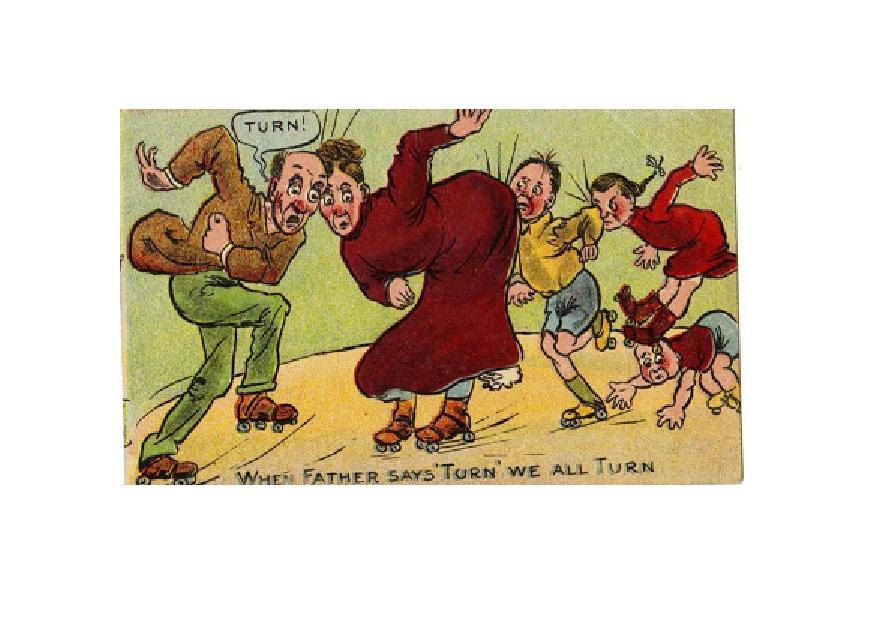 Roller skating was one of Edwardian Britain’s ‘crazes’ – to be enjoyed, as this comic card shows us, by all the family. One could, of course, as I did as a child in the 1950s, roller skate in the streets, but in the years before the First World War entrepreneurs hoping to cash in on the craze ventured to erect roller skating rinks in towns the length and breadth of Britain.
While I am sure that many individual suffragettes and suffragists enjoyed a spin around their local rink, there was one episode of suffragette history that centred on a specific London roller skating rink. For on census night 1911 – 2 April – it was at the Aldwych Skating Rink that the militant suffrage societies – the Women’s Social and Political Union and the Women’s Freedom League, together with related societies such as the Tax Resistance League – urged their supporters to muster. Here, out of their homes, they would escape detailed enumeration.
When interviewed in the 1970s by Sir Brian Harrison (Women’s Library 8 SUF/B/024), Marie Lawson, an important figure in the Women’s Freedom League, remembered that ‘We formed immediately a census resistance group – women who said ‘we don’t count; we won’t be counted’ – that they would stay out somehow – out of a house or roof during the period when you had to be recorded. Our group took the Aldwych skating rink for the night – we hired it. Nobody was supposed to be sleeping there. We had roller skates and we spent the night on roller skates and there was no-one to declare us and when we went away in the morning we were very weary, very tired with our roller skating but we felt we had done the government out of so many names on the census resistance. It wasn’t very useful really but it was something to do. We used to grab at every little thing, you know, that we could make a protest about. It was advertising really.’
So it was that, after a late-evening rally in Trafalgar Square, the suffragettes promenaded down the Strand to the Aldwych where it was estimated by the Census Office that 500 women and 70 men gathered at the Skating Rink. Although the numbers were recorded, the identity of most of that 570 is lost – only those whose names are mentioned in the Votes for Women report (7 April 1911) can be placed there with certainty. These included Mrs Pankhurst, Ethel Smyth and, among members of the Actresses’ Franchise League who provided the entertainment, Decima Moore and her sister, Ada, Adeline Bourne, Winifred Mayo, Inez Bensusan, Rosa Leo, Sidney Keith, Miss Laing and Natalia de Meix. Emmeline Pethick-Lawrence was also there. She certainly did her bit to disrupt the census, being enumerated in three separate places- once in her Clement’s Inn flat, once in her Surrey country cottage and, again, here at the Aldwych. By way of contrast, no trace of a census paper for Christabel Pankhurst has been found – but she was there in the Skating Rink, bringing the entertainments to a rousing conclusion at 3.30 am.
Here is Decima Moore photographed that night inside the Skating Rink. I am pretty certain that she is captured doing her party piece -Laurence Housman’s ‘Women This and Women That’. In the photograph we can see, behind the audience and the NWSPU ‘No Vote No Census’ banner, the walls of the skating rink – rather bare as one might expect. ‘What kind of structure was it?’, I wondered and, moreover, ‘where was it?’ ‘Aldwych’ was a rather vague address.
I discovered that the Aldwych Skating Rink was first listed in the rate books in 1911, provisionally numbered 10 Aldwych. The Kingsway/Aldwych area that to us today looks so solidly Edwardian was, in 1911, still in a state of flux.
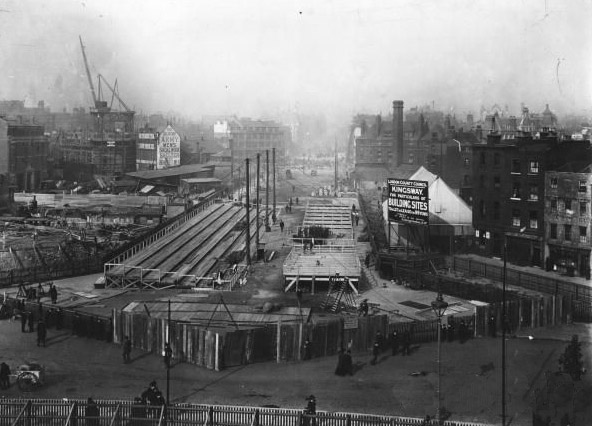
Looking up Kingsway from the Aldwych, 1905
Kingsway had been driven through – it was formally opened in 1905 – and the curve of the Aldwych formed, but it was not until well into the 1920s that all the plots were sold and developed. Thus, from the rate book, I could see that no 10 Aldwych was surrounded by vacant lots enclosed in advertising hoardings, the hoarding company paying a rent for their advertisements.
But I was still unclear as to precisely where no 10 was. However, the rate book came to the rescue, recording that on one side of no 10 the lot was owned by the London County Council and was ‘used for advertising station on frontage line from Houghton Street to roller skating rink. On its other side –provisionally numbered no 8 – was an advertising station north-east on the frontage line east of the roller skating rink. So this seemed to establish that the skating rink was on the north-east curve of Aldwych, to the east of Houghton Street. Clement’s Inn, the WSPU headquarters, virtually abutted the rear of the plot. What more suitable venue to book for such an evening than this, probably the nearest large hall?
The owner of the skating rink was Edward Johnson Wilson who had formed his company, ‘Rinkeries’, in 1909. In 1911 the company also ran ‘ideal skating palaces’ on the Holloway Road, as well as in Exeter, Plymouth and St Leonards. Like many other roller-skating rink companies, whose liquidations, as recorded in the London Gazette, are a sad testament to so many lost hopes, ‘Rinkeries’ does not appear to have been very successful; Edward Wilson was doubtless glad of the windfall of a night’s rent from the WSPU.
But I still did not know what the skating rink looked like. It is difficult now to conjure up the appearance of that A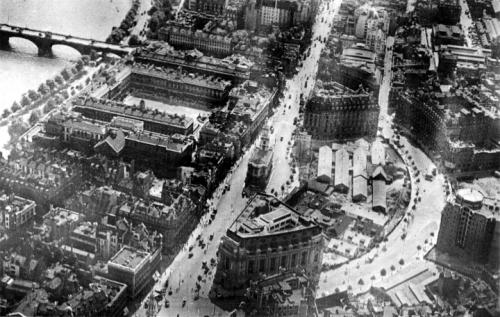 ldwych curve before the arrival of the imperial solidity of the buildings we see today. From looking at contemporary photographs of Kingsway, dominated by empty plots and high advertising hoardings, I could imagine that the area must have felt strange and impermanent. The old higgledy-piggledy rookery streets around Holywell Street and Houghton Street – that many of the suffragettes would have remembered – had been swept away, but the new order had not yet arrived. In this aerial photograph, probably taken c 1918 after the completion of Australia House (in the centre foreground), the Aldwych Skating Rink would have been – and perhaps still was – one of the low buildings in the bottom right of the picture.
But in 1911 the southern side of the road had not been developed at all. With few buildings to throw out light, the area was doubtless rather dark. What kind of building was it that the suffragettes waited outside that night – surrounded by, in effect, a building site – while posses of hooligans attempted to storm the rink’s doors?
I have not been able to locate a photograph, but, as luck would have it, I found the answer in the ‘Rinkeries’ file in the National Archives – its presence there a consequence of the company’s eventual liquidation. There, as a heading to ‘Rinkeries’ notepaper, was an engraving of the Aldwych Skating Rink. I could now see that it comprised four linked, gabled structures –chalet-type – single storey. The effect, for all the panache of many flying union flags, was somewhat temporary – as it was no doubt in reality. What a contrast to its successors.
During the First World War the Aldwych Skating Rink was used as a clearing house for Belgian refugees. This watercolour, in the Imperial War Museum collection, shows the building after it was hit in a Zeppelin raid on 13 October 1915. The church in the background is St Clement Danes. The Rink must have been swept away by the end of the war, to make way for the monumental buildings that still occupy the central section of that Aldwych curve. It takes an effort to reimagine its former appearance – but to do so helps us to enter the 1911 worldview of the census evaders.
To listen to a talk I gave on the suffragette boycott at a National Archives conference on the 1911 census click here
Copyright
 Woman and her Sphere

