Archive for January, 2013
Women Writers And Italy: The Albergo Di Parigi In Via Della Croce
Posted by womanandhersphere in Women Writers and Italy on January 28, 2013

Charlotte and Jane Waldie arrived in Rome in the winter of 1816. We have read Charlotte’s report of her first sight of Rome, but Jane, too, was busy with her notebook. Her Sketches Descriptive of Italy in the years 1816 and 1817 were published by John Murray in 1820, the same year as Charlotte’s Rome in the Nineteenth Century.
Jane corroborated her sister’s description of that magical first sight of Rome. ‘ When the dome of St Peter’s first burst on our view in the midst of the Campagna. Unable any longer to restrain ourselves, we leaped out of the carriage and ran up a bank by the road-side. Never, oh, never shall I forget the motions with which I gazed on this prospect! That Rome itself should be before me seemed incredible, that my mind could scarcely take in the fact.’
We can then take up their story again with Charlotte who describes how, having arrived in the Piazza del Popolo, ‘Rome was overflowing. We drove about for more than two hours, and found every hotel full of Inglesi. The lucky departure of one family of them, however, at length enabled us to take possession of their newly-vacated apartments, which are indeed most comfortable. You cannot conceive, without having travelled Vetturino from Florence to Rome, and lodged in the holes we have done, how delightful is the sensation of being in a habitable hotel, how acceptable the idea of a good dinner, and how transporting the prospect of sleeping in a clean bed.’
Charlotte was, however, immediately ill with a pleuritic fever ‘Cicero himself was dangerously ill of it; so that, if I had died, I should have died a very classical death, which would undoubtedly have been a great consolation.’
‘By way of an agreeable adventure, about midnight, on the second night of my illness, loud cries through the hotel and in the street spread the alarm of fire. The master of the house (a Frenchman) burst into my room in his shirt, followed by a whole train of distracted damsels wringing their hands, while he continued to vociferate ‘Au feu! Grand Dieu!’ in a key which drowned even the shrill lamentations of the women. Volleys of smoke rolled down our chimney, where the fire had originated, and, rapidly spreading to the rafters of the room above, gained ground so fast, that in spite of the promptitude with which all the firemen of the city and their engines set to work, two hours elapsed before it was extinguished. In the interim, the inmates of the hotel fled in consternation from their apartments, all but ourselves; for, conceiving that there was much more danger, in my situation, of getting my death by cold than by fire, and expecting the flames to be got under every moment, I laid quietly in bed and S-, who would not leave me, sate beside me until we were both nearly stifled; thus acting as if it was no concern of ours the house being on fire, since we were only lodgers.’

It is from Jane that we learn that this hotel, its management conducted by, as Charlotte relates, a Frenchman, was in fact the Albergo di Parigi in the Via della Croce, just off the Piazza di Spagna. This hotel – sometimes variously termed the Hotel de Paris or Villa di Parigi – was to provide shelter to many English women writers over the next 20 years. It is slightly surreal to see their shades slipping into bed, one after the other, under this one Roman roof. Amusingly all commented on the indifference of its facilities; as soon as Charlotte had recovered the Waldies moved to lodgings in the Corso.
It was at the Villa di Parigi in March 1819, two years or so after Charlotte and Jane’s sojourn, that Mary Shelley, with husband, step-sister – Claire Clairmont – and her sole surviving child, William – stayed very briefly before also making the move to lodgings in the Corso. As summer approached they then moved again to take advantage to what they hoped was less feverish air at the top of the Spanish Steps. They may as well not have bothered, as far as the fate of poor little William was concerned.
A few years later Anna Jameson – then still Anna Murphy – related in Diary of an Ennuyee that her party was ‘rather indifferently lodged at the Albergo di Parigi’. ‘So here we are in Rome where we have been for the last five hours, and have not seen an inch of the city beyond the dirty pavement of the Via Santa Croce; where an excellent dinner cooked a la Anglaise, a blazing fire, a drawing-room snugly carpeted and curtained, and the rain beating against our windows, would almost persuade us that we are in London; and every now and then, it is with a kind of surprise that I remind myself that I am really in Rome .’ But to be fair to the Parigi it was December and the scene as she describes it appears rather cosy. At least the fire blazed without setting the chimney alight.
All the articles on Woman and Her Sphere and are my copyright. An article may not be reproduced in any medium without my permission and full acknowledgement. You are welcome to cite or quote from an article provided you give full acknowledgement.
Women Writers and Italy: Charlotte Eaton’s First Sight of Rome
Posted by womanandhersphere in Women Writers and Italy on January 25, 2013
Scottish- born Charlotte Waldie (1788-1859), with her sister, Jane, and brother, John, travelled to Europe – as did so many others – in 1816/17, after the final defeat of Napoleon. For at least some of the time the two sisters travelled alone, when John was otherwise occupied. They each kept detailed notes of their journeys and sojourns: Charlotte turned her experience into Rome in the Nineteenth Century, first published privately and then, in 1820, by Archibald Constable.
Here follows her report of arriving – at last – in sight of Rome. The night before their arrival was spent at Monterosi. I particularly relish descriptions of gothic-horror inns.

Jervis McEntee, Journey’s Pause in the Roman Campagna
‘After considerable delay we did get into a bed-room, more wretched than language can describe: open in many a cranny to the weather, unswept, unplastered, and unfurnished except by two such beds as it is impossible for you to form any idea of; but as the surly people of the house could or would shew us no other, we had no remedy. A fire, that grand consoler of discomforts, was not to be had. The wood was so wet, the wind so high, and the chimney so wide, that while we were blinded and suffocated with wreaths of pungent smoke, and while the wind whistled at its pleasure through the hundred chinks of the unglazed windows, our most persevering efforts failed to make a blaze. Though something swimming in oil, and smelling of garlic, was set before us its appearance was so disgusting, that, after a fast of more than twelve hours, not even hunger could persuade us to touch it. If we did not eat, however, we were eaten; whole hosts made us their prey during the night, while we lay shivering and defenceless.

First view of Rome from Eaton, Rome in the 19th century
We got up – I believe in the middle of the night..and we were dragged along at a foot-pace.. for about three hours in darkness, til we approached Baccano, when the sun rose in splendour and we found ourselves on the deserted Campagna of Rome. In answer to our eager inquiries of when we should see Rome, our phlegmatic Vetturino only replied, ‘Adesso! adesso!!’ unable to conceive any other cause for our anxiety than the very natural impatience to get to the end of our tedious journey. Our longing eyes were intently fixed on the spot where we were told that it would first appear; when, at length, the carriage having toiled up to the top of a long hill, the Vetturino exclaimed, ‘Eccola!’ The dome of St Peter’s appeared in view; and, springing out of the carriage, and up a bank by the road side, we beheld from its summit, Rome!’
Women Writers and Italy: Two Englishwomen in Rome, Garibaldi And Rheumatism
Posted by womanandhersphere in Women Writers and Italy on January 22, 2013
Anne ( 1841-1928) and Matilda Lucas (1849-1943) were the daughters of Samuel Lucas, a brewer with land and influence in Hitchin, Hertfordshire. The Lucas family were Quakers. Their mother had died when they were young and after their father’s death in 1870 the sisters continued to live for a short time with their step-mother. But then, in mid-1871, they left England for Rome, where, for the next 29 years, they were to spend much of the year. Ten years after her sister’s death, Matilda Lucas published excerpts from the letters sent over the years by the sisters to friends and relations back in England. Two Englishwomen in Rome, 1871-1900 (Methuen, 1938) makes very entertaining reading.

Garibaldi and family c 1875
Rome. Hotel Milano. February 27, 1875.
We have not seen Garibaldi yet. He is quite a cripple and goes about on crutches. He seems quite taken up with his scheme of draining the Campagna and turning the Tiber. I think it very well that he should be harmlessly busy; it keeps him quiet. I have not heard of his baptizing any one here. It seems to be one of his ideas to think he can do those sort of things instead of a priest.
Rome. March 14, 1875.
This morning I paid a call of sympathy on Miss Pagan. She spent yesterday in bed with rheumatism and was rather feverish. Tomorrow she is going with some others to call on Garibaldi. The poor General’s hands are quite drawn with rheumatism and he often cannot sleep at night; so I tell her she had better take some of her pills with her. I am thinking of calling on him with a small bottle of colchicum and a little laudanum for outward application.
Rome. March 21, 1875.
As it was Garibaldi’s Saint’s day, Villa Casalini was crowded with people. Just as the Irvings came by the General threw up a window and appeared in his red shirt, waving his rheumatic hand.
Suffrage Stories: Mrs Evelina Haverfield And The Campaigning Raincoat
Posted by womanandhersphere in Suffrage Stories on January 21, 2013
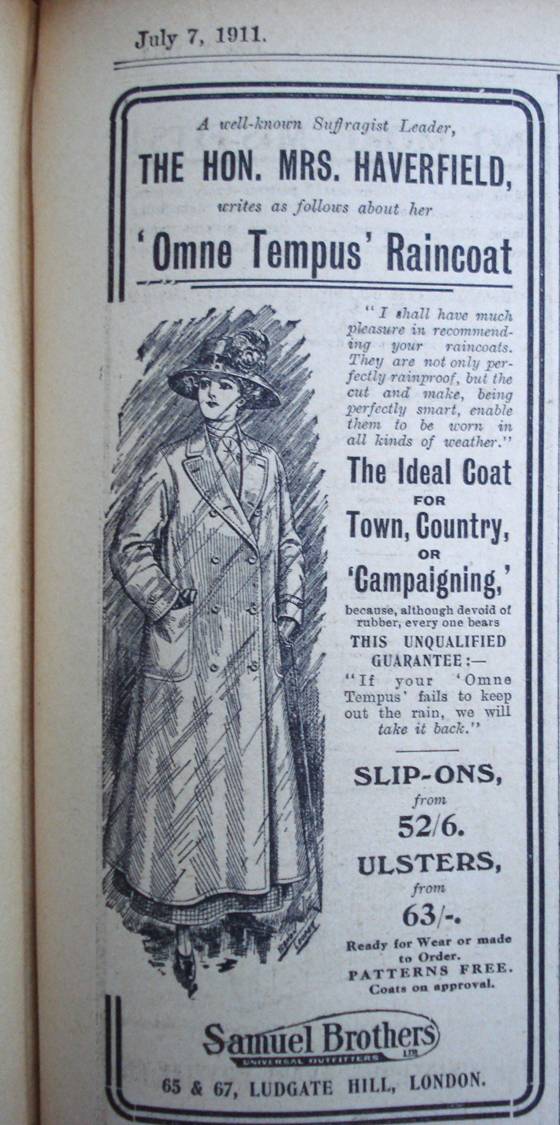
Advertisement from ‘Votes for Women’, 1912
In 1912 Mrs Evelina Haverfield gave her imprimatur to the ‘Omne Tempus’ Raincoat – ‘The Ideal Coat for Town, Country or Campaigning’. As Kate Frye records in Campaigning for the Vote (my forthcoming edition of her diary), the suffrage organiser was forced to contend with all weathers as she tramped from door to door, canvassing for support for her society. On a typical wind-lashed and rain-soaked day she then had the prospect of returning to dank digs, to a room that offered few facilities for drying a sodden, mud-splashed skirt. A coat – suitable for ‘all times’ – guaranteed by the manufacturers to keep out the rain – was a very necessary requirement for the suffrage campaigner. Kate, in fact, favoured Aquascutum; Mrs Haverfield put her faith in Samuel Brothers.
Evelina Haverfield (1867-1920) was the younger daughter of 3rd Baron Abinger. An adept sportswoman, she married young and had two sons. After his early death she remarried and for two years during the Boer War was with her second husband in South Africa, where she set up a retirement camp for horses left to die on the veldt. By 1908, with the second husband no longer on the scene, she was a suffragette, a member of – and generous benefactor to – the Women’s Social and Political Union. She was particularly keen on appearing on horseback – riding astride in suffragette processions – often with Vera Holme, with whom she formed a life-time partnership.
Mrs Haverfield’s collaboration with Samuel Brothers of Ludgate Hill was clearly very suitable. The manufacturers of the ‘Omne Tempus’ were – and are still – military tailors. During the First World War Mrs Haverfield, was one of the founders of, first, the Women’s Emergency Corps and then the Women’s Volunteer Reserve, a militaristic organisation, the members of which sported khaki uniforms and felt hats. She was commandant of the WVR and the writer Christopher St John described her as looking ‘every inch a soldier in her khaki uniform, in spite of the short skirt which she had to wear over her well-cut riding breeches’. See here for Mrs Haverfield’s defence of the WVS uniform as ‘useful and sensible’ and her dismissal of much current fashion as ‘ridiculous and preposterous’.
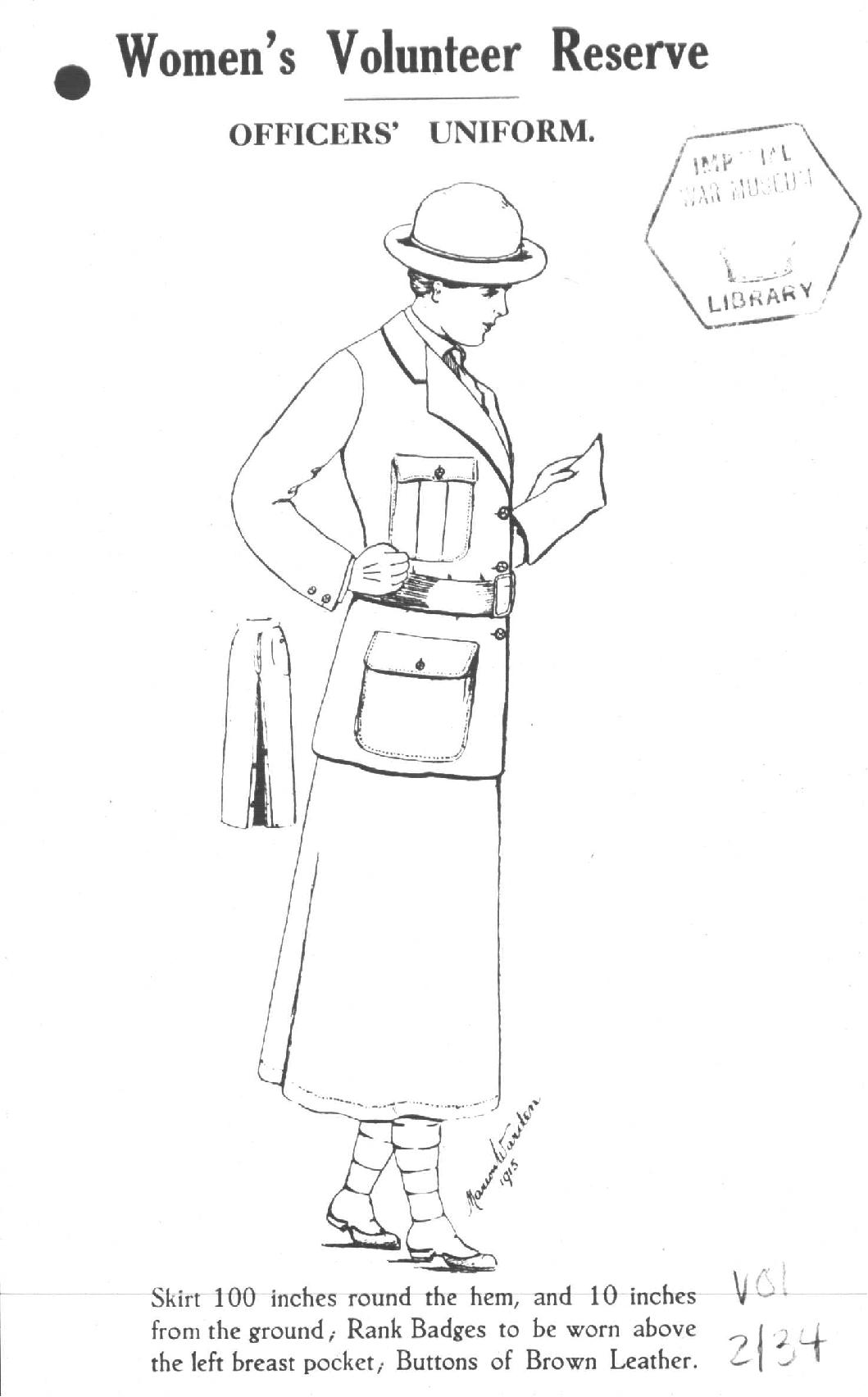
WVS uniform – from Imperial War Museum ‘Women’s War Work Collection’, courtesy of Gale Learning
I wonder if the WVS uniform (for details see here) – modelled on male military attire and certainly made in London – was manufactured by Samuels Brothers? It did initially excite a great deal of controversy- see here, for instance – but as the war wore on lost the power to shock. Indeed, ‘civilian’ fashion was soon influenced with, as the Daily Graphic (7 June 1915) put it, ‘military touches charmingly introduced’.
From 1915 Mrs Haverfield, with Vera Holme, promoted the Serbian cause, both in that country and in England. She was working in Serbia in 1920 when she contracted pneumonia and died.
For more information see the entries on Evelina Haverfield and Vera Holme in Crawford, The Women’s Suffrage Movement: a reference guide.
Suffrage Stories: The WSPU Photographer, DORA And The Nazis
Posted by womanandhersphere in Suffrage Stories on January 17, 2013
If you care to look at the entry ‘Photographs and Photography’ in my Women’s Suffrage Movement: a reference guide’ – you will discover that F. Kehrnhahn & Co of Bexleyheath were the publishers of a variety of real photographic postcards depicting key WSPU occasions. For instance, see here the firm’s picture of WSPU members tricked out in 18th-century attire, designed by Sylvia Pankhurst, as they (wo)manned their stall at the 1911 Christmas Fair.
But who was ‘F. Kehrnhahn’, whose name sat a little incongruously alongside ‘Bexleyheath’? The answer is another intriguing ‘Suffrage Story’.
Ferdinand Louis Kehrhahn was born in Birkenhead in 1883, christened at Tranmere, Cheshire, in 1884 and by 1911 was living with his parents and younger brother, Frederick, at 303 Broadway, Bexleyheath. His father, a watchmaker, had been born in Germany and his mother in Sheffield. On the census form Ferdinand described himself as a ‘Traveller & Photographer’ and Frederick as a ‘Photo Postcard Producer’.
 Hampstead by F. Kehrhahn
The brothers, as one might expect, produced a great number of topographical postcards showing scenes in Kent and in London and, at some point, had made contact with the WSPU. I note in my book a number of WSPU occasions – and a number of individual WSPU members – photographed by F. Kehrhahn. I now realise that this was probably something more than a purely commercial arrangement and that there may have been a real coincidence of sympathy between the Bexleyheath photographer and the militant wing of the suffrage movement.
For I have now discovered that during the First World War Ferdinand Kerhahn was an internee. From 1916 he spent some time in the Islington internment camp, which was housed in a former workhouse. The vast majority of the inmates – c 700 – were, according to Hansard (20 Dec 1916), alien enemies, but, in addition, the camp held 39 British subjects and 7 alien friends, held there under the Defence of the Realm Act. Presumably Kehrhahn, who had been born in Birkenhead, was one of those 39 British subjects.
But how had he fallen foul of DORA? The answer lay in his membership of the radical ‘anti-war’ wing of the British Socialist party. In November 1916 he managed to escape from internment and reached New York before being arrested and returned, c April 1917, to Brixton prison [see Hansard 29 Nov 1917].
In the inter-war period Kerhahn, who had now changed his name to ‘Kerran’, was a leading member of the Communist Party, working alongside such former suffragettes as Sylvia Pankhurst, Dora Montefiore and Helen Crawfurd. Apparently, although I have not verified this, before the outbreak of the Second World War Ferdinand Kerran was working in Germany, helping Jews to escape and listed by the Gestapo as an enemy of the Nazis.
And so, when, on the suffrage trail, you view pictures of maidens in mob caps standing by their stalls ready to sell gewgaws for the Cause, your eye should travel back through the camera into the mind of the photographer where, biding its time, was the desire that capitalism should be overthrown.
Ferdinand Kerran, who had married Lily Chris in 1919, died in Hampstead in 1949.
The Garretts And Their Circle: Ladies’ Residential Chambers And The Importance of Tiles
Posted by womanandhersphere in The Garretts and their Circle on January 15, 2013
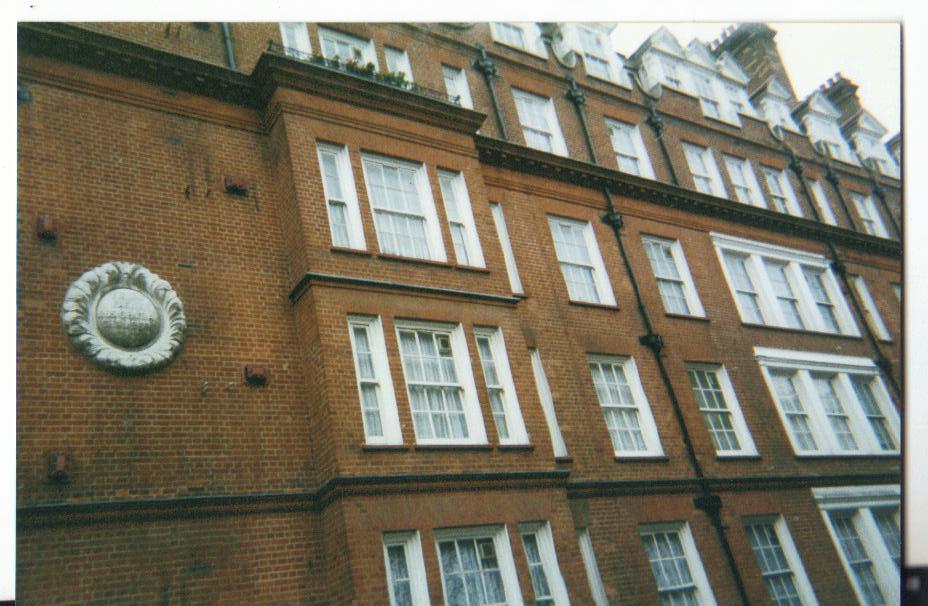
York Street Chambers
York Street Chambers – in York Street, Marylebone – was the second venture undertaken by the Ladies’ Residential Chambers Company, of which Agnes Garrett was a driving force. Its purpose was to provide purpose-built accommodation for ‘educated working women’.
The company had successfully launched the Ladies’ Residential Chambers in Chenies Street in 1889 – to a design by J.M. Brydon – and lost no time in commissioning Thackeray Turner, brother-in-law of Christiana Herringham, one of the company’s directors, to plan for another set of chambers, to be erected in York Street, just south of the Marylebone Road. Turner worked in partnership with Eustace Balfour, whose sister, Eleanor Sidgwick, was involved with Millicent Fawcett (Agnes Garrett’s sister) in the founding of Newnham College, Cambridge.
The York Street Chambers were twice as expensive to build as those in Chenies Street – and have not suffered the indignity of the Second World War bombing that destroyed much of the latter’s original detail. Today York Street Chambers still looks handsome – both outside and inside.
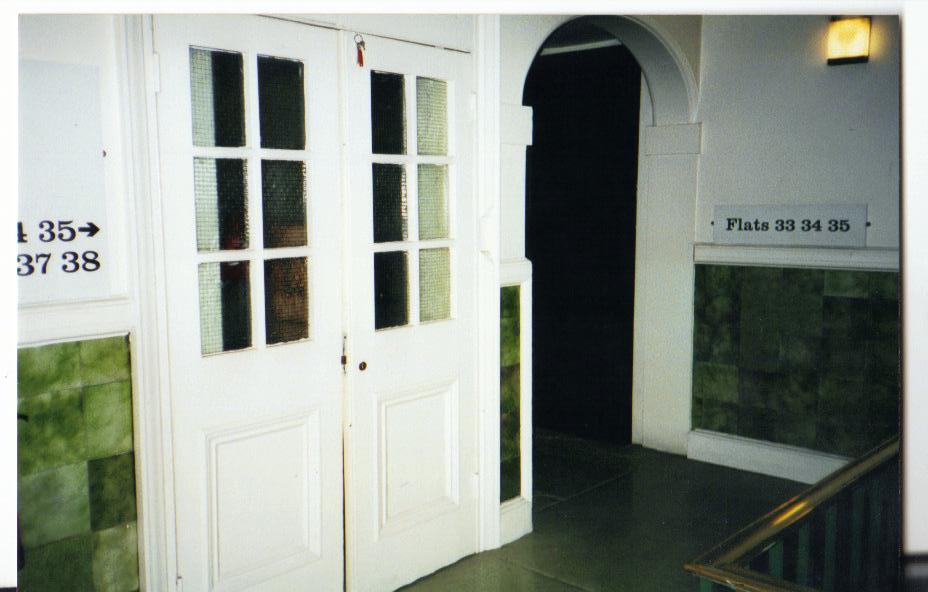
Although it is unlikely that Agnes Garrett was responsible for the internal decoration (while, of course, assiduously attending committee meetings and doubtless supervising such matters) the green tiles that still line the corridors of York Street Chambers appear identical to the blue tiles commissioned from Powells of Whitefriars by Agnes for the corridors of the New Hospital for Women, her sister Elizabeth’s contemporary venture. Alas, we cannot compare them with those selected for Chenies St for it appears that, c 1990, Camden Council removed the corridor tiles before spraying the walls with a purple-fleck paint (they have since been given a rather less aggressive treatment).
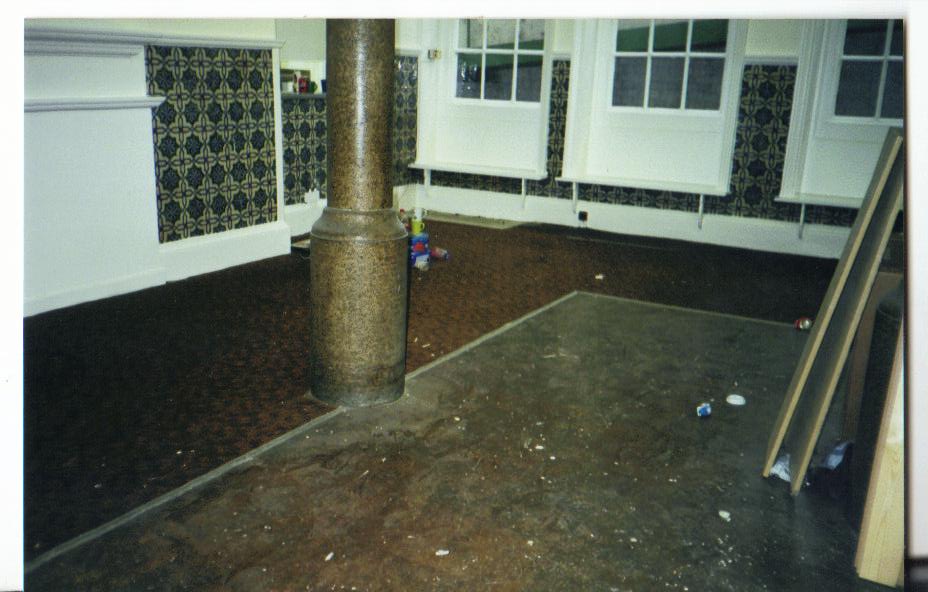
Basement c. 2000- originally the communal dining room – of York Street Chambers
As in Chenies Street, so in York Street, the basement of the chambers housed a communal dining room. While this was supposed to make life easier for the residents by relieving them of the burden of cooking, committee minutes show that in both sets of chambers the dining room was the focus of a variety of bitter resentments. It makes quite entertaining reading when minuted (if you are that way inclined), but must have been very wearing on the patience of the Company’s directors. When I visited York Street Chambers – probably c 2000 – the basement was in the process of being renovated in order to house a School of Massage and I do not know whether the tiles with which the room was lined were retained. I was, however, very taken by the vigour and panache of the decoration and cannot believe that they would have been ripped out.
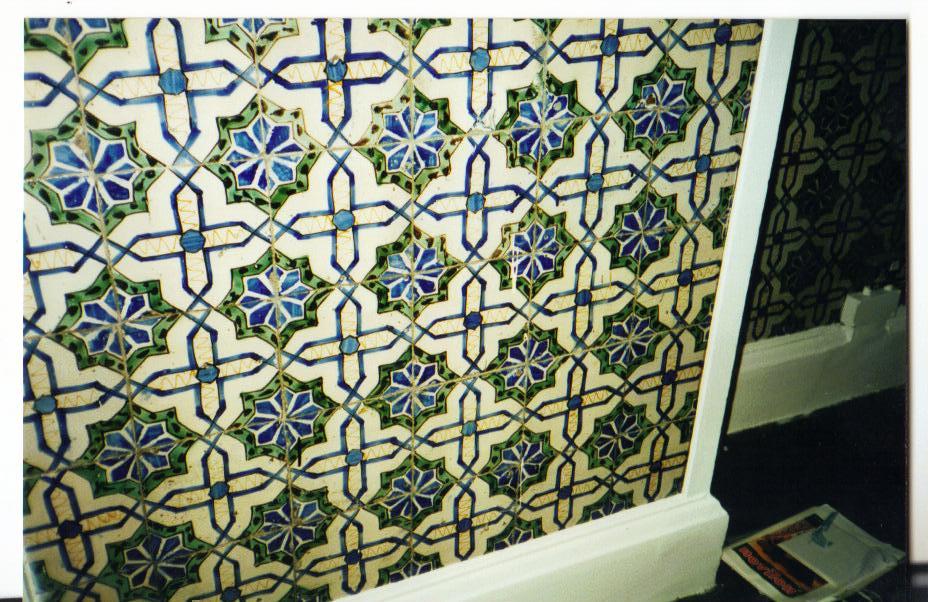
Tiles in the erstwhile dining room of the York Street Residential Chambers
When, in Enterprising Women, I described the similar space – by then divided into two flats – that had originally constituted the Chenies Street communal dining room I had no idea that underneath the bland decoration lay a similar riot of ‘Persian’ tiles. It was only a year or so after the book was published that the elderly owner (who had been so helpful in giving me access – and allowing me to photograph Ellen Rope’s ‘Hope’ hovering over his mantle piece) sold the flat to a young couple who undertook a full-scale renovation. Knowing that I had written about the Chambers – indeed ‘Hope’ was on its cover (see pic below) -they were kind enough to invite me round to see what they had uncovered. And, behold, the room was transformed – the light reflecting off the colourful tiles with which the original dining room had been lined. This was closer to the effect experienced by the chambers’ earlier tenants as they dined – with Ellen Rope’s ‘Hope, Faith, Charity and Heavenly Wisdom’ for inspiration along the wall above them – than the rather claustrophobic gloom of the room as I had first encountered it.
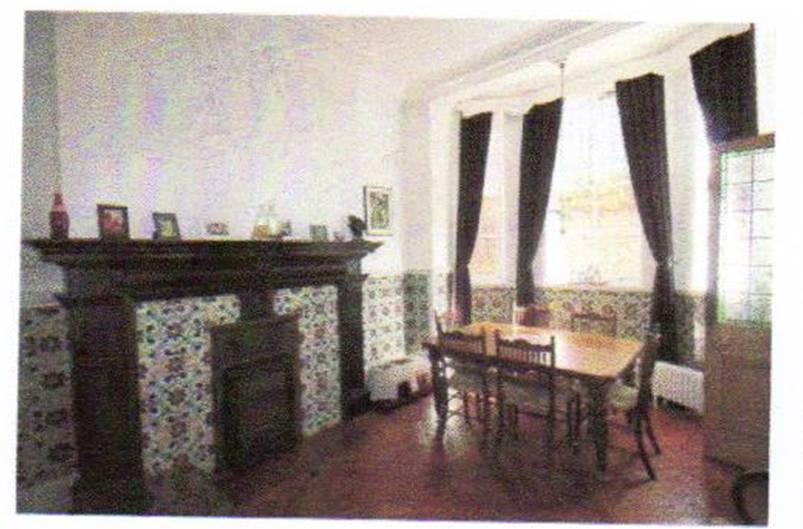
A section of the (former) Chenies Street communal dining room. ‘Hope’ remains on the wall over the mantle piece (though not clear in this pic), while part of ‘Charity’ has survived in the alcove to the left of the fireplace. ‘Faith’ and ‘Heavenly Wisdom’ have disappeared, absorbed into a corridor and another flat. The four spandrels had originally been created to decorate the vestibule of the Woman’s Building at the 1893 World’s Columbian Exposition and afterwards travelled back across the Atlantic to be incorporated in 1897 into the extended dining room of the Chenies Street Chambers. What an adventure.

Copyright
The Garretts and their Circle: Fanny Wilkinson And The Bloomsbury Triangle
Posted by womanandhersphere in The Garretts and their Circle on January 14, 2013
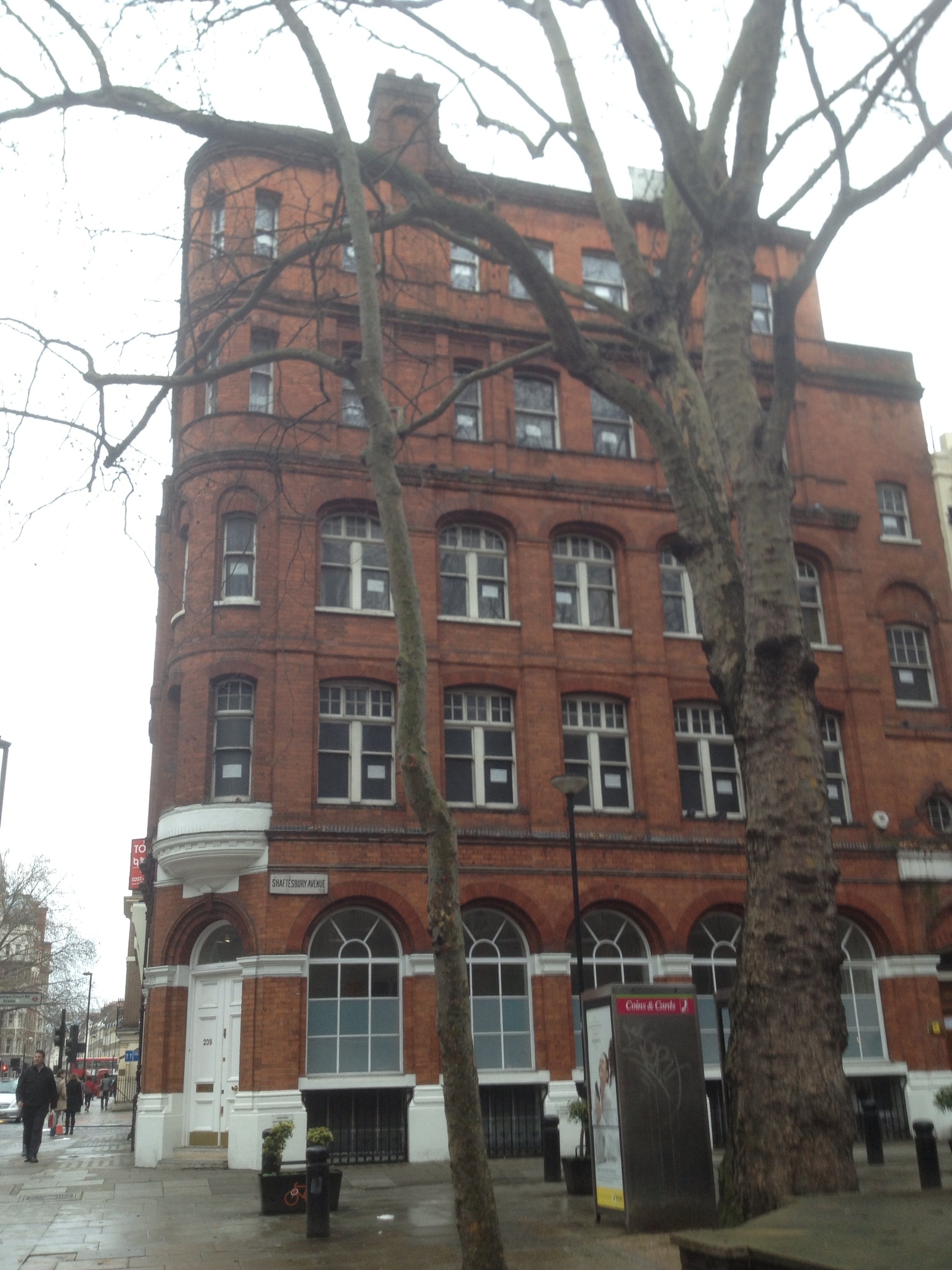
Fanny Wilkinson’s flat was on the first floor. Photo courtesy of understanding rome.com
In early 1885 Fanny Wilkinson, a recently qualified landscape architect – indeed the first woman in Britain to undertake a professional training course – moved into a flat at 15 Bloomsbury Street, just south of what is now New Oxford Street. Ten years or so ago, when I first wrote about Fanny Wilkinson – in Enterprising Women: the Garretts and their circle – I assumed that, as there was no trace now of that address, the building had been swept away in the various redevelopments that have taken place in the area over the last 100 years or so. Anyway, the exact site of Fanny’s first London home was not particularly important in the context of that book.
However, three or four years ago I undertook a little more concentrated research on the subject and, realising that 15 Bloomsbury Street had, soon after Fanny’s arrival, been renamed 241 Shaftesbury Avenue, discovered that the building in which she had lived is still there. Moreover, because the bus routes I use most frequently – the 38 and 19 – have been diverted (courtesy of CrossRail development at Tottenham Court Road) I now pass almost daily alongside Fanny Wilkinson’s former home.
The building – red-brick, with Queen Ann-ish windows and corner turret – faces onto an odd little triangle of land that had I long thought rather intriguing. The space is reminiscent of one of those Parisian squares (or triangles) that one may have seen – or imagined. It is rather dark – even in the summer – with lofty trees rising, close together, out of the pavement. In Paris one would add a cafe, waiters with long white aprons, an accordion etc. The London reality includes quantities of strutting pigeons and a peculiar raised concrete circle – ugly and serving no obviously useful purpose – probably something to do with underground systems of one kind or another – a useful shelf for discarded KFC packets, coca cola cans etc.
A little investigation revealed that the triangle had been formed when the final section of Shaftesbury Avenue was cut through St Giles Rookeries and that it was Fanny Wilkinson, in her capacity as landscape gardener to the Metropolitan Public Gardens Association, who ensured that it was not built over. She recommended that trees – London plane trees, as it happened – should be planted and seats made available for the public. The trees – although probably not the originals – are still there but the seats had only a short existence. They were removed c 1893 having attracted ‘dirty tramps, who make them a sleeping place in the day time and by loose women at night.’
Had the journalist who interviewed Fanny Wilkinson for the Women’s Penny Paper in 1890 ‘at her charming flat in Bloomsbury’, had to pick her way past sleeping tramps? Anyway, if she did, she put a brave face on it and assured her readers that ‘[Miss Wilkinson’s] rooms have a pleasant country air about them, and it would be difficult to imagine that one was in the heart of the big city in her pretty drawing room. It is the home of a lady, and instinctively one feels its owner must be a woman of refined taste.’ I do not know for certain, but would like to think that the drawing room ran across the first-floor, including the turret corner window, and that one would have looked down onto the leafy tops of the recently-planted trees.
Next door to the building is a pub – The Crown – which was there, under the same name, in Fanny’s day. It now does something to bring an approximation to the Parisian look by setting out tables on its frontage on the triangle. As the smokers huddle there we can be certain that not one – if they gave any thought at all to their surrounding – would imagine that the tiny section of urbanscape before them owed anything to decisions taken 125 years ago by a young Yorkshire woman. Nor, indeed, will the estate agents now attempting to lease the building in which she lived have any idea that what to them is merely so many square feet of office space was once the ‘pretty drawing room’ of a ‘woman of refined taste’. But now, as you walk up this section of Shaftesbury Avenue or inch past on the 38 or 19 (because the traffic is always jammed) – you, at least, will be aware of the layers of the past that hover around this odd little triangle.
Suffrage Stories: Alison Neilans Cleans The Stove
Posted by womanandhersphere in Suffrage Stories on January 12, 2013
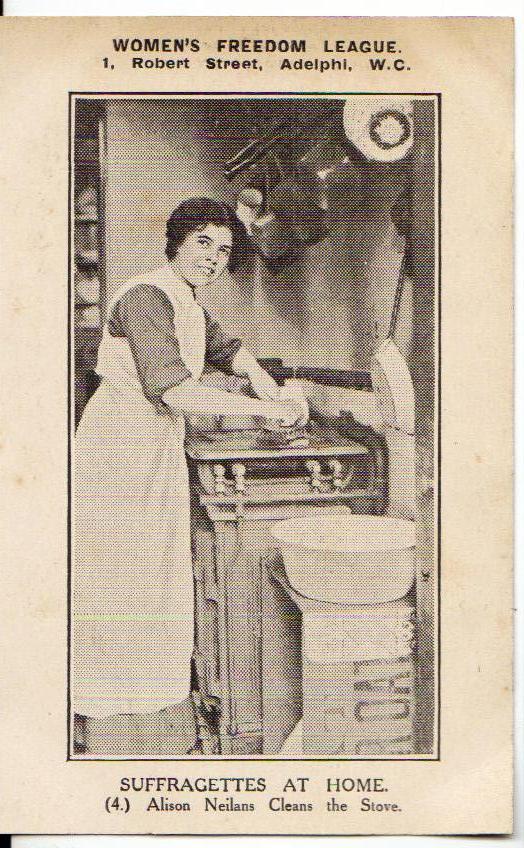 Another in the Women’s Freedom League ironic series – c 1910 – of ‘Suffragettes At Home’. Here Alison Neilans, then about 26 years old, is seen cleaning her gas cooker.
The gas stove may have been in the kitchen/scullery attached to the 4 rooms she shared with her mother and brother at 37 Caversham Road, Kentish Town. (Not that she was there on the night of the 1911 census – she was, rather, enumerated by the police walking with a couple of companions down Hampstead Road in a boycotting attempt.) Or perhaps it photographed in somebody else’s kitchen – borrowed for this propaganda purpose. Who knows.
Moreover, as ‘Mrs Joseph McCabe Bathing Her Baby’ (the previous card in the series about which I posted), was rather more subverting than the ostensibly homely depiction of a suffragette mother and her son when one realised that the child was the product of her marriage to an ex-Catholic priest, that the erstwhile ‘Brother Anthony’ was now a rampant aetheist, and that she herself was a secularist – so I would like to think that more can be read into this photograph of Alison Neilans.
The fact that she is photographed engaged in an act of cleaning might be taken as an allusion to the act of sabotage she performed at the 1909 Bermondsey by-election when she poured liquid into the ballot boxes. Is this photograph not saying ‘I may have dirtied and destroyed voting papers in the man’s sphere of the polling station but in the woman’s sphere I am relentless in my cleansing’? For, from 1917, Alison Neilans devoted her life to ‘Moral and Social Hygiene’ – as Secretary of the Association of Moral and Social Hygiene and editor of its journal.
By the way, I do have a number of leaflets/pamphlets etc associated with Alison Neilans in stock at the moment
Suffrage Stories: Mrs Joseph McCabe Bathing her Baby
Posted by womanandhersphere in Suffrage Stories on January 10, 2013
 This card was one of several published by the Women’s Freedom League in 1910 in an ironical series ‘Suffragettes At Home’ – a tongue-in-the cheek riposte to those who castigated suffragettes as being unwomanly.
Mrs Joseph McCabe was born Beatrice Alice Lee in Leicester in 1880, one of several children of William Lee, a framework knitter and, most importantly, a member of the Leicester Secular Society. For it was doubtless through the Lee family’s association with that Society that in 1899 Beatrice Lee, at barely 19 years old, came to marry Joseph McCabe. The latter was then 32 years old and had already experienced an adventurous religious life – having, at about the time Beatrice was born, entered the Franciscan order and in 1890 having been ordained as a Roman Catholic priest. By 1896, however, he had lost his faith, left the priesthood and begun a career as a writer and thinker on freethought. From 1898-99 he was secretary of the Leicester Secular Society.
In 1911 the family was living in north London, at 16 Elm Grove, Cricklewood. On 2 April, when the census was taken, Joseph was away in Wales, presumably on a lecture tour, leaving Beatrice at home with her four children. Although we must assume – in that she allowed herself to be promoted in the WFL card – that she was a member of the Women’s Freedom League she did not evade the census enumerator when he left the form with her at 16 Elm Grove. She completed it, describing herself as ‘mother, nurse and housekeeper also cook’. Besides the 4 children and the 17-year-old domestic help she lists the other members of the household – the cat ‘Diddie’ (neutered), 5 rabbits: ‘Brownie’, ‘Toodles’, ‘Baby’, ‘Biskie’ and ‘Bunkie’, and 3 goldfishes ‘no name’.
Across the form she added the following protest:
‘I wish to register in the strongest possible terms, my utter detestation of, and indignation at, having thrust upon me in the absence of my husband, the duties and responsibilities of citizenship, when neither I nor any single member of my sex is allowed to exercise the most elementary right of a citizen. I would also protest against the insult especially to mothers in describing their valuable services as ‘”only” domestic’.
Joseph McCabe was a keen supporter of women’s suffrage – particularly speaking for the Women’s Freedom League. In 1917 Beatrice McCabe was the hon secretary of the Hendon Women’s Franchise Society, which was affiliated to the United Suffragists. The McCabes were then living at 49 Bridge Lane, Hendon, but separated in 1925; Joseph was notoriously difficult. Beatrice died in 1960.
So that is the story that underpins ‘Mrs Joseph McCabe Bathing her Baby’ – that chubby-cheeked chap being Ernest (1909-1988).
Kate Frye: A War-Time Birthday: 9 January 1917
Posted by womanandhersphere in Kate Frye's suffrage diary on January 9, 2013
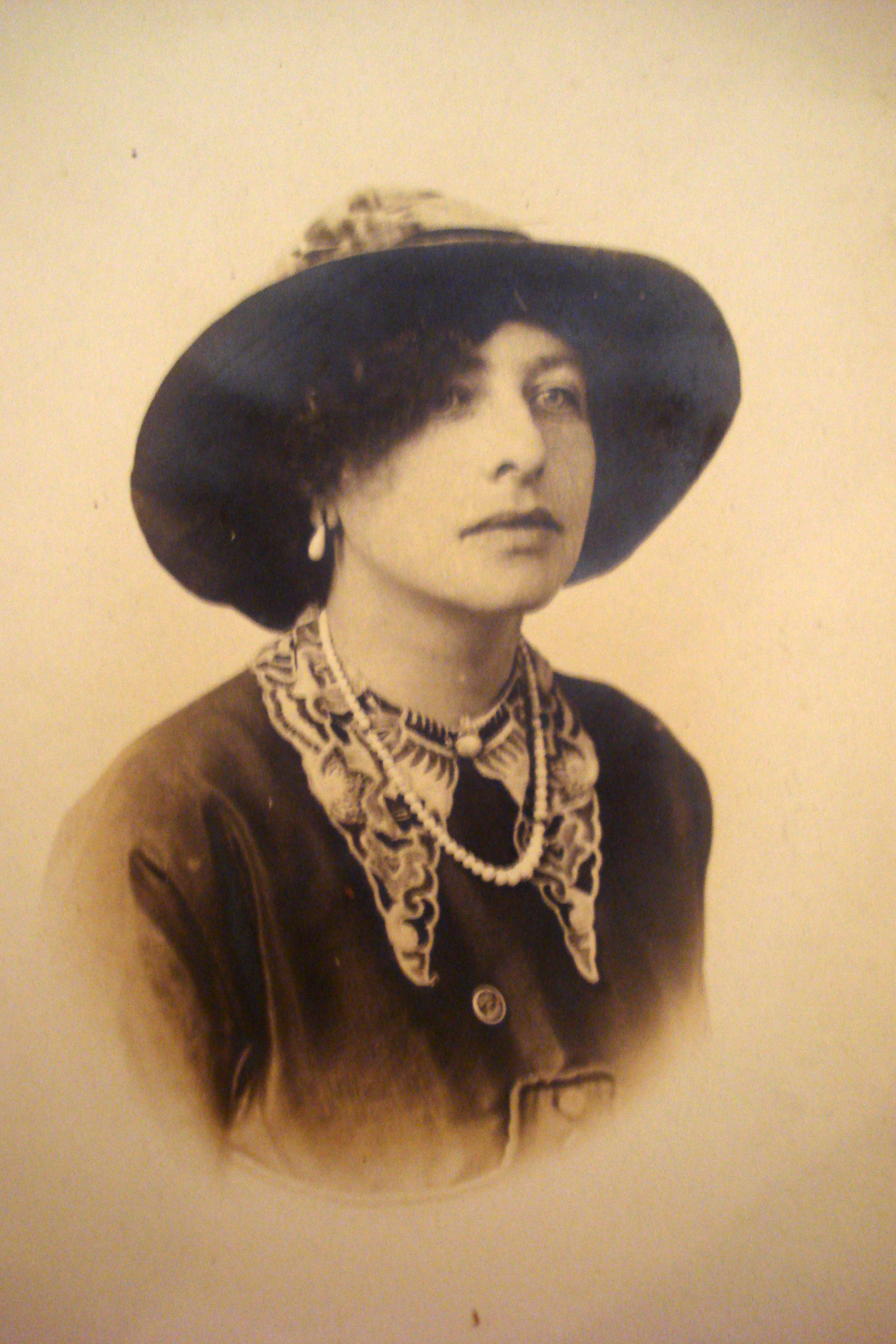
Kate
On her birthday – 9 January 1915 – Kate Frye had at last married her long-term fiance, John Collins. Two years later he was fighting in France and she was living with her mother and sister in a house at Berghers Hill, Buckinghamshire, courtesy of her mother’s sister, the wealthy Mrs Agnes Gilbey. A small cluster of cottages on a ridge at the top of a steep hill above Wooburn Green, Berghers Hill lay exposed to the elements. The wind whipped through Kate’s cottage, bedrooms were icy, the pipes froze – and burst. The walk down the hill to Wooburn Green and Cores End, whether by the road or the path through Wooburn Manor Park (the Gilbey property), was treacherous in winter.
Tuesday 9 January 1917
Woke to a terrible morning – dark & cold & sleet. It continued to sleet & snow & hail at intervals all day and the wind out was cruel. The anniversary of our wedding day. Two years ago at Hove. All day long & into the night I kept thinking at this time we were doing so & so and Oh it was sad to think of the present and to wonder whether John was alive or dead. It comes so suddenly – the death to them and it would be hours & days before I should hear.
Agnes [Kate’s sister] still seedy & in bed and so cross with both Mother & I. I went off soon after 10.30 to Cores End to seek a Cod’s Head for the cats & fish for her dinner. Couldn’t get the former, the latter she refused to eat when cooked and sent up.
Writing letters most of the evening and after supper sat over the fire trying to get warm & thinking, thinking. Fortunately Mother went to bed. A letter from John – the first since Friday.
For more on Kate – look out for Elizabeth Crawford (ed): Campaigning for the Vote: the suffrage diary of Kate Parry Frye to be published by Francis Boutle Publishers in February 2013
Mariana Starke: First Productions
Posted by womanandhersphere in Mariana Starke on January 7, 2013
In 1787 J. Walter, a London publisher/bookseller operating from premises close to Charing Cross, issued – as Theatre of Education – a new English translation of Le Théâtre á l’usage des jeunes personnes, a collection of comedies by Mme de Genlis, the first woman to be appointed tutor to princes of France.
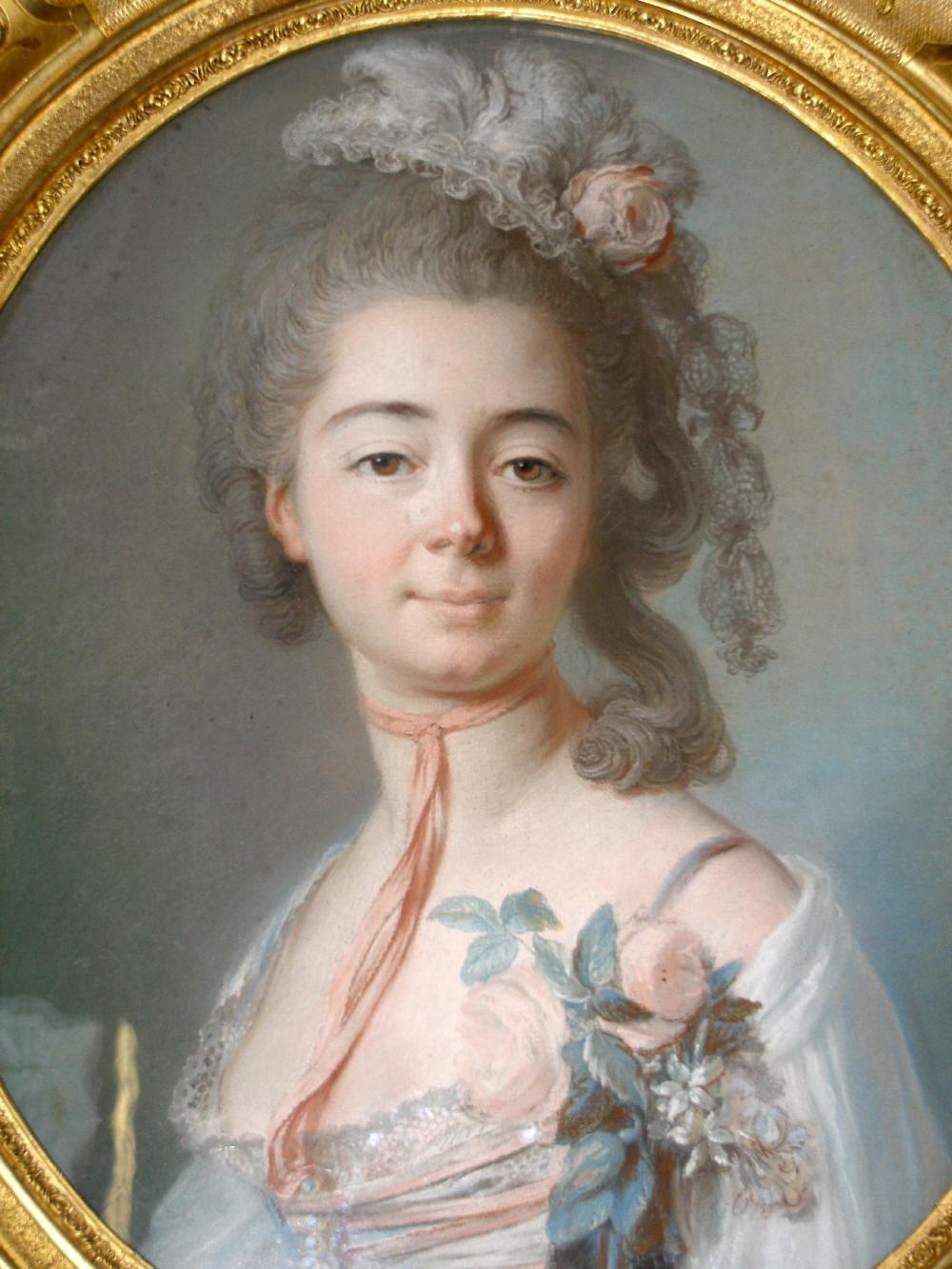 Madame de Genlis
This innovative method of providing a moral education for children through the use of short plays had proved immensely popular on both sides of the Channel. First published in France in July 1779, an English translation, under the imprint of T. Cadell and P. Elmsly ; T. Durham, appeared in 4 octavo volumes in 1781, with a new edition, in 3 volumes, under the same imprint, following in 1783. [See http://archive.org/details/theatreeducatio07genlgoog for the online edition of the 1781 4-volume edition]. Nowhere is the name of the translator of this edition stated, although it is thought that he was male. As far as I know he has never been identified – although this really is not my field and I would welcome correction.
Nor, indeed, is there any indication on the title page of the J. Walter edition of the names of the translator(s) of his edition. It was not until 1831, when an obituary of Mrs Millecent Thomas (the former Millecent Parkhurst -see Mariana Starke: An Epsom Education) appeared, that the truth was revealed.
As the Annual Register and The Gentleman’s Magazine reported, Mrs Thomas ‘assisted her friend Miss Starke in translating Mme de Genlis’ Theatre of Education’. Over 150 years later, in Notes and Queries (45:1; March 1998), Edward W. Pitcher identified the edition translated by Mariana and Millecent as that published by J. Walter. The Annual Register had cited the translation as being issued between 1783 and 1788 in three duodecimo volumes, although a consultation of COPAC reveals no J. Walter edition pre-dating 1787. It does, however, seem to have been issued in a variety of formats. The 3-volume British Library set appears to be inscribed, if I have deciphered the handwriting correctly, ‘Miss M.B. Woollery, the gift of her friend Mrs Thomas’. Millicent Parkhurst married the Rev Joseph Thomas in 1791, the gift, if it really was from her, presumably post-dating her marriage. The only advertisement for the J. Walter edition that I have found appears in The Times, 28 July 1790, and refers to a set of four-volumes, at the not inconsiderable price of 10 shillings. J. Walter was the publisher of, among a wide variety of productions, Mrs Chapone’s works – including Letters on the Improvement of the Mind, a seminal conduct book for young women of the period. He had presumably thought it worth backing a translation of Theatre of Education to rival that issued by Cadell et al, although doubtless he had paid little to the youthful translators. It does not appear to have merited either a reissue or a second edition.
So we find that the two young women, still in their mid-20s, living close to each other in Epsom, had embarked on a new translation of a much-fêted work which they had then succeeded in getting published. Not that this, when we know their circumstances, is particularly surprising. For, by the 1780s, Millecent Parkhurst and Mariana Starke were well-educated young women, with influential literary contacts. We have noted that John Parkhurst, Millecent’s father, and William Hayley, to whom Mariana was a ‘poetic daughter’, both gave encouragement.
Mariana Starke was also on intimate authorly terms with George Monck Berkeley (1763-93), a precocious literary talent. In a letter written to him at Magdalen Hall, Oxford, on 22 August 1787, Mariana reveals ‘that I am now much better qualified to write a Tragedy than when I composed the first three Acts of Ethelinda, as I have lately studied dramatic composition with great diligence.’ She is referring to a play, Ethelinda, which she and Monck were writing together. It is tempting to conclude that her reference to recent dramatic composition might not be unrelated to the work involved in producing the translation of Mme de Genlis’ plays. A few sentences later she tells Monck that ‘After I had finished Ethelinda to the best of my abilities, I carried it to my excellent Friend, Mr Parkhurst, whose almost paternal regard for me prompted him to consider it with great attention: he has corrected all the errors which happened to strike him; and advises me to let every material thing stand as it is now, saying, he thinks the Play very dramatic, and very likely to be well received: As he has condescended to take infinite pains with the Piece, I am sure you must agree with me in thinking it would be extremely indelicate to put any Critic over him, especially as Mr Parkhurst (from the soundness of his judgment and the depth and universality of his knowledge), is perhaps of all men in this Kingdom, best qualified for the office of a Critic. I have, in conformity to your advice, shortened my own acts and lengthened yours; and I have studied to insert the many excellent speeches, with which your acts abound; but sorry am I to say, that there is one sweet speech on fame, which I know not how to introduce according to the present plan of the Play. Your speech on murder, which is, by the by, the finest thing I ever read, I have put into the beginning of the Play, where it shows to great advantage; and many more of your lines I have occasionally introduced among my own, by way of giving a strength to my composition, which it seemed to want. I find, from Joinville, that the Crusaders always crowned their Heroes with palm, therefore I have substituted that for laurel. I am told by a Gentleman who is deeply read in the records, that even Kings, in the time of Richard the 1st, did not espouse what we now call the regal style; therefore I should think Ethel had better not do it – and I have taken the liberty to alter the two last lines of Bertram’s [?] dying speech, because (if Homer may be credited) no man, who dies of a wound in the breast, can see objects immediately before his death. I have applied to a Friend for Mrs Siddons’s interest but am not certain how I shall succeed – if I was more intimate with Mrs Soane [?] I would certainly write to her; but slight as our acquaintance is, it would be too presumptuous – from you, perhaps, she might receive an application graciously. Another Friend of mine, who is acquainted with Linley and King, has undertaken to introduce Ethelinda and me to both of them, and I almost daily expect a summons to appear before those mighty Rulers of the Theatre. So, if you have any interest, work it now, let me entreat you. Linley, at present, is at Bath, but he will speedily return to London.’
Thus, it is clear that by 1787 Mariana Starke was working her apprenticeship as a playwright and knew how to network the theatrical scene. (Mrs Siddons was the most famous tragic actress of her day; Thomas Linley and Thomas King were both involved with the management of the Theatre Royal, Drury Lane.) It is virtually certain (although I have not yet found any pre-1788 evidence) that Mariana was already well acquainted with Mrs Mary Crespigny (see Mariana Starke: The Mystery of the Bodleian Diary), who organized dramatic performances at a private theatre erected in the grounds of her Camberwell home. The success of The Theatre of Education was predicated on the willingness of families, such as the Crespignys, to stage short plays for amusement – and instruction. For an interesting article on the relationship at this time between private theatricals and public theatre see here.
Although the translators of the J. Walter edition are not named, the ‘Advertisement’ that prefaces the text at least makes clear that they were women. ‘The fame acquired by Madame de Genlis is so deservedly great, and the Theatre d’Education so universally considered as her chef-d’oeuvre, that it naturally becomes the study and admiration of her sex; some of whom, in order to amuse their minds, and at the same time amend their hearts, by imprinting on the memory such exalted precepts as those contained in the Theatre d’Education, undertook to translate it into English, and have now, to the best of their abilities, finished this Work, which they presume to place before the eyes of an indulgent Publick….[so that].people of all ages and all ranks may derive from the Original of Madame de Genlis, the most useful and persuasive lessons, couched in the most eloquent and characteristic language.
I have only compared the two editions in the most superficial way, but, even so, could immediately detect distinct differences in the language used. It was presumably because they felt something wanting in the 1781 translation of Mme de Genlis’ work that the two young women felt encouraged to embark on their own. However, The Critical Review, while conceding that there were faults in the 1781 edition, could not bring itself to praise the J. Walter edition.
The translators make clear in the Preface to the J. Walter edition that they had sought Mme de Genlis’ permission to publish their translation of her work: ‘Permit us, Madam, thus publickly to return our most thankful acknowledgements for the honour you confer upon us, by allowing the following translation to be inscribed to your name; an honour which demands our gratitude in an especial manner, as we do not enjoy the happiness of your personal acquaintance’. There had, presumably, been an exchange of letters between Epsom and France. Unfortunately there is no correspondence (or, at least, none that I have found) that throws any more light on either the production of the translation of the Theatre of Education or its afterlife as it related to the life of Mariana Starke. I have come across no reference at all to the work in any subsequent correspondence. This is perhaps just a little surprising.
We do know, however, the fate of the other work mentioned with which Mariana was involved – for, on 30 October 1788 [at least, I think it was 1788, but it may have been 1787 – the dating of the letters is uncertain], her mother, Mary Starke, wrote from Epsom to George Monck Berkeley a letter in which she she mentions that Mariana is awaiting ‘something decisive respecting the fate of the rash, yet beauteous Ethelinda.. You long ago were informed that this heroic Damsel was presented to, and rejected, by the respective Managers of Drury Lane and Covent Garden. Her next application was to Mr Colman [of the Theatre Royal, Haymarket] who paused a long while upon the question, her merit making a deeper impression upon his mind, than upon either of the other Gentlemen. Yesterday, and not before, his determination reached Epsom – ‘That he thinks the piece distinguished by many touches of Poetry, tho’ on the whole too romantick ..for the Theatre. ‘…The dear Authoress has laid aside her pen, and taken up her distaff, in other words, her time now is chiefly occupied in inquiring as to the practicability and possibility [?] of establishing Sunday Schools & Schools of Industry in this neighbourhood. How much more becoming in a Female [?] is this than dabbling in ink. However I have derived so large a portion of amusement, not to say instruction, from some female Writers of the present age that I cannot subscribe implicitly to this opinion, worthless perhaps it does not seem proper and may so claim an exception from this lordly privilege on behalf of my own daughter. Therefore she, as I told you before, is resuming the primitive employment of the distaff. Let her rejoice at the success attendant upon the fair Heloise….’
 The latter remark may refer to Monck Berkeley’s Heloise: or the Siege of Rhodes, published in 1788. Ethelinda, clearly a play set at the time of the Crusades, does not alas, appear ever to have been staged. However we know that Mariana Starke certainly did not take up the distaff and devote herself to ‘Sunday Schools & Schools of Industry’ but, if the dating of her mother’s letter is correct, had already, on 8 August 1788, seen another of her plays – The Sword of Peace – given its first public performance at the Theatre Royal, Haymarket. George Colman had, as we shall discover in the next Mariana Starke post, proved most supportive.
Sources: Berkeley mss, British Library
Copyright
 Woman and her Sphere