Archive for May, 2014
Kate Frye’s Suffrage Diary: Buckingham Palace, 21 May 1914
Posted by womanandhersphere in Kate Frye's suffrage diary on May 21, 2014
A hundred years ago today, on 21 May 1914, having failed to influence the government, Mrs Pankhurst’s Women’s Social and Political Union, decided to appeal directly to the King. Kate Frye, although not a militant suffragette, was there – outside Buckingham Palace – to witness the scene. This is the copy of the Daily Sketch that she bought that day and kept all her life.
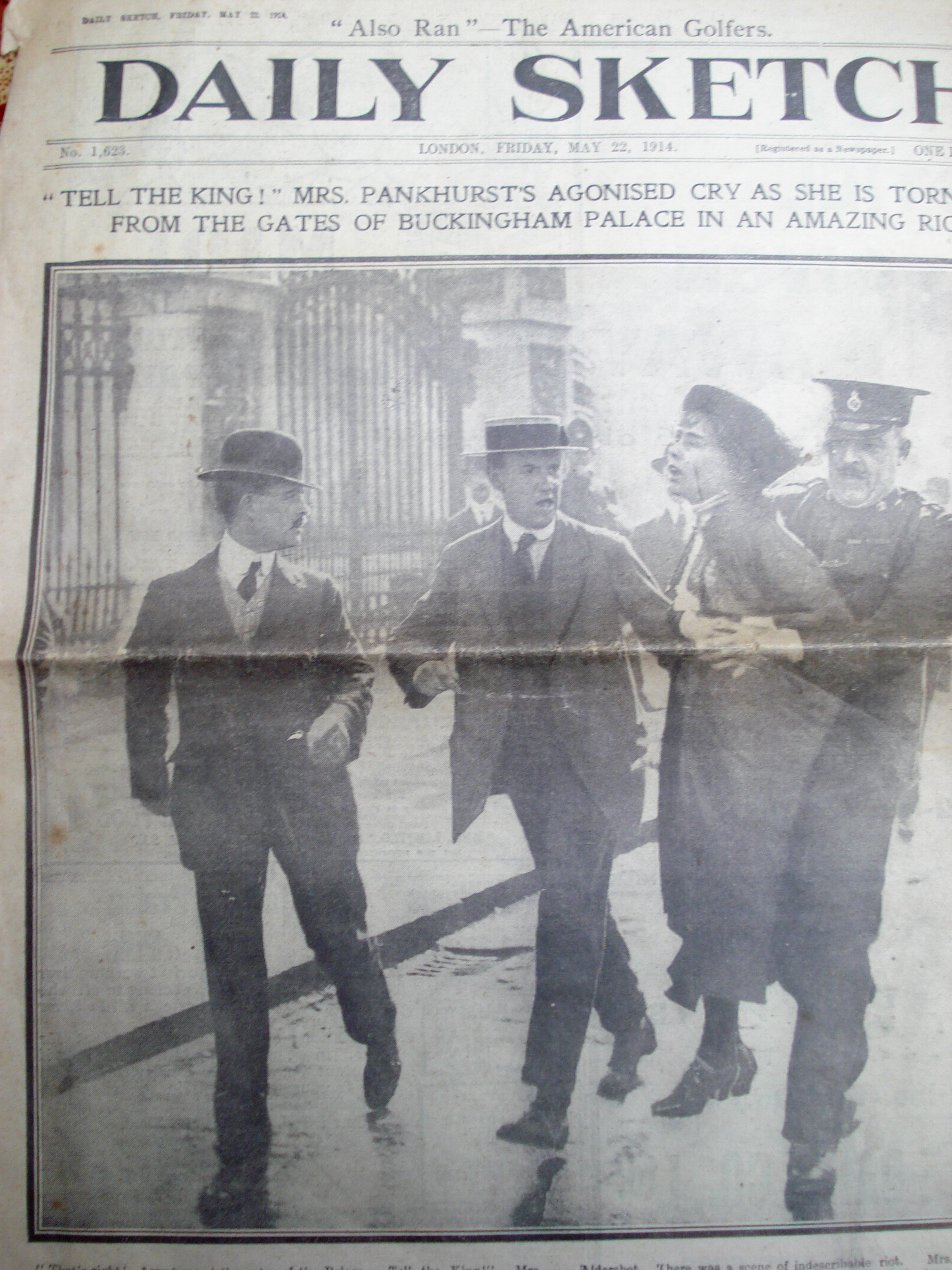
The following is Kate’s diary entry:
‘Thursday May 21st 1914
To Office. Then in the afternoon I went to Buckingham Palace to see the Women’s deputation – led by Mrs Pankhurst which went to try and see the King. It was simply awful – oh! those poor pathetic women – dresses half torn off – hair down, hats off, covered with mud and paint and some dragged along looking in the greatest agony. But the wonderful courage of it all. One man led along – collar torn off – face streaming with blood – he had gone to protect them. Fancy not arresting them until they got into that state. It is the most wicked and futile persecution because they know we have got to have ‘Votes’ – and to think they have got us to this state – some women thinking it necessary and right to do the most awful burnings etc in order to bring the question forward. Oh what a pass to come to in a so-called civilised country. I shall never forget those poor dear women.
The attitude of the crowd was detestable – cheering the police and only out to see the sport. Just groups of women here and there sympathising, as I was. I saw Mrs Merivale Mayer, Miss Bessie Hatton and a good many women I knew by sight. I stayed until there was nothing more to be seen. The crowds were kept moving principally by the aid of a homely water cart. It was very awful. Mrs Pankhurst herself was arrested at the gates of the Palace. I did not see her but she must have passed quite close to me.

At the Buckingham Palace railings, 21 May 1914
I went to Victoria and had some tea and tried to get cool, but I felt very sick. The King could have done something to prevent it all being so horrible – he isn’t much of a man. Back by bus [to the office of the New Constitutional Society where she was working]. They [Alexandra and Gladys Wright, friends and colleagues ] wanted to hear about it, but they don’t take quite the same view of it that I do. They seem so ‘material’ in all their deductions – it’s all so tremendously more than that.’
I edited Kate’s diary as Campaigning for the Vote: Kate Parry Frye’s suffrage diary – but that is now out of print. However you can read
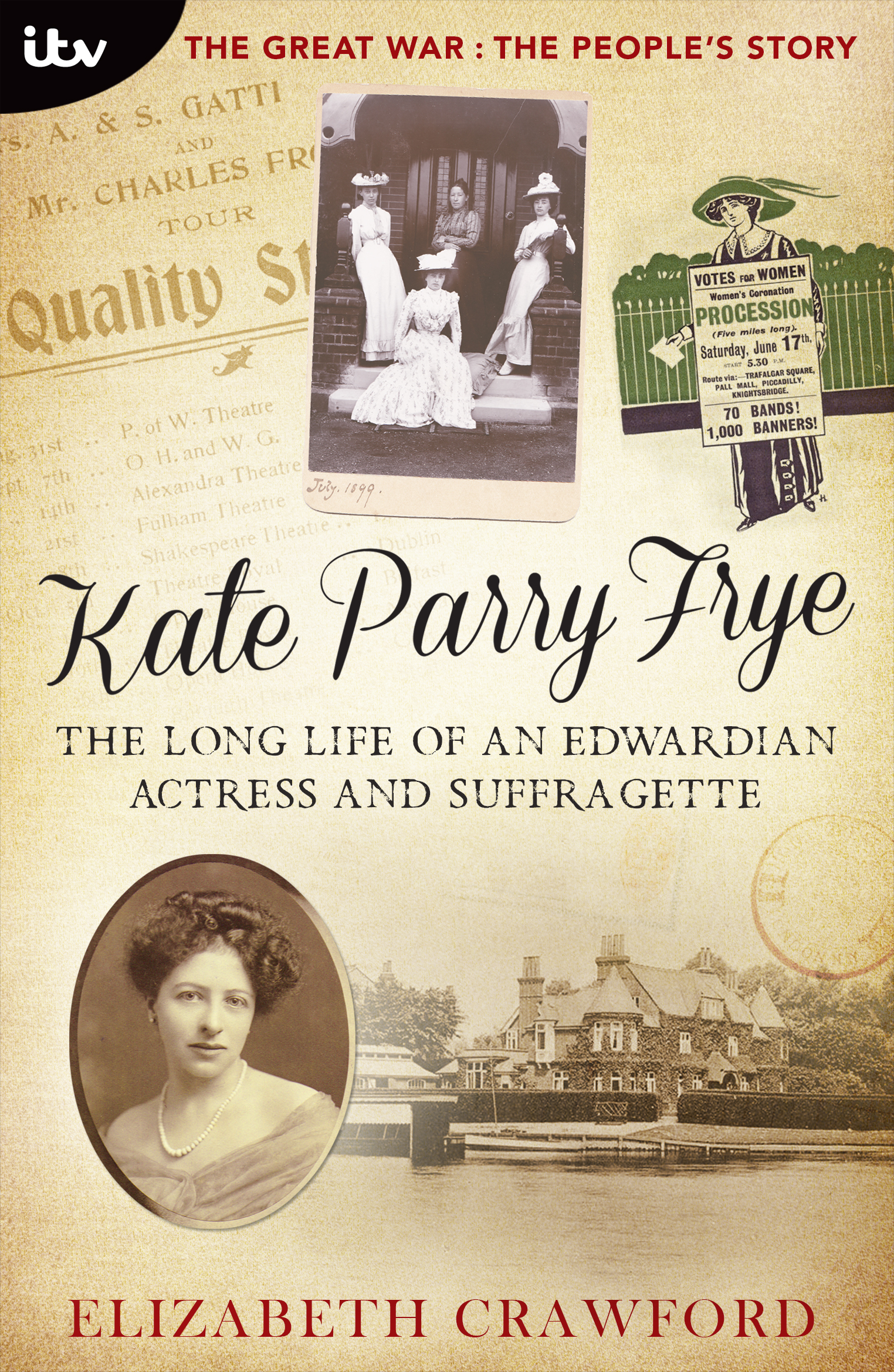
Kate Parry Frye: the long life of an Edwardian actress and suffragette
Published by ITV Ventures as a tie-in with the series: ‘The Great War: The People’s Story’, this e-book tells Kate’s life story from her Victorian childhood to her brave engagement with the Elizabethan New Age. For details see here (and many more posts on my website).
Available to download from iTunes or Amazon
Suffrage Stories: Shoulder To Shoulder – Conference And Campaign
Posted by womanandhersphere in Suffrage Stories on May 20, 2014
Shoulder -To-Shoulder: Female Suffrage, Second-Wave Feminism and feminist TV Drama in the 1970s.

I very much enjoyed attending this conference –Shoulder To Shoulder: Female Suffrage, Second-Wave Feminism and feminist TV Drama in the 1970s – which focussed on ‘Shoulder to Shoulder’, the BBC’s 6-part series about the militant suffrage movement, broadcast in 1974.
The conference was held on 15 and 16 May 2014 at Birkbeck College’s School of Arts in Gordon Square. Who would think that behind the familiar early-19th-century facade of no 43 lies a state-of-the art cinema and gallery? It was a pleasure to be there.
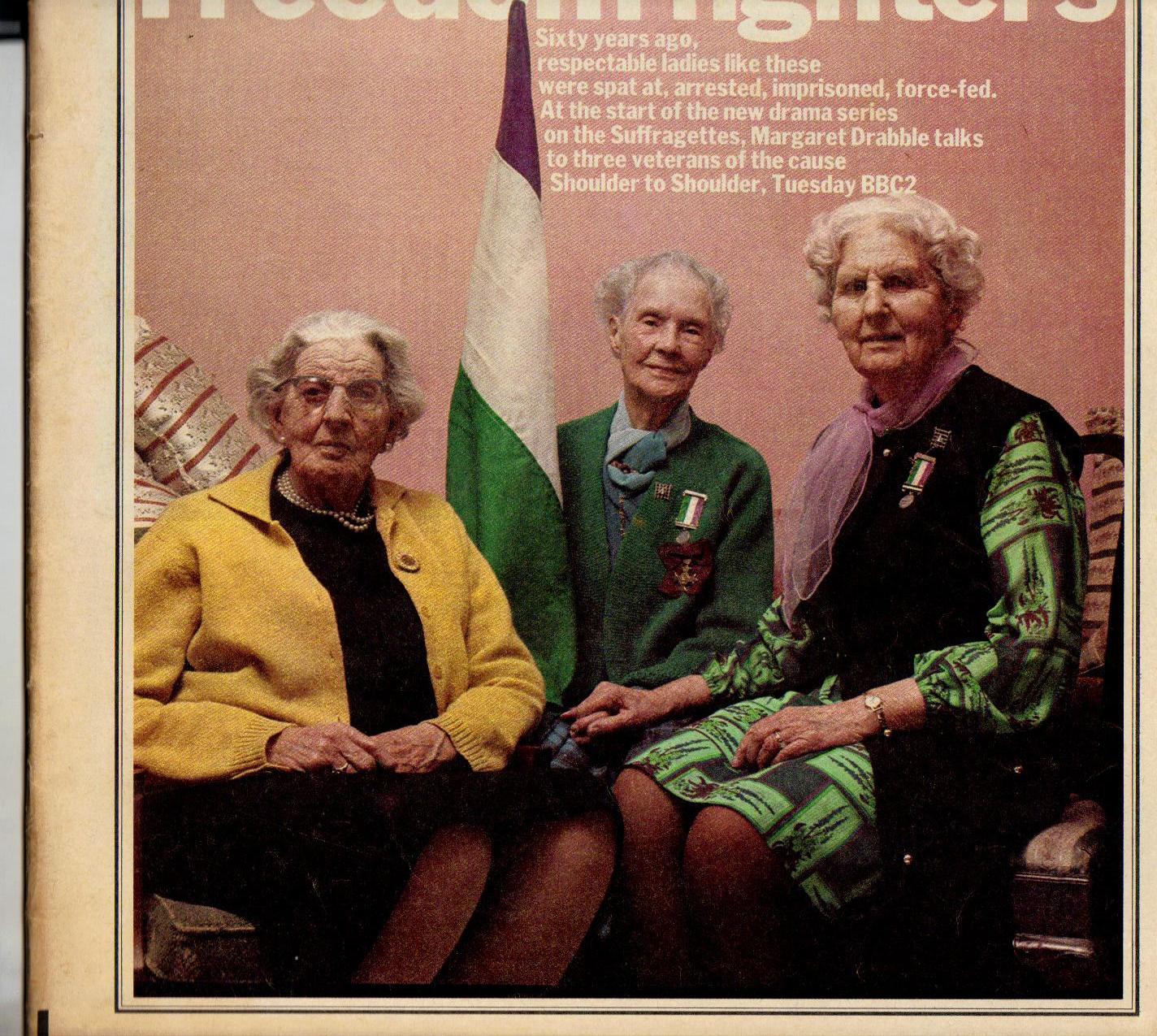
And even more of a pleasure to be in the audience for a screening of one of the episodes from the series. The one selected was Episode 2 – ‘Annie Kenney’, written by Alan Plater, directed by Waris Hussein and starring Georgia Brown as Annie Kenney. This was the first time I had ever seen the production. I have long known of the series, have sold copies of Midge McKenzie’s ‘spin-off’ book, and have even sold copies of the Radio Times Special that was produced to accompany the series, and the tie-in issue of Radio Times in which Margaret Drabble interviewed three surviving suffragettes, Grace Roe, Leonora Cohen and Cicely Hale. But I have never seen the programmes – we didn’t have a television in the 1970s.
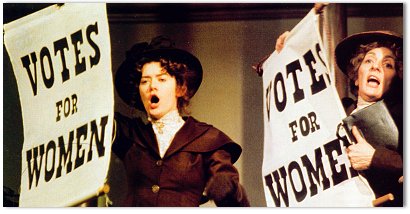 I was very impressed by the episode I saw – impressed by the script and by the production. From a 2014 perspective faces, dresses, sets etc all look persuasively Edwardian – no hint, I think, of the 1970s.
The script, too, is pleasingly accurate. There was much discussion at the conference about the fact that the writers of the series were reflecting the Pankhursts’ view of suffragette history, centring the story around the characters of Emmeline, Christabel and Sylvia Pankhurst and Annie Kenney. Nevertheless they do not shirk from dealing with the politics of the campaign in considerable detail. Would any drama series nowadays bother (dare!) to discuss the nitty-gritty of the ballot for private members’ bills – and actually mention the name ‘Bamford Slack’?
After the screening of the Annie Kenney episode we were privileged to be party to a reunion discussion between cast and crew of the series, chaired by Dame Joan Bakewell. Sian Phillips, who played Emmeline Pankhurst, Patricia Quinn,(Christabel) and Angela Down (Sylvia) were joined by two of the series’ directors, Waris Hussein and Moira Armstrong, and Graham Benson, the programme’s production manager. All had given up their time to come along and reminisce about the making of the series. It’s always so interesting to listen to insiders talking – and remarkable that 40 years on so many details were recalled.
I particularly liked the fact that, because the budget allowed for so few extras, rather than attempting to show the battle in Parliament Square on ‘Black Friday’, the damage wrought on the suffragettes was, instead, hinted at by filming the detritus left on the ground, while a voice-over intoned a dispassionate account (from a newspaper, think). Very much an example of ‘less is more’.
One thing that became very clear was that cast, crew and audience were united in hoping that Shoulder To Shoulder would be made available on a DVD. In my bookselling capacity I am often asked if I know where such a thing might be obtained – and the answer is that, not only has the series rarely been rebroadcast, but there is no DVD. You can find the series on You Tube – but it really should be commercially available, with added background, context, interviews etc. Apart from the interest and enjoyment it would give to the general viewer, what an excellent teaching tool it would be!
Dr Janet McCabe of Birkbeck and Dr Vicky Ball of De Montfort University are planning to launch a campaign to persuade the BBC to produce a DVD of Shoulder To Shoulder. There will be a petition and, to coordinate the campaign, a Facebook page. But in the meantime, if you are interested in giving your support you can email Janet McCabe at jmccabe@bbk.ac.uk or Vicky Ball at vicky.ball@dmu.ac.uk.
Suffrage Stories: 1911 Census: View House of Commons Talk – Vanishing For The Vote – The Suffragette Boycott
Posted by womanandhersphere in Suffrage Stories on May 14, 2014
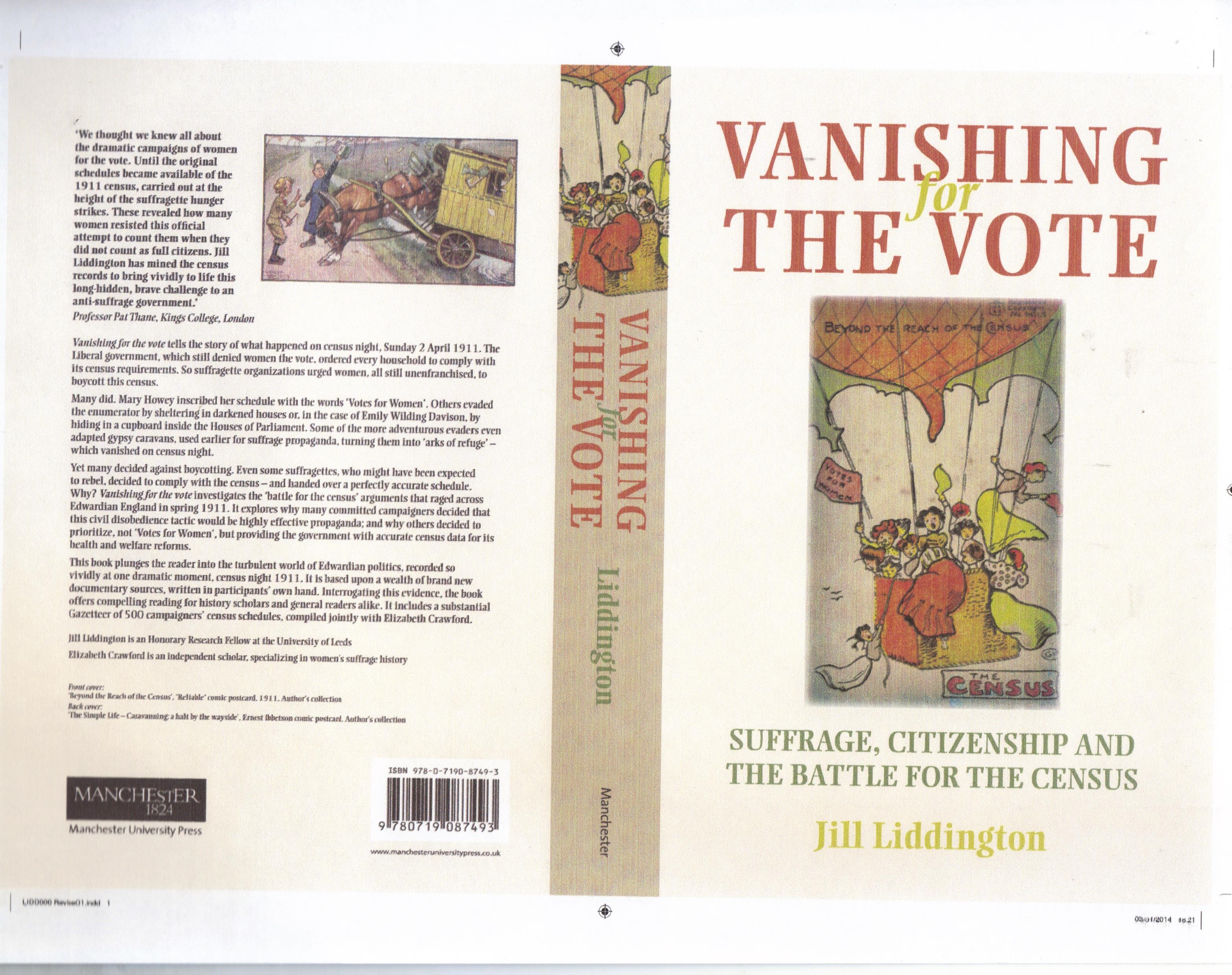
A couple of months ago, to coincide with the publication of Dr Jill Liddington’s latest book, Vanishing for the Vote, I was pleased to take part in a three-hander talk – with Jill and Prof Pat Thane – in the House of Commons – in which we discussed the suffragette boycott of the 1911 census. This talk was videoed and has now been uploaded to the Parliamentary YouTube channel. You can view it here.
Jill and I had together undertaken the initial research into the identities of those who had either made clear on their census forms that they were not prepared to answer the government’s questions or who had failed to be included on any census return. This work resulted in a jointly-written article in History Workshop Journal – see here to read it – and a talk I gave at a National Archives conference on the 1911 census – which you can listen to here. The details of 500 women protesters may be found in the Gazetteer that Jill and I compiled and which comprises the final section of Vanishing for the Vote.
Suffrage Stories: The 1866 Suffrage Petition – And The Geyser
Posted by womanandhersphere in Suffrage Stories on May 13, 2014
 Back in the days when the world was young, there was no internet, and antiquarian booksellers – as well as the layman/woman book-buyer – had to search their quarry among the stacks of brick and mortar bookshops, my time, when not engaged in child care, was spent touring London and the market towns of southern England in search of the books and ephemera with which I and my customers might resurrect the women that were famously ‘hidden from history’.
These days have long passed away – now we need only sit at home and search internet book-selling sites, trawling through the print-on-demand dross in the increasingly forlorn hope of finding the odd nugget of treasure. The corollary, of course, is that there are now precious few brick and mortar bookshops selling second-hand/antiquarian books.
In those olden days I even thought it occasionally worthwhile to take a tour down Portobello Road on a Saturday morning, not something I have done for a long time, now that Portobello’s landlords are handing the antiques arcades over to fashion chain stores. But that particular Saturday-morning visit was memorable because it was in a bookselling alcove in the warrens that stretch behind Portobello Road that I came across one of the most interesting finds of my bookselling career – a copy of the pamphlet edition of the 1866 women’s suffrage petition.
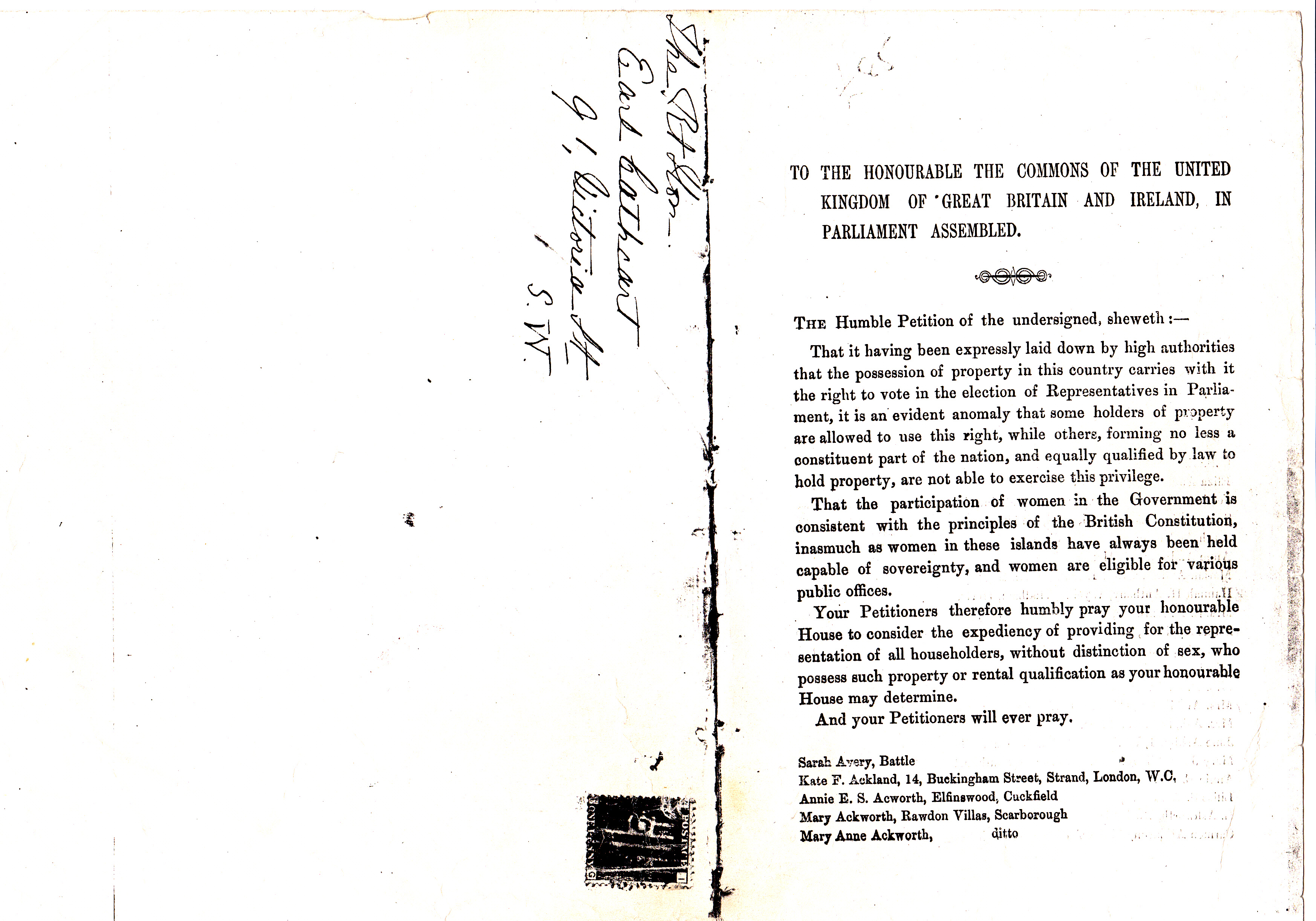
The petition itself comprised a long scroll onto which were pasted the signatures of the (circa) 1500 women who, in the spring of 1866, were prepared to put their names to a request (it was certainly not yet a demand) that women who met the requisite property qualifications , as set out in the Reform bill then under discussion, should be able to cast a parliamentary vote alongside men. The petition had been organised by a group of women who formed themselves into a small informal committee – among their number being Barbara Bodichon, Bessie Rayner Parkes, Elizabeth Garrett, and Emily Davies. John Stuart Mill, for whom they had campaigned when he had contested – and won – the Westminster parliamentary seat the previous year, had agreed to present the petition.
Emily Davies was the businesswoman of the group and it was she who decided that the names of those who had signed the petition should be printed in pamphlet form and sent to the weekly papers so that, as she wrote on 18 July 1866 to Helen Taylor (Mill’s step-daughter), ‘ in case they take any notice, they make know what they are commenting on.’ Copies of the petition pamphlet were also sent to members of the House of Commons and the House of Lords.
The copy of ‘my’ 1866 petition pamphlet is, as you see, addressed to Earl Cathcart – the 3rd Earl, Alan Frederick Cathcart. I suspect he was not overly interested in the rights of women.
I did sell the pamphlet almost as soon as I found it but, before parting with it, had the sense to take a photocopy. That sounds nothing extraordinary, but back in those days photocopiers were not the casual desk accessory that they are today and in order to process the petition’s 38 pages I had to visit the machine in the local library. How glad I am that I bothered to do so. For having easy access to those 1500 names allowed me not only to build up the pattern of political and friendship networks supporting the suffrage campaign that lies at the heart of The Women’s Suffrage Movement: a reference guide, but also provided a starting-point for researching The Women’s Suffrage Movement: a regional survey, in which the part each region, county and town played in the campaign is detailed.
Some of the names on the petition are well-known, but it is the unknown that I find particularly interesting. For example, Fanny Maughan of 214 Goswell Road, London EC attracted my attention because that address is a very close to where I live. Although Fanny’s house has long been swept away to make room for a high-rise housing estate, I wanted to know how her name might have come to be on one of those petition slips.
She was born Fanny Elizabeth Seamer in Hackney in 1838, when her family was living in Down Terrace, Clapton. Her father, a hairdresser, died when she was young and her mother remarried John King, a piano maker. The ‘new’ family lived in Bishopsgate and Fanny acquired half-brothers, one of whom was named John Lovett King. In 1863 Fanny married Benjamin Waddy Maughan in Islington and three years later signed the women’s suffrage petition.
How did Fanny Maughan come within the orbit of the petition gatherers? Well, there is a tiny possible clue in her half-brother’s middle name, from which I would guess that her step-father was connected to the circle surrounding William Lovett, chartist and artisan radical. More to the point her father-in-law, John Maughan, born into a non-conformist (Wesleyan) family, became a friend of William Lovett, an associate of George Holyoake, and a member of the London Secular Society. The men in these circle were all supportive of John Stuart Mill – and the petition – and someone must have suggested that a visit should be made to 214 Goswell Road, to request Fanny Maughan’s signature.
Although Fanny Maughan has left no discernible trace other than that signature on the petition, we have good reason to think daily of her husband. For 1n 1868 Benjamin Waddy Maughan invented the first domestic water heater that did not rely on solid fuel. His invention – which he called The Geyser – used gas to provide a constant stream of hot water.
 By 1881 he and Fanny were living at Heydon House, Quarry Road, Hastings and Benjamin was described on the census as ‘Gas Engineer Fitter, employing 28 hands’. However, by 1887, when Fanny died, the couple were back living in Islington and Benjamin had a factory at Gloucester Road in Hackney, just off Hackney Road.
Alas, all did not go well for Benjamin Maughan and the 1911 census shows him, described as ‘formerly house painter’, as an inmate of the Islington Workhouse, with a note that he had become deaf when he was 63 years old. I cannot even with certainty find a record of his death. But how interesting that the geyser, an invention that, in time, did much to unshackle women from household chores, should have been so closely associated with the 1866 women’s suffrage petition. I sincerely hope that Fanny Maughan – and the cook and the housemaid that the family were able to afford in the 1880s – were able to benefit from Benjamin’s invention.
Copyright
Ann Dingsdale also researches the 1866 petition – access her thesis here and her blog here
Suffrage Stories: Five Reasons To Love Sally Heathcote Suffragette
Posted by womanandhersphere in Suffrage Stories, Uncategorized on May 12, 2014
I knew only of Mary Talbot as the author of the Costa-winning Dotter of Her Father’s Eyes when, a year ago, she got in touch, sending me PDFs of the bulk of Sally Heathcote Suffragette and asking what I thought of it.
I had no hesitation in deciding that Sally Heathcote Suffragette was a winner.
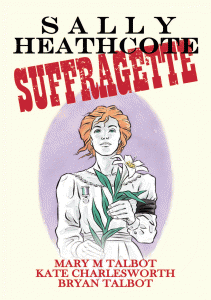
1) Not only does the book tell the story of the militant suffrage movement with clarity and verve, but, most interestingly, approaches the narrative from an unfamiliar angle. And I must say it is an angle that appeals to me. For Sally’s story applauds the efforts of Frederick and Emmeline Pethick Lawrence, whose work for the cause has been overshadowed by the antics of the more headline-grabbing suffragettes. By not offering any resistance to their ousting from the WSPU by Emmeline and Christabel Pankhurst they have, until now, been consigned to the shadows.
The Pethick Lawrences were militant up to a point – they both went to prison – but they drew the line at bombings and fire-raising. Apart from the danger involved, they could see that this level of violence would only further antagonise both government and public.
Sally Heathcote brings to the fore the social philanthropy – and socialism – that lay at the heart of the Pethick-Lawrences’ involvement in the suffrage cause and their support for pacifism during the First World War. They effected ‘deeds’ – running the Maison Esperance, the Esperance Club and the Green Lady Hostel- as well as publishing ‘words’ – in the shape of the paper Votes for Women. You can read more about the Pethick-Lawrences’ work after their expulsion from the WSPU here.
2) I love the accuracy of Sally Heathcote – not only of the history, but of the visuals. For instance I was very taken by Kate Charlesworth’s drawing of the interior of Lincoln’s Inn House – as in the picture in the bottom frames here.

Below is the interior of Lincoln’s Inn House in reality – a (rather blurry) photo I took in what is now a Bill’s Restaurant last summer. I just love the fact that the detailing of the staircase railing is so right.

I asked if either Kate or Mary had visited the building – but no. We worked out that Bryan’s source had been this page in Votes for Women.
3) All the well-known suffrage scenes are captured brilliantly. You can see from Kate’s drawing of Christabel speaking in Trafalgar Square how her fresh-faced spontaneity had the power to entrance her audience. And I do like the comment in the bottom right of the picture -there’s no doubt Emmeline Pethick-Lawrence’s prose was on occasion over-purpled.

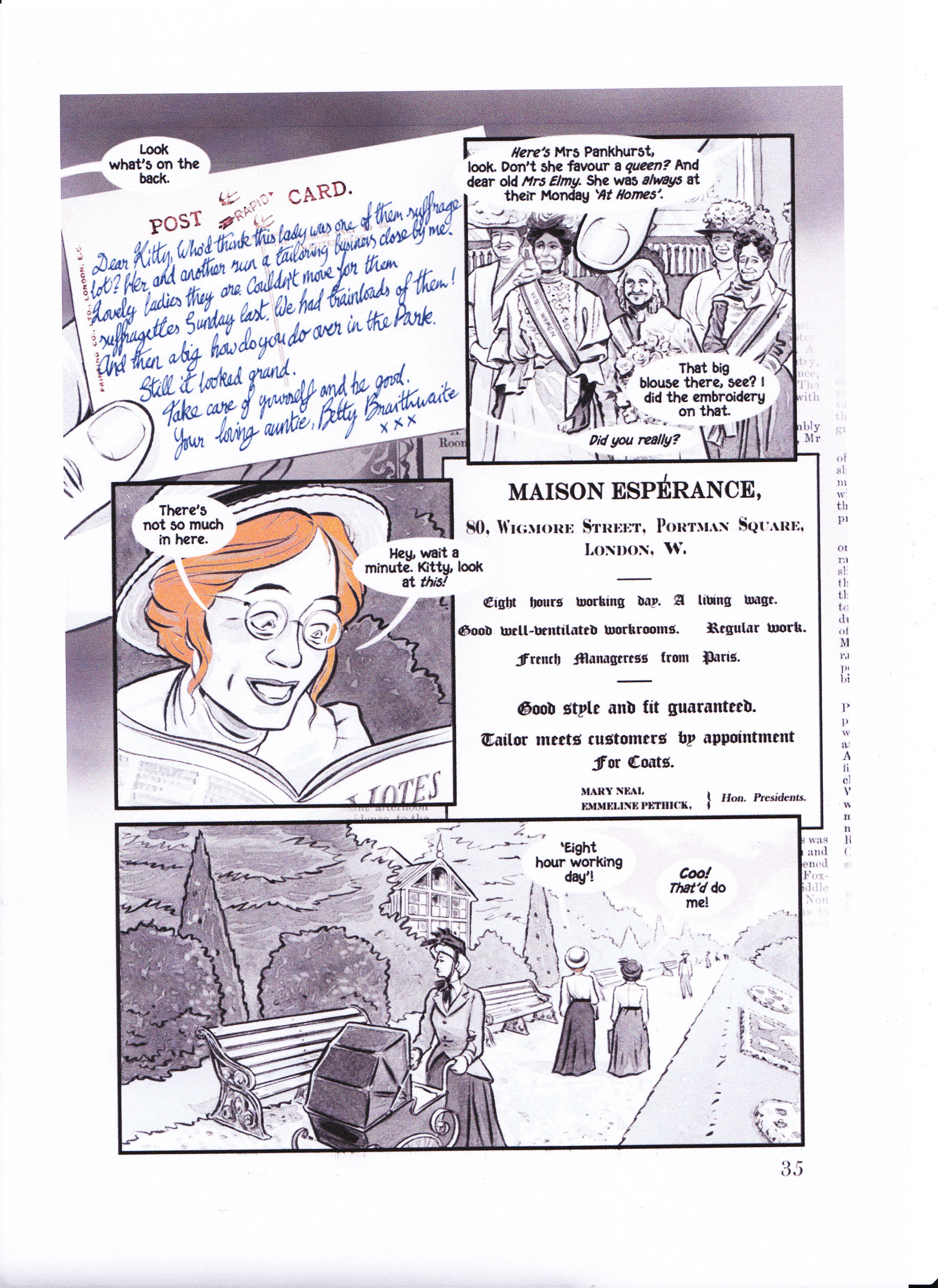
4) I love Sally because one page alone refers to two constituents of the suffrage campaign that have long appealed to me. The first is dear Elizabeth Wolstenholme Elmy, whose life-long efforts have until recently been sadly undervalued. I remember that when the massively long text for my The Women’s Suffrage Movement: a reference guide was being copy-edited, the excellent editor did demur about the length of the entry on Mrs Elmy. However, I managed to convince him that she was really important and that back then, in 1999, very little had been written about her – so she was allowed her long entry. So I’m very pleased that Mary has taken notice of her. The postcard (and, of course, I’m very keen on real photographic postcards) shows her on Mrs Pankhurst’s platform during the 1908 Hyde Park rally. You can just see that Kate has drawn a hint of the bouquet that Mrs Elmy was carrying. Mrs E. mentioned in a letter that it was composed of ferns, purple lilies and lilies of the valley – the colours with which Emmeline Pethick-Lawrence branded the WSPU for this grand occasion.
The second reference is to Maison Esperance – the dressmaking establishment set up by Emmeline Pethick-Lawrence to put her ideals into practice and provide her workers with good working conditions – such as an 8-hour day. I have always thought this a laudable and intriguing enterprise. Alas, as Mary admits in another frame in the text, the experiment did not last long. Was the provision of good working conditions uneconomic? Or was it that the Maison’s garments did not flatter? Why did Emmeline, with her marketing skill, not get the Cara Delevingne or Alexa Chung of the day to be seen wearing them? However, the associated girls’ club and the Green Lady Hostel at Littlehampton were successful.
5) Finally, apart from everything else, I applaud the understated – but very pointed – message in the final frame. Read the book – look at the pictures – and discover what this is.
Do have a look at Mary Talbot’s website to find out more about Sally Heathcote Suffragette – about Mary and Bryan Talbot and Kate Charlesworth – and about associated conferences and book signings.
Suffrage Stories: Anti-Suffrage Sneaks And Their Stealthy Stickering
Posted by womanandhersphere in Suffrage Stories on May 8, 2014
Below is an item that I found in a postcard album compiled by Mrs Louisa Thomson Price, one of the leaders of the Women’s Freedom League.
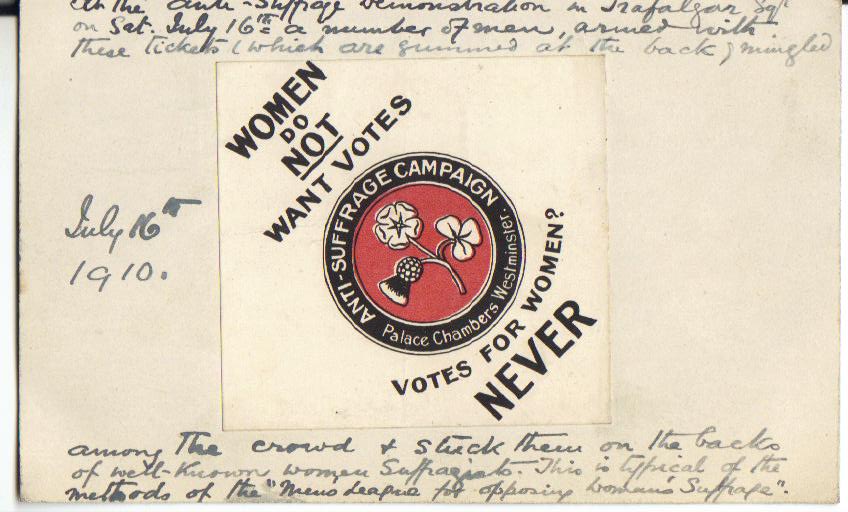 Mrs Thomson Price acquired this sticker at a ‘Anti-Suffrage campaign’ demonstration held on 16 July 1910 in Trafalgar Square – during which men mingled with the crowd and stickered ‘well-known women suffragists’ with ‘Votes for Women Never’ slogans. The Daily Telegraph, in describing the demonstration, particularly remarked on ‘the large number of suffragists and supporters of “votes for women” who were in attendance’, commenting that ‘the militant Suffragists utilized the occasion as a great opportunity for doing propaganda work among the enemy.’
While Mrs Thomson Price declared that this stealthy stickering was ‘typical of the methods of the ‘Men’s League for Opposing Women’s Suffrage’, The Daily Telegraph reveals that ‘a most effective ending to the afternoon was the march past of the WSPU Drum and Fife Band playing ‘The Marseilles’. Well, that was certainly a more open spoiler.
This anti-suffrage demonstration was held a few days after the suffrage Conciliation Bill had passed its second reading in the House of Commons and a week before the WSPU’s massive 23 July rally in Hyde Park. The suffrage campaigners’ hopes were high -and the anti-suffragists were presumably just a little nervous. They need not have worried – for on the very day of the Hyde Park spectacular the prime minister, Asquith, informed Lord Lytton, chairman of the Conciliation Committee that the Conciliation Bill would progress no further than parliamentary session. It was yet another example of how difficult it was to get the political machine to change gear if those in the engine room were not minded to operate the levers.
Mrs Louisa Thomson Price (1864 -1926) was the daughter of a Tory military family but from an early age rebelled against their way of thinking and became a secularist and a Radical. In 1888 she married John Sansom, a member of the executive of the NSS.From c 1886 she worked as a journalist – as a political writer, then a very unusual area for women, and drew cartoons for a radical journal, ‘Political World’. She was a member of the Council of the Society of Women Journalists. After the death of her first husband, in 1907 she married George Thomson Price.
Louisa Thomson Price was an early member of the Women’s Freedom League, became a consultant editor of its paper, The Vote, and was a director of Minerva Publishing, publisher of the paper. She took part in the WFL picket of the House of Commons and was very much in favour of this type of militancy. In her will she left £250 to the WFL. and £1000 to endow a Louisa Thomson Price bed at the Elizabeth Garrett Anderson Hospital.
Suffrage Stories: Words – As Well As Deeds
Posted by womanandhersphere in Collecting Suffrage, Suffrage Stories on May 7, 2014
This article was published in the March 2003 issue of Antiquarian Book Review.
‘Deeds Not Words’ was Mrs Pankhurst’s motto. The slogan flourished in the early 20th century – it was even embroidered on a banner – a reaction to the apparently unproductive campaign for the enfranchisement of women that had already been waged for nearly 40 years.
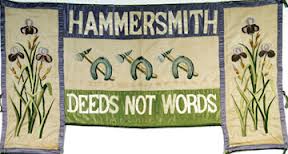 The debate as to whether the vote was won by the slow drip of reasoned argument or by the sharp crack of breaking glass is one that still occupies historians. Although it is the deeds of Mrs Pankhurst’s suffragettes – the spectacle of processions, the breaking of windows, the burning of houses and churches – that has coloured the popular perception of the suffrage campaign, without the ‘words’ that had over many years shaped the idea that women had an equal right with men to citizenship, the ‘deeds’ would have been committed in a vacuum. The women’s suffrage campaign was, during its entire 62 years, underpinned by ‘Literature’ in all its guises.
Works written in support of women’s enfranchisement had little difficulty in achieving publication. The instigators of the movement were members of the articulate radical middle class and were in close contact with communicators. A tentative beginning had been made in 1851 with Harriet Taylor’s article The Enfranchisement of Women, which, shortly after her marriage to John Stuart Mill, was published anonymously in the Westminster Review ( a journal of which Mill had in the past been editor). This was followed in 1855 by a pamphlet, The Right of Women to the Elective Franchise, written by Agnes Pochin, wife of a future Liberal MP, and published by John Chapman, that ‘Publisher of Liberalisms’.
Among the names of the 1500 women who signed the suffrage petition that Mill presented to parliament in June 1866 (marking the formal beginning of the campaign), were several with connections to the publishing or bookselling trades – including Elspet Strahan, sister of Alexander Strahan, a liberal with a zeal for social reform and the publisher of the eponymous publishing house. He had recently launched the Contemporary Review, in which he published an article on ‘female suffrage’ in March 1867, written by Lydia Becker.

Lydia Becker – with books
Based in Manchester, Lydia Becker was to be the driving force behind the 19th-century campaign. Among other signatories to the petition were Louisa Farrah, wife of a radical publisher and bookseller (282 Strand, London); Eliza Embleton, a bookseller from Leeds (Burley Street); the wife of James Renshaw Cooper, a radical Manchester bookseller (1 Bridge Street); and the wife and daughter (both named ‘Harriet’) of Edward Truelove, radical publisher and antiquarian bookseller (2240 Strand), who had been imprisoned for publishing Robert Owen’s Physiology in Relation to Morals. (See here for an interesting blog by Dr Tony Shaw about Truelove and his grave, on which the two Harriets both appear.)

Edward Truelove’s grave in Highgate Cemetery. Photo courtesy Dr Tony Shaw
Once the campaign had been launched, ‘words’ in support of women’s enfranchisement multiplied rapidly. The societies that had formed to promote the cause published a plethora of pamphlets – one of the first, of which 4500 copies were distributed, was a reprinting of the speech made by Mill to Parliament during the debate on the second reform bill in May 1867.
The accounts of the earliest Enfranchisement of Women Committee show that in its first year of existence over £94 was spent on printing. This was set against receipts from the sale of pamphlets of only £6 11s. Political publishing was not a profitable business. In reality, political publishers who were prepared to put their imprint on books and journals to promote the woman’s cause were not so unworldly as to risk their money. A study of the ledgers of companies, such as Trubner and H.S. King, reveals that many of the suffrage publications, including Lydia Becker’s The Women’s Suffrage Journal, were published only on a commission basis.
Under this arrangement, the author or the society undertook all the risk of publication, while the publishers merely provided the service of printing, binding and distribution, for which they gave the book their imprint, charged a fee and took a percentage of sales. Publishers’ ledgers, where they have survived, provide an interesting keyhole through which to view the suffrage campaign. Lists of payments make it possible to identify an author who published anonymously, the print order for a book, journal or pamphlet can give us an idea of the ambition of the author or society; and the number of pulped gives a reason why so many of the items are now extremely scarce – and expensive.
The suffrage campaign appeared to have made such considerable progress in its first years that Mill, a canny businessman as well as philosopher, felt the time was ripe to publish the work that he had first drafted in the early 1860s on ‘the woman question’. As he wrote in a letter to The Times on 9 April 1869: ‘It is not specially on the Suffrage question, but on all the questions relating to women’s domestic subordination and social disabilities, all of which it discusses more fully than has been done hitherto. I think it will be useful, and all the more, it is sure to be bitterly attacked’. Mill knew full well the publicity value of controversy.

John Stuart Mill remained a hero to the more constitutionally-minded elements in the suffrage campaign
The Subjection of Women was published by Longmans in May 1869, went into a second edition in the same year, and has remained ever since a central text of the women’s movement.
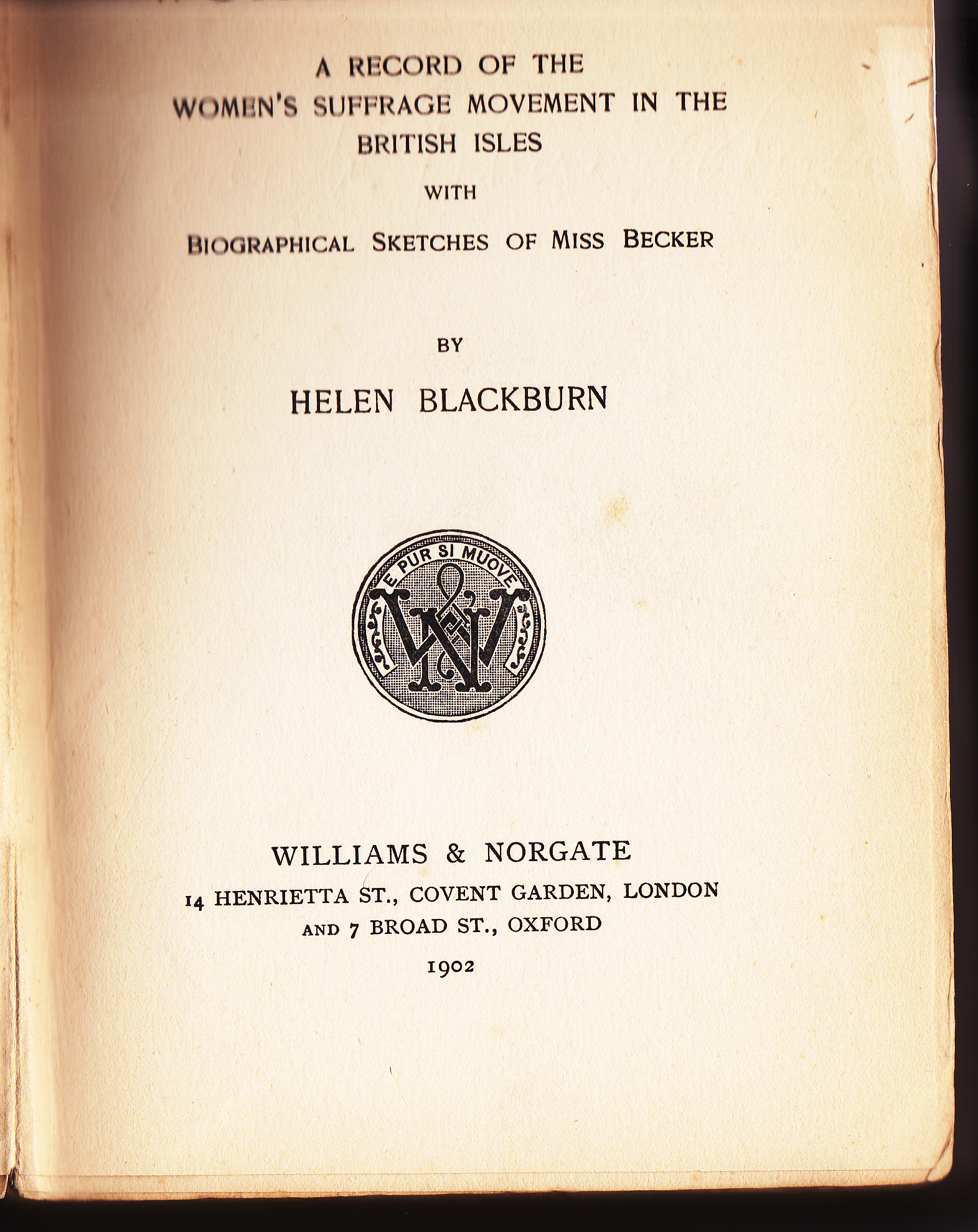
Helen Blackburn, Women’s Suffrage, 1902
It took until 1902 for the first history of the campaign to appear. Women’s Suffrage: a record of the women’s suffrage movement in the British Isles with biographical sketches of Miss Becker was painstakingly compiled by Helen Blackburn, who had for many years worked as secretary of the Central Committee for Women’s Suffrage.
The new force that emerged in 1903, Mrs Emmeline Pankhurst’s Women’s Social and Political Union, did not delay so long before giving itself a distinctive history. A series of articles written by Sylvia Pankhurst, daughter of Emmeline, as The History of the Suffrage Movement, appeared in the WSPU’s new paper, Votes for Women, starting in the first issue in October 1907 and concluding in September 1909.
 This history was, naturally, shaped to emphasise the Pankhursts’ centrality to the movement. Bibliophiles might like to note that the book that emerged from the articles, The Suffragette: the history of the women’s militant movement, was first published in America in 1911 by Sturgis & Walton and sheets where only then shipped back to Britain, where it was subsequently published by Gay & Hancock.
The publication in 1912 of Women’s Suffrage: a short history of a great movement (TC & EC Jack), written by Millicent Fawcett, did something to redress the balance. She had been involved with the campaign since its earliest days and since 1907 had been leader of those who described themselves as ‘law-abiding’ in contradistinction to the militants.
 Agnes Metcalfe’s Woman’s Effort: a chronicle of British Women’s Fifty Years Struggle for Citizenship (1865-1914), published in 1917, gives a detailed overview of the campaign, concentrating on the efforts of the militants.
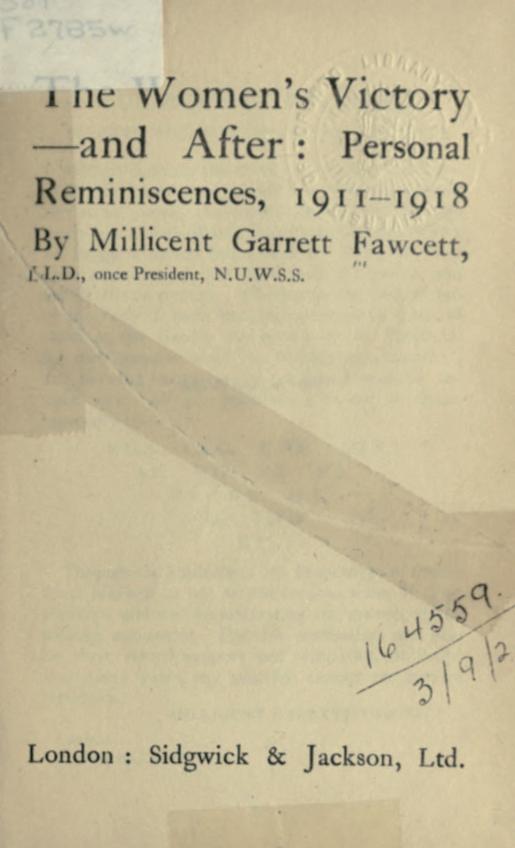
In 1920 Mrs Fawcett completed her history of the suffrage campaign, begun in A Short History, with another pithy summary of events that had led to the passing of the Representation of the People Act, 1918, granting the vote to women over the age of 30.
All these books were bought (as ownership inscriptions found in them testify) by sympathisers to the cause, were part of the stock of the small lending libraries run by many of the local suffrage societies and also found their way into the public library systems and even into prison libraries. While imprisoned, suffragettes were able to read lives, such as those of Joan of Arc and Garibaldi, that they considered (by analogy) relevant to their cause – the cult of the ‘hero’ clearly appealed to those conscious of their role in history.

Daniel Maclise, John Francis Maguire
Alongside the polemics, the women’s suffrage campaign also provided a rich seam mined by writers of fiction. John Francis Maguire, MP for Cork and an active supporter of the woman’s cause, was the first, publishing in 1871, a year before his death, a three-decker, The Next Generation (Hurst & Blackett). The action was set in 1891, by which time the ‘Rights of Woman’ movement..was a wonderful success [and had] long since been accepted with satisfaction almost universal’. Eighty-nine women MPs sat in parliament and Mrs Bates was chancellor of the exchequer.
The following year, ‘Arthur Sketchley’ in Mrs Brown on Women’s Rights (George Routledge) worked what Maguire had correctly identified as a ‘fruitful theme’, and demonstrated that his comic heroine, Martha Brown, had already got the measure of ‘women’s sufferages’. Mrs Brown surveys her first suffrage meeting: ‘Why, surely no Members of Parlyment aint a-coming to sich a ‘ole as this; for I’d ‘eard Miss Snapley a-braggin’ as Professor Fairplay were a-goin’ to take up the question in the chair, along with a old lady in the name of Mill, and a good many more as all ‘oped to be in Parlyment afore they died.’
The subject also, of course, lent itself to melodrama as well as to comedy. Emily Spender published in 1871 a novel, Restored (Hurst & Blackett, 1871) dedicated to the leader of the Bath society for women’s suffrage, of which she herself was an active member. In the novel a wicked husband, repossessing his young wife, declaims ‘If you had read your Bible a bit more, and John Stuart Mill, a little less, you would have been a better woman, Frederica.’ [Incidentally Emily Spender, the great-aunt of Sir Stephen Spender, spent her later years in Italyand was the model for E.M. Forster’s ‘Miss Lavish’ in Room with a View.]
Throughout the 19th century, a stream of novels used support for, or antipathy to, the suffrage cause as a shorthand by which to delineate characters or to put plot machinery into gear. An indication that the campaign was losing its momentum at the end of the century may be surmised from the fact that between 1900 and 1906 no ‘suffrage’ novels were published.

Robins, The Convert. Photo courtesy of Lorne Bair (click here to find a 1st US ed for sale)
However, in 1907, the year after the WSPU took its campaign to London, three novels appeared. The most famous of these is The Convert (Methuen) written by Elizabeth Robins, who was a keen supporter of the WSPU and based her scenes and personalities on activities of which she had been an eyewitness. Describing a suffrage rally in Trafalgar Square she drummed home the argument for the existence of the WSPU:
‘You’re in too big a hurry’, someone shouted, ‘All the Liberals want is a little time.’
‘Time! You seem not to know that the first petition in favour of giving us the Franchise was signed in 1866…We must try some other way. How did you working men get the suffrage?, we asked ourselves. Well, we turned to the records and we say. We don’t want to follow such a violent example. We would much rather not – but if that’s the only way we can make the country see we’re in earnest – we are prepared to show them.’
The Convert was in fact Elizabeth Robins’ novelisation of her play Votes for Women!, written during the autumn of 1906 and first staged at the Royal Court Theatre in April 1907. For Kate Parry Frye’s description of a visit to see the play on 16 April 1907 click here.
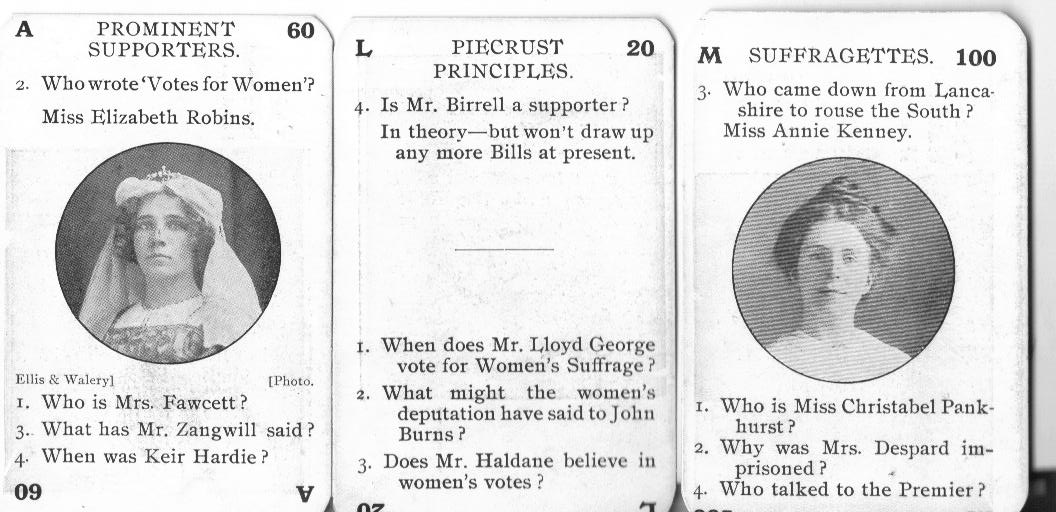
Elizabeth Robins, as author of ‘Votes for Women!’, featured on a card in ‘The Game of the Suffragette’
In the years that followed, the real-life activities of the suffragettes were reflected by the derring-do of their fictional equivalents in a steady stream of novels. Novelists could now take their middle-class readers into places they might not previously have sought to enter – even the prison cell – and were given legitimate reason to describe the indignities that might be wrought on women’s bodies, whether through the horrors of force-feeding or at the hands of policemen in battle outside the House of Commons. A hero of one such tale (A. Mollwo, A Fair Suffragette) is racked by ‘the picture of [a] fragile, slender little body at the mercy of this yelling, excited crowd, torn first one way, then another, insulted by angry policemen, knocked under the feet of horses.’

Words describing the WSPU Deeds – from Kate Frye’s diary
All in all, the wide range of ‘suffrage’ literature published during the course of the campaign – histories, tracts, speeches, leaflets and novels – offers historians and collectors a fascinating lens through which to view not only the political battle in all its complication, but also the changing perception of the position of women that in the end was so necessary to the winning the vote.
Women And The First World War: The Work Of Women Doctors
Posted by womanandhersphere in First World War on May 6, 2014
I wrote the following article back in 2006 and it was published in that July’s issue of Ancestors, a magazine published by The National Archives but now, alas, defunct.
The Work of Women Doctors in First World War
On 15 September 1914, six weeks after the outbreak of the First World War, Louisa Garrett Anderson, daughter of Britain’s first woman doctor, wrote to her mother, ‘This is just what you would have done at my age. I hope I shall be able to do it half as well as you would have done’. Louisa was writing in the train on her way to Paris where, with her companion, Dr Flora Murray, she proposed to set up a hospital to treat the war wounded.
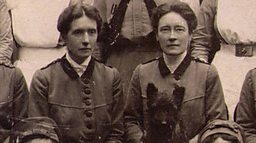
Louisa Garrett Anderson (r) and Flora Murray – plus dog. (Phot0 courtesy of BBC website)
Neither woman had any previous experience of tending male patients. Louisa was a surgeon in the New Hospital for Women, founded by her mother, and Flora was physician to the Women’s Hospital for Children that she and Louisa had established in London, in the Harrow Road. Although it was now nearly 40 years since British women had become eligible to study and practise medicine, they were still barred from posts in most general hospitals. Their work was confined to general practice and to the hospitals that had been founded by women to treat women and children. The war, however, created new conditions and by its close around one-fifth of Britain’s women doctors had undertaken medical war work, both at home and, more particularly, abroad.
This experience was not at first gained through the conventional conduit of the Royal Army Medical Corps or through the joint committee of the British Red Cross Society and the Order of St John that had been formed to co-ordinate voluntary medical work. The War Office, believing it had sufficient reserves of male medical personnel, refused to employ women doctors in war zones. However in the chaos of war the relief of suffering was open to any groups – even groups of women – able to raise the necessary funds and staff.
In autumn 1914 British agencies, such as the Serbian Relief Fund, the Society of Friends, the Wounded Allies Relief Committee and the British Farmers, quickly organized medical teams for service overseas. Many of these, such as the Berry Mission and the Almeric Paget Massage Corps, were happy to include women doctors. Of other ‘free enterprises’ the Women’s Imperial Service League, the Women’s Hospital Corps, and the Scottish Women’s Hospitals employed only women doctors.
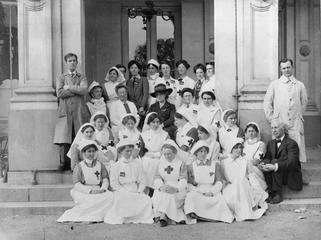
Mrs Stobart (centre) with her group in Antwerp. Sept 1914. Photo courtesy of Imperial War Museum Collection
The Women’s Imperial Service League was formed by Mrs Mabel St Clair Stobart in August 1914. Unlike most women of her day Mrs Stobart already had experience of organizing a medical mission to a war zone. In 1912 she had founded the Women’s Convoy Corps, taking it to Bulgaria during the first Balkan war. Mrs Stobart’s team had comprised three women doctors, ‘for the purpose of fully demonstrating my argument that women are capable of undertaking all work in connection with the sick and wounded in warfare.’ Similarly, at the invitation of the Belgian Croix Rouge, on 22 September 1914 she took the Women’s Imperial Service League unit to Antwerp.

Florence Stoney, wearing the decorations she received for her service during the First World War
The doctor-in-charge was Dr Florence Stoney, who before the war had set up the x-ray department at the Royal Free and the New Hospital for Women and who brought with her the very latest in x-ray equipment. Accompanying her were five other women, Drs Joan Watts, Helen Hanson, Mabel Ramsay (for her account of the expedition click here) , Rose Turner and Emily Morris. As the Germans overran Belgium the women were quickly forced to evacuate.
In April 1915, after working for a time in France, the Stobart Unit set out for Serbia, under the auspices of the Serbian Relief Fund. That country had lost many of its own doctors and was grateful for the assistance of the Unit, which by now comprised 15 women doctors. The Unit dealt with those wounded in battle but also played an important part in treating the neglected civilian population. Typhus was a major threat to the health of both soldiers and civilians and the Unit set up roadside dispensaries so that patients could be treated before they entered towns and spread infection further. This work came to an end when Bulgaria invaded Serbia in October 1915 and the Unit was forced to retreat.
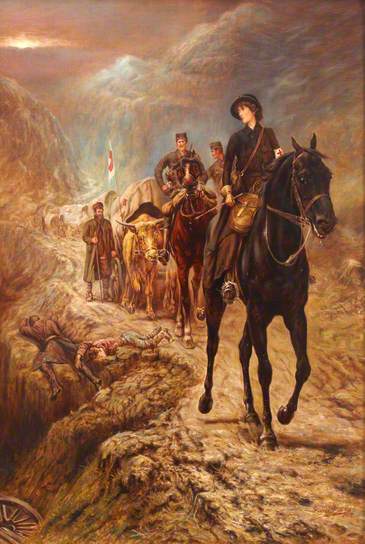
George James Rankin, Mrs M. A St Clair Stobart (Lady of the Black Horse. (c) British Red Cross Museum and Archives; Supplied by The Public Catalogue Foundation)
Mrs Stobart, a feminist but fiercely independent, had not been directly involved in the pre-war suffrage campaign, unlike many of her doctors. Drs Helen Hanson and Dorothy Tudor, who went out to Bulgaria with her in 1912, were members of the Women’s Freedom League and Dr Mabel Ramsay had been secretary of the National Union of Women’s Suffrage society in Plymouth. Indeed women doctors, as a class, had been very much involved in the suffrage movement, the greater number being associated with the non-militant National Union of Women’s Suffrage Societies (NUWSS). Most women could not afford to jeopardize their livelihood and professional standing by serving a prison term.
As tax payers many doctors were members of the Tax Resistance League, prepared to commit acts of civil disobedience that did not result in imprisonment. Louisa Garrett Anderson and Flora Murray were relatively unusual in being supporters of Mrs Pankhurst’s Women’s Social and Political Union. Indeed in 1912 Louisa Garrett Anderson had joined the hunger strike when imprisoned in Holloway after taking part in a WSPU window-smashing raid. However on the outbreak of war the suffrage campaign was suspended and within eight days women doctors, both suffragettes and suffragists, were planning how best to give practical support to the war effort.
Louisa Garrett Anderson and Flora Murray wasted no energy in approaching the War Office. Instead, on 12 August, they called in person at the French Embassy, offering to raise and equip a surgical unit, comprising women doctors and trained nurses, for service in France. Within a week the French Red Cross had accepted this offer. The newly-formed Women’s Hospital Corps quickly raised £2000 and on 17 September 1914 Louisa Garrett Anderson was in Paris, writing that ‘we found Claridge’s Hotel [in which their hospital was to be housed] a gorgeous shell of marble and gilt without heating or crockery or anything practical but by dint of mild ‘militancy’ & unending push things have advanced immensely.’
Working alongside Anderson and Murray were Drs Gertrude Gazdar, Hazel Cuthbert and Grace Judge. On 27 September Louisa wrote to her mother: ‘The cases that come to us are very septic and the wounds are terrible. .. We have fitted up quite a satisfactory small operating theatre in the ‘Ladies Lavatory’ which has tiled floor and walls, good water supply & heating. I bought a simple operating table in Paris and we have arranged gas ring and fish kettles for sterilization…After years of unpopularity over the suffrage it is very exhilarating to be on top of the wave, helped and approved by everyone, except perhaps the English War Office, while all the time we are doing suffrage work – or woman’s work – in another form…I wish the whole organization for the care of the wounded…could be put into the hands of women. This is not military work. It is merely a matter of organisation, common sense, attention to detail and a determination to avoid unnecessary suffering and loss of life.’
In March 1915, after running a second hospital at Wimeueux, close to heavy fighting, the Women’s Hospital Corps received the accolade from the War Office of being put in charge of a new military hospital in London, housed in the former St Giles Workhouse in Endell Street, Covent Garden.
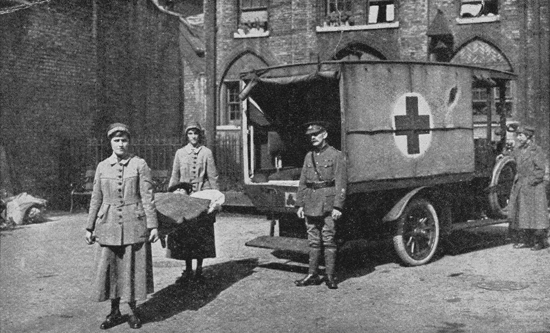
Endell Street Military Hospital, 1919. Courtesy Wellcome Library, London. Wellcome Images
images@wellcome.ac.uk
The hospital staff comprised women only and included 15 doctors, surgeons, ophthalmic surgeons, dental surgeons, an anaesthetist, bacteriological and pathological experts and seven assistant doctors and surgeons, together with a full staff of women assistants. Members of the executive staff were ‘attached’ to the Royal Army Medical Corps, holding equal rank and receiving equal pay with Army doctors, but were not commissioned and did not wear army uniform. Flora Murray’s rank was equivalent to that of a lieutenant-colonel and Louisa Garrett Anderson’s that of a major. For a ‘Woman’s Hour’ podcast about the Endell Street Hospital click here.
The hospital proved particularly successful in gaining the loyalty of its patients. One, Private Crouch, wrote in 1915 to his father in Australia: ‘The management is good, and the surgeons take great interest in and pains with their patients. They will persevere for months with a shattered limb, before amputation, to try to save it…The whole hospital is a triumph for women, and incidentally it is a triumph for suffragettes’. The Endell Street hospital was retained in service until October 1919, longer than many other temporary military hospitals, and in its time treated over 24,000 soldiers as in-patients and nearly the same number of out-patients.
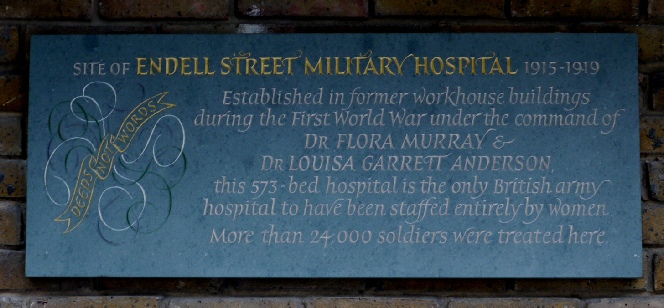
Plaque commemorating the Endell Street Military Hospital (photo courtesy of Plaques of London website)
Louisa Garrett Anderson who, like all the other women surgeons, had had no previous experience of trauma surgery, was particularly interested in the treatment of gunshot wounds. She backed the BIPP treatment (bismuth and iodoform paraffin paste), publishing articles on the subject in the Lancet. Both Murray and Anderson were, in 1917, among the first to be appointed CBE.
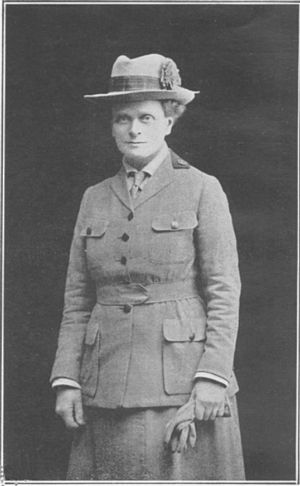
Elsie Inglis, 1916
On the very day in August 1914 that Anderson and Murray were offering their assistance at the French Embassy, Elsie Inglis, a Scottish surgeon, proposed to a meeting in Edinburgh of the Scottish Federation of the NUWSS, of which she was secretary, that help should be given to the Red Cross. Matters swiftly progressed until Inglis was able to offer a unit of 100 beds to either the War Office or the Red Cross. After receiving a sharp rebuff, she, too, approached the French Ambassador with an offer to send hospital units to France. A similar proposition was also made to the Serbian authorities.
By 19 November 1914 the first Scottish Women’s Hospital Unit For Foreign Service was in Calais, dealing with an outbreak of typhoid. The doctor in charge was Alice Hutchinson, who in 1912 had been a member of Mrs Stobart’s Women’s Convoy Corps. In fact it was for service in Serbia that this unit had been recruited and, after dealing with the Calais emergency, by spring 1915 it was able to set up a 40-tent hospital at Valjevo, 80 miles from Belgrade.
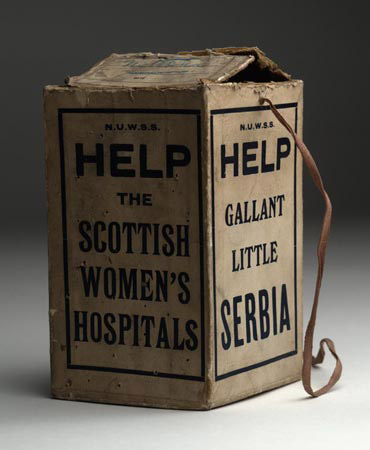
Scottish Women’s Hospitals Collecting box 1914-1918. Image courtesy of National MuseumsScotland. http://www.nms.ac.uk
On 2 December 1914 the SWH’s first French unit (that is, the first intended for France) left Waverley Station, bound for Royaumont, where it was to be housed in a 13th-century Abbey.
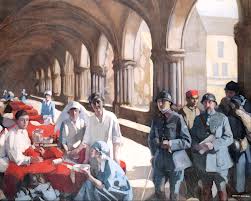
Norah Neilson-Gray. The Scottish Women’s Hospital : In The Cloister of the Abbaye at Royaumont. Dr. Frances Ivens inspecting a French patient. Picture courtesy Imperial War Museum Women’s Work Section
The unit comprised seven doctors, under the charge of Dr Frances Ivens. It was one of the hospitals closest to the front line and at its peak was, with 600 beds, the largest British voluntary hospital in France. On 25 September 1915 Miss M. Starr, a VAD at Royaumont, wrote of a casualty that had just arrived, ’One arm will simply have to be amputated, he had had poison gas, as well, and the smell was enough to knock one down, bits of bone sticking out and all gangrene. It will be marvellous if Miss Ivens saves it, but she is going to try it appears, as it is his right arm. He went to X-ray, then to Theatre, and I believe the operation was rather wonderful, but I had no time to stop and see’. Four days later she wrote, ‘The operating theatre is a horrible hell these days, it goes on till 2 and 3 in the morning. Then there is another fitted up temporarily on one of the Ward kitchens’.
In mid-1917 Royaumont opened a satellite camp hospital even closer to the line, at Villers Cotterets. From there in May 1918 Dr Elizabeth Courtauld wrote, ‘Terrible cases came in. Between 10.30 and 3.30 or 4 am we had to amputate six thighs and one leg, mostly by the light of bits of candle, held by the orderlies, and as for me giving the anaesthetic, I did it more or less in the dark at my end of the patient’.
Between January 1915 and February 1919 the surgeons at Royaumont and Villers Cotterets performed 7204 operations. The hospital had an excellent x-ray unit, necessary for locating bullets and shrapnel before surgery, and placed great importance on bacteriological examinations. To prevent death from gas gangrene the doctors followed the procedure developed in 1915 of extensive excision of the wound, which was then kept open, with an appropriate dressing, for later suture.
In May 1915 a second Scottish Women’s hospital was established by the ‘Girton and Newnham’ Unit, in tents, near Troyes. Its doctors included Laura Sandeman, Louise McIlroy and Isabel Emslie.
In November 1915 the unit was moved from France to Salonika, attached to the French Expeditionary Force. By April 1915 Elsie Inglis was in Serbia, in charge of another unit, the ‘London’. She worked there and in Russia until the autumn of 1917 when, with her unit, she returned, mortally ill, dying the day after arriving at Newcastle.
In Serbia the necessity was less for war surgery than for combating disease. Dysentery, typhus and malaria were rife. The SWH laboratory attached to the Girton and Newnham Unit was the best equipped in Serbia and its pathologists were kept busy. In it Isabel Emslie carried out cerebro-spinal fluid examinations for the consultant physician to the British Army, writing later, ‘I was proud and most willing to help by giving this voluntary contribution to the British, who had not thought fit to accept our SWHs.’
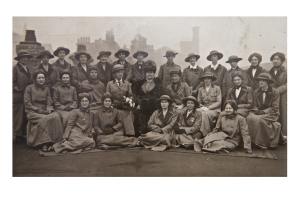
Girton and Newnham Unit of the Scottish Women’s Hospitals about to embark on board ship at Liverpool, October 1915. Photo courtesy of Royal College of Physicians and Surgeons of Glasgow Archive
In the summer of 1916 another SWH unit, named the ‘American Unit’ because it was financed by money raised in the USA, was sent to Ostrovo, 85 miles from Salonika. It was to remain in Serbia until mid-1919. Isabel Emslie became its chief medical officer in 1918.
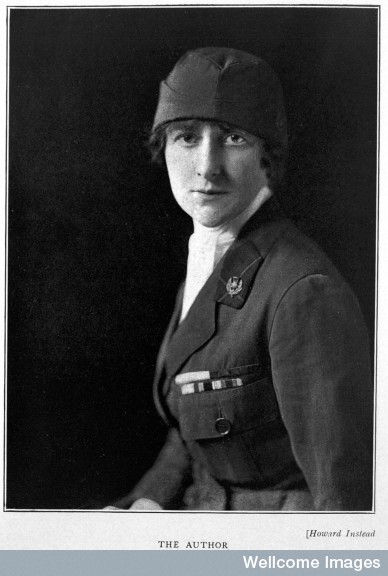
Dr Isabel Emslie. Courtesy Wellcome Library, London. Wellcome Images
images@wellcome.ac.uk
She later wrote, ‘I did the operating and was ably assisted by the keen young doctors, latterly arrived from home, who were able to brief me on the latest methods, for it was now four years since I had been home. I undertook major operations which I never imagined would have fallen to my lot, and I would never have had the temerity to tackle all the specialist operations if there had been anyone else capable of doing them. Looking back on a long life of medical work and service, I believe that my sojourn in Vranja was the most worth-while period of my war experience and possibly of my life’. The work of the SWH in Serbia only ended in March 1920, by which time over 60 British women doctors, some of whom were working independently of the SWH, had served in the country.
By 1916 the War Office, recognizing that the supply of male doctors was dwindling, reversed its policy and sent a contingent of 85 medical women to Malta. Others followed and, for the remainder of the war, were to be found working in Egypt, Salonika and the Sinai Desert. These women were attached to the RAMC, receiving 24s a day, the pay of a male temporary officer. However they did not have equal rights, were forced to pay for their own board and were not permitted to wear uniform.
In Britain, again in response to the shortage of male doctors, a few women were appointed to posts in military hospitals. For instance Dr Helena Wright was a surgeon at Bethnal Green Military Hospital and Dr Florence Stoney, following her work with Mrs Stobart’s Unit, was appointed to the x-ray department of the Fulham Military Hospital. In addition, as the war dragged on, new posts became available to women doctors in connection with the new women’s services, the WAAC, the WRNS, and the WRAF.
During the war the necessity of providing the country with doctors forced the medical profession to allow women access to schools previously the preserve of men. The London School of Medicine for Women also played its part, expanding rapidly until, by 1919, it was the largest medical school in the country.
In How to Become a Woman Doctor, published in 1918, the author optimistically wrote that ‘War-time appointments at large hospitals have given great satisfaction and done much to break down old conservative ideas’. However, with the return to peace, the forces of reaction regrouped. The Royal Free once again became the only London teaching hospital offering clinical instruction to women. Women doctors, even those who had gained extensive experience in all aspects of medicine during the previous four years, were relegated to the type of position that they had held before the war. Although doctors such as Louise McIlroy, Frances Ivens and Isabel Elmslie had distinguished post-war careers, these were not based on the practical experience they had gained during the war.
The war-work of women doctors was quickly forgotten. It is only in the last decade or so that detailed research on the subject has been published. This has been facilitated by war diaries and collections of letters donated to archives either by the women medical workers themselves or by their descendants. If you believe that you have in your possession any such material, do consider depositing it at one of the archives listed below.
Taking it further
Imperial War Museum, Lambeth Road, London SE1 6HZ holds books, papers and photographs relating to the work of medical women in the First World War.
The Liddle Collection, Leeds University Library, University of Leeds, LS2 9JT – is a specialist collection of primary material relating to the First World War, including papers of women doctors.
The Wellcome Library, 210 Euston Road, London NW! 2BE holds the archive of the Medical Women’s Federation, which includes some material relating to the work of women doctors in the First World War.
The Women’s Library@ LSE – holds papers relating to Louisa Garrett Anderson, Flora Murray and the Women’s Hospital Corps
Mitchell Library, 201 North Street, Glasgow holds the main archive of the Scottish Women’s Hospitals
Further Reading
Eileen Crofton, The Women of Royaumont: a Scottish women’s hospital on the Western Front (Tuckwell Press, 1997)
Monica Krippner, The Quality of Mercy: women at war, Serbia 1915-18 (David & Charles, 1980)
Leah Leneman, In the Service of Life: the story of Elsie Inglis and the Scottish Women’s Hospitals (Mercat Press, 1994)
Flora Murray, Women as Army Surgeons (Hodder & Stoughton, 1920)
[
Suffrage Stories: The Women’s Tax Resistance League And The Sad End Of Mrs Kineton Parkes
Posted by womanandhersphere in Uncategorized on May 1, 2014

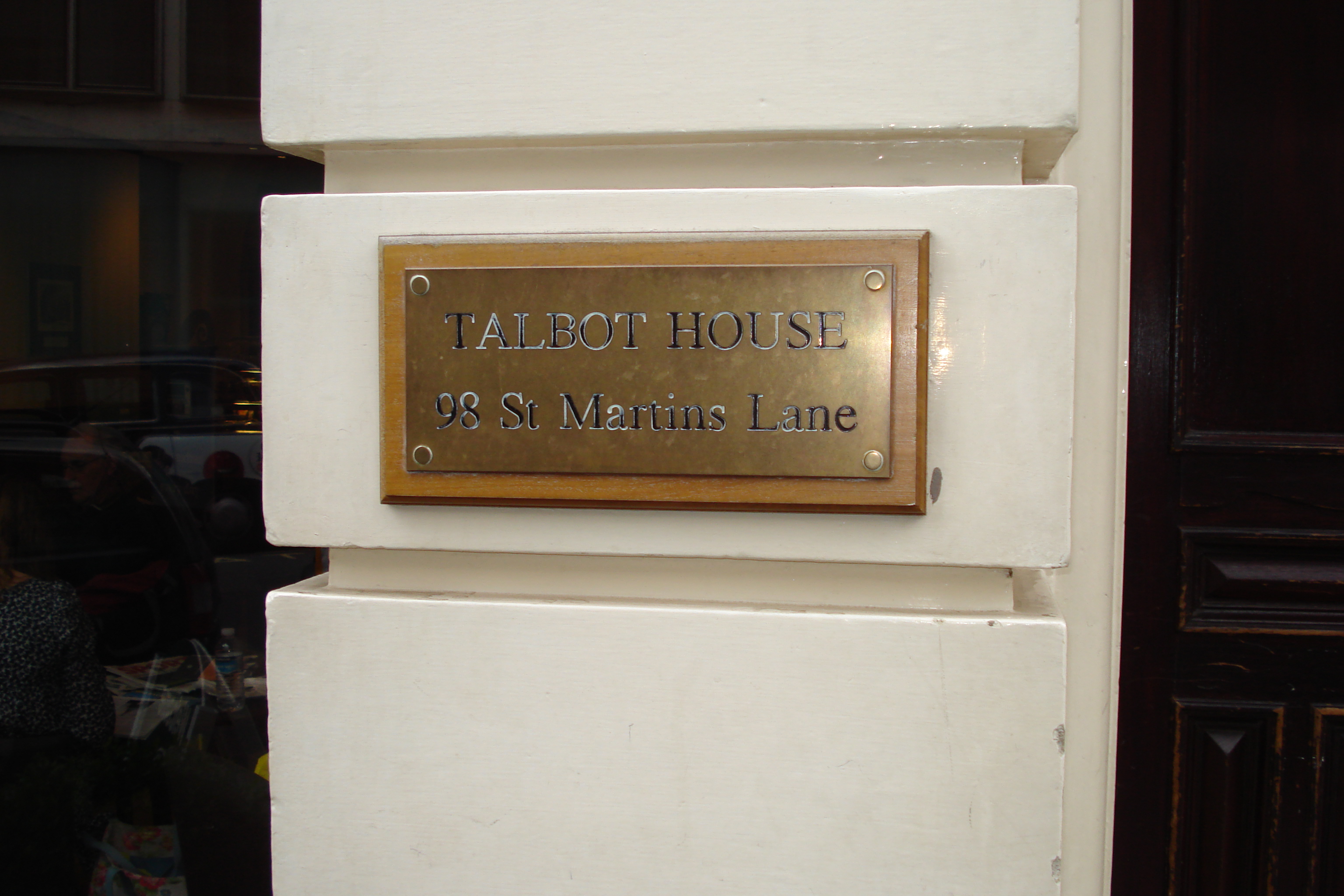
98 St Martin’s Lane, home of the Women’s Tax Resistance League
Flat 10, Talbot House, 98 St Martin’s Lane, on the borders of Covent Garden, was from 1910 the office of the Women’s Tax Resistance League and the home of Mrs Margaret Kineton Parkes (1865-1920), its indefatigable secretary. In 1889 she had married William Kineton Parkes, novelist, art historian and librarian to the Nicholson Institute in Leek, Staffordshire, built as a memorial to Richard Cobden. The couple had two sons, Gabriel and Maxwell, but by 1909, when Margaret Kineton Parkes moved to London, they appear to have separated.
Needless to say Mrs Kineton Parkes was not at home on the night of 2 April 1911 when the census was taken. The Women’s Tax Resistance League had been one of the societies that strongly supported the WFL/WSPU call to boycott the census and she doubtless spent the night at the Aldwych Skating Rink and the Gardenia Restaurant. Her son, Maxwell, was enumerated at the Letchworth home of Clara Lee of Norton Way, Letchworth, who was herself a census evader. Gabriel Parkes spent census night in Wandsworth at the home of a fellow agricultural student.
I suspect that Mrs Kineton Parkes was dependent on her work for the Women’s Tax Resistance League for her income. She certainly sent out frequent letters to other societies, advertising her services as a lecturer. For further information see my The Women’s Suffrage Movement: a reference guide (entries under ‘Parkes, Mrs Margaret Kineton’ and’Tax Resistance League’).
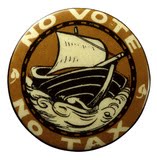
Women’s Tax Resistance League badge
In February 1914 Maxwell Parkes set sail for Wellington, New Zealand, his occupation described on the passenger list as ‘Farming’, although he was later, in various documents, described as ‘traveller’ (as in ‘commercial traveller’) and as ‘photographer’.
In August 1914, with suffrage campaigning put aside for the duration of the war, Mrs Kineton Parkes became financial secretary to the newly founded Women’s Emergency Corps. In March 1915 she was given a cheque as a testimonial for her work for the Women’s Tax Resistance League. This was presented at a ceremony held at the home of Miss Gertrude Eaton, who had been an active tax resister and the chairman of the meeting was Mrs Cecil Chapman, president of the New Constitutional Society for Women’s Suffrage.
On 2 November 1917 another meeting was held by member of the Tax Resistance League at Gertrude Eaton’s home, this time to wish Margaret Kineton Parkes ‘heartiest good wishes for health, happiness and prosperity’ prior to her departure on 16 November for New Zealand, travelling out to stay with her son Maxwell near Dunedin. She left with the society the text of a history of the Tax Resistance League, which was I think published as a pamphlet in 1919.
During 1918 and 1919 Margaret Kineton Parkes travelled the length and breadth of New Zealand, lecturing on women’s war work, on the struggle for the vote in Britain, and advocating a total prohibition on the sale of alcohol in NZ. See here for her views on the latter as reported in the Wairarapa Daily Times, 8 August 1919. You can read here her comments on the passing of theUK Representation People Bill, as expressed to the reporter from the Otago Times, 15 February 1918.
Mrs Kineton Parkes was still lecturing at the end of November 1919 and her death on 13 May 1920 was described as ‘sudden’.

Seacliff Mental Hospital, Dunedin, New Zealand
In fact she died in the Seacliff Mental Hospital, some miles outside Dunedin, the institution in which the writer Janet Frame was many years later to be a patient. Mrs Kineton Parkes was only 55 years old; an inquest was held and the coroner’s report gave the cause of her death as ‘exhaustion from acute delirious mania’. A sad end.
 Woman and her Sphere