Archive for March, 2013
Women Writers and Italy: Two Englishwomen In Rome and Sarah Parker Remond
Posted by womanandhersphere in Women Writers and Italy on March 30, 2013
Anne ( 1841-1928) and Matilda Lucas (1849-1943) were the daughters of Samuel Lucas, a brewer with land and influence in Hitchin, Hertfordshire. The Lucas family were Quakers. Their mother had died when they were young and after their father’s death in 1870 the sisters continued to live for a short time with their step-mother. But then, in mid-1871, they left England for Rome, where, for the next 29 years, they were to spend much of the year. Ten years after her sister’s death, Matilda Lucas published excerpts from the letters sent over the years by the sisters to friends and relations back in England. Two Englishwomen in Rome, 1871-1900 (Methuen, 1938) makes very interesting reading.
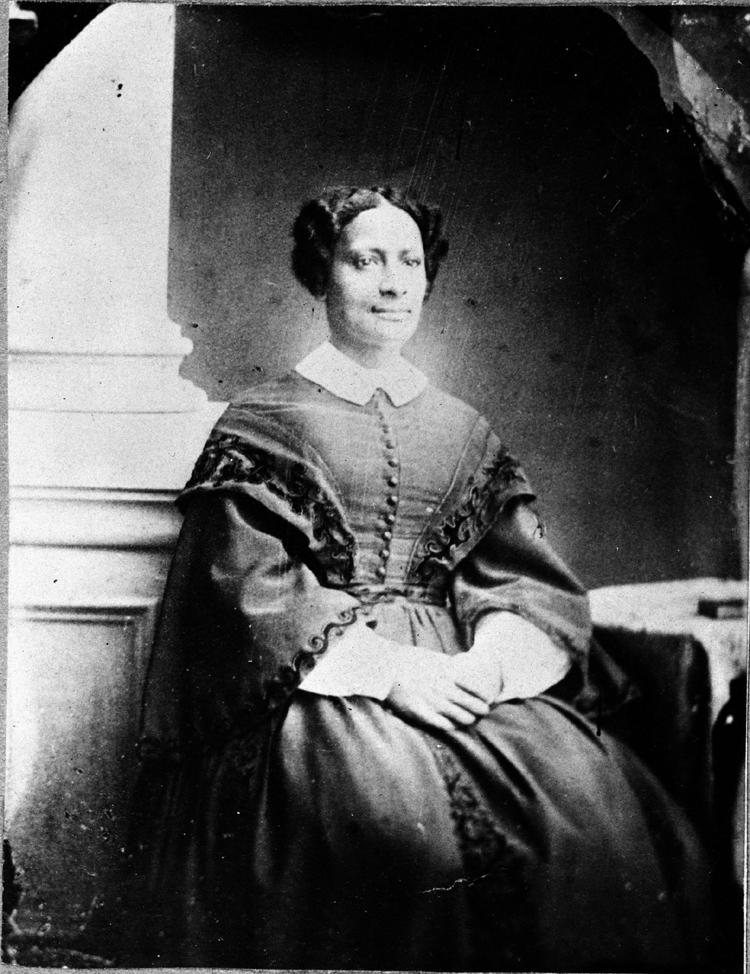
Sarah Parker Remond c. 1865 (Courtesy Peabody Essex Museum Collection)
The few disingenuous sentences I transcribe below would appear to delineate the discomfort that must have been endured by Sarah Parker Remond (1824-94) , or Sarah Remond Pintor as she was by then, as she mixed in society – even expatriate Roman society, which was by no means ruled by convention. An American free-born black woman, Sarah Remond had lived for a time in London, signing the first women’s suffrage petition in 1866, perhaps the only black woman to do so, had then travelled to Italy, where she qualified as a doctor. She had married an Italian, Lazzaro Pintor in Florence in 1877. There is some debate as to how long the marriage lasted. From the Lucas’ evidence, Pintor did not accompany his wife to this social occasion in Rome in March 1878, but Sarah was sufficiently still married to feel able to don her bridal dress.
However am I correct, I wonder, to read the passage as reflecting the curiosity and, perhaps, also slight discomfort felt by the gathering at the presence of a black woman in their midst? If Sarah was their aunt the P___s must surely have been the ‘Putnams’ – the family of Sarah’s sister, Caroline Remond Putnam, who lived with her in Italy on various occasions. If so the fact that Caroline also was ‘black’ makes the passage a little difficult to interpret. Why was Sarah specifically their ‘black aunt’? Did they have any other kind? So perhaps it was only the bridal dress that was the cause for comment. A simple scene, but something of a puzzle.
March 17, 1878. Tell Madgie that the P___s were there with their black aunt. She was a bride, having just married an Italian, and wore her bridal dress of grey silk. It must have been very trying for Mrs P____. People came up to question her. One Italian said, ‘Chi e quell’Africana?’ It appears that she is very clever, and a female doctor. She was taken up a good deal in London by different people who were interested in negroes. I think she lived with the Peter Taylors. She has given lectures. I went to sit on the sofa with her, to the amusement of Franz, who cannot rise above her appearance. Dr Baedtke was much impressed to think that anyone has had the courage to marry her, and said, ‘In that I should have been a coward.’
Click here for Sarah Parker Remond: A Daughter of Salem, Massachusetts – a very interesting website
Elizabeth Garrett Anderson Gallery At The UNISON Centre
Posted by womanandhersphere in The Garretts and their Circle on March 28, 2013
ALAS, IT WOULD APPEAR THAT THE GALLERY HAS FAILED TO REOPEN AFTER COVID CLOSURE. PLEASE PHONE UNISON TO ENQUIRE.
The Elizabeth Garrett Anderson Gallery at the UNISON Centre tells the story of Elizabeth Garrett Anderson, of the hospital she built, and of women’s struggle to achieve equality in the field of medicine.

HAElizabeth Garrett Anderson
Elizabeth Garrett Anderson (1836-1917) was determined to do something worthwhile with her life. In 1865 she qualified as a doctor. This was a landmark achievement. She was the first woman to overcome the obstacles created by the medical establishment to ensure it remained the preserve of men.
Elizabeth Garrett Anderson then helped other women into the medical profession, founding the New Hospital for Women where women patients were treated only by women doctors.
Elizabeth Garrett Anderson, by her example, demonstrated that a woman could be a wife and mother as well as having a professional career.
Elizabeth Garrett Anderson worked to achieve equality for women, being especially active in the campaigns for higher education and ‘votes for women’.
In the early 1890s the New Hospital for Women (later renamed the Elizabeth Garrett Anderson Hospital) was built on the Euston Road and continued to treat women until 2000. For some years this building then lay derelict until a campaign by ‘EGA for Women’ won it listed status. UNISON has now carefully restored the building, bringing it back to life as part of the UNISON Centre.
Two important rooms in the original 1890 hospital building have been dedicated to the Elizabeth Garrett Anderson Gallery. One is the
ORIGINAL ENTRANCE HALL
of the hospital which has been carefully restored to its original form. Here you can study an album, compiled specially for the Gallery, telling the history of the Elizabeth Garrett Anderson Hospital in words and pictures, while, in the background you can listen to a soundscape evocative of hospital life. This is interwoven with the reminiscences of hospital patients, snippets from the letters of Elizabeth Garrett Anderson and sundry other sounds to stimulate your imagination.
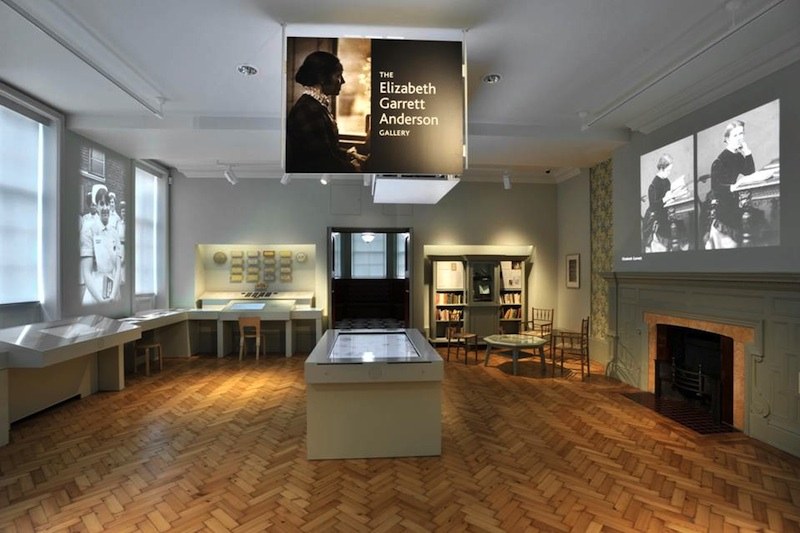
The main gallery
The other Gallery room is what was known when the hospital opened as
THE MEDICAL INSTITUTE
This was a room, running along the front of the hospital, parallel to Euston Road, set aside for all women doctors, from all over the country, at a time when they were still barred from the British Medical Association. It was intended as a space in which they could meet, talk and keep up with the medical journals.
Here you can use a variety of media to follow the story of women, work and co-operation in the 19th and 20th centuries.
A BACK-LIT GRAPHIC LECTERN RUNS AROUND THE MAIN GALLERY:
allowing you to see in words and pictures a quick overview of the life of Elizabeth Garrett Anderson and of her hospital.
AT INTERVALS ARE SET SIX INTERACTIVE TOUCH-SCREEN MONITORS
-named – Ambition, Perseverance, Leadership, Equality, Power in Numbers and Making Our Voices Heard – allowing you to access more information about Elizabeth Garrett Anderson, about the social and political conditions that have shaped her world and ours, and about the building’s new occupant – UNISON..
Each monitor contains:
TWO SHORT VIDEO SEGMENTS.
‘Elizabeth’s Story’. Follow the video from screen to screen. Often speaking her own words, the video uses images and voices to tell the story of Elizabeth Garrett Anderson’s life.
‘UNISON Now’ UNISON members tell you what the union means to them.
and four
INTERACTIVES
‘Campaigns for Justice’ and ‘Changing Lives’.
Touch the screen icons to discover how life in Britain has changed since the birth of Elizabeth Garrett Anderson.
AMBITION
Campaigns for justice
Victorian Britain: a society in flux
Victorian democracy: who could vote, and who couldn’t
Did a woman have rights?
Workers organised
Changing lives
The people’s lives in Victorian Britain
The medical profession before Elizabeth Garrett
Restricted lives, big ambitions: middle-class women in the Victorian era
Women workers in the first half of the 19th century
PERSEVERANCE
Campaigns for justice
The changing political landscape
Widening the franchise: can we trust the workers?
Women want to vote: the beginnings of a movement
Trade unions become trade unions
Changing lives
A new concept of active government: Victorian social reform
Women as nurses and carers
Living a life that’s never been lived before: women attempt to enter medicine
International pioneers: women study medicine abroad
LEADERSHIP
Campaigns for justice
Contagious Diseases Acts
Trade unions broaden their vision
Women and education
Women trade unionists
Changing lives
The middle-class century
Working women in the second half of the 19th century
Social reform, philanthropy and paternalism
Women doctors for India
EQUALITY
Campaigns for justice
The women’s suffrage movement
The Taff Vale decision hampers the unions
The founding of the Labour party
The People’s Budget
Changing lives
Work and play
Marylebone and Somers Town
Did the working classes want a welfare state?
1901 – Who were the workers in the NewHospital for Women?
POWER IN NUMBERS
Campaigns for justice
The General Strike – 1926
The first Labour governments
Feminist campaigns between the wars
1901: The lives of working women in London
Changing lives
Work of women doctors in the First World War
Can we afford the doctor? Health services before the NHS
Wartime demand for social justice
The creation of the National Health Service 1945-1948
MAKING OUR VOICES HEARD
Campaigns for justice
Equality campaigns
Public sector unions before UNISON
UNISON brings public service workers together
Are trade unions still relevant?
Changing lives
The National Health Service becomes sacrosanct
Did the welfare state change the family?
Women’s equality today
Women in medicine now
IN THE CENTRE OF THE GALLERY YOU WILL FIND:
ENTERPRISING WOMEN
an interactive table containing short biographies of over 100 women renowned for their achievements in Britain in the 19th-21st centuries. Up to four visitors can use the table at any one time. Drag a photograph towards the edge of the table to discover details of that individual’s life. Or search by name or vocation, using the alphabetical or subject lists.
ON THE WALLS OF THE GALLERY
PROJECTIONS
show a changing display of pictures of the hospital as it was and of Elizabeth Garrett Anderson and some of the other women whose stories the Gallery tells.
 THE GARRETT CORNER
is designed in the style associated with the work of Elizabeth Garrett Anderson’s sister, the architectural decorator Agnes Garrett, who was in charge of the original interior decoration of the hospital in 1890. The Gallery’s fireplace is the only surviving example of Agnes Garrett’s work. Next to this hangs a length of wallpaper, ‘Garrett Laburnum’, re-created from one of her designs.
In the Garrett Corner a display case and a low table contain a small collection of objects relevant to Elizabeth Garrett Anderson, the hospital and early women doctors.
While here do sit down and browse the library of books. These relate to the history of women – in society, in medicine, in the workplace, and in trade unions – and to the Somers Town area.
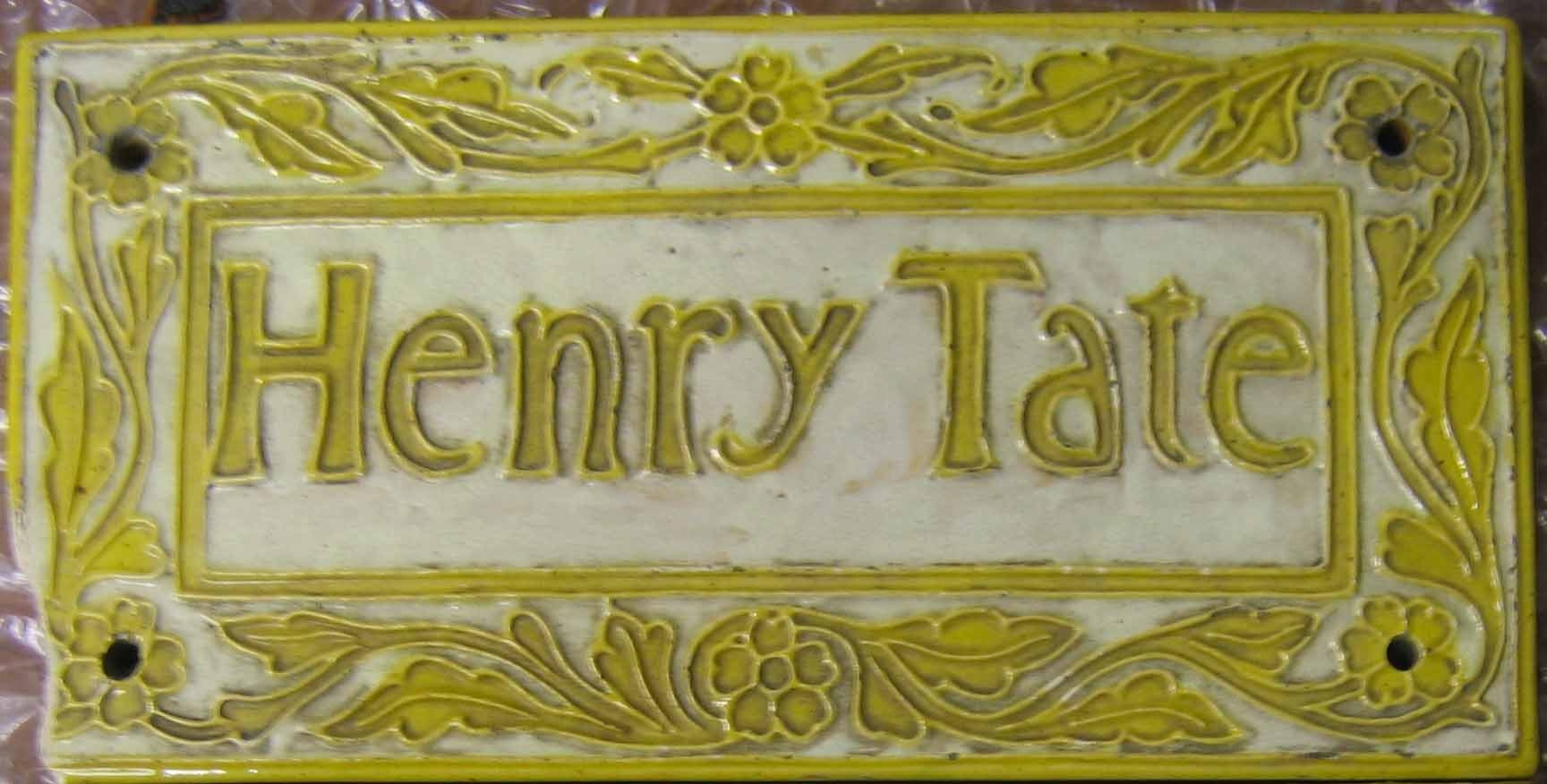
Plaque commemorating a substantial donation to the hospital by Henry Tate, industrialist and philanthropist
ACROSS FROM THE GARRETT CORNER IS A DISPLAY OF CERAMIC PLAQUES
Decorative plaques that used to hang beside patients’ beds, each commemorating a donor’s generosity.
You can read in detail about the work of the Garrett family in the fields of medicine, education, interior design, landscape design, citizenship and material culture in Elizabeth Crawford, Enterprising Women: the Garretts and their circle, published by Francis Boutle Publishers, £25. The book can be bought direct from womanandhersphere.com or click here to buy from the publisher
DO VISIT:
Elizabeth Garrett Anderson Gallery at the UNISON Centre
130 Euston Road
London NW1 2AY
Telephone: 0800 0 857 857
Open Wednesday to Friday 9.00am to 6.00pm
and the third Saturday of every month 9.00am to 4.00pm
Admission Free
Suffrage Stories: Devon Suffragists
Posted by womanandhersphere in Suffrage Stories on March 26, 2013
NUWSS South-West branch of the Pilgrimage photographed in 1913
In the summer of 1913, in the aftermath of Emily Wilding Davison’s spectacular funeral procession, while WSPU members were reading in the pages of The Suffragette details of Mrs Pankhurst’s successive hunger strikes, numerous reports of increasingly dangerous suffragette militancy, and Christabel Pankhurst’s denunciation of prostitution and venereal disease (eventually published as The Great Scourge), the constitutional suffragists, the National Union of Women’s Suffrage Societies, were planning a ‘Woman’s Suffrage Pilgrimage’.
The Pilgrimage was intended to act as a counter to suffragette militancy, to create a spectacle demonstrating that women, while disciplined, were also law-abiding. The air of spirituality that had surrounded Emily Davison’s coffin was paralleled by the consciousness-raising intent of the Pilgrimage. It is interesting to note that the model, which had been enacted the previous autumn when a small group of women had journeyed from Edinburgh to London, was known as the ‘Women’s March’. By mid-1913 the mood had changed – the women were no longer marchers, they were pilgrims.
In my Women’s Suffrage Movement: a reference guide I give an account of the various strands of the Pilgrimage, which, beginning at various distant points in England, approached London along eight main routes.
Now, to mark the centenary of the Pilgrimage, the Dreadnought South West Association is planning to tour a new play, ‘Oxygen’, playing at many of the stopping places of the south-west route of the Pilgrimage, which began at Land’s End on 19 June. One of those involved in planning the Pilgrimage commemoration is Dr Julia Neville, details of whose latest book are given below.
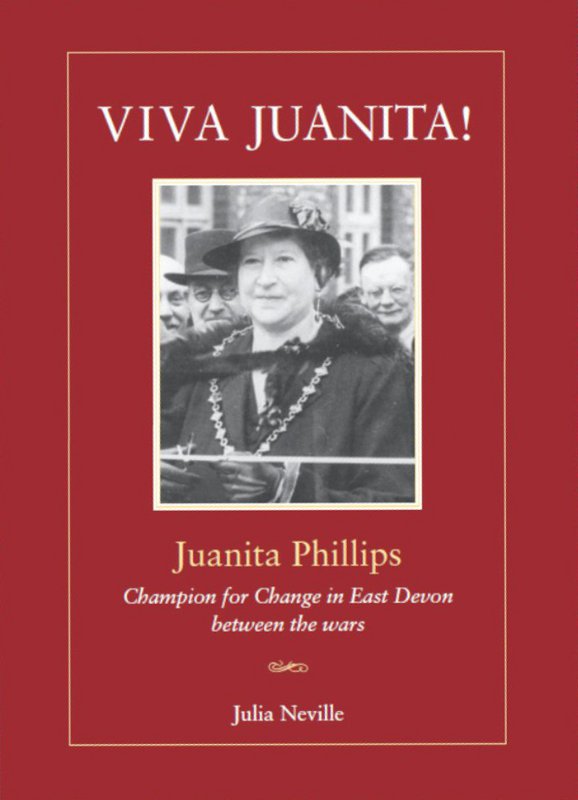 Viva Juanita:
Juanita Phillips: Champion for Change in East Devon between the wars
by Julia Neville
‘”Juanita Maxwell Phillips, OBE (1880 – 1966) was eleven times Mayor of Honiton, Alderman and Freeman of the Borough, Devon County Councillor and County Alderman, JP and OBE. Her extraordinary story – from Chile to Honiton, from suffragette to pillar of the establishment, from amateur dramatics to theatre impresario – was uncovered in 2009 by the Senior Council for Honiton. It was brought to life in Honiton in newspaper articles, presentations, commemorative events, and a Honiton Players production, Viva Juanita! Now this fascinating illustrated book tells her story in words and pictures.”
For details of how to buy Viva Juanita see here
While being generally interested in NUWSS activities, I have an interest slightly more personal in the Devon branch because for some years before 1913, its secretary was Miss Jessie Montgomery, who was also a mover in establishing the college that eventually became Exeter University. When I arrived as a student I was among the first intake at a hall of residence that went by what seemed the rather cumbersome name of ‘Jessie Montgomery House’. We were never told who this Jessie Montgomery was – or had been – and I must say I never inquired – although I do remember being rather pleased when I could give her some reality, after coming across a commemorative plaque to her in Exeter Cathedral. Anyway, Miss Montgomery is now once more history – I see that ‘her’ hall of residence, along with others on that campus, have now been demolished. Sic transit…
Suffrage Stories: ‘From Frederick Street to Winson Green’: The Birmingham Women’s Suffrage Campaign
Posted by womanandhersphere in Suffrage Stories on March 22, 2013
On 13 October 2008 I gave the following talk in King’s Norton, Birmingham. It was part of a series of lectures to commemorate the restoration of the Old Grammar School and the Saracen’s Head, which in 2004 had won the BBC’ ‘Restoration’ television series.
I chose the title ‘From Frederick Street to Winson Green’ because it is interesting to trace the growth of the women’s suffrage movement in Birmingham through the streets and buildings in which the men and women of the city conducted their campaign. We will see that this campaign moved slowly from a domestic environment, from the villas (particularly the drawing rooms) of its main protagonists – into the public buildings and then the streets of Birmingham. And it was in Winson Green, the city’s castellated jail, that in 1909 the campaign which had begun 43 years earlier, took on a completely different and very much more dangerous aspect, that for which it has become notorious, when it was in there that suffragettes were forcibly fed for the first time in Britain.
But to begin at the beginning – it is worth bearing in mind that the campaign for women’s enfranchisement was just one among many in which liberal-minded men and women of the mid-19th century were interested. The campaigns for, example, land reform, anti-vaccination, compulsory education, early closing, and the Sunday opening of museums and art galleries were ones to which equal attention was devoted by their adherents. In 1866 the country was aware that parliamentary reform was in the air. It was over 30 years since the last attempt at reform and those who had industrialised Britain were determined that their exclusion from the franchise should be remedied. John Bright, who from 1858 had been Birmingham’s Radical MP, was at the forefront of this agitation. It was not, however, around Bright, who, unlike the rest of his remarkable family, was never in favour of giving any women the vote, but around another Radical MP, John Stuart Mill, that the campaign to include women in this potentially enlarged electorate was to centre. When Mill was elected to the Westminster seat in 1865 it was on a manifesto that included women as a category in a proposed enlarged franchise
A year later, in June 1866, he presented to Parliament a petition, signed by 1499 women, asking that the vote should be given to women on the same terms as it was given to men. This did not, of course, mean that all women should have a vote – any more than it meant all men – the capacity to vote was still to be determined by a property qualification. This petition includes only three names definitely from the Birmingham area – one woman lived at King’s Heath and two in Hockley. None of these women played any significant part in the ensuing campaign and it is likely that they were each asked to give their signature by a friend or relation from outside the area. There was clearly not yet an existing ‘feminist network’ in Birmingham, although this situation was soon to be remedied by the arrival at 10 Chad Road,
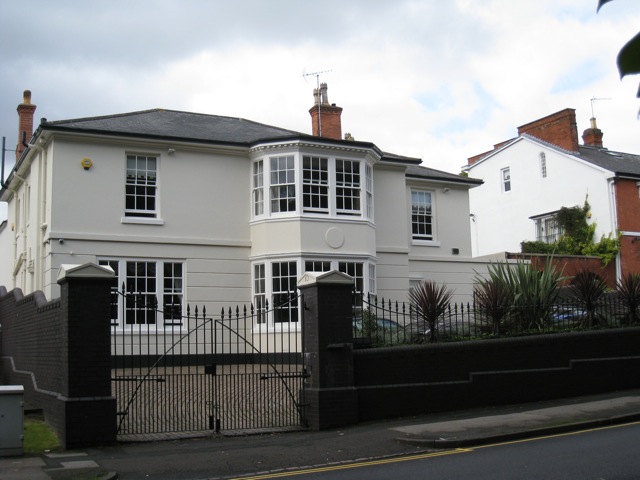
10 Chad Road (with thanks to Carole McKeown)
Edgbaston in c. 1867 of William Taylor and his young family. He was a member of a family that was closely involved both by business and marriage with the Courtaulds, manufacturers in Essex of that most eminently Victorian material – crape. Courtauld and Taylor fortunes were built on the backs, literally, of mourning Britons. William’s brother, Peter Alfred Taylor, was the very wealthy and very radical MP for Leicester. P.A. Taylor’s wife, Clementia, had been very active in the campaign to abolish slavery – as well as in numerous other radical causes – and was a member of the committee that organised that first women’s suffrage petition. William Taylor’s wife, Caroline, had signed the petition while they were living in Bridgwater. The family was Unitarian (as were so many others of their fellow campaigners of this period) and William is described in the 1871 census as an iron merchant and manufacturer.
The 1867 Reform Bill, when passed, did not, of course, include women in the enlarged franchise and groups of men and women in London and Manchester slowly formed themselves into the nuclei of a continuing campaign to put further petitions before parliament. At the time this was seen as the correct way in which to exert pressure on parliament; methods were to change over the years.
A committee of this National Society for Women’s Suffrage was formed in Birmingham on 21 April 1868 ‘in accordance with the request of Mrs P. Taylor, the Secretary of the London Suffrage Society, who had urged Mrs William Taylor, of Birmingham, and Miss Johnson to take up the matter’. A month later the committee held its first public meeting at the Exchange Rooms in New Street. William and Caroline Taylor were from the first members of the Birmingham executive committee and in 1868 Caroline was its treasurer. The first secretary was Mary Johnson, who had already been subscribing to the main London suffrage society in 1867. She lived with her parents, George and Fanny Johnson, at 90 Wheeley’s Road in Edgbaston. George Johnson is described in the 1871 census as an Independent minister. Lydia Becker, who was secretary of the very influential women’s suffrage society in Manchester, acted as Mary Johnson’s mentor, giving her guidance in setting up and running the society.
However in 1870 after her marriage, Mary Johnsonmoved to West Bromwich and was succeeded as secretary by Eliza Mary Sturge who lived at 17 Frederick Street (long ago renamed ‘Frederick Road’). She was the 28-year-old daughter of Charles Sturge, alderman of the city, brother of Joseph Sturge. The latter was by then dead, but very much alive in the Birmingham municipal memory. In the 1820s he had been one of the most vociferous campaigners against slavery and had been secretary of the Birmingham Anti-Slavery Society – even going out to the West Indies to inspect conditions there for himself. In the 1840s Joseph Sturge had been a leading campaigner in favour of the repeal of the Corn Laws, had throughout his life been an ardent supporter of free trade, peace and temperance, an advocate of manhood suffrage, founder of the Complete Suffrage Union, but, like John Bright, was not prepared to include women in any proposed enlarged franchise.

Sturge statue
After his death, in 1862 a fountain and statue had been dedicated to his memory at Five Ways, in Edgbaston and it is still there, despite all the road alterations. His brother, Charles, who worked in business with him as a corn merchant, was also involved in Joseph’s philanthropic endeavours but, unlike him gave practical, financial, support to the women’s suffrage movement. In 1871 he lived with his two daughters, Eliza and Maria, at 17 Frederick Street and it was from her home that Eliza conducted the business of the Birmingham Women’s Suffrage Society. The Sturges were Quakers and were related to the Clark family – the Quaker shoe makers – of Street in Somerset, who with other Sturge cousins were influential in the Bristol women’s suffrage society.
Having taken over the role of secretary in Birmingham, Eliza quickly became an active speaker in the suffrage cause. It was the policy of the suffrage societies around the country to attempt to influence both the existing, male, electorate and the women of the country by holding public meetings, using both local and imported speakers to lay out the arguments for women’s right to a vote in pithy speeches. In December 1871 there had been such a meeting in Birmingham, held in the Masonic Hall and described as crowded and highly successful.
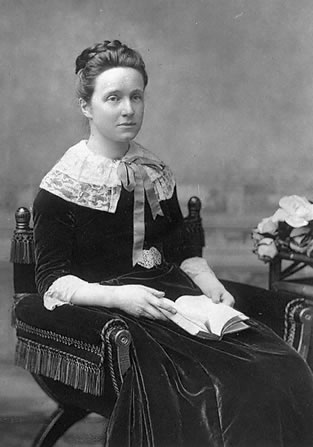
Millicent Fawcett
Millicent Garrett Fawcett came from London to speak at it. Eliza Sturge herself also took to the road as a suffrage speaker. In 1872, for instance, she was a speaker at suffrage meetings in both Bristol and Rochdale. A speech she gave on 6 December that year at BirminghamTown Hall was reprinted as a pamphlet. In the course of this speech she mentions that ‘I know that I can go and return from public meetings alone at night without experiencing the slightest difficulty or annoyance’, which says something about the streets of Birmingham at the time and gives us an idea of how Eliza Sturge occupied her evenings! Millicent Garrett Fawcett was again a speaker and her speech was also reprinted. In it she made the point that ‘I can scarcely imagine that the Birmingham politicians, who took so prominent part in the reform agitation for the extension of the suffrage to working men, can be blind to the patent fact that all the most convincing arguments used during that agitation in favour of admitting the working classes to representation apply with equal cogency to the case of women.’ In 1873, very soon after women became eligible to stand, Eliza Sturge was elected as a member of the Birmingham School Board, of which Joseph Chamberlain was then the chairman. She was a Liberal supporter but in the 1870s despaired at the Liberal Party’s lack of interest in the woman’s cause.
As well as holding public meetings, members of the Birmingham society also undertook personal canvassing and the distribution of pamphlets in some of the wards of the city. However they were always at this time hampered by a lack of funds. At the beginning of the 1870s the society had a subscribing membership of about 30 and had only slightly increased its numbers by the end of the decade. The society’s annual reports are notably brief in comparison with those of, for instance, the Manchester or Edinburgh societies, But in March 1873 the society did manage to move its affairs out of Frederick St and into an office in central Birmingham, at 4 Broad Street Corner and spent £3 13s on its furnishing.
In 1872, the executive committee of the society also included the Rev Henry Crosskey and his wife, who, like the Taylors, were also recent arrivals in Birmingham. He was a Unitarian minister and had previously been living in Glasgow.
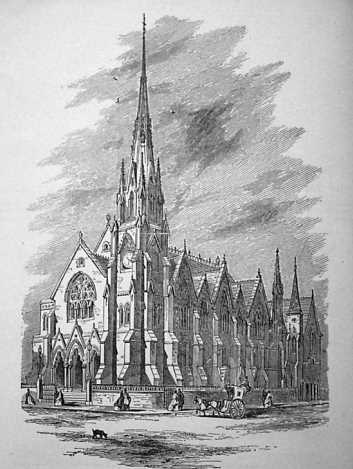
Church of the Messiah
In Birmingham he became minister of the congregation of the Church of the Messiah in Broad Street, a large Gothic building which reflected, as Pevsner put it, ‘the importance of Unitarians in Birmingham in the second half of the 19th century’. Under Crosskey the Church of the Messiah became an intellectual centre, a place where ideas about society were openly and critically discussed. Crosskey had long been associated with such radical causes as the Young Italy movement (Garibaldi and Mazzini were heroes to all the early supporters of women’s suffrage) and in Birmingham found a comrade in George Dawson, another independent nonconformist minister. Dawson had been a Baptist but in 1847 had opened his own church, the Church of the Saviour, in the middle of the city. His congregation included many people – Kenricks, Martineaus and Chamberlains -who were to become influential in the civic life of Birmingham. Dawson’s message was that the church should eschew fixed creeds and work towards the greater good, urging citizens to give all their talents for the service of the city. Dawson, thus, was a promoter of the ‘civic gospel’ that led Birmingham, in the 1870s and 1880s, to acquire the reputation for being the best-governed city in the world. Dawson had as early as the 1840s made clear that he was concerned about the position of women in society. It is unsurprising, therefore, to discover that his wife was also a member of the executive committee of the suffrage society at this time.
By 1878 Eliza Sturge had moved with her father and sister to Bewdley, from where, for a time she continued to act as secretary to the suffrage society. But by 1885 the honorary secretaryship had been taken over by Catherine Osler, who was finally to retire, as president of the society, 35 years later in 1920. As Catherine Courtauld Taylor, daughter of William and Caroline Taylor of 10 Chad Road, she had subscribed 1/- to the Birmingham Women’s Suffrage Society when it was founded in 1868; she was then 14. In 1873 she had married, in Crosskey’s Church of the Messiah, Alfred Clarkson Osler, a member of the wealthy Birmingham family of glass manufacturers. From both their families Catherine and Alfred Osler inherited a radical liberal tradition and from about 1884 Catherine was president of the Birmingham Women’s Liberal Association. All 4 of their children were to become active in the women’s suffrage movement. With increasing prosperity the Oslers moved to a large house in Edgbaston, ‘Fallowfields’, in Norfolk Road, the scene of a plethora of drawing-room meetings at which the question of women’s suffrage was discussed.

Mrs Osler (c) Birmingham Museums and Art Gallery, Supplied by the Public Catalogue Foundation
When Catherine Osler became secretary of the suffrage society her unmarried sister, Edith, became treasurer. It will have become clear that the 19th-century suffrage campaign in Birmingham, as in the rest of the country, was very much a middle-class affair – indeed very much an Edgbaston affair. With the vote firmly allied to a property qualification, it would only be householders and ratepayers who would benefit from any extension of the vote. There were, however, even within the middle-class pro-suffragists, degrees of liberalism. The 19th-century campaign split in 1888 along the lines of the split in the Liberal Party over Home Rule for Ireland. In Birmingham, as in the country at large, Joseph Chamberlain was one of the most prominent of the Liberal Unionists (those against Home Rule); the Oslers, unlike most of the Birmingham industrial families, who followed Chamberlain, were members of the more radical wing – followers of Gladstone in supporting Home Rule. This schism was reflected in a split in the national suffrage society so that for most of the 1890s the suffrage movement rather lost its focus, although individual members and societies were extremely active.
In 1892 Birmingham was chosen as the venue for a national conference organized by one of the splinter societies, the Women’s Emancipation Union, perhaps the most radical of these societies, with an agenda that demanded equality with men in every aspect of life. Although it is doubtful that Catherine Osler was actually a member of this society she did chair one session of this conference and proposed a resolution supporting the inclusion of women in any reformed scheme of local government. One of the leading members of the Women’s Emancipation Union was an interesting Birmingham woman. She was Caroline Smith, the sister of George Jacob Holyoake, Chartist and secularist, the last man in England to be sentenced on a charge of atheism. They were the eldest children in a large family, living in the 1820s in comparative poverty at 1 Inge Street in central Birmingham. As a child George Holyoake worked as a whitesmith alongside his father in the Eagle Foundry. Their mother had a small home workshop making horn buttons, before being put out of work by the growth of larger manufacturers. The Holyoakes were obviously an able family. However nothing is known about Caroline’s early life except that at some point she married a William Benjamin Smith, who had been born in Kings Norton around 1822. When the 1871 census was taken they were living at 19 Carpenter Road, Edgbaston. Although the Smiths’ house has now disappeared, it was presumably not unlike those that do remain – that is to say a large stucco Regency villa – a far cry from the house cum workshop in Inge Street where Caroline grew up. She was a member of the executive committee of the Birmingham Women’s Suffrage Society in 1885 but had clearly been attracted to the more radical movement and by 1892 was the national treasurer of the Women’s Emancipation Union.
It was doubtless its central position in the country that made Birmingham a popular venue for national conferences because again it was here, in 1896, that the main suffrage societies made a concerted effort to regroup. It was proposed that past differences be put aside and that they should unite as the National Union of Women’s Suffrage Societies, it being recognised that, after 30 years of campaigning – and the goal little nearer achievement – there was a need to present a common front from the centre. Although no parliamentary bill in favour of women’s suffrage was presented between 1897 and 1904 the suffrage movement did benefit from a more effective central organisation and this enthusiasm permeated down to the local societies. In October 1900 the minutes of the Birmingham society record that one of its best ever drawing-room meetings had been held in a private house at which 100 ladies were present and 26 new members enrolled. In 1902 the annual meeting of the Birmingham society – held in the Grand Hotel – was addressed by Sir Oliver Lodge, principal of Birmingham University. His speech was published as a pamphlet‘ so that today we can read that he thought, ‘The vote itself is a trivial affair, but its artificial withholding is a gratuitous insult: I am not surprised that the arbitrary withholding on that small function is one that galls out of all proportion to its importance. I recognize the desirability of doing away with artificial obstacles, and giving to everyone a clear field and an equal chance – a fair share in education, an open entrance to the professions, and a fair and reasonable opportunity of service in every direction.’
By this time Catherine Osler had become president of the Birmingham society and in 1903-4, with help from paid organizers (the movement was definitely moving away from involvement on a purely voluntary basis), she had supervised the opening of new branches in Coventry, Warwick, Redditch, and Leamington. At this time the Birmingham Women’s Suffrage Society thought it advisable to undertake work among working women, as was being done in Lancashire among the women textile workers. The Birmingham society began with the women chain makers of Cradley, paying for an organizer to go around from yard to yard, talking to the women about the suffrage issue.
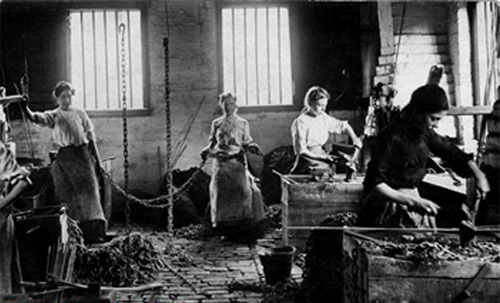
Women chainmakers at Cradley Heath
In early 1904 they conducted another campaign amongst the Cradley nail makers. During 1907 the society held 30 meetings in Birmingham and the surrounding district and in 1908 drew in £8 6s 3d in subscriptions – making it the second largest society (after London) in England.
The increasing activity of the Birmingham Women’s Suffrage Society was not only due to better central organization but doubtless owed something to the impetus provided by the arrival on the suffrage scene of a new ginger group. This was the Women’s Social and Political Union, which had been founded in October 1903 in Manchester by Mrs Emmeline Pankhurst, but which had only really begun to make an impact with the arrest and imprisonment in October 1905 (in Manchester) of Mrs Pankhurst’s eldest daughter, Christabel, and of Annie Kenney on charges of obstructing the police.
The WSPU determined to win the vote by what they termed ‘militant methods’, that is, in order to bring pressure to bear on the Cabinet they were prepared to do more than hold orderly public meetings and present petitions to parliament through MPs. The political process itself had evolved since the 1860s; it was clear that individual members of parliament had little real power (that now resided in the Cabinet) and that no bill in favour of women’s suffrage would have a chance of passing into law unless it was presented as a government measure. What actually were ‘militant methods’ was never clearly defined by the WSPU – members more or less set their own limits, and that militancy escalated as the years passed. Initially WSPU strategy was to hold large meetings at the beginning of each session of parliament in a hall, such as Caxton Hall, close to the House of Commons, and for a deputation, often led by Mrs Pankhurst herself, to attempt to present a petition to the Prime Minister, who would invariably refuse to see them. The police would attempt to prevent them reaching Parliament and brawling would ensue.
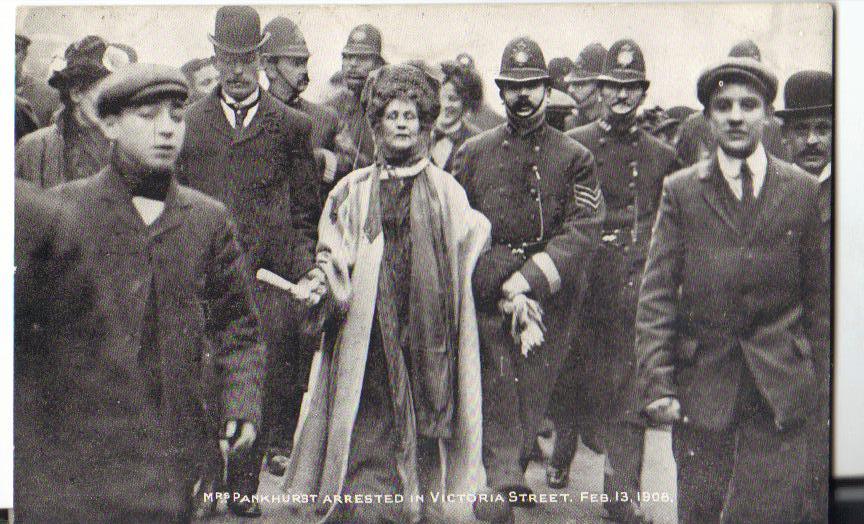
Mrs Pankhurst arrested while leading a deputation to Parliament
This all attracted marvellous publicity, in a way in which drawing-room meetings in Edgbaston never had. The WSPU provided newspapers with ‘news’, that is, spectacle that was recorded in the photographs that had only lately superseded the engravings with which newspapers had been illustrated, and with the kind of behaviour that, because it was considered ‘extreme’, was, therefore, ‘news’.
Although the WSPU opened branches around the country it was increasingly autocratically controlled from Clement’s Inn, its London centre, by the Pankhursts and their fellow leaders, Emmeline and Frederick Pethick-Lawrence. The WSPU did not, like the NUWSS societies, foster local centres run by local women, Instead organizers were appointed by Clement’s Inn to the main cities and were expected to work to orders. These organizers were moved frequently around in order that they might not develop too close local attachments.
The Pankhursts’ autocratic system was not put in place without difficulty. In the autumn 1907 one group, which perhaps might be roughly characterized as a more left-wing element, broke away from the WSPU. When first founded in Manchester the WSPU had drawn support from the local Labour party and women had been drawn into it through their interest in furthering the cause of Labour as well as of women. When it became clear that, as well as forbidding any democracy within their own society, the Pankhursts were not interested in supporting the Labour party at parliamentary elections, a group, under the leadership of Charlotte Despard, withdrew and formed the Women’s Freedom League.
Thus in Edwardian Britain there were three main suffrage groupings, the National Union of Women’s Suffrage Societies, which sought the vote using constitutional methods, the Women’s Social and Political Union that employed militant methods, and the Women’s Freedom League that was prepared to use militant methods against the political process (such as attacking the ballot box and picketing parliament) but would not countenance harm to people or property. Interestingly, although by 1913 the WFL had 59 branches, it only had two in the West Midlands, in Wolverhampton and the Potteries, and never supported a branch in Birmingham, although on occasion, during general election campaigns, for instance, WFL speakers, such as its leader, Charlotte Despard, did come to speak in Birmingham.
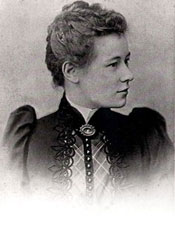
Emma Sproson
The most active member of the WFL in the West Midlands was Emma Sproson, who had been a member of the WSPU in 1906, but joined the WFL after the 1907 split. She was a keen supporter of the Labour Party. Mrs Pankhurst had stayed with Emma Sproson when she visited Wolverhampton in 1906 to speak to local members of the Labour Party.
In keeping with their practice, by November 1907 the WSPU had appointed as their organizer in Birmingham Annie Kenney’s younger sister, Nell, who was based at 22 Belgrave Road, Edgbaston. She had worked from the age of 10 in an Oldham mill, until forced by ill health to leave and become a shop assistant. Now in her mid- twenties she set about organizing Birmingham. She calmly notes in her report for the WSPU newspaper, Votes for Women, in November 1907, ‘I am visiting most of the influential people in Birmingham and surrounding districts’. She was also holding a series of drawing-room, open-air and factory-gate meetings, besides addressing different religious societies and women’s co-operative guilds. She notes that ‘Our meetings are being run on strictly economical lines. The outdoor meetings are being advertised by chalking the pavements or ringing the bell, and the audiences so far have been orderly and sympathetic’. On 20 November 1907 a well-publicized WSPU meeting was held at Birmingham Town Hall, with both Mrs Pankhurst and Mrs Pethick-Lawrence as speakers, and Christabel Pankhurst taking the chair. Regular, women-only meetings were held at this time on Thursdays at the Bristol Street Schools. In February 1908 a contingent of women travelled from Birmingham to London to take part in what was called ‘The Women’s Parliament’, a meeting held in Caxton Hall on the occasion of the opening of a new session of the ‘the men’s parliament’. In the ensuing fracas four women from Birmingham were among the 50 or so arrested and subsequently sent to Holloway.
Mrs Pankhurst arrested while leading a deputation to Parliament
Another Birmingham woman was arrested the next day while taking part in the deputation led by Mrs Pankhurst that attempted to approach the House of Commons.
In June 1908 the WSPU organized an extravagant demonstration in Hyde Park to which women from all over the country came. Birmingham was on the line from Wolverhampton along which travelled on the day a Special Train bringing Birmingham supporters to take part in the rally. Tickets for the train cost seven shillings return and could be bought from Stanford and Mann, booksellers in New Street, from James Pass’s music warehouse at 48 Cherry Street, or from Combridge at 4 and 5 New Street. The train left Birmingham at quarter to eight in the morning. When they got off the train at Euston the women lined up with thousands of others to process to Hyde Park.
One of the main speakers in Hyde Park, with her own platform from which to address the vast crowds, was Gladice Keevil,
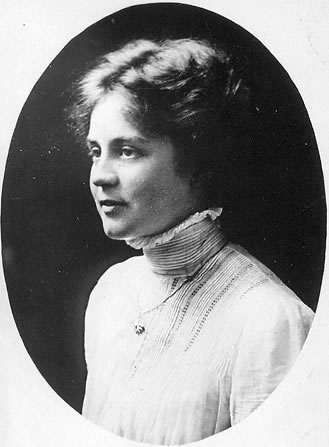
Gladice Keevil
considered one of the prettiest and most effective of WSPU speakers. She was a Londoner and was then 24 years old – she had already spent six weeks that year in Holloway. The Daily News report of the Hyde Park rally singled her out : ‘Miss Keevil was a particularly striking figure. Robed in flowing white muslin, her lithe figure swaying to every changing expression, and the animated face that smiled and scolded beneath the black straw hat and waving white ostrich feather, was the centre of one of the densest crowds’, showing that then, as now, it is the messenger rather than the message that captures the attention of the reporter. It was around this time that Gladice Keevil came to Birmingham, appointed WSPU National Organizer in the Midlands. She had already played her part in the conducting of the WSPU campaign at a by-election in Wolverhampton in May. WSPU election policy was to oppose the government (that is the Liberal) candidate in order, as they hoped, to bring pressure to bear on the government. At this Wolverhampton election the Liberal retained his seat with a majority of only eight (reduced from over 2800); the WSPU of course claimed that it was their campaign that had produced this close call. By the end of October 1908 Gladice Keevil had opened a WSPU office in Birmingham at 14 Ethel Street, which was to act as the headquarters for the Midlands. Evening At Homes were held there at 7.30 on Tuesdays, presumably attracting women who were working during the day, while afternoon
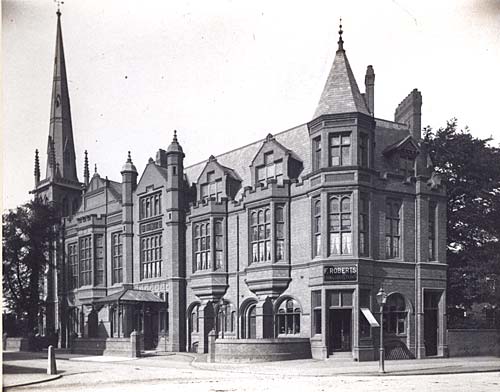
Edgbaston Assembly Rooms
meetings were held for the leisured at the Edgbaston Assembly Rooms. Working closely with Gladice Keevil at this time was Bertha Ryland, the daughter of Mrs Alice Ryland, of 19 Hermitage Road,
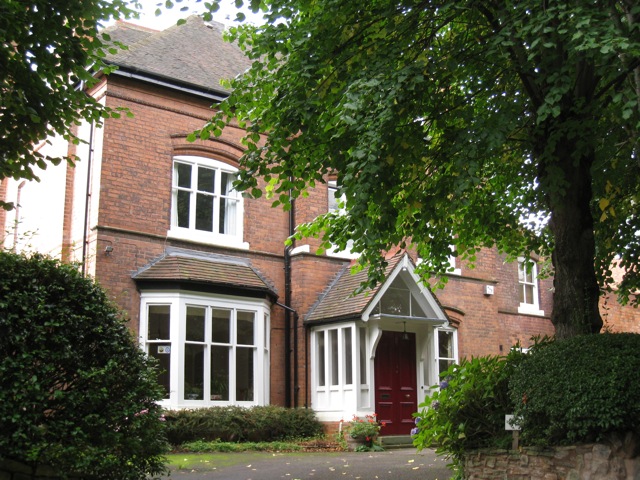
19 Hermitage Road (thanks to Carole McKeown)
Edgbaston, who in the mid 1870s had been a member of the executive committee of the Birmingham Women’s Suffrage Society and who had, with her daughter, transferred allegiance The Birmingham WSPU took its campaign into the Bourneville works and reported that many of the girls there wore the WSPU ‘Votes for Women’ badges. In February 1909 Christabel Pankhurst was the speaker at a meeting at the Town Hall and, as Votes for Women reported, ‘received an ovation the like of which no woman has ever experienced in Birmingham’.
A month later Mrs Pankhurst addressed a reception at the Midland Hotel, and a month after that Mrs Pethick-Lawrence led another Town Hall meeting. Birmingham was certainly not allowed to forget the women’s Familiar names appear in the list of WSPU activists; Miss Mathews and Miss Saxelby, for instance, have the same surnames as married women members of the 19th-century suffrage society, presumably attracted by the opportunity of more direct action offered by the WSPU. Catherine Osler’s daughters, Nellie and Dorothy, remained active members of the constitutional society and their brother, Julian was by this time a member of the Men’s League for Women’s Suffrage, the male counterpart of the NUWSS. Their other brother, John, was running the London side of the glass business and his wife was secretary of the Hampstead NUWSS society.
Gladice Keevil had introduced plenty of amusement for the young women of Birmingham; they could join the Votes for Women Corps and take to the street, standing in the gutter and attempt to persuade passers by to buy the WSPU newspaper. Again this activity seems to have been aimed at the leisured because quarter to 12 on a Friday morning was the rendevous time for the Corps to meet. Those sufficiently active could join the Cycling Scouts who, covering a 10-mile radius around Birmingham, took the suffrage message to out of the way places. There was also a Midlands WSPU horse-drawn caravan which in the summer toured the surrounding countryside.
Throughout the spring of 1909 there was also rather more sedentary activity that could be dedicated to the cause; the WSPU held in London a vast fund-raising bazaar, to which each district was encouraged to contribute goods for sale. The Midland group supported two stalls, one presided over by Mrs Kerwood, who had been one of the WSPU prisoners in March 1908, and the other by Mrs Gertrude Howey of Malvern, who had donated the campaigning caravan and whose daughter, Elsie, was one of the most active of the younger WSPU members. Women were encouraged to come from all over the country to visit the Exhibition, which was beautifully decorated by Sylvia Pankhurst, another of that remarkable family. Parties came down from Birmingham for the occasion on special excursion tickets. Birmingham women jewellers, including a Miss Myers and Annie Steen (of Woodfield Cottage, Woodfield Road, King’s Heath) contributed jewellery for sale on the Midland stall. Annie Steen was a regular advertizer in the pages of Votes for Women. In the 1901 census she had been described as an Art Teacher living at Mayfield Road, Kings Norton. Some of this jewellery would have been rendered with enamelling or stones in the WSPU ‘colours’; Annie Steen advertised in October 1909 ‘Handwrought jewellery in gold and silver set with stones in the colours’. Emmeline Pethick-Lawrence had introduced the colours, purple, white, and green, as ‘favours’ to be worn at the Hyde Park rally the previous year and WSPU branding had taken off in Birmingham. In a May 1909 report Gladice Keevil reminded members that hats, ties etc in the colours could be obtained from Romney, a milliner at 150 Broad Street and noted that one member was having the colours introduced into her wedding in every possible way, including the bouquets and the cake. Besides supplying jewellery to the cause Annie Steen also volunteered her drawing room for WSPU At Homes. Such meetings were also held at this time in the Women’s Hospital and in Queen’s College.
Mary Leigh in her uniform as leader of the WSPU Fife and Drum Band
Birmingham hit the headlines in September 1909 when suffragettes (as WSPU members had been nicknamed in order to be differentiated from members of the non-militant societies, the suffragists) dramatically interrupted a meeting that Asquith was attempting to hold in the Bingley Hall. Birmingham had tried to protect itself against any likely outrage; nine-foot high barricades had lined the station platform and the main streets along which the prime minister had travelled. However one intrepid suffragette had penetrated the defence and had reached the roof of the hall, from where she proceeded to hurl down slates to the ground. The five suffragettes, only one of whom (Evelyn Hilda Burkitt, a secretary who lived at 214 Wellington Road, Perry Barr) was native to Birmingham, were arrested. Four were sentenced to three months’ imprisonment and the fifth, Mary Leigh, who was regarded as a repeat offender, was sentenced to four months’ imprisonment with hard labour in Winson Green. There they went on hunger strike. Mary Leigh had used the tactic, both in Holloway and in Walton jail, Liverpool, and on both occasions had starved herself out of prison before the end of her sentence. However by late September the Home Office, whose officials had been giving advice to the prison medical officers, decided that enough was enough and Winson Green staff were instructed to institute a regime of forcible or, as the Home Office preferred to call it, ‘artificial’ feeding.
The minutes of the Prison Visiting Committee for this period make interesting reading. Unlike the issues of Votes for Women in which the suffragettes told their story, the Committee minutes give a dispassionate account of the procedure, recording that attempts were first made to feed Mary Leigh with a spoon, and when she resisted, resort was made to feeding by a nasal tube, but that by the end of the month she was taking food from a feeding cup. The WSPU brought a case on her behalf against the Home Office and the Governor of Winson Green, to the effect that a prisoner had a right to refuse such ‘treatment’ as feeding, However, the Lord Chief Justice eventually ruled that it was a medical officer’s duty to prevent prisoners committing suicide. A statement made by Mary Leigh, ‘Forcible Feeding in Prison’, based on her experiences in Winson Green, was published by the WSPU. The Birmingham WSPU did what they could to capitalise on the prison’s notoriety; parades were organised to march around outside, the women singing to offer encouragement to the inmates, I have seen a postcard sent at the time by a certain Arthur Lewis, who wrote to his correspondent ‘No doubt you have heard of the Birmingham suffragettes being forcibly fed in the prison.. It is occurring only about 3 minutes walk from our house and nearly every night the suffragettes who are at liberty ride to the prison in sometimes wagonettes and sometimes a fruitier’s cart and blow bugles. There are always some policemen there and do not let the conveyance stop. One suffragette Mrs Leigh was released yesterday, Saturday.’ Indeed Much had been made of the release of Mrs Leigh who was taken to the Ethel Street office in a cab and then straight to a nursing home.
The sight, as it were, of the Liberal government forcibly feeding suffrage prisoners was too much for Catherine Osler and at the end of the year she resigned as president of the Birmingham Women’s Liberal Association, a position she had held for most of her adult life. She did not, however, condone militancy, as she made clear in a pamphlet, ‘Why Women Need the Vote’.
By January 1910, when the general election that resulted from the House of Lord’s rejection of Lloyd George’s budget was held, Gladice Keevil had been moved on from Birmingham to Exeter, a very marginal Liberal seat, which went, with an equally small majority to the Conservatives; obviously Gladice’s winning ways were thought an essential tool in this aspect of the campaign. Liberalism was presumably too entrenched in Birmingham for it to be thought worth more than the usual measure of campaigning. The new organiser was Dorothy Evans and a new office, which stayed open until 8 in the evening, was opened at 33 Paradise Street. Throughout 1910, with the Liberal government dependent on a greatly reduced majority, the WSPU put militancy on hold, taking at face value Asquith’s assurance that if a reform bill were to be introduced the government would make the question of a women’s suffrage amendment open to a free vote. Activity therefore in the country concentrated on keeping the issue in front of the electorate. Bertha Ryland and Hilda Burkitt were still active WSPU workers, attracting a range of high- profile WSPU speakers to Birmingham. Through the pages of Votes for Women the minutiae of the campaign can be traced; it certainly involved an incredible amount of organisation. By the end of the year the WSPU activists were even able to employ electricity to advertize a meeting at which Mrs Pankhurst was speaking in the Town Hall; lanterns were ‘fitted with electric light which shone through’ throwing up the words ‘Mrs Pankhurst, Town Hall, November 15’ and were carried around the streets. The lanterns had been made by members of the local Men’s Political Union – the WSPU’s male counterpart. Women might agitate for the vote but they obviously didn’t mess with electricity.
The Birmingham NUWSS society had reopened an office c 1908 at 10 Easy Row – it was apparent that they had been without a central office for several years. Catherine Osler had by now an extremely competent secretary to run the society – Mrs Florence Carol Ring. I have been unable to find out anything about Mrs Ring – perhaps some local researcher can – but believe she was a most efficient organizer. A notebook in the Archives is labelled ‘Town Hall Meetings: Method of organizing and procedure’ and is full of the most detailed notes of how to organize and advertize the suffrage society’s meetings. All the items are costed and this notebook highlights the orderliness and forward planning that went into NUWSS meetings in this period.
In the summer of 1910 the country’s NUWSS and WSPU societies jointly staged in London a grand rally, wonderfully decorated with banners. There would have been trainloads of participants from Birmingham.
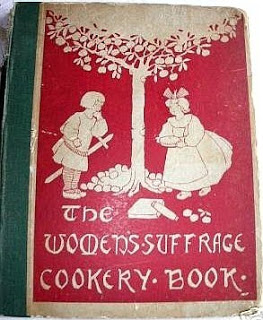
MRs Aubrey Dowson (ed), The Women’s Suffrage Cookery Boook
The Birmingham Women’s Suffrage Society was behind the production of one of the NUWSS’s most appealing fund-raising projects, the Women’s Suffrage Cookery Book, edited by Mrs Aubrey Dowson, whose husband was a nephew of Catherine Osler. The recipes were gathered from suffragists all over the country – the first in the book, for Egg Croquettes is from Mrs Julian Osler, Catherine’s daughter-in-law.
The suffrage peace came to an end in November 1910 when it was announced that parliament was to be dissolved without women being any closer to getting the vote. This was not the outcome for which the suffrage societies, both constitutional and militant, had been working; the WSPU put in place prepared plans for a deputation to the House of Commons. This met with firm police resistance in Parliament Square.
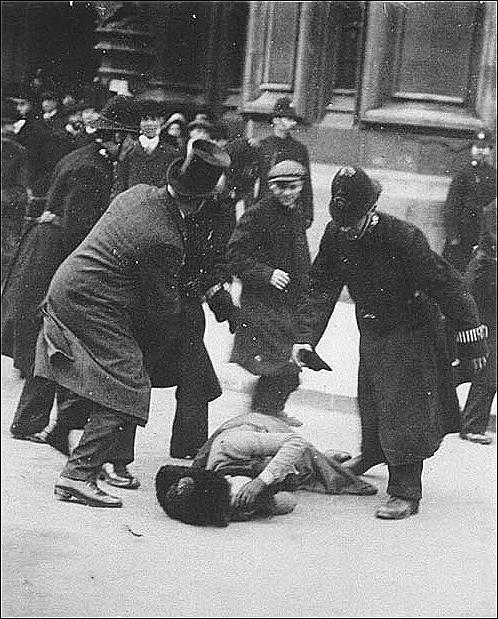
‘Black Friday’, Parliament Square, November 1910
Women were assaulted and the occasion went down in suffrage history as ‘Black Friday’. Dorothy Evans was among the women arrested but, because the Home Office realised that the occasion would be used as a wonderful source of propaganda by the WSPU, no charges were brought against her or any of the many others. However women who, a couple of days later, protested about the Parliament Square debacle by throwing stones at government offices, were arrested and charged. One of these, who was sentenced to two weeks’ imprisonment, was a Mrs Pattie Hall, who although originally from Manchester, where she and her husband had been very close associates of the Pankhursts in their Labour Party days, now lived in Edgbaston, at 56 Hagley Road. Her young daughter, Nellie, had taken part the previous year in the parades outside Winson Green and was to remain a supporter of Mrs Pankhurst until the latter’s death. A wonderful collection of Nellie Hall’s suffrage papers and ephemera (including a suffragette tea service and her hunger strike medal) is on loan to the Birmingham Museum. By mid 1911 the WSPU office had moved again – to 97 John Bright Street.
In April 1911 some members of the Birmingham WSPU joined in the boycott called on the census. One of these was Mrs Ethel Adair Impey, a Quaker, of Cropthorne, Middletonhall Road, King’s Norton. She was described on the census form, filled in by the registrar, as a ‘Suffragette, Information Refused’. In fact information was refused not only by her, but also by her husband, her son, her servant and about 6 nameless females.
In November 1911 after yet another long period of truce, Asquith announced that the government planned to introduce a manhood suffrage bill, which might, if the House of Commons desired, be amended to include women. An unlikelihood. This was the signal for women to take to the streets in London with stones, breaking more windows of government offices. Amongst the many arrested was Bertha Brewster, a young Birmingham woman whose mother had also long been a suffrage supporter. She was sentenced to 21 days’ imprisonment and on her release, with other Birmingham prisoners, she was given a hero’s welcome, in a room in Queen’s College, by the local WSPU. Dorothy Evans was among the many women arrested in London in March 1912 after smashing windows in the West End; Mrs Pankhurst had told the WSPU that ‘the argument of the broken pane of glass is the most valuable argument in modern politics’. Dorothy Evans was sentenced to two month’s imprisonment and a Miss Grew took over as organizer in Birmingham. Because there were too many suffragette prisoners to be accommodated in Holloway many were farmed out to prisons around the country. Twenty-five ordinary prisoners were moved from Winson Green in order to make way for suffragettes, who then went on hunger strike and were forcibly fed. Miss Grew organized members to go each night to stand outside the prison and cheer them on.
The prisoners appear to have made the most of their incarceration. They produced a hand-written, illustrated magazine, entitled The Hammerer’s Magazine – ‘for private circulation only’, its cover showing a hammer striking a pane of glass. One of the sketches, drawn on toilet paper, shows the 25 suffragettes in two rows seated on chairs, backs to the artist, with the prison gallery above, one warder at the front and another on the first-floor gallery. This is quite an important sketch, giving a rare view of life inside Winson Green..
The best poem in the magazine is probably one entitled ‘Winson Green in April & May 1912’ which appears to be written on the back of a Robertson’s Golden Shred marmalade wrapper! It begins:
Cling, clang of prison keys,
Slam bang of doors,
Wash slosh – Monday morn,
Water on the floors –
Tramp, tramp of prison feet,
Ring, rang of bells,
Clash smash of prison bars,
Suffragettes in cells.
Among the women imprisoned at this time was Maude Kate Smith from Birmingham, with whom Professor Brian Harrison recorded an excellent interview now held in the Women’s Library. Besides giving very graphic detail of her experience of forcible feeding, during the course of the interview Miss Smith reveals that there were plans afoot to blow up a Birmingham canal – for during 1912 and 1913 WSPU militancy escalated as the government’s intractability became more apparent.
 Pillar boxes were fired – here is one comical comments on this method of militancy. More seriously, property (always at least intended to be empty) was also targeted. The actions of the government contributed towards what might now be seen as ‘terrorism’. In April 1913 parliament passed ‘The Cat and Mouse Act’, by which women prisoners who were being forcibly fed were to be released for a few days to recover their health and were required to return to prison to resume their sentence. Most of those released – the mice – did not bother to return to prison and in many instances the police did not bother to look for them. This ‘underground’ life did, however, have a momentum of its own. Mice, already branded as criminals, thought nothing of repeating their acts of arson (or, as they called it, ‘work’) and much of the damage, which was really quite extensive, was carried out by a dedicated few, travelling around the country, given shelter by well wishers.
For instance, on Christmas Day 1913 one young suffragette, Lilian Lenton, who had been arrested on a charge of setting fire to a house in Cheltenham, was released from prison after going on a hunger-and-thirst-strike – into the care of Mrs Edith Impey of King’s Norton. In April 1913 suffragettes were suspected of setting fire to a boathouse in Handsworth Park. In the same month the Morning Post reported that the suffragettes had planned to set fire to the Old Grammar School at Kings Norton, but had changed their minds when they saw its beauty. In June 1913 a house in Solihull was destroyed and in July one in Perry Bar and another in Selly Park was set on fire. Nellie Hall was charged on suspicion of having been involved with this last arson attack; she had been caught on 13 July after throwing a brick at Asquith’s car when he visited Birmingham and was sentenced to three weeks’ imprisonment. In October 1913 two local railway stations -Northfield (not far from here) and
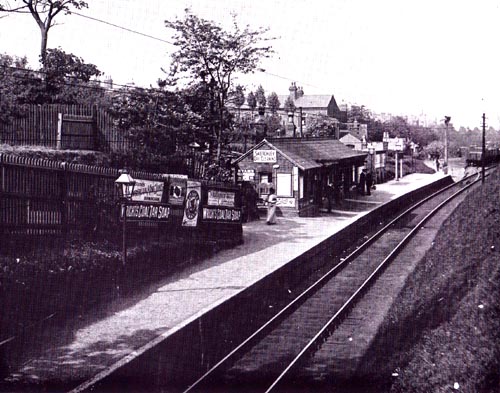
Hagley Road Station c 1913
Hagley Road were fired and in February 1914 Northfield Library was destroyed – the damage was estimated at £1000 – and on the same day a bomb exploded at Moor Hall Green. Soon after there were several other serious arson attempts in Birmingham; two houses and two cricket pavilions were set alight – at Smethick and Harborne. The slogan left at Harborne was ‘Down with sport, up with fair play for women’ – and there was a fire on the Midland railway at Kings Norton. .In March 1914 the Cathedral was defaced by suffrage slogans – including ‘Stop Forcible Feeding’ –which were daubed on much of its interior in white enamel paint. ‘Votes for Women’ was painted across the middle of the Burne- Jones window. On the vestry door was painted ‘The clergy must rise on our behalf’ Edgbaston Parish Church and St Stephen’s Selly Hill were also attacked.
On 17 May a grandstand at Bromford Bridge racecourse was destroyed and on 8 June Bertha Ryland, cleaver in hand, slashed a picture, ‘Master Thornhill’ by Romney, in Birmingham Art Gallery . She carried a letter giving an explanation of her conduct, saying ‘I attack this work of art deliberately as a protest against the government’s criminal injustice in denying women the vote, and also against the government’s brutal injustice in imprisoning, forcibly feeding, and drugging suffragist militants, while allowing Ulster militants to go free..’ The gallery was immediately closed for six weeks. After that it was not open after 5 in the afternoon and was closed all day Sunday; presumably the level of security had to be increased and the gallery could not afford to open for so many hours. A rule of ‘No muffs, wrist-bags or sticks’ was subsequently enforced.. Bertha Ryland, the presumably gently-nurtured daughter of Edgbaston (whose mother had 30 years earlier been intent on bringing art to the working-classes), had already spent a week in Holloway in November 1911 and, after taking part in the March 1912 window-smashing campaign in London, had been sentenced to six months’ imprisonment. She had spent four months in Winson Green prison, had gone on hunger strike and been forcibly fed.

Bertha Ryland’s WSPU hunger-strike medal (together with her Coronation medal) courtesy of Christie’s
After her arrest in the Art Gallery she went on hunger strike while held on remand. She then accepted bail, was too ill to stand trial at the July assizes, and still had not been sentenced when war broke out. She suffered permanent kidney damage as a result of her treatment in prison.
With Mrs Pankhurst in and out of prison under the Cat and Mouse Act and Christabel based in Paris, to where she had fled to escape the police, the WSPU leadership was

Christabel Pankhurst relaxing in France
increasingly out of touch with day-to-day reality and the campaign was ricocheting out of control. It is my contention that the WSPU was only saved from real disaster by the outbreak of war. The Pankhursts then dropped all suffrage activity and rallied to the flag leaving many, but by no means all, of their supporters dumbfounded. Some of the latter group founded the United Suffragists, to carry on campaigning. In 1915 Bertha Brewster founded a Birmingham branch of the United Suffragists, with an office at 15 New Street.
The NUWSS had, of course, eschewed all the pre-war violence and concentrated on spectacle and politicking. The constitutional or ‘law-abiding’, as they termed themselves, societies had organised themselves into Federations to concentrate their efforts. Birmingham played a leading part in the Midlands (West) Federation and in June 1913 joined with the other societies in The Pilgrimage, a grand attempt to bring a dignified campaign to the country and the prime minister. The Birmingham society travelled along the route that brought pilgrims, with cockleshell badges pinned to their hats, from Carlisle to London. On 14 July 1913 the Birmingham Daily Mail carried a report of the arrival of the pilgrims in Birmingham. ‘At 5 o’clock a strong contingent of the Birmingham Women’s Suffrage Society marched from Easy Row to meet the pilgrims who had started early in the afternoon from Wolverhampton. At Great King St, Hockley, the visitors were joined by the local suffragists, and a procession was formed, headed by the Baskerville Band. Banners bearing the legends ‘Law Abiding’ and ‘By Reason, Not Force’ were prominently displayed’. The pilgrims that passed through Birmingham would have been among those who continued on to Oxford.
As far as politics was concerned, the NUWSS entered into an electoral alliance with the Labour party in order to support Labour candidates at by-elections and thereby subject Liberal candidates to rather more opposition that the usual lone Conservative – that is, they were prepared to turn by-elections into three-cornered fights. Catherine Osler supported the national executive in this, although by no means all local societies did. Birmingham was still radical. By 1913 the society had enrolled 1600 ‘Friends of Women’s Suffrage’, mainly working-class women who could not afford to pay the annual membership fee but were prepared to sign pledges of support. The society at this time suggested founding ‘Women’s Study Circles’ at which working women could meet in each others homes to discuss the suffrage issue; Mrs Osler’s pamphlet ‘Why Women need the Vote’ was one of the suggested texts, as was John Stuart Mill’s Subjection of Women. At this time the Society had over 700 full members.
Unlike the WSPU, the NUWSS societies carried on campaigning during the First World War, as well as supporting the war effort. There was a split in the NUWSS; a majority of its committee wished to withdraw this support and to join in a Women’s Peace Conference to be held at The Hague and it was in Birmingham in June 1915 that at a national conference this move was defeated.
Whether it was because of women’s contribution to the war effort, matters were at last reaching a resolution. In March 1917 Catherine Osler presided over a meeting held in the Midland Institute in support of the move to include women in the proposed Electoral Bill. When the first installment of enfranchisement (that is, to women over the age of 30) was granted in 1918 the NUWSS’s work was ostensibly finished. Catherine Osler was in the chair at the meeting in which the proposed amalgamation of the Birmingham Women’s Suffrage Society and the local branch of the National Union of Women Workers (‘workers’ in this usage were not working-class women but women workers in a cause – in a 19th-century sense – philanthropists). The amalgamated society became the Birmingham Society for Equal Citizenship. Catherine Osler, radical to the end, was keen that the lack of representatives of women’s labour organizations on the new body should be rectified, suggesting that the Women’s Co-operative Guild should be given three representatives. She finally resigned as president in 1920; a portrait of her was commissioned and was presented to the ArtGallery (see above). The surplus of the money raised to pay for the portrait was used to fund a scholarship in her name at Birmingham University, to allow women graduates to read for a postgraduate degree in the Faculty of Arts. It is still awarded from time until very recently.
As well as all this activity from the two main suffrage societies, Birmingham also had other smaller but active suffrage groups. In 1913 the Birmingham branch of the Church League for Women’s Suffrage operated from the home of Miss Griffiths at 34 Harborne Road, Edgbaston; that of the Conservative and Unionist Women’s Franchise Association from the home of Miss Adams at 56 Carlyle Road, Edgbaston, the Birmingham branch of the Men’s League for Women’s Suffrage was run by Mr Evans from 382 Moseley Road, and that of the Friends League for Women’s Suffrage from the home of Miss Joyce at 12 Frederick Road, Edgbaston (a few doors from where Eliza Sturge, also a Quaker, had campaigned nearly 45 years previously).

Mrs Margery Corbett Ashby
At the 1918 general election, the first at which women (albeit only those over 30 years of age) could both vote and stand as candidates, the main attention was focused on Smethwick where Christabel Pankhurst stood as a coalition candidate; she was defeated. At that election Birmingham’s first woman candidate (at Ladywood) was Mrs Margery Corbett Ashby, who stood as a Liberal, again unsuccessfully. The Women’s Library archive includes a 1975 interview with Dame Margery, as she had then become, in which she says that the idea of her standing against a Chamberlain in Birmingham was greeted by her family with hoots of laughter. She goes on to say that she didn’t have ‘the faintest idea of getting in – which would have been very inconvenient – but did so in order to get people used to the idea of a woman standing. That she did as well as other Liberal candidates around. And her candidature was greeted with surprise but with no ridicule.
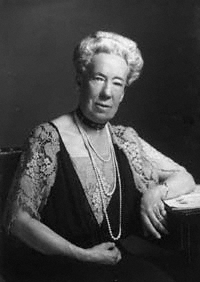
Dame Elizabeth Cadbury
The first woman to stand as a candidate for King’s Norton’s at a general election – in 1923 – was Elizabeth Cadbury, widow, by then, of George Cadbury, the chocolate manufacturer. She was a Liberal and was also unsuccessful. She lived at Manor House, Northfield, and was a city councillor for Kings Norton from 1919 to 1924. In 1928, 60 years after Birmingham’s campaign had been launched at the meeting in the Exchange Rooms, New Street, all women were given the vote on the same terms as men. However Birmingham did not have a woman MP until after the Second World War – with Mrs Edith Wills elected as Labour member for Duddeston in 1945 and Mrs Edith Pitt (Conservative) elected for Edgbaston in 1953 – the culmination of the campaign that had begun in 1866 with a mere three Birmingham names on that very first ‘women’s suffrage’ petition.
See also:
Birmingham Stories: Votes for Women
Fight for the Right: the Birmingham Suffragettes
Suffragette Acts in Birmingham: Parliament UK
Suffrage Stories: Radio 4 ‘Document’: Votes For Victorian Women
Posted by womanandhersphere in Suffrage Stories on March 19, 2013
On Monday, 18 March 2013 Radio 4 broadcast, in the series ‘Document, an interesting programme to which I made a small contribution. Below is the description of the programme that appears on the BBC website. The programme is available on iPlayer for a year – that is until March 2014 – click here to listen.
‘Votes for Victorian Women
- Duration:
- 28 minutes
- First broadcast:
Monday 18 March 2013
Popular history tells us that women did not get the vote until 1918.
Though they could technically vote in local elections before that, many historians have argued that in practice they had no vote until the 1860s at the earliest. And evidence that they ever did vote has proved almost impossible to find.
But now a poll book, discovered in a box of papers in a local record office, clearly shows 25 women voting in elections for important local posts in Lichfield in 1843.
In this week’s Document, the historian Sarah Richardson follows the trail of these women, to reveal a picture of Victorian women’s involvement in politics which challenges many of our assumptions.
She discovers that they represented a surprising cross-section of society – old and young, poor and prosperous – and attempts to trace their descendants today.
She finds out how, when even universal manhood suffrage was seen as a radical, dangerous idea, these women may have been just a few of many more who could vote at a local level.
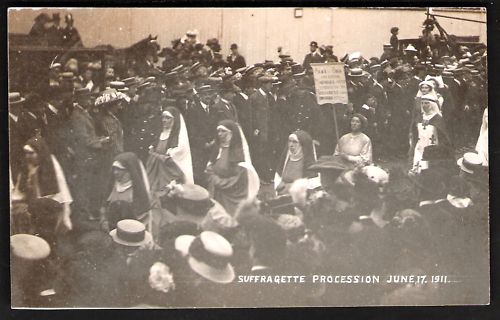
Coronation Procession 1911: The Historical Pageant
And she explores how, decades later, campaigners for Votes for Women at the Westminster level had to contend with this complex legacy.’
[Left – the photograph that Sarah and I are looking at when discussing the way in which 20th-century suffrage campaigners were keen to legitimise their claim to the franchise by looking to the power, occasionally electoral, exercised by women in the past.]
Women Writers And Italy: Mrs Piozzi And St Peter’s, 1786
Posted by womanandhersphere in Women Writers and Italy on March 18, 2013

Mrs Piozzi
Before images of St Peter’s and the Sistine Chapel disappear from our television screens, I thought you might like to read how this set piece of the Roman scene was viewed at the end of the 18th century by a plain-spoken English woman.
At Easter 1786 Mrs Piozzi (the former Mrs Hester Thrale) was in Rome. The continental tour she had been enjoying with her second husband, Gabriel Piozzi, former music teacher to her children, was drawing to a close.
Like Charlotte Eaton, who arrived in Rome some years later, Mrs Piozzi viewed St Peter’s – and its Easter celebration – with an eye not a little clouded by Protestant prejudice.
‘Nothing can look very grand in St Peter’s church; and though I saw the general benediction given (I hope partook it) upon Easter Day, my constant impression was, that the people were below the place; no pomp, no glare, no dove and glory on the chair of state, but what looked too little for the area that contained them. Sublimity disdains to catch the vulgar eye, she elevates the soul; nor can long-drawn processions, or splendid ceremonies, suffice to content those travellers who seek for images that never tarnish, and for truths that never can decay. Pius Sextus, in his morning dress, paying his private devotions at the altar, without any pageantry, and with very few attendants, struck me more a thousand and a thousand times, than when arrayed in gold, in colours, and diamonds, he was carried to the front of a balcony big enough to have contained the conclave; and there, shaded by two white fans, which, though really enormous, looked no larger than that a girl carries in her pocket, pronounced words which, on account of the height they came from, were difficult to hear.

Pilgrims in St Peter’s From ‘Glimpses of Italian Society’
All this is known and felt by the managers of these theatrical exhibitions so certainly, that they judiciously confine great part of them to the Capella Sistina, which, being large enough to impress the mind with its solemnity, and not spacious enough for the priests, congregation, and all, to be lost in it, is well adapted for those various functions that really make Rome a scene of perpetual gala during the Holy Week – which an English friend here protested to me he had never spent with so little devotion in his life before.’
From Glimspses of Italian Society in the Eighteenth Century, From the ‘Journal of Mrs Piozzi’, Seeley & Co, 1892
Kate Frye’s Suffrage Diary: ‘Campaigning for the Vote’ Is Here
Posted by womanandhersphere in Kate Frye's suffrage diary, Suffrage Stories on March 13, 2013
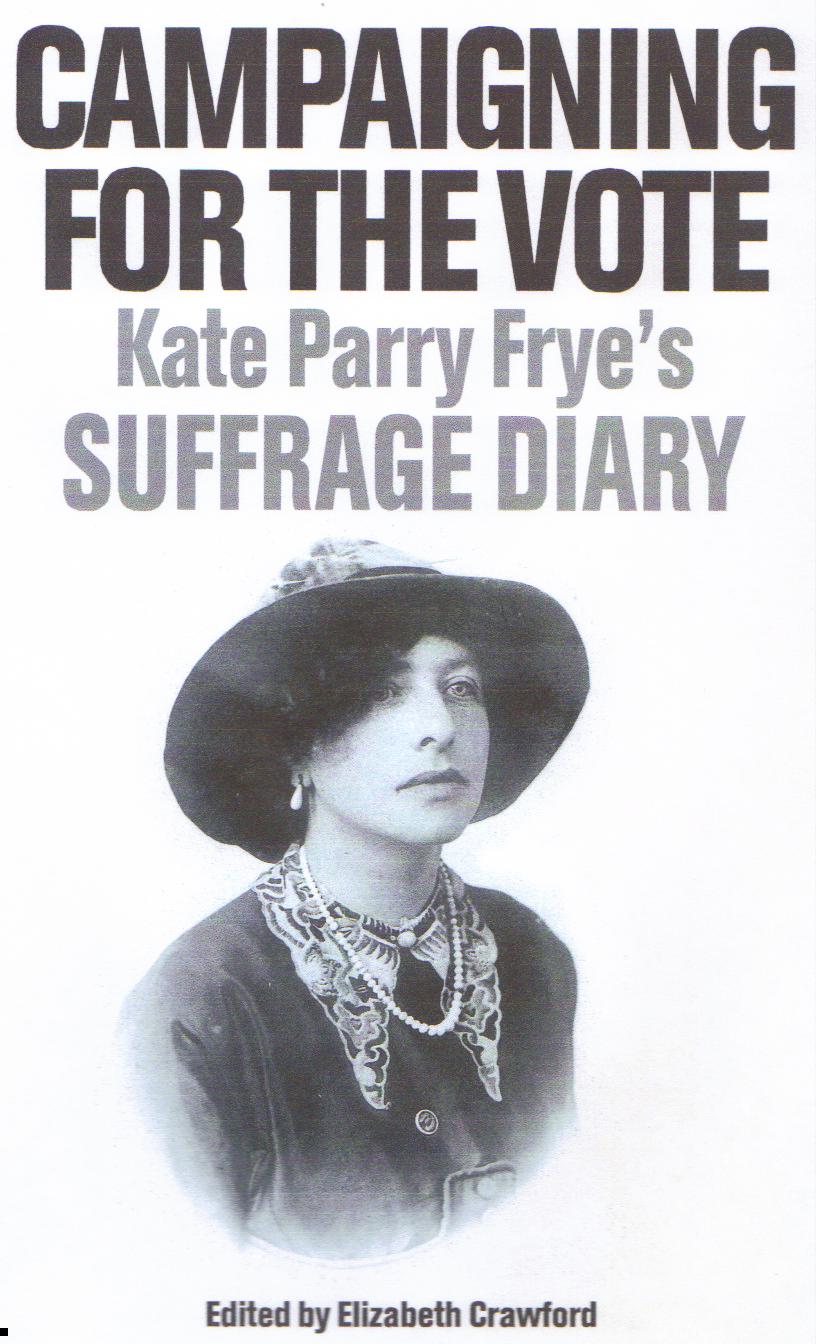 Here is the front cover of Campaigning for the Vote: Kate Parry Frye’s Suffrage Diary – published by Francis Boutle Publishers.
The key points about the book are:
- Drawn from a new primary source, Campaigning for the Vote tells, in her own words, the efforts of Kate Frye, a working suffragist, to convert the men and women of England to the cause of women’s suffrage. The detailed diary Kate kept all her life (1878-1959) has been edited to cover 1911-1915, years she spent as a paid organiser for the New Constitutional Society for Women’s Suffrage.
- No other diary gives such an extensive account of the working life of a suffragist, one who had an eye for the grand tableau – such as following Emily Wilding Davison’s cortége through the London streets – as well as the minutiae of producing an advertisement for a village meeting.
- With Kate for company we can experience the reality of the ‘votes for women’ campaign as, day after day, in London and in the provinces, she knocks on doors, arranges meetings, trembles on platforms, speaks from carts in market squares, village greens, and seaside piers, enduring indifference, incivility and even the threat of firecrackers under her skirt.
- Kate’s words bring to life the world of the itinerant organiser – a world of train journeys, of complicated luggage conveyance, of hotels – and hotel flirtations – , of boarding houses, of landladies, and of the ‘quaintness’ of fellow boarders. This was not a world to which she was born, for her years as an organiser were played out against the catastrophic loss of family money and enforced departure from a much-loved home. Before 1911 Kate had had the luxury of giving her time as a volunteer to the suffrage cause; now she depended on it for her keep.
- Kate Frye gives us the fullest account to date of the workings of the previously shadowy New Constitutional Society for Women’s Suffrage. She writes at length of her fellow workers, never refraining from discussing their egos and foibles.
- After the outbreak of war in August 1914 Kate continued to work for some time at the society’s headquarter, helping to organize its war effort, while allowing us to experience her reality of life in war-time London.
- Campaigning for the Vote is over 200pp long and contains over 70 illustrations, all drawn from Kate Frye’s personal archive. ISBN 978 1903427 75 0 £14.99
- Advance orders may be placed either with me or with the publisher – or with any good bookshop.
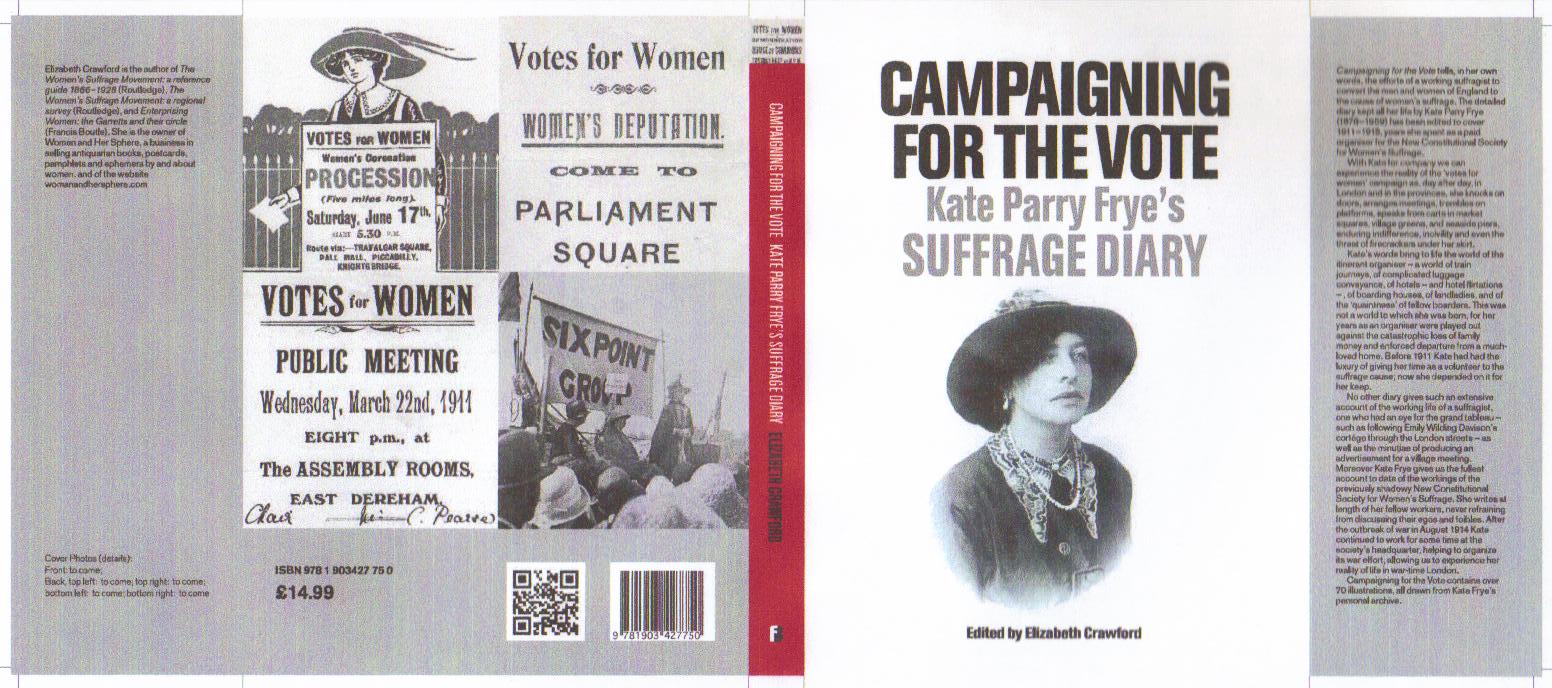
‘Campaigning for the Vote’ – Front and back cover of wrappers
Women Writers and Italy: Charlotte Eaton: St Peter’s Through Protestant Eyes
Posted by womanandhersphere in Women Writers and Italy on March 12, 2013
Scottish- born Charlotte Waldie (1788-1859), with her sister, Jane, and brother, John, travelled to Europe – as did so many others – in 1816/17, after the final defeat of Napoleon. For at least some of the time the two sisters travelled alone, when John was otherwise occupied. They each kept detailed notes of their journeys and sojourns: Charlotte turned her experience into Rome in the Nineteenth Century, first published privately and then, in 1820, by Archibald Constable.
Charlotte’s view of St Peter’s, recorded in these extracts, was reflected through a prism of Protestantism.
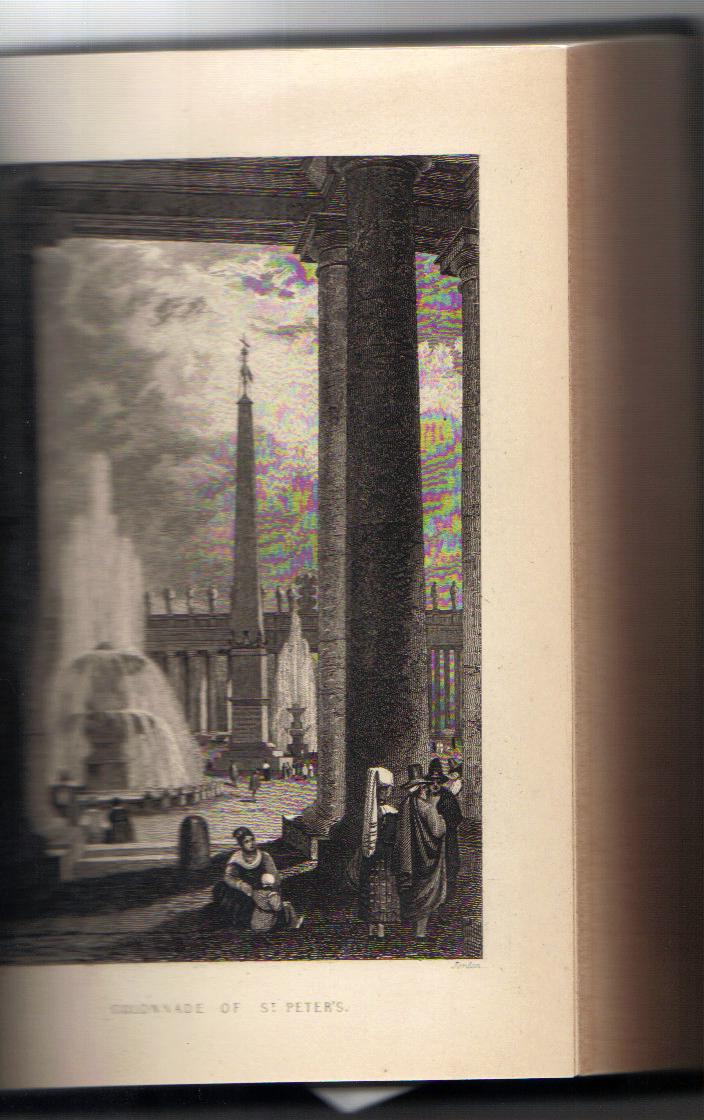
Colonnade of St PEter’s from ‘Rome in the Nineteenth Century’
It is impossible to express my disappointment I felt on seeing what seemed to me to be – not a church, but a large house or palace, three stories high, with little attic windows at the top. The dome is placed so far back, in consequence of the length of the Latin cross, that in the front view its grandeur is lost. Its design is irredeemably faulty, in giving to the front of the greatest temple in the world the frittering littleness of the exterior of a dwelling-house, and the effect, in producing apparent mediocrity of size, is as striking to the eye, that I could scarcely recognise in it any character of a church, much less of St Peter’s, that boast of modern architecture, and latest wonder of the world.
The crowded courts and irregular angles of that huge, unwieldy pile of building, the Vatican Palace, which adhere to it on one side like a monstrous excresence, are a great deformity. They overlook the top of the colonnade, depress the elevation, destroy its uniformity, and injure its general effect.
Having ventured inside, Charlotte found ‘The interior, on the whole, as far surpassed my highly-raised expectations, as the exterior fell short of them. Yet notwithstanding its beauty, I was conscious of a species of disappointment too commonly felt, when what we have long dwelt on in fancy is seen in reality. I had pictured it to myself less beautiful, and far less magnificent but more sublime. With an imagination deeply impressed with the imposing effects of the Gothic cathedrals of our own country, I expected, from the immensity of St Peter’s, even more of that religious awe and deep solemn melancholy, which they never fail to inspire: and I was unprepared for its lightness, decoration, and brilliance; – and, above all, for that impression of gaiety, which the first sight of its interior produces.
Charlotte condemns the use of Corinthian pilaster and, particularly, the Grecian arch which ‘has the unfortunate effect of diminishing the apparent length, which the the perspective of a Grecian colonnade, or a Gothic aisle, uniformly appears to increase….The windows, too, are mean and poor-looking, and offensive to the eye. It is easier, however, to point out the fault than the remedy; for windows do not enter gracefully into the beautiful combinations of Grecian architecture. In Gothic churches, on the contrary, how grand and majestic an object is the arched and shafted window! Indeed, if I may venture to own to you the truth, it is my humble opinion, that though Grecian architecture is admirably adapted to palaces and theatres, and places of public assembly, and public buildings of almost every other kind, it is not suited to churches….it does not accord with the solemn purposes of Christian worship, to which the simplicity and grandeur of the Gothic, and its impressive effect upon the mind, are so peculiarly fitted.
Certainly some apology may be found for its defects in the frequent changes of plans, and architects, and Popes during the building of [St Peter’s]; and in the real and imaginary necessity of having an upper balcony for the purpose of giving the benediction; a circumstance which has been so ruinous to its beauty, that we might say with truth, that the blessings of the Popes have been the perdition of the Church. But whatever the cause, the faults of the front of St Peter’s are unredeemable and unpardonable.
Kate Frye’s Suffrage Diary: ‘Votes for Women!’ At The Royal Court, April 1907
Posted by womanandhersphere in Kate Frye's suffrage diary, Suffrage Stories on March 8, 2013

Kate Frye photographed in costume for her part in J. M. Barrie’s ‘Quality Street’ – on tour in 1903
Kate Frye, besides being a life-long diarist, had a life-long devotion to the theatre, for a few years at the beginning of the 20th century even putting herself on the stage. However, on this afternoon in April 1907, it is her experience as a theatre-goer that she records. Her growing interest in women’s suffrage, which had been instigated by her new friends, Alexandra and Gladys Wright, was stimulated by a visit to the Royal Court Theatre to see Votes for Women! – a play by the American actress and author, Elizabeth Robins.
‘Tuesday April 16th 1907 [London: 25 Arundel Gardens, North Kensington]
..Changed my dress before lunch. Agnes and I had to leave at a quarter to two and went up to Notting Hill Gate. There met Mrs Wright, Alexandra and Gladys. They had asked us to join them in a theatre party to see ‘Votes for Women’ at The Court – but Mrs Wright told us it was her party and wouldn’t let us pay for a thing. They took us first-class to Sloane Square and in the Dress Circle – second row right – in the centre – to see the piece. It was a most enjoyable and interesting afternoon. I loved the piece – it is quite fine – most cleverly written and the characters are so well drawn. Needless to say the acting was perfection as it generally is at the Court Theatre and the second act – the meeting in Trafalgar Square – ought to draw the whole of London. I was besides myself with excitement over it – so were the Wrights – we all loved it. It was a jolly afternoon – and most awfully kind of them to take us like that. Gladys was very keen to know if it would have any effect on people. I can’t tell – people are not so easily influenced, I fear, except in isolated cases. I wanted to know what the men were thinking of it.
Miss Wynne Matthison was fine – really great, I thought – as Vida. Dorothy Minto was good and I liked Jean Sterling Mackinlay. Aubrey Smith was just the man for the part and played it well. Lewis Casson, Holman Clark were good too and Edmund Gwenn was fine and so amusing as a ‘Labour Member’. Miss Maud Milton, Miss Frances Ivor, Miss Gertrude Burnett and Agnes Thomas all played well and added to the complete success of the piece. The papers have not done it credit, I think – they have only seen the novelty of the idea and situations – not the cleverness in writing and construction. It was pouring when we came out. Mrs Wright took us to a tea shop and gave us tea and then we all came home by train together.’
Votes for Women! (n.b. the exclamation mark that Kate omitted) was first performed on 9 April 1907, directed by Granville Barker. The title had been changed from more the rather more anodyne ‘The Friend of Woman’. The Pankhursts were in the audience on the first night.
Nearly 100 years later, on 19 March 2003, Samantha Ellis wrote a most interesting piece on the play and its production for guardian.co.uk. See here for the whole article.
She notes that, like Kate, the critics loved the second act,
‘which had 40 actors, a plastercast base of Nelson’s Column and two huge ‘Votes for Women’ banners. For the Sketch it was “the finest stage crowd scene that has been seen for years”; to the Observer, it was “a marvel of verisimilitude akin to that which might be achieved by a joint use of megaphone and cinematograph”. Beerbohm, writing in the Saturday Review, felt that Dorothy Minto, playing one of the speakers, “caught exactly the spirit of her part – the blithe spirit of the budding platformist”. The Illustrated London News praised Agnes Thomas, playing a speaker identified in the script only as “A Working Woman”, for having “just the rasping Cockney tones, the termagant attitude, that are required” but carped: “There never were such speeches in Trafalgar Square.”

Edith Wynne Matthison
The play’s heroine, Vida Levering, a militant with a mysterious past, who may have been based on Christabel Pankhurst, was played by doe-eyed Edith Wynne-Matthison. Her casting affronted some reviewers; the Times’s critic sniffed, “The cause would make much more headway than it does if all its advocates were as fair to look upon and as beautifully dressed as Miss Wynne-Matthison,” and wondered: “Why, by the way, does Miss Levering take such care to make the best of her good looks and pretty figure and wear such charming frocks? Is it to please other women?”
He also cast doubt on the play’s polemical power: “Whether … the cause Miss Robins has at heart is likely to be advanced by hanging it on to other questions of seduction, abortion, and infanticide is perhaps doubtful.” He was not the only one to dislike the plot, in which Vida is revealed as the quintessential fallen woman, who hates men because an ex-lover forced her to have an abortion. Beerbohm claimed that he “yawned outright” when the ex-lover’s perfidy was revealed by the creaky device of a dropped handkerchief.
At the final plot twist, “when the ex-lover became a born-again suffragette”, even the Stage’s critic became distressed: “Except to those who have the Cause at heart … this might have seemed a rather lame and impotent conclusion.” For the Illustrated London News’s critic, the “play proper [was] not so interesting; its melodramatic story … [was] far too long and … far too thin”. But the suffragettes did not care. Robins gave them a quarter of her royalties, and in 1909 the play was staged in New York and Rome, selling the feminist message far beyond London. It also converted its leading lady, Edith Wynne-Matthison, to the cause; she and Robins founded the Actresses’ Franchise League in 1908 “ensuring that men like the Times’s critic could never again imply that suffragettes could not be glamorous”. ‘

Elizabeth Robins
As far as I remember Kate Frye, although she became a member of the Actresses’ Franchise League very soon after it was founded and was very proud to walk with the AFL in the 1911 Coronation Procession, makes no mention of seeing any of the short plays written to be performed by members of the suffrage societies. Some of these plays – such as How The Vote Was Won by Cicely Hamilton and Christopher St John – have been collected in The Methuen Drama Book of Suffrage Plays, edited by actress and researcher Naomi Paxton, recently published by Bloomsbury. See here for details.
Kate Frye did, however, have a starring – if silent – role in the first production, directed by Edith Craig, of Christopher St John’s controversial play, The Coronation. You can read her full diary entries relating that experience in
Campaigning for the Vote: Kate Parry Frye’s Suffrage Diary edited by Elizabeth Crawford
For a full description of the book click here
Wrap-around paper covers, 226 pp, over 70 illustrations, all drawn from Kate Frye’s personal archive.
ISBN 978 1903427 75 0
Copies available from Francis Boutle Publishers, or from Elizabeth Crawford – elizabeth.crawford2017@outlook.com (£14.99 +UK postage £3. Please ask for international postage cost), or from all good bookshops.
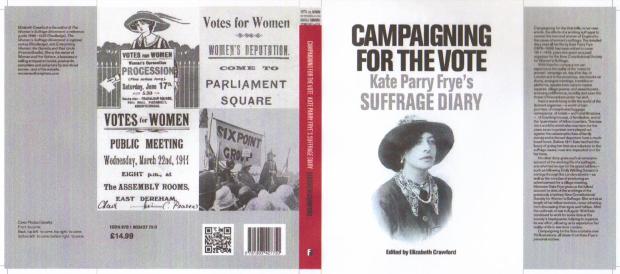 ‘Campaigning for the Vote’ – Front and back cover of wrappers
For much more about Kate Frye’s life as an actress see Kate Parry Frye: the long life of an Edwardian actress and suffragette by Elizabeth Crawford for details see here
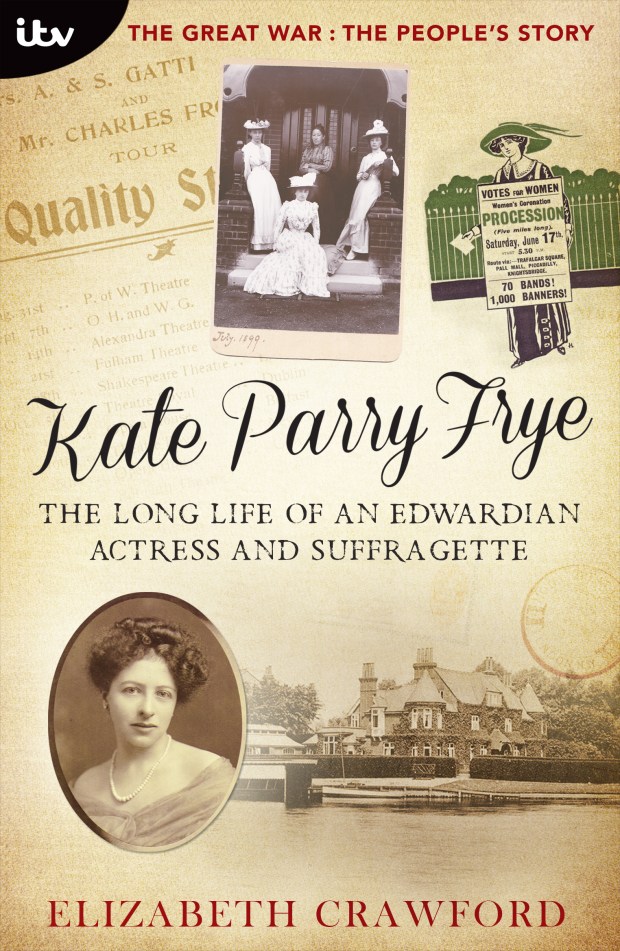
Suffrage Stories: Kate Frye’s Suffrage Diary, The Royal Albert Hall, And The Importance of Gas
Posted by womanandhersphere in Suffrage Stories on March 5, 2013
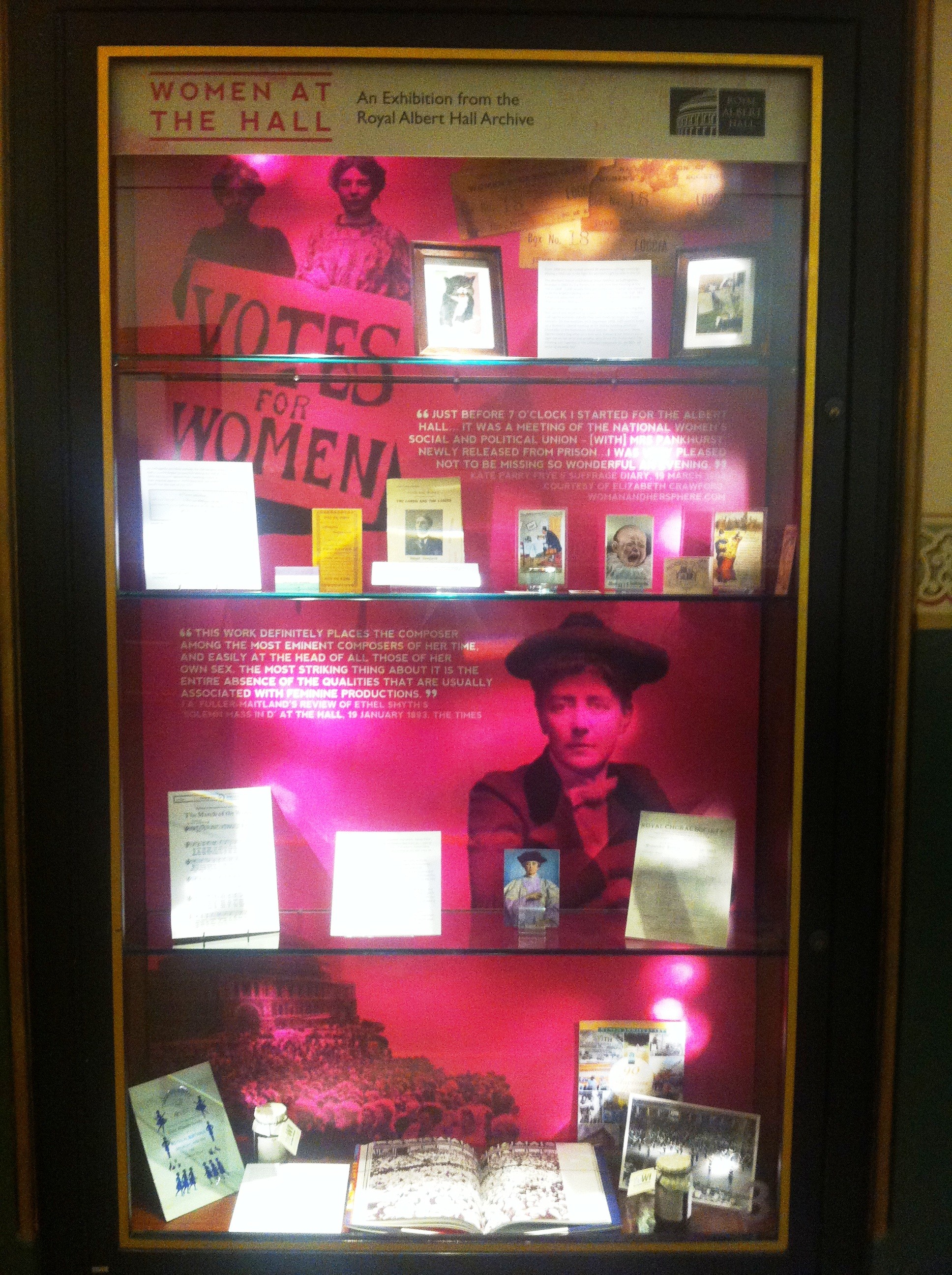 The Royal Albert Hall was the scene of many grand suffrage occasions – organised by both the constitutional and the militant suffrage societies. The management of the Hall has recognised this by supporting its archivists in mounting a small display relating to its suffrage past. The display may be viewed by anyone with a ticket to an event in the hall.
Researchers use the primary sources available and Suzanne Keyte, Project Archivist at the Royal Albert Hall, has mined what is known as the Hall’s ‘Gas Book’ to recreate a list of occasions on which the Hall was rented for suffrage-related meetings. The ‘Gas Book’ records the amount of cubic feet used each time the Hall was let for a concert or a political or a religious meeting and, with certain provisos, can be used as an indication of the size of the audience.
Kate Frye witnessed several grand suffrage occasions in the Hall. Here she describes an evening stewarding for the London Society for Women’s Suffrage at a Mass Meeting of suffrage societies in support of the Conciliation Bill
 Saturday November 12th 1910
I sat and sewed a red, green and white scarf for the evening. We had tea at 4.15 and I had a rush to dress and take Mickie [her dog] out and get off by soon after 5 o’clock. I was due at the Albert Hall at 5.30. Was given a job to do till 6.30 – or rather before – when we all went to our posts. Mine was Balcony – selling of programmes and ‘Common Causes’ [the NUWSS newspaper] & helping with the collections. The hall looked lovely – the banners were so beautifully arranged – but it wasn’t so full as I should have liked. The W.S.P.U. had a crowded meeting on Thursday and collected £8,000. Wonderful people one simply cannot hear from the Balcony. Mrs Swanwick was the only one I could really hear – her elocution is marvellous. It was so interesting seeing all the Societies – but [ie except for] the W.S.P.U. there – such lots of colours & badges – and I got very chatsome to some of my companions upstairs from the different societies.
When the meeting was nearly over I went down to the hall & tried to sell ‘Common Cause’. Old Major General Sir Alfred Turner, who was sporting around with Adeline Bourne, bought one of me with a beam and a handful of coin – he is a joke. It had come on to pour with rain and the Wrights insisted on bringing me as far as their place in their Taxi which was kind. ‘
The Hall’s ‘Gas Book’ shows that for this meeting the NUWSS consumed – and were charged for – 47,800 cubic feet of gas. On this November night one imagines that it would have been necessary to have lit all the Hall’s lamps. In fact, on 19 March 1908, when Kate Frye attended the first WSPU meeting to be held in the Albert Hall, that night’s gas consumption had been very similar- 46,800 cubic feet (click here to see Kate’s description of that meeting). From this idiosyncratic source we can deduce that the NUWSS did not lag behind the WSPU in ensuring that their evening meetings were brilliantly lit, even though, from Kate’s account, they were not necessarily able to muster as large an audience.
There was something to be said for staging meetings in the Albert Hall on summer evenings. For at the meeting held there that marked the finale to the NUWSS’s procession through London on 13 June 1908, gas consumption was only 16,000 cubic feet. We know when the meeting started because Kate Frye carefully noted in her diary that, after marching from the Embankment in the rearguard position which the Kensington branch had been allotted, she reached the Albert Hall at 5.10, just as the meeting was about to begin. Clearly less artificial illumination was required for a meeting held on an early evening in summer than for one in the winter, thereby reducing at least one element of the cost. (See here for the entry from Kate’s diary describing the procession).
Suzanne Keyte has identified c 30 suffrage meetings that were held at the Royal Albert Hall. By June 1913, however, after pressure had been exerted on hall owners throughout the country, the management of the Hall decided that they would refuse the WSPU any further lettings. What was in effect their last meeting had taken place a couple of months earlier, on 10 April.
Campaigning for the Vote: Kate Parry Frye’s Suffrage Diary edited by Elizabeth Crawford
For a full description of the book click here
Wrap-around paper covers, 226 pp, over 70 illustrations, all drawn from Kate Frye’s personal archive.
ISBN 978 1903427 75 0
Copies available from Francis Boutle Publishers, or from Elizabeth Crawford – e.crawford@sphere20.freeserve.co.uk (£14.99 +UK postage £3. Please ask for international postage cost), or from all good bookshops. In stock at London Review of Books Bookshop, Foyles, National Archives Bookshop.

- ‘Campaigning for the Vote’ – Front and back cover of wrappers
 Woman and her Sphere