Archive for July, 2012
Book of the Week: Frances Hays: Women of the Day
Posted by womanandhersphere in Book of the Week on July 31, 2012
 Frances Hays (ed), Women of the Day: A Biographical Dictionary of Notable Women Contemporaries, published by J.B. Lippincott & Co (Philadelphia), 1885. This is a copy of the American edition, published in the same year as the London, Chatto & Windus, edition.
This is a superb biographical source on interesting 19th-century women. The first entry is on Lea Lundgren Ahlborn, a Swedish artist, and the last is on Helen Zimmern, a German-born British journalist and writer. The hundreds of entries in between give biographical details of women who were ‘notable’ – for their work rather than their position in society – in the latter half of the 19th century but who have now rather faded from view.
This books is, therefore, a very useful vademecum for those researching the period. The general reader, too, will find plenty to interest her in this biographical bran tub.
Frances Hays clearly did much of her research in the Reading Room of the British Museum, thanking both ‘Mr John P. Anderson, Assistant in the British Museum, for much valuable aid’ and noting her indebtedness to Dr Garnett (who was assistant keeper of printed books at the Museum).
This is a copy of the American edition, first published by J.B. Lippincott & Co (Philadelphia), in the same year, 1885, as the London, Chatto & Windus, edition. In fact, apart from the title page, the editions are likely to have been identical. Although the title page of this copy dates it to 1885, bound in at the back is a 32-page section listing Chatto & Windus books dated June 1891. I doubt that the book actually ever saw Philadelphia: it was presented to The City of York Public Library by C.J. [Cuthbert Joseph] Kleiser (1855-1929), a Yorkshire-born watchmaker. What an excellent choice; it makes one want to know more about Mr Kleiser.
The copy is in good conditon, in its original binding, with the City of York Public Library bookplate on the front pastedown and relatively discreet shelf mark on the spine. £75 plus postage.
To buy: email e.crawford@sphere20.freeserve.co.uk
Suffragette postcards: What Women Want
Posted by womanandhersphere in Collecting Suffrage on July 31, 2012
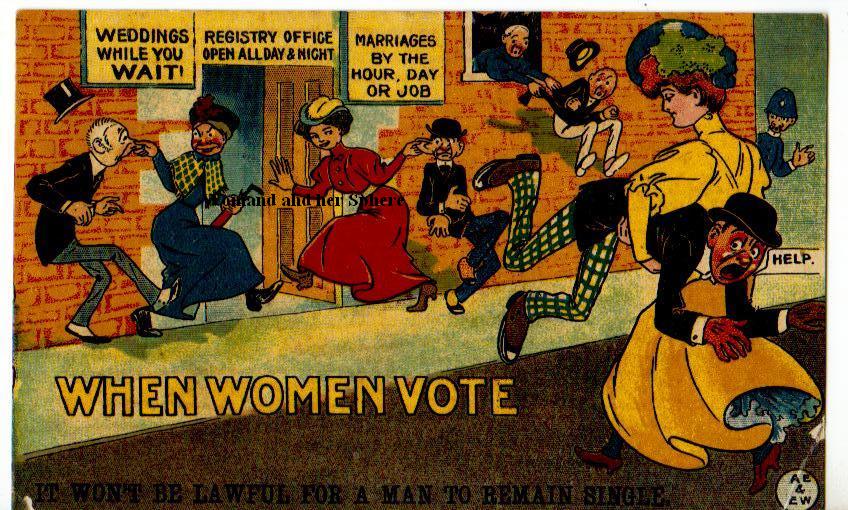 ‘WHEN WOMEN VOTE It won’t be lawful for a man to remain single’. All the men are being rushed into marriage – tweaked by the nose and carried under the arms of women – and all because they have a vote!
The card was published by Mitchell & Watkins, who had been producing postcards – both topographical photographic and artist-drawn – from c 1906.
This card was posted – in, I think, 1913 (the postmark is obscured) – to Miss Ida Currell – who had been born in 1882 and was one of 4 surviving children of the 10 born to a Hertfordshire farmer and his wife. The Currells farm, at 2 Ware Road, Hertford, was called ‘The Chaplains’.
The card is in very good condition and is £45 post free.
To buy: email e.crawford@sphere20.freeserve.co.uk
Suffragette postcards: harem pants
Posted by womanandhersphere in Collecting Suffrage on July 30, 2012
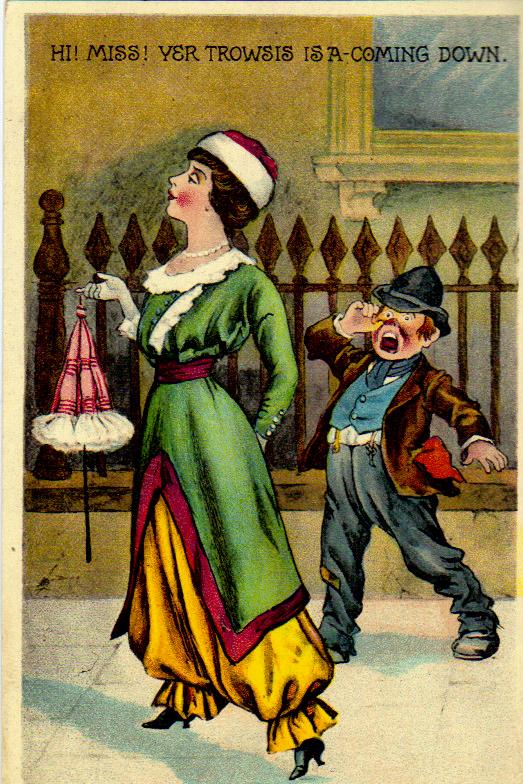 A comment on the ‘look’ that Paul Poiret was promoting c 1909 – although perhaps not to Margot Asquith – see ‘Suffrage Stories’ post -‘Madame Mantalini’.
‘HI! MISS! YER TROWSERS IS A-COMING DOWN’ shouts tyke to elegant young woman sporting ‘harem’ trousers. Pre-First World War, published by Felix McGlennon, who having been a rather successful song writer and music publisher, jumped on the bandwagon and added the publication of postcards to his repertoire as the postcard craze swept Edwardian Britian.
Not actually ‘suffrage’ but very much of its time. In very good condition – very glossy- £25 post free.
To buy email e.crawford@sphere20.freeserve.co.uk
Suffrage Stories: ‘Madame Mantalini’
Posted by womanandhersphere in 1911 Census, Suffrage Stories, The Garretts and their Circle on July 30, 2012
Since 2009, when details of the 1911 census were released, I have (with, for a time, Dr Jill Liddington) been investigating how the women of the country responded to the call issued by the more militant suffrage societies to boycott the census. In the process I have discovered women of a suffrage inclination of whom, until now, suffrage history has known nothing.
One of these was a ‘Miss S. Marsden’, whose census form was delivered to her at 69 Church Street, Kensington, and who refused the enumerator any details about herself. However, Miss Marsden did not leave the form blank, writing on it one of the longest statements that I have so far encountered. Although the right edge of the census form is badly damaged, creating gaps in her comments, I think we can get the gist.
‘I, Mdme Mantalini, a municipal voter and tax payer, refuse to fill in this census paper, as I have no intention of furnishing this government with information and thereby helping them to legislate for women without obtaining their consent or first consulting them in the [missing words] effective way possible & extending the franchise to duly qualified women. As a responsible, law-abiding citizen I have conducted my business for sixteen years; as an employer of labour I have [contributed?] to the wealth of the state and in return I have been taxed for the upkeep of no 10 Downing Street. No 10 Downing Street, the official residence of the prime minister, but converted by his wife into a show-room for a French [dress maker?] (free of all duty and taxation) to exhibit his Paris models and take orders from them to be executed in Paris. I [missing words] with very few exceptions the dressmaking establishments in England are all owned by women, & only women & [missing words] workers. It therefore comes to this, that the only way open to us to protest at ‘our trade’ being ruined in [missing words] our taxes, is to drive home to the government by every method available that women are determined [missing words – perhaps ‘not to be governed’] without their consent.’
Would that not whet any researcher’s appetite? Who was Miss Marsden/Mdme Mantalini? What had Margot Asquith been up to?
In fact the second question was the easier to answer. An inspection of The Times archive revealed that in May 1909 Margot Asquith had been called to task by drapers’ associations from around the country for inviting the Parisian designer Paul Poiret to show dresses in 10 Downing Street.
Poiret then was the epitome of chic – designing dresses that relied on draping, rather than tailoring – so much easier to wear – and promoting hobble skirts, harem pants and kimono coats – designs such as these.
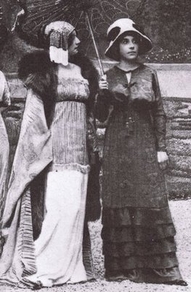
In response to a letter of complaint from an MP, Mrs Asquith explained, ‘I received in my private rooms at tea from 20 to 25 of my personal friends and a well-known French costumier, whose models can be bought in any London shop, brought some specimens for the inspection of myself and my guests. It was a purely personal occasion.’ In fact, such was the rumpus, that henceforward Margot Asquith was obliged to patronize British costumiers, such as Lucile although probably not, I fear, Madame Mantalini.
I thought at first that when Miss Marsden referred to herself on the census paper as ‘Mdme Mantalini’ it was merely as short-hand to describe her position as a dressmaker – that being the name of the dressmaking establishment at which, in Nicholas Nickleby, Kate Nickleby is apprenticed. But, consulting my 1908 London street directory, I found that the shop at 69 Church Street (which is still there) was, indeed, that of ‘Mrs Sybil Mantalini’. It was then only a short step to establish that Mrs Mantalini was, in fact, Miss Sybil Marsden, who was on the London Electoral Register by dint of her occupation of those premises, and the question of’ ‘Who was Miss S. Marsden?’ was solved.
But now I was hooked. Who was Miss Sybil Marsden? Why was she such an outspoken dressmaker?
I discovered that she had 9 siblings and in 1911 was living at the family home, 82 RedcliffeGardens in South Kensington, with her mother and one unmarried sister. Her father, Algernon Moses Marsden, had been a fine art dealer but, by 1901, had been declared bankrupt several times. His background was most interesting; he had declined to enter the family’s successful clothing business, clearly preferring the more elevated association with ‘art’.
 Algernon Moses Marsden by James Tissot
Marsden was by all accounts – mainly in the bankruptcy reports – an engaging fellow – as is evident in the portrait of him by James Tissot, painted in 1877, when Sybil was four-years-old. At that time Marsden was Tissot’s dealer, but gambling and high-living proved his downfall. It would appear that after his final bankruptcy in 1901 he removed himself to New York, where he died in 1920. I can now see that the choice of the name ‘Madame Mantalini’ may have been even more to the point than I first thought. In Nicholas Nickleby it is Mr Mantalini’s extravagance that resulted in the bankruptcy of his wife’s business – an awful warning to Sybil Marsden. No wonder Algernon’s daughter had little faith in the ability of men to manage her affairs.
Epilogue
The cinéaste members of my family play the Six Degrees of Kevin Bacon game (whereby any named film actor has to be connected with fellow-actor KB by links covering no more than 6 films). I am hopeless at that – but think I might be a contender in Six Degrees of Garrett. This particular case is easy: Sybil Marsden, Algernon Marsden, James Tissot, J.M. Brydon, Agnes and Rhoda Garrett. As I discuss in Enterprising Women: the Garrets and their circle, the two young women were undergoing their architectural training with Brydon in 1873, at a time when he was working on the design of a new studio for Tissot, attached to the artist’s St John’s Wood house. Did they go on a site visit? Had they perhaps even seen in the flesh, as it were, the tiger skin and the fashionable blue vase, that serve to emphasise Algenon Marsden’s exoticism and good taste.
Suffragette postcards: real photographic portrait
Posted by womanandhersphere in Collecting Suffrage on July 28, 2012
 Here is an example of a real photographic postcard issued by a suffrage society – in this case by the Women’s Freedom League. Its subject is Mrs Lilian Hicks (1853-1924) who, with her daughter, Amy, was at that time of its publication a leading member of the WFL – as well as a supporter of the Church League for Women’s Suffrage, the New Constitutional Society for Women’s Suffrage and the Tax Resistance League. Both mother and daughter, by then members of the Women’s Social and Political Union, heeded the call to boycott the 1911 census.
The Hicks’ association with a wide range of suffrage societies, of which I had written a few years earlier in their joint entry in my Women’s Suffrage Movement: a reference guide, was made manifest in the magnificent collection of badges and awards – including a hunger-strike medal – that many years ago I acquired from a woman to whom they had been indirectly bequeathed. They are now held in a private collection.
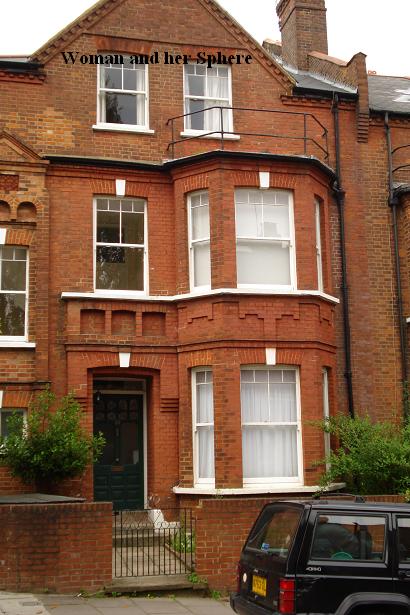 Lilian and Amy Hicks lived here, at 33 Downside Crescent, Hampstead. At the other end of the street was the home – probably the rather unhappy home – of Margaret Wynne Nevinson, a fellow member of the Women’s Freedom League. I realised that a bond of friendship existed between the two women when, all those years ago, I recognised – hanging on the wall of the sitting-room in the small cottage of the woman from whom I was buying the collection of Hicks’ memorabilia – a large painting by Margaret’s son, C.R. Nevinson. It was in the guise of ‘the mother of the Futurists’ that Margaret went when she attended a dinner given by the Women Writers’ Suffrage League at the Hotel Cecil on 29 June 1914. Unfortunately there is no record of the form of dress that this witty allusion took.
The photograph of Mrs Hicks on this official Women’s Freedom League postcard was taken by Lena Connell and probably issued around 1909/10.
Mrs Lilian Hicks was a member of the Women’s Freedom League
Suffragette postcards: suffragettes and policemen 3
Posted by womanandhersphere in Collecting Suffrage on July 27, 2012
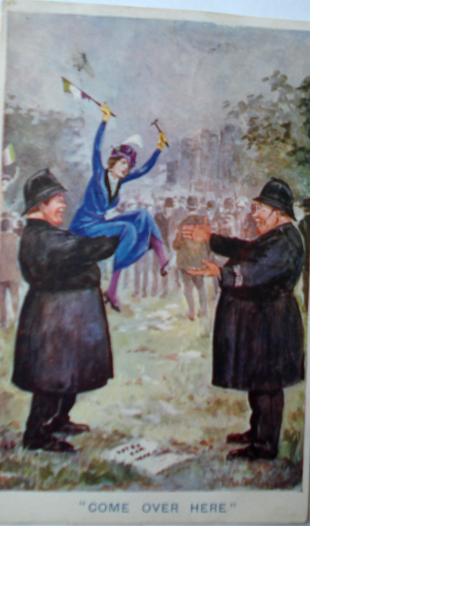 Another in this week’s theme of ‘suffragettes and policemen’.
Two burly policeman are playing games with tiny (elegant, for a change) suffragette. Waving the tools of her trade – a hammer and flags, she is held aloft by one who looks as though he intends to lob her over to the other, who is waiting with outstretched arms. A ‘Votes for Women’ placard lies on the ground between them. Published by Inter-Art Co., Red Lion Sq, London WC. Good – slightly rubbed at edges – posted in 1913. £35 post free.
What Mariana Starke was not
Posted by womanandhersphere in Mariana Starke on July 26, 2012
Mariana Starke was not born in India
Since its first edition the printed edition of the DNB has stated that Mariana Starke was born in India, where her father, Richard Starke, was governor of Fort St George and that she spent her early years there. Furthermore ,the latest edition – when issued – went on to say that this early observation of Anglo-Indian life bore fruit in two of her plays, The Sword of Peace (1788) and The Widow of Malabar (1791). This information has been accepted without investigation by the increasing number of scholars who have become interested in Mariana Starke but it is incorrect. My researches – and those of one or two others who independently reached the truth – have led to an amendment to Mariana’s entry in the online edition of the ODNB. Mariana Starke, although eventually earning for herself the soubriquet ‘The Celebrated Tourist’ was born in Surrey – in late-September 1762 at Hylands House in Epsom.
Nor did Mariana, although well-travelled, ever live in or visit India. However her family did have a long association with the continent, dating back to c 1711 – and India and the East India Company would have been a topic much discussed in the Starke household.
In a similar fashion there may have been family reminisces about the success in business of Mariana’s great-grandfather, Thomas Starke, who in the late-17th century, was a Virginia landowner and one of the first – and leading – London slave traders. One of Mariana’s plays, The Poor Soldier (1789), recounts the story of Charles Short, American Loyalist of South Carolina. I do not know that any scholar has yet made the connection between America and her family’s history – and it is not one I would want to labour. I am, however, very interested in Thomas Starke’s life and work and will recount something of it in the next ‘Mariana Starke’ post.
UPDATE
Information about the reality of Mariana’s early life was passed to the ODNB and her entry duly altered.
Copyright
Kate Frye’s Suffrage Diary: 3 December 1906
Posted by womanandhersphere in Kate Frye's suffrage diary on July 26, 2012
 Kate’s family had always taken an interest in politics; her father had been Liberal MP for North Kensington in the 1890s and into the 20th century her mother was the president of the North Kensington Women’s Liberal Association. However, the meeting described below is the first occasion that Kate mentions in her diary her attendance at a specifically ‘suffrage’ meeting and of the disturbances that had been caused by the WSPU’s ‘rowdy attacks’.
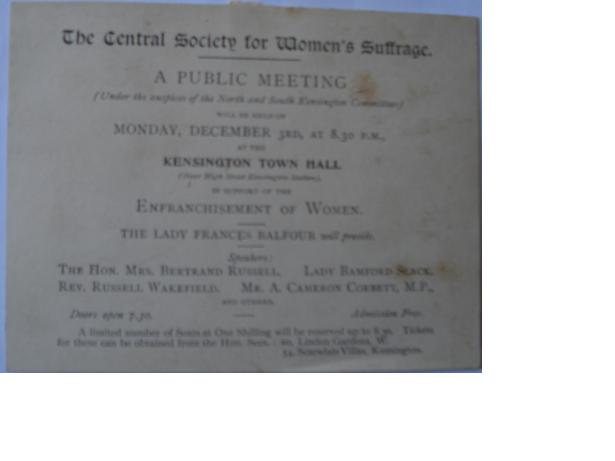 Monday 3 December 1906
At 8 o’clock [evening] Agnes [Kate’s elder sister] and I went off to KensingtonTown Hall to a Woman’s Suffrage meeting – got up by the Central Society. Lady Frances Balfour was presiding. We went by bus – when we got there the large hall was packed. Alexandra Wright was at the top of the stairs and directed us up to the overflow meeting and that was packed too. After a bit the speakers came in to us – the Hon Mrs Bertrand Russell, Miss Gore Booth, Lady Frances Balfour and Mr Cameron Corbett M.P. I heard excellent speeches all of them – they really did put the case in a nutshell and were most instructive and interesting.
Then Gladys Wright came and fetched me out and came and asked me to act as a Steward and collect – then later she went in for Agnes – and we both did what we could. We collected in the Gallery first – then later I was stationed to get the people as they came out. It was very amusing really – and I got so hot and excited – off my head with it – we certainly are in the thick of things always. Some of the people gave a lot – others shook their heads and frowned. One man said I wanted too much – to marry as well as a Vote. I had quite a flirtation on the stairs with a big smart young man – who stopped to ask me a question – he didn’t seem to know anything about anything and when he said the speaker had referred to Earl Percy as ‘half asleep’ – I said ‘That is true about a great many people’ – he did laugh.
I am afraid I felt I was more like a helper at a Bazaar than at so grave a thing as a Woman’s Suffrage Meeting – but then it is so hard for me to be serious about anything – but I am in earnest – I really do feel a great belief in the need of the Vote for Women if only as a means of Education. I feel my prayer for Women in the words of George Meredith ‘More brains, Oh Lord, more brains.’ But we are coming along and not slowly by any means. Of course all these rowdy attacks on the Ministers and these imprisonments have sounded coarse and unpleasant and the jokery made of it most bad for the cause – but women have waited patiently for so long the sort of women who have gone for the matter in this rowdy method are not the best educated or most refined amongst our members.
At this meeting every thing passed off in a most orderly dignified spirit – and the speeches from the women were delightful and must have come as a revelation to many of the audience. There was a declaration there for any working woman there who cared to sign – a number did – I did – as I have a profession [Kate was a rather unsuccessful actress]. Naturally they don’t want crowds of names without any meaning or strength in them. We came home after hearing the amount collected nearly £20 – about the cost of getting up a meeting – the reason for the collection. Bus to Notting Hill – got in soon after 10.30 – in a frenzy of excitement.
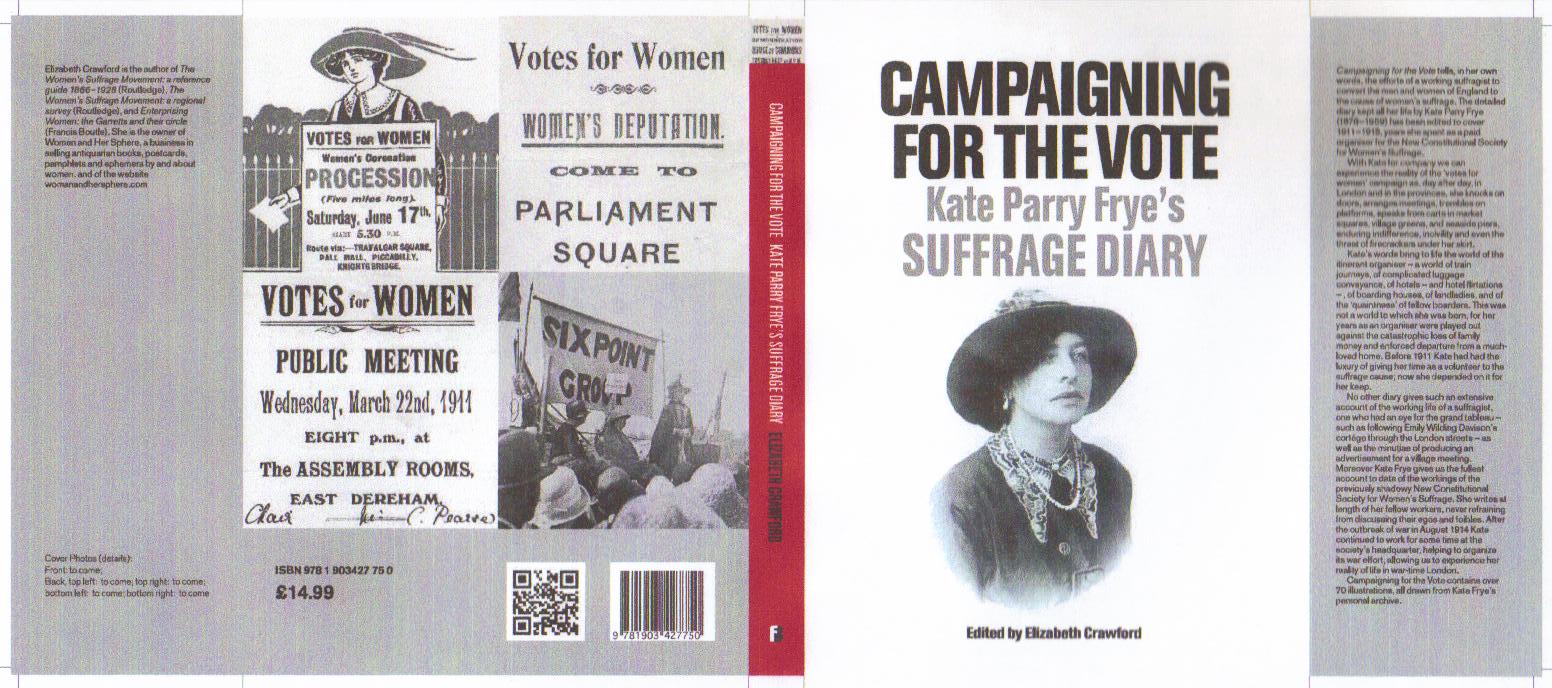
Campaigning for the Vote: Kate Parry Frye’s Suffrage Diary edited by Elizabeth Crawford
For a full description of the book click here
Wrap-around paper covers, 226 pp, over 70 illustrations, all drawn from Kate Frye’s personal archive.
ISBN 978 1903427 75 0
Copies available from Francis Boutle Publishers, or from Elizabeth Crawford – elizabeth.crawford2017@outlook.com (£14.99 +UK postage £3. Please ask for international postage cost), or from all good bookshops – and Amazon.

- ‘Campaigning for the Vote’ – Front and back cover of wrappers
‘Glad were they to rest on Australia’s shore’
Posted by womanandhersphere in Emigration research, Uncategorized on July 26, 2012
This article was first published in March 2008 in Ancestors, a magazine, now, alas, defunct, published by The National Archives.
‘From old Scotland’s shore a vessel set sail
Old ocean to cross mid tempest and gale
Full laden with souls bound to a strange shore
Australia’s bright land never seen before’
The vessel was the India, sailing from Greenock on 4 June 1841, bound for Australia. Among the ‘souls’ aboard were my great-great-great-great grandfather, Phillip Shillinglaw, and four of his children. I trace my descent from a daughter who, already married, remained in Scotland. Although, in the course of research for books and articles, I have spent years investigating the history of others, only recently have I looked at my own family. I was delighted to discover this Australian link, no hint of which had passed down to me. After a little internet detective work I had the amazing good fortune of making contact with a (very) distant Melbourne relative, Margaret Ball. With her help I have been able to piece together a remarkably full picture of the Shillinglaw family’s traumatic voyage and their subsequent life in Australia.
The above lines open an epic poem describing the disaster that befell the India, the near miraculous rescue of the majority of its passengers, and their eventual arrival at Port Phillip, then in New South Wales. The author of the poem was Phillip Shillinglaw’s grandson and namesake. The manuscript, as in all the best tales of genealogical research, lay unregarded in a tin box until inherited in 1984 by Margaret Ball, great-great-great granddaughter of Phillip Shillinglaw the emigrant. She wrote that ‘This tin box started me on a great chase and a love for family history which is never ending’ and of the poem, ‘It took me a while to work it out but when I started to check public records it all made sense’. It is certainly unusual to be able to trace so dramatically the experience of steerage emigrants of this period. Much of the information in the poem tallies well with that held in public records. Phillip Shillinglaw the versifier was, of course, retelling the story he had heard from his mother and father, who had both, then unmarried, travelled out on the India, rather than recounting an official history. I am very grateful to Margaret Ball for permission to quote from the poem.
The Shillinglaws represent the ‘everyman’ and ‘everywoman’ of the mid-19th century emigrant movement to Australia. Indeed the year 1841 has come to be regarded as a watershed in the peopling of Australia. The colonies were keen to break from their convict-peopled past and introduce a different kind of settler. Britain’s industrious, virtuous working-class, suffering in a severely depressed economy, provided the ideal candidates.
The cost of a steerage passage to Australia was around £17, almost the average annual wage of a rural labourer and about twice the wage of a young female domestic servant. In order to supply Australia with this type of worker a series of schemes were devised to assist their passage, all requiring candidates to fulfil occupation, health, age, and character criteria set by the colonial legislatures. There was a bias towards family groupings, ‘protected’ single females, and those from rural counties.
The Shillinglaws certainly qualified on that score. They were travelling to Australia from Aberdalgie, a village in Perthshire. My suspicion, mentioned when this article was first published, that Phillip Shillinglaw worked in some specialist area of horticulture, perhaps fruit growing, rather than as a general agricultural labourer has proved correct. In 1826, for instance, as gardener to the Earl of Kinnoul, of Duplin Castle, Perthshire, he was awarded a prize for his ‘Queen Pineapple’ and an extra medal for ‘uncommonly fine Black Hamburgh grapes’ by the Caledonian Horticultural Society, meeting in Edinburgh . Two of the daughters he left behind in Scotland were married to estate gardeners and, as we will see, when they reached Australia it was as gardeners, rather than as agricultural labourers or sheep hands, that both he and his son found employment.
Phillip was born in Berwickshire in 1777, probably moving to Maidstone, Kent, with his parents and siblings in the mid-1790s. Certainly he was living in England when he married in St Martin’s-in-the-Fields on 25 October 1807. Several of his older children were born in Kent but the birth in Perthshire of the younger ones indicates that the family had returned to Scotland around the mid-1820s. It was at Aberdalgie that three of the older daughters were married. I have found no trace of their mother’s death, but assume that in 1841 Philip was a widower. The little I have been able to deduce from this genealogical study suggests that Philip Shillinglaw was not a man to limit his horizons and that he could write his name. I might have been able to discover more about the family were it not for the irony that the India set sail a mere two days before the taking of the first census.
Of the Shillinglaw party, Phillip’s son, William, and two of his daughters, Martha and Elizabeth, appear in the Index to Assisted British Immigrants, although with their surname rendered as ‘Shillingham’. William was in his mid-20s. Elizabeth’s age was given as 21 on her arrival, although she may have been considerably younger. Martha’s age is recorded on arrival as 16, which tallies with her death at the age of 65 in 1891.
A slight mystery surrounds the identity of the third female member of the party. Her name is clearly written as ‘Catherine Shillinglaw’ on a list of passengers. However, nothing is known of a family member of that name and Caroline Shillinglaw, one of Phillip’s elder daughters, certainly did travel to Australia. Caroline would have been 31 in 1841 and it is possible that the fifth named member of the party, James Shillinglaw, was her illegitimate son. Neither Catherine/Caroline nor James is recorded on arrival as an assisted passenger.
Phillip, too, is missing from this record, his absence explained by the fact that, at 64, he was well above the qualifying age. It was considered part of the success of the emigration scheme that ‘ship-room’ was given to elderly family members. This was important in persuading the younger people to emigrate. In this case, however, I rather think that Phillip may himself have been a driving force. He could quite well have stayed quietly in Perthshire with his married daughters.
How would the Shillinglaws have heard about the possibilities of emigration and of the bounty scheme? Emigrant guides, aimed at the working class, had been published since the 1830s. It is quite possible that the Shillinglaws had studied one of these. Also at this time the emigration scheme was being vigorously promoted in the various regions of rural Scotland. The official responsible for selecting emigrants travelled around, holding meetings, posting broadsheets and distributing circulars.
It was no simple business to apply for an assisted passage. Medical certificates and references were required, as well as money for a deposit, specified clothing and equipment, and the cost of travel to the port of embarkation. But well-informed, self-selecting, literate individuals with initiative could, and clearly did, overcome bureaucratic hurdles.
The voyage of the India was handled by Glasgow shipping agents McNeill and Somervall. The ship, described as ‘A 1 copper-bottomed’, was a three-masted barque of 493 tonnes, relatively new, having been built in Greenock in 1839. It had already completed one round trip to Australia. Passengers in 1841 were advised to be in Greenock by 28 May, ready for the 4 June departure.
It has been calculated that 172 passengers embarked. The ship had a poop cabin, accommodating 20 passengers, but the majority of the emigrants, including the Shillinglaws, travelled steerage. Thus, around 150 men, women and children lived and slept on the lower deck, in what was in effect one dormitory. Although the exact layout of the interior of the India’s steerage accommodation is unknown, it was usual for married couples and children to be housed in the centre, with the single women and girls in the ‘after berths’, and the single males and boys in the ‘fore-part’. Headroom was just over 6 feet, allowing for two tiers of bunks running along each side of a central table. These berths, usually fitted by the ship’s carpenter, were temporary so that they could be removed to make way for cargo on the return journey.
The passengers formed themselves into messes of six at meal times, with a mess captain appointed to collect the rations and take them to the galley for cooking. The India was well supplied with fresh meat, having live chicken, geese, pigs and sheep on board.Life in such close quarters could be fraught, but also led to friendships and, indeed, marriages. Seven months after their arrival at Port Phillip, William Shillinglaw married Jean Blamire, a fellow passenger. Their son, Phillip, the versifier, was born three months later.
The motion of the ship, causing, for many, incapacitating sea-sickness, the noise from wind, waves, sails and creaking wood, the threat of disease, and the increasing heat from the sun, combined with the discomfort of living packed together in such a confined space, made life on an emigrant ship at best uncomfortable. The passengers on the India were later to look back on the early stage of the voyage as blessedly uneventful.
The first indication that this journey was not to be without complication came when, according to Phillip’s poem, the crew mutinied. There is no mention of this incident in official sources, but I am prepared to give credence to his report that:
Now mutiny comes: crew refuses to work
So passengers have to handle the Barque
The crew’s dissatisfaction is unexplained and, according to the poem, the mutiny collapsed when they realised the punishment that would result from endangering the ship.
Near two hundred souls on that vessel’s deck
Having no knowledge of how life to save,
Constitutes a crime most fearfully grave.
After mutiny, the India and its passengers next had to contend with the threat of being pillaged by a Spanish pirate ship, the Gabriel.
Soon sea robbers hove in sight of the ship
But do not molest, though round her they slip
For, having established that the India carried a worthless cargo – emigrants – the Gabriel lost interest and sailed away. Shortly afterwards, however, she was involved in a four-hour gun battle with HM Brig Acorn and her crew captured.
It was about a fortnight after this encounter that, on 19 July, the India met its nemesis. As Phillip Shillinglaw put it:
At two of the clock, on the India they dined.
At six of the clock she was left behind
A glowing ball, burnt down to the water
To disappear, when the winds had caught her.
The disaster, he wrote, was due to the actions of the second mate (another report says the third mate), ‘a drunken fiend’, who went into the hold to fill a two-gallon measure with rum for the occupants of the state cabin.
But he could not stand
Steady, staggering with candle in hand..
At last he let fall
His candle…
[Then]
Seizing the full measure with might and main
He dashed its contents right onto the flame
So quickly it caught, blazed up and flared
Beyond all control. For no-one dared
To face that inferno
The rather more prosaic report in the Times, provided by a cabin passenger, corroborates this story. The ship, 600 miles from the nearest land, was quickly ablaze. Death would have been inevitable for all had it not been for the fortuitous presence, about nine miles away, of a French whaler, the Roland. Even so, the blazing India was only spotted when the Roland’s carpenter climbed its rigging to make a repair. The Roland hurried to the rescue, lowering all her boats. The India’s boats, too, had been launched, but the first upturned when swamped by those desperate to clamber aboard, drowning 17 passengers and the boatswain. There was, anyway, only capacity for a third of the India’s passengers in its own long-boats. The India’s first mate then took charge of a second boat and used it to ferry passengers to those of the Roland.
To the ship they rowed
Returning-discharged-taking load after load,
Until, all were saved from the wreck, at last.
A fearful ordeal. But now it is past
Both my Father and my Mother were there
But they were not yet made into a pair.
The Times reporter wrote that ‘all was one scene of confusion and despair, the women were wringing their hands in the most heart rending manner, and this, mingled with screaming of children, presented a scene it would be vain to attempt describing.’ He also noted that the long-boat had to be cleared of ‘pigs, goats, &c., which were tossed overboard. ‘He described how, with his fellow passengers, he had doubted that the Roland would reach them in time as the India ‘was now one glowing mass of flame from stem to stern below, and rising through the hatches, and running up the rigging with incredible velocity. In less than one hour from the commencement of the fire her mainmast was lying over her lee-side.’ The surviving passengers were eventually picked up, many naked. Steerage and cabin passengers alike, they had lost all their possessions. It is salutary to note that during the 19th century at least 26 ships foundered on the voyage to Australia. Click here to see the watercolour of ‘The Burning of the Barque India of Greenock’, painted by Samuel Elyard and now in the Australian National Maritime Museum
On deck of the Roland, now, safely they stand
In mid Atlantic, a fortunate band…
Rio-Janaro’s the port – the name of the town
Where landed, and left to wander alone.
The Roland arrived at Rio de Janeiro on 26 July. There the emigrants were fortunate to be looked after by a remarkably considerate consul. Robert Hesketh’s correspondence with the Foreign Secretary, Lord Palmerston, records the effort made to ensure the comfort of the survivors and to find and equip a ship to carry them on to Australia. Hesketh found lodgings for all and, as he reported, ‘The British residents most charitably and liberally contributed Clothes’. For the sum of £1549 he chartered another ship, the Grindlay, writing to Palmerston, ’I shall have to draw on Her Majesty’s Treasury for the Sum, and also for the cost of Victualling the Emigrants during the Voyage. The expense of lodging, Victualling and Clothing in the place will form another item for which I shall also have to draw on Her Majesty’s Treasury. By thus acting, I hope to afford the assistance required from me by those unfortunate individuals in a manner that will meet your Lordship’s approval.’ Palmerston did not approve. However wiser counsels prevailed. It was pointed out that if this group of emigrants was left destitute in Rio all schemes for colonial emigration would be brought into disrepute.
The Grindlay sailed from Rio on 22 August. The widows of three drowned passengers returned to Scotland with their children. In addition, three women and two men had ‘absconded’, presumably tempted by the bright lights of Rio.
Hesketh appointed one of the India’s passengers, William Lilburne, as Superintendent of the Grindlay, giving ‘him charge of all the provisions, furnishing him with General Instructions, and with a set of regulations and Diet Scale which were notified to the Emigrants’. Hesketh wrote to the Governor of Port Phillip, ‘I consider myself fortunate in having had the assistance of such a person as Mr Lilburne to superintend on shore, in this Place, such a collection of persons under such trying circumstances, and his respectability, Discrimination and firmness makes me confident that the Passengers will be comfortable.’ Lilburne, who had been born in Perth in 1811, was given a testimonial to further his prospect of employment in Port Phillip.
It is noteworthy that Hesketh considered Lilburne better able to ensure the welfare of the passengers than the ship’s surgeon, Mr Houston, to whom, as was usual, they had previously been entrusted. Houston later appealed against the loss of gratuity resulting from this demotion, finally being offered half the money he might otherwise have received. William Lilburne received a free passage and a gratuity of £36.
British residents in Rio had raised a fund which provided the emigrants with clothing, some tools and Mr Houston with some medical instruments. The fund must have been substantial because a balance of £501 7s was left to be divided amongst the emigrants on their arrival at Port Phillip. A sum had also been given to the returning widows. The master of the Roland was presented with a gold chronometer and his crew a reward, shared between them, of £40.
There were no more adventures and the Grindlay disembarked at Port Phillip on 22 October 1841, one of 42 ships, carrying 7716 emigrants, which arrived that year from Britain.
Glad were they to rest on Australia’s shore.
But thankful indeed, the voyage is o’er.
Some came as servants, engaged ere they came,
As station hands some, all treated the same.
‘Tis a wild new land: Native tribes abound
“Plenty Blackfellow”, there wand’ring around
Port Phillip, soon to be renamed Melbourne, was clearly very different from Aberdalgie.
Phillip worked as a market gardener at Merri Creek, on the outskirts of Melbourne, until his death in 1852. In 1847 William was a gardener to ‘Government gardens’, the precursor of what is now the world-famous Melbourne Botanical Gardens. Caroline married in 1843 and had at least four children before dying in 1856. Elizabeth married in Melbourne in 1846, with her father present at the wedding. William Lilburne, a widower when he embarked on the India with at least two of his children, had married, soon after his arrival at Port Phillip, a fellow passenger, Christina Mcdougall. They had three children before divorcing. In 1853 he married Martha Shillinglaw.
The Shillinglaws thrived in Australia, the family increasing rapidly down the generations. Phillip the versifier settled in the Melbourne suburb of Eltham, where the brick house in which he and his family lived has been restored and preserved as Shillinglaw Cottage. In 1991 Margaret Ball organised a reunion for the descendants of those Shillinglaws who had, ‘with hearts all elate at what is before’, endured such danger to travel to that ‘wild new land’.
Taking It Further
Index to Assisted British Immigrants 1839-1871 http://www.prov.vic.gov.au
Australian Family History and Genealogy. http://www.nla.gov.au/oz/genelist.html
Australian Vital Records Index 1788-1905. Available for purchase on CD, or can be freely accessed at The National Archives, Kew
Read More About It
M. Cannon, Perilous Voyages to the New Land, Today’s Australia Publishing Co, 1997
R. Haines, Emigration and the Labouring Poor: Australian recruitment in Britain and Ireland 1831-60, Macmillan, 1997
R. Haines, Life and Death in the Age of Sail: the passage to Australia, NationalMaritimeMuseum, 2003.
Suffragette postcards: suffragettes and policemen 2
Posted by womanandhersphere in Collecting Suffrage on July 25, 2012
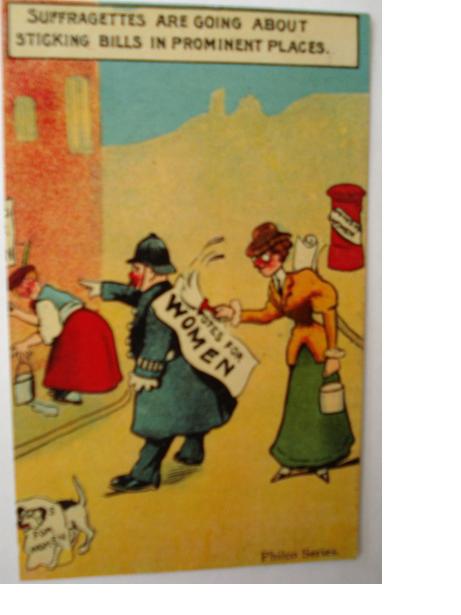 Here is another card in the ‘Philco Series’, titled ‘SUFFRAGETTES ARE GOING ABOUT STICKING BILLS IN PROMINENT PLACES’ and in this particular case that is pasting a ‘Votes for Women’ on the back of a policeman, who is in the process of accosting another bill-sticking suffragette. Needless to say the women are the usual stereotypical trilby-wearing, bespectacled harridens. In the scene a pillar box and a dog have also been plastered with V f W posters. The message on the reverse – written in pencil from the same sender to the same recipient as that of the card in the previous ‘Collecting Suffrage’ post – that is Win to Mrs James – reads ‘And the best of wishes for a happy Christmas. The suffragettes what and how they do things in London.’ Very good – unposted £45 post free. NOW SOLD
Suffragette postcards: suffragettes and policemen
Posted by womanandhersphere in Collecting Suffrage on July 24, 2012
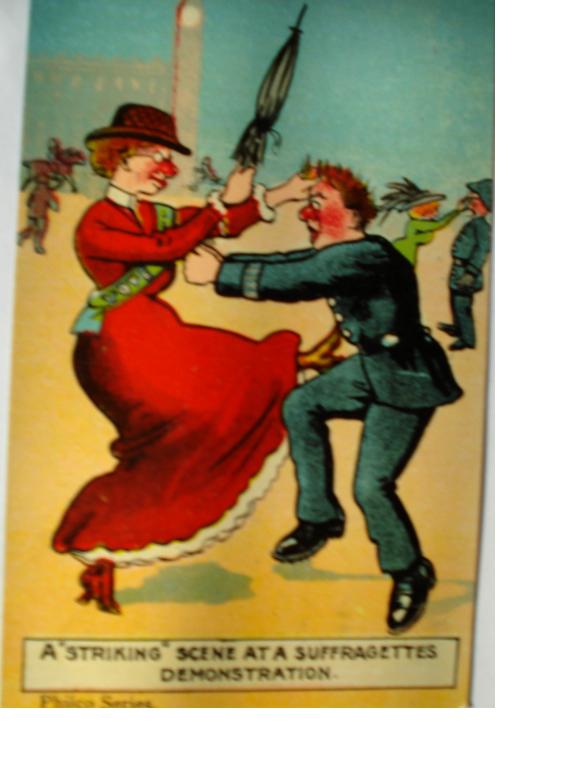 The increased activity of the women’s suffrage campaign in the early years of the 20th century coincided with the golden age of the postcard. It proved to be a subject very popular with the burgeoning number of commercial postcard publishers and cards with a ‘suffragette’ theme outnumber those relating to other contemporary campaigns – such as Tariff Reform and Home Rule.
Without too much effort, anyone interested can still build up a collection of cards reflecting the varying views of Edwardian society on women’s desire for citizenship – and their methods of achieving it. The suffrage societies themselves all produced cards – portraits of their leaders or photographs of great suffrage occasions – although they are vastly outnumbered by cards produced by the commercial publishers.
The incongruence of women battling with policemen – as on ‘Black Friday’ in November 1910 – certainly caught the publishers’ attention and there are many variations on the theme. This card was published by Philco Publishers, whose office was in Holborn Place – very close to WSPU headquarters. This card was not posted but is written to ‘Mrs James’. The message reads ‘I do not know what you will think of this. But this is suffragettes in vengeance and in their battle array.’
The stereotypical harridan (trilby hat, glasses, high-colouring, big nose) wearing ‘Votes for Women’ sash wields her umbrella as she kicks a policeman. In the background another, similar, scene is enacted. There is a tall clock tower – which might just be intended as Big Ben – at the very back of the scene, attached to a misty building. This card, which is in good condition, was one of a series. It is available for sale from me: £45 post free. NOW SOLD
See the August 2012 issue of BBC History Magazine for Prof June Purvis’s article on ‘suffragette’ cards published by commercial publishers and click here for details of her very interesting and informative accompanying podcast (June’s piece begins 20 minutes into the recording).
2 Gower Street – Royal Holloway College – and a Sense of Place
Posted by womanandhersphere in The Garretts and their Circle on July 23, 2012
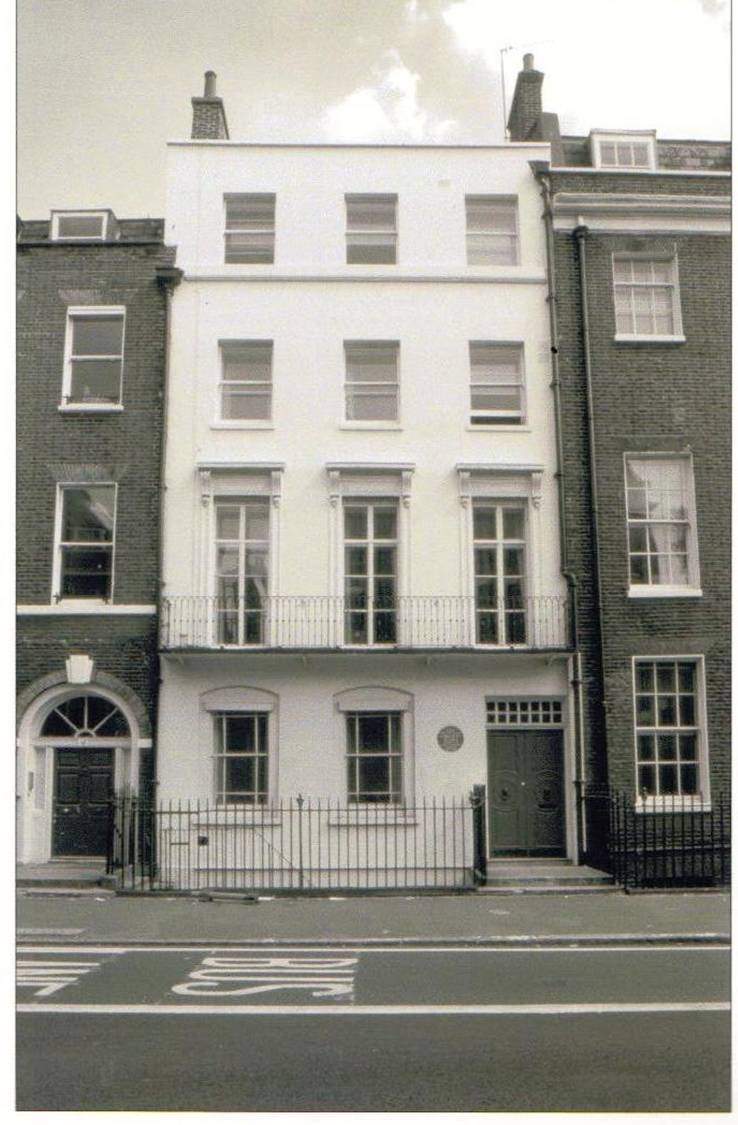
Number 2 Gower Street – just past the north-east corner of Bedford Square in Bloomsbury – was home to Agnes Garrett from 1874. She lived there first with her cousin and partner, Rhoda, and then with her widowed sister, Millicent Fawcett, and Millicent’s daughter, Philippa. Rhoda died in the house in 1882, as did Millicent in 1929 and Agnes in 1935. Philippa continued to live there alone for several more years. The Garretts, thus, had an association with this one house for well over 60 years. The fact that it was the home of Dame Millicent Fawcett, ‘pioneer of women’s suffrage’, is marked by the blue plaque on the front of the house.
2 Gower Street is now the central London campus of Royal Holloway College which was most generous in allowing me access when I was researching the work of Rhoda and Agnes Garrett. In addition, in January 2012 I had the pleasure of spending an evening there, giving a talk on the Garretts’ interior design business to members of the Camden History Society. Afterwards we all had a chance to wander around, spotting the elements of design that might be attributed to the Garretts. One of the best rooms is the first-floor back, the ceiling of which was painted by Rhoda and Agnes. Seen by lamplight on a dark wintery night it did look most attractive.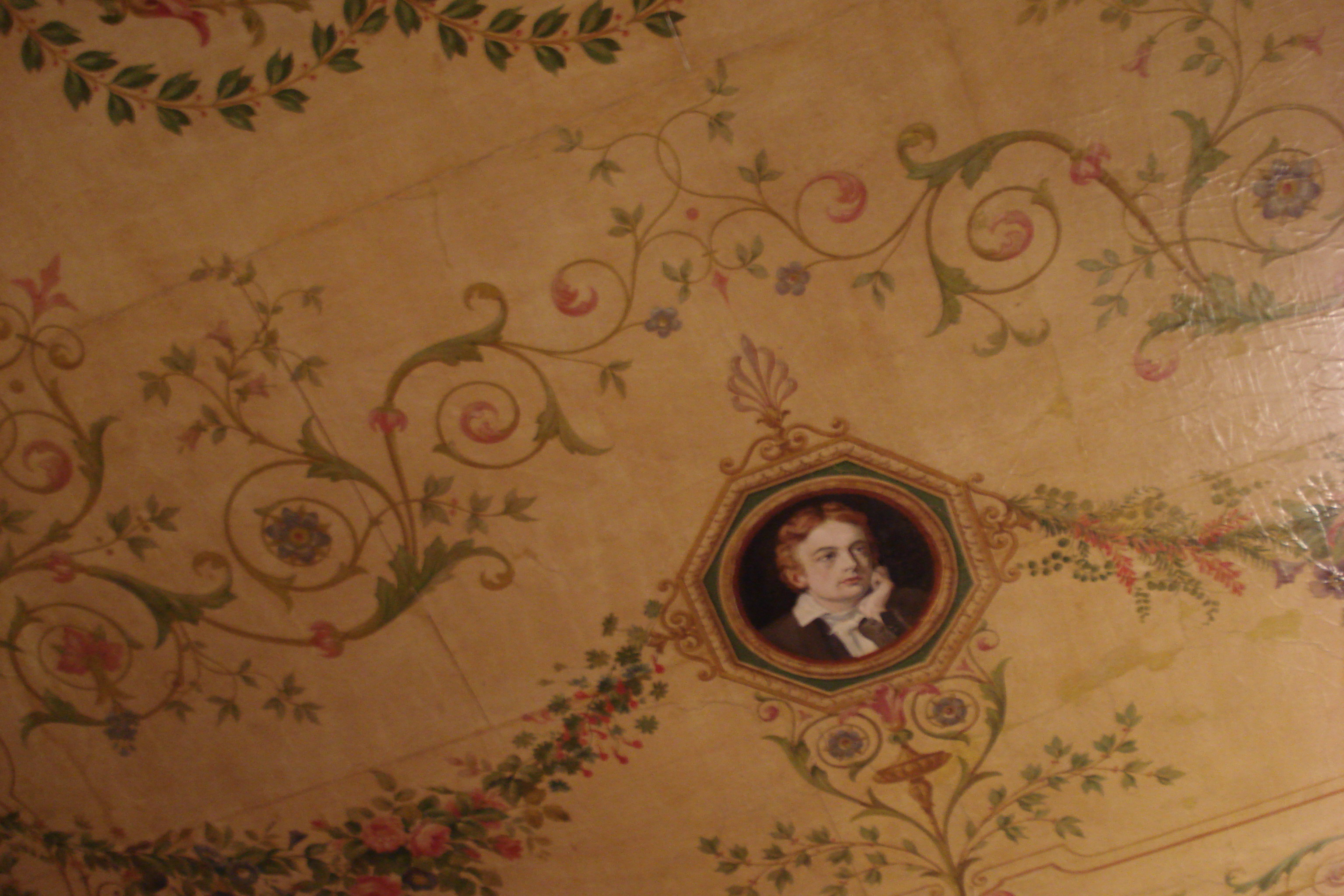
Although an effort has been made to make the interior of the house look a little less institutional than in the recent past, it did strike me how strange it was that there was not one visual reference to the long Garrett occupation. For instance, a series of etchings (I think) of what appeared to be northern European market towns, while being attractive, do nothing to give meaning to the rooms in which they are hung.
Coincidentally, a few days after that talk, I saw an advertisement for Royal Holloway’s MA in Creative Writing, one of the ‘pathways’ of which is ‘Environmental Writing’ (‘Place, Environment, Writing’). Looking at the website I saw that the accompanying photograph shows Prof Andrew Motion, the biographer of Keats, whose portrait the Garretts included in the ceiling next door, conducting a seminar in the Garretts’ drawing room. How ironic, I thought, that they should be discussing a sense of place in a place from which all sense of a past has been excluded.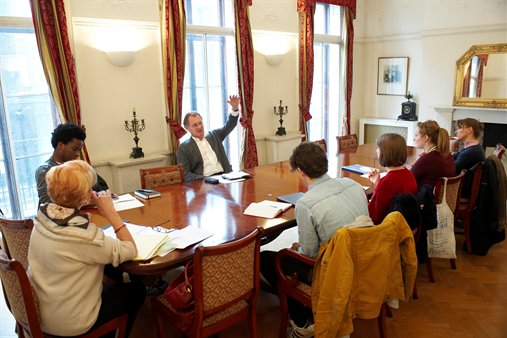
I emailed Andrew Motion to make this point and received an immediate and very supportive reply – suggesting I write to his head of department. Well, I did so, but met with silence. I suppose universities have more pressing matters to attend to.
But how easy and inexpensive it would be to add a few pictures to that seminar room and show an awareness of its past history.
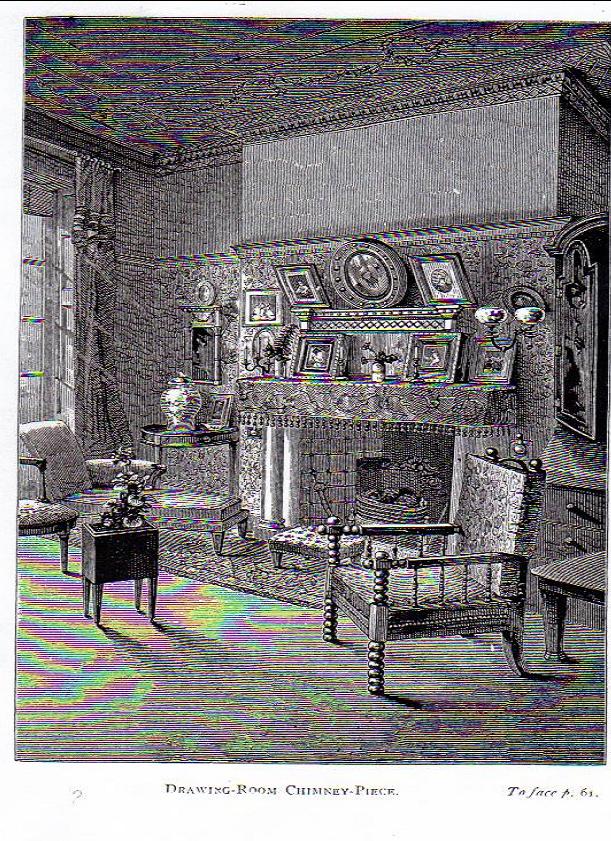
For instance, an enlargment of this – showing the same room in 1875 – as depicted in Rhoda and Agnes’s book, House Decoration.
And here is a photograph, held in the National Portrait Gallery, of Agnes attending to the grandfather clock in the corner just to the left of the fireplace. The portrait in the background is that of Philippa Fawcett by Harold Rathbone. And here is Millicent Fawcett conducting the women’s suffrage campaign from her desk in the corner on the fireplace’s right.
That is just a beginning – I could suggest many more illustrations – all inexpensive to access – of designs, people and occasions that would bring a sense of place back to the house that was the centre of so much activity during the last quarter of the 19th century and the first quarter of the 20th. How pleased I would be if Royal Holloway were to take my suggestion seriously.
For much more about Millicent Fawcett and Agnes Garrett see Elizabeth Crawford, Enterprising Women: the Garretts and their circle
Music For Garrett Rooms: Hubert Parry’s ‘English Lyrics’
Posted by womanandhersphere in The Garretts and their Circle on July 22, 2012
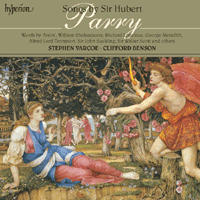 The most detailed account of Rhoda and Agnes Garrett at work as ‘house designers’ is, as far as I have been able to establish, recorded in the diary of the composer, Hubert Parry. He was their close friend and in May 1876 stayed with them for a fortnight in 2 Gower Street, afterwards writing in his diary:
’To live in their house is a very great deal of happiness in itself. The quiet and soothing colour of the walls and decoration and the admirable taste of all things acts upon the mind in the most comforting manner. I was quite excised of the vulgar idea that everything ought to be light & gaudy & covered with gilt in London. All these are a sure element of discomfort in a house, ones eye wants rest & nothing shows the dirt & dust of London so soon as light colours & gilding’.
Later in 1876 Rhoda and Agnes were commissioned to decorate Parry’s new house in Phillimore Place, Kensington.
In 1881 Parry chose to build his country house, Knights Croft, just across from the back garden of Rhoda and Agnes’s cottage in Rustington, Sussex.. There he provided members of the Garrett circle with many evenings of musical entertainment. In my first draft of Enterprising Women I included the suggestion that while reading Chapter 4 – that discussing Rhoda and Agnes’s careers as interior designers – a background accompaniment of Parry’s Songs might be appropriate. This suggestion was excised by a (prosaic) editor and I did not have the gumption to remonstrate.
Here, however, I can now suggest you listen to some excerpts from ‘Parry’s English Lyrics’.
Don’t you think that they add another dimension to a study of the work of ‘R & A Garrett’?
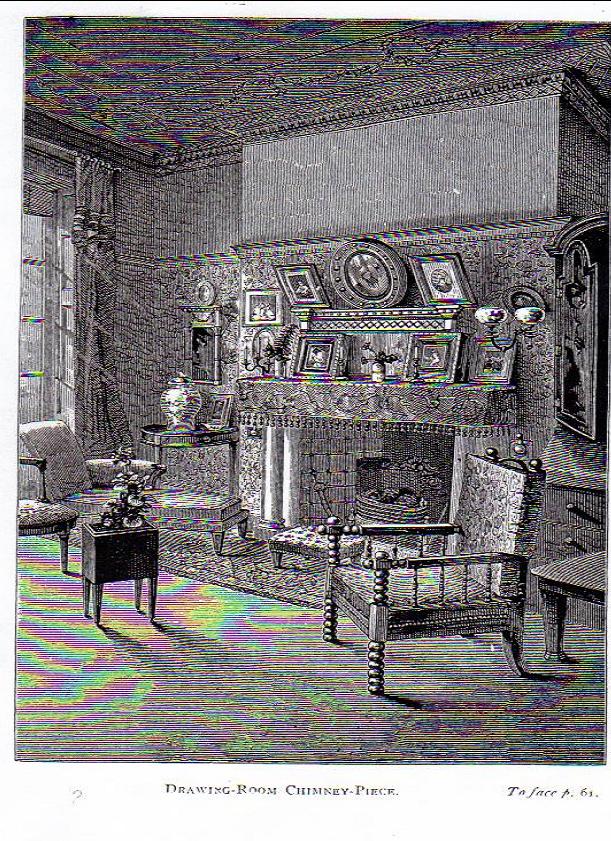
Rhoda and Agnes Garrett’s drawing room, 2 Gower Street, Bloomsbury
This music, so fluent, so English, was made to be played in the rooms that the cousins designed, composer and decorator each in their own way bringing comfort and harmony to the middle classes. The music also speaks of the patriotism and imperialism that was dear to the Garretts and their circle.
For more about Rhoda and Agnes Garrett and their work see:
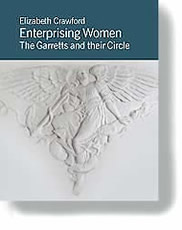
Elizabeth Crawford, Enterprising Women: the Garretts and their circle, published by Francis Boutle
Click here for details
£25
Mrs Millicent Vince: Pupil of Agnes Garrett And Interior Decorator
Posted by womanandhersphere in The Garretts and their Circle on July 22, 2012
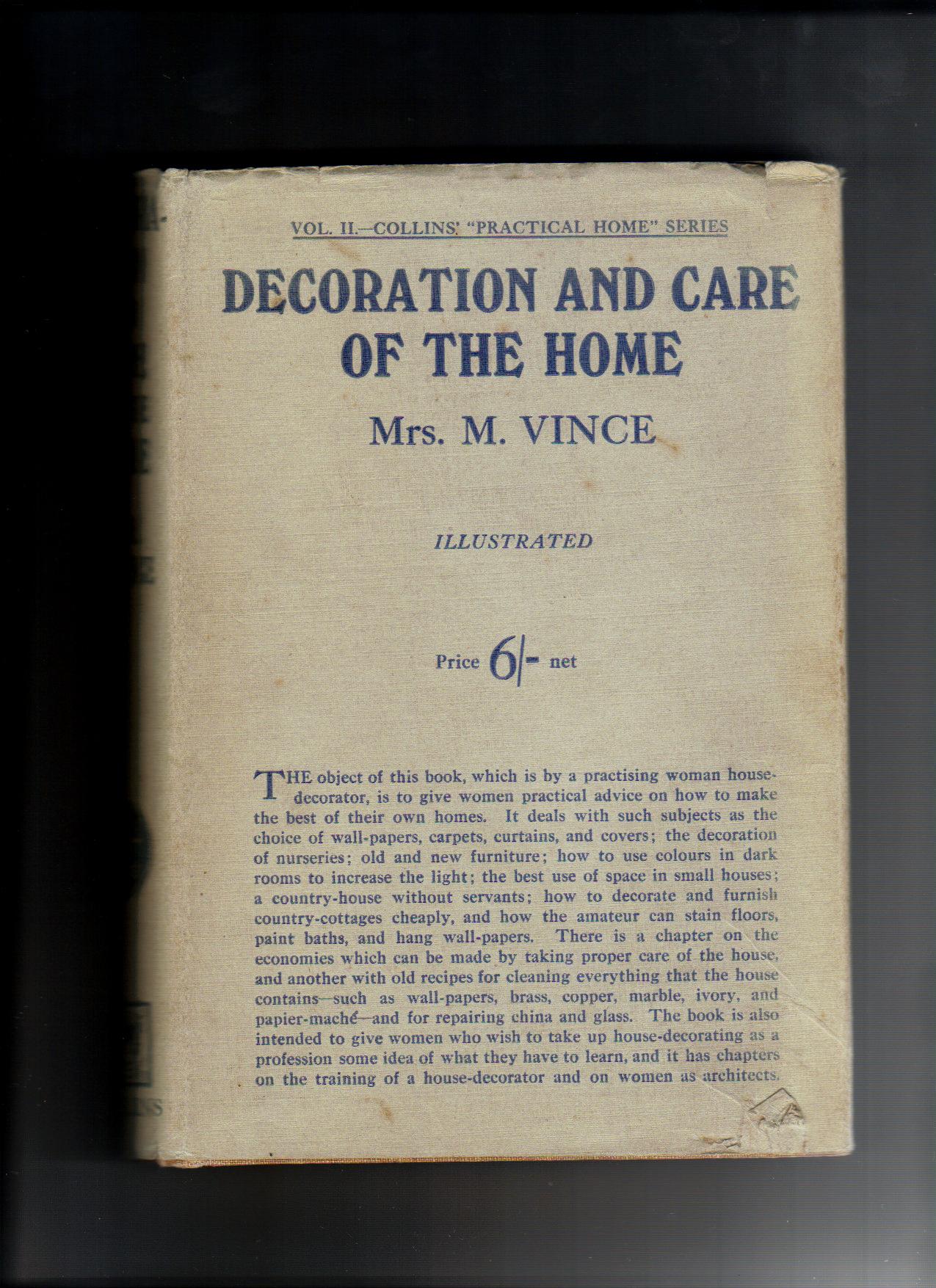 In the post ‘Garrett Laburnum’ I mentioned that I had come across a sliver of wallpaper designed by Rhoda and Agnes Garrett as a photo in a book by one of Agnes’ pupils, Millicent Vince. Being curious, I wondered what I could find out about Mrs Vince and her work.
I discovered that she had been born Emily Cohen in Birmingham in 1868, the daughter of Adolph Cohen, a Hamburg-born watchmaker and diamond dealer. There was clearly artistry in the family; one of Adolph’s watch case designs (1871) is held in the National Archives Design Register. Her mother, Juliana, was Scottish. Emily, who was known as ‘Millie’ or ‘Millicent’, had 3 sisters and a brother, the family living for many years at 27 Frederick Street, in the city’s Jewellery Quarter. Her brother, David, also became a diamond dealer, eventually moving out of Birmingham to live at The Old Stone Manor, Upper Oddington, Gloucestershire.
I would imagine that the family was Jewish, although it would seem doubtful that Millicent, at least, was observant. There is no hint of the sisters having any paid occupation until, after their father’s death, in the 1901 census the eldest sister, Jessie, is shown as running a typewriting agency. Emily is living at home.
However, in the 1911 census Jessie no longer has an occupation, while the 1908 London Directory that I happen to have to hand shows ‘Miss M. Cohen’ running her own business as an Interior Decorator from Oakley House (14,16,18 Bloomsbury Street).There is no trace of Emily Cohen in the 1911 census, either under her given name or her diminutives. She was at that time living at 68 Great Russell Street, just round the corner from her office, but is not listed in the enumerator’s book as being expected to be there on census night. I would not, however, jump to the conclusion that she is absent because she heeded the suffragette call to boycott the census. There is likely to be a more prosaic explanation – such as a holiday abroad.
So in 1908 Millicent Cohen was living just down the road from Agnes Garrett’s house at 2 Gower Street. Did her pupillage with Agnes Garrett occur after 1901? – perhaps between then and Agnes’ retirement in 1905? The fact that she chose to set up business so close by might indicate that she inherited the goodwill of Agnes’s business. She clearly was very fond of her, dedicating Decorating and Care of the Home to ‘Agnes Garrett Pioneer of Women House-Decorators My Teacher and Friend’ and writing of her in the feminist paper, The Woman’s Leader, in 1925.
Millicent’s training probably followed closely that which Rhoda and Agnes had enjoyed. In a footnote she reveals that as a student she made drawings of the woodwork – mantelpieces and panelling – from building such as Aston Hall, Juniper Hall and Kew Palace; Rhoda and Agnes had had entry for just such a purpose to many of the great houses of England.
On reading Decorating and Care of the Home it is obvious that Millicent Vince shared many of the views on what constituted an ideal home as set out by Rhoda and Agnes Garrett nearly 50 years earlier in House Decoration (Macmillan, 1875). The emphasis is always on light and simplicity.
For instance, for country cottages Mrs Vince recommends the Swedish style – light-painted furniture, perhaps decorated with discreet stencils – thinking this preferable to the dark ‘country’ furniture usually thought suitable. This is a timeless look: today’s ‘country decorating’ magazines such as Country Living and Homes and Antiques usually feature at least one home dressed in such a style. In fact Mrs Vince clearly had a penchant for Sweden – leaving bequests in her will to two Swedish friends, one being the 1912 Olympic tennis player, Ebba Hay.
After setting up in business Miss Cohen soon made a name for herself, being quoted thus in article by Sarah Tooley, published in the Everywoman Encyclopaedia around 1910. ‘Are you not afraid of your workmen?” a lady asked Miss M. Cohen, one of our most accomplished designers and decorators. “Afraid of my workmen?” replied Miss Cohen. “Why, I count them all among my friends. They are willing, polite, and obliging, and it has done me good to know them.” This was very much the attitude to her workforce that Agnes Garrett had displayed throughout her working life.
Having probably not commenced in business until she was in her mid-30s, Millicent Cohen’s life took an interesting turn when, in 1915, she married Charles Vince. He was the son of a Cambridge fellow (and former headmaster of Mill HillSchool), had been educated in Birmingham and, when they married, was 28 to her 48. I am not sure whether or not she continued in business. After her marriage she no longer appears to have an office address, but the telephone directory lists ‘Mrs M. Vince’ rather than Charles. After the war he was in full-time employment as publicity secretary of the Royal Naval Lifeboat Institution and may not have needed the listing for professional purposes – while Millicent did. But that is perhaps a deduction too far.
After a brief sojourn in Hampstead Garden Suburb (Mrs Vince, while finding the Suburb’s cottages agreeably quaint on the outside, is a little scathing about their practicality), the couple lived in Brunswick Gardens, Kensington, first at 42 and, after 1936, at 27.
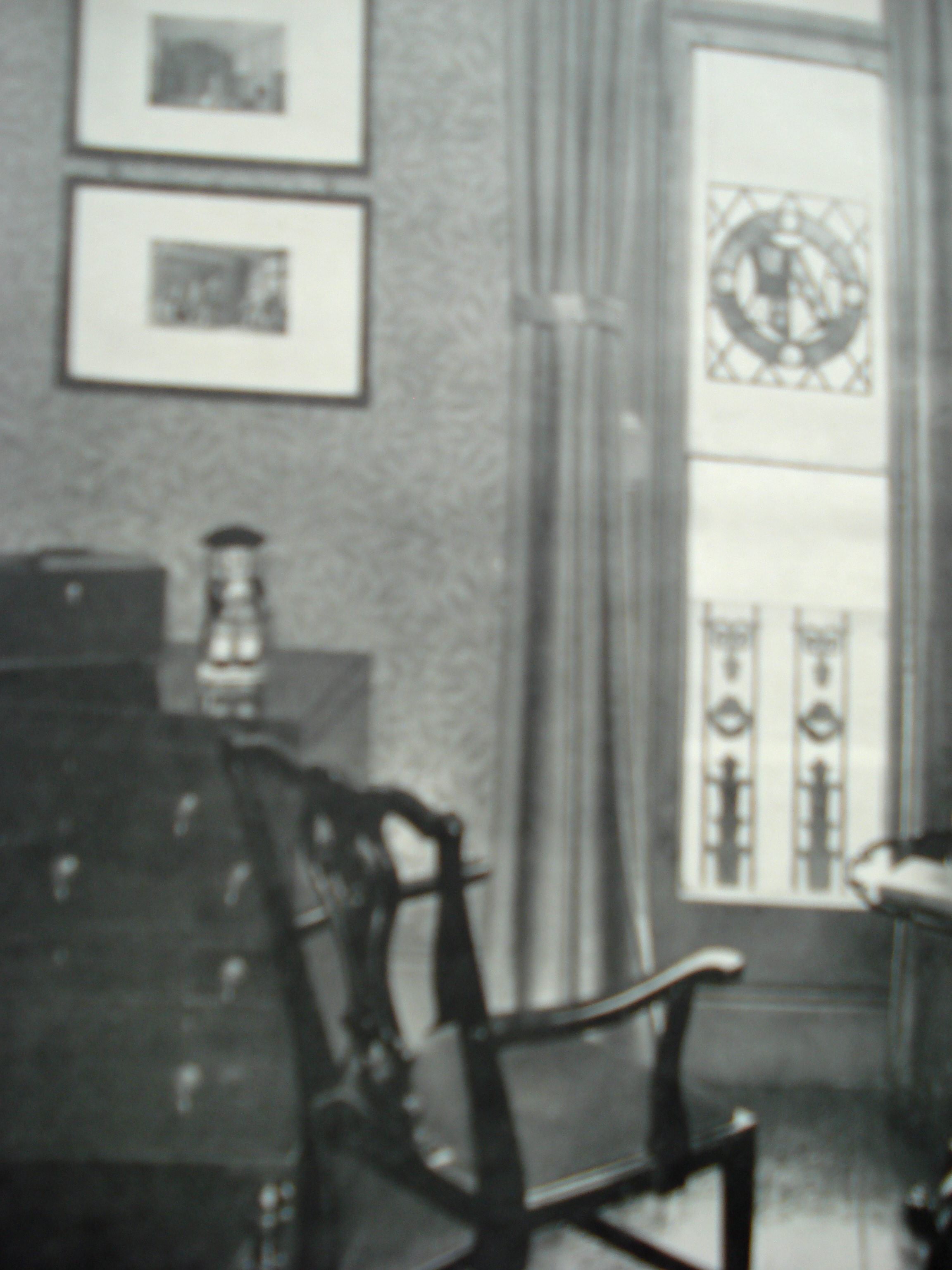 Although in her book Mrs Vince mentions in passing many decorating commissions that she had undertaken, all of them are anonymous. If it was difficult to identify Agnes Garrett’s clients, it seems impossible now to discover those to whom Mrs Vince brought the luxury of tranquil surroundings. For that was her aim. This photograph is taken from Decorating and Care of the Home and I rather think is of a room in her own apartment. The wallpaper looks very much like Morris’s ‘Willow Bough’, the paper she had selected for illustration alongside ‘Garrett Laburnum’.
Apart from her books, Millicent Vince’s will is the only document I have seen that gives any other clue to her personal life. In that she makes clear her affection for her husband and siblings and, among many bequests, are ones to the woman-run Lady Chichester Hospital at Hove and one of its doctors, Dr Helen Boyle, and to Kensington feminist designer and enameller, Mrs Ernestine Mills.
Mrs Vince’s other two books are Furnishing and Decorating Do’s and Don’ts, Methuen, 1925 and Practical Home Decorating: how to choose your decorations and how to carry them out yourself, Pitman, 1932. Here are details of the copy of Decorating and Care of the Home that I have for sale.
For more on Rhoda and Agnes Garrett ‘House Decorators’ see Elizabeth Crawford, Enterprising Women: the Garretts and their circle.
‘Garrett Laburnum’
Posted by womanandhersphere in The Garretts and their Circle on July 17, 2012

One of the pleasures in working on the creation of the Elizabeth Garrett Anderson Gallery was to be able to help bring back to life the only surviving wallpaper created by the firm of ‘Rhoda and Agnes Garrett Household Decorators’.
I first came across the design in the form of a small, rather indistinct, black and white photograph in Decoration and Care of the Home by Mrs Millicent Vince.
 The book was published in 1923 and is dedicated to Agnes Garrett, with whom Millicent Vince had trained. The photograph labelled ‘Garrett Laburnum’ appears alongside one of ‘Willow Bough’, created by William Morris in 1887. ‘Garrett Laburnum’ is likely to date from around the same time..
Although we do not know exactly how the original wallpaper was coloured, wallpaper artist Pip Hall did a wonderful job of re-creating ‘Garrett Laburnum’ using the soft greens and yellows that surviving comments indicate were predominant in Agnes Garrett’s palette.
Click here to see how ‘Garrett Laburnum’ is displayed in the Elizabeth Garrett Anderson Gallery.
For Pip Hall click here
For much more information about Rhoda and Agnes Garrett as the first women professional decorators see Elizabeth Crawford, Enterprising Women: the Garretts and their circle.
 Woman and her Sphere