Archive for category Suffrage Stories
Suffrage Stories/Collecting Suffrage: Suffragette Jewellery
Posted by womanandhersphere in Collecting Suffrage, Suffrage Stories on August 27, 2012
 Pendant made for Margaret Murphy by Ernestine Mills
‘Prison to Citizenship’ – Three pendants earned by two Irish suffragettes
In previous posts I have mentioned how necessary it is to observe the provenance of an item of jewellery in order to be able to label it with certainty as ‘suffrage’. In that way the collector is less likely of falling into the trap of buying an item – vaguely Edwardian with vaguely purple, white and green stones – that an auction house or dealer has chosen to label ‘suffragette’ In this post I will bring to your attention three items of jewellery – made for two Dublin sisters – that are indisputably ‘suffrage’.
‘Margaret’ and ‘Jane Murphy’ were the pseudonyms of two middle-class women from Dublin – whose real names were Leila (b. 1887) and Rosalind Cadiz (b. 1886). They were members of the Irish Women’s Franchise League. They both took part in the window-smashing campaign in London in March 1912 and were sentenced to two months in Holloway. They went on hunger strike (c 16 April) and were forcibly fed. They were released c 15 May. The pendant above is engraved – “Holloway Prison No. 15474, Maggie Murphy, 2 months hard Labour, E.4 Cell.12., Hunger Strike 16th April 1912, Forcibly Fed – and was made by the suffragist and enameller, Ernestine Mills. As you can see the lily motif is rendered in purple, white and green – in this case a ‘true’ use of the colours.
 Margaret and Jane Murphy, top row far right and second from right, pictured in Votes for Women, 25 June 1912.
A couple of months later the Murphy sisters took part in the first window-smashing campaign in Dublin and were again sentenced to two months’ imprisonment – but in Dublin they were given the status of political prisoners.
Margaret Murphy requested to be treated by her own doctor, Kathleen Maguire, ‘as I am undergoing treatment owing to having been forcibly fed in Holloway,… Dr Maguire understands my constitution.’ To this the Medical Officer in Mountjoy replied (5 July 1912) ‘I beg to report that I regard her [Margaret Murphy] as a woman of neurotic temperament who suffers from indigestion, an ailment frequently complained of by women of this type.’
The Murphys eventually succeeded in not only getting a suffragist doctor, Kathleen Maguire, to treat them, but also in getting their own dentist. ‘Miss Jane Murphy will attend her own dentist at her own expense’ (July 1912).
The Murphys clearly had a way about them for ‘with reference to Margaret Murphy’s complaints of the possible effect of the whitewashed walls of her cell on her eyes, the governor agreed to have the walls recoloured, and to have a new gas burner fitted in lieu of the existing one, and her request for a special kind of disinfectant to be used in her cell was referred to the Medical Officer.’ 25 July 1912 Minutes of Mountjoy Prison.
Finally the sisters went on hunger strike for the last 92 hours of their sentence (along with 2 other Irish suffragettes) in sympathy with three English suffragettes (Mary Leigh, Gladys Evans and Jennie Baines) who had received harsh prison sentences in Dublin and who had not been given political prisoner status. The Murphys were not forcibly fed – the end of their sentence arriving before this became necessary. They were released, together, from Mountjoy Prison on 19 August, welcomed by members of the Irish Women’s Franchise League.
Here are the pendants that the sisters either commissioned for themselves or, more likely, with which they were presented after their release. Each pendant is of shield shape, surmounted by a green enamelled shamrock, hallmarked Dublin, Hopper and Hannay, 1912. One is engraved on the obverse “From Prison to Citizenship” and on reverse “J. Murphy 20.6.12 to 19.8.12” and the other “M. Murphy 20.6.12 to 19.8.12”. Thus do three items of jewellery commemorate the efforts of two Irish sisters to win ‘Votes for Women’.
Suffrage Stories: ‘The Putney Caravans’
Posted by womanandhersphere in 1911 Census, Suffrage Stories on August 20, 2012
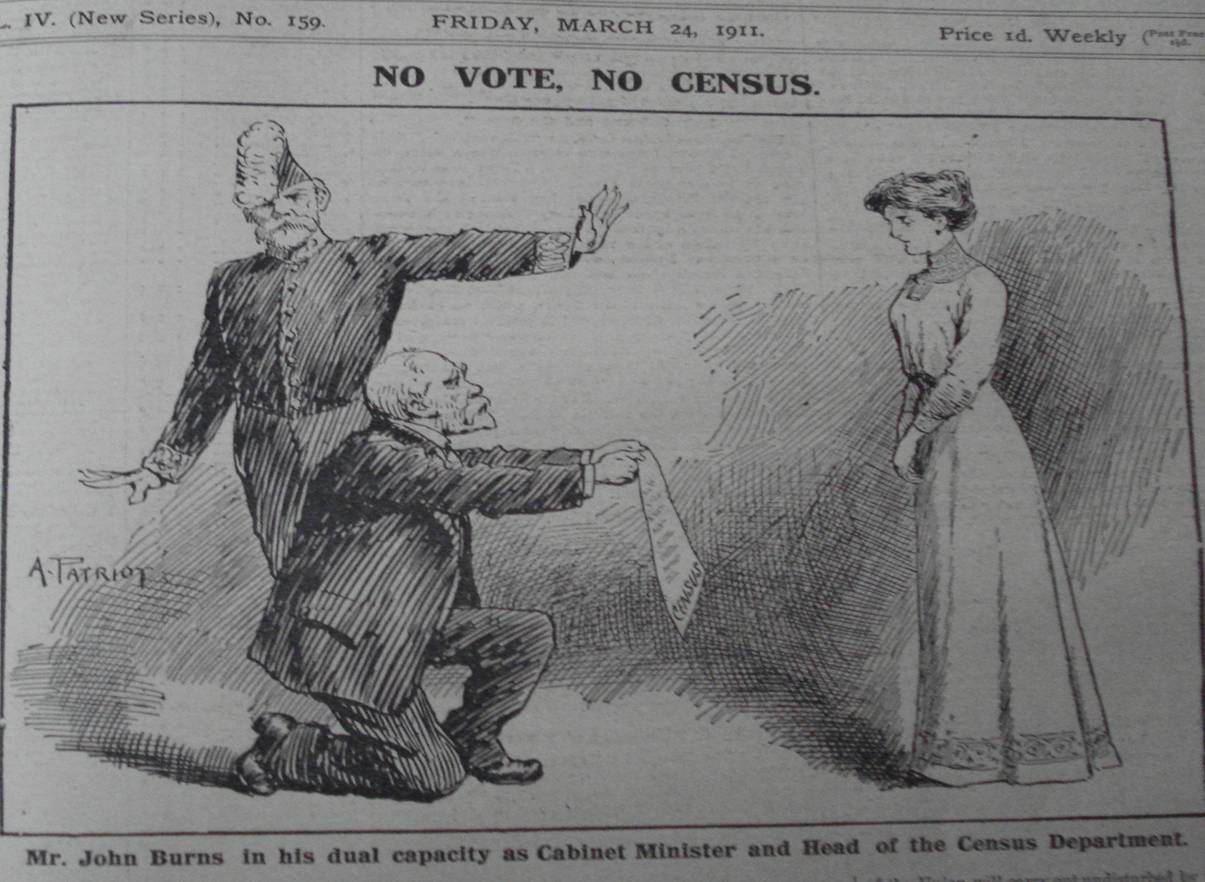
John Burns, the suffragettes and the census boycott
As I have already described here, one of the most inclusive acts of civic resistance undertaken by the militant suffrage societies was the boycott of the 1911 census. The argument was that, if the government was not prepared to grant them full rights of citizenship, women would not fulfill the duties of a citizen. On the night of the census – 2 April – those who obeyed the call either went to considerable lengths to evade the enumerator – or, like ‘Madame Mantalini’, refused to supply the required details on their census paper.
There are many stories to be told, but one of the more flamboyant adventures was that of Arthur Marshall, the WSPU’s solicitor, who with his wife, Kitty and nine other rented from a Paddington firm, Rickards, what were described as ‘smart Pullman caravans’. The caravans, horse-drawn, of course, were then driven in the dark from Paddington and into and round Trafalgar Square, where the main suffragette protest was taking place – and then down Whitehall and out to the west, eventually coming to a halt on Putney Common.
As the journalist Henry Nevinson, writing in the suffragette newspaper, Votes for Women, wrote, ‘I had noticed three gypsy caravans….they were driven by women, who whispered me the names of woodland regions not very far off in Surrey. Whether statistics will add them to Surrey’s glorious army of vagrants I don’t know, but they vanished silently down the road, past the decorated windows of the Home Office and the Local Government Board.’ The last office was singled out for mention because it was the LGB – under its minister, John Burns – that was charged with organising the census.
Once they had arrived at Putney Common, not exactly deepest Surrey, the women – and Arthur Marshall – all appeared to have had a jolly dinner and reported that they had refused all information to the police who turned up to take their particulars. In the morning they decorated their caravans with placards saying – ‘If we don’t count we shall not be counted.’ and, thus adorned, travelled back into London.
Although this excursion doubtless attracted publicity, the police knew quite well who the leaders of that ‘suffragette party’, as they described it, were – and the Marshalls’ details were duly entered on a census form. The other nine women did, however, manage to remain anonymous.
It may be that Henry Nevinson was embroidering reality a little – and that it was not the women themselves who were driving the caravans – because a week or so later three men – presumably Rickards drivers – were charged with driving the caravans unlawfully on the turf of Putney Common. This was one of the very few prosecutions brought that related to the census boycott; women who had evaded or resisted were not charged, the government realising there was little to be gained by giving the protest the oxygen of publicity. However, the local Putney magistrate clearly thought the case a nonsense and it was dismissed with the defendants merely having to pay 2s in costs. And the image painted by Nevinson of the caravans with their bohemian crew remains in the memory.
Suffrage Stories/Collecting Suffrage: Mrs Pankhurst’s portrait
Posted by womanandhersphere in Collecting Suffrage, Suffrage Stories on August 13, 2012
In a previous post on Suffragette Jewellery I commented on the danger of assuming that any piece of jewellery that a dealer described as ‘suffragette’ had, in fact, anything to do with the suffragette movement. However it is still possible to discover items the provenance of which cannot be doubted.
Below is one such.
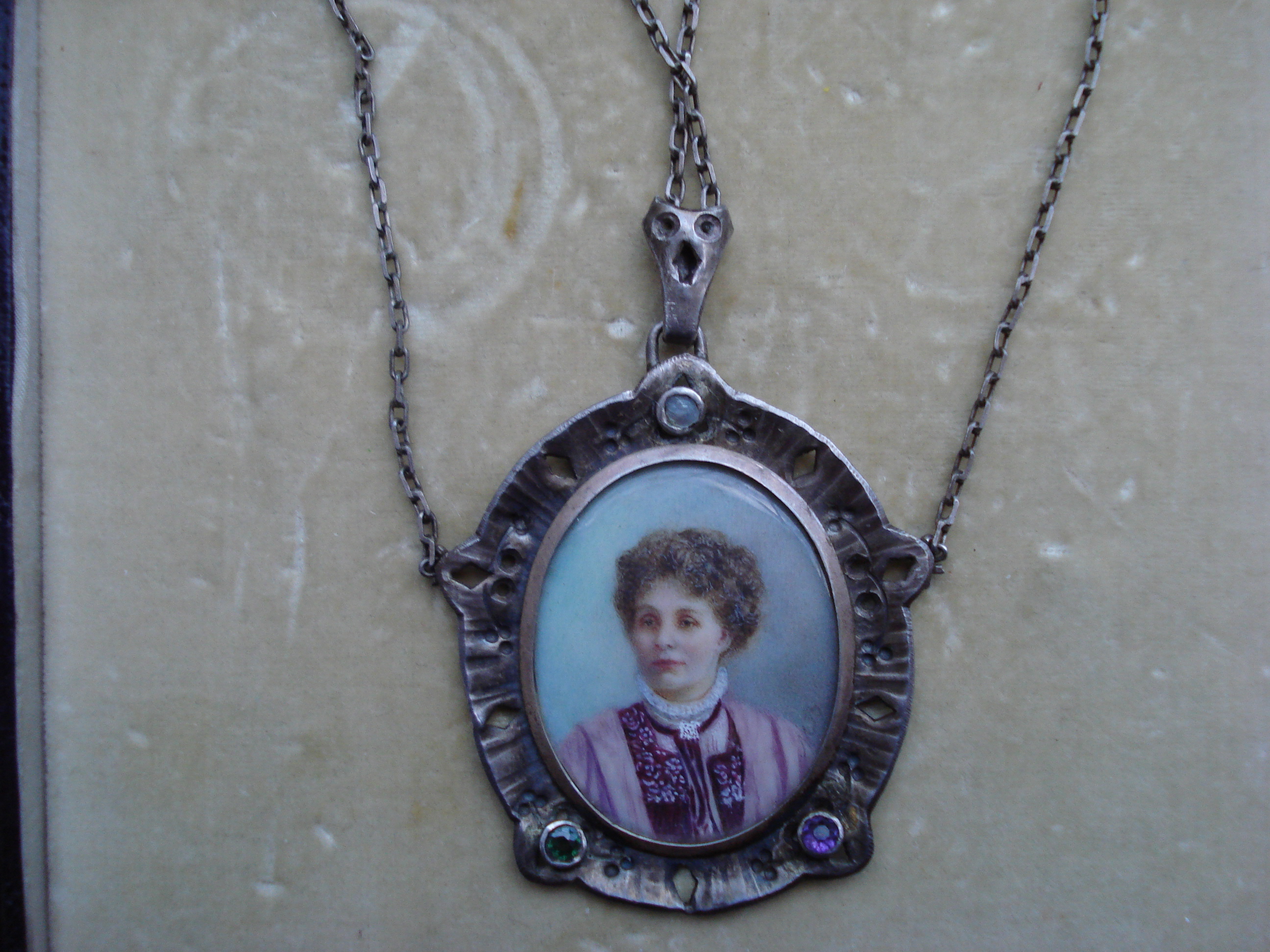
PENDANT – MRS PANKHURST – ICONIC PAINTED PORTRAIT MINIATURE -presented to Mary Leigh, leader of the WSPU Drum and Fife Band, devoted friend of Emily Wilding Davison, and ardent suffragette.
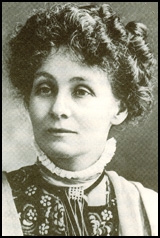
The image for this original painted miniature portrait of Mrs Pankhurst is derived from the photograph of her by the Kensington photographer, Martin Jacolette (see above). In it she is wearing a Holloway brooch, which dates the photograph to no earlier than April 1909.
The portrait miniature is very pleasingly painted and, although no artist’s signature is visible, I did wonder if it might not be by one of the Brackenbury sisters (Georgiana’s much later portrait of Mrs Pankhurst is in the National Portrait Gallery). The portrait is set in a metal pendant, on the back of which is inscribed ‘Presented to Mrs Marie Leigh Drum Major by the N.W.S.P.U. Drum and Fife Band in memory of her courageous fight for woman’s freedom December 1909’.
In the autumn of 1909 Mary Leigh had been forcibly fed while serving sentences in Winson Green and Strangeways prisons and in December an action for damages was brought on her behalf by the WSPU against the Home Secretary. The WSPU newspaper, Votes for Women, reported that, on 16 December 1909, ‘Ushered to the strains of “See the Conquering Hero Comes” , played by the WSPU Band, Mrs Leigh, the Drum Major received a royal welcome at St James’s Hall. Looking rather pale but as determined as ever, she delivered a stirring address.’ As Christabel Pankhurst, who was presiding, commented, ‘The Government did not know with whom they were dealing.’ The pendant was probably presented on this occasion.
The pendant, which has its original chain, has set around its edge three little stones – one white, one purple and one green. In this case the choice of stones clearly did have WSPU relevance. The pendant is in its original box – similar in material to that used for the hunger strike medals. Contemporary painted portraits of Mrs Pankhurst are exceedingly rare and with this particular provenance – unique. I have never seen another pendant like this, but wonder whether Mary Leigh was the only recipient of such an object. Might there be others waiting to be discovered?
Suffrage Stories: What else is in Emily Wilding Davison’s grave?
Posted by womanandhersphere in Suffrage Stories on August 6, 2012
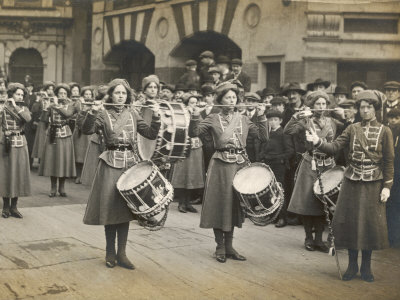
 A while ago I acquired a small collection of items that had once belonged to Mrs Mary Leigh, the leader of the WSPU fife and drum band and close friend and life-long supporter of Emily Wilding Davison. Among these was a copy of Walt Whitman, Song of the Open Road, published by the Arden Press, Letchworth (1912), containing a lengthy inscription by Mary Leigh on the free front endpaper.
From studying the handwriting I deduced that her comments had been made at two different times – probably decades apart. At the top of the page is an ink inscription ‘From E.W.D. 1912’.- which, I think, was not a presentation inscription from Emily Wilding Davison, but a note by Mary Leigh to commemorate the gift to her. The Emily Wilding Davison archive held by the Women’s Library contains another volume of Whitman’s verse, given by ‘Comrade Davison to Comrade Leigh’. Whitman was clearly a favourite, a poet who spoke to the women – eulogising their bond of close comradeship – and in The Song of the Road Mary Leigh, as in the Whitman in the Women’s Library, has annotated particular verses with some vehemence. The little book itself had clearly been well used; laid in the title-page fold of this copy was a pressed flower.
However it is another piece of information that Mary Leigh added to her endpaper writings that particularly interested me. She wrote: ‘I placed one [i.e. a book] like this from L C. Lytton in E.W.D.’s hand. ‘ In biro, at a later date, as though giving a fuller explanation, she has amplified these details – so that the whole now reads: ‘1913 June 14 in her coffin at Epsom Mortuary I placed one like this (Walt Whitman) from L C. Lytton (Lady Constance Lytton) in E.W.D’s hand open at the page she loved so well. I also placed her Hunger Strike Medals and the 8 Bars of Forcible Feeding also the Medal of Jeanne D’Arc to Fight on God will give the Victory’. 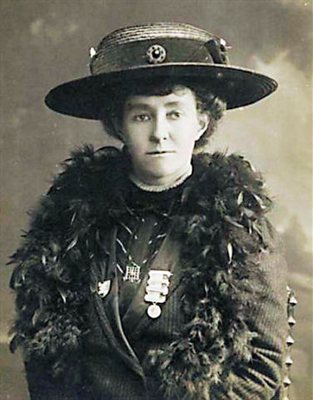
‘Fight on God will give Victory’, Joan of Arc’s assurance, given at her trial, is the message emblazoned on the banner carried at Emily Wilding Davison’s funeral, both in London and then draping the grave in Morpeth.
Here is Emily Wilding Davison wearing her Hunger Strike Medal, with still, I think, four bars, each commemorating a hunger strike and consequent episode of forcible feeding. Further imprisonment lay in the future. It is interesting that Mary Leigh specifically writes of ‘Medals’ in the plural. As well as the Hunger Strike Medal, with its 8 bars, she may have been referring to the ‘Holloway’ badge, received for an earlier imprisonment, that Emily is wearing in the photograph. In addition, I suspect, but cannot be sure, that she may also have, pinned on her other lapel, a WSPU ‘Boadicea’ brooch.
However I have not yet been able to deconstruct Mary Leigh’s mention of the ‘Jeanne d’Arc’ Medal’. As far as I know there was no WSPU medal directly associated with Joan of Arc – although, 1912 having been the 500th anniversary of her death, she loomed large in the popular – particularly suffragette – imagination, Elsie Howey rode as ‘Joan of Arc’ in Emily Wilding Davison’s funeral procession. It may have been that EWD particularly treasured a medal – there were many issued – acquired in the quincentenary year.
Mary Leigh remained Emily Wilding Davison’s champion for the remainder of her life. Out of a meagre income she arranged each year for a Morpeth florist to supply an expensive bouquet of flowers and travelled north every June- even well into old age – to lay them at EWD’s grave in St Mary’s Churchyard. The rather pathetic correspondence concerning these arrangements may be read in the Mary Leigh Papers at the Women’s Library. The florist was a credit to her profession, entirely kind and helpful.
Little would Mary Leigh have expected – although she may well have approved (you can never be sure – she was a contrary character) – that into the 21st century EWD’s grave would have become a shrine – the plot now immaculately restored. So many myths have accrued to the memory of Emily Wilding Davison that it is something of a relief to be able to produce a piece of primary evidence, in the form of this copy of Song of the Road, that allows the visitor standing in front of the Morpeth obelisk to picture, with some assurance, the moment in the Epsom Mortuary as Mary Leigh laid in the open coffin Lady Constance Lytton’s copy of this small volume of verse, together with the hard-earned Hunger Strike Medal.
Suffrage Stories: ‘Madame Mantalini’
Posted by womanandhersphere in 1911 Census, Suffrage Stories, The Garretts and their Circle on July 30, 2012
Since 2009, when details of the 1911 census were released, I have (with, for a time, Dr Jill Liddington) been investigating how the women of the country responded to the call issued by the more militant suffrage societies to boycott the census. In the process I have discovered women of a suffrage inclination of whom, until now, suffrage history has known nothing.
One of these was a ‘Miss S. Marsden’, whose census form was delivered to her at 69 Church Street, Kensington, and who refused the enumerator any details about herself. However, Miss Marsden did not leave the form blank, writing on it one of the longest statements that I have so far encountered. Although the right edge of the census form is badly damaged, creating gaps in her comments, I think we can get the gist.
‘I, Mdme Mantalini, a municipal voter and tax payer, refuse to fill in this census paper, as I have no intention of furnishing this government with information and thereby helping them to legislate for women without obtaining their consent or first consulting them in the [missing words] effective way possible & extending the franchise to duly qualified women. As a responsible, law-abiding citizen I have conducted my business for sixteen years; as an employer of labour I have [contributed?] to the wealth of the state and in return I have been taxed for the upkeep of no 10 Downing Street. No 10 Downing Street, the official residence of the prime minister, but converted by his wife into a show-room for a French [dress maker?] (free of all duty and taxation) to exhibit his Paris models and take orders from them to be executed in Paris. I [missing words] with very few exceptions the dressmaking establishments in England are all owned by women, & only women & [missing words] workers. It therefore comes to this, that the only way open to us to protest at ‘our trade’ being ruined in [missing words] our taxes, is to drive home to the government by every method available that women are determined [missing words – perhaps ‘not to be governed’] without their consent.’
Would that not whet any researcher’s appetite? Who was Miss Marsden/Mdme Mantalini? What had Margot Asquith been up to?
In fact the second question was the easier to answer. An inspection of The Times archive revealed that in May 1909 Margot Asquith had been called to task by drapers’ associations from around the country for inviting the Parisian designer Paul Poiret to show dresses in 10 Downing Street.
Poiret then was the epitome of chic – designing dresses that relied on draping, rather than tailoring – so much easier to wear – and promoting hobble skirts, harem pants and kimono coats – designs such as these.
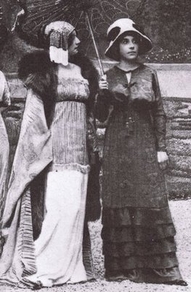
In response to a letter of complaint from an MP, Mrs Asquith explained, ‘I received in my private rooms at tea from 20 to 25 of my personal friends and a well-known French costumier, whose models can be bought in any London shop, brought some specimens for the inspection of myself and my guests. It was a purely personal occasion.’ In fact, such was the rumpus, that henceforward Margot Asquith was obliged to patronize British costumiers, such as Lucile although probably not, I fear, Madame Mantalini.
I thought at first that when Miss Marsden referred to herself on the census paper as ‘Mdme Mantalini’ it was merely as short-hand to describe her position as a dressmaker – that being the name of the dressmaking establishment at which, in Nicholas Nickleby, Kate Nickleby is apprenticed. But, consulting my 1908 London street directory, I found that the shop at 69 Church Street (which is still there) was, indeed, that of ‘Mrs Sybil Mantalini’. It was then only a short step to establish that Mrs Mantalini was, in fact, Miss Sybil Marsden, who was on the London Electoral Register by dint of her occupation of those premises, and the question of’ ‘Who was Miss S. Marsden?’ was solved.
But now I was hooked. Who was Miss Sybil Marsden? Why was she such an outspoken dressmaker?
I discovered that she had 9 siblings and in 1911 was living at the family home, 82 RedcliffeGardens in South Kensington, with her mother and one unmarried sister. Her father, Algernon Moses Marsden, had been a fine art dealer but, by 1901, had been declared bankrupt several times. His background was most interesting; he had declined to enter the family’s successful clothing business, clearly preferring the more elevated association with ‘art’.
 Algernon Moses Marsden by James Tissot
Marsden was by all accounts – mainly in the bankruptcy reports – an engaging fellow – as is evident in the portrait of him by James Tissot, painted in 1877, when Sybil was four-years-old. At that time Marsden was Tissot’s dealer, but gambling and high-living proved his downfall. It would appear that after his final bankruptcy in 1901 he removed himself to New York, where he died in 1920. I can now see that the choice of the name ‘Madame Mantalini’ may have been even more to the point than I first thought. In Nicholas Nickleby it is Mr Mantalini’s extravagance that resulted in the bankruptcy of his wife’s business – an awful warning to Sybil Marsden. No wonder Algernon’s daughter had little faith in the ability of men to manage her affairs.
Epilogue
The cinéaste members of my family play the Six Degrees of Kevin Bacon game (whereby any named film actor has to be connected with fellow-actor KB by links covering no more than 6 films). I am hopeless at that – but think I might be a contender in Six Degrees of Garrett. This particular case is easy: Sybil Marsden, Algernon Marsden, James Tissot, J.M. Brydon, Agnes and Rhoda Garrett. As I discuss in Enterprising Women: the Garrets and their circle, the two young women were undergoing their architectural training with Brydon in 1873, at a time when he was working on the design of a new studio for Tissot, attached to the artist’s St John’s Wood house. Did they go on a site visit? Had they perhaps even seen in the flesh, as it were, the tiger skin and the fashionable blue vase, that serve to emphasise Algenon Marsden’s exoticism and good taste.

