Archive for April, 2014
Suffrage Stories/Suffrage Collecting: WSPU Illuminated Address
Posted by womanandhersphere in Collecting Suffrage, Suffrage Stories on April 30, 2014
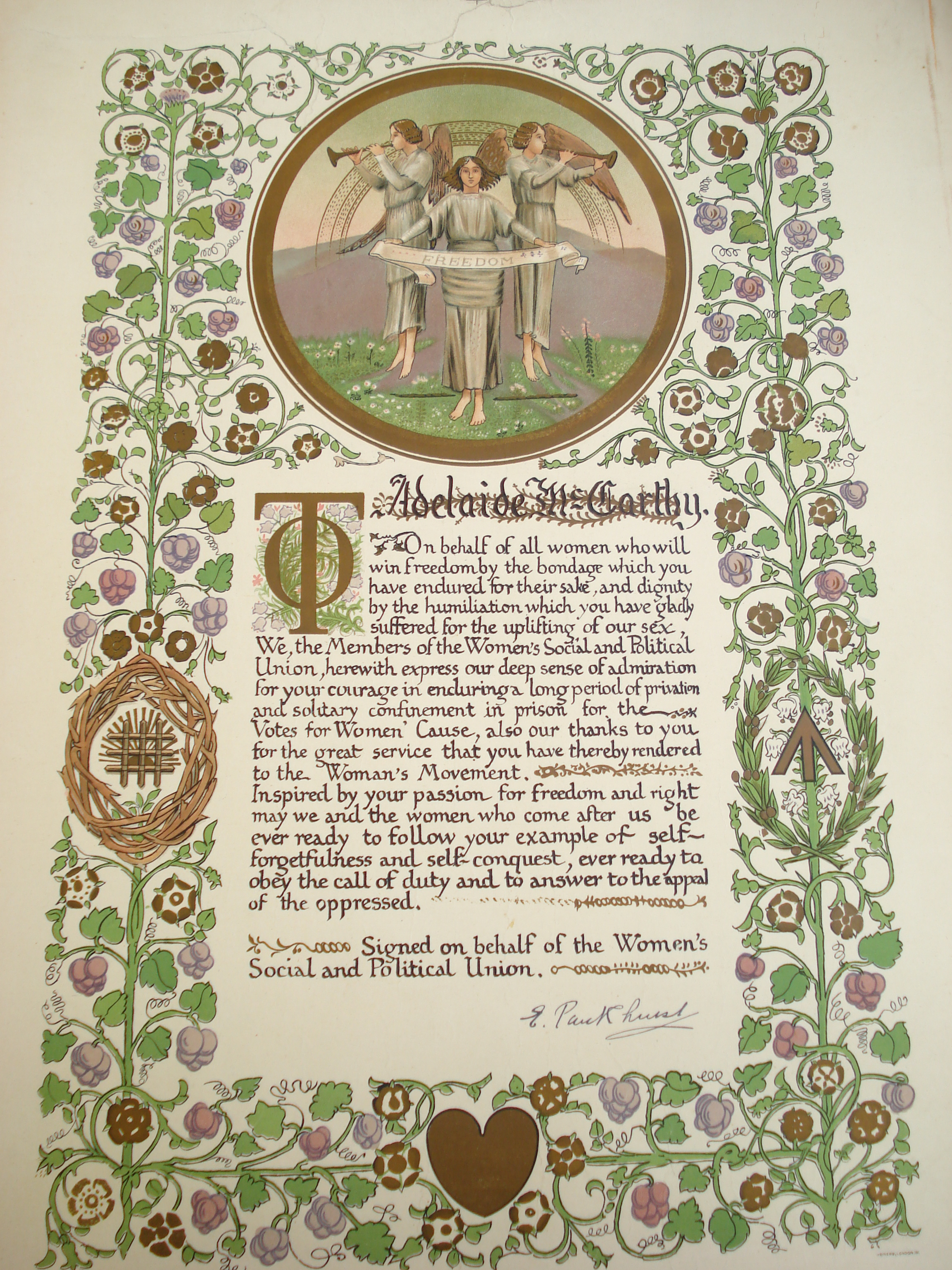
Illuminated address presented to Adelaide McCarthy
Illuminated addresses such as this were first presented to WSPU prisoners on their release from Holloway in September 1908.
The addresses, signed by Emmeline Pankhurst, were designed by Sylvia Pankhurst and incorporate the purple, white and green colours that the WSPU had adopted three months earlier, in June 1908. The ‘angel of freedom’ device was one that Sylvia was to use on other WSPU artefacts – a neat piece of WSPU ‘branding’.
As ever, the suffrage collector needs to be on guard against modern reproductions that pass as the original. As a dealer I was once offered what appeared to be the address presented to suffragette Clara Codd. However, always rather suspicious, my research quickly revealed it to be a copy sold, entirely legitimately, by Bath-in-Time (the gallery of Bath Central Library). I was told that the unfortunate person offering the address to me had bought it as the real thing from a (presumably) rather unscrupulous source. Caveat Emptor.
Suffrage Stories:’We Believe That The Rousing Of The Irish People Had Best Be Left To Irish Women’
Posted by womanandhersphere in Suffrage Stories on April 29, 2014
‘We believe that the rousing of the Irish people on this matter had best be left to Irish women’
This article is the text of a paper that I gave in 2003 at a conference held at Portsmouth University to mark the 100th anniversary of the founding of the WSPU. Eleven years later we are now approaching the 100th anniversary, on 25 May, of the passing of the Government of Ireland Act, the campaign for which had been so closely entwined with that for ‘Votes for Women’. In the circumstances it seems timely to remind my readers of the important – and complicated – part that Irish politics played in the women’s suffrage campaign.
In 2003 I had decided to devote the paper to the Irish suffrage campaign because, although the Irish Question and the British government’s attempts to deal with it, had a profound philosophical and a practical impact on the WSPU campaign both in Ireland and in mainland Britain, it is not a subject that is often given much consideration at English conferences.
The title of the paper – ‘We believe that the rousing of the Irish people on this matter had best be left to Irish women’ – is taken from an article published in The Irish Citizen of 14 September 1912. This was a Dublin suffrage paper, founded a few months earlier with financial help from the Frederick and Emmeline Pethick-Lawrences, still (if only for another month) leaders of the WSPU. The article was written either by Hanna Sheey Skeffington, the leader of the militant Irish suffrage society, the Irish Women’s Franchise League, or by her husband, Francis, the paper’s editor, and was prompted by what the paper described as the first public meeting held by the WSPU in Dublin, at which the speakers had included Sylvia Pankhurst and Georgina Brackenbury.
The article continued: ‘Many will regret that the campaign for women’s suffrage in Ireland was not left entirely in the hands of the Irish suffrage societies, which are sufficiently numerous and sufficiently varied in their appeal. But the advent of the WSPU might have been predicted from the moment when Mr Redmond and his party decided to import Mr Asquith into Ireland. That some of the English militants would follow their chief enemy might have been foreseen. We believe however that the rousing of the Irish people on this matter had best be left to Irish women, who understand the psychology of their countrymen as the ablest English advocate never can.’
I will take these several sentences as my text and use them to analyse the Irish suffrage campaign and the WSPU’s part in it.
‘Many will regret that the campaign for women’s suffrage in Ireland was not left entirely in the hands of the Irish suffrage societies, which are sufficiently numerous and sufficiently varied in their appeal’. And indeed they were. The suffrage campaign had begun in the 1860s in Ireland as it had in England, although its early development had been even more hesitant in Dublin than it had in London. The Irish suffragists were initially drawn from the Quaker circles that had been long involved in radical causes, such as the anti-slavery campaign. However those women in Ireland who signed the 1866 petition were not sufficiently motivated to found a suffrage society immediately.
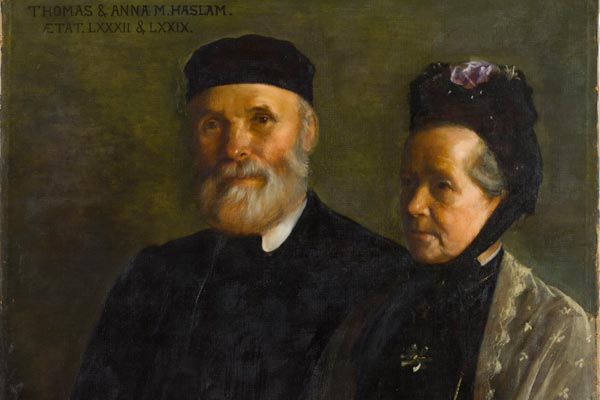
Thomas and Anna Maria Haslam, portrait by Sarah Cecilia Harrison, courtesy of the Hugh Lane Gallery, Dublin
There was a Dublin committee between 1870 and 1873 but the campaign stagnated until 1876 when a new Dublin society was founded by Anna Maria and Thomas Haslam. This Dublin society was, although in its way radical for Ireland, not particularly effective.
In 1871 a Belfast committee had been formed by the formidable Isabella Tod; a close ally of Lydia Becker – and, like the Haslams, a staunch Unionist.
 This society certainly gives the impression of having more drive than that in Dublin and Isabella Tod maintained closer contact with Manchester and London than did Mrs Haslam. Although both societies were affiliated to the Central Committee in London, they suffered from being at a distance from the political engine. There was also the feeling that the Irish suffragists were doubly at a disadvantage, not only, as all women, were they lobbying for entry into a political system which, by its very nature, was the only source of the entrance ticket, but for entry to the political machine of what was considered by many in Ireland to be that of a colonial power. Perhaps as a result, the suffrage societies in both the south and the north concentrated their efforts in the 1880s and 1890s on local emancipation, campaigning to gain for women the municipal franchise – because Ireland had not been included in the acts that enfranchised single and widowed women ratepayers in England and Scotland in 1869 and 1882 respectively. During the course of this campaign Mrs Haslam strongly objected to what she saw as English interference. However, reading between the lines, the London societies saw her work as rather ineffective and actually criticized one of her pamphlets as inaccurate. Between 1886 and 1895 the Dublin suffrage society appears to have published no reports and held no public meetings, considering that the state of the country was unfavourable to such activity. However, in 1897 both the Dublin and Belfast societies joined the new National Union of Women’s Suffrage Societies (NUWSS) and from 1903 both were drawn into the revived suffragist campaign.
In Dublin, as in Manchester and London, this revived campaign led to the formation of a new type of suffrage society, the Irish Women’s Franchise League, founded in 1908 by women who were Irish Nationalists, but who were prepared, until the vote was achieved, to put the women’s cause before that of Home Rule.

Margaret Cousins
The IWFL established links with the WSPU and in 1909 Margaret Cousins, one of its co-founders, spent three weeks in Clement’s Inn learning tactics directly from the WSPU. Ireland had long had a symbolic importance to the Pankhurst family as it had to all radicals. In her autobiography Emmeline Pankhurst particularly singles out the effect that the fate of the Manchester Martyrs had on her (they were hanged in the 1860s for the accidental killing of a policeman during a Fenian riot), noting that it was this that brought home to her that ‘justice and judgment lie often a world apart’. According to Sylvia Pankhurst, her father was ‘the first English Parliamentary candidate to pledge himself to Irish self-government when he stood at a by-election in Manchester in 1883’. Christabel made her first visit to Dublin in March 1910, returning again in October 1911 and Mrs Pankhurst toured Ireland in October 1910, returning again in April 1911. The Irish Citizen was, therefore, not entirely correct in calling the WSPU’s 1912 meeting its first in Dublin. While in Cork in October 1910 Mrs Pankhurst had inaugurated a new branch of the IWFL, indicating how closely at that stage the two societies were working. As for the north, Mary Gawthorpe had visited Belfast at about the time of Christabel’s first visit to Dublin.
Ireland did certainly support a variety of suffrage societies. Whereas in England, Scotland and Wales new local societies, whether militant or constitutional, tended to be formed as branches of one of the main national societies, in Ireland many localities sponsored their own individual society. Besides Mrs Haslam’s Dublin-based society, now known as the Irish Women’s Suffrage and Local Government Association, and the IWFL, there was, for instance, the Munster Franchise League in co Cork, the Irish Women’s Suffrage Society in Belfast and many separate, small suffrage societies in individual towns.
Indeed, by 1911 the proliferation of societies was such that it was considered sensible to found a Federation of Irishwomen’s Suffrage Societies. The Federation soon developed a synergy of its own, leading quickly to the formation of the Irish Reform League based in Dublin, and of a new Belfast Suffrage Society. Neither the IWSS, nor the IWSLGA nor the Irish Women’s Franchise League joined the Federation. The effect of the suffrage lobby in Ireland, small as it was, was further diluted by these divisions.
The Irish suffrage campaign had to all intents and purposes been left for 45 years in the hands of Irish societies – which, battling against even greater cultural and political difficulties than had the women of mainland Britain, eventually achieved the municipal franchise for women but could hardly have been said to have roused the Irish people.
‘But the advent of the WSPU might have been predicted from the moment when Mr Redmond and his party decided to import Mr Asquith into Ireland.’
At a parliamentary level, from the 1880s to the outbreak of the First World War, there was a synergy between the woman’s movement and the Irish movements – both unionist and nationalist. All were pressure groups attempting to influence the political machine – that is parliament and, increasingly, the cabinet – and each development in the campaign of one affected in some way that of the other. The Irish Question, in parliamentary arithmetical terms, was at this time crucial to the possibility of the suffrage campaign’s success. After the second 1910 election, in December, the 84 members of the Irish parliamentary party, led by John Redmond, held the balance of power in the House of Commons and, on the understanding that a Home Rule bill would be introduced, agreed to support the Liberal party. Now, indeed, Irish women suffragists for a time considered that they were in a strong position, with two chances of success. The first as a result of any national measure introduced by the imperial parliament – that is the Liberal government backed by the Irish party – and as Irishwomen, under a Home Rule bill. However it became clear that the Irish party – as a party – was not interested in supporting women’s suffrage. Irish Nationalist MPs, whatever their personal feelings, were not prepared to load, as they saw it, a Home Rule bill with another controversial question. Unwilling to jeopardize any Home Rule bill by risking their influence with Asquith, who, it was rumoured, threatened to resign if the Conciliation bill was passed. they reneged a second time in 1912.
Until then, close as the IWFL was to the WSPU, it had not been able to imitate the WSPU’s electoral tactic of urging those who did have a vote to use it in such a way as to prevent a government candidate from being elected, the tactic that in Britain was summed up in the slogan, ‘Keep the Liberal Out’. Ironically, this was a technique which had been first used by the Irish nationalists under Parnell in the 1880s and which the Pankhursts adopted early in the WSPU campaign. Between 1908 and 1911 the IWFL’s task, as Margaret Cousins put it, was, rather, ‘to see that votes for women was incorporated in the Home Rule Bill for which Ireland was fighting.’ In early 1913, when it had became clear that neither the Liberal party nor the Irish Parliamentary party was prepared to include women in any Home Rule bill, the IWFL did adopt a policy of opposing the election of nationalist candidates. The conflict between nationalism and suffragism haunted the Irish suffrage campaign.
In June 1912, despite a large demonstration by Irishwomen in Dublin, the government ignored a resolution from the IWFL to amend the Home Rule bill by adopting as the basis for its franchise the local government register – which would, of course, have given many women the vote. This marked a watershed in the Irish campaign. The IWFL now adopted not only the WSPU’s by-election policy but also its militant tactics – Hanna Sheey Skeffington and others broke windows of government buildings in Dublin. For a previous post about two of these other women – Rosalind and Leila Cadiz (aka as ‘the Murphy sisters’) – and the pendants which they received to commemorate their efforts see here.
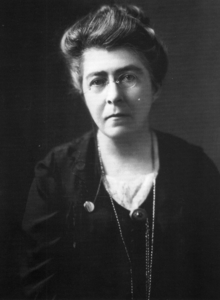
Hanna Sheehy Skeffington
Although several of these women had already been imprisoned in England after taking part in WSPU- organized deputations or window-smashing raids, this was the first time that acts of physical suffrage militancy had been carried out in Ireland. Four of the women received prison sentences. In court, from the dock, Hanna Sheey Skeffington shouted, ‘Remember Mr Asquith is coming in July’. Irish nationalists considered this visit to be an indication of the government’s imprimatur on the Home Rule bill and the popular press was clear that any demonstrations by suffragettes would be classed as anti-nationalist, and therefore ‘English’. You can see how complicated Irish political priorities and the perception of them could be.
‘That some of the English militants would follow their enemy might have been foreseen.’ Indeed the WSPU campaign was now brought, with a vengeance, to Ireland. The Prime Minister’s speech on the second reading of the Reform bill early in July made clear that his government had no intention of extending the franchise to women. Thus, within a few weeks, the suffrage campaigners had seen both the chances of enfranchisement that they had been nurturing– whether under the Home Rule bill (which had particularly interested the Irish suffragettes) and the Reform bill (of interest to all women) swept aside. Three WSPU members, Mary Leigh, Jennie Baines and Gladys Evans (the first two had been members of the WSPU since the earliest days) followed Asquith to Dublin. It later became clear that they had done this of their own initiative. Emmeline was staying with Christabel in Paris at the time; but both, of course, gave their firm support to the expedition after the event.
On 18 July Mary Leigh threw a hatchet, to which a suffrage message was attached, into the carriage in which Asquith was travelling through the streets of Dublin with John Redmond and that evening Gladys Evans attempted to set fire to the Theatre Royal, in which he was to speak (for more about Gladys Evans see here). There had hitherto been no attempts at suffrage arson in Ireland. Members of the IWFL harried Asquith, but in no such spectacular manner and the 27 July issue of The Irish Citizen, while full of their activities, does not directly report the WSPU attacks, except to print a letter from Margaret Cousins stating that ‘the IWFL had no connection with or knowledge of the action of English suffragettes in Dublin’.
Although distancing themselves from the WSPU, disliking what they saw as English interference in Ireland, the IWFL prisoners did embark on a sympathetic hunger strike with the WSPU prisoners, who had received lengthy jail sentences with penal servitude.. The Irishwomen, however, were not forcibly fed, this procedure being only carried out in Irish prisons on English prisoners. Jennie Baines and Mary Leigh were both released, ill, the former after 12 days, the latter after five weeks; Gladys Evans endured the forcible feeding until 3 October, when she was released into the care of a member of the IWFL This incursion into the south of Ireland by WSPU militants was, however, a ‘one-off’, – as the Irish Citizen had suggested the opportunity of harrassing Asquith on Irish soil had been too good to miss.
We believe, however, that the rousing of the Irish people in this matter had best be left to Irish women, who understand the psychology of their countrymen as the ablest English advocate never can.
The first acts of suffrage militancy in Ulster were committed by Irish suffragettes on 16 November 1912 when windows were broken in the GPO in Belfast as a protest against the defeat of Philip Snowden’s amendment to include women in the third Home Rule Bill. Two IWFL members had, for the same reason, broken windows in the Custom House in Dublin. Two months later, on 28 January 1913, when it seemed likely that the second reading of this Home Rule bill would pass without an amendment including women in the franchise, Margaret Cousins and others again attacked the windows of a government building, this time of Dublin Castle. The women were each sentenced to a month’s imprisonment and went on hunger strike until they were treated as political prisoners. It is noteworthy that all acts of suffrage militancy in Ireland by Irish suffragettes up to this time were reaction to the continued failure to include women in Home Rule bills rather than in the Reform bills with which women in the rest of Britain were concerned.
By the autumn of 1913 with the Home Rule bill assured, although women were still excluded from it, the focus of the Irish suffrage campaign moved from Dublin to Ulster, reflecting the growing importance of that arena in national politics. This stage of the campaign was, however, to be, in the main, waged by the WSPU. The IWFL appears to have blamed the various Ulster suffrage societies for not working sufficiently hard and thus allowing a vacuum into which the WSPU could slip. In early September 1913 Sir Edward Carson announced that if a Home Rule bill were passed, he would set up a separate provisional government in Ulster. Moreover, a letter, dated 10 September, from Sir Edward to the secretary of the Ulster Unionist Council intimated that the draft articles of this Provisional Government would include the franchise for women on the basis of the Local Government Register. Needless to say Carson had never before been considered as a politician sympathetic to the suffrage cause – and suffrage campaigners, while on the surface accepting it as something of a coup, certainly wished to see this statement clarified. The WSPU – with Dorothy Evans as its organiser -had arrived as a formal presence in Ulster very shortly before and their aim over the next few months was to get Carson to state in public that women would be enfranchised under any Ulster government. This he never did.
If the arrival of the WSPU did not put much fear into Carson it certainly threw the Belfast-based Irish Women’s Suffrage Society into confusion. Shortly after the arrival of the WSPU in Belfast, the IWSS passed a resolution to declare itself in favour of militancy – if you couldn’t beat them, join them. Matters became even more complicated as individual members of the older societies changed allegiance. In fact by 20 April 1914 so many members of the IWSS had joined the Belfast branch of the WSPU that the former society collapsed. The Irish Citizen continued with its objection to an English society bringing its campaign to Ireland. However, although the WSPU tactics might be classed as ‘English’ they were now being carried out by Irishwomen. Despite this, the Irish Women’s Suffrage Federation, in completely disassociating all its constituent societies from any involvement in militancy, stated ‘The Northern Committee of the IWSF wish to place on record their disapproval of the policy of the WSPU in Ulster, and to explain the fact that the WSPU is an English association, and has no connection with any Irish suffrage organisation’.
It is clear why the WSPU thought Ulster a particularly suitable arena in which to employ its militant tactics. The suffragette campaign in the whole of the United Kingdom in that year before the outbreak of the First World War was set against the background of increasing militarism in Ulster. The Ulster Volunteer Force had been formed in January 1913, an illegal organisation, but with strong links to both the Orange Order and the British army. In retaliation nationalist Ireland raised the Irish Volunteers. In her editorials in The Suffragette, Christabel Pankhurst drew legitimacy for her campaign of terrorism from the success that threats of violence by the UVF were achieving in Ulster. The WSPU, like the UVF, and unlike the IWFL in Dublin, did not confine itself to threats against government property only. Houses, bowling pavilions, pillar boxes and railway stations were fired, culminating on 31 July 1914 in an explosion in Lisburn Cathedral, after which Dorothy Evans and three other women were arrested, imprisoned and went on hunger strike, only being released after the outbreak of war.
There was never much WSPU action in the south of Ireland, although branches were set up in Dublin and in Cork, the latter by Geraldine Lennox, then on the run as a ‘mouse , and Flora Drummond spoke in Cork and Dublin in February 1914. Nor, it must be said, was there much activity at all in 1914 from the IWFL. The political agenda was, of course, now concentrated on Ulster but it has also been suggested that the IWFL kept a low profile because it did not wish to be associated with what was perceived to be the ‘English’ campaign in the north. The WSPU was not particularly interested in rousing the Irish people, but was more intent on using and increasing the turmoil in Ulster as a means of putting pressure on the political machine at Westminster. As Christabel later put it in Unshackled, ‘It was not that we were concerned to question or assert the moral justification of Ulster’s militancy, actual or prospective, but we did claim the same immunity from prosecution and imprisonment for militant women whose grievance was at least equal and whose militancy was far milder’
The WSPU intervention in Ireland had the effect, then, of diminishing, for a year from September 1913, the campaign that had been waged by the Irish suffrage societies. We have no way of knowing whether the militant campaign might have had some positive effect – it was, of course, called off in August 1914. Dorothy Evans then returned to England – although she remained a close friend and co-worker of Hanna Sheey-Skeffington. That militancy – Unionist militancy, that is – could have an effect on the Asquith government was made clear when the Home Rule bill – which received the Royal Assent on 18 August 1914 – excluded Ulster, although its enaction was postponed until the end of the war.
Throughout the years of war the Irish suffrage societies carried on the campaign in their various ways. They found it was to be no easier to wrest the vote from Irish politicians than it had been from the English. In fact the Irish parliamentary party tried hard to prevent the extension to Ireland of the 1918 Representation of the People Bill, by which the Westminster parliament gave the vote to women over 30.
The Sheey Skeffingtons were probably correct, in principle, in stating that the rousing of the Irish was best left to Irishwomen. However, there is no escaping the fact that in the years before the First World War, because there were so many Irish suffrage societies that, because of the divisive nature of Irish society in general, were unable to pool their efforts, little success had been achieved in influencing either the Irish public or Irish politicians to give women the vote. The WSPU was not interested in the nuances of the Irish Question, but saw Ireland – specifically Ulster – as another battle ground on which to engage with the enemy. Christabel Pankhurst used the parallels of the Unionist and the suffragette campaigns to emphasise the injustice being done to women by the Asquith government.
Perhaps the incursion from England gave the Irish societies food for thought. It is certainly true that during the war years the Irish societies managed a greater degree of co-operation than heretofore. For the December 1918 general election the IWFL co-operated with Sinn Fein to run two women candidates, Winifred Carney in Belfast – who was not successful – and Constance Markievicz, in Dublin, who, famously, was – the first woman MP elected to the British parliament, although she did not take her seat at Westminster.

Constance Markievicz, police photo on her arrest after the Easter Rising in Dublin in 1916.
In 1922, six years before women in Britain, Irishwomen over 21 were granted the vote, albeit reluctantly, by the Irish parliament. In the final stage of the Irish suffrage campaign it was most certainly the effort of Irishwomen, still led by Hanna Sheey Skeffington, that achieved the final victory.
Further reading: E. Crawford, The Women’s Suffrage Movement in Britain and Ireland: a regional survey, Routledge, 2008 (paperback).
Copyright
Suffrage Stories: Millicent Fawcett’s Bookplate
Posted by womanandhersphere in Suffrage Stories, The Garretts and their Circle on April 24, 2014
Here is Millicent Fawcett’s bookplate
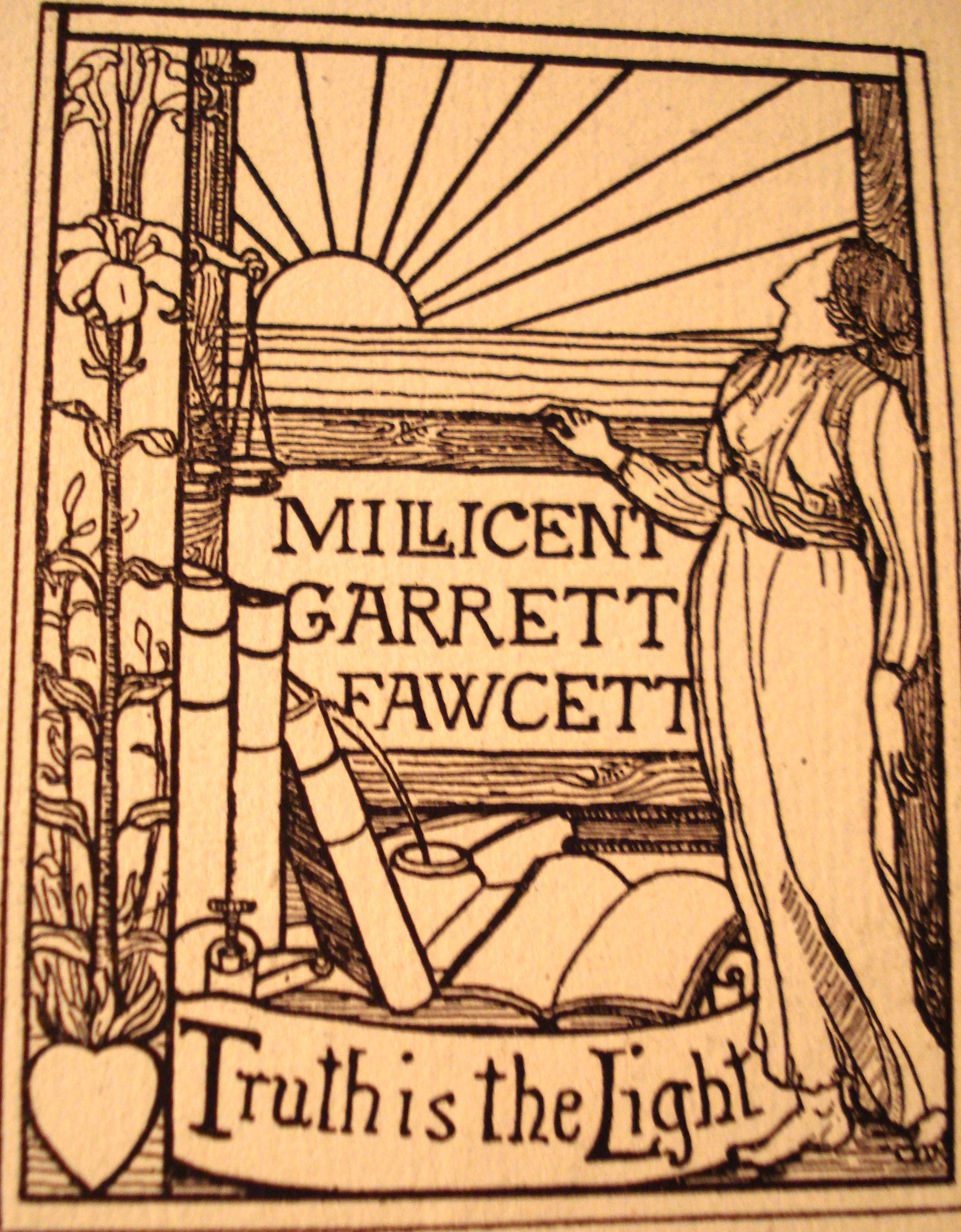 Rather lovely, I think.
New Dawn, Aesthetic Lilies, Aesthetic Dress (not that Millicent, unlike Rhoda and Agnes Garrett, ever favoured such a style in reality) and the tools of her trade, the Scales of Justice, Books, Pen and Ink
Artist unknown
For those who have not yet seen Millicent at work at her desk in the drawing room of 2 Gower Street, click here
Mariana Starke: With Thanks To Mrs Crespigny From ‘The Poor Soldier’, ‘The British Orphan’ And ‘The Widow of Malabar’
Posted by womanandhersphere in Mariana Starke on April 17, 2014
The period 1789-91 was a busy and important time for Mariana Starke, who was still only in her mid-twenties. For her very public success she owed everything to the patronage of Mrs Crespigny, for more about whom see Mariana Starke: The Mystery of the Bodleian Diary.
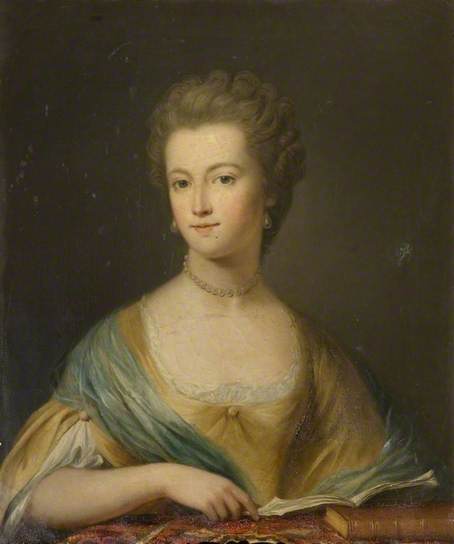
Mrs Crespigny, courtesy of Kelmarsh Hall and the Public Catalogue Foundation
In March 1789 Mariana’s long poem, The Poor Soldier, An American Tale was published by J. Walter (who in 1787 had published her first work, A Theatre of Education). The work was advertised as ‘founded on a recent fact and inscribed to Mrs Crespigny’. The poem tells how Mrs Crespigny, travelling in her coach across Westminster Bridge, stopped to give alms to a beggar. He turned out to be an American Loyalist, Charles Short, who had lost his home, wife, children and leg during the American Revolution. Remaining loyal to the Crown, he had resisted the call to join the Congress forces and had ‘left his happy Cot, his fair domains/ To war for thee on Carolina’s Plains’.
The poem tells how Mrs Crespigny intervened to grant him his heart’s desire, a place, as a veteran soldier, in the Chelsea Hospital. Alas, though, the offer came too late for the Poor Soldier, who died before he could take up his place. Although Mariana was herself a true-blood Royalist/Loyalist, and those in America fighting to free themselves from Britain were of the planter class, I wonder if her knowledge of her great-grandfather’s involvement with Virginia – as the owner of tobacco plantations, added to her interest in this story. The poem proved sufficiently popular for the publisher to issue a second edition in July 1789.
A couple of weeks after the first publication of The Poor Soldier, The Times reported on 7 April that ‘At Mrs Crespigny’s temporary theatre at her house at Camberwell Miss Starke and Mr Starke took part in The Tragedy of Douglas.’ The performance had, in fact, taken place on 4 April with a cast that included Mrs Crespigny, her son, William, Mariana Starke, her brother, Richard, and a Mr Bayley. The play had been written by John Home in the 1750s but for this production Mrs Crespigny had given it a new, happy, ending. On 30 April the Public Advertiser reprinted her new Prologue, in which she warned that ”If in our play some alter’d scenes you find/They owe their merit to a female mind’.
Two months later, in July (as described in a previous post), ‘The Sword of Peace’, was back on stage at the Theatre Royal Haymarket, and the text was published by J. Debrett..
In its issue dated 29 December 1789 The World mentioned that Mrs Crespigny was planning another theatrical and tried to dispel the rumour that the new play was ‘by a lady’. The report also mentioned that Mr Starke was’exerting his pencil’ and Miss C. Fanshaw had adorned the theatre with a Tragic and a Comic Muse ‘painted in a novel and very superior stile’. ‘Mr Starke’ was surely Mariana’s brother Richard and ‘Miss C. Fanshaw’ Catherine Fanshawe (1765-1834),who is now better known as a poet than a scenic designer, but see here for an example of her art . The Starkes had been very friendly for many years with the Fanshawes, who were Surrey neighbours.
This play, The British Orphan, opened at Mrs Crespigny’s Camberwell theatre on 7 April 1790.The Public Advertiser of 10 April reported that ‘The author of The British Orphan was not announced but he is certainly of the modern school. The principal incident of the piece is founded on the idea of suspended animation..”The dresses were extremely splendid and the scenery was characteristic and painted with great spirit’. For all the attempts to dissemble and pass the author off as a man, it was Mariana who was this author ‘of the modern school’; the play, alas, was never published and no text survives. The cast included Mrs Crespigny, Richard Starke, Mr Thomas (who may have been the Mr Thomas who was soon to marry Millecent Parkhurst), and a Mr Fitz-Gerald, who wrote the Prologue. The accompanying music was composed by R.J.S. Stevens, who mentions the experience in his Recollections. His work was a setting of a poem by Mariana, Saints and Angels hear our strains, hear our strains from purging fire. Interestingly, he appears to have been vehemently opposed to private theatricals ‘a species of entertainment very injurious to young minds; destructive of their innocence and modesty; and equally endangering their piece and happiness.’
Mrs Larpent, wife of the inspector of plays in the Lord Chamberlain’s office, was in the audience for the first night of The British Orphan, writing in her diary on 7 April ‘..to Camberwell to Mrs Crespigny’s to see Miss Starke and others, act The British Orphan, a tragedy written by Miss Starke. Mrs Crespigny acted the heroine, and Roxana, in The Sultan, which was the Afterpiece. The Scenery was very pretty, the dresses very elegant. The Acting outrée. And the whole absurd. I was shocked – I disapprove the whole. Acting revolts in Women against Feminine delicacy – in Men against Manly decorum – My spirits were hurt with contemplating so much folly, I could not be amused. I was sorry to see Miss Starke thus traverstie – and as she was – as I should grieve to see a worthy man I esteemed, intoxicated’. Mariana had, as author, presumably written for herself a part that required her, for some of her scenes, to dress as a man – and thereby outrage Mrs Larpent’s sensitivities. She was, in fact, the heroine, Eliza, who arises out of her coffin after a period of suspended animation. Mrs Crespigny played her sister, Isabella.
Barely a month later, on 5 May, Mariana’s new play, The Widow of Malabar, was given its first public performance at the Theatre Royal Covent Garden. Embellished with the rituals of Indian sati – a burning funeral pyre – and with specially composed music, it was something of a spectacle. Mrs Larpent was again in the audience – ‘We went to the Play, saw The Widow of Malabar, a free translation from the French, by Miss Starke on the fate of an Indian widow, who burns herself. I was ennuiée. I will not criticise. Dramatic Interest is wanting, it is a showy performance’. If by ‘showy performance’ she meant to single out one actress, she may have been referring to ‘Miss Brunton’, who The World reported on 6 May, had received the play as a present from Miss Starke, that is, this first night was a ‘Benefit’ performance for her. ‘Miss Brunton’ was likely to be Ann Brunton, the elder of a family of actress sisters.

Ann Brunton (as Cordelia in ‘King Lear’, 1785)..This engraving by T. Cook and William Brent, courtesy of Women in Theatre Collection, Univeristy of Illinois Library
Fortunately other critics, such as that writing for the Whitehall Evening Post (6 May), were kinder to The Widow of Malabar than was Mrs Larpent and on 27 May it was announced that ‘Miss Starke’s Widow has been accepted by Mr Harris for the next season’. Thus the play was back at the Theatre Royal Covent Garden for more performances in January 1791.
Thanks to the newly discovered diary in the Bodleian Library we know that Mrs Crespigny was in the theatre on that second, as it were, first night – 12 January – ‘Miss Starke’s play The Widow of Malabar came on and it went off extremely well – but Lady Salisbury took my Box which caused great confusion’. She was back a week later on Wednesday 19 January for ‘Third night of The Widow. Miss Starke had a very full house. I sent [?] vast numbers – filled 10 rows of pit & nearly all the Boxes – & numbers [?] into the Gallery.’
The play was a considerable success, often staged in succeeding years. Although derived from La Veuve du Malabar, a play by Lemierre, Mrs Larpent was incorrect in referring to it as a translation, it was, rather, a free interpretation. In Mariana’s version the widow is saved from the funeral pyre by an Englishman. In the edition of Mariana’s play, published by William Lane in 1791, her dedication, dated 24 January, is, unsurprisingly, to Mrs Crespigny, who had given such active support, not least of all by packing the theatre with her friends during the previous fortnight.
See D. O’Quinn, ‘Battling Hindu Superstition on the London Stage’ in M. Franklin (ed), Romantic Representations of British India, Routledge, 2006, for an interesting discussion of the text of Mariana Starke’s The Widow of Malabar.
Copyright
Mariana Starke: ‘The Sword Of Peace’, 1788
Posted by womanandhersphere in Mariana Starke on April 8, 2014
On 9 August 1788 Mariana Starke’s play, The Sword of Peace; or, a Voyage of Love, received the first of six public performances that season at London’s Theatre Royal, Haymarket.
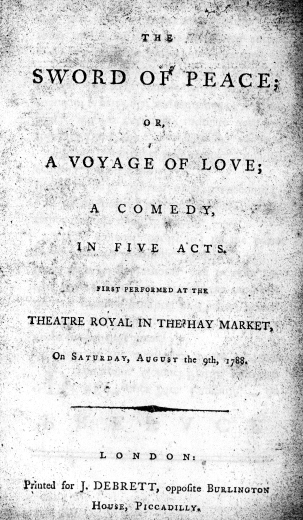
This was certainly not the first play that Mariana had written, but was the first to be professionally staged. See Mariana Starke: First Productions for mention of Ethelinda, which, possibly in 1787, Mariana had sent to George Colman, the manager of the Theatre Royal. He had been encouraging, but in the end had rejected it. He would, therefore, have been an obvious choice to receive her next dramatic work and in the Preface to the published edition of The Sword of Peace she thanks him most warmly. To Mariana’s play Colman added a Prologue and his son an Epilogue.
In her introduction to the online edition of The Sword of Peace Jeanne Moskal has suggested that prior to its short run at the Theatre Royal, the play may already have been produced in the private theatre of her friend and patron Mary Crespigny [see Mariana Starke: The Mystery of the Bodleian Diary]. This is possible, but if such a production was staged it is surprising that papers such as ”The World and Fashionable Advertiser’ and ”The Public Advertiser’ make no mention of it, while carrying information of other theatricals at Camberwell Grove that involved Mariana and her brother, Richard. Mrs Crespigny’s activities were good ‘copy’for these papers and it seems unlikely they would have overlooked such an interesting item.
As the reader can so easily consult the online text of The Sword of Peace, together with the associated apparatus of notes which includes a summary of the play, I will not repeat it here, but would like to make one observation.
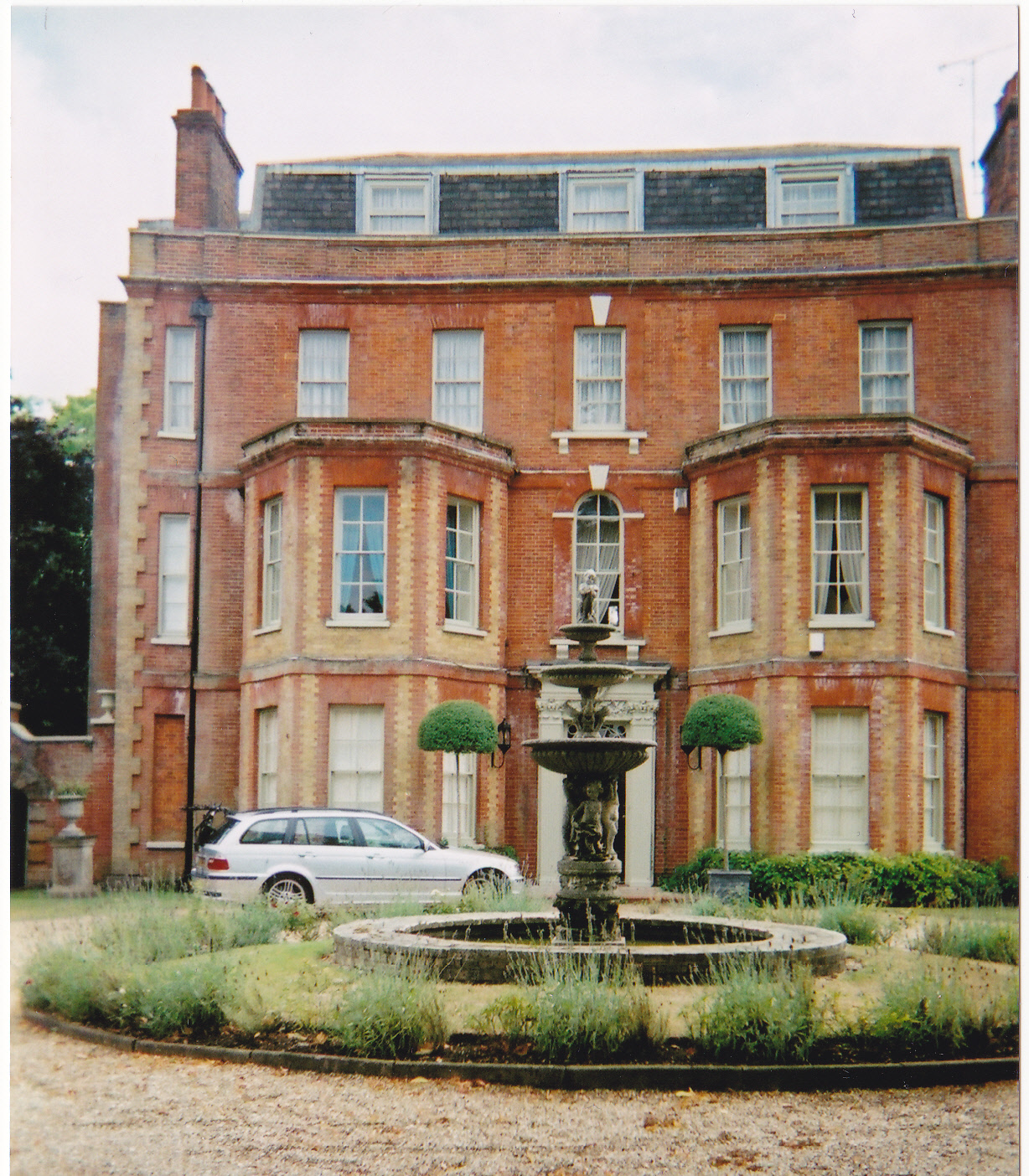
Hylands House, Epsom, 0ne-time home of Governor Starke and his family’ (the two brick bays being a rather unfortunate later addition). A house, in the late 18th-century, replete with memories of and talk about life in India
This is an idea that occurred to me as to what Mariana might mean in her Preface when she observes that ‘the character of David Northcote is a real one. To Indians this is needless: the sketch, however, is not too faint, I hope, for others: it was dictated by a heart glowing with gratitude and admiration of his noble and unbounded goodness!’
It has been suggested, by Jeanne Moskal among others, that ‘David Northcote’ is based on Lord Cornwallis, who succeeded Warren Hastings as Governor-General of India. This assumption is quite probably correct. Hastings had been arrested in 1787, at a time when Mariana would probably have been writing the play; his trial was underway in Westminster Hall when The Sword of Peace played at the Theatre Royal. As ‘David Northcote’ was created as an exemplar of a good man in the midst of venality it may well be that Mariana was commending Cornwallis .
However, with the Hastings trial figuring so prominently in the news it seems just a little odd for the author to hope, even with the falsest of modesty, that ‘the sketch is not too faint’. Actually at the time it must have seemed blindingly obvious. It occurred to me, however, that she may actually have had in mind a model for ‘David Northcote’ found rather closer to home, but more distant in time – one about which there might more justifiably be a fear that the ‘sketch’ might be too ‘faint’ .
Could ‘David Northcote’ have been modelled on Mariana’s father, Richard Starke, who, even at this time, 30 years after he had been forced from office, was always known as ‘Governor Starke’?
The name of the character does have resonances close to Mariana’s own circle. ‘David’ could be a nod to Fort St David, from which her father was ousted in 1756 by ambitious Robert Clive.
Mariana would have discussed the making of her play with her great friend, Millecent Parkhurst, whose father, John Parkhurst, was giving her advice on the construction of her dramas. John Parkhurst’s wife was born Millecent Northey, whose family lived at Woodcote House, Epsom. When Mariana was pondering a surname for the hero of The Sword of Peace could she have created it out of this local association? For an essay on the Northeys and Woodcote House see here.
Among the final lines of the play, when Mr Northcote is created ‘Resident’, one of the characters describes how
‘They [the local inhabitants] do nothing but call him father—they keep blessing him and his children; and King George and his children; and their great prophet and his children’.
Would – could – that mention of ‘blessing him and his children’ have been a knowing authorial wink. The emphasising italics are in the original and there does not seem any reason for an allusion to Northcote’s children in terms of the play. Indeed, there is no mention of his being married, or having children. So was that a little joke -Mariana calling blessings on herself and her siblings, as well as her father -that the audience might have shared?
In terms of the plot of The Sword of Peace, a slight parallel between the careers of ‘David Northcote’ and Richard Starke occurred in 1752 when Governor Floyer of Fort St David was dismissed – accused of allowing a ‘Spirit of Gaming’ and ‘general neglect and want of order’ to prevail, as well as running up ‘Extravagant Expences’. Among the men entrusted to reinstate order was Richard Starke.
On 1 May 1787 ‘Governor Starke and family’ and ‘other names to India not unknown’ were present in the Playhouse, Covent Garden, for the performance of a new farce, Bonds Without Judgment, or, the Loves of Bengal, performed as a benefit for the actress, Mrs Wells. The plot concerns the fate of two young women who are sent to India in search of husbands…There is no mention in the ‘World and Fashionable Advertiser’ report of 2 May 1787 of the author of the piece, but I understand it was one Edward Topham. The piece was acted for four nights in May 1787 but was never printed.
Could this play have motivated Mariana to write her own? It is worth mentioning that the Prologue to ‘Bonds Without Judgment’ was written by ‘Mr Berkley’, surely her friend and collaborator, George Monck Berkeley (for whom see Mariana Starke: First Productions). In fact Oulton, The History of the Theatres of London suggests that Berkeley rather than Topham may have been the author of the entire piece. Incidentally, Mrs Crespigny took a very numerous party to Bonds Without Judgment.
The Sword of Peace was published in 1789, in London by J. Debrett and in Dublin by H. Chamberlaine, and returned to the Theatre Royal that year, on 30 July, for a further four perfomances.
Source: H.D. Love, Vestiges of Old Madras
P.S. UPDATE I knew that Mariana was not Richard and Mary Starke’s first born; a son, John, had died shortly before she was born and was buried at Epsom. I have now just found the gory details in a news report in ‘The Public Advertiser’ of 21 June 1762, to the effect that this young boy, aged 20 months, had died the previous week after falling out of the coach in which he was ‘taking an airing’ with some women servants and was then run over by the vehicle’s wheels. Horrific.
Copyright
WALKS/Suffrage Stories: Millicent Fawcett and Queen Elizabeth I
Posted by womanandhersphere in Suffrage Stories, Walks on April 3, 2014
Now that the Women’s Library Reading Room is open on the 4th floor of LSE Library, here is another idea for those who might want to stretch their legs during their visit.
Why not take a gentle meander along Fleet Street and visit Queen Elizabeth I as she stands in her niche over what was the entrance to the Parochial School attached to the church of St Dunstans in the West? Not only is this thought to be the only surviving statue of the Queen carved in her lifetime, but she has a very close connection to Millicent Fawcett, in whose honour the Fawcett Library (as the Women’s Library was originally known) was named.
 Statue of Queen Elizabeth I at St Dunstan’s in the West
It is thought that the statue was carved in 1586. It then led a rather adventurous life before coming to rest in this niche on the facade of St Dunstans in the West when the church was rebuilt here in the 1830s. Nearly a century later it was in a dilapidated state and its restoration was financed by Dame Millicent Fawcett and her sister, Agnes Garrett, together with ‘Miss Jones of Lincoln’s Inn’ and Gwen John. The latter was not, as is sometimes stated, Gwen John the artist, but Gwen John, playwright and actress, author of a biography ‘Queen Elizabeth’ and a play ‘Gloriana’. Gwen John, whose real name was Gladys Jones, lived with Winifred Jones (‘Miss Jones’), presumably her sister, at 9 Old Square, Lincoln’s Inn. See here for National Portrait Gallery of this Gwen John.
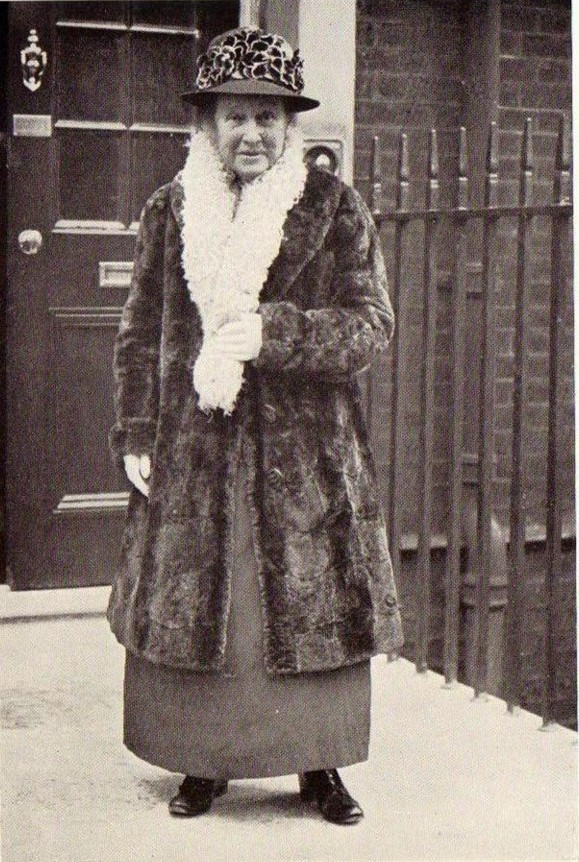 Millicent Fawcett, c 1928
In a rather neat sequence of events, on 28 June 1928 Dame Millicent Fawcett presided at the Annual General Meeting of the Society for the Protection of Ancient Buildings, at which the preservation of old churches was the topic of discussion, on 2 July the Representation of the People (Equal Franchise) Act, for which she had been campaigning since 1866, became law, and on 31 July she unveiled the restored statue of Queen Elizabeth I. See the unveiling here, although Millicent Fawcett, modest as ever, cannot be seen. However the curtain she caused to be moved, moves. Which is sort of symbolic of the influence she exerted during her long life.
While the statue was undergoing restoration it was discovered that it had originally been coloured. So, the statue was repainted, following the original colours as closely as possible. The farthingale and corsage were white, the face was tinted a flesh colour and her crown was gilded. Alas, this colouring is no longer obvious to the passer-by and the Queen has rather faded back into the facade of the building.
Millicent Fawcett died just a few days over a year after unveiling the statue and in her will left £700 towards its upkeep, although that fund may now have been exhausted and wound up.
If you wanted to pause, you could combine veneration of the Virgin Queen and thoughts of the venerable suffrage campaigner with a coffee from the stall that is now a permanent fixture just below her niche.
 Woman and her Sphere