Archive for August, 2013
WALKS: What Would Bring Campaigning Women to Buckingham Street, Strand?
Posted by womanandhersphere in Walks on August 15, 2013
Ever since the decision was made for the Women’s Library to move to LSE (now open as the Women’s Library @ LSE) I have been writing posts that draw attention to the many locations associated with the women’s movement in the area around Aldwych and the Strand. My hope is that researchers in the Women’s Library, when taking a break from their labours, will welcome some information that will allow them to see the surrounding area with fresh eyes. Or even, as in the case of Buckingham Street, draw them to an area they may never have thought of visiting.
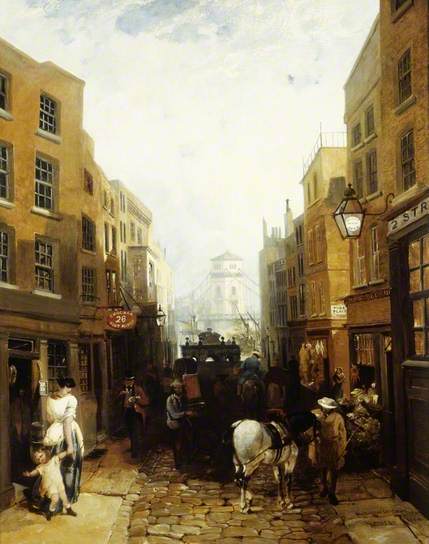 Buckingham Street, Strand, by John Edmund Niemann, 1854. From the Museum of London Collection, courtesy of the Public Catalogue foundation
Buckingham Street runs south from the Strand, parallel with Villiers Street, close to Charing Cross Station. In this picture Niemann positions us with our backs to the Strand, viewing the length of the street down towards the 17th-century Watergate which, before the building of the Embankment, marked the northern bank of the Thames. In the distance, looming over the Watergate, we can see the towers of Brunel’s Hungerford Suspension bridge, demolished in 1863. This view had, therefore, changed by the beginning of the 20th century, but from it we can glean an idea of the busy-ness of the narrow street,. There is probably less traffic now – at the moment, as London perpetually renews itself, this consists mainly of builders’ trucks – but the street still ends at the Watergate, by the side of which steps lead down into the Embankment Gardens.
The Survey of London, published in 1937, gives a thorough building history of the street and today’s London guides – such as this one– mention that Pepys lived at number 12 and Dickens at number 15 (his house now bombed and replaced), but campaigning women, too, have a claim to the street’s history.
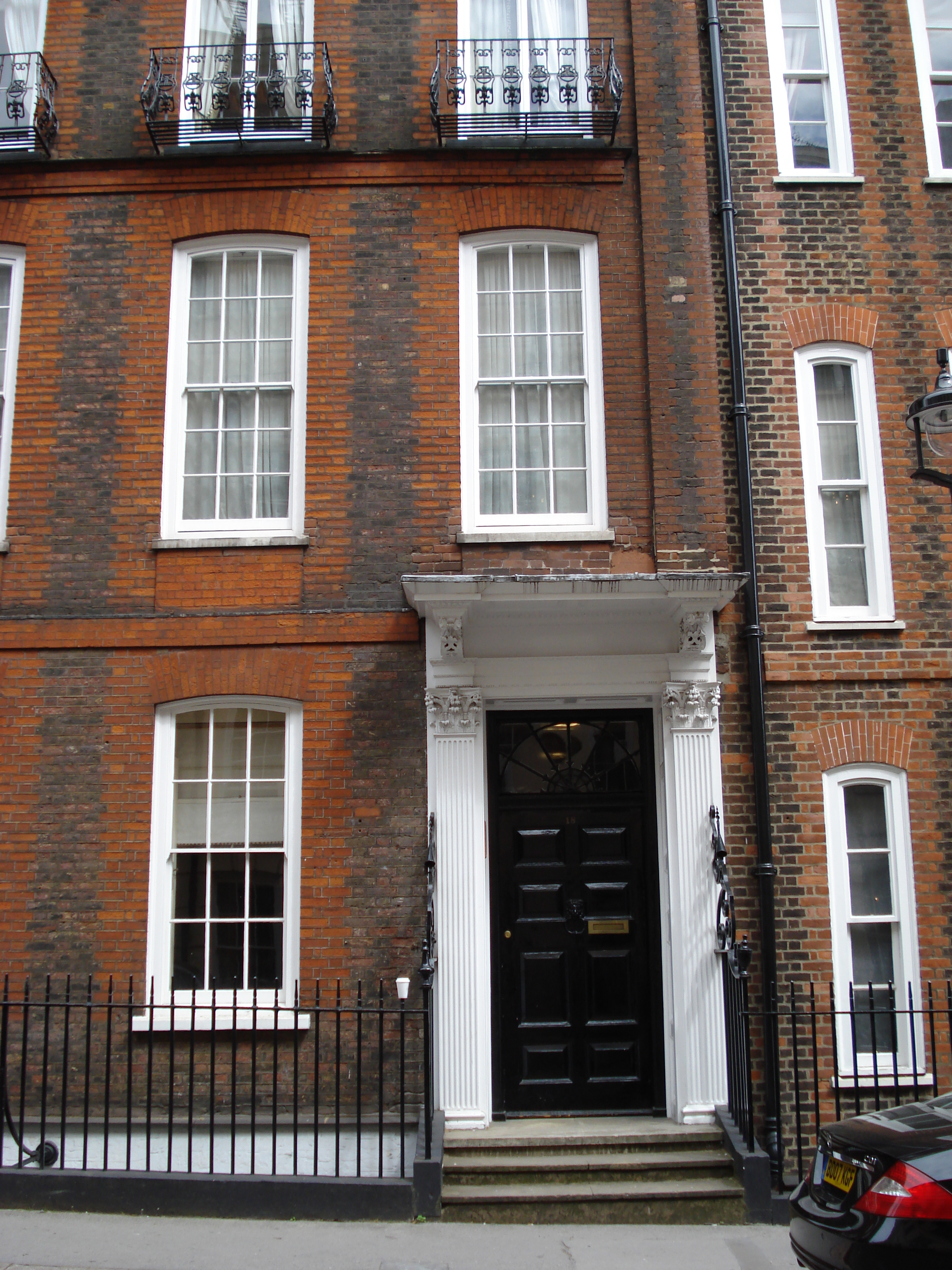 18 Buckingham Street, Strand, first home of the WFL, 1907-08
It was here – at no 18 (at the quieter, river-end of Buckingham Street) that in the autumn of 1907, after the dramatic break with Mrs Pankhurst’s Women’s Social and Political Union, the newly formed Women’s Freedom League opened its office. This was always probably only intended as a temporary solution – the WFL moved to larger premises in nearby Robert Street the following year. I have always wondered whether billiards was not the reason for alighting on no 18 – which at this time also housed the office of the Billiards Association. Teresa Billington-Greig, one of those leading the break with the WSPU, had that year married Frederick Greig, a manufacturer of billiard tables – so, perhaps, when it was clear that they would have to depart Clement’s Inn in a hurry, it was through him that the rebels heard of an office for rent. I’ve not, however, been able to find any proof for this – doubtlessly wild – supposition. Perhaps, rather, the Strand Liberal and Radical Association, also tenants of number 18, effected the introduction to Buckingham Street.
The WFL lost no time in advertising their existence – issuing several photographic cards during the few months they were operating from number 18.
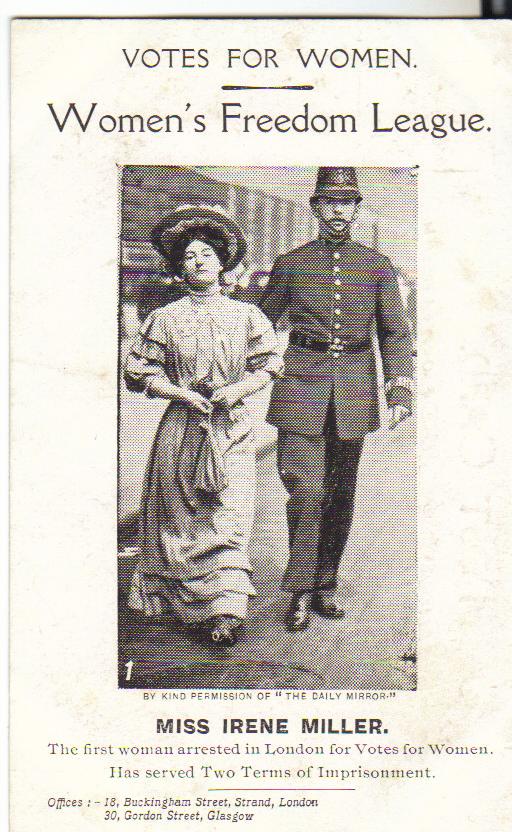 WSL card published from 18 Buckingham Street
 13 Buckingham Street, Strand, office of the Men’s Political Union for Women’s Enfranchisement
On the other side of the street the Men’s Political Union for Women’s Enfranchisement was based at number 13. The MPU had been founded at a meeting held at the Eustace Miles Restaurant (just the other side of the Strand) in 1910. One of the founders – and the hon. organising secretary of the MPU – was Victor Duval. The premises were also, I think, the offices of his family firm, Duval & Co. Victor’s mother, Emily Duval, had been one of those who transferred allegiance from the WSPU to the WFL and would doubtless have been a regular visitor to number 18.
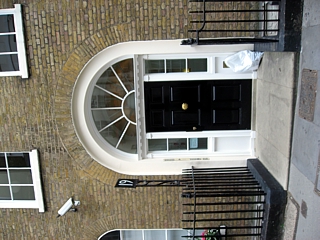 19 Buckingham Street, Strand
Back on the eastern side of the street, number 19, now under scaffolding as it is remodelled as ‘luxury apartments’, is a considerably larger building than its neighbour, no 18. Among its many tenants was the Emerson Club which in 1908 was described as a ‘Ladies’ Club’ but from 1911 welcomed both men and women members. This was still rather unusual. The Emerson remained at this address until 1925 and numbered among its members the WFL activists Elizabeth Knight, Amy Hicks and Alison Neilans, as well as Mrs Pankhurst’s brother, Walter, and Margaret Bondfield, the future Labour cabinet minister. Sarah Bennet, the WFL’s treasurer, was one of the Emerson’s early shareholders.
By 1908 number 19 also housed the office of the architect Basil Champneys, while Thackeray Turner and Eustace Balfour (the latter the husband of the suffragist Lady Frances Balfour) had their architectural practice next door at number 20. All three architects brought to fruition – mainly in Queen-Anne style red brick – the dreams of campaigning women. Champneys was the long-time architect of Newnham College and In the 1890s Turner and Balfour designed the York Street Ladies’ Residential Chambers – one of Agnes Garrett’s projects (for which see much more in Crawford, Enterprising Women). Thackeray Turner was also secretary to the Society for the Protection of Ancient Buildings, at this time also based at number 20. The architects were working out of the type of late-17th/early-18th-century houses so much admired by Agnes and Rhoda Garrett in House Decoration.
Opposite, at number 12, were the offices of the Incorporated Society of Trained Masseuses, the premises of the Midwives’ Institute and Trained Nurses’ Club and the Association of Clerks and Secretaries.
So, a 100 years ago, many different types of women would have had many reasons to make their way down Buckingham Street, stopping off at any one of these addresses. Some might, of course, have carried on down the steps at the end of the street and into the Victoria Embankment Gardens – where two major heroes of the suffrage movement are commemorated.

The WFL, based on the south side of the Strand, was very well placed to honour, as they did every year, their particular hero, John Stuart Mill, whose statue is one of several in the Embankment Gardens. (Incidentally you will note from the caption to this card that the WFL had moved into the new Robert Street office by May 1908.) Well into the 1920s women laid tribute before the statue – one 1927 photograph in the Women’s Library collection shows Millicent Fawcett present on such an occasion.
 Henry Fawcett’s memorial, erected 1886
And it is Millicent’s husband, Henry Fawcett, who is the other hero memorialised in the Embankment Gardens. The sculptor of the bronze bust was a woman – Mary Grant, the fountain’s designer was Basil Champneys and the whole was funded, as the inscription testifies, by Henry Fawcett’s ‘grateful countrywomen’.
For more information about the people and societies mentioned see Crawford: The Women’s Suffrage Movement: a reference guide.
And do consult the Women’s Library @ LSE online catalogue for details of primary source material.
Kate Frye’s Suffrage Diary: The Suffrage Shop in Hythe High Street
Posted by womanandhersphere in Kate Frye's suffrage diary on August 9, 2013

In mid-1912 this shop at what was, before renumbering, 83 High Street, Hythe- now, rather suitably an animal welfare charity shop, opened as the local Suffrage Shop and Club, run by Miss Georgina Cheffins and Miss Eva Lewis, who, although members of the WSPU, were Kate Frye’s most active supporters in the area as she went about her business of organizing meetings for the New Constitutional Society for Women’s Suffrage. I visited it myself in the summer of 2011 and found that the shop is quite large and, as Kate Frye describes, has a room at the back in which the Suffrage Club held its meetings.
Georgina Cheffins (1863-1932) was the daughter of a Portland cement manufacturer. and In the 1901 census, when she was living with Eva Lewis in the St James’s Mission, Temple Street, Sedgley, Cheshire, they are both described as ‘lay sisters’. Eva (Evangeline) Lewis (1863-1928) had been born in Ontario, Canada, the daughter of John Lewis, Lord Bishop of Ontario. She lived with Georgina Cheffins, who was very much the wealthier of the two, from some time before 1901 until her death.
Both women successfully evaded the 1911 census and in 1912 Miss Cheffins was sentenced to four months’ imprisonment after taking part in a WSPU window-smashing raid in London – breaking windows in Gorringes’ store. In court she declared she was a suffragist by conviction, having worked amongst the poor for 20 years.
When Kate first met them the two women lived at ‘Dunedin’, Seabrook Road, the long road connecting Hythe and Folkestone, but in early 1912 they moved to ‘Cravenhurst’, Napier Gardens, Hythe. When I visited Hythe in 2011 I did not know which house in Napier Gardens had been ‘Cravenhurst’ – and it is only today that I have found a piece of information that links the name of the house to a number – 24 – which is ,I think, opposite the house below – one of several in the street that I photographed at random. Anyway, I think no 24 was at the more secluded end of the cul-de-sac that is Napier Gardens .
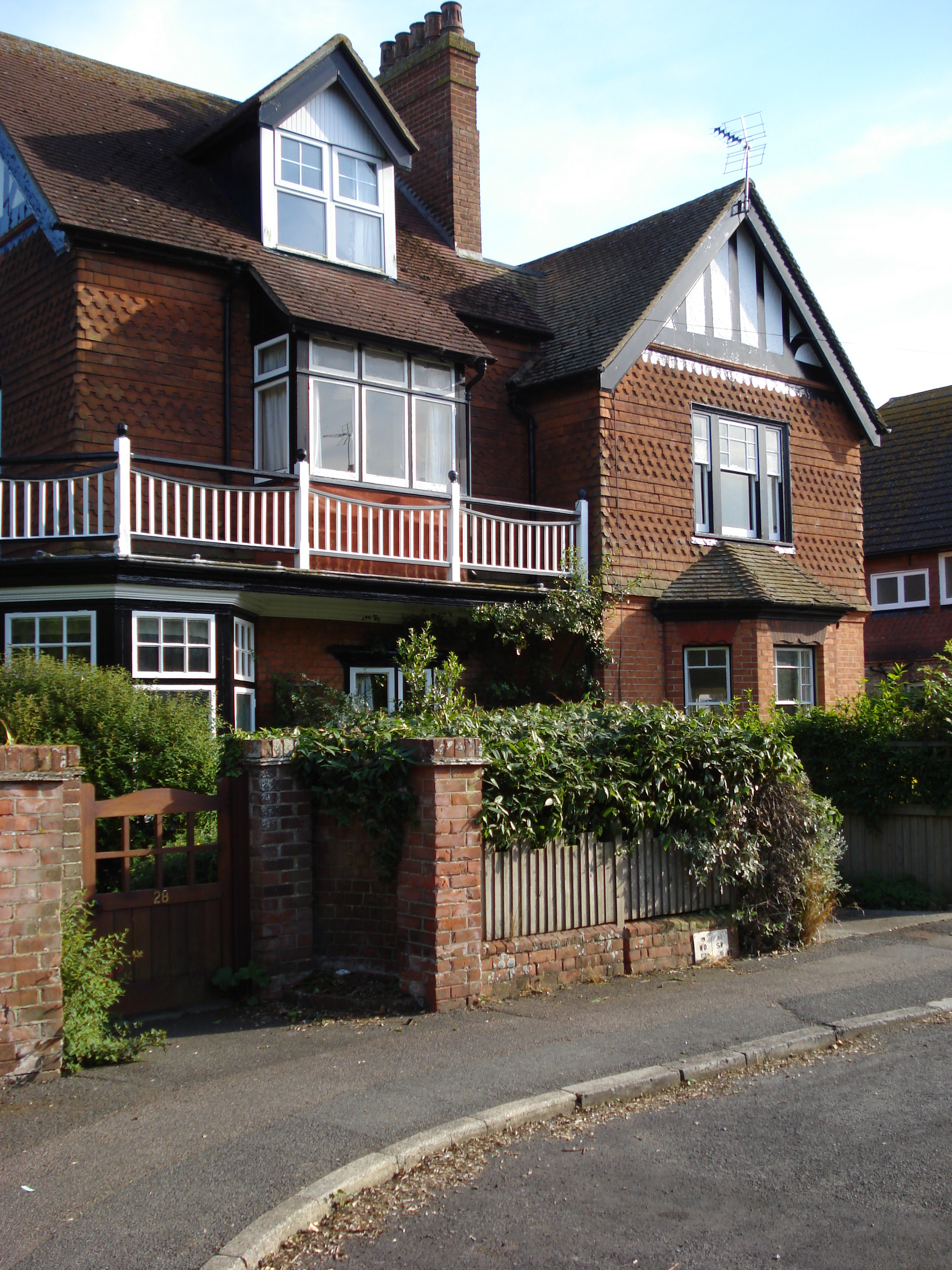
In the summer of 1912 Votes for Women, the WSPU newspaper, reported that the Hythe Suffrage Shop had been visited by many WSPU members on holiday in the area – and that many volunteers had been out selling copies of the paper.
Campaigning for the Vote: Kate Parry Frye’s Suffrage Diary is full of details of the delights – and tribulations – of spreading the ‘Votes for Women’ message in Hythe. Although Miss Cheffins and Miss Lewis could on occasion be prickly, Kate kept in touch with them well into the 1920s.
See here for much more about Campaigning for the Vote
PS. Update – Thanks to Betty Black for information on the renumbering of Hythe High Street. Nothing beats local knowledge.
Copyright
All the articles on Woman and Her Sphere and are my copyright. An article may not be reproduced in any medium without my permission and full acknowledgement. You are welcome to cite or quote from an article provided you give full acknowledgement
Suffrage Stories: Marjorie Hamilton: An Unknown Suffrage Artist
Posted by womanandhersphere in Suffrage Stories on August 6, 2013
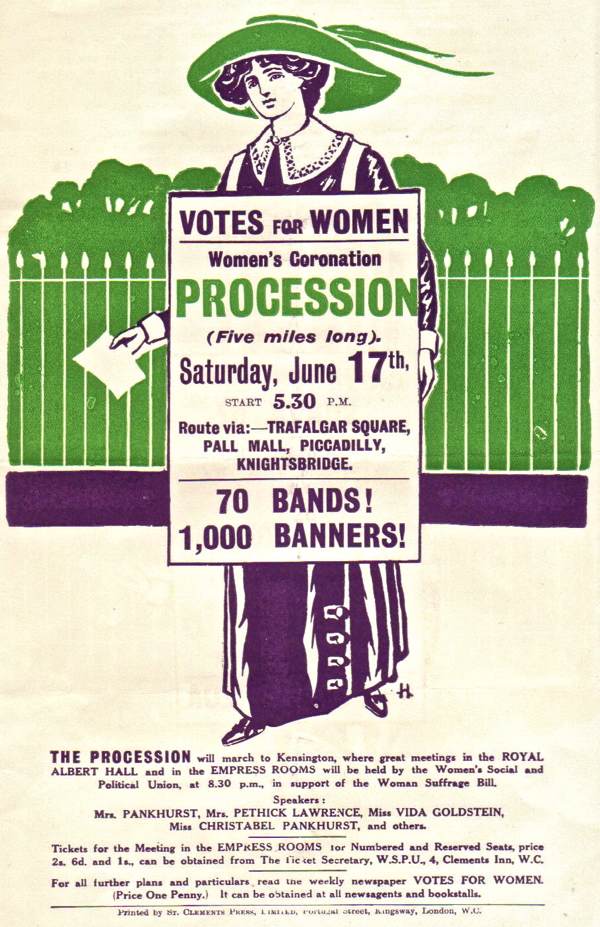 I have long admired this image, created to advertise the 1911 ‘Women’s Coronation Procession’. This particular item was carefully laid by Kate Frye between the pages of her diary. She was proud to be marching that day in the Actresses’ Franchise League contingent.
However I have only just discovered the name of the artist of this appealing flyer was and have immediately set about trying to find out what I can about her.
The name was delivered to me by Ken Florey who, in his superb Women’s Suffrage Memorabilia: an illustrated Historical Study, mentions the image, naming the artist as ‘Marjorie Hamilton’. The US suffrage society, the Women’s Political Union, had clearly recognised an appealing design when they saw it and used it to advertise a meeting held by Mrs Pankhurst in New York’s Carnegie Hall (see Votes for Women, 5 January 1912). Marjorie Hamilton’s name doesn’t appears in Lisa Tickner’s Spectacle of Women – and I must admit that I had not come across it in my own researches into women suffrage artists.
However, now that I have looked into the matter, I see that on 9 June 1911, in the issue that immediately preceded the Procession, the cartoon that appears the front page of Votes for Women was drawn by Marjorie Hamilton. Moreover, I actually hold a copy of the front page of this issue in my bookseller’s stock – I just hadn’t looked sufficiently closely at the image to notice the signature.
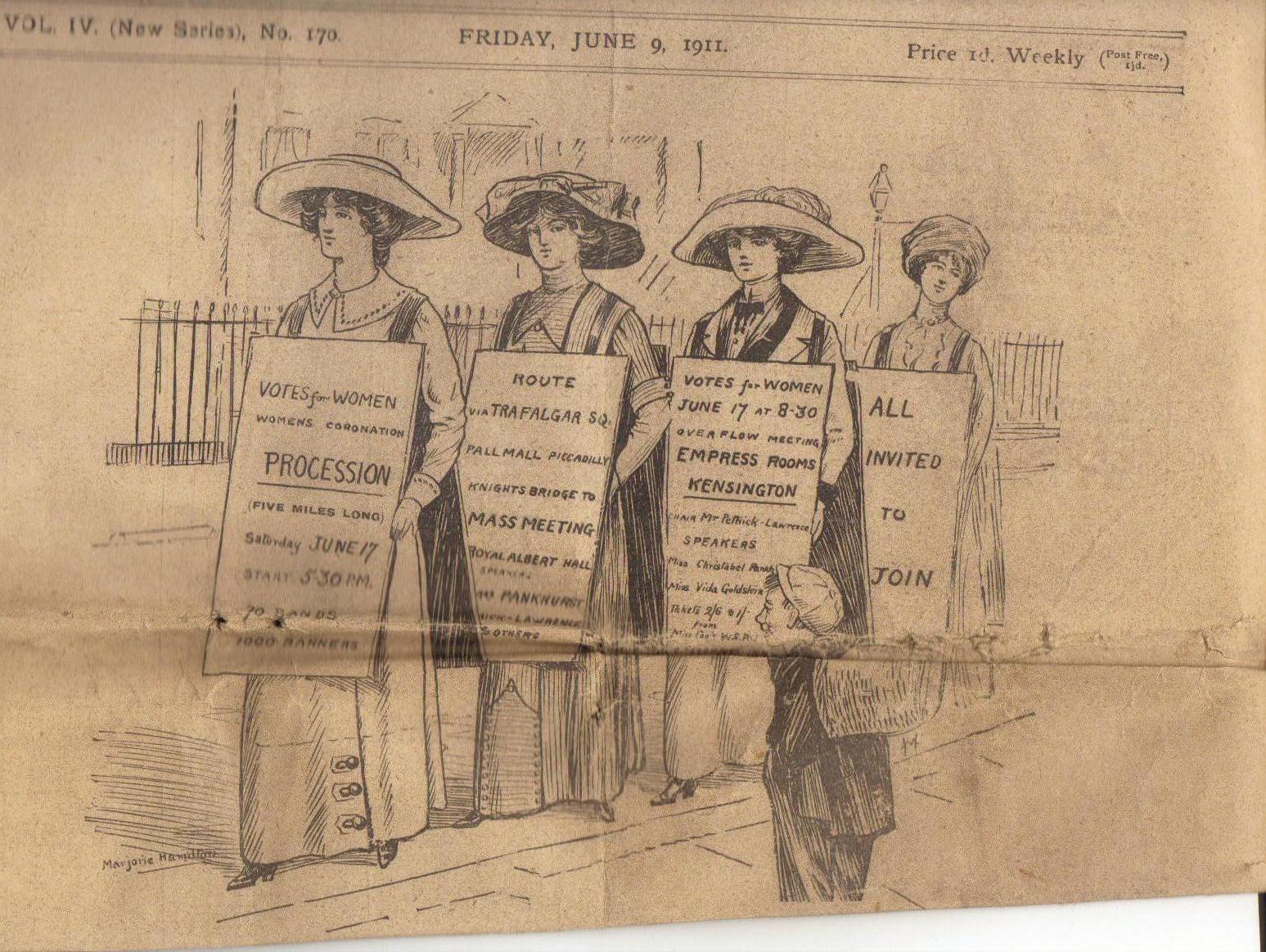
Front page of 9 June 1911 issue of ‘Votes for Women’
To have been given this position on the front page of Votes for Women was, indeed, something of an accolade – the paper’s usual artist, ‘A Patriot’ [Alfred Pease], had made way for her. Marjorie Hamilton’s ‘cartoon’ is, in fact, an advertisement for the Procession, with the lead character in her drawing dressed in the same way as the suffragette on the flyer. The latter, however, makes a very much bolder impression – the image greatly strengthened by the use of colour. While the Votes for Women front-page picture is signed with her full name – that is, ‘Marjorie Hamilton’ – the flyer carries only initials – but these do appear to read ‘MH’. When describing the artist responsible for the image on the cover of the lavish Programme produced for the occasion of the Procession, Votes for Women is rather coy – referring to her only as ‘an artist member of the WSPU’. So who was Marjorie Hamilton?
My research indicates that she was born in Derbyshire in 1882. Her father, Arthur Hamilton, was a banker – a partner in S.Smith & Co’s Bank, Derby. Her mother, Georgina (nee Stokes) had been born in South Africa. Marjorie had a slightly younger sister, Vera, and in 1891 the family lived, presumably in considerable comfort, with three servants and a live-in (young) governess, at The Mount, Duffield Road, Derby. Ten years later, in 1901, the family was living above the bank premises at 7 Market Head, Market Place, Derby, along with six domestic servants and a bank clerk. However, less than a year later Arthur Hamilton, now described as of ‘The Grange’, Ewell, Surrey, died, leaving £10,800. It was in 1902 that Smith’s Bank lost its individual identity when it merged with the Union Bank of London.
Georgina Hamilton, with her daughters, may have moved to Canada c 1906. Certainly Marjorie noted on a subsequent Canadian immigration form that she had lived in Canada from 1906-1908. Her sister, Vera, married in Vancouver in 1908 and in 1911, when the Canadian census was taken, was living there with her mother, her husband and two young children. Even though she was a member of the WSPU, Marjorie Hamilton, luckily for us, did not boycott the 1911 UK census and can be found, describing herself as an ‘art student’, as a boarder at 4 Mills Buildings, Knightsbridge, an 18th-century court on the north side of Knightsbridge High Road, close to the Barracks. At this time Mills Buildings was a rather raffish address, although her fellow boarders all appear very respectable.
The census was taken on 2 April 1911 and it must have been very soon after, while Marjorie Hamilton was living here, that she was given the rather important ‘Coronation Procession’ commission. Marion Wallace-Dunlop and Edith Downing were in charge of the artistic design of the Procession, which was being executed at 12 Smith Street, Chelsea. Perhaps it was they who spotted her talent for graphic design. Incidentally on the night of the 1911 census those resident at this address were Miss Dean, a 27-year-old artist’s model, together with a young secretary and a shop assistant whose surroundings, with 8 rooms, between the three of them, were rather more spacious than those of their neighbours. I wonder if they let out one or two of those 8 rooms to the WSPU? It is clear from the reports in Votes for Women that there was a great deal of activity going on at 12 Smith Street in May and June 1911.
Alas, however, that is about all I can discover of Marjorie Hamilton’s career as an artist – except that in 1913 she was advertising that she would be happy to take order for water-colour sketches of country homes.
I next catch sight of her in February 1917 at Liverpool, embarking on the SS Carmania for New York. Her address is given as ‘Cranleigh, Surrey’ and her occupation is ‘artist’. So, in the six years that had elapsed she had presumably had – or at least had attempted to pursue – art as a career.
I did wonder why, in the midst of a war that made Atlantic travel so dangerous, she was making this journey. And then I realised that her final destination was not New York but Victoria, British Columbia and that she must have been going out to be with her mother – who died a month or so after her arrival.
Another seven years go by until in 1924 I found her again, once more about to enter Canada. However this time it is not as an artist but as the prospective matron of the Waifs and Strays Society Receiving Home at 661 Huron Street, Toronto. This was Elizabeth Rye House – a home to where girls were sent from England to be trained for domestic service. On the immigration form Marjorie Hamilton gave her present occupation as ‘matron’, which may, or may not, indicate that she had found that art did not pay and that she had to find an other means of earning her living.
And there the trail for the moment ends. I know that the Toronto home closed in 1931 – but don’t know if Marjorie Hamilton was still there then. Did she return to England – or remain in Canada. I know that her sister died in Sussex in 1943 – but can find no further trace of Marjorie.
And all this is what comes of wondering who was the artist responsible for a delightful purple, white and green flyer produced something over 100 years ago.
WALKS: The Women’s Library @ LSE Now Open
Posted by womanandhersphere in Walks on August 1, 2013
 Today, 1 August 2013, is a red-letter day for women’s history researchers – for once again they have access to the magnificent Women’s Library archive and museum collections – now open at The Women’s Library @LSE. With research having, perforce, been put on hold for the last few months there was doubtless an impatient queue outside the doors this morning.
As a long-time user of the Women’s Library – with fond memories of the Fawcett Library and its Tardis-like basement – I was delighted to find an interview with David Doughan – the Fawcett’s dedicated custodian – on the LSE Blog. It is so important that women historians remember their own historiography.
I must say that, when hearing that LSE, (as, of course, do so many other institutions) likes to reward those who give very large donations by attaching their name to a room or building – I regretted even more that Millicent Fawcett’s name has been detached from the Library inaugurated in her memory. The Women’s Library@LSE has a very bright future, but we mustn’t forget the past on which it is built.
When – or if – those patient researchers now able to access the Women’s Library@LSE are able to tear themselves away from their papers, I have, over the last few months, created a series of posts on buildings in the area around LSE that relate to the Woman’s Cause. You will find links to them all under the Walks tab at the top of this blog. I thought the information contained in these posts might bring the area to life while legs are stretched and fresh (?) air breathed during strolls around the Aldwych area.
Police outside WSPU offices in Clement’s Inn, 1912. Image courtesy of the International Institute for Social History
 Woman and her Sphere