Material owned by the Metropolitan Police Service Museum, licensed under the Metropolitan Police Service Non-Commercial Licence. (This image must not be reproduced without permission from the Metropolitan Police Service.)
Twelve years ago I paid a visit to what was then the Metropolitan Police Heritage Centre in West Kensington on the off-chance that any records held there might allow the WSPU campaign to be viewed through a police prism. In this I was disappointed – but one item I was incidentally shown did stick in my mind – an illuminated certificate such as the WSPU presented to their imprisoned members. Nobody in the Centre was able to tell me how they came to have this item in their collection and as this visit took place just a few days before I knew what was awaiting me – a cancer diagnosis – I did not follow it up.
However, thanks to the care I receive from University College London Hospital, suffrage detecting continues and four years later, in June 2018, while researching in the National Archives for a chapter on Suffrage Collecting (published in The Routledge Companion to British Women’s Suffrage), I discovered what I thought might be a clue to the certificate’s presence in the police museum. For among the items listed in MEPO/3/2407, an application from the WSPU for the return of their property seized by the police in a raid on Lincoln’s Inn House in April 1913, are ‘2 framed Suffragette certificates’ against which an official marked ‘retained Museum 30 April 1913’.
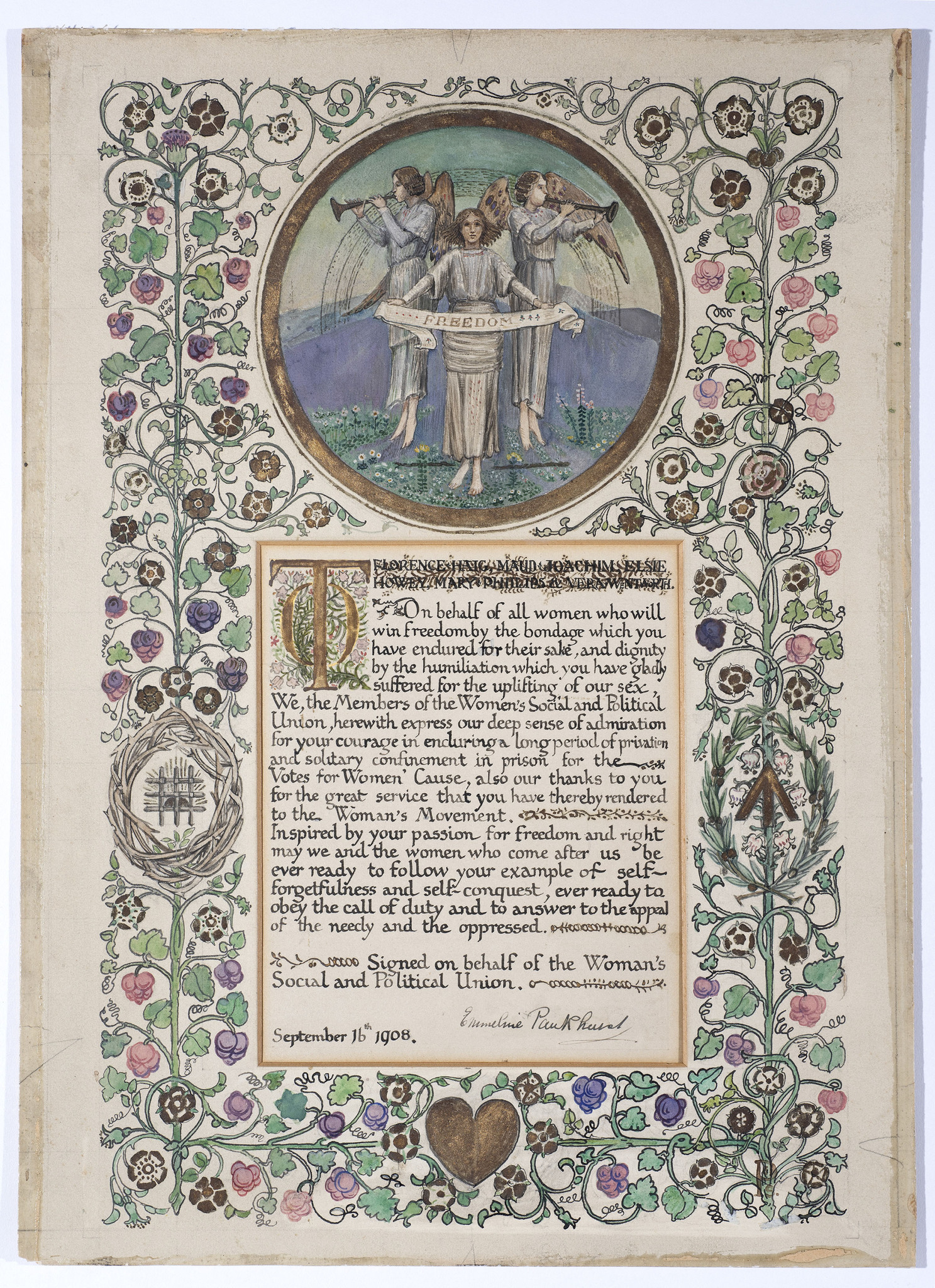
I made a note of this but, what with one thing and another, took the matter no further – until this week when the Metropolitan Police Museum (which removed some time ago from West Brompton to Sidcup) posted on Bluesky a fragment from the illuminated WSPU certificate they held. With communication now so much easier, I asked if they could tell me the name on the certificate – and they quickly responded with an image of not one name but of the five names that appeared at the head of the certificate.
Now that got me wondering. All the certificates I have ever seen are dedicated to one WSPU prisoner only. Why did this one list five – Florence Haig, Maud Joachim, Elsie Howey, Mary Phillips and Vera Wentworth? Well, thanks to the wonders now at our fingertips, it took only a moment of searching digitized Votes for Women to realise that the one time these five women were grouped together around the time of the date on the certificate (16 September 1908) concerned the three-month sentence of imprisonment they each had received after taking part in a WSPU demonstration on 29 June 1908. This was the longest term that had yet been served by suffragette prisoners and the WSPU was determined to gain as much publicity as possible from the prisoners’ eventual release – due to take place on 16 September.
In this photograph (held by the London Museum) you can see four of women (Florence Haig, Vera Wentworth, Elsie Howey and Maud Joachim) as they emerge from Holloway; Mary Phillips had to wait a couple of days longer. As massed crowds lined the route the four women were escorted in triumph through the streets of north London to Queen’s Hall in Langham Place. Sitting in a carriage decorated with banks of heather and purple and white flowers, the carriage was drawn by horses for part of the way but then the traces were taken over by 50 suffragettes ‘in full uniform ‘ who conducted the prisoners to their final destination. A brass band playing ‘The Women’s Marseillaise’ accompanied the procession, while silk banners proclaiming ‘Strong souls live like fire-hearted suns to spend their strength’, Freedom’s wings in prison grow stronger’ and ‘We oppose the Government which has imprisoned over 300 women’ fluttered behind. From a press cart the public could buy copies of Votes for Women, for the WSPU was always alive to a fund-raising opportunity.
The procession was met at the Queen’s Hall by both Mrs Pankhurst and Mrs Pethick-Lawrence and there followed an enthusiastic, consciousness-raising meeting, addressed by all four released prisoners, with militant methods extolled. Votes for Women (24 September 1908) contains a full report of the procession, with a photograph of the carriage as it was drawn by the 50 suffragettes. This was on Wednesday16th and on Friday 18th Mary Phillips received similar treatment, drawn in triumph from Holloway to a reception in the Portman Rooms – with tartan very much in evidence as a nod to her Scottish heritage. At this meeting all five women were presented with an illuminated address, the wording set out in Votes for Women, 24 September 1908 (p. 472).
In the following week’s issue (Votes for Women, 1 October 1908, p. 5) readers were given a full description of the ‘illuminated address’. It was ‘the work of Miss Sylvia Pankhurst, is truly a labour of love, and represents many hours of thought and careful workmanship generously given to the Union. At the top of the design are three messengers, one bearing the scroll of freedom, the other two blowing the trumpets of the new day. The sun is seen in the distance rising over the blue hills, and the messengers have their feet upon the flowers. The rose, shamrock, and thistle are introduced as a border, and on one side is a medallion with a crown of thorns surrounding a barred gate, behind which is the rising sun, while opposite this is a wreath of laurel circling a broad arrow. The words of the address are: ‘To Florence Haig, Maud Joachim, Elsie Howey, Mary, Phillips, and Vera Wentworth …’ The report then sets out the wording as you see it in the image above.
This report also contains one other important item of information: ‘Readers..will like to know that the original may be seen at the N.W.S.P.U. offices, 4 Clement’s Inn, W.C.’ It is this sentence that leads me to think that the Metropolitan Police Museum holds the original artwork created by Sylvia Pankhurst for the illuminated addresses. I suggest that in 1912 this design, framed, moved with the WSPU from Clement’s Inn to Lincoln’s Inn House and was then, on 30 April 1913, during a police raid was down from the wall and packed into a pantechnicon with the other contents of the WSPU offices. [For a short article about the raid (written in 2013) see https://wp.me/p2AEiO-lK.] As noted in MEPO/3/2407 an official, for whatever reason (liked the look of it?, decided that the framed address should be retained for the Museum.
And there it has remained for 113 years. The fact that it is Sylvia Pankhurst’s original artwork was probably not appreciated by the raiding police and, as far as I know, is not now suspected by the curators of the Metropolitan Police Museum. But, having guarded it for all this time, I hope they will be a little thrilled to know they hold in their collection an object with such an interesting provenance. Of course, I imagine the fact that it is the original and not a printed design could easily be confirmed if viewed by a conservation expert.
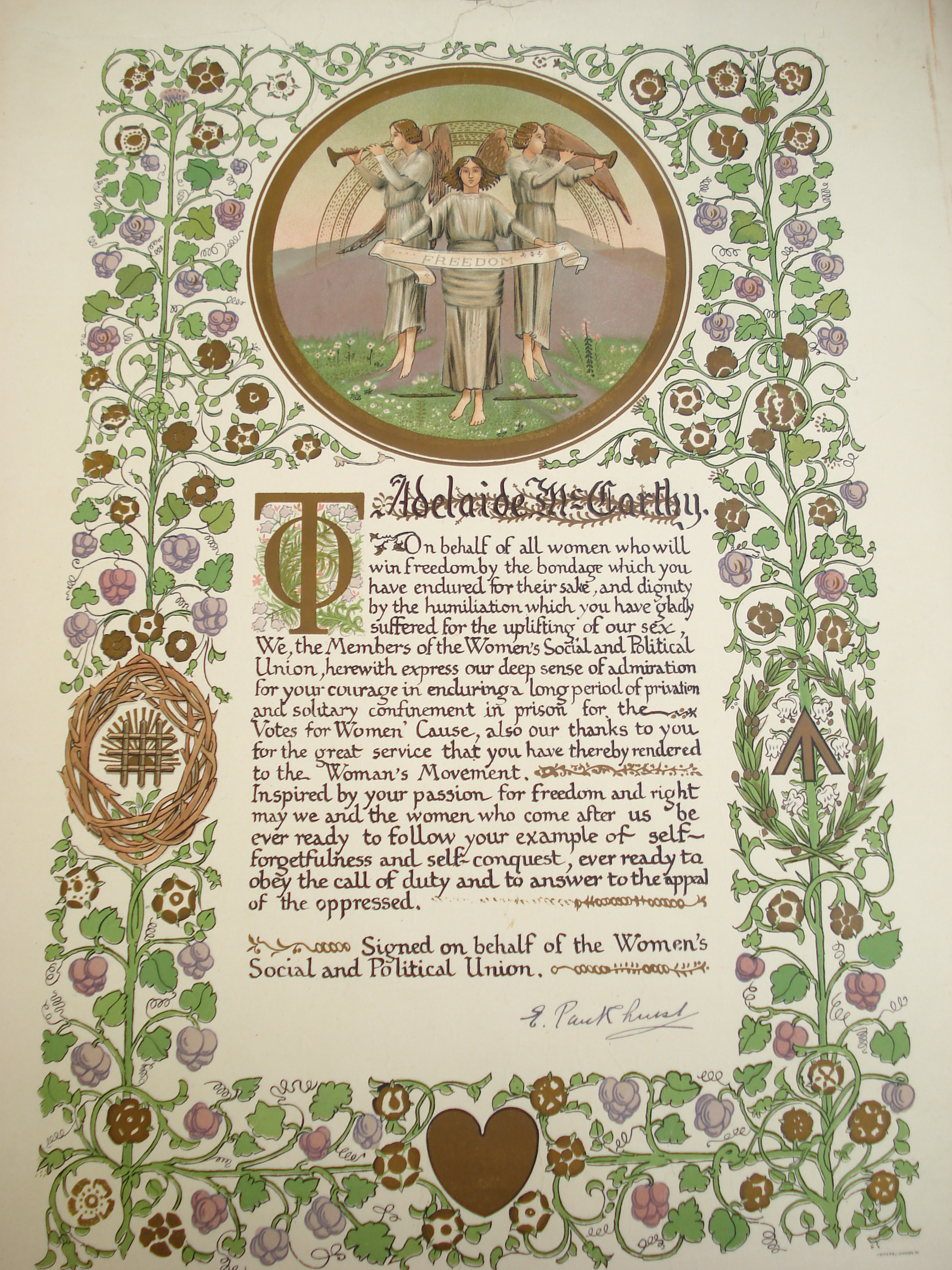
Printed versions of the illuminated address were subsequently annotated with the names of other WSPU prisoners – such as the one below that passed through my hands a few years ago. The printed versions were then signed personally by either Emmeline Pankhurst or Emmeline Pethick-Lawrence, sometimes by both. However, unlike the original they were never dated.
Copyright
All the articles on Woman and Her Sphere are my copyright. An article may not be reproduced in any medium without my permission and full acknowledgement. You are welcome to cite or quote from an article provided you give full acknowledgement.
 Woman and her Sphere
#1 by Jo Stanley on April 17, 2026 - 6:07 pm
Fascinating. Thank you, Elizabeth. Great sleuthing.
#2 by vanneyoung on April 17, 2026 - 7:12 pm
This was such a wonderful, wonderful story! Great research! Thank you for writing and posting.
Your friend in the colonies,
Valerie ________________________________