Archive for May, 2015
Caroline Crommelin and Florence Goring Thomas: 19thc Interior Decorators: Who Were They?
Posted by womanandhersphere in The Garretts and their Circle, Uncategorized on May 26, 2015
Caroline Anna de Cherois Crommelin (c 1854-1910) was born in Co Down, Ireland, one of the many children of Samuel de la Cherois Crommelin of Carrowdore Castle.
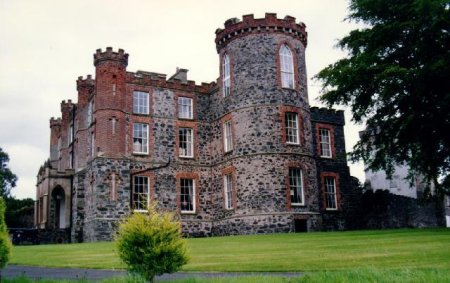
Carrowdore Castle
Although of gentle birth, the family had little money. Political unrest in Ulster forced a move to England and after their father’s death in 1885 Caroline Crommelin and her sisters found it necessary to work to support themselves.

May Crommelin
Caroline’s elder sister, May, became a novelist and enjoyed a measure of popular success. In 1903 another sister, Constance, married John Masefield (who was very much her junior).
In 1886 another of the sisters, Florence, married a solicitor, Rhys Goring Thomas, and in the late 1880s with Caroline, who seems to have been the driving force, embarked on a career as a ‘lady decorator’. The pair were able to travel easily along the path blazed for them a decade earlier by Rhoda and Agnes Garrett.
Unlike the Garretts, Caroline and Florence do not appear to have had any specific training, although years later Caroline wrote that an apprenticeship was essential. Rather, they relied on what was assumed to be a natural taste absorbed from their early surroundings. In a later interview Caroline described how their father had given the two of them a room in Carrowdore Castle to do with as they wished and from painting and papering this room they had learned their trade. Whereas Rhoda and Agnes Garrett were happy to deal with drains and internal structures, I doubt that such practicalities fell within the Crommelin sisters’ remit.
It was ‘beautifying’ that was the word most often used to describe Caroline Crommelin’s work. An article by Mary Frances Billington in The Woman’s World, 1890, describes how in 1888 Caroline Crommelin set up a depot at 12 Buckingham Palace Road for the ‘sale of distressed Irish ladies’ work’ and then ‘saw a wider market as a house-decorator, so she wrote ‘Art at Home’ on her door-plate, took into partnership her sister, Mrs Goring Thomas..and boldly set forth to hunt for old oak, rare Chippendale, beautiful Sheraton and Louis Seize furniture’. She attended auctions in all parts of the country and, in case there was any doubt as to the propriety of this involvement with trade, reported that she had no difficulty doing business with dealers, meeting only with civility.
Noting the popularity of old, carved oak, the sisters’ bought old plain oak pieces and then had them carved by their own craftsmen. There was always a stock of such pieces in their showroom.
The ‘Arts at Home Premises’ were opened in Victoria Street, London, in early 1891. I think their house was at 167a Victoria Street – certainly by 1898 this was Caroline Crommelin’s work premises, but it’s possible that in the late 1880s she was working from 143 Victoria Street. Of the ‘Arts at Home’ premises The Sheffield Telegraph (9 March 1891) described how’charmingly arranged rooms, stored with delightful old oak, Sheraton, and Chippendale furniture, quaint brass ornaments, old silver, beautiful tapestries, and old china were crowded all afternoon with the many friends of the clever hostesses.’..The oak room featured a delightful ‘cosy corner’ in dark oak with blue china arranged on the top ledge against the pink walls. May Billington’s article includes a line-drawing of a corner of the ‘Arts at Home’ showroom.
In its 23 November 1895 issue the York Herald commented of Caroline Crommelin that ‘Her house in Victoria St is conspicuous to the passer by for the pretty arrangement of its curtains, and inside the artistic element is even more apparent. Miss Crommelin has been very successful as a house beautifier and her opinion has been much sought after and esteemed by those who like the home to be dainty and harmonious.’
In 1891 the sisters also displayed their wares at the Women’s Handicrafts Exhibition at Westminster Town Hall. The Manchester Times singled them (‘two of our cleverest art decorators’) out for praise. ‘These ladies have shown that… old oak furniture need not be gloomy and dusty and that new furniture may be made to look as good as old, even if the old be Chippendale or Sheraton, Queen Anne or Dutch marqueterie.’
One of Caroline Crommelin’s first ‘beautifying’ commissions was carried out for Lord and Lady Dufferin on the British Embassy in Rome in 1890/1891. The Manchester Guardian (8 Oct 1889) reported that she redecorated the entire embassy. Doubtless this plum commission was not unconnected to the fact that the Dufferin estate in Co Down was a mere 10 miles from Carrowdore Castle; the families were presumably known to each other. Rather more surprising is the claim made in an interview with her in the Women’s Penny Paper, 23 Nov 1889, that she had ‘supplied nearly all the furniture to Lord Cholmondeley’s old place at Houton [sic]. Houghton Hall was let to tenants during the 19th century so, perhaps, there is a kernel of truth buried in this statement – but I don’t think we need go looking at Houghton as it is today for evidence of Caroline Crommelin’s involvement in its decoration.
In interviews Caroline Crommelin also made clear that she ‘undertakes, when required, to furnish a whole or any part of a house, either going with the customer to different firms or selecting for them’ and ‘does not confine herself to decorative work alone, and will put up blinds or attend to the whitewashing of a ceiling with the most professional alacrity’.
Both Caroline and Florence were supporters of the campaign to give the vote to women householders and were keen to see women’s advancements in the professions – particularly as architects.
In 1895 Caroline Crommelin married Robert Barton Shaw, nephew of a former Recorder of Dublin, who in the 1901 census return is described as an estate agent. I wonder if his wife helped in ‘beautifying’ houses he had for sale? In 1901 they were living at 50 Morpeth Mansions, Morpeth Terrace. Caroline in this census return is described as an ’employer’. Florence lived close by -in 1891 at 3 Morpeth Terrace. However hers was to be a short-lived career – she died in 1895, aged only 37, a few months before her sister’s marriage. In the 1889 Penny Paper interview Florence was quoted as saying ‘I believe everybody is happier for working. It carries one into a new life, and one does not have time to think of being ill’. In the light of her early death this has a certain poignancy, suggesting she may have had a chronic illness to overcome.
Caroline carried on the business on her own and in 1903 teamed up with her sister, May, to write a chapter on ‘Furniture and Decoration’ in Some Arts and Crafts (ed Ethel Mckenna), published in The Woman’s Library series by Chapman & Hall. In this they ran through the various periods of furniture and room design but did not bother to disguise their support for one style in particular. ‘Anyone of artistic feeling is sensible of a singular sense of well-being on entering a genuine Queen Anne sitting-room. If analysed, the sensation will be found to arise from an instantaneous inner perception that all is in just proportion. The height and size of the room obey accurate laws. Its ceiling is relieved by geometrical designs. The walls are half-wainscoted; the polished floor shows up the tapestry-like carpet in the centre. The ornaments of furniture and general decoration are neither profuse, grotesque, nor severe. In all, the fatal “too much” is avoided.’
Caroline Crommelin (or, rather, Mrs Barton Shaw) died at 18 Albion Place, Ramsgate on 1 February 1910.
Copyright
Suffrage Stories: Two New Exhibitions
Posted by womanandhersphere in Suffrage Stories on May 21, 2015
Last week I visited two small exhibitions – both centring on the theme of ‘Campaigning’.
The first was a temporary exhibition (alas, it ends tomorrow, Friday 22 May, so hurry to catch it) – Blackguards in Bonnets – at the impressive Jewish Museum in Camden Town. This tells the story of the involvement of Jewish women and men in the struggle for emancipation. It centres particularly on the 20th-century campaign for women’s suffrage in which many members of the Jewish community took leading roles.
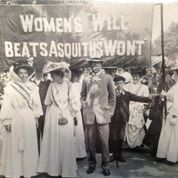
Israel Zangwill at the WSPU’s June 1908 demonstration with, on the far left, Emmeline Pethick Lawrence and on his right Christabel Pankhurst
The writer, Israel Zangwill, a noted speaker on behalf of the movement, is represented by this image. In March 1912 Kate Frye attended a meeting addressed by him and wrote of it in her diary:
‘”I turned to Mrs Mansel, just before he finished, saying ‘Doesn’t he make one think of – and isn’t he like – Spring’” That word concluded his speech, and it was like the Spring in its freshness and gaiety, life and hope, and so deliciously witty. I have never heard a large audience laugh so quickly and as gladly as this audience, the response was almost before the spoken word, in fact there was not a dull flash of the eye all the evening.’
Also on display are a number of items that related to the involvement in the WSPU and Jewish League for Women’s Suffrage campaigns of the wealthy Lowy family. Henrietta Lowy and four of her daughters had joined the WSPU in 1908.
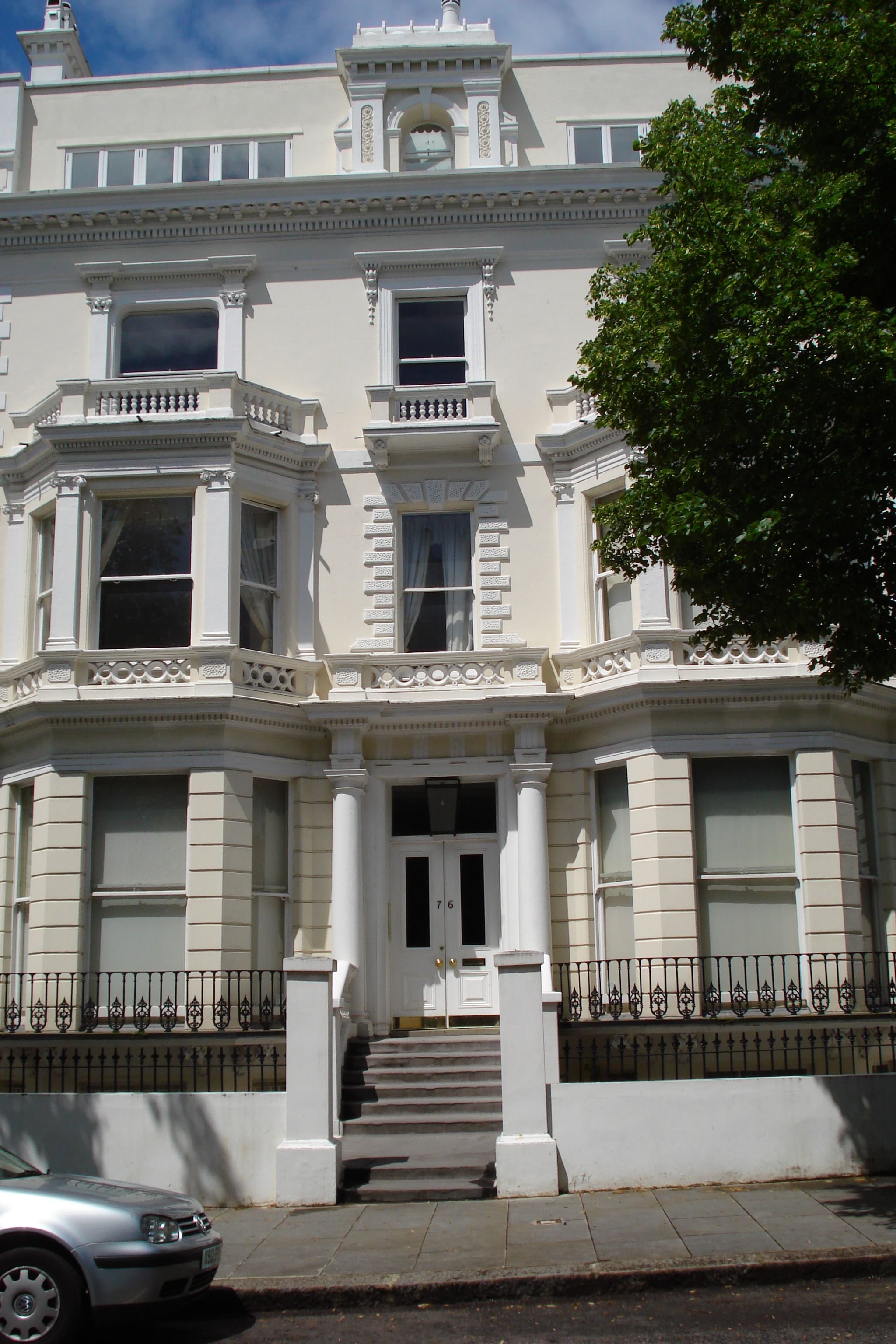
76 Holland Park – once the Lowys’ home – and one from which they were all absent on Census Night, 1911, following the WSPU boycott call
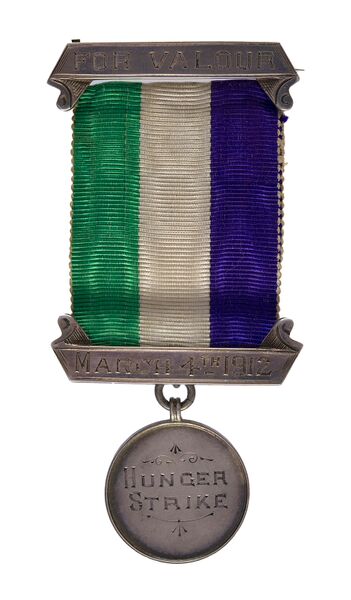
Here, too, you can see Gertrude Lowy’s hunger-strike medal. She was imprisoned after taking part in the March 1912 window-smashing raid.
 But it wasn’t only wealthy members of the established Jewish community whom suffrage campaigners were keen to convert to their cause. In the autumn of 1913 the New Constitutional Society for Women’s Suffrage took their message down to the sweatshops of Whitechapel.
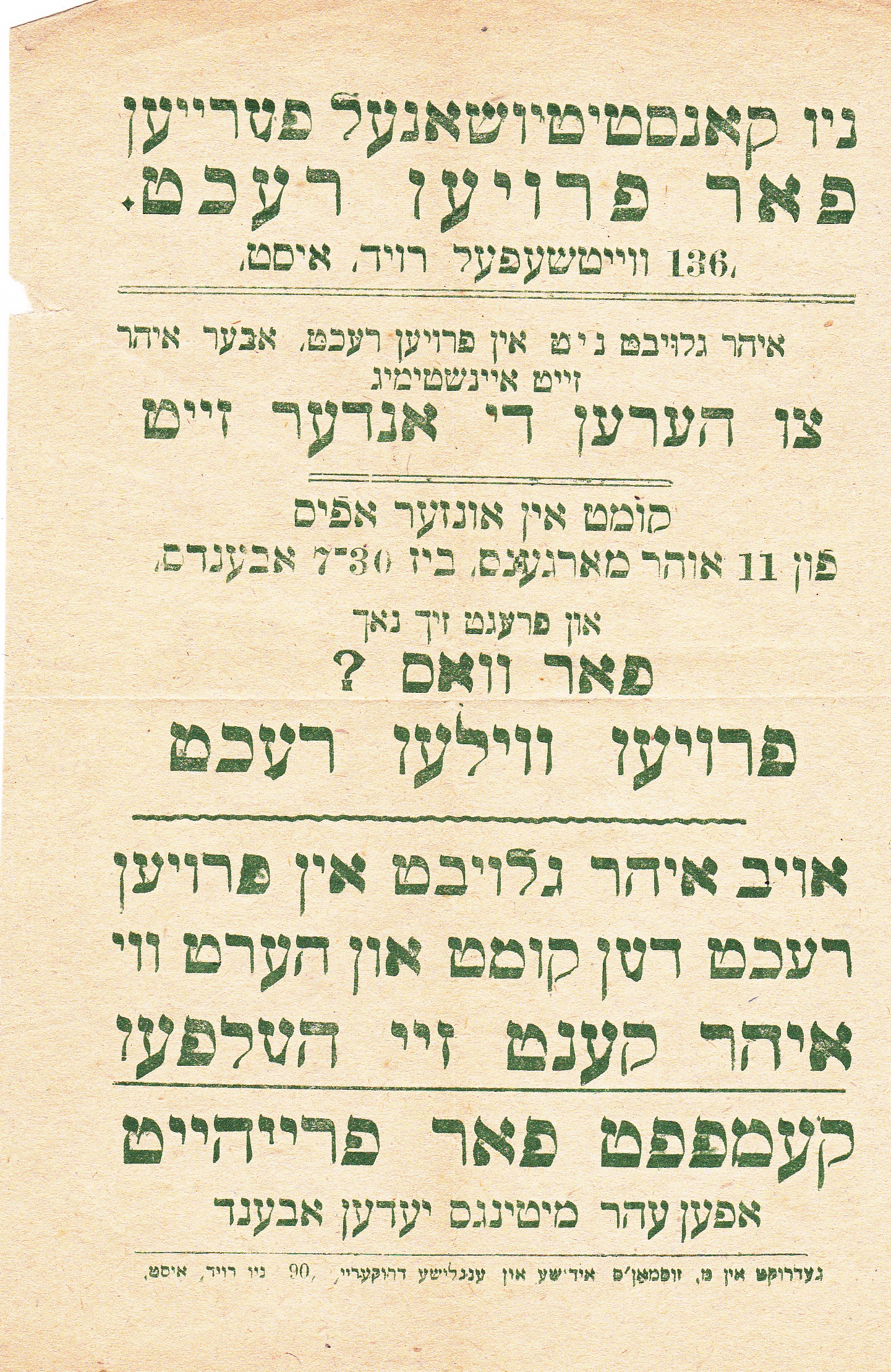 This leaflet, printed in Yiddish, was saved by Kate Frye from the quantity she delivered and is on display, together with her diary open at the entry for 27 September 1913, in which she describes a tea party the NCS gave for the local woman and girls, writing:
‘I chatted and handed round. The girls were so nice – nearly all Jewesses. The pitiful tales they tell of the sweated work is awful – and they are so intelligent – and quite well dressed. The Jews are an example to the gentile in that way.’
Later in the week I went to the LSE Library to view their new exhibition space – and the first exhibition to be shown in it.
The theme is ‘Campaigning’ – covering the suffrage movement (a slight nod to male enfranchisement with the greater emphasis placed on the women’s campaign), Liberations – Gay and Female – and campaigns for Peace. One wall of the exhibition space allows for the display of images, moving on a loop – with space in front devoted to a static display of CND badges, a couple of 19th-century documents, an Artists’ Suffrage League poster and a ‘Votes for Women’ scarf. These advertise, as it were, the themes of the three types of campaign.
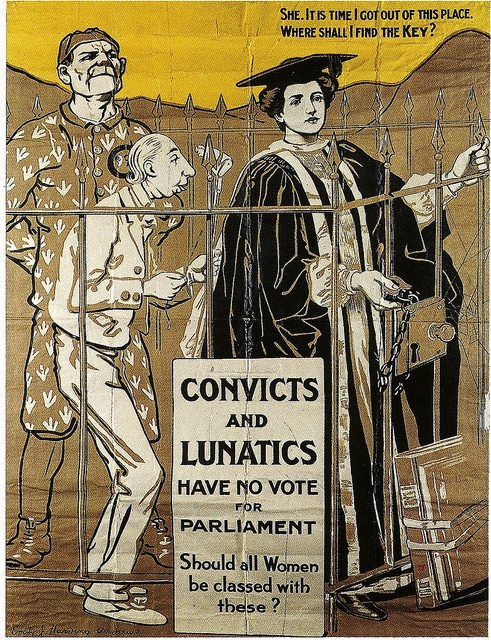
This poster – focussing on the plight of the unenfranchised woman graduate – should appeal to at least 50% of LSE students. For my post on the artist see here
In the centre of the space is a single display case in which neatly chosen documents highlight the different ways in which the campaigns were organised – and, most importantly in my eyes, stresses the rifts and divisions that are a sine qua non, it would appear, of all pressure groups.
Although small, the exhibition makes its points very well. They stick in the mind. It’s presumably intended to catch the eye of LSE students as they pass in and out of the Library entrance and is not intended to deliver in-depth information. Small and simple is no bad thing.
But, oh dear, I did wish that some acknowledgement of Millicent Fawcett and the National Union of Women’s Suffrage Societies had been included in the display. ‘Suffrage’ yet again was only represented by Mrs Pankhurst and the WSPU, whereas the Women’s Library@LSE contains a wealth of material inherited from the NUWSS. As I viewed ‘Campaigning’ it occurred to me that it would be rather a good idea if a future exhibition could, in the same simple manner, by making reference to the NUWSS and the Women’s Freedom League (and, perhaps, some of the smaller societies), demonstrate that the women’s suffrage campaign was more complicated and multifaceted than it is popularly presented.
Copyright
Suffrage Stories: The 1866 Petition: The Aldeburgh Connection
Posted by womanandhersphere in Suffrage Stories, The Garretts and their Circle on May 12, 2015
In a previous post I recorded something of how the 1866 women’s suffrage petition came into being. Comprising 1499 names, it was presented to John Stuart Mill, MP for Westminster, by Emily Davies and Elizabeth Garrett.
Names on the printed form of the petition are listed in alphabetical order, usually accompanied by some form of geographical address. Reading through it one notes that, while some towns have mustered only one or two signatures, others have attracted many more.
That a clutch of signatories to the petition lived in Aldeburgh, a small coastal town (1991 inhabitants in 1871) in Suffolk, had everything to do with the fact that Elizabeth Garrett LSA was one of the principal organizers of the petition. Aldeburgh was home to her family, her father, Newson Garrett, a driving force in its development.
Elizabeth Garrett c 1866 (courtesy of Wellcome Images)
Just a few months earlier Elizabeth Garrett had qualified as a doctor, the first woman to do so in Britain, and signed from her London home, 20 Upper Berkeley Street, the premises of her nascent practice and the headquarters of the petition committee. She ensured that the women of Aldeburgh, her home town, were canvassed. It is likely that it was her younger sisters, Agnes and Millicent, both too young to sign, who took petition forms round to their neighbours.
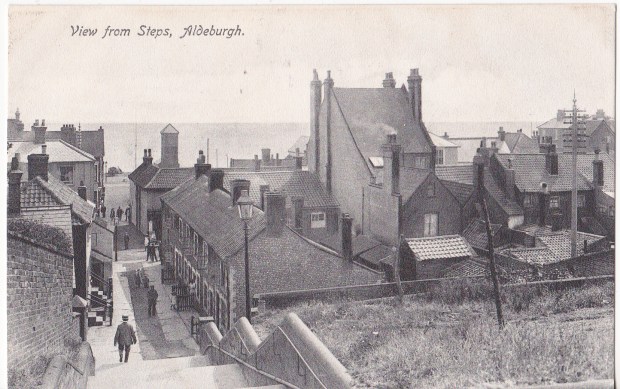 I have extracted the Aldeburgh names from the petition and below give such details as can now be gleaned of these women, none of whom, as far as I can tell, ever again took part in any political protest.
BEGBIE, MRS HAMILTON
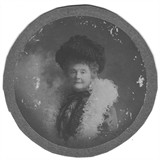
Anna Eliza Begbie (courtesy of Ancestry.co.uk website)
She was Anna Eliza Begbie, née Swiney (1839-1915). She married Mars Hamilton Begbie in Cheltenham in 1858; despite his warlike name he had been ordained. By 1866 they were living in Aldeburgh where, according to the Cambridge Alumni List he was headmaster from 1865 to 1869 of ‘Aldborough School’ – a grammar school. They lived at Crespigny House, a late-18th-century mansion.
Although Anna Eliza Begbie doesn’t appear to have taken any further part in the suffrage campaign, it was surely a subject of discussion among her extended family after her brother, John, married in 1871. His wife, [Rosa] Frances Swiney, who lived in Cheltenham, was an influential campaigner for suffrage – and for Theosophy – in the late 19th and early 20th centuries.
CRESY, MRS THEODORE GRANT [or Cressy]
She was born Hannah Jane Spencer (1837 -1896) in Wrotham, Kent. She married Theodore Grant Cresy, a surgeon, in 1859 and by the time she signed the petition was the mother of 4 sons; another was born four months later. The family lived in Aldeburgh from 1860 – 1868. During their time in Aldeburgh (1860-1868) the family lived at The Uplands, the house that had been the Garretts’ first home after they returned from London when Elizabeth was a young girl.

Uplands House, which carries two blue plaques – one for Elizabeth Garrett Anderson and the other for Millicent Fawcett. One plaque can just be glimpsed in the photo
Hannah Cresy’s mother-in-law, Eliza Cresy [or Cressy], who lived at Riverhead in Kent, and her sister-in-law, Mary Cresy, who lived in Norwood, also signed the petition, suggesting that the organizers had asked for names of family members likely to be sympathetic to the petition.
CULVER, MRS HENRY
Probably a misreading of ‘Mrs Henry Calver’. She was Mary Anne (1819-?). who lived with her husband, a plumber, painter and glazier master, in the High Street.
DANCE, MARGARET
Something of a mystery – I can’t find any trace of a Margaret Dance, whether in Aldeburgh or elsewhere. However the signature may have been that of Mary E Dance, daughter of James Dance, Aldeburgh’s parish clerk. It is entirely possible that her signature was mis-transcribed as ‘Margaret’ and she would have been just old enough to sign.
DOWLER, MRS H.T.
There is, however, no doubt about this signatory. She was Frances Harriett Emma Dowler (1812-1899), wife of Henry Turner Dowler, who for 35 years was Aldeburgh’s vicar. The couple had married in 1838. In her autobiography Millicent Fawcett describes how Newson Garrett frequently engaged in very public quarrels with Dowler who besides being vicar was also the town bailiff and a capital burgess. On these occasions Garrett would insist that his family attended church services at the dissenting chapel rather than at Dowler’s church. Relations with Mrs Dowler were unaffected by these rows.
In May 1867 the Rev Dowler performed the wedding service at marriage of Millicent Garrett and Henry Fawcett.
GARRARD, MRS WILLIAM
She was Mary Anne (née Knights) (1819-1870), wife of William Garrard, brewer, maltster and secretary to the Aldeburgh gas company – one of Newson Garrett’s pet projects. In the 1840s William Garrard had been known as ‘the Ipswich Chartist’ and was one of the founders of the Ipswich Working Men’s Association. In the 1860s the couple lived on Church Hill in Aldeburgh.
GARRETT, MRS NEWSON
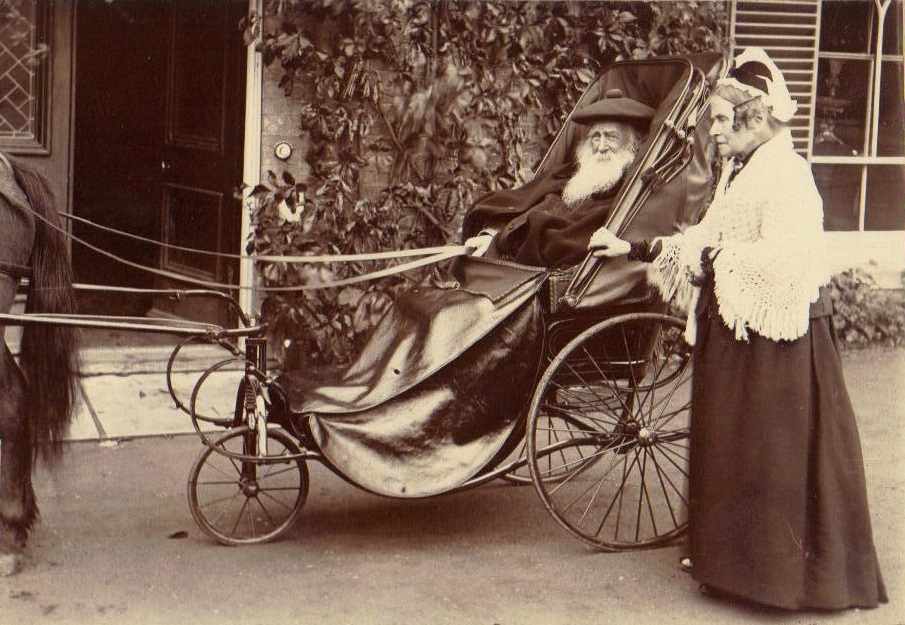
Louisa and Newson Garrett in old age
She was Louisa Garrett (nee Dunnell) ( 1814-1903), wife to Newson Garrett and mother to Louisa (later Smith), Elizabeth (later Garrett Anderson), Newson, Edmund, Alice (later Cowell), Agnes, Millicent (later Fawcett), Samuel, Josephine (later Salmon), and George (another son died in infancy). Although Louisa Garrett was of a far more conservative temperament than her husband she was always supportive of her daughters’ enterprises. She had initially opposed Elizabeth’s desire to become a doctor but, having come round to the idea, was the weekly recipient of letters telling of, at first, the difficulties encountered and later of the success in the medical world achieved as her daughter developed her practice and set up her hospital. Louisa would have signed the petition in the family home, Alde House.
GARRETT, MRS E. Snape Bridge
She was Gertrude Mary Littlewood (c1840-1924) who had married Elizabeth Garrett’s brother, Edmund, in 1862. Unlike his brother, Samuel, Edmund Garrett was not supportive of women’s advancement. In fact he opposed the suggestion that his sister Alice might work in the family business’s counting house. Edmund Garrett and his wife were then living in a house built by Newson Garret next to his maltings at Snape. At the moment (May 2015) it’s for sale – see here for details.
GARRETT, MRS N.D. Calcutta
She was Kate Bruff, who in 1860 had married Elizabeth’s brother, Newson. He was the black sheep of the Garrett family – at this time he was serving with the army in India – a man whose enterprises (unlike those of his sisters) always went awry. Kate’s father, Peter Bruff, was a civil engineer who was involved in several of Newson Garrett (senior)’s plans for improving Aldeburgh. Newson (junior’s) sisters were always rather sorry for Kate.
Despite being so close to Elizabeth Garrett Anderson and Millicent Fawcett, none of this clutch of Aldeburgh-based Garrett women took any further part in the suffrage campaign.
GREEN, HARRIET
She was probably Harriet Green (b 1824) a widow living at Beach Cottage. She is listed in the 1869 Aldeburgh trade directory as being a lodging house keeper.
HAWKESWORTH, MRS WALTER
She was Florence, the daughter of the Rev Dowler, who in 1865 had married John Walter Hawkesworth.
HELE, MRS FENWICK
She was Harriet Shute (1838-1907) who had married Nicholas Fenwick Hele in 1859. She gave birth to her third daughter, Ida, a couple of months after signing the petition. Her husband was a surgeon and the author of Notes and Jottings About Aldeburgh, In 1866 the family lived in Aldeburgh’s High Street. Harriet continued to live in the town after her husband’s death in 1892 – but died in 1907 at St Johns, Newfoundland.
HUNT, MRS
She could have been either Harriet Hunt (1806- 1884), wife of William Hunt, or Cecilia Hunt (1824- 1868), wife of Edward Hunt. Both men were boat builders. Perhaps the younger woman is the more likely candidate.
JAMES, MRS RHODES
She was Caroline James, a widow by the time she signed the petition. She lived with several servants in a large late-18th-century house in Victoria Road – Wyndham House. She was the grandmother of M.R. James, the author of many Suffolk-based ghost stories.
KERSEY, SARAH, ELIZABETH AND MARIA
Sarah Kersey (1811-1886) in 1865 had a lodging house in the High Street. Maria and Elizabeth were her younger sisters. All three were unmarried.
MANNALL, SARAH
Sarah Mannall (1797-1869) was the wife of John Mannall. He had run the Crown and Castle Hotel in Orford for many years before eventually handing it over to his daughter and son-in-law
MARTIN, MRS
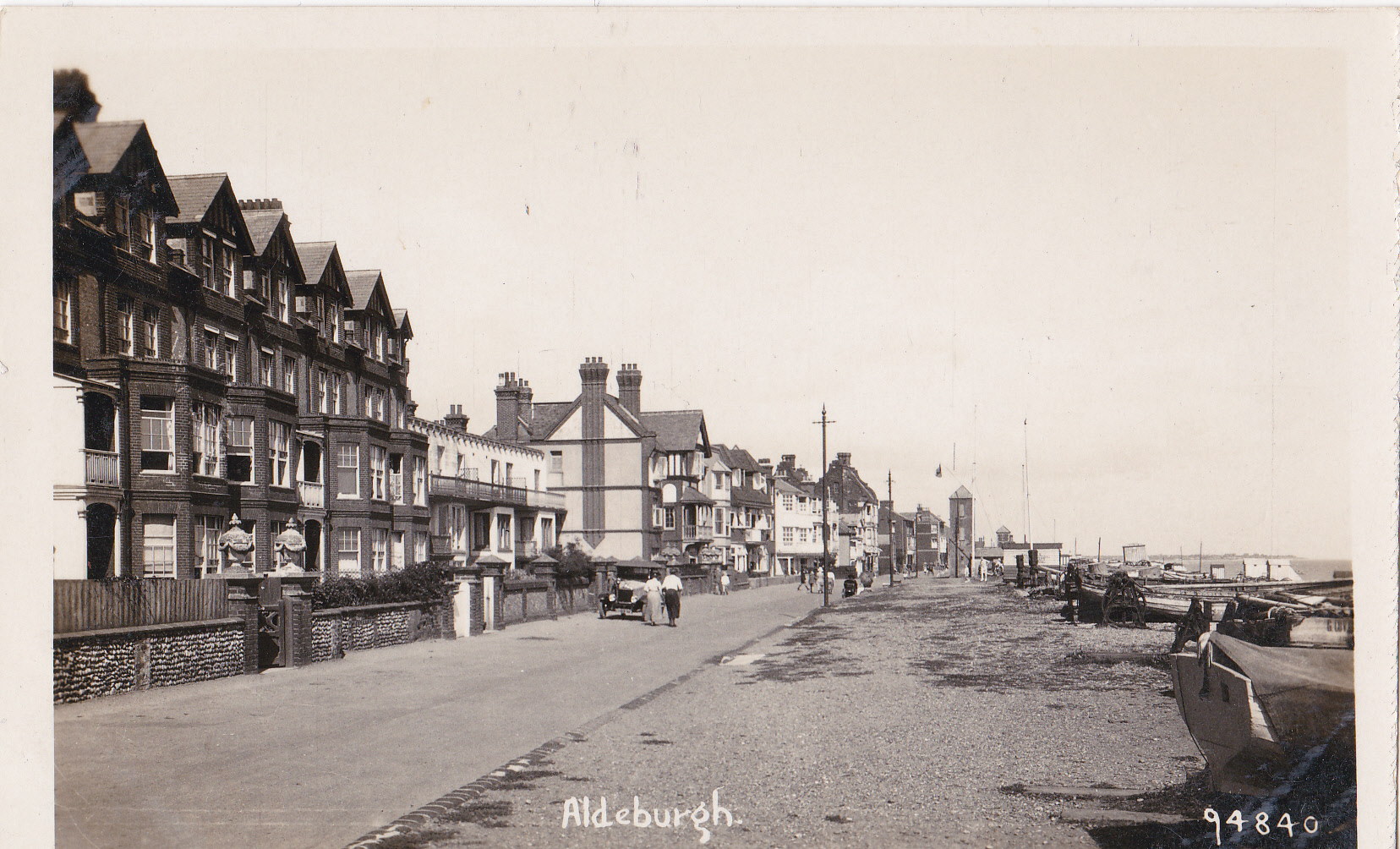
Crag Path, Aldeburgh. Brudenell Terrace, the row of tall houses on left, were built by Newson Garrett . Their red-brick gloom has now been transformed by pastel paints
She was probably Mrs Mary Anne Martin, who in 1865 ran a ladies’ school in a house in Brudenell Terrace.
THELLUSSON, MRS
She was Henrietta Vernon-Wentworth who in 1859 had married Arthur Bethell Thellusson. She died in 1873 – on the same day as one of her young daughters. She had seven children and by the time she signed the petition she had already lost two infant daughters and was to lose another three months before her own death. The family lived at Thellusson Lodge. I seem to remember that Millicent Fawcett described the Thellussons as the ‘aristocracy of Aldeburgh’; for the local canvassers for the petition it must have been something of a coup to have Henrietta Thellusson’s signature on the petition.
WOODWARD, SUSANNAH
Alas, I can find no clue at all as to who this final Aldeburgh signatory to the petition could have been.
After having made this initial bid for emancipation it doesn’t appear that the women of Aldeburgh could be tempted to join the suffrage campaign that followed. During the remainder of the 19th century there is no record of a suffrage meeting being held in the town – described by one contemporary Suffolk author as lying in this ‘quiet, grave, sleepy, Conservative region’.
You can read much more about Elizabeth Garrett Anderson and Millicent Fawcett in Elizabeth Crawford, Enterprising Women: the Garretts and their circle, published by Francis Boutle.
Elizabeth Crawford, The Women’s Suffrage Movement: a regional survey, published by Routledge, surveys the entire suffrage campaign in Suffolk – and in the rest of England, Scotland, Wales and Ireland.
Copyright
 Woman and her Sphere