Posts Tagged rhoda garrett
Another Blue Plaque for Enterprising Women: Rhoda and Agnes Garrett Commemorated
Posted by womanandhersphere in The Garretts and their Circle on March 11, 2025

I am delighted to report that two more of my ‘Enterprising Women’ have just been recognised with an English Heritage Blue Plaque. For the work of Rhoda and Agnes Garrett is now highlighted, this new plaque joining that of their sister/cousin, Millicent Fawcett, on the outside of their home and business premises, 2 Gower Street, Bloomsbury.

The first published study of their work is detailed in a section headed ‘The Home’ in my Enterprising Women: the Garretts and their circle (2002). Having continued the research in the intervening years, most recent discoveries were revealed in an online talk I gave last month for the Victorian Society. If you are interested it is, I believe, possible to buy a recording.
Thus, Rhoda and Agnes Garrett are now memorialized by two blue plaques, the other being by the gate to their Rustington, Sussex, house, then known as ‘The Firs’. I had the pleasure of unveiling that one in 2018.

And while Blue Plaques are on my mind, I’ll mention that Fanny Wilkinson, entirely forgotten before I made her the subject of the section ‘The Land’ in Enterprising Women, is also now memorialised by two. One is the English Heritage version, on her one-time flat in Bloomsbury
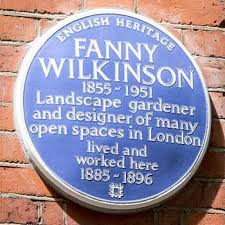
The other is in the garden of her former family home, Middlethorpe Hall, now a delightful hotel. I had the pleasure of giving a talk about Fanny and her work to accompany that unveiling in 2022.

I may say that I initiated none of these commemorations – I just didn’t think to do so – but how delighted I am that the work of these interesting women has touched the imagination of those who launched the four proposals.
And here’s the book that started it all:

330 pages, 75 illustrations £25 +pp (can be ordered directly from me – elizabeth.crawford2017@outlook.com).
The Garretts And Their Circle: A Talk For International Women’s Day
Posted by womanandhersphere in Art and Suffrage, Suffrage Stories, The Garretts and their Circle on February 23, 2024
For the Pascal Theatre Company I am giving a talk on 8 March:
Gower Street’s ‘Enterprising Women’:transforming the home, the land, and politics, 1875-1928
The event is free and already fully booked – but, of course, people who have signed up for it may drop out – so, if you are interested, do add your name to the waiting list. To accompany my talk Senate House Library is amounting a small Garrett/Fawcett-related exhibition, to include sections from the ceiling from 2 Gower Street that was decorated by Rhoda and Agnes Garrett.


Women for Women March Events
WOMEN FOR WOMEN
CELEBRATES WOMEN’S HISTORY MONTH: MARCH 2024
Elizabeth Crawford at Senate House Library Friday 8 March 4.00pm. THIS EVENT IS NOW FULL – WE HAVE A WAITING LIST WE ARE HAPPY TO ADD YOUR NAME TO.

Millicent Fawcett standing on the doorstep of 2 Gower Street, Bloomsbury, on her way to receive her DBE, 12 February 1925
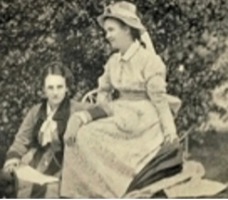
Rhoda and Agnes Garrett
Gower Street’s’ Enterprising Women’: transforming the home, the land, and politics, 1875-1928
RHODA GARRETT (1841-1882)
AGNES GARRETT (1845-1935)
FANNY WILKINSON (1855-1951)
MILLICENT FAWCETT (1847-1929)
A FULLY ILLUSTRATED TALK by Elizabeth Crawford
In the late-19th and early-20th centuries four pioneering women lived at 2 and 6 Gower Street, Bloomsbury. These houses were their homes as well as the sites of their commercial and campaigning enterprises.
The firm of ‘R & A Garrett House Decorators’ operated from number 2, which was first the home of the cousins Rhoda and Agnes Garrett. After Rhoda’s death, it housed Agnes and her sister Millicent Fawcett, leader of the constitutional women’s suffrage movement.
Fanny Wilkinson lived and worked next door but one, at number 6. She was the first professional woman landscape gardener, responsible for laying out over 75 of London’s public parks and gardens.
All four women were also involved, together with an intriguing assortment of friends and relations, in any number of other campaigns. All worked to improve the position of women.
This fully-illustrated talk will describe the life and work of Rhoda Garrett, (1841-1882), Agnes Garrett (1845-1935), Fanny Wilkinson (1855-1951), and Millicent Fawcett (1847-1929).
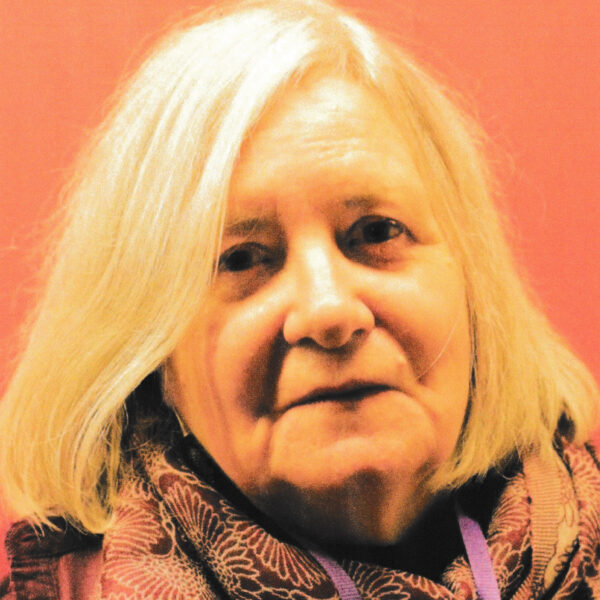
Elizabeth Crawford is the author of a number of books on aspects of women’s history. Of particular relevance to this talk is Enterprising Women: the Garretts and their circle.
Venue: Seng Tee Lee Seminar Room, Senate House Library, 4th floor, Senate House, Malet Street, WC1E 7HU
Timing: The talk 4pm-5.00pm will include a Q & A session.
You are also invited to join an introduction to the library at 5.15pm.
Registration (free) (access will be given at reception to those who have registered)
We have a waiting list and will notify you if a space becomes available.Continue reading“Elizabeth Crawford at Senate House Library Friday 8 March 4.00pm. THIS EVENT IS NOW FULL – WE HAVE A WAITING LIST WE ARE HAPPY TO ADD YOUR NAME TO.”
Other talks organised by the Pascal Theatre for Women’s History Month
Tuesday 12 March
An online talk by Lynsey Cullen about the first Lady Almoner: Mary Stewart
Thursday 14 March
An in- person talk by Emily Midorikawa about the most unlikely Victorian celebrity: Georgina Weldon.
Thursday 21 March
Jane Martin in conversation with Melissa Benn remembering the educational life and networks of educator and activist Jane Chessar.
Further information here: Women for Women March Events – Pascal Theatre Company (pascal-theatre.com)
Elizabeth Garrett Anderson Gallery At The UNISON Centre
Posted by womanandhersphere in The Garretts and their Circle on March 28, 2013
ALAS, IT WOULD APPEAR THAT THE GALLERY HAS FAILED TO REOPEN AFTER COVID CLOSURE. PLEASE PHONE UNISON TO ENQUIRE.
The Elizabeth Garrett Anderson Gallery at the UNISON Centre tells the story of Elizabeth Garrett Anderson, of the hospital she built, and of women’s struggle to achieve equality in the field of medicine.

HAElizabeth Garrett Anderson
Elizabeth Garrett Anderson (1836-1917) was determined to do something worthwhile with her life. In 1865 she qualified as a doctor. This was a landmark achievement. She was the first woman to overcome the obstacles created by the medical establishment to ensure it remained the preserve of men.
Elizabeth Garrett Anderson then helped other women into the medical profession, founding the New Hospital for Women where women patients were treated only by women doctors.
Elizabeth Garrett Anderson, by her example, demonstrated that a woman could be a wife and mother as well as having a professional career.
Elizabeth Garrett Anderson worked to achieve equality for women, being especially active in the campaigns for higher education and ‘votes for women’.
In the early 1890s the New Hospital for Women (later renamed the Elizabeth Garrett Anderson Hospital) was built on the Euston Road and continued to treat women until 2000. For some years this building then lay derelict until a campaign by ‘EGA for Women’ won it listed status. UNISON has now carefully restored the building, bringing it back to life as part of the UNISON Centre.
Two important rooms in the original 1890 hospital building have been dedicated to the Elizabeth Garrett Anderson Gallery. One is the
ORIGINAL ENTRANCE HALL
of the hospital which has been carefully restored to its original form. Here you can study an album, compiled specially for the Gallery, telling the history of the Elizabeth Garrett Anderson Hospital in words and pictures, while, in the background you can listen to a soundscape evocative of hospital life. This is interwoven with the reminiscences of hospital patients, snippets from the letters of Elizabeth Garrett Anderson and sundry other sounds to stimulate your imagination.
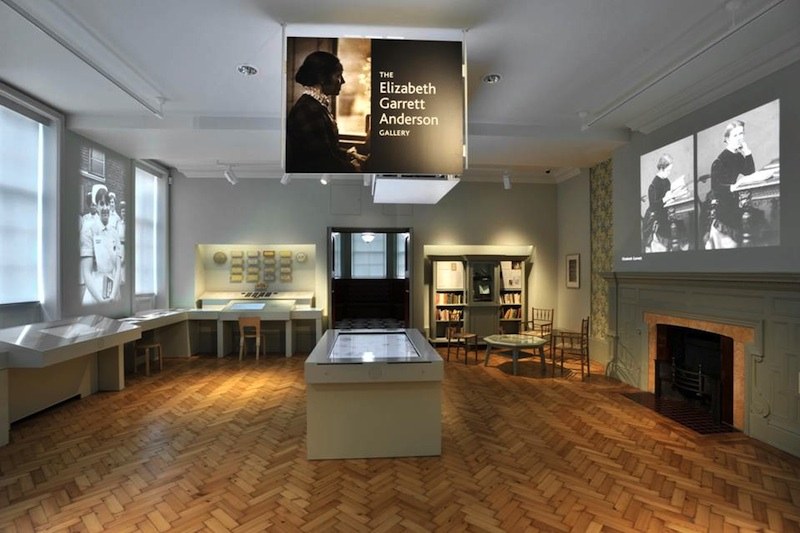
The main gallery
The other Gallery room is what was known when the hospital opened as
THE MEDICAL INSTITUTE
This was a room, running along the front of the hospital, parallel to Euston Road, set aside for all women doctors, from all over the country, at a time when they were still barred from the British Medical Association. It was intended as a space in which they could meet, talk and keep up with the medical journals.
Here you can use a variety of media to follow the story of women, work and co-operation in the 19th and 20th centuries.
A BACK-LIT GRAPHIC LECTERN RUNS AROUND THE MAIN GALLERY:
allowing you to see in words and pictures a quick overview of the life of Elizabeth Garrett Anderson and of her hospital.
AT INTERVALS ARE SET SIX INTERACTIVE TOUCH-SCREEN MONITORS
-named – Ambition, Perseverance, Leadership, Equality, Power in Numbers and Making Our Voices Heard – allowing you to access more information about Elizabeth Garrett Anderson, about the social and political conditions that have shaped her world and ours, and about the building’s new occupant – UNISON..
Each monitor contains:
TWO SHORT VIDEO SEGMENTS.
‘Elizabeth’s Story’. Follow the video from screen to screen. Often speaking her own words, the video uses images and voices to tell the story of Elizabeth Garrett Anderson’s life.
‘UNISON Now’ UNISON members tell you what the union means to them.
and four
INTERACTIVES
‘Campaigns for Justice’ and ‘Changing Lives’.
Touch the screen icons to discover how life in Britain has changed since the birth of Elizabeth Garrett Anderson.
AMBITION
Campaigns for justice
Victorian Britain: a society in flux
Victorian democracy: who could vote, and who couldn’t
Did a woman have rights?
Workers organised
Changing lives
The people’s lives in Victorian Britain
The medical profession before Elizabeth Garrett
Restricted lives, big ambitions: middle-class women in the Victorian era
Women workers in the first half of the 19th century
PERSEVERANCE
Campaigns for justice
The changing political landscape
Widening the franchise: can we trust the workers?
Women want to vote: the beginnings of a movement
Trade unions become trade unions
Changing lives
A new concept of active government: Victorian social reform
Women as nurses and carers
Living a life that’s never been lived before: women attempt to enter medicine
International pioneers: women study medicine abroad
LEADERSHIP
Campaigns for justice
Contagious Diseases Acts
Trade unions broaden their vision
Women and education
Women trade unionists
Changing lives
The middle-class century
Working women in the second half of the 19th century
Social reform, philanthropy and paternalism
Women doctors for India
EQUALITY
Campaigns for justice
The women’s suffrage movement
The Taff Vale decision hampers the unions
The founding of the Labour party
The People’s Budget
Changing lives
Work and play
Marylebone and Somers Town
Did the working classes want a welfare state?
1901 – Who were the workers in the NewHospital for Women?
POWER IN NUMBERS
Campaigns for justice
The General Strike – 1926
The first Labour governments
Feminist campaigns between the wars
1901: The lives of working women in London
Changing lives
Work of women doctors in the First World War
Can we afford the doctor? Health services before the NHS
Wartime demand for social justice
The creation of the National Health Service 1945-1948
MAKING OUR VOICES HEARD
Campaigns for justice
Equality campaigns
Public sector unions before UNISON
UNISON brings public service workers together
Are trade unions still relevant?
Changing lives
The National Health Service becomes sacrosanct
Did the welfare state change the family?
Women’s equality today
Women in medicine now
IN THE CENTRE OF THE GALLERY YOU WILL FIND:
ENTERPRISING WOMEN
an interactive table containing short biographies of over 100 women renowned for their achievements in Britain in the 19th-21st centuries. Up to four visitors can use the table at any one time. Drag a photograph towards the edge of the table to discover details of that individual’s life. Or search by name or vocation, using the alphabetical or subject lists.
ON THE WALLS OF THE GALLERY
PROJECTIONS
show a changing display of pictures of the hospital as it was and of Elizabeth Garrett Anderson and some of the other women whose stories the Gallery tells.
 THE GARRETT CORNER
is designed in the style associated with the work of Elizabeth Garrett Anderson’s sister, the architectural decorator Agnes Garrett, who was in charge of the original interior decoration of the hospital in 1890. The Gallery’s fireplace is the only surviving example of Agnes Garrett’s work. Next to this hangs a length of wallpaper, ‘Garrett Laburnum’, re-created from one of her designs.
In the Garrett Corner a display case and a low table contain a small collection of objects relevant to Elizabeth Garrett Anderson, the hospital and early women doctors.
While here do sit down and browse the library of books. These relate to the history of women – in society, in medicine, in the workplace, and in trade unions – and to the Somers Town area.
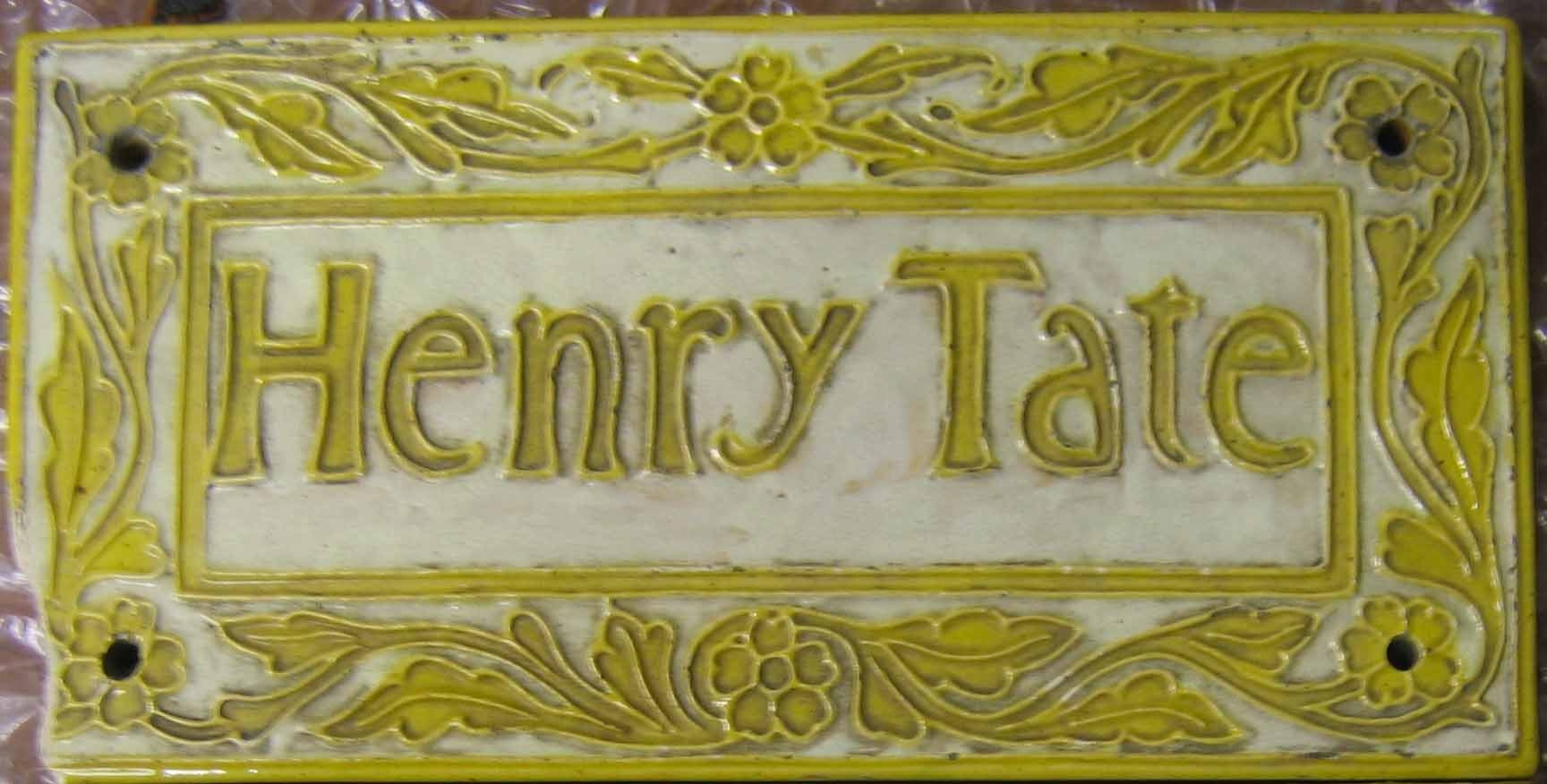
Plaque commemorating a substantial donation to the hospital by Henry Tate, industrialist and philanthropist
ACROSS FROM THE GARRETT CORNER IS A DISPLAY OF CERAMIC PLAQUES
Decorative plaques that used to hang beside patients’ beds, each commemorating a donor’s generosity.
You can read in detail about the work of the Garrett family in the fields of medicine, education, interior design, landscape design, citizenship and material culture in Elizabeth Crawford, Enterprising Women: the Garretts and their circle, published by Francis Boutle Publishers, £25. The book can be bought direct from womanandhersphere.com or click here to buy from the publisher
DO VISIT:
Elizabeth Garrett Anderson Gallery at the UNISON Centre
130 Euston Road
London NW1 2AY
Telephone: 0800 0 857 857
Open Wednesday to Friday 9.00am to 6.00pm
and the third Saturday of every month 9.00am to 4.00pm
Admission Free
 Woman and her Sphere