Posts Tagged rhoda and agnes garrett
Another Blue Plaque for Enterprising Women: Rhoda and Agnes Garrett Commemorated
Posted by womanandhersphere in The Garretts and their Circle on March 11, 2025

I am delighted to report that two more of my ‘Enterprising Women’ have just been recognised with an English Heritage Blue Plaque. For the work of Rhoda and Agnes Garrett is now highlighted, this new plaque joining that of their sister/cousin, Millicent Fawcett, on the outside of their home and business premises, 2 Gower Street, Bloomsbury.

The first published study of their work is detailed in a section headed ‘The Home’ in my Enterprising Women: the Garretts and their circle (2002). Having continued the research in the intervening years, most recent discoveries were revealed in an online talk I gave last month for the Victorian Society. If you are interested it is, I believe, possible to buy a recording.
Thus, Rhoda and Agnes Garrett are now memorialized by two blue plaques, the other being by the gate to their Rustington, Sussex, house, then known as ‘The Firs’. I had the pleasure of unveiling that one in 2018.

And while Blue Plaques are on my mind, I’ll mention that Fanny Wilkinson, entirely forgotten before I made her the subject of the section ‘The Land’ in Enterprising Women, is also now memorialised by two. One is the English Heritage version, on her one-time flat in Bloomsbury
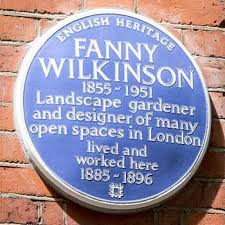
The other is in the garden of her former family home, Middlethorpe Hall, now a delightful hotel. I had the pleasure of giving a talk about Fanny and her work to accompany that unveiling in 2022.

I may say that I initiated none of these commemorations – I just didn’t think to do so – but how delighted I am that the work of these interesting women has touched the imagination of those who launched the four proposals.
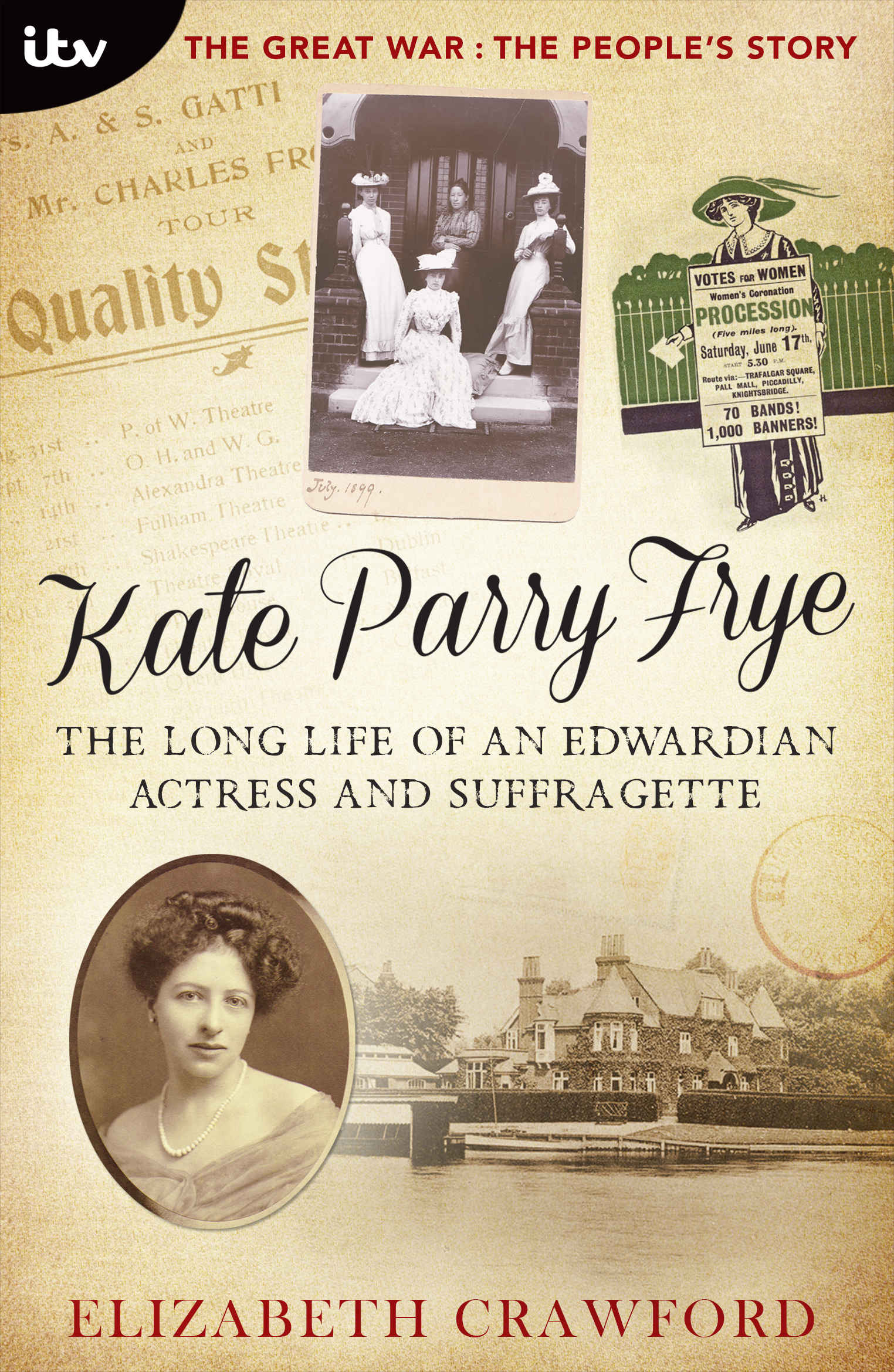
And here’s the book that started it all:

330 pages, 75 illustrations £25 +pp (can be ordered directly from me – elizabeth.crawford2017@outlook.com).
The Garretts And Their Circle: Millicent’s Writings (soon to be published) And Agnes’ Furnishings (work in progress)
Posted by womanandhersphere in The Garretts and their Circle on March 8, 2022
This International Women’s Day I would like to celebrate, once again, the work of the women of the Garrett family.

In a couple of months’ time UCL Press will be publishing Millicent Garrett Fawcett: Selected Writings on which I have had the pleasure of working, alongside the lead editor, Prof Melissa Terras. In the volume, which will be open access as one of the publishing options, 35 texts and 22 images are contextualised and linked to contemporary news coverage, as well as to historical and literary references. This is the first opportunity to study in one volume Millicent Fawcett’s thinking on a range of topics concerning the advancement of women, of which the women’s suffrage campaign is only one.
In the photograph we chose as the cover for the book you see Millicent Fawcett seated at her desk in a corner of the first-floor front drawing-room of her home at 2 Gower Street, Bloomsbury. It may be the very same desk as that of which we catch a glimpse, to the right of the fireplace in the illustration below, taken from Suggestions for House Decoration (1876) by Rhoda and Agnes Garrett. Many years ago, after visiting 2 Gower Street when researching Enterprising Women: the Garretts and their circle, I came to the conclusion that the illustrations in House Decoration were taken directly from real life, that is they were pictures of the rooms in 2 Gower Street, as arranged by Rhoda and Agnes. Recently I have been delighted to have my educated guess vindicated by discovering that Lady Maude Parry, a friend of the Garretts, stated in an obituary article on Rhoda, published in Every Girls’ Annual 1884, that in Suggestions for House Decoration ‘are illustrations of their house in Gower Street’.

Rhoda died in 1882, but Agnes carried on the business of ‘R & A Garrett’, house decorators, until 1905, although in 1899 the lease on the firm’s warehouse in Morwell Street came to an end, necessitating the sale of its contents and, presumably, a reduction in the work undertaken. Incidentally the Morwell Street building and its neighbours has recently, 2022, been approved for demolition, to be replaced by a 6-storey building. When I first noted it c 2000, the Garrett’s ‘warehouse’ retained its original façade (illustrated in Enterprising Women), which has subsequently been altered – now another Garrett link will be utterly obliterated. However, that furniture sale, held at Phillips, Son and Neale on 27 July 1899, has provided me with considerable scope for research – allowing me to identify a number of individuals keen to buy furniture and house accoutrements that had the Garrett seal of approval – in that they had passed through Agnes’ hands – and to muse a little on the state of the ‘house furnishing’ market at the end of the 19th century. That research will appear in a subsequent post on this website.
Copyright
All the articles on Woman and Her Sphere are my copyright. An article may not be reproduced in any medium without my permission and full acknowledgement. You are welcome to cite or quote from an article provided you give full acknowledgement
Mrs Hartley Brown And Miss Townshend -19th-c Interior Decorators: Who Were They?
Posted by womanandhersphere in The Garretts and their Circle on February 27, 2015
 In a chapter on ‘Decorative Art in England (Travels in South Kensington, 1882) Moncure Conway commended Rhoda and Agnes Garrett for their ‘admirable treatment of the new female colleges connected with English Universities’. It has always been a niggle that neither I – or anyone else – as far as I know – has ever been able to find any evidence that the Garretts did work on the interior of any women’s college.
As one member of the Garrett family, Elizabeth, was a close friend and supporter of Emily Davies, founder of Girton, another, Millicent, was a founder of Newnham, and Rhoda and Agnes had received their training in the office of J.M. Brydon, sharing an office with Newnham’s architect, Basil Champneys, it would not have been at all surprising if they had been involved with the interior decoration of one or other of the colleges. But neither in Garrett family letters nor in the press is there any mention of Rhoda and Agnes working on the interior of Newnham – or of Girton.
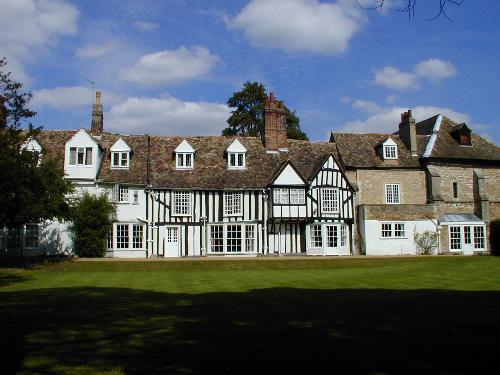 Merton Hall, Cambridge. (Photo courtesy of Cambridge 2000)
In fact the only mention of work being done by women interior decorators on a Cambridge women’s college relates to furnishings for an early incarnation of Newnham – when, between October 1871 and 1874, it was housed in an ancient, rambling house, Merton Hall. The house belonged (and still belongs) to St John’s College, whose Master was very sympathetic to the Lectures for Ladies’ scheme that had been instigated in Cambridge by Millicent Fawcett, Henry Sidgwick and Jemima Anne Clough.
Merton Hall is first mentioned by Moncure Conway in ‘Decorative Art and Architecture in England’, an article published in Harpers New Monthly Magazine, November 1874. In this, after discussing the work of Rhoda and Agnes Garrett, he tells us that Mrs Hartley Brown and Miss Townshend had set up in the same business as the Garretts, in premises at 12 Bulstrode Street. He then goes on to say that ‘These ladies, who have been employed to decorate the new ladies’ College (Merton) at Cambridge, have not only devised new stuffs for chairs, sofas and wall panels, but also for ladies’ dresses.’ The fact that he uses the past tense seems to indicate that the work was already complete.
A further allusion to this partnership is made by Emily Faithfull when discussing new trade opportunities that have been opening for women. In Three Visits to America (1884) she mentions that ‘Mrs Hartley Brown and Miss Townshend, soon after entering into partnership, were appropriately employed in decorating Merton College, and devised with much success some new stuffs for the chairs and sofas for the use of Cambridge girl graduates.’
That seems quite clear: Mrs Hartley Brown and Miss Townshend had been involved with furnishing Merton Hall (later Newnham) and neither Conway or Faithfull, although discussing the Garretts’ work, made any mention of the Garrtts being similarly employed.
However, when Moncure Conway came to publish Travels in South Kensington in 1882 the Garretts were going from strength to strength and, if the silence in the press is anything to go by, Mrs Hartley Brown and Miss Townshend had gone out of business. One construction might be that, while making no mention of the latter two, Conway lauds the success of the Garretts and, carelessly assigns to them the ‘admirable treatment of female Colleges’. It may be that only one firm of female interior decorators worked on the furnishings of a female college – and that was the partnership of Mrs Hartley Brown and Miss Townshend.
But who were Mrs Hartley Brown and Miss Townshend? I have to confess to drawing a blank on Mrs Hartley Brown – but can make an educated guess at the identity of Miss Townshend.
In his Harper’s 1874 article Conway (who, as we see was prone to getting things a bit muddled) mistakenly describes Mrs Hartley Brown as ‘a sister of Chambray Brown, Esq – a very distinguished architect’. In fact what he meant was that ‘Miss Townshend was a sister of Chambray Townshend…’. The latter was indeed an architect, although not even his wife – indeed particularly not his wife – would have called him distinguished. Unfortunately for us Chambray Townshend had eight sisters. And the question is ‘which one went into business as an interior decorator?’
Well three can be discounted, being in 1874 already married. Of the remaining five, very little is known of the lives of three, although Alicia, who didn’t marry until 1880, is known to have studied art at the Slade and is I suppose a possibility. However I suspect that the two strongest candidates of the five are Isabella (1847-1882) and Anne (1842-1929).
Anne certainly seems to have the most productive work record. According to family information she trained as a nurse at London’s Foundling Hospital and was later Matron at the Hospital for Hip Disease in Childhood (Queen’s Square). When and for how long she was engaged in nursing I don’t know. By 1882 she had moved into philanthropic administration and was secretary of the Metropolitan Association for Befriending Young Servants (MABYs).
Then in 1888 she became the first secretary of the Ladies’ Residential Chambers Co (the founders of which included Agnes Garrett and Millicent Fawcett) and remained involved with the company until 1910. In 1890, when the company was planning a new set of chambers in York Street, Marylebone, it was Anne Townshend who was deputed to consult with Thackeray Turner, the architect, over the company’s specifications for the new building. However nowhere in the minutes of the Ladies’ Residential Co is there any suggestion that she was ever involved with the interior design of either of the buildings.
Isabella Townshend is the more artistic candidate – and she does have a very clear Cambridge connection- being one of the Girton Pioneers. In 1869 she was one of the first five to join Emily Davies at her new college at Hitchin (it was not yet ‘Girton’). She left without taking a Tripos at Easter 1872. Could she then have gone into the interior decorating business?
In Girton College, Barbara Stephen comments that ‘Miss Townshend was not striking in either appearance or manner‘, while reporting Barbara Bodichon’s opinion that [Isabella’s] ‘interests were wide and her mind original’ Barbara Stephen was too young ever to have met Isabella; perhaps she made her rather harsh judgement on the basis of this photograph she included in her book
 However, Isabella certainly made a very strong impression on her fellow Pioneers – particularly on Emily Gibson. When Isabella left Hitchin in the 1872 without taking a Tripos (perhaps it was this high-handed approach to all that Miss Davies had to offer that attracted Barbara Stephen’s disapproval) Emily followed suit and the following year married Isabella’s brother, Chambray Townshend.
In Some Memories for Her Friends., Emily wrote of Isabella: ‘She was more mature than many of us, and in quite a different stage of development, but the sort of position she held among us, the sort of influence she exercised over me was chiefly due to her having been swept over by a very early wave of that current of aestheticism which was then just beginning to gather force. The sort of doctrine she taught, or rather that she gave living expression to, was, that the most valuable means of culture was to be found in the enjoyment of the beautiful in nature and art, that a beautiful combination of colours, a delicate bit of decorative work seen and cared for in a reverent and appreciative spirit, could do more for us in the way of training and development than much steady grinding away at mathematics and classics.’
‘She had considerable ability, indeed, many of us gave her credit for a touch of genius, yet she never accomplished much definite work of any kind.’..Isabel took the utmost pains to live from hand to mouth. She would work hard now and again when she felt the subject in hand to be worth working at, but she scorned to tie herself down to do things against inclination for the sake of obtaining some definite mundane good.’
 Isabella Townshend, self-portrait, (c) Girton College, University of Cambridge. Supplied by The Public Catalogue Foundation
Isabella Townshend was undoubtedly ‘artistic’. Isn’t this a wonderful self-portrait – bequeathed to Girton by Emily Townshend? It wouldn’t at all surprise me if Isabella had not ‘devised new stuff’ for her dress and designed it herself. But did she have the stamina to set up in business? Emily Gibson mentions that in the period between leaving Cambridge and her marriage to Chambray Townshend, he and Isabella were particularly friendly with Walter and Lucy Crane – so she was certainly moving in art design circles.
There is no doubt that interior decorating ran in the family veins. In his Harper’s article Moncure Conway wrote ‘I have become convinced by a visit to a beautiful house which Chambrey Townshend arranged at Wimbledon, that there can be nothing so suitable for somewhat dark corridors and staircases as a faint rose tint. In Mr Townshend’s house, however cold and cheerless the day may be, there is always a glow of morning light. This gentleman has shown that a sage-gray paper with simple small squares (such as Messrs Marshall & Morris make) furnishes a good dado to support the light tints upon walls not papered.’
The house may well have been the Townshend family home at 12 Ridgway Place, Wimbledon, where the unmarried sisters lived with their mother.
Unfortunately Chambray Townshend took the same laissez-faire approach to work as did Isabella. Of him Emily, his wife, later wrote ‘Chambrey Townshend had little push and no business ability to back up his remarkable artistic abilities.’ After his death she regretted she hadn’t devised some opening for his remarkable talent for house decoration ‘when architectural work was not forthcoming’.
If the interior decoration business was run by Mrs Hartley Brown and Isabella Townshend, it may be that Isabella soon lost interest. In the early 1880s she went to Italy to study painting and died in 1882. The Girton Register has it that she died in Italy, ‘of typhoid fever contracted at Capri’. It may well be that she became ill in Italy, but the Probate Register shows that she died on 20 July 1882 at Ealing and was buried at Perivale on 25 July 1882.
So, although Anne Townsend had the stamina and application to run a business, I’m inclined to think that it was Isabella Townshend who, for a brief period, was in partnership as an interior decorator with Mrs Hartley Brown and who provided the furnishings for Merton Hall, the early incarnation of Newnham.
For more about the interior decoration business run by Rhoda and Agnes Garrett see here.
**
Suffrage Stories: ‘Home Art Decorator’ To The Queen – And The ‘Human Letter’
Posted by womanandhersphere in Suffrage Stories on February 6, 2015
For some time I have been meaning to investigate Charlotte Robinson, ‘Home Art Decorator’ to Queen Victoria, mention of whom I came across years ago while researching the interior design career of Rhoda and Agnes Garrett. Now that I have done so, I’ve discovered, as an added bonus, her family link with one of the WSPU’s more imaginative publicity stunts.
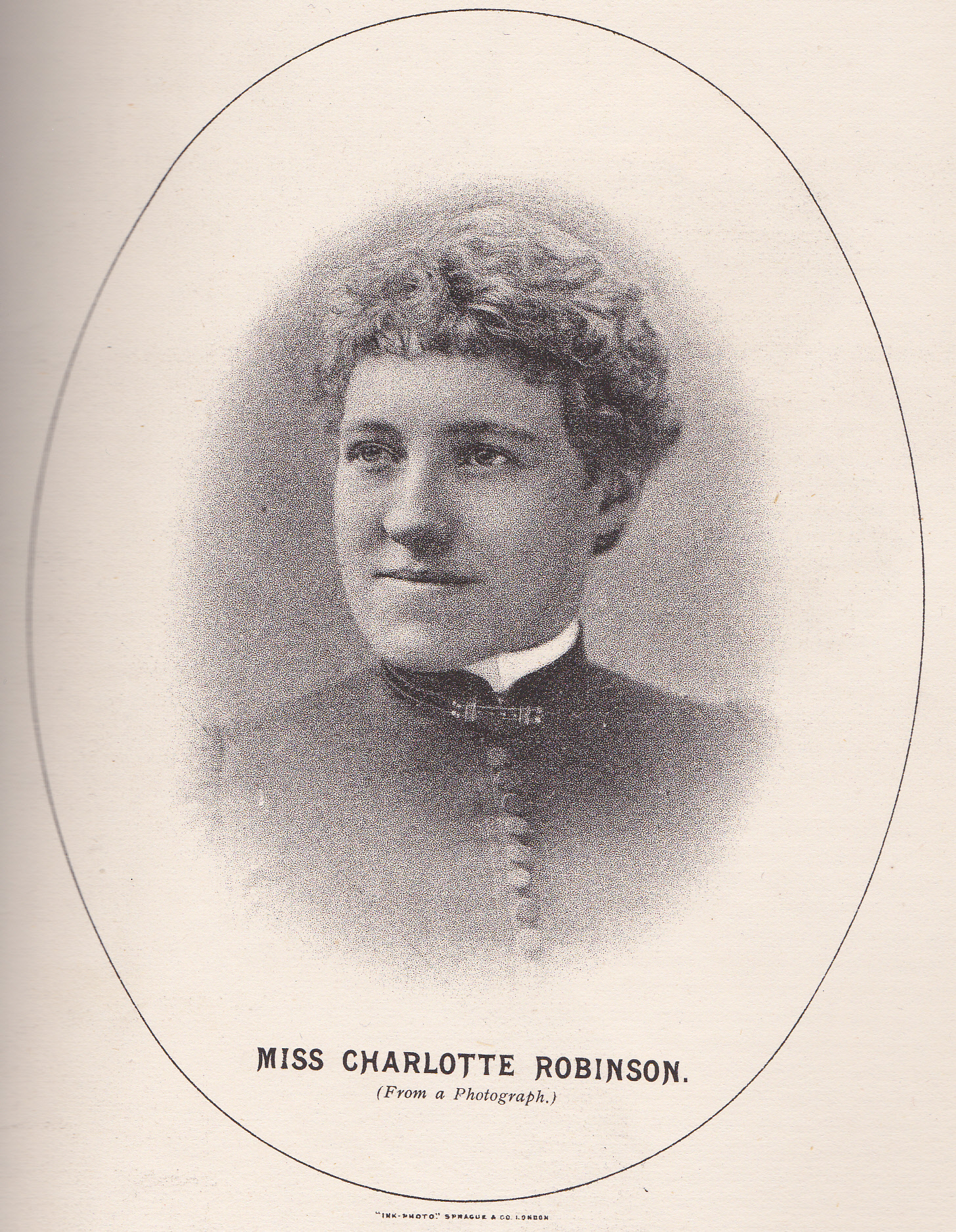 Charlotte Robinson was born c 1859 in Settle in Yorkshire, one of the younger children in the large family of a Yorkshire solicitor. He died in 1870, leaving an estate of c £20,000. A later biographical piece about Charlotte noted that she (as presumably were all the children) was left a share of his property and it was this that gave her the freedom to develop a career.
By 1871 Charlotte had been sent as a boarder to a small school in Bolton but was later moved to the rather more prestigious Queen’s College in London. Education complete she returned home for a time – the 1881 census finds her living with her brother, William, a solicitor, in Keighley. She then spent some time travelling abroad.
 Emily Faithfull
For some of that time, certainly in 1883, Charlotte was travelling in America with Emily Faithfull – described on the manifest of the ship on which they travelled to New York as ‘Secretary’. You can read a very interesting article about Emily Faithfull here. It would seem, from remarks recorded by Emily that she had met Charlotte when the latter was still a pupil at Queen’s College.
Emily Faithfull was, of course, a fierce advocate of work for middle-class women so it’s unsurprising that, when interviewed in the 1890s for Manchester Faces and Places, Charlotte described how on her return from her travels ‘she resolved to invest her money in a business which she could control herself instead of returning to the usual round of gaieties, varied by intermittent charitable enterprises.’ The journalist then elaborated – ‘Having always been interested in decorative art, friends who knew her marvellous deftness of touch and infallible sense of colour, strongly advised her to turn these special gifts to account.’
In an interview that appeared in the Women’s Penny Paper, 9 February 1889, Charlotte went into more detail. ‘The idea of house decoration as a profession came to me while travelling through America. I was much struck with the interiors of some of the magnificent houses to which I was invited in some of the principal cities between New York and San Francisco, and on my return to England began to supplement previous artistic study. My first professional business was in furnishing houses, now I decorate them through, as well as working in conjunction with my sister, Mrs McClelland, who presides over the studio from which come the beautiful friezes you have just been admiring.’ So that is how Charlotte Robinson came to become a ‘house decorator.
She was setting up in the house decoration business ten years after the trail had been blazed for women by Agnes and Rhoda Garrett and, like them, she stressed the necessity of undergoing a training. However, although we know that the Garretts were pupils of the architect John Brydon, I’ve been unable to discover where or with whom Charlotte Robinson trained. All that is revealed in the Manchester Faces interview is that she ‘went through the necessary course of study and thoroughly qualified herself for the work.’ As Emily Faithfull put it in a later article Charlotte studied ‘house decoration from hearth tiles to frieze painting’.
According to Emily Faithfull, Charlotte Robinson first went into business in London. This must, I think, have been immediately on their return from America – and was probably by way of dipping a toe in the water. But very soon – probably in late 1884/early 1885 – the two women moved to Manchester and, as Emily wrote, ‘regardless of that bugbear which terrifies most women – she [Charlotte] put up her own name over the door.’
That door gave entrance to 20 South King Street, in the central Manchester shopping district, the premises serving primarily as a shop. It would seem from other remarks that Charlotte’s design work was done at home – 10 Plymouth Grove – the house she shared with Emily Faithfull. By 1886 a part of 20 South King Street had been given over to a ‘Typewriting Office’, run by a Miss Giles. As the Manchester Courier remarked when reporting this ‘Doubtless the typewriter will soon become as popular here as in America’. One can imagine that this was a development of which Emily Faithfull was fully supportive.
It is clear from every description that Charlotte Robinson’s ideas of interior design were the antithesis of those of Rhoda and Agnes Garrett. It is impossible to imagine the latter displaying mirrors such as one to be found in Charlotte Robinson’s establishment – for on it was painted ‘a pool fringed with rushes in which a wild duck and her brood were swimming, while the old mallard was taking wing to enjoy the pleasures of the world beyond – after his kind – leaving to the mother the care of the little fluffy yellow ducks, whose very feathers seemed to move with the passing wind’. (Manchester Courier, 6 February 1885).
Items such as this were produced not in Manchester but in London, in the studio of Charlotte’s sister, Mrs McClelland (33 Warwick Avenue, Paddington). Epsey McClelland was twelve years older than Charlotte – in the 1891 census she is described as a widow, a ‘decorative artist’, living with her daughter at the Warwick Avenue address. In an article on ‘Ladies as Shopkeepers’, reprinted in Pall Mall Gazette, (23 December 1887), Emily Faithfull extolled Charlotte’s taste – ‘Her furniture designs are simple and unique; she has dainty and quaint arrangements for cosy nooks and odd corners, and has good reason to be proud of the work of the artists employed in in the studio over which her clever sister, Mrs McClelland is the presiding genius.’
In 1887 Charlotte Robinson took stands at two exhibitions. In Saltaire in June she showed ‘..beautiful painted screens, brackets, plaques, a corner cabinet richly decorated with painted flowers and an excellently painted frieze.’ (Leeds Mercury 3 June 1887).
Of the Manchester Jubilee Exhibition, June/July 1887, the Cabinet Maker and Art Furnisher wrote:- ‘Miss Charlotte Robinson showed a frieze, corner sideboard, overmantel, draught screen, fire screens, Tuckaway tables, and other knickknacks, all, more or less decorated with the light and fanciful painting for which she had made a name. It is in some aspects too “pretty” for our taste, but it is none the less skilful. This lady is happy in the sprightly woodwork forming the foundation of her paintings. The corner sideboard is particularly pleasing.’
We can get a clearer picture of the ‘light and fanciful painting’ from a description given of Charlotte’s stand at the Glasgow Exhibition the following year. ‘Visitors to this stand ought to note the billet-doux writing table, a facsimile of that purchased by the Princess of Wales, and invented and patented by Miss Robinson. Beside this is the ‘Interloper’ chair purchased by the Countess of Rosebery. Both are painted with white French enamel, and decorated with blue tom tits. There are two friezes, specially designed for drawing rooms bearing groups of roses and chrysanthemums and one for a smoking room, with a design of wild ducks in flight.’ (Glasgow Herald 25 May 1888).
Blue tom tits for the ladies and wild ducks for the gentlemen – an aesthetic very different from that of the Garretts, whom Sir Hubert Parry commended – writing in his diary while staying in their house – ‘The quiet and soothing colour of the walls and decoration and the admirable taste of all things acts upon the mind in the most comforting manner. I was quite excised of the vulgar idea that everything ought to be light & gaudy & covered with gilt in London.‘
In late 1888 Charlotte received the accolade of being appointed ‘Home Art Decorator’ to Queen Victoria. Over 20 years earlier Emily Faithfull had been appointed publisher and printer in ordinary to the Queen, her brushes with scandal having apparently done nothing to dent her reputation in the eyes of the royal family. On 9 October 1889 the Leeds Mercury reported that ‘Miss Charlotte Robinson has had the honour of submitting to her Majesty some dessert d’oyleys painted on silk, from sketches taken near Palé as mementoes of Her Majesty’s visit to Wales’ and, as we have seen the Princess of Wales had already bought one of her writing tables’.
By October 1888 business was sufficiently prosperous for Charlotte to open a London showroom – in Mayfair – at 20 Brook Street – and in the same month was appointed as editor of ‘the decorative department’ on the magazine, The Queen, in succession to Mrs Talbot Coke. She was now in a position both to dictate taste and to supply the means of achieving it. She held her position on The Queen for the rest of her life. A small measure of this power was the fact that in an advertisement a Gloucester furnishing store, Messrs Matthews, regularly mentioned that their stock was approved by the leading Art Critics of the Day – such as Charlotte Robinson, Mrs Talbot Coke and Mrs Panton.
The interview given to the journalist from the Women’s Penny Paper took place in the Brook Street showroom, among the ‘cream coloured music racks, dainty billet doux tables, LouisSeize screens etc which provide an artistic public with useful as well as beautiful wedding and birthday gifts’. Charlotte commented that ‘I spend a great deal of time in Manchester, where I have a large business to control, and much is taken up in travelling “back and forth” as we say in the north, between the various houses I have to decorate and furnish in London and the country.Through The Queen I have to advise about houses in every part of the world.’
However for all the reports of how busy she was with her commissions – ‘She can drape a room in less time than it takes most people to think of it’ – there is no information now available to tell us who her clients were or which were the houses she decorated. In the case of the Garretts I was able, from a variety of sources, to piece together a short list of their clients, but I can find no trace at all of Charlotte Robinson’s private clients. There is mention that in in June 1892 she was commissioned to decorate a hotel being erected in Manchester for the Manchester, Sheffield and Lincolnshire Railway, that she did some work for Cunard, and that she was called upon to redecorate the Lord Mayor’s Parlour in Manchester Town Hall. The latter is a superbly Gothic creation and certainly no place for tom tits and wild ducks.
Emily Faithfull died in 1895, leaving all her property to Charlotte. In her will, which had been written in 1893, she wrote that’ I feel sure that any loving members of my family, who may survive me, will appreciate my desire that the few possessions I have should be retained for the exclusive use, and as the absolute property, of my beloved friend Charlotte Robinson, as some little indication of my gratitude for the countless services for which I am indebted to her, as well as for the affectionate tenderness and care which made the last five years of my life the happiest I ever spent.’
After Emily’s death Charlotte Robinson continued to cut a dash in Manchester society. The local newspapers record her attendance at numerous balls and conversaziones – for instance, in July 1899 dressed in white brocaded silk and heliotrope velvet. On these occasions she is often in the company of Julia Dux, who lived close by in Plymouth Grove.
Charlotte Robinson’s career was brought to a premature end, however, by her death at home, in October 1901. She left £3100 – and the executors of her will were her sister, Epsey, and her niece Elspeth McClelland.
The latter, then aged 22, continued along the path that her aunt had, to a degree, forged and, with the changing times, was able to become more fully a professional and practise as an architect. You can read an account of her career here. and a 1905 article (issue 32, p, 114) about her in a Spanish architectural journal here She, like her aunt Charlotte, was clearly a woman of independent thinking and, not unsurprisingly, was swept into the Edwardian suffragette movement, achieving a certain notoriety in 1909 when she was one of the ‘Human Letters’ sent as a publicity stunt to 10 Downing Street. You can see a photograph here of Elspeth posing for the camera – with Daisy Solomon, her fellow ‘Letter’, on the left and Annie Kenney in support on the right. Under her married name – Mrs Elspeth Douglas Spencer – she has an entry in the Suffrage Annual and Woman’s Who’s Who.
Thus, by way of Charlotte Robinson’s ‘home art decoration’ , we can trace a line of endeavour that stretches from Emily Faithfull’s involvement in the 1860s with the Langham Place Group (middle-class women intent on improving work opportunities for their sisters) to a woman architect who, in her short life, managed to design and build several houses – as well as giving birth to three children. It was, apparently, that third birth that in 1920 killed her – putting an end to another interesting career.
For more about the interior design work of Rhoda and Agnes Garrett see Enterprising Women: the Garretts and their circle, published by Francis Boutle.
Copyright
 Woman and her Sphere