Archive for June, 2014
Kate Frye’s Diary: Coming Soon: Kate Frye On Both The Small – And Even Smaller – Screens
Posted by womanandhersphere in Kate Frye's Diary, Kate Frye's suffrage diary on June 27, 2014
ITV have issued this press release which includes mention of my forthcoming e-book, to be published by ITV, Kate Parry Frye: the long life of an Edwardian actress and suffragette.
ITV marks First World War centenary by telling the people’s story in partnership with Imperial War Museums
The extraordinary stories of ordinary people whose lives were transformed during the First World War will be told in their own words in a landmark new series for ITV, made in partnership with Imperial War Museums
Marking the centenary of the outbreak of the war in 1914, the experiences of men and women, young and old, from across Britain and the social classes that divided society at the time, are vividly brought to life in 4×60 series The Great War: The People’s Story, produced by Shiver [ITV Studios].
As part of ITV’s partnership with IWM, a book accompanying the series will also be published as well as three e-books. In addition to its partnership with IWM, ITV is also announcing two other programmes to mark the First World War centenary.
With narration from Olivia Colman, The Great War: The People’s Story tells the real-life stories of soldiers, from privates to officers, their wives and girlfriends left behind, and people from Britain’s villages and cities. They are portrayed by a cast of actors including Alison Steadman, Daniel Mays, Claire Foy, Brian Cox, Romola Garai, MyAnna Buring and Matthew McNulty, who speak their words as they were written in their diaries and letters.
These moving accounts, revealing their intimate thoughts and feelings offer a raw insight into the profound impact of being caught up in a conflict that would change their lives – and Britain – forever. Sourced from archives and libraries across the country, selected in partnership with Imperial War Museums, which provided much of the material, and brought to life by actors – each story conveys the hopes, fears, heroism and tragedies of countless ordinary British people… made all the more powerful by the fact that every word is real.
Diane Lees, Director General of IWM, said: “IWM is pleased to have worked in partnership with ITV on the development of The People’s Story – The Great War. The Imperial War Museum was established while the First World War was still being fought, to ensure future generations would remember those who contributed during the conflict. This series, featuring a number of people whose diaries and letters are held in the museum’s archives, gives an insight into some of the experiences and innermost thoughts of individuals from the time. Now that the war is out of living memory, it is up to our generation to ensure that their stories are and continue to be told – the stories of ordinary people living through extraordinary times.”
Richard Klein, ITV Director of Factual, said: “This programme gives the stage to the authentic voice of the British people as they endured over four years of the greatest violence in human history. The diaries, letters and memoirs of privates and officers, wives and mothers, working class and the well-to-do all brilliantly and emotionally document the journey from the patriotism and positivity at the start of war to the gradual understanding of the deadly and mind-shattering realities of modern warfare to the final days of simple endurance and exhaustion. This is a beautifully composed portrait of a country during a war that changed everything for everyone.”
Ollie Tait, Executive Producer of The Great War: The People’s Story for Shiver added: “Alongside the heartbreak and horror of war, Britain was changing at an amazing pace for everyone and there is something hugely powerful about reliving this through the people who never thought their voices would be heard. We really wanted ‘The People’s Story’ to be a world apart from the usual approach to the First World War and to make it about us, to bring to life the treasured letters that are tucked away in attics across the nation.”
ITV Studios Global Entertainment (ITVS GE) and Imperial War Museums have signed a deal with Random House for The Great War: The People’s Story, a hardback non-fiction book to accompany the TV series. Written by Izzy Charman, the TV series producer, and published in partnership with Imperial War Museums, the book provides a narrative of the war years as seen through the eyes of the people featured in the show. The book will be available from 31st July.
ITVS GE will also be publishing three e-books based on three of the individuals in the TV series. Written by daughter Pamela Campbell, Reg Evans DCM – A Hero’s War In His Own Words is about a young soldier who was one of the first people to undergo facial surgery in Britain after a gunshot wound to the face. In Alan Lloyd – The Lost Generation, Izzy Charman tells the story of the just-married officer, a member of the privileged Lloyds banking family, who died in battle. Author Elizabeth Crawford explores the story of a working suffragette in Kate Parry Frye – The Long Life of an Edwardian Actress and Suffragette whose suffrage society turned to war work. All three e-books will be available from 31st July.
- Press contact:
************************************************************************************
Romola Garai plays Kate Parry Frye in The Great War: The People’s Story.
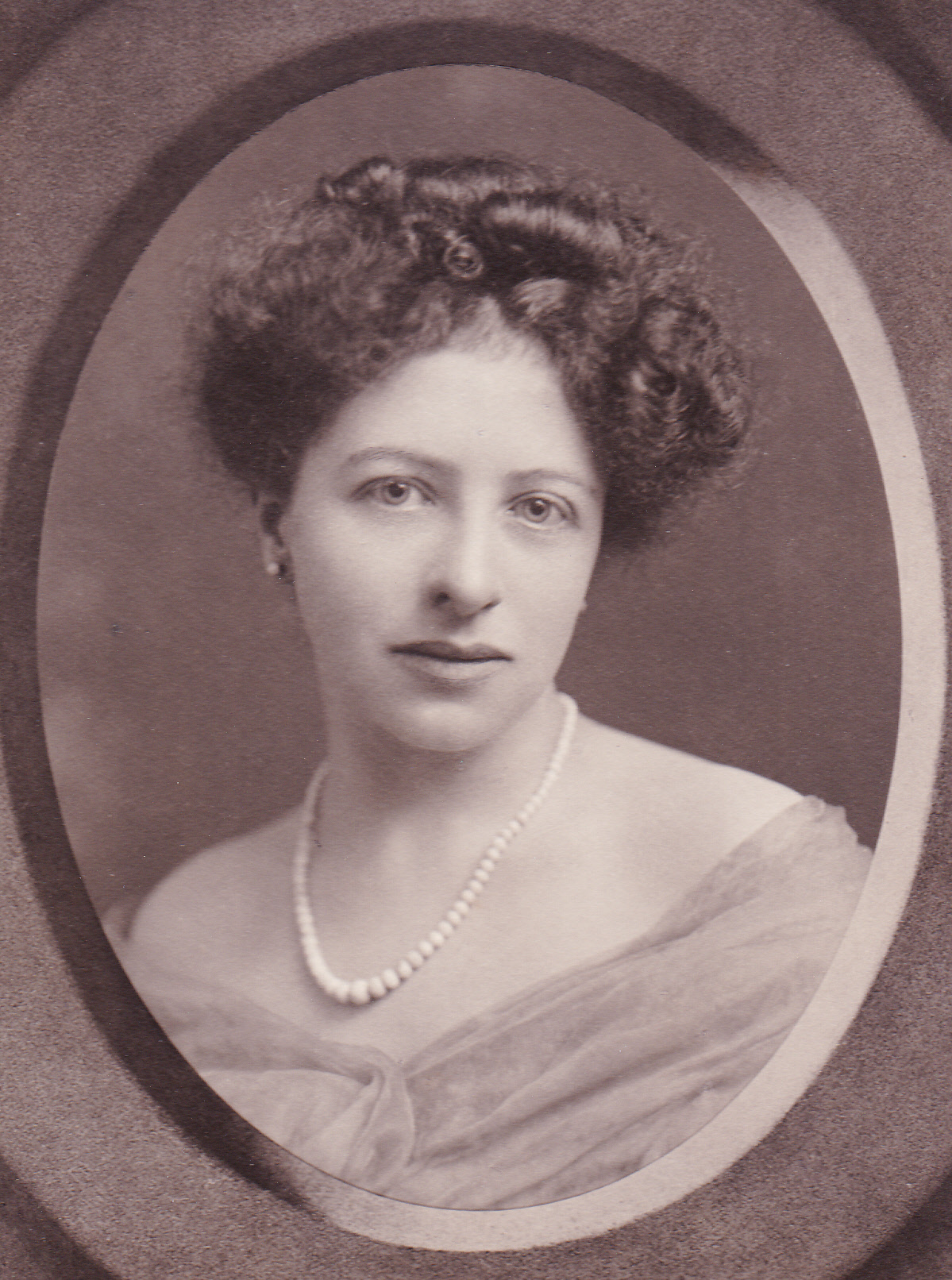 I tell the whole story of Kate’s life (1878-1959) – based on her own outstanding diaries – in Kate Parry Frye: The Long Life of an Edwardian Actress and Suffragette to be published by ITV as an e-book on 7 August 2014.
Kate’s years as the organizer for a suffrage society are told in Campaigning for the Vote: Kate Parry Frye’s Suffrage Diary, published by Francis Boutle in 2013.

Mariana Starke: Toxophilia – And Then To Italy, 1791
Posted by womanandhersphere in Mariana Starke on June 26, 2014
1791 was a most important year in the life of Mariana Starke.
We last met her in January of that year when, with her friend and patron, Mrs Crespigny, she attended her play, The Widow of Malabar, on the first night of its second season at the Theatre Royal Covent Garden.
Mrs Crespigny’s diary reveals that during the next few months she and Mariana met frequently – sometimes in Camberwell and sometimes in Epsom. Among their circle were the family of Henry Martin, who had become Comptroller of the Navy in 1790 and the news of whose baronetage Mrs Crespigny noted in her diary on 21 June 1791.
The Martins had at one time lived at Ashtead, a short distance down the Dorking Road from the Starkes’ Hylands House, but were probably now resident at Little Farm, near Tooting. ‘Miss Martin’ – presumably the eldest of his four daughters – was frequently included in parties to the theatre and opera and Mrs Crespigny mentions dining with Mrs Martin, together with Mariana, on 4 April, a day she described as ‘the first shooting day at Epsom’.
Mrs Crespigny’s diary relates that she and Mariana next met in Camberwell on 2 May – when they were joined by ‘Thomas on his matrimonial business’. This ‘Thomas’, I am sure, refers to the Rev Joseph Thomas for, on 6 May, ‘Miss Parkhurst dined and slept here’. Millecent Parkhurst, Mariana’s very close friend and co-author, was soon to marry the Rev Thomas. I cannot, though, explain why the Rev Thomas was discussing ‘matrimonial business’ – apparently in Millecent’s absence – with the inhabitants of Grove House. On 7 May, after dinner, Mariana and Millecent returned to Epsom.
Mariana was back at Grove House on 24 May and on the 25th Mrs Crespigny notes that she ‘gave my first archery party’. Mrs Crespigny was a keen archer – for excellent articles about this aspect of her life see A toxophilite – Mary de Crespigny née Clarke (1749 – 1812) and, for another much older article, here.
![After John Emes & Robert Smirke To His Royal Highness George Prince of Wales This Plate representing a Meeting of The Society of Royal British Archers in Gwersyllt Park, Denbighshire, aquatint by Cornelis Apostool, [Siltzer p.335], 1794, John Emes. The scene illustrates the popularity of the Royal British Archers, or Royal Toxophilite Society, amongst women (albeit only of a high social standing) as one of the few sports in which they compete at all, let alone on equal terms. The original painting is in the British Museum, the landscape being the work of Robert Emes, who also published the print, while the figures were painted by Robert Smirke. Retrieved from http://www.bloomsburyauctions.com/detail/13420/1154.0. Image and caption courtesy of A toxophilite - Mary de Crespigny née Clarke (1749 - 1812) see http://ayfamilyhistory.blogspot.co.uk/](https://womanandhersphere.com/wp-content/uploads/2014/06/royal-toxophilite-society-1794.jpg)
After John Emes & Robert Smirke To His Royal Highness George Prince of Wales This Plate representing a Meeting of The Society of Royal British Archers in Gwersyllt Park, Denbighshire, aquatint by Cornelis Apostool, [Siltzer p.335], 1794, John Emes. The scene illustrates the popularity of the Royal British Archers, or Royal Toxophilite Society, amongst women (albeit only of a high social standing) as one of the few sports in which they compete at all, let alone on equal terms. The original painting is in the British Museum, the landscape being the work of Robert Emes, who also published the print, while the figures were painted by Robert Smirke. Retrieved from http://www.bloomsburyauctions.com/detail/13420/1154.0. Image and caption courtesy of A toxophilite – Mary de Crespigny née Clarke (1749 – 1812) see http://ayfamilyhistory.blogspot.co.uk/
On Monday 21 August Mrs Crespigny spent the night at Hylands House after a day of archery in the course of which she presented the Surrey Bowmen with a silver arrow as a prize for a competition.
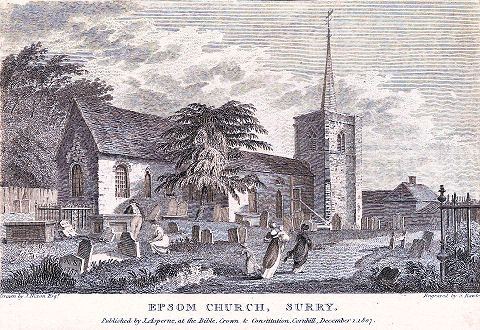
St Martin’s Church 1807
Drawn by J Nixon, Engraved by S Rawle
Image courtesy of Surrey Libraries and is held in the
Epsom & Ewell Local And Family History Centre. Image courtesy Epsom and Ewell History Explorer website
On 19 September 1791 Mrs Crespigny met Mariana in town. Although she makes no entry in clear script, surely both she and Mariana were in attendance three days later at St Martin’s Church in Epsom when, on 22 September, Millecent Parkhurst married the Rev Thomas? The Rev Jonathan Boucher conducted the ceremony and the witnesses were Millecent’s father, John Parkhurst, and her half-sister, Susanna Altham. I note that in the entry in the parish register the Rev Joseph Thomas is described as ‘of Camberwell’ – which may explain why he was discussing wedding plans in Grove House a few months earlier. I mention that Mrs Crespigny made no entry in clear script because large sections of her diary are written in shorthand and I haven’t checked whether there is such any such passage for that date.
Mrs Crespigny saw Mariana on several occasions in October. On 17th she slept at Hylands House after attending an archery match at Epsom and on the 22nd Mrs Starke, Mariana and Louisa arrived at Grove House for a short visit.
However, the atmosphere over these few days seems to have been less than calm. On 23rd October Mariana and Mary Crespigny had words -though quite what it was about is difficult now to ascertain. The diary entry appears to read ‘Miss S was very unkind to me relative to the grog and the Bow – and said things that hurt me. I was very ill in consequence.’
The following day, Monday 24 October, Mrs Crespigny records that she ‘Had a sad day with the distress of Mr Browning & Miss Louisa’ This may, perhaps, be explained by the next-day’s entry – ‘Wednesday 25 October Mr & Mrs Starke & Misses Starke & Scott, who I parted with to oblige them, set off for Nice.
”Scott’ was a woman, a maid or nurse, who until now had been in Mrs Crespigny’s employ and to whom, on her departure with the Starkes, she gave a guinea. That the Starke family was setting out for the south of France late in the autumn and despite the state of turmoil in that country would indicate that the state of health of Louisa Starke certainly – and probably also both her mother and father – had become increasingly critical. All were suffering from tuberculosis.
As early as 1779/1780 Mrs Starke, discussing her ill-health in a letter to Mrs William Hayley, had commented that ‘an hour’s talking would produce a spitting of blood’. In an April 1781 letter to William Hayley Mariana mentioned that they had been staying at Brighthelmstone for the previous two months on account of her mother’s health. The sea air was, of course, considered efficacious for pulmonary complaints. In a letter of 1787 or 1788 Mrs Starke mentioned that she and Louisa had spent a few weeks at Brighthelmstone, leaving her husband and Mariana at Hylands House.
In the Introduction to the 1815 edition of Letters from Italy (which is the one I have to hand) Mariana writes that she hopes the work will be of use ‘to those of my compatriots who, in consequence of pulmonary complaints, are compelled to exchange their native soil for the renovating sun of Italy’ and mentions that her observations on health are ‘the result of seven years’ experience; during which period my time and thoughts were chiefly occupied by endeavours to mitigate the sufferings of those most dear to me.’ Alas, little of the time abroad was devoted to nursing her sister Louisa, who, aged just 20, died at Nice on 18 April 1792, barely six months after leaving England. Had Mrs Crespigny’s comment on 24 October 1791 about ‘the distress of Mr Browning and Miss Louisa’ been a comment on a romance thwarted by her illness?
Having buried Louisa in Nice the Starke party – which Mariana describes in Letters from Italy as four in number (comprising, presumably, herself, her mother and father and ‘Scott’)- set out for Italy. In Letter 1, dated Nice, September 1792, Mariana writes that they undertook the journey over the Alps to Turin at the end of May.
On 3 November 1791 Mrs de Crespigny had noted in her diary that Mr and Mrs Starke and party had arrived at Calais and on 3 December that she had received ‘letters from Lyons’. Were those from Mariana?
I wondered briefly if Mrs Crespigny could have been the recipient of the originals of the Letters on which Mariana eventually based her book? It is the kind of role a close friend and patroness might fulfil but I must swiftly state that I have seen no evidence whatsoever to suggest that this was so. Indeed, perhaps rather surprisingly, I have come across no mention of Mrs Crespigny in any of Mariana’s manuscript letters that I have read.
The dedication in the 1815 edition of Letters from Italy is to Millecent Thomas ‘as a small testimony of gratitude for her great kindness in having corrected the press, and aided, by her deep and extensive classical knowledge, the labours of The Author’. Mariana would surely have acknowledged any specific interest taken in her work by the woman to whom she had made such a fulsome dedication in The Poor Soldier.
However, it is Mrs Crespigny we must thank (or at least those of us who follow the life of Mariana Starke in intimate detail must thank) for alerting us to the exact date when the Starkes’ coach swept out of the gates of Hylands House, taking Mariana to Italy and her destiny.
Copyright
Suffrage Stories: What Links Charles Dickens, The Rokeby Venus And The Number 38 Bus?
Posted by womanandhersphere in Suffrage Stories on June 23, 2014
 Mary Richardson, c 1913. This image of her was included in the sheet of ‘surveillance photographs’ of known suffragettes sent to museums and art galleries
I was asked the other day to speak briefly on Woman’s Hour about Mary Richardson, the suffragette who took a hatchet to the Velasquez painting, The Toilet of Venus -known as The Rokeby Venus , while it was on display in the National Gallery in March 1914.  You can listen to the resulting piece – which includes a clip from a 1957 Woman’s Hour interview with Mary Richardson – here.
Looking again at Mary Richardson’s story – as she tells it in her suffragette autobiography, Laugh a Defiance – I was interested in a brief mention she made of the house from which she set out for the National Gallery on that fateful day – Tuesday 10 March 1914. It was a house in which she had been given shelter when she was let out of Holloway the previous October under the terms of the ‘Cat and Mouse Act’, after going on hunger strike. She continued to live there clandestinely – as a ‘mouse’ – evading the police.
As she tells it, this house in Doughty Street in Bloomsbury had once been the home of Charles Dickens but was now under the charge of a ‘Mrs Lyon’. Investigation reveals that in 1914 the house that was Dickens’ home from 1837-9 and is now the Charles Dickens Museum was, together with number 49, a boarding house run by a Miss Jane Lyons.  Mary Richardson wrote that she knew immediately that it was to Dickens’ house that she had been brought. Indeed she would have, for as she left the motor car that had carried her from Holloway she would have seen this plaque, which had been placed on the front of 48 Doughty Street by the LCC in 1903. Once settled into the boarding house doubtless she would have heard from Miss Lyons more about the famous connection that gave cachet to the establishment.
Number 48 Doughty Street was acquired by the Dickens Fellowship in 1923 and opened as the Museum in 1925. Interestingly the Museum has quite recently acquired number 49 – so that the two houses are now interlinked as they presumably were when Mary Richardson was given shelter in Miss Lyons’ boarding house.  When Mary Richardson made her acquaintance in 1914 Miss Lyons would have been 78 years old. She may well have been given the honorary title of ‘Mrs’ and it isn’t particularly surprising that Mary Richardson had, 40 years or so later, slightly misremembered her surname. The only information that Mary Richardson offers about ‘Mrs Lyon’ was that she had once been housekeeper to Benjamin Disraeli. Could that have been true?
Jane Lyons had been born in Plymouth in 1836, one of the eldest in a large family – of possibly 12 children. Her father, Moses Lyons (who also gave his name on various censuses as ‘Lewis Lyons’ and ‘Morris Lyons’) was a licentiate of the Society of Apothecaries – that is, he was qualified as a doctor and practised as both a doctor and as a dentist. He had been born in Coventry c 1811; his mother had been born in Russia. The family were probably Jewish in origin – although there is no evidence that they practised that religion. One sister, certainly, was married in a Congregational church. In 1871 the Lyons family was living in the Islington area of Birmingham and Jane Lyons worked with her mother and five of her sisters in the family’s stationers shop.
By 1881 Jane Lyons had come to London and on the night of the census, 3 April 1881, was living in a boarding house at 72 Gower Street in Bloomsbury, described as an ‘annuitant’. So it doesn’t appear that she was Disraeli’s housekeeper at the time of his death – which occurred 16 days after the census was taken. But I suppose it is not impossible that she was so employed at some time during the previous decade.
By 1891 Jane Lyons was housekeeper at ‘Brunswick House’, 56 Hunter Street, Bloomsbury. Here lived 45 boarders – all women – most of whom were working – as teachers, typists, clerks, and artists.
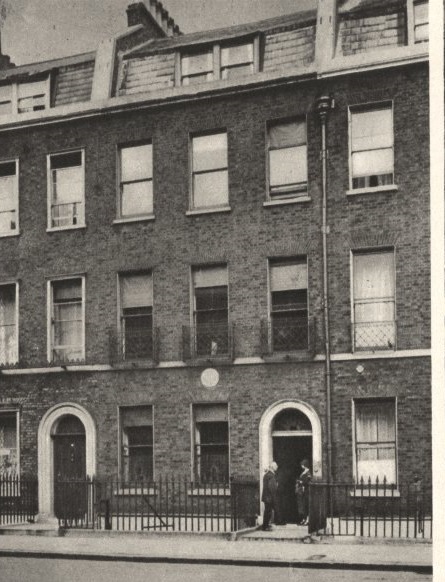 48 Doughty Street – post 1903
Ten years later, in 1901, Jane Lyons was the proprietor of a ‘Private Hotel and Boarding House’ at 48 & 49 Doughty Street. Here, on the day of the census, she had 24 boarders – all women – again clerks, teachers and typists (and a stockbroking nephew). By 1911 Miss Lyons’ clientele had slightly changed – now numbering a good half-dozen men among her boarders.
Miss Lyons, as a single woman running her own business, was very much the type of woman we might expect to support the ‘votes for women campaign’ – perhaps as a member of the Tax Resistance League. But from Mary Richardson’s evidence she went that bit further and gave active support to those who were evading the police. According to Mary, while she was living at number 48 Annie Kenney, who was also on the run, stayed for a time in Miss Lyons’ boarding house. I wish I knew more about Miss Lyons.
In Laugh a Defiance Mary Richardson relates that she had planned her attack on the RokebyVenus in advance – presumably while living under Miss Lyons’ roof. Indeed she states that she had sought approval from Christabel Pankurst for her plan. But never once in Laugh a Defiance can I find any mention of the fact that since March 1912 Christabel had been living in Paris. Mary Richardson refers to her as though she were living close by, convenient for consultation. I find it difficult to believe that in those febrile months in 1914 Mary Richardson was in such close contact with Christabel. Did she, 40 years later, feel it necessary to justify her actions by implying that she was always ‘acting on orders’?
The sequence of events ran like this. Mrs Pankhurst was arrested in Glasgow during the evening of Monday 9 March – after something of a battle with the police at a meeting in the St Andrew’s Hall. Around her was a bodyguard of women – one of whom was Mrs Lillian Dove-Willcox, with whom Mary Richardson was closely associated.
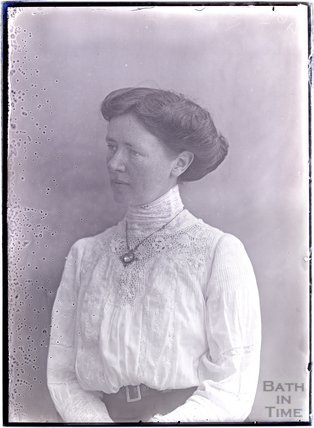 Lillian Dove-Willcox (photo courtesy Bath In Time website)
After one of her hunger strikes Mary had recuperated at Lillian’s cottage in the Wye Valley and their friendship seems to have lasted all Mary’s life. Symbol Songs, a collection of poems she published in 1916 contains ”The Translation of the Love I Bear Lillian Dove’ – and it was Lillian (by now, after remarriage, Mrs Lillian Buckley) who wrote Mary’s obituary for the Suffragette Fellowship newsletter. It wouldn’t surprise me that if the ‘Rokeby Venus’ plan had been shared with anyone, it had been shared with Lilian Dove-Willcox, who travelled back from Glasgow on the train in which Mrs Pankhurst was being escorted by the police.
However the train stopped at a station short of Euston and Mrs Pankhurst was taken off it and driven straight to Holloway in order to avoid the suffragette crowds that were awaiting her at the terminus. The news of her arrest was in the Tuesday morning papers. I don’t really want to add any (quite gratuitous) speculation to Mary Richardson’s already rather unreliable memoir, but I’m going to anyway.
Could Mary Richardson have seen Lilian Dove-Willcox early that Tuesday morning and heard first-hand of the dramatic events in the St Andrew’s Hall? And dramatic they were. It was a violent scene – with clubs wielded by the women and a gun – loaded with blanks – fired by Janie Allan, a wealthy Scottish supporter. A report from the front line, made by a close friend, or even the knowledge that such a friend had been involved in such a battle could have been the real catalyst for choosing this day of all days for putting her plan into action. Doughty Street is only a short distance from Euston. Although Mary Richardson says in a radio interview that she was in the National Gallery as early as 10 am, The Times report, Wednesday 11 March, mentions that she was there at 11 .
Mary Richardson is not explicit as to whether she had already purchased her weapon of choice – a butcher’s chopper – although she does state that she bought it in the Theobald’s Road – a main road close to Doughty Street .However, because, as she repeatedly explains, she fixed the chopper into her sleeve with a chain of safety pins (though I can’t quite work out how the first in the chain was attached to the chopper??) it seems unlikely that she would have undertaken this rather cumbersome exercise on her way to the National Gallery, suggesting that she had the chopper already primed, as it were, in her room in the boarding house.
In another BBC radio interview, broadcast on 23 April 1961 – click here to listen to it – Mary Richardson revealed that she had chosen the Rokeby Venus because she hated women being used as nudes in paintings – she had seen the picture gloated over by men, and she ‘thought it sensuous’. In the 1957 Woman’s Hour interview she mentioned that she felt the painting was held in high regard because it was so financially valuable (it had cost £45,000 when purchased in 1906), whereas Mrs Pankhurst’s life counted for nothing. Presumably she was unaware that it was a fellow suffragist, Christiana Herringham, who had been the driving force in the setting up of the National Art Collections Fund – the organization that bought the painting for the nation.
In the later interviews Mary Richardson doesn’t mention that Mrs Pankhurst had only just been rearrested – but tells the story as though Mrs Pankhurst had been held for a long time, on hunger strike, in a damp underground cell in Holloway – and that her life was in danger. But, as we see, Mrs Pankhurst could have barely reached Holloway by the time Mary set out from number 48. I have mentioned that Mary Richardson’s Laugh a Defiance is an unreliable memoir. At the most basic level the account she gives of her involvement in the suffragette campaign is not chronologically accurate – rather she presents a series of incidents, in each of which she takes a starring role. I have little doubt that the purpose of Laugh a Defiance was to raise funds. It doesn’t appear that Mary Richardson was ever in full-time employment and, although she had presumably inherited some money from her family, at the end of her life the income must have dwindled. At the time of her death in 1961 she was living in a single room – in Hastings. Obviously in order for such a book to sell it did have to be packed with dramatic incident.
I can find no reviews of the book in contemporary newspapers or magazines – or, to be accurate, in ones that are now digitized. The only quote used in its publicity by the publisher, Weidenfeld & Nicolson, was a remark by C.V. [Veronica] Wedgwood who on the radio programme, The Critics, described it as ‘A document – ingenious and absolutely genuine’. Well, yes, ‘ingenious’ is perhaps the word to describe Laugh a Defiance for although Wedgwood was an historian she clearly had not interrogated the accuracy of the ‘document’.
Leaving aside quibbles about who did what, when or where, the book contains laughable examples of ‘cod history’ – such as when Mary in Holloway describes her view onto what she describes as the site, in Elizabethan times, of the banqueting hall of the Earls of Warwick. Doubting very much that those Earls had ever had a London home in Parkhurst Road, Holloway, I did a little research to try to discover what had been in Mary Richardson’s mind. The answer: that when the prison was built in the mid-19th century the architect copied the design of the gatehouse from Warwick Castle. Such is the way that the most innocuous facts become corrupted and I’m certain that Mary Richardson’s suffragette autobiography contains many more such elisions and half-truths. Rubbed up and polished, they presented a dashing and easily digested history designed to appeal to the general reader.
I have always wondered what her fellow suffragettes made of Mary Richardson’s Laugh a Defiance – and of her two broadcasts. The Suffragette Fellowship, the organization to which many former members of the WSPU and the Women’s Freedom League belonged, was by no means devoid of factional infighting. Certainly she appears to have felt quite at ease when, a couple of years after the book was published (but before the radio programmes were broadcast), she attended a Suffragette Fellowship reunion at Caxton Hall (you can watch her here on a Pathe newsreel as she shows her very distinctive hunger-strike medal to a policeman. I wonder if any comments were made about the accuracy of her recollections?
For instance, as far as I can discover, no member of the WSPU ever mentioned that Mary Richardson was, as she claimed, at the Derby watching Emily Wilding Davison as she stepped into the path of the King’s horse. Why was such a valuable first-hand account not written up in The Suffragette or Votes for Women? Why was she not called as a witness at the inquest? In her telling the expedition to Epsom was not clandestine – rather she was following an order from Headquarters to go there to sell The Suffragette. She doesn’t go so far as to say that she accompanied Emily Davison but somehow out of the seething Derby crowd – the hundreds of thousands that swarmed over Epsom Downs – she was able to spot Emily and position herself at the opposite side of the track at Tattenham Corner. Exciting reading – but is it history?
However, Mary Richardson’s account in Laugh a Defiance of her attack on the Rokeby Venus accords very accurately with the contemporary newspaper reports. There was, of course, no need to dress up that drama – for she was (with Venus) undoubtedly the star of that particular episode.
As this is a blog post – not an academic article – I will allow myself another flight of fancy. I live not far from Doughty Street and am a regular passenger on the No 38 bus that runs along Theobalds Road. By 1914 this bus route had been in operation for a couple of years and, unless Mary Richardson walked to the National Gallery, may well have carried her as far as Cambridge Circus, bringing her within striking distance, as it were, of the Gallery. It is these gossamer connections – the layers of history through which we pass – that continue to amuse me. If I were sufficiently fanciful I could link Mary Richardson and the Rokeby Venus to both the number 38 bus, on which, incidentally, I travelled part of the way to my date with her in the Woman’s Hour studio, and to Charles Dickens, the shade of whose footstep she touched as she made her determined way over the threshold of 48 Doughty Street that March morning.
P.S. Coincidentally another nude, George Clausen’s Primavera, attacked by Maude Kate Smith in the RA Summer Exhibition in 1914, was sold by Christies on 17 June 2014, the day after my Woman’s Hour piece – for £92,500. You can listen to Miss Smith describing how she attacked the painting in a recording held by the Women’s Library@LSE.
PPS Readers who have been kind enough to visit from the Persephone Books website and are of a ‘Persephone mind’ (although equipped with non-Persephone technology – ie an e-book reader) will, I hope, find a GOOD READ in the life of Kate Parry Frye – who was very much a ‘Persephone’ woman. Read all about her here.

Suffrage Stories: Emily Wilding Davison: Centennial Celebrations
Posted by womanandhersphere in Suffrage Stories on June 19, 2014
 The Women’s History Review asked me to write a ‘Viewpoint’ about the 2013 100th anniversary commemoration of the death of Emily Wilding Davison.
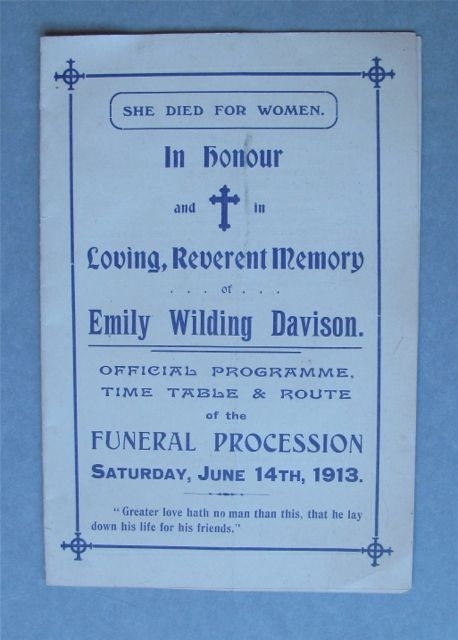
The resulting article – ‘Emily Wilding Davison: centennial celebrations’ – is now available to read online at the WHR website. The first 50 viewers can access it free here. After the 50 viewings are exhausted, access, I’m afraid, is charged. But you can, of course, always read a print copy in your library!
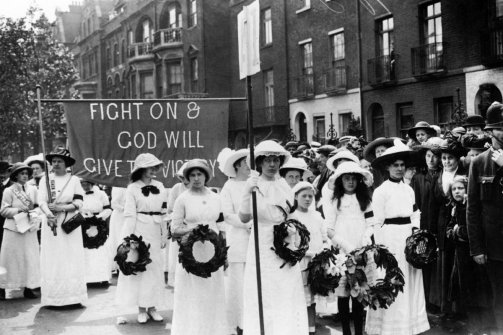
Suffrage Stories/ Walks: The Actresses’ Franchise League – And Kate Frye
Posted by womanandhersphere in Kate Frye's suffrage diary, Suffrage Stories, Walks on June 11, 2014
The Actresses’ Franchise League was founded in December 1908. Its purpose was to stage propaganda plays, the majority of which were specially written by members, hold meetings, sell suffrage literature and give lectures. Kate Frye, who considered herself a professional actress, attended her first meeting of the AFL on 23 March 1909.
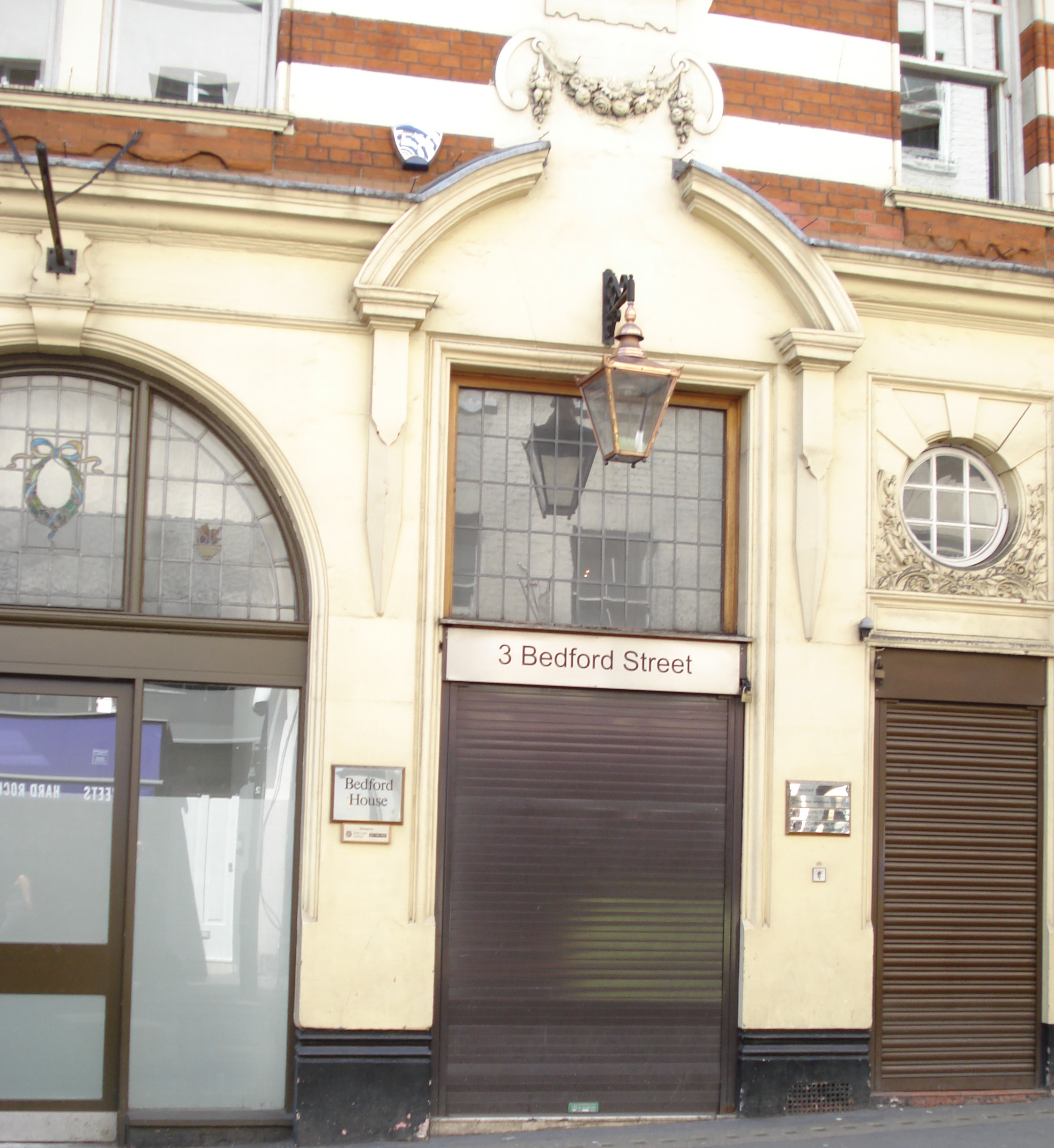
3 Bedford Street, Covent Garden
The venue for this first meeting, 3 Bedford Street, Covent Garden – just a few steps from The Strand – was very familiar to Kate. For on 11 December 1901 she had gone through that door and climbed the stairs to the studio and office near the top of the building where actor/manager Ben Greet ran his Acting Academy. There and then Kate had enrolled as a drama student. The story of her time at the Academy and her subsequent stage career is told in The Great War: The People’s Story – Kate Parry Frye: Edwardian actress and suffragette – which ITV will be publishing as an e-book in August to coincide with their The Great War: The People’s Story series.

Of that first AFL meeting Kate wrote in her diary:
‘Tuesday March 23rd 1909
[Afternoon] went by bus to Bedford Street, Strand – the old Ben Greet Academy Room where we used to rehearse – to the Actresses’ League for Women Franchise meeting. Who should be there but Miss [Ada] Moore, who introduced me to Eva Moore and as she is going to be on our Dance Committee we shall meet again on Monday. She didn’t seem to like me much but I am used to treating all Suffrage women as merely women not little Queens. I had a long talk to Miss Moore who was charming as ever.

Eva Moore with her husband, H.V. Esmond
Kate had known Ada Moore quite well since the late 1890s – and was rather entranced by all the Moore sisters. During her time as a suffrage organizer, she often arranged meetings at which another Moore sister, Mrs Emily Pertwee, was the speaker. Eva Moore had obviously been a little too distant for Kate’s liking when they met on this occasion. She eventually resigned from the AFL after a play written for them by her husband, H.V. Esmond, was deemed too light-hearted for its propaganda purpose.
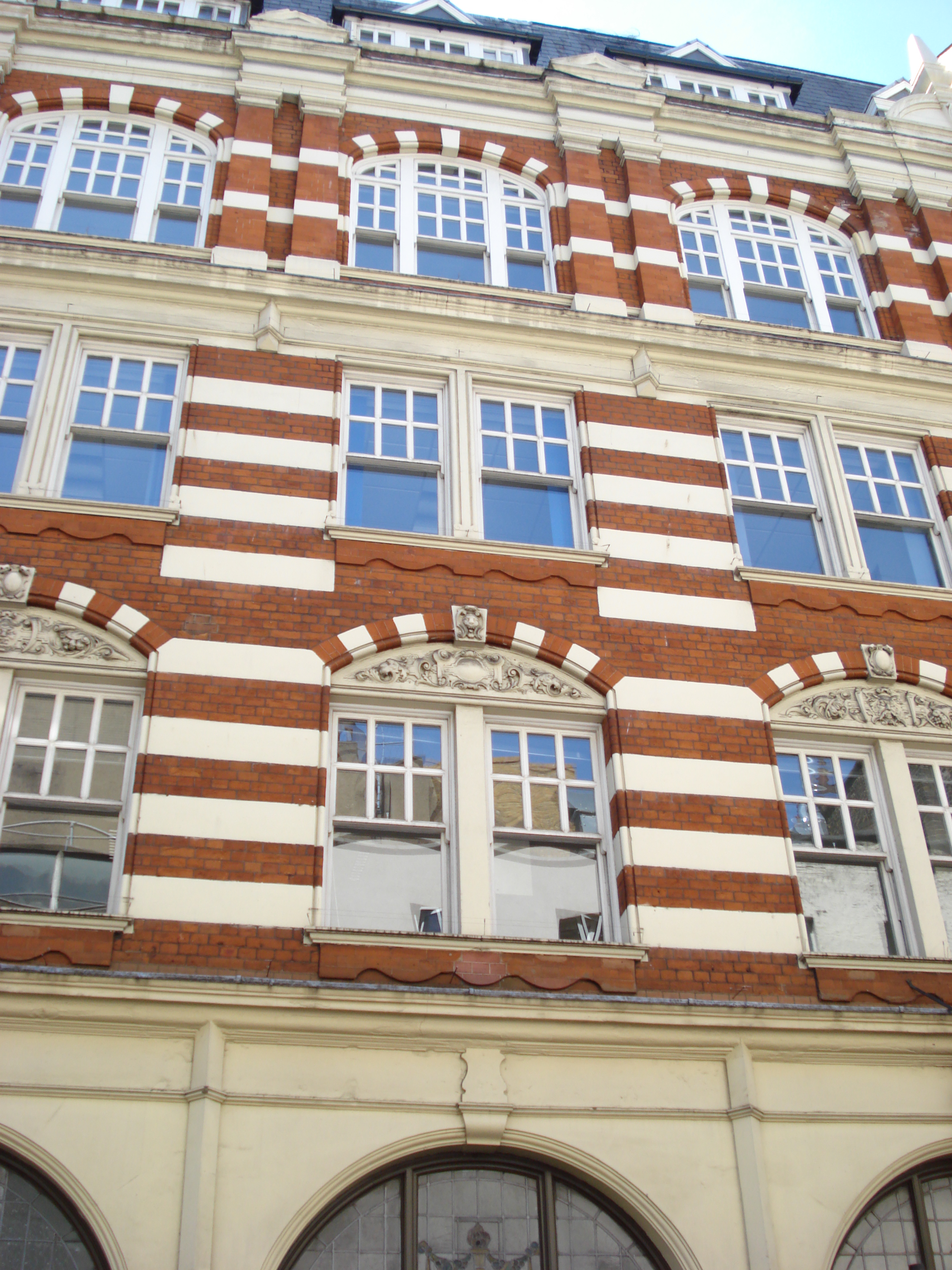
Although the lower half of the building appears to be empty at the moment – and a little sad – it’s not difficult to imagine the tyro actors and actresses – numbering among them Sybil Thorndike – climbing the stairs to the top of the building to be put through their paces by Ben Greet. Or the members of the AFL feeling at home in a building decorated with wreaths and swags.

A month later – in April 1909 – the AFL began to hold their meetings in the Criterion Restaurant. Kate was a regular attender at these meetings, often acted as a steward and faithfully recorded in her diary her impression of the occasions. For more about the AFL at the Criterion see here.
For more about Kate Frye and her involvement in the suffrage campaign see here.
 Woman and her Sphere