Archive for April, 2016
Suffrage Stories: Hidden From History? – Mrs Augustine Watkins
Posted by womanandhersphere in Suffrage Stories on April 13, 2016
On 4 April 2016 I gave a talk in the House of Commons at the Regional Suffrage Conference – one of the activities organised by Vote100 in the lead up to the 100th anniversary of (partial) women’s enfranchisement in 2018. I had been asked to speak on the methods that we can all use to recover something of the lives of hitherto unknown suffrage campaigners – the foot soldiers of the movement. I called the talk ‘Hidden from History?: using genealogical data to recover the lives of suffragettes’.
As a demonstration of what can be done – and the techniques used – I picked at random a few names from those who appeared in the Contributors’ List in Votes for Women, the newspaper published by the Women’s Social and Political Union, in the weeks of 7 and 14 April 1911. Over the next few days I will post their stories.
The first name I discussed was Sybil Campion and the second was Miss Susan Cunnington – who each donated 5 shillings to the Cause. The third was Yevonde Cumbers, who turned out to be less hidden from history than most, and the fourth was ‘Miss S.A. Turle’ whose sister, Caroline, was, I saw, also a generous donor. The fifth and sixth were twins, Florence and Beatrice Sotheran.
The final name that I picked at random from the 7 April issue of Votes for Women was that of Mrs Augustine Watkins who donated £1 2s 6d. Some digging through the late-19thc marriage index and censuses showed that in 1877, as a 22-year-old, she had married a man more than twice her age, (George) Herbert Watkins, a photographer.
Further digging revealed Augustine was Herbert Watkins’ second wife. He had opened a studio in Regent Street in the 1850s and took portraits of celebrities such as Dickens – in fact the National Portrait Gallery holds 260 of his photographs – for details see here. His first marriage had taken place in 1853 and the ever helpful Ancestry Hints threw up the fact that it had ended in divorce in 1877. Thanks to Ancestry I was able to read all the details of how Watkins sued for divorce on the grounds of his wife’s adultery. He and Augustine must have married as soon as the decree nisi was granted.
In 1891 he and Augustine and a young daughter (Florence, born 1879) were living in King Street, Hammersmith.
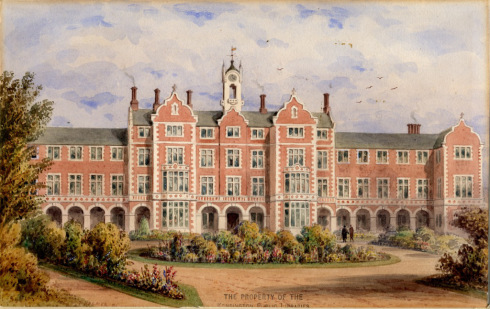
Kensington Workhouse (courtesy RBKC Library)
But to my surprise I found that ten years later Herbert Watkins was an inmate of the Kensington Workhouse – while Augustine with their daughter lived in Rowan Road, a pretty street in Hammersmith. The Workhouse records – very helpfully available on Ancestry – seem to show that Watkins had been an inmate since 1898.
Looking at the record for 1912 his previous occupation was indeed given as ‘photographer’, that by way of ‘Religious Persuasion’ he was a Baptist, and that, tellingly, he was allocated a diet appropriate for ‘Feeble Men’. He was also classed as ‘Aged and Infirm’.
So while the Workhouse authorities were filling out details of Herbert Watkins on their registers, Augustine was making her quite generous donation to the WSPU – and entering herself on the 1911 census as a widow. Of course you can’t necessarily believe everything you read on a census form – her husband is described as ‘married’ on his 1911 census form. Indeed he did not die until 1916, presumably still in the Workhouse, having lived there for about 18 years. What a sad story.
In fact I can see from various websites that Herbert Watkins’ fate has eluded those interested in his photographic career so I hope these few facts about his later life will prove useful in providing information about his sad end. I’ll alert the National Portrait Gallery. And all this comes of wondering who was the Mrs Augustine Watkins who gave £1 2s 6d to the WSPU in April 1911.
Copyright
Suffrage Stories: Hidden From History? – Florence And Beatrice Sotheran
Posted by womanandhersphere in Suffrage Stories on April 12, 2016
On 4 April 2016 I gave a talk in the House of Commons at the Regional Suffrage Conference – one of the activities organised by Vote100 in the lead up to the 100th anniversary of (partial) women’s enfranchisement in 2018. I had been asked to speak on the methods that we can all use to recover something of the lives of hitherto unknown suffrage campaigners – the foot soldiers of the movement. I called the talk ‘Hidden from History?: using genealogical data to recover the lives of suffragettes’.
As a demonstration of what can be done – and the techniques used – I picked at random a few names from those who appeared in the Contributors’ List in Votes for Women, the newspaper published by the Women’s Social and Political Union, in the weeks of 7 and 14 April 1911. Over the next few days I will post their stories.
The first name I discussed was Sybil Campion and the second was Miss Susan Cunnington – who each donated 5 shillings to the Cause. The third was Yevonde Cumbers, who turned out to be less hidden from history than most, and the fourth was ‘Miss S.A. Turle’ whose sister, Caroline, was, I saw, also a generous donor.
Two others, grouped together on the 7 April list, appeared to be sisters – Florence and Beatrice Sotheran. Being a bookseller the name ‘Sotheran’ means something to me – Henry Sotheran’s is a very long-established bookshop in Sackville Street – off Piccadilly. And sure enough when I checked I found they were the twin daughters – at least I assume they were twins as they were both born in 1866 – of Henry Sotheran.
At first I thought that they were missing from the 1911 census – but one does have to check – and I found them in the Welsh census – on holiday in Barmouth. A Google search revealed the fact that both sisters were included on the Suffragette Roll of Honour – a list of suffragette prisoners that was compiled in the 1950s by the Suffragette Fellowship.
Armed with that information I then turned to one of the newer sources of information that is now available on Ancestry – the National Archives file that contains police records of suffragettes arrested.
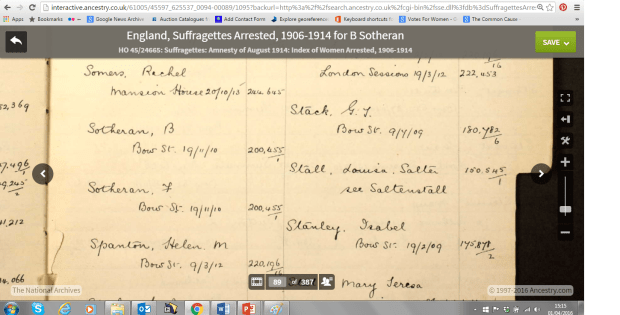
Entry for the Sotheran sisters in the ‘England – Suffragettes Arrested 1906-1914’ (courtesy of The National Archives and Ancestry.co.uk)
I used to study this on my visits to the National Archives and think how wonderfully useful it was. And now it is available to all of us. Well, five months or so before they gave their April 1911 donations both sisters had been arrested and appeared at Bow Street Magistrates Court. The file gives the date – 19 November 1910– so I turned to look at the relevant copy of Votes for Women – and sure enough in the 25 November 1910 issue the WSPU had included brief biographies of all those arrested. That for the Sotherans tells us that ‘they are two constitutional suffragists who have been morally forced to take up militancy through the utter failure of quiet, Law-abiding methods of agitation’.
They had been arrested in the aftermath of Black Friday – when women went en masse to Downing Street. The Aberdeen Journal – found in the Findmypast collection of British Library newspapers – contains a vivid account of the scene and lists Beatrice and Florence Sotheran amongst those arrested.
So here, again, is an insight into the mindset of a couple of WSPU foot-soldiers. They were reasonably well-off, they neither needed to or – apparently – wanted to work for a living (although they may have devoted themselves to ‘good works’), but they were quite prepared to flout the law in pursuit of the parliamentary vote.
Sadly I see that Florence died in September 1918 and would never have had the opportunity to exercise her parliamentary vote. Beatrice, however, lived for another 20 years and would have been able to vote on numerous occasions.
Copyright
Suffrage Stories: Hidden From History? – Miss S.A. Turle
Posted by womanandhersphere in Suffrage Stories on April 11, 2016
On 4 April 2016 I gave a talk in the House of Commons at the Regional Suffrage Conference – one of the activities organised by Vote100 in the lead up to the 100th anniversary of (partial) women’s enfranchisement in 2018. I had been asked to speak on the methods that we can all use to recover something of the lives of hitherto unknown suffrage campaigners – the foot soldiers of the movement. I called the talk ‘Hidden from History?: using genealogical data to recover the lives of suffragettes’.
As a demonstration of what can be done – and the techniques used – I picked at random a few names from those who appeared in the Contributors’ List in Votes for Women, the newspaper published by the Women’s Social and Political Union, in the weeks of 7 and 14 April 1911. Over the next few days I will post their stories.
The first name I discussed was Sybil Campion and the second was Miss Susan Cunnington – who each donated 5 shillings to the Cause. The third was Yevonde Cumbers, who turned out to be less hidden from history than most, and when I put the fourth name, ‘Miss S.A. Turle’, into Google I managed straightaway to identify her as Miss Sophia Adelaide Turle, a literary editor and musician whose personal papers are now at Girton.
The Girton archive listing gives brief background information on Sophia and her family – her father was at one time organist at Westminster Abbey -and mentions that she was a supporter of a range of women’s educational institutions and of the suffrage movement. To quote from the archive listing ‘Miss Turle gave a small donation from her dress allowance to Girton in very early days. Though not rich, she was generous and gave money unasked and without ostentation to women’s causes.’
The Girton archive holds her diaries from 1877 to 1889 and the catalogue specifically mentions that Sophia attended numerous women’s suffrage meetings (both public meetings and smaller committee meetings), made regular payments of subscriptions to the Women’s Suffrage Society, and helped with the getting of names for petitions in favour of the franchise for women’.So here was the woman who is listed in the 7 April 1911 issue of Votes for Women as giving £4 3s 6d to the WSPU.
I then had a look at the 1911 census with no very great expectations of finding anything particularly interesting – Sophia was now 70 years old – and when Jill Liddington and I researched the census we did tend to find it was younger women who protested. But there in the listing was ‘S.A. Turle’ – it’s always a hopeful sign for the researcher of census boycotters to see initials rather than a full name. But there would have been no way of identifying her as a census resister without knowing her name to look up – she is what I called an ‘unknown unknown’
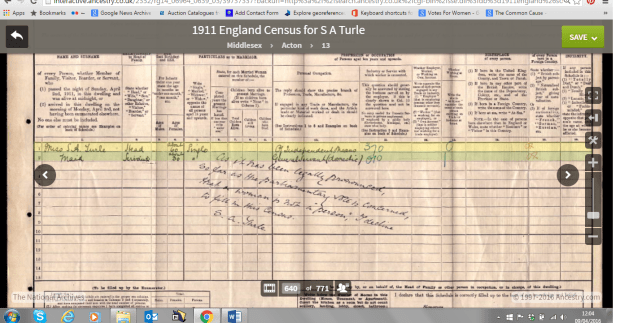
1911 census form for Miss Sophia Adelaide Turle (courtesy of The National Archives and Ancestry.co.uk)
But when I clicked on the form I was gratified to find that she had written across it ‘As it has been legally pronounced, so far as the parliamentary vote is concerned, that a woman is not a ‘person’, I decline to fill in this census’. So here was a woman who had been involved with the suffrage campaign throughout the last quarter of the 19th century and was now taking militant action in the 20th. Details for Sophia Turle and her maid had then been filled in by the enumerator.
In the same week her sister, Caroline, who had moved out of London to Dorset, gave £20 to the WSPU – and £2 the following week. She, too, is missing from the 1911 census – and died just over a month later (for short pieces about her see issues of Votes for Women for 2 and 30 June 1911). So behind those brief listings of donations, chosen at random, lies the story of a lifetime of support for women’s causes.
Copyright
Suffrage Stories: Hidden From History? – Yevonde Cumbers
Posted by womanandhersphere in Suffrage Stories on April 8, 2016
On 4 April 2016 I gave a talk in the House of Commons at the Regional Suffrage Conference – one of the activities organised by Vote100 in the lead up to the 100th anniversary of (partial) women’s enfranchisement in 2018. I had been asked to speak on the methods that we can all use to recover something of the lives of hitherto unknown suffrage campaigners – the foot soldiers of the movement. I called the talk ‘Hidden from History?: using genealogical data to recover the lives of suffragettes’.
As a demonstration of what can be done – and the techniques used – I picked at random a few names from those who appeared in the Contributors’ List in Votes for Women, the newspaper published by the Women’s Social and Political Union, in the weeks of 7 and 14 April 1911. Over the next few days I will post their stories.
The first name I discussed was Sybil Campion and the second was Miss Susan Cunnington – who each donated 5 shillings to the Cause.
The next name on the list that I selected is one of the kind I like to come across – ‘Yevonde Cumbers’ –there can’t have been too many of women of that name around.
I looked for her on the 1911 census – nothing. I then looked on the 1901 census and there she was – born in 1893, living with her parents and younger sister, Verena, in Margate. He father was a manufacturer of printing ink. It’s interesting that she’s missing from the 1911 census. Did she evade? I found her mother and father on the 1911 census – by now they were living in a house with two servants in Bromley. But there is no trace anywhere in the country of Yevonde and Verena. At 18 and 16 they were quite young to be taking part in a census party – but I think we can probably add them to our list of census boycotters.
I discovered that Yevonde Cumbers married in 1920. From the Ancestry website I discovered that when she travelled back from the US after a visit in the mid-1930s the ship’s manifest revealed her occupation as that of ‘press photographer’ – and that is when the penny dropped.
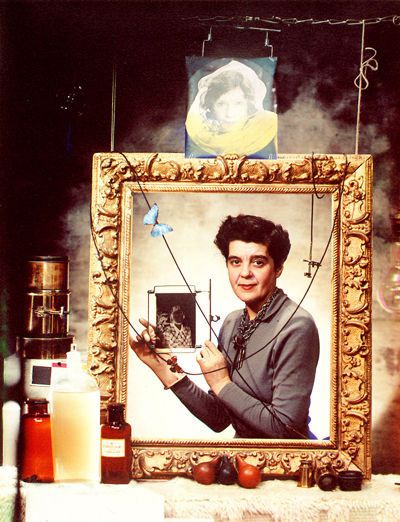
Madame Yevonde – Self Portrait with image of Hecate
I realised that she was none other than the one and only ‘Madame Yevonde’ – a starry portrait photographer whose autobiography, In Camera, published by the Woman’s Book Club in 1940, I once sold. I don’t know why I didn’t think of her as soon as I saw her name – but ‘Yevonde Cumbers’ really didn’t ring any bells.
Well ‘Madame Yevonde’ most certainly is not ‘hidden from history’ – here is a website all about her and her work. Sure enough it stresses that in her teens ‘Madame Yevonde’ had ‘discovered the suffragette movement and had devoted her efforts to the cause’. The article mentions that she was very strong and determined and was only 21 when she opened her own photographic studio.
The 1939 Register finds Yevonde Middleton, as she now is, in Frobisher House, Dolphin Square, a widow – and a ‘Portrait Photographer’. There are masses of references to Yevonde in the Findmypast newspaper search facility.
But here in the 7 April 1911 issue of Votes for Women we have young Yevonde Cumbers – freeze-framed, as it were – handing over money she had collected – 4s 9d – to the WSPU. She didn’t yet know how famous she would become, but she did know that ‘Votes for Women’ was in her interest.
Copyright
Suffrage Stories: Hidden From History? Sybil Campion
Posted by womanandhersphere in Suffrage Stories on April 5, 2016
Yesterday (4 April 2016) in the House of Commons I gave a talk at the Regional Suffrage Conference – one of the activities organised by Vote100 in the lead up to the 100th anniversary of (partial) women’s enfranchisement in 2018. I had been asked to speak on the methods that we can all use to recover something of the lives of hitherto unknown suffrage campaigners – the foot soldiers of the movement. I called the talk ‘Hidden from History?: using genealogical data to recover the lives of suffragettes’.
As a demonstration of what can be done – and the techniques used – I picked at random a few names from those who appeared in the Contributors’ List in Votes for Women, the newspaper published by the Women’s Social and Political Union, in the weeks of 7 and 14 April 1911. Over the next few days I will post their stories.
Here is the first:
In the issue of 14 April 1911 the list is headed by Elizabeth Garrett Anderson who gave £200. Well I don’t think we need to find out more about her – and there are many other names in the lists that will also be familiar to suffrage historians – many of them with entries in my Reference Guide. But what about the next on the list after Mrs Garrett Anderson. Who was Miss Sybil Campion who gave 5 shillings?
Looking at the 1911 census on the Ancestry.com website there is a young woman of that name who fits the bill. She is a shorthand typist who works for a metal merchant and is living in what was described as a Ladies Residential Club – Hopkinson House – in Vauxhall Bridge Road.
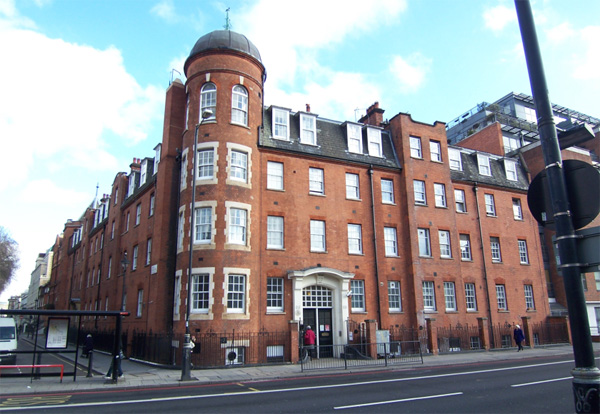
Hopkinson House – as it is today, little changed since 1911.
She was one of 96 boarders – parish workers, secretaries, students, photographers, teachers – mostly, but not all, in their twenties. What was Sybil’s background? I easily found her – thanks to the Ancestry Hints – on the 1891 and 1901 censuses. In both cases she was living with her mother and Caroline, her slightly older sister – but there was no trace of a father. Her mother is enumerated as married and living on private means. On the first occasion, that is in 1891, when Sybil was under 1 year old and her mother was 42, they were living in Belmont Street, Bognor Regis. Another search showed that Sybil had been born at nearby Felpham between April and June 1890. By 1901 mother and daughters were living in Hastings.
But I then took a look back at the mother – Eva Campion’s 1881 census form showed that far from being a relatively elderly mother of only two daughters – she was in fact the wife of an ex- army officer who was now an indigo planter – and by 1881 she already had two young sons.
After I had completed my initial Ancestry and Findmypast searching on the family I then put Sybil Campion’s name into Google and was directed to an Ancestry members’ board thread where a query had been made about the family. And this revealed that Sybil’s father was Thomas Arthur Campion, superintendent of a plantation in ‘east India’ – I think we can take that as meaning ‘the East Indies’. In fact I then substantiated this by accessing yet another Genealogical site – ‘Family Search’ run by the Mormons – the Latter Day Saints. Access to this is free, but it offers more limited sources of information. However it was here that I found the record of Sybil Campion’s christening at Felpham on 20 May 1890. This gives her full name – Sybil Constance Burney Campion – and the full names of both her parents – Thomas Arthur Campion and Evelina Ross Campion.
Noting that her mother’s name was ‘Evelina’ I momentarily mused about the inclusion of ‘Burney’ in Sybil’s name. Could there be a family connection to Fanny Burney, author of Evelina? Well, I did quickly establish that her mother had been born Evelina Ross Burney in 1848 and that her mother’s married name was Frances Burney – though let me stress that was her married name. Evelina’s father was a major in an East Indies regiment and she had clearly followed him out east – for in 1867 – aged 18 – she had married William Henry Adley at Barrackpore in Bengal. Back in England the following year she had given birth to a son and buried him a few days later. And then 3 years later in India she and Adley had had a daughter, Lilian Maud.
And now the story gets rather murky. For there is no doubt that this Evelina is the same Evelina who ten years later was living in Bognor with two young Campion sons. She had probably not been divorced from Adley, who, in his turn, when he appeared in the 1891 Welsh census as retired surgeon-general of the India army, described himself as a widower – although as we know Eva was very much still alive. Living with him then was 20-year-old Lilian. Had Evelina left her husband to live with Thomas Campion, and produce 4 further children, including Sybil? Had she lost contact with her first-born daughter?
Following up Thomas Arthur Campion in the Findmypast newspaper archive, I discovered that he had retired from the Army – the 5th Foot Regiment – as a lieutenant in 1876 and resigned his commission as a reserve officer in 1885. There is a suggestion that as a young lieutenant his role had been that of interpreter. An entry for ‘Sybil Campion’ in the same newspaper search engine yielded the fact that a girl of that name – and it must have been our Sybil Campion – was a pupil at Kenilworth College, a girls’ school in Hastings, passing the Preparatory class of the Royal Drawing Society in 1900 and taking part in a ‘pretty tambourine dance’ during a conversazione in 1902. Her sister, whom I can see was known as ‘Carrie’, is also mentioned as a pupil at the school. At this time the 1901 census shows that Sybil, her mother and sister lived in ‘Stewart Lodge’, Baldslow Road in Hastings. In 1901 all the houses in the road had names and not numbers and unfortunately house names such as this have now vanished from usage and without a good deal of local searching it is difficult to identify exactly which house ‘Stewart Lodge’ was in a long road of large houses – even if it is still standing – –Street View shows me that there has been some redevelopment. The Campions shared the house with the family of an artist – named Herbert Sparks..but I’ll resist getting sucked into his family’s rather interesting-looking history.
Another quick search showed that Evelina Campion, described as the wife of Thomas Campion, died in Bournemouth in 1908. However probate was not given to her husband but to one of her own relatives, Charles Burney. Her estate amounted to a rather pathetic £41.
But where was her putative husband – Thomas Arthur Campion? Following all leads, a Google search led me to another Ancestry forum members’ thread that suggested that the younger son, George, might have emigrated to Canada. So I turned to Ancestry’s selection of Canadian records and there in those of Canadian soldiers of the First World War I discovered the answer to Thomas Arthur’s whereabouts. For when he joined up in 1916 George gave his father’s address as ‘Rose Bay, New South Wales, Australia’. A quick jump to Ancestry’s Australian records found the death of a Thomas A. Campion in Sydney in 1914. Rose Bay is a suburb of Sydney – is this the correct Thomas A Campion? In 1916 did George not know of his father’s death two years earlier? It seems to me quite probable – but obviously more hard evidence would be required.
The army records afford a good deal of information – for instance, in answering a question about previous military experience George cited membership of the Hurstpierpoint Cadet Corps. I knew of Hurstpierpoint College in Sussex, but interested in further details I read online that it had moved to its present site in 1853 thanks to its local benefactors – the Campion family. What is one to make of that? I see that the East Sussex Archives hold Campion family papers – mentioning connections to army service in India in the 19th century. More paths to follow? Well – not at the moment. Incidentally, on the army form George described himself as a farm labourer – not exactly the rank in society that might have been expected of one who had been educated at Hurstpierpoint. A little more Ancestry searching led me to discover that Arthur, the elder of the Campions’ sons had joined a Royal Navy Training ship when he was a teenager.
So I had now uncovered something of Sybil’s apparently rather unstable background. I had discovered where she had lived and where she was educated, and had established that by the age of 18 she was to all intents and purposes a penniless orphan. It was time now to forge on into her adult life.
Well, I couldn’t find any obvious death date or will for her but I did see that when her sister, Caroline, died in 1965 her birth date on the death register was given as 1885 rather than the correct date of 1889, which suggested to me that when she died she was not in the company of anybody who knew her full details. She didn’t leave a will.
Giving up on a death date for Sybil I looked at the London electoral register and I saw that between 1922 and 1925 she was living in shared premises at 18 Endsleigh Terrace – just off the Euston Road. There are more entries for ‘Sybil Campions’ on the local London electoral register but one has to beware of red herrings – a Sybil Campion who pops up in the late 1940s in Wandsworth is living with a James Campion, ie they are likely to be a married couple and not our Sybil. I had, of course checked Ancestry’s marriage records – but there was no evidence that our Sybil had married. I then looked at the 1939 Register on Findmypast but there was no trace of her there. I must explain that the 1939 Register is just that – a register taken in 1939 at the outbreak of the Second World War. It is useful in giving the most basic data – such as an address – and also does give an exact date of birth and an occupation. However, for women – particularly women involved in the suffrage campaign who by 1939 were necessarily no longer young –this ‘occupation’ designation can be rather opaque – ‘Unpaid Household Duties’ being the most common. But occasionally the subject will be a little more forthcoming and allow themselves to be enumerated as ‘Artist’ or ‘Headmistress (Retired).
Anyway back to Sybil Campion. I then checked the Ancestry Travel files and lo and behold there she was – on 6 May 1927 Miss Sybil C. Burney Campion had embarked from Southampton to Auckland, New Zealand, sailing on the ‘Remuera’. She was 37 years old and gave her occupation as ‘Household Duties’. The address she left behind didn’t give much away either – just care of the National Provincial Bank in London’s Victoria Street. And there we must take leave of her – I can’t find her death in New Zealand – probably because the available records only go up to 1964 and she may have been as long lived as her sister.
From all this we can get something of a picture of that young woman who sent off her 5 shillings to the WSPU in April 1911. She came from a family where the father was mostly absent – indeed where her parents may not have been formally married – where her two considerably older brothers from an early age made their own way in the world, where her mother coped alone with bringing up her two daughters, living in towns along the south coast of England. Did Sybil know of the existence of her half-sister, Lilian – who, incidentally, married the professor of civil engineering at Birmingham University. Sybil probably did not stay at her genteel girls’ day school past 16, then trained as a typist and found work in a London office, living for a time in a hostel and then in a series of shared flats.
She didn’t have an opportunity of boycotting the 1911 census –even if she had intended to – because the form for the hostel was filled in by the superintendent and not by the individual boarders. But now that we see the forces that shaped her life it was little wonder that she was a WSPU supporter. The 5 shillings she gave was likely to have been the equivalent of a day’s pay – working on the basis that a clerical wage was about £2 a week (for instance, that was the amount that suffrage organizers were paid). She could see that she would have to fend for herself through life. She could have had little faith in relying on men for support. In her late-30s Sybil shook the dust of old England off her feet and set sail for a new adventure – as had many of her ancestors. I wonder what became of her?
Copyright
 Woman and her Sphere